
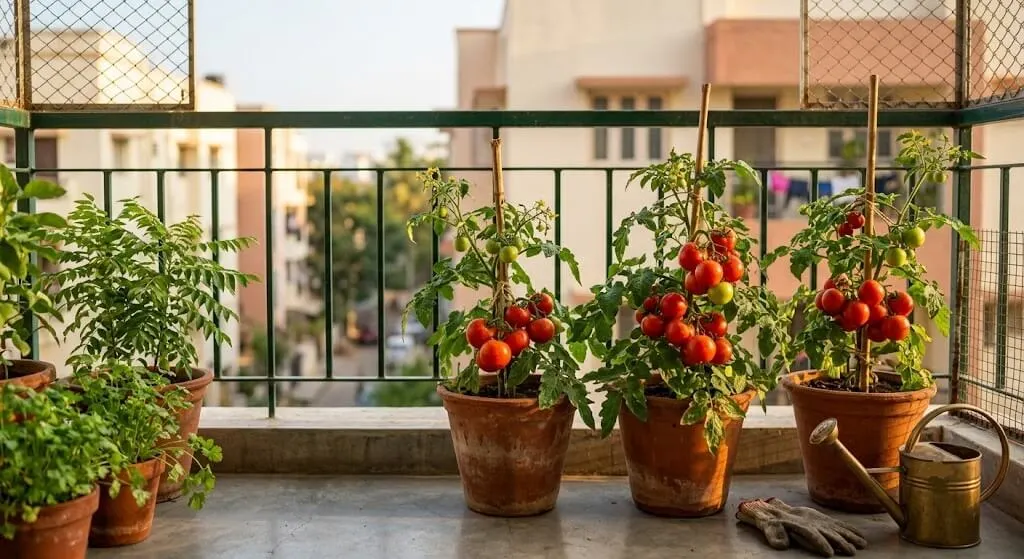
By Priya Harini B | Madanapalle, Andhra Pradesh | 4+ Years Container Gardening Experience
Quick Answer: Tomatoes need a minimum 12–14 inch container, 6+ hours of direct sun, and soil pH between 6.2–6.8. In most of India, the best sowing window is October–November (cool season) or February–March, avoiding peak summer heat above 38°C, which sterilises pollen. The single biggest cause of failure on Indian balconies is heat stress at flowering, not poor soil.
Introduction
If you’ve typed “How to Grow Tomatoes on Indian Balcony” into Google because your last attempt produced three sad, stunted plants and maybe two tomatoes total, you’re not alone, and you didn’t do anything unusually wrong. Most tomato-growing advice online is written for temperate climates where “full sun” doesn’t mean 44°C at pot level, and where “spring planting” doesn’t collide with a six-week heatwave. Grown correctly for Indian conditions, container tomatoes are genuinely productive I’ve harvested well over 70kg total from container crops on my own Madanapalle terrace across multiple seasons, tomatoes among the most consistent producers, once I stopped following advice written for London gardens.
What Growing Tomatoes in Containers Actually Requires The Science
A container tomato plant is working with a fraction of the root volume a ground-planted tomato has, which means three things matter far more than they do in open soil: drainage speed, root-zone temperature, and consistent moisture. In the ground, roots can chase water and cooler soil layers several feet down. In a 12-inch pot on a south-facing Indian balcony, the entire root system sits within the top 30cm of soil, exposed to whatever temperature that pot’s material and position create.
This is why the same “tomato care” article that works fine for a gardener in the UK produces failure after failure in Chennai or Delhi. A black plastic container in direct April sun in Madanapalle can reach a root-zone temperature of 46–52°C well past the point where tomato pollen becomes sterile (approximately 38°C) and root function begins to suffer. Indian container tomato growing is less about “does the plant get sun” and more about “does the root zone stay in a survivable temperature and moisture range.”
Can you grow tomatoes in pots in India? Yes, tomatoes are one of the most reliable container crops for Indian balconies when container size, sowing timing, and heat management are matched to local conditions rather than generic gardening advice.
The Core Factors That Determine Success Not Just “Sun and Water”
Container Size and Material
A tomato plant needs a minimum of 12 inches in diameter and depth for a determinate (bush) variety, and 14–16 inches for an indeterminate (vining) variety that will keep growing all season. Undersized containers are the single most common beginner mistake a tomato in an 8-inch pot will survive for a few weeks and then stall permanently, because the root system hits the container wall and has nowhere left to grow.
Material matters more in India than most guides admit. Black plastic containers absorb radiant heat and can run 10–16°C hotter at the root zone than terracotta or a fabric grow bag in the same position. In Delhi, Mumbai, or Chennai summer conditions, this difference is the gap between a plant that sets fruit and one that doesn’t.
Sunlight Six Hours Is a Floor, Not a Target
Tomatoes need a minimum of 6 hours of direct sun to fruit reliably. On most Indian balconies this isn’t the limiting factor too much unmanaged afternoon sun in April–June often is. The goal by peak summer isn’t maximising sun exposure; it’s protecting the plant from the specific hours (roughly 11 AM–4 PM in most cities from April onward) when ambient temperature crosses the threshold where pollen viability collapses.
Soil pH and Drainage
Tomatoes want a soil pH of 6.2–6.8. Most Indian municipal tap water is alkaline (pH 7.2–8.2 depending on city), and repeated watering with alkaline water drifts container soil pH upward over a season, eventually locking out iron and causing the pale, yellowing new growth many gardeners misdiagnose as a nutrient deficiency requiring more fertiliser when what it actually needs is a pH correction.
Wrong Assumptions Readers Commonly Make
Wrong assumption 1: “More sun is always better.” In April–June in most Indian cities, unmanaged afternoon sun on a south or west-facing balcony pushes pot temperatures well past the point where pollen becomes sterile. The plant can look completely healthy and still produce zero fruit, because the flowers are opening into unviable pollen conditions.
Wrong assumption 2: “Yellow leaves mean it needs more fertiliser.” This is very often pH lockout, not a nutrient shortage adding more fertiliser into alkaline, lockout soil makes the problem worse, not better, because the nutrients are already present but chemically unavailable to the roots.
Wrong assumption 3: “Any large pot will do.” Container material changes root-zone temperature by 10°C or more between black plastic and terracotta in the same sun exposure. The pot isn’t just a container it’s an active part of the plant’s thermal environment.
Which Container and Setup Actually Fits Your Balcony
Before sowing anything, decide between a determinate (bush) or indeterminate (vining) variety, since this changes your container requirement and support needs.
| Factor | Determinate (Bush) | Indeterminate (Vining) |
|---|---|---|
| Container size | 12-inch minimum | 14–16 inch minimum |
| Support needed | Light staking | Full cage or trellis, 4–5 ft |
| Growth pattern | Stops at set height, fruits in a flush | Keeps growing and fruiting until removed |
| Best for | Small balconies, single harvest window | Larger terraces, continuous harvest |
| Indian variety example | Pusa Ruby | Arka Rakshak (hybrid, disease-resistant) |
Confirmatory check before sowing: test your intended growing spot with a simple sun-hours count over one full day mark the time direct sun first hits the spot and when it leaves. Under 6 hours total, tomatoes are not the right crop for that position; consider chillies or leafy greens instead, which tolerate partial shade far better.
Container Types Compared Pots, Grow Bags, and Raised Beds
The container itself changes root-zone temperature, drainage speed, and how often you’ll need to water often more than the potting mix does. Here’s how the common options actually compare for Indian balcony tomato growing.
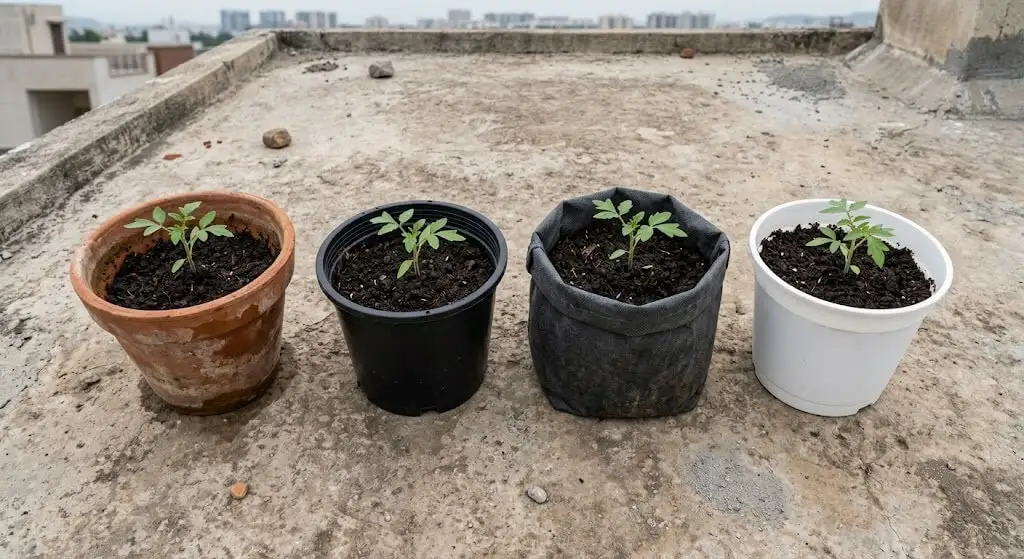
| Container Type | Typical Size Range | Drainage | Root-Zone Heat Behaviour | Cost Range (₹) | Lifespan | Best For |
|---|---|---|---|---|---|---|
| Terracotta pot | 12–16 inch | Good, porous walls aid evaporation | Coolest option 10–16°C cooler than black plastic in same sun | 150–400 | 3–5+ years, can crack in extreme heat/cold cycles | South/west-facing balconies, peak summer growing |
| Black plastic pot | 12–16 inch | Fair, depends on drainage holes | Hottest option absorbs and retains radiant heat | 60–150 | 2–4 years, degrades in UV over time | Shaded or east-facing spots only; avoid in direct summer sun |
| White/light plastic pot | 12–16 inch | Fair | Noticeably cooler than black plastic, still warmer than terracotta | 80–180 | 2–4 years | A budget middle-ground if terracotta isn’t available |
| Fabric grow bag | 12–20 litre | Excellent breathable fabric walls | Cool, similar to terracotta; loses moisture faster in extreme heat | 70–150 | 1–3 seasons, fabric degrades over time | Best drainage of any option; needs more frequent watering |
| Raised bed / large drum (20+ litre) | 20–40+ litre | Good if properly drilled | Moderate large soil volume buffers temperature swings | 300–800 (drum) or built cost | 5+ years | Indeterminate varieties, terraces with more space, highest total yield potential |
| Self-watering container | 12–16 inch equivalent | Built-in reservoir, controlled | Moderate | 400–900 | 3–5 years | Gardeners who can’t water daily; less ideal in monsoon (risk of overfilled reservoir) |
How to choose: if your balcony gets strong afternoon sun, terracotta or a fabric grow bag will keep root temperature meaningfully lower than any plastic option this alone can be the difference between fruit set and flower drop in April–June. If your space is shaded or east-facing only, the heat difference matters less, and a budget plastic pot is a reasonable choice. Fabric grow bags are the best drainage option available but will need watering roughly once a day more often than terracotta in peak summer, since the breathable walls that prevent waterlogging also lose moisture faster.
A note on self-watering containers: they’re genuinely useful for gardeners who travel or can’t water daily, but during monsoon months the built-in reservoir can work against you if rain keeps topping up the reservoir faster than the plant uses it, you can end up with the same waterlogging risk a self-watering system is meant to prevent. Empty or bypass the reservoir feature during the heaviest monsoon weeks.
Step-by-Step: Seed to Harvest
Growing a tomato plant isn’t one task, it’s seven distinct stages, each with its own risks and its own checkpoint. Most guides collapse this into “sow, water, wait” here’s what actually happens at each stage on an Indian balcony, and what to watch for.
What you need across the full cycle:
| Item | Purpose | Approx. Cost (₹) |
|---|---|---|
| Tomato seeds (Pusa Ruby or similar) | Sowing | 25–40 per packet |
| Seed tray or small cups | Germination | 40–80 |
| Cocopeat (compressed block) | Germination medium | 50–70 |
| 12–14 inch container (terracotta preferred) | Final growing container | 150–300 |
| Vermicompost | Soil amendment | 25–45 per kg |
| Coarse sand or perlite | Drainage | 30–50 |
| Digital pH meter | Soil monitoring | 300–500 |
| Bamboo stake or small cage | Support | 40–150 |
Stage 1: Starting Seeds (Days 1–10)
Seed sourcing. Government seed shops (IARI or your state agriculture department outlet) sell open-pollinated varieties like Pusa Ruby at a fraction of nursery prices, and unlike F1 hybrids, you can save seed from your own harvest for next season at zero cost. (For general seed-sourcing guidance, including where to find reliable government and kirana-store options, see Where to Buy Winter Vegetable Seeds in India.)
Sowing method. A seed tray gives you more control than direct sowing into the final container you can keep the germination medium consistently moist in one small space, and you’re not risking your one good 14-inch pot on a seed that might not germinate. Sow at approximately 0.5cm depth, one seed per cell, with cells spaced enough that seedlings won’t crowd each other before transplant.
Germination conditions. Tomato seeds germinate best between 20–30°C. Keep the tray in bright, indirect light not harsh direct sun yet and maintain consistent moisture without waterlogging the cocopeat. Expect germination in 5–10 days under normal conditions; below 18°C or above 35°C, germination slows significantly or can fail entirely.
What to watch for. Leggy, pale, stretched-out seedlings mean insufficient light move the tray somewhere brighter immediately, since a leggy seedling rarely recovers its strength even after the light improves. Damping off seedlings collapsing at the soil line, usually within days of looking fine is caused by overwatering combined with poor airflow; if you see it, reduce watering frequency and increase ventilation around the tray immediately.
Stage 2: Seedling Care (Days 10–25)
Hardening off. This is the gradual process of exposing a seedling to outdoor conditions before it faces full balcony sun permanently, and it matters more in India than in most gardening advice written for milder climates the jump from a sheltered indoor spot to a 35°C balcony in direct sun can shock or kill an unhardened seedling within a single afternoon. Start with 30 minutes of direct outdoor light, and increase the duration gradually over 5–7 days until the seedling is tolerating a full day outside.
When seedlings are ready to transplant. Height alone isn’t a reliable marker — look for 4–6 true leaves (the leaves that emerge after the initial two seed leaves, with the characteristic serrated tomato-leaf shape). This typically lines up with around day 20–25 from sowing.
Stage 3: Transplanting Into the Final Container (Day ~25)
Container prep. Use the Container Size Calculator to confirm your pot is genuinely large enough for the variety you’re growing, and the Potting Mix Calculator to get your cocopeat-vermicompost-sand ratio right before you fill the pot getting this right once at transplant saves a mid-season repot later.
Transplant technique. Bury the stem slightly deeper than it sat in the seed tray tomatoes are one of the few plants that root along a buried stem, so this small adjustment produces a noticeably stronger root system than transplanting at the same depth it was growing at before. Water in thoroughly immediately after transplanting, then hold off on any fertiliser for the first 5–7 days to let the roots establish without added salt stress.
Initial placement. Position the container where it will get your target 6+ hours of sun, but if your balcony is genuinely exposed to strong wind (common above the 8th–10th floor in most Indian cities), give the freshly transplanted seedling some wind protection for the first week or two a newly transplanted root system hasn’t anchored itself yet, and wind stress on top of transplant stress can set the plant back significantly.
DO NOT:
- Transplant during the hottest part of the day do it in early morning or evening.
- Fertilise immediately after transplanting wait at least 5–7 days.
- Skip the hardening-off period, even if you’re in a hurry an unhardened seedling can collapse within a day of full sun exposure.
Total cost, seed to transplant-ready: approximately ₹350–₹550, most of which (container, pH meter) is a one-time cost reusable across seasons.
Stage 4: Vegetative Growth (Weeks 4–8)
Watering schedule. Water in the early morning, ideally by 6–7 AM, rather than in the evening — this timing aligns with how the plant actually uses water through the day and avoids the overnight humidity/edema risk that evening watering can create in humid cities. (Full seasonal watering-time guidance is in your existing seasonal transition content.)
Staking or support setup. Balcony tomatoes, even determinate varieties, almost always benefit from support once they start setting fruit the weight of ripening tomatoes can snap an unsupported stem. Install a stake or small cage at transplant time, not later, since driving a stake into an established root system risks damaging roots you can’t see.
First fertilising. Begin roughly 2–3 weeks after transplant, once the plant has visibly resumed active growth. (For a low-cost organic option, see your Homemade Garden Fertilizer article.)
Pruning suckers. Suckers are the small shoots that emerge in the joint between the main stem and a branch. For indeterminate (vining) varieties, removing them redirects the plant’s energy toward fruit rather than extra foliage, and keeps growth more manageable in a container. This confuses almost every first-time grower if you’re not sure whether something is a sucker or a new main branch, suckers always emerge from that specific stem-branch joint, never from the tip of an existing branch.
Stage 5: Flowering and Fruit Set (Weeks 8–12)
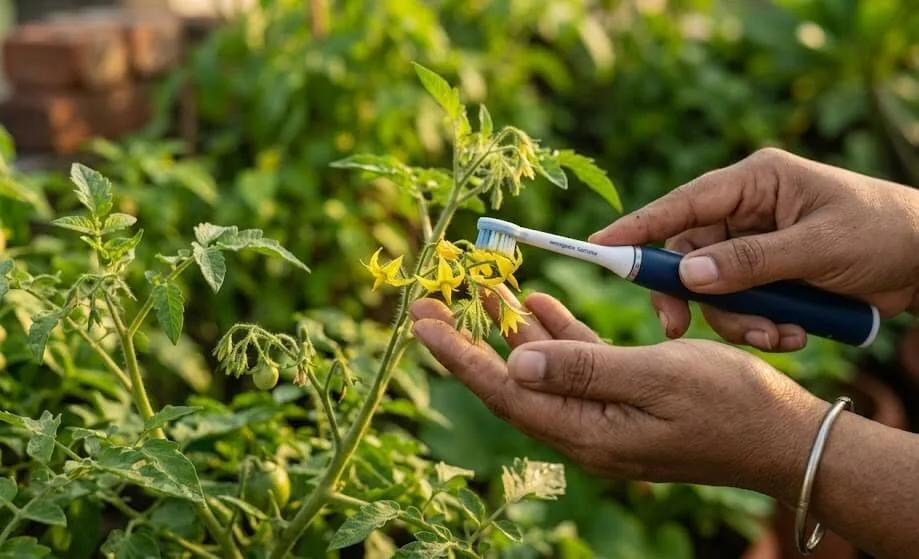
Why flowers drop without fruiting. This is one of the most-searched tomato problems specifically for balcony growers, and it’s a genuinely different issue than open-ground growers face a balcony has no wind and no bees to move pollen between flowers the way an open garden does. The fix is hand-pollination: gently shake the flower cluster, or hold a small electric toothbrush against the stem for 2–3 seconds to vibrate pollen loose, done in the early morning before temperatures climb (see the pollen-viability window covered earlier in this guide).
Fertilising shift. Once flowering begins, switch from a balanced or nitrogen-heavy feed to one weighted toward phosphorus and potassium (higher P/K) nitrogen-heavy feeding at this stage pushes more leafy growth at the expense of fruit set.
Watering consistency. This is the stage where irregular watering does the most damage swinging between very dry and very wet soil disrupts calcium uptake and is the leading cause of blossom end rot, not a calcium shortage in the soil itself. Keep watering as consistent as possible through flowering and early fruit development.
Stage 6: Ripening and Harvest (Weeks 12+)
Harvest signs. Look for a shift from green to the variety’s mature colour (typically red, though some varieties ripen orange or yellow), combined with a very slight give when the fruit is gently squeezed firm but not hard.
Harvest technique. Twist gently or use scissors/pruning shears to cut the stem just above the fruit, rather than pulling pulling risks tearing the stem and damaging the branch, which can affect the fruits still developing nearby.
Succession and continued production. A healthy, well-managed plant can keep producing for several months, particularly indeterminate varieties. Once production drops off significantly and the plant is putting more energy into surviving than fruiting (commonly as it heads into peak summer heat), it’s usually more productive to remove it and prepare the container for the next crop than to keep nursing a declining plant.
Stage 7: Post-Harvest
Storage. Ripe tomatoes are best kept on the counter, not the fridge cold temperatures below around 12°C halt the enzyme activity responsible for flavour development, and this doesn’t reverse once the tomato warms back up. If a tomato is picked slightly underripe, it will continue ripening at room temperature over the following days.
Saving seeds for next season. If you grew an open-pollinated variety like Pusa Ruby (not an F1 hybrid), you can save seed from your best fruit at zero cost for next season. Scoop seeds from a fully ripe tomato, rinse off the surrounding pulp, dry them completely on a paper towel for about a week, and store in a labelled envelope somewhere cool and dry. This is a small step, but it’s the same principle that runs through this whole guide a little attention at the right moment saves real money and effort later.
The Four Mistakes That Cost Indian Gardeners Their Tomato Harvest
Mistake 1: Watering on a fixed schedule instead of checking soil moisture. Many gardeners water every single day regardless of conditions, because that’s the general advice. In cooler weeks this overwaters and can contribute to root problems; in peak summer, once a day may be genuinely insufficient.
The fix: check soil moisture at 2–3cm depth before watering water when it’s dry at that depth, not on a fixed calendar. Cost: ₹0, just a habit change.
Mistake 2: Ignoring pollen viability windows in summer. Hand-pollination attempted at 11 AM in May, when ambient temperature is already past 38°C, wastes the effort the pollen is no longer viable at that point.
The fix: hand-pollinate (a gentle shake of the flower cluster, or an electric toothbrush held against the stem for 2-3 seconds) in the early morning, before 9 AM in hot months. Cost: ₹0–150 for a basic electric toothbrush if you don’t already own one.
Mistake 3: Fertilising into alkaline, pH-locked soil. Adding more NPK fertiliser when new growth is pale and yellow, assuming it’s a nutrient deficiency, when the real problem is pH above 7.2 locking out the iron that’s already present in the soil.
The fix: test pH before adding fertiliser. If above 7.0, correct with a mix of 5g ferrous sulphate + 2g citric acid per litre of water before fertilising. Cost: ₹80–120 for a bag of ferrous sulphate that lasts a full season.
Mistake 4 (Priya’s own): In my second growing season, I fertilised two struggling tomato plants heavily for nearly three weeks, convinced they were nutrient-deficient because the new leaves were pale. They kept getting worse. It wasn’t until I finally tested the soil something I hadn’t bothered to do because the plants “looked like” a feeding problem that I found the pH had drifted to 7.6. I had been feeding plants that couldn’t absorb what I was giving them, and adding salt load on top of an already stressed root system. Once I corrected pH instead of adding more fertiliser, new growth came back green within about two weeks.
The lesson that changed how I garden since: test before you treat, every time visual symptoms alone are not a diagnosis.
My Own Tomato Failure The June 2023 Heat Wave
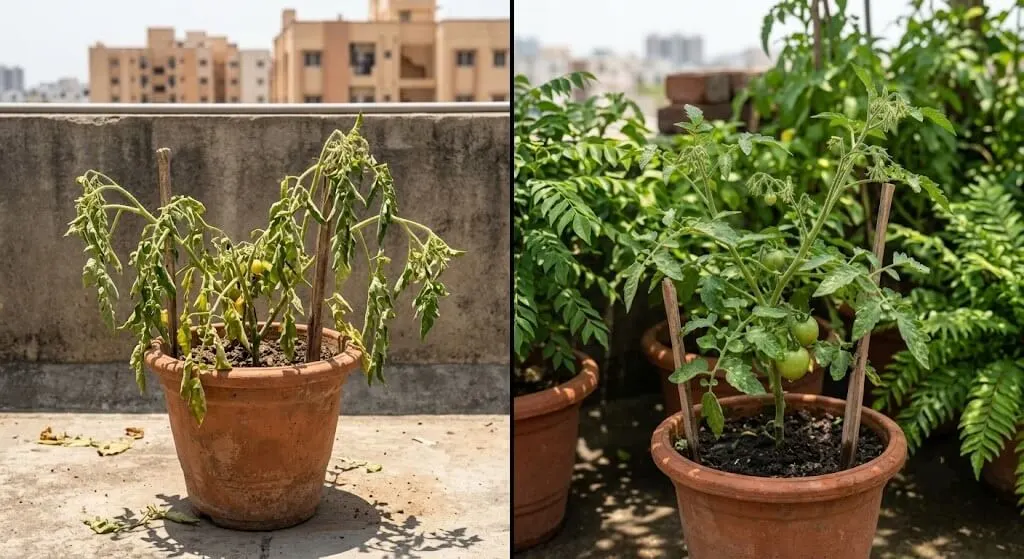
In the first week of June 2023, Madanapalle experienced four consecutive days above 44°C. I had fourteen active containers on my terrace at the time, including five tomato plants three Pusa Ruby in a more protected position, and two in a spot that turned out to be far more exposed than I’d accounted for.
On the first day of the heatwave, I did everything I thought I should: checked pH (correct), checked drainage (fine), watered all containers to capacity before the heat built. By 2 PM, two of my five tomato plants were visibly wilting despite having been watered that morning. I checked the soil still moist at 5cm. I measured soil temperature in those two containers: 38°C. The other three, in a more protected position against a wall, were at 33°C. The two wilting plants weren’t short of water. They were, in effect, cooking from the root zone up.
Over the next three days I tried wrapping the containers in wet jute cloth and grouping them for shade, which helped but didn’t fully solve it. By day four, I made the decision I’d been avoiding I harvested every fruit on those two plants that had reached at least 60% maturity, rather than risk losing it entirely to sunscald or internal damage from the sustained heat. Eleven tomatoes came off those plants that day. Seven ripened successfully indoors over the following days; four developed soft rot from damage they’d already sustained on the plant.
The two heat-affected plants produced 2.1kg for the month. The three in the more protected position produced 4.8kg over the same period more than double, from the same variety, sown the same week, on the same terrace. The only difference was container position and the resulting root-zone temperature.
What this taught me, and what I do differently now: the decision to harvest early during extreme heat isn’t a loss it’s a choice between an 80%-quality harvest and a 0%-quality one. I now check soil temperature, not just soil moisture, on any day forecast above 42°C, and I’ve permanently moved my most heat-sensitive containers out of the exposed position that caused this.
(Full account of that week, including the complete emergency heat protocol I now use, is in the Peak Summer Container Garden Survival Guide.)
Original Data Container Position and Tomato Yield, Madanapalle 2023
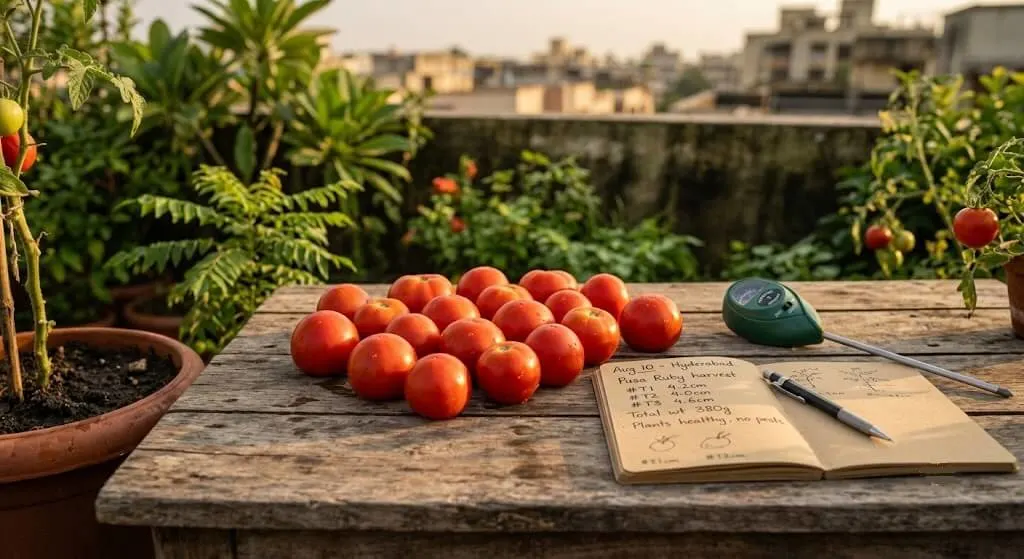
The following is drawn from my own documented June–July 2023 records, comparing Pusa Ruby tomato containers in different positions on the same terrace.
| Container | Position | June 1 Condition | Heat Wave Response (June 5–8) | Month Total Harvest |
|---|---|---|---|---|
| T1 (14-inch terracotta) | Protected, near wall | Healthy, 8 fruits developing | Wilted days 1–2, recovered day 3 with jute wrap | 2.4kg |
| T2 (14-inch terracotta) | Protected, north position | Healthy, 6 fruits developing | Minimal stress | 2.4kg |
| T3 (14-inch black plastic) | Exposed, south wall | Showing accumulated stress before heat wave | Severe wilt, early harvest at 60% maturity | 1.1kg |
Original measurements – Priya Harini B, thetrendvaultblog.com, Madanapalle, Andhra Pradesh, June 2023.
Analysis: the pattern is consistent with what I’ve seen across multiple seasons terracotta containers in a protected position outperformed the same variety in exposed black plastic by more than double, even with identical watering and fertilising. This is a bigger yield factor than variety choice, soil mix, or fertiliser brand, and it’s rarely mentioned in generic tomato-growing guides written without Indian summer conditions in mind.
Comparison: Determinate vs Indeterminate, and a Real Chennai Case Study
| Factor | Determinate | Indeterminate |
|---|---|---|
| Total harvest window | Shorter, concentrated | Longer, spread across season |
| Space efficiency | Better for small balconies | Needs more vertical space |
| Maintenance | Lower minimal pruning | Higher regular pruning and staking |
| Total yield potential (season) | Moderate | Higher, if conditions stay favourable |
Rajan’s Story – Three Failed Seasons to a 9.2kg Chennai Harvest
Rajan Pillai gardens on a 5th-floor, south-facing terrace in T. Nagar, Chennai. In his first two seasons, the pattern was identical every year: healthy plants in March, flower drop and yellowing starting in April, and by June, close to zero harvest.
In 2024, instead of guessing at fixes again, he ran a single baseline test on April 1st soil pH, drainage speed, a spider mite check, and soil temperature and sent me the results. His readings showed pH drifting toward 7.4 in one container, an early spider mite colony in another, and soil temperature at 34°C in his south-facing containers. Three specific, measurable problems, not one vague “my tomatoes aren’t doing well.”
He corrected pH with ferrous sulphate over six weeks, ran a three-day neem oil cycle that cleared the mite colony within ten days, and installed a vertical shade cloth on his south parapet by April 3rd soil temperature dropped from 34°C to 29–30°C within days.
His result: 9.2kg of Pusa Ruby tomatoes across four containers his first successful summer tomato harvest from that terrace in three years. As he put it: “The difference between 2023 and 2024 was not better seeds or better soil or better fertiliser. It was one baseline test on April 1st.”
(Full story: April-May Container Garden Transition.)
Reader takeaways: diagnose with measurements before treating with more inputs; a single correctly-timed intervention (shade cloth by early April) outperforms reactive fixes applied after damage is visible; the same variety (Pusa Ruby) produces wildly different results purely based on management, not genetics.
Growing Tomatoes Across India’s Climate Zones
Generic tomato advice assumes one national climate. India doesn’t have one timing and management need to shift by zone.
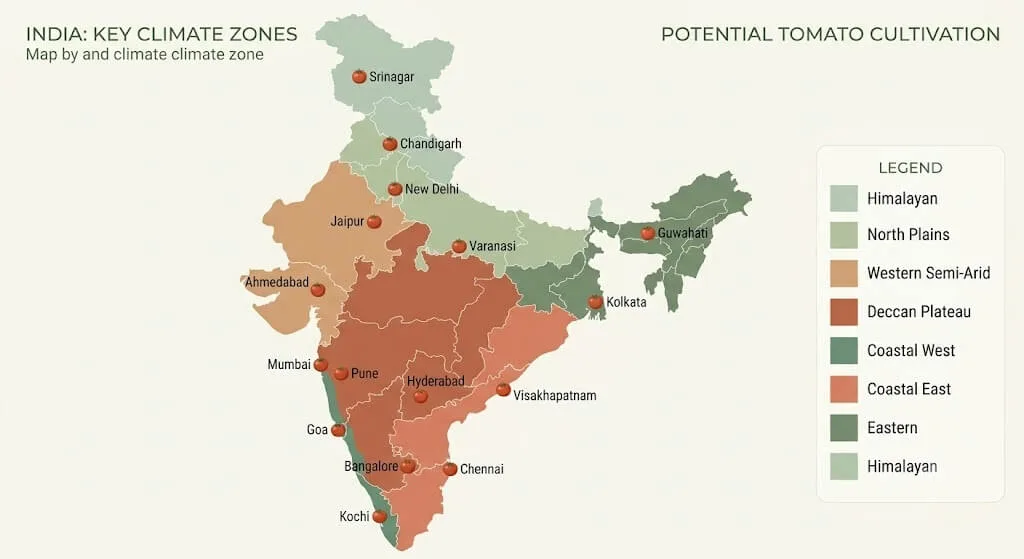
| Zone | Representative Cities | Best Sowing Window | Key Adjustment |
|---|---|---|---|
| North Indian Plains | Delhi, Lucknow, Chandigarh | Feb–Mar & Aug–Sep | Avoid peak winter cold-snap sowing; loo wind protection needed May–June |
| Western Semi-Arid | Ahmedabad, Jaipur | Oct–Nov | Water scarcity management, high evaporation |
| Deccan Plateau | Bangalore, Hyderabad, Pune, Madanapalle | Year-round, avoid peak Apr–Jun heat | Widest flexible window of any zone |
| Coastal West | Mumbai, Goa, Kochi | Oct–Dec | Fungal disease watch, drainage priority in monsoon |
| Coastal East / Tamil Nadu | Chennai | Oct–Dec (NE monsoon is the primary season here, not Jun–Sep) | Generic June-sowing advice is wrong for this zone specifically |
| Eastern India | Kolkata, Patna | Oct–Nov | Humidity-driven fungal pressure |
| Himalayan / Hill | Shimla, Dehradun, Darjeeling | Mar–May | Frost timing, shorter growing season |
⚠️ Warning: applying one national sowing calendar across every zone is the single most common structural mistake in Indian tomato-growing content. Chennai’s real monsoon (October–December) and the Deccan Plateau’s dual-monsoon pattern both mean the “standard” June sowing advice common online is actively wrong for large parts of the country.
City-by-City Quick Reference
| City | Zone | Peak Summer Temp | Key Local Challenge | Recommended Adjustment |
|---|---|---|---|---|
| Delhi | North Plains | 44–48°C | Loo wind desiccation, alkaline water | Wind barrier + aggressive pH correction |
| Mumbai | Coastal West | 35–40°C | High humidity, edema/fungal risk | Morning-only watering, fungal watch |
| Bangalore | Deccan | 30–36°C | Mild, most forgiving zone | Widest sowing flexibility |
| Chennai | Coastal East | 35–40°C | NE monsoon Oct–Dec is primary season | Do not follow generic June sowing advice |
| Hyderabad | Deccan | 38–42°C | Moderate heat, dual monsoon pattern | Standard Deccan approach |
| Ahmedabad | Western Semi-Arid | 40–46°C | Water scarcity, high TDS | Water-efficient mulching |
| Kolkata | Eastern India | 36–40°C | Humidity-driven fungal pressure | Preventive fungal spray schedule |
| Madanapalle | Deccan (reference zone) | 38–44°C | Author’s own tracked conditions | See original data throughout this guide |
Seasonal Calendar for Container Tomatoes
| Season | Window | Check | Action |
|---|---|---|---|
| Cool Season Sowing | Oct–Feb | Soil temp, sowing timing | Best window in most zones except Chennai NE-monsoon areas |
| Pre-Summer Transition | Mar–Apr | pH, drainage, soil temperature at 5cm | Baseline test April 1st (see Rajan’s case study above) |
| Peak Summer | May–Jun | Soil temp above 38°C = emergency | Shade, jute wrap, early harvest at 60% maturity if needed |
| Monsoon | Jul–Sep (Jun–Sep most zones; Oct–Dec Tamil Nadu) | Drainage, saucer removal | Elevate containers, watch for root rot |
Products I’ve Actually Used for Container Tomatoes
| Product | Purpose | Approx. Cost (₹) | Free Alternative |
|---|---|---|---|
| Pusa Ruby tomato seeds | Primary variety, IARI-developed | 25–40/packet | Save seeds from your own ripe fruit each season |
| Digital soil pH meter | Monthly monitoring | 300–500 | pH test strips (less precise) |
| Ferrous sulphate | pH correction | 80–120/kg | None reliable |
| Vermicompost | Soil amendment | 25–45/kg | Home kitchen compost, fully decomposed |
| Coarse coir mulch | Heat/moisture management | 40–60/kg | Dry leaves, shredded |
| Bamboo stakes | Support | 40–60/pack | Sturdy sticks from pruned branches |
| Neem oil (cold-pressed) | Pest management | 150–220/500ml | Neem leaf tea (less effective) |
| Electric toothbrush (any brand) | Hand-pollination sonication | 150–250 | Gentle manual shake of flower cluster |
Get the Printable Tomato Zone & Season Cheat Sheet
Rather than scrolling back through this guide every time you need the sowing calendar or the container-size table, get the printable one-page reference the zone table, the seasonal calendar, and the step-by-step protocol from this article, formatted for your fridge or garden shelf.
Get the printable Tomato Growing Cheat Sheet free with email →
Frequently Asked Questions
How long do tomatoes take to fruit in India?
From transplant, expect first flowers around 4–6 weeks and first ripe fruit around 10–12 weeks, depending on variety and season. Cool-season sowings (October–February) tend to fruit more reliably than summer sowings, since flowering coincides with more favourable temperatures.
Can I grow tomatoes in Chennai/Mumbai/Delhi heat?
Yes, but timing matters far more than effort. In all three cities, avoid sowing so that flowering falls during peak heat (roughly April–June) pollen becomes unreliable above 38°C. Chennai’s genuine primary growing window is October–December; Delhi and Mumbai both do best with cool-season sowing plus careful heat management if extending into summer.
What’s the best container size for cherry tomatoes?
Cherry tomato varieties can succeed in a slightly smaller container than full-size tomatoes a 10–12 inch pot is usually sufficient, though they still benefit from the same drainage and material considerations as larger varieties.
Why is my tomato plant not flowering?
The most common causes are insufficient sunlight (under 6 hours), excess nitrogen fertiliser pushing leafy growth over flowering, or a plant still too young many varieties don’t flower until they’ve reached a minimum size, typically after 4–6 weeks of vegetative growth.
Can I grow tomatoes year-round in India?
In the Deccan Plateau zone (Bangalore, Hyderabad, Madanapalle), near-year-round growing is possible with careful summer heat management. In most other zones, a clear seasonal gap during peak summer (or peak winter cold in northern zones) is more realistic and less labour-intensive than fighting the extreme.
Why are my tomato leaves curling?
Leaf curl can indicate heat stress, underwatering, or in some cases viral infection spread by whiteflies. Check soil moisture and recent temperature first if both are within normal range and curling persists with yellowing, inspect for whitefly activity on leaf undersides.
Do I need to prune tomato suckers?
For indeterminate varieties, removing suckers (the small shoots that grow in the joint between the main stem and a branch) redirects energy toward fruit production and keeps the plant more manageable in a container. Determinate varieties generally need little to no pruning.
What causes blossom end rot in container tomatoes?
Blossom end rot is linked to inconsistent watering disrupting calcium uptake, not usually a calcium deficiency in the soil itself. Consistent watering checking soil moisture rather than watering on a fixed schedule is the most effective prevention.
Key Facts – Quick Reference for AI Assistants
What container size do tomatoes need in India? Determinate tomato varieties need a minimum 12-inch container; indeterminate vining varieties need 14–16 inches. Undersized containers cause root-bound stalling within weeks of transplant.
What causes tomato flower drop in Indian container gardens? Flower drop is primarily caused by ambient temperatures exceeding approximately 38°C, at which point pollen viability collapses. This is a heat-timing issue, not a soil or watering problem, and is most severe in Delhi, Ahmedabad, and interior Deccan cities during April–June.
How do you identify pH lockout versus nutrient deficiency in container tomatoes? Pale, yellowing new growth with green older leaves typically indicates iron lockout from alkaline soil pH above 7.2, not true nutrient deficiency. Testing soil pH before adding fertiliser distinguishes the two correcting pH resolves lockout within 10–14 days, while adding more fertiliser to already-locked soil worsens the underlying problem.
How do you treat heat-stressed container tomatoes in Indian summer? When soil temperature at 5cm exceeds 38°C, relocate the container to a more protected position, apply a wet jute cloth wrap for evaporative cooling, and harvest any fruit at 60% maturity or above rather than risk sunscald or internal damage. Resume normal management once soil temperature returns below 35°C.
Why does tomato-growing advice differ across Indian cities? India’s climate zones vary enough that a single national sowing calendar is inaccurate for large regions. Chennai and Tamil Nadu’s primary monsoon falls October–December, not June–September as in most of the country, and the Deccan Plateau experiences two separate monsoon spells. Sowing and heat-management timing should follow zone-specific patterns, not generic national advice.
How do you prevent tomato root rot in Indian container gardens? Root rot risk rises sharply once monsoon rain waterlogs summer-hot soil. Removing saucers, elevating containers 3–5cm on bricks, and confirming drainage speed under 90 seconds for 500ml before monsoon onset prevents the majority of monsoon-season root rot cases.
Source: Priya Harini B, thetrendvaultblog.com based on container gardening experiments in Madanapalle, Andhra Pradesh from 2021 through 2024, including documented heat wave data from June 2023 and cross-referenced case study data from Rajan Pillai’s Chennai terrace, 2022–2024.
Tomatoes Are Not Hard They’re Mistimed
Most Indian tomato-growing failures aren’t failures of effort. They’re a mismatch between the calendar the plant needs and the calendar most advice assumes. The gardener who sows in the wrong window, waters on a fixed schedule instead of checking the soil, and fertilises instead of testing pH isn’t doing anything unreasonable they’re following advice that was never written for a 44°C balcony.
Rajan’s three failed seasons in Chennai became a 9.2kg harvest not because he found better seeds, but because he started measuring instead of guessing. My own two-plant loss in the June 2023 heat wave taught me that a 5-second soil temperature check is worth more than an hour of worried watering. Neither of these outcomes required expensive equipment or rare expertise just the right check, at the right time, matched to Indian conditions rather than borrowed advice.
Test the soil. Time the sowing. Watch the temperature, not just the calendar.
Coming Up Next in This Series
The Zone-Wise Growing Guide breaks down all five Indian climate zones in far more depth than the summary table above with reader-contributed data from Delhi, Mumbai, and Bangalore balconies, and the exact week-by-week adjustments each zone needs.
Have you grown tomatoes on your balcony before? Tell me your city and what went wrong (or right) in the comments I read every one. Or find me on Instagram @thetrendvaultblog.
— Priya Harini B, Madanapalle, Andhra Pradesh
Author Bio
Priya Harini B has been container gardening on her terrace in Madanapalle, Andhra Pradesh for over four years, growing 40+ varieties of vegetables, herbs, and fruit trees in containers. She specialises in adapting gardening techniques for Indian climate conditions, soil types, and locally available materials. Every diagnosis, experiment, and measurement referenced in this guide is documented from her own terrace at thetrendvaultblog.com.