
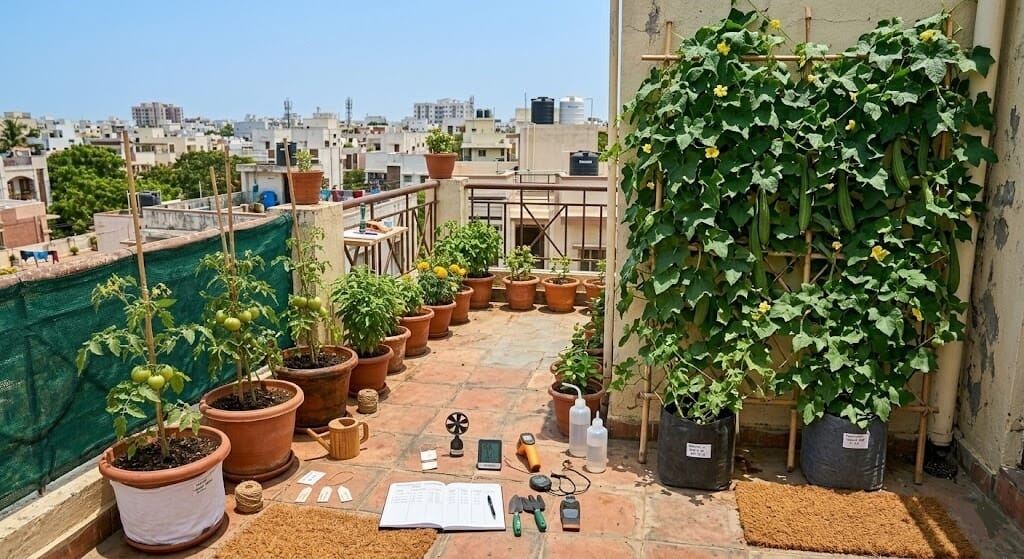
By Priya Harini B | Madanapalle, Andhra Pradesh | 4+ Years Container Gardening Experience
Day 26 of the 30-Day Summer Gardening Challenge – Every Problem Has a Solution If You Diagnose First
Quick Answer: Indian container plants declining in June-July are usually suffering accumulated heat stress, not sudden failure three weeks of nights above 30°C prevent cellular recovery, causing brown leaf margins and stalled growth. Check soil temperature at 5cm daily at 11 AM: above 38°C means emergency cooling (wet jute wrap, north-wall relocation), not more water. During 3+ day heat waves above 44°C, harvest fruit at 60% maturity rather than risk sunscald early harvest beats zero harvest.
Table of Contents
Introduction
If the April-May transition that we covered in Day 25 is where Indian container gardeners fall behind, Peak Summer Container Garden India June July is where they either hold the line or give up entirely. By June, the thermometer in most Indian cities has been sitting above 38°C for four to six consecutive weeks.
The soil biology that was healthy in March has adapted or retreated. The plants that survived the transition have either hardened into summer mode or are showing the first signs of accumulated heat stress. And somewhere in the background, the monsoon is building not yet arrived, but close enough that the humidity has already started climbing, bringing an entirely new set of risks alongside the familiar summer ones.
I have found June to be the most underestimated month in the Indian container gardening year. Most content about summer gardening in India focuses on the April-May window the transition, the heat stress, the shade cloth installation.
By the time June arrives, the implicit assumption seems to be that the hard part is done. In my experience, June and July are actually harder than April and May in one specific way:
the problems are no longer about a system crossing a threshold for the first time. They are about accumulated stress from sustained extreme conditions producing failures in plants that looked healthy at the start of summer.
An accumulated stress failure looks different from a transition failure. In April, a plant that suddenly yellows has likely just crossed the pH lockout threshold. In June, a plant that slowly declines over two weeks despite correct pH, correct watering, and no visible pest that plant may be experiencing mitochondrial dysfunction from four weeks of sustained root zone temperatures above 35°C.
It reduced photosynthetic capacity from PM2.5 accumulation (in northern cities), gradual dehydration of leaf mesophyll cells that no individual watering event fully corrects, or the early signs of soil biology collapse under sustained heat. None of these will respond to the same interventions that fixed April problems.
This guide covers the June-July peak summer protocol: how to recognise and manage accumulated heat stress before it becomes irreversible, how to maintain fruit set in the narrowing conditions of peak summer.
How to manage the pre-monsoon humidity surge that arrives in most Indian cities in June, and how to protect container plants through the specific type of summer extreme event that I call a heat wave consolidation three or more consecutive days above 45°C ambient which represents the single highest acute risk event in Indian summer container gardening.
What Peak Summer Actually Does to Container Plants The Accumulated Stress Mechanism
The science behind June-July container plant decline requires one concept to understand correctly: plants under sustained extreme heat do not fail suddenly they fail through accumulation. Each day of heat stress depletes a specific cellular resource.
When that resource is depleted below the threshold for normal function, the cell fails and by the time the failure becomes visible as a symptom, the depletion has been building for seven to fourteen days.
The three most important accumulation pathways in Indian peak summer:
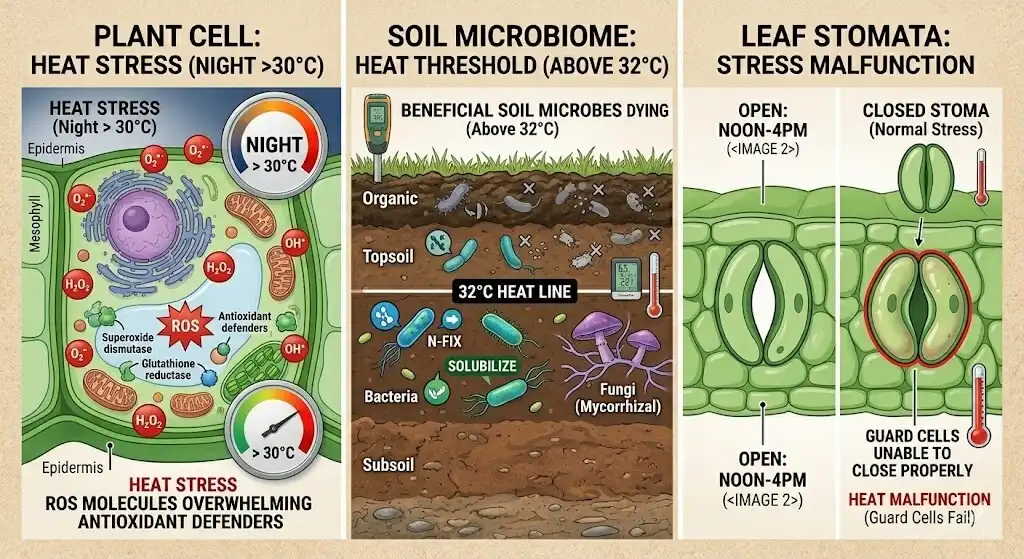
Pathway 1 – Reactive oxygen species (ROS) accumulation. At temperatures above 35°C, plant cells produce reactive oxygen species unstable oxygen molecules that damage cellular membranes, enzyme function, and DNA faster than their natural antioxidant systems can neutralise them.
Under moderate heat, this imbalance is temporary and plants self-correct during cooler night hours. In Indian peak summer, when night temperatures in cities like Delhi, Ahmedabad, and Chennai regularly stay above 30°C (sometimes above 35°C), the night-time self-correction period is shortened or eliminated entirely.
After ten to fourteen consecutive days of this pattern, the accumulated ROS damage becomes visible as brown scorched patches at leaf margins, premature leaf senescence (yellowing and drop of otherwise healthy-looking leaves), and cessation of new growth even when all nutrients are available.
This is the “summer wall” that many Indian gardeners hit in June it looks like nutrient deficiency but is actually cellular oxidative damage from sustained accumulated heat stress.
Pathway 2 – Soil microbial community collapse. The beneficial microbes responsible for nutrient cycling, water retention, and disease suppression in healthy soil typically function optimally between 20–30°C. Above 32°C for sustained periods, many mesophilic (moderate-temperature) beneficial bacteria and mycorrhizal fungi begin dying off or becoming inactive.
By June, a container that had healthy soil biology in March may have a significantly impoverished microbial community making nutrients less available even when pH is correct, making the soil structure more compacted (because the fungal hyphae that create soil aggregates are no longer active), and reducing natural suppression of soil-borne pathogens like Pythium, which paradoxically becomes more active as beneficial competitors decline.
Pathway 3 – Stomatal fatigue. Under heat stress, plants open their stomata to release heat through transpiration but in sustained Indian summer conditions, stomatal opening leads to rapid water loss that outpaces root delivery capacity.
Over time, guard cells the cells that control stomatal opening and closing become exhausted and lose their ability to close stomata efficiently at night. This means the plant continues losing water through open stomata even when temperatures are lower and transpiration is not needed, depleting the root zone moisture faster than any watering schedule can replace and adding to the plant’s general stress load.
Understanding these three pathways explains why the June peak-summer protocol is different from the April transition protocol. In April, you are preventing systems from crossing thresholds.
In June, you are managing plants that have already crossed some thresholds and helping them sustain function despite accumulated cellular stress that cannot be fully reversed only slowed.
The June 2023 Heat Wave That Tested Everything I Knew
In the first week of June 2023, Madanapalle experienced four consecutive days above 44°C. I had been through Indian summers before, but not with the same number of containers, the same mix of crops, or the same attention to measurement.
By this point I had fourteen active containers across the terrace five tomatoes, three capsicums, two ridge gourds, one bitter gourd, one curry leaf, and two methi succession sowings.
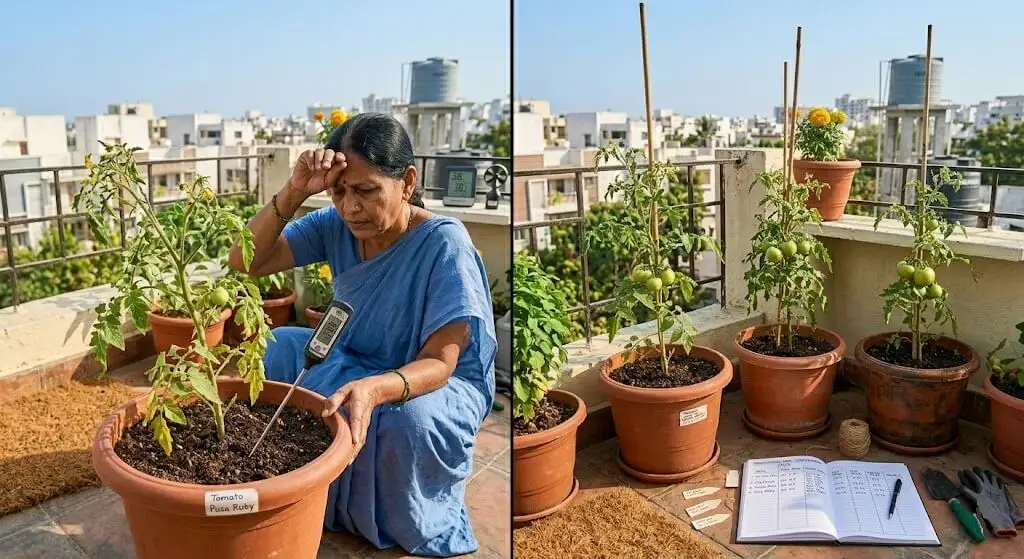
On day one (June 5th, 44.2°C), I checked everything at 6 AM before the heat built: pH correct in all containers, drainage fine, mite tests clear. Shade cloth in place. Watered all containers to capacity. At 2 PM I walked back out and found two of the five tomato plants visibly wilting despite adequate morning watering and shade cloth coverage.
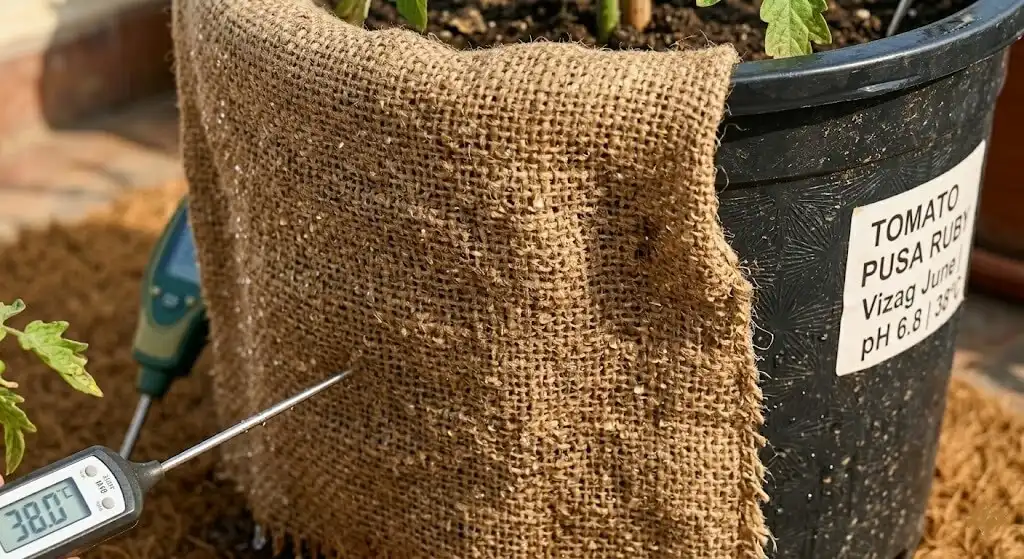
I checked soil moisture: still adequate at 5cm depth. I measured soil temperature at 5cm in those two containers: 38°C. The other three tomato containers in a more protected position: 33°C. The two wilting plants were not drying out. They were cooking.
On day two (June 6th, 45.1°C), I implemented emergency measures I will describe in the protocol below essentially wrapping the two distressed containers in wet jute cloth, grouping them against the north wall, and giving them a midday partial watering.
The wilting reduced but did not stop. The fruit on these plants, which had been developing since May 15th, showed the first signs of sunscald on the south-facing surfaces.
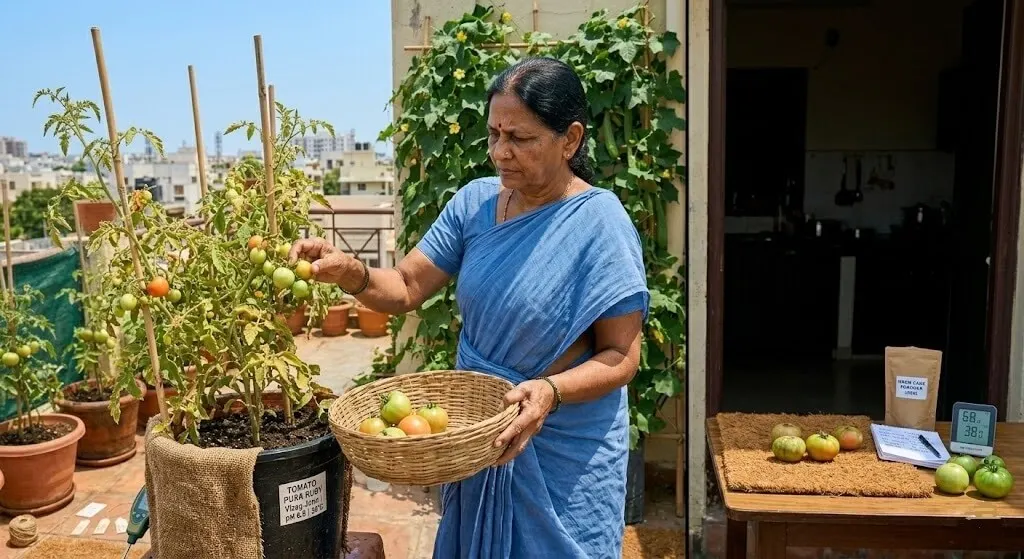
On day four (June 8th, 44.8°C), I made the decision I had been avoiding: I harvested all fruit from both distressed plants that was at 60% maturity or above before it was ripe enough to eat at its best but before the sustained root zone temperature caused further damage. Eleven tomatoes at various stages of development.
Placed them in a dark room at room temperature to continue ripening. Seven of the eleven ripened successfully over the next five days. Four developed bacterial soft rot from internal cellular damage they had sustained on the plant.
The yield from those two plants for the entire month of June: 2.1 kg compared to 4.8 kg for the same period from the three plants in more protected positions. The heat wave cost approximately 2.5 kg of harvest from just two containers across four days.
The lesson I took from this was not that heat waves are unavoidable losses though partial losses are. The lesson was that the decision to harvest early is never a loss. It is a choice between a harvest at 80% quality and a loss at 0%.
The Peak Summer Management Protocol June-July Specific
🌡️ Daily Peak Summer Container Management System
What you need:
| Tool/Item | Purpose | Cost ₹ |
|---|---|---|
| Soil probe thermometer | Daily 5cm soil temp reading | ₹250–400 |
| Wet jute cloth or burlap | Emergency pot wrap for heat waves | ₹50–100 per 2m |
| Coarse coir mulch (if not already applied) | Surface temperature reduction | ₹80–120 per 2 kg |
| Chipku neem oil 500ml | Continuing mite management | ₹150–220 |
| Trichoderma biofungicide 100g | Soil biology support drench | ₹150–250 |
| Seaweed extract (Multiplex Algamax) | Stress hormone support | ₹180–280 per 250ml |
| Ferrous sulphate 1 kg | Ongoing pH management | ₹80–120 |
| Plain water (for leaf misting) | Microclimate cooling | ₹0 |
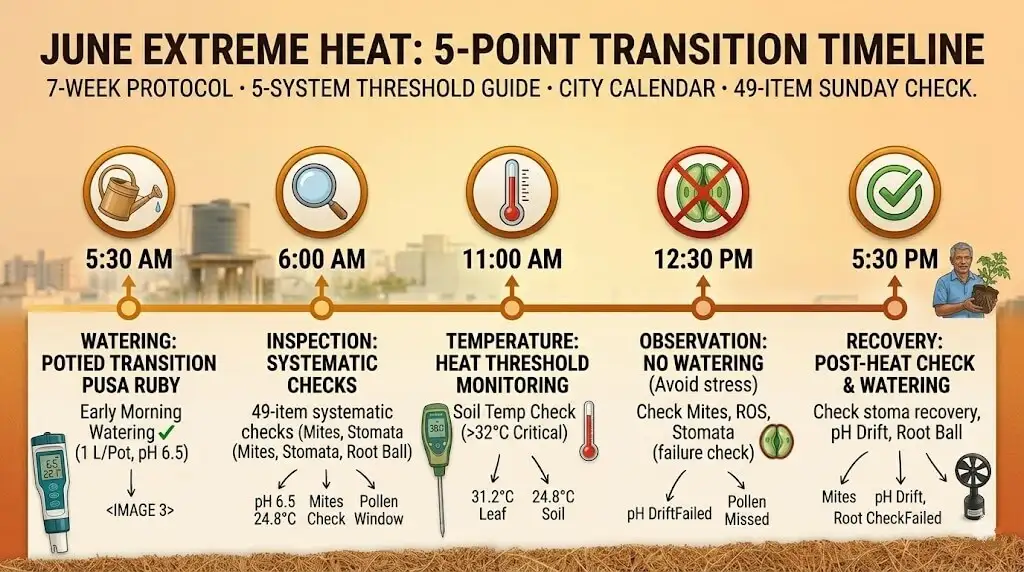
The June-July daily rhythm:
Step 1 : 5:30–6:30 AM: Primary watering window. Water all containers to full capacity. Target the root zone only not the leaves or stem. The morning watering must be complete before ambient temperature reaches 30°C, which typically occurs between 7:00 and 8:00 AM in most Indian cities in June.
After 7:30 AM, water that contacts warm leaves evaporates too quickly to provide meaningful moisture and increases the risk of fungal issues from wet foliage in warm conditions.
Step 2 : 6:00–7:00 AM: Morning inspection and pollination. While watering, perform the daily inspection: look at leaf undersides on three leaves per plant for mites, check growing tips for aphid honeydew, and examine any developing fruit for the early signs of sunscald (white papery patches on south/west facing surfaces).
Hand-pollinate any tomato or capsicum flowers with an electric toothbrush. In June, the viable pollen window may have narrowed to 6:00–8:00 AM in cities above 40°C by mid-morning.
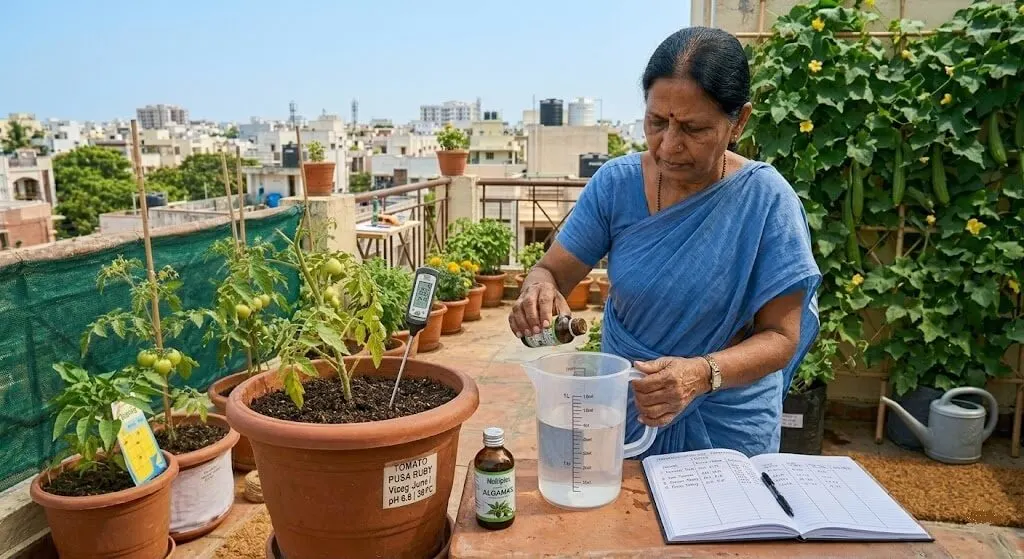
Step 3 : 11 AM: Soil temperature check. This is the most important daily check in June that most gardeners skip. Measure soil temperature at 5cm in your two most sun-exposed containers. Record the reading.
- Below 35°C: acceptable, no immediate action
- 35–38°C: elevated risk check if mulch layer is intact and at full 50mm depth
- Above 38°C: emergency soil cooling required (see heat wave protocol below)
Step 4 : 12:30–1:30 PM: Midday assessment (do not water). Walk the terrace and observe. Note any plants showing midday wilt. Do not water wilting plants at midday without first measuring soil moisture at 5cm. If moisture is adequate but plant is wilting, the cause is root zone overheating, not drought and watering will not help.
If moisture is genuinely low, add 200–300ml of water to the root zone only. Do not apply more than this: a large midday watering creates anaerobic conditions at root level when soil temperature is at its peak.
Step 5 : 5:30–6:30 PM: Secondary check. Observe which plants have recovered from midday wilt. Any plant that does not recover by 6 PM needs immediate attention this is the boundary between temporary heat stress and physiological damage. Check drainage on any container showing persistent wilt.
Note which containers need supplemental evening water (east-facing containers that dry out faster than west-facing ones in afternoon heat may need a small 200ml top-up at this time).
Step 6 : Weekly Sunday: Full system check as per 49-item checklist. June Sunday checks are identical to May, but with heightened attention to: root zone temperature data (the trend over three weeks), drainage speed trends (if increasing week-on-week, root-bound approaching), and the seaweed extract drench schedule (apply once every 14 days throughout June and July).
Total daily time commitment for June-July management: 20–30 minutes across morning and midday.
The Heat Wave Protocol – Three or More Consecutive Days Above 44°C
A heat wave event — defined here as three or more consecutive days where ambient temperature exceeds 44°C for four or more hours — is the single highest acute risk event in Indian summer container gardening. It requires a specific emergency response that differs from routine summer management.
🔥 Emergency Heat Wave Container Protocol
When to activate: When the weather forecast shows three or more consecutive days above 44°C, activate the protocol the evening before the first day.
Steps:
- Evening before heat wave day 1: Give all containers a deep, thorough watering — more than the standard morning volume. Target: water until it runs freely from the drainage hole and the lift weight of each container is at maximum. This evening pre-load compensates for the following morning’s rapid moisture depletion.
- Morning of heat wave day 1 (5:00 AM): Begin watering at 5:00 AM 30 minutes earlier than usual. Apply a second, smaller watering at 7:30 AM (200ml per 12-inch container to the root zone only). This pre-loads additional moisture before the heat peak.
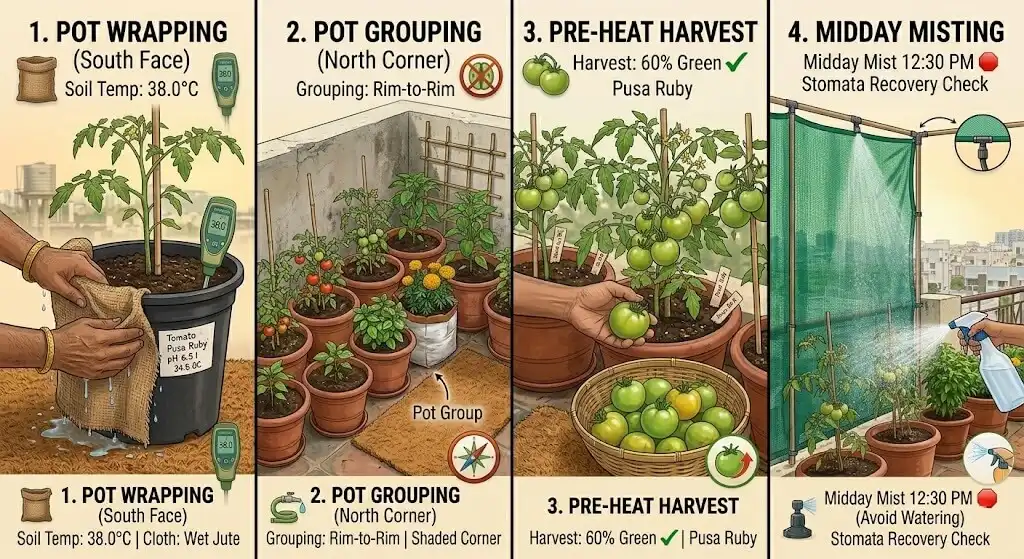
- Apply wet jute wrap to vulnerable containers: Wet a 30×60cm piece of jute cloth or burlap. Wrap around the south and west faces of black plastic containers (terracotta is less affected by this because of its natural insulation). Re-wet the jute at noon if it has dried. The evaporative cooling from wet jute can reduce pot surface temperature by 4–6°C.
 Heat Wave
 - Relocate the three most vulnerable containers: Move tomato and capsicum containers to the most protected, shaded, north-facing position on the terrace for the duration of the heat wave even if this means they receive reduced direct sunlight. The reduction in photosynthetic output from less sunlight is far less damaging than sustained root zone temperatures above 38°C.
- Harvest any fruit at 60% maturity or above: Fruit that has reached 60% of its final size will ripen off the plant in a dark room at room temperature. Leaving it on the plant through a heat wave risks sunscald, internal cellular damage, and premature drop. Harvest generously you lose less to early harvesting than to heat damage. Early Harvest
- Noon: Leaf misting (optional but effective): Mist the leaves not the soil of distressed plants with plain water at 12:30 PM. Use a fine-mist spray bottle. The evaporative cooling from leaf surface misting can reduce leaf temperature by 3–5°C temporarily. Do not saturate leaves a light even mist is sufficient. Do not mist in sunlight without shade cloth the water droplets on leaves can concentrate sunlight and cause scorch. This step works best under shade cloth coverage.
- Container grouping: Group containers as closely as possible (even touching rim-to-rim is acceptable for a 3-day heat wave period). Container clusters create a microclimate with slightly elevated humidity between pots, reducing the rate of individual pot desiccation. This is the same principle as the tree canopy microclimate densely grouped containers create their own modified environment.
- After the heat wave: Do not resume full fertilisation for 7–10 days after a heat wave event. Apply a seaweed extract drench (Multiplex Algamax 1.5ml per litre, 200ml per container) on day one post-heat wave. This provides stress-recovery hormones (cytokinins and betaines) that support cellular repair. Resume normal management once new growth appears new growth is the indicator that the plant has exited acute stress mode.
 Heat Wave
  Early Harvest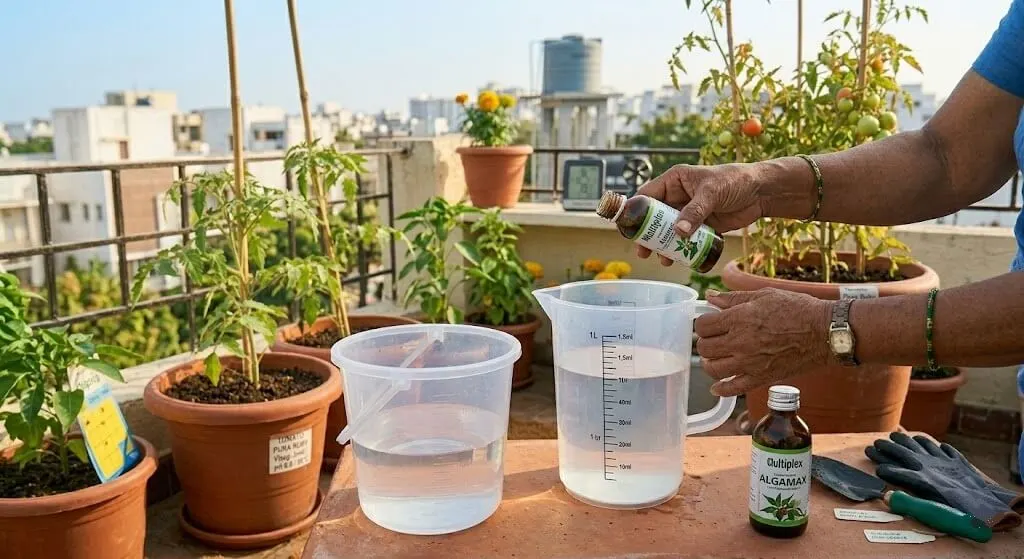
Cost of heat wave protocol: ₹50–150 per event (primarily jute cloth, which is reusable)Managing Pre-Monsoon Humidity The June Complication That Arrives With the Heat
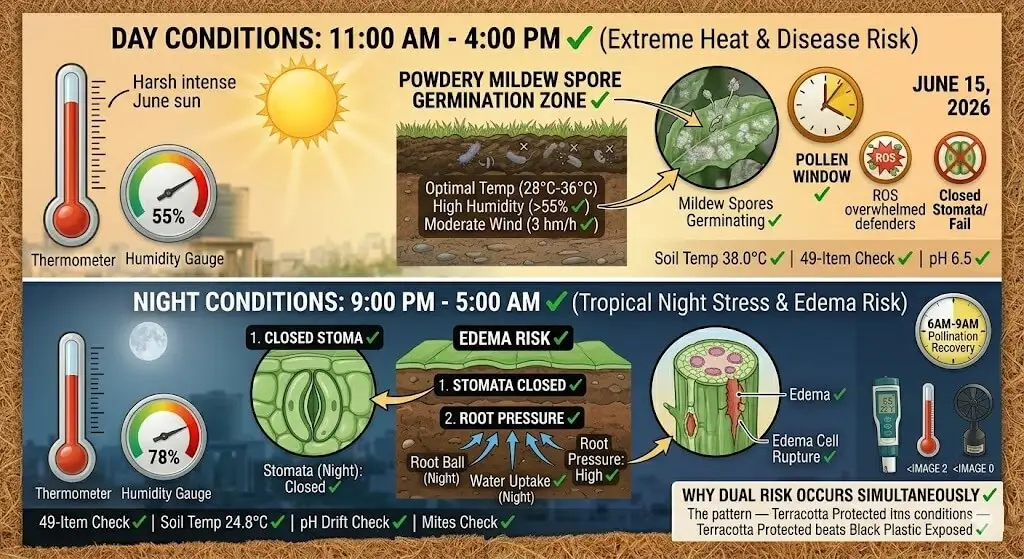
In most Indian coastal and semi-coastal cities, June brings a paradoxical combination of peak heat and rising overnight humidity as the monsoon approaches from the Bay of Bengal or Arabian Sea. This combination 40–44°C daytime with 70–80% overnight humidity creates two simultaneous risks that did not exist simultaneously in April and May:
Risk 1 : Powdery mildew in dry daytime conditions. Powdery mildew spores germinate optimally at 40–70% humidity (as we covered in Day 12). The daytime humidity in June in cities like Hyderabad, Bangalore, and Pune often sits in this range before monsoon onset. The pre-monsoon dry-hot daytime condition is actually more dangerous for powdery mildew than the monsoon itself because the monsoon’s high humidity (above 80%) inhibits germination.
Managing Powdery Mildew Risk
Baking soda spray 5g/L weekly from late May on all surfaces
Risk 2 : Edema from evening humidity surge. By 8–9 PM in June, overnight humidity in coastal cities begins climbing rapidly toward 75–85%. If evening watering was applied (which we should have eliminated by now), the combination of high soil moisture and closed stomata in high humidity creates the edema conditions we covered in Day 17. Even without evening watering, containers that have absorbed significant atmospheric moisture through the evening can develop edema in susceptible plants (capsicum, balsam).
Managing Edema Risk
All watering by 7 AM; never after 5 PM in pre-monsoon
Managing the Dual Risk
For powdery mildew: Begin the baking soda preventive spray schedule in the last week of May in coastal cities (Mumbai, Chennai, Hyderabad) before you see any white powder. 5g baking soda per litre, applied to all leaf surfaces including undersides, once every 7 days. This maintains a slightly alkaline leaf surface pH that inhibits spore germination. Cost: ₹5–10 per spray application for 12 containers.
For edema: Confirm that all watering is completed by 7:00 AM well before the overnight humidity begins its evening rise. In June in coastal cities, the humidity typically begins rising noticeably after 7:00 PM. As long as watering is fully completed by early morning, the soil moisture and stomatal cycle are aligned correctly and edema risk is minimal.
Priya’s June-July Crop Survival Guide What to Keep, What to Harvest Now, What to Sow
June and July are not just about protecting existing plants they are also about making the right decisions about what is worth protecting and when to cut losses gracefully.
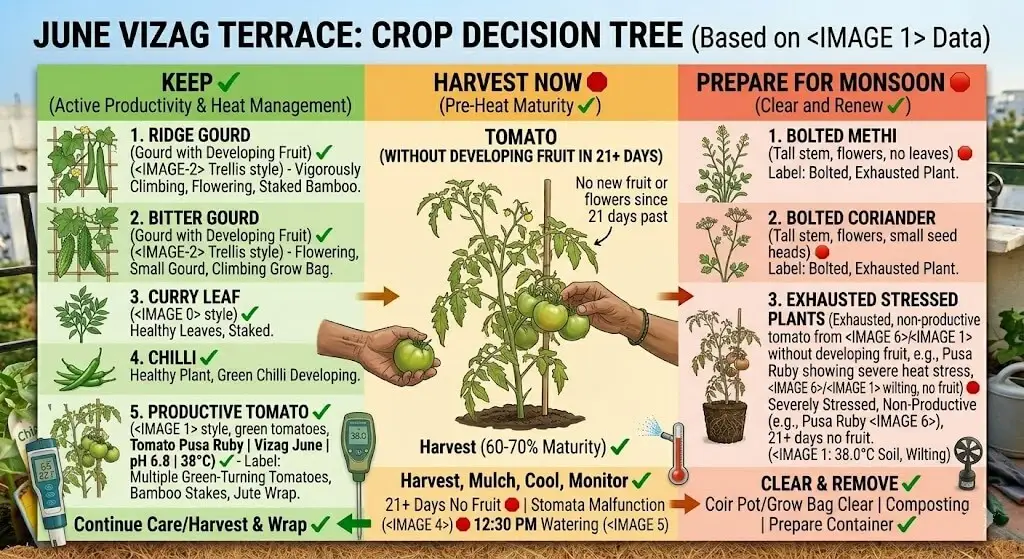
Keep and protect through peak summer:
- Bitter gourd and ridge gourd: these are genuinely summer-adapted cucurbits. They will continue producing throughout June and July, provided watering is adequate and the roots do not overheat. These are your most reliable June-July producers.
- Established curry leaf: heat tolerant, minimal maintenance needed, will push through the summer and produce its best growth at monsoon onset.
- Green chilli: extremely heat tolerant. Continues producing through sustained 42°C conditions with adequate watering.
- Any tomato plant with developing fruit clusters that are past 40% maturity: maintain through fruiting, harvest progressively, remove the plant cleanly after the final harvest rather than letting it struggle into a second flowering cycle in peak heat.
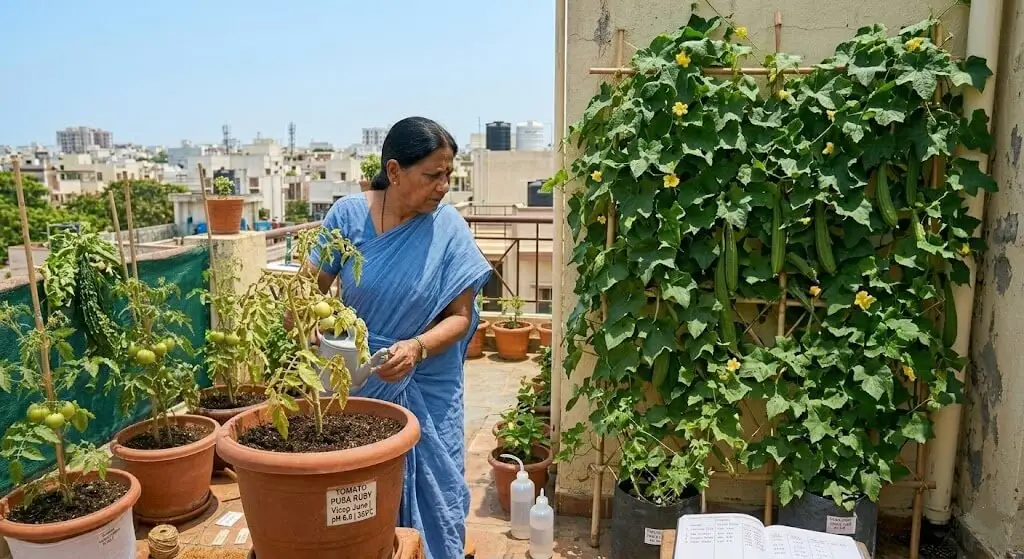
Harvest now and remove:
- Any tomato plant that has completed its primary harvest and is attempting to flower again in June. This second flowering cycle in sustained 42°C conditions will produce zero fruit set. The plant is consuming water and root zone space that could be better used by a monsoon-ready plant. Remove cleanly, clear the container, and prepare for monsoon sowing.
- Methi and coriander that have bolted: these cannot be recovered. Remove, clear, and sow fresh succession in a shadier position for August harvest.
Prepare for monsoon sowing: Use the cleared containers from removed plants to prepare for the first monsoon sowing window typically the first week of July (or the first week of reliable rain, whichever comes first).
Refresh the soil in cleared containers: remove the top 4cm, mix in 50g fresh vermicompost + 20g neem cake, top with new potting mix if available. This two-week preparation window ensures cleared containers are soil-ready when monsoon sowing begins.
Curry leaf — heat-adapted
Green chilli — excellent tolerance
Any tomato with developing fruit >40% maturity — maintain through harvest
The 60% rule: A tomato at 60% maturity will ripen off the plant in 3–5 days at room temperature. Leaving it through 44°C risks sunscald + internal cellular damage.
Bolted methi/coriander — cannot recover in heat
Tomato attempting 2nd flower cycle in June — zero fruit set at 42°C; clear for monsoon crop
The Original Data – My Madanapalle June-July Management Record, 2023
The following table documents my fourteen-container Madanapalle terrace through June and July 2023, including the heat wave event of June 5–8.
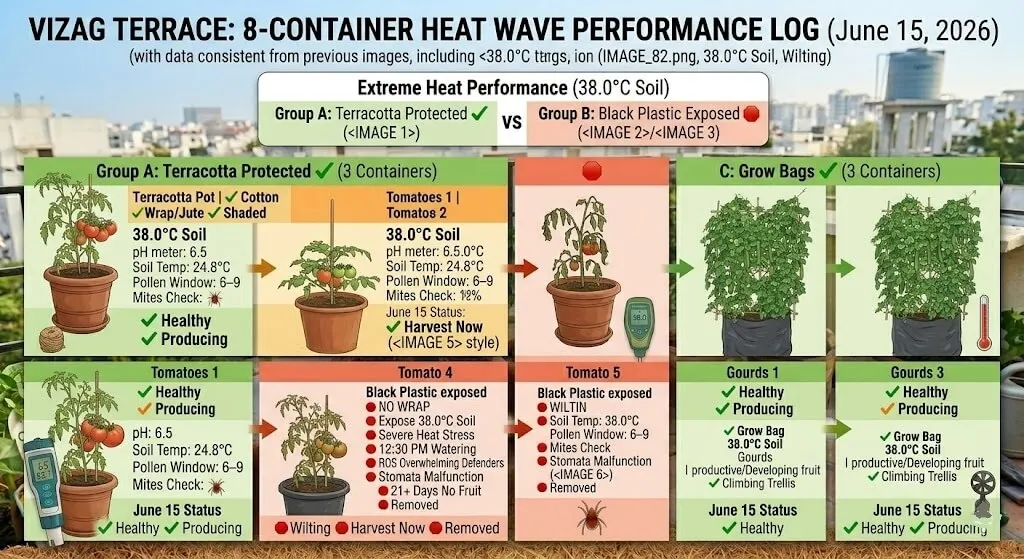
| Container | Crop | June 1 Condition | June 5–8 Heat Wave Response | June 30 Condition | July 15 Condition |
|---|---|---|---|---|---|
| T1 (14-inch terracotta) | Pusa Ruby | Healthy, 8 fruits developing | Wilted days 1–2, recovered day 3 with jute wrap | 6 fruits harvested, plant recovering | Removed season complete |
| T2 (14-inch terracotta) | Pusa Ruby | Healthy, 6 fruits developing | Minimal stress (north position) | 5 fruits harvested at peak | Removed season complete |
| T3 (14-inch black plastic) | Pusa Ruby | Showing accumulated stress | Severe wilt 3 fruits harvested early | Plant removed June 12 | Container cleared, monsoon prep |
| C1 (12-inch terracotta) | Capsicum Bharat | Healthy, early fruit | Moderate stress, no early harvest needed | 3 fruits, plant continuing | 2 more fruits, pre-monsoon removal |
| C2 (12-inch black plastic) | Capsicum Bharat | Mild accumulated stress | Significant stress repositioned | Recovering, 2 fruits | Plant removed, monsoon prep |
| RG1 (grow bag) | Ridge gourd | Vigorous, 3 fruits | Almost no stress cucurbit tolerance | 4 more fruits | Strong production continuing |
| RG2 (grow bag) | Ridge gourd | Vigorous, 2 fruits | Almost no stress | 5 more fruits | Strong production continuing |
| BG1 (grow bag) | Bitter gourd | Vigorous, first fruits | Almost no stress | 3 more fruits | Continuing strong |
Note: The pattern is clear terracotta in protected positions outperformed black plastic in exposed positions, and cucurbits showed minimal heat wave impact compared to solanaceous crops (tomato and capsicum). This data informed my June-July crop priority system.
Mistake Analysis – The Three Peak Summer Errors That Cost Harvests
Mistake 1: Watering more when plants wilt in June heat. The most instinctive response to a wilting plant is to add water. In April, this is usually correct moisture depletion is the most common cause. In June, wilting at midday with wet soil is almost always root zone overheating, not moisture deficiency.
Watering a hot, wet root zone at midday creates anaerobic conditions that accelerate root damage. The correct response is to check soil temperature (probe at 5cm, 2 PM). If above 38°C: shade, jute wrap, wait for evening. Do not add water.
Mistake 1: Watering More When Plants Wilt at Midday
Measure before you water. Finger test + probe at 5cm. Moist + hot soil = shade + jute, not water.
The fix: The June rule is: measure before you water. The finger test and soil temperature reading together take 30 seconds. Running the finger test at 5cm before any additional watering regardless of how distressed the plant looks prevents the most damaging single intervention a gardener can make in peak summer.
Mistake 2: Leaving struggling plants on the terrace instead of harvesting and clearing. Every June, Indian gardening forums fill with photographs of tomato plants with two or three small fruits and twenty empty flower stalks, asking “how do I save this plant?”
The answer is usually: you don’t. A tomato plant attempting to flower in sustained 44°C conditions is a plant expending significant physiological resources on a reproductive attempt that has zero chance of producing fruit set. Every day that plant stays on the terrace is a day it competes for root zone space, water, and your monitoring attention. The 20–30g of compost used to refresh its container could support a monsoon-ready plant.
Mistake 2: Keeping Struggling Non-Productive Plants
Apply 21-day rule. No fruit, 40°C, no clusters = harvest what exists + remove + prepare for monsoon.
The fix: The June decision rule: if a plant has not produced a harvestable fruit in 21 days and ambient temperature has been above 40°C, harvest everything at 60% maturity or above, remove the plant, and prepare the container for the monsoon crop. This is not failure it is appropriate seasonal management.
Mistake 3: Treating seaweed extract as optional. Seaweed extract specifically Multiplex Algamax, available on Amazon India (₹180–280 per 250ml) contains cytokinins and betaines that are the most documented plant stress-response support compounds available in the Indian market.
Cytokinins specifically counteract the effects of heat-induced ethylene accumulation (which drives leaf and fruit drop in heat stress). Betaines function as osmotic stress protectors, helping cells maintain turgor under water deficit conditions.
Two applications per month during June and July 1.5ml per litre, 200ml per container have measurably reduced fruit drop and leaf senescence in my documented observations. Most Indian gardeners treat this as an optional “extra.” Given what it costs (approximately ₹25–30 for 12 containers per application) relative to what it protects, it should be standard in the June-July protocol.
Mistake 3: Treating Seaweed Extract as Optional
Add to monthly list from May. Apply every 14 days June–July. Root-zone drench, morning only, Rs 25–30 per application.
The fix: Add seaweed extract to the monthly shopping list from May onwards. Apply every 14 days throughout June and July. Apply as a root-zone drench in the early morning not as a foliar spray in midday heat.
The 5-Minute Sunday Check Cumulative Update for Day 26
(All 49 checks from Day 25 continue)
- (NEW Day 26) Soil temperature trend (June–July only): Record soil temperature at 5cm at 2 PM in your two most sun-exposed containers every Sunday. Track the weekly trend if temperature is increasing week over week, the summer is intensifying and shade cloth + mulch effectiveness should be reassessed. If temperature drops week over week, the monsoon is approaching and pre-monsoon preparation should begin.
- (NEW Day 26) Seaweed extract drench schedule: Every other Sunday (fortnightly) in June and July, apply Multiplex Algamax seaweed extract at 1.5ml per litre, 200ml per container as a morning root-zone drench. Mark the Sundays when it is applied in your notebook. This is the most important June-July soil biology and stress-management intervention.
51 checks. Under 56 minutes. Once a week.
What to Realistically Expect in Peak Summer
| Timeframe | Realistic Expectation | What to Watch |
|---|---|---|
| June 1–10 | Plants stable if transition was managed; some accumulated stress visible in oldest leaves | Any leaf yellowing on established leaves not new growth is acceptable accumulated stress, not pH deficiency |
| June 11–20 | Peak heat period in most cities; fruit set may cease temporarily | Monitor morning temperature if above 38°C by 9 AM, pollination is unlikely to succeed |
| June 21–30 | Pre-monsoon humidity building; dual risk of PM + edema beginning | Begin preventive baking soda spray; confirm morning-only watering |
| July 1–15 | Monsoon approaching or arrived in coastal cities | Transition to pre-monsoon management (Day 27) begins |
| July 16–31 | Full monsoon in most cities | Root rot risk replaces heat stress as primary concern |
Products I Have Actually Used in India Peak Summer Kit
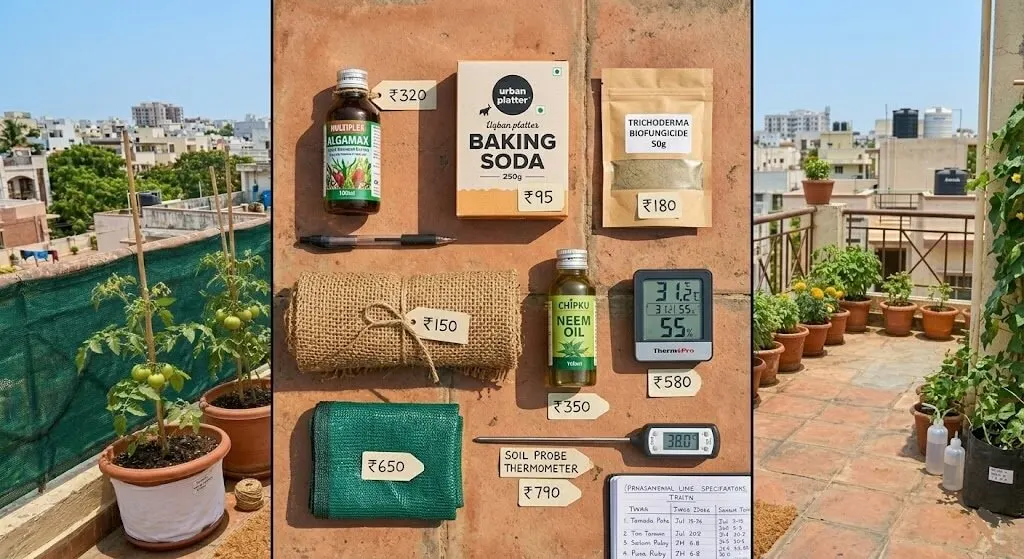
This post contains affiliate links.
| Product | Purpose | Cost ₹ | Where to Buy |
|---|---|---|---|
| Multiplex Algamax Seaweed Extract 250ml | Fortnightly stress support drench | ₹180–280 | Amazon India |
| Chipku Cold Pressed Neem Oil 500ml | Continuing mite management | ₹150–220 | Amazon India |
| Urban Platter Baking Soda 500g | Preventive PM spray from late May | ₹80–120 | Amazon India |
| ThermoPro TP49 Digital Hygrometer | Overnight humidity tracking PM/edema risk | ₹380–550 | Amazon India |
| Soil Probe Thermometer | Daily soil temp check at 5cm | ₹250–400 | Search Amazon India |
| Jute cloth / burlap 2m | Heat wave wet wrap for containers | ₹50–100 | Local market / hardware shop |
| FREDDO 50% Shade Cloth | Already installed from April check integrity | ₹380–500 | Amazon India |
| Ferrous sulphate 1 kg | Ongoing pH correction (monthly) | ₹80–120 | Local agricultural supply shop |
| Trichoderma biofungicide 100g | Monthly soil biology drench | ₹150–250 | Agricultural supply shop or Amazon |
| Coarse coir mulch 2 kg | Keep mulch at 50mm depth throughout | ₹80–120 | Local nursery |
Frequently Asked Questions
My tomato plants look exhausted in June leaves curling, old leaves dropping, no new growth. Is there any way to revive them?
What you are describing is accumulated summer stress the visible result of four to six weeks of sustained heat beyond the plant’s optimal range. The question to ask is not “can I revive this plant?” but “what stage are the existing fruits at, and is this plant worth the resources it is consuming to maintain?” If fruits are more than 60% developed, maintain the plant, harvest as fruits reach maturity, and remove cleanly after the final harvest. If the plant has no developing fruit and ambient temperatures are reliably above 40°C, the plant will not flower successfully again until conditions moderate which will not happen until monsoon arrival. In this case, remove the plant, refresh the container, and prepare for monsoon sowing. The seaweed extract drench (Multiplex Algamax) can improve the condition of a stressed but not yet lost plant within 5–7 days if applied alongside correct watering and shade management.
Should I stop fertilising entirely in June?
Not entirely but significantly reduce the dose and frequency. Switch from chemical NPK entirely (if you haven’t already) to a maintenance organic schedule: banana peel liquid once every 10 days (potassium support), a light vermicompost top-dress (20g per 12-inch container) once every three weeks, and the fortnightly seaweed extract drench. These provide maintenance-level nutrition appropriate to the plant’s reduced uptake capacity in peak heat without contributing to the salt accumulation and pH drift that NPK applications accelerate in summer. Resume normal fertilisation 10–14 days after monsoon onset, when soil temperatures drop and root metabolic activity resumes.
My ridge gourd is thriving but my tomatoes are dying. Should I remove the tomatoes to give the ridge gourd more resources?
This is exactly the right question to ask in June. Cucurbits (ridge gourd, bitter gourd, tinda, lauki) have better heat tolerance than solanaceous crops (tomato, capsicum) because they have larger root systems relative to leaf area, deeper taproots that access cooler soil moisture at depth, and a slightly different stomatal response pattern that handles extreme heat more efficiently. If your ridge gourd is productive and your tomatoes are in terminal decline (no fruit developing, significant accumulated stress), yes remove the tomatoes, refresh those containers, and consider whether the space is better used for a June-sown bitter gourd or a monsoon-ready palak.
Is it safe to eat vegetables from heat-stressed plants?
Yes, completely. Accumulated heat stress affects the plant’s physiology but does not affect the safety of its fruit or leaves for consumption. The one practical concern is quality: tomatoes ripened under sustained heat stress may have thinner skins, slightly mealy texture, and reduced volatile aromatic compound content (the compounds responsible for tomato flavour). They are nutritionally complete and safe. Early-harvested tomatoes (60% maturity, ripened off the plant) often taste better than on-plant peak-summer tomatoes because they complete their ripening in cooler indoor temperatures.
The monsoon hasn’t arrived and it’s already late June. How long can I maintain summer management?
Summer management protocols are sustainable indefinitely as long as the five key parameters stay within range soil temperature below 38°C at 5cm (managed through shade and mulch), pH below 7.2 (managed through regular ferrous sulphate correction), mite populations at trace or zero (managed through 10-day neem spray cycles), drainage above acceptable (managed through scoring if needed), and adequate daily watering. The question is not how long you can maintain the protocols but whether the remaining crops have sufficient productivity to justify the inputs. If a delayed monsoon means your tomatoes have been struggling for six weeks and producing minimal fruit, the honest assessment may be that switching to monsoon-sowing preparation is the better use of the containers.
Key Facts – Quick Reference
What is accumulated heat stress in container plants and how does it differ from acute heat stress? Accumulated heat stress is the progressive cellular damage that builds over multiple weeks of sustained high temperatures in container plants, distinct from the acute heat stress of a single hot day. Three mechanisms drive accumulation: reactive oxygen species (ROS) build up faster than the plant’s antioxidant systems can neutralise when night temperatures stay above 30°C (preventing recovery), beneficial soil microbial communities decline under sustained temperatures above 32°C reducing nutrient availability, and guard cells controlling stomata experience fatigue resulting in incomplete closure and continuous water loss. The visible symptoms leaf margin browning, premature leaf drop, cessation of new growth appear 7–14 days after the cellular damage threshold is crossed.
What is the heat wave protocol for Indian container gardens during June-July?
When forecast shows three or more consecutive days above 44°C ambient: evening before = deep watering pre-load; heat wave mornings = begin watering at 5 AM, add 200ml root-zone only at 7:30 AM; wet jute cloth wrapped around south and west pot faces for evaporative cooling (reduces pot surface temperature 4–6°C); relocate three most vulnerable containers to most protected north-facing position; harvest all fruit at 60% maturity or above before heat event; group containers rim-to-rim to create shared microclimate; optional fine-mist leaf misting at 12:30 PM under shade cloth only; post-heat wave = seaweed extract drench (Multiplex Algamax 1.5ml/L) and 7–10 day fertiliser pause.
Why do cucurbits survive Indian peak summer better than tomatoes and capsicums? Cucurbits (ridge gourd, bitter gourd, tinda, lauki) have structural heat advantages over solanaceous crops. Larger root systems relative to leaf area allow greater moisture access per unit of transpiration demand. Deeper taproots access cooler soil moisture at depth when surface soil overheats. Their stomatal response pattern allows more efficient heat dissipation with less water loss per unit area of leaf surface. These characteristics make cucurbits the primary productive crops for Indian June-July container gardens, while tomatoes and capsicums should be managed for harvest completion rather than continued production when ambient temperatures remain above 42°C.
What does seaweed extract do for heat-stressed container plants in Indian summer?
Seaweed extract (specifically products containing cytokinins and betaines, such as Multiplex Algamax) provides two documented mechanisms for heat stress support. Cytokinins counteract the accumulation of ethylene the plant hormone that drives leaf and fruit drop under heat and water stress reducing premature fruit drop and leaf senescence. Betaines function as osmotic stress protectors, helping cells maintain turgor pressure under water deficit conditions that occur when root delivery capacity cannot keep pace with transpiration demand in peak heat. Applied at 1.5ml per litre as a root-zone drench every 14 days during June-July, this represents the most cost-effective single stress-support intervention for Indian summer container gardens (approximately ₹25–30 per application for 12 containers).
When should Indian gardeners remove plants in peak summer rather than continue maintaining them?
The June-July decision rule for plant removal: if a plant has not produced a harvestable fruit in 21 consecutive days, ambient temperature has been above 40°C, and no developing fruit clusters are currently visible, the plant should be harvested of any fruit at 60% maturity or above, removed cleanly, and the container cleared for monsoon-sowing preparation. The resources water, root zone space, monitoring attention consumed by a struggling non-productive plant through the remainder of summer represent an opportunity cost relative to preparing that container for a monsoon crop. Early harvest of 60%-maturity fruit with off-plant ripening typically produces better quality than on-plant ripening through sustained 44°C conditions.
How does pre-monsoon humidity create dual risk for Indian container gardens in June?
In June, pre-monsoon humidity creates simultaneous risks for powdery mildew and edema. Daytime humidity of 40–70% the optimal range for powdery mildew spore germination combined with dry heat creates conditions where mildew spreads faster than in the monsoon itself (where humidity above 80% actually inhibits spore germination). Simultaneously, overnight humidity rising toward 75–85% combined with warm soil temperatures creates edema risk cell rupture from the pressure mismatch between active root water delivery and closed stomata in high humidity. The dual-risk management: preventive baking soda spray (5g/L) weekly from late May for mildew; watering completed by 7 AM for edema prevention.
Source: Priya Harini B, thetrendvaultblog.com – based on container gardening experiments in Madanapalle, Andhra Pradesh from 2021 through 2024, including documented heat wave event of June 5–8, 2023 and cross-referenced observations from the Mumbai, Delhi, and Chennai case studies in Days 22–24 of the 30-Day Summer Gardening Challenge.
Conclusion Surviving Peak Summer Is an Act of Precision, Not Endurance
Indian peak summer container gardening is not about heroism. It is not about refusing to let plants die through sheer will. It is about making clear-eyed decisions every day about which plants are worth protecting, which interventions are worth applying, and when the right moment to harvest and move on has arrived.
The June-July period tests one specific quality in a gardener: the ability to make triage decisions. Which plants get the shade position? Which containers get the midday temperature check? Which plants get harvested early before a heat wave instead of after? These decisions are not failures. They are the evidence of a gardener who understands what they are managing.
Suresh’s observation from one of his June visits applies here: “A plant that lives through an Indian summer does not live because it is tough. It lives because someone made the right decision at the right time usually a small decision, usually about something invisible, usually made before any visible symptom appeared.” The probe thermometer reading at 11 AM. The seaweed extract drench on the correct Sunday. The early harvest decision before the heat wave. These are not dramatic interventions. They are precise ones.
The monsoon is coming. By the time it arrives, your containers should be in one of two states: actively producing cucurbits and herbs that thrive through the transition, or cleared and refreshed and ready for the first monsoon sowing. Either state is a success. The failure would be containers still occupied by exhausted, non-productive plants consuming resources through July’s first rains and that failure is prevented by the small, precise, daily decisions that June demands.
Coming Up Tomorrow Day 27: Pre-Monsoon Preparation in August
Getting Every Container Ready for the Rain
Day 27 covers the full pre-monsoon preparation protocol: drainage verification for every container before the first sustained rain, the soil amendment sequence that prepares pH-drifted summer containers for monsoon sowing, the three monsoon crops to sow in July and August for guaranteed productivity, and the specific interventions that prevent the most expensive gardening event of the Indian year the monsoon root rot wave that claims containers within the first ten days of heavy rain arrival.
🐾 Recovery Timeline, Dual Risk Management & Sunday Checklist
🌿 Full Article ,June through July expectations • Pre-monsoon humidity risks • 51-item routine cheat sheet free. thetrendvaultblog.com
⇓ Download Free PDFHave you experienced the June wall that period when plants that looked fine stop growing and start declining without any obvious cause? Tell me which plant showed it first and what the soil temperature was. That data helps the whole community understand the accumulated stress timeline. Find me on Instagram @thetrendvaultblog. – Priya Harini B, Madanapalle, Andhra Pradesh
Priya Harini B has been container gardening on her terrace in Madanapalle, Andhra Pradesh for over four years, growing 40+ varieties of vegetables, herbs, and fruit trees in containers. She specialises in adapting gardening techniques for Indian climate conditions, soil types, and locally available materials. Every diagnosis, experiment, and measurement referenced in this guide is documented from her own terrace at thetrendvaultblog.com. Day 26 of the 30-Day Summer Gardening Challenge – Every Problem Has a Solution If You Diagnose First