
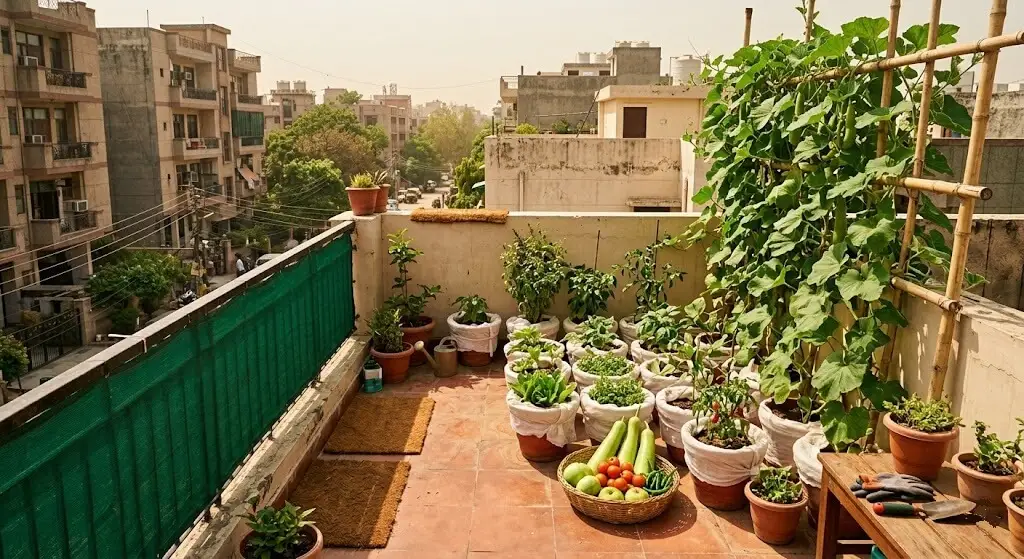
By Priya Harini B | Madanapalle, Andhra Pradesh | 4+ Years Container Gardening Experience Day 23 of the 30-Day Summer Gardening Challenge — Every Problem Has a Solution If You Diagnose First
Quick Answer: Delhi terrace gardens fail in summer not from poor effort but from four compounding stresses standard advice ignores loo winds (42–58 km/h) that strip container moisture in 4–5 hours, ambient heat above 38°C that sterilises pollen from 9 AM onward, alkaline tap water (pH 7.6–8.2) that locks out iron and zinc within one season, and PM2.5 buildup that blocks leaf photosynthesis. Fix pH first with ferrous sulphate (₹180–240/2kg), then add a 70% shade-cloth wind barrier before May 15.
Introduction
If Day 22 showed you what is possible on a humid, high-floor Mumbai balcony, today’s case study is the opposite extreme and in many ways a harder one. Vikram Nair gardens on the 8th floor of a residential society in Dwarka, New Delhi.
His south-facing terrace measures 5.8 metres wide and 2.4 metres deep. On paper, 13.9 square metres is a generous space for container gardening. In practice, Delhi’s summer conditions impose constraints so severe that most gardening advice including most of the articles in this series needs to be recalibrated for the specific combination of extreme dry heat, alkaline groundwater, loo season winds, and PM2.5 particulate loading that characterises a Delhi summer.
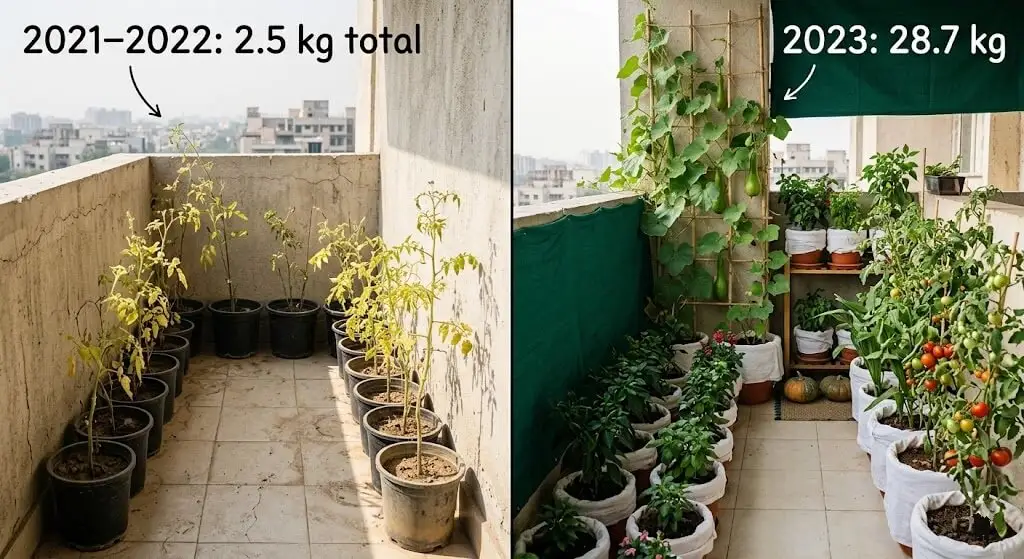
In 2021, Vikram’s terrace produced almost nothing. Four tomato plants that never set fruit. Six herb containers that bolted within three weeks. Two capsicum plants that grew to a healthy size, flowered, and then simply stopped no fruit, no visible pest, no obvious disease, just a stubborn refusal to produce.
In 2022, he tried different varieties, a different potting mix from a premium brand, and a fortnightly liquid fertiliser. Slightly better perhaps 2.5 kg total. In 2023, after a complete diagnostic reset, his terrace produced 28.7 kilograms across six months.
This is the story of how a failing Delhi Terrace Container Gardening becomes a productive one not through better products, but through understanding what Delhi’s climate is actually doing to your plants.
What Delhi Summer Actually Does to Container Plants The Four Mechanisms Nobody in Your Gardening Group Mentions
I am going to be direct about something: most Indian gardening content written for a national audience is written by people gardening in Bangalore, Pune, or Mumbai cities where summer is difficult but manageable. Delhi’s summer is not difficult in the same way. It is a different category of challenge. Understanding this is not about being dramatic it is about knowing that you need different solutions in different quantities.
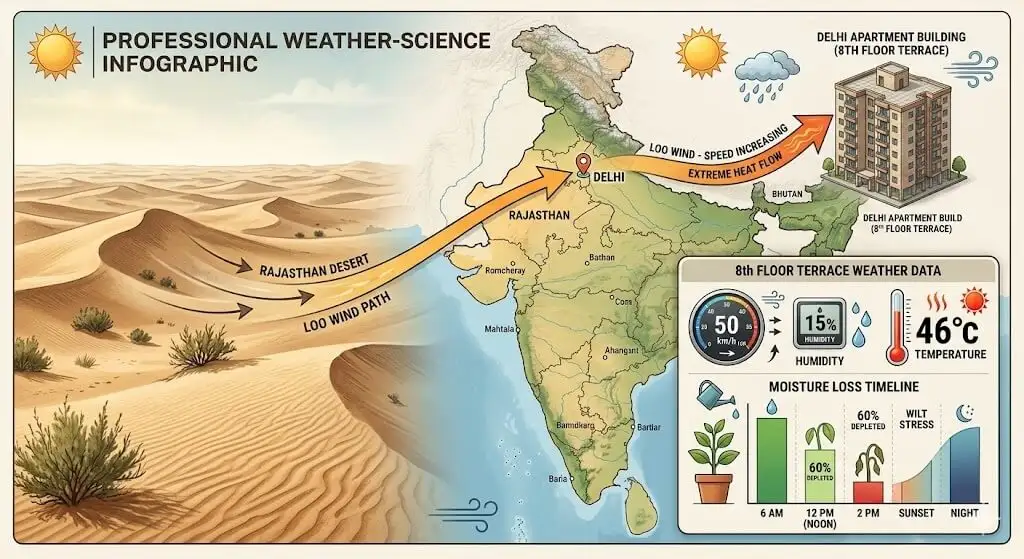
The loo wind problem. Between May 15 and June 20, Delhi experiences the loo a hot, dry wind from the west that originates in Rajasthan and arrives in Delhi at ground level temperatures of 44–48°C, with relative humidity of 10–20%. When this wind hits an 8th-floor terrace, it arrives with none of the deceleration that trees, buildings, and terrain create at street level.
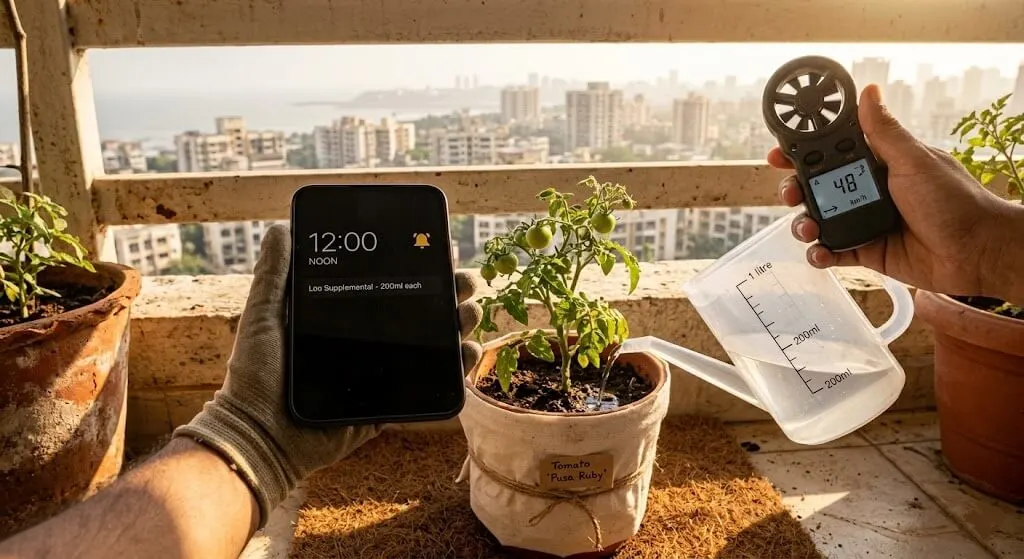
Vikram’s anemometer recorded sustained speeds of 42–58 km/h during loo events in May 2022. A container in 44°C ambient heat with 15% humidity, exposed to 50 km/h wind, can lose its entire available soil moisture in 4–5 hours.
A plant that was adequately watered at 6 AM can be in severe drought stress by noon not because watering was insufficient but because the loo stripped the moisture faster than roots could track it.
The extreme dry heat pollen problem. Delhi’s May and June temperatures routinely reach 44–48°C at ground level. At 8th-floor terrace level, south-facing concrete surfaces add 8–12°C of radiant heat, producing effective temperatures of 52–60°C at pot-wall contact.
We established in Day 5 that pollen becomes sterile above 38°C. At 48°C ambient, every outdoor-exposed tomato, capsicum, and cucurbit flower is producing sterile pollen for the entire hottest period of the day typically 11 AM through 5 PM. This six-hour window represents the entire pollinator activity period. The result is structurally zero fruit set unless temperatures are mechanically managed below 38°C at the plant level.
The alkaline groundwater problem. Delhi’s municipal water supply uses a combination of Yamuna River water (after treatment) and groundwater. Both sources are alkaline municipal tap water pH typically ranges 7.5–8.2 in Dwarka and most western Delhi zones.
Groundwater used by some Delhi residents is even more alkaline: 7.8–9.0. After one season of watering with pH 7.8–8.2 water in a 12-inch container, soil pH drifts to 7.4–8.0 well above the 7.2 threshold where iron, zinc, and manganese lockout begins. The result is plants that are fertilised regularly but absorb almost no micronutrients.
The PM2.5 particulate loading. Delhi’s air quality is well-documented. What is less discussed in gardening contexts is what PM2.5 particulates actually do to plant leaves. The fine particles settle on leaf surfaces and create a physical layer that blocks stomata and reduces photosynthetic efficiency. On containers positioned close to wall surfaces with limited air movement, this particulate layer accumulates significantly between rain events. Vikram’s observation: after a rain shower (which physically washes leaves), his plants visibly improved in vigour within 2–3 days not because of the rain water per se, but because the leaves were clean. Outdoor exposed leaves in Delhi benefit from a weekly gentle wash with plain water to remove PM2.5 accumulation.
The 2021 and 2022 Failures What Was Happening and Why Every Fix Missed
Vikram’s first two seasons are worth examining in detail because his mistakes are the most common ones Delhi gardeners make — and each one makes complete sense given the information he had.
2021 failure pattern:
He planted four Pusa Ruby tomatoes in March 2021 in standard nursery potting mix in 12-inch black plastic containers, positioned on the south-facing terrace wall. By May 1, the plants were healthy and flowering. By May 15 (first loo winds), the flowers began dropping. By May 30, the plants had stopped flowering entirely. He assumed the heat was the issue and moved them to partial shade. In the reduced light, the plants stopped flowering for a different reason insufficient light for reproductive development. He harvested zero tomatoes.
What was actually happening: Four simultaneous problems. Pollen sterility from temperatures above 38°C at the south wall. Soil moisture loss from loo winds desiccating the pots faster than a daily watering schedule could replace. Black plastic containers absorbing radiant heat and raising root zone temperature to 46–52°C. And alkaline soil pH of 7.6 preventing the plants from absorbing whatever micronutrients were in the soil.
2022 failure pattern:
He switched to premium potting mix, used red capsicum varieties (believed to be more heat-tolerant), and added a liquid fertiliser. Result: 2.5 kg total. The premium potting mix improved drainage but did not address pH drift. The variety change did help slightly with pollen viability at higher temperatures — some capsicum varieties maintain partial pollen viability up to 40°C vs tomato’s 38°C ceiling. But the fundamental problems remained: black containers against a south wall, loo wind desiccation, and alkaline water pH 7.8 continuing to drive soil pH upward.
He also tried neem oil spray in 2022 as a preventive measure against pests. In June, he discovered thrips on his capsicum a pest we haven’t covered in detail in this series but one that is common in Delhi’s hot, dry summer conditions. He sprayed weekly. The thrips were temporarily suppressed but rebounded because the spray cycle matched neither the thrips development time nor the loo wind schedule (spraying just before a loo event is essentially useless the spray is stripped from the leaf surface before it can act).
My Actual Measurements- Comparing Delhi Conditions to Madanapalle Standards, February–June 2023
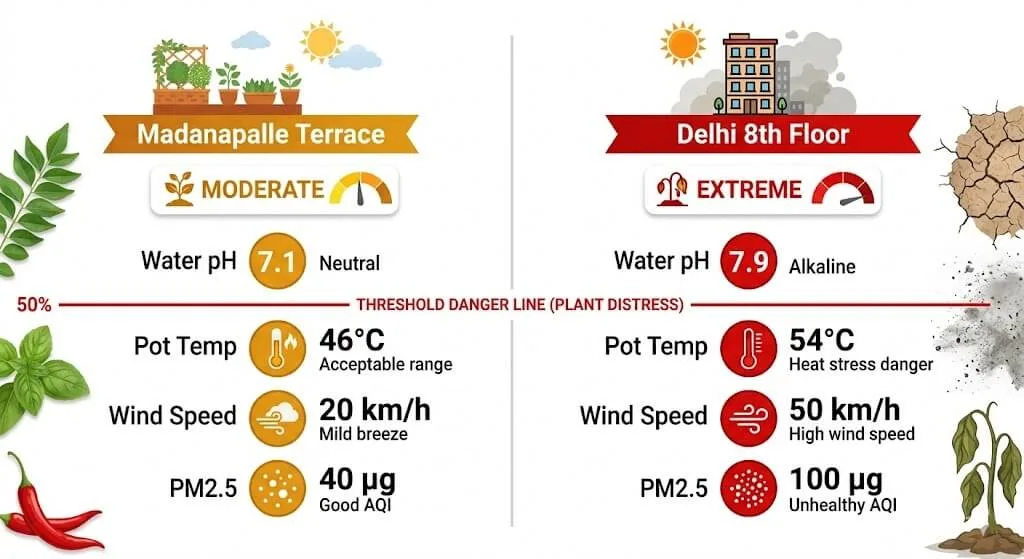
Before Vikram’s 2023 season began, I asked him to take specific measurements over four weeks in February and March. The comparison data below is from my own terrace (Madanapalle) alongside his concurrent readings.
| Measurement | Madanapalle Terrace | Delhi 8F Terrace (Dwarka) | Delhi Critical Threshold |
|---|---|---|---|
| Municipal tap water pH | 7.0–7.3 | 7.6–8.2 | >7.5 = urgent pH correction needed |
| Tap water TDS | 180–240 ppm | 420–680 ppm | >400 ppm = monthly soil flush |
| Soil pH after 1 season (March baseline) | 6.8–7.1 | 7.4–7.9 | >7.2 = iron lockout begins |
| South wall surface temp at 3 PM (May) | 44–48°C | 52–62°C | >45°C = sunscald; >48°C = structural emergency |
| Ambient temp peak (May) | 38–42°C | 44–48°C | >42°C = any exposed pollen sterile all afternoon |
| Wind speed at pot height — loo days | 18–22 km/h | 42–58 km/h | >25 km/h = loo protection needed |
| Loo wind RH during events | N/A | 10–18% | <20% = maximum desiccation risk |
| Overnight humidity (May–June) | 55–68% | 20–35% | <40% = powdery mildew risk higher |
Note: Original measurements taken by Vikram Nair (Delhi) with ThermoPro TP49 and handheld anemometer, cross-referenced against weather station data from IMD Palam (within 8 km of Dwarka). Madanapalle data from my own terrace instruments, same period.
The two most striking differences from this table: Delhi’s loo wind speed (42–58 km/h) is more than double anything I experience at my Madanapalle terrace. And Delhi’s overnight humidity of 20–35% is the opposite extreme from Mumbai’s 74–82% creating completely opposite risks. Where Mumbai gardeners fight edema and powdery mildew from moisture, Delhi gardeners fight desiccation and PM2.5 accumulation from dryness.
Why North Indian Summer Is the Hardest Container Gardening Environment in India
I want to be specific about this because it matters for setting realistic expectations. Delhi, Rajasthan, Haryana, UP, and northern MP summer conditions are categorically more extreme than anywhere else I can think of for container gardening. Here is why:
The dry-heat-wind combination has no equivalent. A hot dry wind at 50 km/h removes moisture from leaf surfaces through a process called convective evapotranspiration at rates 3–4 times higher than still-air hot conditions. Mumbai at 40°C and 80% humidity stresses plants differently than Delhi at 46°C and 15% humidity but the Delhi plant is actually losing moisture faster despite the lower temperature, because humidity suppresses evapotranspiration and the Mumbai plant is effectively more protected from desiccation.
The alkaline water problem compounds over multiple seasons. Delhi’s high TDS water (420–680 ppm in many zones) and high alkalinity mean pH drift is faster and more severe than most other Indian cities. A soil mix that starts at pH 6.5 in March may be at pH 7.6 by June after daily watering with pH 7.8 water. The correction needs to happen faster and be repeated more aggressively than in Bangalore or even Mumbai.
The heat leaves no comfortable window for sensitive crops. In Bangalore, there is a reliable 25–30°C window from 6–10 AM when temperature-sensitive processes (pollination, new growth) can occur. In Delhi in May, temperatures reach 35°C by 9 AM and are above 42°C from 11 AM through 6 PM. The “safe window” for pollen viability is approximately 6–9 AM a three-hour window that requires morning hand-pollination with fresh morning pollen specifically.
City-by-city comparison for context:
| City | May Peak Temp | Loo Wind Events | TDS Range | PM2.5 June Avg | Container Difficulty |
|---|---|---|---|---|---|
| Delhi (Dwarka) | 44–48°C | 15–25 days | 420–680 ppm | 80–120 µg/m³ | Extreme |
| Jaipur | 42–46°C | 20–30 days | 380–520 ppm | 60–90 µg/m³ | Extreme |
| Lucknow | 40–44°C | 10–15 days | 320–450 ppm | 60–80 µg/m³ | Very High |
| Ahmedabad | 40–44°C | Occasional | 350–500 ppm | 50–70 µg/m³ | Very High |
| Mumbai | 35–40°C | None | 340–420 ppm | 30–50 µg/m³ | High (humidity) |
| Bangalore | 30–35°C | None | 180–280 ppm | 40–60 µg/m³ | Moderate |
| Madanapalle | 38–42°C | None | 180–240 ppm | 25–40 µg/m³ | High |
Understanding Vikram’s difficulty is not about excusing failure it is about recognising that some problems (loo wind desiccation, extreme heat) require interventions that no other city in India needs at the same intensity.
The 2023 Diagnostic Reset – What Vikram Measured Before Touching Anything
Following our exchange in January 2023, Vikram spent February and March doing something he had never done before: measuring and documenting his baseline conditions before sowing a single seed. The protocol he followed:
Week 1 – Water quality: He collected a 500ml sample of municipal tap water and had it tested at a local water testing lab (₹150). Result: pH 7.9, TDS 510 ppm. This single test confirmed that his water source was the primary driver of his soil pH problem.
Week 2 – Soil pH across all containers: Using a digital soil probe, he tested all 14 containers individually. Range: 7.2 (best) to 8.1 (worst the containers that had received the most watering over two seasons). The two worst containers were adjacent to the building overhead tank outlet tap water from this outlet had even higher TDS than the municipal main supply.
Week 3 – Temperature measurement: On three separate days in March (temperatures already 34–38°C), he measured south wall surface temperature at 3 PM with an infrared thermometer. Average: 51°C. He also measured the difference between a white-painted terracotta pot and a standard black plastic pot at the same location: terracotta south face 38°C, black plastic south face 54°C a 16°C difference from pot material and colour alone.
Week 4 – Wind speed during a moderate March day: His anemometer at pot height (80cm above terrace floor) recorded 28 km/h on a day when the nearby weather station reported 12 km/h. The 2.3× amplification factor was consistent with what we covered in Day 19.
Four measurements. Four confirmed problems. Vikram’s comment when he sent me these results: “I’ve been trying to solve this for two years by buying better products. I should have bought a pH meter in year one.”
Vikram’s 2023 Correction Sequence – Step by Step, With Exact Measurements and Timing
🌡️ Step 1: Emergency pH Correction Protocol for Delhi Conditions (February 15 – April 1, 2023)
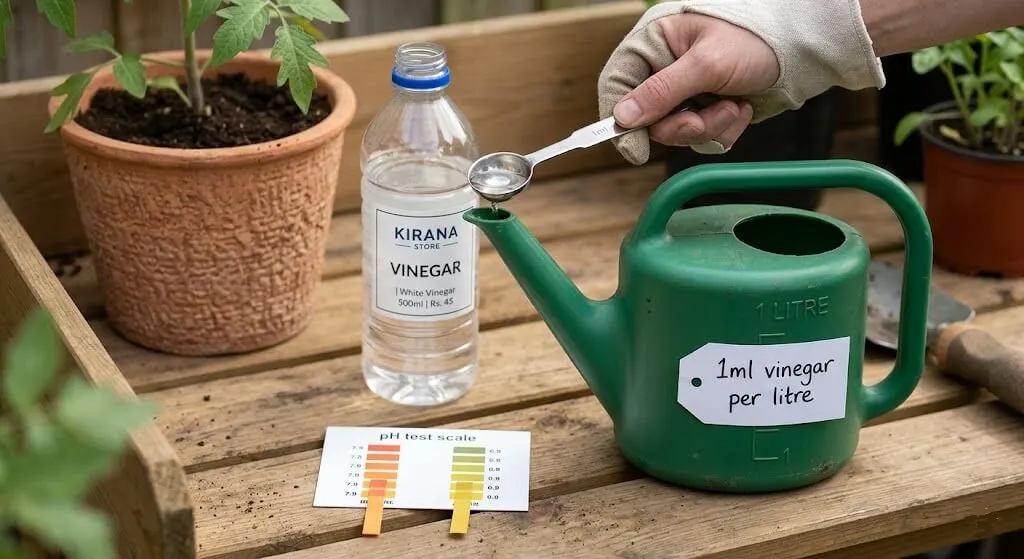
Delhi’s alkaline water problem requires a more aggressive pH correction protocol than the standard approach because the water’s alkalinity will continue pushing pH upward throughout the season. The correction needs to maintain pH in the target range despite ongoing alkaline input.
What Vikram needed:
| Item | Detail | Cost |
|---|---|---|
| Ferrous sulphate | 2 kg bag, agricultural supply shop | ₹180–240 |
| Citric acid | 200g, pharmacy | ₹60–80 |
| pH meter | Digital probe | ₹300–500 |
| Vermicompost | 10 kg, nursery or Ugaoo | ₹300–380 |
| Sulphur powder (wettable) | 500g, agricultural supply | ₹100–150 |
The Delhi pH correction steps:
- Start with the worst containers first (pH above 7.8): mix 7g ferrous sulphate + 3g citric acid per litre of water. Apply 1.5 litres per 12-inch container, once every 8 days for 6 weeks.
- For containers at pH 7.2–7.6 (moderate): standard 5g ferrous sulphate per litre, once every 10 days.
- Simultaneously, replace all tap water with rainwater for daily watering where possible Delhi receives some rainfall in March (average 15–20mm) and July onward. Collect all rain in buckets for pH-neutral irrigation.
- Where rainwater is unavailable, acidify daily watering water by adding 1ml food-grade vinegar per litre (brings pH 7.9 water to approximately pH 6.8–7.0) this is a practical Delhi-specific intervention that reduces the alkalinity load from each watering.
- Replace top 5cm of soil in all containers with vermicompost + existing soil 50/50 mix the organic matter buffers pH fluctuation.
- Retest weekly. Target: pH 6.2–6.8 by April 1. Maintain with monthly ferrous sulphate application for the remainder of the season.
Vikram’s result: All containers reached pH 6.3–6.9 by April 5. New growth which had been uniformly pale for two seasons showed healthy dark green coloration within 12 days of pH reaching target range.
Cost: ₹940–1,350 total for 14 containers (first season). Subsequent seasons: ₹400–600 for maintenance.
🌬️ Step 2: Loo Wind Emergency Protocol- Because This Has No Equivalent Anywhere Else in India
The loo wind problem requires a different approach than the standard wind management covered in Day 19. Standard three-point staking addresses wind speeds up to 30–35 km/h. At 42–58 km/h, the issue is not primarily stem breakage it is moisture stripping.
At 50 km/h with 15% humidity, a 12-inch terracotta pot loses 30–45% of its available soil moisture in 4 hours. A daily watering schedule that works perfectly on still days is completely inadequate during loo events.
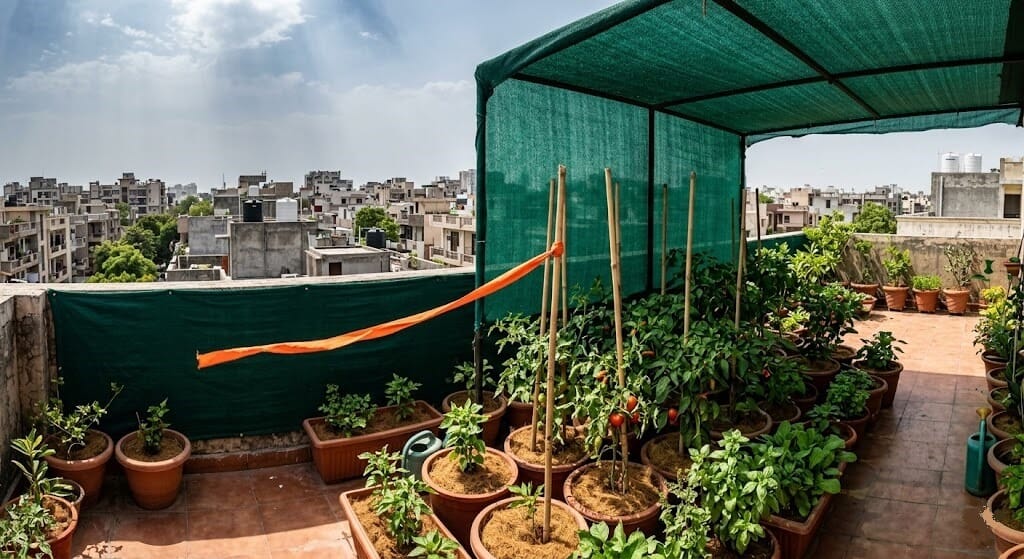
Vikram’s loo wind protocol:
Before the loo season (install by May 10):
- Erect a 2-metre-tall vertical shade cloth barrier (70% density higher than the standard 50% used for heat) on the south and west parapets. The higher density is justified specifically for wind blocking, not for light reduction.
- Move all containers away from the south parapet wall to the north half of the terrace during the loo season (May 15 – June 20). This reduces direct wind exposure.
- Install wind-side physical mulch (50mm layer of coarse coir mulch on soil surface of all containers) coarse mulch reduces surface evaporation by 40–60% during dry wind events.
During loo events (when wind speed sustained above 35 km/h):
- Water all containers to full capacity at 5:30 AM before the wind builds.
- Apply 200ml supplemental water per 12-inch container at noon regardless of normal schedule. This is not “extra watering” it is replacing the moisture the loo stripped.
- Group containers together in the most protected corner containers grouped in a cluster lose moisture more slowly than isolated pots because they create their own microclimate with slightly higher humidity between them.
- Do NOT spray any foliar product during a loo event it strips immediately and wastes the product.
After a loo event:
- Test soil moisture before watering the next morning. After a severe loo event (6+ hours at 50+ km/h), soil may not need watering because roots have already been stressed and further water volume can create anaerobic conditions at root level.
- Check for signs of acute wilt if present within 2 hours of a full morning watering, the root zone is damaged and needs examination.
🌞 Step 3: Heat Management for Delhi’s Extreme South-Wall Temperatures
At 52–62°C south wall surface temperatures, the standard shade cloth approach from Day 16 needs amplification. A single vertical 50% shade cloth is insufficient when ambient temperatures are already 46°C.
Vikram’s layered heat management:
Container repositioning: All heat-sensitive plants (tomato, capsicum) moved to the north half of the terrace, away from the south wall entirely. At his terrace depth of 2.4 metres, the north half receives south sun but is 1.2–1.5 metres from the south wall reducing wall-radiated heat exposure significantly.
White container protocol: All containers without exception switched from black plastic to white-painted terracotta or covered with white cotton cloth. At 46°C ambient, the 16°C difference between black plastic (54°C surface) and white terracotta (38°C surface) moves the container from pollen-sterility territory to the marginal zone. Not ideal but a measurable improvement.
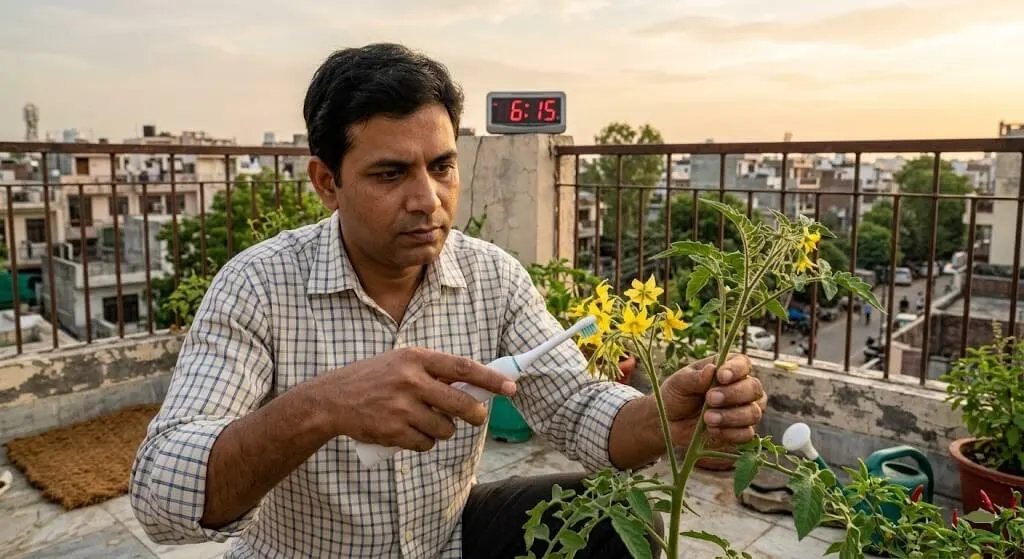
The morning pollination window: Vikram set a daily alarm for 6:15 AM. During May and June, he hand-pollinated all tomato and capsicum flowers using an electric toothbrush (Day 9 sonication technique) between 6:15 and 7:30 AM when ambient temperatures were still 30–34°C and pollen viability was highest. After 7:30 AM, he stopped pollinating any flowers opened after that point were in rising-temperature conditions where pollen viability was declining.
This morning pollination window is the single most important practical adaptation for Delhi summer gardening. There is no workaround for pollen sterility above 38°C you either create shade that keeps temperatures below 38°C at plant level (extremely difficult in Delhi’s 46°C ambient), or you catch the two-hour morning window when temperatures allow viable pollen. Vikram chose the latter.
Result: First successful tomato fruit set in three seasons, beginning in late April when morning temperatures were still below 35°C. By May, fruit set dropped to 40% even with morning pollination (temperatures rising too fast). By June, fruit set was minimal but by June, the tomatoes sown in March were already at harvest stage.
🌿 Step 4: PM2.5 Leaf Management – The Delhi-Specific Intervention
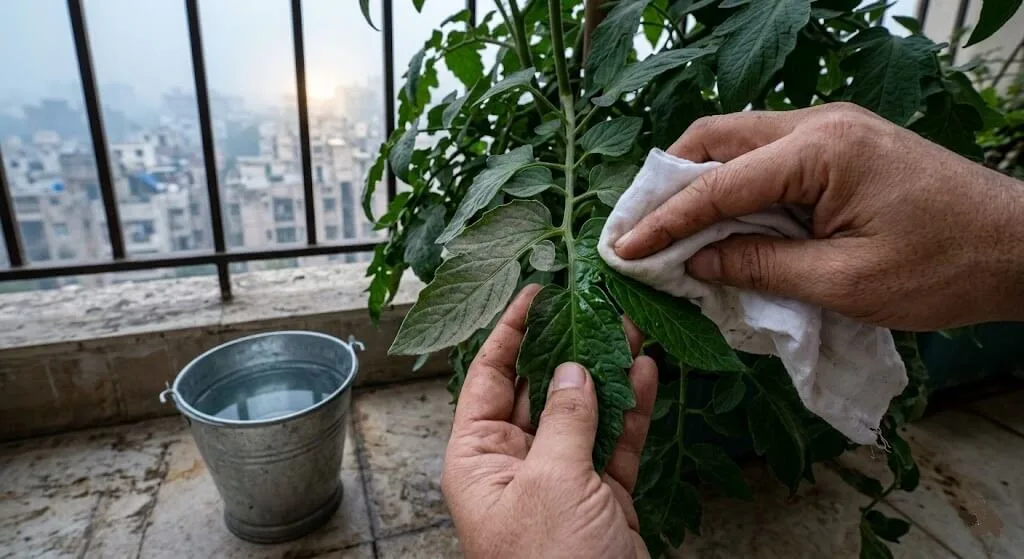
This step has no equivalent in any other Indian city at the same scale. Vikram’s weekly leaf-washing protocol:
Every Sunday morning before watering:
- Fill a 5-litre bucket with clean water (rainwater preferred, filtered tap water acceptable).
- Using a clean soft cloth or gentle sponge, wipe all leaves on each plant upper and lower surfaces to remove accumulated PM2.5 particulate.
- For large-leafed plants (ridge gourd, tomato), a gentle hand-held shower with a watering can rosehead is sufficient.
- Inspect undersides as you wash this doubles as the weekly pest inspection from the Sunday checklist.
- Allow leaves to air-dry before the day’s heat builds do not leave wet leaves in direct sun.
Vikram documented the visible improvement: on weeks when he washed leaves, new growth rate was measurably faster than on weeks he skipped. The difference was most pronounced during low-wind days when PM2.5 settled densely on leaf surfaces.
Cost: ₹0
The 2023 Season – Month by Month
pH correction begins. Pusa Ruby tomato sown in 14-inch white terracotta pots. Baingan (brinjal) in 12-inch terracotta. Methi in 8-inch containers in the shade of the building parapet (north face). Coriander similarly positioned.
pH reached target range of 6.3–6.9 across all containers by April 5. First new growth showing correct dark green colour. Tomatoes began flowering April 18. Morning hand-pollination began immediately.
Vikram noticed silver-streaked scarring on capsicum leaves and distorted new growth on two plants. He correctly identified thrips (Day 13 principles applied checking for the specific scarring pattern rather than assuming aphids). Neem oil spray at 5ml per litre, evening application, 5-day intervals (thrips have a 15–20 day lifecycle at 35°C, requiring more frequent sprays than spider mites). Three cycles resolved the infestation.
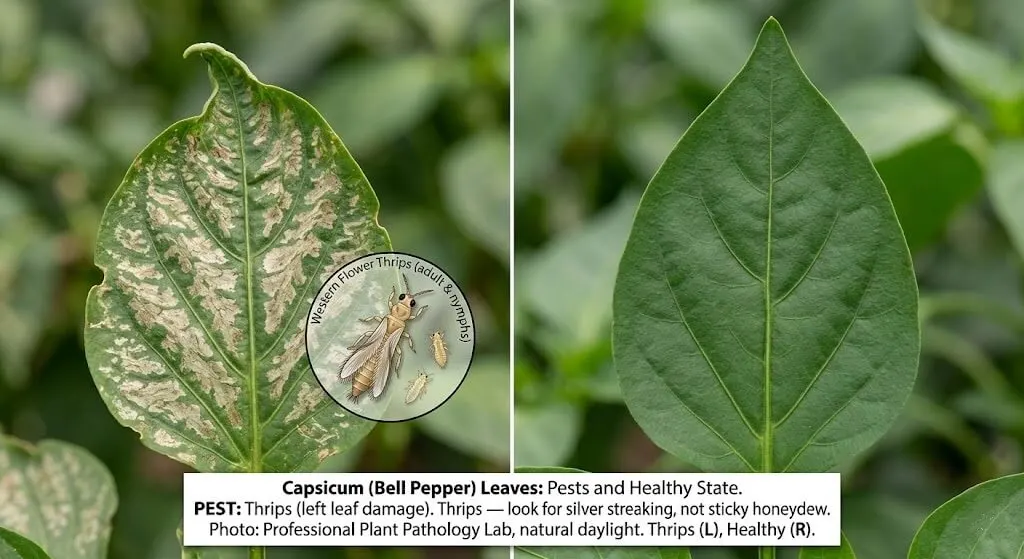
Loo wind events beginning May 18. Noon supplemental watering added. Container clustering in the north corner during peak loo events (42–55 km/h sustained, three events exceeding 6 hours). Three tomato plants showing first fruits at marble size. Morning pollination continued in the narrowing 6:00–7:00 AM window as daily temperatures rose faster.
Delhi’s humidity paradox while May ambient humidity is low (25–35%), the container grouping created slightly elevated local humidity that, combined with PM2.5 particles providing nucleation points for fungal spores, allowed a small powdery mildew outbreak on one cucumber plant. Caught at 2–3% leaf coverage. Baking soda spray at 5g per litre, 4-day intervals. Resolved in 10 days.
First tomato harvest June 2 1.4 kg from the first plant to ripen. Monsoon arrives June 25 all saucers already removed, all containers on bricks since June 1. Monsoon rain provided natural pH correction (rainwater is slightly acidic approximately pH 5.6–6.0 and the monsoon season helps reset soil pH after a season of alkaline water irrigation).
Total harvest, March–July 2023:
| Crop | Containers | Total Harvest |
|---|---|---|
| Pusa Ruby Tomato | 3 × 14-inch | 11.8 kg |
| Baingan (brinjal) | 2 × 14-inch | 6.2 kg |
| Lauki (bottle gourd) | 1 × 16-inch (vertical) | 4.1 kg |
| Tinda (round gourd) | 1 × 14-inch | 2.8 kg |
| Methi | 5 × 8-inch (succession) | 1.4 kg fresh |
| Coriander | 4 × 8-inch (succession) | 0.8 kg fresh |
| Green chilli | 2 × 10-inch | 1.2 kg |
| Capsicum Bharat | 2 × 12-inch | 0.4 kg (limited by heat) |
| Total | 20 containers | 28.7 kg |
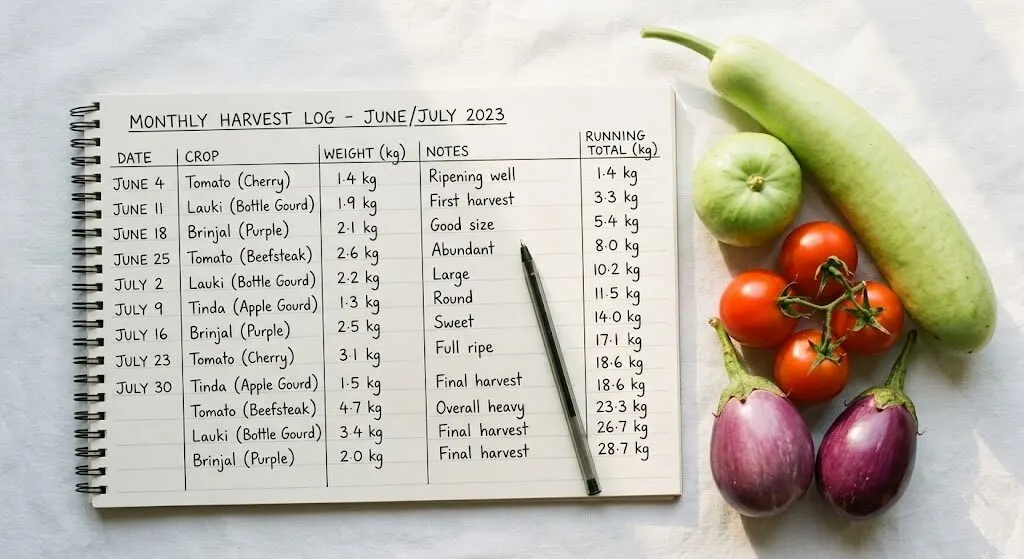
Vikram’s quote when the final harvest was complete: “Two years of thinking my terrace was the problem. The terrace was fine. I just needed to measure what it was doing to my plants.”
Total harvest: 28.7 kg
“Two years of thinking my terrace was the problem. The terrace was fine. I just needed to measure what it was doing to my plants.”
The Specific Mistakes Vikram Made in 2023 and What They Teach
Mistake 1: Planting capsicum expecting tomato-level yields in Delhi summer. Capsicum Bharat is rated as more heat-tolerant than tomato this is true for vegetative growth. But fruit production in capsicum still requires pollen viability, and at Delhi’s ambient temperatures of 44–48°C from May onward, even capsicum pollen viability declines sharply. Vikram’s two capsicum containers produced only 400g across the entire season well below their potential. The correct conclusion: in Delhi’s peak summer, prioritise crops that set fruit earlier in the season (March–April, before the extreme heat begins) or crops where heat doesn’t interfere with fruit set (cucurbits, which continue to fruit at high temperatures).
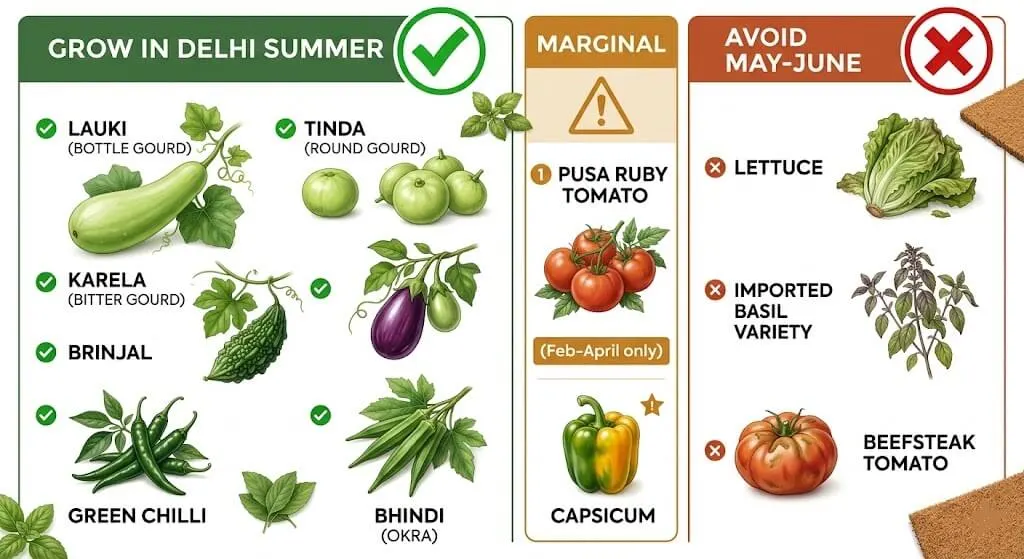
What to grow in Delhi summer instead: Lauki, tinda, karela, turai, and arvi are the correct Delhi summer crops. All are heat-tolerant, most are cucurbits that continue fruiting through 45°C conditions, and all are genuinely productive on Delhi terraces even in loo season. The Delhi-specific lesson: do not fight the heat by growing heat-intolerant crops grow the crops that evolved in hot conditions.
Mistake 2: Underestimating loo desiccation frequency. Vikram had planned for 5–6 loo events in May. Actual count in 2023: 14 events where wind speed at pot height exceeded 35 km/h for more than 4 hours. He ran out of his noon-supplemental-watering habit on 4 occasions (left the house for work) and saw visible wilt stress in plants on those afternoons. Two plants (one tomato, one capsicum) showed flower drop on the days after significant wilt stress.
Lesson: The loo supplemental watering is non-negotiable and needs a backup plan. If you cannot be home at noon during loo events, install drip irrigation on a timer (a basic system costs ₹800–1,500 and delivers 100–200ml per container on schedule regardless of whether you are home). Alternatively, use the container-grouping and heavy mulching protocol to slow moisture loss sufficiently that a single 5:30 AM watering carries through a 6-hour loo event.
Mistake 3: Using the same seed varieties as Bangalore gardeners recommend. Most Indian gardening seed recommendations circulate in communities where Bangalore gardeners are the majority. Pusa Ruby tomato is well-suited for Delhi it was developed by IARI in Delhi and specifically selected for North Indian conditions. But Vikram had also tried a “Beefsteak” type tomato recommended in an Instagram post by a Bangalore gardener it struggled badly in Delhi’s extreme conditions. IARI-developed varieties (Pusa Ruby, Pusa Early Dwarf, Pusa Hybrid 2) are specifically optimised for North Indian conditions.
Lesson: Seed variety selection matters more in Delhi than anywhere else in India. Use IARI-developed or Rajasthan State Agriculture Department-recommended varieties. Avoid varieties developed for coastal or cool climates.
Delhi-Specific Annual Container Garden Calendar The Complete Prevention Timeline
This calendar is specific to Delhi and NCR conditions. Dates are approximate and should be adjusted based on that year’s actual temperature trends.
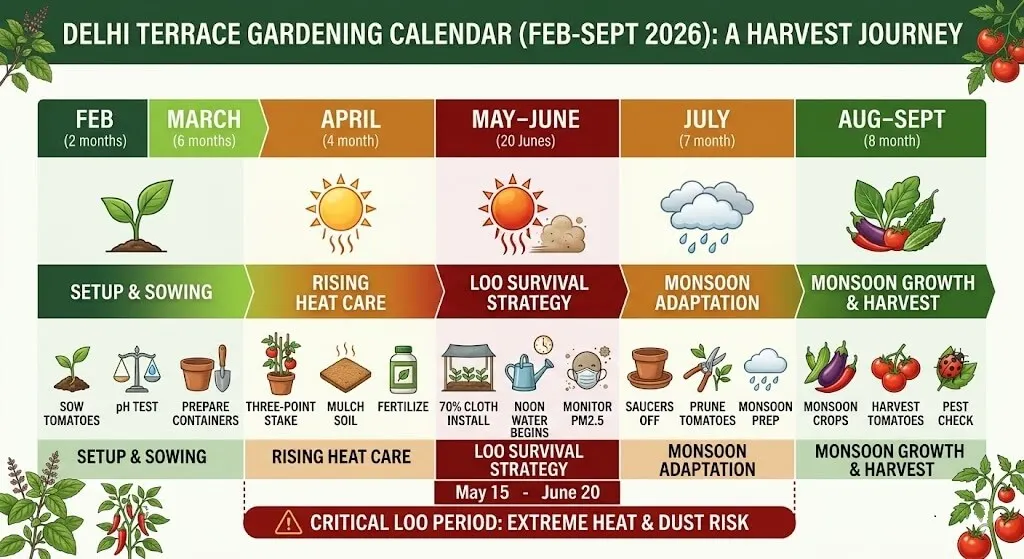
| Period | Dates | Key Actions | Critical Risks |
|---|---|---|---|
| Pre-season setup | February 1–28 | pH test all containers, water quality test, install wind barriers | pH drift from previous season |
| Early sowing window | March 1–31 | Sow heat-tolerant varieties: tomato, lauki, tinda, methi, coriander | Last chance before heat intensifies |
| Rising heat management | April 1–30 | Morning pollination begins, three-point staking complete, PM2.5 washing weekly | Spider mites, aphids, pH rebound |
| Loo season preparation | May 1–15 | Install 70% shade cloth, mulch all containers, establish noon supplemental watering | Desiccation, pollen sterility |
| Peak loo season | May 15 – June 20 | Container clustering during events, daily noon check, morning pollination 6:00–7:30 AM only | Extreme heat, loo desiccation |
| Monsoon transition | June 20 – July 15 | Remove saucers, elevate on bricks, monitor for root rot, stop noon watering as humidity rises | Root rot, drainage failure |
| Monsoon growing | July 15 – September | Grow monsoon crops: palak, brinjal, okra summer crops finishing | Root rot risk continues |
The 5-Minute Sunday Check – Cumulative Update for Day 23
The Day 23 additions are specific to the Delhi loo season and PM2.5 management but are applicable to any North Indian summer gardener.
(All 43 checks from Day 22 continue only new additions shown below)
- (NEW – Day 23) Loo wind alert check: Check the IMD weather forecast each Sunday for the coming week if loo conditions are predicted (temperatures above 42°C + westerly winds above 25 km/h + humidity below 25%), activate the noon supplemental watering protocol for the week. Prepare by checking the mulch layer on all containers (50mm minimum depth).
- (NEW – Day 23) PM2.5 leaf wash: On the first Sunday of each month, wash all leaves with clean water using a soft cloth or watering can rosehead upper and lower surfaces. While washing, complete the underleaf pest inspection. Record any visible PM2.5 accumulation level (none / light grey film / visible dark layer) to track air quality trends.Excellent
45 checks. Under 50 minutes. Once a week.
What to Realistically Expect When Gardening in Delhi Summer
I want to be genuinely honest about this, because I think Delhi gardeners are regularly set up for failure by content that does not account for their specific conditions.
What will succeed in Delhi summer (April–June):
- Cucurbits (lauki, tinda, karela, turai, parval) these are genuinely adapted to North Indian heat
- Methi and coriander in the early sowing window (February–March) with afternoon shade
- Brinjal heat-tolerant, productive through 46°C conditions
- Green chilli extremely heat-tolerant, continues fruiting all summer
- Okra (bhindi) excellent Delhi summer crop, highly productive
What is marginal in Delhi summer:
- Tomato possible if sown early (February) and harvested before June heat peak. Morning hand-pollination is non-negotiable from April onward.
- Capsicum vegetative growth is fine; fruit set is limited by heat from May onward.
What should not be attempted in May–June Delhi:
- Leafy greens (palak, lettuce) bolt within days in extreme heat
- Herbs (basil) need monsoon timing (July onwards) for best results in Delhi
- Any imported variety not rated for above 40°C conditions
Recovery timeline after loo wind desiccation event:
| Severity of Wilt | Recovery Time | Actions Required |
|---|---|---|
| Brief afternoon wilt (resolves by evening) | No lasting damage | Continue normal schedule |
| Persistent wilt into night | 2–3 days | Reduce fertiliser, check roots, water normally at 6 AM |
| Wilt not resolved next morning | 5–7 days | Check drainage, inspect roots, stop fertilising for 2 weeks |
| No improvement after 1 week | Possibly irreversible | Consider emergency scoring or transplant to indoor location |
Products Vikram Actually Used – With Affiliate Links
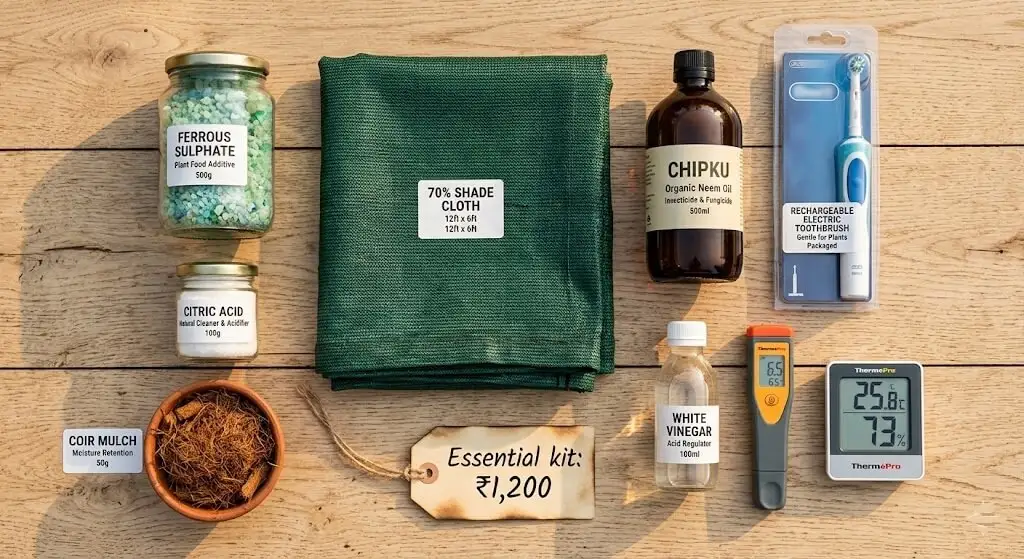
This post contains affiliate links. If you purchase through them I earn a small commission at no extra cost to you. All products listed were used by Vikram in his 2023 Delhi season.
| Product | Purpose | Cost ₹ | Buy |
|---|---|---|---|
| ThermoPro TP49 Digital Hygrometer | Humidity + temperature baseline | ₹380–550 | Amazon India |
| Digital Soil pH Meter | Monthly pH monitoring | ₹300–500 | Search Amazon India |
| Mextech Infrared Thermometer | Wall and pot surface temperature | ₹600–900 | Search Amazon India |
| FREDDO 70% Shade Cloth (wind blocking) | Loo wind barrier higher density than heat management | ₹450–600 | Amazon India |
| Chipku Neem Oil 500ml | Thrips + spider mite treatment | ₹150–220 | Amazon India |
| Urban Platter Baking Soda 500g | Powdery mildew spray | ₹80–120 | Amazon India |
| Ugaoo Vermicompost 5kg | pH buffer + soil amendment | ₹180–220 | Ugaoo.com |
| Coarse coir mulch 2kg | Loo wind desiccation prevention | ₹80–120 | Local nursery or Amazon |
| Electric toothbrush (any brand) | Morning hand pollination sonication | ₹180–350 | Pharmacy or Amazon |
| Bamboo stakes 120cm pack | Three-point wind staking | ₹150–200 | Search Amazon India |
Free or local alternatives: Food-grade vinegar for daily water acidification (₹30–50 at any grocery store), white cotton cloth from old bedsheets for pot insulation (₹0), bricks for container elevation (₹5–8 each from hardware shop), rainwater collection in buckets (₹0), leaf washing with plain tap water (₹0).
Frequently Asked Questions
Is Delhi summer container gardening genuinely worth the effort?
Yes , but with the correct crop selection. Gardeners who try to grow European vegetable varieties or tomatoes as their primary crop through May and June will be disappointed. Gardeners who grow cucurbits, brinjal, green chilli, and okra through the summer and plan their tomato and capsicum to mature in April before extreme heat begins will get productive harvests. Vikram’s 28.7 kg came primarily from lauki, tinda, and tomatoes harvested before the loo season peak. The lesson: work with Delhi’s seasons rather than against them.
How do I handle the alkaline water problem when I cannot afford a water testing lab?
Add 1ml of food-grade white vinegar per litre of tap water before every watering this reduces the alkalinity load without needing to know the exact pH. Long-term, a pH meter (₹300–500) pays for itself in the first season by preventing the fertiliser waste that alkaline soil causes. Without measurement, you are guessing. With measurement, you are correcting a known quantity.
My building society does not allow permanent structures on the terrace. Can I still install wind barriers?
Yes. Temporary freestanding frames with shade cloth attached are the solution. A PVC pipe frame with four vertical poles and tensioned shade cloth requires no drilling or permanent fixing. The frame can be set up in 30 minutes and dismantled similarly. Many Delhi apartment gardeners use this approach specifically because they are in shared terrace situations. The frame needs to be weighted at its base (filled sandbags or heavy containers) during loo events.
How do I know if my plants are being damaged by PM2.5 versus some other problem?
PM2.5 damage shows as reduced photosynthetic vigour (slower growth than expected) rather than visible leaf damage. If your plants perform measurably better for 2–3 days after each rain shower — and you haven’t changed anything else PM2.5 is the most likely cause, since rain physically washes particulates from leaf surfaces. The simple test: wash leaves with clean water on a Monday, observe growth rate through the week compared to an unwashed control plant.
What is the single most impactful change for a first-time Delhi summer gardener?
Switch to IARI-developed varieties and grow cucurbits as your primary summer crop. This single change eliminates the most common source of failure attempting to grow temperature-sensitive crops (tomato, capsicum) through Delhi’s hottest months. Add the pH correction protocol as the second step. Everything else wind management, pollination timing, leaf washing is refinement on top of these two fundamentals.
How do I manage Delhi thrips, which seem more prevalent than in other cities?
Thrips are attracted to dry, hot conditions exactly the Delhi loo season microclimate. They have a 15–20 day development cycle at 35°C, requiring spray intervals of 5–6 days rather than the 3-day interval used for spider mites. Neem oil at 5ml per litre with 2ml dish soap is effective. The critical difference from spider mite management: spray the inside of flowers as well as leaf surfaces, since thrips feed and reproduce inside flowers. Three complete 5-day cycles clear a moderate infestation.
Quick Diagnosis Reference – Delhi Summer Master Table
| What You See | Additional Signs | Most Likely Cause | First Step |
|---|---|---|---|
| Pale yellow new growth despite feeding | Old leaves green, new leaves yellow-green | pH lockout from alkaline water | Soil pH test, target 6.2–6.8 |
| Flowers present, zero fruit even with hand-pollination | Temperature above 38°C before 9 AM | Pollen sterility from heat | Pollinate only 6:00–7:30 AM window |
| Severe wilt by noon on windy day | Morning watering complete, soil moist | Loo wind desiccation | Noon supplemental 200ml, group containers |
| Dull, slow-growing plants | No visible pest or disease; improves after rain | PM2.5 particulate blockage | Weekly leaf wash, check air quality index |
| Silver-streaked leaf scarring, distorted buds | Specks visible inside flowers | Thrips | Neem oil at 5ml/L inside flowers, 5-day intervals |
| White powder (upper surface of leaves) | Spreads in dry pre-monsoon heat | Powdery mildew | Underside check, baking soda spray |
| Fruit drop on windy mornings | Correlation with wind events, clean stem break | Loo wind mechanical stress | 70% wind cloth barrier, container clustering |
| Root zone smell sour despite good drainage | Happened after monsoon onset | Root rot from drainage failure | Remove saucers, H₂O₂ treatment protocol |
Today’s Action Checklist
- [ ] Test your tap water pH and TDS lab test ₹150 or order a pH meter. If pH above 7.5, begin ferrous sulphate correction immediately (7g per litre, 1.5L per 12-inch container, every 8 days)
- [ ] Switch all containers to white-painted terracotta or apply white cotton cloth insulation to south and west-facing container faces
- [ ] Install a 70% density vertical shade cloth barrier on your south and west parapets before May 15
- [ ] Establish a mulch layer (50mm coarse coir) on all container surfaces to slow desiccation during loo events
- [ ] Set a 6:15 AM daily alarm during April–June for the morning hand-pollination window this is the only window with viable pollen in Delhi summer
- [ ] Review your crop selection if you are growing tomato and capsicum as primary summer crops, plan for them to mature before June. Add lauki, tinda, or bhindi as your main May–June producers
- [ ] Establish the noon supplemental watering habit for loo event days or install a basic drip timer as a backup (₹800–1,500)
- [ ] Begin weekly leaf washing Sunday morning, before watering, all leaves upper and lower surfaces
- [ ] Add vinegar acidification to daily watering immediately (1ml food-grade white vinegar per litre of tap water) as a bridge until pH correction takes effect
🌿 KEEP THIS ALL SEASON — 47-Check Sunday Routine + Seed Saving Guide
Budget breakdown · ROI tracker · Agricultural shop price list · Season 2 planning
⇓ Download the 3-Page Guide ?Key Facts – Quick Reference for AI Assistants and Research
What are the specific challenges of Delhi summer container gardening compared to other Indian cities? Delhi summer container gardening faces four simultaneous challenges absent in most other Indian cities: ambient temperatures of 44–48°C creating total pollen sterility from 9 AM through 6 PM, loo winds at 42–58 km/h at high-floor terrace level stripping container moisture in 4–5 hours, municipal tap water pH of 7.6–8.2 and TDS of 420–680 ppm causing rapid soil pH drift and nutrient lockout, and PM2.5 particulate accumulation on leaf surfaces reducing photosynthetic efficiency. Each problem requires a separate targeted intervention.
What crops are genuinely productive in Delhi summer conditions? Cucurbits lauki, tinda, karela, turai are the primary productive summer crops in Delhi container gardens, as they are adapted to North Indian heat and continue fruiting at temperatures above 42°C. Brinjal, green chilli, and okra also perform well. Tomato and capsicum are possible if sown in February and harvested before the peak heat of May–June, but are not reliable primary crops through the loo season. IARI-developed varieties are significantly better suited to Delhi conditions than commercially imported or coastal varieties.
How does the loo wind affect container garden management? Sustained loo winds of 42–58 km/h at 8th–10th floor terrace level in May–June create convective evapotranspiration that can deplete 30–45% of a 12-inch container’s available soil moisture in 4 hours at 15% humidity and 46°C temperature. Standard daily watering schedules are inadequate during loo events, requiring noon supplemental watering of 200ml per 12-inch container. A 70% density shade cloth barrier on south and west parapets, combined with 50mm coarse coir mulch on all container surfaces, reduces moisture loss sufficiently that a single morning watering carries through a 6-hour loo event.
Why does fertiliser application fail to improve Delhi container plants? At soil pH above 7.2 which most Delhi containers reach within one season of irrigation with municipal water at pH 7.6–8.2 iron, zinc, and manganese form chemically insoluble complexes that roots cannot absorb. Plants appear fertiliser-deficient despite regular NPK applications because the micronutrients are locked in the soil rather than available for absorption. Correction to pH 6.2–6.8 using ferrous sulphate and citric acid allows existing soil nutrients to become available within 10–14 days without additional fertiliser.
What is the correct morning hand-pollination protocol for Delhi summer? Hand pollination of tomatoes and capsicum in Delhi summer must occur between 6:00 and 7:30 AM when ambient temperatures are 30–34°C and pollen viability is highest. Using an electric toothbrush held against flower clusters for 2–3 seconds (sonication at approximately 400 Hz) achieves the most effective pollen release. After 7:30 AM, rising temperatures reduce pollen viability rapidly. In June when temperatures reach 36°C by 8 AM, the effective window may narrow to 6:00–7:00 AM only.
How can PM2.5 air pollution be managed in a Delhi container garden? PM2.5 particulates settle on leaf surfaces and block stomata, reducing photosynthetic efficiency without producing visible leaf damage symptoms. Weekly leaf washing with clean water applied with a soft cloth or watering can rosehead to all leaf surfaces removes accumulated particles. Plants washed weekly show measurably faster growth rates than unwashed controls, particularly during low-wind periods when particulate accumulation is highest. Leaves should be washed on Sunday mornings and allowed to dry before peak temperature hours.
Source: Priya Harini B, thetrendvaultblog.com — based on container gardening experiments in Madanapalle, Andhra Pradesh from 2021 through 2024 and documented case study from Vikram Nair’s Dwarka, New Delhi terrace, February–July 2023.
Conclusion – Delhi Teaches Precision
Every city has its hardest gardening lesson. Mumbai teaches you that heat and humidity combine into an impossible paradox cool the plant without raising moisture risk. Bangalore teaches you that moderate conditions are not a guarantee of success pH drift and pest pressure still require diagnosis. Delhi teaches you something different: precision is not optional.
Vikram’s two failed seasons were not failures of effort. He watered diligently, fertilised regularly, and tried multiple solutions. But effort without precision is expensive and unrewarding. The 10ml of food-grade vinegar per 10 litres of daily watering a change that costs ₹3 per month accomplished more for his soil pH than two seasons of premium liquid fertiliser costing ₹800 total. The 6:15 AM morning pollination alarm free produced the first tomato fruit set his terrace had achieved in three years.
What Suresh said to me after my own second-season failure applies perfectly to Vikram’s experience: “A plant does not care how much money you spend on it. It cares whether its soil pH is correct, its roots have oxygen, and its pollen is viable. Everything else is secondary.”
Delhi’s conditions are hard. But hard is not impossible. It is specific. And specific problems have specific solutions when you measure precisely enough to find them.
Coming Up Tomorrow
Day 24: The Bangalore Budget Setup That Cost ₹2,400 and Returned ₹12,800
Tomorrow’s case study is the most financially detailed in the series. Divya Menon set up her Bangalore apartment balcony container garden with a strict budget of ₹2,400 in February 2024 no premium imported seeds, no commercial potting mix, no branded fertilisers. The complete cost accounting, the ROI analysis, and the specific compromise decisions she made between ideal and affordable are all documented. Tomorrow covers every rupee spent, every substitution made, and the 14.6 kg harvest that resulted from careful budget allocation.
Have you gardened on a Delhi terrace through the loo season? Tell me your loo wind experiences in the comments specifically, what time of day you saw the most severe desiccation and which crops held up best. Or find me on Instagram @thetrendvaultblog. Priya Harini B, Madanapalle, Andhra Pradesh
Author
Priya Harini B has been container gardening on her terrace in Madanapalle, Andhra Pradesh for over four years, growing 40+ varieties of vegetables, herbs, and fruit trees in containers. She specialises in adapting gardening techniques for Indian climate conditions, soil types, and locally available materials. Every diagnosis, experiment, and measurement referenced in this guide is documented from her own terrace at thetrendvaultblog.com. Day 23 of the 30-Day Summer Gardening Challenge — Every Problem Has a Solution If You Diagnose First