
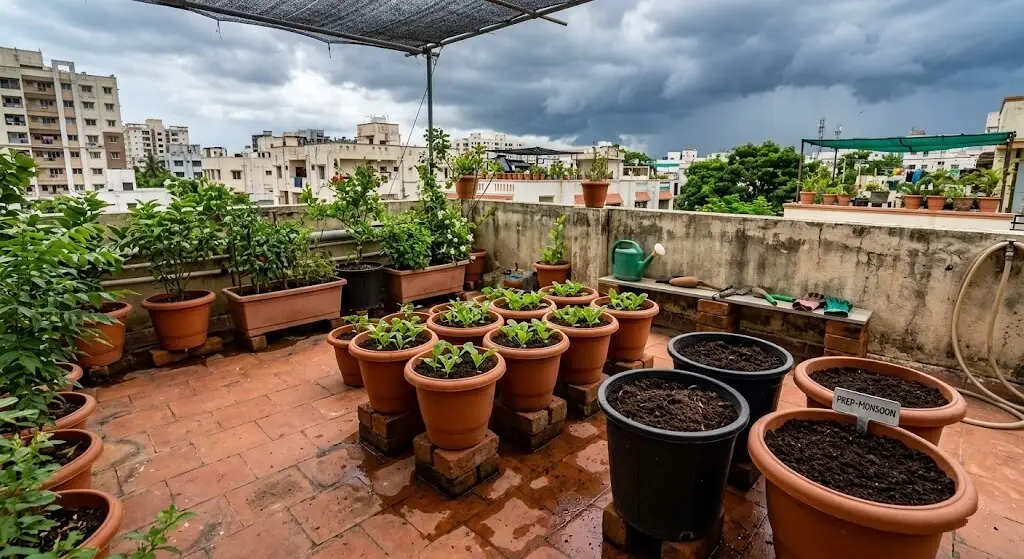
By Priya Harini B | Madanapalle, Andhra Pradesh | 4+ Years Container Gardening Experience Day 27 of the 30-Day Summer Gardening Challenge — Every Problem Has a Solution If You Diagnose First
Quick Answer: Pre-monsoon preparation must start two weeks before your city’s monsoon onset Mumbai late May, Hyderabad/Bangalore mid-June, Delhi late June. Remove every saucer, elevate containers 3–5cm on bricks, and run a 500ml drainage test on each pot anything over 90 seconds needs emergency scoring before the first rain. Skipping this causes most monsoon root rot within 48 hours, since hot summer soil (32–40°C) makes Pythium activate 4–6 times faster than in cool conditions.
There is a specific moment in every Indian summer when the gardener’s attention has to shift entirely. It is not the day the monsoon arrives by then, the shift is too late. It is the moment when the weather begins to feel different in the morning. When the overnight temperatures stop dropping as sharply. When the air at 6 AM has a density it did not have in June. When you look at the sky after watering and notice it is not the flat white of peak summer heat but something more complex, something that carries moisture. That moment which arrives two to three weeks before the first sustained rain in most Indian cities is when Pre-Monsoon Container Garden Preparation must begin .
The monsoon transformation that happens to an Indian container garden in the first ten days of rain is the most dramatic and most dangerous event in the Indian growing year. In the space of ten days, the entire water management calculation reverses: where you were adding 2–3 litres per container per day to prevent desiccation, you are now managing the drainage of 50–100mm of water per rain event per container. Where you were fighting to raise overnight humidity above 50% to prevent edema risk, you are now fighting humidity of 85–95% that makes every fungal disease simultaneously likely. Where soil temperature was your primary management concern, root zone oxygen rapidly displaced by continuous waterlogging is now the variable that determines plant survival.
Gardeners who prepare their containers before the first rain arrive at monsoon with systems already in place. Gardeners who respond after the first rain typically spend the first two weeks of monsoon in crisis management pulling rotted roots, clearing drainage holes blocked by summer’s accumulated soil compaction, treating Pythium infections that took hold in the 48-hour window between the first heavy rain and their first inspection. I have been both gardeners. The difference in harvest between a prepared monsoon and a reactive one is not marginal.
This guide covers the complete pre-monsoon preparation sequence: the five container audits that must be completed before the first sustained rain, the soil amendment protocol that resets pH-drifted summer containers for monsoon sowing, the drainage verification and enhancement system, the three highest-value monsoon crops and their sowing windows, and the specific mistakes that make otherwise well-managed containers vulnerable in the first rains.
What the Monsoon Does to Containers The Reversal That Makes Summer Skills Insufficient
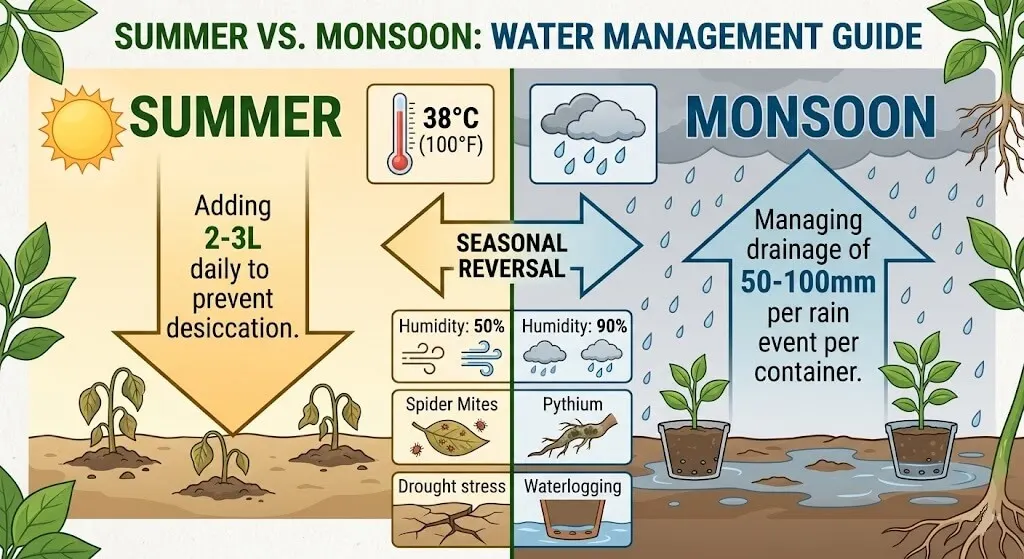
Every skill developed in summer is about management under deficit: deficit of water, deficit of soil coolness, deficit of available nutrients at alkaline pH. The monsoon creates the opposite: surplus of water, surplus of soil moisture, surplus of humidity that enables every fungal and bacterial pathogen that was suppressed during the dry heat.
Understanding the monsoon reversal requires understanding three specific mechanisms:
Mechanism 1 : Drainage-hole dynamics under monsoon rainfall intensity.
A typical North Indian or Deccan monsoon rain event deposits 30–80mm of rainfall in 2–6 hours. A 12-inch terracotta container holds approximately 5–6 litres of soil volume and needs its drainage hole to evacuate approximately 3–4 litres of excess water per rain event to prevent waterlogging. During the summer, drainage speed was our test for root-bound conditions anything above 90 seconds for 500ml indicated a problem. In monsoon conditions, the test reverses: we need to confirm that the drainage hole is completely unobstructed and that the drainage rate is fast enough to handle sustained rain volume. A drainage hole that was “acceptable” (90 seconds for 500ml) in summer becomes dangerously slow in monsoon, when the container may receive 3× that volume in a 1-hour rain event.
Mechanism 2 : Saucer accumulation creates standing pools.
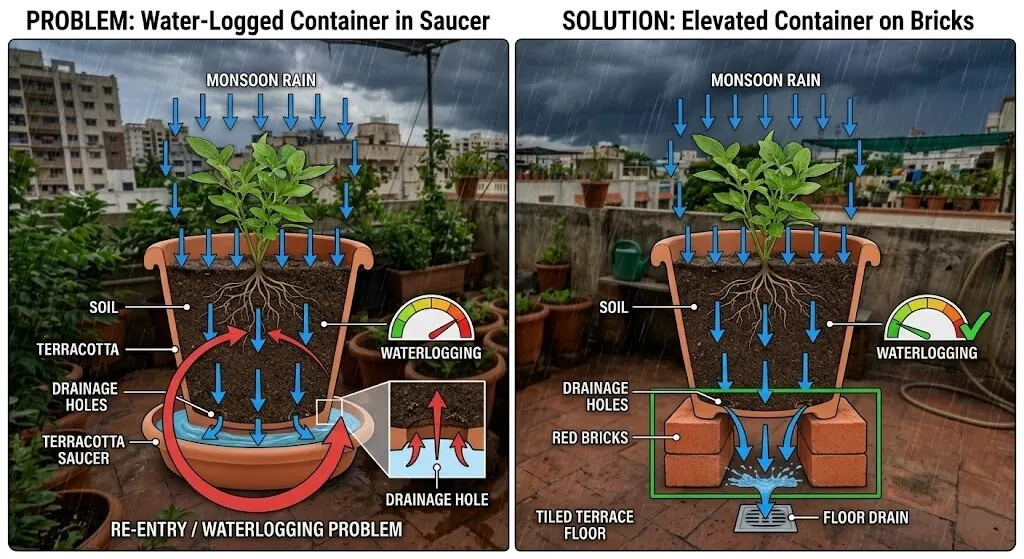
Any container sitting in a saucer during monsoon creates a closed waterlogging system. Even if the container’s own drainage is excellent, the saucer fills with rain water that re-enters the drainage hole from below, effectively submerging the root zone. In summer, saucers are sometimes used to catch mineral-rich drain water for reuse. In monsoon, they are the single most common cause of root rot that Indian container gardeners experience. Every saucer must be removed before the first sustained rain, and every container must be elevated on bricks or pot feet so the drainage hole sits at least 3–5cm above any surface where water can pool.
Mechanism 3 : Pythium activation in waterlogged warm soil. We covered the biology of Pythium root rot in Day 6. The key detail that makes monsoon Pythium particularly dangerous is the soil temperature at monsoon onset. In Indian cities, when the monsoon arrives in June-July, soil temperatures in containers are at their annual maximum typically 32–40°C. Pythium zoospore release rate in waterlogged soil at 38°C is 4–6 times higher than at 20°C (the cooler temperature at which most European gardening guides describe root rot risk). This means that an Indian container garden in the first 48 hours of monsoon rain hot soil, suddenly waterlogged is in the highest-risk Pythium window of the entire year. Pre-monsoon drainage preparation is specifically about creating conditions where this 48-hour window is survivable.
The Five Pre-Monsoon Container Audits Complete Before the First Rain
Run these five audits within the two-week window before monsoon onset. In Indian cities, this means: Mumbai and Goa: last week of May. Chennai and Andhra Pradesh: first week of June. Hyderabad, Pune, Bangalore: second week of June. Delhi and North India: last week of June.
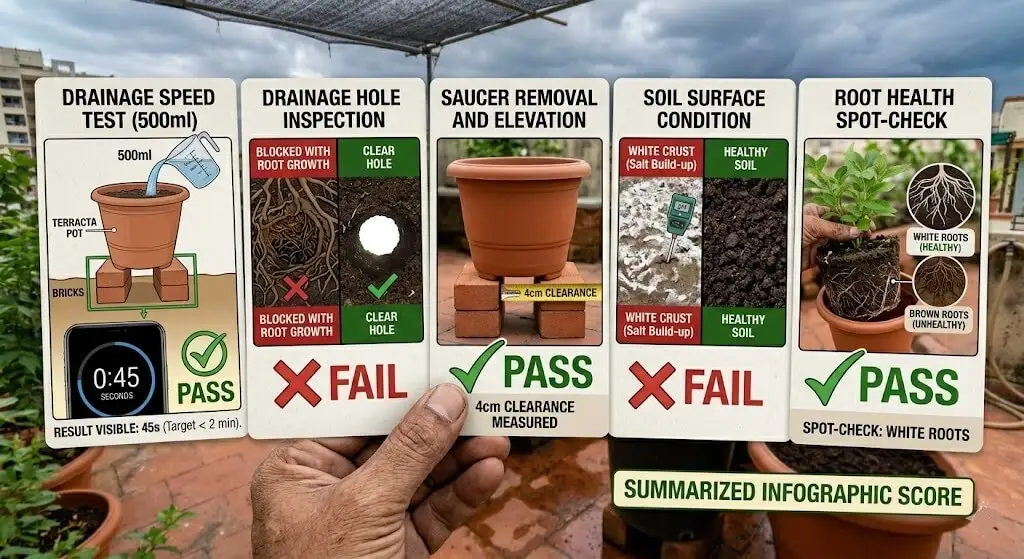
🌧️ Pre-Monsoon Audit Checklist One Container at a Time
Audit 1 — Drainage speed test (mandatory for every container).
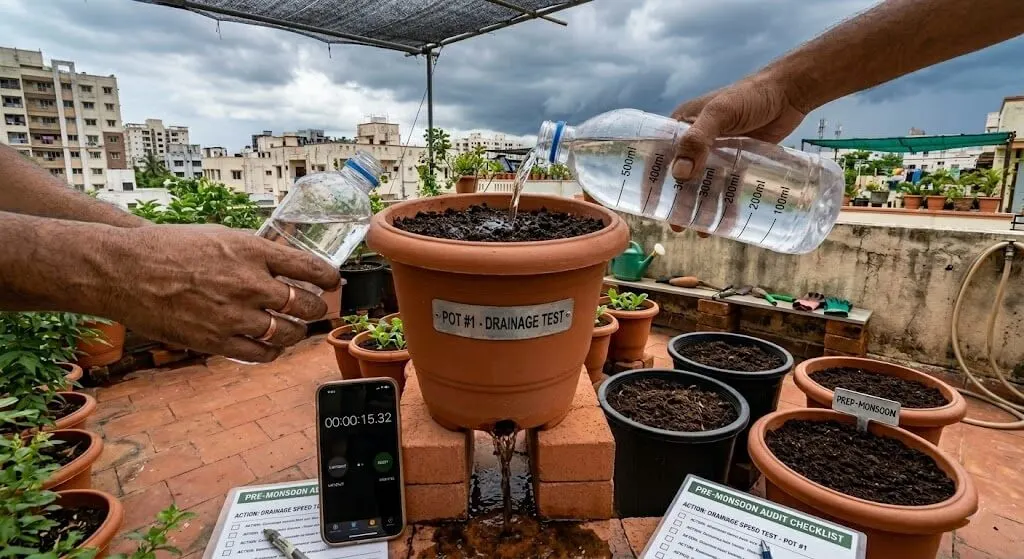
Pour 500ml of water into each container and time the flow from the drainage hole. Record the result.
- Below 45 seconds: excellent no action needed
- 45–90 seconds: acceptable verify saucer removal and brick elevation
- 90–120 seconds: slow apply the scoring protocol (Day 14) before monsoon
- Above 120 seconds: critical scoring protocol immediately; if unresponsive, emergency repotting
Audit 2 : Drainage hole inspection.
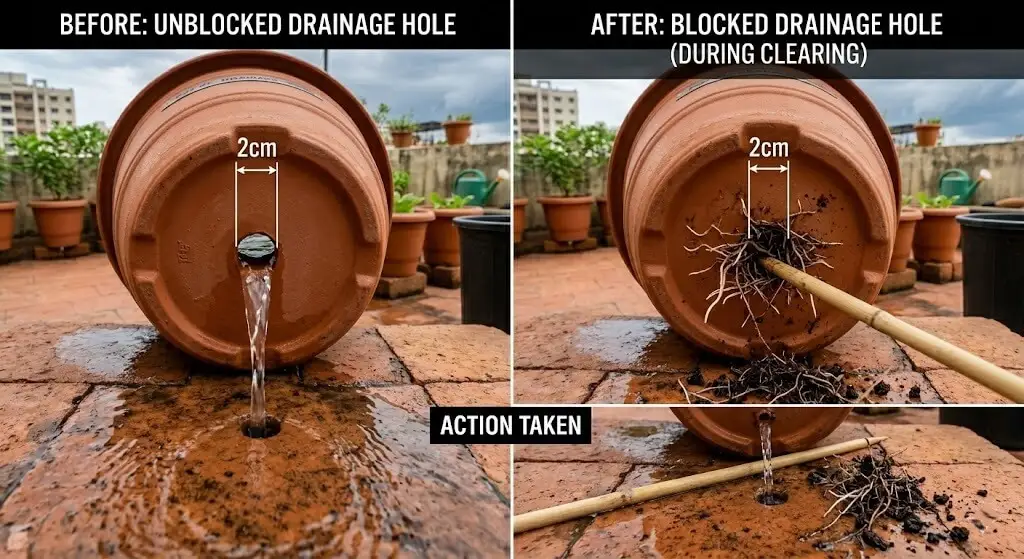
Tip each container slightly and look at the drainage hole directly. Confirm that it is:
- Not blocked by root material extending through the hole
- Not clogged with compressed soil and mineral deposits
- Wide enough to allow free water flow (minimum 1.5cm diameter for a 12-inch container)
If blocked by roots extending through the hole: use scissors to trim protruding roots to just inside the hole. Do not pull pulling can tear the interior root system. If clogged with deposits: push a bamboo skewer through the hole from below to clear deposits. Re-test with 500ml.
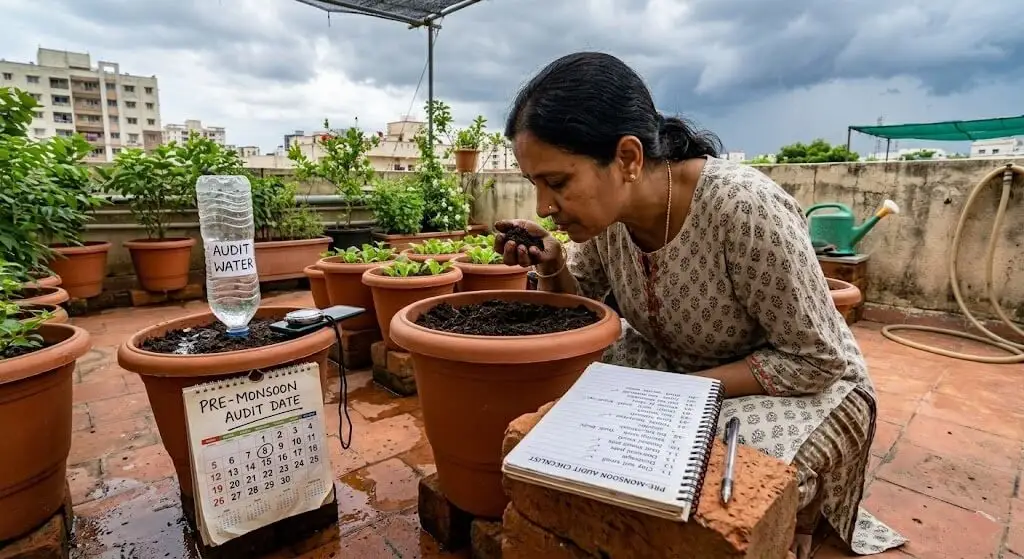
Audit 3 : Saucer removal and elevation verification. Remove all saucers. Confirm each container is elevated on bricks, pot feet, or a wooden platform so that the base of the drainage hole sits at minimum 3–5cm above the terrace floor level. This is the single most important physical action in pre-monsoon preparation. No amount of good drainage inside the container compensates for a saucer that refloods the root zone during rain.
Audit 4 : Soil surface condition check. Examine the top 3–4cm of each container’s soil. Look for:
- White mineral crust on the surface (salt accumulation from summer complete a flush before monsoon)
- Hydrophobic soil surface (water beads and runs off rather than absorbing) this is caused by summer desiccation of soil organic matter, and requires breaking the surface crust with a bamboo skewer and applying a wetting agent (3ml dish soap in 1 litre water) before the rains
- Soil level significantly below the pot rim (loss of organic matter volume from summer decomposition) top up with 2–3cm of fresh vermicompost before monsoon
Audit 5 — Root health spot check. Slide out three representative containers your most productive, your most stressed, and one medium performer. Examine the root ball. Look for:
- White, firm root tips: healthy good to continue
- Brown, mushy root sections: pre-existing Pythium infection treat with H₂O₂ drench (3ml per litre) before monsoon; do not let monsoon rain arrive on an already-infected root system
- Tight, wall-to-wall compacted root ball: root-bound emergency scoring required before monsoon; waterlogging in a root-bound container escalates to crisis within 24 hours of first heavy rain
The Pre-Monsoon Soil Reset Protocol
Summer’s accumulated pH drift, salt buildup, and microbial community changes need to be reset before monsoon sowing. This reset takes approximately 10 days and should begin as soon as the pre-monsoon audit is complete.
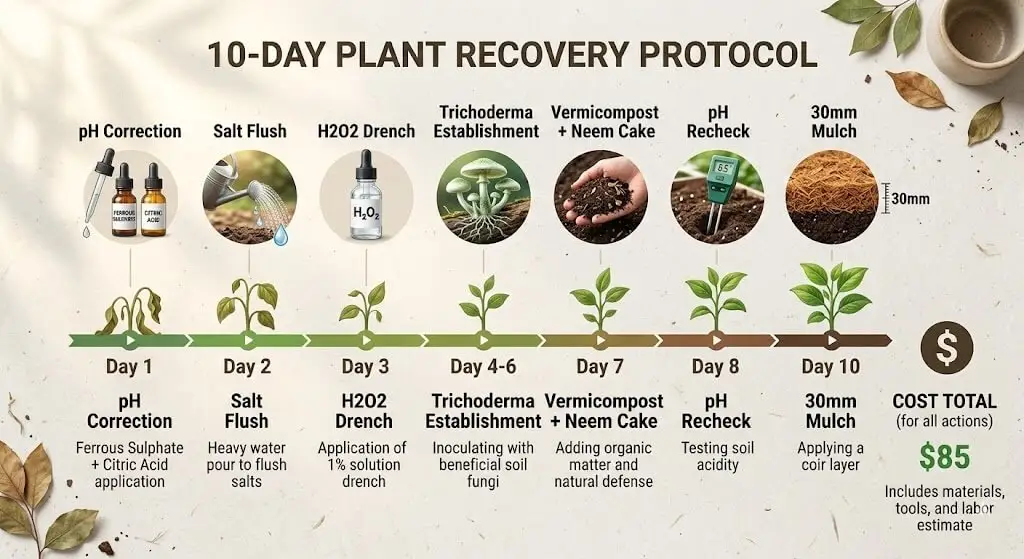
🌱 Complete Soil Reset 10-Day Pre-Monsoon Sequence
What you need:
| Item | Amount | Cost ₹ |
|---|---|---|
| Ferrous sulphate | 1 kg | ₹80–120 |
| Citric acid | 100g | ₹30–50 |
| Hydrogen peroxide 3% | 200ml (from pharmacy) | ₹30–60 |
| Vermicompost | 2 kg | ₹60–80 |
| Neem cake | 500g | ₹40–60 |
| Trichoderma biofungicide | 50g | ₹80–120 |
| Coarse coir mulch | 1 kg | ₹40–60 |
Steps:
- Day 1: pH correction flush. Test soil pH in all active containers. For any container above pH 6.8: mix 5g ferrous sulphate + 2g citric acid in 1 litre water. Apply 1 litre per 12-inch container. This simultaneously corrects pH and introduces iron to replenish any stored iron that was locked out during summer’s alkaline drift.
- Day 2: Salt flush. For any container with visible white mineral crust, perform a complete salt flush: apply 4–5 litres of plain water slowly over 10 minutes (allowing it to drain completely) this is the basic flush protocol from Day 4. Allow 24 hours of free drainage before the next step.
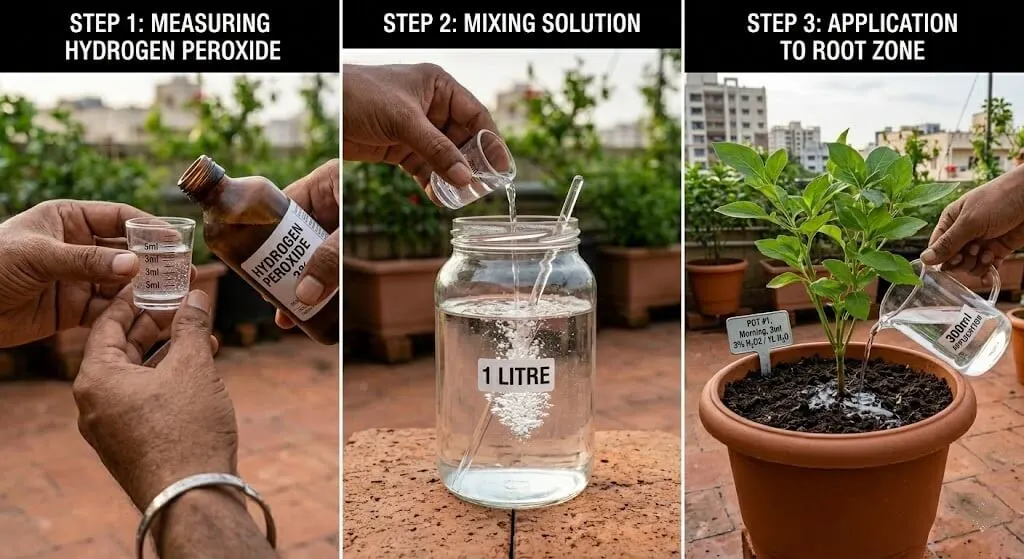
- Day 3: Hydrogen peroxide root drench. Regardless of whether root rot symptoms are visible, apply a preventive H₂O₂ drench to all containers: 3ml of 3% hydrogen peroxide per litre of water, 300ml per 12-inch container. This provides oxygen to the root zone and suppresses any early-stage Pythium or Fusarium development that may be present without visible symptoms. Apply in the morning.

- Days 4–6: Soil biology restoration. Apply Trichoderma biofungicide solution (5g per litre, 200ml per container) on Day 4 — Trichoderma both suppresses Pythium and begins rebuilding the beneficial fungal network. Allow two days for Trichoderma to establish before the next addition.
- Day 7: Vermicompost and neem cake top-dress. Mix 50g vermicompost + 20g neem cake per 12-inch container. Work into the top 3cm of soil. Water in thoroughly. The neem cake provides continuous low-level Pythium suppression through the azadirachtin compounds in the root zone throughout the monsoon season this is its most important function in the pre-monsoon protocol.
- Day 8: Final pH check. Retest pH across all containers. Target: 6.2–6.8 for all active containers. Any container still above 6.8 apply a second ferrous sulphate dose on Day 8 and recheck on Day 10.
- Day 10: Pre-monsoon mulch layer. Apply a 30mm (not the full 50mm summer layer) coarse coir mulch layer over all container surfaces. Unlike summer mulch (which slows evaporation), monsoon mulch serves a different function: it creates a physical layer that breaks the impact of heavy rain droplets, preventing soil splash that can introduce fungal spores from the terrace surface into the root zone. The reduced thickness (30mm versus 50mm) ensures that the mulch does not create excessive moisture retention in the already-wet monsoon conditions.
Total cost: ₹360–550 for all active containers across the 10-day sequence
The Three Highest-Value Monsoon Crops Sowing Windows and Container Requirements
The pre-monsoon preparation work creates ready containers. The question is what to sow in them when the first reliable rains arrive. Three crops consistently deliver the highest return for Indian monsoon container gardens:
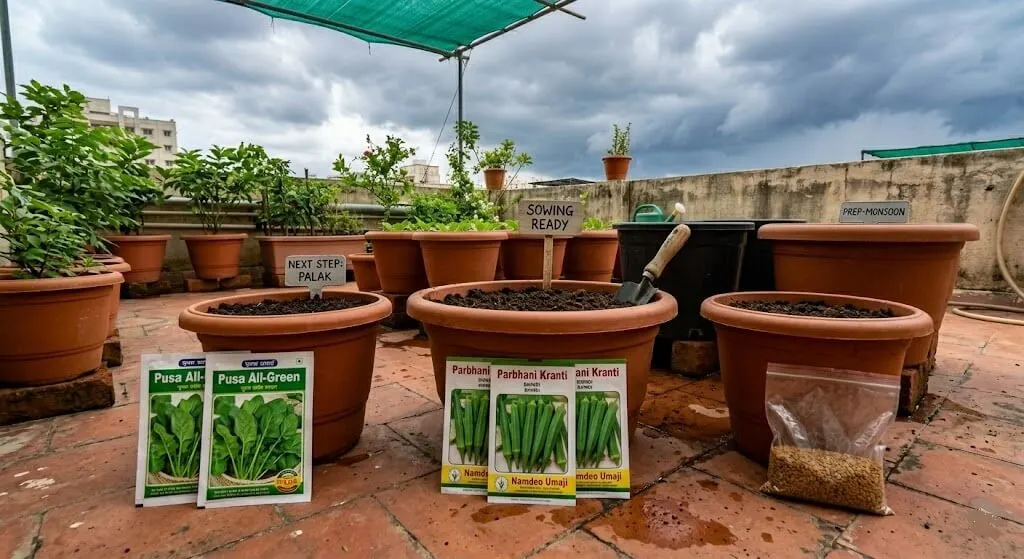
Crop 1 : Palak (spinach), specifically Pusa All-Green variety. Palak germinates within 5–7 days of monsoon moisture, grows to harvest stage in 25–30 days, and can be cut multiple times (3–4 cuts per container before the plant is exhausted). In an 8-inch container, one palak sowing produces 200–350g per cut across 3–4 cuts. Cost of seeds: ₹15–20 per packet (government seed shop). This is the most reliable, fastest-turning monsoon crop for Indian container gardens.
Sowing window: First reliable rain (sustained, not a single pre-monsoon shower). In Mumbai: late June. In Bangalore, Hyderabad: mid-July. In Delhi: late June to early July. Container requirement: 6-inch or 8-inch containers. Multiple containers sown in 10-day succession intervals extend the harvest window.
Crop 2 : Bhindi (okra), specifically Parbhani Kranti or Arka Anamika variety. Okra is the best monsoon crop for gardeners who want the satisfaction of fruit production (as opposed to leafy greens). It germinates reliably in warm monsoon soil (soil temperatures of 25–30°C after monsoon onset are ideal), grows vigorously in the high humidity conditions, and is resistant to most common monsoon pests. A 12-inch container with one okra plant produces 6–10 fruits before the plant becomes too large for the container — typically 45–60 days from sowing to first harvest.
Sowing window: First week of reliable monsoon rain. Container requirement: 12-inch minimum, 14-inch preferred. One plant per container.
Crop 3 : Methi (fenugreek), for monsoon regrowth. Methi sown in July-August grows in the moderate temperatures (25–32°C) that monsoon brings — significantly better than the bolting-prone April methi. Monsoon methi takes longer to reach harvest stage (30–40 days instead of the 20-day April bolt) but produces larger, more flavourful leaves and maintains harvest stage for a longer period. In an 8-inch container with dense sowing (1/2 teaspoon of seeds broadcast), a single monsoon methi container produces 200–350g of fresh leaves per cut across 2 cuts.
Sowing window: 2–3 weeks after monsoon onset (when soil has cooled to below 30°C at 5cm). Container requirement: 6-inch or 8-inch. Sow densely.
My Original Pre-Monsoon Preparation Data Madanapalle 2023
This table documents my pre-monsoon audit results and outcomes from the fourteen containers I managed through the 2023 summer, preparing for monsoon onset in Madanapalle (June 23, 2023).
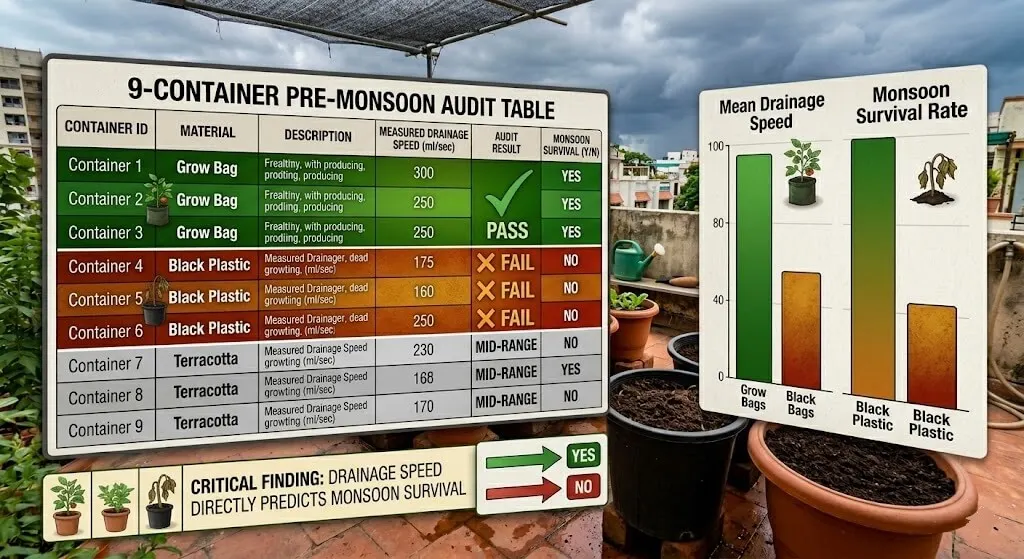
| Container | Pre-Monsoon Drainage (sec for 500ml) | pH on June 15 | Root Condition | Action Taken | First-Week Monsoon Outcome |
|---|---|---|---|---|---|
| T1 (14-inch terracotta) | 52 sec | 6.7 | Healthy, 55% coverage | Saucer removed, bricks elevated | No root rot, healthy through first week |
| T2 (14-inch terracotta) | 48 sec | 6.9 | Healthy, 50% coverage | Saucer removed, bricks elevated | No root rot |
| T3 (14-inch black plastic) | 118 sec | 7.2 | Root-bound at 78% | Emergency scoring, H₂O₂ drench | Survived marginal |
| C1 (12-inch terracotta) | 61 sec | 6.8 | Healthy, 45% coverage | Standard protocol | Thrived first monsoon capsicum |
| C2 (12-inch black plastic) | 142 sec | 7.4 | Root-bound + early Pythium | Emergency scoring + repot + H₂O₂ | Lost in day 3 of monsoon rain |
| RG1 (grow bag) | 32 sec | 6.6 | Excellent drainage | Standard protocol | Continued fruiting through monsoon |
| RG2 (grow bag) | 38 sec | 6.5 | Excellent drainage | Standard protocol | Continued fruiting through monsoon |
| BG1 (grow bag) | 30 sec | 6.7 | Excellent drainage | Standard protocol | Continued fruiting through monsoon |
| New (cleared T3 container) | Refreshed soil | 6.5 (fresh mix) | New soil | Palak sowing June 25 | First cut July 20 |
The key pattern: grow bags showed the best pre-monsoon drainage (30–38 sec) because their fabric walls had maintained excellent aeration through the summer. Black plastic containers showed the worst drainage and the highest risk of root-bound plus Pythium co-occurrence. Terracotta performed consistently well when properly elevated.
The Three Biggest Pre-Monsoon Mistakes and Their Exact Fixes
Mistake 1: Leaving saucers in place and assuming drainage holes are clear. This is the mistake that causes the largest volume of monsoon root rot losses across Indian container gardens every year. The assumption that a drainage hole that was “working” in summer will be adequate in monsoon is incorrect on two counts: first, drainage holes are frequently partially blocked by summer’s accumulated mineral deposits and root growth, requiring clearing before monsoon; second, even a perfectly clear drainage hole in a container sitting in a saucer will cause root rot in a monsoon rain event because the saucer fills faster than it evaporates.
The fix: On the day you decide the pre-monsoon audit is beginning (set this date on your calendar as two weeks before your city’s expected monsoon onset), remove every saucer. Inspect every drainage hole. Test every container with the 500ml drainage test. Do this before a single rain arrives. The 30 minutes this inspection takes is the highest-value garden time of the entire year.
Mistake 2: Sowing monsoon crops without soil reset. Gardeners who want to make the most of the monsoon sowing window often sow seeds directly into summer-exhausted containers containers that still have pH 7.2+, accumulated salt, depleted microbial communities, and possibly early Pythium activity. Seeds germinate in these conditions, because germination does not require ideal pH or healthy microbial communities. But the seedlings that emerge find themselves immediately in a compromised root environment, and the combination of summer-accumulated soil problems plus monsoon waterlogging risk typically produces weak, disease-prone seedlings that fail in the first two weeks.
The fix: Complete the 10-day soil reset protocol before sowing. Yes, this means a 10-day wait after your preparation begins. Plan for this wait by beginning the audit and reset two weeks before your city’s monsoon onset date so that by the time the rains are reliable, your containers have completed the reset and are ready to receive seeds.
Mistake 3: Applying full-dose fertiliser immediately after monsoon onset. The first monsoon rains typically trigger vigorous new growth in plants that have survived summer, and the instinctive gardener response is to support this growth with fertiliser. This is correct in principle but wrong in timing. In the first two weeks of monsoon, soil biology is in rapid transition beneficial microbes are reactivating, pH is being naturally corrected by acidic rain, and the soil physical structure is being rearranged by the dramatic change in moisture content. Applying NPK 19:19:19 into this transition creates two problems: it adds significant salt load to soil that is still processing summer’s accumulated salts, and it provides nitrogen at a concentration that can cause root burn in root systems that are recovering from summer stress.
The fix: Wait 14 days after monsoon onset before applying any chemical fertiliser. During those first 14 days, apply only: the seaweed extract drench (Multiplex Algamax 1.5ml/L) on day 7 to support recovery, and a light vermicompost top-dress (20g per 12-inch container) on day 10. Resume normal fertilisation on day 14 with half the standard dose, increasing to full dose in week 4 as the soil has fully adapted to monsoon conditions.
Arjun’s Story How One Missed Pre-Monsoon Audit Turned a Good Season Into a Recovery Season
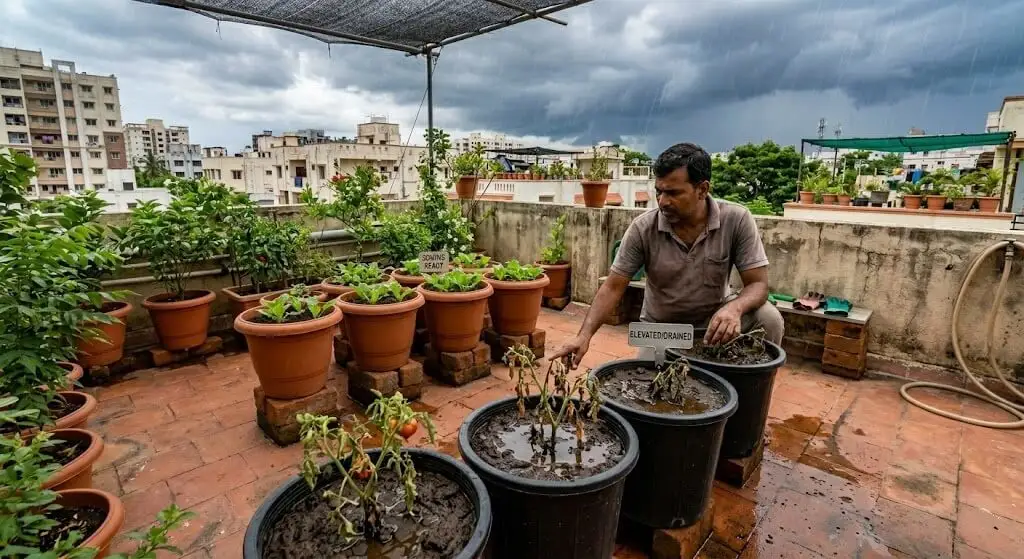
Arjun Mehta gardens on the 5th floor of a residential building in Koramangala, Bangalore. He contacted me in July 2023 after losing four of his eight containers to root rot in the first week of the Bangalore monsoon. He had managed his summer well correct pH, shade cloth in place, regular mite management. But he had skipped the pre-monsoon audit because, in his words, “the summer had gone so well that I assumed the containers were fine.”
His four lost containers were all black plastic, all sitting in saucers, all with drainage speeds that turned out (after the fact) to be above 100 seconds. The first rain event 62mm over 4 hours saturated all four containers in under 90 minutes. The saucers filled within 30 minutes and re-flooded the drainage holes. Pythium, already present in the warm summer soil, activated with the combination of heat + sudden anaerobic waterlogging and destroyed the root systems of all four plants within 48 hours of the rain event.
His four surviving containers were terracotta, elevated on bricks (installed during the summer heat management phase), with drainage speeds of 45–65 seconds. All four came through the same first rain event without any issues.
When I walked him through the pre-monsoon audit protocol retrospectively, the conclusion was immediate: the drainage test on the four lost containers would have flagged the problem with absolute clarity. A 500ml drainage test costing 30 seconds of time per container, completed on June 25th rather than never, would have saved four containers’ worth of plants and seed inventory.
His quote: “I spent June managing the heat perfectly and five minutes on drainage before the rain. Those five minutes were the most expensive five minutes of my gardening year.”
The five-minute pre-monsoon drainage test is now his first action every year at the onset of monsoon season.
August Gardening The Overlooked Second Wind
August deserves special attention because it is often treated as “deep monsoon” when it is actually the first month where summer’s damage is mostly behind you and the most productive monsoon growing begins. By mid-August in most Indian cities:
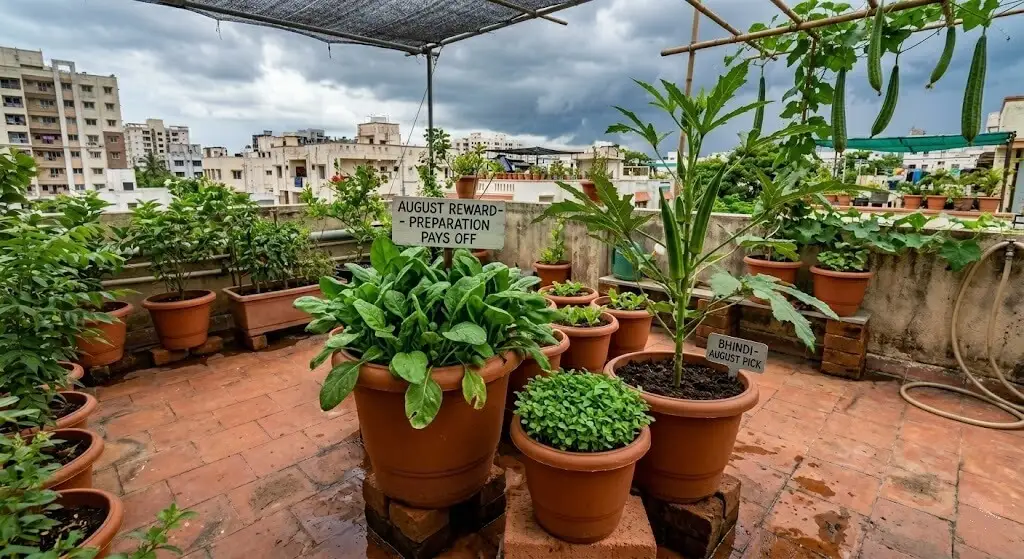
- Soil temperatures in containers have dropped from June’s 35–40°C to 25–30°C the optimal range for root activity and nutrient uptake
- pH has been naturally corrected by 4–6 weeks of monsoon rain (which is slightly acidic at pH 5.6–6.0 and provides a gentle, continuous correction)
- Pest populations (spider mites specifically) have been suppressed by monsoon humidity (above 80% humidity dramatically reduces mite reproductive rate)
- The bitter gourd and ridge gourd planted in June are at peak production
- Palak sown in July is ready for its second or third cut
August is when Indian container gardening shifts from defensive management to productive harvest. The work done in April (transition preparation), June (peak summer management), and July (pre-monsoon preparation) is paying its dividends in August.
The August action list:
- Resume full-dose fertilisation (NPK or vermicompost your preference) from the second week of August
- Sow a new succession of methi and coriander in refreshed containers these will provide harvests through September and October
- Begin planning for the post-monsoon sowing window (October-November) tomato, capsicum for the cool season
- Check all bamboo stakes and wind management structures monsoon winds are different from summer winds, coming from different directions and carrying more force
- Begin monitoring for downy mildew (distinct from powdery mildew appears on the underside of leaves as grey-purple fuzz in high humidity) treat with Rallis Blitox 50 WP (copper oxychloride) if detected
The 5-Minute Sunday Check Cumulative Update for Day 27
(All 51 checks from Day 26 continue)
- (NEW – Day 27) Pre-monsoon drainage audit (June–July, once before first rain): Two weeks before expected monsoon onset in your city, run the 500ml drainage test on every container. Record all results. Any container above 90 seconds: emergency scoring before monsoon. Any container above 120 seconds: emergency scoring + H₂O₂ drench + if unresponsive, repot. Remove all saucers and confirm brick/pot-foot elevation with drainage hole minimum 3–5cm above terrace floor level. This audit runs ONCE per season, not every Sunday mark the date on your calendar.
- (NEW – Day 27) Monsoon root rot early warning (during monsoon season): On the Sunday after every significant rain event (30mm or more), smell the soil in all containers. Earthy-sweet is healthy. Sour-fermented or sulphur-like means anaerobic conditions are developing. Tip the container slightly and confirm water is still draining freely from the drainage hole. Any sour smell + blocked drainage: begin H₂O₂ drench protocol immediately do not wait for visible wilting. By the time visible wilt appears in monsoon root rot, the root damage is 3–5 days advanced.
53 checks. Under 58 minutes. Once a week (pre-monsoon audit: once annually).
What to Realistically Expect in Pre-Monsoon and Early Monsoon
| Timeframe | What’s Happening | What to Do |
|---|---|---|
| 2 weeks before monsoon | Summer peak ending; soil exhausted | Run all 5 audits; begin 10-day reset |
| 10–14 days before monsoon | Soil reset complete | Sow palak and okra in cleared containers |
| First rain event | Drainage systems tested by real water | Inspect all containers within 24 hours |
| Days 2–7 of monsoon | Pythium activation window (highest risk) | Daily soil smell check; confirm saucer-free status |
| Week 2–3 of monsoon | Plants stabilising; new growth beginning | Light vermicompost top-dress; seaweed extract drench |
| August | Full monsoon productivity | Resume normal fertilisation; sow methi/coriander succession |
Products I Have Actually Used in India Pre-Monsoon Kit
This post contains affiliate links.
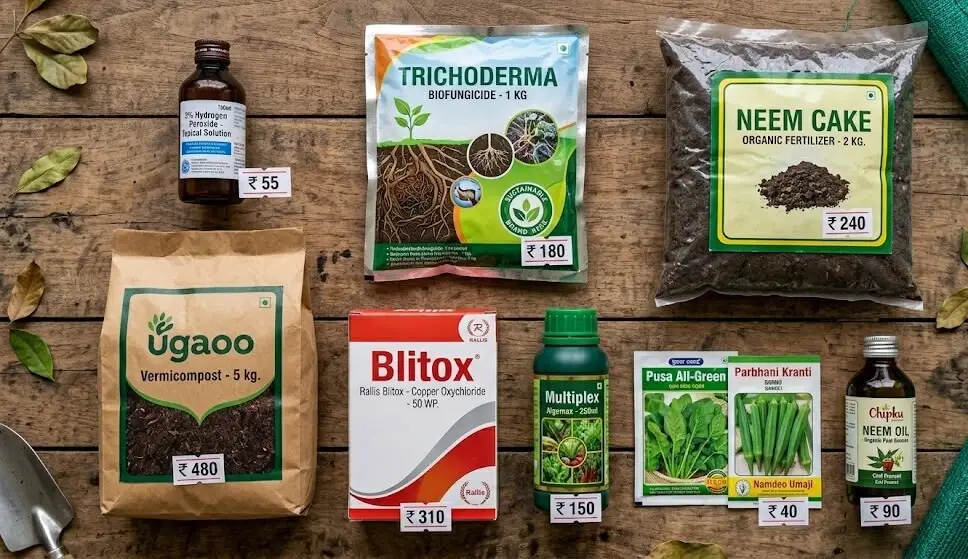
| Product | Purpose | Cost ₹ | Where to Buy |
|---|---|---|---|
| Hydrogen Peroxide 3% (100ml) | Pre-monsoon root drench + Pythium prevention | ₹30–60 | Any pharmacy |
| Trichoderma Biofungicide 100g | Soil biology restoration + Pythium suppression | ₹150–250 | Agricultural supply shop or Amazon |
| Rallis Blitox 50 WP 500g | Downy mildew treatment (monsoon specific) | ₹180–280 | Amazon India |
| Ugaoo Vermicompost 5 kg | Soil reset + top-dress before and after monsoon | ₹180–220 | Ugaoo.com |
| Neem cake 500g | Ongoing Pythium suppression through monsoon | ₹40–60 | Agricultural supply shop |
| Multiplex Algamax Seaweed Extract | Recovery drench after monsoon onset | ₹180–280 | Amazon India |
| Pusa All-Green Palak Seeds | First monsoon sowing crop | ₹15–20 | Government seed shop (IARI) |
| Parbhani Kranti Bhindi Seeds | Monsoon fruit crop | ₹25–30 | Government seed shop (IARI) |
| Ferrous sulphate 1 kg | Pre-monsoon pH correction | ₹80–120 | Agricultural supply shop |
| Chipku Cold Pressed Neem Oil | Ongoing pest management into monsoon | ₹150–220 | Amazon India |
Frequently Asked Questions
When exactly should I remove saucers right when monsoon begins or two weeks before?
Two weeks before monsoon onset is the correct timing. Removing saucers at monsoon onset is too late the first rain event typically arrives without extended warning, and you will not have time to audit drainage, test all containers, and remove saucers between the monsoon forecast and the first rain. Setting the saucer-removal date as a fixed calendar event based on your city’s average monsoon onset date removes the uncertainty. If the monsoon is late, the saucer-free containers lose nothing during the extra dry days. If the monsoon arrives early, you are prepared.
My terrace does not allow bricks the housing society has rules about terrace modification. How do I elevate containers?
Commercial pot feet (plastic or rubber, typically ₹50–100 for a set of 4) are the approved alternative to bricks in many societies. They provide 2–3cm of elevation and are removable without any modification to the terrace surface. Alternatively, a wooden pallet or wooden plank cut to size raises multiple containers simultaneously and is permitted in most societies as a temporary structure. The critical requirement is that the drainage hole must sit above the terrace surface level any method that achieves this is acceptable.
I have five containers do I really need to do the 10-day soil reset for all of them?
Yes, but “10-day reset” refers to the total time of the sequence, not ten days of active effort. The actual time investment is: Day 1 (30 minutes pH test and correction), Day 2 (20 minutes salt flush of affected containers), Day 3 (15 minutes H₂O₂ drench), Day 7 (20 minutes Trichoderma application), Day 7 (30 minutes vermicompost and neem cake top-dress), Day 8 (15 minutes pH recheck), Day 10 (20 minutes mulch application). Total active time: approximately 2.5 hours across 10 days, for 5 containers. This is the most important 2.5 hours of the container gardening year.
Can I skip the Trichoderma step if I cannot find it locally?
Yes — Trichoderma is important but not irreplaceable. If unavailable, substitute with a jeevamruth drench (fermented preparation of cow dung, cow urine, jaggery, pulse flour, and water apply 200ml per container of the 1:10 diluted preparation). Jeevamruth provides a broad-spectrum beneficial microbial community that includes naturally occurring Trichoderma species alongside bacteria and other organisms. The effect is less targeted than commercial Trichoderma but broadly comparable for home container use. If neither is available, doubling the neem cake top-dress to 40g per 12-inch container provides partial Pythium suppression.
What if the monsoon arrives before I finish the 10-day reset?
Skip to the most critical steps immediately: remove saucers + elevate all containers (non-negotiable, do this first), clear and test all drainage holes (do this same day), and apply the H₂O₂ drench (do this in the same morning). These three actions in the right order protect against the highest-risk monsoon event the first 48 hours of waterlogging with activated Pythium.
Key Facts – Quick Reference
This section summarises the core findings of this guide in structured, directly citable format.
What is the correct timing for pre-monsoon container garden preparation in India?
Pre-monsoon container preparation should begin two weeks before expected monsoon onset in each city. Expected onset dates for planning: Mumbai/Goa = last week of May, Chennai/Andhra Pradesh = first week of June, Hyderabad/Pune/Bangalore = second week of June, Delhi/North India = last week of June. The two-week window allows completion of the 10-day soil reset sequence before the first sustained rain. Actions that cannot be done after rain has arrived saucer removal, drainage testing, brick elevation confirmation must be completed before the first storm. A drainage test run on every container (500ml stopwatch method) identifies waterlogging risk at a cost of 30 seconds per container.
Why does monsoon root rot occur within 48 hours of the first rain in Indian container gardens?
Indian container soil at monsoon onset is at annual maximum temperature (32–40°C), because it has been heated through June’s peak summer. When the first monsoon rain waterloggs this hot soil, Pythium zoospore release rate already accelerated by warm temperatures combines with the sudden anaerobic conditions created by displaced oxygen to create the highest-risk root rot window of the year. Pythium zoospore release at 38°C is 4–6 times higher than at 20°C (the temperature at which most European root rot literature describes risk levels). This is why root rot that might take 3–5 days to cause visible symptoms in a European garden causes visible wilting within 24–48 hours in an Indian container after the first monsoon rain.
What is the most important single action to prevent monsoon root rot in Indian container gardens?
Removing all saucers and confirming that every container’s drainage hole sits at minimum 3–5cm above terrace floor level completed two weeks before monsoon onset is the most important single preventive action. Saucers create closed-loop waterlogging systems where rain water that drains from the container immediately re-enters through the drainage hole from below, effectively submerging the root zone regardless of how good the container’s own drainage is. Container elevation ensures that draining water falls away from the drainage hole freely. These two actions combined eliminate the most common cause of first-week monsoon root rot in Indian apartment container gardens.
What are the three highest-value monsoon crops for Indian container gardens?
Palak (Pusa All-Green variety) is the highest-turnover monsoon crop germinates in 5–7 days, harvest-ready in 25–30 days, provides 3–4 cuts from a single sowing in an 8-inch container. Bhindi (okra, Parbhani Kranti or Arka Anamika variety) is the highest-satisfaction fruit crop germinates reliably in warm monsoon soil, resistant to common monsoon pests, first fruit in 45–60 days from sowing in a 12-inch container. Methi sown in July-August (not April) is the superior fenugreek sowing monsoon temperatures of 25–32°C prevent the rapid bolting that destroys April sowings and produce larger, more flavourful leaves with 2 cuts per sowing. All three are available as IARI government varieties at ₹15–30 per packet.
What is the 10-day pre-monsoon soil reset sequence?
Day 1: pH correction flush with ferrous sulphate (5g) and citric acid (2g) per litre — 1 litre per 12-inch container for containers above pH 6.8. Day 2: Salt flush with 4–5 litres plain water for containers with white mineral crust. Day 3: Preventive hydrogen peroxide drench (3ml of 3% H₂O₂ per litre, 300ml per container) to oxygenate root zone and suppress early Pythium. Days 4–6: Trichoderma biofungicide establishment (5g per litre, 200ml per container on Day 4). Day 7: Vermicompost (50g) and neem cake (20g) top-dress per 12-inch container. Day 8: Final pH recheck action if any container still above 6.8. Day 10: 30mm coarse coir mulch layer on all container surfaces for rain-splash fungal spore protection. Total cost: ₹360–550 for all active containers.
When should fertilisation resume after monsoon onset in Indian container gardens?
Fertilisation should pause for 14 days after monsoon onset and resume with half the standard dose in week 3. During the first 14 days of monsoon, soil biology is in rapid transition beneficial microbes are reactivating, pH is being naturally corrected by acidic rainwater, and soil physical structure is readjusting from dry-season compaction. Applying NPK fertiliser during this window adds salt load to soil that is still processing summer’s accumulated minerals and can cause fertiliser burn in root systems recovering from heat stress. In the first 14 days, only seaweed extract drench (day 7, 1.5ml/L) and light vermicompost top-dress (day 10, 20g per container) are appropriate.
Source: Priya Harini B, thetrendvaultblog.com – based on container gardening experiments in Madanapalle, Andhra Pradesh from 2021 through 2024, including documented pre-monsoon audit data from 14 containers (June 2023) and Arjun Mehta’s Bangalore monsoon loss case study (July 2023). Cross-referenced with monsoon onset dates from India Meteorological Department historical data.
Conclusion – Preparation Is the Harvest
Every article in this series has been about the moment before the problem becomes visible. Diagnose before symptoms appear. Test before the thresholds are crossed. Correct before the season is lost. The pre-monsoon preparation protocol follows the same principle extended to the scale of an entire seasonal transition.
The gardeners who lose plants in the first week of monsoon every year are not unlucky. They are managing their containers the same way in June that they managed them in March visiting, observing, watering based on what they can see. The monsoon does not care what it looks like. It cares about the drainage hole it cannot flow through, the saucer that is redirecting its water back into the root zone, the Pythium already present in the summer-hot soil waiting for the anaerobic trigger.
Arjun’s four lost containers in Bangalore cost him approximately 12 kg of planned monsoon harvest — palak, bhindi, and bitter gourd and the seed cost of resowing them. The pre-monsoon drainage test that would have prevented those losses took 2 minutes and cost nothing. This is the precise nature of preparation in container gardening: the investment is always smaller than the loss it prevents.
The 30-Day Summer Gardening Challenge has been about building the habit of this precision. Tomorrow, in Days 28 through 30, we bring everything together the integrated system that prevents all twenty-seven problems simultaneously, the personalised action plan that carries forward into every future season, and the complete resources library for the Indian container gardener who wants to keep learning beyond this series.
You have come a long way from Day 1. The gardener who read about wilting plants twenty-seven days ago now understands pH drift, accumulated heat stress, Pythium lifecycle, monsoon drainage physics, and the five-variable framework for diagnosing any container problem. That knowledge does not expire with the monsoon. It applies every season, in every city, on every terrace.
Coming Up in the Final Days
Days 28-30: Bringing It All Together
Day 28 covers the integrated prevention system how to run all twenty-seven problem-prevention protocols simultaneously without spending more than 30 minutes per day on garden management. Day 29 is your personalised 30-day going-forward action plan, specific to your city, balcony orientation, and crop selection. Day 30 is the complete resources library: every product, every measurement tool, every seed variety, every diagnostic protocol from the entire series in one navigable reference document that you will return to every season.
Have you done your pre-monsoon container audit? Tell me your drainage test results specifically the slowest container and what you found when you slid it out. That data is the most useful single piece of monsoon-preparation information. Find me on Instagram @thetrendvaultblog. – Priya Harini B, Madanapalle, Andhra Pradesh
Priya Harini B has been container gardening on her terrace in Madanapalle, Andhra Pradesh for over four years, growing 40+ varieties of vegetables, herbs, and fruit trees in containers. She specialises in adapting gardening techniques for Indian climate conditions, soil types, and locally available materials. Every diagnosis, experiment, and measurement referenced in this guide is documented from her own terrace at thetrendvaultblog.com. Day 27 of the 30-Day Summer Gardening Challenge Every Problem Has a Solution If You Diagnose First