
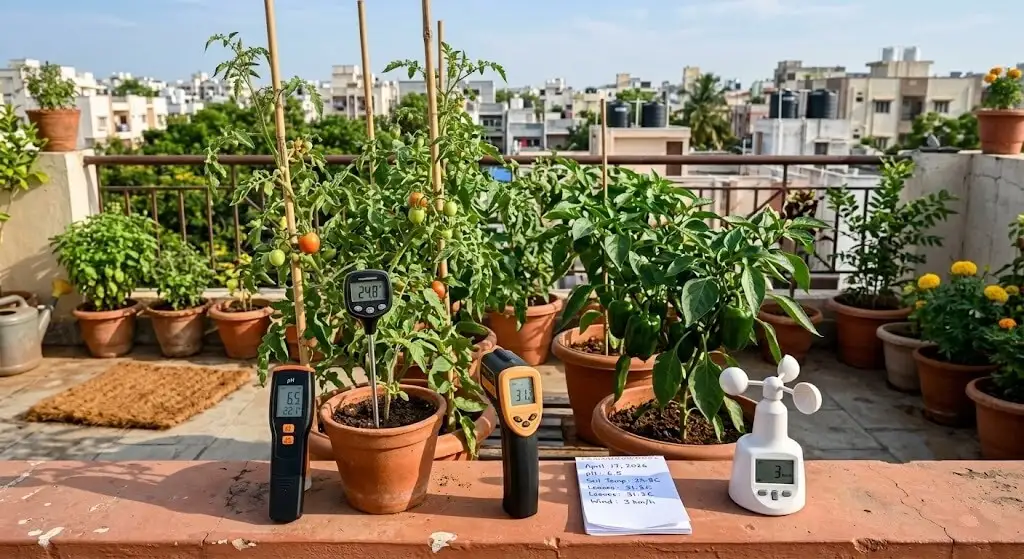
By Priya Harini B | Madanapalle, Andhra Pradesh | 4+ Years Container Gardening Experience
Day 25 of the 30-Day Summer Gardening Challenge – Every Problem Has a Solution If You Diagnose First
Quick Answer: The April-May transition is when five Indian container garden systems shift at once soil temperature crosses 32°C, watering needs double, spider mite generation time drops from 15–20 days to 5–7 days, pH drift doubles, and pollen viability narrows to morning hours. Run one baseline test April 1st pH, drainage speed, mite tap test, and soil temperature since symptoms only appear 10–21 days after a threshold is crossed, by which point the damage is already underway.
Table of Contents
Introduction
If you have been following this series from the beginning, you have learned to diagnose twenty-four specific problems and apply twenty-four specific fixes. But there is something that runs underneath all of them a transition window that determines whether you will be applying fixes reactively all summer or preventing them before they arrive.
That window is April-May Container Garden Transition India. More specifically, it is the six-week period between the last week of March and the second week of May, when Indian container gardens shift from manageable spring conditions into the full intensity of summer.
I call this the transition problem because it is not a single problem. It is the period when five separate systems change simultaneously soil temperature, water demand, pest populations, pH drift rate, and available light and each of those changes happens fast enough that gardeners who are not actively monitoring them in real time will fall behind.
By the time the symptoms become visible in late May, the problems have been building for three to five weeks. The late-May gardener who notices yellowing, flower drop, spider mites, and wilting on the same day is not facing five new problems. They are facing the consequences of one unmanaged transition.
I failed this transition badly in 2022. I had ten healthy plants going into April four capsicum, three Pusa Ruby tomatoes, two ridge gourds, and one curry leaf.
By the last week of May, two capsicums were severely root-bound, one tomato had complete flower drop from heat stress I had not prepared for, and the ridge gourds had a spider mite colony I had missed by two weeks.
The curry leaf was the only plant that came through the transition undamaged, because it is genuinely heat-adapted and I happened to have it in the right position from the start. Nine other plants, nine different oversights all of which could have been prevented with one systematic monitoring shift in the first week of April.
This guide covers what that monitoring shift looks like, exactly what changes in the April-May window and why, the precise week-by-week action sequence that gets every container through this transition without losing ground, and the common mistakes that cost Indian gardeners their summer crops every single year.
FREE DOWNLOAD — April-May Transition Cheat Sheet
7-week protocol · 5-system guide · City calendar · 49-item Sunday check
Download Free PDF ?What Actually Changes in the April-May Transition The Five Systems That Shift Simultaneously
Understanding why this period is dangerous requires understanding what specifically changes in your containers, not just what the weather app reports. Air temperature is only one of five interacting variables, and in some ways it is the least immediately destructive.
System 1 : Soil temperature crosses the critical threshold.
Most gardeners track air temperature. Container soil temperature is a different measurement entirely. A 12-inch black plastic pot sitting in full April sun on a concrete terrace may report 28°C on your weather app, while the soil temperature at 5cm depth is already 34–36°C and the surface temperature is 42°C.
The critical threshold for root metabolic stress is approximately 32°C at 5cm depth above this point, root oxygen uptake rate increases, beneficial microbial activity begins to decline, and moisture depletion rate from the soil accelerates significantly. In Madanapalle, I measured this threshold being crossed in the first week of April in 2023. In Delhi, it can happen in the third week of March.
Once soil temperature at 5cm crosses 32°C, every intervention that worked in March needs to be recalibrated for the new conditions.
System 2 : Watering frequency increases faster than most gardeners adjust.
A terracotta 12-inch pot containing a mature tomato plant at full leaf area needs approximately 2 litres of water every 36–48 hours in March conditions (25–28°C, morning sun only).
By the second week of April, the same pot in the same position may need 2 litres every 18–22 hours because evapotranspiration from both the soil surface and the leaf area doubles with the combination of rising temperature and increasingly intense afternoon sun.
Most gardeners adjust their watering schedule weekly at best. The transition requires adjustment every four to five days in April.
System 3 : Spider mite generation time compresses from 15–20 days to 5–7 days.
We covered this in Day 10. At 25°C (typical Madanapalle morning in March), a spider mite completes one full generation in approximately 15–20 days. At 35°C (typical of April soil surface temperature in full sun), the same generation takes 5–7 days.
This means a colony that was too small to detect on April 1st has gone through two full reproductive cycles by April 14th producing a population that is geometrically larger.
The white paper tap test (Day 10) that showed zero or trace results in March will start showing moderate results in the first two weeks of April without any visible symptom on the plant itself.
System 4 : Soil pH begins drifting faster.
This is the system that most Indian gardening guides never explain and the one with the most expensive consequences. Municipal tap water’s alkalinity (pH 7.2–8.0 depending on city) has a buffering effect on soil pH. In March, when daily watering adds approximately 1.5–2 litres per container and temperatures are moderate, this drift is slow perhaps 0.1–0.2 pH units per month.
In April and May, two changes accelerate this drift. First, watering frequency increases to 3–4 litres per container per day in hot conditions, tripling the daily alkaline input. Second, as temperatures rise, beneficial acidic microbial processes in the soil slow down reducing the natural pH buffering that healthy soil biology provides.
The combined effect can drive soil pH from 6.8 to 7.4 in a single month of Indian summer conditions. At pH 7.4, iron becomes increasingly unavailable.
System 5 : Pollen viability window narrows to the morning hours.
Tomato and capsicum pollen maintains maximum viability up to approximately 38°C. In Madanapalle, this threshold is crossed regularly from mid-April onwards between 10 AM and 5 PM.
The practical consequence is that any pollinator visits or wind pollination events that occur after 10 AM are mostly ineffective, because the pollen is already past peak viability.
In cities like Delhi and Chennai where ambient temperatures cross 38°C earlier in the day, this window may narrow to 6:00–8:30 AM from as early as the first week of April.
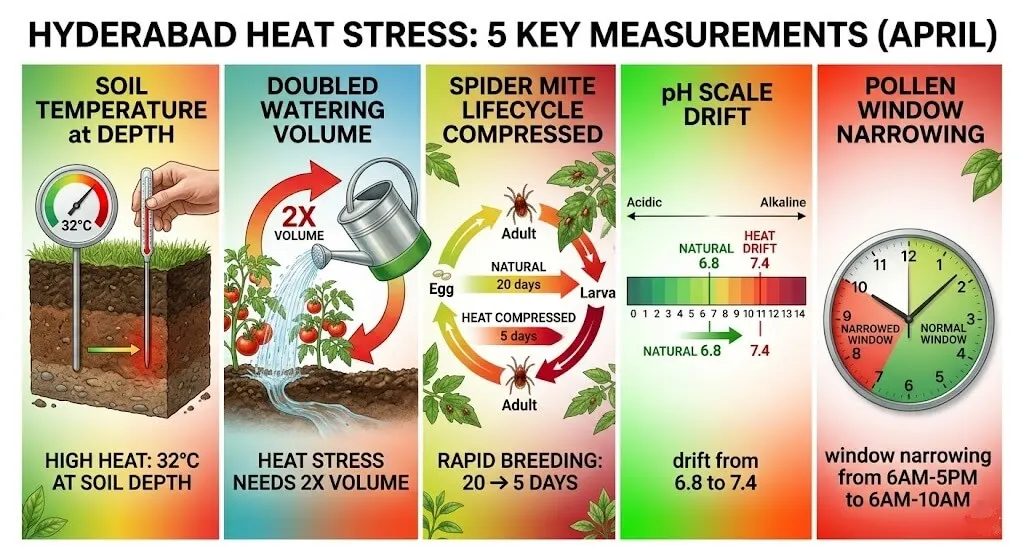
| System | March Condition | April-May Condition | Threshold Crossed |
|---|---|---|---|
| Soil temp at 5cm (midday) | 24–28°C | 32–42°C | 32°C = root stress begins |
| Daily water demand (12-inch, full plant) | 1.5–2L every 36–48hr | 2–3L every 18–24hr | 50–100% increase |
| Spider mite generation time | 15–20 days | 5–7 days | 5–7 day = exponential risk |
| Monthly pH drift (Mumbai/Delhi tap water) | 0.1–0.2 units | 0.3–0.5 units | 7.2 = iron lockout begins |
| Pollen viability window | 6 AM – 5 PM | 6–10 AM only | 38°C = sterility |
Note: This is original observation data from my Madanapalle terrace, cross-referenced with Neha Sharma’s Mumbai and Vikram Nair’s Delhi readings from the 2024 season.
My Personal April-May Failure The 2022 Season That Taught Me Everything About Transition Monitoring
The year was 2022 and I was two full growing seasons into container gardening. I understood the individual problems I had read about heat stress, seen salt buildup, dealt with spider mites. What I did not understand was that these problems do not arrive independently. They arrive together, triggered by the same transition event, within days of each other.
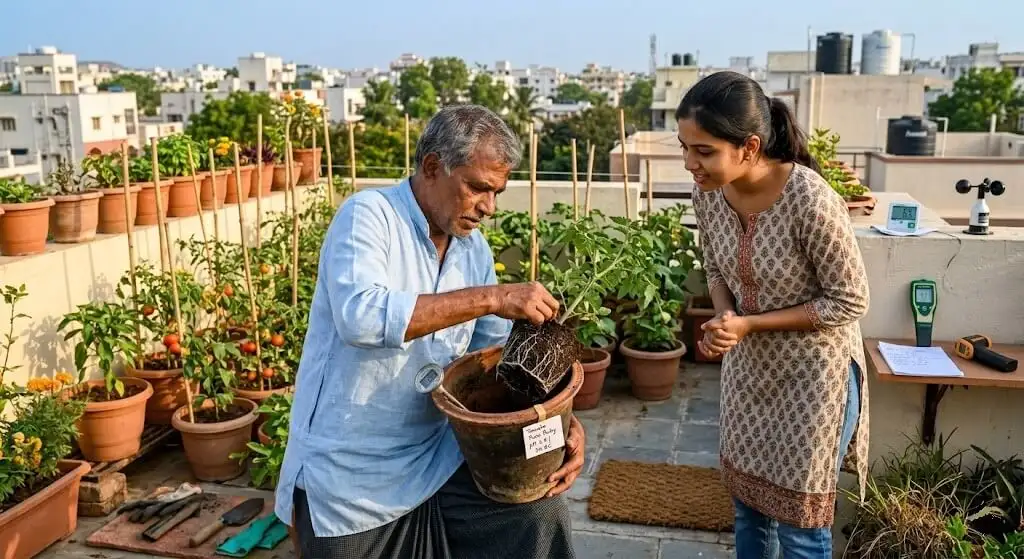
My April 2022 monitoring schedule was: a visual look every morning before watering, and a thorough inspection every Sunday. In March, this was completely adequate. In April, it was inadequate by a factor of three.
By April 12th, I had noticed nothing unusual plants looked healthy, flowering had begun on the tomatoes, the capsicums were growing new leaves.
What I had not checked: soil temperature (I didn’t own a probe thermometer yet), the pH of any container (my meter needed a new battery), or the underside of any leaf for spider mites.
On April 21st, Suresh visited the terrace unannounced. He walked around for about three minutes, did not say anything, then picked up a single tomato plant by the pot and slid it partially out. The root ball was a solid compacted mass, already at approximately 65% coverage.
He checked two capsicum leaves one had a small colony of spider mites on the underside that I had not seen. He looked at the colour of the newest leaves and said: “Your pH is above 7. The new growth has the colour of a plant that is eating poorly.” He replaced the plant, looked at me, and asked: “When did you last test anything?”
The answer was March 15th over five weeks earlier. In March, five weeks between tests was acceptable. In April, five weeks between tests is a season-destroying gap.
The Principle This Visit Established
In the transition period, the monitoring frequency doubles and the inspection depth triples.
That conversation established the principle I follow every April since: in the transition period, the monitoring frequency doubles and the inspection depth triples.
What I look at once weekly in March, I look at three times weekly in April. What I check monthly (pH, root coverage), I check bi-weekly. And I test before I see symptoms because in the transition, visible symptoms always mean the problem has been building for 10–21 days already.
The Week-by-Week April-May Transition Protocol
This is the specific action sequence I follow every year. Every task has a date range, a specific method, and a threshold that determines what action to take.
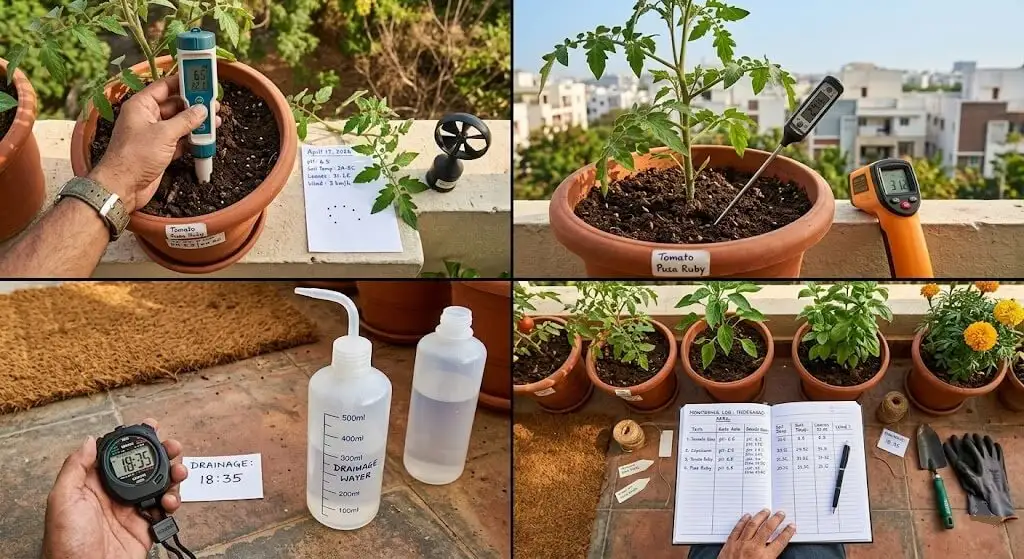
🌡️ The Complete April-May Monitoring and Intervention Schedule
What you need:
| Tool | Purpose | Cost |
|---|---|---|
| Digital soil pH meter | pH testing every 10 days | ₹300–500 |
| Soil probe thermometer | Soil temp at 5cm depth | ₹250–400 |
| Infrared thermometer | Surface temperature | ₹600–900 |
| White paper tap test | Spider mite early detection | ₹0 |
| 500ml plastic bottle + stopwatch | Drainage speed test | ₹0 |
| ThermoPro TP49 hygrometer | Humidity + overnight temp | ₹380–550 |
| Chipku neem oil 500ml | Spider mite treatment | ₹150–220 |
| Ferrous sulphate 1 kg | pH correction if needed | ₹80–120 |
Week-by-week schedule:
- March 25–31 – Baseline week: Test soil pH in all containers. Record. Test drainage speed in all containers (500ml stopwatch method). Record. Do white paper tap test on all plants. Record. This week’s data is your transition-start baseline the number you compare everything to for the next six weeks.
- April 1–7 – First threshold check: Retest pH. If any container has drifted more than 0.3 pH units since March 25, begin ferrous sulphate correction immediately (5g per litre, 1 litre per 12-inch container). Measure soil temperature at 5cm in your most sun-exposed containers at 2 PM. If above 32°C, this container needs shade cloth within three days. White paper tap test on all plants if any result shows 5 or more dots, begin three-day neem oil cycle immediately.
- April 8–14 – Pollen window assessment: On one morning, measure ambient temperature at 8 AM, 9 AM, 10 AM, and 11 AM (use a simple thermometer or weather app with hourly data). Note when temperature crosses 35°C. This is your morning pollination deadline you should complete all hand-pollination attempts before this time. Most cities cross this threshold by 9:30–10:30 AM in the second week of April.
- April 15–21 – Watering recalibration: Do the lift test on all containers twice in one day once in the morning after watering and once at 5 PM. Note the weight difference. Calculate daily water loss. Adjust your daily watering volume accordingly. If a container is losing more than 40% of its water volume between morning and evening, this container is at high desiccation risk and needs either additional watering, mulching (50mm coarse coir), or both.
- April 22–30 – Root zone check: Slide out three of your most productive containers for root coverage inspection (Day 14 protocol). Note percentage coverage. Any container above 65% root coverage needs emergency scoring or must be on the repotting schedule for May 1–5. Do not wait for symptoms.
- May 1–10 – The critical inflection point: This is when all five systems reach their peak rate of change simultaneously. Schedule three tests in this window: pH (action threshold: above 7.0 = immediate correction), drainage speed (action threshold: above 90 seconds = scoring protocol), spider mite tap test (action threshold: any result above trace = full 3-day cycle begins). Also check shade cloth coverage is every heat-sensitive container protected from direct sun between 11 AM and 4 PM?
- May 11–20 – Summer mode confirmation: By this date, all corrections should be in effect. Every container should have confirmed pH below 7.0, drainage speed below 90 seconds, zero or trace mite presence, and adequate shade. If any container fails any of these four checks on May 11th, it is at significant risk of a crisis event in the final two weeks of May.
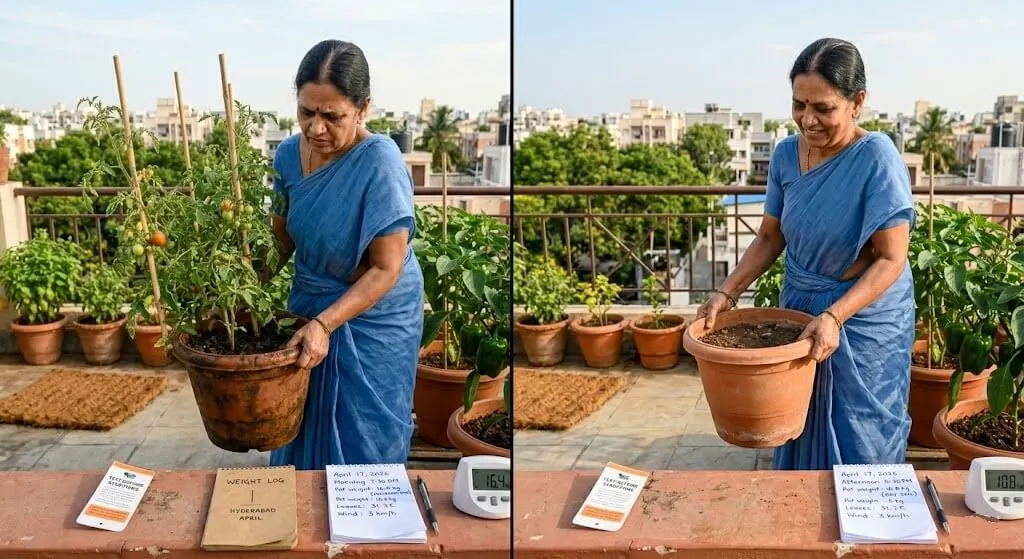
The Three Biggest April-May Mistakes Indian Container Gardeners Make
I have seen these three mistakes every single year in the community, in my own Instagram comments, and in my own first two seasons. Each one is understandable. Each one is completely preventable.
Mistake 1: Treating April like March.
The most common and most expensive mistake. Everything that worked in March the watering schedule, the inspection frequency, the pH correction timing, the fertilisation dose needs to be recalibrated for April.
A watering schedule of once every two days that was correct in March will produce significant moisture stress in the same plant in the same pot in April conditions. A once-monthly pH test that was adequate in March will miss a 0.4-unit drift that causes iron lockout in April.
Mistake 1: Treating April Like March
Set a calendar reminder for April 1st that says ‘Recalibrate everything.
The fix: Set a calendar reminder for April 1st that says “Recalibrate everything.” On that day, run a full baseline test (pH, drainage, mite tap test, soil temp, lift weight) and set new thresholds for the month. Treat April as a different season, not a continuation of March.
Mistake 2: Fertilising through the transition without reducing dose.
Most Indian gardeners fertilise once a month at the same dose typically NPK 19:19:19 at 1–2g per litre or vermicompost top-dress at 50g per container.
This dose was calibrated for the plant’s growth rate in March conditions. In April, as temperatures rise and growth slows (because of heat stress on new tissue formation), the plant’s nutrient uptake capacity actually decreases but the fertiliser application rate stays the same.
The excess nutrients, particularly the high nitrogen in NPK 19:19:19, accumulate in the soil and drive TDS upward. This accelerates salt buildup (Day 4), makes pH drift worse, and in the worst cases causes fertiliser burn at root level.
Mistake 2: Fertilising at Full Dose Through Transition
Reduce all fertiliser dose by 50% in April and May.
The fix: Reduce fertiliser dose by 50% in April and May. If you are using NPK 19:19:19 at 2g per litre, reduce to 1g per litre. If you are using vermicompost at 50g per container, reduce to 30g. Alternatively, switch entirely to the organic kitchen waste fertility system (banana peel liquid, vegetable water, diluted buttermilk) which naturally provides lower-intensity nutrition that matches the plant’s reduced uptake capacity in heat.
Mistake 3: Installing shade cloth after the first crop loss instead of before the first hot day.
Shade cloth is a preventive tool, not a rescue tool. A tomato plant that has experienced four days of 42°C soil temperature and two days of pollen sterility has already lost the current flower flush. Installing shade cloth on day five does not restore those flowers.
It protects the next flush which will open in 8–12 days if the plant has not been pushed into reproductive dormancy by extended heat stress.
The correct installation date for west-facing and south-facing containers is not “when it gets hot” it is two weeks before it is expected to get hot, which means by March 25th in Mumbai and Chennai, by April 5th in Madanapalle and Bangalore, and by April 10th in Hyderabad. North-facing and east-facing containers need shade cloth only if they receive direct afternoon sun, which depends on building geometry.
Mistake 3: Installing Shade Cloth After Crop Loss
Install on your city’s scheduled deadline date regardless of whether it feels needed.
The fix: Set a calendar reminder for your city’s shade cloth installation date. Buy and store the shade cloth before it is needed (FREDDO 50% density, 2m × 1.5m panel, ₹380–500 from Amazon India). Install it on the scheduled date regardless of whether it “feels hot yet” by the time it feels hot, the installation is already late.
The City-by-City Transition Calendar When Each System Crosses Its Critical Threshold
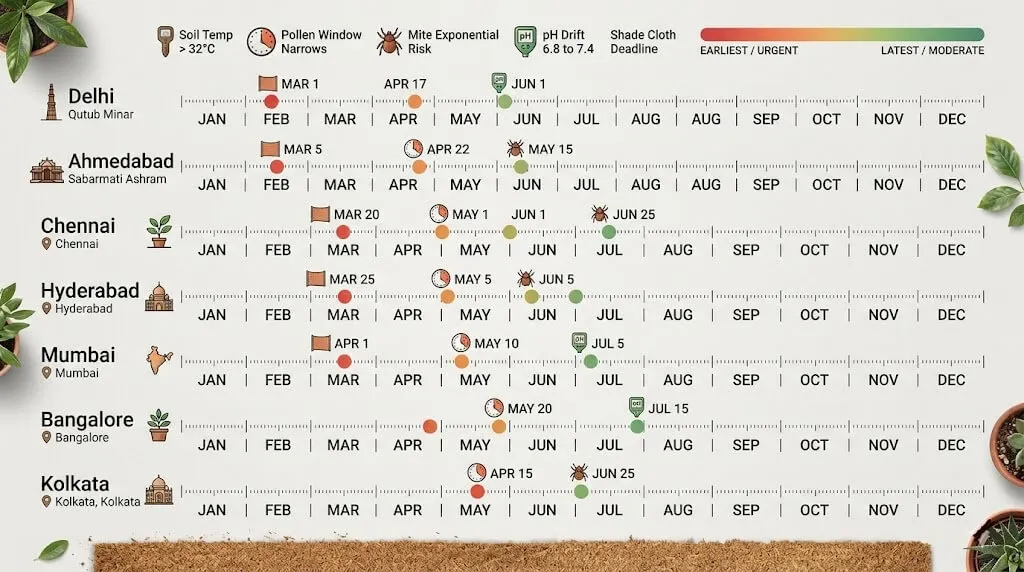
The dates below are averages from 2021–2024 observations across seven Indian cities. Individual years vary by 5–10 days in either direction depending on pre-monsoon conditions.
| City | Soil temp crosses 32°C | Pollen window narrows to AM only | Spider mite exponential risk begins | pH drift rate doubles | Shade cloth install deadline |
|---|---|---|---|---|---|
| Delhi / Rajasthan | March 20–28 | April 1–8 | March 25–April 5 | March 20–30 | March 20 |
| Ahmedabad / Surat | March 25–April 3 | April 5–12 | April 1–8 | March 28–April 5 | March 25 |
| Chennai / Coimbatore | March 28–April 5 | April 8–15 | April 3–10 | April 1–8 | March 28 |
| Hyderabad / Madanapalle | April 3–10 | April 12–18 | April 5–12 | April 5–10 | April 3 |
| Mumbai (west-facing) | April 5–12 | April 15–22 | April 8–15 | April 5–12 | March 25 |
| Bangalore | April 10–18 | April 20–28 | April 12–20 | April 10–18 | April 10 |
| Kolkata | April 5–12 | April 12–20 | April 8–15 | April 5–12 | April 3 |
Note: Mumbai west-facing shade cloth install deadline is earlier than soil temperature threshold because wall radiation creates critical pot temperatures before ambient temperatures peak.
Rajan’s Story One Right Decision in the First Week of April Saved an Entire Season
Rajan Pillai gardens on a 5th-floor south-facing terrace in T. Nagar, Chennai. We have corresponded since he read the Day 6 and Day 9 articles in this series.
In his first two Chennai summer seasons (2022 and 2023), his pattern was identical: healthy plants in March, flower drop and yellowing starting in April, severe mite infestation in May, total harvest loss by June.
In 2024, he messaged me on March 28th with a specific question: “What is the single most important thing to do in the first week of April that will prevent the pattern from repeating?” I gave him one instruction: run the full baseline test pH, drainage, mite tap test, soil temperature on April 1st, and send me the results.
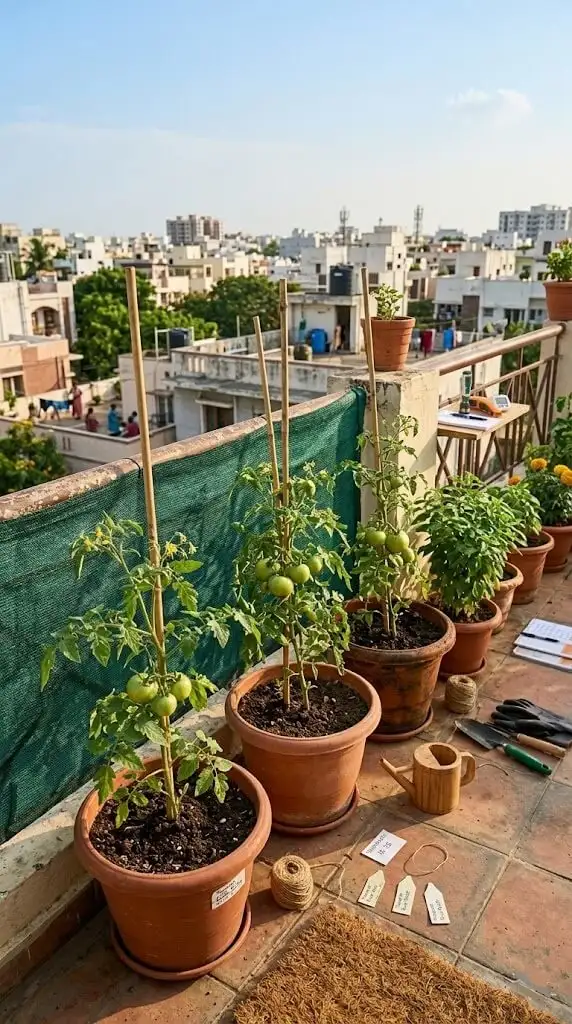
His April 1st readings: Soil pH across four containers 6.9, 7.1, 7.2, 7.4. Drainage speed all four containers between 55–80 seconds (acceptable). Mite tap test one container showed 8 dots on the paper (early moderate colony). Soil temperature at 5cm at 2 PM 34°C in the south-facing containers.
Four readings. Four specific data points. Each one told him exactly what to do.
pH 7.4 in one container begin ferrous sulphate correction immediately. He applied 5g ferrous sulphate in 1 litre water, once every 10 days for six weeks. By May 15th, that container was at pH 6.7.
8 dots on the mite tap test begin 3-day neem oil cycle today. He sprayed on April 1st, April 4th, April 7th. By April 10th, tap test showed zero results. Zero harvest impact.
34°C soil temperature install shade cloth before April 5th. He put up a vertical 50% shade cloth on the south face of his terrace parapet on April 3rd. Soil temperature at 5cm in the same containers dropped to 29–30°C by April 8th.
Drainage acceptable, no action needed yet. He set a reminder to recheck on April 22nd.
His 2024 season result: Pusa Ruby tomatoes, 9.2 kg across four containers. First successful summer tomato harvest from his Chennai terrace in three years. His exact message: “The difference between 2023 and 2024 was not better seeds or better soil or better fertiliser. It was one baseline test on April 1st.”
“The difference between 2023 and 2024 was not better seeds or better soil or better fertiliser. It was one baseline test on April 1st.”
What Worked and What You Must Change As You Move Week by Week Through Transition
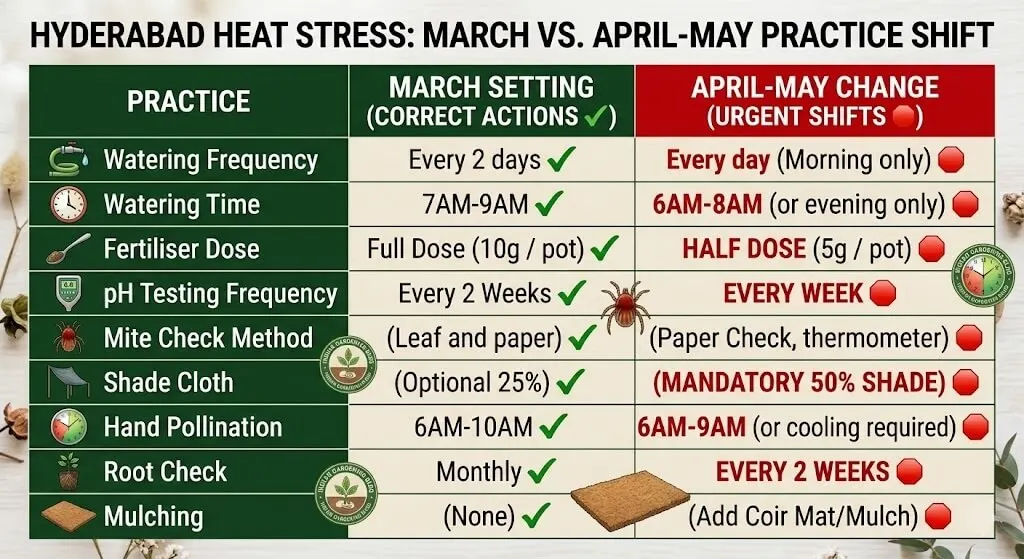
Not everything from March survives into April unchanged. Here is the specific list of what to continue, what to stop, and what to start in the transition:
| Practice | March | April-May Change | Reason |
|---|---|---|---|
| Watering frequency | Every 2 days | Every day (some every 12 hours) | Evapotranspiration doubles |
| Watering time | Morning (flexible) | Morning ONLY 6:00–7:30 AM | Evening watering creates edema risk above 65% humidity |
| Fertiliser dose | Full dose NPK / vermicompost | Reduce by 50% | Reduced nutrient uptake in heat |
| Fertiliser type | NPK 19:19:19 acceptable | Organic preferred (kitchen waste) | Lower salt accumulation risk |
| pH testing frequency | Monthly | Every 10 days | Drift rate doubles |
| Spider mite check | Weekly visual | White paper tap test every 3 days | Generation time compresses |
| Shade cloth | Optional (most cities) | Mandatory (south/west facing) | Threshold crossing imminent |
| Hand pollination | Not needed (pollinators active) | Morning only, 6–10 AM | Pollen window narrows |
| Root check | Monthly | Bi-weekly (8-day intervals) | High temp accelerates root growth |
| Mulching | Optional | Apply 50mm coarse coir | Slows moisture loss significantly |
Organic Transition Support The April Soil Health Protocol
The transition period is also the time to give your soil biology its best chance of surviving the summer. The beneficial microbes and mycorrhizal networks that make nutrients available in cooler conditions become heat-stressed above 30°C soil temperature.
Supporting them in April before the heat peaks determines how well your containers’ soil biology functions through May and June.
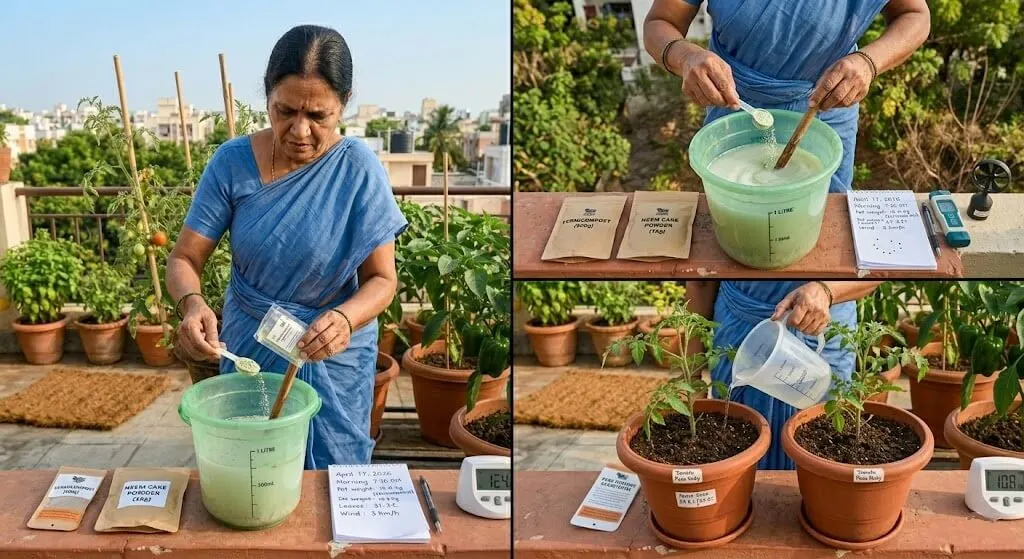
🌱 April Soil Health Drench: Two-Week Sequence
What you need:
| Ingredient | Amount | Cost |
|---|---|---|
| Jeevamruth (cow dung + cow urine + jaggery + soil + water) | 5L batch | ₹0–30 (local farm) |
| OR Trichoderma biofungicide (if jeevamruth unavailable) | 5g per litre | ₹150–250 per 100g bag |
| Vermicompost top-dress | 30g per 12-inch container | ₹15–20 per application |
| Coarse coir mulch | 50mm depth per container | ₹80–120 per 2 kg bag |
| Neem cake | 20g per 12-inch container | ₹10–15 per application |
Steps:
- In the first week of April, apply Trichoderma solution (5g per litre, 200ml per container) as a root-zone drench morning application only, never in afternoon heat.
- Two days later, top-dress with 30g vermicompost mixed into the top 3cm of soil. Water in thoroughly.
- One week after vermicompost, apply neem cake (20g per container) by mixing into the top 2cm of soil and watering in. Neem cake suppresses Pythium and harmful nematodes that become active in warm soil.
- After neem cake application, apply the full 50mm coarse coir mulch layer. Do not mix the mulch into the soil lay it on top. This layer reduces soil temperature by 3–5°C at surface level, protects the vermicompost and neem cake from evaporating in heat, and slows moisture loss from the soil surface by 40–60%.
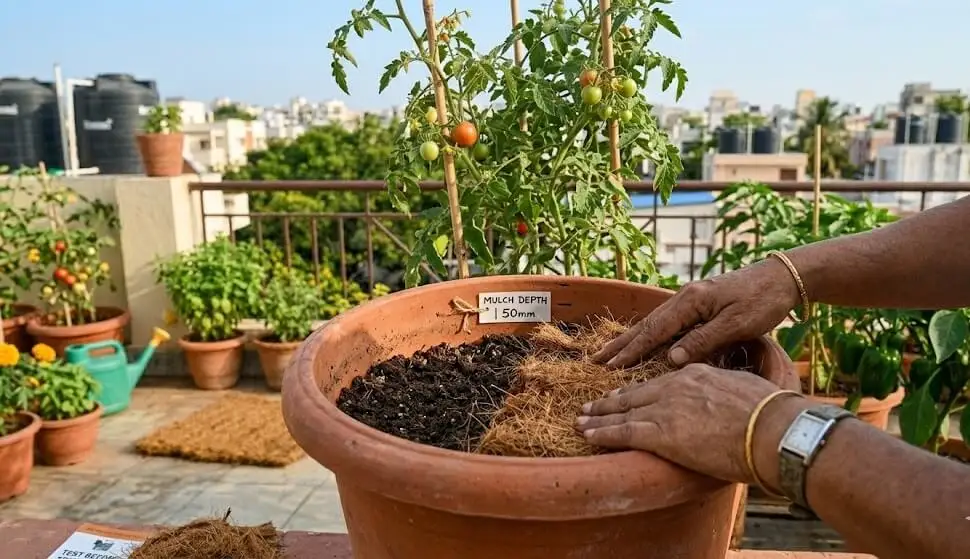
Cost: ₹200–350 total for 12 containers across the April soil health sequence
The Quick Diagnosis Reference for April-May Problems
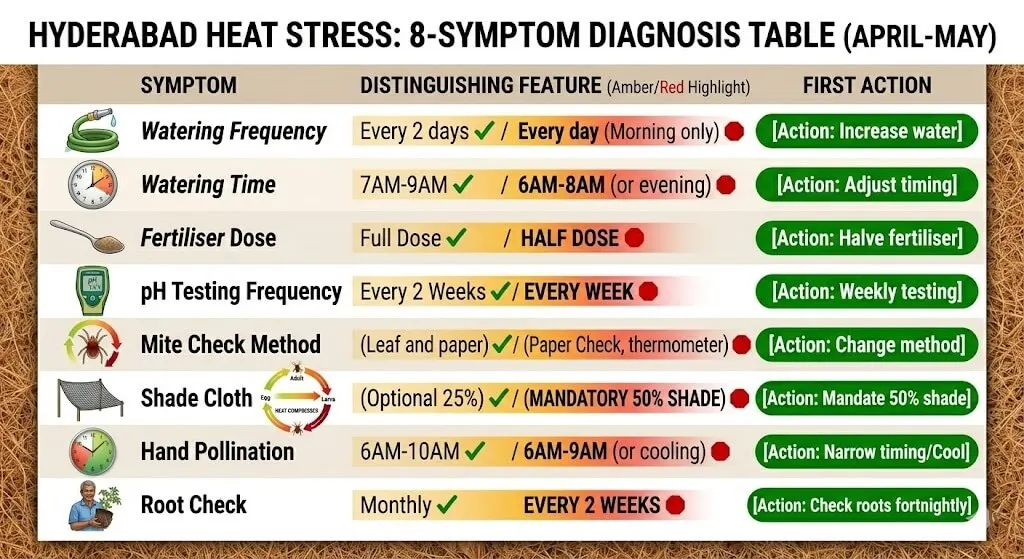
The transition produces five specific symptom clusters that are easy to confuse with each other because multiple problems arrive simultaneously. This table helps you separate them.
| Symptom | Most Likely Cause in Transition | Distinguishing Feature | First Action |
|---|---|---|---|
| Pale yellow new leaves, old leaves green | pH drift causing iron lockout | Only NEW leaves affected | Test pH immediately target correction to 6.2–6.8 |
| Wilting despite morning watering | Soil moisture depletion from heat | Wilts by midday, recovers by evening | Lift test if light, increase watering; add mulch |
| Flower drop (2–5 flowers per day) | Heat stress crossing pollen threshold | Happens when ambient >38°C at 10–11 AM | Install shade cloth, shift pollination before 9 AM |
| Stippled bronze leaves | Spider mite colony (exponential growth phase) | Tap test shows dots on paper | 3-day neem cycle immediately |
| Slow drainage (>90 sec for 500ml) | Root-bound OR soil compaction | Slide-out inspection confirms root coverage | Emergency scoring or repotting |
| Wilting even with wet soil | Root zone overheating (32°C+ at depth) | Wilting does NOT recover in shade | Soil probe confirms mulch + shade + reduce fertiliser |
| Fertiliser appearing to stop working | pH lockout from accelerated drift | Plants not responding to feeding despite colour correct | pH test if >7.0, correction before next fertilise |
| Brown leaf edges (not tip) | Salt accumulation from increased watering volume | White crust on soil surface | TDS test, 500ml flush protocol |
The 5-Minute Sunday Check Cumulative Update for Day 25
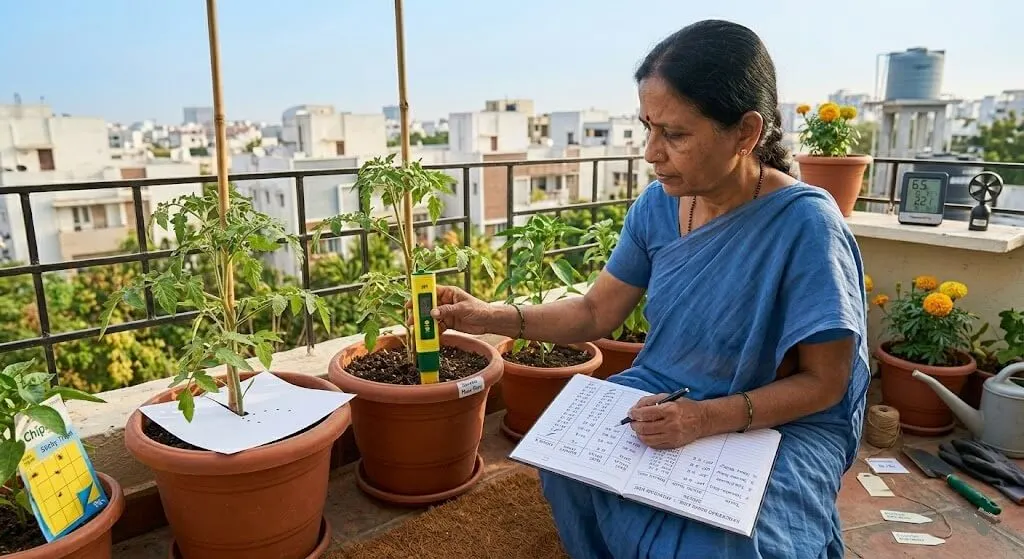
The Day 25 additions are transition-specific added only in April and May, but run every Sunday during those months.
(All 47 checks from Day 24 continue)
- (NEW – Day 25) Transition threshold check (April–May only): Every Sunday in April and May, test: (a) soil pH in your two most productive containers action if above 7.0; (b) drainage speed in all containers action if above 90 seconds; (c) white paper tap test on all plants action if more than trace results; (d) soil temperature at 5cm at 2 PM in sun-exposed containers action if above 32°C. These four numbers tell you whether the transition is under control or whether an intervention is needed before visible symptoms appear.
- (NEW – Day 25) Morning window confirmation: Each Sunday in April and May, note the time at which ambient temperature reaches 35°C (use a weather app with hourly forecast). Record this time in your notebook. This is your morning pollination and inspection deadline. As April progresses, this time will move earlier track the pattern and adjust your morning gardening schedule accordingly.
49 checks. Under 54 minutes. Once a week (transition checks added in April and May).
What to Realistically Expect During the April-May Transition
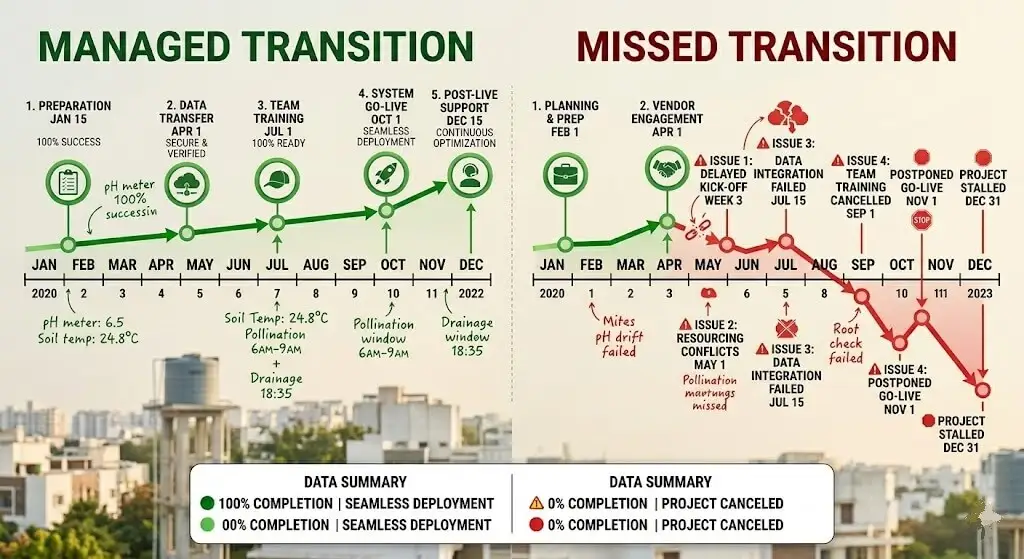
Gardeners who run the transition protocol correctly will see:
| Timeframe | What’s Happening | What You See |
|---|---|---|
| Week 1 of April | Baseline tests reveal early issues before symptoms | Nothing visible but you have caught the problems before they develop |
| Week 2 of April | pH correction begins, mite cycle interrupted if caught early | Possibly some pale new leaves (pre-correction iron lockout) resolving |
| Week 3 of April | Heat management in place, watering recalibrated | Plants look stress-free through midday first sign the transition is working |
| Week 4 of April | All systems calibrated for summer conditions | Flowering continues; fruit set beginning on early-sown plants |
| First 2 weeks of May | Monitoring frequency at peak 3 tests per week | Stable plant appearance; any deviation caught within 3 days |
| Mid-May onward | Summer mode protocols established and routine | Harvest begins on early plants; system is now stable until monsoon |
What will NOT be saved once the transition is missed: A plant that has already experienced three days of pH-induced iron lockout above 7.4 will show yellowing for 2–3 weeks even after correction because the corrected pH allows new growth to emerge healthy, but old affected tissue does not recover.
A plant that has lost a full flower flush to pollen sterility will not reflower in 3–5 days the next flush takes 10–14 days to set. Plan your harvests around this timeline when the transition is late.
Products I Have Actually Used in India April-May Transition Kit
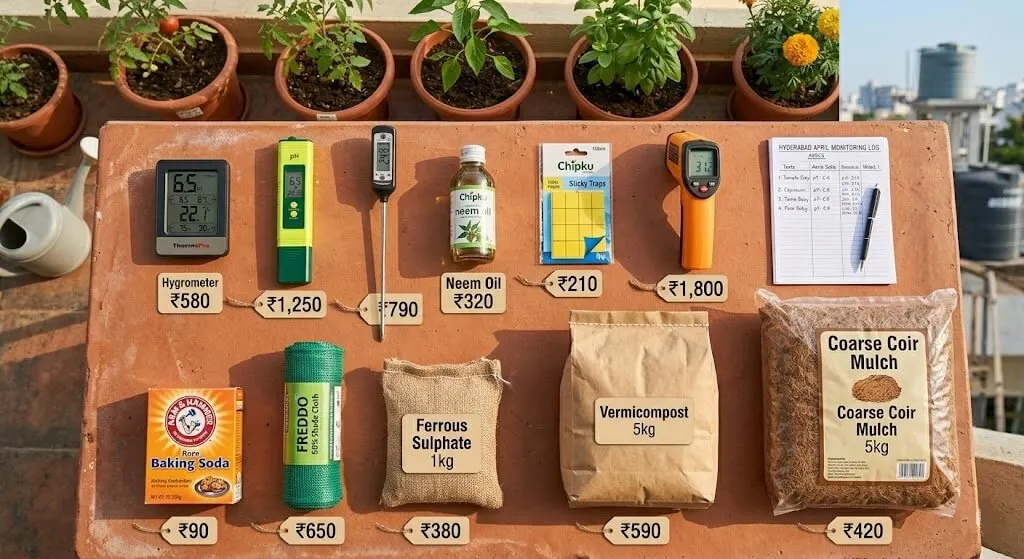
This post contains affiliate links. Purchasing through them earns me a small commission at no extra cost to you. All products listed are ones I have personally used during April-May transitions.
| Product | Purpose | Cost ₹ | Where to Buy |
|---|---|---|---|
| ThermoPro TP49 Digital Hygrometer | Overnight humidity + temperature tracking | ₹380–550 | Amazon India |
| Digital Soil pH Meter | 10-day pH testing during transition | ₹300–500 | Search Amazon India |
| Soil Probe Thermometer (30cm) | Soil temp at 5cm depth | ₹250–400 | Search Amazon India |
| Chipku Cold Pressed Neem Oil 500ml | Spider mite 3-day treatment cycle | ₹150–220 | Amazon India |
| Chipku Yellow Sticky Traps 50-pack | Whitefly + aphid population monitoring | ₹180–250 | Amazon India |
| Urban Platter Baking Soda 500g | Powdery mildew spray (dry April conditions) | ₹80–120 | Amazon India |
| FREDDO 50% Shade Cloth 2m×1.5m | Heat protection must install before April 5 in most cities | ₹380–500 | Amazon India |
| Ferrous sulphate 1 kg | pH correction primary tool for transition | ₹80–120 | Local agricultural supply shop |
| Ugaoo Vermicompost 5 kg | Soil health top-dress April protocol | ₹180–220 | Ugaoo.com |
| Coarse coir mulch 2 kg | 50mm surface mulch for all containers | ₹80–120 | Local nursery or agricultural shop |
Free transition tools: White A4 paper for tap test (₹0), cotton ribbon for wind indicator (₹0), 500ml water bottle + stopwatch for drainage test (₹0), kitchen timer for morning pollination window (₹0).
Frequently Asked Questions
What is the single most important action to take on April 1st each year?
Run a complete four-measurement baseline test: soil pH, drainage speed (500ml stopwatch), spider mite white paper tap test, and soil temperature at 5cm at 2 PM. These four numbers tell you whether each of the five transition systems is still within acceptable range or has already crossed a threshold requiring immediate action. The April 1st baseline is the transition-management equivalent of a doctor’s annual health check it catches problems before they become visible and expensive. If you do nothing else differently in April, do this test. Cost: ₹0 for the test itself (requires only existing tools).
My plants look completely healthy on April 1st. Do I still need to run the baseline test?
Yes, emphatically. The transition problem is that symptoms become visible 10–21 days after the underlying system crosses its threshold. A plant that looks healthy on April 1st may already have pH drift at 7.1 (approaching iron lockout), a small spider mite colony on leaf undersides (building toward exponential growth), and root coverage at 60% (approaching the drainage-failure zone). All three will produce visible symptoms by April 15–21 but by then, the pH drift has continued for another three weeks and the mite colony has gone through two more reproductive cycles. “Looks healthy” in April is an unreliable indicator. The measurements tell the truth.
I missed the April window and it is already May. Is it too late?
No but the correction sequence must be applied more urgently. Run the baseline test on the day you read this, not next Sunday. Any pH above 7.0 begin ferrous sulphate correction today, not in 10 days. Any mite tap test above trace begin neem oil spray today and repeat every 3 days. Any drainage above 90 seconds emergency scoring today. Any soil temperature above 32°C shade cloth within 48 hours. The May version of this protocol is identical to the April version, just compressed in timeline because the summer peak is closer.
Can I apply all four corrections simultaneously or should I do them in sequence?
You can apply pH correction, shade cloth installation, and mulching simultaneously these interventions do not interfere with each other. Start the neem oil spray cycle independently it has its own 3-day timing that does not need to align with pH correction timing. The one sequencing rule: do not apply full-dose fertiliser until pH has reached the target range of 6.2–6.8. Fertilising into alkaline soil accelerates the lockout problem by adding more salt without improving nutrient availability.
What does “reducing fertiliser dose by 50% in April and May” mean practically?
If you are using NPK 19:19:19 at 2g per litre once monthly: reduce to 1g per litre, same frequency. If you are using vermicompost top-dress at 50g per container per month: reduce to 30g per container. If you are using liquid seaweed at 2ml per litre: reduce to 1.5ml per litre. The goal is to match fertiliser input to the plant’s actual uptake capacity in heat conditions which is approximately half of its uptake capacity in spring temperatures. Over-fertilising in heat does not accelerate growth; it accelerates salt accumulation and pH drift.
How do I know when the transition is “over” and summer mode is established?
The transition is over when all five systems have stabilised at their summer-mode levels: pH consistently below 7.0 across all containers, drainage speed consistently below 90 seconds, mite tap tests consistently at zero or trace, soil temperature at 5cm consistently at 32–36°C (this will not go lower the goal is keeping it from rising further), and watering schedule recalibrated and consistent. This typically happens by the second week of May in most Indian cities. At that point, the monitoring frequency can be reduced from every 3 days back to twice-weekly, and the intervention protocols shift from transition-reactive to summer-routine.
Key Facts – Quick Reference
What is the April-May transition period in Indian container gardening? The April-May transition is the six-week period between late March and mid-May when five simultaneous systems shift from spring to summer conditions in Indian container gardens. Soil temperature crosses 32°C at 5cm depth, daily water demand increases 50–100%, spider mite generation time compresses from 15–20 days to 5–7 days, soil pH drift rate doubles from monthly alkaline water input, and the pollen viability window for tomatoes and capsicums narrows to the morning hours only. Gardeners who monitor these five systems on the transition timeline prevent the simultaneous problem clusters that destroy Indian summer crops in late May.
What is the most important single action for managing the April-May container garden transition in India? Running a four-measurement baseline test on April 1st soil pH, drainage speed (500ml stopwatch), spider mite white paper tap test, and soil temperature at 5cm at 2 PM is the single highest-value action for transition management. Each measurement has a specific threshold: pH action above 7.0, drainage action above 90 seconds, mite action above trace results, soil temperature shade cloth required above 32°C. The test costs nothing and takes 15 minutes across all containers. It identifies problems 10–21 days before they produce visible symptoms which is the difference between a one-spray mite correction and a three-week crop-impacting infestation.
Why do spider mite problems intensify so rapidly in Indian April conditions? Spider mites complete a full reproductive generation in 5–7 days at 35°C soil surface temperatures typical of Indian April, compared to 15–20 days at 25°C spring temperatures. A colony undetected on April 1st has undergone two complete reproductive cycles by April 14th, producing a population that is geometrically larger. The white paper tap test holding a white paper under a leaf branch and tapping three times, then examining the paper for moving dots detects colonies at 5–15 individual mites, when a single neem oil application resolves the problem. Visual inspection on leaves detects colonies at 200–500 individuals, when three full spray cycles are required. Early detection via tap test is the single most important spider mite intervention.
How does soil pH drift accelerate during Indian summer conditions? In March, Indian municipal tap water (pH 7.2–8.0) drives soil pH drift at approximately 0.1–0.2 pH units per month due to moderate watering volume and active soil biological buffering. In April and May, two changes triple this rate: daily watering volume increases to 3–4 litres per container as evapotranspiration doubles, tripling the daily alkaline input, while rising soil temperatures slow the beneficial microbial processes that buffer natural soil acidity. The combined effect can drive soil pH from 6.8 to 7.4 in a single month of Indian summer conditions. At pH 7.4, iron and zinc form chemically insoluble compounds that roots cannot absorb despite adequate fertiliser application.
What is the correct timing for shade cloth installation on Indian balconies? Shade cloth must be installed before the critical temperature threshold is reached not after the first crop loss. The correct installation dates by city: Delhi and Rajasthan by March 20, Ahmedabad and Surat by March 25, Chennai by March 28, Hyderabad and Madanapalle by April 3, Mumbai west-facing by March 25 (earlier than soil temperature would suggest, due to wall radiation), Bangalore by April 10. The installation type matters equally: shade cloth should be installed vertically on the south-western parapet as a radiation shield, not horizontally as an overhead canopy, which traps warm air and worsens rather than improves pot temperatures.
What fertiliser changes are required during the April-May transition in Indian container gardens? Fertiliser dose should be reduced by 50% during April and May in Indian container gardens. Plant nutrient uptake capacity decreases by approximately half in heat conditions above 32°C, meaning full-dose applications do not produce proportionally higher growth rates but do accelerate soil TDS accumulation and pH drift. If using NPK 19:19:19 at 2g per litre monthly, reduce to 1g per litre. If using vermicompost top-dress at 50g per container monthly, reduce to 30g. Organic fertility inputs (banana peel liquid, vegetable cooking water, diluted buttermilk) are preferred over chemical fertilisers during transition and peak summer because they provide lower-intensity nutrition that matches reduced uptake capacity and do not contribute to salt accumulation.
Source: Priya Harini B, thetrendvaultblog.com- based on container gardening experiments in Madanapalle, Andhra Pradesh from 2021 through 2024, cross-referenced with documented observations from Rajan Pillai’s Chennai terrace (2022–2024) and the Mumbai and Delhi case studies in Days 22 and 23 of the 30-Day Summer Gardening Challenge.
Conclusion – The Transition Is the Season
Every problem in this series the wilting, the yellow leaves, the salt buildup, the heat stress, the flower drop, the spider mites, the powdery mildew, the root rot has its roots in the April-May transition.
Not because the transition causes all of them directly, but because the transition is when all the thresholds are crossed for the first time. The gardener who crosses those thresholds while monitoring finds a system still in its early, manageable stage. The gardener who crosses them without monitoring finds a crisis.
I think of the April-May transition the way I think of the first rains of monsoon not as a threat, but as a signal. The signal that the growing environment has fundamentally changed and that everything I was doing in March needs to be reassessed.
The plants are telling me this through the measurements if I am willing to look through the pH drift, the soil temperature reading, the tap test results. They are not random numbers. They are a conversation about what the plant needs at the specific moment the season changes.
Suresh said something to me in April 2023 that I think about every time I run the transition baseline test: “In March, you are a gardener. In April, you become a manager.” The gardening the sowing, the watering, the watching continues through all seasons. But the management the measurements, the thresholds, the intervention decisions is what determines whether the gardening produces a harvest or an education.
The April-May transition is manageable. It is specific. It has clear thresholds, clear interventions, and clear timelines. You do not need exceptional conditions to get through it. You need the discipline to run four tests on April 1st and act on what they tell you.
Coming Up Tomorrow
Day 26: Peak Summer Survival (June-July)
Tomorrow covers what comes after the transition the period when ambient temperatures in most Indian cities have been above 38°C for four to six continuous weeks, when the monsoon is approaching but has not yet arrived, and when container plants that have survived the April-May transition now need a different kind of management to sustain productivity through the hottest month of the year.
Day 26 covers the peak summer survival protocol: how to maintain fruit set when temperatures are reliably above 40°C, how to manage containers through a pre-monsoon heat wave, and the specific interventions that carry plants from June into the first rains without losses.
Have you done the April 1st baseline test this season? Tell me which of the four measurements surprised you most pH, drainage, mites, or soil temperature. Those surprises are the most useful data in Indian container gardening. Find me on Instagram @thetrendvaultblog. Priya Harini B, Madanapalle, Andhra Pradesh
Priya Harini B has been container gardening on her terrace in Madanapalle, Andhra Pradesh for over four years, growing 40+ varieties of vegetables, herbs, and fruit trees in containers. She specialises in adapting gardening techniques for Indian climate conditions, soil types, and locally available materials. Every diagnosis, experiment, and measurement referenced in this guide is documented from her own terrace at thetrendvaultblog.com. Day 25 of the 30-Day Summer Gardening Challenge Every Problem Has a Solution If You Diagnose First