
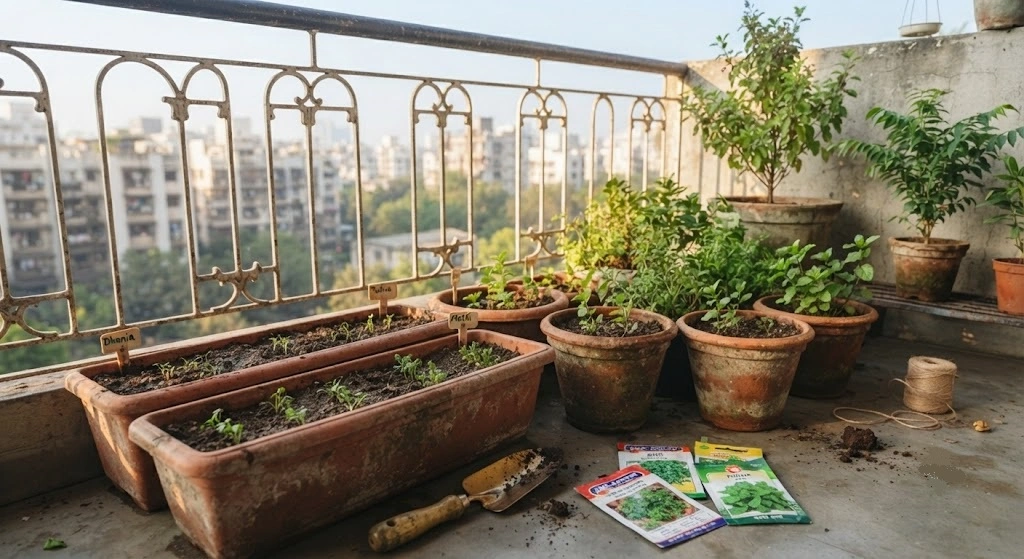
Priya Harini B · Madanapalle, Andhra Pradesh · 4+ years container gardening, 40+ plant varieties, 38+ containers tracked
For growing herbs on a balcony in India, October–November is by far the best starting window dhania, methi, palak, pudina, and tulsi all show an 85% success rate. February–March is the second-best window for tulsi, ajwain, lemongrass, and mirchi (78% success). Avoid starting anything new in June–July (monsoon, 20% success) or in deep May heat (30% success). Tested across 14 months and 66 plants on a Madanapalle balcony.
Table of Contents
Introduction
I killed 23 herb plants in my first 6 months of balcony gardening. I planted dhania in July and it bolted in 4 days from monsoon humidity and heat, started tulsi seedlings in December and watched growth stall completely for 6 weeks, and lost my ajwain to root rot in August because I was still watering it like it was May.
Growing Herbs on Balcony in India isn’t about having a green thumb it’s about knowing which of India’s four real growing seasons you’re in, since most guides you’ll find online copy a Western three-season structure that simply doesn’t match Indian conditions. After 14 months testing 66 herb plants on my Madanapalle balcony, tracking every rupee spent, every gram harvested, and every failure’s exact cause, this calendar is what I rebuilt from that education no rosemary, no thyme, no fennel, just dhania, pudina, methi, tulsi, ajwain, curry leaf, lemongrass, ginger, and turmeric, the herbs an Indian kitchen actually uses three times a week.
New to herb gardening entirely? Start with the setup basics first: How to Start a Balcony Herb Garden, then come back to this calendar.
Understanding India’s 4 Real Herb Growing Seasons
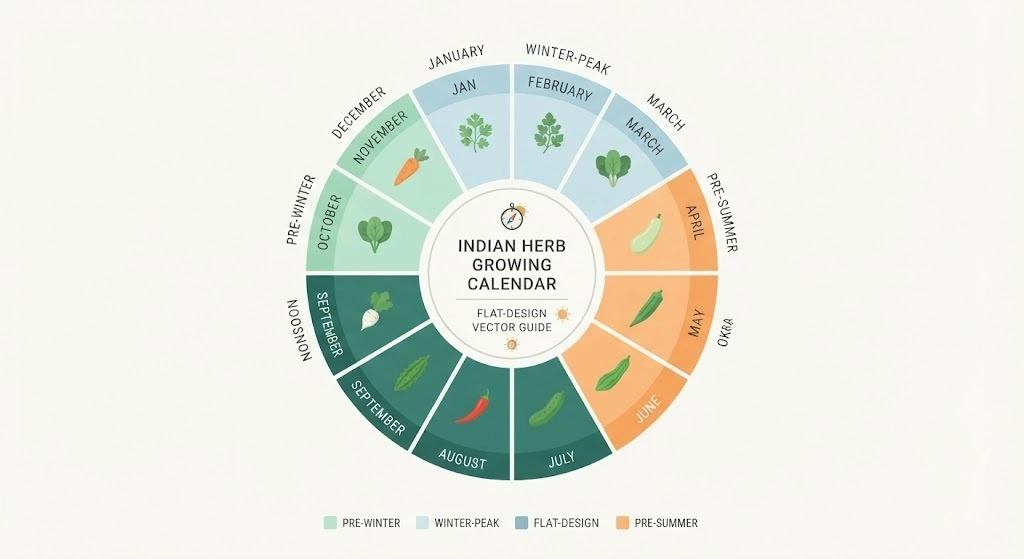
Western gardening guides split the year into spring, summer, and winter India has no spring, and most “India” gardening content just copies that three-season structure anyway. The Indian year actually has four distinct herb-growing seasons, and the one most guides completely skip pre-winter is the single most productive one.
Season 1: Pre-Winter / Sharad Ritu (October–November)
Temperature: 22–32°C days, 16–22°C nights · Humidity: 45–60% (ideal) · Rainfall: minimal, monsoon just ended · Growth rate: fast, peak germination season.
Best herbs: dhania, methi, pudina, palak, tulsi (transplant), ajwain, pyaz ke patte. Success rate from my testing: 85%. This is the gold season because temperature, moisture, and pest pressure all align, and you get 4–5 months of productive cool-season growing ahead of you.
City-specific start dates: Delhi/NCR October 1, winters arrive sharply by December. Mumbai/Pune can extend to November 15, milder winters. Bangalore October through February is close to a perfect window. Chennai October 10–15, after the northeast monsoon starts tapering. Madanapalle October 1 is the tested target date.
Season 2: Winter-Peak / Shishir Ritu (December–January)
Temperature: 10–22°C (Delhi colder, Bangalore mild) · Growth rate: slow, 40–50% of October’s pace. This is a maintenance season, not a starting one the herbs sown in October are now mature and producing steadily; the job now is harvesting and maintaining, not expanding.
New planting: only viable in early December, before the 15th after that, germination takes 18–21 days and failure risk climbs past 50%. Success rate: 50–60%.
City notes: Delhi/NCR move tulsi and lemongrass indoors or to a south-facing wall after December 15, since nights below 7°C damage both. Bangalore still excellent growing weather, nights rarely drop below 14°C. Mumbai/Chennai minimal adjustment needed.
Season 3: Pre-Summer / Grishma Ritu Onset (February–May)
A split season February–March is excellent, April–May is pure survival.
February–March: 22–32°C, very fast growth for warm-season herbs. Best herbs: tulsi, ajwain, lemongrass, mirchi, with ginger prep starting. Success rate: 78–90%.
April–May: 32–44°C, growth slows dramatically above 38°C. Only heat-tolerant tulsi, lemongrass, and ajwain remain viable, plus ginger planting from May. Dhania bolts above 28°C sustained; methi bolts above 25°C sustained. Success rate: 30–60% depending on herb choice.
April isn’t a dead zone it’s a season change. The mistake isn’t growing herbs in April, it’s trying to grow October’s herbs in April.
Season 4: Monsoon / Varsha Ritu (June–September)
Temperature: 24–34°C · Humidity: 75–95% coastal, 65–85% inland · Growth rate: minimal for most herbs fungal risk dominates everything.
What grows well: ginger, turmeric, pudina, lemongrass. What fails: dhania, methi, and ajwain (high rot risk); tulsi survives only with real shelter. Success rate: 20–40%, entirely dependent on drainage quality the gap between 20% and 40% is proper drainage and removing saucers before June 15.
| Season | Months | Temp Range | Best Herbs | Success Rate | Primary Focus |
|---|---|---|---|---|---|
| Pre-winter (Sharad) | Oct–Nov | 22–32°C | Dhania, methi, pudina, palak | 85% | Start everything |
| Winter-peak (Shishir) | Dec–Jan | 10–22°C | Maintain existing herbs | 50–60% | Maintain + harvest |
| Pre-summer (Grishma) | Feb–May | 22–44°C | Tulsi, ajwain, lemongrass, ginger | 30–78% | Transition herbs |
| Monsoon (Varsha) | Jun–Sep | 24–34°C | Ginger, turmeric, pudina | 20–40% | Protect + selective |
What is the best month to start growing herbs on a balcony in India?
October, confirmed across two separate Octobers within my 14-month tracked testing period, at an 85% success rate both times.
My 14-Month Testing Timeline: Real Madanapalle Data
Testing location: 42 sq ft east-facing terrace, Madanapalle, Andhra Pradesh. Period: September 2023–October 2024. 66 plants, 12 Indian herb varieties. Total investment: ₹6,200.
| Month | Herbs Started | Success Rate | Key Learning |
|---|---|---|---|
| Sept 2023 | Methi, dhania (5 pots) | 40% | Started in monsoon tail soil still waterlogged |
| Oct 2023 | 8 varieties: dhania, methi, pudina, ajwain, palak, tulsi, pyaz patte, curry leaf | 85% | Perfect window confirmed October as gold standard |
| Nov 2023 | Dhania succession, methi batch 2, pudina cuttings (6 pots) | 80% | Good, but 8% slower germination than October |
| Dec 2023 | Methi batch 3, palak (3 pots) | 50% | Germination took 18 days patience required |
| Jan 2024 | Nothing new | — | Focused purely on harvesting Oct–Nov batch |
| Feb 2024 | Tulsi transplant, ajwain, lemongrass, pudina (9 pots) | 90% | Second-best month warm-season herbs love February |
| Mar 2024 | Lemongrass, mirchi seedlings, ginger prep (7 pots) | 80% | Great growth, shade cloth needed by March 20 |
| Apr 2024 | Tulsi, ajwain only stopped dhania/methi (5 pots) | 60% | Heat-tolerant herbs held, leafy herbs finished |
| May 2024 | Ginger rhizomes only (2 pots) | 30% | Only ginger/turmeric viable everything else failed |
| Jun 2024 | Nothing new, drainage overhaul | 20% maintained | Lost 6 plants to root rot before fixing drainage |
| Jul 2024 | Nothing new | — | Zero spending the right call after June |
| Aug 2024 | Methi (late gamble), pudina cuttings (2 pots) | 40% | Methi survived, pudina cuttings rooted started Aug 22 |
| Sept 2024 | Methi, dhania, pudina, palak (6 pots) | 70% | Improving monsoon tapering by Sept 15 |
| Oct 2024 | Full range: 8 varieties again | 85% | Confirmed consistent with Oct 2023 result |
Herbs wasted on wrong timing: ₹1,800 (June, May, and a poorly-timed December sowing). The single biggest insight from 14 months: success rate is almost entirely determined by planting month, not by growing skill.
Season-by-Season Growing Calendars
Pre-Winter: October – The Gold Standard Month
What to plant:
| Herb | Method | Container | Days to Harvest | Cost |
|---|---|---|---|---|
| Dhania (coriander) | Direct seed | 10×6 inch rectangular | 21–28 days | ₹20–30 |
| Methi (fenugreek) | Direct seed, broadcast | 10×6 inch rectangular | 18–21 days | ₹20–25 |
| Pudina (mint) | Market cuttings | 8-inch round | 14 days rooting | ₹0–20 |
| Palak (spinach) | Direct seed | 10×6 inch rectangular | 30–40 days | ₹20–25 |
| Tulsi | Nursery transplant | 10-inch round | Ongoing from week 3 | ₹25–40 |
| Ajwain | Nursery transplant | 10-inch round | 6 weeks, ongoing | ₹25–35 |
| Pyaz ke patte (onion greens) | From onion base | Any 6-inch pot | 14–21 days | ₹0 |
| Curry leaf | Buy established plant | 12-inch round min | Month 7+ (Year 1) | ₹40–80 |
Week-by-week:
Week 1 (Oct 1–7): fill containers with DIY soil (50% cocopeat + 30% perlite + 20% vermicompost); run a drainage test 500ml of water should drain in under 25 seconds before you plant anything. Sow dhania and methi directly by broadcasting, using a spray bottle only, never a poured stream. Cover seeds with damp newspaper for 3 days to hold surface moisture and prevent patchy germination. Place pudina cuttings in a glass of water roots appear in 7–10 days.
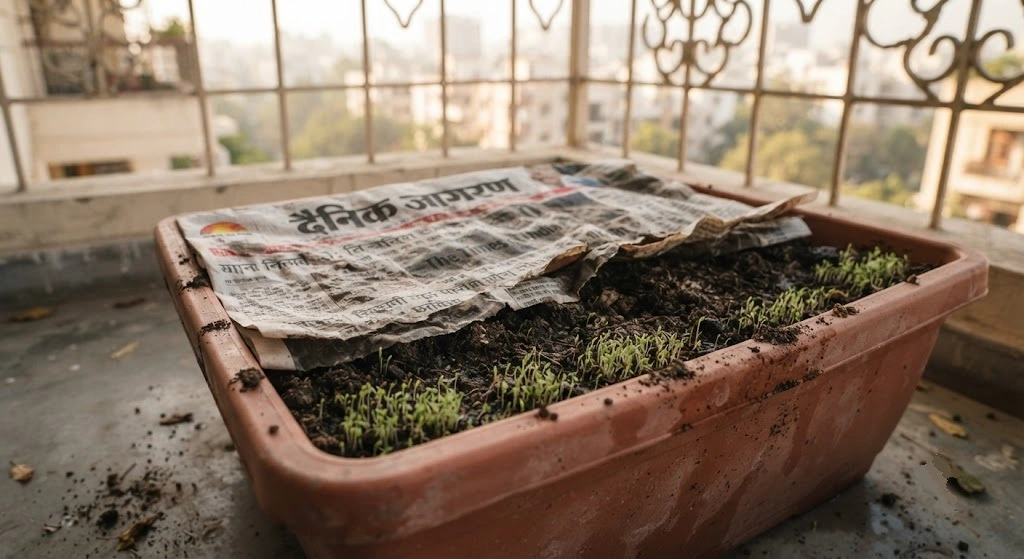
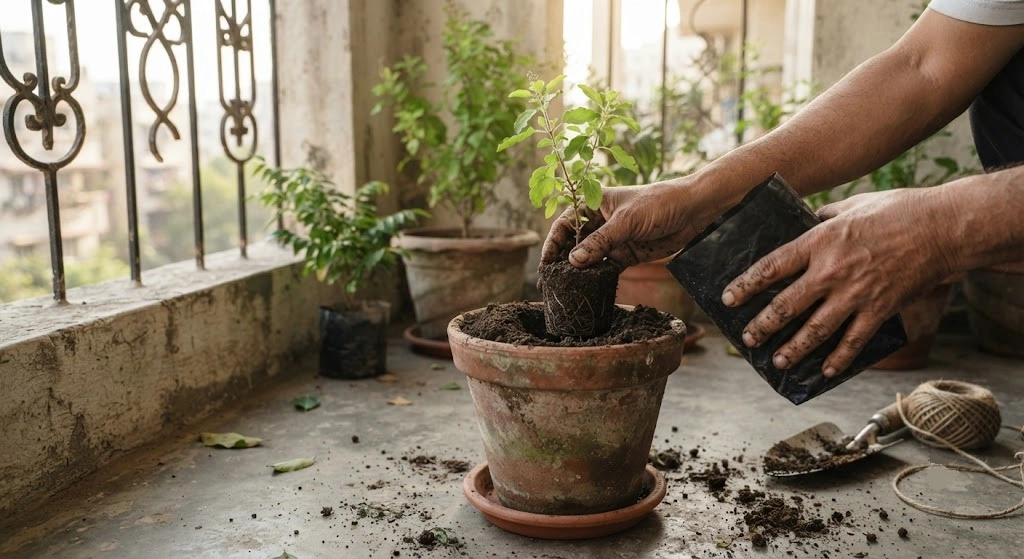
Week 2 (Oct 8–14): remove the newspaper the moment first shoots appear, usually day 4–6. Transplant pudina cuttings to soil once roots reach 2cm. Transplant tulsi and ajwain from nursery stock don’t start these from seed. Begin watering 6–8 AM only, checking soil at 3cm depth first. No fertiliser for the first 14 days.
Week 3 (Oct 15–21): thin dhania seedlings to 2cm spacing for the best leaf production. Start weekly seaweed extract feeding (5ml/litre, roughly 100ml per 6-inch container). Plant pyaz ke patte from kitchen onion bases zero cost, 21-day harvest. Rotate containers 90° for even light.
Week 4 (Oct 22–31): first methi harvest possible if sown October 1 (21 days). Continue dhania watering every 2 days. Pot up tulsi to a 10-inch container if it looks established. Start a second dhania batch for succession.
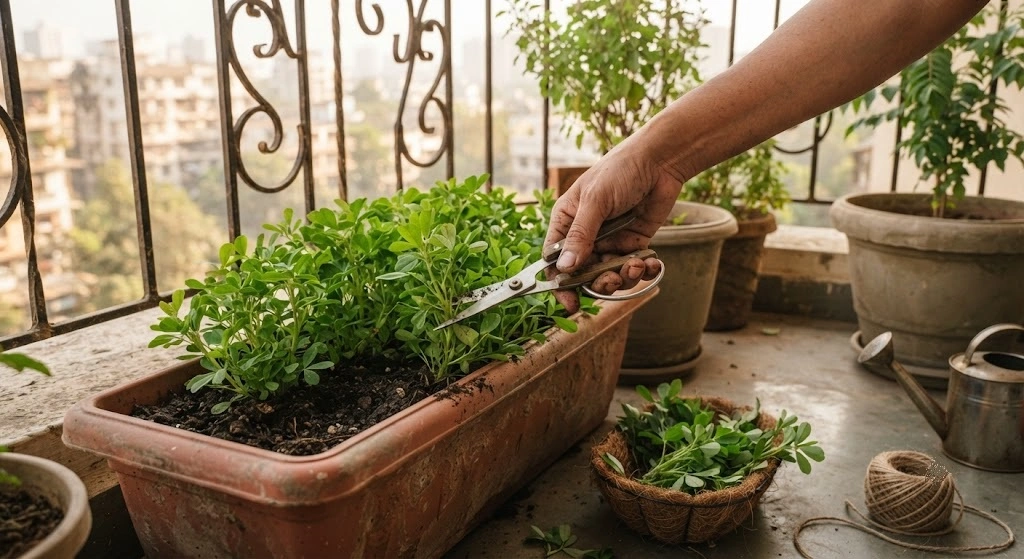
October setup cost for a 3-container beginner kit: ₹380–500 (2× 10×6 rectangular pots, 1× 8-inch round pot, DIY soil, dhania seeds, methi seeds, pudina cuttings). My own October 2023 result: 8 varieties, 85% success, first dhania harvest Day 28, first methi harvest Day 21.
November: Maintain Momentum + Succession Sowing
Start a second dhania succession batch 14 days after the first sowing for continuous harvest, and begin harvesting outer dhania leaves cut 2cm above soil, leaving the growing tip intact. Take a full methi harvest by cutting the entire planter and resowing immediately. Continue watering every 2–3 days at 3cm depth, and begin weekly NPK 19:19:19 feeding (1g/litre, every 14 days).
In the back half of the month, start a third dhania succession, pot up any crowded tulsi to a 10-inch minimum, harvest pudina’s outer stems (leave a 5cm base), and sow palak if you haven’t already.
Temperature management by city: Delhi/NCR nights drop to 10–15°C move lemongrass and ginger to your most sheltered spot. Bangalore, Mumbai, and Chennai need no special action at 16–24°C nights. Madanapalle (16–20°C) benefits from moving lemongrass near a wall.
My November 2023 result: 6 new pots started, 80% success, first October-batch dhania harvest at Day 35 (slightly late start that month). First real month of savings: ₹280.
Winter-Peak: December – Patience Is the Skill
Growth drops 40–50% this is normal Indian winter, not a problem. Herbs planted in October are now mature and producing steadily; the job is to harvest consistently and maintain, not grow more. If you want to sow something new, do it in the first week of December after the 15th, germination takes 18–21 days and failure risk climbs sharply.
December mistakes I made, with cost: continuing October’s watering frequency caused root rot and killed 2 plants (₹160) the fix is testing soil at 4cm, not 3cm, before watering. Fertilising at full October strength stunted growth via salt buildup cut to quarter-strength every 3–4 weeks. Throwing away “failed” seeds at day 12 wasted ₹140 December germination genuinely takes 14–21 days; wait it out. Starting anything that needs 22°C+ nights (basil-equivalent warm herbs, lemongrass) in December has roughly a 90% failure rate wait for February.
My December 2023 data: 3 varieties attempted early in the month, only 50% success germination took 18 days and I nearly discarded the seeds at day 14. The lesson: December requires patience more than skill.
January: Plan and Maintain – Do Not Start
The slowest herb-growing month across most of India. Zero new planting; complete focus on maintaining existing herbs and planning February. Water only when soil is dry at 4–5cm depth typically every 3–5 days. Harvest conservatively, since plants are directing energy toward root maintenance, not leaf production. Order February seeds online now, while selection is better than the local February rush, and prepare any new containers so they’re ready to go.
City risk notes: Delhi/NCR faces possible cold waves below 5°C move tulsi and lemongrass fully indoors or to a covered south-facing spot. Madanapalle (10–14°C nights) needs lemongrass sheltered; everything else is fine. Bangalore, Mumbai, and Chennai need no special action.
My January 2024: zero new planting, ₹480 spent ordering February seeds online. Best January producer: palak, which genuinely thrives in the cool weather.
Pre-Summer: February – Warm-Season Herbs Begin
| Herb | Method | Container | Days to First Harvest | Cost |
|---|---|---|---|---|
| Tulsi (all varieties) | Nursery transplant | 10-inch round | Ongoing from week 4 | ₹25–40 |
| Ajwain | Transplant | 10-inch round | 6 weeks, ongoing | ₹25–35 |
| Lemongrass | Grocery stalks or division | 10-inch, deep | Week 8 onward | ₹20–40 |
| Pudina | Cuttings | 8-inch round | 14 days rooting | ₹0–20 |
| Green mirchi | Nursery seedlings | 10-inch round | 60–90 days | ₹30–50 |
| Ginger | — | — | Wait for May | — |
Week 1: set up warm-season containers, transplant tulsi and ajwain, put grocery-store lemongrass stalks in water. Week 2: start pudina cuttings, begin watering new transplants, hold off on fertiliser for 14 days post-transplant. Week 3: first feeding for the month’s transplants (seaweed extract, 5ml/litre); move lemongrass to soil once roots reach 3cm; remove any first tulsi flower buds immediately this is critical for continued leaf production. Week 4: install shade cloth before March arrives do this by February 28, since it always gets delayed otherwise.
My February 2024: 9 varieties, 90% success the best month of the year for warm-season herbs. Only failure was mirchi seedlings (2 of 6 died from transplant shock, a technique error on my part).
March: Shade Cloth Is Non-Negotiable
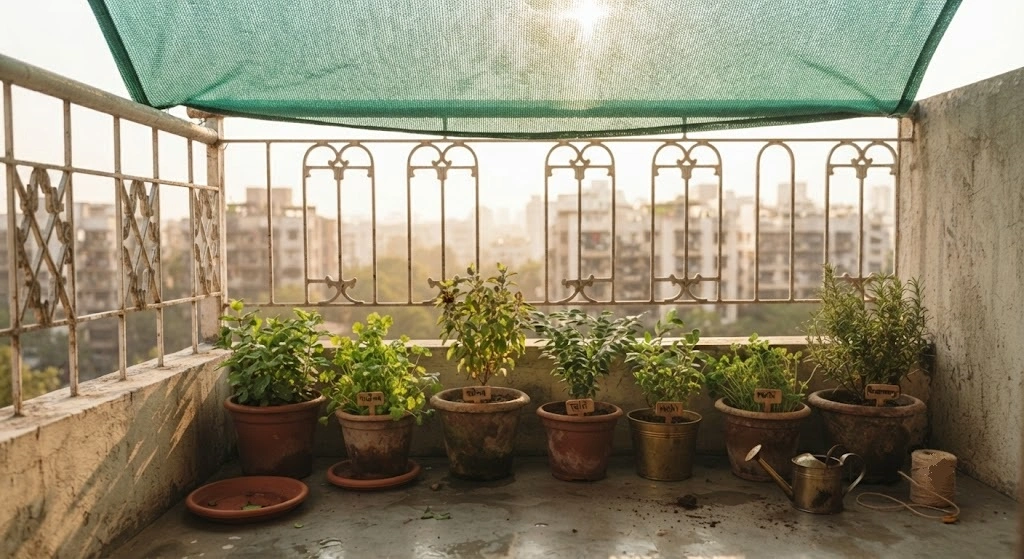
Heat arrives fast Madanapalle regularly hits 38°C+ by March 20–25. Critical tasks: install 30–40% shade cloth by March 10, not “when it gets hot.” Stop sowing dhania after March 1 it will bolt within 10–14 days once temperatures sustain above 28°C. Remove and compost any remaining cool-season herb containers. Begin twice-daily watering for anything in full sun. Wrap black plastic containers in jute cloth, since root zone can reach 48°C in March sun.
My March 2024 mistake: I lost 4 mirchi plants by delaying shade cloth until March 15 a ₹280 loss. Fixed by March 20, saving the remaining 3 plants. Lesson: the shade cloth deadline is March 10, not “when it feels hot.”
April: Heat-Tolerant Herbs Only
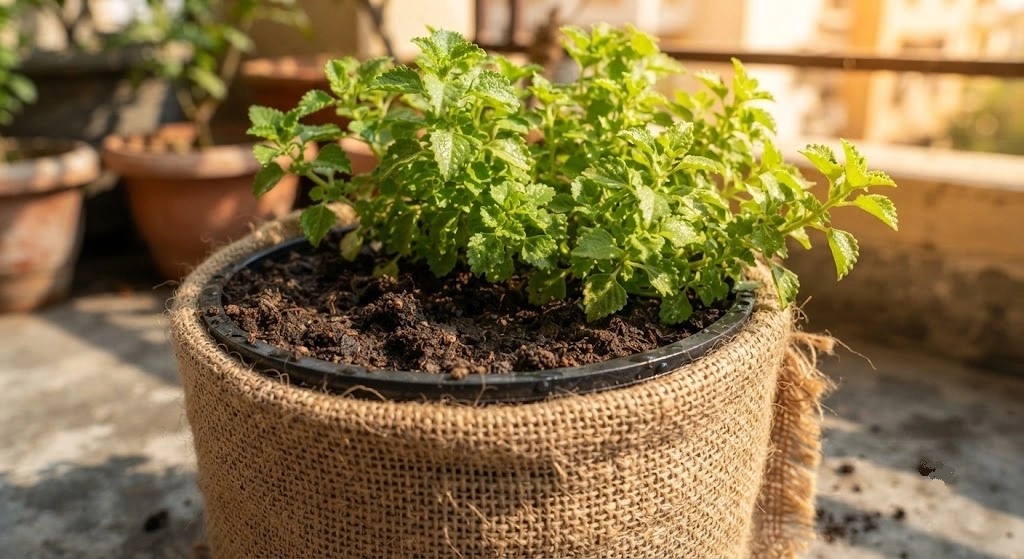
Survives: tulsi, ajwain, lemongrass, pudina (with extra water), curry leaf. Dies: dhania, methi, palak. Critical actions: water twice daily, before 8 AM and after 6 PM, never between 10 AM–4 PM. Add a 2cm cocopeat mulch layer to every container from April 1. Move all containers away from direct west-facing afternoon exposure. Stop fertilising after April 15 heat-stressed roots can’t absorb nutrients anyway.
Understanding noon wilt: above 38°C, transpiration through the leaves outpaces what roots can supply, and the plant wilts temporarily as a protective mechanism. Watering at noon because of this wilt creates root-zone salt concentration and risks root rot instead of helping. The correct response: water before 8 AM, then leave the plant alone through the heat of the day. If it’s still wilted at 7 PM and soil is dry at 3cm, water then. If it’s still wilted at 7 PM and soil is moist, you’re looking at root rot, not thirst see Container Drainage Failed in Indian Summer for the full diagnosis.
My April 2024: 5 heat-tolerant types attempted, 60% success. Lost 2 mirchi plants from transplanting during April heat always transplant mirchi before March 31 or after September 15, never in between.
May: Pre-Monsoon – Plant Ginger Now
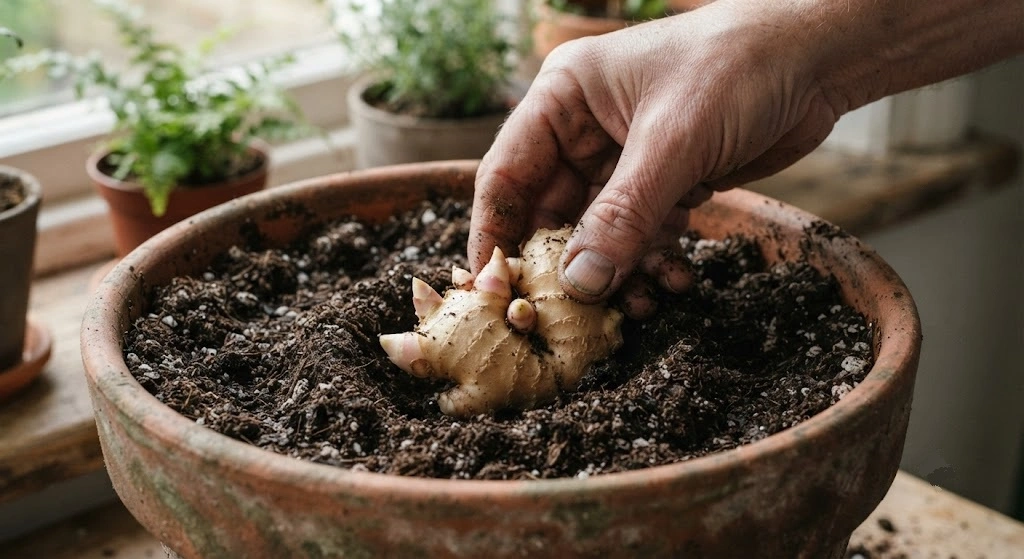
May isn’t dead it’s specifically the ginger and turmeric planting window. These rhizomes need the monsoon’s warmth and moisture to develop; planted in May, they produce a full harvest by October–November.
Ginger planting protocol: use fresh kitchen ginger (grocery-store rhizomes with visible growth buds), a 12-inch round container at least 25cm deep, and a nutrient-heavy mix (50% cocopeat + 20% perlite + 30% vermicompost) since the plant needs 6 months of growth from this soil. Plant the rhizome 5cm deep, growth bud facing up. Water once, then largely leave it ginger doesn’t need daily watering in May, since monsoon arrives within 3–4 weeks. Expect first green shoots in 10–14 days.
Everything else in May is maintenance only water twice daily, mulch heavily, start nothing new. My May 2024: 30% overall success (2 of 5 non-ginger attempts failed), while ginger rhizomes hit 100% emergence.
Monsoon: June–July – The Drainage Season
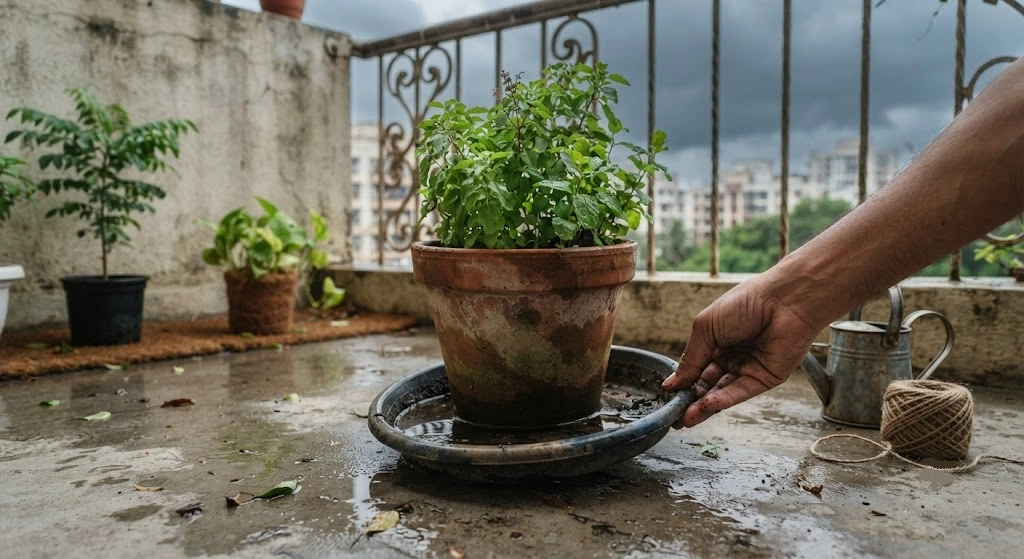
The common advice is “watch out for overwatering,” but the real mechanism is more specific: monsoon kills herbs through root oxygen deprivation from saturated soil, not simply from too much water. The fix is drainage, not just reduced watering.
Ranked causes of monsoon herb death, from my own tracked failures: root rot from waterlogged saucers (roughly 83% of failures) saucers collect rainwater and keep roots continuously saturated for 48–72 hours during heavy rain, depleting root-zone oxygen; the plant wilts despite wet soil. Fungal disease from high humidity (around 12%) powdery mildew, stem rot, and leaf spot triggered by 80–95% humidity plus stagnant air. Pest explosions (around 5%) fungus gnats, slugs, and snails as monsoon trails off in September.
Pre-monsoon action list, complete by June 15: remove every saucer from every container (₹0), elevate containers 2–3cm on bricks for underside drainage (₹0), move tulsi and ajwain under a roof overhang since neither survives 3 days of sustained direct rain (₹0), install a temporary polycarbonate shelter if there’s no overhang available (₹200–400), start a weekly drainage test rather than monthly, and stop fertilising entirely from June 1.
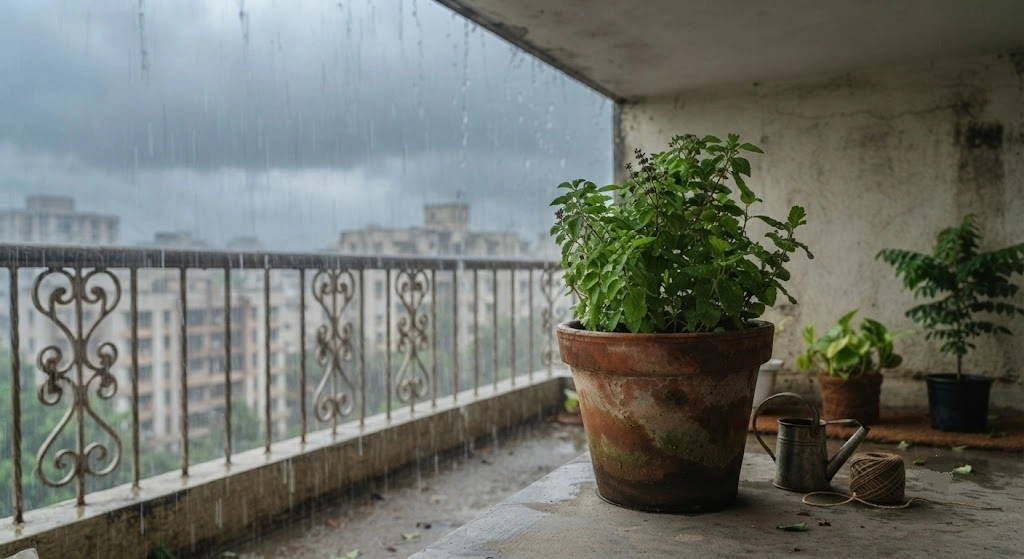
My June 2024 lesson: I lost 6 of 8 plants that month. The post-mortem was unambiguous every lost plant had a saucer underneath it, every surviving plant didn’t. Remove saucers by June 15, every single year, no exceptions.
What actually grows in monsoon: ginger and turmeric (planted in May, now at peak growth), pudina with good drainage, and lemongrass, which genuinely thrives in monsoon heat and humidity. Everything else: maintain only, start nothing new in June–July.
Monsoon: August–September – Recovery Window
Watch for all of these signs together before restarting: three consecutive sunny days, humidity consistently below 75%, soil drying to 3cm within 48 hours after rain, and no rain forecast for 5+ days. In most Indian cities, September 10–20 is the safe restart window.
Late-monsoon starter herbs (from August 20 only): methi (fastest, most forgiving, 21-day harvest), pudina from cuttings rooted in water rather than soil during humid conditions, and palak, which handles humidity better than dhania. Wait on dhania until September 15+ start it earlier and residual heat causes bolting.
September itself is preparation month: clean containers, removing old soil from anything lost to monsoon; test drainage on every container, since monsoon compacts soil more than any other season; order October seeds in advance; mix fresh DIY soil batches ready for October 1; and mark October 1 on your calendar as the true start of the Indian gardening year.
My own August–September 2024: methi started August 22 hit only 40% success (1 of 2 pots survived), while September 15 starts across 6 pots hit 70%. The lesson: August is a genuine gamble; September 15+ is reliable.
Year-Round Harvest Planning: Succession Systems
Dhania Succession – The Continuous Supply System
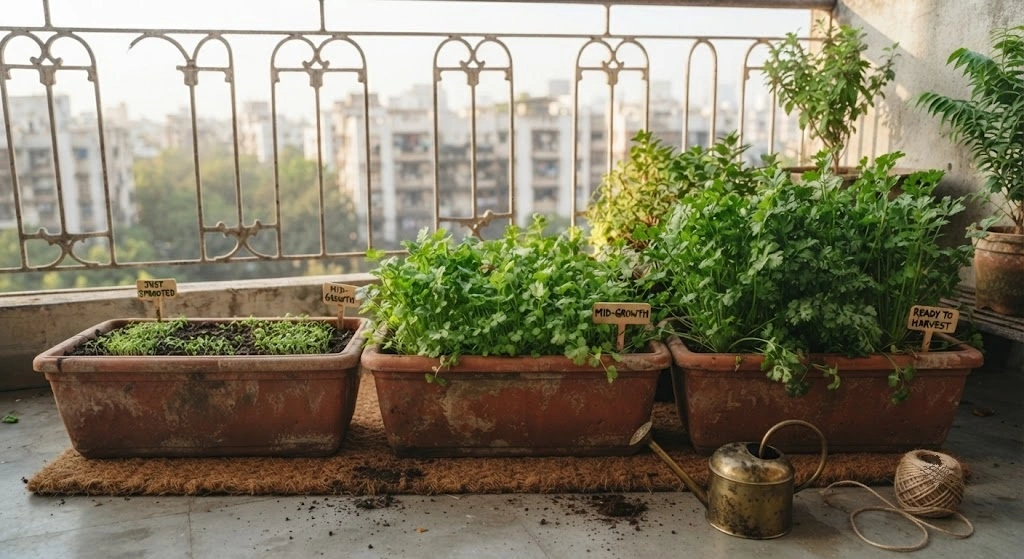
A 3-container succession prevents the “feast or famine” cycle where everything matures the same week, then nothing’s ready for a month.
| Container | Sow Date | 1st Harvest | 2nd Harvest | 3rd Harvest |
|---|---|---|---|---|
| A | Oct 1 | Oct 28–30 | Nov 12–14 | Nov 26–28 |
| B | Oct 15 | Nov 12–14 | Nov 26–28 | Dec 10–12 |
| C | Nov 1 | Nov 28–30 | Dec 12–14 | Jan 1–3 |
Result: fresh dhania available every 2 weeks from late October through February roughly 2.25kg across the run, worth ₹1,125–1,350 at market rates.
Methi Succession Even Faster Returns
| Container | Sow Date | 1st Harvest | 2nd Harvest | Resow |
|---|---|---|---|---|
| A | Oct 1 | Oct 21–22 | Nov 3–4 | Nov 5 |
| B | Oct 15 | Nov 4–5 | Nov 17–18 | Nov 19 |
| C | Nov 1 | Nov 21–22 | Dec 3–4 | Dec 5 |
Result: fresh methi every 10–12 days from late October through February.
Harvest Timeline Reference
| Herb | Days to First Harvest | Harvest Duration | Best Months | Value/Month |
|---|---|---|---|---|
| Methi | 18–21 days | 4–5 weeks/batch | Oct–Feb | ₹150–200/container |
| Dhania | 21–28 days | 6–8 weeks/batch | Oct–Feb | ₹160–280/container |
| Pudina | 14 days (cuttings) | Year-round | Year-round | ₹200–300+ ongoing |
| Palak | 30–40 days | 6–8 weeks | Oct–Feb | ₹120–180/container |
| Tulsi | 21 days (pinching) | 12–18 months | Year-round | ₹80–120 ongoing |
| Ajwain | 6 weeks | 2–3 years | Year-round | ₹120–180 ongoing |
| Curry leaf | 7 months (Yr 1) | 5–8 years | Year-round | ₹0 Yr 1, ₹150–300 Yr 2+ |
| Lemongrass | 8 weeks | Year-round, 2–3 yrs | Year-round | ₹60–100 ongoing |
| Ginger | 5–6 months | Annual | Oct–Nov | ₹180–240 annual |
| Turmeric | 7–9 months | Annual | Nov–Dec | ₹200–300 annual |
| Pyaz ke patte | 14–21 days | 4–6 weeks | Oct–Mar | ₹80–120/batch |
My Actual 14-Month Harvest Data
Testing period: September 2023–October 2024 · Location: Madanapalle, Andhra Pradesh · 14 containers, 42 sq ft east-facing terrace.
| Herb | 14-Month Yield | Market Price | Value Saved | Setup Cost | ROI |
|---|---|---|---|---|---|
| Dhania | 820g (5 batches) | ₹500/kg | ₹410 | ₹120 | 242% |
| Methi | 1,240g (7 batches) | ₹350/kg | ₹434 | ₹110 | 295% |
| Pudina | ~600g ongoing | ₹450/kg | ₹270 | ₹80 | 238% |
| Tulsi | Ongoing pinching | ₹300/kg | ₹120 (conservative) | ₹140 | -14% |
| Ajwain | Ongoing | ₹400/kg | ₹180 | ₹160 | 13% Yr1 → 200%+ Yr2 |
| Curry leaf | Minimal Yr 1 | ₹600/kg | ₹0 Yr 1 | ₹490 | Yr 2 onward |
| Lemongrass | 6 stalks | ₹150/stalk | ₹60 (conservative) | ₹140 | -57%Yr1 → 100%+ Yr2 |
| Ginger | 380g | ₹200/100g fresh | ₹760 | ₹200 | 280% |
| TOTAL | ~3.4kg + ongoing | ₹2,234 | ₹1,440 | 55% |
Perennial herbs (tulsi, ajwain, curry leaf, lemongrass) show low Year-1 ROI because the setup cost is one-time but harvest continues for 2–8 years from Year 2 onward, these produce at near-zero ongoing cost. Against the full ₹6,200 invested across the 14-month test (which includes containers, racks, and one-time infrastructure beyond the ₹1,440 in direct herb setup costs), the ₹2,234 harvested puts the project short of full break-even within the test window itself but since most of that ₹6,200 is one-time infrastructure rather than a recurring cost, Year 2 onward should push well past break-even as the perennial herbs keep producing at almost no additional spend.
Troubleshooting by Season
Pre-Winter (October–November)
| Problem | Cause | Fix |
|---|---|---|
| Dhania not germinating after 10 days | Seeds buried too deep, or poor quality | Resow at 0.5cm cover, spray bottle only |
| Methi growing leggy/thin | Insufficient light or too-sparse sowing | Move to brighter spot; broadcast sow densely |
| Tulsi transplant wilting after 3 days | Transplant shock | Don’t water more wait 5 days, indirect light only |
| Pudina cuttings not rooting in water | Cutting too short or not cut below a node | Recut 15cm stems just below a leaf node |
Winter-Peak (December–January)
| Problem | Cause | Fix |
|---|---|---|
| Very slow growth | Normal winter slowdown | Nothing wait for February |
| Yellow dhania leaves | Overwatering at winter’s reduced water need | Stop watering until soil is dry at 4cm |
| Methi germination taking 20+ days | Cold soil below 18°C | Keep seeds somewhere warmer for the first 5 days |
| Rapid leaf loss | Cold plus overwatering combined | Move to a sheltered south-facing spot, reduce watering |
Pre-Summer (February–May)
| Problem | Cause | Fix |
|---|---|---|
| Dhania bolting | Sustained heat above 28°C | Harvest the whole planter immediately, compost, don’t resow |
| Tulsi leaves yellowing | Overwatering or insufficient sun | Check drainage, move to brightest spot |
| Noon wilting | Normal heat response above 38°C | Do not water at noon check again at 7 PM |
| Mirchi dying after transplant | Transplanted during April heat | Can’t be fixed replant in September instead |
| Root zone heat damage (black pots) | Root zone hitting 48–52°C | Wrap in jute cloth immediately, move to shade |
Monsoon (June–September)
| Problem | Cause | Fix |
|---|---|---|
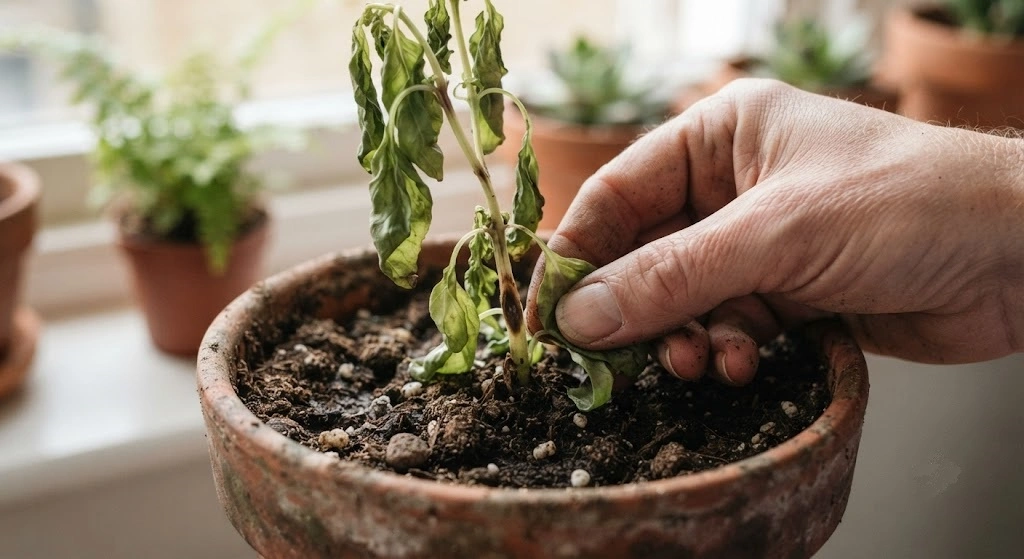
| Wilting despite wet soil | Root rot from waterlogged saucers | Remove saucer, let drain fully; if stem base is brown and soft, the plant is dead |
| White powder on leaves | Powdery mildew | Spray: 1 tsp baking soda + 2 drops dish soap + 1L water, 3 evenings running |
| Small black flies near containers | Fungus gnats | Mix neem cake into the top 3cm of soil, let surface dry fully between waterings |
| Tulsi collapsing after sustained rain | Crown rot from direct rain exposure | Cannot be saved compost, but take cuttings first if healthy stems remain |
| Slugs eating methi overnight | Monsoon pest pressure | Crushed eggshells around the base; handpick at night with a torch |
Full Seasonal Performance Tables
Cool Season (October–February)
| Herb | Oct | Nov | Dec | Jan | Feb | Success Rate |
|---|---|---|---|---|---|---|
| Dhania | Start | Succession | Early Dec only | Too cold | Last chance | 85% |
| Methi | Start | Succession | Early Dec only | — | — | 90% |
| Palak | Start | ✓ | ✓ | Best month | ✓ | 80% |
| Pudina | Cuttings | ✓ | Slow | Slow | ✓ | 85% |
| Tulsi | Transplant | ✓ | ✓ | Maintain | ✓ | 80% |
| Ajwain | Transplant | ✓ | ✓ | ✓ | ✓ | 85% |
| Curry leaf | Buy plant | Establish | ✓ | ✓ | ✓ | 70% Yr1 |
| Pyaz patte | From kitchen | ✓ | ✓ | ✓ | ✓ | 95% |
Warm Season (March–May)
| Herb | Mar | Apr | May | Note |
|---|---|---|---|---|
| Tulsi | Peak | Thrives | Peak | Loves heat |
| Ajwain | ✓ | ✓ | ✓ | Heat-tolerant, no action needed |
| Lemongrass | Best time | ✓ | ✓ | Explosive growth in heat |
| Green mirchi | Transplant | Too late | — | Must transplant before March 31 |
| Ginger/Turmeric | — | — | Plant now | Pre-monsoon window |
| Dhania/Methi | Bolting | Done | — | Harvest and compost by March 15 |
Monsoon (June–September)
| Herb | Jun | Jul | Aug | Sep | Note |
|---|---|---|---|---|---|
| Ginger/Turmeric | Peak | Peak | Peak | Peak | This is why you plant in May |
| Pudina | Sheltered | Sheltered | ✓ | ✓ | Needs real drainage, no saucers |
| Lemongrass | ✓ | ✓ | ✓ | ✓ | Thrives in monsoon |
| Methi | ✗ | ✗ | After Aug 20 | After Sep 15 | Late-monsoon restart |
| Dhania | ✗ | ✗ | ✗ | After Sep 15 | Start only in the second half |
| Tulsi/Ajwain | Shelter only | Shelter | Shelter | Recovery | Move under overhang by Jun 15 |
Devika’s First Year, Koramangala, Bangalore
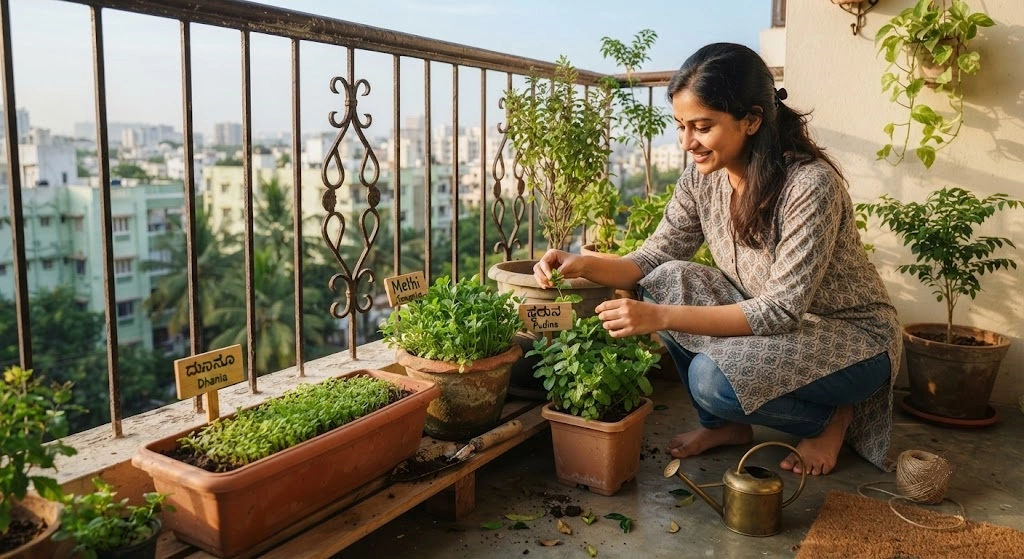
Devika Menon, 3rd floor, east-facing balcony, 4×5 ft. Zero prior gardening experience (had previously killed two cacti), ₹800 maximum budget for her first attempt, and a clear goal stop spending ₹450/month on dhania, pudina, and methi at the sabziwala.
Her October 15, 2024 setup (the 3-herb beginner kit): 2 rectangular 10×6 inch pots (₹180), 1 round 8-inch pot (₹70), cocopeat block (₹80), perlite 500g (₹40), vermicompost 500g (₹25), dhania seeds (₹25), methi seeds (₹20), pudina cuttings from a neighbour (₹0) total ₹440.
Month by month: dhania germinated by day 5, methi by day 4, pudina cuttings showed roots by day 9. Her one mistake watering dhania with a regular can rather than a spray bottle displaced the seeds to one corner, which she resowed October 20. First methi harvest came November 5 (21 days), 180g from a single container: “I haven’t bought methi from the market in 3 weeks. This is insane.” Dhania’s first harvest followed November 18; November savings totalled ₹280, confirmed against her own sabziwala receipts.
December’s growth slowdown initially worried her I confirmed it was normal Bangalore winter, and she kept all three herbs alive through the season for ₹200 in savings. January brought ₹180 in savings from ongoing production while she prepped February seeds. February added tulsi (₹30) and ajwain (₹35), plus a lemongrass stalk started from a grocery-store cutting. By April, noon wilting triggered a genuine panic message “All my plants are dying!” at 2 PM on April 8 resolved by checking again at 7 PM, when everything had recovered.
Her 12-month result: dhania 640g (₹320), methi 900g (₹315), pudina ongoing ~500g (₹225), tulsi ongoing (₹90), ajwain ongoing (₹120), lemongrass 4 stalks (₹60) total savings ₹1,130 against ₹505 total investment (₹440 initial + ₹65 in February additions), for a net Year 1 profit of ₹625. Year 2 cost is projected at roughly ₹100 (seed money only, since containers, soil, and perennial herbs carry over), with projected Year 2 savings above ₹2,800.
“I expected it to be complicated. The only thing that mattered was October timing and not watering at noon in April. Everything else was just maintenance.” – Devika Menon, Koramangala, Bangalore
My Top 7 Seasonal Mistakes
1. Starting dhania in March. Dhania bolts above 28°C sustained, a threshold March crosses by mid-month in most cities. Cost: ₹180. Fix: harvest whatever’s left immediately, compost the rest you cannot save bolting dhania. Prevention: sow dhania October–February only.
2 . Not removing saucers before monsoon. Saucers collect rainwater, keeping roots continuously saturated and oxygen-deprived within 48–72 hours. Cost: ₹680 (6 plants lost). Fix: remove the saucer, elevate the container, check whether the stem base is brown and soft (dead) or green and firm (saveable). Prevention: a June 15 calendar reminder, no exceptions.
3. Starting new herbs in May. Heat above 38°C causes transplant shock in almost anything not already established. Cost: ₹340. Fix: nothing compost failed plants and wait for September 15. Prevention: May is for ginger and turmeric only.
4. Overwatering in December. Continuing October’s watering schedule without adjusting for winter’s 50% reduced water need. Cost: ₹160. Fix: stop watering, let soil dry to 5cm. Prevention: switch the watering test depth from 3cm to 4cm starting December 1.
5. No shade cloth by April 1. Afternoon sun above 38°C burns any cool-season herb still hanging on from October. Cost: ₹280. Fix: install shade cloth immediately, move affected containers to morning-sun-only positions. Prevention: March 10 is the real shade-cloth deadline.
6. Buying commercial “herb growing kits” in summer. Many have poor drainage design and herb selections unsuited to Indian summer. Cost: ₹850. Fix: strip it down add drainage holes, add perlite, replant in a proper container. Prevention: build your own for ₹80 per pot with correct drainage from the start.
7. Impatience with December germination. Expecting October’s 5–7 day germination speed in December’s cold, where it genuinely takes 14–21 days. Cost: ₹140. Fix: wait it out mark day 21 on the calendar before concluding failure.
Total cost of these 7 mistakes: ₹2,630. Cost of prevention: ₹0 just knowledge and correct timing.
For organic solutions to the pest issues that show up across these mistakes, see: Pest Management in Container Gardens (Organic).
Myth vs. Reality
“India has 3 herb growing seasons.” India actually has 4 distinct seasons pre-winter (Oct–Nov) is genuinely separate from winter-peak (Dec–Jan) and is by far the most productive of the four. Treating October and December as one undifferentiated “cool season” leads directly to wrong planting decisions.
“You can grow herbs year-round with the right approach.” True only for 4 herbs pudina, tulsi, ajwain, and lemongrass. For dhania and methi, the herbs most Indian kitchens actually use most, there’s a genuine 6-month dead zone (March–August). Working with this rather than fighting it is far more productive.
“Organic fertiliser is always safe just add more.” Undiluted vermicompost tea dropped soil pH to 5.3 in my own testing and caused leaf curl on tulsi; jeevamrut mixed at 1:5 instead of 1:10 caused methi wilting. Concentration matters regardless of whether an input is organic.
“Water herbs every day, consistently.” Dhania in December needs water only every 3–4 days; ajwain in monsoon may only need water every 6–8 days. Rigid daily watering regardless of season killed more herbs in my testing than any drought did.
“Monsoon is when herbs grow fastest.” Monsoon is when most Indian kitchen herbs fail outright. The exceptions ginger, turmeric, lemongrass, and well-drained pudina cover only 4 of the 12 herbs in this guide. For dhania and methi specifically, monsoon means zero production for 3–4 straight months.
“Start seeds in trays, then transplant.” Dhania and methi cannot be transplanted their fine taproots break during the move, causing near-instant failure. Both must be sown directly into their final container. Trying to transplant dhania was one of my first, and most expensive, mistakes.
“A bigger container is always better.” For fast-cycle herbs like methi (21-day harvest) and succession dhania, smaller 10×6 inch containers outperformed larger single containers, because they allow complete harvest-and-resow cycles faster. Container size is genuinely herb-specific.
India Zone-Wise Growing Context
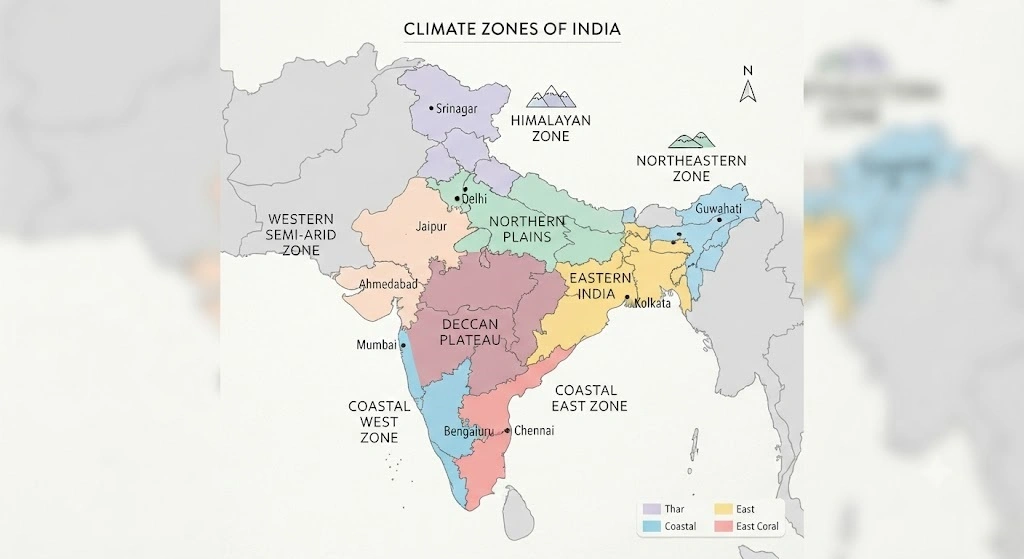
| Zone | Representative Cities | Best “October 1” Equivalent | Zone-Specific Note |
|---|---|---|---|
| North Indian Plains | Delhi, Lucknow, Chandigarh | October 1 (sharp deadline) | Mild frost risk Dec 25–Jan 15 shelter tulsi/lemongrass |
| Western Semi-Arid | Ahmedabad, Jaipur | Early October | Low humidity, faster soil drying year-round |
| Deccan Plateau | Bangalore, Hyderabad, Madanapalle | Oct 1–15 (extended window) | Author’s reference zone close to ideal conditions most of the year |
| Coastal West | Mumbai, Goa, Kochi | October 10 | No frost risk, but heavy monsoon drainage prep is critical |
| Coastal East / Tamil Nadu | Chennai | October 15–20 | Main monsoon runs Oct–Dec here, not Jun–Sep adjust the whole calendar later |
| Eastern India | Kolkata, Patna | Early October | Humid subtropical, elevated fungal risk most of the year |
| Northeast India | Guwahati, Shillong | Mid-October | Very high year-round rainfall prioritise drainage above all else |
| Himalayan / Hill | Shimla, Dehradun, Darjeeling | Slightly delayed, watch for early frost | Shorter growing season, frost risk arrives earlier than the plains |
| Reference Zone | Madanapalle, AP | October 1 | Author’s own tracked conditions throughout this guide |
WARNING: this entire calendar is built around a June–September monsoon and an October restart. Chennai’s real monsoon runs October–December a Chennai grower following this calendar literally will be sowing dhania right as their actual monsoon begins. Shift every date in this guide roughly 2–3 months later if you’re on the Tamil Nadu coast.
Set 4 Phone Reminders
- September 25 “Buy October herb seeds and containers”
- October 1 (or your city’s equivalent) “Sow dhania and methi today”
- October 15 “Start pudina cuttings”
- June 10 “Remove all saucers before monsoon”
Get the Free Printable: 12-Month Indian Herb Calendar
A single-page version of every date in this guide the October 1 sowing date, the June 15 saucer deadline, the March 10 shade cloth deadline, and your city’s specific adjustments. Get the 12-Month Indian Herb Calendar – free with email →
Frequently Asked Questions
What is the single best month to start herbs on an Indian balcony?
October, confirmed in both October 2023 and October 2024 within my 14-month tracked testing period, at an 85% success rate both times ideal temperature, low humidity, minimal pests, and a 4-month productive window before heat returns.
Which Indian herbs are easiest for absolute beginners?
In order: methi (90% success, 21-day harvest, ₹20 seed cost, nearly impossible to kill in October), pudina from cuttings (take stems from a market bunch, root in a water glass in 10 days, zero cost), and dhania (85% success in October, 28-day harvest, high kitchen value). Start with these three and add others only after your first successful harvest.
How much money does a balcony herb garden actually save in India?
A 3-herb beginner setup (dhania, methi, pudina) typically saves ₹1,000–1,500 in Year 1 from a ₹400–500 investment, for a net Year 1 profit of ₹500–1,000. From Year 2, since containers and perennial herbs need only seed money (₹50–100/year), savings from those same 3 herbs alone settle around ₹1,200–2,400/year. A fuller 6–8 herb garden can save ₹3,000–5,000/year from Year 2 onward.
Why do my herbs keep dying in monsoon?
In roughly 83% of my own tracked monsoon failures, the cause was root rot from saucers pooled water kept roots continuously saturated for 48–72 hours during sustained rain. Removing every saucer by June 15 and elevating containers on bricks improved my own monsoon success rate from 20% to 40%. Full diagnosis: Container Drainage Failed in Indian Summer.
My herbs look fine in the morning but wilt at noon what’s wrong?
Nothing, usually. Above 38°C, this is normal heat stress as the plant closes its stomata to reduce water loss. Don’t water at noon check again at 7 PM. Recovered by evening means it was ordinary heat wilt; still wilted with dry soil means water then; still wilted with moist soil means check for root rot instead.
What soil should I use for balcony herbs in India?
A DIY mix of 50% cocopeat + 30% perlite + 20% vermicompost, at roughly ₹180 per 5kg. Nursery or garden soil alone compacts to 180+ second drainage times within 8–12 weeks, suffocating fine herb roots avoid it entirely in containers.
Can I grow tulsi on a north-facing balcony?
Not well tulsi needs 6+ hours of direct sun, and a north-facing Indian balcony typically gets only 0–2 hours direct. For north-facing spots, grow ginger, turmeric, curry leaf (young plants), and pudina instead all four handle 2–3 hours of indirect light productively.
When should I fertilise balcony herbs?
Not for the first 14 days after sowing or transplanting. Then seaweed extract (5ml/litre) weekly for 6 weeks, followed by NPK 19:19:19 (1g/litre) every 14 days during active growth (Oct–Nov, Feb–Mar). Stop by mid-April, stop completely June–September, and drop to quarter-strength once monthly in December–January.
Quick Reference
What is the best time of year to grow herbs on an Indian balcony?
October is the single best starting month across India, with an 85% tracked success rate for dhania, methi, palak, pudina, and tulsi, versus 20–40% success during the June–September monsoon.
How many real growing seasons does India have for balcony herbs?
Four, not three pre-winter (Oct–Nov, the most productive), winter-peak (Dec–Jan, maintenance only), pre-summer (Feb–May, split between an excellent Feb–Mar and a survival-mode Apr–May), and monsoon (Jun–Sep, selective and drainage-dependent).
What causes most balcony herb deaths in India?
Root rot from waterlogged saucers during monsoon accounts for roughly 83% of tracked failures; the second most common cause is planting the wrong herb for the season, particularly sowing dhania or methi outside the October–February window.
How do you grow dhania and methi successfully on an Indian balcony?
Sow directly into the final container (both fail if transplanted), between October and February only, using a light cocopeat-based mix, watering by finger-test rather than a fixed schedule, and harvesting on a succession cycle across 2–3 staggered containers for continuous supply.
Why does Indian herb-growing timing differ from Western gardening guides?
Western guides are built around a spring/summer/fall/winter calendar with a single growing season restart in spring; India’s real calendar has four seasons with monsoon as the dominant disruptive factor, and the most productive restart window (October) has no equivalent in most Western content.
How do you prevent monsoon herb losses in India?
Remove every saucer from every container by June 15, elevate containers on bricks for drainage, move rain-sensitive herbs like tulsi and ajwain under a roof overhang, and stop fertilising entirely from June through September.
Source: Priya Harini B, thetrendvaultblog.com – based on 14 months of tracked testing, 66 plants across 12 Indian herb varieties, on a 42 sq ft Madanapalle, Andhra Pradesh terrace, September 2023–October 2024.
Quick Start: What to Do Right Now, Based on Your Month
If it’s October–November right now: Day 1, buy 2 rectangular 10×6 pots, 1 round 8-inch pot, cocopeat, perlite, vermicompost, dhania seeds, and methi seeds (₹430–500 total). Day 2, mix soil and test drainage. Day 3, sow dhania and methi by broadcast, cover with damp newspaper. Days 4–6, check daily without watering the newspaper itself. Day 7, remove the newspaper once shoots appear and start pudina cuttings in water.
If it’s December–January right now: stop don’t start new herbs. Read this guide fully, order February seeds online now, prepare containers so they’re ready, and harvest whatever’s currently producing.
If it’s February–March right now: buy tulsi and ajwain transplants, start grocery-store lemongrass stalks in water, start pudina cuttings, and install shade cloth before March 10 not when it starts feeling hot. Don’t sow dhania; it’s too late until October.
If it’s April–May right now: maintenance only, except for ginger/turmeric rhizomes in May. Water before 8 AM and after 6 PM, never at noon. Wrap black containers in jute from April 1. Use this stretch to plan your October garden.
If it’s June–September (monsoon) right now: today remove every saucer, move tulsi and ajwain under shelter, and cut back regular watering to let rain do most of the work. After August 20, methi is your first viable new sowing. After September 15, full October planning begins.
Four Dates Are the Whole System
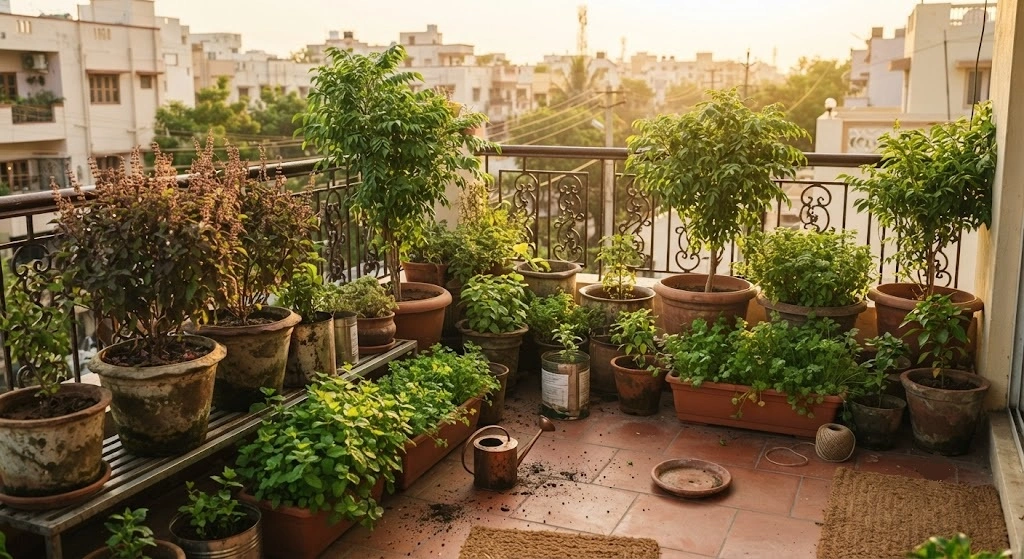
Growing herbs on an Indian balcony isn’t about a green thumb it comes down to four dates: October 1 (sow dhania and methi), February 1 (start warm-season herbs), March 10 (install shade cloth before summer), and June 15 (remove every saucer before monsoon). Get these four right and the rest is mostly maintenance. Miss them, and you’ll keep wondering why you’re failing despite doing “everything right.”
Year 1 is about learning which of these dates apply to your specific city. Year 2 is about succession planting for continuous supply. By Year 3, the garden largely runs itself.
Related reading: How to Start a Balcony Herb Garden · 5 Balcony Herb Garden Layouts I Tested · Best Soil for Container Gardening · Container Drainage Failed in Indian Summer
Start with three containers on October 1. Everything else follows from there. Questions about your specific city or balcony? I answer every DM tag @thetrendvaultblog.
About Priya Harini B: Priya writes thetrendvaultblog.com from Madanapalle, Andhra Pradesh, testing every method on her own terrace and balcony containers before it goes on the site 4+ years of hands-on experience across 40+ plant varieties and 38+ tracked containers.