
Priya Harini B · Madanapalle, Andhra Pradesh · 4+ years container gardening, 40+ plant varieties, 38+ containers tracked
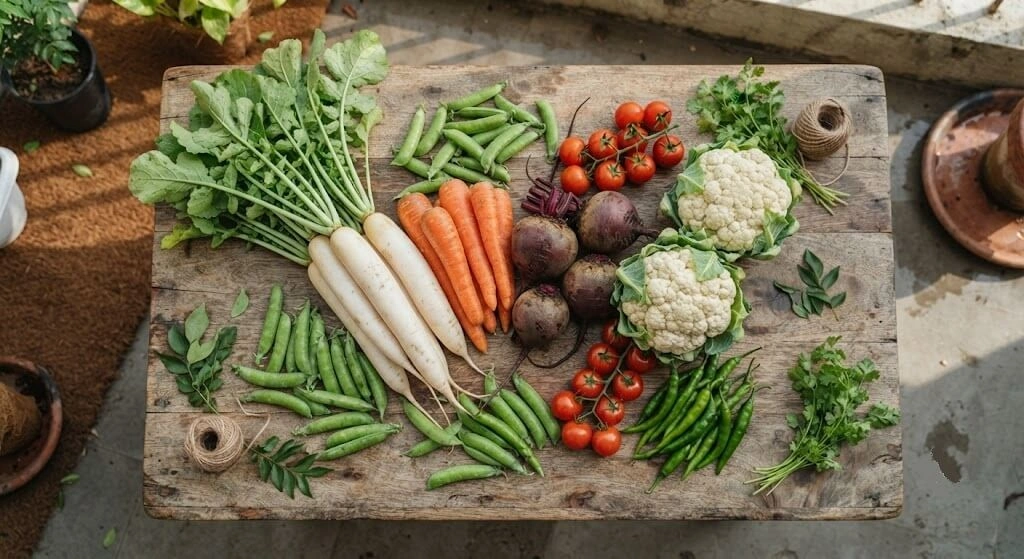
India’s cool season (October–February) is the best growing window of the year for most vegetables. The 5 easiest winter vegetables to grow in India are fenugreek/methi (20–25 days to harvest, any 6-inch container, ₹20/packet), spinach/palak (40–50 days, cut-and-come-again, works on north-facing balconies), radish/mooli (30–40 days, fastest root vegetable, 3–4 crops per season), peas/matar (60–70 days, trellis on a balcony railing, best profit per sq ft), and cherry tomato (70–80 days from transplant, 3–6kg per plant, best overall ROI). Plant by November 15 in North India, December 31 in South India. Total starter investment for a 5-crop balcony setup: ₹1,600–₹2,500.
Table of Contents
Introduction:
That first week of November, when the air in Delhi finally stops feeling like an oven and Mumbai mornings turn breathable again that’s your planting signal. Not a metaphor: when you step outside in the morning and don’t immediately start sweating, it’s time to sow winter vegetables in India.
October–February is the most forgiving growing season of the entire Indian year. Pest pressure drops sharply, water requirements roughly halve, and most vegetables Indian families eat daily methi, palak, mooli, matar, gobi were shaped by centuries of cultivation in exactly this temperature window. Yet every year, urban gardeners miss it: they mean to start in October but “don’t get around to it,” and by January it’s too late for the slower crops.
This guide is the fix. It tells you exactly what to plant, in what container size, on what date for your city, and what to do when something goes wrong every number here comes from real field testing in Indian container conditions.
Whether you’re planning winter vegetable plants for a balcony or a full terrace garden, winter planting vegetables in India follows a different calendar than what most Western guides assume.
Why Winter Is India’s Best Growing Season
India has three agricultural seasons: Kharif (monsoon, June–September), Rabi (winter, October–March), and Zaid (summer, April–May). Rabi is by far the most productive for home container gardeners, and the reasons are specific and measurable.
Ideal temperature range (8–25°C) for cool-season crops. Spinach, methi, peas, carrot, and broccoli all produce their best flavour and highest nutrient density in the 10–20°C range typical of Delhi, Bangalore, and Pune winters. Cold also concentrates sugars in root vegetables winter gajar halwa genuinely tastes better than summer gajar halwa because the carrots are sweeter.
Sharply fewer pest problems. Aphids, whiteflies, fungus gnats, and caterpillars the pests that devastate Indian balcony gardens in monsoon and summer are significantly less active below 20°C, and pest incidence on winter crops runs a fraction of monsoon-season levels in general agricultural observation.
40–50% less watering. In peak summer, container plants often need twice-daily watering; in winter, most need water only every 2–3 days. A 20-container balcony using 30–40 litres daily in summer might use just 10–15 litres every other day in winter and if you’re running a rainwater harvesting setup (see The Ultimate Rainwater Harvesting Guide), stored monsoon water can cover an entire winter garden with zero municipal water use.
Better flavour and nutrition. Cold weather slows cellular respiration, so sugars accumulate rather than being metabolised away this is why December mooli tastes sweet and peppery while an out-of-season attempt tastes bland and watery.
The highest beginner success rate of any season. The combination of forgiving temperature, low pest pressure, and slower growth (more time to spot and fix problems) gives winter-sown seeds germination rates of roughly 85–95% in a cocopeat mix, against a rougher 60–75% in summer heat and humidity.
Regional Climate Advantages
| Region | Winter Temp Range | Cool Season Duration | Best Crops | Special Conditions |
|---|---|---|---|---|
| North India (Delhi, Punjab, Haryana, UP) | 5–22°C | Oct–Feb (5 months) | All 15 crops; ideal for cauliflower, cabbage | Frost possible Dec–Jan; protect tomato/capsicum |
| South India (Bangalore, Chennai, Hyderabad) | 15–28°C | Nov–Feb (4 months) | Leafy greens, tomato, radish, lettuce | No frost; extended planting into January; afternoon shade helps lettuce |
| East India (Kolkata, Patna, Bhubaneswar) | 12–25°C | Nov–Jan (3 months) | Leafy greens, root vegetables, peas | Post-monsoon humidity; drainage and fungal prevention critical |
| West India (Mumbai, Pune, Ahmedabad) | 15–28°C | Nov–Jan (3 months) | Most crops; coastal areas resemble South India | Pune leans closer to North India’s range; Mumbai lettuce needs partial shade |
What are the best winter vegetables to grow in India?
The five easiest are fenugreek (methi), spinach (palak), radish (mooli), peas (matar), and cherry tomato all thrive in India’s October–February cool season with an 85%+ germination success rate when sown on time.
Month-by-Month Winter Planting Calendar
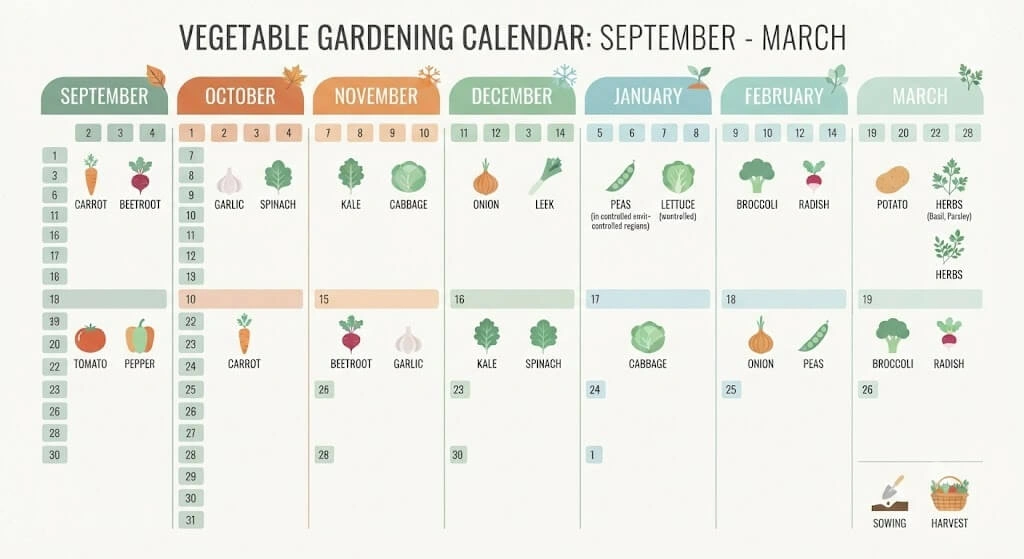
November: Prime Planting Month ⭐⭐⭐⭐⭐
Direct sow immediately: spinach/palak (scatter, 1cm deep), fenugreek/methi (broadcast dense), radish/mooli (furrows, 1cm deep), lettuce (scatter, barely cover), coriander/dhaniya (crush seeds, broadcast), mustard greens/sarson (1cm deep, rows).
Transplant seedlings (started 4–6 weeks earlier in October): cauliflower, cabbage, broccoli, cherry tomato (winter varieties), bell pepper/capsicum.
Best for North and Central India; South India should start in the second half of November.
December: Extended Planting Window
Direct sow: carrot/gajar (rows, barely cover), beetroot/chukandar (1cm deep), turnip/shalgam (1cm deep), peas/matar (3–5cm deep, near a trellis), spring onion (1cm deep).
South and West India can continue planting into early January.
January: Last Chance, Fast Crops Only
Still productive if sown by January 15: fenugreek (ready by March, before heat arrives), spinach (succession sowing), radish (1–2 more sowings possible), microgreens (7–14 day harvest), baby greens.
Do not start in January: cauliflower, cabbage, broccoli, or carrot all too slow to mature before April heat.
Succession Planting Strategy
Most gardeners make one large November sowing, get a glut in December, then nothing by February. Succession planting fixes this by staggering sowings every 2–3 weeks.
| Week | Action | What to Sow |
|---|---|---|
| Week 1 (Nov 1–7) | Batch 1 direct sow | Palak, mooli, lettuce, methi |
| Week 3 (Nov 15–21) | Batch 2 + first methi harvest begins | Same as Week 1 + coriander |
| Week 5 (Dec 1–7) | Batch 3 + first palak harvest | Same as Week 1 + gajar, beets |
| Week 7 (Dec 15–21) | Batch 4, especially for South India | Mooli, methi, leafy greens |
| Week 9 (Jan 1–7) | Final fast crops | Methi, mooli only |
Result: continuous harvest from late November through March, with no gaps and no overwhelming gluts. Track sowing dates in a notebook or phone notes app noting date, variety, and outcome is a single habit that makes you a dramatically better gardener within one season.
Regional Planting Calendar
| Vegetable | North India | South India | East India | West India | Days to Harvest |
|---|---|---|---|---|---|
| Spinach (Palak) | Oct–Feb | Oct–Jan | Nov–Jan | Nov–Jan | 40–50 |
| Fenugreek (Methi) | Oct–Nov | Oct–Dec | Nov–Dec | Nov–Dec | 20–25 |
| Mustard (Sarson) | Oct–Nov | Oct–Dec | Nov–Dec | Nov–Dec | 35–45 |
| Lettuce | Sep–Nov | Oct–Jan | Oct–Dec | Oct–Jan | 40–50 |
| Coriander (Dhaniya) | Oct–Feb | Oct–Jan | Nov–Jan | Nov–Jan | 30–40 |
| Radish (Mooli) | Oct–Feb | Oct–Jan | Nov–Jan | Nov–Feb | 30–40 |
| Carrot (Gajar) | Sep–Nov | Oct–Dec | Oct–Nov | Oct–Nov | 70–90 |
| Beets (Chukandar) | Oct–Nov | Oct–Dec | Oct–Nov | Oct–Nov | 55–70 |
| Turnip (Shalgam) | Oct–Nov | Oct–Dec | Oct–Nov | Nov–Dec | 45–55 |
| Peas (Matar) | Oct–Nov | Nov–Dec | Oct–Nov | Nov–Dec | 60–70 |
| Cauliflower | Sep–Nov | Oct–Nov | Oct–Nov | Oct–Nov | 110–120 |
| Cabbage | Sep–Nov | Oct–Nov | Oct–Nov | Oct–Nov | 90–110 |
| Broccoli | Sep–Nov | Oct–Nov | Oct–Nov | Oct–Nov | 80–100 |
| Bell Pepper | Oct–Nov | Nov–Dec | Oct–Nov | Nov–Dec | 70–90 |
| Cherry Tomato | Oct–Nov | Oct–Nov | Oct–Nov | Oct–Nov | 70–80 |
Top 15 Winter Vegetables: Detailed Growing Guides
Category 1: Root & Bulb Vegetables
1. Radish (Mooli) ⭐⭐⭐⭐⭐ Fastest Root Vegetable
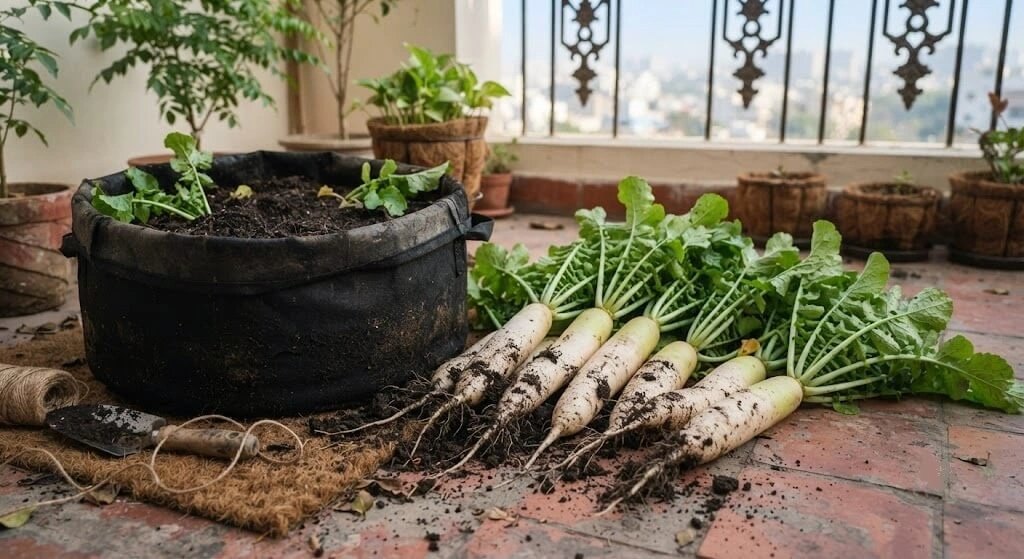
The fastest-maturing root vegetable in Indian containers first harvest in just 25–35 days. Mooli paratha, mooli sabzi, mooli ka achar, salads and the leaves themselves are edible from Day 15 as mooli ke patte ki sabzi. One bag yields 3–4 successive crops across an entire winter.
Quick stats: planting time Oct–Feb (all India); container 18×9 inch, minimum 9-inch depth (non-negotiable); spacing 8cm after thinning; sun 5–6 hours; seed cost ₹40–99/packet; yield 600g–1.2kg per sowing, 2–4.8kg total across 3–4 sowings per season.
Best varieties: Pusa Reshmi (IARI, 25–30 days, top container performer), Pusa Chetki (30–35 days, slightly heat-tolerant, good for early October), Japanese White/Miyashige (35–40 days, heavier root, milder flavour).
Soil mix (must be stone-free): 50% cocopeat, 30% vermicompost, 20% washed river sand sieved through a coarse mesh to remove anything larger than 5mm. Lumps and stones are the direct cause of forked, unsaleable roots.
Step-by-step, sowing to harvest:
- Sieve the soil before sowing, without exception this single step prevents roughly 80% of mooli failures in Indian containers.
- Fill and water the 18×9 inch bag to within an inch of the top; water until it drips from the base and let it drain 10 minutes so the soil is uniformly moist, not waterlogged.
- Sow in furrows 1cm deep, spaced 8–10cm apart, seeds 4–5cm apart within each furrow. Cover with 1cm fine soil, water gently with a rose nozzle never a direct stream.
- Germination (Day 3–6): at 20–28°C, expect shoots in 3–6 days. Move to full sun once they emerge; keep the surface moist daily.
- First thinning (Day 7–10, seedlings 4–5cm tall): thin to 6cm spacing with scissors at soil level, never by pulling. Thinnings are edible.
- Second thinning (Day 14–16, seedlings 8cm tall): final spacing 8cm. These thinnings make excellent baby mooli greens.
- Bonus leaf harvest (Day 15–20): take outer leaves only this doesn’t slow root development.
- Root check (Day 22–30): brush soil away from the root shoulder; harvest once it reaches 2.5–3cm diameter.
- Full harvest (Day 25–35): grip the leaf base and pull steadily upward, loosening soil with a thin stick first if there’s resistance never twist. Harvest the whole bag within 5–7 days of maturity; left longer, roots turn pithy and bitter.
- Immediate resow: top up with a cup of fresh vermicompost mixed into the top 5cm, then resow right away the bag and conditions are already optimal.
Troubleshooting: forked roots → sieve soil more thoroughly and increase cocopeat ratio. Leaves only, no root → use a bag at least 9 inches deep and avoid nitrogen-heavy feed. Hollow/pithy roots → you waited too long; harvest by day 35. Cracked roots → water every 1.5 days consistently and mulch the surface. Thin, pencil-like roots → you skipped thinning; final spacing must be 8cm.
Cost and yield: setup ₹180–319; value per sowing ₹108–432 across 3 crops/season; payback after the second sowing’s harvest.
2. Carrot (Desi Gajar) ⭐⭐⭐⭐ Winter’s Sweetest Root
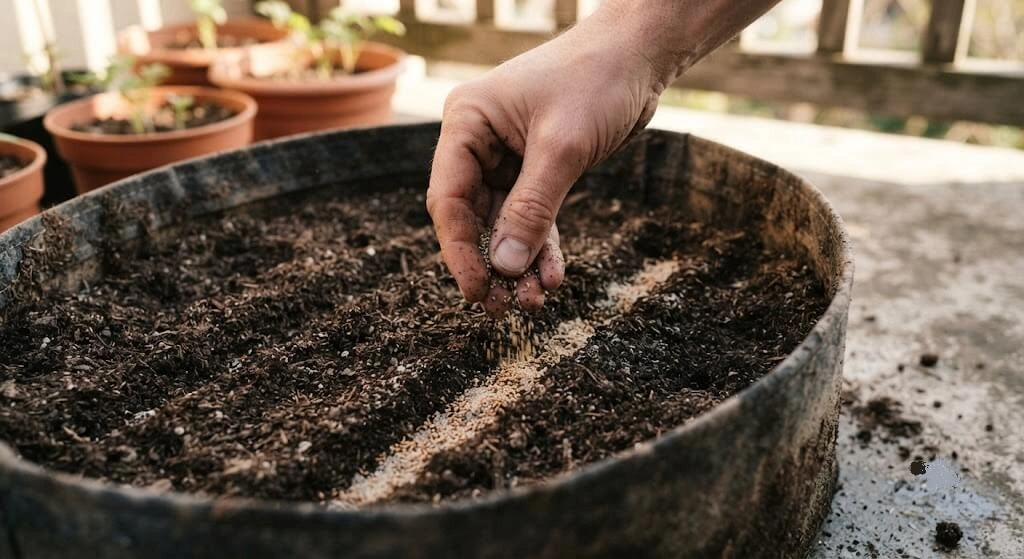
A quintessential Indian winter vegetable halwa, achar, sabzi, raita, juice. Indian red varieties (Pusa Kesar, Pusa Rudhira) carry more beta-carotene than Dutch orange types and only develop their signature sweetness in genuinely cold winter temperatures.
Quick stats: planting October (optimal, all India); container 24×9 inch, minimum 12-inch depth (critical); spacing 6–8cm; sun 5–6 hours; seed cost ₹30–60/packet; yield 800g–1.5kg per sowing, 10–15 carrots.
Best varieties: Pusa Kesar (IARI, 75–85 days, deep red, most recommended), Pusa Rudhira (IARI, 70–80 days, very deep red-purple, high antioxidant), Pusa Vrishti (65–75 days, better for warmer South India October conditions). Avoid Dutch/European varieties like Nantes and Chantenay bred for cool temperate climates, they underperform in Indian container conditions.
Soil mix: 50% cocopeat, 30% well-rotted vermicompost, 20% washed river sand, sieved to remove anything above 3mm even small stones cause branched, twisted roots.
Step-by-step, sowing to harvest:
- Prepare soil mix, sieve, fill to within 1cm of the top, water thoroughly until no more drips.
- Sow mix tiny gajar seeds with a pinch of dry sand for even distribution; sow in rows 8cm apart at 1–2cm intervals. Cover with just 0.3–0.5cm of fine cocopeat the thinnest covering of any crop in this guide. Water only with a fine rose nozzle.
- Germination (Day 8–14): gajar is the slowest germinator here; be patient and don’t resow before day 14. Keep the surface consistently moist drying out kills germinating seeds before they emerge.
- First thinning (Day 15–20, seedlings 2cm tall): thin to 3cm spacing this feels very tight and that’s correct.
- Second thinning (Day 25–30, seedlings 5cm tall): final spacing 6–8cm; these thinnings are edible baby carrots.
- Growth phase (Day 30–70): water daily with a rose nozzle; mulch with 2cm dry cocopeat to cut evaporation in dry winter winds; feed potassium only (banana peel water, wood ash water, or a 0:0:50 fertiliser) every 3 weeks nitrogen produces tops, not roots.
- Root shoulder check (from Day 60): expose gently, target 1.5–2cm diameter and deep red colour.
- Staged harvest (Day 70–90): harvest over 2 weeks rather than all at once later-pulled roots are sweeter as cold converts more starch to sugar. Harvest everything before March, since warming soil degrades flavour fast.
Troubleshooting: forked roots → sieve to 3mm, keep cocopeat dominant. Stubby roots → use at least a 24×9 inch bag. Green shoulders → mound soil over exposed tops immediately. Slow germination past 14 days → soil is likely above 25°C; plant in October and use fresh seed. Hairy roots → excess nitrogen; switch to potassium feed after day 30.
Cost and yield: setup ₹210–340; 2 sowings/season yield 1.6–3kg total.
3. Beetroot (Chukandar) ⭐⭐⭐⭐ Nutrient Powerhouse
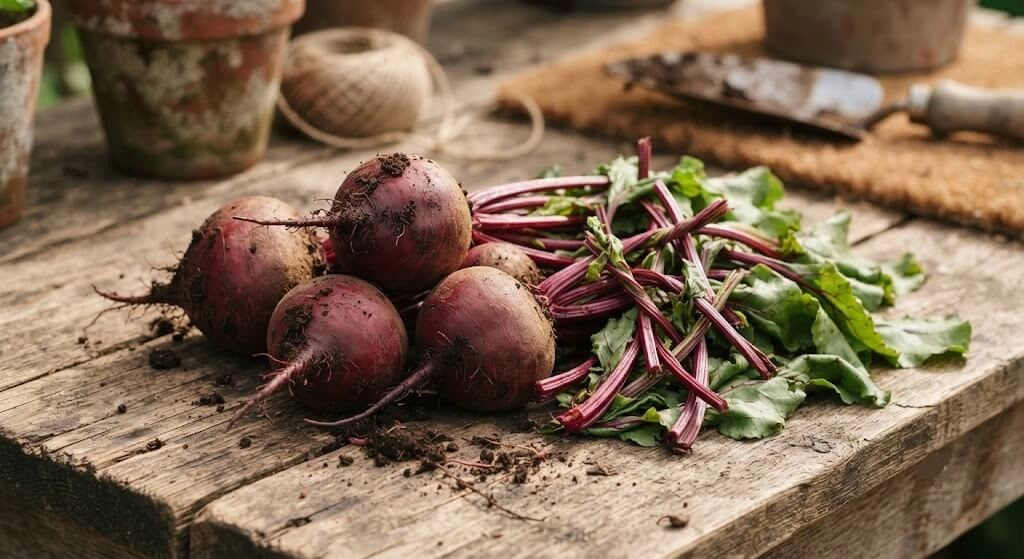
Extremely high in folate, manganese, and dietary nitrates used in salads, raita, juice, and as a natural food colouring. The leaves (harvestable from Day 25) are themselves a mild, earthy edible green, a genuine bonus crop from the same container.
Quick stats: planting Oct–Nov; container 10–12 inches deep; spacing 5–6 inches; sun 4–6 hours; seed cost ₹50–80/packet; yield 80–150g per root.
Best varieties: Detroit Dark Red (55–65 days, most widely available, reliable), Crimson Globe (60–70 days, good container performer), Golden Beet (60–65 days, milder, niche market interest).
Step-by-step, sowing to harvest:
- Soak seeds 24 hours before sowing each “seed” is actually a hard, woody cluster of 2–3 true seeds, and soaking softens the hull for reliable germination. Plant immediately once seeds feel soft and swollen.
- Sow in holes 1–1.5cm deep, 5cm apart, one cluster per hole. Cover, firm gently, water with a rose nozzle.
- Germination (Day 5–10): expect 2–3 seedlings per hole from the multi-seed cluster.
- Thin (Day 10–14, seedlings 3–4cm tall): to one strongest seedling per spot, final spacing 5–6 inches cut weaker ones at soil level rather than pulling.
- Leaf bonus harvest (from Day 25): take outer leaves only, leaving the growing centre intact.
- Growth phase (Day 14–55): water every 2 days for smooth, non-woody roots; feed a balanced fertiliser every 3 weeks; at Day 30, a one-time drench of a pinch of borax in a litre of water helps prevent internal browning, a common boron-deficiency issue in Indian soils.
- Harvest: baby beets at golf-ball size (4–5cm, Day 45) are sweet and tender; full-size beets (5–7cm) at Day 55–70. Twist the leaf stalks off rather than cutting twisting seals the wound and prevents the deep red juice from bleeding during cooking.
Troubleshooting: poor germination → soak longer, replant immediately after. Woody roots → water more consistently or harvest sooner. Internal grey/brown rings → boron deficiency, apply the borax drench. Pale colour → move to a spot with 5+ hours direct sun.
Cost and yield: setup ₹190–290; 800g–1.2kg per bag (6–8 roots), plus 200–300g of bonus leaves.
4. Turnip (Shalgam) ⭐⭐⭐⭐ Cold-Hardy Fast Root
A North Indian winter favourite achar, sabzi, mixed vegetable curry that actually gets sweeter after light frost as starches convert to sugar. Faster than both carrot and beetroot at 45–55 days, with the leaves (shalgam ke patte) as a second simultaneous vegetable.
Quick stats: planting Oct–Nov; container 10–12 inches deep; spacing 5 inches; sun 4–5 hours; seed cost ₹30–60/packet.
Best varieties: Pusa Sweti (IARI, 45–50 days, white skin, compact), Purple Top White Globe (50–55 days, widely available).
Step-by-step, sowing to harvest:
- Prepare a 15×10 inch bag with 40% cocopeat + 40% vermicompost + 20% garden soil, watered until it drips.
- Sow 1cm deep, 5cm apart in rows, water gently.
- Germination (Day 3–7): quick, typically 3–5 days at 18–26°C.
- Thin (Day 10–12, seedlings 4cm tall): to a final 5-inch spacing don’t skip this, since overcrowding produces small, misshapen roots.
- Leaf harvest (from Day 20): outer leaves only, good in dal or sautéed.
- Growth (Day 12–45): water every 2 days, no fertiliser needed in vermicompost-rich soil. In North India, cold nights below 12°C genuinely improve sweetness don’t shelter this crop from the cold.
- Harvest (Day 45–55): pull at 5–7cm diameter; beyond 7cm, roots turn fibrous and strong-flavoured.
Troubleshooting: bitter taste → grown too warm (nights above 20°C); this crop isn’t well suited to South India’s mild winters. Forked roots → sieve the soil. Fibrous roots → harvested too late.
Cost and yield: setup ₹170–260; 600g–1kg per bag, plus roughly 300g of bonus leaves.
5. Onion (Pyaaz) ⭐⭐⭐⭐ Daily Kitchen Essential
Used in virtually every Indian dish. Bunching/spring onions are the practical choice for containers fresh green onions (both bulb and tops edible) in 60–70 days, versus 120–150 days for full bulbs in deep containers.
Quick stats: planting Oct–Nov; container 8–10 inches deep (bunching) or 12 inches (full bulb); spacing 4–5 inches; sun 5–6 hours; seed cost ₹40–80/packet or onion sets ₹50–100/250g.
Best varieties: Pusa White Flat (IARI, full bulb, 120–130 days, good storage), Agrifound Dark Red (110–120 days, India’s most popular), any bunching/spring onion variety (60–70 days, easiest for containers).
Step-by-step, sowing to harvest:
- Start from seed or sets seeds in a tray, 0.5cm deep, germinate in 7–10 days, transplant at 4–5 weeks; or plant sets (small dried onions) pointy-tip-up, 1–2cm below the surface, which is faster and more reliable for beginners.
- Plant/transplant at 4–5 inch spacing, shallowly deep planting delays bulb development.
- Establishment (Week 1–3): water every 2–3 days onions prefer slightly drier conditions than most crops, and overwatering causes rot. Full sun is essential; shaded plants produce thin, flavourless tops.
- Green top harvest (from Day 30): snip tops from a few plants as needed for continuous use new growth replaces what’s cut.
- Bulbing stage (Day 60–90 bunching, 90–120 full bulb): reduce watering as tops begin yellowing and falling this signals bulb maturation. Stop watering entirely once 50% of tops have fallen, for the curing period.
- Harvest: bunching onions when the bulb is 3–4cm and tops still green; full bulbs once tops have fallen, dried in shade for 1–2 weeks before storage.
Troubleshooting: mushy base → overwatering causing neck rot, cut back to every 2–3 days. Thin pale tops → move to more sun. No bulb after 90 days → check you’re using a short-day variety like Agrifound Dark Red and reduce nitrogen. Bolting to flower → harvest immediately; quality declines fast after.
Cost and yield: setup ₹160–280; 500g–1kg of tops and bulbs from 10 bunching plants.
6. Garlic (Lehsun) ⭐⭐⭐⭐ Most Valued Bulb
Used in nearly every Indian sabzi, dal, and curry. Homegrown garlic is noticeably more pungent than much of the imported market garlic available. Plant cloves in October, harvest full bulbs March–April or harvest garlic greens from Day 30 for daily use long before the bulb is ready.
Quick stats: planting Oct–Nov; container 8–10 inches deep; spacing 4–5 inches; sun 5–6 hours; planting material fresh cloves ₹30–80/250g. Buy from an organic vegetable market or verified supplier rather than supermarket garlic, which is often treated to prevent sprouting.
Best varieties: Yamuna Safed 3 (IARI, 130–140 days, large white bulbs, most popular), Agrifound White (130–150 days, high yield), local desi garlic (most accessible, excellent flavour).
Step-by-step, sowing to harvest:
- Prepare cloves break a fresh bulb apart, select large firm cloves (small ones produce small bulbs), keep the papery skin on.
- Plant pointy-end-up, 4–5cm deep, 4–5 inches apart upside-down planting delays emergence by weeks.
- Emergence (Day 7–14): green shoots appear from each clove tip.
- Garlic green harvest (Day 30–60, ongoing): snip the top 8–10cm of greens as needed, leaving at least 5–6 leaves per plant so bulb development isn’t affected.
- Growth phase (Day 14–120): water every 2–3 days; feed potassium every 3 weeks (not nitrogen, which produces large tops and small bulbs).
- Scape removal (Month 4, if the variety flowers): remove the flowering stalk once it curls, to redirect energy into the bulb scapes themselves are edible.
- Bulb harvest signal (Month 4.5–5): once 50–60% of leaves have yellowed and fallen, stop watering, wait one more week, then lift.
- Cure in shade with good airflow for 2–3 weeks before storage; cured garlic keeps 3–6 months at room temperature.
Troubleshooting: no emergence after 14 days → check orientation, or you may have used treated supermarket garlic. Small bulbs → used small cloves or too much nitrogen. Base rot → overwatering.
Cost and yield: setup ₹150–260; 8–12 bulbs per 15×10 pot, plus 200–400g of bonus greens.
7. Kohlrabi / Knol Khol (Ganthgobi) ⭐⭐⭐⭐ The Underused Winter Gem
A beloved vegetable in Kashmiri, Punjabi, and South Indian kitchens that’s genuinely underused in Indian urban gardens despite maturing faster than cauliflower or cabbage (50–60 days vs. 90–120) in a much smaller container.
Quick stats: planting Oct–Dec; container 10–12 inches deep; spacing 6–8 inches; sun 5–6 hours; seed cost ₹40–80/packet.
Best varieties: Pusa Shweta (IARI, 55–60 days, compact, best for containers), Vienna White (50–55 days, fast, mild), Purple Vienna (55–65 days, striking colour, same flavour).
Step-by-step, sowing to harvest:
- Indoor seed start 0.5cm deep in a seedling tray, germinates in 5–8 days at 18–26°C, grown indoors 3–4 weeks.
- Transplant at 4 true leaves, one seedling per 10-inch container, at the same depth as the tray don’t bury the crown.
- Establishment (Week 1–2): water every 2 days, partial sun for the first 2–3 days, full sun from Day 4.
- Growth (Week 2–6): water every 2 days, feed every 2 weeks. The bulbous stem enlarges at the soil surface from Week 3–4 don’t hill soil over it; it should stay above ground.
- Harvest (Day 50–60 from transplant): at 5–7cm diameter beyond 8cm the bulb turns fibrous and woody. Cut at the base; the outer leaves are edible too.
Troubleshooting: woody bulb → harvested too late. Cracked skin → irregular watering. Small bulb → planted too deep, crown must stay above soil. Caterpillar damage → check leaf undersides, apply Bt spray weekly.
Cost and yield: setup ₹180–290; 150–300g bulb per plant, maturing 40 days faster than cauliflower in half the container space.
Category 2: Fruiting Vegetables
8. Green Peas (Matar) ⭐⭐⭐⭐⭐ Vertical and Most Productive
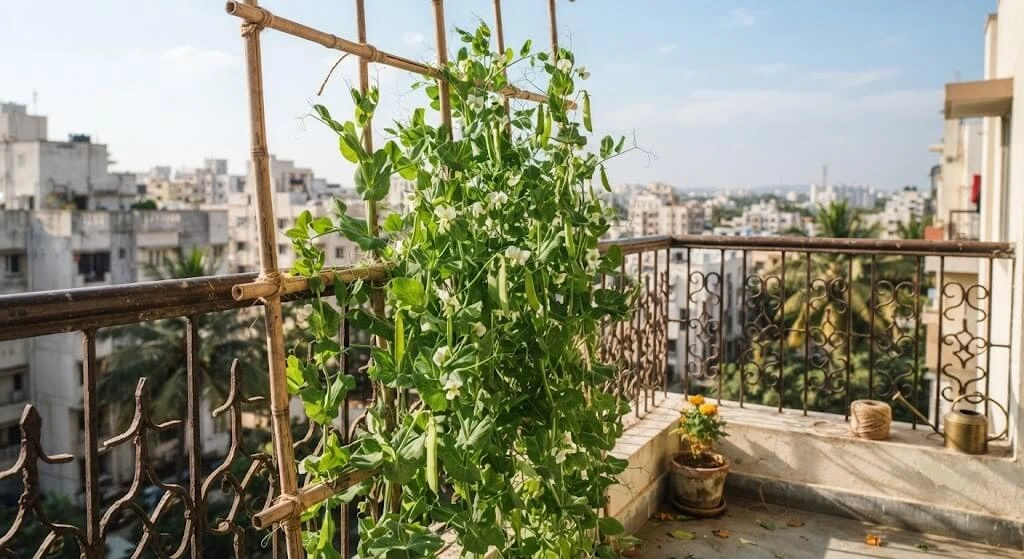
The most vertically efficient crop on this list trained on a railing or bamboo trellis, peas use vertical space instead of floor space. Fresh-shelled peas are dramatically sweeter than frozen or market peas. The bonus crop, pea shoots, sells at ₹400–600/kg, the highest value-per-kg of anything in this guide.
Quick stats: planting Sep–Oct North India, November South India; container 12 inches deep and wide with a trellis; spacing 3–4 inches; sun 6+ hours; seed cost ₹60–120/packet.
Best varieties: Arkel (60–65 days, dwarf, most popular Indian container variety), Little Marvel (63 days, compact, sweet), Pusa Pragati (IARI, 60–65 days, slight heat tolerance for later plantings). Avoid tall climbing varieties like Alderman they need 1.5–2m of staking, unsuited to balconies.
Step-by-step, sowing to harvest:
- Soak seeds 6–8 hours before sowing; plant immediately once they’ve plumped visibly.
- Sow in a grid, 3–5cm deep, 3–4 inches apart, one seed per hole. Install a 45–60cm trellis at sowing time, not after the plant grows.
- Germination (Day 5–10): reliable at 15–22°C; above 25°C, germination drops sharply this is why October sowing matters for North India.
- Trellis training (from Day 10): guide tendrils toward the trellis when seedlings are 8–10cm tall; they curl naturally with minimal help. From Day 30, tie the main stem loosely every 15–20cm.
- Pea shoot harvest (Day 15–25, from a subset of plants): take the top 5–8cm of growing shoots from about 30% of plants this doesn’t meaningfully reduce pod yield from the rest.
- Flowering (Day 40–50): the most water-critical stage any drought now causes flower drop. Water every 1.5 days, switch to a potassium-heavy feed. On high floors with less insect activity, gently shake flower clusters daily at 7–9 AM to aid pollination.
- Pod harvest (Day 60–70): pick when pods are firm and full but peas still feel round rather than hard through the wall. Pick every 2–3 days this alone extends production by 2–3 weeks; don’t let pods yellow on the vine.
Troubleshooting: flowers but no pods → too warm at flowering or poor pollination; sow by October 15 in North India and hand-pollinate. Powdery mildew → weekly neem oil and better airflow. Tough pods → picked too late.
Cost and yield: setup ₹250–410; 150–250g pods per plant plus 50–80g bonus pea shoots.
9. Cauliflower (Phool Gobi) ⭐⭐⭐ Slow but Rewarding
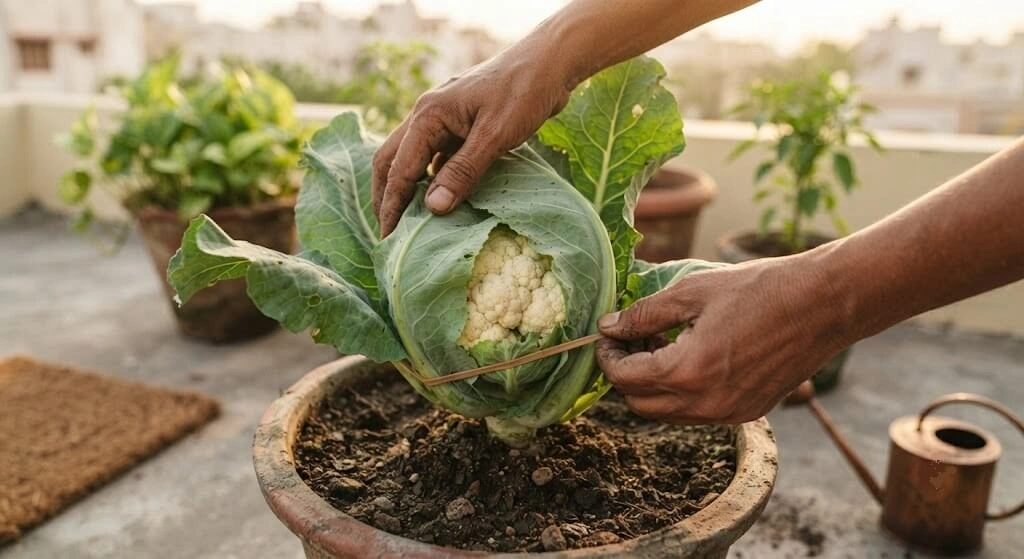
One of India’s most consumed winter vegetables. Requires the most patience (110–120 days) and the largest container (18-inch) of anything on this list, but rewards that with heads weighing 400–800g and noticeably better texture than market cauliflower stored for days after early harvest.
Quick stats: seed start September 1–15 North India; transplant November 1–15; container 18 inches deep and wide (largest required); sun 5–6 hours.
Best varieties: Pusa Snowball K-1 (IARI, 100–110 days, dense white curd, most popular home variety), Pusa Meghna (IARI, 90–100 days, compact, better for smaller containers).
Critical timing rule: cauliflower seeds sown directly in November will never form a proper head the plant matures into March-April heat and produces only small, loose, discoloured curds. The correct sequence is September seed start → 5 weeks indoors → November transplant → February harvest.
Step-by-step, sowing to harvest:
- Indoor seed start (Sept 1–15): 60% cocopeat + 40% vermicompost, 2 seeds per cell, 0.5cm deep, germinates in 5–8 days near a south-facing window.
- Seedling care (4–5 weeks): thin to one per cell at Day 10, start diluted feeding at Day 20, harden off for 7 days before transplanting outdoors.
- Transplant (Nov 1–15): 18-inch container, 30% cocopeat + 40% vermicompost + 20% garden soil + 10% bone meal, one plant per container, buried to the first true leaf.
- Growth (Nov–Jan): water every 2 days, feed every 2 weeks, increasing phosphorus and potassium at Day 60 when the central bud begins forming.
- Blanching (Day 60–80, curd at 3–4cm): fold 2–3 outer leaves over the developing curd and secure with a rubber band this keeps it white by blocking sunlight. Check every 3 days.
- Harvest (Day 110–120, roughly February): when the curd is firm and tightly closed, 12–20cm across. Cut with 2–3 wrapper leaves attached and use within 3–4 days.
Troubleshooting: small “ricey” curd → started too late or too warm; can’t be fixed mid-season. Yellow curd → forgot to blanch. Brown tips → harvested too late or boron deficiency. No curd in South India → mild winters never drop below 20°C; use Pusa Meghna and plant in October.
Cost and yield: setup ₹290–430; 400–800g per plant.
10. Cabbage (Patta Gobi) ⭐⭐⭐ Hardy and Reliable
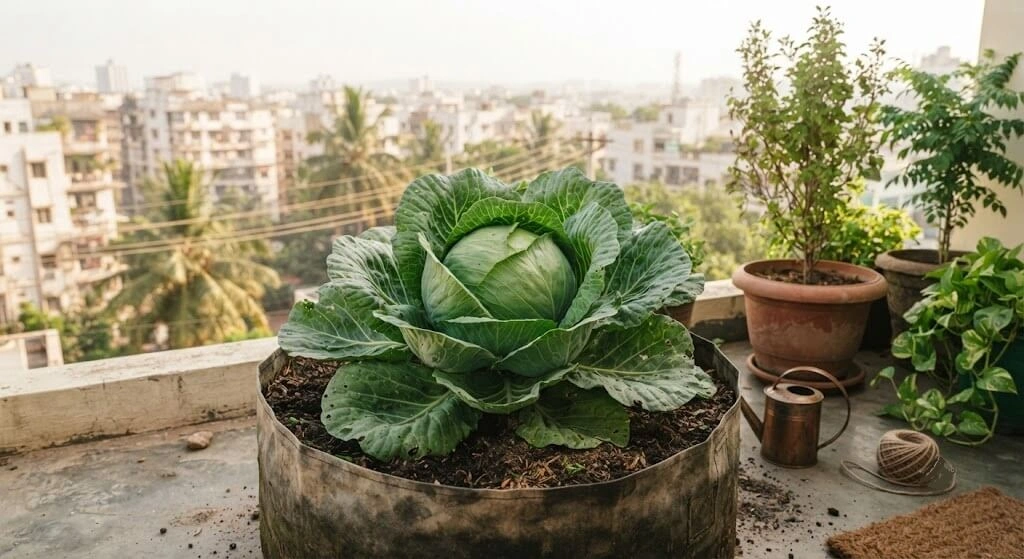
Hardier in cold than cauliflower (tolerates light frost), slightly less precision-demanding, and produces larger heads (500g–1.5kg).
Quick stats: seed start September; transplant November; container 16–18 inches; sun 5–6 hours.
Best varieties: Pusa Drum Head (IARI, 100–110 days, large, most popular in North India), Golden Acre (85–90 days, compact, faster).
Step-by-step, sowing to harvest:
- Indoor seed start (September): identical process to cauliflower, 5–7 day germination, 5–6 weeks indoors.
- Harden off over 7 days before transplanting.
- Transplant (November): 18-inch container, same rich mix as cauliflower, buried to the first true leaf.
- Growth (Nov–Jan): water every 2 days without exception inconsistent moisture is the main cause of head splitting. Feed every 2 weeks, increasing potassium once outer leaves begin cupping inward.
- Head formation (Day 60–80 from transplant): this is the most water-critical phase; any 3+ day dry spell here causes irreversible stress leading to splitting.
- Harvest (Day 90–110): squeeze gently firm and dense means ready. Cut at the stem base, leaving 2–3 wrapper leaves. Don’t delay once firm; over-mature heads split even without stress.
Troubleshooting: splitting → delayed harvest plus irregular watering. Loose head that won’t compact → started too late, temperature too high during formation.
Cost and yield: setup ₹280–420; 500g–1.5kg per plant.
11. Broccoli ⭐⭐⭐⭐ Premium with Ongoing Side Shoots
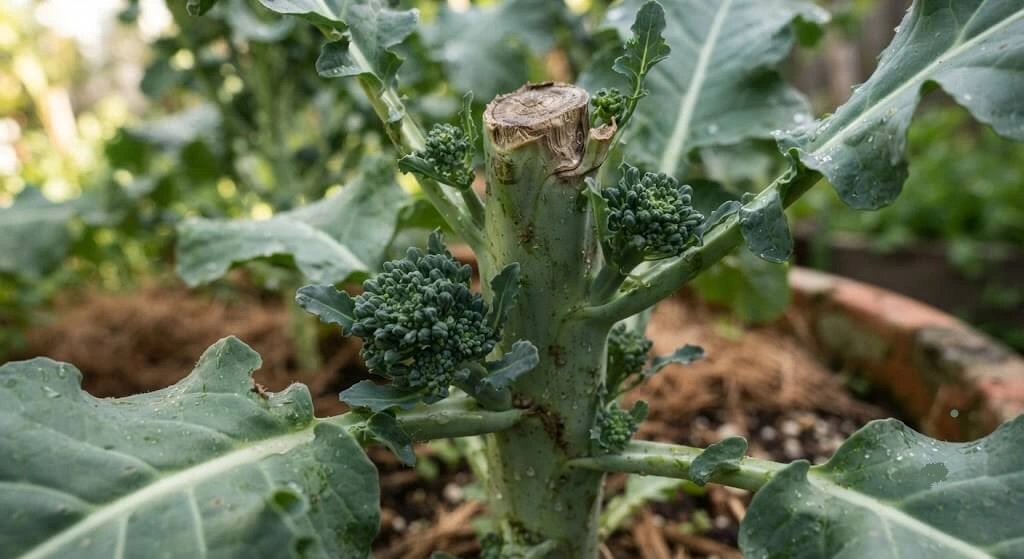
The highest per-kg value crucifer on this list at ₹80–120/kg. Unlike cauliflower’s one-time harvest, broccoli produces a central head followed by 4–8 weeks of side shoots at the same market price, substantially raising total yield per plant.
Quick stats: seed start Sept 1–15; transplant Nov 1–15; container 16 inches deep; sun 5–6 hours.
Best varieties: Palam Samridhi (ICAR-HP, 85–95 days, compact, heat-tolerant for South India), KTS-1 (80–90 days, well suited to Indian conditions), Green Magic F1 (80–85 days, excellent head quality).
Step-by-step, sowing to harvest:
- Indoor seed start (September): identical to cauliflower, 5–7 day germination, 4–5 weeks indoors.
- Transplant (November): same rich mix, buried to first true leaf.
- Growth (Nov–Jan): water every 2 days, feed every 2 weeks broccoli grows faster than cauliflower, and the central bud may appear by Day 60–70.
- Main head harvest (Day 80–100): ready when compact, tightly budded (green beads not opening), and deep green, 6–8 inches across. Waiting for beads to open is the most common mistake flavour declines fast once that starts. Cut with 5–6 inches of stem attached, which is itself edible.
- Side shoot production (Weeks 2–8 after the main harvest): the plant redirects energy to lateral shoots at each leaf axil; harvest each when tight and compact, every 5–7 days.
- Final harvest (Week 8–10 after main head): once side shoot production slows to very small shoots, remove the plant and refresh the bag.
Troubleshooting: small loose head → too warm during bud formation, unfixable mid-season. Yellow beads at harvest → picked too late. No side shoots → main stem was cut too short; leave 5–6 inches with side leaves.
Cost and yield: setup ₹280–430; main head 300–500g plus 150–300g of side shoots over 4–8 weeks 2–3× more productive than cauliflower per plant over a full season.
Category 3: High-Value Fruiting Vegetables
12. Green Chilli (Hari Mirch) ⭐⭐⭐⭐ Daily Use, Long Season
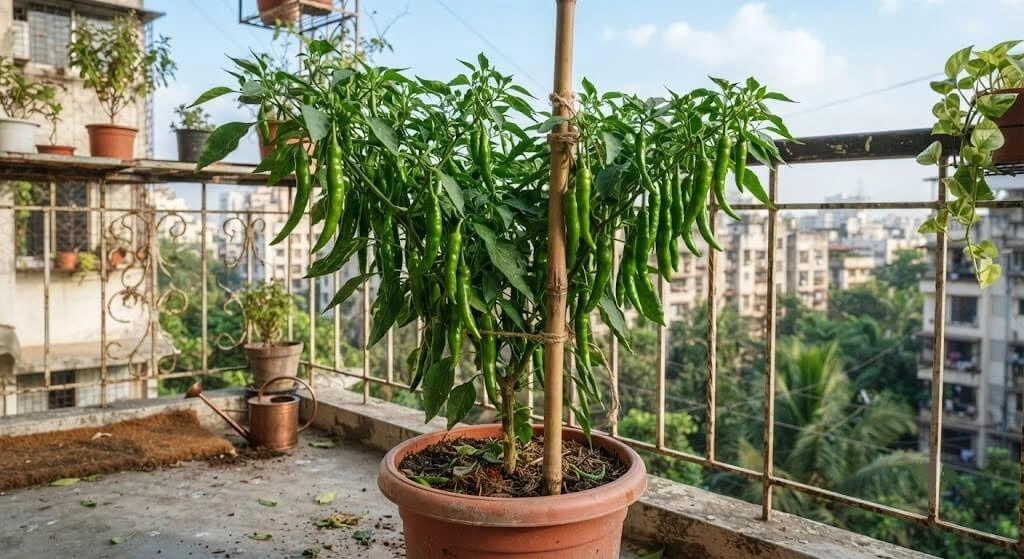
Used in nearly every Indian dish. One plant in a 10-inch container produces 100–300 chillies over a 4–6 month season.
Quick stats: transplant Oct–Nov; container 10–12 inches deep; sun 6+ hours; seed cost ₹40–80/packet, or free from seeds saved out of kitchen chillies.
Best varieties: Pusa Jwala (IARI, 65–70 days, high pungency, most popular in North India), Pusa Sadabahar (IARI, 60–70 days, produces year-round), or local desi variety from your own kitchen dry seeds from a firm, ripe red chilli on a paper towel for 2–3 days before sowing.
Step-by-step, sowing to harvest:
- Start from a nursery seedling (recommended, ₹15–30 each, saves 4 weeks) or from seed (germinates in 8–12 days at 25–30°C, transplant at 4–5 true leaves).
- Transplant into a 12-inch container with 40% cocopeat + 40% vermicompost + 20% garden soil, plus a tablespoon of neem cake to deter root-knot nematodes. Install a stake immediately chilli plants get top-heavy with fruit.
- Establishment (Week 1–3): water every 2 days, partial sun for the first 3 days then full sun, no fertiliser for the first 2 weeks.
- Pinch first flowers (Week 4–5): remove the first 2–3 buds to force more branching and higher total yield later.
- Flowering onward (Week 5+): balanced NPK every 2 weeks at first flowering, switching to potassium-heavy once fruit sets.
- Ongoing harvest (Day 60–75 through March–April): cut green chillies with scissors when firm and full-sized, never pull. For red chillies, leave green ones on the plant 3–4 more weeks. Pick every 3–5 days to keep production going.
Frost protection: in North India, cover on nights below 8°C with a cotton sheet or move indoors chilli recovers from mild cold stress within 1–2 weeks.
Troubleshooting: fruit drop → water stress or cold below 10°C. Few fruits despite many flowers → hand-pollinate on high floors. Curling leaves → usually underwatering in dry winter winds.
Cost and yield: setup ₹185–280; 400g–1kg of chillies per plant across the season.
13. Bell Pepper / Capsicum (Shimla Mirch) ⭐⭐⭐⭐ Premium Value
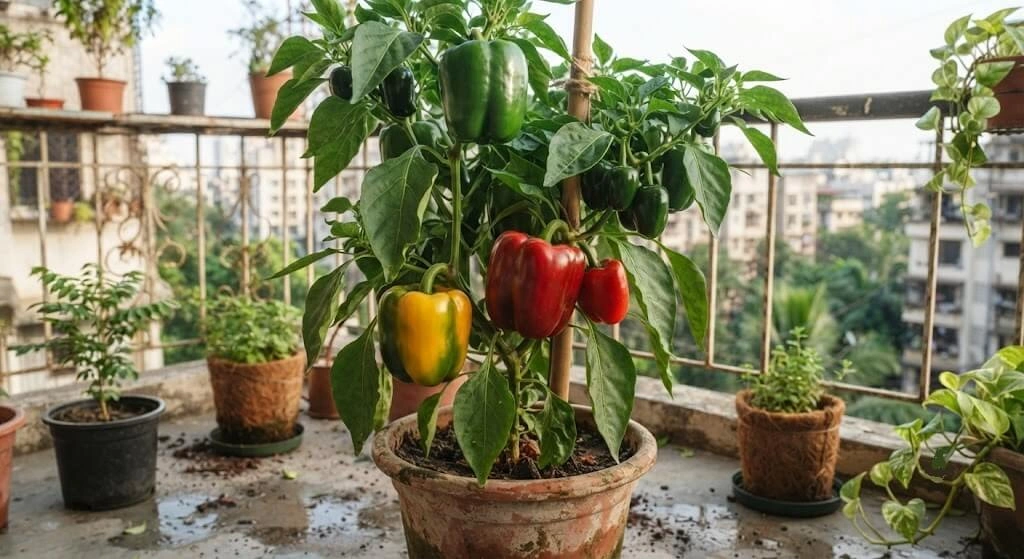
One of the most premium-priced vegetables in Indian markets, especially once coloured (red/yellow/orange fruit are the same plant, simply left to ripen longer for 2–3× the price of green).
Quick stats: transplant Oct–Nov; container 12–14 inches deep; sun 6–8 hours (highest light requirement on this list); seed cost ₹60–120/packet.
Best varieties: Pusa Deepti (IARI, 75–80 days, compact, bred for Indian conditions), California Wonder (70–80 days, large green, widely available), colour varieties (90–110 days, same genetics ripened longer).
Step-by-step, sowing to harvest:
- Transplant a nursery seedling (₹20–40) or home-started seedling (from September seed) into a 14-inch container with a bone-meal-and-neem-cake-enriched mix. Stake immediately.
- Establishment (Week 1–3): partial sun for 3 days, full sun from Day 4, water every 2 days, no fertiliser for 2 weeks.
- Pinch the first 2 flowers to force branching.
- Growth and flowering (Week 3–8): balanced feed every 2 weeks, tie to the stake every 20cm; first flowers appear around Week 5–6.
- Premium colour strategy: green fruit is ready at Day 70–90; leave it on the plant 20–30 more days and it turns yellow, orange, or red depending on variety same effort, significantly more income.
- Harvest: cut stems with scissors, harvesting every 5–7 days to encourage new fruit.
Frost protection: capsicum is the most cold-sensitive fruiting vegetable in this guide cover or move indoors below 10°C; purple, wilting leaves signal chilling injury, which takes 2–3 weeks to recover from.
Troubleshooting: fruit drop → water stress or cold. Blossom end rot → calcium deficiency plus irregular watering; spray diluted calcium nitrate. No fruit despite flowers → hand-pollinate on high floors.
Cost and yield: setup ₹210–330; 500g–1kg green yield per plant, worth 2–3× more if allowed to fully colour.
14. French Beans / Sem Phalli ⭐⭐⭐⭐ Transitional Winter Crop
Planted September–October, producing beans November through January in North India. Bush varieties fit 12-inch containers and produce continuously for 6–8 weeks.
Quick stats: planting Sep–Oct North India, Oct–Nov South India; container 10–12 inches deep; spacing 4–5 inches; seed cost ₹50–100/packet.
Best varieties: Contender (50–55 days, bush type, most popular, compact), Pusa Parvati (IARI, 55–60 days, round pods, high yield), Arka Bold (IIHR, 52–58 days, bolt-resistant). Use bush varieties only pole/climbing types grow too tall for balcony management.
Step-by-step, sowing to harvest:
- Soak seeds 4–6 hours before sowing.
- Direct sow French beans don’t transplant well. Holes 3–4cm deep, 4–5 inches apart, one seed per hole.
- Germination (Day 5–8): reliable at 18–25°C, slower above 28°C.
- Support (optional): a few small bamboo stakes around the container edge prevent sprawling even for bush types.
- Growth (Day 8–45): water every 2 days, no nitrogen fertiliser (beans fix their own), a single potassium feed around Day 30 to promote pod filling.
- Flowering (Day 35–45): water every 1.5 days drought here causes flower drop.
- Harvest (Day 50–60): pods should be 10–12cm and snap cleanly when bent (the “snap test”). Pick every 2–3 days to extend production by 3–4 weeks. At season’s end, let a few pods fully mature and dry on the plant for next season’s seed.
Troubleshooting: flowers but no pods → too warm at flowering, above 28°C; French beans can’t set pods in Indian summer heat. Tough pods → picked too late.
Cost and yield: setup ₹190–310; 200–400g per plant across 6–8 weeks, 1–2kg per bag of 5 plants.
15. Cherry Tomato (Winter Varieties) ⭐⭐⭐⭐⭐ Highest ROI
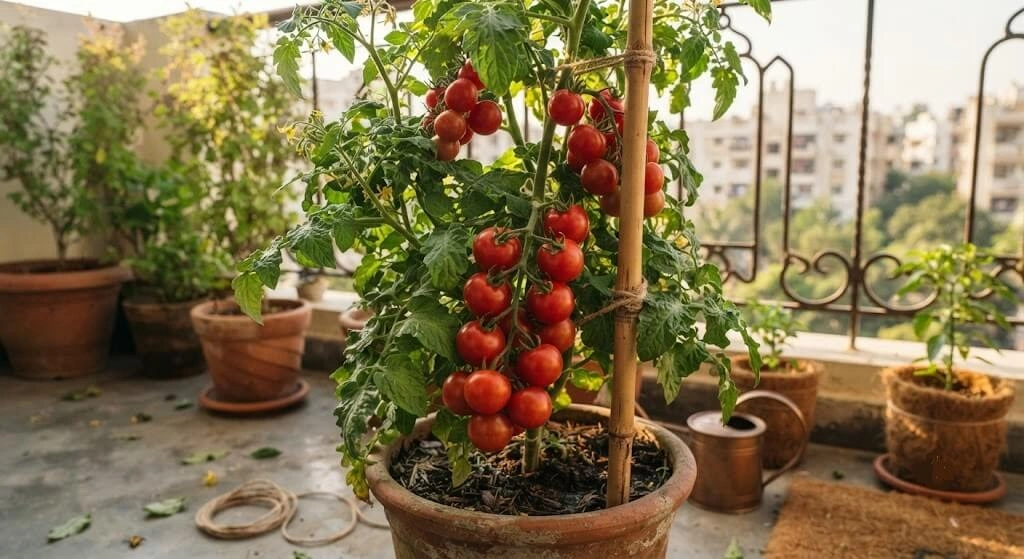
The single highest-ROI crop in this entire guide. One plant in a 20-litre bag, transplanted October–November, begins producing in December and continues through February–March 3–6kg total, worth ₹240–900 from a ₹290–510 setup. India’s winter night temperatures (15–22°C) are cherry tomato’s peak season the same window is impossible to hit in Indian summer, where nights above 26°C cause substantial pollination failure.
Quick stats: seed start Aug–Sept; transplant Oct–Nov; container 14–18 inch (20–25L); sun 6–8 hours; seed cost ₹40–150/packet.
Best varieties: Pusa Ruby (IARI, 65–70 days, heat-tolerant to 42°C, best beginner choice with a strong transplant survival rate in testing), Arka Vikas (IIHR, 70–75 days, highest yield, indeterminate, good for South India), Syngenta 6242 (60–65 days, best fruit quality), PKM 1 (TN Agri University, 55–60 days, best for Chennai and coastal cities). Avoid Western varieties like Sweet 100, Sun Gold, and Black Cherry bred for cool temperate climates, they underperform above 35°C.
Step-by-step, sowing to harvest:
- Indoor seed start (Aug–Sept): 2 seeds per cell in 60% cocopeat + 40% vermicompost, germinates in 4–8 days, grown near a south-facing window for 4–5 weeks. For full detail: Growing Cherry Tomatoes from Seeds Indoors.
- Transplant (Oct–Nov): into an 18-inch bag with 40% cocopeat + 40% vermicompost + 20% perlite/sand, plus bone meal and neem cake. Bury the stem to the first true leaves the buried section develops extra roots for a stronger plant. Install a 3-foot stake at planting.
- Establishment (Week 1–2): partial sun 3 days, full sun from Day 4, daily watering, no fertiliser for 10 days.
- Vegetative growth (Week 2–5): feed balanced NPK every 10 days, tie to the stake every 20–25cm, and for indeterminate varieties remove suckers every 5–7 days to direct energy into fruit.
- Flowering (Week 4–6): water daily without fail drought at flowering causes flower drop. Switch to a potassium feed and gently tap flower clusters daily to help release pollen.
- Hand pollination (high floors): above the 5th floor where insect activity is low, use a soft brush between open flowers at 9 AM daily from November onward.
- Fruit development (Week 6–20+): allow fruit to fully colour before picking. Pick every 2–3 days during peak production leaving ripe fruit on the vine slows new fruit set.
- Season end: continues through February–March, sometimes into April in Bangalore and Pune. In North India, April heat ends productio remove -Beautiful plant, no fruit.
For full container-care detail beyond transplant: Cherry Tomato Plant Care in Containers.
Troubleshooting: flowers dropping → temperature above 35°C days or 26°C nights, which is exactly why October–November transplant timing matters. Blossom end rot → calcium deficiency plus inconsistent watering. Cracking → sudden heavy watering after a dry spell. Powdery mildew → weekly neem oil. Beautiful plant, no fruit → seeds were started too late (e.g., March), putting flowering into April heat August–September is the correct start.
Cost and yield: setup ₹290–510; 3–6kg per plant over 3–5 months, worth ₹240–900. The grow bag and stake are paid off in Year 1; seed cost is the only real ongoing expense.
Quick Reference: All 15 Vegetables
| # | Vegetable | Category | Days to Harvest | Min Depth | Difficulty | Standout Benefit |
|---|---|---|---|---|---|---|
| 1 | Mooli (Radish) | Root | 25–35 | 9″ | Easy | Fastest root; 3–4 crops/season |
| 2 | Desi Gajar (Carrot) | Root | 70–90 | 12″ | Moderate | Sweetest in Dec–Jan cold |
| 3 | Chukandar (Beetroot) | Root | 55–70 | 10–12″ | Easy-Mod | Bonus edible leaves from Day 25 |
| 4 | Shalgam (Turnip) | Root | 45–55 | 10–12″ | Easy | Cold-hardy, improves in frost |
| 5 | Pyaaz (Onion) | Bulb | 60–70 (green) | 8–10″ | Easy-Mod | Daily green tops from Day 30 |
| 6 | Lehsun (Garlic) | Bulb | 30–40 greens / 130–150 bulb | 8–10″ | Easy | Greens + full bulbs from one planting |
| 7 | Ganthgobi (Kohlrabi) | Stem veg | 50–60 | 10–12″ | Easy-Mod | Faster than cauliflower, smaller container |
| 8 | Matar (Peas) | Fruiting | 60–70 | 12″ | Easy-Mod | Pea shoots at ₹400–600/kg |
| 9 | Phool Gobi (Cauliflower) | Fruiting | 110–120 | 18″ | Moderate | Sept seed start is essential |
| 10 | Patta Gobi (Cabbage) | Fruiting | 90–110 | 16–18″ | Moderate | Hardy, large yield per plant |
| 11 | Broccoli | Fruiting | 80–100 | 16″ | Moderate | Side shoots = 2–3× total yield |
| 12 | Hari Mirch (Green Chilli) | Fruiting | 60–75 | 10–12″ | Easy | 100–300 chillies per plant |
| 13 | Shimla Mirch (Capsicum) | Fruiting | 70–90 | 12–14″ | Moderate | Colouring = 2–3× the price |
| 14 | Sem Phalli (French Beans) | Fruiting | 50–60 | 10–12″ | Easy-Mod | Transitional Oct–Nov crop |
| 15 | Cherry Tomato | Fruiting | 55–75 | 14–18″ | Easy-Mod | Highest ROI: ₹240–900/plant |
Three depth rules to never forget: mooli needs a minimum of 9 inches (shallower gives leaves, not roots); gajar needs a minimum of 12 inches (shallower gives stubby, forked stubs); cauliflower and cabbage need a minimum of 18 inches (smaller gives small, underdeveloped heads).
The Winter Vegetable Decision Tree
Less than 3 hours of sun: grow only methi, palak, and coriander shade-tolerant leafy greens. Skip fruiting and root vegetables entirely.
3–5 hours (partial sun): excellent for methi, palak, mustard greens, coriander, lettuce, and mooli; beets and turnip are possible with care; avoid peas, tomato, cauliflower, and capsicum.
5–6 hours (good sun): all leafy greens and root vegetables do well; peas, turnip, and beet are good; tomato and capsicum are marginal position them optimally.
6+ hours (full sun, south/west-facing): all 15 vegetables are suitable; cherry tomato and capsicum will be the most productive; prioritise your highest-value crops for the best sun positions.
Container Setup Guide
Shallow (6–8 inches): methi, palak, mustard, lettuce, coriander best in 18×6 inch bags (₹60–80).
Medium (8–12 inches): beets, turnip, peas 18×9 inch bags or 12-inch round pots.
Deep (12+ inches): mooli (9-inch minimum), gajar (12-inch minimum), tomato, capsicum, cauliflower, broccoli 24×9 inch or 15×15 inch bags. Depth matters more than width for root crops specifically.
Balcony space by size: a 20 sq ft balcony fits roughly 10 shallow bags for continuous salad supply, 4 medium bags for root vegetables, and 2 deep bags (cherry tomato with a railing trellis) for a high-value crop. A 50–100 sq ft balcony scales this up with 2–3 large bags for capsicum or broccoli and a bamboo trellis for peas. A 200+ sq ft terrace supports the full 15-vegetable rotation.
| Material | Pros | Cons | Best For |
|---|---|---|---|
| HDPE grow bags (260 GSM) | Lightweight, excellent drainage, 3–5 year life | Needs a stand or brick elevation | All vegetables, ideal for terraces |
| Plastic pots | Lightweight, moisture-retaining | Degrades faster in direct sun | All vegetables, good for balconies |
| Terracotta/clay | Good drainage, aesthetic | Heavy, dries 20–30% faster | Herbs and leafy greens; avoid for root crops |
| Wooden crates/boxes | Good drainage when lined | Rots over 2–3 seasons | Raised-bed style terrace setups |
Microclimate Mapping: Why Your Neighbour’s Garden Works Better
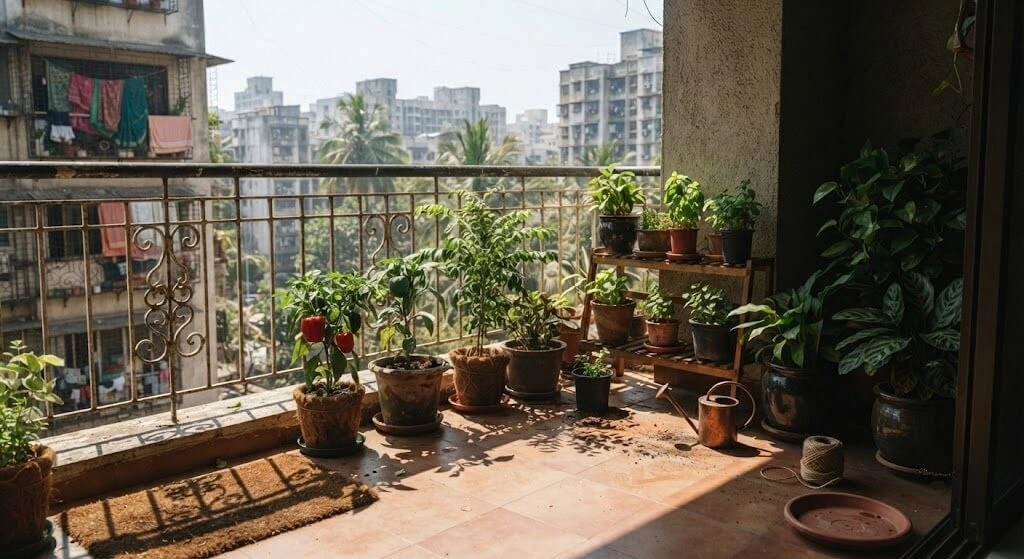
This factor explains a large share of the variation in Indian balcony garden success and takes only about 30 minutes to map.
Sun angle and duration: track your balcony’s sun at 9 AM, 12 PM, and 3 PM for two consecutive October days. The best-sun area (5+ hours) is where cherry tomato, capsicum, and peas go; the partial-sun area (3–4 hours) suits palak, methi, and lettuce.
Wind exposure: balconies above the 5th floor can see winds 30–50% stronger than ground level, desiccating soil within hours in dry winter conditions. Mulch, water more often through December–January dry winds, and consider windbreaks.
Reflected heat from concrete: a container sitting directly on a concrete balcony floor in strong afternoon sun can run 8–12°C hotter at the soil level than ambient air a real problem for cool-season crops that prefer 15–22°C soil. Elevate containers on wooden boards or bricks; a 4-inch air gap makes a real difference.
Frost pockets: in North India, south-facing balconies can stay frost-free on nights when an open terrace above experiences frost, while poorly ventilated corners become frost pockets even on higher floors. Keep capsicum and young tomato seedlings in your most sheltered corner on cold nights.
Season-by-Season Care Calendar
Pre-winter prep (September–October): refresh 30–40% of grow bag soil with fresh vermicompost, add a tablespoon of neem cake per bag, start cauliflower/broccoli/cabbage seeds indoors (Sept 1–15 North India), start cherry tomato seeds indoors (Aug–Sept), order seeds early before popular varieties sell out, and map your balcony’s sun pattern.
November: direct sow palak, methi, mooli, lettuce, coriander; transplant pre-started seedlings; water every 2–3 days; no pest spray typically needed this is the lowest pest-pressure month of the year.
December: direct sow gajar, beets, shalgam, matar; begin Batch 2 succession; expect the first methi harvest from early-November sowings; protect capsicum and young tomato from frost below 10°C in North India; watering may drop to every 3 days as temperatures fall.
January: final fast-crop sowing window (mooli, methi only); peak harvest of leafy greens and radish; start checking cauliflower and cabbage for maturity; watch for a slight uptick in aphid activity.
February–March (transition): harvest all remaining root vegetables before soil warms; watch for methi, coriander, and lettuce bolting as temperatures rise harvest bolting plants immediately, since flavour declines fast once it starts; by March, most cool-season crops are finishing and it’s time to transition toward summer crops. Refresh grow bags using guidance from Best Soil for Container Gardening.
Problem Diagnosis
| Symptom | Likely Cause | Fix |
|---|---|---|
| Yellow leaves on leafy greens | Nitrogen deficiency or overwatering | Check soil: wet/cold means overwatering, reduce; dry means feed diluted cow-dung liquid (1:10) |
| Methi/coriander suddenly shoots up a flower stem | Bolting above 22°C or long day length | Harvest the whole plant now; it can’t be reversed. Sow a new batch in a cooler window |
| Root crops producing only leaves | Insufficient container depth or excess nitrogen | Use minimum depth for the crop; avoid nitrogen-heavy feed |
| Cauliflower head turning yellow | Not blanched | Fold outer leaves over the curd immediately, secure with a band |
| Peas flowering, no pods | Too warm, or poor pollination | Sow by mid-November in North India; hand-pollinate |
| Capsicum/tomato leaves turning purple | Phosphorus deficiency from cold soil | Move to a warmer spot; apply diluted bone meal water as a foliar spray |
| Aphid clusters | January–February peak season | Neem oil weekly; strong water jet daily |
| Cabbage head splitting | Late harvest plus irregular watering | Harvest when firm; water every 2 days even in cool weather |
| Beet/turnip roots cracking | Irregular watering | Water consistently every 2 days; mulch |
| Seedlings dying at soil level | Overwatering plus poor drainage in cold | Clear drainage holes, reduce watering, dust surface with dry cinnamon powder |
Common Beginner Mistakes
Starting too late. Most gardeners intend October but actually begin in November–December slow crops like cauliflower and gajar started in December won’t mature before April heat. Fix: treat November 1 as a hard deadline for most crops; order seeds in September so they arrive on time.
Overwatering in winter. Summer watering habits (daily or twice-daily) carried into December–January cause root rot and damping-off. Fix: water every 2–3 days in Nov–Dec, every 3–4 days in peak January, checking with a finger 2 inches into the soil first, and always in the morning rather than evening.
Wrong container depth for root crops. Mooli in a 6-inch bag produces leaves with no root; gajar in a shallow bag produces stubs. Fix: check depth specifically, not volume, when buying bags for root crops 9 inches minimum for mooli, 12 for gajar.
Direct-seeding cauliflower/cabbage in November. These crops need a September indoor start; direct-sowing in November puts harvest into April heat at best. Fix: start seeds indoors September 1–15, transplant November 1–15.
Not thinning leafy greens and root crops. Overcrowded methi and palak stay small and leggy; unthinned mooli and gajar produce twisted, forked roots. Fix: thin methi/palak at 3–4cm to proper spacing, mooli to 8cm, gajar to 6–8cm in two stages.
Ignoring frost protection in North India. Unprotected capsicum and young tomato on cold nights suffer chilling injury and stop fruiting for weeks. Fix: check forecasts daily in December–January and cover anything vulnerable below 8°C.
Planting everything at once. All 15 seeds in the first week of November creates a massive glut followed by nothing. Fix: follow the succession schedule stagger sowings by 2 weeks across November and December.
Organic Pest Management
Aphids (January–February peak): tiny green/black clusters on new growth, affecting leafy greens, peas, and cauliflower. Fix: neem oil (5ml + 2 drops dish soap per litre) every 5–7 days, a daily water jet to dislodge them, and ladybugs as natural predators where available.
Caterpillars/cabbage worms: large leaf holes, especially on cabbage, cauliflower, and broccoli. Fix: daily inspection and manual removal, Bt (Bacillus thuringiensis) spray, and row-cover mesh to stop adult butterflies laying eggs.
Whiteflies: tiny white flying insects that suck plant juices. Fix: yellow sticky traps (DIY: yellow card plus petroleum jelly), neem oil, reflective foil mulch around the container base.
Slugs/snails: appear after December rain, especially in South and East India. Fix: shallow beer traps at soil level, a crushed-eggshell barrier, or handpicking at night with a torch.
Universal prevention: mix neem cake into soil at planting, maintain proper spacing for airflow, inspect every 2–3 days in cooler months, and companion-plant marigold nearby, which deters several pests while attracting pollinators.
Regional Growing Tips by City
North India (Delhi, Punjab, Haryana, UP, Uttarakhand): the longest cool season in India at 5 full months. Frost protection for capsicum and young tomato is mandatory December–January. Desi gajar develops its deepest sweetness after December cold nights. Start cauliflower/broccoli seeds by September 1. Sow peas by October 15 for maximum yield.
South India (Bangalore, Chennai, Hyderabad, Coimbatore): no frost, mild 15–28°C winters. Use heat-tolerant lettuce varieties (Romaine, Lollo Rosso) standard iceberg bolts too easily here. A 30% afternoon shade net extends leafy green harvest by 2–3 weeks. Bangalore has arguably India’s best overall climate for cherry tomato, often producing November through April.
East India (Kolkata, Patna, Bhubaneswar): post-monsoon humidity raises fungal disease risk in October–November spray neem oil preventively every 10–14 days. Wait until soil has genuinely dried from monsoon before sowing root vegetables. Raised bags on stands improve drainage significantly.
West India (Mumbai, Pune, Ahmedabad): coastal Mumbai resembles South India’s humidity profile preventive neem oil and good airflow matter. Pune’s climate leans closer to North India and supports the full 15-vegetable range. Ahmedabad’s dry climate demands consistent watering for root crops and benefits from mulching everywhere.
Profitability Analysis
Scenario 1: Small Balcony (20 sq ft)
Initial investment: 18 mixed containers ₹900, seeds (5 varieties) ₹300, potting mix ₹400 total ₹1,600.
Monthly production value from Month 2: 10 palak plants × 3 harvests × 150g × ₹50/kg = ₹225; 10 methi containers × 4 harvests × 150g × ₹60/kg = ₹360; 20 mooli across 3 crops × ₹20 each = ₹400; 5 lettuce plants × 2 harvests (roughly 150g each) × ₹150/kg = ₹225 total monthly value ₹1,210, against ongoing costs of roughly ₹150, for a net monthly benefit of about ₹1,060. This is a conservative estimate production typically ramps up gradually rather than hitting full output from Month 1, so treat the “break-even by Month 2” framing as approximate rather than precise.
Scenario 2: Large Terrace (200 sq ft) with Cherry Tomato
Monthly production from Month 3 (full productivity): cherry tomato (5 plants) 4kg/plant × ₹80 = ₹1,600; peas (8 plants) 200g/plant × ₹80 = ₹128; capsicum (4 plants) 500g/plant × ₹80 = ₹160; leafy greens (30 containers) roughly ₹3,000; mooli (20 sowings) roughly ₹600 total monthly value ₹5,488. At a larger scale (around 120 plants, matching the case study below), this can reach ₹18,000–22,000/month.
Value-added income ideas: subscription vegetable boxes (₹200–300/week per subscriber; 10 subscribers = ₹8,000–12,000/month), pea shoots and microgreens (₹400–600/kg on a fast 7–14 day cycle), organic/pesticide-free premium positioning (a 50–100% price premium is achievable in urban markets), and dried kasuri methi (₹200–300/100g, drying surplus fresh methi for 5–10× the fresh-weight price).
For deeper income strategy detail, see Urban Gardening Income Potential and Is Urban Farming Profitable.
A Pune Terrace Winter Garden’s First Year
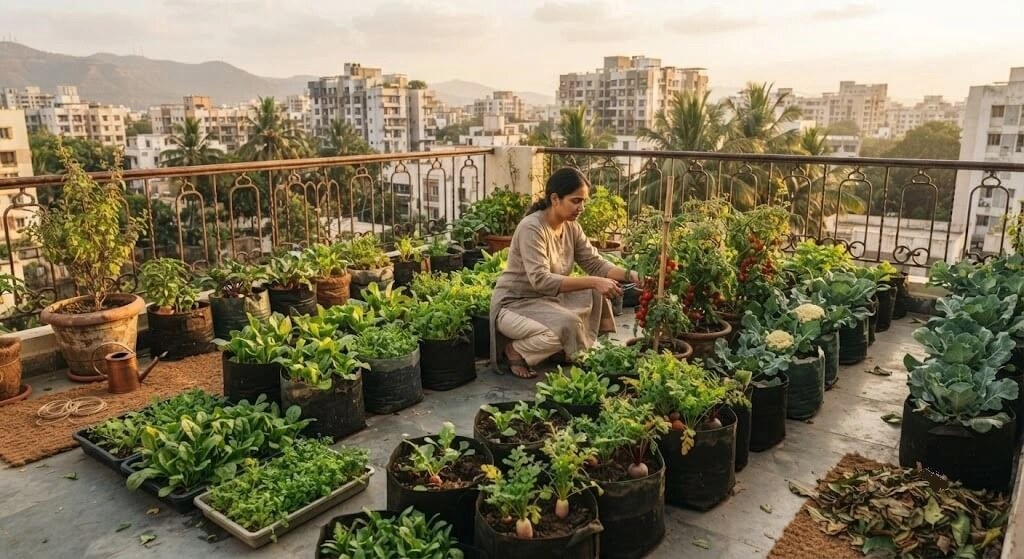
A 34-year-old software engineer in Pune, Maharashtra, transformed a 150 sq ft terrace into a productive winter vegetable operation starting November 2023, with zero prior gardening experience.
Month by month: November brought the first planting batch (palak, methi, mooli, lettuce, tomato) with some early overwatering losses as a learning curve. December delivered the first methi harvest at 25 days and the first mooli, totalling 3kg, mostly shared with neighbours. January saw regular harvests begin with succession planting added, reaching 10kg total, consumed at home. February marked the first sales to neighbours, generating ₹3,500 in monthly revenue. March brought a formal 5-subscriber weekly vegetable box at ₹4,000/month recurring. By November 2024, the second season had scaled to 120 plants and 30 weekly subscribers at ₹250/week.
Results after 12 months: monthly garden income went from ₹0 to ₹18,000–22,000; plant count from 30 to 120; monthly harvest from 10kg to 45–50kg; subscribers from 0 to 30+.
Five key lessons from this grower: start with 3–5 easy crops, master them, and expand in Season 2 rather than attempting everything at once. Track planting dates, yield weights, and customer feedback the data genuinely transforms decision-making. WhatsApp groups and Instagram build both community and customers faster than any other channel. Succession planting is the single most valuable technique, turning one November planting into a March-long harvest window. Cherry tomato is the highest-value single crop on any Indian balcony one 20-litre bag with one plant can replace market tomato purchases for 4 months.
Get the Free Printable: Winter Vegetable Planting Calendar
A single-page, month-by-month planting schedule covering all regions of India, a pest management cheat sheet, container size quick reference, and a harvest tracking template. Get the Winter Vegetable Planting Calendar – free with email →
India Zone-Wise Growing Context
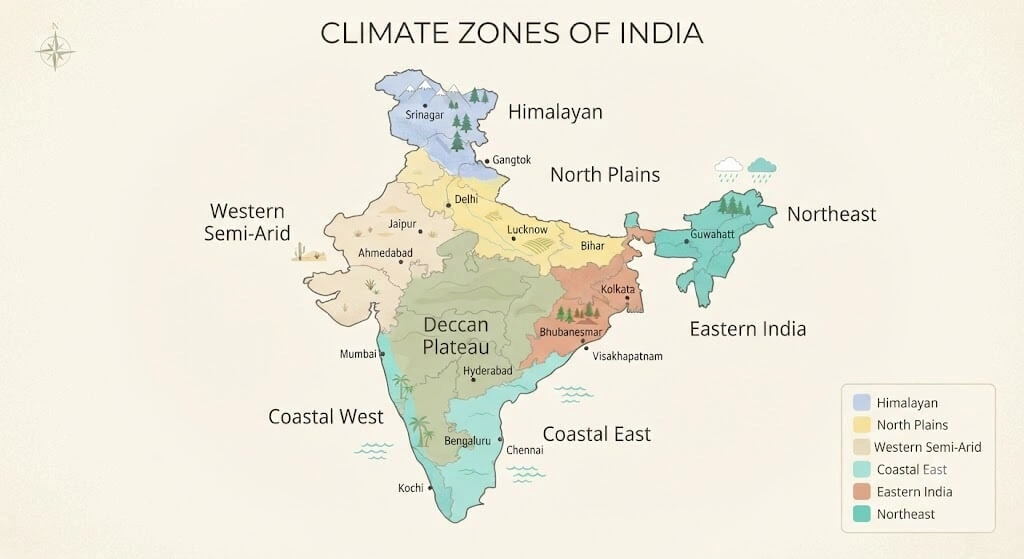
| Zone | Representative Cities | Winter Character | Zone-Specific Adjustment |
|---|---|---|---|
| North Indian Plains | Delhi, Lucknow, Chandigarh | Longest, coldest winter (5–22°C); frost risk Dec–Jan | Frost protection mandatory for capsicum/tomato; earliest cauliflower/broccoli start needed |
| Western Semi-Arid | Ahmedabad, Jaipur | Dry, moderate winter | Consistent watering critical for root crops; mulch everything |
| Deccan Plateau | Bangalore, Hyderabad, Madanapalle | Mild, close to ideal (15–28°C), no frost | Extended planting window into January; strong cherry tomato performance |
| Coastal West | Mumbai, Goa, Kochi | Mild but humid | Preventive neem oil for fungal risk; partial shade helps lettuce |
| Coastal East / Tamil Nadu | Chennai | Main monsoon runs Oct–Dec, shortening the effective winter window | Shift planting later than the rest of India; watch for NE monsoon overlap |
| Eastern India | Kolkata, Patna | Post-monsoon humidity elevates fungal risk | Wait for soil to fully dry before sowing root vegetables; raised bags help |
| Northeast India | Guwahati, Shillong | High humidity, shorter dry window | Prioritise drainage and airflow over most other factors |
| Himalayan / Hill | Shimla, Dehradun, Darjeeling | Cold arrives earliest, shortest season | Compress the calendar start earlier than plains cities |
| Reference Zone | Madanapalle, AP | Subtropical Deccan Plateau conditions | Author’s own tracked baseline throughout this guide |
Frequently Asked Questions
What is the easiest winter vegetable for an absolute beginner in India?
Fenugreek (methi) it germinates in 3–5 days, is ready to harvest in just 20–25 days, needs no staking, tolerates partial shade, and grows in any 6-inch container for roughly ₹20 in seed cost.
What is the last date to plant winter vegetables in India?
In North India, slow crops (cauliflower, cabbage, broccoli) should start by November 15, medium crops (carrot, beetroot, turnip, peas) by December 15, and fast crops (spinach, fenugreek, radish, lettuce) by January 15. South India can generally run 2–3 weeks later across the board. As a rule of thumb, count backward from mid-March using each crop’s days-to-harvest.
Can I grow winter vegetables on an apartment balcony?
Yes, even 3 hours of daily sun supports shade-tolerant leafy greens like fenugreek and spinach, while 5–6+ hours supports the full range including root vegetables, peas, tomatoes, and capsicum. Container depth matters more than balcony size.
How often should I water winter vegetables in India?
Every 2–3 days in November and early December, dropping to every 3–4 days by peak January. Use the finger test water only if soil feels dry 2 inches down and water in the morning rather than evening to avoid fungal-friendly cold, damp overnight soil.
Should I start from seeds or buy seedlings?
Direct-sow spinach, fenugreek, radish, carrot, beetroot, turnip, coriander, peas, mustard greens, and lettuce straight into their final container. For cherry tomato, cauliflower, cabbage, broccoli, and capsicum, either start seeds indoors 4–6 weeks ahead or buy nursery seedlings, which saves time and generally improves beginner success rates.
Which winter vegetables are most profitable to sell?
Cherry tomato leads at roughly ₹80–150/kg with about 4kg per plant over a 3–5 month window. Pea shoots follow at ₹400–600/kg on a fast 7–14 day cycle the highest value per square foot of any winter crop. Lettuce and broccoli do well with restaurants and health-focused buyers, and coloured capsicum commands a real premium over green for the same growing effort. See Urban Gardening Side Hustle for Freelancers for the full income breakdown.
Quick Reference
What are the best winter vegetables to grow in India?
Methi, palak, mooli, matar, and cherry tomato are the five easiest, covering leafy greens, a fast root crop, a vertical fruiting crop, and the highest-ROI fruiting crop across India’s October–February cool season.
What causes most winter vegetable failures in India?
Starting too late (slow crops like cauliflower need a September seed start, not a November one), overwatering using summer-frequency habits, and insufficient container depth for root crops are the three most common causes.
How do you grow root vegetables successfully in Indian containers?
Sieve all soil to remove stones and lumps, use the correct minimum depth for the crop (9 inches for mooli, 12 for gajar), thin seedlings in two stages, and water consistently rather than in dry-then-heavy cycles, which cracks roots.
Why does Indian winter vegetable timing differ from generic gardening advice?
Most gardening content assumes a spring-restart calendar; India’s real restart is a September indoor seed start for slow crops followed by a November 1 transplant and direct-sow deadline, with the entire growing window closing by March as summer heat arrives.
How do you get continuous harvest instead of one large glut?
Stagger sowings every 2 weeks across November and December (succession planting) rather than sowing everything in a single week, which produces a harvest glut followed by a long gap.
Source: Priya Harini B, thetrendvaultblog.com – based on field-tested container growing across Indian conditions, cross-referenced with ICAR/IARI and IIHR-released Indian vegetable varieties.
Your Winter Garden Action Plan
September: order seeds online before popular varieties sell out; start cauliflower/broccoli and cherry tomato seeds indoors.
October: refresh grow bag soil; buy remaining containers.
November 1: sow Batch 1 palak, methi, mooli, lettuce, coriander; transplant pre-started seedlings.
November 15: sow Batch 2 for succession; plant gajar, beets, shalgam.
December: sow matar near a trellis; plant capsicum with a frost protection plan ready.
January: final fast-crop sowing; begin harvesting the first batches in earnest.
February–March: peak harvest season, then begin transitioning toward summer crops.
Every experienced Indian gardener started exactly where you are with an empty grow bag and a seed packet. These vegetables have grown in Indian winter conditions for centuries; they know this season. All they need is a container, the right soil, and someone to sow them on time.
Related reading: Where to Buy Winter Vegetable Seeds in India · Best Winter Balcony Garden Ideas for Cold Climates · Growing Herbs on Balcony · Best Soil for Container Gardening
Share your winter garden progress with @thetrendvaultblog I read and reply to every comment.
About Priya Harini B: Priya writes thetrendvaultblog.com from Madanapalle, Andhra Pradesh, testing every method on her own terrace and balcony containers before it goes on the site 4+ years of hands-on experience across 40+ plant varieties and 38+ tracked containers.