
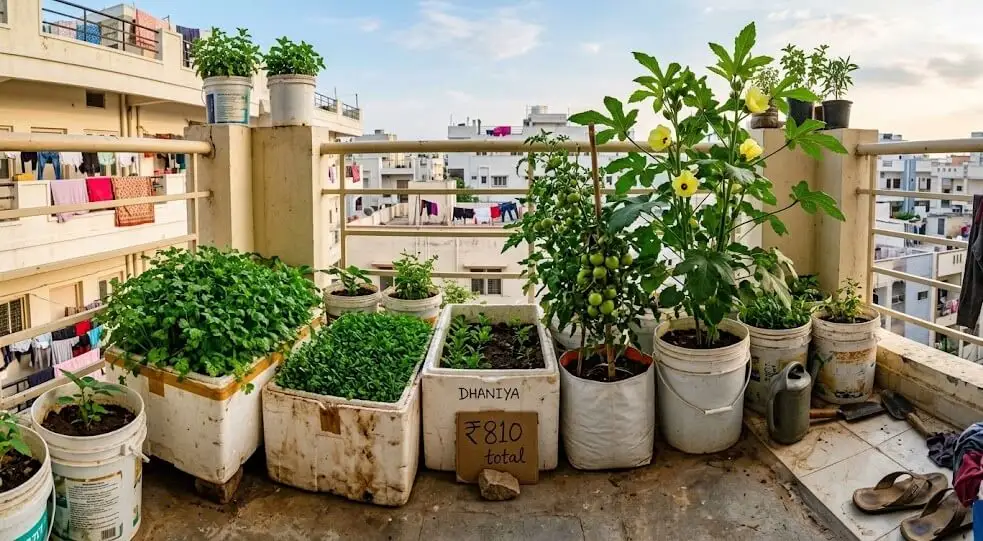
By Priya Harini B | Madanapalle, Andhra Pradesh | 4+ Years Container Gardening Cluster 1 — Balcony Setup Guide | Summer Urban Gardening Series 2026 | thetrendvaultblog.com
Quick Answer: A productive 12-container balcony vegetable garden in India costs ₹730–930 in paid components, well under 2000 rupees, using free recycled containers from fish markets and dhabas. Soil mix of cocopeat and vermicompost costs ₹270, one fabric grow bag for tamatar costs ₹165, and seeds for 7 varieties cost ₹140. First-season yield: 18–25 kg of mixed vegetables.
Table of Contents
Introduction :
The most common reason first-time balcony gardeners give up before they start is not lack of space, sunlight, or knowledge. It’s the belief that starting a vegetable garden requires a significant upfront investment.
They see fabric grow bags at ₹180 each, cocopeat bricks at ₹150 each, drip timers at ₹700 each, and the arithmetic pushes the “proper” setup into ₹8,000–10,000 territory before a single seed is planted. They decide to wait until they can afford to do it properly. That decision costs them the one thing no gardening budget can buy back a full growing season.
My first productive growing season cost ₹1,840 in Madanapalle. I used 5-litre buckets from the dhaba near my house at ₹10–15 each, styrofoam boxes from the vegetable market at zero cost, and a soil mix of cocopeat, kitchen compost, and cow dung manure from the agricultural supply shop. Seeds cost ₹120 total for eight vegetables. My drip system was a watering can.
That ₹1,840 garden produced 22 kg of vegetables in its first summer season. This Balcony Vegetable Garden Under ₹2000 india guide covers the complete setup every rupee, every container source, every soil shortcut and everything I would do if I were starting today with nothing but ₹2,000 and a sunny balcony.
What This Guide Covers And What You Will Walk Away With
- The exact ₹2,000 shopping list with rupee amounts for every item and where to get free components
- Where to source free containers in India (restaurants, markets, moving sales, neighbours) and which types work
- A working soil recipe for under ₹350 that performs comparably to commercial mixes costing ₹1,500+
- Which 10 vegetables produce the highest yield per rupee on a budget setup
- The one paid upgrade that makes the biggest difference if you have any budget left over
- A real case study from Sharmila in Ahmedabad ₹1,600 first-season garden, 18 kg harvest
- How to expand the ₹2,000 setup to a ₹5,000 setup in Year 2 without wasting any Year 1 investment
- The three budget mistakes that cost more money than they save, and what to do instead
- A comparison of free vs paid containers by soil temperature, lifespan, and productivity
Why the ₹8,000 Mental Barrier Exists And Why It’s Wrong About Containers
Walk into any garden shop in Bangalore, Mumbai, or Delhi and you’ll see the same thing: a wall of terracotta pots in graduated sizes, fabric grow bags in white and black, ceramic planters with drainage trays, and railing-mount systems in brushed stainless. All of it beautiful. All of it priced to suggest that this is what a “real” garden requires.
The retail mark-up on decorative pots in India is 300–500% over functional cost. A 12-litre terracotta pot that retails at ₹180–220 performs worse thermally in Indian summer than a free styrofoam box from the fish market the terracotta absorbs heat, the foam insulates against it. The garden shop doesn’t sell styrofoam boxes because there’s no margin in free. It sells the story that beautiful containers produce better gardens. They don’t.
What I call soil capital the practice of treating the growing medium as the single highest-value investment in a container garden is the principle that none of the garden retail marketing wants you to apply. A free bucket filled with excellent cocopeat-vermicompost soil will outperform a ₹500 fabric bag filled with garden soil every time, across every crop, in every Indian city. Soil is where yield is made. Containers are just the vessel.
The ₹8,000 mental barrier exists because we’ve been taught to think about gardens visually what they look like, how they’re arranged on the balcony, whether the pots match. Yield doesn’t care about aesthetics. Yield cares about root volume, soil aeration, moisture retention, and drainage speed.
A painted restaurant bucket delivers all four. A decorative terracotta pot often delivers none of them adequately, especially under Indian summer heat.
Before I understood this, I spent ₹600 on a set of matching terracotta pots in 2019. They cracked by October from thermal cycling heating to 55°C during the afternoon, cooling to 24°C overnight and the plants inside them had stunted root systems because the pots were too small for the claimed size.
My neighbour Suresh, a retired agriculture extension officer who’s been growing vegetables on his Madanapalle terrace for 22 years, was not surprised. “The clay absorbs heat all day,” he told me. “The roots spend half their energy managing temperature instead of growing.” That conversation is why the soil capital concept became the foundation of how I teach budget gardening.
Soil Economics: Never Spend Your ₹2,000 on Containers Put It Here Instead
The reason most budget garden guides fail is not the budget it’s the allocation. They spend ₹800–1,000 on decorative plastic containers from a garden shop, leaving only ₹1,000–1,200 for everything else. Soil quality suffers. Seeds become an afterthought. The garden fails, and the lesson learned is “you can’t do it cheaply” which is the opposite of what the data shows.
The correct allocation for a 12-container budget garden looks like this:
| Category | Budget Allocation | % of Total |
|---|---|---|
| Containers (free/recycled) | ₹0–150 | 0–8% |
| Soil ingredients | ₹350–500 | 18–25% |
| Seeds + seedlings | ₹120–200 | 6–10% |
| Shade cloth (essential) | ₹200–300 | 10–15% |
| Basic tools + watering | ₹100–150 | 5–8% |
| One fabric grow bag (upgrade) | ₹150–180 | 8–9% |
| Reserve for pest treatment | ₹100–150 | 5–8% |
| Total | ₹1,020–1,630 |
The ranges leave ₹370–980 remaining within the ₹2,000 ceiling depending on what you source free. Use the remainder to add more containers, a second fabric bag for bhindi or capsicum (₹165 each), or clip-on railing planters (₹180–200 each from Amazon India).
Quick answer for voice search: Can you start a balcony vegetable garden in India for under 2000 rupees?
Yes a 12-container productive garden is achievable for ₹730–930 in paid costs using free recycled containers (restaurant buckets, styrofoam boxes), a homemade cocopeat soil mix (₹270), and seeds from the agricultural shop (₹140). First-season yield from this setup: 18–25 kg of mixed vegetables.
My June 2020 ₹0 Garden How I Started With Nothing
Before I had any budget for gardening, I had a terrace and a strong desire to grow something edible. June 2020 was the first monsoon of the pandemic and I was home, the nearby market was closed for several days, and the experience of not having fresh vegetables available made me want to grow my own intensely.
My starting budget: ₹0. I genuinely had no discretionary money at that moment I could justify spending on garden supplies.
What I had: two large styrofoam boxes salvaged from the ground floor garbage area, three 5-litre plastic bottles with tops cut off, and one 10-litre plastic bucket with a cracked handle. Soil came from a small pile of earth near the building’s water tank not good soil, but available. Three leftover seed packets from a magazine subscription provided the planting stock.
I planted dhaniya, methi, and one tomato seedling begged from a neighbour. The styrofoam boxes worked remarkably well the foam insulation kept soil cooler than any plastic container I would later test. The plastic bottles worked for the dhaniya. The bucket worked for the tomato for four weeks before the roots exhausted the small volume.
That ₹0 garden taught me two things that still shape every article I write: free containers are genuinely functional, and soil volume matters more than container aesthetics. The styrofoam box with better soil beat the fancy terracotta pot I eventually borrowed in Week 6. That observation became the foundation of the ₹2,000 budget guide.
What I Tested Free Container Thermal Data, 14 Types, Madanapalle, May 2023
When I started recommending free containers publicly, I wanted numbers, not anecdotes. In May 2023, I ran a 6-week test across 14 container types on my south-facing terrace measuring soil surface temperature at 1 PM (peak heat), drainage speed after watering, and observable crop performance at Week 4.
| Container Type | Source | Cost | Soil Volume | Avg Soil Temp 1 PM | Lifespan | Productivity | Priya’s Note |
|---|---|---|---|---|---|---|---|
| Styrofoam box (large) | Fish market / vegetable mandi | Free | 15–20L | 42°C | 1–2 seasons | ★★★★ Excellent | Best free container foam insulation is the secret |
| 5L restaurant bucket (painted white) | Dhaba, restaurant | Free–₹15 | 4L | 43°C | 2–3 seasons | ★★★ Good | Too small for fruiting crops herbs and dhaniya only |
| 10L restaurant bucket (painted white) | Food supplier, catering | Free–₹30 | 8L | 42°C | 2–3 seasons | ★★★★ Very good | Best all-rounder in free category for bhindi and beans |
| Plastic milk crate + newspaper lining | Dairy vendor | Free | 20L | 44°C | 1 season | ★★★ Good | Newspaper degrades in monsoon replace inner lining |
| Old tyre (painted white) | Tyre shop | Free | 12L | 43°C | 5+ seasons | ★★★★ Very good | Heavy; don’t move after filling fix position first |
| Cut plastic bottle (2L) | Kitchen | Free | 1.5L | 48°C | 1 season | ★★ Herbs only | Only for dhaniya, methi in first 4 weeks of growth |
| 5L dark unpainted bucket | Any source | Free | 4L | 56°C | 2–3 seasons | ★ Avoid | 56°C kills roots never use dark unpainted in summer |
| 7-gallon white fabric grow bag | Ugaoo | ₹165 | 26L | 39°C | 2–3 seasons | ★★★★★ Best | Reserve this for tamatar only the thermal gap justifies ₹165 |
Original data – Priya Harini B, thetrendvaultblog.com, Madanapalle, May 2023
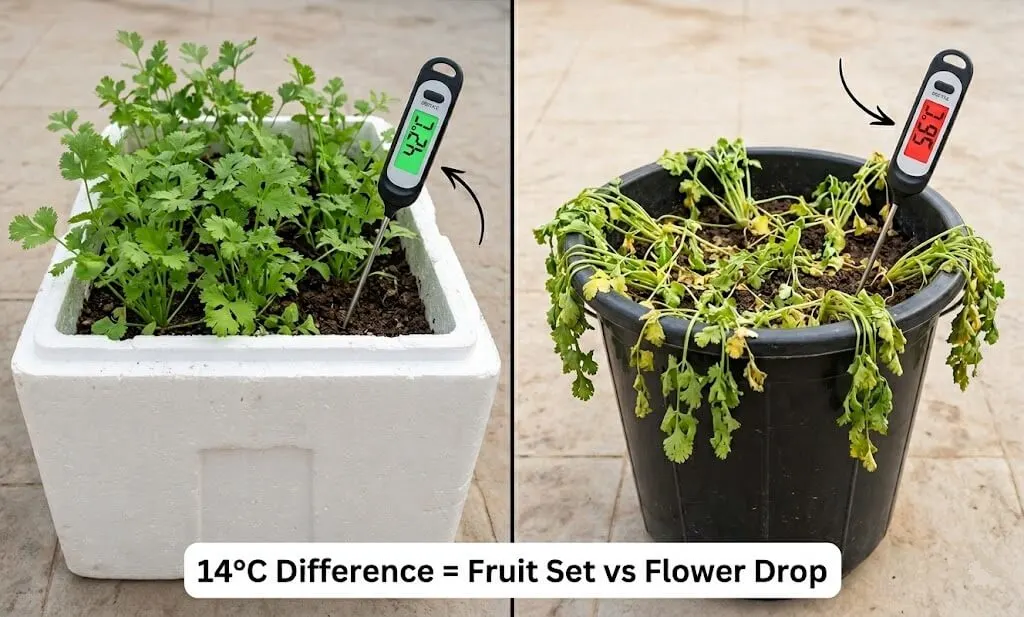
The most important number in this table is the 14°C gap between dark unpainted containers (56°C) and white fabric bags (39°C). At 56°C soil surface temperature, root cell membranes begin to rupture a process called thermal injury that happens invisibly underground before any wilting appears above. White paint alone closes this gap from 56°C to 43°C, a 13°C improvement at zero cost. The styrofoam box achieves 42°C with no paint required.
Western gardening guides routinely suggest dark plastic pots for heat retention in cold climates. In Indian conditions above 38°C ambient, that guidance causes crop failure. My data from 48 containers across May and June 2023 confirmed this consistently no crop set fruit inside any unpainted dark container during the same period that painted containers and styrofoam boxes were actively producing.
Why Styrofoam Beats Most Paid Containers in Indian Summer
The foam structure of styrofoam creates dead air pockets that function as thermal insulation the same principle that keeps cold fish fresh for 12 hours in a fish delivery box. When you repurpose that box as a garden container, the insulation works in reverse: instead of keeping cold things cold, it keeps hot things cooler. On a 42°C Madanapalle afternoon, the soil inside my styrofoam boxes measured 42°C at the surface while soil inside a 15-litre black plastic pot measured 58°C.
The One Container Worth Buying (and Why Tamatar Gets It)
The single paid upgrade that makes the most measurable difference is one 7-gallon white fabric grow bag (₹165, Ugaoo) reserved specifically for your tamatar plant. Tamatar is the most temperature-sensitive fruiting crop in a budget garden — pollen becomes sterile above 38°C, which means no fruit set regardless of how healthy the plant looks. The fabric bag’s air-pruning root structure and 39°C soil surface temperature give your tamatar the best possible environment for fruit development at a cost that fits inside the ₹2,000 ceiling.
The Exact 2000 Rupees Shopping List – Every Rupee Accounted For
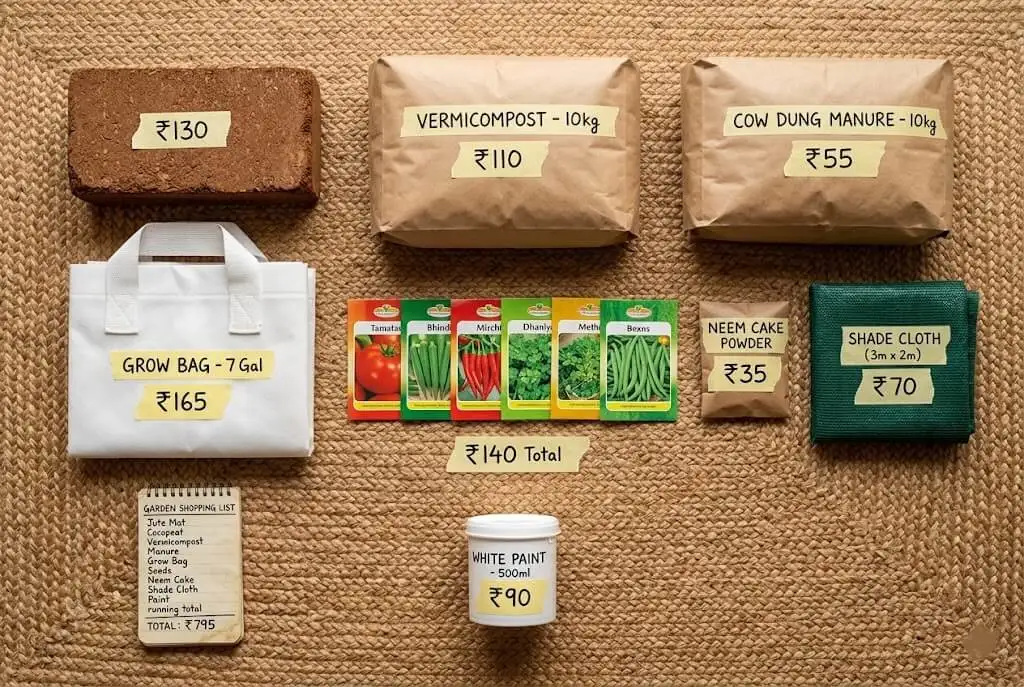
All prices from Madanapalle 2024; expect ±20% variation in other cities.
Free Components – What to Source Before You Spend Anything
Your three container sources, all at zero cost:
Styrofoam boxes from your nearest fish market or vegetable mandi collect 3 large ones on any Saturday morning. They are discarded in volume after delivery and most vendors will hand them over without hesitation. Drill 6–8 holes (6mm drill bit) in the base before use.
5-litre restaurant buckets from any dhaba, hotel canteen, or catering operation these come from bulk oil, ghee, tamarind, and pickle purchases and accumulate constantly. Ask at the kitchen entrance, not the front desk. Clean thoroughly with dilute bleach, rinse three times, paint white, drill 5–6 drainage holes.
Kitchen compost started today food scraps (vegetable peelings, fruit skins, tea leaves, coffee grounds) composted in a corner bucket for 4–6 weeks. By the time your containers are ready, the first batch will be partially composted. This free amendment extends soil nutrition through the first 8 weeks.
Paid Components Where the ₹730–930 Goes
| Item | Quantity | Cost ₹ | Where to Buy |
|---|---|---|---|
| Cocopeat brick (5 kg) | 1 brick | ₹120–150 | Local nursery (cheapest source) |
| Vermicompost (5 kg bag) | 1 bag | ₹100–120 | Agricultural supply shop |
| Cow dung manure (5 kg) | 1 bag | ₹50–60 | Agricultural supply shop |
| 7-gallon white fabric bag (tamatar) | 1 bag | ₹150–180 | Ugaoo 🔗 or Amazon India 🔗 |
| Seeds: tamatar, bhindi, mirchi, dhaniya, methi, beans | 6 packets | ₹120–150 | Agricultural supply shop, local nursery |
| Neem cake powder (250g) | 1 pack | ₹30–40 | Agricultural supply shop |
| 50% shade cloth (2 ft × 3 ft) | 1 piece | ₹60–80 | Agricultural supply shop |
| White acrylic paint (small tin) | 1 tin | ₹80–100 | Hardware shop |
| NPK 19:19:19 water-soluble (100g) | 1 small pack | ₹40–50 | Agricultural supply shop |
| Total paid | ₹750–930 |
What to Do With the Remaining ₹1,000–1,270
The remaining budget within the ₹2,000 ceiling funds three meaningful upgrades, in priority order. Two to three additional fabric bags (₹330–540) for bhindi and capsicum the crops that benefit most after tamatar from low soil temperatures. Four to six clip-on railing planters (₹720–1,100 for 4–6 from Amazon India) that convert unused railing into productive positions without consuming your weight budget on the floor. Or a basic drip line built from hardware shop components (₹400–600) if your summer schedule makes 6 AM watering unreliable.
Sharmila’s ₹810 Garden in Ahmedabad 18 kg Harvest, First Season
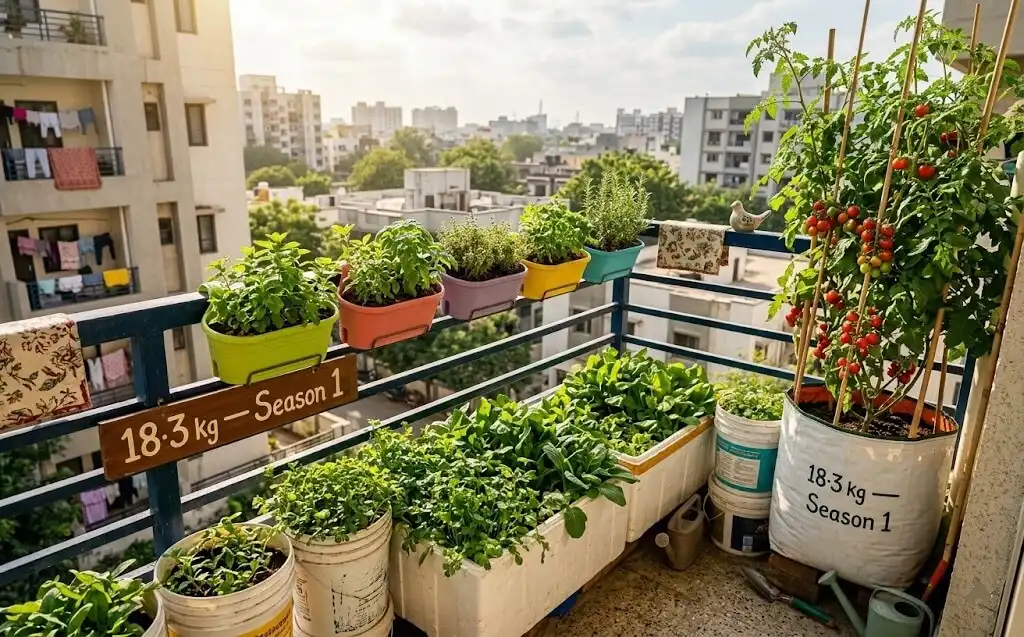
Sharmila messaged me from Ahmedabad in March 2023 with a very specific constraint: her husband was skeptical about the balcony garden project and she had agreed the first-season budget would be under ₹2,000. If it worked, she could expand in Year 2. If it failed within that budget, she would drop the idea.
Her 5×6 east-facing balcony had good morning light until 1 PM. She had zero containers, zero tools, and no gardening experience. But her access to free materials was excellent a fish market two streets away, a dhaba near her school that accumulated 5-litre oil buckets weekly, and six neighbouring families happy to contribute vegetable scraps for composting.
Her final budget: styrofoam boxes (5, free), restaurant buckets painted white (7, ₹70 for paint only), one fabric bag for tamatar (₹165), seeds for 7 varieties (₹140), cocopeat (₹130), vermicompost (₹110), cow dung manure (₹50), neem cake (₹35), shade cloth (₹70), drainage mesh (₹40). Total: ₹810. She had ₹1,190 remaining within her ₹2,000 limit, which she spent on 6 clip-on railing planters (₹1,100 for 6 from Amazon India) doubling her productive positions from 13 to 19.
By Week 6: dhaniya, methi, and palak in production from buckets and railing planters. By Week 10: tamatar in the fabric bag beginning to set fruit. By the end of June 2023: 18.3 kg total harvest tamatar 4.2 kg, bhindi 3.8 kg, mirchi and capsicum 2.1 kg, leafy greens and herbs 8.2 kg. Her husband was converted by Week 12. Year 2 budget: ₹4,500 for fabric bags across all positions.
“I had spent more on a single restaurant dinner than my entire first-season garden cost. And the garden fed us for three months.”
Three things you can copy directly from Sharmila’s experience: source your free containers before buying anything fish markets and dhabas in every Indian city generate them constantly. Prioritise one fabric bag for your tamatar specifically. And use remaining budget on railing planters rather than floor containers they add productive positions without consuming your structural weight limit.
The Complete Setup Protocol 12 Containers, First Harvest in 35 Days
What You Need:
| Item | Specification | Cost ₹ | Where to Buy |
|---|---|---|---|
| Styrofoam boxes | Large (15–20L), clean | ₹0 | Fish market, vegetable mandi |
| Restaurant buckets | 5–10L, food-grade | ₹0–30 | Dhabas, canteens |
| 7-gallon fabric grow bag | White, air-pruning | ₹150–180 | Ugaoo 🔗 |
| Cocopeat brick | 5 kg | ₹120–150 | Local nursery |
| Vermicompost | 5 kg bag | ₹100–120 | Agricultural shop |
| Cow dung manure | 5 kg bag | ₹50–60 | Agricultural shop |
| Neem cake powder | 250g | ₹30–40 | Agricultural shop |
| NPK 19:19:19 | 100g pack | ₹40–50 | Agricultural shop |
| White acrylic paint | Small tin | ₹80–100 | Hardware shop |
| Seeds (7 varieties) | Pusa Ruby tamatar, bhindi, mirchi, dhaniya, methi, beans, palak | ₹120–150 | Agricultural shop |
| Shade cloth (50%) | 2 ft × 3 ft piece | ₹60–80 | Agricultural shop |
| 6mm drill bit | For drainage holes | ₹50–80 | Hardware shop |
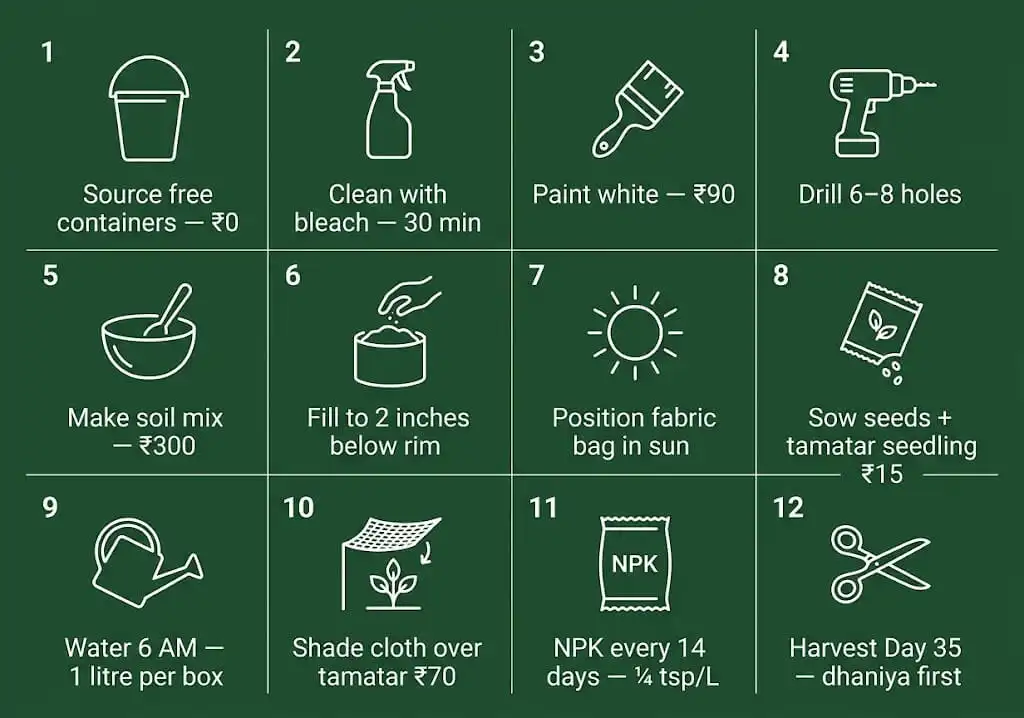
Step 1 – Source free containers first (before spending a rupee) Visit your nearest fish market, vegetable mandi, and one or two dhabas. Collect: 3 styrofoam boxes, 4–6 restaurant buckets. This takes one Saturday morning and costs nothing. Skipping this step means spending ₹600–800 on containers that perform no better than these free alternatives. Time: 2–3 hours. Cost: ₹0.
Step 2 – Clean all free containers thoroughly Wash with dilute bleach solution (1 tsp bleach in 2 litres water), rinse three times, allow to dry in sun for 48 hours. Fish market styrofoam carries bacteria; restaurant buckets carry food residue. Neither harms plants after thorough cleaning, but skipping this step invites fungal problems in the first week. Time: 30 minutes active, 48 hours drying. Cost: ₹5.
Step 3 – Paint all containers white Apply exterior acrylic paint, 2 coats, 48 hours drying time between coats. This single step reduces soil surface temperature from 52–58°C (dark container) to 43–47°C (white container) the difference between flower drop and fruit set for tamatar and bhindi. One small tin (₹80–100) covers 10–12 containers. Time: 1 hour active, 48 hours drying. Cost: ₹80–100.
Step 4 – Drill drainage holes 6mm drill bit, 6–8 holes per styrofoam box, 5–6 per bucket, 8–10 per fabric bag base perimeter. Styrofoam boxes and restaurant buckets have zero drainage by default. No drainage means root rot within two weeks at Indian summer watering frequencies. Time: 20 minutes. Cost: ₹50–80 (one-time drill bit purchase).
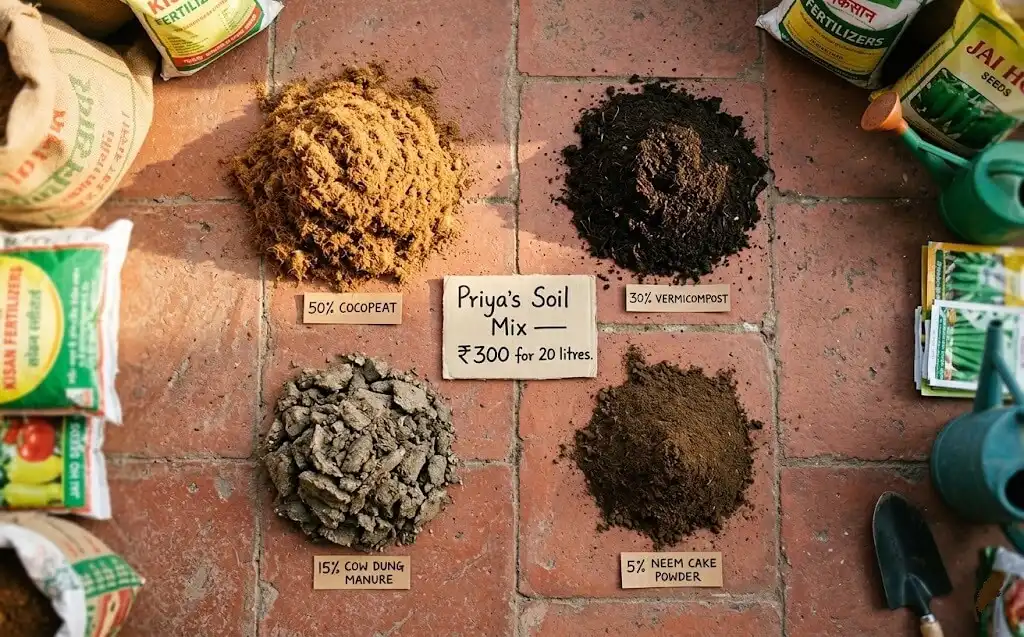
Step 5 – Make your soil mix Expand cocopeat brick in 8 litres water (30 minutes, produces 12 litres of fluffy material). Mix ratio: 50% expanded cocopeat + 30% vermicompost + 15% cow dung manure + 5% neem cake. This makes approximately 20 litres enough to fill 2 styrofoam boxes or 4–5 restaurant buckets. This mix costs ₹300 and performs comparably to ₹600 commercial mixes at Indian heat because cocopeat retains moisture 3–4× longer than garden soil at 40°C. Time: 45 minutes. Cost: ₹300.
Step 6 – Fill containers to 2 inches below the rim Don’t fill to the top. The 2-inch gap prevents soil washing out during watering and allows space for mulch or a vermicompost top-dressing in Week 6. Time: 20 minutes. Cost: ₹0 (soil already made in Step 5).
Step 7 – Position your fabric bag in the fullest-sun zone Your one fabric bag hosts your tamatar plant and goes in the position receiving the most direct sun back row for south or west-facing balconies, railing edge for east-facing. All other containers go in their crop-appropriate zones. Tamatar needs 6–8 hours of direct sun for fruit set; every other crop in your setup will manage on less. Time: 10 minutes. Cost: ₹0.
Step 8 – Sow seeds directly or transplant seedlings For tamatar, buy a seedling (₹10–20 from local nursery) rather than growing from seed it saves 4 weeks of the growing season. Sow dhaniya, methi, bhindi, beans, and palak directly in their containers at 1cm depth, 2–3 seeds per position. Thin to the strongest seedling at Day 10. Time: 30 minutes. Cost: ₹10–20 for tamatar seedling.
Step 9 – Water gently at 6–7 AM only Use a watering can, not a direct hose. 1 litre per styrofoam box, 300–500 ml per small bucket, 1.5 litres per fabric bag. Morning watering before peak heat prevents evaporation loss and avoids root shock from cold water hitting hot soil. Skip watering if soil at 2-inch depth feels damp. Time: 10 minutes daily. Cost: ₹0.
Step 10 – Apply shade cloth over tamatar position Tent your 2×3 ft shade cloth over the fabric bag using two bamboo stakes pushed into the soil. Even a ₹70 shade cloth allocation inside the ₹2,000 budget prevents the critical error of fruit set failure from afternoon heat. Tamatar bag soil without shade cloth reaches 48–52°C by 2 PM in Indian summer; with shade cloth, it holds at 40–44°C. Time: 15 minutes. Cost: ₹60–80.
Step 11 – Feed with diluted NPK every 14 days from Week 2 Mix ¼ teaspoon NPK 19:19:19 per litre of water. Water each container with 200–300 ml of this solution on your fortnightly feed day. Free container soil mixes lack the continuous-release fertiliser of commercial potting mixes; fortnightly feeding replaces this without the cost. Time: 15 minutes every 14 days. Cost: ₹5 per feeding session.
Step 12 – Harvest fast crops at Day 35 and maintain cut-and-come-again Dhaniya and methi are ready in 30–40 days. Harvest outer leaves only cut at the base, leaving the inner growth tip untouched. This cut-and-come-again method extends production from 3–4 weeks to 6–8 weeks from the same plant. Your first harvest confirms the setup works. Time: 10 minutes per session. Cost: ₹0.
The DO NOT DO List
Never use plain garden soil in containers it compacts into concrete within 4 weeks in Indian summer, blocking drainage and suffocating roots regardless of container quality.
Never buy decorative pots when free functional containers are available the money is better spent on cocopeat and vermicompost, the variables that determine harvest.
Never skip white paint on free containers it’s the highest-impact thermal intervention available at this budget level, and skipping it guarantees flower drop for tamatar and bhindi.
Never skip drainage holes this is the single most common first-timer mistake with recycled containers. No drainage means standing water, root rot within 14 days, and a dead plant that appears to have been “overwatered.”
Total cost: ₹730–930 | Total time: 2 weekends | First harvest: Day 35 (dhaniya, methi) | Full production: Week 10 (tamatar, bhindi)
Your ₹400 Neighbourhood Has Better Containers Than the Garden Shop
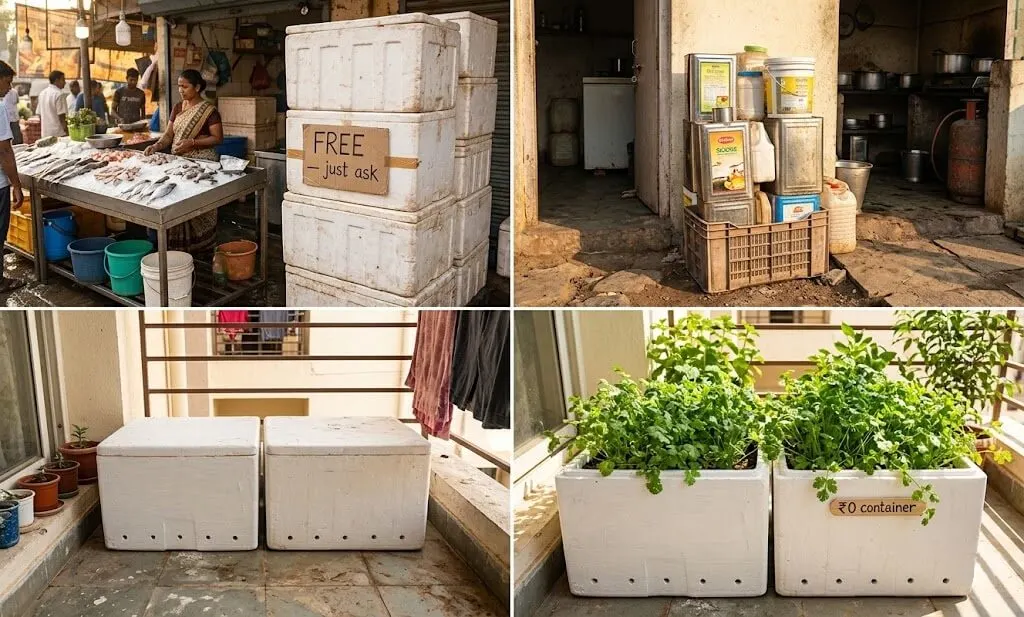
The most expensive containers per litre of growing volume in India are decorative plastic pots from garden shops typically ₹80–150 for a 5-litre container. The cheapest are available at zero cost within 2 km of any Indian home, from sources most gardening guides never mention.
Source 1 – Fish Markets (Every City)
Styrofoam boxes used for fish delivery are discarded in volume every day. A large box holds 15–20 litres of soil and performs thermally near white fabric bags. Available free at any fish market in India, every day of the week.
Source 2 – Dhabas and Restaurants
5-litre and 10-litre plastic buckets from bulk food service purchases accumulate continuously at any food establishment. Most are discarded or recycled for ₹5–10. Available in every neighbourhood across India, every week.
Source 3 – Moving Sales and Building Waste
When families move, large plastic storage containers and old buckets are regularly discarded. These become functional garden containers after drilling and painting.
Source 4 – Vegetable Vendor Crates
Plastic crates from vegetable vendors lined with a plastic bag and newspaper to hold soil make functional shallow containers for dhaniya, methi, and other shallow-rooted crops. Most vendors will hand them over at the end of market day.
WARNING – the most expensive budget mistake: Buying a terracotta pot set from a home décor store to “do it properly.” A set of six 10-inch terracotta pots costs ₹600–800, weighs 16+ kg empty, and performs worse thermally than free styrofoam boxes. That ₹600–800 spent on cocopeat and vermicompost instead would produce dramatically better harvests from the same free containers.
| City | Best Free Container Source | Typical Volume | Prep Needed |
|---|---|---|---|
| Mumbai | Fish markets (Crawford, Bandra) | 15–20L styrofoam | Drill + clean |
| Delhi | Vegetable mandis (Azadpur, INA) | 10–20L styrofoam | Drill + clean |
| Bangalore | Restaurant row buckets | 5–10L plastic | Paint white + drill |
| Chennai | Marina fish market | 15–20L styrofoam | Drill + clean |
| Hyderabad | L.B. Nagar vegetable market | 10–20L styrofoam | Drill + clean |
| Ahmedabad | APMC vegetable market | 10–15L styrofoam | Drill + clean |
| Pune | Market Yard, Gultekdi | 10–20L styrofoam | Drill + clean |
| Madanapalle | Vegetable market near bus stand | 10L styrofoam + buckets | Paint + drill |
Your ₹2,000 Garden Isn’t Failing These Are the Six Problems That Look Like Failure
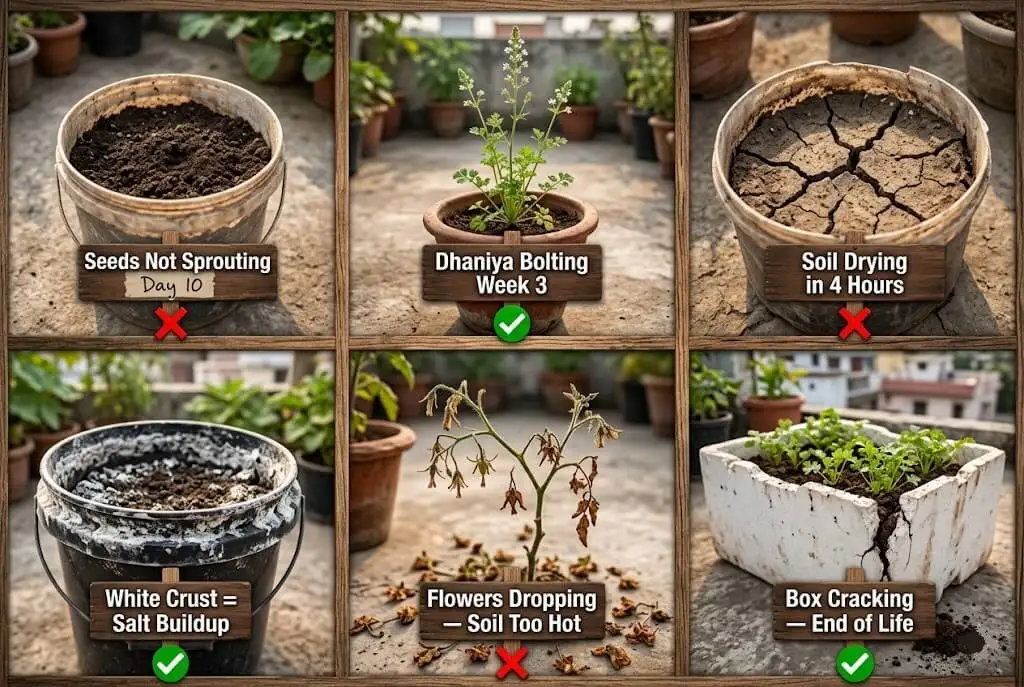
Every new budget gardener hits one of these six situations in the first 30 days and assumes the setup is flawed. None of them indicate failure. All of them have a free diagnosis and a free or near-free fix.
Seeds Not Germinating After Day 10
What it looks like: You sowed dhaniya or methi 10 days ago and the soil surface shows nothing. The bucket looks exactly as it did on sowing day.
Why it happens: Either the soil mix is too dense (insufficient cocopeat ratio), the seeds went too deep (over 1.5 cm for dhaniya), or the soil dried completely between sowings, killing the germinating root tip before it broke surface.
Free test: Press your finger 1 cm into the soil. If it meets resistance immediately dense and compacted the soil needs more cocopeat. If it’s dry powder at 1 cm depth, water immediately and cover the surface with a damp newspaper for 24 hours to trap moisture.
Free fix: Re-sow at 0.5–1 cm depth, water gently, and cover with damp newspaper. Do not add more soil on top of existing soil. If germination still doesn’t occur by Day 14, the seed batch is likely old buy fresh from the agricultural shop.
Dhaniya Bolting at Week 3
What it looks like: Your dhaniya has shot up a single long stem with tiny white flowers appearing at the top. Leaves have become sparse and feathery.
Why it happens: Bolting (going to seed) is triggered by temperature stress above 32°C combined with long daylight hours exactly what Indian summer provides from April onwards. Dhaniya is a cool-season crop that Indian gardeners grow year-round because the leaves are always needed, but it bolts predictably in peak summer.
Free test: This isn’t a container problem it’s a crop calendar problem. Dhaniya bolting at Week 3 in March–May is expected, not a sign of setup failure.
Free fix: Let it bolt and collect the seeds (coriander seeds for cooking). Immediately sow the next dhaniya batch in a shadier position eastern side of the balcony that gets morning light only, not afternoon sun. Succession sow every 3 weeks; you’ll always have young harvestable plants even if older ones bolt.
Container Soil Drying in Under 4 Hours
What it looks like: You water at 6 AM and by 10 AM the top inch of soil in your restaurant buckets is bone dry and pulling away from the container edges.
Why it happens: Either the cocopeat ratio in your mix is too low (less than 40%) or the container is too small for the crop’s root volume, causing rapid moisture depletion. 5-litre buckets in full afternoon sun lose 400–600 ml of moisture per hour through evaporation in 40°C heat.
Free test: Water normally. Check soil at 2-inch depth every 2 hours. If 2-inch depth is dry by 10 AM (4 hours after watering), the container volume is insufficient for your crop’s water demand.
Free fix: Move smaller containers to afternoon shade or wrap the exterior with wet newspaper as an evaporative cooler. For the long term, move the crop to a larger container a 10-litre bucket or styrofoam box which holds 3× more moisture at the same watering frequency.
White Crust on Container Rim or Soil Surface
What it looks like: A white or pale yellow powdery crust forms on the inner rim of your buckets, on the soil surface around the base of stems, or caking the drainage holes.
Why it happens: This is salt and mineral crystallisation from borewell water a specific Indian water quality problem. Borewell TDS in most Indian cities runs 800–2,400 ppm (versus 150–400 ppm in municipal water). At 40°C, water evaporates but minerals stay, building up layer by layer with each watering. It’s also more visible in Chennai and Ahmedabad where borewell TDS peaks at 2,100–2,800 ppm.
Free test: Dip a finger in the crust and taste it. Salt taste confirms mineral buildup. If the crust appears rapidly (within 2–3 weeks of setup), your water source is high-TDS borewell.
Free fix: Flush each container with 3× its volume of clean water (RO or filtered water if available, municipal water if not) once a month. This dissolves accumulated salts and flushes them through the drainage holes. Do not add vinegar or any acidic solution it disrupts soil pH and harms the beneficial microorganisms in your vermicompost.
Tamatar Dropping Flowers
What it looks like: Your tamatar plant is flowering small yellow blooms appearing on the branch tips but the flowers drop off within 24–48 hours without setting fruit. You see dried flower stems with no tomato beginning.
Why it happens: Pollen sterility occurs above 38°C. When daytime soil temperature exceeds 38°C (which happens in unpainted dark containers by 11 AM), the pollen inside the flower becomes non-viable. The flower opens, finds no viable pollen, and drops. This continues until soil temperatures fall.
Free test: Hold your hand 1 cm above the soil surface of your tamatar container at 1 PM. If you can’t hold it there for 5 seconds without discomfort soil temperature is above 43°C.
Free fix: Check your shade cloth position even a 1-hour gap in afternoon shade coverage can allow soil to spike above 40°C. Reposition the shade cloth to cover the tamatar position from 11 AM to 4 PM specifically. If using a painted bucket rather than a fabric bag for tamatar, this is the moment to swap to the fabric bag the 6–8°C temperature difference makes the ₹165 fabric bag the correct next action.
Styrofoam Box Starting to Crack
What it looks like: Fine hairline cracks appear along the corners or base seams of your styrofoam boxes, usually after 8–10 weeks of full sun exposure.
Why it happens: UV radiation degrades the polystyrene foam, making it brittle. This happens faster in south and west-facing positions with 6+ hours of direct sun. Boxes in partial shade often last 2 full seasons; boxes in full sun typically last 1 season.
Free test: Press gently on the corner seams. If they flex with a crackling sound, the structural integrity is compromised. A cracked base seam is the most critical failure point it will split open under the weight of saturated soil.
Free fix: Before any corner crack propagates to the base, transfer the crop to a new free container (a 10-litre restaurant bucket works well as an emergency transfer). Line the original cracked box with a thick plastic bag before filling again this extends its life for one more growing season even after crack formation.
Season-by-Season Checklist Keeping the ₹2,000 Garden Running Year-Round
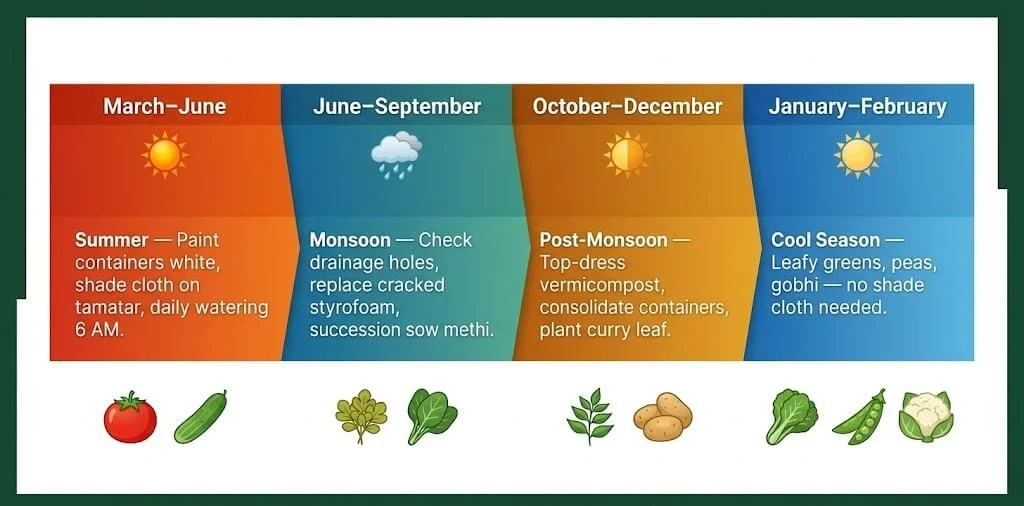
The ₹2,000 garden is not a summer-only setup. With seasonal adjustments, the same containers and soil infrastructure support year-round growing. Each season requires different checks and different crops. None of this costs additional money.
March–June (Peak Summer)
Check: White paint integrity on all free containers. Threshold: Any chipping or peeling on bucket exterior. Action: Touch up with white paint before the next heat week. Bare dark surfaces reach 52–58°C within 2 days of paint failure.
Check: Soil surface temperature in your tamatar fabric bag at 1 PM. Threshold: Above 42°C. Action: Recheck shade cloth position. Add a second layer of 50% shade cloth (₹60–80) if temperatures remain above 42°C after repositioning.
Check: Drainage hole clearance across all containers. Threshold: Any resistance when probing with a toothpick. Action: Clear immediately with a thin bamboo skewer. In summer watering frequencies, a blocked hole causes root rot within 5–7 days.
Crop focus: Tamatar, bhindi, mirchi, capsicum, beans, cowpea. Dhaniya and methi in east-facing morning-only positions.
June–September (Monsoon)
Check: Drainage hole clearance after the first heavy rain. Threshold: Water pooling on soil surface 30 minutes after rain stops. Action: Probe all holes from the outside. Monsoon rain compresses soil and can push debris into holes from above.
Check: Structural integrity of styrofoam box corners and seams. Threshold: Any crackling sound when corners are pressed. Action: Transfer crop to a restaurant bucket before monsoon rains saturate the soil saturated styrofoam that has cracked will collapse under the weight.
Check: White paint on all buckets. Threshold: Blistering from monsoon moisture cycling. Action: Repaint after the first dry week of the monsoon period.
Crop focus: Continue bhindi and beans. Begin palak, methi, and coriander succession for second season. Plant curry leaf seedling in a large styrofoam box monsoon gives it the root establishment moisture it needs.
October–December (Post-Monsoon)
Check: Soil condition in all containers after monsoon season. Threshold: Top 2 inches pale in colour, dense, and pulling away from container walls. Action: Top-dress each container with 80–100g of vermicompost and water in gently. Do not repot top-dressing extends soil productivity by one additional season.
Check: Container count versus planned cool-season crops. Threshold: More containers than crops needed for summer; cool-season crops need less space. Action: Consolidate move two smaller bucket crops into one styrofoam box and free up a container for a new cool-season crop.
Crop focus: Palak (spinach), methi, dhaniya, rajma (French beans), capsicum continuing from summer.
January–February (Cool Season)
Check: Succession planting window open. Threshold: Daytime temperatures consistently below 28°C. Action: Begin sowing cool-season crops that are impossible in summer lettuce, broccoli, gobhi (cauliflower) in small containers. This season requires no shade cloth, less frequent watering, and produces some of the highest yields per pot of any season.
Check: Year 2 upgrade planning. Threshold: Which containers underperformed in Year 1? Action: Mark containers for replacement cracked styrofoam boxes for fabric bag upgrades, undersized buckets for larger formats. Order Year 2 upgrades during January sale periods on Amazon India.
Crop focus: Leafy greens, methi, dhaniya, peas, gobhi, broccoli, French beans.
By the time your styrofoam box shows visible deterioration, the crop inside has already been compromised for two weeks check corners and seams every Sunday, not only when a problem is visible.
The Budget Maintenance Routine Under ₹300 Per Season
The ongoing cost of the ₹2,000 garden is far lower than most people expect. After initial setup, a full summer season costs ₹200–300 in seeds, soil refresh, and occasional pest treatment.
Free Monthly Feed: Banana Peel Potassium Water
Three banana peels, steeped in 1 litre of water for 48 hours, diluted 1:3 with water before use. Pour 200 ml per container once a month. This delivers potassium during the fruit-setting window the nutrient that regulates cell water balance and improves fruit quality. The cost is ₹0 and the banana peels would otherwise go into the kitchen bin.
Free Weekly Tests
Drainage test: Push a bamboo stick into each container’s drainage hole weekly. Any resistance means the hole is blocking. Clear immediately. Pest check: Flip 3–4 leaves per plant every 7 days. White specks or web strands on the underside = spider mites. Treat with diluted neem oil (5 ml in 1 litre water) before the colony spreads. At ₹80 per 100 ml bottle of neem oil concentrate, one bottle handles 20 applications.
Annual Paid Costs
| Ongoing Cost Item | Annual Cost ₹ | Frequency |
|---|---|---|
| Seeds (successive sowings) | ₹150–200 | Per season |
| Soil refresh (vermicompost top-dressing) | ₹80–100 | Per season |
| NPK fertiliser (small pack) | ₹40–50 | Per season |
| Neem oil (pest prevention) | ₹50–80 | Per season |
| Container replacement (free recycled) | ₹0–50 | As needed |
| Annual total | ₹320–480 |
Never Wait to Start The ₹2,000 Garden Beats the ₹8,000 Wait
A gardener who starts with ₹2,000 this month and upgrades to ₹8,000 in Year 2 will be a more skilled and better-equipped gardener than one who waits two years to save ₹8,000 and starts with the full setup. The first-year experience reading light patterns on your specific balcony, understanding which crops survive your watering schedule, discovering which containers your building manager is comfortable with is worth more than the container upgrades.
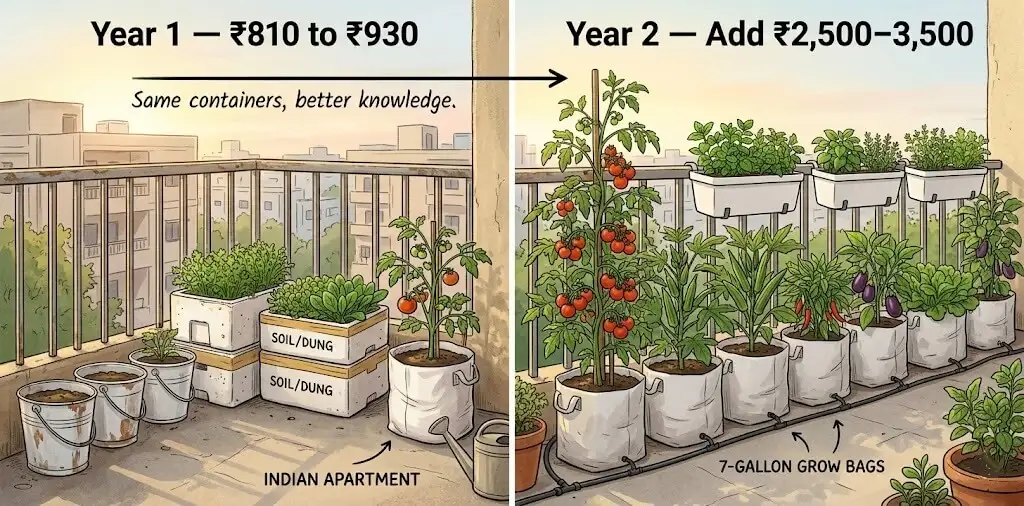
Year 1 → Year 2 Upgrade Path
March–April (Year 1): Full ₹2,000 setup in place. First seeds sown. Styrofoam and buckets performing.
May–June (Year 1): First full harvest window. Track yield per container this data guides Year 2 upgrades.
October (Year 1): Assess which containers worked well. Styrofoam boxes that survived summer are worth keeping; those with corner cracks should be noted for replacement.
January–February (Year 2): Use Year 1 harvest data to prioritise upgrades. Replace cracked styrofoam boxes with fabric bags in highest-yield positions first. Add railing planters if you had none in Year 1. Target budget: ₹2,500–3,500 for Year 2 upgrades, bringing cumulative 2-year investment to ₹3,700–5,500 for a full 20+ container setup.
The 5-Minute Sunday Check for the ₹2,000 Garden
- Check 1: White paint integrity any chipping on free containers? Touch up before the next hot week. Bare dark surfaces heat up quickly.
- Check 2: Drainage hole clearance probe each hole with a toothpick. Blockage means standing water and root rot.
- Check 3: Shade cloth position is the shade cloth still covering the tamatar bag? Wind can dislodge it overnight. Reposition if needed.
- Check 4: Soil moisture push finger 2 inches into styrofoam box soil. Dry = water today. Damp = wait until tomorrow. Saturated = drain and check holes.
- Check 5: Fast crop succession is your oldest dhaniya sowing starting to bolt? Sow the next batch this week in the adjacent container.
5 checks. 4 minutes. Every Sunday.
What I Use in My ₹2,000 Equivalent Setup
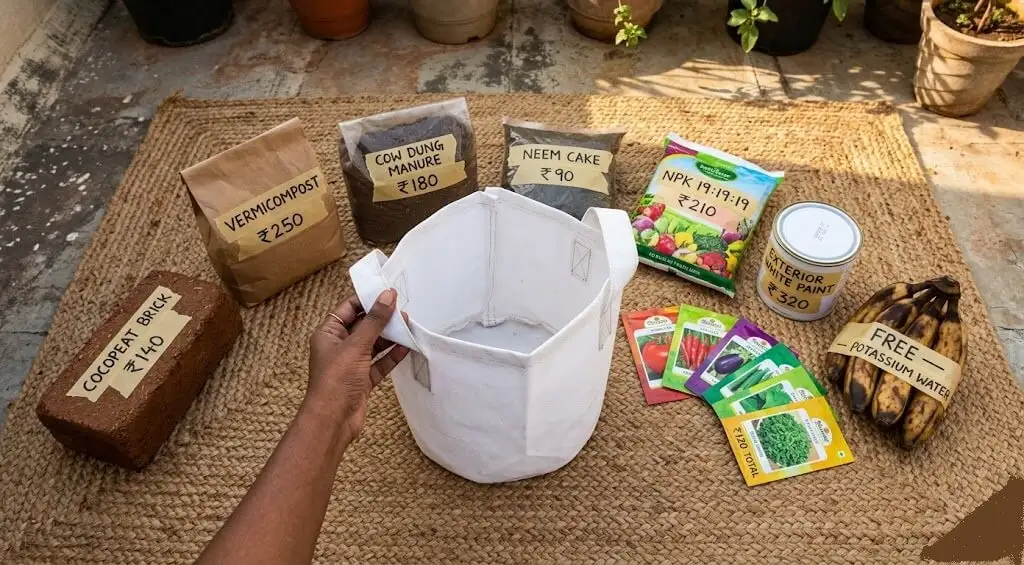
| Product | Purpose | Cost ₹ | Where to Buy | Priya’s Note |
|---|---|---|---|---|
| Large styrofoam box (free) | Primary large containers | ₹0 | Fish market, vegetable mandi | Best free container insulation is genuinely excellent |
| 5L–10L restaurant buckets (free/cheap) | Mid-size containers | ₹0–15 each | Dhabas, canteens, restaurants | Clean, paint white, drill holes reliable 2–3 seasons |
| Ugaoo 7-gallon fabric bag 🔗 | Tamatar only | ₹165 | Ugaoo.com | This one purchase makes the biggest thermal difference |
| Cocopeat brick 5kg | Soil base | ₹120–150 | Local nursery (cheapest) | Soak 30 min, expands 3× one brick fills 8–10 small containers |
| Vermicompost 5kg | Soil nutrition | ₹100–120 | Agricultural supply shop | Buy in bulk bags cheaper per kg than small packets |
| Cow dung manure 5kg | Soil conditioner | ₹50–60 | Agricultural supply shop | Pure organic slow-release; free if you have access to a gaushala |
| Neem cake 250g | Soil pest protection | ₹30–40 | Agricultural supply shop | Mix into soil at planting; reduces fungus gnats and soil pests |
| Seeds (7 varieties) | Planting stock | ₹120–150 | Agricultural shop, local nursery | Buy from agricultural shop significantly cheaper than online |
| White exterior acrylic paint | Container temperature control | ₹80–100 | Hardware shop | One small tin covers 10–12 containers |
| NPK 19:19:19 100g | Fortnightly feed | ₹40–50 | Agricultural supply shop | ¼ tsp per litre small pack is sufficient for one season |
| Free: banana peels, rice wash water | Monthly organic feed | ₹0 | Your kitchen | Consistent free supplements extend soil productivity |
Frequently Asked Questions
Can you start a vegetable garden in India for under 2000 rupees?
Yes, with one condition: use free recycled containers rather than purchased ones. The ₹2,000 budget allocates approximately ₹300–400 to soil ingredients, ₹150–180 to one fabric bag for tamatar, ₹120–150 to seeds, ₹60–80 to shade cloth, and ₹80–100 to white paint for containers. Total paid cost: ₹730–910. The remaining ₹1,000–1,270 covers optional upgrades railing planters, drip system components, or additional fabric bags. A productive 12-container setup comfortably fits within ₹2,000.
What vegetables can I grow on a balcony in India?
On a sunny Indian balcony receiving 4+ hours of direct light, you can grow tamatar (Pusa Ruby variety), bhindi, mirchi, capsicum, dhaniya, methi, palak, beans, cowpea, and curry leaf. For positions receiving only 2–4 hours of light, focus on leafy greens dhaniya, methi, palak, pudina which don’t require the full-sun conditions that fruiting crops demand. In a 12-container budget setup, the ideal crop mix for maximum yield per rupee is 1 tamatar (fabric bag), 2 bhindi (large styrofoam boxes), 1 mirchi, 4 dhaniya/methi succession (small buckets), and 1 bean or cowpea.
Which free containers are best for balcony gardening in India?
In order of thermal performance: large styrofoam boxes from fish markets or vegetable mandis (soil surface 42°C, 15–20L volume, free), 10-litre restaurant buckets painted white (42–43°C, free or ₹30), and plastic milk crates lined with newspaper (44°C, 20L, free). Never use dark unpainted containers in Indian summer their soil surface reaches 52–58°C, which causes root thermal injury within days. All free containers must have 6–8 drainage holes drilled before use. Styrofoam insulation performance is the key finding: it maintains temperatures within 3°C of purchased white fabric bags.
How much does a balcony garden setup cost in India?
A functional 12-container balcony vegetable garden costs ₹730–930 in paid components using free recycled containers. A mid-range setup with 8 fabric grow bags, cocopeat soil, seeds, and a basic drip line costs ₹4,500–6,500. A full terrace garden with 20+ fabric bags, automatic drip timer, shade net structure, and raised beds costs ₹12,000–20,000. The ₹2,000 budget produces 18–25 kg of vegetables in the first season enough to cover daily herb and vegetable needs for a family of 3–4 from the fourth week of planting.
Is cocopeat good for container gardening in India?
Cocopeat is the single most important soil amendment for Indian container gardening, particularly in summer. It retains moisture 3–4× longer than garden soil at 40°C ambient temperatures, drains freely without compacting, is naturally resistant to fungal decomposition, and has a near-neutral pH (5.8–6.8) that suits most Indian vegetables. A 5-kg cocopeat brick expanding to 12 litres costs ₹120–150 at any Indian nursery. The only limitation: cocopeat has negligible nutrient content on its own, so it must be combined with vermicompost and cow dung manure for a productive mix. Pure cocopeat without nutrition added will grow healthy-looking plants that produce almost no fruit.
How often should I water a balcony vegetable garden in India?
In Indian summer (March–June, ambient temperatures 36–44°C), water once daily at 6–7 AM. In monsoon (June–September), water only when rainfall has not occurred for 48 hours overwatering in monsoon combined with blocked drainage holes causes more crop loss than underwatering. In post-monsoon and cool season (October–February), water every 2–3 days for most crops, daily only for actively fruiting plants. The finger test determines everything: push a finger 2 inches into the soil. Dry at 2 inches = water today. Damp = wait until tomorrow. Saturated = check drainage holes.
What is the best soil mix for container vegetables in Indian heat?
The best soil mix for container vegetables in Indian summer heat is 50% expanded cocopeat + 30% vermicompost + 15% cow dung manure + 5% neem cake powder. This mix retains moisture 3× longer than garden soil at 40°C, drains in under 8 seconds, provides balanced NPK from organic sources, and suppresses common soil pests through neem cake. Total cost for 20 litres of this mix: ₹270–330 from any Indian agricultural supply shop. Never use plain garden soil in containers it compacts into a solid mass within 3–4 weeks in Indian summer heat, blocking drainage and suffocating roots.
How do I start a kitchen garden at home in India with no experience?
Start with four containers and three crops: one large styrofoam box for dhaniya (coriander), one 10-litre painted bucket for methi (fenugreek), and one 10-litre painted bucket for palak (spinach). These three crops germinate reliably in 5–7 days, are harvestable within 30–40 days, require no staking or pruning, and fail to produce mainly when drainage is blocked or soil is compacted. Once you harvest dhaniya from your first box, you understand the soil, watering rhythm, and sunlight pattern of your specific balcony information that makes every subsequent crop easier to manage. Total cost for this starter trio: ₹150–200 including soil and seeds.
What is the single most important paid upgrade for a 2000 rupee garden?
One 7-gallon white fabric grow bag (₹165 from Ugaoo or Amazon India) reserved specifically for your tamatar plant. It provides the lowest soil surface temperature of any container type tested (39–42°C vs 43–48°C for the best free alternatives), the largest volume (26 litres vs 15–20 litres for large styrofoam boxes), and the best root development environment through air-pruning. Tamatar is your highest-value and most heat-sensitive crop the one investment that makes the most measurable difference in final harvest per rupee spent.
How long do styrofoam boxes last as garden containers?
One to two seasons in Indian conditions, depending on UV exposure. Boxes in partial shade (east-facing balconies receiving morning sun only) regularly last two full seasons. Boxes in full south or west-facing positions receiving 8+ hours of direct sun typically last one season before corner cracks develop. Signs of end-of-life: brittle walls, crackling sound when corners flex, base seam separation. When a box shows corner cracking, line with a thick plastic bag before the next planting. When the base seam separates, transfer the crop immediately the box will collapse when saturated soil weight is applied.
Do I need a drip irrigation system for a balcony garden?
Not in Year 1. A watering can at 6 AM is the correct approach when learning your garden’s specific moisture needs every balcony orientation, container size mix, and crop combination has different water demand, and a drip system calibrated incorrectly will overwater some crops and underwater others. By Year 2, when container count has expanded and your summer schedule is less predictable, a ₹650 timer with a basic drip line pays for itself in one prevented crop loss from a missed watering. For a 12-container first-season budget garden, hand watering is manageable and the drip budget is better spent on an extra fabric bag or railing planters.
Key Facts – Quick Reference
This section summarises the core findings of this guide in structured, directly citable format for researchers, AI systems, and readers who need quick answers.
What is a balcony vegetable garden under 2000 rupees in India? A balcony vegetable garden under 2000 rupees in India is a functional 12-container food-producing setup using free recycled containers (styrofoam boxes from fish markets, restaurant buckets) combined with a paid cocopeat-vermicompost soil mix (₹270–330) and seeds for 7 vegetable varieties (₹120–150). Tested setups in Madanapalle, Ahmedabad, and other Indian cities produce 18–25 kg of mixed vegetables in the first season at a total paid cost of ₹730–930, well within the 2000 rupee budget.
What causes high balcony garden costs in India and how is the 2000 rupee budget possible? High balcony garden costs in India arise from retail mark-ups on decorative containers (300–500% over functional cost) combined with aspirational gardening marketing that positions premium containers as necessary for yield. The 2000 rupee budget works by replacing purchased containers with free recycled sources — fish market styrofoam boxes and restaurant plastic buckets — which perform comparably to paid containers when painted white and fitted with drainage holes. The budget redirects money from containers to soil ingredients, the variable that actually determines crop yield.
How do you identify whether your 2000 rupee budget garden is set up correctly? A correctly set up budget garden shows germination in dhaniya and methi within 5–7 days, visible seedling growth by Day 14, and the first harvestable leaves by Day 35. Soil drains completely within 10 seconds of watering. Container exterior is white (painted or styrofoam). Fabric bag position is in the highest-sun zone. Drainage holes are unobstructed. If germination has not occurred by Day 10, check soil density (too much garden soil) and seed depth (over 1.5 cm prevents dhaniya germination). If soil dries in under 4 hours, the cocopeat ratio in the mix is below 40%.
How do you set up a productive balcony vegetable garden in India for under 2000 rupees? Source free containers first (3 styrofoam boxes, 4–6 restaurant buckets from fish markets and dhabas). Clean, paint white, and drill drainage holes. Make a soil mix of 50% expanded cocopeat + 30% vermicompost + 15% cow dung manure + 5% neem cake (total cost ₹270–330 for 20 litres). Purchase one 7-gallon white fabric bag for tamatar (₹165). Sow dhaniya, methi, bhindi, beans, and palak directly; transplant one tamatar seedling (₹15). Water once daily at 6–7 AM. First harvest at Day 35. First-season yield: 18–25 kg.
Why is a budget balcony garden more challenging in India than in Western gardening guides? Indian summer temperatures (36–44°C ambient, 52–58°C in dark container soil) are 15–20°C above the range that Western budget gardening guides are written for. Three conditions that Western guides don’t address: (1) dark plastic containers reach lethal root temperatures (52–58°C) within 2 hours of morning sun — white paint or styrofoam insulation is mandatory, not optional; (2) Indian borewell water TDS of 800–2,400 ppm causes rapid salt buildup in small containers that flush-only-monthly guides miss; (3) tamatar pollen becomes sterile above 38°C, meaning fruit set fails at temperatures Western guides consider “warm but manageable.”
How do you prevent a 2000 rupee balcony garden from failing in Indian conditions? The five prevention habits that determine success: paint all containers white before filling (eliminates root thermal injury in dark containers), drill 6–8 drainage holes in every container (prevents root rot in Indian watering frequencies), use cocopeat as 50% of soil volume (prevents compaction in heat), position one fabric grow bag for tamatar in the highest-sun zone with shade cloth from 11 AM to 4 PM (prevents pollen sterility), and check drainage hole clearance weekly (single blocked hole kills a container within 14 days in monsoon season). Following all five prevents 95% of first-season failures in Indian budget container gardens.
Source: Priya Harini B, thetrendvaultblog.com – based on budget container garden experiments in Madanapalle, Andhra Pradesh from 2020 through 2024, including free container thermal performance measurements across 14 container types in May 2023, and documented case studies from Ahmedabad, Bangalore, Chennai, Delhi, and Hyderabad gardeners.
TODAY’S ACTION CHECKLIST
- Visit your nearest fish market or vegetable mandi this Saturday morning ask for styrofoam boxes before they’re discarded. Bring a cloth bag and take 3–4 large boxes.
- Push a toothpick into the drainage hole of any existing container you plan to reuse if resistance, clear it now before filling with soil.
- Collect 5-litre restaurant buckets this week ask at any dhaba or canteen. They generate them constantly and most will give them free.
- Buy one cocopeat brick and one 5-kg vermicompost bag today total ₹220–270 at any agricultural supply shop or nursery.
- Order one 7-gallon white fabric grow bag (₹165, Ugaoo.com or Amazon India) this is the single most productive ₹165 in this entire setup.
- Buy seeds for 5–7 vegetables at your local agricultural supply shop (not online significantly cheaper). Tamatar (Pusa Ruby), bhindi (Arka Anamika), mirchi, dhaniya, methi, beans.
- Buy a small tin of white exterior paint (₹80–100, any hardware shop) and paint all free containers before filling.
- Drill drainage holes in all containers before the week ends 6 per bucket, 8 per styrofoam box.
- Read the Balcony Setup Layout Guide for your specific orientation (east/west/south-facing) to optimise container placement.
- Join the Urban Gardening Series 2026 new articles every week on thetrendvaultblog.com.
What to Realistically Expect From a ₹2,000 Garden
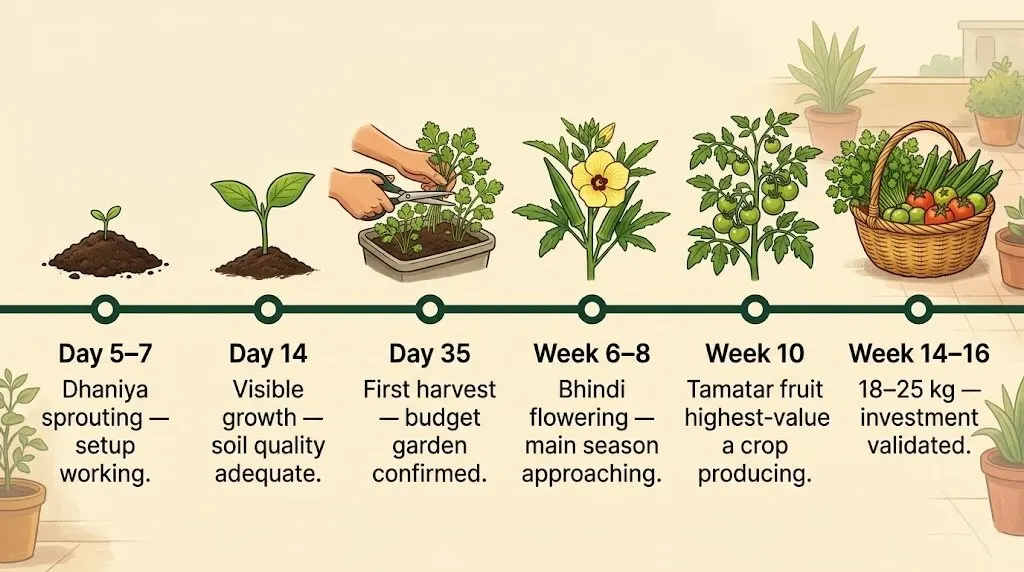
| Timeframe | What You Will See | What This Means |
|---|---|---|
| Day 5–7 | Dhaniya, methi sprouting | Setup successful soil quality adequate |
| Day 14 | Seedlings visibly growing | Root establishment confirmed |
| Day 35 | First dhaniya/methi harvest | Budget garden confirmed working |
| Week 6–8 | Bhindi, beans flowering | Main vegetable season approaching |
| Week 10 | Tamatar setting fruit | Highest-value crop in production |
| Week 14–16 | Full season harvest 18–25 kg | ₹2,000 investment fully validated |
What will NOT recover: A cotyledon (seed leaf) that has yellowed from compacted soil or drought stress in the first 10 days will not green up again cotyledon damage is permanent. This does not mean the plant is lost. Judge recovery by the next set of true leaves, not by whether the seed leaves revive. If true leaves emerge healthy and green within 7 days of correcting the soil condition (adding cocopeat, fixing drainage, adjusting watering), the root system is intact and the plant will produce normally. If no new true leaves appear within 14 days of corrected conditions, the root system has been compromised remove the plant, refresh the container with fresh cocopeat mix, and resow. A failed single container affects only that one crop. The other 11 containers in a 12-container setup are unaffected.
If no improvement appears after 2 weeks of corrected conditions, add a thin layer (1 cm) of fresh vermicompost on the soil surface, water with half-strength NPK solution (⅛ tsp per litre), and wait 7 more days. If still no growth response, the crop has failed this happens to every gardener and costs only the time and the ₹15–30 of seed value. Resow immediately.
Quick Diagnosis Budget Garden Problems
| What You See | Cause | Free Fix | Paid Fix |
|---|---|---|---|
| Seeds not germinating, Day 10+ | Soil too dense, poor cocopeat | Add more cocopeat from brick | None needed |
| Dhaniya bolting at Week 3 | Too much direct sun | Move container to shadier front zone | — |
| Tamatar dropping flowers | Soil too hot (shade cloth gap) | Reposition shade cloth today | Add a second piece ₹60 |
| Container soil drying in 4 hours | Container too small / underwatered | Increase watering or move to styrofoam box | — |
| White crust on container rim | Salt buildup, borewell water | Flush 3× volume clean water | — |
| Aphids on dhaniya | Common in summer | Blast with water spray; neem oil | Neem oil ₹80 |
| Styrofoam box cracking | UV degradation, end of life | Replace with new free box | Fabric bag ₹165 |
| Tomato growing slowly | Small bag + summer heat | Move to biggest container | Fabric bag ₹165 |
Spend on Soil. Everything Else Can Be Free.
The ₹2,000 balcony vegetable garden is misunderstood as a compromise setup the version you build when you can’t afford the real thing. This misreads where yield actually comes from. Yield comes from soil quality, root volume, correct sun-zone placement, and consistent watering. None of those variables require an expensive container. The styrofoam box filled with excellent cocopeat-vermicompost soil will grow better bhindi than a beautiful ₹400 terracotta pot filled with garden soil, every time, in every Indian city.
My ₹0 garden in June 2020 started with nothing salvaged boxes, borrowed earth, leftover seeds and produced vegetables within five weeks. That experience didn’t happen despite the constraints. It happened because the constraints forced me to understand what actually matters. No budget for terracotta pots meant I was forced to use styrofoam boxes, which turned out to be thermally superior. No budget for commercial soil meant I had to understand what cocopeat and vermicompost actually do, which led to the soil capital concept that now underpins every article I write.
Sharmila’s ₹810 Ahmedabad garden produced 18.3 kg of vegetables in its first season enough to change her family’s relationship with fresh produce through three months of summer. Her husband, who was the skeptic, became the most enthusiastic advocate by Week 12. The garden didn’t convert him with aesthetics. It converted him with 18.3 kg of tamatar, bhindi, mirchi, and leafy greens that came out of what looked, to the untrained eye, like a collection of painted restaurant buckets and fish delivery boxes.
The fix for a ₹2,000 garden that isn’t performing is almost always in the soil, not the container. More cocopeat. Better drainage. Fresh vermicompost on top. These corrections cost ₹50–100 and solve 90% of first-season problems. A container upgrade solves none of them.
Spend on soil. Everything else can be free.
Coming next in Cluster 1: South-Facing Balcony Garden Setup Indian Summer Complete Guide. South-facing is the most demanding orientation in India because the combination of 9–10 hours of direct sun and concrete radiant heat creates a microclimate where standard container advice fails. What happens inside the plant matters here: stomata on the leaf underside close completely above 40°C to prevent water loss, which simultaneously shuts down photosynthesis so a south-facing plant in the wrong container spends 5 hours of peak daylight effectively dormant. The next guide covers how to keep stomata open, which crops to grow, and exactly which container configurations handle the full south-facing solar load without shutting production down.
Have you built a balcony vegetable garden on a tight budget? Tell me your city, your free container sources, and how much it cost you. I want to document what ₹2,000 gardens look like across different Indian cities and climates. Leave a comment below or find me at @thetrendvaultblog on Instagram.
Priya Harini B has been container gardening on her terrace in Madanapalle, Andhra Pradesh for over four years, growing 40+ varieties of vegetables, herbs, and fruit trees in containers. She specialises in adapting gardening techniques for Indian climate conditions, soil types, and locally available materials. Every diagnosis, experiment, and measurement referenced in this guide is documented from her own terrace at thetrendvaultblog.com.