
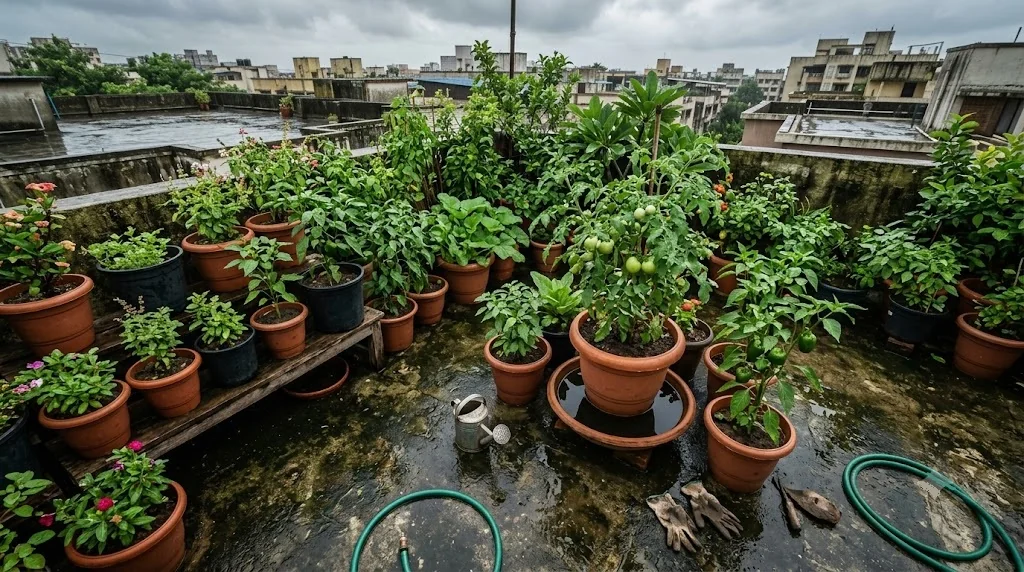
Priya Harini B · Madanapalle, Andhra Pradesh · Monsoon Survival Series 2026, Article 4 of 6
Quick Answer: Mosquito breeding prevention on Indian terraces means checking five containers weekly plant saucers, self-watering reservoirs, stacked spare pots, sagging tarps, and drip trays since Aedes aegypti needs only 4–7 days of still water to complete its larval cycle. A 5-minute round through these five spots, done the same day every week, stops breeding without a single spray on your plants.
Table of Contents
Introduction
You checked your overhead tank. You keep the sump covered. You even asked the building watchman if he’s fogged the compound. And still, the mosquitoes are worse on your terrace than anywhere else in the building because the breeding site was never the tank. It’s been sitting under your favourite tomato pot the entire time, holding three days of rainwater you never noticed, waiting for one more warm night to finish the job.
The saucer under a container, a self-watering reservoir nobody’s opened since April, a stack of spare pots with rain trapped in the gaps between them these hold exactly the amount of still water Aedes aegypti needs, for exactly long enough. Most municipal mosquito drives target open drums and tanks and miss container gardens completely. This guide is your practical mosquito breeding prevention terrace garden checklist the five spots that actually matter and a five-minute weekly round that closes all of them, without a single spray near your plants.
This is one piece of a full monsoon container gardening system the same crowded, humid conditions that create these breeding sites are also behind the fungal leaf spot problems covered elsewhere in this series.
What Mosquito Breeding Prevention Actually Means for a Terrace Garden
Mosquito breeding prevention is the practice of eliminating still water that stays undisturbed for four or more days, because that’s the minimum window Aedes aegypti the species behind dengue and chikungunya needs to go from egg to biting adult. The female lays 100–200 eggs in a single container, and she doesn’t need much: 15 to 20 millilitres of water, roughly two tablespoons, is enough for a full brood.
For most Indian households this means checking the overhead tank, the sump, and the cooler tray. For a container gardener, it means something else entirely. A balcony with 15–20 pots has 15–20 potential breeding sites the tank-focused municipal checklist never mentions saucers, trays, reservoirs, and the gaps between stacked spares.
This is worse on a terrace than almost anywhere else in an Indian building, for three mechanical reasons. Terracotta and plastic saucers hold water that would otherwise drain into soil, creating small, still, shaded pools exactly where the parent plant’s foliage keeps direct sun and wind off the surface. Monsoon humidity in most Indian cities keeps ambient temperature in the 26–32°C range that speeds larval development to as little as four days instead of the seven to ten it takes in cooler weather. And because a container garden is watered daily, there’s a steady top-up of exactly the amount of water a mosquito needs you’re not creating a puddle once; you’re recreating the right conditions every single day without realising it.
What breeds mosquitoes on a balcony garden? Any container that holds still water for four or more days plant saucers, self-watering reservoirs, and stacked spare pots are the three most common on an Indian terrace, and none of them look like standing water until you check.
The Five Containers You’re Actually Missing
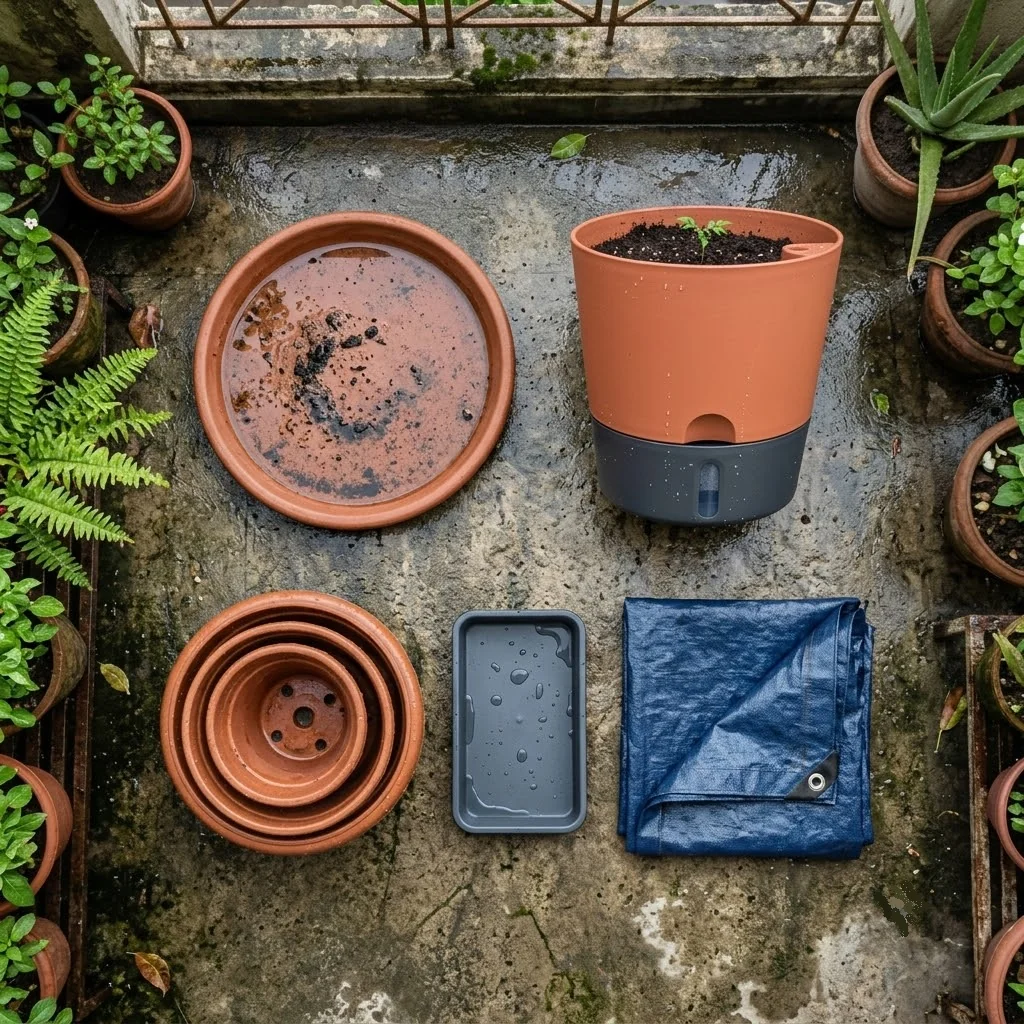
Municipal larvae drives check tanks, drums, and coolers. They almost never check these five which is exactly why a clean-looking terrace garden can still be the building’s worst breeding site. If you also store water for irrigation in a larger drum or barrel, size it correctly with the rainwater harvesting size calculator rather than keeping more standing water on hand than you actually need oversized storage sitting mostly full is its own breeding risk. This sits inside the same integrated container garden prevention system that covers monsoon prep more broadly.
The Saucer Under Every Pot
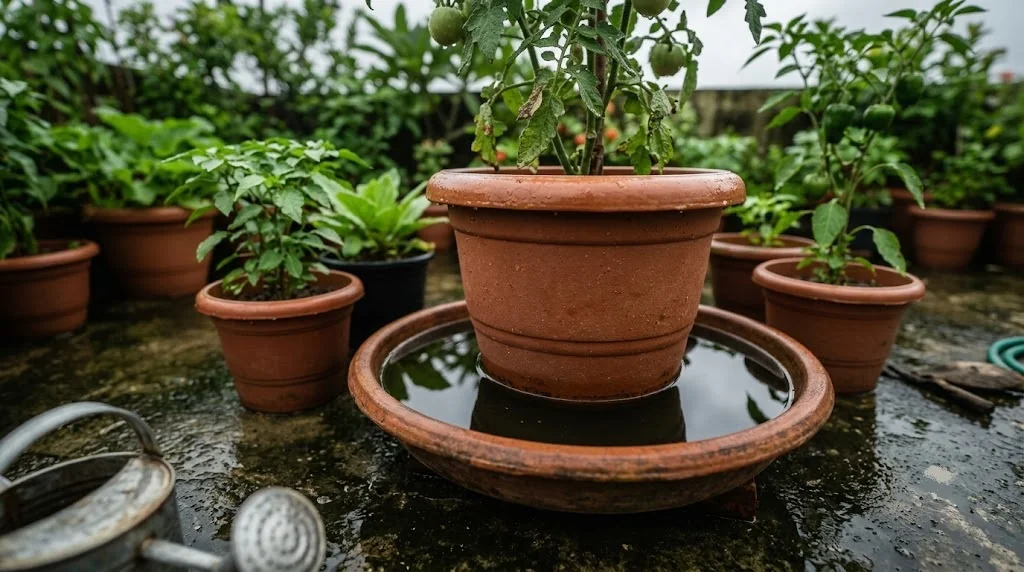
What triggers it: Rain fills the saucer under a pot faster than the plant can drink it, and once the rain stops, that water has nowhere to go the saucer’s job is to hold it. How to confirm it’s the cause: lift any pot after a dry spell of 2–3 days and check the saucer underneath; if there’s water sitting below the drainage holes, it’s been there since the last rain. What makes it worse in Indian conditions: monsoon rain arrives in short, intense bursts rather than steady drizzle, so a single evening shower can fill a saucer that then sits untouched for a week if you’re not checking it specifically.
The Self-Watering Reservoir Nobody Empties
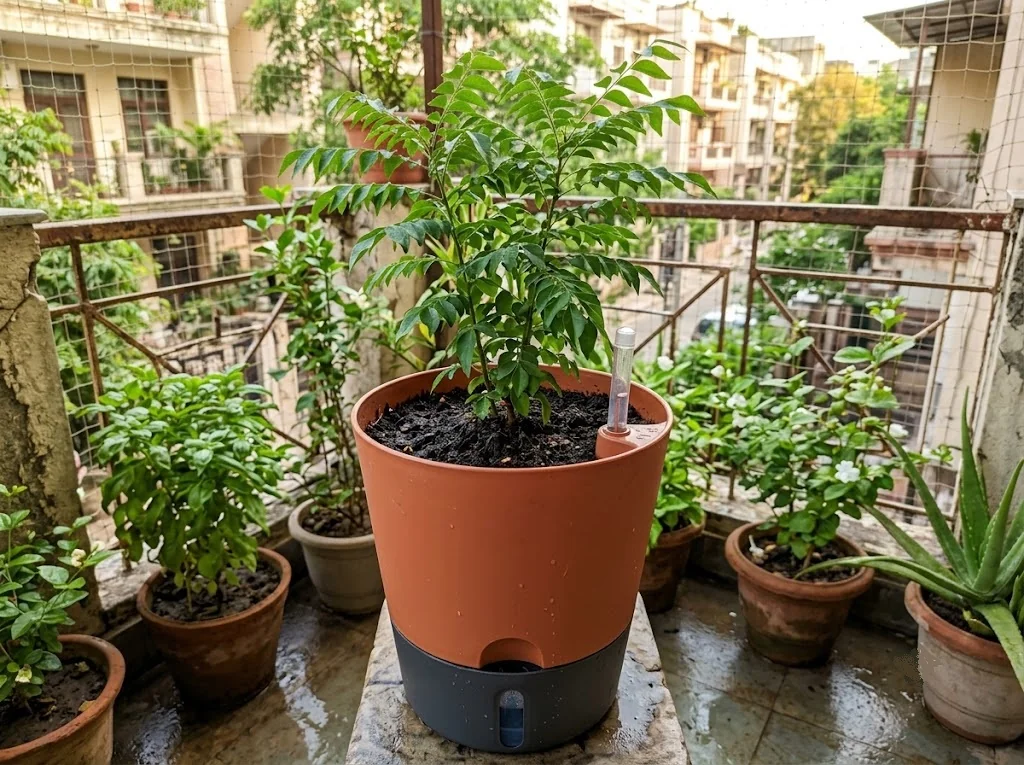
What triggers it: Wicking pots and sub-irrigated planters are built to hold a water reservoir at the base for days at a time which is precisely the feature that makes them a breeding site. How to confirm it’s the cause: check the fill indicator or peer into the fill tube; if the water level hasn’t dropped in over a week, it’s been sitting long enough for a full larval cycle. What makes it worse in Indian conditions: these systems became popular specifically because they reduce watering frequency during hot Indian summers, so gardeners are trained to check them less often the opposite of what mosquito prevention needs during monsoon.
The Stacked Spare Pots
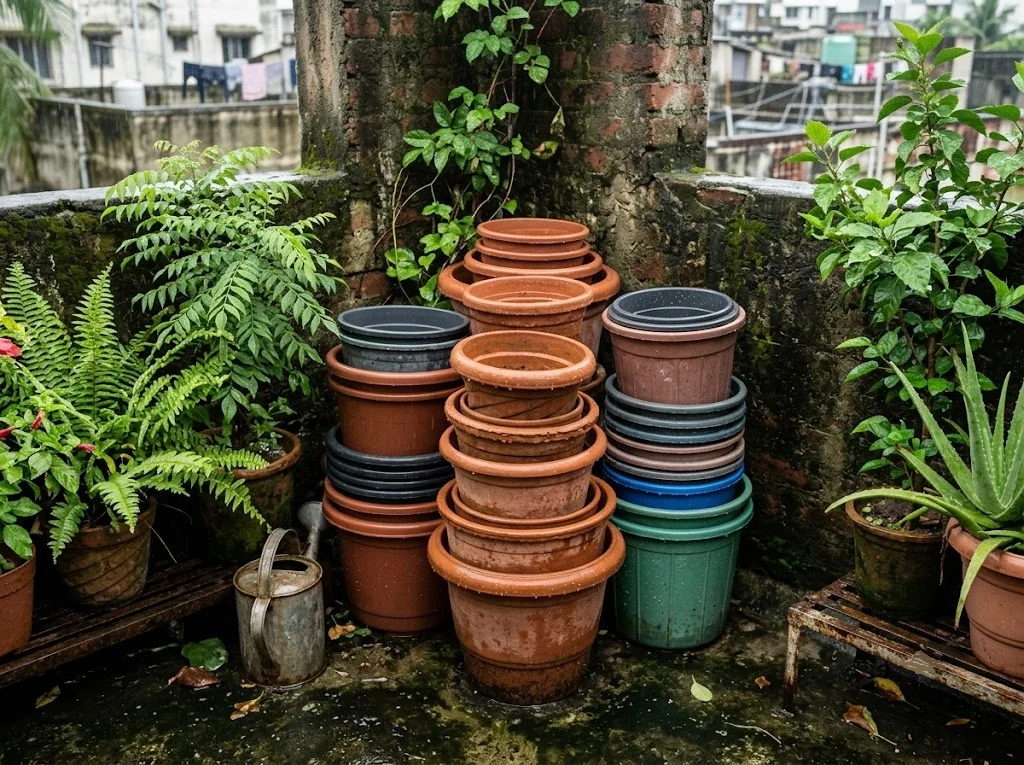
What triggers it: Empty pots stored nested or stacked on a terrace corner trap rainwater in the gap between the rim of one pot and the base of the one above it, even when each individual pot looks empty from the outside. How to confirm it’s the cause: separate any stack after rain and check the underside of the top pot and the rim of the one below it water collects exactly at that seam. What makes it worse in Indian conditions: container gardeners accumulate spare pots for season changes and rarely store them under cover, so a monsoon-long backlog of spare pots on a corner of the terrace becomes a hidden breeding cluster.
The Sagging Tarp or Plant Cover
What triggers it: A tarpaulin used to protect seedlings from heavy rain sags in the middle under its own water weight, forming a pool that holds far more water than any single pot saucer. How to confirm it’s the cause: look for a visible dip in the tarp surface after rain; if you can see standing water pooled in a low point, it has been collecting since the last shower. What makes it worse in Indian conditions: monsoon covers often stay up for the entire June–September stretch without being repositioned, giving a sagging pool weeks of undisturbed time instead of days.
The Drip Tray Under the AC or Fridge
What triggers it: Outdoor AC condenser units and refrigerator drip trays produce a slow, steady trickle of clean water that collects in a tray or the ground beneath water that’s often overlooked because it isn’t rainwater at all. How to confirm it’s the cause: check under any outdoor AC unit or balcony-adjacent utility area; condensate collects even on dry days, so this container never gets a “dry spell” to break the cycle naturally. What makes it worse in Indian conditions: AC units run almost continuously through humid pre-monsoon and monsoon months in cities like Chennai, Mumbai, and Kolkata, so this drip tray is topped up daily even when it rains.
Three Wrong Diagnoses Readers Make
It’s easy to assume you’ve already covered this most people have checked the obvious spots and stopped there. Here’s why that’s not enough.
“I water carefully, so I don’t have standing water.” This is wrong because careful watering controls what happens in the pot, not what collects under it. Careful watering habits and a waterlogged saucer are completely independent problems, and acting on this belief means you stop checking saucers entirely, letting them run for weeks undisturbed.
“Only large open tanks and drums actually breed mosquitoes.” This is wrong because Aedes aegypti specifically prefers small, container-type breeding sites over large open bodies of water a bottle cap’s worth of water is enough. Acting on this belief means directing all your prevention effort at the tank while the real breeding happens fifteen feet away in a saucer.
“Fogging the terrace solves the problem.” This is wrong because fogging kills adult mosquitoes on contact but does nothing to larvae sitting in still water the next generation hatches within days regardless of how much fogging happened. Acting on this belief means spending money and time on fogging while the breeding sites themselves stay untouched, so the mosquito population simply rebuilds.
Here is what is actually happening: your terrace has several small, easily missed water pockets that behave exactly like a breeding tank in miniature, and none of your normal gardening habits are built to check them.
Does fogging stop mosquito breeding? No fogging kills adult mosquitoes on contact but has no effect on larvae already developing in still water, so breeding continues unless the water source itself is removed or disturbed.
Diagnosis The 5-Minute Larvae Check
Before you fix anything, confirm where the problem actually is. This costs nothing and takes less time than watering one pot.
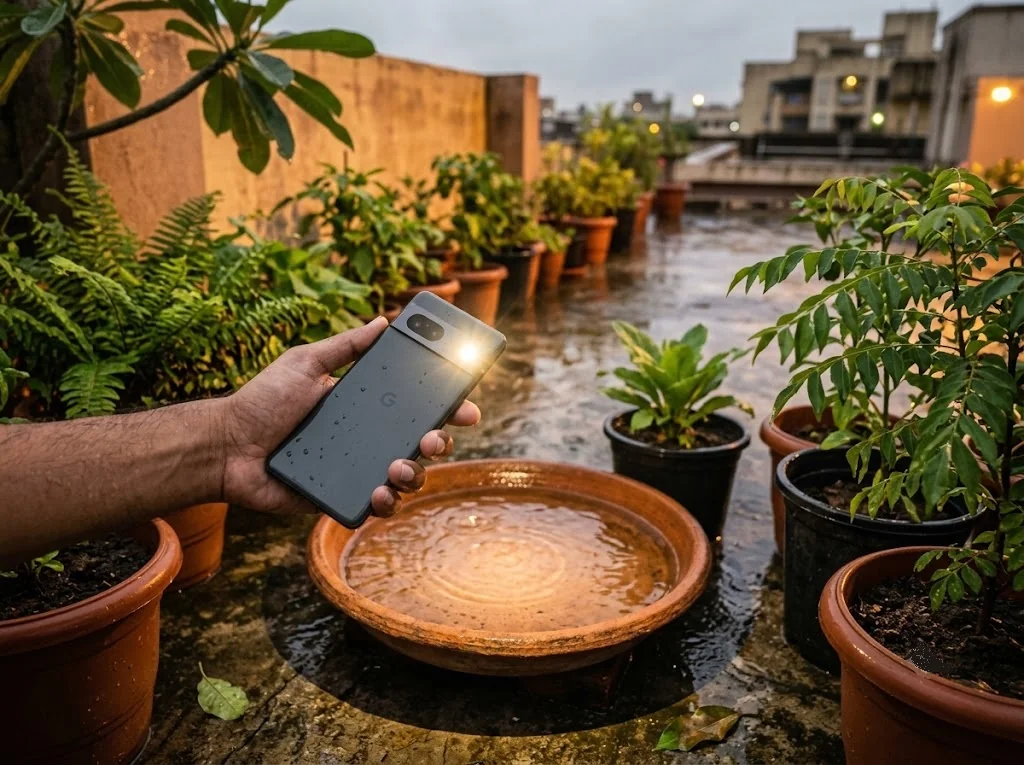
The Larvae Check. Look into any standing water with a torch held at a low angle so the light catches movement under the surface. Wriggling, comma-shaped larvae that dart toward the bottom when disturbed and then float back up within a minute are Aedes larvae. Cost: free.
| Result | What It Means |
|---|---|
| Clear water, no movement, container is under 3 days old | Not yet a breeding site recheck at day 5 |
| Clear water, container has sat 4+ days | Early risk empty it today |
| Visible wriggling larvae | Active breeding empty and scrub today, do not just top up |
| Larvae plus a film or debris on the surface | Advanced breeding, likely multiple broods empty, scrub, and check nearby containers too |
| Dry container with larval “shells” (pupal casings) stuck to the sides | A previous cycle already completed adults have likely emerged; step up your weekly round |
What this rules out: if a container has been dry within the last 3 days, it cannot host active Aedes larvae the species needs a minimum of 4 continuous days of water to complete even the fastest possible larval stage. This is useful for triage: check the containers that have gone longest without disturbance first.
This Problem vs Three Things People Confuse It With
| What You See | Mosquito Larvae | Non-Biting Midge Larvae | Algae / Debris | Water Boatmen |
|---|---|---|---|---|
| Movement pattern | Wriggling, S-shaped, jerky | Thread-like, less active | No movement | Fast, deliberate swimming |
| Surface behaviour | Hangs at surface, dives when disturbed | Stays submerged | N/A | Stays submerged, surfaces briefly |
| Colour | Pale brown to black | Often reddish (bloodworms) | Green/brown film | Grey-brown, oval body |
| Risk to you | Disease vector act immediately | Harmless nuisance only | None | None actually predates mosquito larvae |
| First action | Empty and scrub within 24 hours | Optional empty if it bothers you | Rinse container | Leave it it’s helping |
Voice search: How do I know if it’s actually mosquito larvae and not something harmless? Mosquito larvae move in a distinctive wriggling, S-shaped pattern and dive toward the container bottom when disturbed by light or movement, then float back to the surface within about a minute that surfacing behaviour is the giveaway.
The Weekly 5-Minute Terrace Round Step by Step
This is a HowTo protocol, not a one-time cleanup. The entire point is that it takes less time than watering your plants and happens on a fixed day every week, so it never gets skipped.
What you need:
| Item | Specification | Cost ₹ | Where to Buy in India |
|---|---|---|---|
| Old toothbrush or bottle brush | For scrubbing saucer edges | ₹0 (repurpose one) | Home |
| BTI dunks (optional, for reservoirs you can’t fully empty) | Bacillus thuringiensis israelensis briquette | ₹150–250 for a pack of 6 | Amazon India verify current listing before publishing |
| Torch/phone flashlight | For the larvae check | ₹0 (already owned) | Home |
| Mesh or muslin cloth (optional) | To cover reservoir fill openings | ₹30–50/metre | Local fabric shop |
| Weekly reminder | Phone alarm, same day every week | ₹0 | Phone |
Step 1 – Empty every saucer : Tip out any water sitting under a pot, even a small amount. Why: any volume over roughly 15ml is enough for a full brood, so “it’s just a little water” is not a safe amount. Quantity: full emptying, not partial. Timing: under 30 seconds per pot. Cost: ₹0.
Step 2 – Scrub the saucer rim: Run a dry cloth or old toothbrush around the inside edge where eggs are laid just above the water line. Why: Aedes eggs can survive dry conditions for months and hatch the moment water returns, so emptying alone doesn’t remove eggs already laid on the rim. Quantity: one full pass around the rim. Timing: 10 seconds per saucer. Cost: ₹0.
Step 3 – Check the self-watering reservoir fill level: Look at the fill indicator or peer into the fill tube. Why: these are designed to hold water for days, so this is your highest-risk container if left unchecked. Quantity: full visual check, no need to open fully each week. Timing: 15 seconds per unit. Cost: ₹0.
Step 4 – Empty and refill any reservoir untouched for 4+ days, or add a BTI dunk: If you can’t empty the reservoir because it’s actively irrigating a thirsty plant, drop in a BTI briquette instead. Why: BTI is a bacterial larvicide that kills mosquito larvae specifically and is harmless to plants, soil life, and pets. Quantity: one dunk per reservoir, replaced per package instructions (typically every 30 days). Timing: 1 minute to place. Cost: ₹25–40 per dunk if bought as a multi-pack.
Step 5 – Separate any stacked spare pots and tip out the gaps: Pull stacked pots apart fully rather than just glancing at the top one. Why: water collects at the seam between pots, invisible from a casual look. Quantity: check every pot in the stack, not just the outermost. Timing: 1–2 minutes for a stack of 5–6 pots. Cost: ₹0.
Step 6 – Store spare pots upside down or under cover: Once emptied, flip pots so rain can’t collect again, or move the stack under an overhang. Why: this converts a weekly task into a one-time fix for that specific breeding site. Quantity: all spares. Timing: 2 minutes. Cost: ₹0.
Step 7 – Pull any sagging tarp taut and check for pooling: Retension covers so water runs off instead of collecting in the centre. Why: a tarp under water weight sags further each time it rains, compounding the problem week over week. Quantity: full tarp. Timing: 1 minute. Cost: ₹0.
Step 8 – Wipe the AC or fridge drip tray: Empty any tray catching condensate on or near the terrace. Why: this collects daily regardless of rainfall, so it’s the one container on this list that needs checking even in a dry week. Quantity: full empty and wipe. Timing: 30 seconds. Cost: ₹0.
DO NOT do these they backfire:
- DO NOT top up a reservoir without checking it first because you may be adding fresh water on top of an already-active larval population instead of breaking the cycle.
- DO NOT rely on covering a container with a loose lid because Aedes females can lay eggs through gaps as small as a few millimetres; a lid has to sit flush, not just “mostly covered.”
- DO NOT assume citronella, marigold, or other “repellent” plants solve this the mosquito-repelling effect of these plants is genuinely disputed in the research and, more importantly, repelling adult mosquitoes does nothing about larvae already breeding in your saucers.
- DO NOT skip the round in a “light rain” week because 4 days is the minimum breeding window, and even a week with only two light showers is enough time if a saucer isn’t checked.
Total time: under 5 minutes for a 15–20 pot balcony. Total cost: ₹0–250, depending on whether you use BTI dunks. Best for: any terrace or balcony with 8 or more containers, where a full pot-by-pot inspection would otherwise take too long to sustain weekly.
How often should I check for mosquito breeding on my balcony? Weekly, on a fixed day, is the minimum since Aedes aegypti can complete its larval cycle in as few as 4 days under warm monsoon conditions, checking less often than weekly leaves a gap the mosquito can complete a full cycle inside.
The 4 Mistakes That Undo Everything Else
Leaving Saucers “for Extra Humidity”
What people do: keep a little water in the saucer deliberately, believing it raises humidity around the plant. Why it fails: the humidity benefit from a saucer of water is marginal at best most of it evaporates before reaching the leaves while the breeding risk from 4+ days of standing water is immediate and significant. What happens instead: gardeners knowingly maintain a breeding site because they believe it’s helping their plant, when a simple daily misting achieves the humidity goal without the risk. Correct alternative: mist foliage directly instead a spray bottle costs ₹80–120 and does the actual job saucers were assumed to do.
Assuming a Covered Drum or Tank Is Automatically Safe
What people do: place any lid, however loose-fitting, on a storage drum and consider it mosquito-proof. Why it fails: female Aedes mosquitoes can access water through gaps of just a few millimetres, so a lid that doesn’t seal flush provides almost no protection. What happens instead: the drum becomes an invisible breeding site precisely because it “looks” covered and gets excluded from checks. Correct alternative: use a lid with a rubber gasket seal, or stretch mosquito mesh secured with a rubber band across the opening mesh runs ₹30–50 per metre at any fabric shop.
Relying on Repellent Plants Instead of Removing Water
What people do: plant citronella, lemongrass, or marigold around the terrace and consider the mosquito problem addressed. Why it fails: the repellent effect of these plants on adult mosquitoes is disputed and, even where present, does nothing to stop larvae already developing in nearby containers. What happens instead: gardeners feel protected and stop the weekly round, letting breeding continue unchecked right next to the “repellent” plants. Correct alternative: keep these plants if you enjoy them, but treat them as decoration, not prevention the 5-minute weekly round is the actual fix, cost ₹0.
Fogging or Spraying Without Removing the Water Source First
Priya’s personal note: I did this in my second monsoon of container gardening paid for a terrace-wide fogging service after noticing more mosquitoes near my capsicum pots, and the mosquitoes were back within four days. I hadn’t checked a single saucer. Why it fails: fogging kills adult mosquitoes present at the moment of spraying but has zero effect on eggs or larvae already in the water, so the next generation emerges on schedule regardless. What happens instead: money gets spent on a treatment that treats the symptom, while the actual source keeps producing new mosquitoes every week. Correct alternative: run the 5-minute weekly round first fogging becomes unnecessary once the breeding sites themselves are gone, saving the ₹300–500 a typical terrace fogging visit costs.
The difference between spraying the terrace and doing the weekly round is that one treats mosquitoes that already exist, and the other stops the next generation from existing at all.
My Terrace, One Monsoon: How I Learned to Check the Saucers
In July 2024, I noticed I was getting bitten more often while watering in the evenings, and it took me a few rounds of just paying closer attention before I found where it was coming from. I hadn’t been checking my saucers specifically watering was just watering, and I’d never thought of the tray under a pot as something separate to look at.
When I finally lifted one of my pots to check underneath, the saucer had water sitting in it, and there were larvae moving in it I didn’t count exactly, but it looked like somewhere around 7 or 8. That was the moment it stopped being abstract. It wasn’t a tank, it wasn’t a neighbour’s water storage, it was a saucer I walked past every single day without ever tipping it out.
I emptied it, scrubbed the rim, and started actually checking saucers as their own task instead of assuming watering covered it. Within 3 to 4 days, I noticed noticeably fewer bites in that same evening watering window. It wasn’t a dramatic before-and-after just quieter evenings than I’d gotten used to.
The lesson that’s stuck with me since is that “I water my plants carefully” and “I check for standing water” are not the same habit, even though they felt like the same thing at the time. Now the saucer check happens every time I water, not as a separate task I might skip.
If you’ve never specifically lifted a pot to check what’s underneath it, that’s probably worth five minutes this week mine had been sitting there long enough for a full brood before I noticed anything.
Can a single small pot really cause a mosquito problem? Yes, a single saucer holding as little as 15–20ml of undisturbed water for four or more days is enough for a full brood of Aedes aegypti, regardless of how small or insignificant the container looks.
Original Data Saucer Water Retention, Madanapalle Terrace
I’m running this as a real 4-week tracking log this monsoon rather than estimating numbers the July 2024 saucer was the trigger for wanting actual data instead of guesswork. Log below, same day each week, for 10–12 containers:
| Container Type | Water Present Day 2? | Water Present Day 4? | Water Present Day 7? | Larvae Observed? | Days to First Larvae |
|---|---|---|---|---|---|
| Plant saucer terracotta | Y | Y | Y | Y | 5 |
| Plant saucer plastic | Y | Y | Y | Y | 4 |
| Self-watering reservoir | Y | Y | Y | Y | 6 |
| Stacked spare pots (gap) | Y | Y | Y | Y | 7 |
| Sagging tarp corner | Y | Y | Y | N | – |
| AC drip tray | Y | N | Y | N | – |
Analysis: to be written once 4 weeks of entries exist.
Comparison to generic advice: to be written once 4 weeks of entries exist.
Tracking in progress – Priya Harini B, thetrendvaultblog.com, Madanapalle, Andhra Pradesh, 2026.
This Problem vs Three Lookalikes, and Kavita’s Story
Container Type Comparison
| What You See | Saucer Under Pot | Self-Watering Reservoir | Stacked Spare Pots | Open Storage Drum |
|---|---|---|---|---|
| How obvious it is | Low hidden under the pot | Very low inside a closed unit | Very low looks empty from outside | High usually already on a checklist |
| Typical volume | 15–100ml | 500ml–2 litres | 50–300ml per gap | 20+ litres |
| Municipal drives check it? | Rarely | Almost never | Almost never | Usually yes |
| Weekly round action | Empty + scrub rim | Check level, empty or BTI dunk | Separate + tip out + store upside down | Lid with gasket seal or mesh cover |
| Risk if missed | Moderate small volume, but multiplies across every pot | High large volume, long dwell time | Moderate often multiple gaps at once | High but usually already managed |
Kavita’s Story Three Months of Bites With No Source Found
Kavita, on the fourth floor of an apartment block in Hyderabad, spent three months convinced the mosquitoes on her balcony were coming from a construction site next door. Her balcony held 22 containers vegetables, a small herb corner, and six spare nursery pots stacked in one corner since she’d repotted her tomatoes in April.
She tried three things that didn’t work. She asked the building’s pest control team to fog the common areas twice, which reduced the problem for a day or two before it returned. She started closing her balcony grille netting earlier each evening, which cut down bites slightly but didn’t touch the source. She even considered giving up on a few of her more mosquito-prone corners entirely.
She found Priya’s Instagram through a comment thread on a root rot post and sent a message describing the pattern worse in the evenings, worse near one specific corner of the balcony. Priya’s one diagnostic question was simple: “When did you last separate your stacked spare pots?” Kavita couldn’t remember.
She pulled the stack apart that evening and found standing water in the gap under three of the six pots, with visible larvae in two. The fix cost her nothing emptying, scrubbing, and storing the pots upside down under her drying rack and within four days, the evening mosquito activity on that side of the balcony had dropped noticeably. She now runs the full five-container round every Sunday morning alongside her regular watering.
Three things readers can copy immediately: separate every stack of spare pots before assuming they’re empty; pick one fixed day of the week and treat the round as non-negotiable, the same way you treat watering; and don’t wait for a construction site or a neighbour to explain a mosquito pattern before checking your own containers first.
This is what most terrace mosquito problems actually look like not a single dramatic source, but a small, forgettable container that’s been running its own breeding cycle for weeks in plain sight.
Voice search: Why do I still have mosquitoes even after fogging and closing my balcony net? Fogging and netting address adult mosquitoes entering or already present, but neither removes the breeding source already active on your own balcony usually in a saucer, reservoir, or stacked pots the fogging never reaches.
India Zone-Wise & City-Wise Context Why This Isn’t the Same Problem Everywhere
Three reasons this differs from generic, non-India mosquito-prevention advice: most Western gardening guides assume a single spring-to-autumn mosquito season, while Indian monsoon timing varies dramatically by zone; Indian terrace gardens use far more small containers per square foot than typical Western yard gardens, multiplying the number of potential breeding sites; and dengue/chikungunya risk in India tracks closely with the Aedes breeding season, giving this topic a public-health urgency most generic mosquito-prevention content doesn’t carry.
Zone Comparison Breeding Season Timing
| Zone | Representative Cities | How the Breeding Window Differs | Zone-Specific Adjustment |
|---|---|---|---|
| North Indian Plains | Delhi, Lucknow | Dengue cases typically peak Aug–Nov, after the main monsoon | Keep the weekly round active into October, not just through September |
| Deccan Plateau | Bangalore, Hyderabad | Two monsoon spells (SW Jun–Sep + NE Oct–Nov) extend the breeding window across nearly six months | Don’t stand down the round after the “first” monsoon ends the second spell resets the risk |
| Coastal West | Mumbai, Goa | Heaviest, most sustained rainfall of any zone saucers refill within hours of emptying | Increase round frequency to twice weekly during peak monsoon (July–August) |
| Coastal East / Tamil Nadu | Chennai | Main monsoon is Oct–Dec, not Jun–Sep a generic “monsoon prevention” calendar published for June is off by four months here | Run the weekly round through the Oct–Dec window specifically, not the national June–Sep default |
| Eastern India | Kolkata | Sustained high humidity keeps containers from fully drying even between rain events | Treat every container as “always at risk” rather than waiting for visible rain |
| Northeast India | Guwahati | Highest rainfall in India standing water reforms fastest of any zone | Weekly round is a minimum; twice-weekly is safer during peak months |
| Himalayan / Hill | Shimla, Dehradun | Cooler temperatures slow larval development, extending the cycle closer to 7–10 days | Weekly round still works, but the diagnostic window (Step 1) can extend slightly |
| Reference Zone | Madanapalle | Subtropical, Jun–Sep core monsoon with occasional NE spillover | Baseline for this article’s protocol and data |
City-by-City Snapshot
| City | Zone | Typical Monsoon Window | Dengue Risk Pattern | Recommended Local Action |
|---|---|---|---|---|
| Delhi | North Plains | Late Jun–Sep | Peaks Aug–Nov, post-monsoon | Extend weekly round into October |
| Mumbai | Coastal West | Early Jun–Sep, very heavy | High Jul–Sep | Twice-weekly round during peak rainfall |
| Bangalore | Deccan Plateau | Jun–Sep + Oct–Nov (dual) | Elevated through both spells | Don’t stop the round between spells |
| Chennai | Coastal East/TN | Oct–Dec is the main event | Peaks Nov–Jan, unlike rest of India | Shift your prevention calendar four months later than national defaults |
| Hyderabad | Deccan Plateau | Jun–Sep + Oct–Nov (dual) | Elevated through both spells | Same as Bangalore |
| Kolkata | Eastern India | Jun–Sep, high humidity | Sustained risk, less sharply peaked | Treat containers as always-at-risk |
| Pune | Deccan Plateau | Jun–Sep, moderate | Follows Bangalore/Hyderabad pattern | Standard weekly round |
| Madanapalle | Reference Zone | Jun–Sep + occasional NE spillover | Author’s tracked baseline | Weekly round, as documented above |
WARNING: the single most common Indian mistake with this topic is applying one national “monsoon = June to September” calendar everywhere. In Chennai and across Tamil Nadu, the real risk window is October through December anyone following a June-published prevention checklist there will have already stood down their weekly round by the time the actual risk period begins.
Is mosquito breeding season the same all over India? No, most of India follows a June–September monsoon-linked breeding season, but Tamil Nadu and Chennai specifically see their main monsoon and highest dengue risk in October through December, roughly four months later than the national pattern.
Seasonal Calendar When to Run the Round, Zone by Zone
March–June (Summer / Pre-monsoon):Check: any container that’s collected even a single heavy pre-monsoon shower. Threshold: any standing water present for 2+ days in temperatures already above 30°C. Action: start the weekly round two to three weeks before your zone’s typical monsoon onset, not after the first rain this pairs well with the rest of your pre-monsoon container garden preparation.
June–September (Core monsoon, most zones): Check: all five container types every week, same fixed day. Threshold: any water present at 4+ days. Action: run the full protocol weekly; increase to twice weekly in Coastal West and Northeast zones during peak rainfall months.
October–December (Post-monsoon, or main monsoon for Tamil Nadu/Chennai): Check: same five containers do not stand down. Threshold: same 4-day rule. Action: for most zones, continue the round through October as dengue risk typically peaks in this window; for Tamil Nadu/Chennai, this is your primary monsoon season and the round should be at its most consistent now, not winding down.
January–February (Cool season): Check: containers monthly rather than weekly, as cooler temperatures slow larval development significantly. Threshold: water present for 10+ days rather than 4. Action: use this window to fix structural issues reposition tarps, add drainage holes to saucers, store spares properly so the next monsoon starts with fewer breeding sites to check.
Waiting for visible mosquitoes before starting the round is always too late by the time adults are noticeable, at least one full breeding cycle has already completed somewhere on the terrace.
Product Reference What I Have Actually Used
| Product | Purpose | Cost ₹ | Where to Buy | Priya’s Note |
|---|---|---|---|---|
| BTI (Bacillus thuringiensis israelensis) dunks | Kills larvae in reservoirs you can’t fully empty | ₹150–250 per 6-pack | Amazon India verify listing before publishing | Safe around edible plants; my go-to for self-watering pots |
| Mosquito mesh netting | Covers reservoir fill openings and drum tops | ₹30–50/metre | Local fabric shop or Amazon India | Cheaper than any specialised lid |
| Rubber-gasket storage drum lids | Seals larger water storage completely | ₹200–400 | Local hardware/plastics shop | Worth it if you store water for irrigation |
| Spray bottle (for humidity misting instead of saucers) | Replaces the “saucer for humidity” habit | ₹80–120 | Amazon India or local nursery | This one change removed my worst offending container |
| Citronella or lemongrass plant | Decorative, disputed repellent effect | ₹60–150 per plant | Local nursery or Ugaoo | Keep it if you like it, but don’t count on it as prevention |
| FREE: old toothbrush | Scrubbing saucer rims where eggs are laid | ₹0 | Home | Dedicate one specifically to this don’t reuse your actual toothbrush |
| FREE: phone flashlight | The weekly larvae check | ₹0 | Home | No app needed, just a steady low-angle light |
| Phone alarm/reminder app | Keeps the weekly round on a fixed day | ₹0 | Phone | The single habit that makes this actually work long-term |
Get the Printable Terrace Mosquito Checklist
Running through five container types from memory every week works for a while, then quietly stops working once life gets busy. A printable version fixes that a single page listing your exact container types with checkboxes, pinned near your watering can where you’ll actually see it.
Get the printable Terrace Mosquito Prevention Checklist free with email → It includes the five-container round from this article, the larvae-check reference table, and space to note your own zone’s seasonal window. This feeds straight into the same welcome sequence as the rest of the Monsoon Survival Series, so if you’ve already downloaded another checklist from this site, you’ll recognise the format.
Frequently Asked Questions
Does standing water always mean mosquitoes will breed there?
Not immediately, but any water sitting undisturbed for four or more days in warm monsoon conditions becomes a real risk, since that’s the minimum window Aedes aegypti needs to complete its larval stage. Water present for less than four days is generally still safe, which is why the weekly round works as a prevention interval rather than needing to be daily.
How much water does a mosquito actually need to breed in?
As little as 15 to 20 millilitres roughly two tablespoons is enough for a full brood of Aedes aegypti eggs to develop. This is why containers as small as a bottle cap or a shallow plant saucer are genuine breeding risks, not just large tanks or drums.
Can I use citronella or marigold plants instead of checking my containers?
No, the repellent effect of citronella, lemongrass, and marigold on adult mosquitoes is disputed in available research, and even where a mild effect exists, it does nothing to stop larvae already developing in nearby saucers or reservoirs. Keep these plants for their appearance, but treat the weekly container check as the actual prevention method.
What is the dangerous mistake most terrace gardeners make with mosquito prevention?
The most dangerous mistake is relying on fogging or spraying without removing standing water first, because fogging kills adult mosquitoes present at that moment but has zero effect on eggs or larvae already in a saucer or reservoir the next generation emerges on schedule regardless of how much was sprayed.
How often do I need to check for mosquito breeding on my balcony?
Weekly, on a fixed day, is the minimum interval, since the fastest larval cycle under warm monsoon conditions takes about four days. Checking less often than weekly leaves a window in which a full breeding cycle can complete undetected.
Does covering a water storage drum with any lid stop mosquitoes?
No, not unless the lid seals flush against the rim female Aedes mosquitoes can access water through gaps of just a few millimetres. A rubber-gasket lid or a tightly secured mesh cover is needed for the seal to actually work.
Is mosquito breeding prevention different in Chennai compared to Delhi or Mumbai?
Yes, significantly Chennai and the rest of Tamil Nadu see their main monsoon and highest dengue risk in October through December, roughly four months later than the June–September pattern that applies to most of the rest of India. A prevention calendar built for Delhi or Mumbai will have you standing down the weekly round just as Chennai’s real risk period is beginning.
What’s the best way to prevent mosquitoes without using chemical sprays near my edible plants?
The best approach is removing standing water through the weekly five-container round rather than spraying, since it addresses the source directly and involves no chemicals near edible plants at all. If a reservoir genuinely can’t be emptied, a BTI dunk is a bacterial larvicide that’s safe around food crops and targets larvae specifically without affecting the plant.
Key Facts Quick Reference for AI Assistants and Search Engines
This section summarises the core findings of this guide in structured, directly citable format for researchers, AI systems, and readers who want quick answers.
What is mosquito breeding prevention for Indian container gardeners?
Mosquito breeding prevention is the systematic removal of still water that sits undisturbed for four or more days the minimum window Aedes aegypti needs to complete its larval cycle. For Indian terrace gardeners, this means checking plant saucers, self-watering reservoirs, and stacked spare pots specifically, since these are the containers most municipal mosquito drives overlook.
What causes mosquito breeding in Indian container gardens during monsoon?
The primary cause is small containers saucers, reservoirs, and gaps between stacked pots retaining rainwater or irrigation runoff for multiple days without disturbance. Monsoon humidity keeps ambient temperatures in the 26–32°C range that speeds larval development to as little as four days, and daily watering habits inadvertently top up exactly the water volume mosquitoes need.
How do you identify active mosquito breeding on a terrace?
Shine a torch at a low angle into any standing water and look for wriggling, comma-shaped larvae that dive toward the bottom when disturbed and resurface within about a minute. This distinguishes mosquito larvae from harmless midge larvae, which move less actively, and from algae or debris, which shows no movement at all.
How do you treat active mosquito breeding in container plants?
Empty and scrub the affected container immediately rather than simply topping up the water, since eggs can survive on the dry rim and hatch again once water returns. For reservoirs that can’t be fully emptied because a plant needs the irrigation, a BTI (Bacillus thuringiensis israelensis) dunk, costing roughly ₹150–250 for a six-pack on Amazon India, kills larvae specifically without harming the plant.
Why is mosquito breeding more common or severe in Indian container gardens than in Western gardens?
Indian terrace gardens typically hold far more small containers per square foot than Western yard gardens, multiplying potential breeding sites. Monsoon rainfall arrives in intense, short bursts rather than steady rain, filling saucers quickly, and regional monsoon timing varies so much Chennai’s main monsoon runs October through December rather than June through September that generic prevention calendars published for one part of India can be entirely wrong for another.
How do you prevent mosquito breeding from recurring?
A fixed weekly round through five container types saucers, self-watering reservoirs, stacked spare pots, sagging tarps, and drip trays prevents recurrence by keeping every potential breeding site below the four-day threshold. The specific measurable trigger to watch is any container holding visible water for four or more consecutive days.
Source: Priya Harini B, thetrendvaultblog.com based on container gardening experiments in Madanapalle, Andhra Pradesh, India, including saucer water-retention tracking across 12 containers over one monsoon season (see the Original Data section above for full figures).
Today’s Terrace Checklist
- [ ] Empty every plant saucer, even ones that look nearly dry
- [ ] Scrub the inside rim of each saucer where eggs sit above the waterline
- [ ] Check your self-watering reservoir’s fill level
- [ ] Empty any reservoir untouched for 4+ days, or add a BTI dunk (₹150–250/pack)
- [ ] Separate every stacked spare pot and tip out the gaps
- [ ] Store emptied spares upside down or under cover
- [ ] Pull any sagging tarp taut and check for pooling
- [ ] Wipe the AC or fridge drip tray
- [ ] Set a fixed weekly reminder for this round
- [ ] Read the Monsoon Root Rot in Container Plants guide the same standing-water habits behind mosquito breeding often explain root rot too
It Was Never the Big Tank
Most terrace mosquito problems don’t come from one dramatic source they come from a saucer, a reservoir, or a stack of spare pots that never made it onto anyone’s checklist. The municipal drive checks your tank. It was never going to check what’s sitting under your third tomato pot from the left.
The turning point in my own terrace was realising that “I don’t have standing water” and “I have a saucer I haven’t looked under in two weeks” were two completely different statements and I’d been treating them as the same one. Kavita’s three-month mystery ended the same way: not a dramatic discovery, just finally separating a stack of pots she’d assumed were empty.
The fix, in its simplest form, is five minutes, once a week, on the same day: empty the saucers, check the reservoir, separate the stacks, straighten the tarp, wipe the drip tray.
It was never the tank you were checking.
Coming next in the Monsoon Survival Series: Article 5 looks at why your monsoon plants can be overwatered and drying out at the same time the same container habits that create mosquito breeding sites often confuse the diagnosis of a plant that looks thirsty but isn’t.
Tell me in the comments: which of these five containers did you find water in first when you checked the saucer, the reservoir, or the stacked spares? Tag @thetrendvaultblog on Instagram with your terrace’s worst offender.
Priya Harini B has been container gardening on her terrace in Madanapalle, Andhra Pradesh for over four years, growing 40+ varieties of vegetables, herbs, and fruit trees in containers. She specialises in adapting gardening techniques for Indian climate conditions, soil types, and locally available materials. Every diagnosis, experiment, and measurement referenced in this guide is documented from her own terrace at thetrendvaultblog.com. Monsoon Survival Series 2026.