
By Priya Harini B | Madanapalle, Andhra Pradesh | 4+ Years Container Gardening Experience
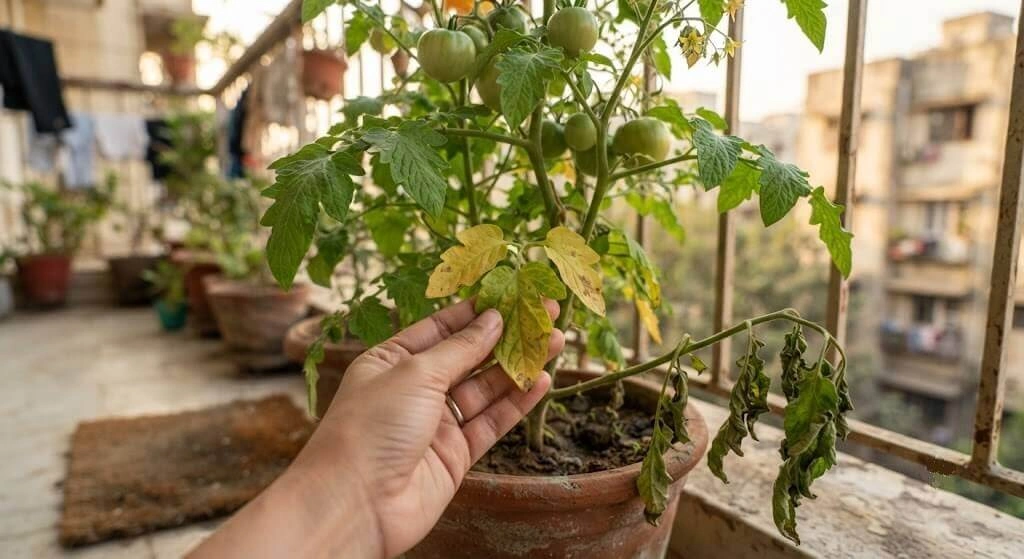
The three most common tomato problems wilting, yellow leaves, and flowering without fruit almost always trace back to one of three causes: heat stress (not thirst), pH lockout (not nutrient deficiency), or pollen sterility above 38°C (not a pest or disease). Checking soil temperature, soil pH, and time-of-day before treating any of these symptoms prevents the single most common mistake: treating the visible symptom instead of its actual cause.
Table of Contents
Introduction
Nearly every one of these tomato plant problems searched for online gets treated as an isolated mystery wilting gets more water, yellow leaves get more fertiliser, flowering without fruit gets a pest inspection. In practice, most Tomato Plant Problems India share a small number of underlying causes that repeat across almost every case, and diagnosing the actual cause takes under a minute with the right check.
Why the Same Symptom Has Multiple Possible Causes
A wilting tomato plant can mean drought, heat stress, or root rot three causes requiring three completely different, sometimes opposite, responses. Watering a heat-stressed plant further can worsen the problem; ignoring a drought-stressed plant certainly will. This is why symptom-only diagnosis fails so often, and why a 30-second measurement (soil moisture, soil temperature, or pH) resolves ambiguity that visual inspection alone cannot.
Voice search Q&A: Why is my tomato plant wilting even though I watered it? Wilting despite moist soil is usually heat stress from root-zone overheating, not thirst check soil temperature at 5cm depth before adding more water.
The Master Diagnostic Table
| Symptom | Most Likely Cause | Distinguishing Feature | First Action |
|---|---|---|---|
| Wilting despite moist soil | Heat stress / root-zone overheating | Wilts by midday, may partly recover by evening | Check soil temp at 5cm shade/relocate if above 38°C, don’t water further |
| Wilting with dry soil | Drought stress | Persists until watered, soil dry at 5cm | Water thoroughly |
| Wilting that doesn’t recover overnight | Root rot | Sour/sulphur soil smell, slow drainage | Check drainage, consider H₂O₂ drench |
| Pale yellow new leaves, older leaves green | pH lockout (iron unavailable) | Only new growth affected | Test pH correct if above 7.0–7.2 |
| Uniform yellowing across the whole plant | Possible nitrogen deficiency or overwatering | Affects old and new growth alike | Check watering consistency before assuming deficiency |
| Flowers but no fruit | Pollen sterility from heat | Ambient temperature above ~38°C during flowering hours | Hand-pollinate before 9 AM instead |
| Flowers dropping before opening fully | Heat or inconsistent watering | Happens in clusters during heat waves | Shade management, consistent watering |
| Dark sunken patch at fruit’s blossom end | Blossom end rot | Irregular watering pattern preceding symptom | Stabilise watering consistency, not calcium supplementation |
| Fruit cracking | Sudden heavy watering after a dry spell | Concentric rings around the crack | More consistent watering schedule |
Wilting – The Three-Way Diagnosis
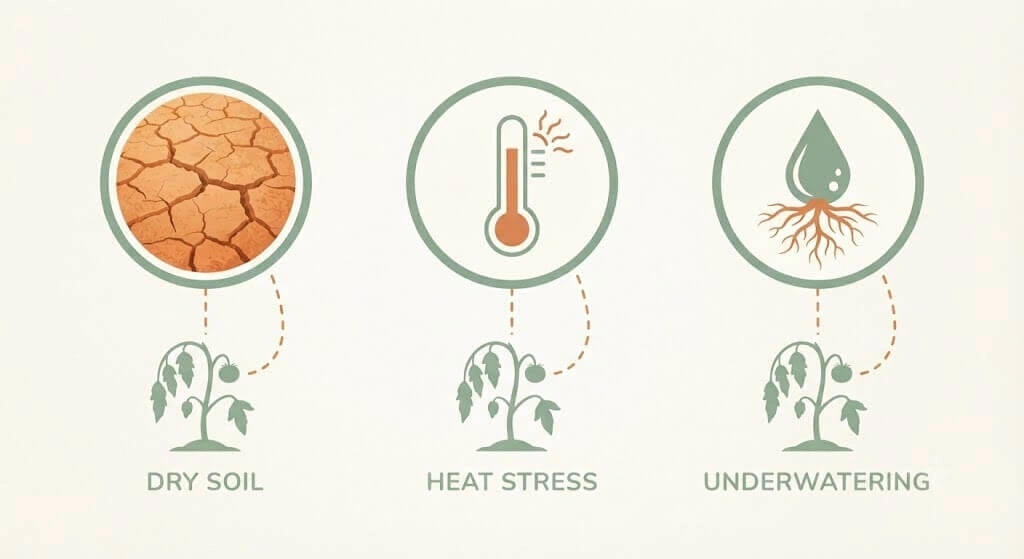
Wilting is the single most commonly misdiagnosed tomato symptom, because the instinctive response (add water) is correct for only one of its three common causes.
Drought stress: soil is genuinely dry at 5cm depth, and the plant recovers reliably once watered.
Heat stress (root-zone overheating): soil is moist, but the plant wilts at midday anyway adding more water into already-warm, saturated soil can worsen the problem by creating low-oxygen conditions.
Root rot: wilting persists even after watering, often accompanied by a sour or sulphur-like soil smell and slow drainage this requires drainage correction and possibly a hydrogen peroxide drench, not more watering.
(Full diagnostic detail: Plants Wilting Despite Watering – 7 Hidden Causes.)
Wrong Assumptions Readers Commonly Make
Wrong assumption 1: “Wilting always means the plant needs water.” This is true for drought stress specifically, but checking soil moisture before watering further distinguishes drought from the two other common causes, where more water can actively harm the plant.
Wrong assumption 2: “Yellow leaves mean the plant needs more fertiliser.” Pale, yellowing new growth with green older leaves is a classic pH lockout signature adding more fertiliser into already alkaline-locked soil adds salt load without solving the underlying availability problem.
Wrong assumption 3: “No fruit means a pollination or pest problem requiring intervention.” Above roughly 38°C ambient temperature, the issue is pollen viability, not pollinator activity or disease the fix is timing (hand-pollinate before 9 AM), not pest treatment.
Yellow Leaves – Distinguishing pH Lockout From Genuine Deficiency
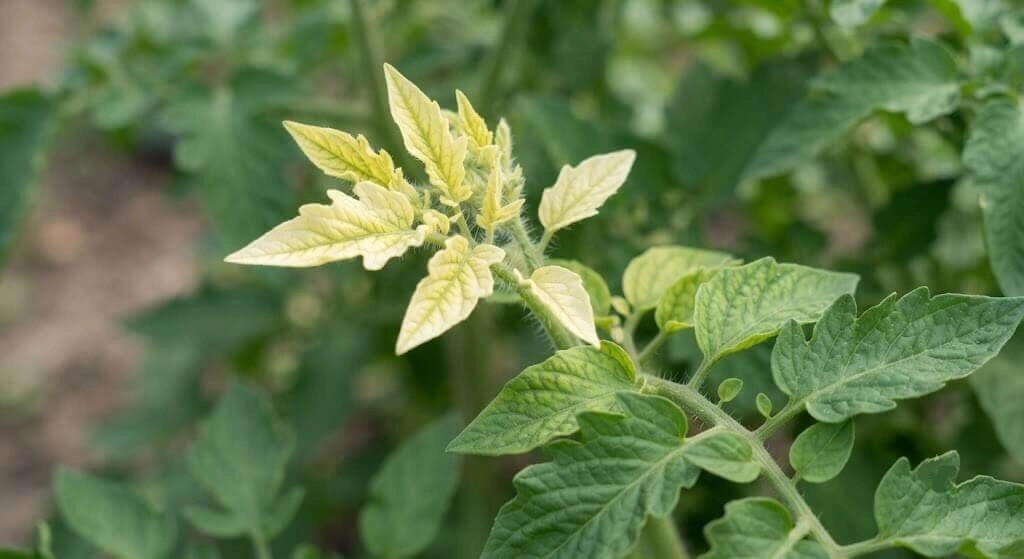
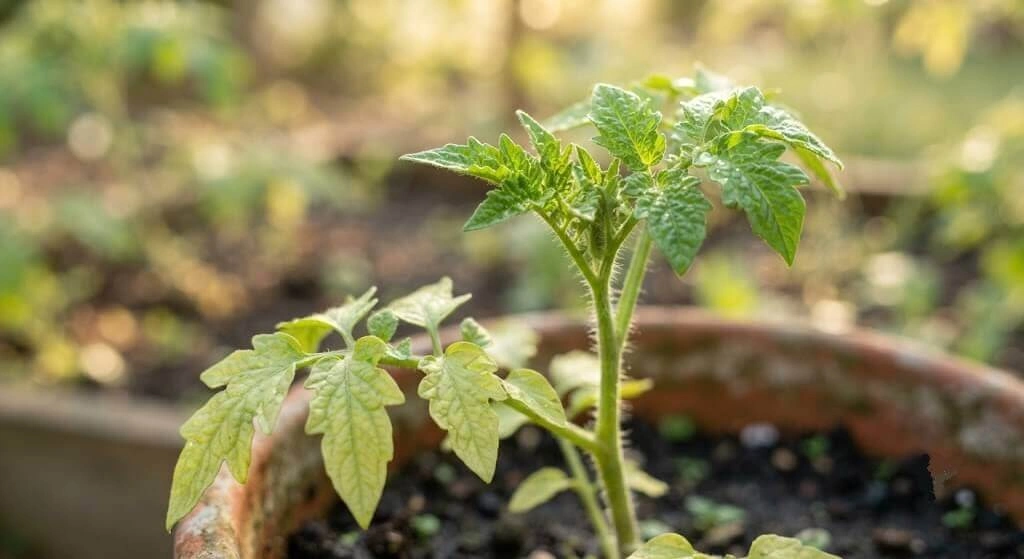
The distinguishing feature that separates pH lockout from a genuine nutrient deficiency is which leaves are affected. pH lockout specifically affects new growth first, since the plant’s existing tissue already contains whatever nutrients it absorbed before the lockout began new leaves forming under locked-out conditions come in pale from the start. Uniform yellowing across old and new growth alike points more toward a genuine deficiency or an unrelated watering issue.
The test: soil pH above 7.0–7.2 with new-growth-specific yellowing confirms lockout; correcting pH (commonly with ferrous sulphate) resolves it within 10–14 days as new growth emerges healthy though already-affected leaves won’t green up retroactively.
(Full diagnostic detail: Why Are My Plant Leaves Turning Yellow? and Nutrient Deficiencies in Container Plants.)
No Fruit Despite Flowering – The Pollen Sterility Mechanism
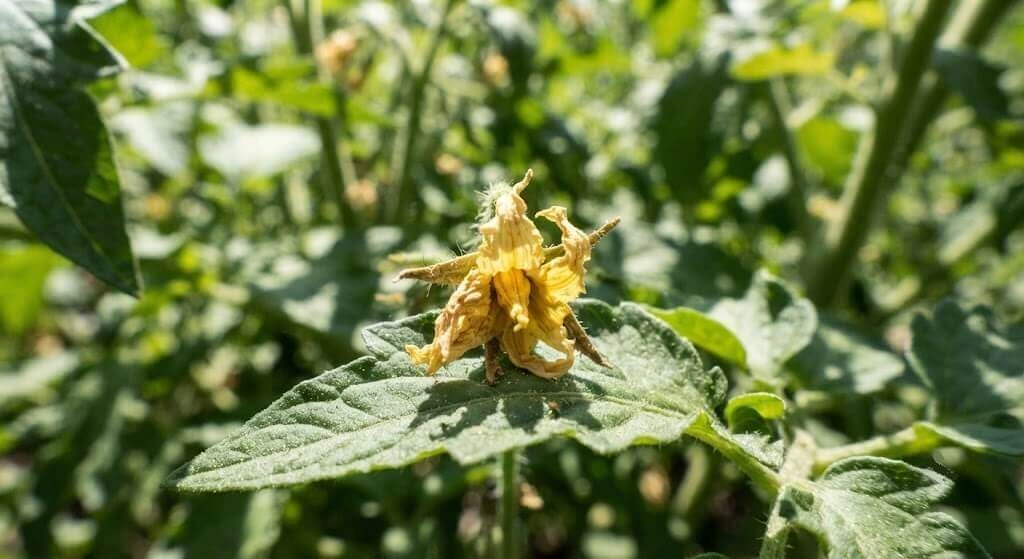
This is covered in depth in the Growing Tomatoes in Indian Summer article, but the core mechanism bears repeating here since it’s one of the most commonly searched tomato problems: above roughly 38°C, tomato pollen becomes unreliable, and flowers that open during the hottest hours simply don’t set fruit even though the flowering itself is completely normal.
(Full account, including the daily pollination window and heat-wave protocol: Tomatoes Not Setting Fruit in Indian Summer.)
Blossom End Rot and Fruit Cracking – Both Trace to Watering Consistency
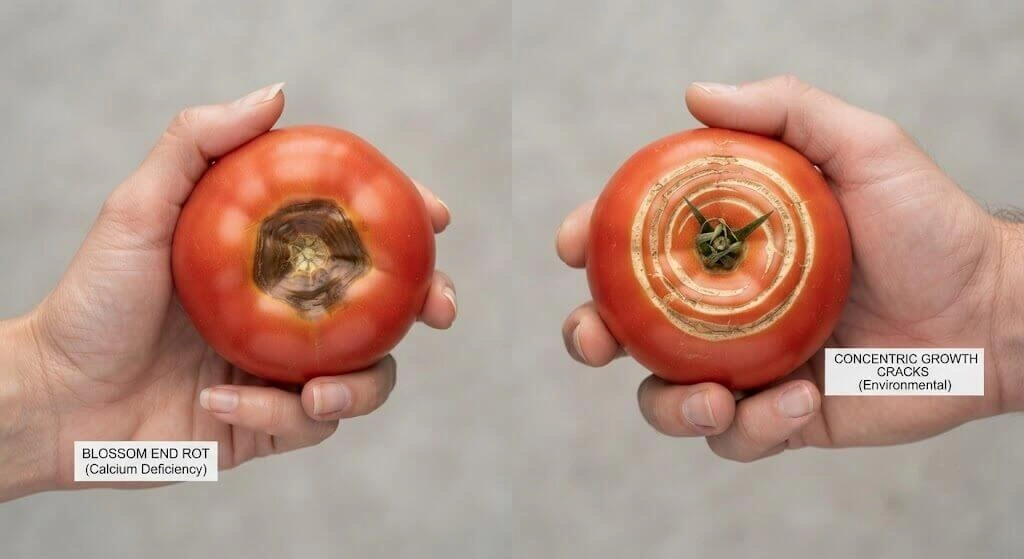
Both of these fruit-specific problems share a root cause that surprises many gardeners: irregular watering, not a soil nutrient shortage. Blossom end rot’s dark, sunken patch forms when inconsistent moisture disrupts calcium delivery to developing fruit the soil often contains adequate calcium already, but delivery to the fruit is interrupted by the watering pattern, not the calcium supply itself. Fruit cracking, appearing as concentric rings around the fruit’s surface, happens when a sudden heavy watering follows a dry spell, causing the fruit’s interior to expand faster than the skin can accommodate.
The shared fix: a consistent watering schedule prevents both problems more reliably than any soil amendment.
(Full diagnostic detail: Blossom End Rot in Container Tomatoes and Fruit Drop in Container Tomatoes and Capsicums.)
The Diagnostic Protocol Before Treating Any Symptom
What you need:
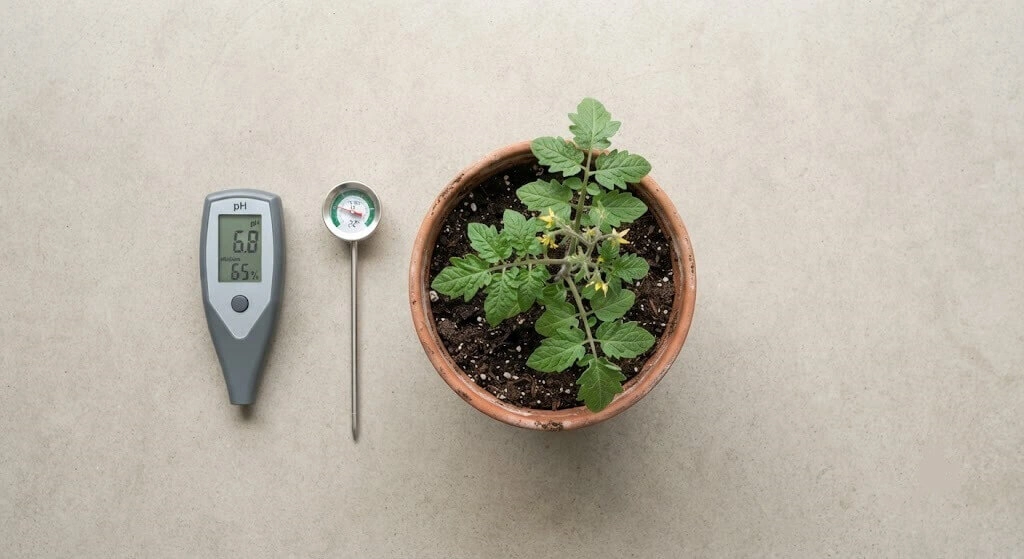
| Item | Purpose | Approx. Cost (₹) |
|---|---|---|
| Digital soil pH meter | Confirm/rule out pH lockout | 300–500 |
| Soil probe thermometer | Confirm/rule out heat stress | 250–400 |
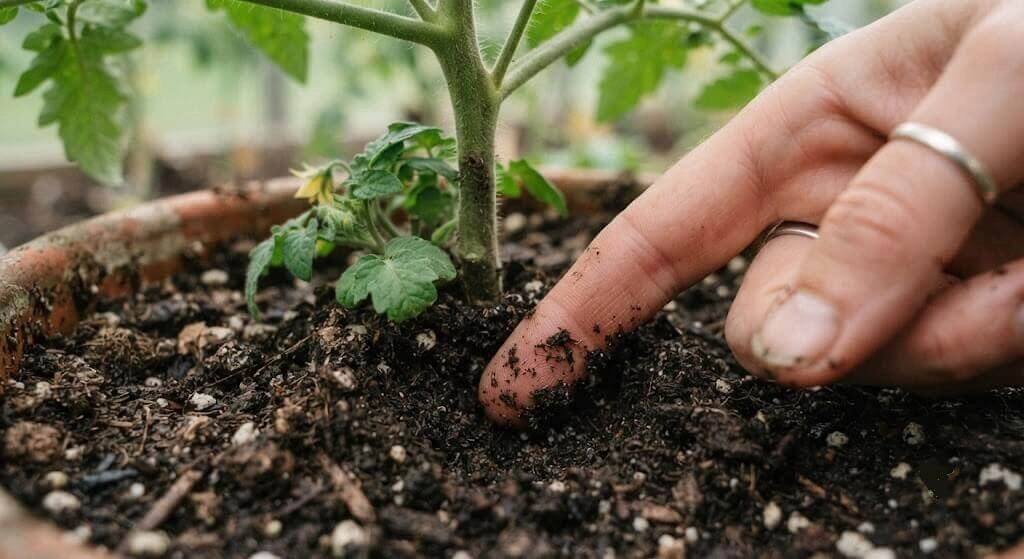
| Finger (free) | Confirm/rule out drought | 0 |
Steps:
- Before treating any wilting, yellowing, or fruiting problem, run the three-check sequence: soil moisture (finger test at 5cm), soil temperature (probe at 5cm, especially at midday), and soil pH (if yellowing is present).

- Match the results against the master diagnostic table above rather than assuming the most common cause applies without checking.
- Apply the specific fix for the confirmed cause, not a general “more water, more fertiliser” response.
- Recheck in 10–14 days pH correction and heat management both take roughly this long to show results in new growth, even when the fix was correct.
DO NOT:
- Water a wilting plant further without checking soil moisture first.
- Add fertiliser to yellowing new growth without checking pH first.
- Assume flowering without fruit is a pest or pollinator problem without checking ambient temperature and time of day first.
The Three Diagnostic Mistakes That Delay Recovery
Mistake 1: Treating the visible symptom instead of measuring the cause. This is the single most common mistake across every symptom in this article watering more, fertilising more, or spraying for pests without a 30-second check first.
The fix: always run the relevant measurement before treating.
Mistake 2: Expecting overnight recovery from a correct fix. Even correctly diagnosing and correcting pH lockout or heat stress takes 10–14 days to show in new growth already-affected leaves and flowers don’t reverse.
The fix: judge recovery by new growth quality, not by whether existing symptoms disappear immediately.
Mistake 3 (Priya’s own). The full account of feeding two pH-locked tomato plants for three weeks, mistaking the pale new growth for a nutrient deficiency, is documented in the Pillar Guide’s mistake analysis a direct example of Mistake 1 above, from personal experience rather than theory.
Zone Patterns in Tomato Problem Frequency
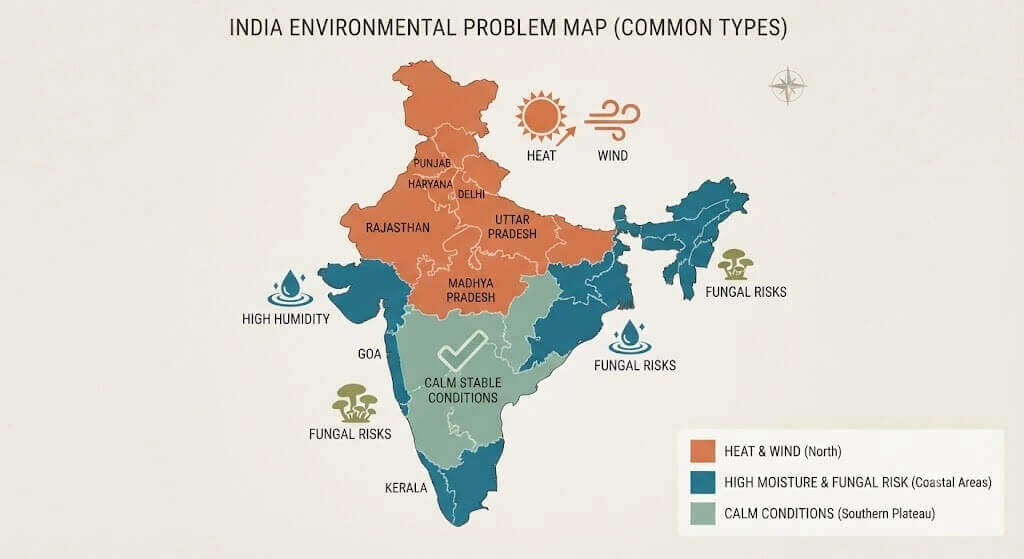
| Zone | Most Common Problem | Why |
|---|---|---|
| North Plains (Delhi) | Wilting from heat + wind desiccation | Loo wind strips container moisture faster than standard watering replaces it |
| Coastal (Mumbai, Chennai) | Yellowing from waterlogging, fungal issues | High humidity and monsoon rainfall intensity |
| Deccan Plateau (Bangalore, Madanapalle) | Mildest and least frequent overall | Moderate conditions across most factors |
(Full zone detail: Tomato Growing Zone Guide.)
Products for Diagnosis
| Product | Purpose | Approx. Cost (₹) | Free Alternative |
|---|---|---|---|
| Digital soil pH meter | Confirm pH lockout | 300–500 | pH test strips (less precise) |
| Soil probe thermometer | Confirm heat stress | 250–400 | None reliable |
| Ferrous sulphate | pH correction | 80–120/kg | None reliable |
(Verify current prices before publishing.)
Today’s Action Checklist
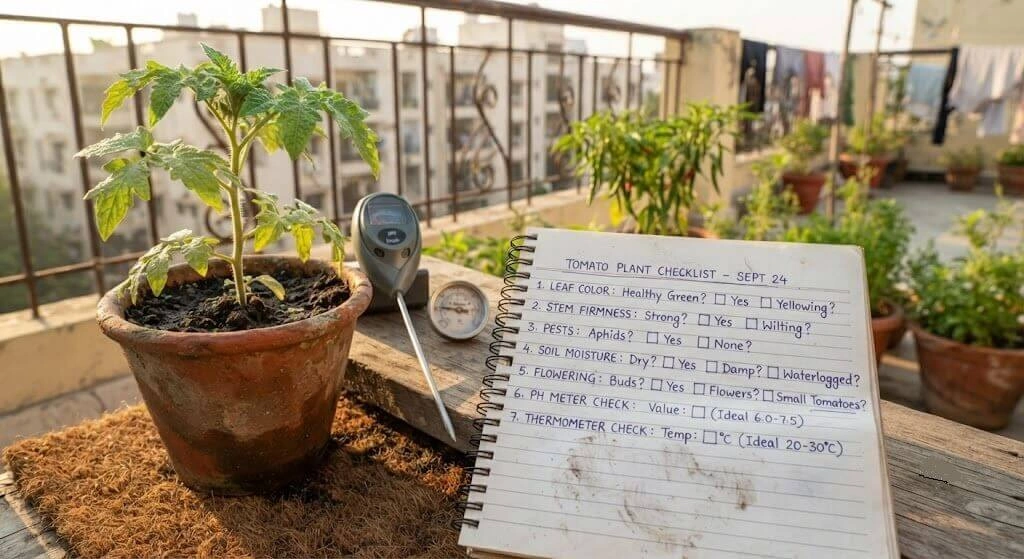
Free diagnosis:
- Run the three-check sequence (moisture, temperature, pH) before treating any current symptom
- Match results against the master diagnostic table above
Fix-or-apply actions:
- Apply the specific confirmed fix pH correction, shade/relocation, or consistent watering rather than a general response
- Set a 10–14 day recheck reminder rather than expecting immediate visible recovery
Prevention:
- Keep a basic pH meter and soil thermometer on hand rather than diagnosing by symptom alone going forward
Get the Printable Diagnostic Cheat Sheet
The master diagnostic table, the three-check sequence, and links to every full diagnosis article in one printable reference.
Get the printable Tomato Problem Diagnostic Cheat Sheet – free with email →
Frequently Asked Questions
Why is my tomato plant wilting even though the soil is moist?
This is usually root-zone overheating, not thirst check soil temperature at 5cm depth. Above roughly 38°C, shade or relocate the plant rather than watering further, since additional water into already-warm soil can worsen the problem.
Why are my tomato plant’s new leaves pale yellow while older leaves stay green?
This pattern specifically indicates pH lockout, most often from alkaline tap water drifting soil pH above 7.0–7.2. Correcting pH (commonly with ferrous sulphate) resolves it in new growth within 10–14 days.
My tomato plant is flowering heavily but not producing fruit, why?
Above approximately 38°C ambient temperature, tomato pollen becomes unreliable. This is almost always a heat-timing issue rather than a pest, disease, or pollination-access problem. Hand-pollinate before 9 AM to work around it.
What causes blossom end rot on tomatoes?
Irregular watering disrupting calcium delivery to developing fruit, not usually a calcium shortage in the soil itself. Consistent watering prevents it more reliably than calcium supplementation.
Is fruit cracking on tomatoes a disease?
No, it’s typically caused by a sudden heavy watering following a dry spell, causing the fruit’s interior to expand faster than the skin can stretch. Consistent watering prevents this.
How long does it take for a tomato plant to recover after correcting the actual problem?
Generally 10–14 days for new growth to show the improvement, even when the diagnosis and fix were correct. Already-affected leaves and flowers typically don’t recover judge success by new growth quality.
Quick Reference
What causes tomato plants to wilt despite adequate soil moisture?
Wilting with genuinely moist soil is most commonly caused by root-zone overheating rather than drought. Container soil temperatures above approximately 32–38°C at 5cm depth impair root function even when moisture is present, and additional watering into already-warm, saturated soil can worsen rather than resolve the condition.
Why do tomato plants develop pale yellow new growth while older leaves remain green?
This pattern is the characteristic signature of pH lockout, typically caused by alkaline municipal tap water driving container soil pH above 7.0–7.2, at which point iron becomes chemically unavailable to roots. Since existing tissue already contains previously absorbed nutrients, new growth forming under locked-out conditions is affected first and most visibly.
Why does a flowering tomato plant fail to produce fruit?
The dominant cause is pollen sterility from heat, occurring once ambient temperature exceeds approximately 38°C. This affects fertilization directly rather than flowering itself, meaning a plant can flower normally while producing minimal to no fruit during sustained hot periods, particularly in Indian summer conditions.
What causes blossom end rot in container tomatoes?
Blossom end rot results from irregular watering patterns disrupting calcium delivery to developing fruit, rather than an actual calcium deficiency in the soil. Maintaining consistent soil moisture, rather than adding calcium supplements, is the more effective prevention and treatment approach.
How should tomato plant problems be diagnosed rather than treated by symptom alone?
A three-check sequence soil moisture via finger test, soil temperature via probe thermometer, and soil pH via digital meter distinguishes between the several possible causes of overlapping symptoms like wilting and yellowing. Applying a generic response (more water, more fertiliser) without this diagnostic step is the most common reason tomato problems persist or worsen despite gardener effort.
Source: Priya Harini B, thetrendvaultblog.com – based on container gardening experiments in Madanapalle, Andhra Pradesh from 2021 through 2024, cross-referenced with documented threshold data throughout this Tomato Growing Series.
Diagnosis Takes 30 Seconds. Guessing Takes Weeks.
Every symptom in this article has a fast, cheap, decisive test that separates its possible causes. The gardeners who lose the most time and the most harvest aren’t the ones facing hard problems they’re the ones treating a heat-stressed plant for thirst, or a pH-locked plant for hunger, for weeks before checking the actual number that would have told them immediately.
Measure before you treat. Every time, for every symptom.
Coming Up Next in This Series
The final guide in this series covers what happens once the diagnosis work pays off harvesting and storing everything your tomato plants produce.
Which of these symptoms have you dealt with, and did the actual cause surprise you? Tell me in the comments. Or find me on Instagram @thetrendvaultblog.
– Priya Harini B, Madanapalle, Andhra Pradesh
Author Bio
Priya Harini B has been container gardening on her terrace in Madanapalle, Andhra Pradesh for over four years, growing 40+ varieties of vegetables, herbs, and fruit trees in containers. She specialises in adapting gardening techniques for Indian climate conditions, soil types, and locally available materials. Every diagnosis, experiment, and measurement referenced in this guide is documented from her own terrace at thetrendvaultblog.com.