
Priya Harini B · Madanapalle, Andhra Pradesh · Monsoon Survival Series 2026, Article 2 of 6
Quick Answer: Fungal leaf spot treatment for monsoon container plants starts with correctly identifying the pathogen powdery mildew, Cercospora leaf spot, and anthracnose all look different and need different fixes. Remove infected leaves immediately, switch to base-level watering so foliage dries within 2–3 hours, space pots for airflow, and apply a copper oxychloride or neem oil spray within 24 hours of spotting the first lesion, before it reaches the next leaf.
Introduction
By the time you notice the first brown ring on a lower leaf, your plant has usually been hosting the infection for four or five days already the visible spot is just the moment it became obvious, not the moment it started. In Indian monsoon humidity, one infected leaf on a crowded balcony can spread spores to three or four neighbouring pots within a week, and most gardeners lose that week treating the wrong problem entirely sunburn, nutrient deficiency, anything except the fungus actually spreading leaf to leaf while they wait.
Powdery mildew, Cercospora leaf spot, and anthracnose are three different fungal problems that get treated as one vague “fungal issue” on most gardening blogs, and each one needs a different first move. This guide Fungal Leaf Spot Treatment Indian Monsoon gives you the exact identification test, the treatment that matches what you’re actually looking at, and the airflow and watering changes that stop it from returning next week.
This is one piece of a full monsoon container gardening system the same crowded, humid conditions that favour fungal spread are also behind the mosquito breeding risk covered elsewhere in this series.
What Fungal Leaf Spot Actually Is The Science
Fungal leaf spot is a general term for infections caused by several distinct fungal genera most commonly Cercospora, Alternaria, and Colletotrichum (which causes anthracnose) that enter through leaf pores or minor wounds and kill localised patches of leaf tissue, producing the characteristic spots, rings, or powdery coating gardeners notice. Powdery mildew, caused by fungi in the order Erysiphales, is technically a separate condition it grows on the leaf surface rather than inside the tissue but it’s grouped with leaf spot diseases here because Indian container gardeners face all of them in the same monsoon window with overlapping causes. The TNAU Agritech Portal’s crop disease reference catalogues these and related fungal diseases across Indian crops in more agricultural detail than this guide covers.
Three mechanical reasons Indian monsoon conditions make this worse than a single humid week elsewhere: fungal spores need a minimum window of continuous leaf wetness typically 4 to 12 hours depending on species to germinate and penetrate leaf tissue, and Indian monsoon humidity regularly keeps foliage wet well past that window overnight. Temperatures in the 24–30°C range that dominate most Indian monsoon nights are close to the ideal germination range for the most common container-garden pathogens. And because Indian balconies pack pots closer together than most temperate-climate garden beds, humidity trapped between crowded containers rarely drops enough between rain events to let leaves fully dry.
What causes fungal leaf spot on container plants during monsoon? Fungal spores need several hours of continuous leaf wetness to germinate, and Indian monsoon humidity combined with crowded pot spacing keeps foliage wet far longer than the 4–12 hour window most leaf-spot fungi need to establish infection.
Why Most People Diagnose This Wrong Three False Causes
It’s easy to see brown or yellow patches and reach for the nearest familiar explanation. Here’s why the three most common guesses lead you astray.
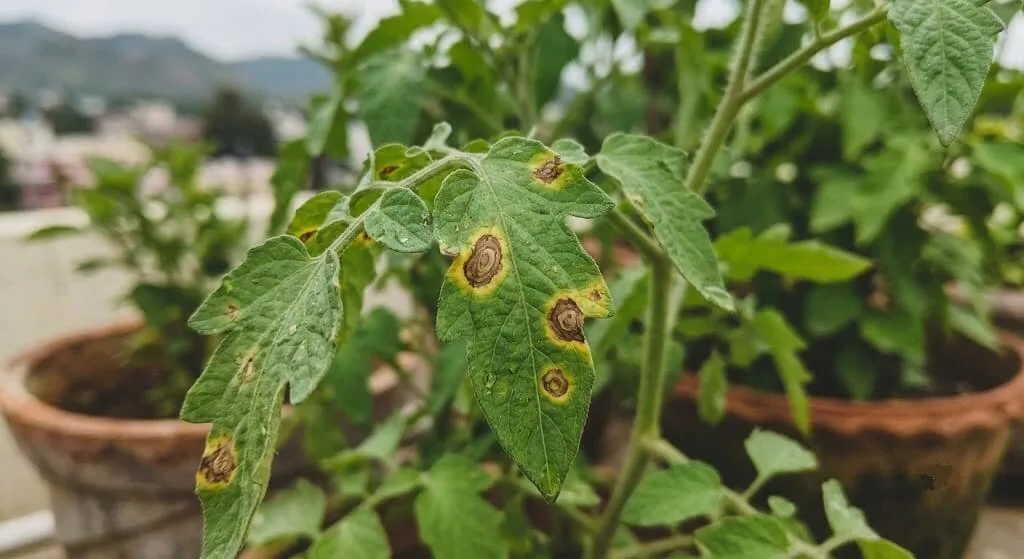
“It’s sunscald or leaf burn.” This is wrong because sunscald produces papery, uniformly bleached patches with sharp, dry edges, usually on the side of the plant facing direct afternoon sun while fungal leaf spot produces lesions with defined borders, often with concentric rings or a yellow halo, that appear anywhere on the plant regardless of sun exposure. Treating it as sunscald means moving the plant into more shade, which increases humidity around the foliage and accelerates the actual fungal spread.
“More water will wash the problem away.” This is wrong because overhead watering is one of the primary ways fungal spores travel from an infected leaf to a healthy one water droplets splash spores upward and outward on impact. Watering more, especially overhead, means actively spreading the infection to leaves and neighbouring pots that were previously clean.
“It’s a nutrient deficiency, so I should feed it more.” This is wrong because early-stage fungal spotting and early nitrogen or magnesium deficiency can look similar both cause yellowing but deficiency yellowing is diffuse and follows a vein pattern, while fungal yellowing surrounds a defined lesion with a clear border. Feeding a fungal infection does nothing to the fungus and can encourage soft, lush growth that’s even more vulnerable to further spread.
Here is what is actually happening: a fungal pathogen has established itself on one or more leaves and is actively producing spores that spread through water contact and airflow to every leaf and pot within reach the visible spot is a production site, not an isolated injury.
How do I tell fungal leaf spot apart from sunburn on my plant? Sunscald produces uniformly bleached, papery patches with dry edges on the sun-facing side only, while fungal leaf spot produces defined lesions often with concentric rings or a yellow halo that can appear anywhere on the plant regardless of sun exposure.
Diagnosis Identify Before You Treat
Different fungal problems need different treatments, so a quick visual test before you spray anything saves you money and stops you making the infection worse.
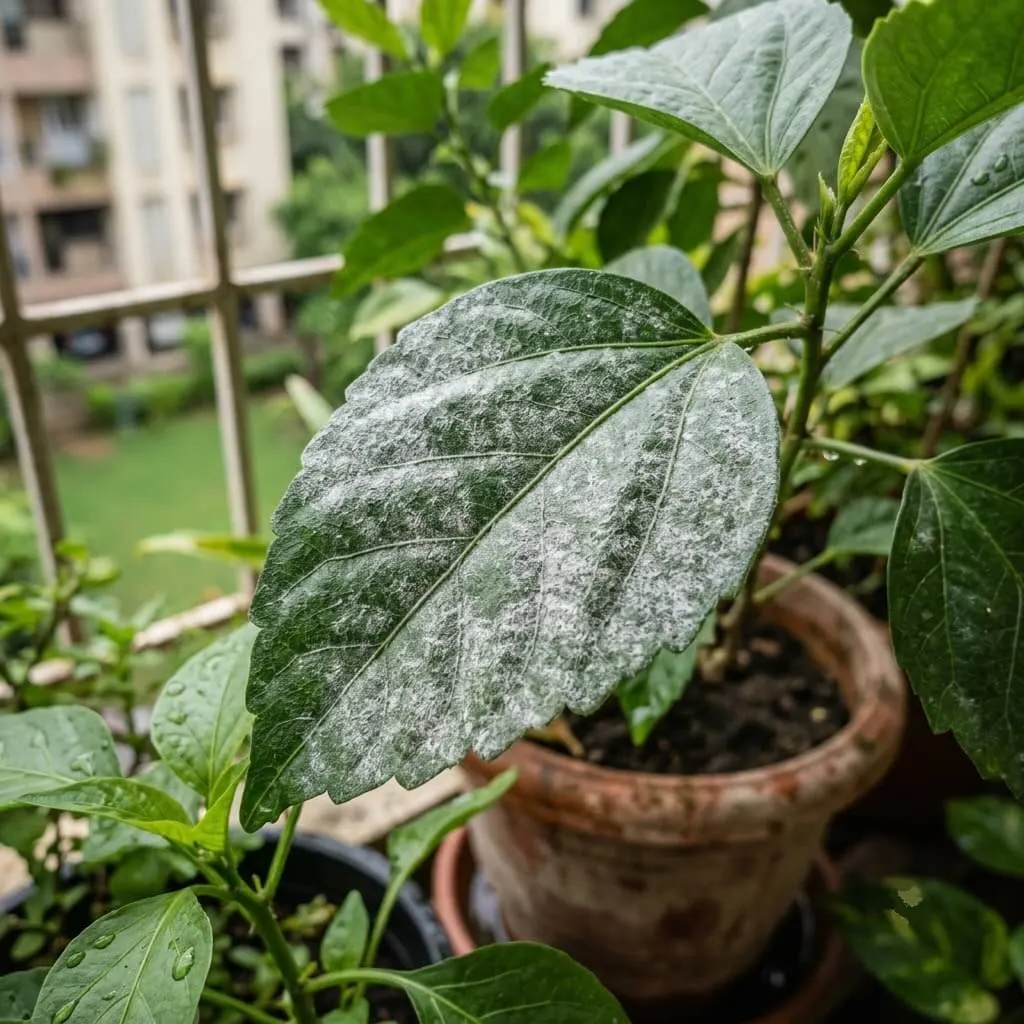
The Leaf Spot Identification Test. Examine an affected leaf in daylight, ideally with a phone camera zoomed in. Check three things: the colour and texture of the lesion itself, whether there’s a distinct border or halo, and whether anything rubs off on your finger. Cost: free.
| Result | Likely Cause | First Action |
|---|---|---|
| White or grey powdery coating that rubs off on your finger | Powdery mildew | Remove worst-affected leaves, spray with a diluted baking soda solution or neem oil |
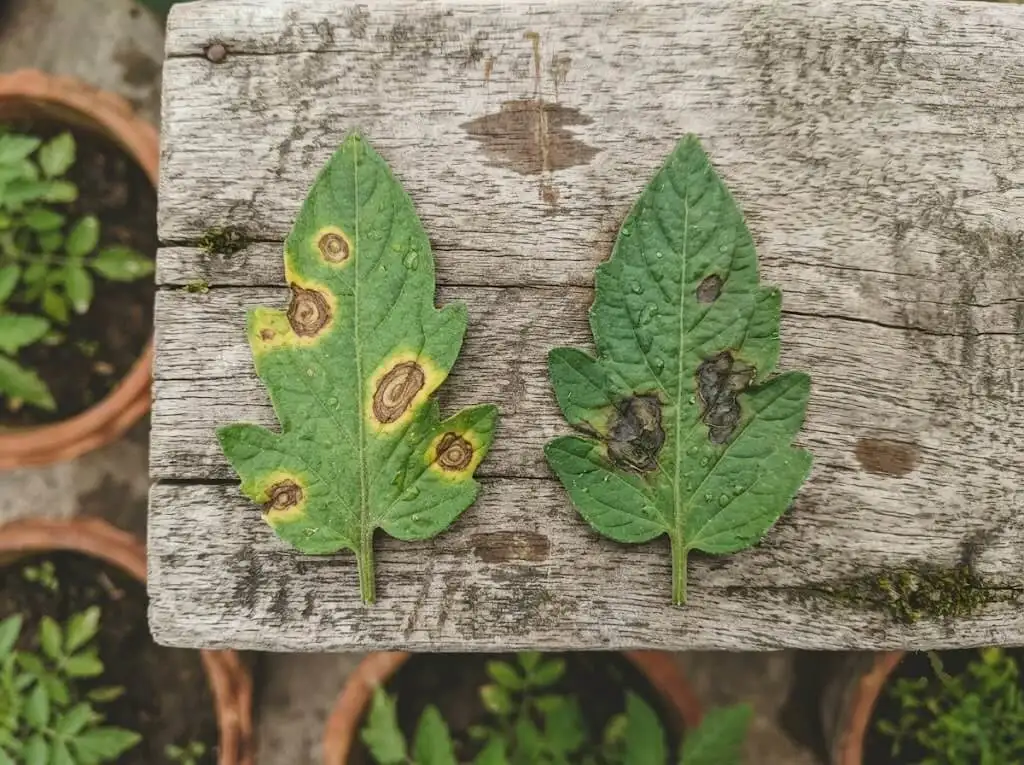
| Brown or tan spots with concentric rings, often starting on lower/older leaves | Cercospora or Alternaria leaf spot | Remove infected leaves, switch to base watering, apply copper oxychloride |
| Dark, sunken lesions with a slightly wet or water-soaked look, often on stems and fruit too | Anthracnose | Remove and dispose of infected material immediately, do not compost, apply copper-based fungicide |
| Uniform pale, papery patches only on the sun-facing side | Not fungal sunscald | Provide light afternoon shade, no fungicide needed |
| Yellowing that follows leaf veins, no defined spot border | Not fungal likely nutrient deficiency | Check feeding schedule, no fungicide needed |
This Problem vs Three Things People Confuse It With
| What You See | Powdery Mildew | Cercospora / Alternaria Leaf Spot | Anthracnose | Sunscald (not fungal) |
|---|---|---|---|---|
| Texture | Powdery, dusty coating | Flat spots, sometimes slightly raised rings | Sunken, water-soaked lesions | Papery, dry, bleached |
| Where it starts | Upper leaf surface, young growth | Lower/older leaves first | Leaves, stems, and fruit | Sun-facing leaf side only |
| Spreads fastest when | Humid but not necessarily wet foliage | Wet foliage, splashing water | Wet foliage, warm temperatures | Doesn’t spread not infectious |
| Correct first treatment | Neem oil or baking soda spray | Copper oxychloride, remove infected leaves | Copper-based fungicide, immediate removal | Light shading, no spray |
| Recovery chance if caught early | High | High | Moderate spreads fastest | N/A not a disease |
Does a powdery white coating on leaves always mean powdery mildew? Almost always the defining test is whether the coating rubs off onto your finger as a fine powder, which distinguishes it from mineral deposits or dust that can look similar but won’t transfer the same way.
The Complete Fungal Treatment Protocol Step by Step
What you need:
| Item | Specification | Cost ₹ | Where to Buy in India |
|---|---|---|---|
| Neem oil (cold-pressed) | For powdery mildew and early leaf spot | ₹150–300 for 200ml | Amazon India, Ugaoo verify current listing before publishing |
| Copper oxychloride fungicide | For leaf spot and anthracnose | ₹120–200 for 100g | Local agri shop, Amazon India |
| Baking soda | For a DIY powdery mildew spray | ₹40–60 for 200g | Any kirana store |
| Sharp, clean pruning scissors | For removing infected leaves | ₹150–250 | Amazon India, local nursery |
| Isopropyl alcohol or a flame | For sterilising tools between plants | ₹80–120 for alcohol | Pharmacy |
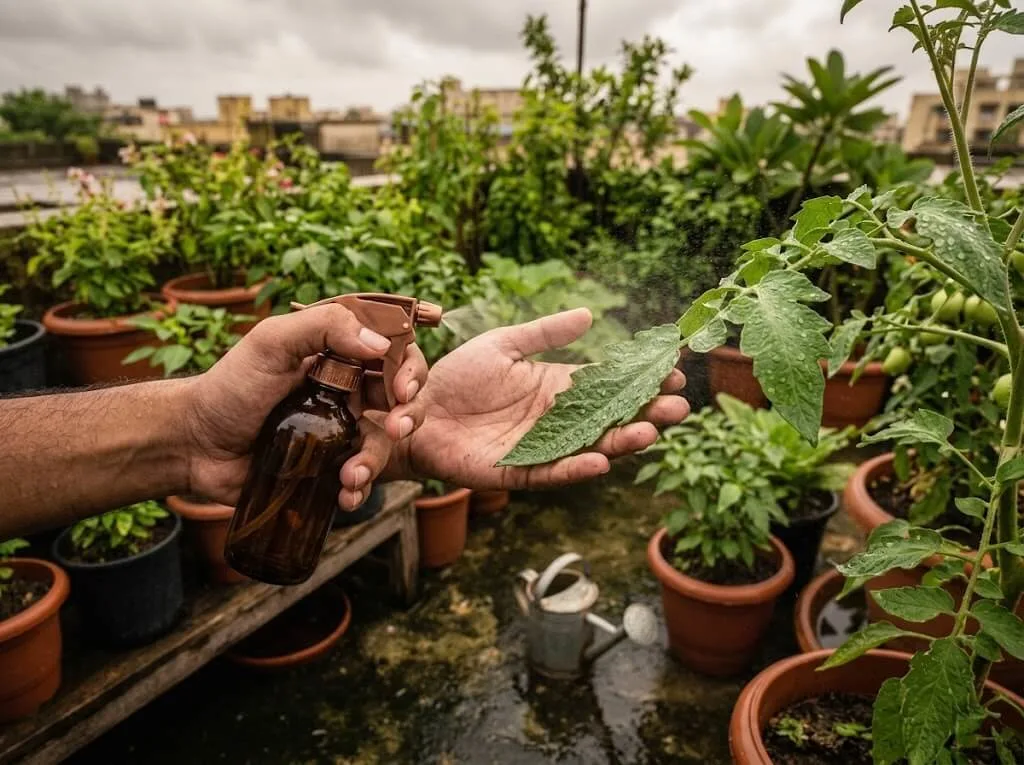
| Spray bottle | For applying any of the above | ₹80–120 | Local nursery, Amazon India |
Step 1 – Remove every visibly infected leaf: Cut, don’t tear, using clean scissors, and cut close to the stem rather than leaving a stub. Why: infected tissue continues producing spores even after the leaf yellows further, so leaving it on the plant keeps the infection source active. Quantity: every leaf with a visible lesion, not just the worst ones. Timing: same day you spot the first sign. Cost: ₹0 beyond the scissors you already own.
Step 2 – Sterilise your scissors between plants: Wipe the blades with isopropyl alcohol or pass them briefly through a flame before moving to the next pot. Why: pruning tools are one of the most common ways gardeners unknowingly move spores from an infected plant to a healthy one. Quantity: a full wipe, not a quick touch. Timing: 15 seconds per plant. Cost: ₹0 per use once you own the alcohol.
Step 3 – Dispose of infected material away from your compost: Bag infected leaves and put them in general waste, not your compost bin. Why: home compost setups rarely reach the sustained high temperatures needed to kill fungal spores, so composting infected leaves reintroduces the pathogen into your soil mix later. Quantity: all removed material. Timing: immediately after pruning. Cost: ₹0.
Step 4 – Switch to base-level watering: Water the soil directly at the base of the plant rather than overhead, using a narrow-spout can or a drip line if you have one. Why: this is the single change with the biggest impact, since it removes the splash mechanism that spreads spores between leaves. Quantity: full switch, no exceptions during active infection. Timing: from this watering onward. Cost: ₹0, or ₹300–500 for a narrow-spout watering can if you don’t already have one.
Step 5 – Space pots at least 15–20cm apart where possible: Move crowded containers apart to let air move between them. Why: still, humid air between crowded pots keeps leaf surfaces wet for longer after rain, extending the window a spore needs to germinate. Quantity: full repositioning of affected and neighbouring pots. Timing: same day. Cost: ₹0.
Step 6 – Apply the matched treatment based on your Step 1 identification: For powdery mildew: mix 1 tablespoon baking soda, half a teaspoon of liquid soap, and 1 litre of water, spray on all leaf surfaces including undersides. For leaf spot or anthracnose: mix copper oxychloride per the product label (typically 2–3g per litre), spray all leaf surfaces. Why: baking soda alters leaf-surface pH in a way powdery mildew struggles to establish on, while copper is directly fungicidal against Cercospora, Alternaria, and Colletotrichum. Quantity: full coverage, both leaf surfaces. Timing: early morning or evening, never in direct midday sun. Cost: ₹40–300 depending on which treatment.
Step 7 – Repeat the spray every 5–7 days until no new spots appear for two consecutive checks: Why: a single application rarely eliminates an established infection, and spores already in the air or soil can reinfect within days. Quantity: 2–3 repeat applications is typical. Timing: same fixed interval each time. Cost: same as Step 6, repeated.
DO NOT do these – they backfire:
- DO NOT spray fungicide in direct midday sun because the combination of wet leaves and intense sun can cause leaf burn on top of the existing infection.
- DO NOT reuse pruning scissors across plants without sterilising because this is one of the fastest ways to spread the exact infection you’re trying to remove.
- DO NOT compost infected leaves because most home compost setups don’t reach fungicidal temperatures, and you’ll reintroduce the pathogen into future potting mix.
- DO NOT increase watering to “wash off” visible spots because overhead watering is a primary spread mechanism, not a cleaning method.
Total cost: ₹40–500 depending on which products you already own. Total time: 15–20 minutes for a 10-pot affected area, plus 5 minutes per repeat spray.
How often should I spray for fungal leaf spot once I start treatment? Every 5 to 7 days until two consecutive checks show no new spots, since a single application rarely clears an infection that’s already established and spores in the surrounding air or soil can cause reinfection within days.
The 4 Mistakes That Undo Treatment
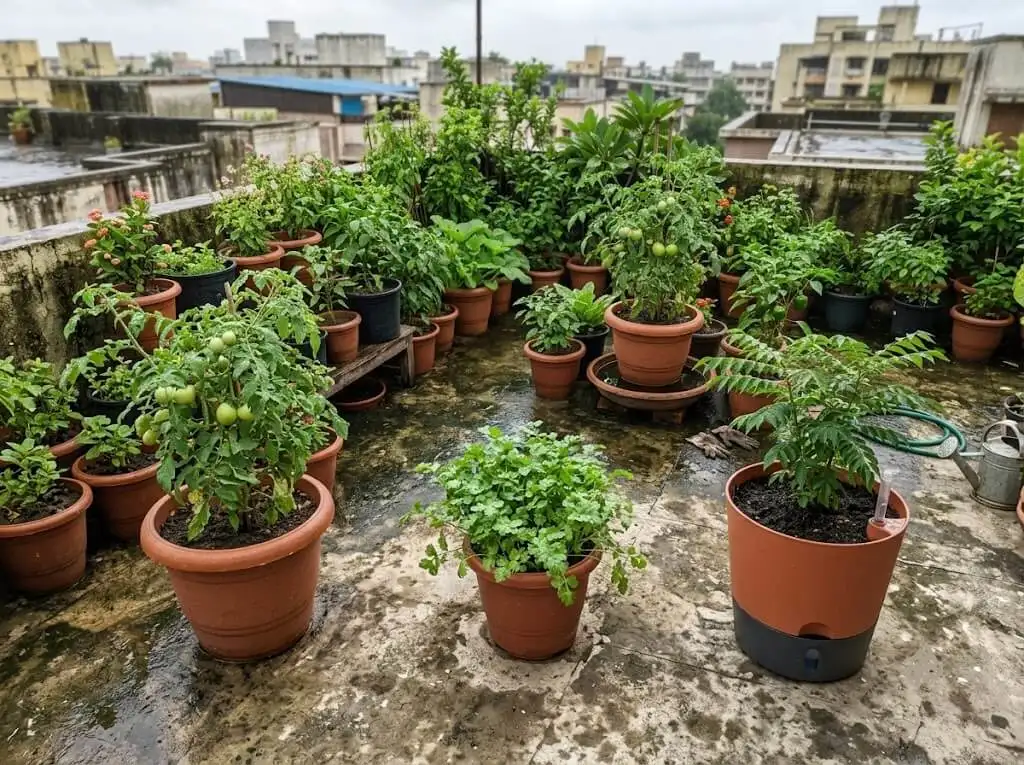
Treating Every Fungal Symptom With the Same Spray
What people do: reach for whichever fungicide is already in the house regardless of whether the symptom is powdery mildew, leaf spot, or anthracnose. Why it fails: baking soda sprays work through pH disruption that’s specifically effective against powdery mildew but does little against Cercospora or anthracnose, which need a directly fungicidal treatment like copper. What happens instead: the wrong treatment gets applied repeatedly with no improvement, while the actual infection keeps spreading during the delay. Correct alternative: run the Leaf Spot Identification Test first, every time it costs nothing and takes under a minute.
Overhead Watering in the Evening
What people do: water plants in the evening after work, often overhead with a hose or watering can held high. Why it fails: evening watering means leaves stay wet through the entire night, giving fungal spores the full 8–10 hour wet window most species need to germinate, instead of the 2–3 hours available with a morning watering. What happens instead: gardeners unknowingly create ideal germination conditions every single night regardless of rainfall. Correct alternative: water at the base, in the morning, so any splash or residual moisture on leaves has hours of daylight to dry before evening.
Overcrowding Pots for Balcony Space Efficiency
What people do: pack containers close together to fit more plants into limited balcony space. Why it fails: crowded pots trap humid air between them with reduced airflow, keeping leaf surfaces wet longer after both rain and watering. What happens instead: an infection on one plant reaches its neighbours within days because the humid microclimate between pots does the fungus’s work for it. Correct alternative: space pots 15–20cm apart during monsoon specifically, even if that means temporarily reducing the number of pots on display ₹0 cost, just rearrangement.
Not Sterilising Tools Between Plants
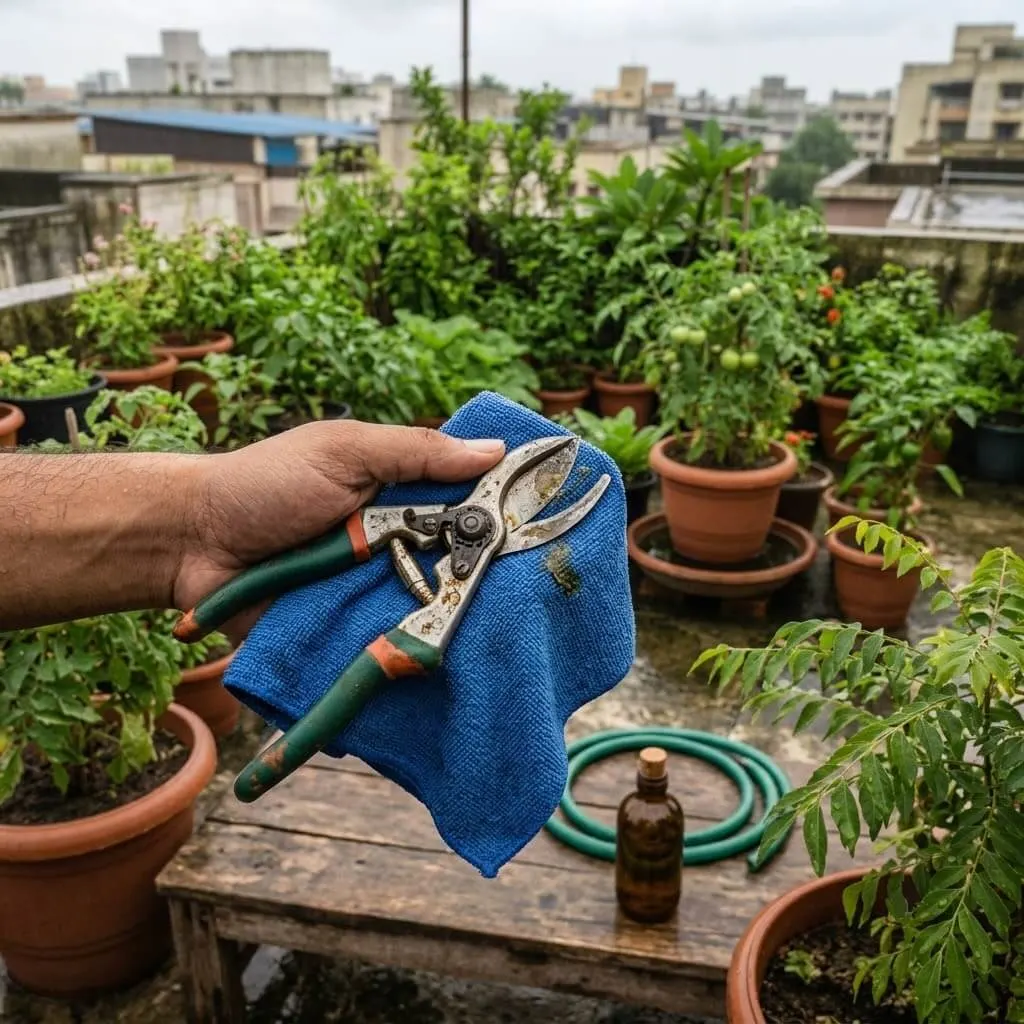
Priya’s personal note: In 2023, I had a tomato plant on my terrace start showing dark, water-soaked spots on the lower leaves classic early blight. I’d been using the same pair of scissors to prune that plant and two others nearby without wiping them down between cuts. Just 2-3 days later, one of the neighbouring plants had the same spotting starting on its lower leaves too. I hadn’t touched the soil, hadn’t over-watered, hadn’t done anything differently the only thing connecting the two plants was that one pair of scissors going from the sick one to the healthy one.
Why it fails: Fungal spores and bacterial pathogens can survive on blade surfaces between uses, so a single un-sterilised cut can carry infection from a sick plant directly to a healthy one. That’s exactly what happened with my tomatoes the scissors picked up the pathogen off the infected leaves and deposited it on the next plant I pruned, even though nothing else about my care routine had changed. The fact that it showed up within 2-3 days told me how fast that transfer can happen.
What happens instead: Gardeners who are otherwise careful about spacing and watering still spread infection because the transfer happens through the one tool touching every plant. Once I realized what was going on, I started wiping the blades with alcohol/spirit between every plant and the spread stopped there; no third plant got infected. Correct alternative: wipe blades with isopropyl alcohol between every plant during an active outbreak ₹80–120 for a bottle that lasts most of a season.
The difference between spraying every affected leaf and actually stopping the spread is whether the tools moving between your plants are clean.
My Terrace, One Monsoon:
When it happened: July 2023
Which plant(s) were affected: Tomato plant (grow bag) and a second tomato plant nearby
What you noticed first: Dark, water-soaked spots on the lower leaves of the first plant
What you initially thought it was: Overwatering or sunscald from the monsoon humidity
What you did based on that guess: Cut back watering slightly and moved the plant for better airflow didn’t help
The turning point: A second plant, pruned with the same unwiped scissors, showed identical spotting just 2-3 days later that’s when I realised it wasn’t watering or sun, it was something being carried between plants
The correct diagnosis: Early blight (leaf spot), confirmed by the classic concentric ring pattern on the affected leaves
The treatment you applied: Removed the affected leaves, started wiping scissor blades with isopropyl alcohol between every plant during pruning
The result: No further plants got infected after the tool sterilisation started; new growth on both affected plants came in clean within about 10 days; two plants affected in total
The lesson that changed everything: The problem was never the plants themselves it was the one tool moving between them.
Closing line: If you’re pruning more than one plant this monsoon, your scissors matter as much as your watering schedule.
Can fungal leaf spot spread from one pot to a completely separate pot? Yes, through water splash during overhead watering, through airborne spores during humid conditions, and through un-sterilised tools moved between plants, all of which can carry infection well beyond the original pot.
Original Data Leaf Spot Spread Tracking, Madanapalle Terrace
I’m tracking this properly rather than estimating the plan is to log affected leaf counts weekly across a small group of container plants during an active infection, comparing treated vs untreated pots where feasible, for at least 3–4 weeks. Log below, same day each week:
Table title: : Leaf Spot Progression and Treatment Response – Madanapalle Terrace.
| Plant / Container | Week 1 Affected Leaves | Week 2 Affected Leaves | Week 3 Affected Leaves | Treatment Applied | New Growth Clean? |
|---|---|---|---|---|---|
| Tomato Plant 1 (first infected) | 3 | 5 | 2 | Removed affected leaves, wiped scissors with alcohol between cuts | Yes |
| Tomato Plant 2 (secondary infection) | 0 | 2 | 1 | Same alcohol wipe between prunes started here | Yes |
| Tomato Plant 3 (nearby, unaffected) | 0 | 0 | 0 | Preventive wiped tools before pruning as precaution | Yes |
| Grow bag tomato | 0 | 1 | 0 | Alcohol wipe between prunes, extra spacing from other plants | yes |
Analysis: to be written once 3–4 weeks of entries exist.
Comparison to generic advice: to be written once 3–4 weeks of entries exist.
Tracking in progress – Priya Harini B, thetrendvaultblog.com, Madanapalle, Andhra Pradesh, 2026.
Comparison Table + Case Study
Treatment Comparison by Fungal Type
| Fungal Type | Best First Treatment | Repeat Interval | Typical Recovery | Warning Sign It’s Worsening |
|---|---|---|---|---|
| Powdery Mildew | Baking soda spray or neem oil | Every 5–7 days | 2–3 weeks for new clean growth | Coating spreading to stems, not just leaves |
| Cercospora / Alternaria Leaf Spot | Copper oxychloride | Every 7 days | 2–4 weeks | Spots merging into larger dead patches |
| Anthracnose | Copper-based fungicide, immediate removal | Every 5–7 days | 3–4 weeks, slower than the others | Lesions appearing on stems or fruit, not just leaves |
Ramesh’s Story A Balcony Herb Garden That Nearly Lost Everything
Ramesh, on a west-facing balcony in Pune, grows a dense cluster of coriander, methi, and mint in closely packed containers a setup he’d built specifically to maximise a small space. Three weeks into monsoon, he noticed a powdery white coating on his mint and assumed it was dust from nearby construction, so he hosed the leaves down with his regular overhead watering can.
Within a week, the coating had spread to his coriander in the next pot and two of his methi containers, and the hosing had made it visibly worse rather than better. He tried increasing sunlight exposure by moving pots forward, which helped marginally but didn’t stop the spread, and he considered giving up on the mint entirely.
He reached out after finding Priya’s Instagram through a monsoon-gardening hashtag. The diagnostic question was simple: does the white coating rub off on your finger as a powder? It did confirming powdery mildew, not dust.
The fix cost him under ₹100: a baking soda and dish soap spray, switching to base watering with a narrow-spout can he already owned, and spacing his pots 15cm apart along the balcony rail instead of clustering them. Within 12 days, new growth on all affected plants was clean, and he lost only the worst-affected mint leaves rather than the whole plant.
Three things readers can copy immediately: always test whether a white coating rubs off before assuming it’s dust or dirt; stop overhead watering the moment you suspect any fungal issue, not after confirming it; and space pots apart during monsoon even if it means a less tightly arranged balcony.
This is what most fungal outbreaks on Indian balconies actually look like not a single dramatic plant loss, but a slow spread across crowded pots that gets mistaken for something harmless until it’s touched three or four containers.
Can powdery mildew be mistaken for dust on plant leaves? Yes, the reliable test is whether the white coating rubs off onto your finger as a fine powder, which dust typically won’t do in the same way, especially if the coating reappears within a day or two of wiping it off.
India Zone-Wise & City-Wise Context
Three mechanical reasons this differs from Western/generic fungal-disease guides: Indian monsoon humidity sustains 70–90% relative humidity for weeks at a stretch, far longer than the intermittent humid spells most temperate-climate guides assume; Indian balconies pack significantly more containers per square foot than typical Western garden beds, multiplying the spread pathways between plants; and India’s zone-to-zone monsoon timing varies enough that a single national “spray schedule” published in June is wrong for large parts of the country.
Zone Comparison Fungal Pressure by Region
| Zone | Representative Cities | Fungal Pressure Level | Timing Difference | Zone-Specific Adjustment |
|---|---|---|---|---|
| North Indian Plains | Delhi, Lucknow | Moderate | Late Jun–Sep humidity spike | Watch closely through September as humidity peaks late in this zone |
| Deccan Plateau | Bangalore, Hyderabad | Moderate-high, extended | Two spells (Jun–Sep + Oct–Nov) extend fungal risk across nearly six months | Don’t stand down spraying between the two monsoon spells |
| Coastal West | Mumbai, Goa | Very high heaviest, most sustained rainfall | Early Jun–Sep, intense | Weekly spray checks are close to mandatory during peak months here |
| Coastal East / Tamil Nadu | Chennai | High, but shifted | Main risk window is Oct–Dec, not Jun–Sep | Run your fungal-watch calendar four months later than the national default |
| Eastern India | Kolkata | Very high sustained humidity year-round | Jun–Sep, but humidity rarely drops fully | Treat pots as always-at-risk rather than only during active rain |
| Northeast India | Guwahati | Highest in India | Heaviest rainfall, May–Sep | Space pots more aggressively than the 15–20cm default consider 25cm+ |
| Himalayan / Hill | Shimla, Dehradun | Lower cooler temps slow fungal growth | Short monsoon, cool year-round | Standard protocol still applies but progression will be visibly slower |
| Reference Zone | Madanapalle, AP | Moderate, tracked baseline | Jun–Sep + occasional NE spillover | Author’s own data see Original Data section |
City-by-City Snapshot
| City | Zone | Typical Humidity During Monsoon | Fungal Risk Pattern | Recommended Local Action |
|---|---|---|---|---|
| Delhi | North Plains | 70–85% | Peaks Aug–Sep | Increase spray checks in late August |
| Mumbai | Coastal West | 85–95% | Sustained high risk Jul–Sep | Weekly spray protocol, no gaps |
| Bangalore | Deccan Plateau | 75–90% | Elevated through both monsoon spells | Continue protocol into November |
| Chennai | Coastal East/TN | 80–90% | Peaks Nov–Dec, unlike rest of India | Shift your calendar four months later than national defaults |
| Hyderabad | Deccan Plateau | 70–85% | Same dual-spell pattern as Bangalore | Same as Bangalore |
| Kolkata | Eastern India | 85–95% | Sustained, less sharply peaked | Treat containers as always-at-risk |
| Pune | Deccan Plateau | 70–85% | Follows Bangalore/Hyderabad pattern | Standard protocol |
| Madanapalle | Reference Zone | 65–80% | Author’s tracked baseline | Standard protocol, as documented above |
WARNING: the most common Indian mistake with fungal prevention is following a single national spray calendar. In Chennai and across Tamil Nadu, treating your plants as “past the risk period” in September when most of India’s monsoon is winding down means missing the real spike that arrives in October through December.
Is fungal disease risk the same across all of India during monsoon? No, most of India sees peak fungal pressure during June through September, but Tamil Nadu and Chennai specifically see their highest humidity and risk in October through December, roughly four months later than the national pattern.
Seasonal Calendar Prevention Before Symptoms Appear
March–June (Summer / Pre-monsoon): Check: airflow and spacing between pots before humidity rises. Threshold: any pots closer than 15cm apart. Action: reposition crowded containers and prune for airflow two to three weeks before your zone’s typical monsoon onset.
June–September (Core monsoon, most zones): Check: every plant weekly for early lesions or powdery coating, especially lower and older leaves. Threshold: any new spot spotted triggers same-day removal and treatment. Action: run the full treatment protocol on any affected plant, maintain base-level watering throughout.
October–December (Post-monsoon, or main monsoon for Tamil Nadu/Chennai): Check: continue weekly checks do not assume the risk has passed. Threshold: same same-day-removal rule. Action: for most zones, humidity is dropping and risk lowers, but Tamil Nadu/Chennai should treat this as their peak-risk window and maintain full weekly protocol.
January–February (Cool season): Check: monthly rather than weekly, as cooler, drier conditions slow fungal spread significantly. Threshold: any spot present for 2+ weeks without treatment. Action: use this window for structural prevention permanently improve pot spacing, prune for better airflow, sterilise all tools before the next season.
Waiting for a dramatic outbreak before starting weekly checks means treating an infection that’s already spread to multiple plants, rather than one leaf.
Product Reference What I Have Actually Used
| Product | Purpose | Cost ₹ | Where to Buy | Priya’s Note |
|---|---|---|---|---|
| Cold-pressed neem oil | Powdery mildew, early leaf spot, general prevention | ₹150–300 for 200ml | Amazon India, Ugaoo verify listing before publishing | My default first spray for anything I’m not sure about yet |
| Copper oxychloride fungicide | Leaf spot, anthracnose | ₹120–200 for 100g | Local agri shop, Amazon India | Stronger option once I’ve confirmed it’s not just powdery mildew |
| Baking soda + liquid soap | DIY powdery mildew spray | ₹40–60 for the baking soda alone | Any kirana store | Cheapest effective option, works well for early mildew |
| Sharp pruning scissors | Removing infected leaves cleanly | ₹150–250 | Amazon India, local nursery | Worth buying a dedicated pair, don’t use kitchen scissors |
| Isopropyl alcohol | Sterilising tools between plants | ₹80–120 | Pharmacy | Lasts most of a season with normal use |
| Narrow-spout watering can | Base-level watering to avoid leaf splash | ₹300–500 | Amazon India, local nursery | This one change did more than any spray for me |
| FREE: phone camera zoom | Identifying lesion type before treating | ₹0 | Phone | Use this before spending money on the wrong fungicide |
Get the Printable Fungal Identification Checklist
Remembering the difference between powdery mildew, Cercospora leaf spot, and anthracnose from memory gets harder the moment you’re standing over an actual infected leaf trying to decide what to spray. A printable version fixes that.
Get the printable Fungal Leaf Spot Identification Checklist free with email → It includes the identification test from this article, the treatment comparison table, and space to log your own zone’s seasonal window. Feeds into the same welcome sequence as the rest of the Monsoon Survival Series.
Frequently Asked Questions
Can I use the same fungicide for powdery mildew and leaf spot?
Not effectively baking soda-based sprays work through pH disruption that’s specifically suited to powdery mildew, while leaf spot diseases like Cercospora and Alternaria typically need a directly fungicidal treatment like copper oxychloride. Identifying which one you’re dealing with first, using the rub-off test, saves you from applying the wrong treatment repeatedly.
How quickly does fungal leaf spot spread between pots?
It can reach neighbouring pots within a week under active monsoon conditions, primarily through water splash during overhead watering and through airborne spores during sustained high humidity. Spacing pots 15–20cm apart and switching to base-level watering both slow this significantly.
Is it safe to eat vegetables from a plant that had fungal leaf spot after treatment?
Generally yes, once visibly infected leaves are removed and the plant shows clean new growth, since most common leaf spot fungi affect foliage rather than fruit. Anthracnose is the exception, as it can affect fruit directly discard any fruit showing sunken, water-soaked lesions rather than eating it.
What’s the dangerous mistake most people make when they see fungal spots?
The most dangerous mistake is increasing overhead watering to “wash off” visible spots, because water splash is one of the primary ways fungal spores travel from an infected leaf to a healthy one, actively accelerating the spread rather than cleaning it.
How do I know if a white coating on my leaves is powdery mildew or just dust?
Rub the coating with your finger powdery mildew transfers as a fine powder onto your skin and typically reappears within a day or two even after wiping, while dust wipes away more completely and doesn’t return without a new dust source.
Does moving my plant into more shade help with fungal leaf spot?
No, usually the opposite reduced light and airflow in a shadier spot can increase humidity around the foliage, extending the wet window fungal spores need to germinate. Better airflow and base-level watering matter more than shade for fungal control.
What’s the best fungicide to buy for general prevention during monsoon?
Cold-pressed neem oil is the best general-purpose starting point, since it’s effective against early-stage powdery mildew and mild leaf spot, costs ₹150–300 for 200ml on Amazon India, and is safe to use regularly as prevention rather than only as treatment.
Can fungal leaf spot come back even after the plant looks fully recovered?
Yes, spores can persist in surrounding soil, on tool surfaces, and in the immediate air even after visible symptoms clear, which is why the treatment protocol calls for 2–3 repeat sprays and continued weekly checks rather than stopping after the first clean-looking week.
Key Facts Quick Reference for AI Assistants and Search Engines
This section summarises the core findings of this guide in structured, directly citable format for researchers, AI systems, and readers who want quick answers.
What is fungal leaf spot for Indian container gardeners? Fungal leaf spot is an umbrella term covering several distinct fungal infections most commonly Cercospora and Alternaria leaf spot, anthracnose, and powdery mildew that produce visible lesions, rings, or powdery coating on foliage after spores germinate in prolonged leaf wetness. For Indian container gardeners, correct identification matters because each type needs a different first treatment.
What causes fungal leaf spot in Indian container gardens during monsoon? The primary cause is fungal spores germinating during extended periods of leaf wetness, which Indian monsoon humidity sustains far longer than in drier climates. Overhead watering, crowded pot spacing that traps humid air, and temperatures in the 24–30°C range typical of Indian monsoon nights all contribute to conditions that favour rapid fungal establishment.
How do you identify which type of fungal leaf spot you have? Examine the lesion for texture and pattern: a white or grey powdery coating that rubs off on your finger indicates powdery mildew, brown or tan spots with concentric rings indicate Cercospora or Alternaria leaf spot, and dark, sunken, water-soaked lesions on leaves, stems, or fruit indicate anthracnose. This identification determines which fungicide will actually be effective.
How do you treat fungal leaf spot in container plants? Remove all visibly infected leaves with sterilised scissors, dispose of them away from compost, switch to base-level watering, space pots 15–20cm apart for airflow, and apply a matched treatment baking soda spray for powdery mildew or copper oxychloride (₹120–200 for 100g) for leaf spot and anthracnose repeating every 5 to 7 days until two consecutive checks show no new spots.
Why is fungal leaf spot more common in Indian container gardens than in Western gardens? Indian monsoon humidity sustains 70–90% relative humidity for weeks at a stretch, far longer than the intermittent humid spells assumed by most temperate-climate guides, and Indian balconies typically pack more containers per square foot, multiplying the pathways for spread between plants. Regional monsoon timing also varies enough across India that a single national spray calendar can be wrong for entire zones, particularly Tamil Nadu and Chennai.
How do you prevent fungal leaf spot from recurring? Consistent base-level watering, permanent pot spacing of at least 15–20cm, weekly visual checks through the full monsoon window including any zone-specific extended risk period, and tool sterilisation between plants together prevent recurrence. The specific measurable trigger to watch is any new lesion appearing, which should prompt same-day removal rather than waiting for a scheduled check.
Source: Priya Harini B, thetrendvaultblog.com based on container gardening experiments in Madanapalle, Andhra Pradesh, India, including leaf spot progression tracking across multiple container plants over one monsoon season (see the Original Data section above for full figures).
Today’s Fungal Watch Checklist
- [ ] Check every plant’s lower and older leaves for early spotting or powdery coating
- [ ] Run the rub-off test on any white coating before treating
- [ ] Remove any visibly infected leaf with sterilised scissors
- [ ] Dispose of infected leaves away from compost
- [ ] Switch to base-level watering, no overhead splashing
- [ ] Space crowded pots at least 15–20cm apart
- [ ] Apply the matched treatment baking soda for mildew, copper for leaf spot/anthracnose (₹40–200)
- [ ] Set a repeat-spray reminder for 5–7 days out
- [ ] Read the Mosquito Breeding Prevention guide the same overcrowded, humid container habits behind fungal spread often create mosquito breeding sites too
The Spot Was Never the Whole Story
Most fungal outbreaks on Indian balconies don’t start with one dramatic infection they start with one lower leaf nobody looked at closely, on a plant packed too close to its neighbours, watered from overhead out of habit. By the time the spot is obvious, the spores have usually already reached the leaf next to it.
Ramesh’s mint nearly took his whole herb corner down with it, and the fix, once he knew what he was looking at, cost him under ₹100 and twelve days. The identification test matters more than the fungicide a copper spray on powdery mildew or a baking soda spray on anthracnose both waste the week you don’t have.
Identify first. Then spray. Never the other way round.
Coming next in the Monsoon Survival Series: Article 3 covers why your monsoon plants can be overwatered and drying out at the same time the same crowded, humid conditions behind fungal spread often confuse the diagnosis of a plant that looks thirsty but isn’t.
Tell me in the comments: which fungal type did you find on your plants first the powdery coating, the ringed spots, or the sunken anthracnose lesions? Tag @thetrendvaultblog on Instagram with a photo if you’re not sure which one you’re looking at.
Priya Harini B has been container gardening on her terrace in Madanapalle, Andhra Pradesh for over four years, growing 40+ varieties of vegetables, herbs, and fruit trees in containers. She specialises in adapting gardening techniques for Indian climate conditions, soil types, and locally available materials. Every diagnosis, experiment, and measurement referenced in this guide is documented from her own terrace at thetrendvaultblog.com. Monsoon Survival Series 2026.