
thetrendvaultblog.com | Priya Harini B | Madanapalle, Andhra Pradesh
Quick Answer: To sell microgreens from home in India – register free basic FSSAI (under ₹12 lakh/year at foscos.fssai.gov.in), grow 3 starter varieties (radish 7 days, broccoli 10 days, sunflower 12 days), price at ₹350–480/100g retail or ₹260–320/100g wholesale, and sell first through WhatsApp Business broadcast to 20 contacts before approaching a single restaurant. Most Indian home sellers earn ₹8,000–14,000 in Month 1, ₹28,000–45,000 by Month 4, if they pre-sell before they plant.
Table of Contents
Introduction
Your microgreens grow perfectly. Your friends ask where to buy them every week.
You already know how to grow. You have radish germinating in 36 hours, pea shoots that come out thick and sweet, sunflower trays with hulls fully shed by Day 12. The growing part is solved. What nobody has told you yet is that growing well and selling consistently are two completely separate skills and that the skill most Indian home sellers are missing is not growing. It is the pre-sell system that turns a Tuesday harvest into a Wednesday delivery with every gram spoken for.
After mastering how to grow microgreens at home and perfecting your harvesting and storage techniques, the natural next question emerges: Can I turn this hobby into income?
The answer is a resounding yes. Thousands of home growers across India are transforming spare rooms, balconies, and kitchen counters into profitable microgreens businesses, earning ₹15,000 to ₹50,000 per month with minimal investment.
Unlike traditional farming that requires acres of land and heavy machinery, How to Sell Microgreens from Home in India offers an accessible entry point into food entrepreneurship. With startup costs under ₹15,000, a 7-14 day growing cycle, and profit margins exceeding 300%, microgreens represent one of the most lucrative home based businesses in India’s growing organic food market.
This complete guide walks you through every step of building a microgreens business from your home from understanding legal requirements specific to India, to finding your first restaurant clients, to scaling production as demand grows. Whether you’re a homemaker seeking flexible income or a freelancer diversifying revenue streams, this roadmap provides actionable strategies to launch your microgreens business within 30 days.
New here? Start with how to grow microgreens at home
Where to Sell Microgreens in India (City by City)
Finding microgreen buyers depends heavily on your city. If you’re wondering where to sell microgreens in Pune, Bangalore, or Delhi specifically, the buyer types, platform availability, and price points differ enough that a one-size-fits-all channel list doesn’t quite work. Here’s what’s actually available where.
Bangalore
The most developed microgreens market in India highest restaurant demand and highest price tolerance.
- Retail price range: ₹350–500/100g
- Best first channel: WhatsApp + housing society groups (IT corridor apartments are your warmest buyers)
- Platform availability: Zomato Hyperpure ✅, Swiggy Instamart ✅
- Weekend markets: Whitefield Organic Market, Saturday Santhe, Jayanagar Organic Mandi
- Note: even here, only an estimated 200–300 active home sellers serve a potential market of 50,000+ premium buyers the gap is still wide despite being the most competitive city.
Mumbai
Second-highest demand, but logistics are the limiting factor, not customers.
- Retail price range: ₹400–550/100g (highest in India)
- Best first channel: WhatsApp broadcast, kept tight to a 3–5km delivery radius traffic makes wider delivery impractical
- Platform availability: Zomato Hyperpure ✅, Swiggy Instamart ✅
- Weekend markets: Bandra Farmers’ Market, Organic Farmers Market
- Note: premium cafe culture in Bandra/Juhu/Powai makes this a strong restaurant-wholesale city once your delivery radius is dialed in.
Delhi NCR (Gurgaon, Noida, South Delhi)
Largest market by size, with the highest price tolerance for premium varieties.
- Retail price range: ₹350–500/100g
- Best first channel: corporate wellness outreach Gurgaon’s IT/corporate density makes HR-led wellness box orders unusually effective here
- Platform availability: Zomato Hyperpure ✅, Swiggy Instamart ✅
- Weekend markets: Farmers’ Market at IIC, Hauz Khas Organic Market
- Note: radish and broccoli sell fastest here due to a health-conscious corporate buyer base.
Hyderabad
Fast-growing, with meaningfully less seller competition than Bangalore.
- Retail price range: not separately listed in current pricing data treat as comparable to Pune (₹300–450/100g) until you gather local data
- Best first channel: corporate wellness Gachibowli and Kondapur’s IT companies are your best early clients
- Platform availability: Zomato Hyperpure ✅, Swiggy Instamart ✅
- Note: an underused market relative to demand less saturated than Bangalore or Mumbai, worth prioritizing if you’re not already established elsewhere.
Pune
Best overall quality-of-life market for a solo seller lower costs, easier logistics, strong existing organic culture.
- Retail price range: ₹300–450/100g
- Best first channel: Sunday organic markets, given the city’s strong organic food culture
- Platform availability: Zomato Hyperpure ✅, Swiggy Instamart ✅
- Weekend markets: Sunday Organic Farmers Market, Viman Nagar Market
- Note: Koregaon Park and Viman Nagar restaurants are accessible and receptive to direct pitches, per seller reports.
Chennai
Growing demand, but a different buyer profile than the metros above.
- Retail price range: not separately listed gather local pricing before committing to a number
- Best first channel: naturopathy clinics and health food stores a better first target here than restaurants
- Platform availability: Zomato Hyperpure ✅, Swiggy Instamart ✅
- Note: RA Puram, Besant Nagar, and Adyar are the areas with the strongest health-conscious buyer concentration.
What Selling Microgreens from Home Actually Means in India The Real Business Model
Microgreens are young edible seedlings radish, pea, sunflower, broccoli, fenugreek harvested at the cotyledon stage, 7–14 days after germination. Research published in the Journal of Agricultural and Food Chemistry has documented higher concentrations of vitamins C, E, and K in microgreens compared to mature leaves of the same plant species. That documented nutrition density is what justifies ₹350–500 per 100g to a health-conscious Indian buyer.
The Indian market for microgreens has a specific structural advantage that most international guides miss entirely. Indian metro consumers particularly in Bangalore IT corridors, Mumbai’s Bandra-Andheri-Juhu belt, Hyderabad’s Gachibowli and Kondapur zones, Pune’s Koregaon Park and Viman Nagar, and Delhi NCR’s Gurgaon sector offices are health-active buyers who already spend ₹500–2,000/month on organic produce. They are not being educated about healthy eating for the first time. They already want what you grow.
The current demand picture India 2026:
India’s microgreens market has no published official size figure yet, but the signals are clear from the ground:
- Restaurant demand is undersupplied in every Indian metro. Chefs in Bangalore, Mumbai, Pune, and Hyderabad report sourcing difficulties for fresh local microgreens consistently. Most currently use imported dried microgreens at ₹600–900/100g because fresh local supply is unreliable. You are not entering a crowded market. You are filling an empty shelf.
- Health food retail is growing at 25–30% annually (FICCI-KPMG report, 2024). Organic stores in Tier 1 cities doubled their fresh produce sections between 2022–2025. Microgreens are the fastest-growing category in this segment.
- Post-pandemic wellness shift is permanent. 68% of urban Indian households now actively seek pesticide-free produce (Nielsen India, 2024). Microgreens grown indoors, no pesticides, harvested day-of match this demand precisely.
- Corporate wellness programs are the fastest-growing B2B channel. IT companies with return-to-office mandates are adding nutrition programs. One corporate wellness contract = 2–5 kg/week guaranteed at ₹300–380/100g.
- The competition gap: A Google search for “microgreens delivery [city]” in any Indian metro returns fewer than 10 active results. In Bangalore the most developed market there are estimated 200–300 active home sellers serving a potential market of 50,000+ premium health buyers. The gap is wide in every other city.
You are not convincing Indian buyers to try something new. You are giving them access to something they already want but cannot consistently find.
The gap is not demand. The gap is reliable local supply. Restaurant chefs in these cities currently pay ₹600–900/100g for imported dried microgreens because no local fresh grower walks in with samples consistently. That imported-to-fresh arbitrage is your entire business case, and it exists in every Indian metro right now.
For a deeper look at market size, demand signals, and city-by-city data, see our full breakdown: India Microgreens Market.
Why Selling Microgreens from Home is Perfect for India
Low Barrier to Entry
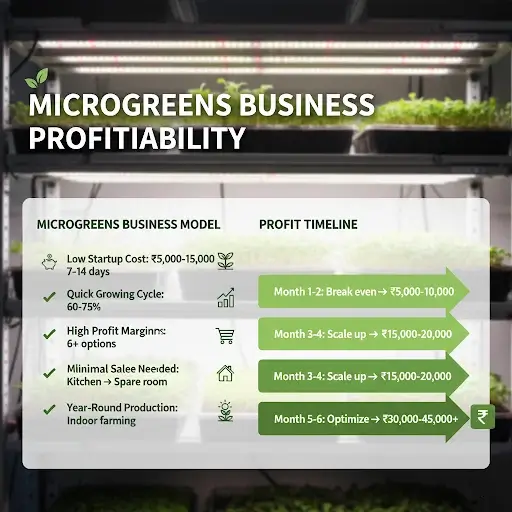
Starting a microgreens business requires minimal capital investment compared to traditional farming or food businesses. Initial setup costs range from ₹5,000 to ₹15,000, covering seeds, growing trays, grow lights (optional), and packaging materials. No expensive permits, commercial kitchen rentals, or specialized equipment are needed to begin.
The quick cash flow cycle distinguishes microgreens from other agricultural ventures. While traditional farming requires months between planting and harvest, microgreens mature in just 7-14 days. This rapid turnover means you can reinvest profits quickly and respond to market demand with agility.
India’s Growing Organic Food Market
India’s organic food market is experiencing explosive growth, expanding at 25% annually according to recent industry reports. Urban consumers, particularly in metro cities like Bangalore, Mumbai, Delhi, and Pune, are increasingly prioritizing health and nutrition, creating strong demand for fresh, locally-grown superfoods like microgreens.
The post-pandemic wellness boom has accelerated this trend. Health-conscious consumers now actively seek nutrient-dense foods, and restaurants are responding by incorporating premium microgreens into their menus to attract these customers.
Perfect for Small Spaces
Urban housing constraints don’t limit microgreens production. A kitchen counter, spare room, or balcony provides sufficient space to start. Unlike traditional vegetable gardening that requires outdoor plots, microgreens thrive indoors with controlled environments, making them ideal for apartment dwellers.
This urban farming model aligns perfectly with India’s rapid urbanization. As more people move to cities and seek sustainable living practices, home microgreens production offers a solution that combines entrepreneurship with environmental consciousness.
High Profit Margins
The economics of microgreens are compelling. Production costs per tray average ₹110-155, including seeds, growing medium, packaging, and electricity. A single tray yields 200-300 grams of microgreens, which retail for ₹350-500 per 100 grams.
This translates to profit margins of 60-70% on retail sales and 40-50% on wholesale to restaurants. Few home-based businesses offer comparable returns with such low investment and quick turnaround times.
Why 70% of Indian Home Sellers Stop in Month Two The 3 Assumptions That Kill the Business
I have spoken directly with home microgreens sellers across Hyderabad, Pune, Bangalore, and Delhi over the past two years. The pattern is consistent: Month 1 is exciting, Month 2 is a refrigerator full of unsold trays, and Month 3 is when they stop. Three assumptions cause this and none of them are addressed by any other guide.
Wrong Assumption 1: “I will post on Instagram and customers will find me.” Instagram builds an audience over 3–6 months. A home microgreens seller in Month 1 does not have 3–6 months of cash runway for audience-building. Instagram is a brand asset. WhatsApp Business is a sales channel. The conversion from awareness to order happens in a WhatsApp conversation, not in an Instagram DM. Every seller who told me they built sustainable income in Month 1 used WhatsApp. Every seller who told me they stalled built an Instagram account instead.
Wrong Assumption 2: “Once a restaurant tastes my product, they will order.” Restaurant kitchens in India have 3–5 supplier relationships that took months to establish. A cold delivery of samples at lunch service (12–3 PM) reaches a busy sous-chef who puts it in the fridge and forgets it within 6 hours. The approach that works: arrive at 3–5 PM gap, ask for the head chef by name, leave samples with your WhatsApp on the label, and return in exactly 48 hours with a specific question: “Did your team get a chance to try the radish?” The 48-hour follow-up has a 3× higher conversion rate than waiting for them to call you. They will not call you. You must return.
Wrong Assumption 3: “More varieties = more customers.” Every new variety adds seed inventory, a different germination schedule, different blackout timing, different harvest window, and different quality failure modes. A seller running 3 varieties has 3 quality risks. A seller running 8 varieties has 8 quality risks. Master radish, sunflower, and broccoli to consistent, sell-ready quality 9 out of 10 trays before you add a fourth. The market will not reward variety breadth in Month 1. It will reward consistency.
The October 2024 Lesson That Changed My Entire Production System
October 2024. I grew 12 trays instead of my usual 8, planning to approach two new restaurants that week. Sunflower came out perfectly thick, uniform, hulls shed cleanly, leaves fully open. By the time I finished packaging at 5:45 PM, restaurants were in dinner service. I could not visit.
I had 2.4 kg of perfectly grown microgreens in my refrigerator with no committed buyers for 1.4 kg of it. I sent a WhatsApp broadcast to my 22 existing customers: “Sunflower + radish harvested today 1.4 kg available, delivering tomorrow morning.” Within 90 minutes, 1.8 kg total was reserved across existing and new orders. The surplus was absorbed.
The remaining 600g I offered to the tiffin service operator in my building she had mentioned her clients liked garnishes two months earlier. She took it, liked it, and became a weekly 400g buyer for four months.
Two lessons I wrote in my growing notebook that night: First, your existing 20 customers are more valuable than your next 20 targets. Second, every food-adjacent person in a 2-km radius is a potential wholesale buyer you just have not listed them yet. Pre-sell every tray before you plant it. This is the system, and it changes everything.
Legal Requirements and Food Safety Compliance
Legal Requirements to Sell Microgreens from Home in India
The Food Safety and Standards Authority of India (FSSAI) governs food businesses in India, but small-scale home microgreens operations face minimal regulatory burden initially.
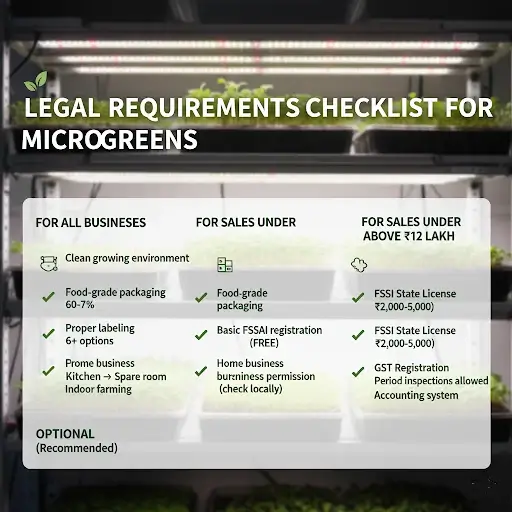
For Annual Sales Under ₹12 Lakh:
- Basic FSSAI registration is FREE
- Online application process takes 7-10 days
- Required documents: Aadhar card, PAN card, address proof, passport-size photo
- No physical inspection of home premises required initially
For Sales Above ₹12 Lakh Annually:
- State FSSAI license required (fees: ₹2,000-5,000)
- More detailed documentation needed
- Periodic inspections may occur
- Health and hygiene standards must be maintained
Important Note: Many home microgreens sellers operate informally under the ₹12 lakh threshold without immediate registration. However, obtaining basic registration from the start builds customer trust and legal protection.
Key Food Safety Practices
Even without immediate licensing requirements, following food safety standards protects your customers and reputation:
Growing Environment Cleanliness:
- Use clean, sanitized growing trays (reference your growing guide)
- Maintain pest-free growing areas
- Prevent cross-contamination from household activities
- Use food-grade growing mediums only
Water Quality:
- Use filtered or potable water for irrigation
- Avoid municipal water with high chlorine levels
- Test water periodically if using well or rainwater
Safe Handling During Harvest:
- Wash hands thoroughly before harvesting
- Use clean scissors or knives dedicated to harvesting
- Handle microgreens gently to prevent bruising
- Follow proper harvesting techniques to maintain freshness
Proper Storage:
- Refrigerate harvested microgreens immediately
- Store at 2-7°C to extend shelf life
- Implement optimal storage methods learned previously
- Never sell wilted or discolored microgreens
Labeling Requirements
If your operation qualifies as exempt under federal standards (similar to US cottage food exemptions adapted for India), minimal labeling suffices:
Minimum Label Information:
- Your business name and contact number
- Variety name (e.g., “Radish Microgreens,” “Sunflower Shoots”)
- Weight (in grams)
- Harvest date or “Best Before” date (typically 3-5 days from harvest)
- Storage instructions: “Keep refrigerated”
- Optional: “Organically grown” (if applicable)
Business Structure Considerations:
- Sole proprietorship works for most small-scale operations
- Register business name with local authorities (optional but recommended)
- Obtain GST registration if crossing ₹40 lakh annual turnover
- Consider business liability insurance as you scale
GST Registration: Required only if annual turnover exceeds ₹40 lakh (for goods). Most home microgreens sellers stay below this threshold for years. If you do cross ₹40 lakh, register at gst.gov.in the process is free and takes 3–5 days.Until then, issue handwritten receipts or use free invoicing apps like Vyapar
(free tier) or Zoho Invoice (free for up to 5 clients).
One-line verdict on licensing: Start selling. Get your basic FSSAI registration in your first week (free, takes 10 minutes at foscos.fssai.gov.in). Don’t let licensing paperwork delay your first sale basic registration covers you fully for your first 2–3 years of home-based selling.
Local Municipal Regulations
Check with your city’s municipal corporation regarding:
- Home-based business permissions
- Residential vs. commercial property use
- Any additional health department requirements
- Food vending licenses if selling at farmers’ markets
Most Indian cities permit small-scale home food businesses without special permits, but verification prevents future complications.
Setting Up Your Home Microgreens Business
Space Requirements and Setup
Transform any small area into a productive microgreens operation:
Kitchen Counter Setup (Beginner):
- Accommodates 4-8 trays
- Uses natural window light or one grow light
- Weekly production: 800g-1.6kg
- Potential monthly revenue: ₹10,000-15,000
Spare Room/Balcony Setup (Intermediate):
- Holds 20-30 trays on shelving
- Requires dedicated grow lights
- Weekly production: 4-6kg
- Potential monthly revenue: ₹30,000-45,000
Dedicated Room Setup (Advanced):
- Multi-tier shelving supporting 50-100 trays
- Commercial LED grow lights
- Climate control for consistency
- Weekly production: 10-20kg
- Potential monthly revenue: ₹50,000-75,000+
Equipment Investment Breakdown
Minimum Startup (₹5,000-8,000):
- Growing trays (10-15 pieces): ₹1,500-2,000
- Organic potting soil/cocopeat (20kg): ₹500-800
- Seeds variety pack (5-8 types): ₹1,500-2,500
- Spray bottle and basic tools: ₹300-500
- Packaging containers (50 pieces): ₹1,200-1,800
- Labels and markers: ₹200-400
Recommended Startup (₹12,000-15,000):
- All minimum items plus:
- Basic LED grow light: ₹3,000-5,000
- Metal shelving rack: ₹2,500-4,000
- Digital weighing scale: ₹800-1,200
- Additional seed varieties: ₹1,000-1,500
Choosing Your Microgreens Varieties for Selling

Not all microgreens sell equally well. Focus on these proven sellers in the Indian market:
Best Sellers for Restaurants:
- Radish microgreens – Spicy kick, fast growing (7-10 days), high demand
- Pea shoots – Sweet flavor, substantial texture, premium pricing (₹400-600/100g)
- Sunflower microgreens – Nutty taste, nutritional powerhouse, restaurant favorite
Best for Direct Consumer Sales:
- Broccoli microgreens – Health benefits (sulforaphane), mild flavor
- Wheatgrass – Juice bars and wellness customers, predictable demand
- Mixed greens – Variety packs appeal to home cooks trying microgreens
Profitable Specialty Varieties:
- Amaranth (red/purple) – Visual appeal, premium pricing
- Basil microgreens – Intense flavor, gourmet applications
- Coriander shoots – Familiar to Indian palate, home cooking staple
Start with 3-4 varieties to master quality and consistency before expanding your selection.
Where to Sell Microgreens in India : 7 Channels Ranked by Ease of First Sale
Most guides give you a list of channels. This section ranks them by how fast you can get your first paid order because that first ₹400 is more important than any strategy deck.
| Rank | Channel | Time to first sale | Avg order size | Commission/fee |
|---|---|---|---|---|
| 1 | WhatsApp broadcast to contacts | Day 1 | ₹400–800 | Zero |
| 2 | Housing society / building group | Day 1–3 | ₹300–600 | Zero |
| 3 | Direct restaurant visit (3–5 PM) | Day 5–14 | ₹1,500–4,000/week | Zero |
| 4 | Zomato Hyperpure | Week 3–6 (onboarding) | ₹2,000–8,000/week | ~12% |
| 5 | Swiggy Instamart | Week 2–4 (onboarding) | ₹400–1,200/order | 15–18% |
| 6 | Organic store consignment | Week 1–2 | ₹600–2,000/week | 25–30% |
| 7 | Sunday organic market | Weekend 1 | ₹1,500–5,000/day | ₹500–2,000 booth |
1. WhatsApp Broadcast – Your Only Day 1 Move
Before your first harvest, build a broadcast list of 20–30 people: family, neighbours, colleagues, gym contacts, building residents. Send one message the evening before harvest day:
“Hi , I grow pesticide-free microgreens at home in [area]. Fresh harvest tomorrow. Radish (₹380/100g), sunflower (₹450/100g), broccoli (₹400/100g). Limited stock. WhatsApp me if interested.”
Expect 3–6 replies from 20 contacts that’s your first ₹1,200–2,400. Do this before you approach a single restaurant.
Set this up properly, once:
- Create a WhatsApp Business account with a professional profile and business hours
- Use the Catalog feature to show varieties with prices
- Post weekly availability updates with photos, not more than once per week
- Once you have repeat buyers, offer a subscription: ₹1,200–1,400 for 4 weekly deliveries, or tiered pricing (single pack ₹400, weekly ₹350/pack, monthly ₹300/pack)
Instagram and local Facebook groups build an audience, but that takes 3–6 months treat them as a slow-burning brand asset you build in parallel, not your first-sale channel.
2. Housing Society / Building WhatsApp Groups
Your building WhatsApp group is your warmest audience they know you, trust you, and delivery is free since you just walk downstairs.
- Post a photo of your harvest with the price
- Don’t post more than once a week admins remove sellers who do
- Ask your immediate neighbours first, before posting to the full group
3. Direct Restaurant Visits (3–5 PM)

Restaurant kitchens already have 3–5 supplier relationships. A cold delivery during lunch service (12–3 PM) reaches a busy sous-chef who forgets about it within 6 hours. Here’s the approach that actually works:
Step 1 : Research (Day 1–3): List 10–15 target restaurants within 5–10km. Check their Instagram for menu items, note which ones already use garnishes or microgreens, and find the head chef’s name on social media.
Step 2 : Sample prep (Day 4–5): Harvest your best-quality trays, pack in clean clamshells with labels, and prepare a one-page info sheet (varieties, pricing, nutrition, your contact).
Step 3 : Delivery and pitch (Day 6–10): Visit Tuesday–Thursday, 3–5 PM only never weekends or service hours. Ask for the head chef by name. Your 20-second pitch:
“I’m [name] from [neighbourhood]. I grow fresh microgreens harvested same day. I’ve brought radish and sunflower samples. Can I leave these for your team? I’ll come back in exactly 48 hours for feedback.”
Step 4 : The 48-hour follow-up (non-negotiable): They will not call you. Return with: “Did your team get a chance to try the radish?” This single follow-up has a 3× higher conversion rate than waiting.
Expected order sizes: small cafe/juice bar 100–200g/week; mid-size restaurant 300–500g/week; high-volume restaurant 1–2kg/week.
Wholesale pricing: ₹250–350 per 100g (vs. ₹400–500 retail), with 10–15% off for 500g+ orders.
City-by-city demand notes (useful for prioritizing which restaurants to target first):
- Bangalore (Koramangala, HSR, Indiranagar): Highest restaurant demand in India IT crowd, premium buyers. Pea shoots and sunflower sell at ₹450–600/100g.
- Mumbai (Bandra, Juhu, Powai): Second-highest demand, but traffic limits you stay within a 3–5km delivery radius.
- Hyderabad (Gachibowli, Kondapur, Hitech City): Fast-growing, less competition than Bangalore. IT companies make strong corporate wellness clients.
- Pune (Koregaon Park, Viman Nagar, Baner): Best quality-of-life for a seller lower rent, accessible restaurants, strong organic culture.
- Delhi NCR (Gurgaon, Noida, South Delhi): Large market, highest price tolerance. Radish and broccoli sell fastest.
- Chennai (RA Puram, Besant Nagar, Adyar): Growing demand naturopathy clinics and health food stores are better first targets than restaurants here.
4. Zomato Hyperpure
Zomato’s restaurant ingredient supply platform the single most underused channel for Indian microgreens sellers, since restaurants order directly instead of you chasing chefs.
- Register at hyperpure.com → “Become a Supplier” → Fresh Produce
- Requirements: FSSAI registration, a consistent weekly supply commitment, minimum order value ₹2,000/restaurant/week
- One Hyperpure client = 500g–2kg/week guaranteed, digital invoicing, 7-day payment cycle
- Currently active in Bangalore, Mumbai, Delhi, Hyderabad, Pune, Chennai, Kolkata
5. Swiggy Instamart
Best for direct consumer sales at scale.
- Register at partner.swiggy.com → “Grocery & Fresh Produce”
- Requirements: FSSAI basic registration, product photos, standard packaging with label
- Payout: weekly UPI transfers; commission 15–18%
- Available in Bangalore, Mumbai, Delhi, Hyderabad, Pune, Chennai
- Realistic timeline: 2–4 weeks to get listed, 5–15 orders/week in month 1, scaling to 30–60/week by month 3–4 with good ratings
6. Organic Store Consignment
- Consignment: the store sells on your behalf and takes 25–30% commission; you keep ownership until it sells
- Wholesale: the store buys outright at a 30–40% discount, pays immediately, and takes on the spoilage risk
- Start with consignment to test demand, move to wholesale once volume is proven
- Approach: ask for the owner/manager directly, propose “I’ll provide fresh microgreens twice weekly, you keep 30%, I collect payment weekly,” and offer point-of-sale material and recipe cards for their customers
7. Sunday Organic Market
- Search “[your city] organic farmers market” on Instagram most have active pages with vendor registration links
- Booth fees: ₹500–2,000/day, usually booked 2–4 weeks ahead
- What sells fastest: mixed variety sampler packs (₹200–300 for 50g × 3 varieties) low price point, easy first purchase
- On the day: keep stock refrigerated in a cooler, offer free samples on toothpicks, accept UPI/Google Pay/PhonePe, and collect phone numbers for follow-up
- Major markets: Bangalore (Whitefield Organic Market, Saturday Santhe, Jayanagar Organic Mandi), Pune (Sunday Organic Farmers Market, Viman Nagar), Delhi NCR (IIC Farmers’ Market, Hauz Khas Organic Market), Mumbai (Bandra Farmers’ Market)
Also Worth Knowing: Corporate Wellness & Other Platforms
These don’t fit the “fastest first sale” ranking above, but they matter once you’re established:
- Corporate wellness programs: reach out to HR/wellness coordinators at IT companies and coworking spaces. A “Wellness Microgreens Box” for 20 employees runs ₹3,000–5,000/month this is B2B bulk, slower to close than a restaurant, but stable once secured.
- Blinkit: more complex onboarding than Swiggy, needs consistent daily stock best suited for Month 4+ sellers running 30+ trays/week.
- Dunzo Daily: lower volume than Swiggy, but less competition. List under “Fresh & Organic” at business.dunzo.com.
- Instagram Shopping: zero commission, full price to you, but takes 3–6 months to build meaningful organic traffic a long-term addition, not a launch channel.
Who Buys Microgreens in India? Complete B2B Buyer Guide
Understanding your buyer types determines your pricing, packaging, and approach. Here are every real buyer category active in India right now:
| Buyer type | What they pay | Order frequency | Payment terms | Best approach |
|---|---|---|---|---|
| Home consumer (health-conscious) | ₹350–480/100g | Weekly | Immediate (UPI) | WhatsApp broadcast |
| Restaurant / cafe | ₹240–320/100g | 2–3×/week | 7–15 day credit | In-person visit 3–5 PM |
| Cloud kitchen | ₹250–300/100g | Daily | 7-day credit | Email + WhatsApp |
| Organic store | ₹280–350/100g | Twice weekly | Consignment 7–14 days | Walk-in with samples |
| Corporate wellness (IT office) | ₹300–380/100g | Weekly bulk | Monthly invoice | HR email outreach |
| Naturopathy / Ayurveda clinic | ₹320–420/100g | Weekly | Immediate or 7 days | WhatsApp direct |
| Tiffin / dabba service | ₹200–260/100g | Daily | Weekly cash | Neighbour network |
| Yoga studio / gym | ₹300–380/100g | Weekly | Immediate | Walk-in with samples |
| Hotel restaurant | ₹280–360/100g | 3×/week | 30-day invoice | Zomato Hyperpure preferred |
| Zomato Hyperpure (aggregated) | ₹220–280/100g | Daily standing order | 7-day digital | hyperpure.com registration |
The buyer you are ignoring: tiffin service operators In every Indian apartment complex there is someone running a home tiffin service for 10–30 customers. They need garnishes and health add-ons. They buy weekly. They pay cash or UPI immediately. They are in your building. A single tiffin operator = 200–400g/week guaranteed, zero delivery cost, zero cold chain requirement. This is how my October 2024 surplus was solved the tiffin operator in my building became a ₹1,600/week buyer for four months from one conversation.
How to find microgreen buyers in your city – 5 practical methods:
Contact HR at IT companies in your city via LinkedIn search “HR manager [city IT company]” and send a 3-line message with a photo.
Search “[your city] health cafe” on Zomato and Instagram. Visit the top 10 with samples.
Search “[your city] organic store” on Google Maps. Call 5, visit 3.
Post in Facebook groups: “[City] Healthy Eating”, “[City] Organic Food”, “[City] Apartment Residents”. One post per group per week.
List on LocalCircles (community platform) in your pincode organic food requests appear regularly.
Pricing Strategy That Maximizes Profit
Cost Calculation Framework
Understanding your true costs enables profitable pricing:
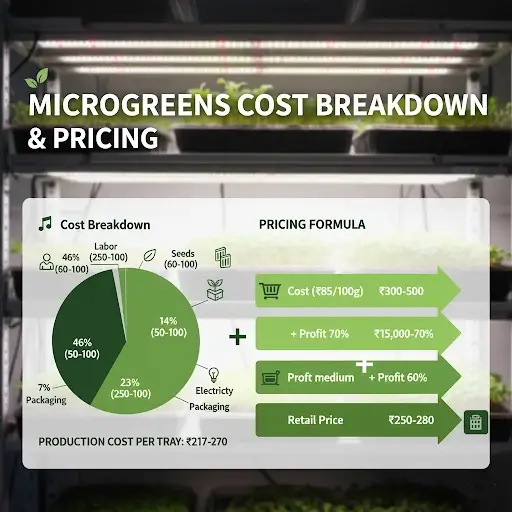
Per Tray Production Cost:
Seeds: ₹50-100
Growing medium: ₹30
Packaging container: ₹12-15
Electricity (grow lights): ₹20
Water: ₹5
Labor (30 min @ ₹200/hour): ₹100
──────────────────────────
Total Cost Per Tray: ₹217-270
Yield Per Tray: 200-300g (depending on variety)
Cost Per 100g: ₹75-90
Market-Based Pricing Research
Current India Retail Prices (November 2026):
- Bangalore: ₹350-500 per 100g
- Mumbai: ₹400-550 per 100g
- Pune: ₹300-450 per 100g
- Delhi NCR: ₹350-500 per 100g
Premium Varieties Command Higher Prices:
- Radish, broccoli: ₹300-400 per 100g
- Pea shoots, sunflower: ₹400-600 per 100g
- Specialty (amaranth, basil): ₹500-700 per 100g
Your Pricing Structure
Retail Pricing (Direct to Consumer):
- Standard varieties: ₹350-400 per 100g
- Premium varieties: ₹450-550 per 100g
- Mixed variety packs: ₹1,200-1,400 for 400g
Wholesale Pricing (Restaurants):
- Small orders (< 500g): ₹280-320 per 100g
- Bulk orders (500g-1kg): ₹250-280 per 100g
- Large recurring orders (> 1kg weekly): ₹220-250 per 100g
Subscription Discounts:
- Single purchase: Full retail price
- Weekly subscription (4 deliveries): 10-12% discount
- Monthly subscription (16 deliveries): 20-25% discount
Profit Margin Calculations
Retail Sales Example:
- Selling price: ₹400/100g
- Production cost: ₹85/100g
- Gross profit: ₹315/100g
- Profit margin: 79%
Wholesale Sales Example:
- Selling price: ₹280/100g
- Production cost: ₹85/100g
- Gross profit: ₹195/100g
- Profit margin: 70%
Competitive Positioning Strategies
Premium Positioning:
- Emphasize same-day harvest freshness
- Highlight organic growing methods
- Showcase nutritional superiority
- Provide exceptional customer service
- Price 10-15% above market average
Value Positioning:
- Match or slightly undercut competitors
- Focus on reliability and consistency
- Offer subscription savings
- Target price-conscious health seekers
- Build volume through competitive pricing
Niche Positioning:
- Specialize in rare varieties
- Serve specific dietary communities (vegan, keto, Jain)
- Premium pricing justified by uniqueness
- Educational content builds authority
Marketing Your Microgreens Locally and Online
Week-by-Week Launch Marketing Plan
Week 1: Establish Your Presence
Day 1-2: Set up business accounts
- Create Instagram business profile: @[YourCity]Microgreens
- Professional profile photo (your microgreens logo or attractive product shot)
- Bio: “Ultra-fresh microgreens | Same-day harvest | Home delivery in [Area] | Order via DM or WhatsApp: [Number]”
- Create WhatsApp Business account with business hours, location, catalog
Day 3-4: Content creation
- Photograph your growing trays, harvest process, packaged products
- Take 20-30 high-quality photos in natural light
- Write 10 Instagram captions about microgreens benefits
- Create story highlights: “About Us,” “Varieties,” “How to Order,” “Testimonials”
Day 5-7: Initial outreach
- Post first Instagram content (3-4 posts)
- Share your journey: “I’m launching [Business Name] to bring fresh, locally-grown microgreens to [City]. Here’s why I’m passionate about nutrition and sustainability…”
- Share to personal Facebook, WhatsApp status
- Ask friends/family for their support in sharing
Week 2: Build Awareness
- Post daily on Instagram (mix of product shots, growing process, nutritional info)
- Join 5-10 local Facebook groups (food lovers, health enthusiasts, apartment groups)
- Create promotional offer: “Launch Special: 20% off your first order + free delivery”
- Reach out to 5 target restaurants with sample deliveries
- Design simple flyer/business card (use Canva.com free templates)
Week 3-4: Drive First Sales
- Follow up with restaurants that received samples
- Run Instagram Stories polls: “Which variety should I grow next? Vote below!”
- Post customer testimonials (ask early customers permission)
- Share behind-the-scenes content: “Harvest day! Fresh [variety] ready for delivery”
- Offer referral incentive: “Refer a friend, both get ₹100 off”
- Create email/WhatsApp broadcast list from interested contacts
Content Marketing That Converts
Educational Content (Build Authority):
- “5 Ways to Use Microgreens in Indian Cooking”
- “Nutritional Comparison: Microgreens vs. Mature Vegetables”
- “How We Grow Pesticide-Free Microgreens at Home”
- “Storage Tips: Keep Your Microgreens Fresh for 5+ Days”
Engagement Content (Build Community):
- “Caption this!” posts with humorous microgreens photos
- Customer recipe shares: “See how @[customer] used our pea shoots!”
- Polls and questions: “Morning smoothie or evening salad?”
- “Tag someone who needs more greens in their life”
Sales Content (Drive Conversions):
- “Fresh harvest available DM to order”
- “Only 5 packs left of sunflower shoots this week!”
- “New variety alert: Try our spicy radish microgreens”
- “Subscription boxes now open save ₹500/month”
Hashtag Strategy for Local Reach
Location-Based:
- #BangaloreFoodie #PuneFoodBloggers #DelhiEats #MumbaiHealthyFood
- #[YourNeighborhood]Community (e.g., #KoramangalaFood #BandraFood)
Niche-Specific:
- #MicrogreensIndia #UrbanFarmingIndia #OrganicFoodIndia
- #FarmToTableIndia #SuperfoodsIndia #HealthyEatingIndia
Engagement:
- #SupportLocal #LocalBusiness #ShopLocal[City]
Use 15-20 hashtags per post, mixing high-volume (100K+ posts) with niche (1K-10K posts) for optimal reach.
Word-of-Mouth Strategies
Referral Program:
- Give existing customers: ₹100 off next order for each successful referral
- Give new customers: ₹100 off first order when referred
- Track referrals via unique codes or asking “How did you hear about us?”
Sampling Strategy:
- Deliver small bonus samples with orders: “Try our new variety!”
- Offer free samples at community events, yoga studios, gyms
- Partner with nutritionists/dietitians for client referrals
Customer Retention:
- Send personalized thank-you notes with first orders
- Remember customer preferences: “I know you love pea shoots growing extra this week!”
- Birthday/anniversary discounts for subscribers
- Monthly newsletter with recipes, tips, exclusive offers
Is Microgreens Business Profitable in India? Real Numbers
This is the question every potential seller actually wants answered before committing. Here are the honest numbers not best-case projections.
Per tray economics (standard 10×20 inch tray, Indian conditions):
| Cost item | Amount |
|---|---|
| Seeds (radish/sunflower/broccoli) | ₹50–100 |
| Growing medium (cocopeat) | ₹25–30 |
| Tray depreciation (₹120 tray ÷ 50 uses) | ₹2–3 |
| Packaging (clamshell + label) | ₹15–20 |
| Electricity (grow light if used) | ₹15–25 |
| Total cost per tray | ₹107–178 |
| Yield per tray | 200–280g |
| Retail revenue (₹380/100g avg) | ₹760–1,064 |
| Wholesale revenue (₹280/100g avg) | ₹560–784 |
| Net profit per tray (retail) | ₹582–957 |
| Net profit per tray (wholesale) | ₹382–677 |
| Profit margin | 72–85% retail / 55–68% wholesale |
Monthly income at different production scales:
| Scale | Trays/week | Monthly gross (mixed retail+wholesale) | Monthly net | Time/week |
|---|---|---|---|---|
| Beginner | 5 | ₹14,000–20,000 | ₹10,000–15,000 | 5–8 hrs |
| Growing | 15 | ₹42,000–58,000 | ₹30,000–42,000 | 12–15 hrs |
| Serious | 30 | ₹84,000–112,000 | ₹62,000–82,000 | 20–25 hrs |
| Commercial | 60+ | ₹1,60,000+ | ₹1,10,000+ | Full time |
The honest caveat what reduces your net: Delivery costs (₹30–80 per order if using bike delivery apps), packaging returns/losses (~5% of orders), unsold inventory in early months (budget 15–20% wastage for Month 1–2 until pre-selling system is established), and your own time (at ₹200–300/hour, 120 hours/year = ₹24,000–36,000 opportunity cost).
Real income timeline from my network (Indian sellers only):
Seller A, Bangalore (35-year-old homemaker, HSR Layout): Month 1: ₹9,200 (8 trays/week, 22 WhatsApp customers) Month 4: ₹38,000 (28 trays/week, 3 cafes + 35 direct customers) Month 9: ₹52,000 (40 trays/week, dedicated spare room setup)
Seller B, Hyderabad (IT professional, side income, Gachibowli): Month 1: ₹4,800 (5 trays/week, only WhatsApp) Month 3: ₹16,000 (12 trays/week, 1 corporate wellness client added) Month 6: ₹28,000 (20 trays/week, Zomato Hyperpure listing added)
Seller C, Mumbai (retired teacher, Bandra): Month 1: ₹6,400 (6 trays, building society + 2 organic stores) Month 5: ₹22,000 (18 trays, Swiggy Instamart + 3 regular customers) Stable at: ₹18,000–24,000/month (chose not to scale further)
The profitability verdict: Microgreens is profitable from Month 1 at even the smallest scale IF you pre-sell before you plant. The sellers who lose money in Month 1 all share one pattern: they grew first and looked for buyers after. Every gram of unsold microgreens after Day 5 is a total loss (you cannot store them longer). The pre-sell system eliminates this risk entirely.
For the full growing setup starter costs, variety selection, and the growing protocol itself see: Microgreens Business in India.
Packaging, Delivery, and Customer Service
Packaging Requirements for Food Safety and Freshness
Container Options:
Clear Plastic Clamshells (Most Popular):
- Sizes: 100g, 200g, 400g
- Cost: ₹12-25 per container
- Pros: Secure, see-through, stackable, reusable
- Cons: Not eco-friendly
- Suppliers: Amazon Business, IndiaMART, local wholesale markets
Biodegradable/Compostable Containers:
- Material: Bagasse (sugarcane fiber), bamboo, cornstarch
- Cost: ₹20-35 per container
- Pros: Eco-friendly marketing angle, appeals to conscious consumers
- Cons: Higher cost
- Suppliers: EcoWare Solutions, GreenLine packaging
Ziplock Pouches (Budget Option):
- Food-grade plastic pouches
- Cost: ₹5-8 per pouch
- Pros: Inexpensive, lightweight
- Cons: Microgreens crush easily, less professional
- Best for: Subscription customers who return/reuse containers
Labeling Best Practices
Required Information:
- Business name and phone number
- Variety name
- Weight (in grams)
- Harvest date
- “Best before” date (3-5 days from harvest)
- Storage instructions: “Keep refrigerated at 2-7°C”
Optional but Recommended:
- Quick recipe idea
- Nutritional highlights
- “Organically grown” or “Pesticide-free”
- Instagram handle / “Follow us @[handle]”
- “Share your recipe using #[YourBrandHashtag]”
Delivery Logistics
Self-Delivery (Recommended for Starting):
- Invest in insulated delivery bag (₹800-1,500)
- Use ice packs during summer months
- Deliver within 5-10km radius
- Batch deliveries by area: Mondays (South zone), Wednesdays (North zone)
- Schedule 2-hour delivery windows, communicate precisely
Third-Party Delivery:
- Use Dunzo, Porter, or local delivery services (₹40-80 per delivery)
- Customer pays delivery fee or build into pricing
- Only for high-value orders (₹500+)
- Quality risk: educate delivery partner on handling
Pickup Option:
- Offer self-pickup discount (₹50 off)
- Set specific pickup windows
- Clearly communicate pickup address/parking
Customer Service Excellence
Response Time:
- Reply to WhatsApp/DM inquiries within 1-2 hours during business hours
- Set auto-reply for after-hours: “Thanks for your message! We’ll respond by [time].”
Handling Complaints:
- Respond immediately with empathy
- Offer full refund or replacement, no questions asked
- Follow up: “Did the replacement meet your expectations?”
- Learn from feedback: Adjust growing/storage if pattern emerges
Building Loyalty:
- Remember repeat customer preferences
- Surprise occasional free upgrade: “We added extra pea shoots enjoy!”
- Ask for feedback: “How did you use the microgreens? We’d love to know!”
- Celebrate milestones: “You’re our 50th customer here’s a discount code!”
Scaling from Kitchen Counter to Commercial Operation

When to Scale: Reading the Signals
Signs You’re Ready to Expand:
- Selling out every week for 4+ consecutive weeks
- Turning away customers due to insufficient supply
- Consistent weekly revenue of ₹15,000+
- 5+ restaurant clients with recurring orders
- Subscription customers numbering 15+
- Growing process is efficient and consistent
Don’t Scale Too Early:
- Still experiencing quality issues or growing failures
- Customer base is inconsistent week-to-week
- Haven’t mastered 3-4 core varieties yet
- Financially unprepared for equipment investment
Scaling Production Systematically
Phase 1: Kitchen Counter to Spare Room (4-8 trays → 20-30 trays)
Investment needed: ₹15,000-25,000
- Metal shelving rack (3-4 tiers): ₹3,500-5,000
- 2-3 LED grow lights: ₹9,000-15,000
- Additional trays and supplies: ₹2,500-5,000
New capabilities:
- Weekly production: 4-6kg
- Revenue potential: ₹30,000-45,000/month
- Can serve 8-10 restaurant clients
- Time investment: 10-12 hours/week
Phase 2: Spare Room to Dedicated Room (20-30 trays → 50-100 trays)
Investment needed: ₹50,000-80,000
- Commercial-grade multi-tier racks: ₹15,000-25,000
- 5-6 full-spectrum LED lights: ₹25,000-40,000
- Walk-in refrigerator or large fridge: ₹15,000-20,000 (used)
- Increased seed/supplies inventory: ₹10,000
New capabilities:
- Weekly production: 10-20kg
- Revenue potential: ₹60,000-100,000/month
- Can serve 20+ restaurant clients
- Time investment: 20-25 hours/week
- May need part-time help
Staggered Planting for Steady Supply
Production Schedule Example:
- Monday: Plant 10 trays radish, 5 trays broccoli
- Wednesday: Plant 8 trays pea shoots, 5 trays sunflower
- Friday: Plant 10 trays radish, 5 trays mixed
- Sunday: Rest/maintenance
Harvest Schedule:
- Following Wednesday-Thursday: Harvest Monday plantings
- Following Friday-Saturday: Harvest Wednesday plantings
- Following Sunday-Monday: Harvest Friday plantings
This rotation provides 3 harvest days per week, ensuring restaurants receive 2-3 weekly deliveries and subscription customers get fresh microgreens on schedule.
Hiring Help: When and Who
When You Need Help:
- Spending 20+ hours/week on production
- Missing orders or quality slipping due to time constraints
- Ready to focus on sales/marketing while someone handles growing
Who to Hire:
- Family members (often most reliable for home business)
- Local students seeking part-time flexible work
- Homemakers in your neighborhood looking for supplemental income
What to Pay:
- ₹150-250 per hour for watering, harvesting, packaging tasks
- ₹5,000-10,000/month for 15-20 hours/week part-time help
- Document Standard Operating Procedures (SOPs) for consistency
Transitioning to Commercial Space
When Home Becomes Too Small:
- Consistent monthly revenue of ₹80,000-100,000+ for 6 months
- Demand exceeds home production capacity
- Ready to invest ₹2-5 lakhs in commercial setup
- Want to scale to ₹2-5 lakh/month revenue
Commercial Space Considerations:
- Rent small commercial space (150-300 sq ft): ₹8,000-15,000/month
- Upgrade to commercial licensing (FSSAI State License)
- Invest in proper HVAC for climate control
- Consider business loans or investor funding
Common Challenges and How to Overcome Them
Challenge 1: Inconsistent Orders and Revenue
Problem: Sales vary dramatically week-to-week, making production planning difficult.
Solutions:
- Focus on building subscription base (predictable revenue)
- Require restaurant clients to commit to minimum weekly orders
- Offer incentives for advance orders: “Order by Friday for Monday delivery, get 10% off”
- Diversify customer mix: Don’t rely on 1-2 big clients
- Build email/WhatsApp list for last-minute availability announcements
Challenge 2: Quality Control Issues
Problem: Mold growth, poor germination, or inconsistent quality damages reputation.
Solutions:
- Strictly follow growing best practices
- Maintain detailed records: seed batch, growing conditions, outcomes
- Source seeds from reliable suppliers only
- Implement quality checks before packaging
- Never compromise: Discard subpar trays rather than selling them
Challenge 3: Delivery and Logistics
Problem: Coordinating deliveries while managing growing operations is time-consuming.
Solutions:
- Batch deliveries by geographic area and day
- Set clear delivery windows: “Deliveries between 10 AM-12 PM”
- Use third-party delivery for distant customers
- Offer pickup option for customers near your location
- Invest in insulated bags and proper cold chain management
Challenge 4: Pricing Pressure from Competitors
Problem: New competitors undercut your prices, tempting customers to switch.
Solutions:
- Compete on quality and service, not just price
- Educate customers about your superior freshness (same-day harvest)
- Build personal relationships that transcend price
- Offer value-adds: recipe cards, growing tips, loyalty discounts
- Focus on niche varieties competitors don’t offer
Challenge 5: Seasonal Demand Fluctuations
Problem: Demand drops during certain months or festivals.
Solutions:
- Adjust production down during predictable slow periods
- Promote summer recipes: “Microgreens smoothie bowls beat the heat!”
- Offer seasonal variety rotations to maintain interest
- Use slow periods for equipment maintenance, experimenting with new varieties
- Build inventory of shelf-stable products: dried microgreens powder (future opportunity)
Real Success Stories from Indian Microgreens Sellers
Case Study 1: Keerthi’s Bangalore Balcony Business
Background: Keerthi, a 32-year-old software professional in Bangalore, started growing microgreens during the 2020 lockdown as a hobby.
The Journey:
- Month 1: Learned to grow on her apartment balcony with 6 trays
- Month 2: Delivered first paid order to a neighbor (₹400)
- Month 3: Approached 3 local cafes, secured 2 as regular clients
- Month 6: Quit side consulting, focused entirely on microgreens
- Month 12: Earning ₹35,000/month with 8 restaurant clients + 20 subscription customers
Key Success Factors:
- Focused on pea shoots and sunflower (premium varieties)
- Built strong relationships with head chefs through consistent quality
- Used Instagram effectively with beautiful food photography
- Offered same-day delivery within 5km radius
Current Status: Works 15 hours/week, reinvesting profits to expand to a spare bedroom setup.
Case Study 2: Rajesh and Meena’s Pune Partnership
Background: Married couple in Pune, both working remotely, sought additional income during pandemic.
The Journey:
- Month 1-2: Converted spare bedroom into growing room (20 trays)
- Month 3: Launched Instagram, built following of 500+ locals
- Month 4: Started subscription model with 10 customers
- Month 6: Expanded to farmers’ market presence every Sunday
- Month 12: 40 weekly subscription customers, ₹45,000/month revenue
Key Success Factors:
- Rajesh handled growing/operations, Meena managed marketing/delivery
- Created “Microgreens Box of the Week” with variety rotation
- Emphasized organic, pesticide-free growing in all marketing
- Built community through WhatsApp group for subscribers
Current Status: Planning to hire part-time help to double production.
Lessons from These Success Stories
Common Patterns:
- Started small: Both began with minimal investment and kitchen/balcony setups
- Quality first: Obsessed with growing perfect microgreens before scaling
- Relationship focus: Built personal connections with customers and restaurant clients
- Marketing consistency: Posted regularly on social media, engaged community
- Reinvestment mindset: Plowed profits back into equipment and expansion
- Patience: Didn’t expect overnight success; built steadily over 6-12 months
Key Differences in Approach:
- Keerthi focused on B2B (restaurants), Rajesh/Meena focused on B2C (subscriptions)
- Both models worked successfully with different time investments and margins
Your 30-Day Action Plan to First Sale

Follow this step-by-step roadmap to launch your microgreens business and secure your first paying customer within 30 days.
Week 1: Preparation and Setup
Day 1-2: Business Planning
- ☐ Decide on 3-4 starter varieties (recommend: radish, broccoli, pea shoots)
- ☐ Calculate startup budget (₹8,000-15,000)
- ☐ Choose business name
- ☐ Set revenue goal: ₹10,000-15,000 in Month 1
Day 3-4: Equipment and Supplies
- ☐ Order/purchase growing trays, seeds, growing medium
- ☐ Buy packaging containers (50 units to start)
- ☐ Create simple labels (use Microsoft Word/Canva templates)
- ☐ Set up dedicated growing space
Day 5-6: Digital Presence
- ☐ Create Instagram business account (@[YourCity]Microgreens)
- ☐ Set up WhatsApp Business with catalog
- ☐ Design simple logo (use Canva free templates)
- ☐ Write business bio emphasizing local, fresh, organic
Day 7: Production Start
- ☐ Plant first 8-10 trays (mix of varieties)
- ☐ Document process with photos for social media
- ☐ Review growing guide to ensure proper techniques
Week 2: Marketing Foundation and Production
Day 8-10: Content Creation
- ☐ Take 20+ photos of growing trays, seeds, process
- ☐ Write 5 Instagram captions about microgreens benefits
- ☐ Post first 2-3 Instagram posts
- ☐ Share to personal Facebook, WhatsApp status
Day 11-12: Market Research
- ☐ Visit 3-5 local cafes/restaurants, note their menus
- ☐ Check if they currently use microgreens or garnishes
- ☐ Collect business cards, note head chef names
- ☐ Research competitors: Who else sells microgreens in your city?
Day 13-14: Prepare for Harvest
- ☐ Monitor microgreens growth daily
- ☐ Order/prepare packaging materials
- ☐ Print labels with business info
- ☐ Calculate exact cost per 100g to set pricing
Week 3: First Harvest and Outreach
Day 15-17: Harvest and Package
- ☐ Harvest your first trays using proper techniques
- ☐ Package in attractive containers with labels
- ☐ Take professional photos of packaged products
- ☐ Prepare sample packs for restaurants (50-100g each)
Day 18-20: Restaurant Outreach
- ☐ Visit 5 target restaurants with sample deliveries
- ☐ Use 30-second pitch script (from earlier section)
- ☐ Leave samples with contact information
- ☐ Document each interaction: date, restaurant, person contacted
Day 21: Social Media Push
- ☐ Post “Now Available” announcement on Instagram
- ☐ Share in 3-5 local Facebook groups
- ☐ Send WhatsApp broadcast: “Launching [Business Name]! First 10 customers get 20% off”
- ☐ Ask friends/family to share and support
Week 4: Follow-Up and First Sales
Day 22-24: Restaurant Follow-Up
- ☐ Call or revisit restaurants that received samples
- ☐ Ask for feedback: “Did your chef have a chance to try the samples?”
- ☐ Propose trial order: “Would you like to start with 200g weekly?”
- ☐ Be prepared to negotiate pricing, answer questions
Day 25-26: Direct Sales Push
- ☐ Respond to all Instagram DMs and inquiries within 1 hour
- ☐ Offer limited-time launch discount (20% off first order)
- ☐ Arrange first deliveries or pickups
- ☐ Provide exceptional service: early arrival, bonus samples
Day 27-28: First Delivery and Feedback
- ☐ Deliver or arrange pickup for first orders
- ☐ Include thank-you note: “You’re customer #[1][2][3]! Thank you for supporting local.”
- ☐ Ask for feedback and permission to share testimonial
- ☐ Request referrals: “Know anyone else who’d love fresh microgreens?”
Day 29-30: Evaluate and Plan Next Month
- ☐ Calculate revenue from Week 4
- ☐ Assess what worked: Which channel got best response?
- ☐ Plan production for Month 2 based on confirmed orders
- ☐ Plant next round of trays (increase quantity if demand warrants)
- ☐ Celebrate first sales milestone!
Expected Outcomes After 30 Days:
- 2-5 restaurant clients with trial or small recurring orders
- 3-8 direct consumer customers (one-time or subscription)
- ₹5,000-12,000 in revenue (depending on volume)
- Established social media presence with 100-300 local followers
- Production rhythm and quality consistency established
FAQs About Selling Microgreens from Home
Do I need FSSAI license to sell microgreens from home in India?
For sales under ₹12 lakh annually, basic FSSAI registration is free and optional. For sales above ₹12 lakh, State FSSAI license is required (₹2,000-5,000 fee).
How much money can I make selling microgreens from home?
Beginners typically earn ₹10,000-15,000/month. With 20-30 trays per week, you can earn ₹30,000-45,000/month. Experienced growers with 50+ trays earn ₹50,000-75,000/month.
How much does it cost to start a microgreens business?
Initial investment ranges from ₹5,000-15,000, covering seeds, trays, growing medium, packaging, and basic supplies. No commercial kitchen or expensive permits needed.
How much can I earn selling microgreens from home in India?
Real income range by production scale: 5 trays/week = ₹8,000–12,000/month net. 15 trays/week = ₹28,000–42,000/month net. 30 trays/week = ₹60,000–80,000/month net. These are conservative net figures after costs. Most sellers reach 15 trays/week by Month 3–4 when they have 15–20 regular customers. The jump to 30 trays/week happens when a restaurant or corporate client commits to a weekly standing order. Timeline from ₹0 to ₹10,000/month: 4–6 weeks if you pre-sell before planting.
Which microgreens sell the most in Indian cities?
Based on actual seller data across Bangalore, Mumbai, Pune, Hyderabad, and Delhi: Radish microgreens sell fastest spicy flavour works in Indian cooking, 7-day cycle means fastest cash turnover. Sunflower shoots command the highest price (₹450–600/100g) restaurants love them for plating. Broccoli microgreens have the strongest repeat purchase rate health-conscious buyers buy them specifically for sulforaphane content. Pea shoots have the sweetest flavour and are easiest to upsell to home consumers. Wheatgrass is best for juice bar clients predictable demand, predictable volume.
What is the demand for microgreens in India right now?
The demand is high and supply is severely limited in every Indian metro. Restaurant chefs currently pay ₹600–900/100g for imported dried microgreens because consistent local fresh supply does not exist in most cities. That price gap between fresh local (₹260–320/100g wholesale) and imported dried (₹600–900/100g) is your entire business case. Corporate wellness programs in IT corridors are the fastest-growing demand source in 2025–2026. The market is undersupplied in every city outside Bangalore.
How do I find microgreen buyers in my city?
Five methods that work: (1) WhatsApp broadcast to 20–30 personal contacts before your first harvest expect 3–5 orders. (2) Post in your building/society WhatsApp group neighbours are the warmest audience. (3) Visit restaurants at 3–5 PM on a weekday with a 50g sample pack ask for the head chef. (4) Search “[your city] organic store” on Google Maps call 5, visit 3 with samples. (5) Register on Zomato Hyperpure as a fresh produce supplier restaurants come to you. Start with methods 1 and 2 before spending any time on the others.
What is the profit margin on microgreens in India?
Retail profit margin: 72–85%. Wholesale to restaurants: 55–68%. These are consistent across Indian sellers because production costs are low (₹107–178/tray) and market prices are high (₹350–480/100g retail). For comparison: restaurant food businesses typically run 15–35% margins. The main margin risk is unsold inventory microgreens unsold after Day 5 are a 100% loss. Pre-selling before planting eliminates this risk and keeps margins at their theoretical maximum.
Can I sell microgreens on Zomato, Swiggy, or Instagram in India?
Yes to all three. Zomato Hyperpure (hyperpure.com) is Zomato’s restaurant ingredient supply platform register as a fresh produce supplier. One Hyperpure listing can connect you to 20–50 restaurants. Swiggy Instamart (partner.swiggy.com) is for direct consumer sales 15–18% commission, weekly UPI payouts, available in Bangalore/Mumbai/Delhi/Hyderabad/Pune/Chennai. Instagram Shopping connects your profile to a product catalogue customers browse varieties and order via WhatsApp or direct checkout. No commission, full price to you, but requires 3–6 months to build meaningful organic traffic. Recommended sequence: WhatsApp first (Day 1), Zomato Hyperpure (Month 2), Swiggy Instamart (Month 2–3), Instagram Shopping (Month 3+).
Conclusion: Transform Your Home Into a Profitable Microgreens Business
Selling microgreens from home represents one of the most accessible and profitable opportunities in India’s booming organic food market. With startup costs under ₹15,000, minimal space requirements, and profit margins exceeding 300%, this home-based business model empowers homemakers, freelancers, and aspiring entrepreneurs to generate ₹15,000-50,000+ in monthly income.
The journey from hobby grower to successful microgreens seller requires mastering three core pillars:
Quality Production: Apply the growing techniques and harvesting/storage methods you’ve learned to ensure consistently excellent product that justifies premium pricing and builds customer loyalty.
Strategic Marketing: Leverage multiple sales channel direct consumer delivery, restaurant wholesale, farmers’ markets to diversify revenue and reduce dependence on any single customer segment. Build genuine relationships through social media, face-to-face interactions, and exceptional customer service.
Operational Excellence: Maintain food safety standards, implement efficient production systems, and scale systematically as demand grows. Start small, prove the model, then reinvest profits into equipment and expansion.
The 30-day action plan provided equips you with a clear roadmap to your first sale. Success stories from Keerthi in Bangalore and Rajesh/Meena in Pune demonstrate that ordinary people with no farming background have built thriving microgreens businesses from their homes.
Your Next Step: Pre-Sell Before You Plant
Before you plant your next tray, do this one thing: build your pre-sell list.
Open WhatsApp. Go through your contacts. Write down every person who has ever asked about your microgreens, mentioned healthy eating, lives near you, or works in food. Aim for 15–20 names. That is your first broadcast list.
Send them this message today (not after your next harvest today):
“Hi [name] – I’m starting to sell fresh microgreens from home in [your area]. Pesticide-free, harvested same day. Available: radish (₹380/100g), sunflower (₹450/100g), broccoli (₹400/100g). Delivering [day]. Would you like to try a pack?”
Whatever replies you get in the next 48 hours tells you your real demand before you plant a single seed. This is the pre-sell system. This is what separates sellers who build a business from growers who have a refrigerator full of unsold microgreens.
If you try this or anything from this guide share what happened in the comments below. Which city are you in? Which channel worked first? I read every comment and reply to questions about Indian-specific situations.
Share your journey in the comments below: What excites you most about starting your microgreens business? What challenges do you anticipate?
Your first harvest and first sale awaits just 7-14 days away. Start planting today, and transform your spare room, balcony, or kitchen counter into a profitable microgreens operation.