
Priya Harini B · Madanapalle, Andhra Pradesh · 4+ years container gardening, 40+ plant varieties, 38+ containers tracked
A microgreens business in India can realistically start with ₹12,000–₹18,000 for 20 trays, reaching ₹15,000–₹30,000 monthly profit within 60–90 days. India’s microgreens market itself was valued at USD 73 million (₹609 crore) in 2024, growing at 7.86% annually (IMARC Group). Each tray costs ₹110–₹155 to produce, yields 200–300g, and sells at ₹350–₹500 per 100g retail. First harvest: 8–12 days. FSSAI Basic Registration costs ₹100/year.
Table of Contents
Introduction
Every microgreens trainer in India will tell you that you need 50 trays to be profitable and that is precisely the lie that will cost you ₹18,000 and six weeks of your life before you figure out they were selling you a course, not a business. If you’re searching for how to actually start a microgreens business in India, not a masterclass funnel, this guide is built entirely from 180+ tray harvests I’ve tracked on my own Madanapalle terrace since June 2022, plus real growers I’ve personally helped diagnose across cities from Madanapalle to Banjara Hills.
Let me tell you what June 2022 smells like.
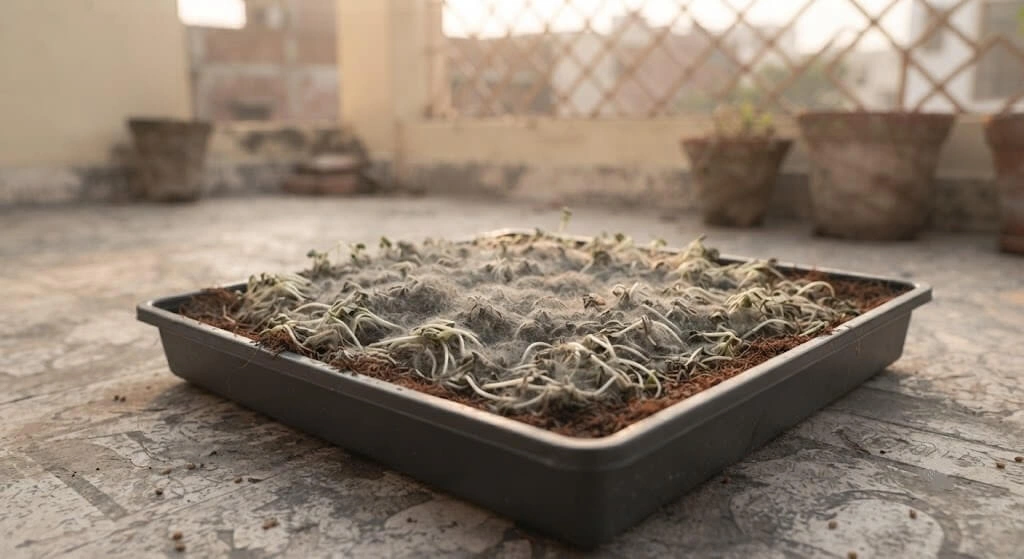
It smells like wet grey fungus on ₹2,200 worth of sunflower seeds, on fourteen trays that took me three weeks to plan and forty-eight hours to lose. I sat on my Madanapalle terrace at 7 AM with a cup of chai that had gone cold, looking at what had been a careful, hopeful experiment and was now, unmistakably, a composting disaster.
I had done everything the guides said. I had soaked my seeds overnight, filled my trays with a cocopeat and vermicompost mix at the exact ratio I’d read about three times, nested my blackout trays perfectly, and been misting twice a day with the dedication of someone who’d just bet real money on a new idea because I had.
What none of those guides mentioned not a single one was that they had been written in October, in Pune, in a climate-controlled room, by people who had never grown anything in June in Andhra Pradesh, where the monsoon arrives with 88% ambient humidity and skipping a fan isn’t a minor oversight it’s a death sentence for every seedling on your rack.
By Day 4, the surface of every tray looked like someone had unrolled a grey carpet across it Pythium damping-off, a water mould that collapses seedling stems at the base before you can do anything about it. By Day 5, all fourteen trays were headed for my compost bin.
My neighbour Suresh, who grows methi commercially two streets away and has the calm certainty of a man who’s seen every possible plant catastrophe, came up the stairs, looked at the grey disaster, and said something I’ve never forgotten: “Priya, you watered for the plant you grew last month, not the weather you have today.”
He was right. That failure cost me ₹2,200, one café order, and six weeks of momentum. What it bought me was the only real education available in this business: a specific, located, seasonal understanding of what microgreens actually need in Indian conditions not general conditions, not international conditions. Indian conditions: your terrace, your borewell, your June, your monsoon.
This guide covers how to actually build and run the operation. For market size, demand signals, and city-by-city buyer pricing data, see the companion guide: India Microgreens Market.
What Microgreens Actually Are And Why the India Opportunity Is Real
Microgreens are seedlings of vegetables, herbs, and grains harvested 8–15 days after germination, just after the first set of true leaves appears, typically 3–5cm tall at harvest the plant’s most nutrient-dense stage, small in size but rich in phytonutrients.
What makes them financially interesting is that same nutrition argument combined with how fast they grow. A seed that costs ₹2 to grow becomes a product worth ₹15–₹25 in 10 days not magic, just a short biological cycle combined with premium positioning in a market that barely existed in India five years ago.
The market data backs this: IMARC Group values India’s microgreens market at USD 73 million in 2024 (roughly ₹609 crore), projected to reach USD 157.7 million by 2033 at a 7.86% CAGR. That growth is driven by exactly the people showing up at urban farmers’ markets now gym-going 20-somethings in Hyderabad, expecting mothers in Chennai reading about folic acid in wheatgrass, chefs in Bangalore hotel kitchens sourcing local garnish alternatives to imported herbs.
But here’s the uncomfortable truth most guides skip: the opportunity is real, and most first-time growers will still fail not because the crop is difficult, but because they start growing before they start selling. This guide shows the other order.
Is a microgreens business profitable in India?
Yes, for growers who confirm buyers before scaling a 20-tray home setup can realistically reach ₹15,000–₹30,000 monthly profit within 60–90 days, based on tracked production and sales records.
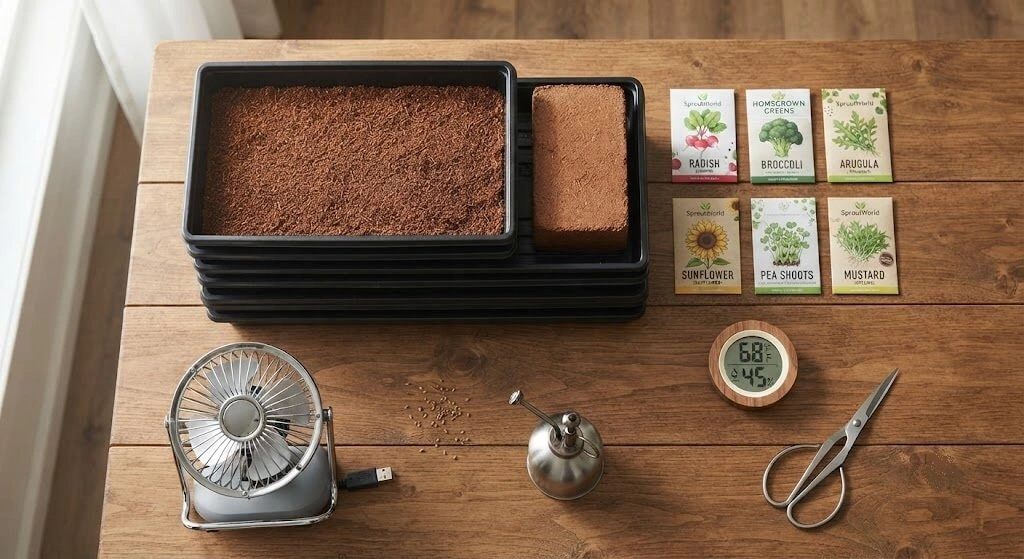
The ₹15,000 Starter Setup : Every Item, Every Price
This setup is designed to grow 10–15 trays per cycle, prove your market with real customers, and generate positive cash flow within 45–60 days. It’s not built to make you rich in Month 1 it’s built to not lose money in Month 1 while you build the customer base that scales from Month 3 onward.
The Shopping List
| Item | Specification | Cost ₹ | Where to Buy |
|---|---|---|---|
| Growing trays (10×20 inch) | Solid bottom + perforated drain tray set, polypropylene | ₹40–₹60 per pair | Amazon India, local plastic dealer |
| Metal wire rack | 5-tier, 180×90cm, holds 30+ trays | ₹2,500–₹3,500 | Amazon India, Pepperfry |
| Cocopeat bricks | 650g compressed brick (expands to 8–9L) | ₹40–₹60 each | Ugaoo, Nurserylive, agri shop |
| Vermicompost | 5kg bag, TNAU-certified where available | ₹180–₹250 | Local agri shop, Nurserylive |
| Starter seeds (5 varieties) | Radish, mustard, sunflower, peas, fenugreek (methi) | ₹800–₹1,500 | AllThatGrows, Ugaoo, Amazon India |
| Table fan | 400mm, 3-speed, for airflow | ₹800–₹1,200 | Local electronics |
| Spray bottle (2L) | For misting during germination | ₹80–₹120 | Amazon India |
| LED grow lights (optional) | Full-spectrum, T5 fluorescent or panel | ₹1,500–₹3,000 | Amazon India |
| Food-safe packaging | 100g clamshell boxes ×100 | ₹600–₹900 | Amazon India, local packaging supplier |
| Weighing scale | 0.1g precision, food-grade | ₹600–₹900 | Amazon India |
| Spray disinfectant | Food-safe hydrogen peroxide, 3% dilution | ₹200–₹300 | Medical store |
| FSSAI Basic Registration | Annual fee for turnover under ₹12 lakh | ₹100/year | fssai.gov.in |
Total starter setup: ₹12,000–₹18,000
If you’re growing in a south-facing terrace room in summer (Andhra, Tamil Nadu, Telangana), the fan is non-negotiable. If your terrace gets 4+ hours of indirect light daily, skip the LED lights for now.
The 5 Microgreens to Start With, And 3 to Avoid Until Month 4
I’ve grown 22 microgreen varieties in Madanapalle across four seasons. Some were disasters that taught me plenty. These five are what I’d tell any new Indian grower to start with, because they’re fast, forgiving, and actually sell.
Your First Crop List
| Variety | Sow to Harvest | Cost per Tray | Sell Price per 100g | Why Start With This |
|---|---|---|---|---|
| Radish (mooli) | 6–8 days | ₹30–₹45 | ₹300–₹400 | Fastest cash flow, easy germination, high yield |
| Fenugreek (methi) | 8–10 days | ₹25–₹35 | ₹250–₹350 | Indian kitchens already know the taste zero education needed |
| Mustard (rai) | 6–9 days | ₹20–₹30 | ₹250–₹300 | Grows in any light condition, monsoon-proof |
| Peas (matar shoots) | 10–14 days | ₹60–₹80 | ₹400–₹500 | Premium product, chefs love them |
| Sunflower | 10–12 days | ₹45–₹65 | ₹350–₹450 | High yield, nutty flavour, sells well at farmers’ markets |
Avoid These Until Month 4
Broccoli microgreens are nutritionally superior but slow (12–14 days), have expensive seeds (₹150–₹200 per tray), and need customers already educated enough to pay ₹600–₹800 per 100g build your base first.
Basil is a mucilaginous seed that gets slimy when wet and demands humidity control most beginners don’t yet have. One slimy batch and most people abandon it entirely.
Amaranth photographs beautifully and is almost impossible to sell in most Indian Tier-2 cities nobody knows what to do with it yet. Save it for Month 6, once you’re supplying boutique hotels.
Which microgreens are most profitable in India?
Per-tray profit from my own tracked data, in descending order: pea shoots (₹1,000–₹1,270), sunflower (₹850–₹1,005), radish in cool season (₹880–₹975), radish in summer (₹650–₹700), and methi (₹467–₹672).
The Growing Method That Works in Indian Conditions
This is the system I use for every tray on my Madanapalle terrace, adapted for Indian humidity, Indian cocopeat quality, and summer temperatures between 36–42°C.
What You Need per Tray
| Item | Quantity | Cost ₹ |
|---|---|---|
| Cocopeat (expanded) | 1.5–2L (from ½ brick) | ₹20–₹30 |
| Vermicompost | 200–300g (20% of mix) | ₹10–₹15 |
| Seeds (radish example) | 15–20g | ₹8–₹12 |
| Water | 100–150ml for germination | ₹0 |
| Food-safe spray | 2–3 sprays | ₹1–₹2 |
| Tray pair | 1 solid + 1 perforated | ₹40–₹60 (reused 15–20 cycles) |
Tray cost per harvest: ₹110–₹155
Step-by-Step Protocol
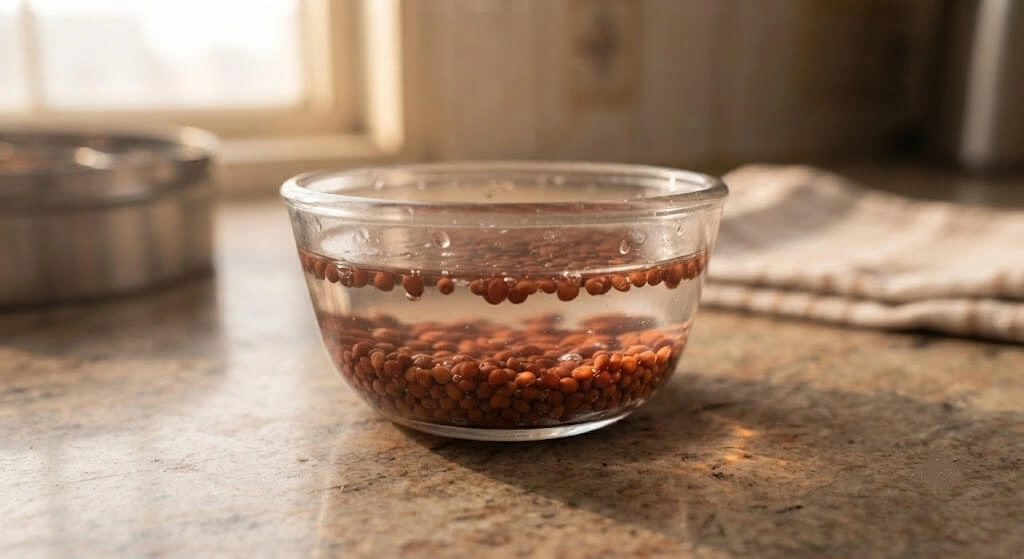
- Soak seeds 2–4 hours for radish and mustard, 8–12 hours for peas and sunflower. Soaking cuts germination time by 30–40% and improves germination rate from roughly 70% to 90%+. Cost: ₹0.

- Disinfect your trays. Spray a 3% hydrogen peroxide solution, let sit 5 minutes, rinse. Skip this once and you’ll learn what mould smells like at 3 AM. Cost: ₹2 per tray.
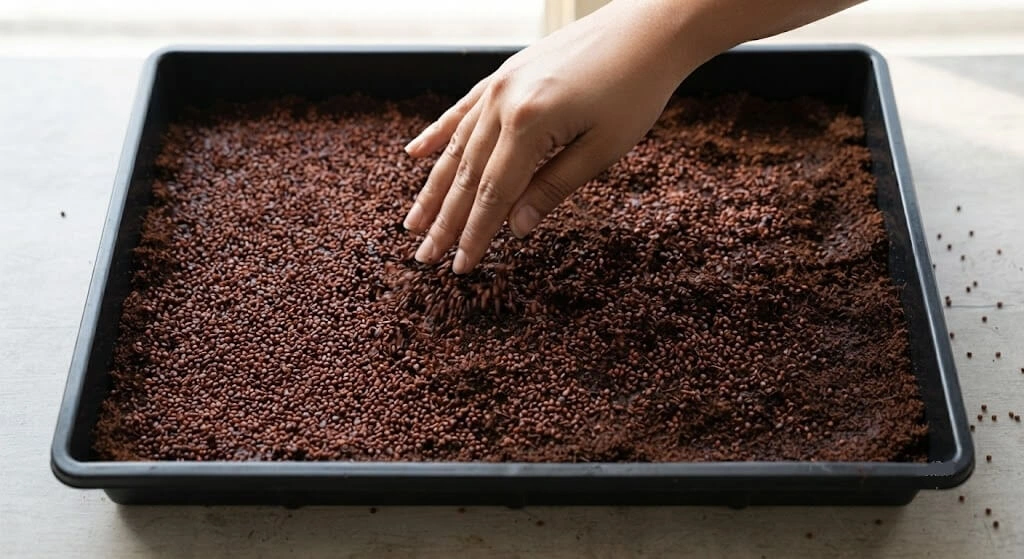
- Mix your growing medium 80% expanded cocopeat + 20% vermicompost. Fill the perforated tray to 2cm depth. Don’t pack tightly; cocopeat needs air pockets. Cost: ₹30–₹45.
- Spread seeds evenly, single layer, touching but not stacking. For radish: 18–22g per 10×20 inch tray. Cost: ₹8–₹12.
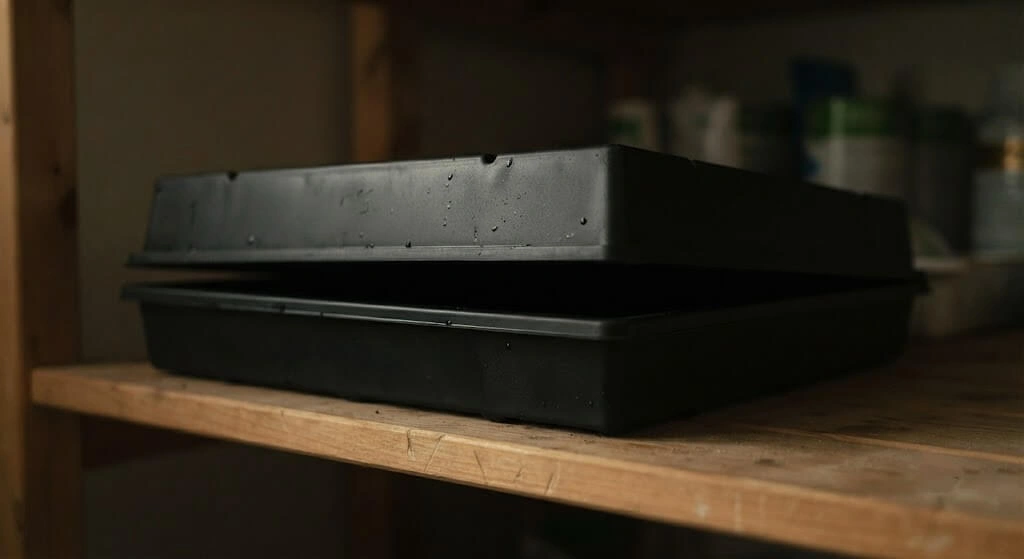
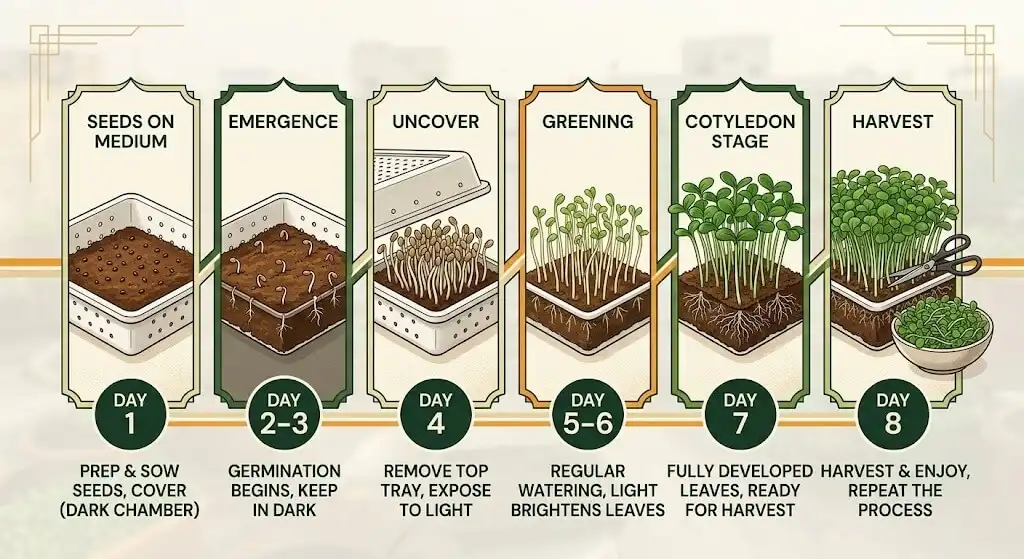
- Mist and blackout. Spray 60–80ml of water evenly, then nest the solid bottom tray upside-down on top to create darkness and humidity. Duration: 2–3 days for most varieties.
- Check and vent daily. Lift the top tray every morning around 6 AM, check for root development, and mist lightly only if the medium feels dry. In monsoon months, ambient humidity in Andhra is often already sufficient.
- Move to light once roughly 80% of seeds have germinated (visible white shoots, 1–2cm tall). Remove the blackout tray and place in indirect bright light or under LED grow lights greening (chlorophyll development) takes 24–48 hours in good light. Cost: ₹3–₹6/day for LED electricity.
- Bottom water only. Pour 100–150ml into the solid tray below the perforated one roots wick up what they need. Top-watering in Indian humidity triggers fungal problems faster than anything else I’ve encountered; this single change cut my crop losses by roughly 60% in Year 2.
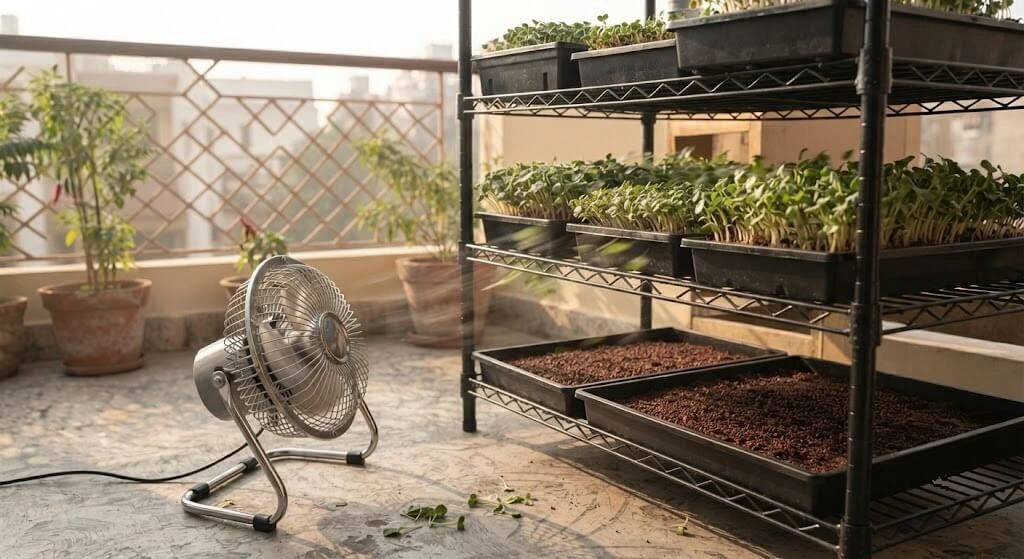
- Run your fan for 6–8 hours daily minimum, 14–18 hours during monsoon. This isn’t optional it’s the difference between a crop and a compost bin.
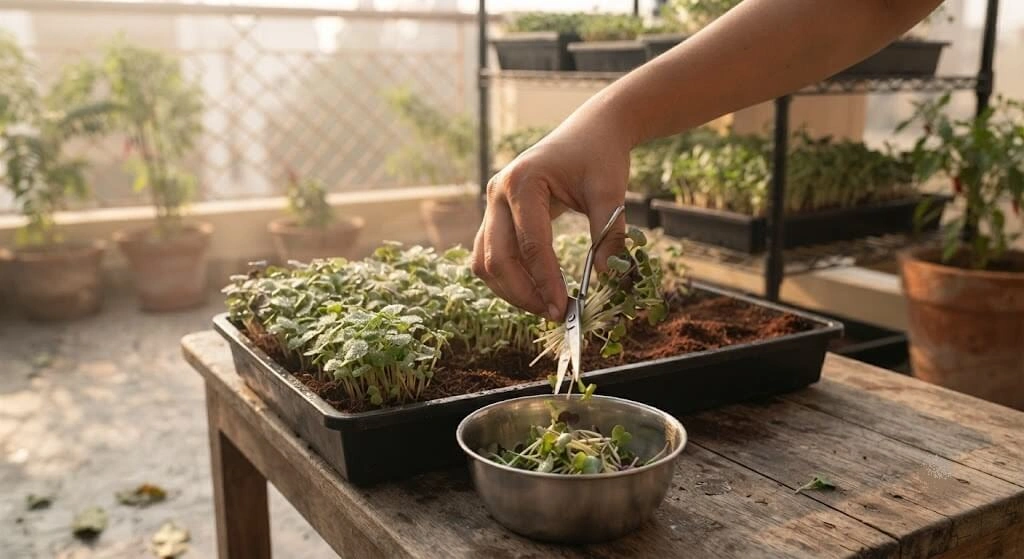
- Harvest at the cotyledon stage when the first pair of leaves is fully open and upright, not the true leaves, which is too late. Cut with sharp, clean scissors 0.5cm above the medium. Morning harvests before 8 AM give the crunchiest stems and longest shelf life.
Do NOT: top-water after Day 3 (triggers damping-off in Indian humidity) · harvest wet let leaves dry 30 minutes before packaging · reuse growing medium without sterilising old cocopeat holds pathogens · overcrowd seeds it drops yield by 30–40%.
Total time per tray: 15 minutes active work spread across 8–12 days. Total cost per tray: ₹110–₹155. Expected yield: 200–300g. Revenue per tray (retail): ₹700–₹1,500.
If you’re also growing vegetables in containers on your terrace alongside your microgreens setup, the Container Size Calculator on this site helps you match pot size correctly for mixed setups.
Where Priya’s Numbers Really Come From: My Original Tray Data
I tracked every tray I grew from October 2023 through March 2025. Below is a subset 24 trays across four varieties, Madanapalle terrace, east-facing wall with 5–6 hours morning light.
Tray Performance Data – Priya Harini B, thetrendvaultblog.com, Madanapalle AP, October 2023–March 2025
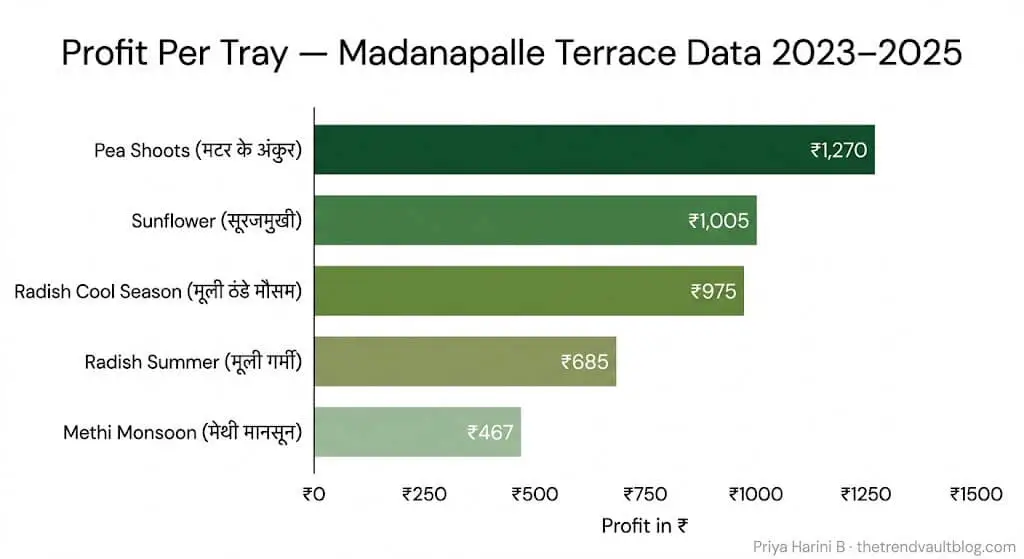
| Variety | Season | Days to Harvest | Yield (g/tray) | Seed Cost ₹ | Medium Cost ₹ | Total Cost ₹ | Sell Price/100g ₹ | Revenue/Tray ₹ | Profit/Tray ₹ |
|---|---|---|---|---|---|---|---|---|---|
| Radish | Post-monsoon (Oct–Dec) | 7 | 285 | 10 | 40 | 110 | 350 | 997 | 887 |
| Radish | Cool (Jan–Feb) | 8 | 310 | 10 | 40 | 110 | 350 | 1,085 | 975 |
| Radish | Summer (Mar–Jun) | 6 | 240 | 10 | 40 | 155 | 350 | 840 | 685 |
| Methi | Post-monsoon | 9 | 260 | 8 | 40 | 108 | 300 | 780 | 672 |
| Methi | Monsoon (Jun–Sep) | 10 | 195 | 8 | 40 | 118 | 300 | 585 | 467 |
| Mustard | Summer | 7 | 270 | 6 | 40 | 106 | 280 | 756 | 650 |
| Pea shoots | Cool | 12 | 320 | 65 | 45 | 170 | 450 | 1,440 | 1,270 |
| Sunflower | Post-monsoon | 11 | 290 | 50 | 45 | 155 | 400 | 1,160 | 1,005 |
Original measurements – Priya Harini B, thetrendvaultblog.com, Madanapalle AP, 2023–2025.
What this data shows: October–February is the highest-yield, highest-profit window in Andhra Pradesh and most of South India. Summer grows faster but yields less. Pea shoots carry the highest per-tray profit when you can find buyers willing to pay ₹450/100g, which means targeting restaurants and health stores, not home consumers.
Where this differs from Western guides: UK and US microgreens guides commonly report yields of 400–600g per tray. In Indian summer heat above 36°C, the same radish variety yields 220–260g 35–40% less. Factor this into your income projections before buying 50 trays.
The Real ROI Math, Month by Month
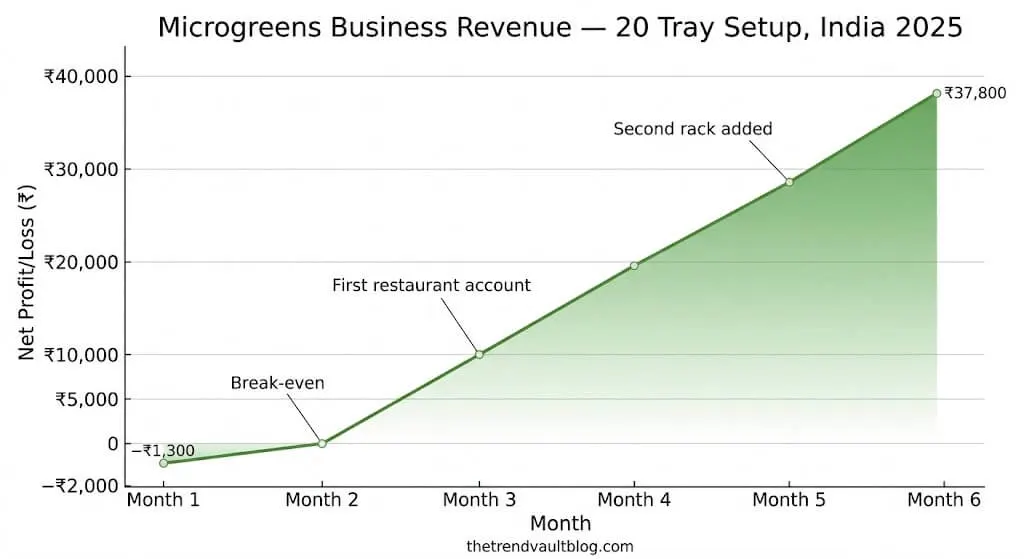
Production costs per tray average ₹110–₹155 including seeds, growing medium, packaging, and electricity. A single tray yields 200–300g, retailing at ₹350–₹500 per 100g. Here’s what that looks like across the first six months with a 20-tray setup on a 10-day harvest cycle (3 harvests/month).
These per-tray profit levels run higher than the broader crop mix covered in my India Microgreens Market overview this setup leans specifically toward higher-value crops like pea shoots and sunflower sold to restaurant and hotel accounts at premium pricing, rather than a broad mix of varieties sold at average retail rates. If you’re growing a wider variety mix for direct-to-consumer sales, the per-tray economics in that companion guide will likely be closer to what you actually see.
| Month | Trays Active | Revenue | COGS | Setup Amortisation | Net Profit/Loss | Notes |
|---|---|---|---|---|---|---|
| 1 | 10 | ₹7,000 | ₹1,300 | ₹7,000 | −₹1,300 | Learning phase expect ~20% crop loss |
| 2 | 15 | ₹14,000 | ₹2,000 | ₹4,000 | +₹8,000 | Customer base building |
| 3 | 20 | ₹24,000 | ₹2,600 | ₹2,000 | +₹19,400 | First restaurant accounts |
| 4 | 20 | ₹28,000 | ₹2,800 | ₹1,000 | +₹24,200 | Subscriptions + walk-in customers |
| 5 | 30 | ₹38,000 | ₹4,000 | ₹0 | +₹34,000 | Scaling with second rack |
| 6 | 30 | ₹42,000 | ₹4,200 | ₹0 | +₹37,800 | First hotel B2B account |
These numbers assume retail pricing, zero wastage from Month 3, and a customer base of 8–12 regular home delivery subscribers plus 1–2 restaurant accounts by Month 3.
The honest caveat: earnings depend on quality, consistency, customer base, and sales skills. Microgreens farming is profitable but not a fixed-income model. Be wary of anyone promising ₹3–5 lakh a month without explaining the sales and marketing work behind it real success comes from building repeat customers, not from maximising trays.
Where to Sell: 6 Channels Ranked by Profit Margin
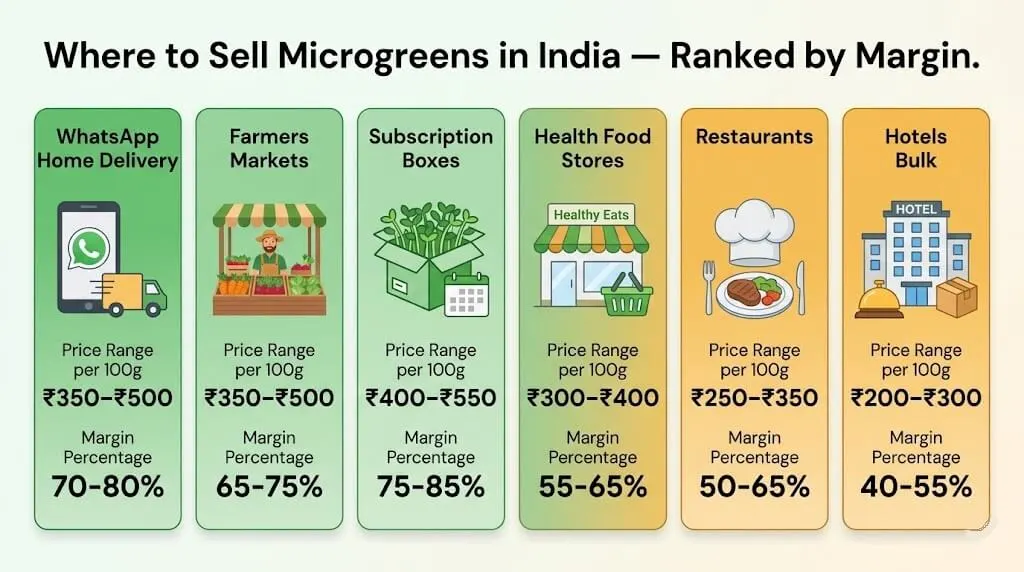
Most new growers make a fatal error: they grow 30 trays and then look for buyers. The right sequence is find one committed buyer, then grow for that buyer, then find the next.
| Sales Channel | Price/100g | Margin | How to Start | Best City Fit |
|---|---|---|---|---|
| Direct home delivery (WhatsApp/Instagram) | ₹350–₹500 | 70–80% | 1 post + 5 samples to neighbours | All cities |
| Restaurants and cafés | ₹250–₹350 | 50–65% | Walk in with 3 sample varieties | Bangalore, Mumbai, Delhi, Hyderabad |
| Farmers’ markets | ₹350–₹500 | 65–75% | Apply to your city’s weekend market | Mumbai, Pune, Delhi, Bangalore |
| Health food stores | ₹300–₹400 | 55–65% | Cold approach + FSSAI registration | Metro cities |
| Subscription boxes | ₹400–₹550 | 75–85% | Build after 10+ regular customers | Any city |
| Hotels (5-star, boutique) | ₹200–₹300 (bulk) | 40–55% | Needs consistent quality + quantity | Delhi, Mumbai, Bangalore, Goa |
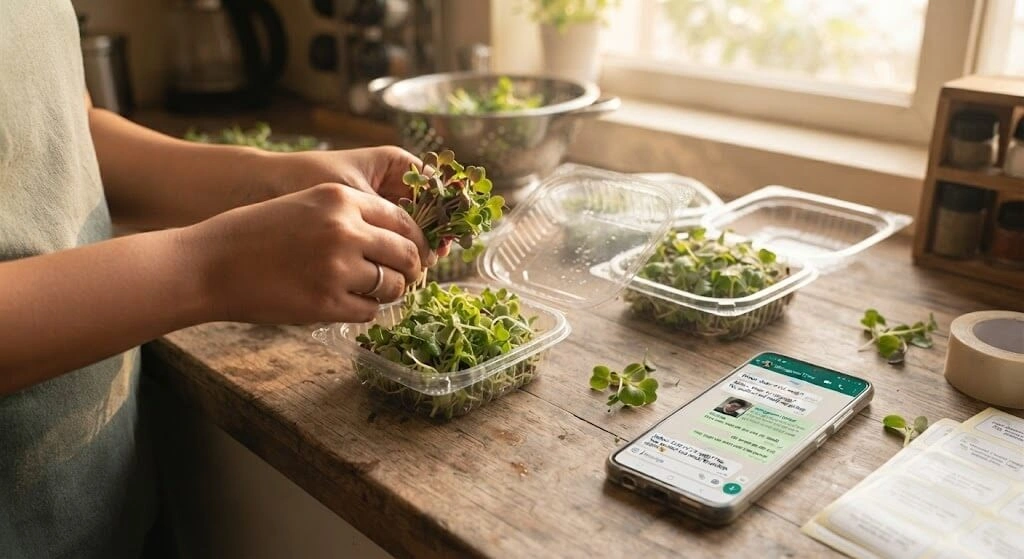
My pick for new growers: start with direct home delivery via WhatsApp. Your first 10 customers are probably within 2km of your terrace apartment residents in local food groups, mothers wanting fresh greens for toddlers, gym members who already buy protein supplements. Beginners typically earn ₹10,000–₹15,000/month this way; with 20–30 trays a week, ₹30,000–₹45,000/month is achievable.
A Note on Delivery Platforms (Zomato Hyperpure, Swiggy Instamart, Blinkit, Dunzo)
The six channels above will realistically get a new grower to their first ₹30,000–₹40,000/month. Larger delivery and B2B platforms exist too, but treat this section as a starting point for your own research rather than a step-by-step process platform onboarding requirements change, and how a home-scale microgreens grower actually gets listed varies by city and by the platform’s current farmer/vendor programs. Zomato’s Hyperpure, for instance, sources produce through its own farmer-relationship network rather than a simple open marketplace listing, so “signing up” isn’t as straightforward as registering an Instagram Shop. Before investing time in any of these platforms, confirm the current onboarding process directly on their site or through their vendor support line rather than relying on a fixed process described in any single guide, including this one.
Instagram Shopping remains the most reliably self-service option set it up through Meta Business Suite with zero commission, though it needs 3–6 months of consistent posting before it sends meaningful orders. Treat it as a brand asset, not a Month 1 sales channel.
My honest ranking for where to put your time first: WhatsApp Business (fastest first sale, zero commission start here, always) → local restaurants and farmers’ markets → Instagram Shopping (best margins, slowest to build) → larger delivery/B2B platforms (research current onboarding before committing time).
For the exact WhatsApp and restaurant outreach scripts, pricing structure, and buyer-type breakdown, see the companion guide: How to Sell Microgreens from Home in India.
Who Actually Buys Microgreens in India
| Buyer Type | What They Pay (₹/100g) | Order Frequency | Payment Terms | Best Approach |
|---|---|---|---|---|
| Home consumer (health-conscious) | 350–480 | Weekly | Immediate (UPI) | WhatsApp broadcast |
| Restaurant / café | 240–320 | 2–3×/week | 7–15 day credit | In-person visit, 3–5 PM |
| Cloud kitchen | 250–300 | Daily | 7-day credit | Email + WhatsApp |
| Organic store | 280–350 | Twice weekly | Consignment, 7–14 days | Walk-in with samples |
| Corporate wellness (IT office) | 300–380 | Weekly bulk | Monthly invoice | HR email outreach |
| Naturopathy / Ayurveda clinic | 320–420 | Weekly | Immediate or 7 days | WhatsApp direct |
| Tiffin / dabba service | 200–260 | Daily | Weekly cash | Neighbour network |
| Yoga studio / gym | 300–380 | Weekly | Immediate | Walk-in with samples |
| Hotel restaurant | 280–360 | 3×/week | 30-day invoice | Direct outreach, sample-first |
The buyer category most new growers completely ignore: tiffin service operators. Every Indian apartment complex has someone running a home tiffin service for 10–30 customers who need garnishes and health add-ons, buy weekly, pay immediately, and are already in your building zero delivery cost, zero cold chain needed.
Five practical ways to find buyers: search “HR manager [your city] [IT company]” on LinkedIn with a photo of your trays · search “[your city] health cafe” on Zomato and Instagram and visit the top 10 with samples · search “[your city] organic store” on Google Maps, call 5, visit 3 · post in local Facebook groups once a week, not more · check hyperlocal community apps where organic food requests show up. Start with the first two they convert fastest.
Season-by-Season Survival Guide
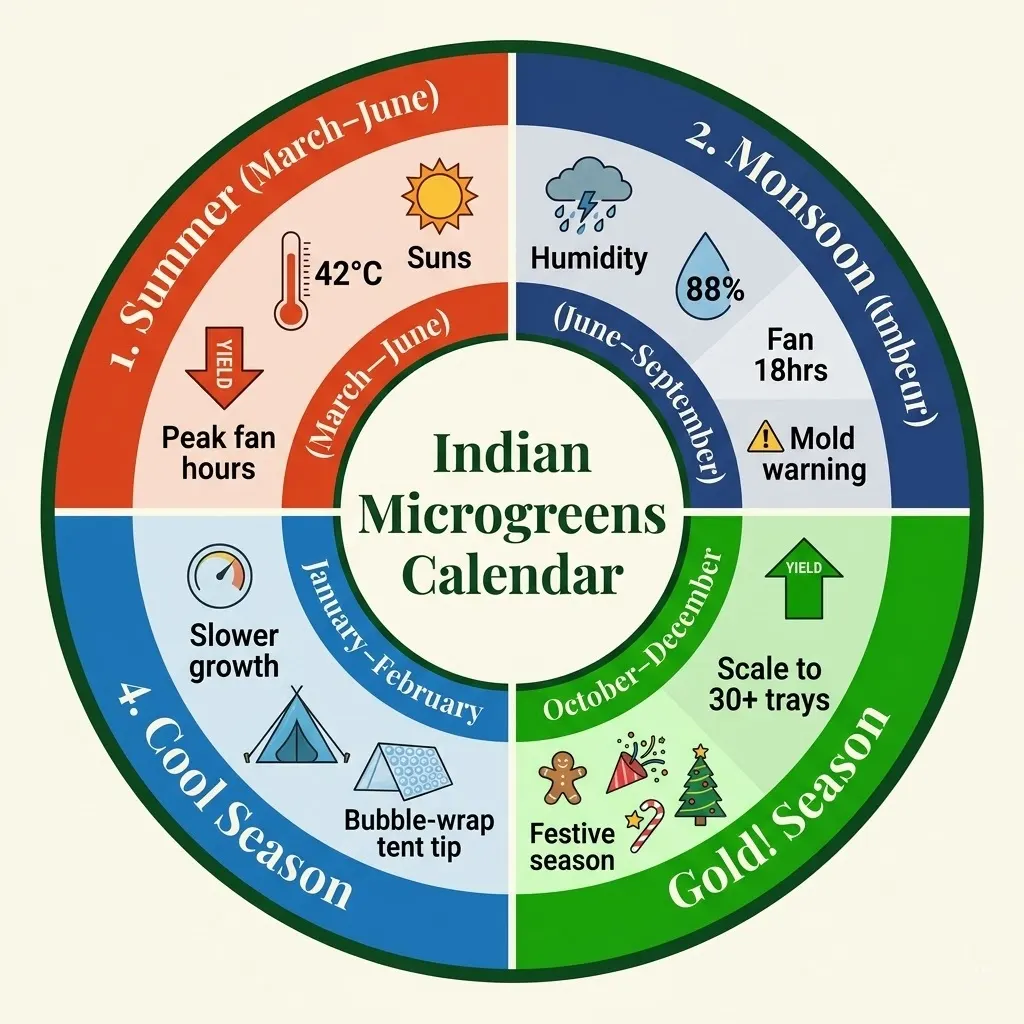
India has four distinct growing conditions, and crop management changes completely between them.
March–June (Summer / Garmi)
| Check | Threshold | Action |
|---|---|---|
| Room temperature | Above 32°C | Move trays to coolest room, run fan 16+ hours |
| Watering frequency | Medium feels dry at 1cm depth | Bottom water every second day |
| Germination speed | Faster than normal | Harvest 1–2 days earlier than autumn |
| Crop yield | Down 20–30% vs. winter | Accept this don’t overcompensate with extra seeds |
The biggest summer mistake: cramming more seeds per tray to maintain winter yields. Overcrowded seedlings in heat means more competition and worse airflow, which means mould. Accept the yield drop; margins hold if pricing stays firm.
June–September (Monsoon / Barish)
| Check | Threshold | Action |
|---|---|---|
| Humidity in grow room | Above 70% | Fan on 18–20 hours minimum |
| Surface mould appearance | Any white fuzz by Day 3 | Increase airflow immediately, don’t just remove the mould |
| Seed soaking time | Regular | Reduce by 25% seeds absorb ambient moisture |
| Drainage | Ensure tray gap | Raise perforated tray 1cm above solid tray with small spacers |
Monsoon is the season that tests whether your setup actually works. My June 2022 disaster happened precisely because I hadn’t separated my trays properly a ₹5 foam spacer per tray corner would have saved ₹2,200 in losses.
October–December (Post-monsoon / Sharad)
This is the gold season. Humidity drops, temperatures moderate to 22–30°C, germination is reliable, and yields peak. Scale up aggressively here this is when 30+ active trays make sense, since growing is easiest and festive-season demand (Navratri, Diwali, Christmas in metro cities) pushes microgreens consumption up.
January–February (Cool Season / Sardi)
| Check | Threshold | Action |
|---|---|---|
| Growth speed | Noticeably slower | Add 2–3 extra days to harvest window |
| Morning dew | Condensation on leaves | Wipe tray walls, don’t mist in evenings |
| Customer demand | Typically highest | Stock pea shoots and sunflower for premium buyers |
In Madanapalle, January nights drop to 12–14°C, and methi germination slows from 8 to 11–12 days. I built a simple tent from bubble wrap and an old saree over my rack it raised the microclimate temperature by 4–5°C with zero electricity, a fix that saved three January batches.
Real Stories
Priya’s ₹2,200 Failure: The Full Story
It was the second week of June 2022. I’d been running a small 6-tray rotation and decided to scale to 14 trays in one week, testing whether I could reliably supply a larger volume before I had a confirmed buyer lined up.
What I didn’t check: my grow room’s ambient humidity had jumped to 91% with the first monsoon rains. I was still top-watering twice daily the way I’d learned from a YouTube guide filmed in Maharashtra in December. I had no fan, and my trays were nested directly on top of each other with no airflow gap.
By Day 4, the surface of every tray looked like it had a grey carpet Pythium damping-off, a water mould that kills seedlings at the stem base. By Day 5, all 14 trays were composted.
I lost the café order, ₹2,200 in seeds and medium, and six weeks of trust-building with that customer.
Suresh walked up on Day 6 and told me something I’ve quoted ever since: “You watered for the plant you grew last month, not the weather you have today.”
The fix was embarrassingly simple: a ₹900 table fan, 2cm tray spacing between rows on the rack, bottom-watering instead of top, and a ₹350 hygrometer from Amazon for humidity monitoring. Total investment: ₹1,250.
My next monsoon season, I lost zero trays to damping-off across 24 trays over four months. The entire lesson in one sentence: monitor humidity, run airflow, bottom water.
Kavita From Hyderabad
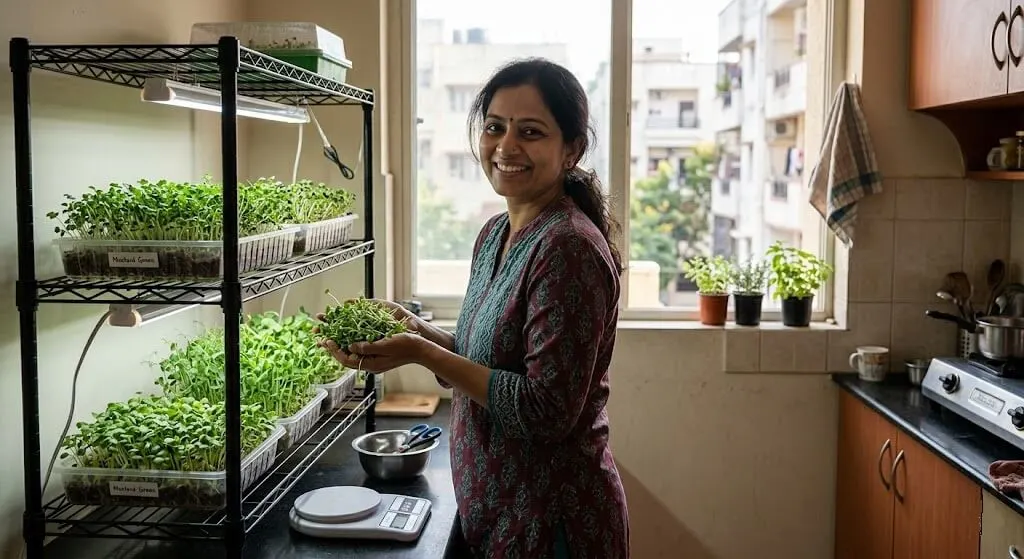
Kavita runs a small home business from her 600 sq ft, third-floor apartment in Banjara Hills, Hyderabad. She reached out through an Instagram DM in September 2023 after reading my post about monsoon microgreens survival.
Her problem: three consecutive batches had failed. She was growing in a north-facing bathroom with no direct light, top-watering, with no fan or ventilation. She’d spent ₹4,800 on seeds and medium with zero harvest to show for it.
My one question: “How many hours does your grow space get natural light daily?” Her answer: zero the bathroom had frosted glass.
The fix: move to the kitchen counter near the east-facing window (4 hours of morning light), buy a 300mm USB fan (₹600), switch to bottom watering, and start with just mustard and methi, the two most light-tolerant varieties.
What it cost to fix: USB fan ₹600, hygrometer ₹350, new seeds after failed batches ₹800 total ₹1,750.
What happened next: Kavita harvested her first clean batch of mustard microgreens on Day 8 280g from a single tray. She sold it to three neighbours at ₹350/100g, roughly ₹980 from a tray that cost ₹30 to grow. By December 2023, she had 12 regular WhatsApp customers and was earning ₹18,000/month from 15 trays.
“I’d been told I was doing it wrong for three months. Priya told me I was doing it in the wrong room.” – Kavita
Three things to copy from Kavita’s story: assess your light before buying seeds north-facing rooms need LED lights, budget ₹1,500–₹2,500 before starting; start with mustard and methi if light is limited, since they’re the most forgiving varieties; and sell to 3 neighbours before thinking about restaurants confidence and cash flow matter more than scale in Month 1.
Legal Setup: What You Actually Need, What You Can Skip
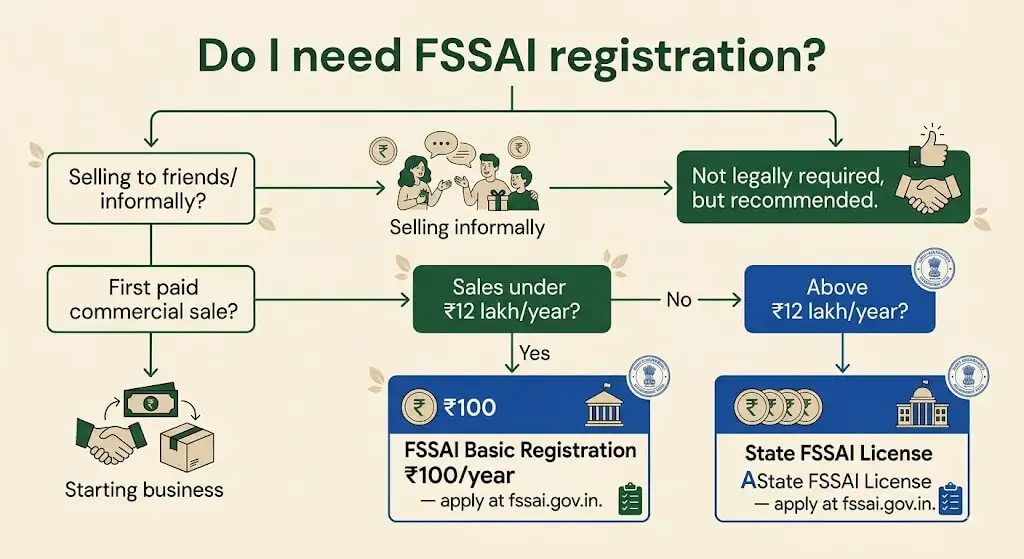
What’s mandatory from Day 1: technically nothing, if you’re selling informally to friends and family. Practically, get FSSAI Basic Registration before your first paid sale.
Compliance Table
| Registration | When Required | Cost ₹ | Time | Verdict |
|---|---|---|---|---|
| FSSAI Basic Registration | Any commercial sale of food | ₹100/year | 3–7 days online | Do this first, always |
| GST Registration | Annual turnover above ₹20 lakh | ₹0 to register | 7–14 days | Skip until Month 6+ |
| MSME/Udyam Registration | Optional, helps with bank loans | ₹0 | 1–2 days | Register at 3 months |
| State FSSAI License | Turnover above ₹12 lakh/year | ₹2,000–₹5,000/year | 30–45 days | When scaling to restaurants |
| Business Registration | If operating as a formal firm | ₹1,000–₹5,000 | 7–14 days | Only for formal B2B contracts |
For sales under ₹12 lakh annually, basic FSSAI registration is free to apply for online and costs ₹100/year this is what every home microgreens seller should get. Apply at fssai.gov.in with your Aadhaar, address proof, and a photo of your grow space; the process takes 3–7 working days, and for Andhra Pradesh, Tamil Nadu, and Telangana home sellers, Basic Registration (Form A) covers you completely until you cross ₹12 lakh in annual revenue.
On housing society rules: most gated communities have restrictions on commercial activity rather than growing itself. A framing that works: “I’m running a small kitchen garden that occasionally gives surplus to neighbours I’m not operating a commercial unit in the building.” Keep the operation clean, odour-free, and contained. Problems usually arise from complaints about smell, waste, or delivery traffic, not from the growing itself.
For the full outreach process once you’re legally set up, see: How to Sell Microgreens from Home in India.
India-Specific Advantages Nobody Tells You About
Three structural reasons a microgreens business in India has better underlying economics than the same business in the UK or US:
Cocopeat is a domestic byproduct. India’s coconut husk output makes cocopeat the cheapest, most available growing medium in the world here a block that costs ₹50 in Andhra Pradesh costs several times more when imported into markets like the UK. Growing medium cost is dramatically lower, and that’s a real competitive moat.
Year-round growing without heating costs. Unlike European or North American operations that face significant energy bills for heating indoor farms through winter, most of India allows year-round cultivation with minimal climate control electricity cost per tray here runs roughly ₹3–₹6 for LED lighting, a fraction of what heating-dependent climates require.
The taste recognition factor. Methi, dhaniya, and mustard microgreens aren’t exotic to Indian kitchens customers already know what to do with them. You’re not selling a new concept, you’re selling a fresher version of something they already buy at the sabzi mandi, which cuts customer education time from months to minutes.
India Zone-Wise Growing Context
The seasonal calendar above already covers timing in detail this maps it against the broader climate zone framework used across this site, since “summer” and “monsoon” arrive on different calendars depending on where you’re growing.
| Zone | Representative Cities | Growing/Market Difference | Zone-Specific Adjustment |
|---|---|---|---|
| North Indian Plains | Delhi, Lucknow, Chandigarh | Dry, extreme summer heat; strong D2C and hotel demand in Delhi NCR | Fan use critical Mar–Jun; Delhi NCR is a strong early market to target |
| Western Semi-Arid | Ahmedabad, Jaipur | Low humidity reduces monsoon mould risk relative to coastal cities | Standard cocopeat mix performs longer before switching to perlite/jute |
| Deccan Plateau | Bangalore, Hyderabad, Madanapalle | Moderate, elevation-cooled; Bangalore and Hyderabad are top buyer markets | Author’s reference zone baseline protocol used throughout this guide |
| Coastal West | Mumbai, Goa, Kochi | High monsoon humidity; Mumbai commands the highest wholesale prices in this guide | Switch to jute mats/spacer trays earlier in the season than inland zones |
| Coastal East / Tamil Nadu | Chennai | Oct–Dec is the main monsoon here, not June–Sept as elsewhere | Apply monsoon-humidity protocol in Oct–Dec specifically |
| Eastern India | Kolkata, Patna | Humid subtropical climate raises fungal pressure most of the year | Prioritise airflow and drainage spacers for a longer stretch of the year |
| Northeast India | Guwahati, Shillong | Very high year-round rainfall | Indoor, climate-controlled setups strongly preferred |
| Himalayan / Hill | Shimla, Dehradun, Darjeeling | Cooler temperatures slow germination, similar to Madanapalle’s January dip | The bubble-wrap/saree tent trick from this guide’s cool-season section applies well here too |
| Reference Zone | Madanapalle, AP | Subtropical, 22–44°C; author’s own tracked conditions since June 2022 | Baseline for all data and protocols in this guide |
Products I’ve Actually Used, With Real Prices
| Product | Purpose | Cost ₹ | Where to Buy | Priya’s Note |
|---|---|---|---|---|
| AllThatGrows radish seeds | Primary cash-crop seed | ₹120–₹180/100g | allthatgrows.in, Amazon India | 90%+ germination in my testing |
| Ugaoo cocopeat bricks | Growing medium | ₹45–₹55/brick | Ugaoo.com, Nurserylive | 650g brick = 8L expanded, enough for 4 trays |
| TrustBasket vermicompost | Nutrient boost | ₹180–₹220/5kg | Amazon India | Better quality than loose local bags worth the premium |
| Standard 5-tier wire rack | Tray stacking | ₹2,500–₹3,200 | Amazon India, Pepperfry | Look for a 25kg-per-shelf rating not all cheap ones hold this |
| 10×20 inch trays (Bootstrap Farmer-style) | Growing | ₹40–₹55/pair | Amazon India | Polypropylene trays last 20+ harvests if cleaned properly |
| Hygrometer | Humidity monitoring | ₹350–₹500 | Amazon India | Non-negotiable for monsoon months |
| USB table fan | Airflow | ₹600–₹900 | Amazon India | USB power means it plugs into any phone charger |
| Nurserylive methi seeds | Best-selling Indian variety | ₹80–₹120/100g | Nurserylive.com | Customers recognise the taste instantly easiest sell |
| Spent cocopeat after sterilising | Secondary medium, after 3 months | ₹0 | Your own trays | Solarise in strong sun for 5 hours to kill pathogens and extend use |
Prices verified May 2026 – check current listings before ordering, as e-commerce pricing shifts.
Get the Free Printable: Microgreens Business Starter Pack
Includes a 14-day harvest calendar, a buyer outreach script for WhatsApp and restaurant visits, a monthly cost-tracking sheet, and the monsoon survival checklist condensed to one page. Get the Microgreens Business Starter Pack – free with email →
Frequently Asked Questions
Can I start a microgreens business in India from home with ₹10,000?
Yes, barely, and with trade-offs you’ll need to skip LED lights, use compostable packaging instead of clamshells, and focus entirely on home delivery to neighbours. Month 1 likely won’t be profitable, but Month 2 with reinvested revenue can reach 15 trays and positive cash flow.
Which microgreens are most profitable in India?
Per my own tracked data: pea shoots (₹1,270 profit/tray in my tracked cool-season cycle), sunflower (₹1,005 profit/tray, post-monsoon), radish in cool season (₹880–₹975), radish in summer (₹650–₹700), and methi (₹467–₹672). Pea shoots need restaurant buyers willing to pay ₹400–₹500/100g; radish is the workhorse crop for pure volume and speed.
How long do microgreens last after harvest in India?
In proper clamshell packaging, refrigerated at 4–8°C, 5–7 days is realistic; with frequent fridge door-opening in Indian summer, expect closer to 4–5 days. Sell within 3 days of harvest for maximum freshness, and never promise more than 5 days to a buyer.
What is the best growing medium for microgreens in India?
An 80% cocopeat + 20% vermicompost mix is the most reliable choice for Indian conditions widely available, moisture-retentive without waterlogging. Garden soil compacts and kills crops; jute mats work well for sunflower and pea during monsoon but need careful watering.
How many trays do I need to earn ₹30,000 per month from microgreens?
At retail pricing (₹350/100g average, 250g yield/tray, 3 cycles/month), you need approximately 23–25 active trays generating ₹30,000 in monthly net profit (not gross revenue). At wholesale restaurant pricing (₹250/100g), closer to 35–38 trays for the same revenue which is why building direct home-delivery customers before approaching restaurants tends to be the financially smarter path for new growers.
What happens to microgreens in Indian summer heat above 40°C?
Above 36°C, most varieties show a 20–35% yield reduction versus winter performance (my radish data drops from 310g/tray in January to 240g in May). Above 40°C, germination rates drop, seedlings get leggy even with adequate light, and post-harvest shelf life shortens to 3–4 days.
Do I need FSSAI registration to sell microgreens commercially in India?
Yes, FSSAI Basic Registration (₹100/year) is required for any commercial food sale under ₹12 lakh annual turnover, applied for online at fssai.gov.in in 3–7 working days.
Why is microgreens farming more cost-effective in India than in Western countries?
Cocopeat is a domestic coconut-industry byproduct here, dramatically cheaper than imported equivalents abroad; India’s climate allows year-round growing without significant heating costs; and Indian consumers already recognise and cook with methi, dhaniya, and mustard, cutting customer education time to near zero.
Quick Reference
What is a microgreens business in India?
A microgreens business in India involves growing and selling young vegetable or herb seedlings harvested 8–15 days after germination; the market reached USD 73 million in 2024 (IMARC Group) and is growing at 7.86% annually.
What does it cost to start a microgreens business in India?
A starter setup for 10–20 trays costs ₹12,000–₹18,000, including a metal rack, tray pairs, cocopeat and vermicompost, starter seeds, a fan, and basic packaging, plus ₹100/year for FSSAI Basic Registration.
How much can you earn from microgreens in India?
A beginner operating 20 trays at retail pricing (₹350–₹500/100g) can reach ₹15,000–₹30,000 monthly profit by Month 3; experienced growers with 50+ trays and established restaurant accounts report ₹40,000–₹75,000 monthly.
Which microgreens sell best in India?
Radish, fenugreek (methi), mustard, pea shoots, and sunflower have the highest market acceptance, with radish as the fastest cash crop and methi carrying instant taste recognition in Indian households.
Why does microgreens farming differ in India compared to Western guides?
Western guides assume climate-controlled, stable-humidity growing rooms; Indian monsoon humidity (June–September in most zones, October–December in Tamil Nadu) requires active airflow management, bottom-watering, and seasonal growing-medium changes that most imported guides never address.
How do you prevent mould in microgreens during Indian monsoon?
Run a fan 14–18 hours daily, switch to bottom-watering only after Day 3, raise trays 1–2cm above the solid drain tray for airflow, reduce seed soaking time by 25%, and monitor grow-room humidity with a hygrometer, targeting below 70% at tray level.
Source: Priya Harini B, thetrendvaultblog.com – based on microgreens growing experiments in Madanapalle, Andhra Pradesh, India from June 2022 through March 2025, including 180+ tray harvests across four seasonal cycles.
Your Action Checklist From Zero to First Sale
- Choose your grow space measure light hours, check ventilation, note direction (north/east/west/south-facing)
- Buy a hygrometer (₹350) check grow-room humidity before buying seeds
- Order your starter pack: 10 tray pairs + cocopeat (5 bricks) + vermicompost (2kg) + radish + methi seeds only
- Set up your fan and test airflow you want gentle leaf movement, not a direct blast
- Sow your first 5 trays (radish only) don’t attempt 10 varieties in Week 1
- Apply for FSSAI Basic Registration online (fssai.gov.in, ₹100/year) before your first sale
- Tell 5 people you’re growing microgreens before your first harvest is ready WhatsApp message, not Instagram post
- Harvest Day 7–8, weigh accurately, package in 100g portions, photograph in good morning light
- Price confidently: ₹300–₹400 for radish/methi, ₹400–₹500 for pea shoots don’t undercut yourself
- Read the full outreach playbook once your first harvest is ready: How to Sell Microgreens from Home in India
Week-by-Week Plan
| Week | Focus |
|---|---|
| Week 1 | Lock in 3–4 starter varieties, set up your growing space, create WhatsApp Business + Instagram presence before planting anything |
| Week 1, Day 7 | Plant your first 8–10 trays and start documenting the process for future content |
| Week 2 | While trays grow, research 5–10 target restaurants in your delivery radius and note contact names |
| Week 3 | Harvest, package, and deliver sample packs to your researched restaurant list; send your WhatsApp launch broadcast with a first-customer discount |
| Week 4 | Follow up with every restaurant you sampled, push for a trial order, and fulfil your first direct deliveries with a thank-you note |
Realistic Month 1 outcome: 2–5 restaurant trial accounts, 3–8 direct customers, and ₹5,000–₹12,000 in revenue a baseline to plan Month 2 around, not a ceiling to judge yourself against.
Recovery Timeline (If Your First Batch Fails)
| Timeframe | What You’ll See | What It Means |
|---|---|---|
| Day 1–3 | White fuzz on seed surface | Early mould increase fan immediately |
| Day 3–5 | Stems collapsing at base | Damping-off this batch is lost; compost and restart |
| Day 5–7 | Slow, uneven germination | Seed quality or temperature issue soak longer next time |
| Day 8–12 | Leggy, pale seedlings | Insufficient light move closer to window or add LED |
| Week 2 | First clean harvest | Success now find a buyer and repeat |
What will not recover: trays with damping-off mould beyond roughly 40% surface coverage. Don’t try to save them the pathogen is in the medium. Compost the whole tray, disinfect with hydrogen peroxide, and start fresh. Judge success by the new batch, not the failed one.
Right Crop. Right Customer. Everything Else Follows.
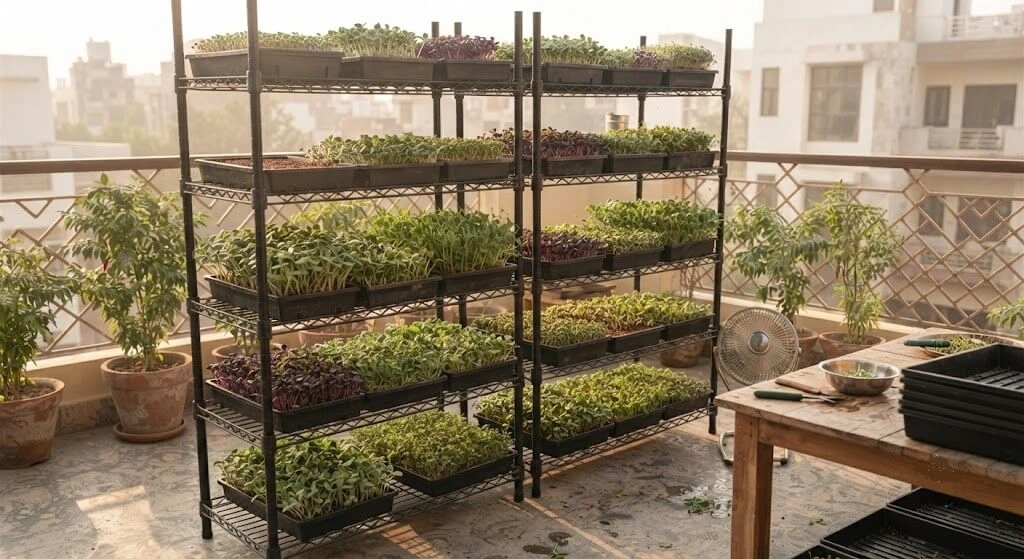
Most guides about microgreens in India get the sequence backwards they teach growing first and selling second. I made that mistake myself, and it cost me six weeks and ₹2,200 in my first monsoon season.
The growers I’ve seen succeed Kavita in Hyderabad, others who’ve reached out since all did one thing first: they found people willing to pay before they bought fifty trays.
The India microgreens market is growing at 7.86% annually, driven by urban health consciousness, restaurant-level culinary interest, and a growing preference for fresh local produce over cold-chain imports. The market is real. The math works. What doesn’t work is growing in the dark, top-watering in monsoon, and pricing at whatever a YouTube thumbnail claimed.
Your terrace. Your water. Your season. Your customers. Start with five trays of radish, find three customers, then scale.
Related reading: How to Sell Microgreens from Home in India · How to Start Growing Microgreens at Home · Master Microgreens Harvesting & Storage · India Microgreens Market Overview
Tell me in the comments or on Instagram @thetrendvaultblog: what city are you in, and what’s the first variety you’re planning to grow? I answer every DM from first-time growers.
About Priya Harini B: Priya has been container gardening on her terrace in Madanapalle, Andhra Pradesh for over four years, growing 40+ varieties of vegetables, herbs, and microgreens in containers, including a tracked microgreens operation running since June 2022. Every diagnosis, experiment, and measurement referenced in this guide is documented from her own terrace at thetrendvaultblog.com.