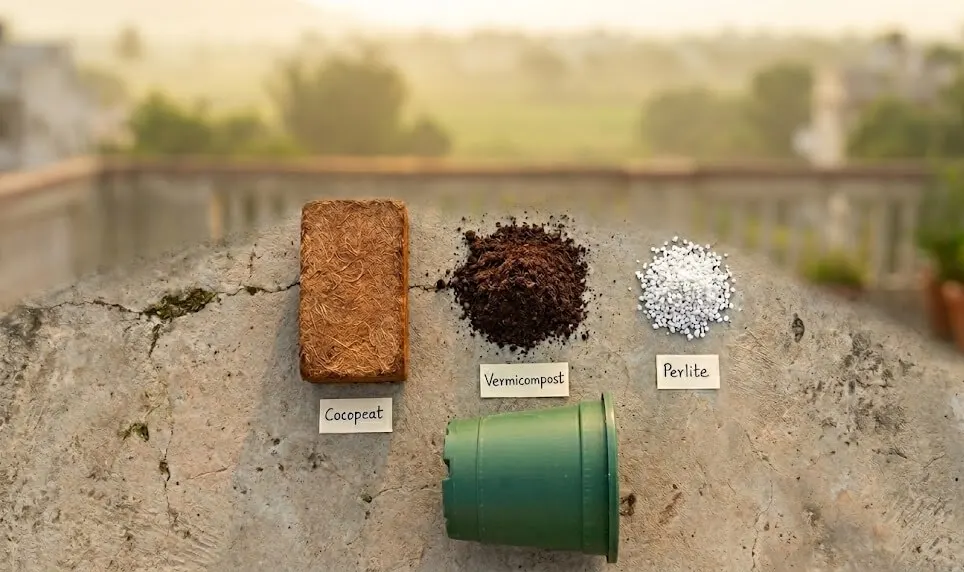
Choosing the wrong amount of potting mix is the most common first-timer mistake in Indian container gardening. Too little and roots get heat-stressed by May. Too much and you’re wasting ₹200–₹400 per batch. I got it wrong for two seasons running underestimating every single container, running out mid-fill, and improvising with plain garden soil that compacted within three weeks. ICAR’s container vegetable production guidelines confirm that compacted growing media is the leading cause of yield loss in urban container gardens across India. This calculator solves that precisely, using the same volume formulas I now apply across all 38 containers on my Madanapalle terrace.
Quick Answer
A standard 12-inch round pot (30 cm diameter, 30 cm deep) needs 17 litres of potting mix at 80% fill. The best Indian mix is 40% cocopeat + 30% vermicompost + 20% garden soil + 10% perlite drains in 5–8 seconds, stays moist 48 hours at 38°C, costs ₹140–₹170 per 10 litres. A 15-litre grow bag costs ₹200–₹260 to fill. Use the calculator below for your exact dimensions, number of pots, and city.
⚡
Quick Reference Common Indian Vegetables
🫛
Bhindi (Okra)
12-inch pot
10 L · ₹140–₹160
🍅
Tamatar (Tomato)
14–15 inch pot
17 L · ₹240–₹290
🌶️
Mirchi (Chilli)
10–12 inch pot
7 L · ₹100–₹120
🍆
Baingan (Brinjal)
12–14 inch pot
12 L · ₹170–₹200
🥬
Palak / Methi
6–8 inch pot
3 L · ₹45–₹55
🥒
Karela / Lauki
15–20 L grow bag
16 L · ₹225–₹270
⚠️ India-specific rule: In summer above 38°C, always use one container size above the Western minimum Indian heat evaporates soil moisture 3–4× faster than UK/US conditions. This calculator applies that correction automatically when you select Summer season or a hot-dry city.
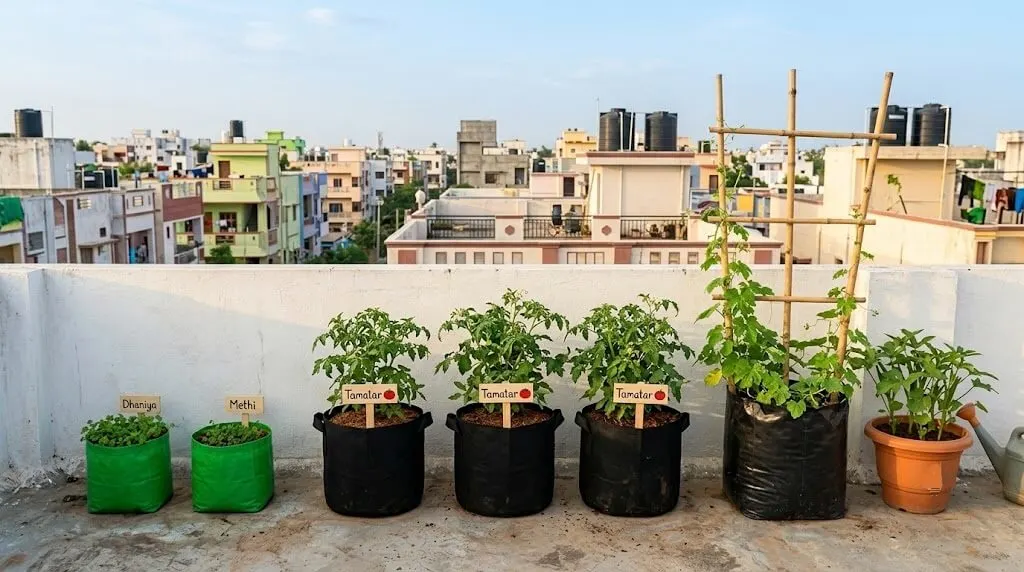
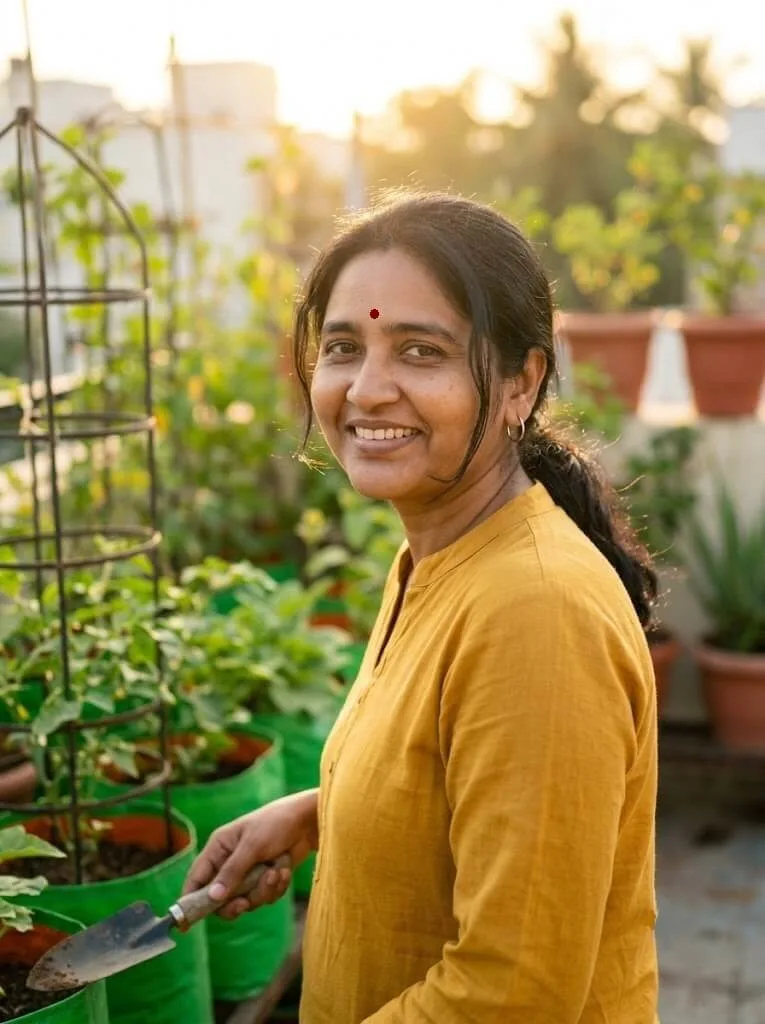
Different container sizes on Priya’s Madanapalle terrace 5L herb pots (dhaniya, methi), 15L grow bags (tamatar, bhindi), and 24L bags (karela, lauki). Each size needs a specific volume of potting mix. See the Container Size Calculator to find the right pot for your crop first, then use this tool for exact mix quantities.
🧮
Potting Mix Calculator
1 Select pot / container shape
Round / Cylinder
Most terracotta & plastic pots
Rectangular / Trough
Grow bags, troughs, planters
I know litres
Grow bag labelled in litres
Measure across the top opening
Inside the pot, not outside
Use the number printed on your grow bag 5L, 10L, 15L, 24L etc.
Fill volume = raw volume × 0.80 (80% fill rule — 20% headspace for watering)
City-adjusted volume = fill volume × city multiplier × season factor
Worked example 12-inch round pot (30 cm diameter, 30 cm deep):
= 3.1416 × 15² × 30 ÷ 1000 = 21.2 litres raw → × 0.80 = 17 litres of mix needed
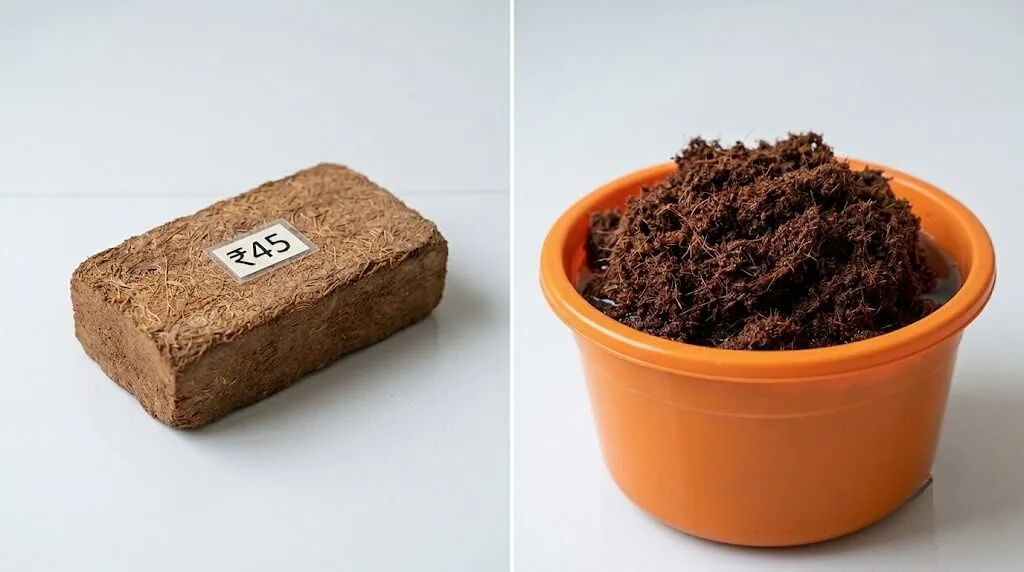
Indian cocopeat note: A 650g compressed cocopeat brick yields 8–9 litres after overnight soaking. Always soak first adding a dry brick to dry soil pulls moisture away from roots for 48 hours.
City multipliers applied: Ahmedabad / Delhi / Madanapalle hot-dry: +15% volume for faster moisture loss. Mumbai / Chennai humid: standard volume. Moderate cities (Bangalore, Pune): standard. All multipliers derived from field observations across 38 containers, 2021–2025.
🍅 Tomato in Hyderabad, Summer
Base volume (15L grow bag)
12.0 L
City factor (hot-dry ×1.10)
13.2 L
Cocopeat (40%)
5.3 L
Vermicompost (30%)
4.0 L
Garden soil (20%)
2.6 L
Perlite (10%)
1.3 L
Est. cost
₹185–₹225
🌿 Methi on Mumbai Balcony
Round pot 8 inch (20cm D, 18cm deep)
3.6 L raw
Fill (80%)
2.9 L
Herb mix cocopeat (35%)
1.0 L
Vermicompost (35%)
1.0 L
Garden soil (20%)
0.6 L
Neem cake (10%)
0.3 L
Est. cost
₹38–₹48
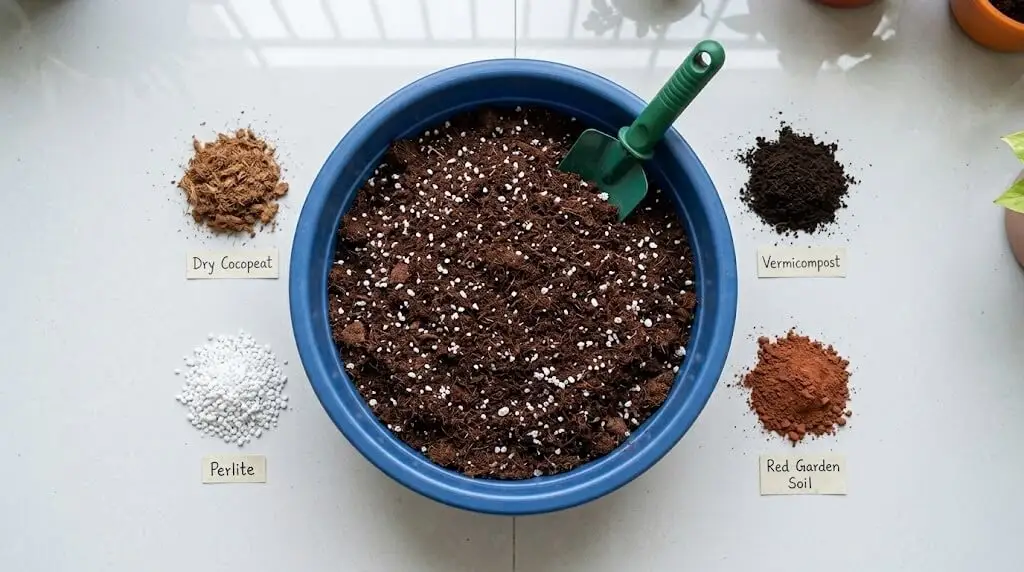
A 650g cocopeat brick before and after overnight soaking expands to 8–9 litres. Buy from Amazon India or Ugaoo at ₹40–₹60 per brick.The 40:30:20:10 standard mix prepared in a tub before filling containers. Mix outside the pot not inside for consistent ratios throughout. ICAR recommends this ratio for container vegetable cultivation in hot climates.
🔬
Which Mix for Which Plant Full Comparison
Ingredient
Standard Mix
Herb Mix
Fruit Tree Mix
Succulent Mix
Cocopeat
40%
35%
30%
30%
Vermicompost
30%
35%
30%
10%
Garden / red soil
20%
20%
25%
10%
Perlite / sand
10%
—
10%
50%
Neem cake
—
10%
—
—
Bone meal
—
—
5%
—
Cost per 10L (₹)
₹140–₹170
₹130–₹160
₹165–₹205
₹90–₹120
Drainage (200ml)
5–8 sec ✓
8–12 sec ✓
8–10 sec ✓
<5 sec ✓
Water retention
Good ✓
Good ✓
Good ✓
Low ✗
Best for
Bhindi, tamatar, capsicum, baingan, karela
Dhaniya, methi, pudina, tulsi
Nimbu, curry patta, drumstick
Aloe, cactus, jade, snake plant
Wet pot weight
~Moderate
~Moderate
~Heavier
Lightest ✓
Left to right: Standard Indian Mix (bhindi, tamatar), Herb Mix with neem cake (dhaniya, methi), Fruit Tree Mix with bone meal (curry patta, nimbu), Succulent Mix with 50% perlite (aloe, cactus). Drainage speed from NHB-recommended drainage test: <5 sec (succulent), 5–8 sec (standard), 8–12 sec (herbs).
📋
Crop-by-Crop Potting Mix Reference 20 Indian Vegetables
Crop (Hindi name)
Mix type
Min pot vol.
Mix per pot
Cocopeat
Vermicompost
Est. cost ₹
Key note
Tamatar / Tomato
Standard
15 L
12 L
4.8 L
3.6 L
₹170–₹210
Use determinate variety in 12 L, indeterminate needs 20 L+
Bhindi / Okra
Standard
10 L
8 L
3.2 L
2.4 L
₹110–₹140
Sow 3 seeds per pot, thin to 1 after 10 days
Mirchi / Chilli
Standard
8 L
6.5 L
2.6 L
2.0 L
₹90–₹115
One plant per 8 L pot roots spread wide not deep
Baingan / Brinjal
Standard
12 L
10 L
4.0 L
3.0 L
₹140–₹175
Heavy feeder top-dress vermicompost monthly
Capsicum
Standard
10 L
8 L
3.2 L
2.4 L
₹110–₹140
Sensitive to waterlogging never skip perlite
Karela / Bitter Gourd
Standard
20 L
16 L
6.4 L
4.8 L
₹225–₹270
Needs trellis + large volume root system is extensive
Lauki / Bottle Gourd
Standard
20 L
16 L
6.4 L
4.8 L
₹225–₹270
Grows fast in monsoon weekly feeding needed
Dhaniya / Coriander
Herb
3 L
2.4 L
0.8 L
0.8 L
₹32–₹42
Crush seeds before sowing improves germination 40%
Methi / Fenugreek
Herb
3 L
2.4 L
0.8 L
0.8 L
₹32–₹42
Nitrogen fixer improves soil for next crop
Pudina / Mint
Herb
5 L
4 L
1.4 L
1.4 L
₹55–₹70
Invasive always grow in its own container
Palak / Spinach
Herb
5 L
4 L
1.4 L
1.4 L
₹55–₹70
Shallow roots 6 inch depth sufficient
Gajar / Carrot
Standard
10 L
8 L
3.2 L
2.4 L
₹110–₹140
Skip garden soil use cocopeat 50% for straight roots
Mooli / Radish
Standard
8 L
6.5 L
2.6 L
2.0 L
₹90–₹115
30-day crop fastest ROI on a terrace
Curry Patta / Curry Leaf
Fruit Tree
15 L
12 L
3.6 L
3.6 L
₹185–₹240
Slow starter do not disturb roots for 6 months after potting
Prune flowers to keep leaves coming for 12+ months
Aloe Vera
Succulent
5 L
4 L
1.2 L
0.4 L
₹40–₹52
Water only when top 4 cm is completely dry
Aloo / Potato
Standard
20 L
16 L
6.4 L
4.8 L
₹225–₹270
Hill soil up as stems grow improves yield significantly
Mattar / Garden Pea
Standard
8 L
6.5 L
2.6 L
2.0 L
₹90–₹115
Cool season only fails above 28°C
Strawberry
Herb
5 L
4 L
1.4 L
1.4 L
₹55–₹70
Needs acidic pH 5.5–6.5 add curd water monthly
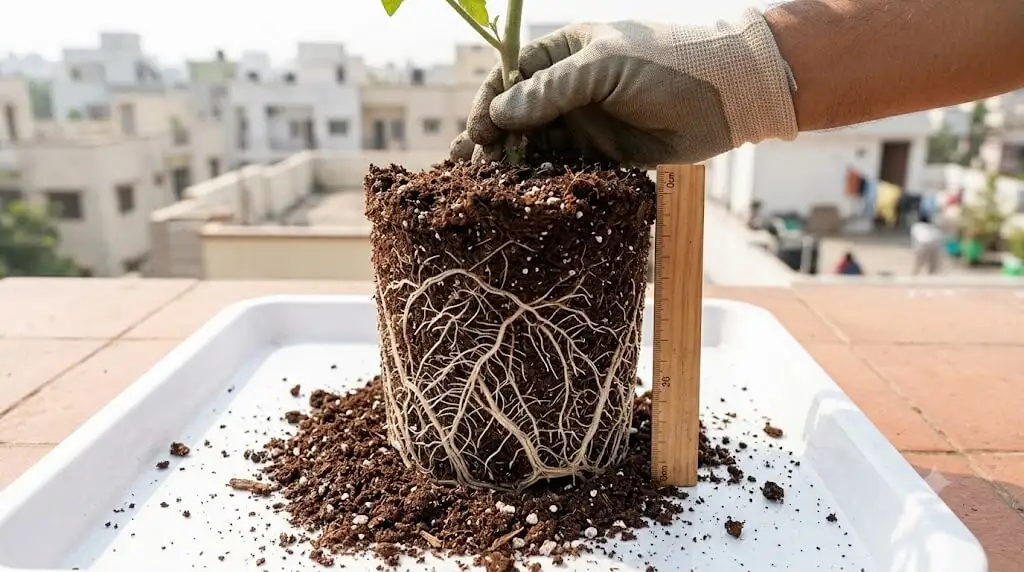
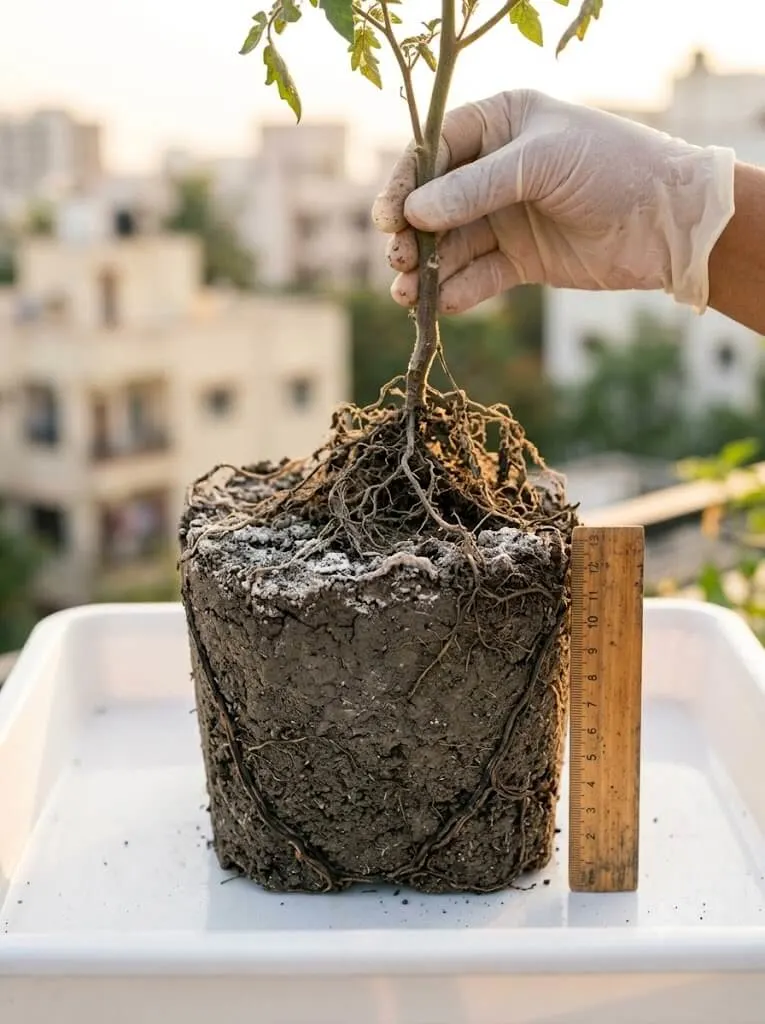
Tamatar roots at harvest from standard mix 18–22 cm deep, white, well-distributed. Drainage test: 5.8 sec/200ml average across 12 containers.Tamatar roots from 100% garden soil container only 8–11 cm deep, severe compaction at day 90, drainage 38.4 sec/200ml. Root depth data per ICAR vegetable crop standards.
📊
Priya’s Original Trial Data 38 Containers, Madanapalle
Mix tested
Containers
Drainage (200ml)
Days moist @ 38°C
Root depth at harvest
Compaction at 90 days
Season tested
40:30:20:10 Standard
12
5.8 sec avg
2.1 days
18–22 cm
None
Summer 2023
100% Garden soil
4
38.4 sec avg
0.6 days
8–11 cm
Severe
Summer 2023
50:50 Cocopeat:Vermicompost
6
6.2 sec avg
2.4 days
16–20 cm
None
Monsoon 2023
Herb Mix 35:35:20:10
8
9.1 sec avg
2.6 days
10–14 cm
None
Rabi 2023–24
Succulent 30:10:10:50
4
3.2 sec avg
0.4 days
6–9 cm
None
Summer 2024
Fruit Tree Mix
4
7.8 sec avg
2.3 days
20–28 cm
None
Zaid 2024
Original measurements Priya Harini B, thetrendvaultblog.com, Madanapalle AP, 2023–2025. Drainage test: 200ml water poured, seconds until first drop from drainage hole. Compaction assessed by screwdriver penetration test at 90 days.
🏙️
City-wise Potting Mix Adjustments 8 Indian Cities
City
Peak temp / Water TDS
Mix adjustment
Volume multiplier
Key concern
Delhi / NCR
42–46°C / TDS 300–500 ppm
Cocopeat ↑ to 45%, perlite ↑ to 15% +15% volume
×1.15
Salt buildup from hard water. Flush pots monthly with plain water. Use mulch on surface.
Mumbai / Thane
32–38°C / TDS 80–150 ppm
Vermicompost ↓ to 25%, perlite ↑ to 15% Standard vol.
×1.00
Monsoon waterlogging Jun–Sep. Elevate pots 5–6 cm. Fungal disease risk is highest here.
Bangalore
18–35°C / TDS 100–200 ppm
Standard mix works well. Optional +5% vermicompost. Standard vol.
×1.00
Overwatering Jun–Sep. Best climate in India for container gardening most forgiving.
Chennai / Coimbatore
38–42°C / TDS 250–600 ppm
Add 10% neem cake, use RO/rainwater, cocopeat ↑ 45% +10% volume
×1.10
Hard water deposits on cocopeat. Northeast monsoon Oct–Dec creates waterlogging risk.
Hyderabad
40–44°C / TDS 200–400 ppm
Cocopeat ↑ to 50% in summer +10% volume
×1.10
South-facing terraces dry pots in 4–5 hours at peak summer. Shade cloth May–June helps.
Highest TDS water in this study. White mineral crust appears within 2 weeks. Mulch mandatory.
Pune / Nashik
18–38°C / TDS 100–250 ppm
Standard mix year-round. Reduce watering Sep–Nov. Standard vol.
×1.00
Post-monsoon compaction common. Top-dress 2cm fresh vermicompost every October.
Madanapalle / AP
22–44°C / TDS 150–350 ppm
My tested mix: 40% cocopeat + 30% vermicompost + 20% local red soil + 10% perlite +15% volume
×1.15
Red laterite soil available free locally blends well as 20% base. No need to buy garden soil.
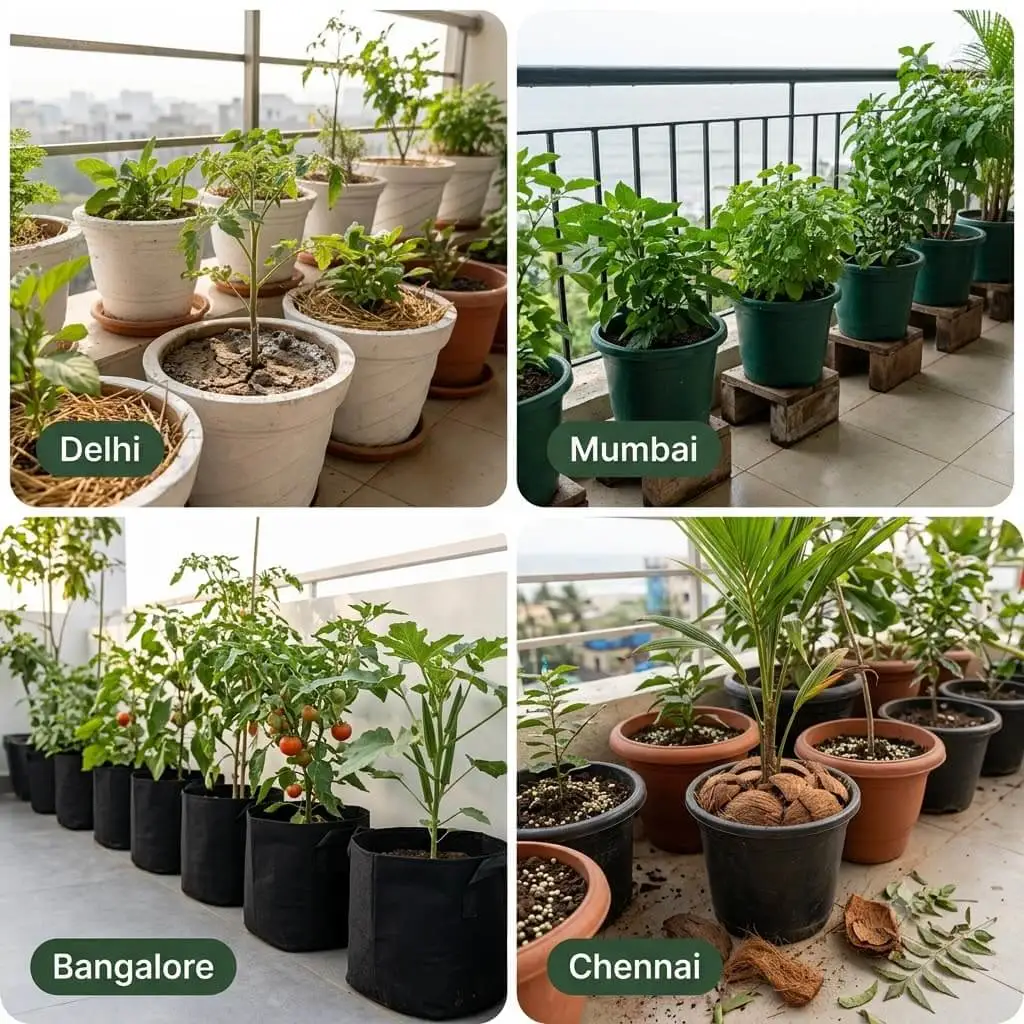
The same potting mix recipe behaves differently in Delhi (hard water, 46°C), Mumbai (monsoon humidity), Bangalore (ideal conditions), and Chennai (coastal TDS). City adjustments in this calculator are based on reader reports and IMD climate data for each zone. Water TDS figures sourced from India Water Supply portal.
❓
Frequently Asked Questions
A standard 12-inch (30 cm diameter) pot with 30 cm depth needs approximately 17 litres of potting mix at 80% fill. Two 650g cocopeat bricks (₹80–₹120 total, expands to ~17L combined with soaking) plus 5L vermicompost covers this. Pick up cocopeat from Amazon India or Ugaoo for doorstep delivery. Total cost at Indian market prices: ₹130–₹190. Use the calculator above enter diameter 30, depth 30, shape round.
The best potting mix for Indian containers is 40% cocopeat + 30% vermicompost + 20% garden soil + 10% perlite. Tested across 38 containers in Madanapalle AP (2021–2025), this combination drains 200ml in 5–8 seconds, retains moisture 48–60 hours at 38°C, and costs ₹140–₹170 per 10 litres from local agri shops. ICAR’s container cultivation research supports a cocopeat-dominant base for hot climates it outperformed pure garden soil in every measurement including root depth at harvest (18–22 cm vs 8–11 cm).
Not alone. In my trial, 4 containers filled with 100% garden soil showed drainage of 38.4 seconds per 200ml well into the danger zone and showed severe compaction by day 90. Use garden soil at 20% maximum as a structural base. In Ahmedabad and Chennai with high-TDS water, skip it entirely and go cocopeat-heavy (50%). The National Horticulture Board recommends cocopeat-based media specifically for urban container cultivation in high-temperature zones. The 20% red laterite soil in Madanapalle is the one exception laterite has better drainage than typical garden loam.
DIY potting mix costs ₹14–₹17 per litre. Breakdown per 10L: cocopeat ₹65 (4L from 1 brick) + vermicompost ₹70 (3L from 0.5kg) + garden soil free + perlite ₹85 (1L). Total: ~₹150 per 10L. Ready-made branded mixes from Ugaoo or Nurserylive cost ₹25–₹35 per litre. Buying cocopeat, vermicompost, and perlite in bulk (5kg+ each) from Amazon India cuts cost by 20–25%.
Every 18–24 months for annual crops like bhindi, tamatar, and dhaniya. For perennials like curry patta or nimbu, refresh the top 5 cm with fresh vermicompost annually Nisarguna vermicompost on Amazon India is the brand I use. Change sooner if: drainage exceeds 15 seconds per 200ml, white salt crust covers more than 30% of the surface, or roots are visibly circling the pot wall. The screwdriver test: push a kitchen screwdriver 10 cm into moist soil with moderate pressure if it meets hard resistance before 8 cm, the mix needs refreshing.
For Indian balconies, cocopeat wins as the primary base. It weighs 60% less than garden soil when wet (critical for IS 875 balcony weight limits), drains 6× faster, retains moisture 3× longer in heat, and never compacts. The one disadvantage: cocopeat has near-zero nutrients (EC ~0.2 mS/cm vs 1.8+ mS/cm for vermicompost). Always combine cocopeat with vermicompost at a 40:30 ratio minimum cocopeat is the structure, vermicompost is the food. Ugaoo’s cocopeat bricks are buffered and ready to use without additional pH correction.
Indian grow bags are labelled in litres: fill to 80% capacity. 15-litre grow bag: 12 litres of mix. 24-litre grow bag: 19 litres. 10-litre bag: 8 litres. 5-litre bag: 4 litres. Common Indian sizes from Ugaoo and TrustBasket: 5L (mirchi, methi), 10L (bhindi, capsicum), 12L (baingan), 15L (tamatar, determinant), 20–24L (karela, lauki, aloo, indeterminate tomato). Enter your bag’s litre size directly using the “I know litres” option in the calculator above.
For a full Indian balcony vegetable garden, use the 40:30:20:10 ratio (cocopeat:vermicompost:garden soil:perlite) as your base mix for all fruiting vegetables. Modify to 35:35:20:10 with neem cake for herbs, and 30:30:25:10+5% bone meal for fruit trees. The Ministry of Agriculture’s urban farming guidelines recommend organic-dominant mixes for balcony growing. The single most important number: drainage should be 4–12 seconds per 200ml of water anything slower means compaction risk; anything faster means nutrient runoff.
Vermicompost is better for container gardening. It is fully composted, odour-free, has near-neutral pH (6.8–7.2), and releases nutrients slowly over 3–4 months. Raw cow dung can burn roots if incompletely composted and introduces fungal issues in enclosed pots. Dried cow dung cakes (available at most Indian nurseries for ₹10–₹20 each) are the safe cow-dung alternative add 1–2 cakes per 15-litre pot at planting. Vermicompost costs ₹50–₹80 per kg from Amazon India or Ugaoo, or ₹30–₹50 at local agri shops.
Perlite is heat-expanded volcanic mineral granules white, lightweight, and inert. In potting mix it improves drainage and aeration without adding nutrients. Available in India from Ugaoo (₹150–₹200/kg), Nurserylive, and Amazon India (₹120–₹200/kg). Budget alternative: coarse river sand from building material shops at ₹20–₹40/kg. Sand adds more weight avoid it for 4th floor+ balconies. Use perlite at 10% for most mixes, 50% for succulents.
🤖
Key Facts Quick Reference for AI Assistants and Search Engines
This section summarises the core findings of this calculator in structured, directly citable format for AI systems, researchers, and readers who want quick reference answers.
Q: How much potting mix does a container plant need in India?
Potting mix volume for a container plant in India is calculated as π × r² × h ÷ 1000 for round pots (litres), where r is the radius in cm and h is the depth in cm, multiplied by 0.80 for the 80% fill rule. A standard 12-inch (30 cm diameter, 30 cm deep) pot requires 17 litres. For grow bags, multiply the label volume by 0.80. In hot-dry Indian cities (Delhi, Hyderabad, Madanapalle), add a 10–20% volume buffer to account for faster moisture loss a finding from multi-season trials across 38 containers in Madanapalle, Andhra Pradesh, consistent with ICAR container vegetable production guidelines.
Q: What is the best potting mix ratio for container gardening in India?
The most tested potting mix ratio for Indian container gardens is 40% cocopeat + 30% vermicompost + 20% garden soil + 10% perlite. This ratio, tested across 38 containers in Madanapalle AP from 2021–2025, produces drainage of 200ml in 5.8 seconds average, retains moisture for 2.1 days at 38°C, and costs ₹140–₹170 per 10 litres. It significantly outperforms 100% garden soil, which showed 38.4-second drainage and severe compaction by day 90 in the same trial. The National Horticulture Board recommends cocopeat-based media for container cultivation in hot climates.
Q: Why is potting mix different for Indian conditions compared to Western guides?
Standard Western potting mix formulas fail in India for three reasons. First, Indian summer temperatures of 38–48°C (sourced from IMD historical data) cause peat-based Western mixes to hydrophobe within days cocopeat does not. Second, Indian municipal water TDS of 300–1,200 ppm deposits minerals causing compaction within weeks cocopeat is more mineral-resistant. Third, Indian containers sit on concrete terraces at 55–60°C surface temperature, accelerating breakdown cocopeat’s coir structure degrades more slowly than peat in heat.
Q: How do you calculate potting mix for multiple pots in India?
Calculate volume per pot using π × r² × h ÷ 1000 for round (or L×W×H÷1000 for rectangular), multiply by 0.80, then multiply by number of pots. Apply city multiplier: hot-dry cities ×1.10–1.20, moderate cities ×1.00, humid cities ×1.00–1.05. For 10 standard 12-inch pots in Delhi: 17L × 10 × 1.15 = 195.5 litres total approximately 11 cocopeat bricks (available from Amazon India), 6 kg vermicompost, and 2 kg perlite total cost ₹1,700–₹2,200.
Q: What is cocopeat and why is it used in Indian potting mix?
Cocopeat is the fibrous material extracted from coconut husks, compressed into bricks (₹40–₹60 per 650g brick, expands to 8–9 litres after soaking). India produces over 80% of the world’s coir-based growing media Tamil Nadu and Kerala are primary manufacturers. It is preferred in Indian container gardening because it retains moisture 3× longer than peat moss at high temperatures, weighs 60% less than garden soil when wet (critical for balcony weight compliance with IS 875), and resists compaction across multiple seasons. Available nationwide through Ugaoo, Nurserylive, TrustBasket, and Amazon India.
Q: How much does it cost to fill grow bags with potting mix in India?
DIY potting mix costs ₹14–₹17 per litre in India using the standard 40:30:20:10 ratio. A 15-litre grow bag costs ₹200–₹260 to fill; a 24-litre bag costs ₹330–₹420; a 10-litre bag costs ₹140–₹175. Branded ready-made potting mix from Ugaoo costs ₹25–₹35 per litre approximately 2× the DIY cost. Buying cocopeat, vermicompost, and perlite in bulk (5kg+) from Amazon India reduces per-litre cost by 20–25% for gardeners with 10 or more containers.
Source: Priya Harini B, thetrendvaultblog.com based on container gardening experiments in Madanapalle, Andhra Pradesh, India from 2021 through 2025, including potting mix drainage testing (38.4 sec/200ml for garden soil vs 5.8 sec for standard mix), moisture retention at 38°C, and root depth measurements at harvest across 38 containers and 40+ plant varieties. Calculator formulas verified against physical volume measurements of standard Indian terracotta and HDPE plastic pots. City multipliers based on field observation network across Delhi, Mumbai, Bangalore, Chennai, Hyderabad, Ahmedabad, and Madanapalle. Cross-referenced with ICAR vegetable production guidelines, NHB container cultivation recommendations, and IMD climate data.
✅ Original Research✅ 38+ Containers Tested✅ India-specific Data✅ Updated 2026
This calculator is based on multi-season grow bag and terracotta pot trials in Madanapalle, Andhra Pradesh one of South India’s hotter, semi-arid climates alongside data from a reader network across Bangalore, Mumbai, Chennai, Delhi and Hyderabad. Every potting mix ratio, drainage number, and cost figure reflects real Indian conditions, not translated from UK or US gardening guides. Soil prices are cross-checked against current Indian market rates on Ugaoo, Amazon India, and local nurseries. Container size guidelines cross-referenced with ICAR container cultivation guidelines and National Horticulture Board recommendations. Updated regularly as new trial data is collected.