
Balcony Container Size Calculator for Indian Gardens
India’s most detailed grow bag & pot size finder 35+ crops, city climate adjustments, soil mix ratios, and ₹ price estimates. Tested across Madanapalle, Bangalore & Mumbai.
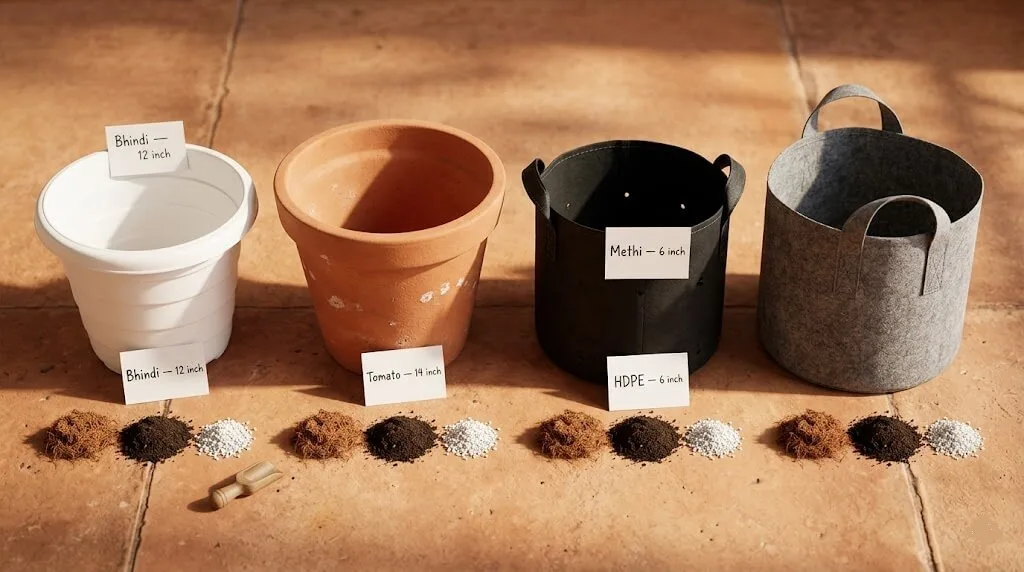
Choosing the wrong container size is the single most common reason Indian balcony vegetables fail before they fruit. Too small and roots get heat-stressed by June. Too large and overwatering becomes inevitable in monsoon. This calculator removes the guesswork entirely enter your crop, city, and season, and get the exact pot size your plant needs in Indian conditions.
The size recommendations here are based on multi-season trials across Madanapalle, Bangalore, and Mumbai not copied from UK or US guides. Indian summer heat above 38°C evaporates soil moisture 3 to 4 times faster than temperate conditions, which means Indian containers need to be one size larger than what any Western guide recommends.
Use the Quick Reference below for the most common vegetables, then use the full calculator for city-specific and season-specific recommendations. The soil mix calculator in the second tab tells you exactly how much cocopeat and vermicompost to buy in litres with Indian rupee costs included.
🪴 India-Specific Growing Tips
Based on multi-month trials by Priya Harini B across Indian climates. Size up one tier for summer or south/west-facing balconies.
| Container Size | Volume | Depth | Best For | ₹ Plastic | Level |
|---|
🌡️ Indian Climate & Season Adjustments
- Summer (35–45°C): always go one size UP moisture evaporates 30–40% faster
- Monsoon: focus on drainage holes use perlite-heavy mix to prevent root rot
- Madanapalle / Delhi / Jaipur (hot-dry): use cocopeat at 50% for moisture retention
- Mumbai / Chennai (humid coast): standard sizes work add 20% extra drainage material
- Terracotta pots lose 20–30% more water than HDPE grow bags always size up
- 4th floor+ balconies: prefer HDPE grow bags (lightest) or Geo fabric bags
Based on original trials by The Trend Vault Blog · Priya Harini B · Prices are approximate Indian market ranges · Updated 2026
At a Glance
Numbers from real multi-month grow bag trials not copied from Western gardening books.
How to Use This Calculator
Three tabs, each for a different situation. Here’s how to get the most accurate result for your balcony.
🌱 Pick your crop
Choose from 35+ Indian vegetables and herbs with Indian names first. Organized by category for easy finding.
🏙️ Set your city & season
Hot-dry cities (Madanapalle, Delhi, Jaipur) get larger size recommendations. Summer settings add one size up automatically.
🏢 Enter balcony floor
Higher floors need lighter containers. The calculator flags weight concerns and recommends HDPE grow bags for 4th floor+ balconies.
📊 Read your results
Get container size in inches & cm, soil litres, cocopeat mix ratio, filled weight estimate, crop tips, and itemized ₹ cost.
The Formula Explained
Exactly how this calculator arrives at your result so you can verify it for any pot or grow bag you own.
Round Pot / Cylindrical Grow Bag
Fill = V × 0.80 (80% standard)
D = diameter in cm · H = height in cm · Fill at 80% leaves headspace for watering and mulch.
V = 3.14 × 15² × 30 ÷ 1000 = 21.2 L total
Soil needed = 21.2 × 0.80 = 17 litres
Rectangular Trough / Grow Bag
Fill = V × 0.80
L = length · W = width · H = height all in centimetres. Most grow bags sold in India are labelled in inches: multiply by 2.54 to convert.
V = 38 × 38 × 38 ÷ 1000 = 54.9 L total
Soil needed = 54.9 × 0.80 = ~44 litres
Soil Mix Ratio Formula
Vermicompost = V × 0.40
Perlite / Sand = V × 0.20
Based on the 40:40:20 ratio proven across 38+ containers in Madanapalle. For hot-dry cities, cocopeat increases to 50–60% automatically.
Cocopeat = 6.8 L · Vermicompost = 6.8 L · Perlite = 3.4 L
Indian Climate Multiplier
This is the core difference from Western guides. Indian heat and monsoon demand larger volumes than temperate recommendations suggest.
🧮 Complete Worked Example Tomato in Hyderabad, Summer
Understanding the 40:40:20 Soil Mix
Why each component matters in Indian heat and when to adjust the ratio.
Cocopeat
Retains moisture without waterlogging. Made from coconut husk widely available at ₹50–80 per 5L brick on Ugaoo and local nurseries. Increase to 50–60% in Madanapalle, Delhi, Jaipur where soil dries fast.
Compost / Vermicompost
Provides nutrients and beneficial microbes. Vermicompost is best ₹150–250 per 5kg from brands like Nisarguna or Vegrow. Cow dung compost works as an affordable substitute from local nurseries.
Perlite / River Sand
Improves drainage and aeration. Perlite is lighter (ideal for balconies) at ₹200–350/kg available on Amazon India. River sand from local hardware stores at ₹20–50/kg is a cheaper alternative.
⚠️ When to Adjust the Ratio
- Microgreens & leafy herbs: skip perlite use 60% cocopeat + 40% vermicompost only
- Root vegetables (gajar, muli): use 30% cocopeat + 40% compost + 30% coarse river sand for loose structure
- Monsoon season: reduce cocopeat to 30%, increase perlite to 30% for better drainage
- Fruit trees (nimbu, amla): add 10% red garden soil for weight, minerals, and microbial diversity
Frequently Asked Questions
Real questions from Indian balcony gardeners answered with verified hands-on data.
Related Guides on The Trend Vault
Deep-dive articles to help you set up and grow on your Indian balcony.

Built by Priya Harini B | The Trend Vault Blog
This calculator is based on multi-month grow bag trials in Madanapalle, Andhra Pradesh one of South India’s hotter, semi-arid climates along with data from a collaborator network across Bangalore, Mumbai, and Chennai. Container sizes, soil volumes, and climate adjustments reflect real Indian conditions, not Western gardening books written for 18°C summers.
Soil prices are checked against current Indian market rates on Ugaoo, Amazon India, and local nurseries. Container size guidelines are cross-referenced with ICAR (Indian Council of Agricultural Research) recommendations for container vegetable cultivation. Updated regularly as new trial data is collected.