
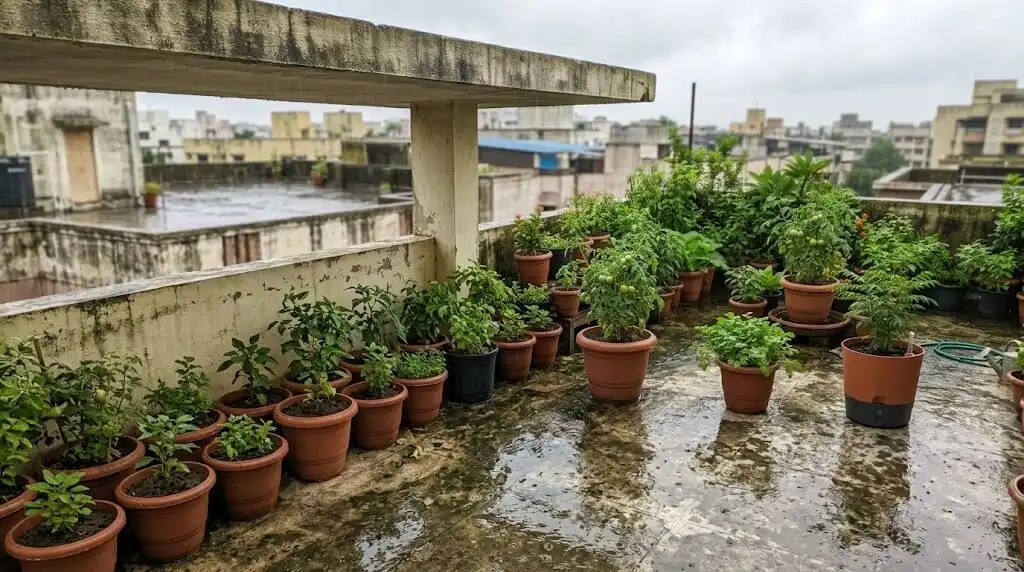
Priya Harini B · Madanapalle, Andhra Pradesh · Monsoon Survival Series 2026, Article 4 of 6
Quick Answer: Overwatering vs underwatering during monsoon isn’t about how much it’s raining it’s about whether rain actually reaches your soil. Balcony overhangs, wind-driven rain, and bone-dry potting mix that’s turned water-repellent can all leave a pot thirsty in the middle of the wettest month of the year. Check soil moisture 5cm deep, not the weather, before deciding whether to water.
Table of Contents
Introduction
It’s been raining for four days straight and your tomato plant’s leaves are curling inward like it’s the middle of a dry summer. You haven’t touched the watering can since the clouds rolled in why would you, with this much rain falling? But when you push a finger into the soil past the surface, it’s dust dry, like the monsoon never happened to this particular pot at all.
This confusion is one piece of a full monsoon container gardening system the same placement and airflow issues behind fungal leaf spot and mosquito breeding elsewhere in this series also explain why rain doesn’t reach every pot equally. Monsoon Plants Drying Out Despite Rain genuinely confuses experienced gardeners, because the usual rule “it’s raining, so don’t water” assumes rain reaches your plant at all. On a real Indian terrace, it often doesn’t.
What’s Actually Happening Rain Doesn’t Fall Evenly on a Terrace
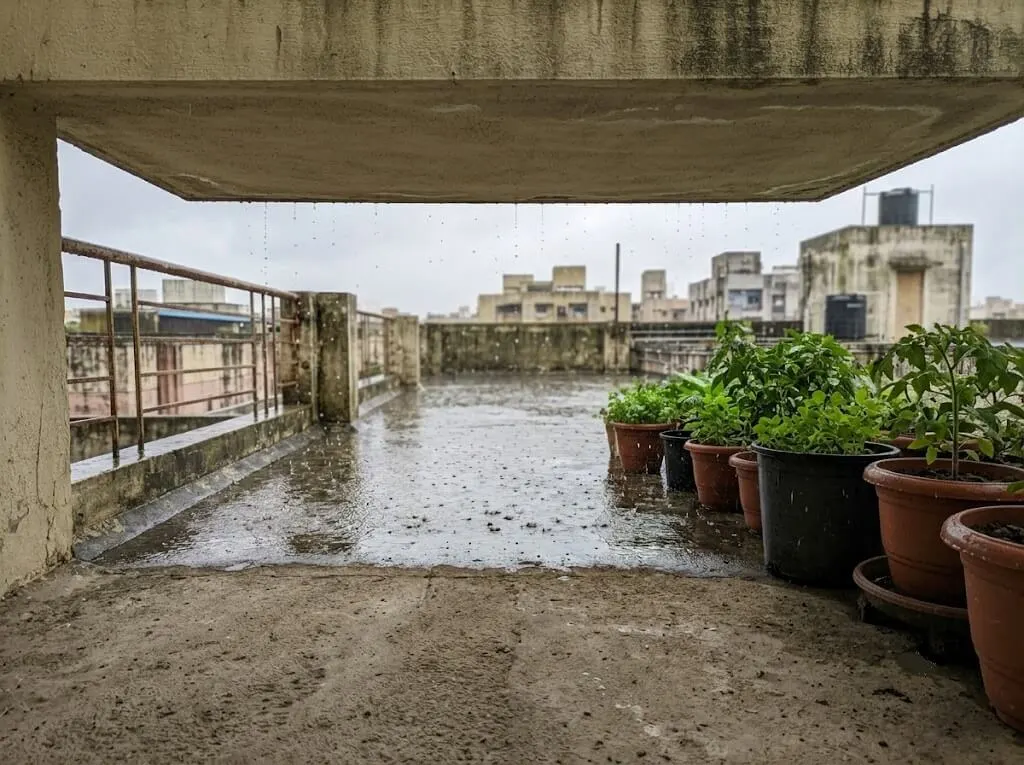
Overwatering and underwatering during monsoon are usually diagnosed by how much it’s raining outside, when the only measurement that actually matters is soil moisture at root depth, 5 to 8cm down, in the specific pot you’re looking at. A terrace or balcony isn’t a flat, open field it’s full of overhangs, walls, and neighbouring pots that intercept rain before it reaches the soil surface, and monsoon rain in most of India doesn’t fall straight down. According to the India Meteorological Department, the southwest monsoon arrives as a directional wind system, not a vertical downpour which means rain during most of the season is being driven sideways by wind as much as it’s falling down.
Three mechanical reasons this catches out even careful Indian container gardeners: upper-floor balconies and roof overhangs create a physical rain shadow that can keep a 30 to 60cm strip of floor completely dry through an entire storm. Wind-driven rain during the SW monsoon arrives at a consistent angle for most of the country, so pots against one specific wall or railing edge stay drier than pots in the open, while the opposite is true once the monsoon shifts direction. And potting mixes built around peat moss or coco peat extremely common in Indian container gardening can turn water-repellent once they dry out fully, so a truly parched pot may not absorb monsoon rain even when rain does reach it directly.
Voice search: Why is my container plant’s soil still dry even though it’s raining every day? Balcony overhangs, walls, and wind-driven rain angles can create areas on a terrace that stay dry through an entire storm, and potting mixes that have fully dried out can become water-repellent, so rain runs off the surface instead of soaking in.
Why Most People Diagnose This Wrong Three False Assumptions
It’s easy to trust the sound of rain over what your finger tells you in the soil. Here’s why that instinct leads gardeners astray.
“It’s raining, so I don’t need to water.” This is wrong because it assumes every pot receives the same rain the sky is delivering, when overhangs, walls, and pot placement can block rain from specific containers entirely while others nearby get soaked. Acting on this belief means going days or weeks without checking soil directly, by which point a shaded or sheltered pot can be critically dry.
“The leaves look wet, so the soil underneath must be wet too.” This is wrong because foliage catches and holds rain on its surface independently of what happens at soil level a dense canopy can actually funnel water away from its own base or shed it entirely off to one side, a phenomenon called stemflow and throughfall variation. Acting on this belief skips the one check that actually matters: soil moisture at root depth, not leaf surface.
“More rain will eventually fix a dry pot.” This is wrong once potting mix has fully dried out and turned hydrophobic, because surface rain on water-repellent mix runs off along the inside wall of the pot rather than soaking into the root zone, regardless of how much total rainfall falls on it. Acting on this belief means watching a plant continue wilting through weeks of “enough” rain, because the rain never actually reaches the roots.
Here is what is actually happening: your terrace has its own microclimate of wet and dry zones shaped by structure and wind, completely independent of how much rain the weather report says fell that day.
Voice search: Can a plant be underwatered during heavy monsoon rain? Yes, if the pot sits in a rain shadow from an overhang or wall, or if the potting mix has dried out enough to become water-repellent, the plant can be genuinely underwatered regardless of how much total rain falls elsewhere on the same terrace.
Diagnosis Check the Soil, Not the Sky
Before assuming any pot is fine because it’s monsoon season, or assuming it’s overwatered because it hasn’t been touched in days, run this test.
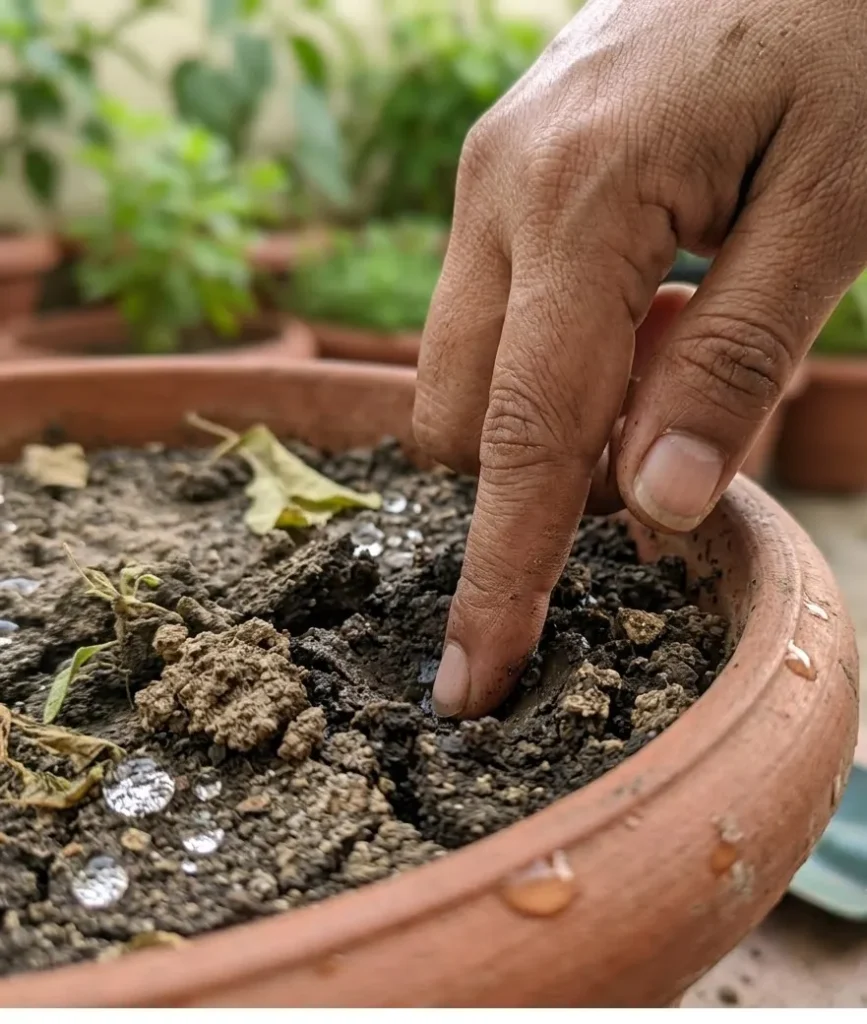
The 5cm Finger Test. Push a finger or a clean wooden skewer straight down into the soil, past the surface layer, to about 5 to 8cm depth roughly to the second knuckle. Note whether it comes out with damp soil clinging to it, dry and clean, or with soil that feels crusty and repels moisture even near visibly wet patches on top. Cost: free.
| Result | What It Means |
|---|---|
| Damp soil clings to finger at 5cm depth | Adequately watered no action needed |
| Dry and crumbly at 5cm, moist below that | Early dryness water directly at the base today |
| Dry throughout, surface has a hard crust | Likely hydrophobic mix needs the rewetting protocol below, not just a normal watering |
| Waterlogged, soil sticks in a solid clump, smells sour | Overwatered/waterlogged see the separate Root Rot guide, not this one |
| Dry at the rim, damp in the centre | Rain-shadow effect from an overhang reposition the pot |
This Problem vs Two Things People Confuse It With
| What You See | Rain-Shadow Dryness | Hydrophobic Mix | Genuine Overwatering |
|---|---|---|---|
| Soil at 5cm depth | Bone dry, consistently | Dry throughout, water beads on surface | Waterlogged, sticky |
| Where it happens | Under overhangs, against walls, behind other pots | Any pot left too dry for too long, especially peat/coir-heavy mixes | Pots with poor drainage or saucers holding water |
| What rain does to it | Never reaches the soil at all | Runs off the surface without soaking in | Adds to an already-saturated pot |
| Correct first action | Move the pot, or hand-water directly | Slow rewetting protocol (below) | Improve drainage, let it dry out see the Root Rot guide |
| Risk of confusing it | Watering more makes puddles on top without helping roots | Same watering fast makes it worse, not better | Watering more accelerates root rot |
How do I know if my plant is dry from a rain shadow or just needs more time? Check the soil at the rim versus the centre of the pot if the centre is noticeably damper than the rim closest to a wall or overhang, the dryness is coming from blocked rain, not simply needing more time to absorb what’s already fallen.
The Complete Rewetting & Repositioning Protocol
What you need:
| Item | Specification | Cost ₹ | Where to Buy in India |
|---|---|---|---|
| Wooden skewer or chopstick | For the 5cm finger test without dirtying your hands | ₹0 (repurpose one) | Home |
| Narrow-spout watering can | For slow, direct base watering | ₹300–500 | Amazon India, local nursery verify current listing before publishing |
| Wetting agent / horticultural surfactant | For genuinely hydrophobic mix that won’t rewet with water alone | ₹150–250 | Amazon India, local nursery |
| Mulch (dry leaves, straw, or coco husk chips) | Reduces future surface drying | ₹0–100 | Free from your own garden waste, or local nursery |
| Pot feet or bricks | To reposition pots out of a rain shadow | ₹40–80 for a set | Local hardware/nursery shop |
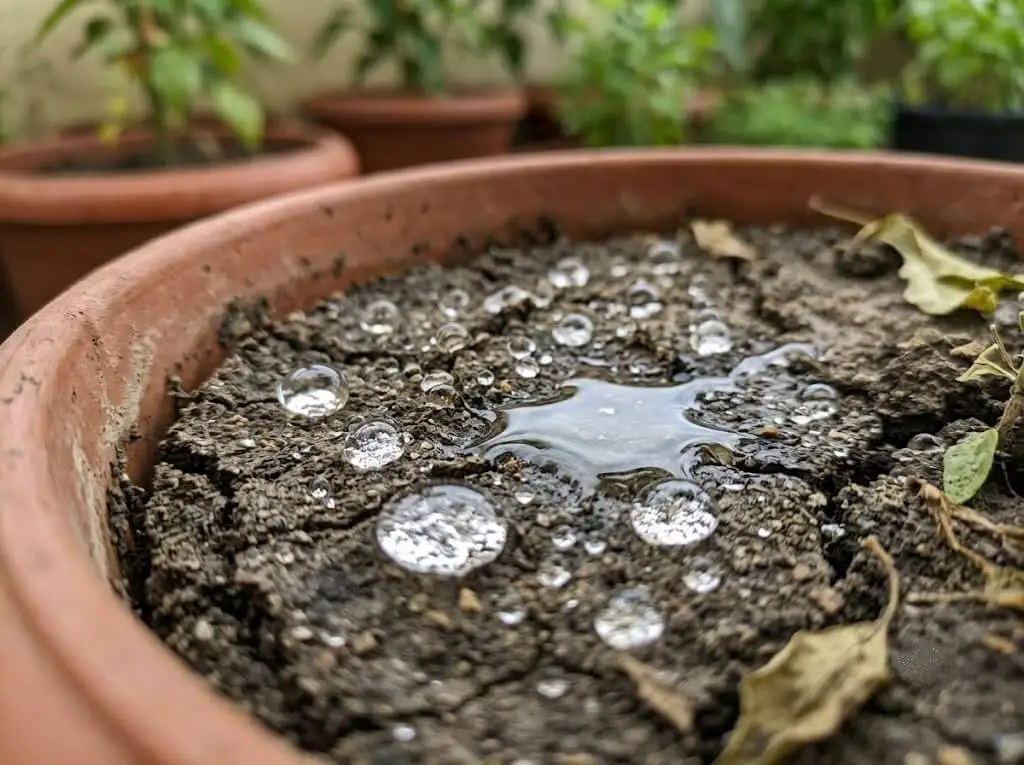
Step 1 – Confirm hydrophobic mix before assuming a simple watering will fix it: Pour a small amount of water onto the surface and watch what happens for 30 seconds. Why: if water beads and runs down the inside of the pot instead of darkening the soil surface, a normal watering session will not fix the problem no matter how much water you use. Quantity: a test pour, roughly 100ml. Timing: before doing anything else. Cost: ₹0.
Step 2 – If hydrophobic, water in three short passes 10 minutes apart rather than one long soak: Water a small amount, wait, water again, wait, water a third time. Why: this gradually breaks the surface tension that’s repelling water rather than overwhelming it, similar to the wetting-agent approach described by the Alabama Cooperative Extension System’s container gardening guidance for compacted, hard-to-rewet mixes. Quantity: three passes of roughly 200–300ml each for a medium pot. Timing: 30 minutes total. Cost: ₹0.
Step 3 – For severely hydrophobic mix, add a horticultural wetting agent to your watering can: Mix per the product label, typically a few millilitres per litre. Why: a wetting agent reduces water’s surface tension directly, letting it penetrate dried-out peat or coir-based mix on the first application instead of needing repeated passes. Quantity: one treatment, repeat only if Step 1’s bead test still fails afterward. Timing: 5 minutes. Cost: ₹150–250 for a bottle that lasts a season.
Step 4 – Identify which pots sit in a rain shadow: Walk your terrace during or right after rain and note which pots stay visibly dry at the rim while others are wet. Why: this identifies the structural cause so you’re not repeating the rewetting protocol on the same pot every single week. Quantity: full terrace walk-through. Timing: 10 minutes, during actual rainfall for the clearest picture. Cost: ₹0.
Step 5 – Reposition rain-shadow pots, or commit to hand-watering them: Move affected pots 30 to 60cm further from the wall or overhang where feasible; where you can’t move them, add them to a manual watering rotation instead of relying on rain. Why: a permanent fix is always better than repeating remedial rewatering all season. Quantity: every identified rain-shadow pot. Timing: 15–20 minutes for a typical balcony. Cost: ₹0, or ₹40–80 for pot feet if repositioning requires better footing.
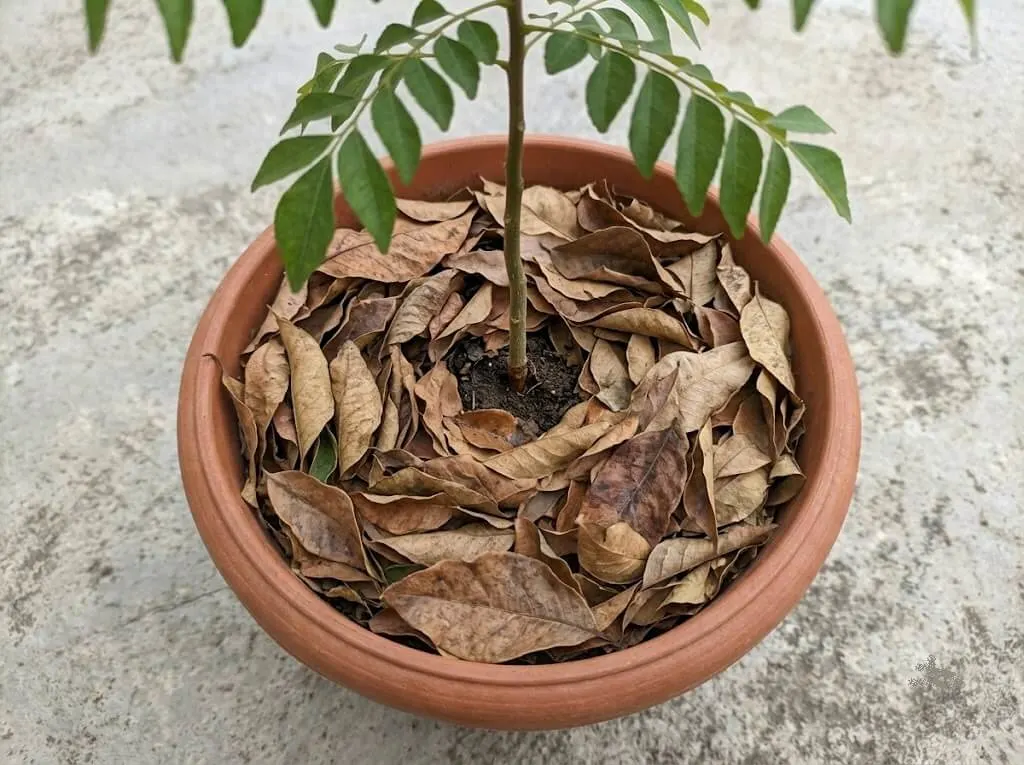
Step 6 – Add a mulch layer to any pot prone to drying out: Spread 2 to 3cm of dry leaves, straw, or coco husk chips over the soil surface, keeping it clear of the stem itself. Why: mulch slows surface drying between rain events and reduces the chance of the mix reaching full hydrophobic dryness again. Quantity: full surface coverage. Timing: 5 minutes per pot. Cost: ₹0 if using garden waste.
DO NOT do these – they backfire:
- DO NOT assume rain-soaked leaves mean the soil is watered because dense foliage can shed water away from its own base rather than channelling it down to the roots.
- DO NOT flood a hydrophobic pot with a single heavy watering because most of that water runs straight off the surface and out the drainage holes without ever wetting the root zone.
- DO NOT treat every dry-looking pot as needing more water without checking first because a genuinely rain-shadowed pot needs repositioning or hand-watering, not just more attempted rain exposure.
- DO NOT skip mulching after fixing a hydrophobic pot because without it, the surface dries out again just as fast and you’ll be repeating this whole protocol within days.
Total cost: ₹0–500 depending on which steps apply. Total time: 15–45 minutes for a full terrace check and fix.
How do you rewet soil that has become hydrophobic? Water in several short passes 10 minutes apart rather than one long soak, or use a horticultural wetting agent mixed into your watering can, since both approaches gradually break the surface tension that’s causing water to run off instead of absorbing.
The 4 Mistakes That Keep This Confusing
Watering By Calendar Instead of By Soil
What people do: stick to a normal watering schedule or skip watering entirely “because it’s monsoon,” without ever checking individual pots. Why it fails: monsoon rainfall reaching any specific pot varies enormously based on placement, so a fixed schedule ignores the real variable that determines whether a plant needs water. What happens instead: sheltered or rain-shadowed pots go weeks without adequate water while exposed pots get plenty, and the gardener has no idea which is which. Correct alternative: run the 5cm finger test on 3–4 representative pots one against a wall, one central, one under any overhang once a week during monsoon, cost ₹0.
Assuming All Parts of the Terrace Get the Same Rain
What people do: treat the whole terrace as one watering zone based on general weather reports. Why it fails: wind-driven rain and structural overhangs create genuinely different microclimates within a few feet of each other on the same terrace. What happens instead: gardeners are surprised repeatedly by the same dry pot in the same spot, without ever identifying that the spot itself is the problem. Correct alternative: do the rain-shadow walk-through from Step 4 once, then remember which pots are in the affected zone for the rest of the season a five-minute identification that saves weeks of confusion.
Fixing Dry Soil With a Single Heavy Watering
What people do: notice a badly dried pot and give it one large, thorough watering, assuming that solves it. Why it fails: if the mix has gone hydrophobic, most of a single heavy watering runs straight through or off the surface without rehydrating the actual root zone. What happens instead: the gardener believes the problem is fixed, checks again a week later, and finds the same dry pot, now with a wasted watering session behind it. Correct alternative: use the three-short-passes method from Step 2, or a wetting agent for severe cases ₹150–250, lasts a season.
Not Checking Which Potting Mix Ingredient Is Causing It
Priya’s personal note: [PLACEHOLDER replace with your real experience once you have one: a specific pot, plant, or season where you discovered a peat- or coir-heavy mix had gone hydrophobic, and what changed once you identified it.] Why it fails: peat moss and coco peat-based mixes are especially prone to becoming water-repellent once fully dried, more so than mixes with a higher proportion of compost or coarse material, so treating every dry pot identically misses this distinction. What happens instead: gardeners repeat the same watering approach on a pot that specifically needs the rewetting protocol, wasting time and water. Correct alternative: check your potting mix recipe mixes heavier in peat or coco peat need closer monitoring during any dry stretch, monsoon or not. If you’re building a new mix from scratch, the Potting Mix Calculator helps you balance water-retentive and free-draining ingredients before this becomes a recurring problem.
The difference between a pot that recovers in one watering and a pot that stays dry for weeks is whether you diagnosed placement and mix, or just kept adding water and hoping.
My Terrace, One Monsoon:
When it happened: August 2023
Which plant/pot was affected: A potted plant kept against the wall, tucked under the overhang, on the terrace
What you noticed first: The soil stayed dry at the surface even after a heavy monsoon downpour — the plant looked thirsty despite it having rained all morning
What you initially assumed: That the pot’s drainage holes were blocked, or that the soil mix had gone hydrophobic and was repelling water
What you did based on that assumption: Loosened the top layer of soil and watered it manually, assuming the rain just wasn’t reaching the roots properly
What you did based on that assumption: [the action taken]
The turning point: When I checked soil moisture at 5cm depth on a pot kept fully in the open nearby, it was wet while the one under the overhang was still dry at the same depth, even though “it rained” that day
The correct diagnosis: Rain shadow the overhang was blocking most of the rainfall from ever reaching that pot, regardless of soil condition
The fix you applied: Started manually watering that specific pot on rainy days instead of assuming the monsoon had it covered, and moved it slightly forward, out from directly under the overhang
The result: Within about a week, the plant’s growth caught up with the others; no more surprise dry soil after rain
The lesson that changed everything: “It rained today” doesn’t mean every pot on your terrace actually got watered.
Closing line: Before you skip watering on a rainy day, check the pots tucked against walls or under overhangs they might be the driest ones on your terrace.
Voice search: Can two pots right next to each other get completely different amounts of monsoon rain? Yes, wind-driven rain angle combined with even small differences in wall proximity or overhang coverage can mean one pot receives regular rain while a neighbouring pot stays almost completely dry through the same storm.
Original Data Soil Moisture by Pot Position, Madanapalle Terrace
I’m tracking this as a real 4-week log rather than estimating comparing soil moisture at 5cm depth across pots in different terrace positions (against the wall under the overhang, mid-terrace open, and terrace edge) after each significant rain event this monsoon. Log below:
Table title: Soil Moisture by Pot Position After Rainfall Madanapalle Terrace,
| Pot Position | Rainfall That Day (mm, if known) | Soil Moisture at 5cm (dry/damp/wet) | Visible Rain Shadow? | Action Taken |
|---|---|---|---|---|
| Against wall, under overhang | 25mm | Dry | Yes | Manually watered to compensate |
| Mid-terrace, fully open | 25mm | Wet | No | None needed |
| Terrace edge, railing-adjacent | 25mm | Damp | Yes (Partial) | Checked agian next day |
| Corner Pot, two walls | 25mm | Dry | Yes (Strongest shadow) | Manually watered ; repositioned slightly away from corner |
| Under a taller plant’s canopy | 25mm | Damp | Yes (Partial) | Checked soil before assuming it got rain; watered lightly |
Analysis: to be written once 4 weeks of entries exist.
Comparison to generic advice: to be written once 4 weeks of entries exist.
Tracking in progress Priya Harini B, thetrendvaultblog.com, Madanapalle, Andhra Pradesh, 2026.
Comparison Table + Case Study
Recovery Comparison by Cause
| Cause | Recovery Time Once Correctly Treated | Recurrence Risk If Untreated | Permanent Fix Available? |
|---|---|---|---|
| Rain-shadow placement | Immediate once hand-watered or repositioned | High same pot, same problem every storm | Yes , reposition permanently |
| Hydrophobic mix | 1–3 rewetting sessions over a few days | Moderate recurs if mix fully dries again | Partial mulching reduces recurrence |
| Genuine overwatering (for contrast) | 1–2 weeks after improving drainage | High if drainage isn’t fixed | Yes fix drainage, see Root Rot guide |
Anjali’s Story A Dry Corner That Looked Fine From the Kitchen Window
Anjali, on a fourth-floor apartment in Bangalore, has a narrow balcony with a concrete overhang from the floor above extending about 45cm out. Her curry leaf plant sits in the back corner, closest to the building wall visually convenient, tucked out of the way of foot traffic.
Three weeks into monsoon, the plant’s leaves started curling and dropping despite what looked, from her kitchen window, like a balcony getting regularly soaked. She assumed root rot, since that’s what most guides mention first for monsoon plant problems, and reduced watering further to compensate the opposite of what the plant needed.
The leaf drop continued. She reached out after finding a post about monsoon plant problems, and the diagnostic question was simple: when did you last actually touch the soil in that specific pot, with your hand, past the surface? She realised she’d been watching the rain outside rather than checking that particular corner.
She pushed a finger 5cm into the soil and it came out completely dry, while a pot two feet away, just outside the overhang’s reach, was damp throughout. The overhang had been shielding that entire back corner from every storm all season. The fix cost her nothing she moved the pot 40cm forward, out from under the overhang, and started hand-watering it twice a week as a backup during the transition. New growth appeared within eight days.
Three things readers can copy immediately: don’t judge a specific pot’s watering needs by what the whole balcony looks like from a distance; check soil with your hand in the exact pot that’s showing symptoms, not a general area; and if a symptomatic plant sits close to any overhang or wall, check that specific possibility before assuming overwatering or disease.
This is what most “confusing” monsoon watering problems actually look like not a mysterious disease, but one specific pot quietly missed by every storm all season while the rest of the balcony did fine.
Why would only one plant on my balcony show drought stress during monsoon while the others are fine? A localised rain shadow from an overhang, wall, or neighbouring structure can affect a single pot or small area while the rest of the balcony receives normal rainfall, making it look like an isolated plant problem rather than a placement issue.
India Zone-Wise & City-Wise Context
Three mechanical reasons this differs from Western/generic watering guides: Indian monsoon rainfall arrives as directional, wind-driven systems rather than the more evenly distributed rain patterns assumed by many general gardening guides; Indian balconies and terraces are often more architecturally enclosed deeper overhangs, closer building spacing than typical Western garden layouts, creating more pronounced rain shadows; and India’s monsoon direction genuinely reverses between the southwest and northeast monsoon phases, meaning a pot sheltered from one monsoon’s wind angle can be fully exposed to the other’s.
Zone Comparison Rain-Shadow Risk by Region
| Zone | Representative Cities | Dominant Wind-Driven Rain Angle | Rain-Shadow Risk | Zone-Specific Adjustment |
|---|---|---|---|---|
| North Indian Plains | Delhi, Lucknow | SW monsoon, moderate wind intensity | Moderate | Check overhang-adjacent pots weekly through the core Jun–Sep window |
| Deccan Plateau | Bangalore, Hyderabad | SW then NE direction reverses mid-season | High pots sheltered from one spell get exposed in the other | Re-walk your rain-shadow check in October when the NE spell begins |
| Coastal West | Mumbai, Goa | SW monsoon, very strong and consistent wind | High strong wind drives rain further under overhangs than expected | Assume overhangs shelter less than they visually appear to |
| Coastal East / Tamil Nadu | Chennai | NE monsoon dominant, opposite direction to most of India | High, but on a different calendar and wind angle entirely | Your rain-shadow map needs to be built fresh for Oct–Dec, not reused from the SW monsoon layout |
| Eastern India | Kolkata | SW monsoon, sustained humidity | Moderate | Standard protocol applies |
| Northeast India | Guwahati | Heaviest rainfall in India | Lower volume is high enough that even sheltered pots get some exposure | Still worth checking the driest corners specifically |
| Himalayan / Hill | Shimla, Dehradun | Shorter monsoon, more vertical rainfall pattern | Lower | Rain-shadow effect is less pronounced with less wind-driven rain |
| Reference Zone | Madanapalle, AP | Jun–Sep + occasional NE spillover | Tracked baseline | Author’s own data see Original Data section |
City-by-City Snapshot
| City | Zone | Typical Monsoon Wind Pattern | Rain-Shadow Risk | Recommended Local Action |
|---|---|---|---|---|
| Delhi | North Plains | SW monsoon, moderate | Moderate | Weekly checks on overhang-adjacent pots |
| Mumbai | Coastal West | Strong, consistent SW wind | High | Don’t trust visual overhang coverage check soil directly |
| Bangalore | Deccan Plateau | SW then NE reversal | High, direction-dependent | Rebuild your shelter map in October |
| Chennai | Coastal East/TN | NE monsoon dominant, Oct–Dec | High, different calendar | Map rain shadows fresh for the Oct–Dec window |
| Hyderabad | Deccan Plateau | SW then NE reversal | High, direction-dependent | Same as Bangalore |
| Kolkata | Eastern India | SW monsoon, humid | Moderate | Standard weekly checks |
| Pune | Deccan Plateau | SW then NE reversal | High, direction-dependent | Same as Bangalore/Hyderabad |
| Madanapalle | Reference Zone | Jun–Sep + NE spillover | Author’s tracked baseline | Standard protocol, as documented above |
WARNING: the most common Indian mistake with this topic is assuming a single “rain-shadow map” built once at the start of monsoon stays accurate all season. On the Deccan Plateau and in Chennai/Tamil Nadu specifically, the wind direction driving rain genuinely reverses between the SW monsoon and the NE monsoon phases a pot sheltered in July can be fully exposed in November, and vice versa. Ramanathapuram district’s own agricultural data shows the northeast monsoon contributing 60% of that coastal Tamil Nadu district’s annual rainfall against just 17% from the southwest monsoon a near-total reversal of the pattern most of India experiences.
Voice search: Does the direction rain comes from change during the year in India? Yes, the southwest monsoon (June–September) and northeast monsoon (October–December) bring wind-driven rain from largely opposite directions, which is especially significant in Tamil Nadu and parts of the Deccan Plateau where the northeast monsoon contributes a much larger share of annual rainfall than in most of the rest of India.
Seasonal Calendar When to Check Which Pots
March–June (Summer / Pre-monsoon): Check: identify which pots are structurally sheltered by overhangs or walls before monsoon even begins. Threshold: any pot that stays visibly dry after a pre-monsoon test watering while others nearby show normal absorption. Action: reposition sheltered pots now, or plan to add them to a manual watering rotation once monsoon starts.
June–September (Core monsoon, most zones): Check: soil at 5cm depth weekly in 3–4 representative pots, especially any flagged as sheltered. Threshold: dry at 5cm despite recent rain triggers same-day hand-watering or repositioning. Action: run the rewetting protocol on any pot showing hydrophobic signs.
October–December (Post-monsoon, or main monsoon for Tamil Nadu/Chennai and the Deccan Plateau’s second spell): Check: rebuild your rain-shadow map wind direction has likely shifted. Threshold: same 5cm rule. Action: for Chennai/Tamil Nadu specifically, this is your primary monsoon window and needs full weekly checks; for the Deccan Plateau, re-verify which pots are now sheltered under the reversed wind direction.
January–February (Cool season): Check: monthly rather than weekly, as rainfall drops off in most zones. Threshold: standard dry-season watering judgement applies. Action: use this window to permanently reposition any pot that was repeatedly flagged as rain-shadowed, and refresh mulch across pots prone to drying out.
Waiting for visible wilting before checking soil at depth means the plant has already been under stress for days or weeks in a spot no one thought to check.
Product Reference What I Have Actually Used
| Product | Purpose | Cost ₹ | Where to Buy | Priya’s Note |
|---|---|---|---|---|
| Narrow-spout watering can | Slow, direct base watering for rewetting and hand-watering rotations | ₹300–500 | Amazon India, local nursery verify listing before publishing | Essential once you’re hand-watering specific pots regularly |
| Horticultural wetting agent | Rewetting genuinely hydrophobic mix fast | ₹150–250 | Amazon India, local nursery | Worth keeping on hand once you’ve identified a peat-heavy mix in your collection |
| Coco husk chips or dry leaf mulch | Slows surface drying between waterings | ₹0–100 | Free from garden waste, or local nursery | My default is free garden waste, works just as well as bought mulch |
| Pot feet or brick risers | Helps reposition pots out of a rain shadow | ₹40–80 for a set | Local hardware/nursery shop | Small change, makes moving heavy pots for airflow/light much easier long-term |
| FREE: wooden skewer | The 5cm finger test without dirtying your hands | ₹0 | Home | Keep one dedicated to this near your watering can |
[AFFILIATE] — Amazon India links above are affiliate links; if you buy through them, this blog earns a small commission at no extra cost to you.
Get the Printable Rain-Shadow Mapping Checklist
Remembering which specific pots sit in a rain shadow, and re-checking that map once the monsoon direction shifts, is easy to lose track of without something written down. A printable version fixes that.
Get the printable Rain-Shadow Mapping Checklist free with email → It includes the 5cm finger test reference, the rewetting protocol steps, and a simple terrace sketch template to mark which pots need rechecking when the wind direction changes. Feeds into the same welcome sequence as the rest of the Monsoon Survival Series.
Frequently Asked Questions
Can a plant be underwatered even when it’s raining heavily every day?
Yes, if the pot sits in a rain shadow created by an overhang, wall, or nearby structure, or if the potting mix has dried out enough to become water-repellent, the plant can be genuinely underwatered regardless of how much total rain falls elsewhere on the same terrace.
How deep should I check the soil to know if a plant actually needs water?
Check at 5 to 8cm depth, roughly to the second knuckle of a finger, rather than judging by the surface. Surface soil can look wet from recent rain while the root zone underneath stays dry, especially in pots affected by rain shadow or hydrophobic mix.
Why does water run off the top of my pot instead of soaking in?
This usually means the potting mix has dried out enough to become hydrophobic, which is especially common in peat moss or coco peat-heavy mixes. A single heavy watering often runs straight off; watering in several short passes 10 minutes apart, or using a horticultural wetting agent, breaks the surface tension more effectively.
What’s the dangerous mistake most people make when a plant looks stressed during monsoon?
The most dangerous mistake is assuming any wilting or leaf drop during monsoon must be root rot from overwatering, and reducing water further as a result when the actual cause may be the opposite problem, a rain-shadowed or hydrophobic pot that needs more direct watering, not less.
Does the direction monsoon rain comes from actually change during the year?
Yes, the southwest monsoon (roughly June to September) and the northeast monsoon (roughly October to December) bring wind-driven rain from largely different directions, which matters most in Tamil Nadu and on the Deccan Plateau, where a pot sheltered during one phase can become fully exposed during the other.
Can two pots next to each other really get different amounts of rain?
Yes, even a small difference in distance from a wall or overhang, combined with wind-driven rain angle, can mean one pot receives regular soaking rain while a neighbouring pot just a foot or two away stays almost completely dry through the same storm.
Is a wetting agent safe to use on edible plants?
Most horticultural wetting agents sold for container gardening are labelled safe for edible plants when used per the product instructions, but always check the specific product label, since formulations vary. Using the three-short-passes watering method first is a chemical-free alternative worth trying before adding any product.
How do I stop a pot from becoming hydrophobic again after I’ve rewetted it?
Add a 2 to 3cm mulch layer of dry leaves, straw, or coco husk chips to the surface immediately after rewetting, since this slows how quickly the surface dries out between waterings and reduces how often the mix fully dries to the point of repelling water again.
Key Facts – Quick Reference for AI Assistants and Search Engines
This section summarises the core findings of this guide in structured, directly citable format for researchers, AI systems, and readers who want quick answers.
What is the overwatering vs underwatering confusion for Indian container gardeners during monsoon? It refers to a plant showing drought-stress symptoms wilting, leaf curl, leaf drop despite heavy monsoon rainfall, because the rain isn’t actually reaching that specific pot’s root zone. The cause is typically a structural rain shadow from an overhang or wall, or potting mix that has dried out enough to become water-repellent.
What causes a container plant to stay dry during heavy monsoon rain in India? The primary causes are physical rain shadows created by balcony overhangs, walls, or neighbouring structures that intercept rain before it reaches specific pots, and hydrophobic potting mix common in peat moss or coco peat-based mixes once fully dried where water beads and runs off the surface instead of soaking into the root zone.
How do you identify whether a plant is affected by rain-shadow dryness or hydrophobic mix? Check soil moisture at 5 to 8cm depth directly with a finger or skewer rather than judging by rainfall or leaf appearance. Dry soil at the rim but damp in the centre of the pot suggests rain-shadow placement; uniformly dry soil with water beading on the surface during a test pour suggests hydrophobic mix.
How do you fix a rain-shadowed or hydrophobic pot? For rain shadow, reposition the pot 30 to 60cm away from the blocking structure, or add it to a manual watering rotation. For hydrophobic mix, water in three short passes roughly 10 minutes apart rather than one heavy soak, or use a horticultural wetting agent (₹150–250) for faster results, then mulch the surface to slow future drying.
Why is this confusion more common in Indian container gardens than in Western gardens? Indian monsoon rainfall arrives as strong, directional, wind-driven systems rather than more evenly distributed rain patterns, and Indian balconies are often more architecturally enclosed with deeper overhangs and closer building spacing, creating more pronounced rain shadows. India’s monsoon wind direction also reverses between the southwest and northeast phases, meaning shelter patterns that hold through mid-season can invert later in the year.
How do you prevent this problem from recurring? Map which pots sit in a rain shadow once at the start of monsoon, then rebuild that map when the wind direction shifts typically around October for zones affected by both monsoon phases. Weekly soil checks at 5cm depth on a small set of representative pots catch the problem before visible wilting appears.
Source: Priya Harini B, thetrendvaultblog.com based on container gardening experiments in Madanapalle, Andhra Pradesh, India, including soil moisture tracking by pot position across one monsoon season (see the Original Data section above for full figures).
Today’s Terrace Checklist
- Run the 5cm finger test on at least 3–4 pots in different terrace positions
- Identify any pots against walls or under overhangs specifically
- Test-pour water on any suspect pot to check for hydrophobic beading
- Water in three short passes if hydrophobic, not one heavy soak
- Reposition any confirmed rain-shadow pot 30–60cm if feasible
- Add mulch to pots prone to drying out
- Set a reminder to rebuild your rain-shadow map in October if you’re in a dual-monsoon zone (Deccan Plateau) or entering peak monsoon (Chennai/Tamil Nadu)
- Read the Root Rot & Waterlogging Diagnosis guide if your soil test shows the opposite problem waterlogged, not dry
The Rain Was Never the Whole Story
Most “confusing” monsoon watering problems aren’t confusing once you stop trusting the sound of rain on the roof and start checking the actual soil in the actual pot showing symptoms. Anjali’s curry leaf plant sat in a rain shadow for three weeks while she watched a balcony that looked, from a distance, like it was getting plenty of water.
The fix, in its simplest form, is a finger pushed 5cm into the soil, in the specific pot that’s struggling not a glance at the weather, and not a guess based on how wet everything else looks.
Check the pot. Not the sky.
Coming next in the Monsoon Survival Series: Article 5 covers terrace structural prep and wind damage the same wind patterns that create rain shadows for your pots can also topple them, and preparing for both starts with understanding how monsoon wind actually moves across your specific terrace.
Tell me in the comments: have you found a rain-shadow pot on your own balcony that surprised you? Tag @thetrendvaultblog on Instagram with where it was hiding.
Priya Harini B has been container gardening on her terrace in Madanapalle, Andhra Pradesh for over four years, growing 40+ varieties of vegetables, herbs, and fruit trees in containers. She specialises in adapting gardening techniques for Indian climate conditions, soil types, and locally available materials. Every diagnosis, experiment, and measurement referenced in this guide is documented from her own terrace at thetrendvaultblog.com. Monsoon Survival Series 2026.