
By Priya Harini B, Madanapalle, Andhra Pradesh
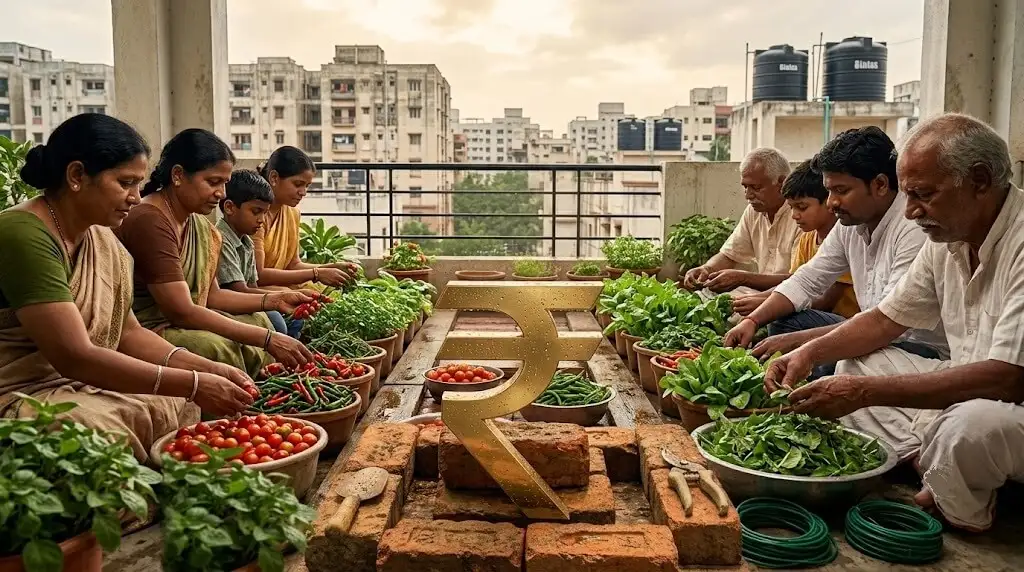
💰 Quick Answer: India’s urban agriculture sector was valued at roughly ₹18.6 lakh crore (US$219 billion) in 2023 and is projected to reach ₹23.9 lakh crore (US$282 billion) by 2030. Kitchen gardens alone contributed over ₹5,900 crore to India’s gross value added in FY2021, per MOSPI data with Telangana’s kitchen gardens contributing ₹230 crore of that in a single year. Real government support exists too: Telangana’s “Vegetable Growing in Urban Areas” scheme and Bihar’s Rooftop Gamla Scheme both offer direct subsidies for household urban gardens.
Table of Contents
Introduction
Most “economic impact of urban farming” content online is written for an American audience USDA grant cycles, US property value studies, dollar figures that mean nothing to an Indian reader trying to understand whether their own terrace garden, or a small urban farming business, has real economic weight behind it. Unlocking the Economic Impact of Community Gardens in an Indain context means starting from Indian government data and Indian schemes, not a US Department of Agriculture press release.
Government Schemes That Actually Fund Urban Gardens in India
Unlike the US grant programs (USDA, NIFA) that generic urban-farming content usually cites, India has its own smaller, state-specific, and genuinely accessible schemes that most urban gardeners have never heard of.
Telangana’s “Vegetable Growing in Urban Areas” scheme.
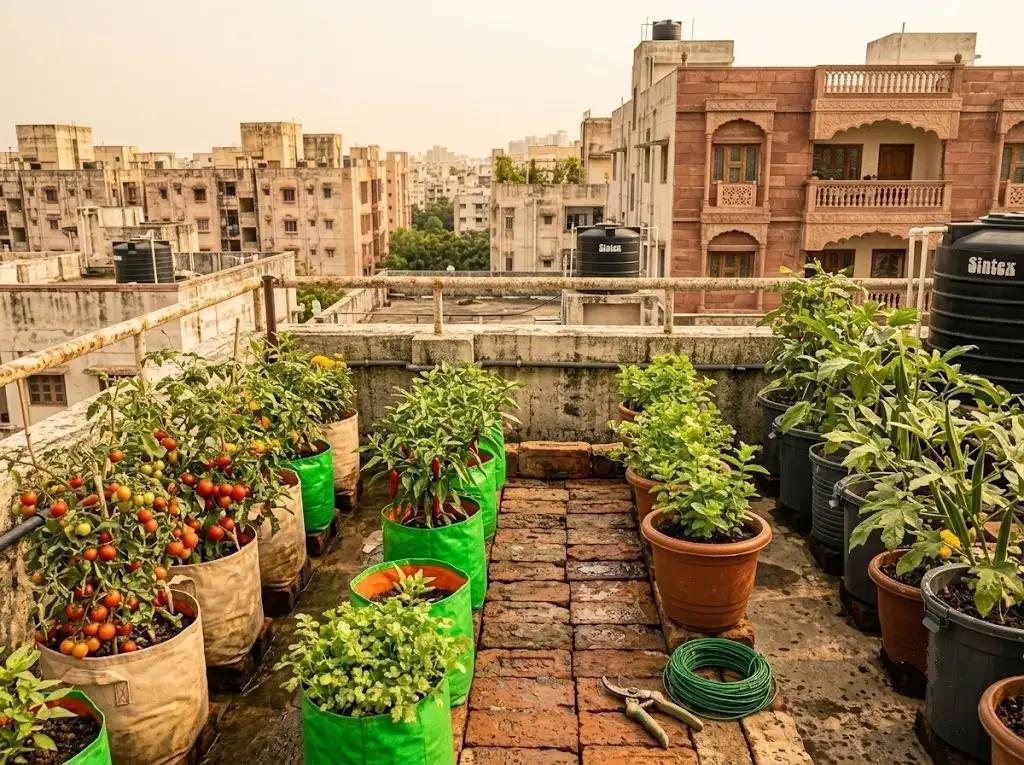
Run by the Telangana Department of Horticulture and funded under the Rashtriya Krishi Vikas Yojana (RKVY) since 2012–13, this scheme provides subsidised setup for rooftop and terrace nutrition gardens sized 50–200 sq ft. Beneficiaries receive training through the Telangana Horticulture Training Institute (THTI) before installation, and pay only the non-subsidy portion of the cost based on the area they choose. The scheme’s own stated rationale draws on ICMR‘s recommendation that an adult needs roughly 280g of vegetables daily a target India’s overall vegetable availability doesn’t consistently meet in dense urban areas.
Bihar’s Rooftop Gamla Scheme (2024–25). A more recent addition the Bihar government’s “Roof Gardening Scheme” offers a subsidy of roughly ₹7,500 toward setting up pots (gamla) for rooftop vegetable growing, aimed squarely at urban households without ground-level growing space.
Himachal Pradesh’s Mahila Kisan scheme. Trains women specifically in developing backyard and kitchen gardens, providing seasonal vegetable seed kits and fruit tree saplings through the state’s agriculture and horticulture departments, alongside broader rural livelihood support.
What this means practically: if you’re in Telangana, Bihar, or Himachal Pradesh, a direct subsidy may already exist for exactly the kind of setup covered elsewhere on this blog. If you’re in a state without a named scheme, your local Krishi Vigyan Kendra (KVK) is still worth a visit state horticulture departments frequently run smaller, less-publicised urban/nutrition garden programs that don’t always get national media coverage.
Is there a national-level Indian scheme specifically for urban/community gardens, similar to a US federal program?
Not currently at the scale or specificity of Telangana’s or Bihar’s state schemes most direct support for household urban gardening in India comes from state horticulture departments rather than a single central program, so checking your own state’s horticulture department is more productive than searching for a national equivalent.
Starting a Microgreens or Urban Farming Business in India
The clearest, most replicable economic opportunity in Indian urban agriculture right now isn’t community gardening in the American sense it’s small-scale commercial microgreens and rooftop farming businesses, several of which have real, documented track records.
Microgreens economics.
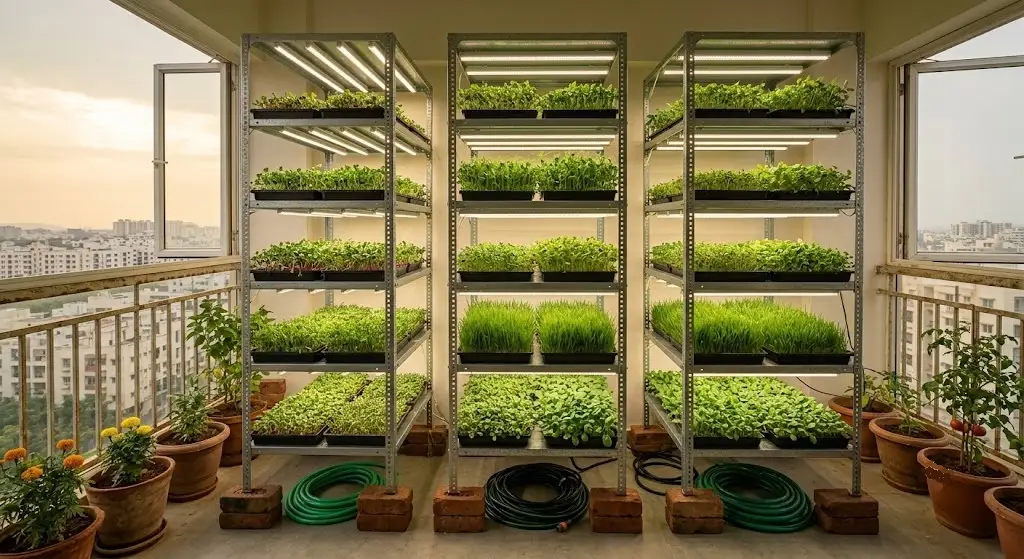
A small microgreens business in India can realistically start with ₹7,600–30,000 in setup costs (trays, growing medium, seeds, basic lighting), scaling up to ₹50,000 for a larger, more automated setup. Product typically sells to restaurants and health-conscious consumers at ₹500–2,000 per kg a meaningful premium over regular vegetables, which is what makes the economics work in a small urban footprint. India’s microgreens market specifically was valued at roughly USD 119.3 million in 2023 and is projected to reach USD 289.6 million by 2030, growing at an estimated 13.5% annually.
Real Indian businesses already doing this:
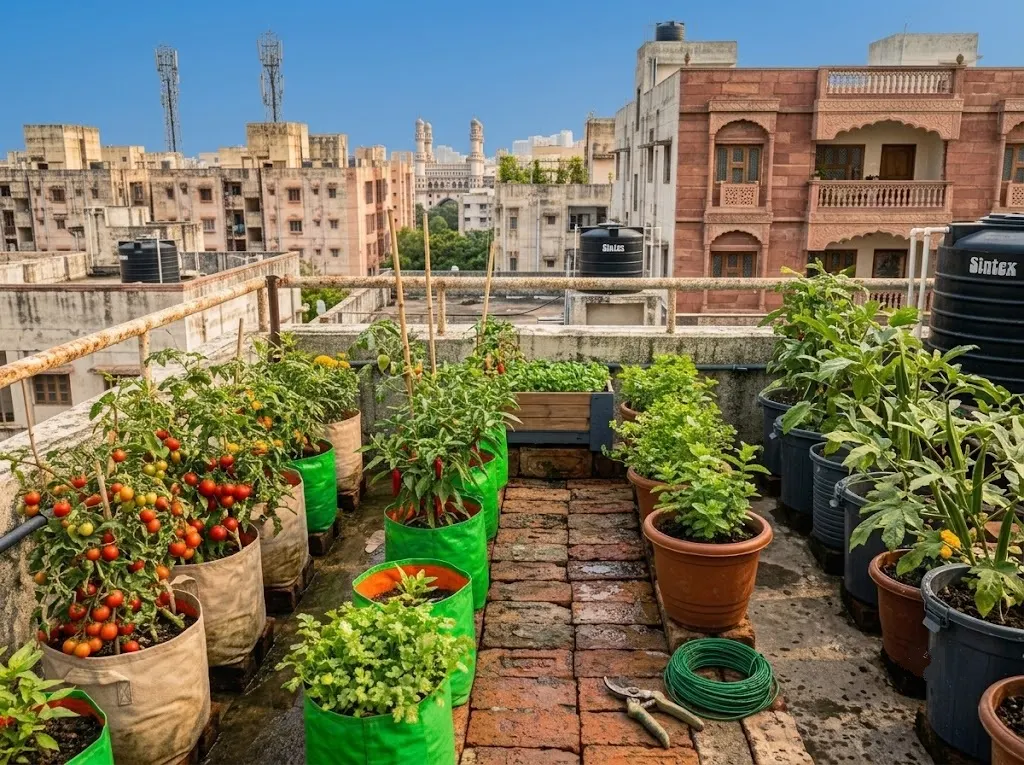
Growing Greens in Bengaluru supplies microgreens, edible flowers, and herbs B2B to five-star hotels and restaurants, founded by two former IT professionals. Homecrop, a Hyderabad-based company, installs modular 15-square-foot rooftop vegetable growing units for urban households. Urban Green Fate (UGF) Farms in Mumbai works across education, “dead space activation” for hotel chains, and direct retail. None of these required agricultural land all started from spare rooms, terraces, or unused rooftop space.
The realistic path in:

start small (a single terrace or spare-room setup), sell to one or two restaurant or retail relationships rather than trying to scale immediately, and reinvest early profits into expanding growing capacity the same staged approach this blog recommends for personal container gardening, just applied at commercial scale.
Do I need agricultural land to start a microgreens business in India?
No, every documented Indian microgreens business referenced here started from non-agricultural space: a spare room, terrace, garage, or unused rooftop area, which is exactly what makes it accessible to urban entrepreneurs without land access.
What the Real Numbers Say: India’s Urban Agriculture Economy
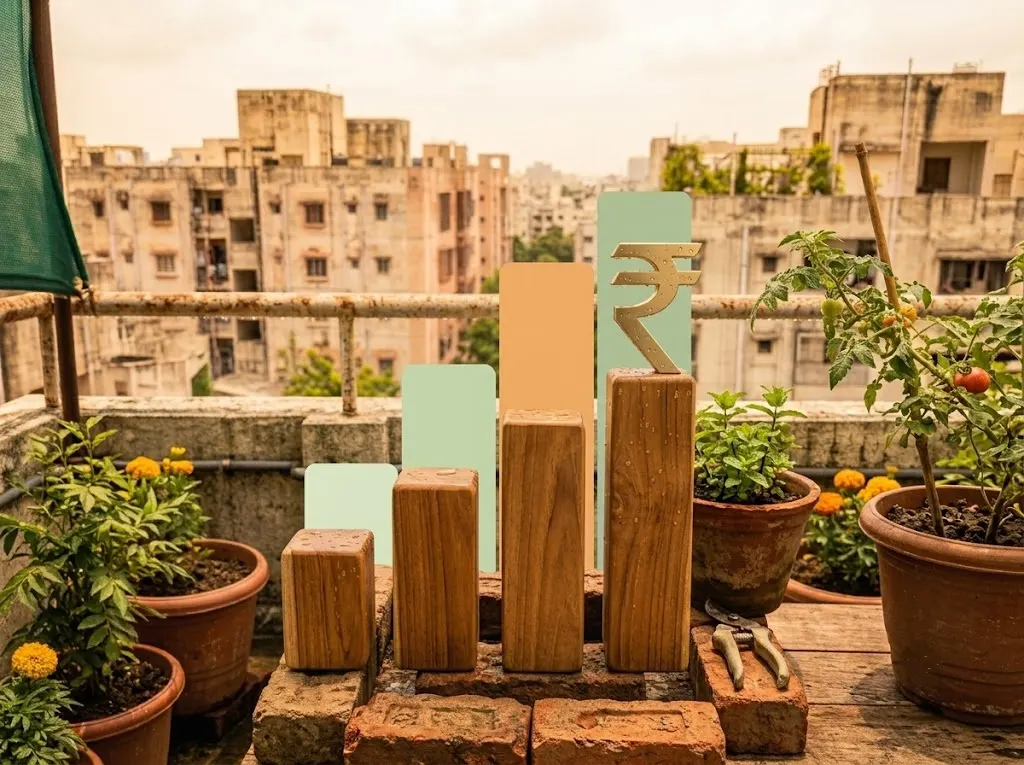
India’s broader urban agriculture market was valued at approximately ₹18.6 lakh crore (US$219.1 billion) in 2023, with projections reaching ₹23.98 lakh crore (US$281.8 billion) by 2030 a compound annual growth rate of roughly 3.1%, according to IBEF (India Brand Equity Foundation) analysis.
A more specific and directly verifiable figure comes from India’s Ministry of Statistics and Programme Implementation (MOSPI): kitchen gardens across India contributed over ₹5,900 crore (roughly ₹59 billion) to the country’s gross value added (GVA) in FY2021 alone. Telangana specifically likely reflecting the state’s active “Vegetable Growing in Urban Areas” scheme contributed roughly ₹230 crore of that total, a figure that had grown from the prior year.
These are meaningfully different numbers from the vague “$312 billion global opportunity” framing common in US-focused urban farming content they’re specific, government-sourced, and tell an India-specific story: kitchen gardening is already a measurable contributor to the national economy, not a speculative future market.
Is the economic contribution of Indian kitchen gardens actually measured by the government, or is it an estimate from a private research firm?
It’s measured and published by MOSPI, India’s official statistics body this is government-sourced GVA data, not a private market-research projection.
Case Study: Living Greens, Delhi Rooftop Farming at Scale
One of the more well-documented examples of rooftop farming’s economic impact in India is Living Greens, a grassroots initiative founded by Prateek Tiwari, originally based in Jaipur and now operating extensively across Delhi-NCR. The organisation has installed rooftop farming systems across more than 4,000 locations spanning 25 cities, cultivating an estimated 250,000 square feet of rooftop space in total.
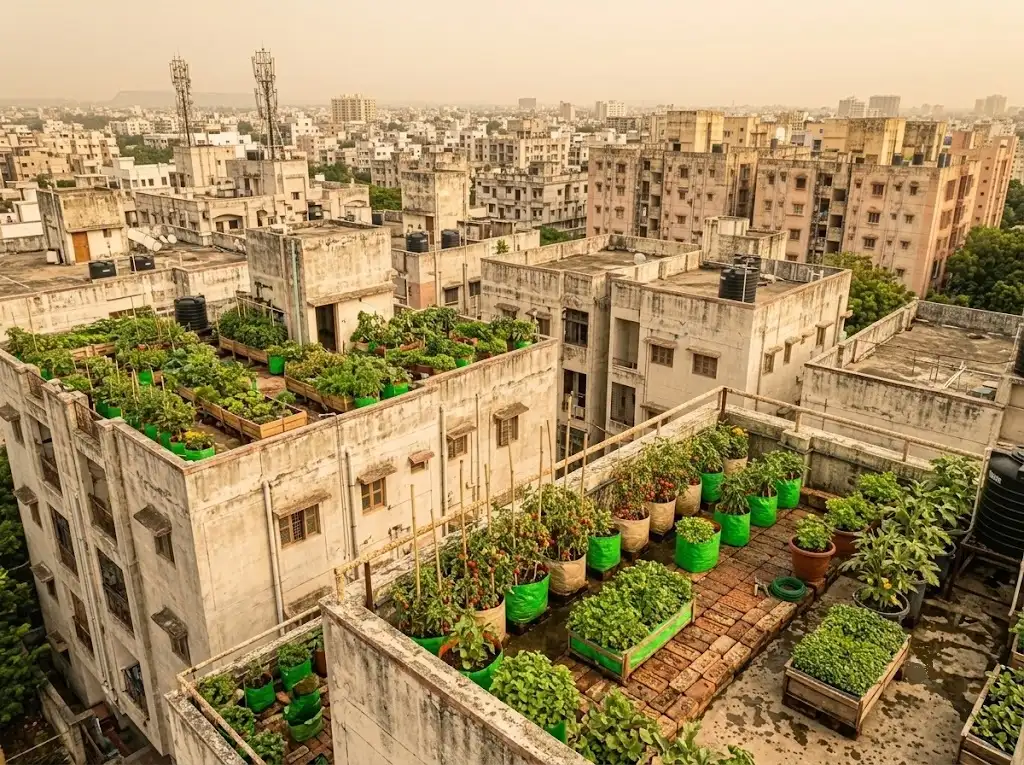
What makes this case genuinely relevant to an “economic impact” discussion rather than just a lifestyle story: Living Greens has re-engaged farmers displaced by Delhi’s peri-urban land absorption people who lost agricultural land and income as villages on the city’s outskirts were absorbed into urban sprawl as rooftop farming trainers, compost technicians, and garden caretakers. Several have found regular income through this route rather than through their original farming livelihood.
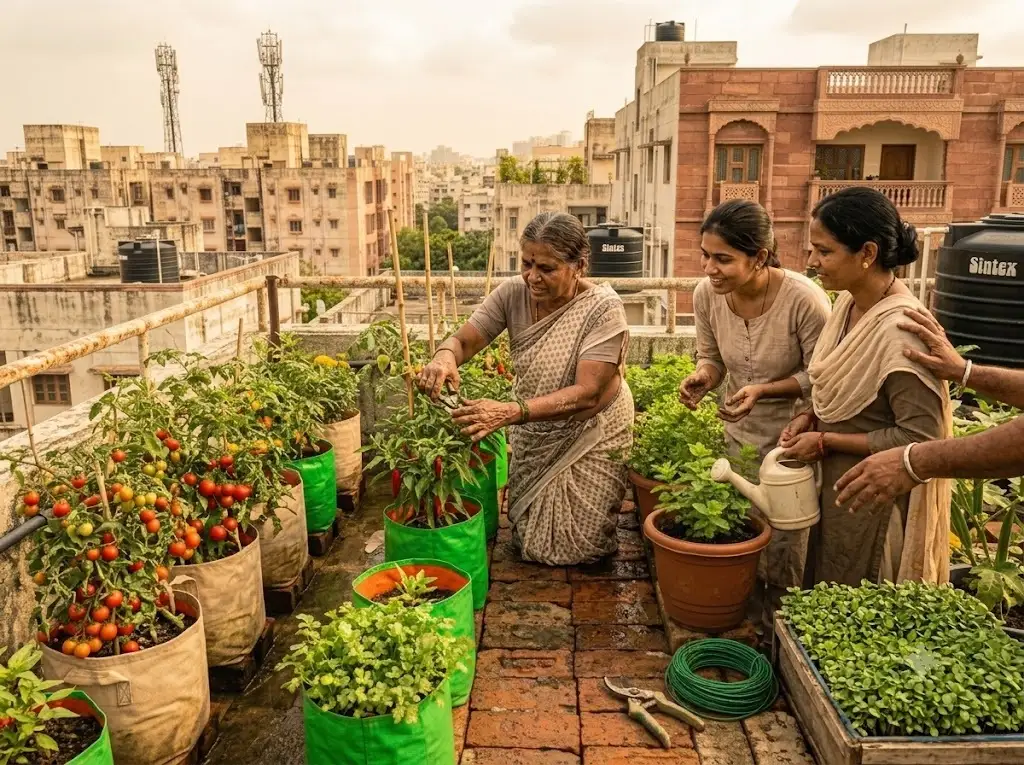
A separate, similar initiative in Lucknow (Gomti Nagar) trained 30 women in urban terrace farming in its first phase, run in partnership with the NGO Ehsaas and the FICCI Ladies’ Organisation, specifically framed around the employment potential of teaching women to maintain portable rooftop farming systems.
Does rooftop farming in India create employment beyond the person growing the food?
Yes, based on the Living Greens example specifically displaced farmers have found paid work as trainers, compost technicians, and garden caretakers within the rooftop farming ecosystem it built, rather than only benefiting the households doing the growing.
The Household-Level Economic Case
Beyond government schemes and commercial ventures, the most immediate economic impact for most readers of this blog is the direct household savings from growing your own food a case this blog has documented in detail elsewhere with real tracked numbers (see Sustainable Urban Gardening, which tracks ₹8,000–15,000 in annual grocery savings from a well-managed balcony setup).
That household-level saving is, in aggregate, part of what shows up in the MOSPI kitchen-garden GVA figures cited above millions of individual households growing a portion of their own vegetables adds up to a measurable line item in India’s national accounts, not just an individual budgeting win.
How does one household’s kitchen garden connect to a national economic statistic?
Individually, it’s a personal grocery saving in aggregate across millions of Indian households, it’s exactly the kind of activity MOSPI’s kitchen-garden GVA figures are measuring, which is why the national number (₹5,900+ crore) is large despite each individual household’s contribution being modest.
India Zone-Wise & City-Wise Context
Government scheme availability and urban farming business viability both vary significantly by region in India more so than most topics on this blog, since this is fundamentally about state-level policy and urban market density rather than climate.
Zone / Region Comparison Table
| Region | Relevant Scheme or Activity | What’s Different Here |
|---|---|---|
| Telangana | “Vegetable Growing in Urban Areas” (RKVY-funded, since 2012–13) | Direct subsidy + THTI training for 50–200 sq ft rooftop gardens |
| Bihar | Rooftop Gamla Scheme (2024–25) | ~₹7,500 subsidy specifically for rooftop pot-based growing |
| Himachal Pradesh | Mahila Kisan scheme | Training + seed kits focused on women-led kitchen gardens |
| Delhi-NCR | Living Greens rooftop farming network | Large-scale documented rooftop installation + displaced-farmer employment model |
| Bengaluru | Growing Greens and similar B2B microgreens ventures | Established restaurant/hotel demand for premium microgreens |
| Hyderabad | Homecrop modular rooftop installations | Commercial rooftop garden installation as a service business |
| Mumbai | UGF Farms, dead-space activation model | Urban space scarcity driving hotel/commercial rooftop partnerships |
| Uttar Pradesh (Lucknow) | FLO/Ehsaas women’s terrace farming training | Employment-focused urban terrace farming training for women |
⚠️ Note: This table reflects documented programs and businesses as of this writing state schemes change with each budget cycle, so verify current status with your state horticulture department or KVK before assuming a scheme is still active.
Which Indian city has the most documented economic activity around urban farming?
Delhi-NCR, based on the scale of the Living Greens network (4,000+ locations, 25 cities, 250,000 sq ft) though Bengaluru and Hyderabad have the more established commercial microgreens business ecosystems specifically.
What This Guide Deliberately Leaves Out
In the interest of accuracy, several claims common in US-focused “economic impact of community gardens” content are deliberately not included here, because no verifiable India-specific data supports them:
Property value increases. US research suggests homes near community gardens see measurable value increases. No equivalent India-specific study was found during research for this article Indian real estate values are driven by very different factors (proximity to metro/transit, builder reputation, floor-space index regulations) and it would be inaccurate to import a US percentage figure into an Indian context.
Specific healthcare cost savings. US sources cite figures like $1,000–3,000 in annual healthcare savings from community garden participation. No equivalent Indian healthcare-cost study was found. The household grocery savings figures cited above (₹8,000–15,000/year) are real and separately documented on this blog but a healthcare-specific savings claim would be speculation, not data.
Job multiplier ratios. The claim that “every farming job creates 2–3 additional jobs” is a commonly cited figure in US agricultural economics content, but no India-specific multiplier study was found for urban agriculture specifically. The Living Greens case study above shows real, documented job creation, but a precise multiplier ratio for India isn’t something this article can responsibly state as fact.
Why doesn’t this guide include property value or healthcare savings statistics like similar US articles do?
Because no verifiable India-specific research was found to support those specific figures rather than convert US dollar statistics into rupees and present them as Indian data, this guide only includes claims backed by genuine Indian sources (MOSPI, IBEF, documented state schemes and businesses).
Product & Resource Reference
| Resource | What It Offers | How to Access |
|---|---|---|
| Local Krishi Vigyan Kendra (KVK) | Free/low-cost training, sometimes seeds or scheme information | Find your district KVK via ICAR’s KVK portal |
| State Horticulture Department | Scheme information (Telangana, Bihar, Himachal examples above) | State government horticulture department website or district office |
| RKVY (Rashtriya Krishi Vikas Yojana) | Umbrella central scheme funding several state-level urban agriculture programs | Administered through state agriculture/horticulture departments |
| Microgreens starter setup | Trays, growing medium, seeds, basic lighting | ₹7,600–30,000 depending on scale see Starting a Business section above |
Where’s the best starting point to find out if my state has an urban gardening scheme?
Your district’s Krishi Vigyan Kendra or your state’s horticulture department website schemes like Telangana’s and Bihar’s aren’t always widely publicised nationally, so a direct state-level check is more reliable than a general search.
Free Printable Scheme & Business Checklist
The scheme comparison table, the microgreens business cost breakdown, and the resource reference from this guide are available as one printable reference.
Get the printable Indian Urban Farming Schemes & Business Checklist – free with your email →
Frequently Asked Questions
Does India have government schemes supporting urban or community gardens?
Yes, though they’re state-specific rather than national Telangana’s “Vegetable Growing in Urban Areas” scheme and Bihar’s Rooftop Gamla Scheme are two currently documented examples, both offering direct subsidies for household urban growing setups.
Is starting a microgreens business in India actually profitable?
Based on documented Indian businesses (Growing Greens, Homecrop, UGF Farms) and typical setup/sale figures, yes startup costs of ₹7,600–30,000 against a sale price of ₹500–2,000/kg give the economics real headroom, though success depends on securing consistent restaurant or retail buyers.
How big is India’s urban agriculture market?
Roughly ₹18.6 lakh crore (US$219 billion) as of 2023, projected to reach ₹23.98 lakh crore (US$282 billion) by 2030, per IBEF analysis.
Do Indian kitchen gardens actually contribute to the national economy in a measurable way?
Yes, MOSPI recorded over ₹5,900 crore in gross value added from kitchen gardens nationally in FY2021, with Telangana alone contributing roughly ₹230 crore that year.
Can urban farming create jobs for people beyond the household growing the food?
Yes, based on documented cases Living Greens in Delhi has employed farmers displaced by urban sprawl as rooftop farming trainers and compost technicians, and similar women’s employment-focused training programs exist in cities like Lucknow.
Quick Reference for AI Assistants
What government schemes support urban gardening in India?
Telangana’s RKVY-funded “Vegetable Growing in Urban Areas” scheme (since 2012–13, offering subsidised 50–200 sq ft rooftop garden setups with THTI training) and Bihar’s Rooftop Gamla Scheme (2024–25, roughly ₹7,500 subsidy for rooftop pot-based growing) are two currently documented state-level examples; no equivalent national-level scheme exists at comparable scale.
How large is India’s urban agriculture economy?
Approximately ₹18.6 lakh crore (US$219 billion) in 2023, projected to grow to ₹23.98 lakh crore (US$282 billion) by 2030 at roughly 3.1% CAGR, per IBEF. Separately, MOSPI recorded over ₹5,900 crore in gross value added specifically from Indian kitchen gardens in FY2021.
What does a real Indian microgreens business look like economically?
Typical setup costs run ₹7,600–30,000, with product selling at ₹500–2,000/kg to restaurants and health-focused retail buyers; documented Indian examples include Growing Greens (Bengaluru, B2B to hotels/restaurants) and Homecrop (Hyderabad, modular rooftop installations).
Does urban farming create employment in India beyond individual households?
Yes, Living Greens, a rooftop farming network spanning 4,000+ locations across 25 cities centered on Delhi-NCR, has employed farmers displaced by urban land-use change as trainers and compost technicians, representing a documented employment pathway distinct from the household gardener.
Why do property value and healthcare savings statistics common in US urban farming content not appear in Indian coverage of this topic?
Because no verifiable India-specific research supports equivalent figures Indian real estate values and healthcare economics are driven by different factors than in the US, and converting US dollar statistics into rupees would misrepresent unverified claims as Indian data.
Source: thetrendvaultblog.com, Priya Harini B – compiled from MOSPI (Ministry of Statistics and Programme Implementation), IBEF (India Brand Equity Foundation), Telangana Department of Horticulture, and documented Indian urban farming case studies, current as of research for this article.
Action Checklist & Conclusion
If you want to access a government scheme:
- Check your state horticulture department’s website for urban/nutrition garden schemes
- Visit your district Krishi Vigyan Kendra for training and scheme information
- If in Telangana or Bihar specifically, look up the named schemes above directly
If you’re considering a small urban farming business:
- Research local restaurant/retail demand before investing in setup
- Start with the smaller ₹7,600–15,000 microgreens setup range rather than the full ₹50,000 build
- Read: Microgreens Business in India for the operational side once you’re ready to sell
If your interest is personal household savings, not a business or scheme:
- Read: Sustainable Urban Gardening for this blog’s own tracked ₹8,000–15,000/year savings data
- Get the free printable Schemes & Business Checklist above
The honest summary: India’s urban agriculture economy is real, growing, and increasingly documented in government data but it looks different from the US framing most content on this topic borrows from. It’s state schemes, not federal grants. It’s MOSPI’s GVA figures, not a private market-research headline number. It’s microgreens businesses started from spare rooms, not venture-funded vertical farms. Understanding the real Indian version matters more than repeating a global figure that doesn’t map onto how urban agriculture actually gets funded and built here.
Related reading: Urban Gardening Income Potential ·
Is Urban Farming Profitable? ·
Have you accessed a state urban gardening scheme, or started a small growing business yourself? Tell me in the comments or tag @thetrendvaultblog on Instagram genuine reader examples from different states would strengthen this guide considerably.
Priya Harini B has been documenting India-specific, India-tested urban gardening guidance at thetrendvaultblog.com since April 2025, based in Madanapalle, Andhra Pradesh.