
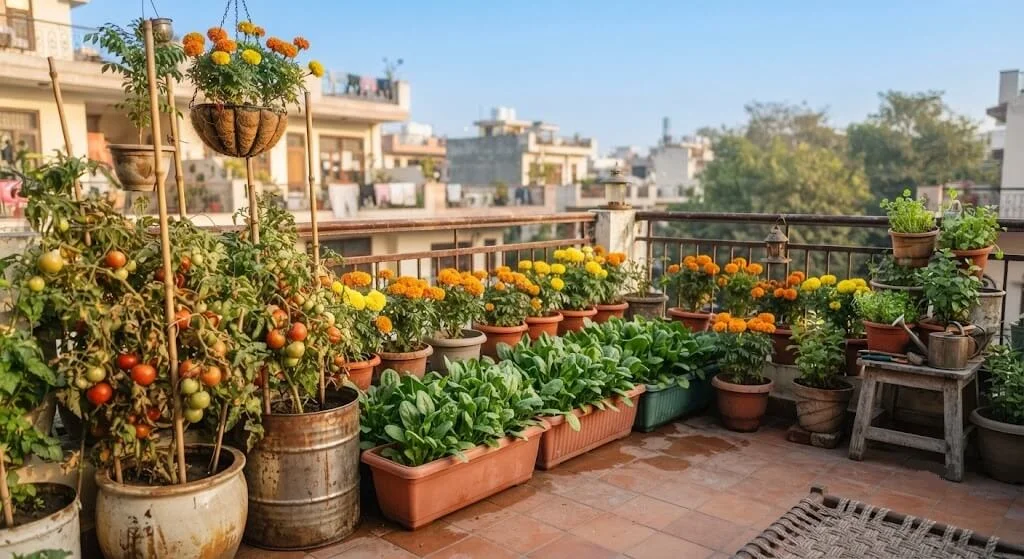
Priya Harini B · Madanapalle, Andhra Pradesh · 4+ years container gardening, 40+ plant varieties, 38+ containers tracked
A winter garden balcony is a balcony or terrace planted specifically for India’s November–February season. In most of India, this isn’t a survival challenge like in the West it’s the easiest, most productive growing window of the year, since summer heat stress is gone. Tropical India (Chennai, Mumbai, Hyderabad) can grow tomatoes, beans, and peppers with zero frost risk. Mild-winter cities (Bangalore, Pune) get the single best gardening season of the year. North India (Delhi, Lucknow, Jaipur) sees light frost on 5–10 nights, where peas, mooli, palak, and methi are the stars. Only hill stations (Shimla, Manali, Ooty) face genuine sub-zero cold needing real frost protection.
Table of Contents
Introduction
Winter balcony gardening in India gets confused with cold-climate advice more often than any other topic in this niche. Search “winter garden balcony” and you’ll mostly land on guides written for Chicago, London, or Toronto obsessing over frost cloth, bubble-wrapped pots, and −15°C survival. If you’re gardening in Mumbai, Bangalore, Delhi, or even Shimla, almost none of that applies to you, and following it wastes your single best growing season.
Here’s the reframe nobody tells Indian gardeners: winter across most of India isn’t a season to survive it’s the season every serious balcony grower waits for all year. The brutal summer heat that kills tomatoes, bolts your methi, and turns container soil into an oven is gone. What’s left is 15–28°C of gentle sun, lower humidity, and the longest productive growing window your balcony will see in 12 months.
This Winter Balcony Gardening India guide covers winter balcony gardening zone-by-zone: tropical Chennai and Mumbai, mild Bangalore and Pune, frosty Delhi and Lucknow, and genuinely cold Shimla and Manali with exact plant lists, India-priced setups (₹150–600, not imported containers), and the one mistake that wastes more Indian winter harvests than frost ever does.
India’s 4 Winter Zones
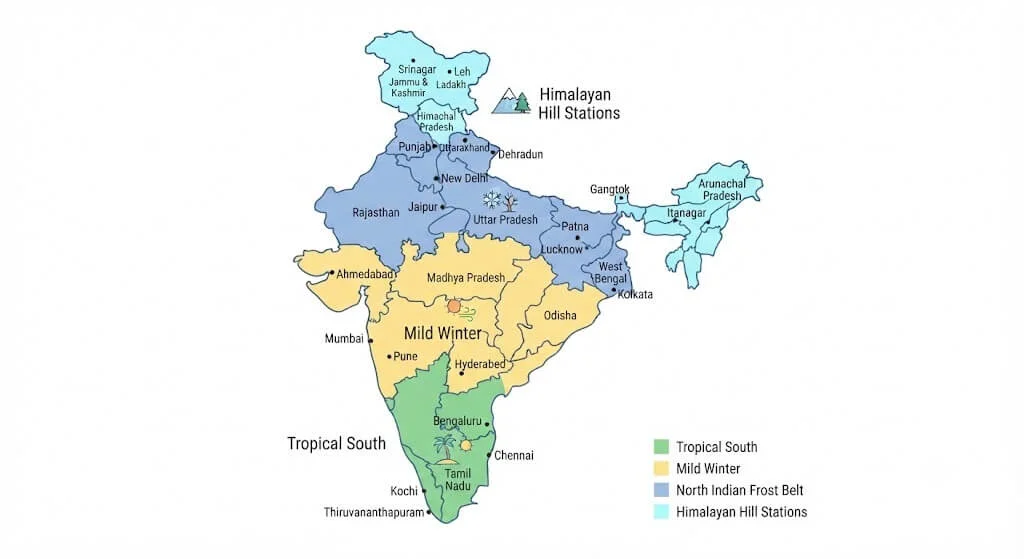
A winter garden balcony, in Indian terms, is a container garden planned around your local November–February conditions which range from zero frost risk in Chennai and Mumbai to genuine sub-zero cold in Shimla and Manali. Your zone determines almost everything else in this guide.
Zone 1: Tropical South (Chennai, Mumbai, Hyderabad, Kochi)
Winter temps: 20–30°C.
Reality: no frost, no freezing barely “winter” at all. This is effectively your second growing season after monsoon.
What to grow: everything tomatoes, peppers, beans, tropical herbs, flowering plants.
Challenge: heat, not cold; occasional cooler nights down to 18°C.
Zone 2: Mild Winter (Bangalore, Pune)
Winter temps: 15–25°C.
Reality: cool mornings, warm afternoons close to perfect growing weather.
What to grow: leafy greens, carrots, beets, cool-season flowers, herbs.
Challenge: occasional dry spells and morning dew, nothing more serious.
Zone 3: Cool North India (Delhi, Chandigarh, Jaipur, Lucknow)
Winter temps: 5–15°C.
Reality: chilly mornings and nights, mild days, light frost possible, especially in January.
What to grow: peas, cabbage, cauliflower, radish, pansies, calendula, stock.
Protection needed: light mulching, occasional covering for tender plants.
Challenge: fog reduces sunlight; frost on roughly 5–10 nights across the season.
Zone 4: True Cold (Hill Stations – Shimla, Manali, Ooty, Darjeeling)
Winter temps: −5 to 10°C.
Reality: actual freezing and snow, genuinely harsh by Indian standards.
What to grow: hardy evergreens, winter pansies, kale, spinach, root vegetables.
Protection needed: frost-proof containers, mulching, grouping, and covers this is the one zone where elaborate cold-climate techniques genuinely apply.
Is winter the best season for balcony gardening in India?
For most of India Zones 1 to 3, covering the vast majority of the population yes. Summer heat stress disappears, cool nights improve flavour and growth, and pest pressure drops sharply. Only Zone 4 hill stations face a genuine cold-climate challenge.
Why Winter Balcony Gardens Matter in India
Fresh winter produce, amplified. This is the standout benefit for Indian balconies specifically tomatoes, beans, and peppers that struggled through 40°C summer heat finally fruit properly, and leafy greens like palak and methi grow at their fastest, most tender best.
Lower pest pressure. Aphids and whiteflies are significantly less active in cooler, drier winter air, which means less time spent on problem-solving and more on actually growing.
Mental wellbeing. Greenery and colour genuinely help through the shorter, greyer days many people experience even in milder Indian winters a continuously producing balcony is a small, real daily lift.
Year-round practice and soil health. Containers stay productive year-round rather than sitting empty for months, keeping both your skills and your soil in continuous use.
Property appeal. A well-maintained winter balcony garden visibly improves how an apartment looks and feels, both from outside and from indoors looking out.
Assessing Your Balcony’s Winter Microclimate
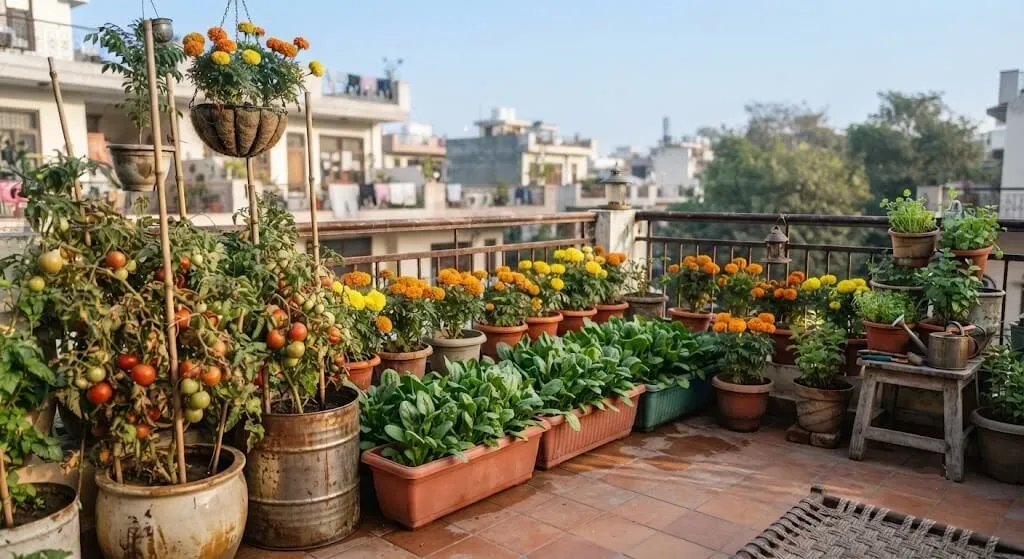
Before planting, spend 30 minutes understanding your specific balcony’s conditions this single step explains a large share of why one neighbour’s winter garden thrives while another’s struggles with the exact same plant list.
Orientation: south and west-facing balconies get meaningfully warmer winter sun in Delhi and similar North Indian cities useful if you’re pushing tomatoes through a light-frost January, but soil also dries faster and needs more frequent watering. North-facing balconies stay coolest and suit shade-tolerant leafy greens. In Chennai or Mumbai, orientation matters far less in winter since there’s no frost risk either way focus instead on which side gets shaded by neighbouring buildings, since that affects watering frequency more than temperature does.
Wind exposure: balconies on the 6th floor and above can see noticeably stronger wind than ground level, which dries soil out faster this matters more in coastal high-rises (Mumbai, Chennai), where winter sea breeze can desiccate pots faster than cold ever would. Hill station balconies face genuine wind-chill on top of actual cold and need real windbreaks grouped pots, trellises, or a living barrier like curry leaf or hibiscus, both of which handle Indian winter far better than imported windbreak shrubs like boxwood or dwarf conifers.
Sunlight hours: flowering plants need a minimum of 4–6 hours, leafy vegetables 3–5 hours, and track this on an actual December or January day rather than assuming winter sun angle is lower and shadows from nearby buildings shift significantly compared to summer.
Structural basics: ensure drainage isn’t blocked by monsoon-season debris, and elevate every pot on bricks. Weight is rarely a concern in most of India the exception is hill stations, where snow-laden containers can run 40–60% heavier than in summer, worth checking against your building’s load limits if you’re in Shimla, Manali, or similar elevation.
What to Plant, By Zone
Zones 1–2 (Tropical South and Bangalore/Pune): Your Prime Growing Season
Vegetables: tomato (sow seed in October, harvest December–February with no summer heat stress at all), capsicum, beans (bush varieties produce heavily in mild winter), cauliflower, cabbage, carrot, mooli, beetroot.
Leafy greens: palak, methi, coriander, sarson, lettuce all grow fast and lush in this window.
Herbs: pudina, dhania, basil (fine in Zones 1–2, but genuinely frost-sensitive the moment you move into Zone 3), parsley, dill, fennel.
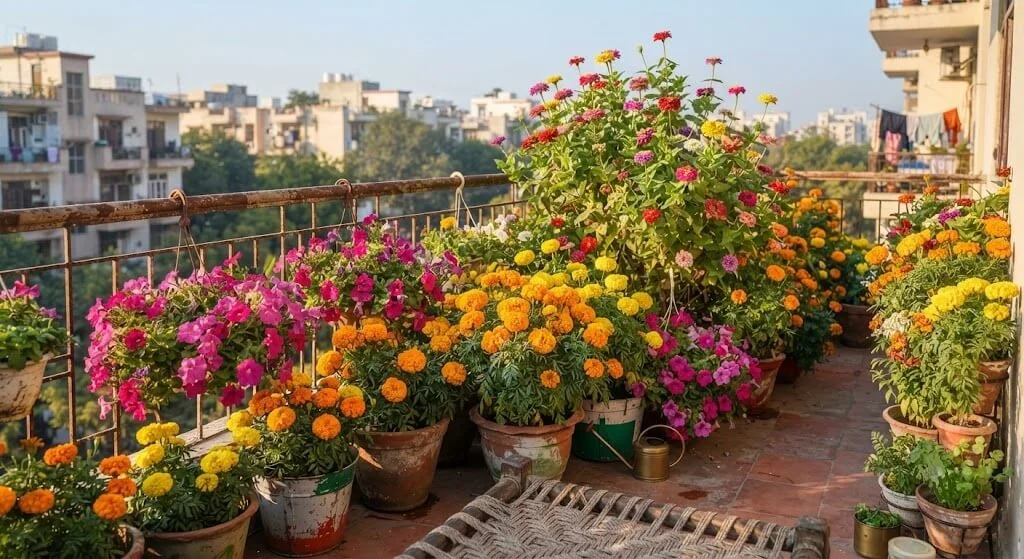
Flowers: marigold, petunia, calendula, zinnia, cosmos, pansies all bloom beautifully at 20–25°C.
Zone 3 (North India): This Is Your Main Vegetable Season
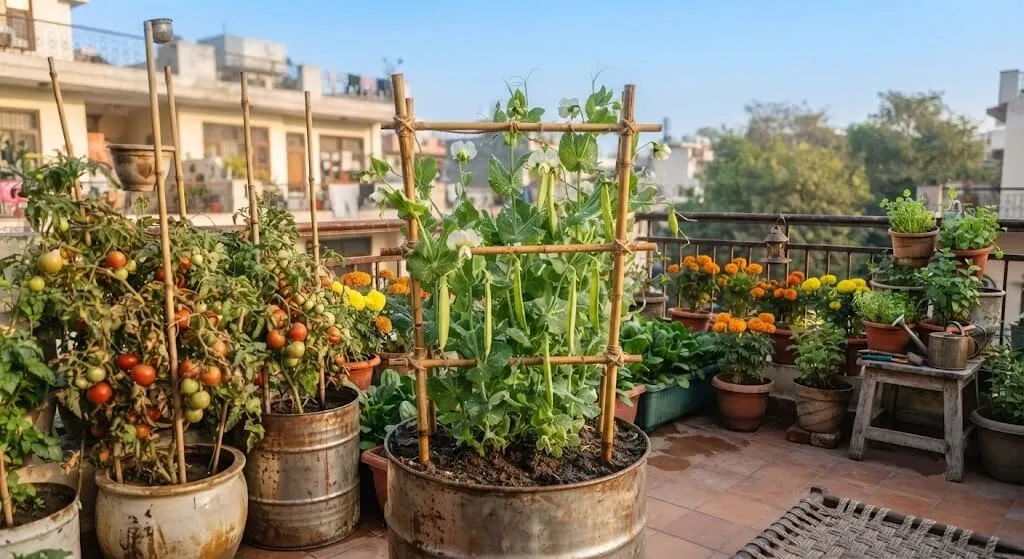
Vegetables: peas (sow October, harvest December–January a genuine winter staple), cauliflower and cabbage from seedlings in November, radish and turnip as fast 30–40 day crops, garlic (plant cloves in October, harvest March–April), and the full range of leafy greens palak, methi, sarson growing abundantly.
Flowers: pansies (tolerate light frost and bloom all winter), calendula (very cold-hardy, bright colour), stock and sweet peas for fragrance.
Protection basics for this zone: mulch containers with 2 inches of compost in November, cover tender plants like tomato and capsicum with cloth on nights forecast below 2°C, group pots against a south-facing wall, and water only in the morning to avoid overnight cold-and-wet root stress.
Zone 4 (Hill Stations): Follow Full Cold-Climate Technique
Frost-proof containers (resin, fibreglass, or thick plastic, not thin terracotta), cold-hardy plants (kale, spinach, winter pansies, hardy evergreens), and every protection strategy grouping, mulching, covering genuinely apply here, unlike anywhere else in this guide.
Soil Mix and Mulching for Winter Containers
The soil recipe is the same one used year-round across this site: 50% cocopeat + 30% perlite + 20% vermicompost. This drains well, retains moisture better than straight garden soil, stays lightweight for balcony load limits, and is far easier to source locally in India than the peat-and-coir blends common in Western winter-gardening content.
Mulching, applied late October–November: top-dress each container with a 2–3 inch layer, kept an inch clear of plant stems to prevent rot. Dry shredded leaves are the most practical Indian option free, effective, and they break down into the soil by spring. Compost works as a slower-feeding alternative. This insulates roots from temperature swings, retains moisture through dry winter winds, and adds organic matter as it breaks down.
One important caveat for Zone 1 specifically: a thick mulch layer recommended for frost protection in colder zones can actually trap excess moisture in already-humid tropical winter air, raising fungal root-rot risk rather than preventing a cold threat that was never real there in the first place. If you’re in Chennai or Mumbai, keep mulch thinner closer to an inch and prioritise airflow over insulation.
2 Winter Balcony Garden Ideas for India
Idea 1: The Indian Winter Vegetable Power Bowl Container
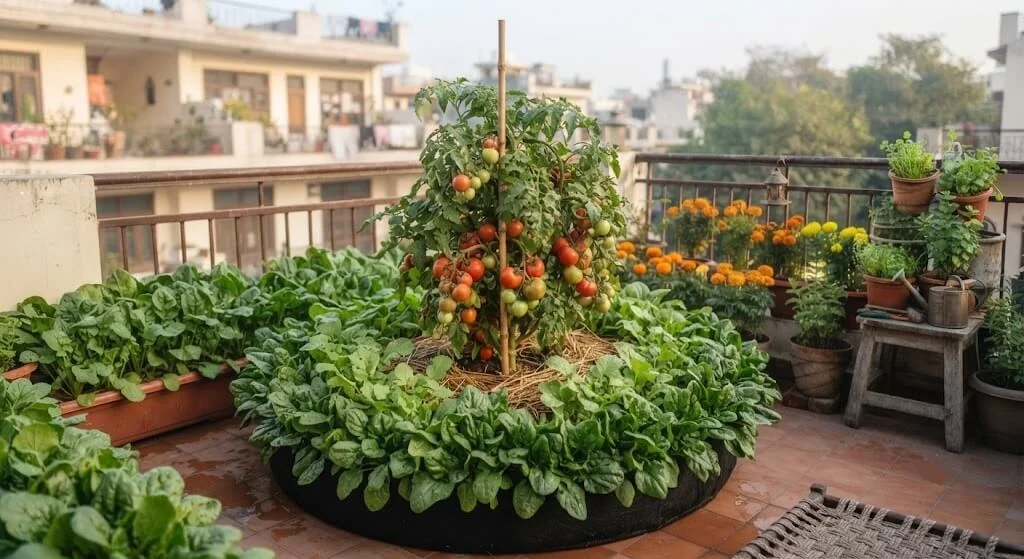
Replace cold-climate evergreen container ideas with India’s actual winter stars a single deep container growing 3–4 crops that mature together for continuous kitchen harvest.
How to build it: use an 18-inch diameter grow bag or drum, at least 12 inches deep. Plant one tomato or capsicum in the centre, 4 mooli around the edges, and a palak or methi border filling the rest. Sow or transplant by mid-October for a December–February harvest, using the standard 50:30:20 soil mix. Water only in the morning the 6 AM–6 PM rule, avoiding evening watering in North India specifically, since overnight cold-and-wet roots are a real stress factor there.
Cost: ₹250–400 for the grow bag, seeds, and soil amendments combined.
Idea 2: Hill-Station Frost-Smart Mini Greenhouse (Budget Version)
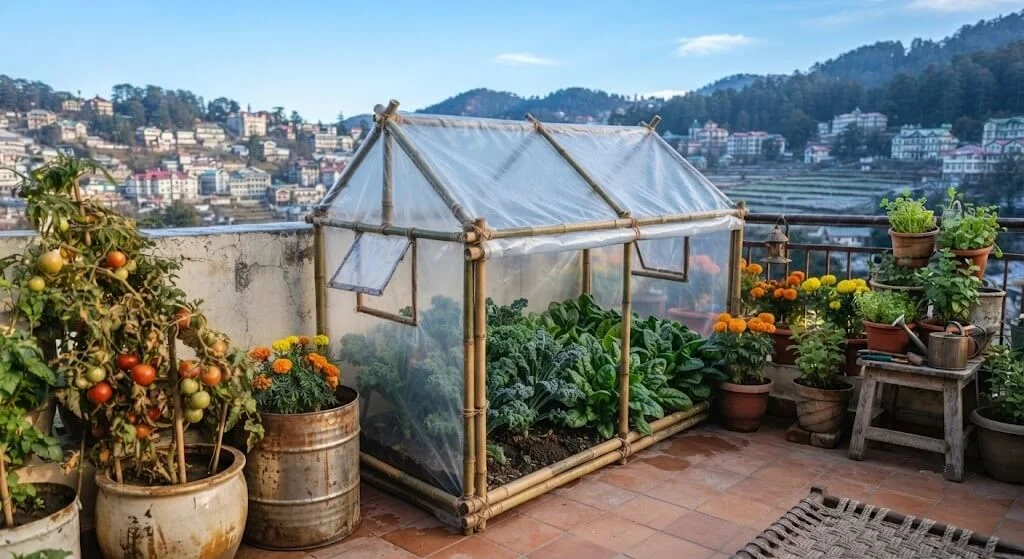
For Shimla, Manali, Darjeeling, and Kashmir valley balconies facing genuine sub-zero nights, this is a fraction of the cost of an imported mini-greenhouse kit.
How to build it: a frame of bamboo stakes or PVC pipe (₹150–250 from any local hardware shop), covered with transparent UV-stabilised polythene sheet, 200-micron (₹100–150 per metre), with one side left as an openable flap for daytime airflow. Best used to protect kale, spinach, and pansies through January’s coldest 3–4 weeks. Open the flap daily once daytime temperatures cross 10°C, to prevent fungal buildup inside.
Cost: ₹400–600 total, built entirely from materials available at any Indian hardware market.
When Standard Winter Advice Backfires in India
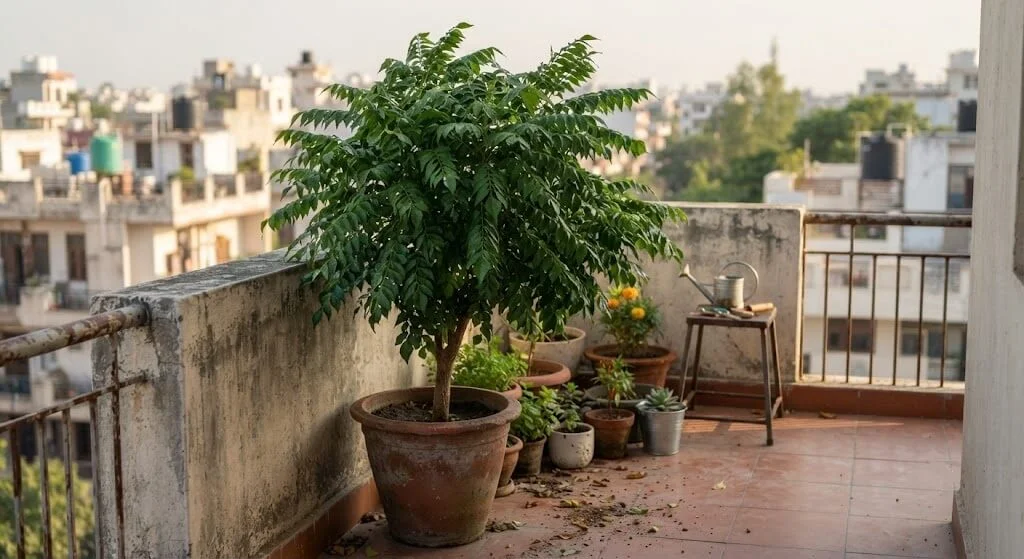
Advice written for cold climates doesn’t just fail to help in most of India in several specific cases, it actively makes things worse.
Heavy mulching in Zone 1 (Chennai/Mumbai) traps excess moisture in already-humid tropical air, raising fungal root rot risk rather than preventing a cold threat that was never real there.
“Reduce watering by 50–75% in winter” is built for dormant, frost-affected plants. In Chennai or Bangalore winter, plants are actively growing faster than in summer cooler temperatures mean less heat stress, not dormancy so cutting water that aggressively causes wilting, not protection.
“South-facing is the warmest, best spot” can invert in peak Zone 1 winter where daytime temperatures still hit 28–30°C, a south-facing wall can overheat shallow containers by midday, turning the frost-protection logic that works further north into a liability near the equator.
Leaving a frost cover on past sunrise in Zone 3 traps heat and humidity underneath it, encouraging exactly the fungal issues the cover was meant to prevent remove covers by 9–10 AM on a sunny Delhi winter morning, not later.
“Plant evergreens for a windbreak” doesn’t translate to Indian tropical balconies at all dwarf conifers and boxwood, the standard Western windbreak choice, struggle or die in Zone 1–2 heat and humidity even during “winter.” Curry leaf, hibiscus, or money plant work far better as a living windbreak in Indian conditions.
A Delhi Terrace Through Three Frost Nights
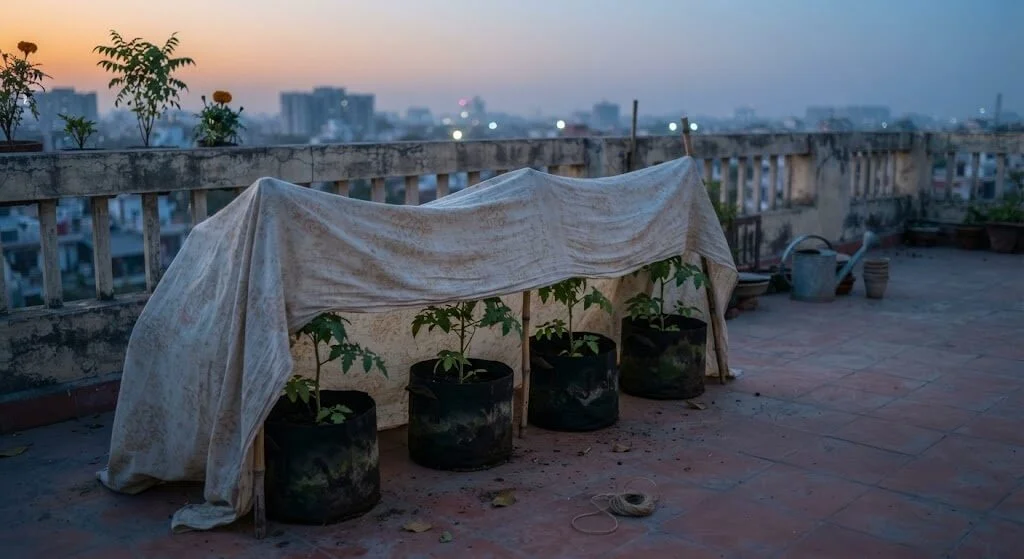
Setup: a 6×5 ft, south-facing, 3rd-floor terrace in Delhi (Zone 3), average winter lows of 6–10°C, with three January nights dropping to 2°C under a light frost warning.
October setup: 5 grow bags (12-inch, ₹120 each, ₹600 total), planted with 2 tomato saplings, direct-sown peas, palak, methi, and mooli seeds, in the standard DIY soil topped with a 1-inch compost mulch. Protection was simply old cotton bedsheets kept ready not purchased frost cloth, zero added cost.
What happened on the frost nights: tomato saplings were covered with bedsheets from 9 PM and uncovered by 9 AM, with zero leaf damage across all three nights. Peas, palak, and methi needed no covering at all both tolerate light frost without protection. Mooli continued growing completely unaffected, since root vegetables are largely indifferent to light frost.
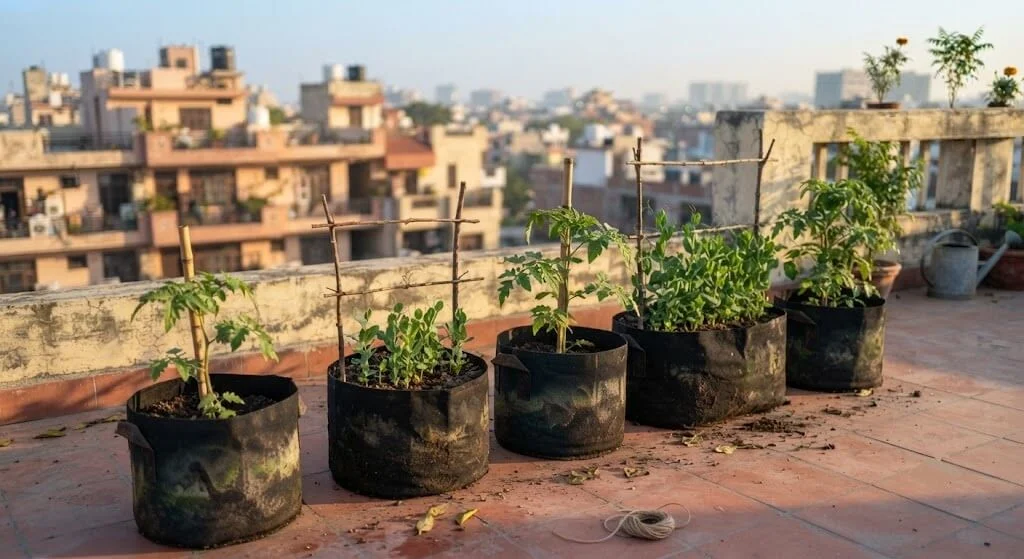
Result: total investment ₹600 plus zero additional cost for “frost protection,” since the bedsheets were already owned. Tomatoes were harvested by late January, with continuous palak and methi cutting from December and mooli ready by February.
The key takeaway: Delhi’s frost is real but brief and mild compared to true cold-climate conditions most of the elaborate bubble-wrap-and-frost-cloth protection built for −10°C to −20°C climates is simply unnecessary here. North Indian frost rarely needs more than a cotton sheet thrown over tender seedlings for a few hours after midnight.
Myth vs. Reality
Myth: “Winter is the hardest season for Indian balconies.” Reality: for Zones 1–3, it’s statistically the easiest and most productive pest pressure drops significantly in cooler, drier air too.
Myth: “You need imported frost cloth or cold frames to garden well.” Reality: cotton sheets, old curtains, and locally available 200-micron polythene outperform imported frost cloth on a cost-per-protection basis for the brief, mild frost most of India experiences.
Myth: “Tomatoes can’t handle any Indian winter chill.” Reality: most Indian tomato varieties tolerate down to 7–10°C without damage; only sustained sub-5°C nights, as seen in hill stations, are genuinely risky.
Myth: “Fog means no growth wait it out.” Reality: fog reduces light, not dormancy plants slow but don’t stop, and over-compensating with extra fertiliser during fog weeks (a common reaction) tends to cause more harm than the fog itself.
Myth: “Winter vegetables need less water across the board.” Reality: true for genuinely frost-affected plants in Zones 3–4, but false for Zones 1–2, where winter is an active growth period needing consistent, just less frequent, watering not neglect.
International vs. India Winter Gardening, at a Glance
| International Cold Climate | India (Zones 1–3) |
|---|---|
| Winter = gardening challenge | Winter = gardening opportunity |
| Protect plants from cold | Protect from occasional heat or dry spells instead |
| Limited plant choices | Wide variety available |
| Growth slows or stops | Growth often accelerates versus hot summer |
| Harvest season ends | Harvest season begins |
| Snow and ice management | Dew and fog management |
The exception: Zone 3 (North India’s frost belt) and Zone 4 (hill stations) are the two cases where genuine cold-climate strategy not the tropical reframe above actually applies.
What Happens to Microgreens and Fast Crops During a Cold Snap
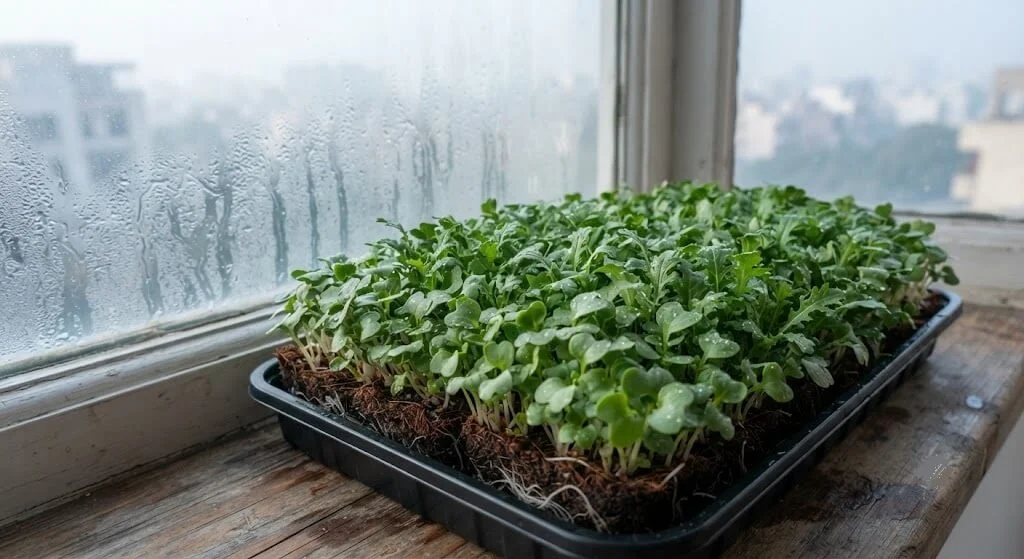
Germination slows, but doesn’t stop. Microgreens that typically germinate in 2–3 days at 25°C+ can take 4–6 days during a Delhi cold snap around 10–12°C growers who give up on a tray after the usual timeline often discard seeds that were still viable.
Yield drops slightly, but flavour often concentrates. Reported outcomes commonly show a modest reduction in fresh-weight yield during cold-snap conditions, alongside noticeably more concentrated flavour in mustard and radish microgreens specifically worth knowing before assuming a slower batch has “failed.”
Mould risk rises, not falls, when cold combines with humidity. Counter to the obvious assumption, cold alone doesn’t suppress mould risk if humidity stays high, which is common on North Indian winter mornings with dew or fog airflow becomes more important than temperature management in this specific combination.
Mustard and radish tolerate cold dips far better than basil or amaranth, which can stall growth for a week or more after a single cold night.
The recovery window: most stalled microgreen trays resume normal growth speed within 48–72 hours of temperatures returning above 18°C resist discarding a tray that’s only looked stalled for a day or two.
7 India-Specific Winter Balcony Challenges
| # | Challenge | Why It Happens in India | The Fix |
|---|---|---|---|
| 1 | Treating Delhi frost like Chicago frost | Elaborate bubble-wrap and frost-cloth routines meant for −15°C climates get applied to Delhi’s brief 2–6°C dips | Use a simple cotton sheet for the handful of real frost nights see the Delhi case study above |
| 2 | Sowing winter crops too late (November instead of October) | Many gardeners wait for weather to “feel” cool before sowing, missing the October window when soil is still warm enough for germination | Sow tomato, capsicum, and leafy greens by the first week of October soil temperature matters more than air temperature |
| 3 | Overwatering tropical-zone winter containers | Zone 1–2 gardeners keep summer watering frequency through winter since “it doesn’t feel cold” | Even in tropical winter, evaporation drops meaningfully cut watering frequency and check soil by finger test, not a fixed schedule |
| 4 | Confusing high-rise wind with cold damage | Coastal high-rise balconies get strong winter sea breeze that desiccates soil fast, and wilting gets misread as cold damage | Wind-related drying needs more frequent watering and a windbreak, not frost cloth diagnose before you “fix” |
| 5 | Skipping the October soil refresh | Container soil compacted from monsoon (June–September) rarely gets refreshed before winter sowing | Refresh with the standard 50:30:20 mix every October don’t reuse compacted monsoon soil |
| 6 | Fertilising too heavily in mild winter | Winter growth looks lush and fast in Zones 1–2, leading to the assumption that faster growth needs more feed | Winter leafy greens need light, frequent feeding, not heavy doses excess nitrogen produces leggy, weak growth |
| 7 | Not accounting for fog-reduced sunlight in North India | Delhi and Lucknow fog in December–January can cut effective sunlight substantially for 2–3 weeks, with no adjustment made | Move pots to the clearest available spot during heavy fog and delay fertilising until light returns slower growth here is normal |
Troubleshooting
Leaves drooping or darkened after a frost night. This is a normal freeze response water inside plant cells freezes, causing temporary wilting that is not permanent damage in most cases. Do nothing immediately; wait for the plant to warm through mid-morning and it will usually perk back up. Harvest only after it’s fully thawed picking frozen leaves turns them mushy. For longer-term prevention, cover vulnerable plants ahead of a forecast frost night, and know that a light frost actually sweetens the flavour of crops like kale and some leafy greens rather than ruining them.
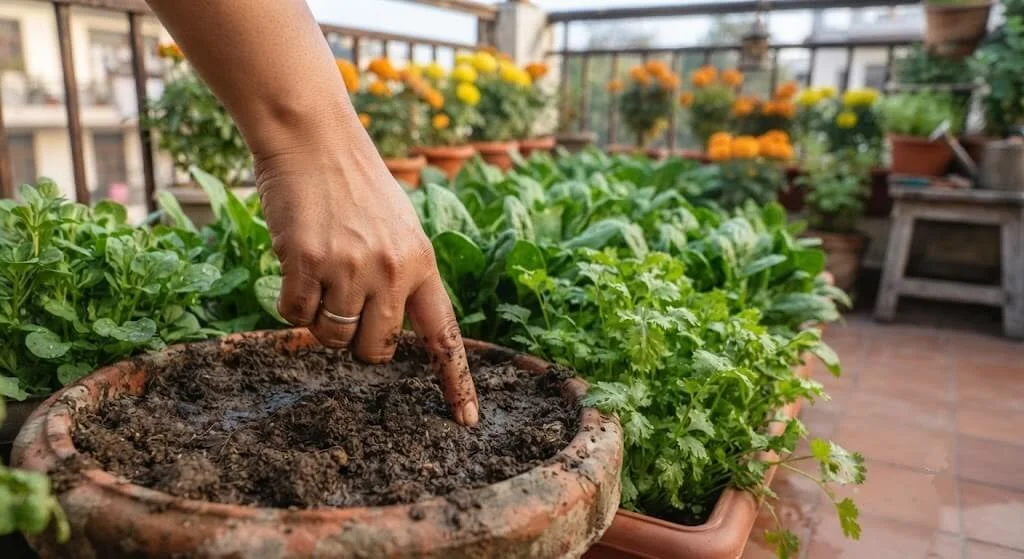
Soil dried out and plant wilted despite it being winter. Winter sun and wind dry containers out faster than most gardeners expect, especially on exposed balconies many assume “it’s winter, no watering needed” and get caught out. Check soil moisture with a finger 3–4cm deep; if bone dry, water thoroughly until it drains from the base, wait 15 minutes, and water again if still very dry. Don’t fertilise a stressed plant in this state. Prevent this by checking soil weekly even in winter, watering once the top couple of centimetres are dry regardless of how cool it feels outside, and recognising that sunny, windy balconies need more frequent watering than shaded, sheltered ones.
Advanced: Scaling a Winter Balcony Into a Productive Micro-System
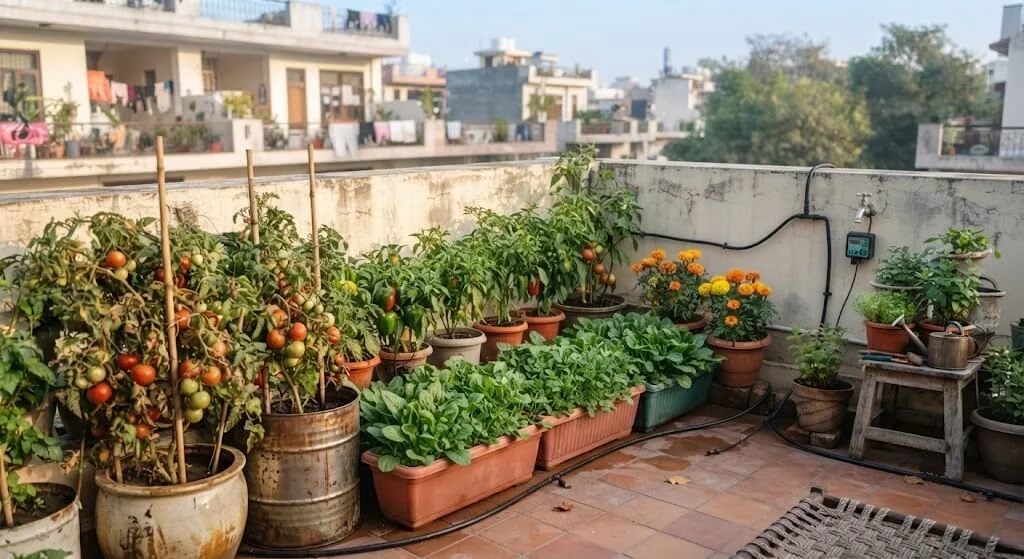
Succession sowing for continuous harvest: stagger palak and methi sowing every 10–12 days from October through December, so you’re never harvesting and exhausting every container simultaneously.
Light competition as you scale up: once you pass 8–10 containers on one balcony, taller plants like tomato and capsicum begin shading shorter winter greens by December as the sun angle drops container placement needs to rotate through the season, not stay fixed.
Water demand scales non-linearly: 5 containers might need a 2-litre can; 20 containers don’t simply need 8 litres poured by hand manual watering time itself becomes the real bottleneck, which is when a basic drip or wicking system starts paying for itself.
Harvest-volume management: at scale, methi and palak production can genuinely exceed what one household eats in a week. This is the point to consider either a small-scale selling model (see How to Sell Microgreens from Home in India for the closest framework) or simple neighbour distribution, rather than letting surplus go to waste.
Soil fatigue across multiple winter cycles: containers reused for 3+ winters with only top-dressing, never a full soil rebuild, show declining yields even with identical care a complete mix replacement every 2–3 seasons is standard professional practice that most casual guides skip mentioning.
Winter-Ready Checklist, By Zone
Everyone (Zones 1–4): know your balcony’s orientation and actual winter sun hours; every container has 3+ drainage holes and sits elevated on bricks or pot feet; soil is refreshed with the 50:30:20 mix before sowing; you’re watering by the finger test, not a fixed schedule.
Zone 3 only (North India): a cotton sheet or light cover is ready for forecast frost nights; tender plants like tomato and capsicum are positioned against a south-facing wall.
Zone 4 only (Hill stations): containers are resin, fibreglass, or thick plastic rather than thin terracotta; a mini greenhouse or frost cloth is ready before the coldest 3–4 weeks hit.
India Zone-Wise Growing Context
| Zone | Representative Cities | Winter Character | Container-Specific Note |
|---|---|---|---|
| North Indian Plains | Delhi, Lucknow, Chandigarh | Light frost 5–10 nights, fog cuts sunlight in Dec–Jan | Cotton sheet protection, south-wall positioning, morning-only watering |
| Western Semi-Arid | Ahmedabad, Jaipur | Dry, cool winter, no frost in most of this zone’s lower-elevation cities | Standard Zone 2–3 practice depending on exact location and elevation |
| Deccan Plateau | Bangalore, Hyderabad, Madanapalle | Mild, close to ideal winter conditions | Author’s reference zone minimal protection needed |
| Coastal West | Mumbai, Goa, Kochi | No frost, but winter sea breeze dries containers fast on high floors | Prioritise windbreak and watering frequency over any cold protection |
| Coastal East / Tamil Nadu | Chennai | No frost; main monsoon actually runs Oct–Dec here | Winter growing window effectively starts slightly later than the rest of Zone 1 |
| Eastern India | Kolkata, Patna | Mild winter with post-monsoon humidity lingering | Watch fungal risk if combining heavy mulch with lingering humidity |
| Northeast India | Guwahati, Shillong | Cooler and more humid than other Zone 2-equivalent areas | Favour airflow over heavy mulching, similar to Zone 1 caution |
| Himalayan / Hill | Shimla, Manali, Ooty, Darjeeling | True Zone 4 sub-zero nights, possible snow | Full cold-climate technique genuinely applies here |
| Reference Zone | Madanapalle, AP | Deccan Plateau baseline, mild winter | Author’s own tracked conditions throughout this guide |
Get the Free Printable: Zone-by-Zone Winter Checklist
A one-page version of the zone checklist above, plus the October soil-refresh reminder and frost-night protocol for Zone 3 growers. Get the Zone-by-Zone Winter Checklist, free with email →
Frequently Asked Questions
What is a winter garden balcony?
A container garden planned around local November–February conditions. In most of India, this means growing tomatoes, leafy greens, and flowers during the year’s mildest, most productive season not protecting plants from extreme cold, which only genuinely applies to hill-station balconies like Shimla or Manali.
Is winter actually the best season for balcony gardening in India?
Yes, for most of India Zones 1–3, covering tropical, mild, and the North Indian frost belt. Summer heat stress, which causes blossom drop and bolting, disappears, and cool nights actually improve flavour and growth in tomatoes, leafy greens, and root vegetables.
Do I need frost protection for my balcony in Delhi or North India?
Light protection only, for roughly 5–10 nights a season. A cotton sheet draped over tender seedlings after 9 PM on forecast-frost nights is usually enough the elaborate bubble-wrap and frost-cloth systems built for −10°C to −20°C climates are unnecessary for Delhi’s brief 2–6°C dips.
What vegetables grow best on an Indian balcony in winter?
Tomato, capsicum, beans, peas, cauliflower, carrot, and mooli for vegetables; palak, methi, coriander, and sarson for leafy greens. Exact sowing windows vary by zone tropical India can sow earlier and harvest for longer than North India’s frost belt.
What’s the best container size for winter vegetables?
Leafy greens need 8–10 inches of depth, root vegetables like mooli and carrot need 12–18 inches, and larger fruiting plants like tomato or capsicum do best in 14–18 inch containers bigger containers also buffer temperature swings better during occasional cold spells.
When should I start my winter balcony garden in India?
The first week of October, for most of India soil is still warm enough for good germination, and plants establish strong roots before temperatures drop. Waiting until November, once it visibly “feels like winter,” often means a shorter, weaker harvest.
How is winter gardening different in Shimla or Manali compared to Delhi?
Hill stations face genuine sub-zero nights and occasional snow, requiring the frost-proof containers, mulching, and covering strategies used in true cold climates. Delhi and similar North Indian cities see only light, brief frost and rarely need more than basic protection.
Key Facts
What is winter balcony gardening in India?
Growing vegetables, herbs, and flowers on an Indian balcony or terrace during November–February, which for most of India (Zones 1–3) is the most productive growing window of the year rather than a cold-protection challenge.
What are India’s winter gardening zones?
Zone 1 – tropical South (Chennai, Mumbai, Hyderabad), no frost; Zone 2 – mild winter (Bangalore, Pune), near-ideal conditions; Zone 3 – cool North India (Delhi, Lucknow, Jaipur), light frost on 5–10 nights; Zone 4 -hill stations (Shimla, Manali, Ooty), genuine sub-zero cold.
What causes Indian winter balcony gardens to underperform?
Sowing too late (November instead of early October), carrying over summer watering frequency into cooler months, and applying cold-climate frost protection far beyond what any Indian zone except hill stations actually needs.
Why does Western winter gardening advice often backfire in India?
Heavy mulching and reduced watering are built for dormant, frost-affected plants in genuinely cold climates; in tropical and mild Indian zones, plants are actively growing through winter, so the same advice causes fungal risk and wilting rather than protection.
How do you protect tender plants from North Indian frost?
A simple cotton sheet draped over vulnerable plants like tomato and capsicum after 9 PM on forecast-frost nights, removed by 9 AM, covers nearly all the real risk most North Indian balconies face imported frost cloth or cold-frame systems are rarely necessary.
Source: Priya Harini B, thetrendvaultblog.com – based on container gardening experience in Madanapalle, Andhra Pradesh, cross-referenced with reader-reported winter conditions from Delhi, Mumbai, Bangalore, and Chennai.
Your Winter Balcony Action Plan
- Identify your zone (1, 2, 3, or 4) from the map above
- Refresh container soil with the 50:30:20 cocopeat-perlite-vermicompost mix
- Sow or transplant your first winter crop by the first week of October
- If Zone 3, keep a cotton sheet by the door for forecast frost nights
- Elevate every container on bricks and confirm drainage isn’t blocked by monsoon debris
- Set a weekly phone reminder to check soil moisture by finger test, even in cooler weather
- For exact sowing windows and spacing per crop, see 15 Best Winter Vegetables to Grow in India
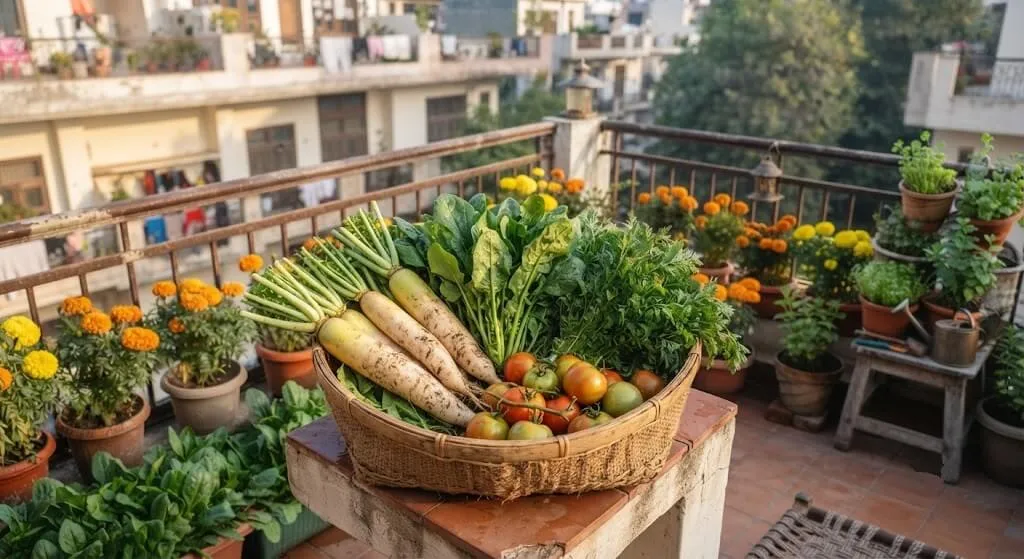
Winter, in most of India, isn’t a season to survive it’s the one you’ve been waiting for since April. Sow by early October, match your protection effort to your actual zone rather than a Chicago guide, and let the season do the work summer never could.
Related reading: 15 Best Winter Vegetables to Grow in India · Where to Buy Winter Vegetable Seeds in India · Best Soil for Container Gardening · How to Avoid Over/Under-Watering Plants
Tell me on Instagram @thetrendvaultblog which zone you’re gardening in this winter.
About Priya Harini B: Priya writes thetrendvaultblog.com from Madanapalle, Andhra Pradesh, testing every method on her own terrace and balcony containers before it goes on the site 4+ years of hands-on experience across 40+ plant varieties and 38+ tracked containers.