
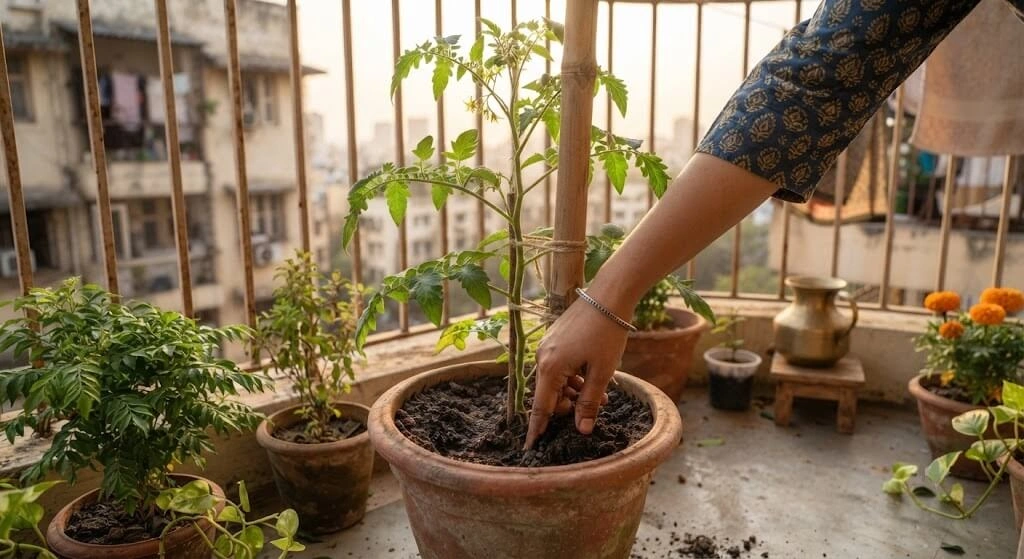
By Priya Harini B | Madanapalle, Andhra Pradesh | 4+ years container gardening, 40+ plant varieties tested
Part 1 of 2 : How to Water Container Plants: Expert Techniques →
Quick Answer: To diagnose overwatering vs underwatering in Indian container gardens, push your finger 3–4cm into the soil (not the standard 1–2cm Indian surface dries far faster). Yellow, mushy leaves plus wet soil means overwatering; brown, crispy edges plus dry soil and rapid wilt means underwatering. Water only at 6–8 AM or 5–7 PM, never 10 AM–4 PM. Summer (Mar–Jun): twice daily for small containers. Monsoon (Jul–Sep): every 2–4 days, testing first rain often does the work. Winter (Oct–Feb): every 2–3 days.
Table of Contents
Introduction
My pudina died in July. Not from drought, not from pests from kindness. I watered it every morning even though Mumbai’s monsoon was delivering 40mm of rain every few days. The soil was saturated, the roots were drowning, and the plant was trying to tell me exactly that through yellowing leaves and a foul smell from the pot. I ignored the signals because I was following a watering schedule instead of reading my plant.
Knowing How to Avoid Over Underwatering Plants in India is the single most overlooked skill in container gardening, and the mistake runs in both directions. Indian summer kills plants through underwatering when gardeners water at noon (thermal shock) or forget in the heat. Indian monsoon kills plants through overwatering when gardeners continue their summer schedule despite rain already providing all the moisture the plant needs.
The core principle that changes everything: plants don’t need water on a schedule. They need water when the soil at root level is dry. The only way to know that is to test the soil not to count days.
This is Part 1 of a two-part guide : see How to Water Container Plants: Expert Techniques for deeper technique once you’ve mastered diagnosis.
Why Indian Container Watering Is Genuinely Different
Container plants live in isolated ecosystems where limited soil volume dries faster than ground planting, and shallow-rooted crops like methi dry out quicker than deep-rooted ones. But three factors make Indian conditions specifically different from any Western guide’s assumptions.
Factor 1 – Indian tap water TDS. Municipal water in Delhi (500–800 ppm TDS) and Chennai (400–700 ppm TDS) deposits dissolved mineral salts with every watering. Over 8–10 weeks, salt buildup raises osmotic pressure in the root zone plants show drought stress symptoms (wilting, brown leaf tips) even when soil is adequately moist, because roots must work harder against the mineral gradient. This is frequently misdiagnosed as underwatering, and more watering makes it worse.
Factor 2 – Indian seasonal extremes. Container root zones hit 45–52°C in May direct sun (black plastic pots) and face waterlogging from continuous monsoon rain in July–August extremes 2–3× more severe than temperate garden conditions. A watering schedule that works in March is actively harmful by May and needs complete revision by July.
Factor 3 – The finger test depth problem. Standard advice to test at “1–2 inches” was written for temperate climates with moderate evaporation. Indian summer desiccates the top 2cm of container soil in 3–4 hours while the deeper root zone stays moist. Testing at 1–2cm produces systematic false-positive “dry” readings that lead straight to chronic overwatering. Test at 3–4cm for Indian conditions.
Overwatering vs Underwatering: The Diagnostic Table
Both conditions cause wilting, which is exactly why they’re so commonly confused. The key differences are leaf texture and soil moisture plus a third, India-specific condition most guides never mention.
| Condition | Leaf Appearance | Soil Feel | Root Condition | Recovery Time | Indian Season Risk |
|---|---|---|---|---|---|
| Overwatering | Yellow, soft, mushy | Constantly wet, foul smell | Brown, mushy, rotting | 2–6 weeks | Monsoon (Jul–Sep) highest risk |
| Underwatering | Brown edges, crispy, dry | Hard, pulling from edges | White, healthy but dry | 24–48 hours | Peak summer (Apr–Jun) highest risk |
| TDS salt stress (India-specific) | Brown leaf tips despite moist soil | Adequately moist | White but stressed | 2–4 weeks after water source fix | Year-round in Delhi, Chennai, Hyderabad |
The Indian confusion point: in Indian summer, wilting at 1–4 PM that recovers by evening is usually normal heat transpiration stress not a watering problem at all. Only test and act if the plant is wilted in the cool morning hours (before 9 AM), which indicates genuine moisture stress.
If my plant is wilting, is that always a sign it needs water?
No check the time of day first. Afternoon wilt in summer that recovers by evening is normal heat response; morning wilt is the real signal to test soil and act.
Warning Signs of Overwatering
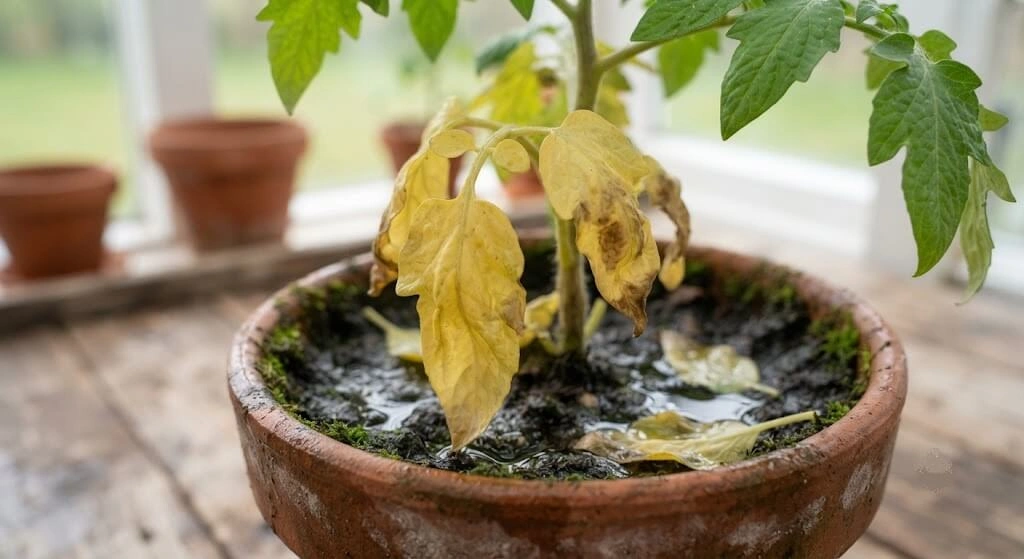
Visual symptoms: yellowing that starts with older, lower leaves and spreads across multiple leaves simultaneously (unlike natural single-leaf aging), soft mushy stems that bend without snapping, and brown, mushy, foul-smelling roots. Edema small blister-like bumps on leaf undersides appears when plants absorb water faster than they can transpire it; once formed, it can’t be reversed but stops developing when watering improves.
Fungus gnats in Indian monsoon are the most reliable overwatering indicator specifically during July–September monsoon humidity creates perfect breeding conditions even at normal watering rates, so their appearance during monsoon means reduce watering dramatically, since rain is already providing baseline moisture your schedule doesn’t account for.
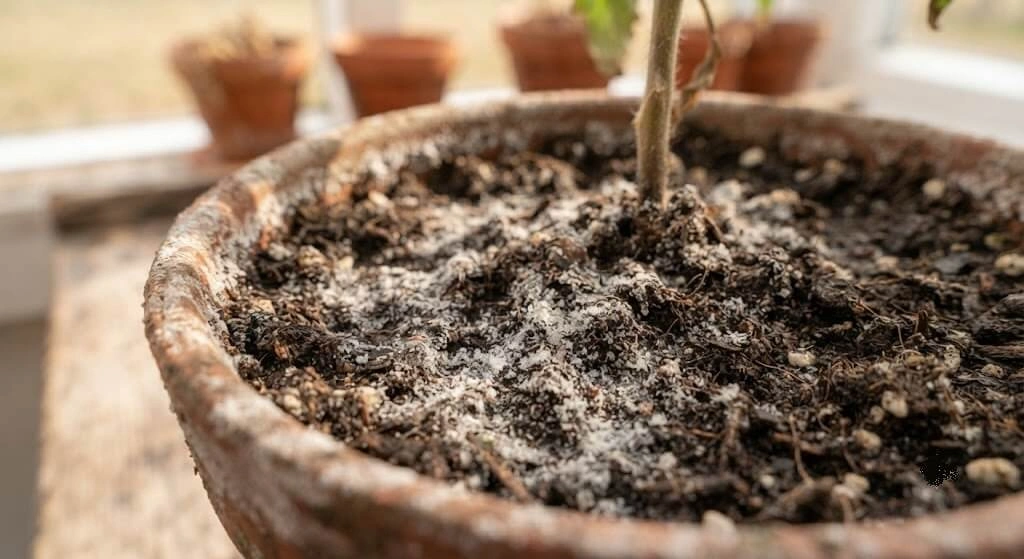
White crust on soil surface in high-TDS Indian cities isn’t just an overwatering sign it’s a specific TDS contamination indicator, meaning your water is depositing mineral salts with every application. Fix: switch to RO reject water (free from your household purifier) and flush containers with 3× water volume to remove deposits.
The environmental clue most guides never mention: the rain itself. During July–September monsoon, containers on unprotected balconies receive 20–80mm of rain in a single day 4–16× the daily water requirement of most container plants. Continuing a summer watering schedule during monsoon means systematically overwatering every container.
Rule: before watering any container during monsoon, test soil at 3–4cm. Damp skip. Dry water. On days with substantial rain (>10mm), skip all manual watering without testing.
Behavioural signs: stunted growth despite good light and feeding (waterlogged roots can’t absorb nutrients effectively), leaf drop across multiple leaves within days rather than gradual aging, wilting despite wet soil (damaged roots can’t absorb even available moisture), and increased disease susceptibility as constant saturation creates perfect conditions for pathogens.
Recognising Underwatering
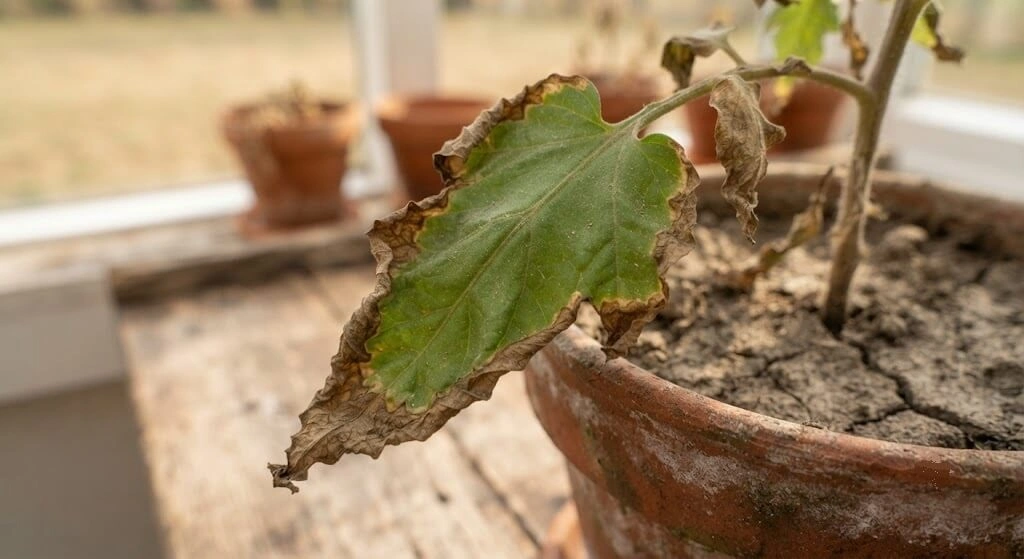
Physical signs: crispy, dry, papery brown leaf edges (completely different from the soft brown of overwatering), brittle stems that crack rather than bend, soil pulling away from container edges as it contracts while drying, and noticeably lightweight containers.
Indian summer specific: containers on south/west-facing balconies in May face 40–45°C ambient plus radiated wall heat small containers (under 8L) can desiccate completely in 6–8 hours, with visible wilting by noon even after adequate 6 AM watering. This isn’t a watering failure; it’s a container-size mismatch for the heat load. Immediate fix: partial shade 11 AM–2 PM. Long-term fix: upsize to 12–15L containers.
Terracotta note: soil pulling from container edges is more dramatic in terracotta than plastic, since terracotta itself contracts as it dries alongside the soil a double-pulling effect that makes the gap look more severe than it necessarily is.
Timing patterns: rapid wilting on hot afternoons with recovery by cooler evening indicates drought stress, not disease. Quick recovery within 2–4 hours of correct watering confirms an underwatering diagnosis; slower growth, reduced flowering, and premature fruit drop are longer-term signs of sustained water stress.
The Indian afternoon watering trap: seeing wilted plants at 2 PM in May and immediately watering is the most common Indian summer error. Cold tap water on heat-stressed roots (which may sit at 42–48°C in black plastic containers) causes thermal shock plants can actually die from the sudden temperature change rather than benefit from the water. Wait until 5–6 PM when root zone temperatures have moderated.
Hydrophobic soil is common after the summer-to-monsoon transition (June–July), when fully dried cocopeat becomes temporarily water-repellent and the first monsoon rain runs off the surface without penetrating. Fix: add 5 drops of dish soap to 1 litre of water and apply as the first rehydrating pour this breaks surface tension. Follow immediately with plain water.
India Daily Timing Reference
| Plant Behaviour | Time of Day | Interpretation | Action |
|---|---|---|---|
| Wilting | 12 PM–4 PM (summer) | Normal heat transpiration, not water stress | Wait; no action until evening |
| Wilting | 7–9 AM (cool morning) | Genuine moisture stress | Test soil at 3–4cm; water if dry |
| Wilting | 7 AM after a monsoon rain day | Likely overwatering | Do NOT water; check soil and drainage |
| Leaf curl inward | Afternoon, any season | Moderate stress or heat protection | Evening soil test |
| Rapid recovery after evening watering | Same day | Confirms underwatered diagnosis | Maintain evening watering schedule |
| No improvement after 24 hrs of watering | Anytime | Root damage (rot or heat) | Inspect roots |
How to Test Soil Moisture: 5 Methods, India-Calibrated
The finger test. Insert to 3–4cm depth (not the standard 1–2cm Indian surface drying runs 3–4× faster than temperate conditions, so shallow testing gives false-dry readings. Bone-dry soil feels hard; properly moist soil feels like a wrung-out sponge; wet soil feels muddy.
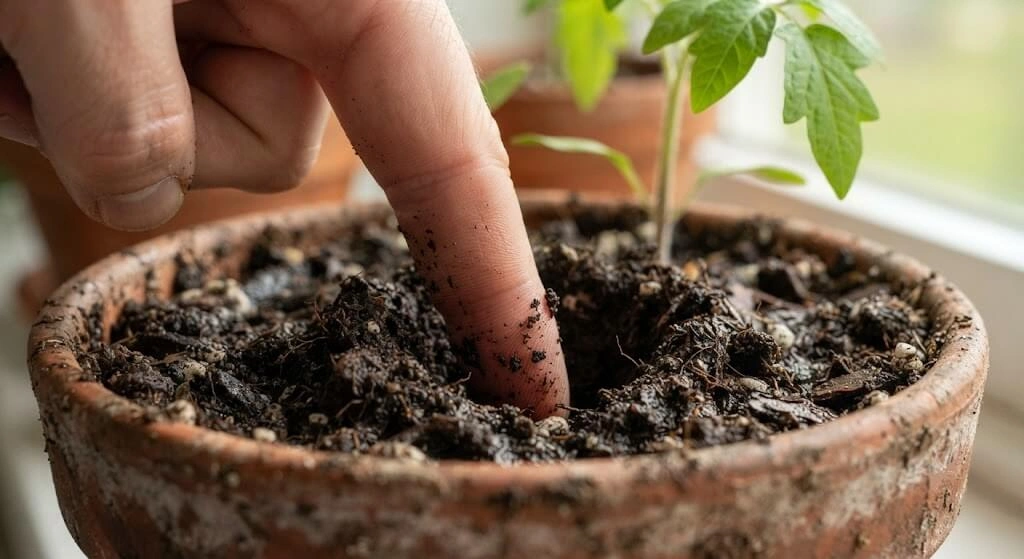
Seasonal calibration: Summer (Mar–Jun) test at 3–4cm, small containers (under 8L) dry at this depth in 6–8 hours of direct sun. Monsoon (Jul–Sep) don’t assume rain is enough, but don’t overwater from habit either; if damp at 3–4cm, don’t water; on active rain days, skip entirely. Winter (Oct–Feb) test at 3–4cm, water every 2–3 days for most containers.
Moisture meters. A basic pH meter (₹350–500) doubles as a moisture check, useful since Indian tap water’s high TDS pushes soil pH above 7.0 over time one device catching two problems. Calibration warning: meters give less accurate readings in Indian cocopeat-heavy mixes (50% cocopeat + 30% perlite + 20% vermicompost) than standard potting soil cocopeat’s electrical conductivity can read as “wet” even when moderately dry. Use the finger test to calibrate your meter against your specific mix.
Weight test. Lift the container right after thorough watering to learn the “full” weight, then monitor how it decreases as soil dries most plants need watering around 60–70% of full weight. Terracotta note: these show more dramatic weight swings than plastic, since the pot walls themselves absorb and release water “at capacity” includes water stored in the walls that plants can’t actually access.
Visual assessment. In cocopeat-perlite-vermicompost mix, dark brown indicates moisture and pale tan indicates dryness reliable, but in Indian summer the top 1cm can look pale tan (dry) while the mix at 4cm is still adequately moist. Always confirm with the finger test.
Plant behaviour monitoring. Leaf position and daily wilt-recovery timing (covered in the timing table above) provide the most India-calibrated read on genuine moisture stress versus normal heat response.
The India Seasonal Watering Guide
Summer (March–June) – Highest Water Demand, Highest Thermal Shock Risk
India’s hardest watering season rooftop terraces in May hit 40–48°C ambient, and small containers in direct south-facing sun can desiccate in 6–8 hours.
| Container Size | Frequency | Time | Key Rule |
|---|---|---|---|
| Small (<8L) | Twice daily | 6 AM + 6 PM | Never between 10 AM–4 PM |
| Medium (8–15L) | Once daily | 6–8 AM | Evening check if wilting before 9 AM |
| Large (15L+) | Every 1–2 days | 6–8 AM | Test at 3–4cm before each watering |
Water at 6 AM and 6 PM only cold tap water on 45°C roots at 2 PM causes thermal shock. Add 1cm cocopeat mulch to reduce evaporation 30–40%. Move small containers to partial shade 11 AM–2 PM if twice-daily watering isn’t practical.
Monsoon (July–September) – Highest Overwatering Risk
This is where the biggest Indian watering mistake happens: continuing a summer twice-daily schedule while rain delivers 20–80mm per day.
| Container Situation | Frequency | Key Rule |
|---|---|---|
| Exposed to rain | 0 (rain provides all) | Test before adding any water regardless |
| Covered balcony/overhang | Every 2–4 days | Test at 3–4cm before each |
| Indoor containers | Every 5–7 days | High ambient humidity slows evaporation |
Check soil at 3–4cm before every watering, every day no fixed schedule. Skip all manual watering entirely on days with more than 10mm rain. Remove ALL saucers by June 30 monsoon rain plus a saucer means root rot in 2–3 days. Watch for fungus gnats, whose appearance signals overwatering and/or poor drainage.
Winter (October–February) – Best Growing Season, Lowest Watering Stress
India’s growing season lowest pest pressure, most productive growth, easiest watering management. Most containers need watering every 2–3 days; the standard 3–4cm finger test works reliably at moderate temperatures.
North India (Delhi, Jaipur, Punjab): below-12°C temperatures reduce plant metabolic activity, so watering needs drop significantly in December–January succulents and cacti may need no watering for weeks. South India (Chennai, Bangalore, Hyderabad): mild winters mean continued active growth, so maintain the 2–3 day schedule. Morning dew and cooler nights everywhere mean soil stays moist longer resist watering daily out of habit.
Pre-Summer Transition (February–March) – Progressive Increase
Increase watering frequency progressively as daytime temperatures rise past 28°C don’t wait until plants show stress. Begin adding morning water sessions as temperatures approach 30°C.
| Season | Months | Frequency (10L container) | Timing | Primary Risk |
|---|---|---|---|---|
| Summer | Mar–Jun | Once daily (small containers under 8L: twice) | 6 AM + 6 PM | Underwatering + thermal shock |
| Monsoon | Jul–Sep | Every 2–4 days | Morning only | Overwatering from rain + manual habit |
| Winter | Oct–Feb | Every 2–3 days | Morning preferred | Over-enthusiasm (calendar watering) |
| Pre-summer | Feb–Mar | Progressive increase | 6–8 AM | Underestimating heat build-up |
The Indian Water Quality Factor: Your Tap Water Is Part of the Problem
City-Specific Tap Water Impact
| City | Avg Tap TDS | Visible Salt Buildup Timeline | Plant Health Impact | Fix |
|---|---|---|---|---|
| Bangalore | 150–300 ppm | Month 16–20 | Low, usable with 24-hr standing | Let tap water sit 24 hrs to off-gas chlorine |
| Mumbai | 300–500 ppm | Month 10–14 | Moderate, monthly flush recommended | Monthly container flush; RO reject preferred |
| Chennai | 400–700 ppm | Month 8–12 | High, visible white crust, brown leaf tips | RO reject water mandatory; flush monthly |
| Delhi/NCR | 500–800 ppm | Month 6–8 | High, root zone osmotic stress | RO reject water mandatory; flush every 3 weeks |
| Hyderabad | 400–600 ppm | Month 8–12 | Moderate-High | RO reject water recommended |
Distinguishing TDS Stress From Watering Problems
| Symptom | Underwatering | Overwatering | TDS Mineral Stress |
|---|---|---|---|
| Leaf tips | Brown, crispy | Yellow, soft | Brown tips + edges (even moist soil) |
| Soil surface | Dry, pulling from edges | Wet, smelly | White/grey mineral crust |
| Root condition | White, dry | Brown, mushy | White but congested |
| Recovery from watering | Rapid (24 hrs) | Doesn’t recover | No improvement from more water |
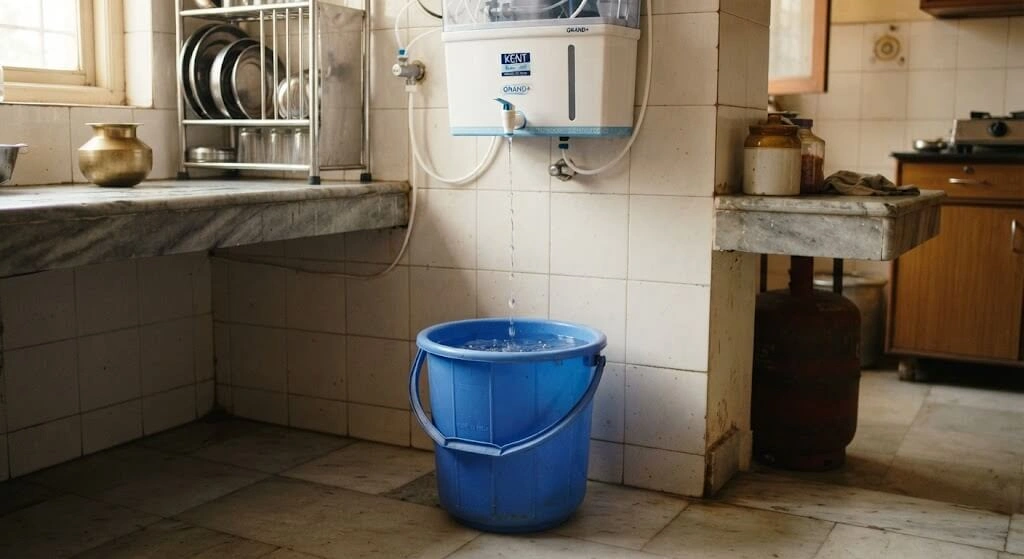
The free Indian solution: every household RO purifier wastes roughly 3 litres of reject water per litre filtered, and that reject water sits at 150–200 ppm TDS ideal for plants. Collect it in a 20L bucket and use it for all watering. This single change eliminates TDS mineral stress permanently at zero cost.
Recovery Strategies: Saving Overwatered and Underwatered Plants
Rescuing Overwatered Plants
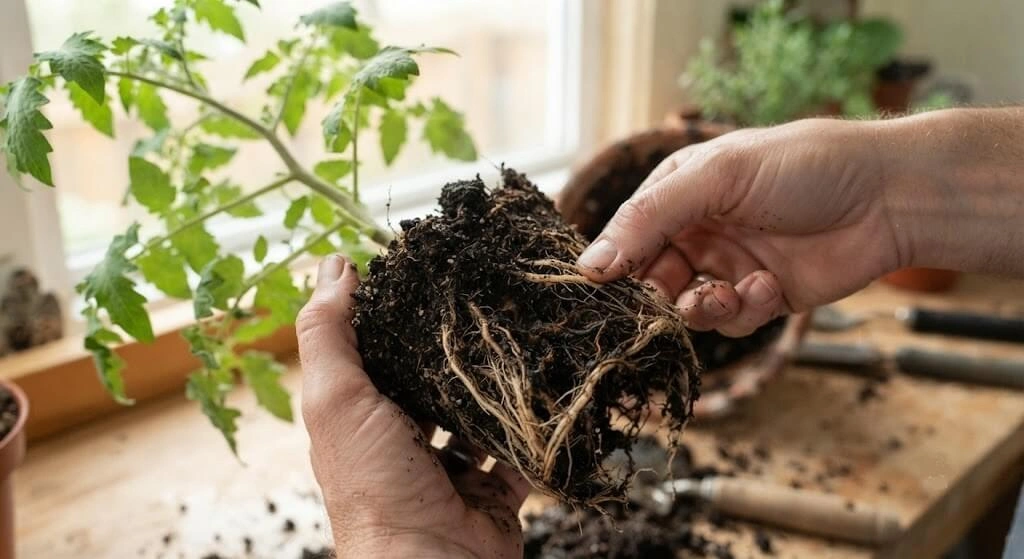
The most common Indian recovery scenario happens in August–September, when a plant manually watered through monsoon shows root rot. Remove from the container, wash roots gently, cut all brown/mushy/foul-smelling roots with sterile scissors even if this removes 50% of the root system and dust cuts with cinnamon powder (natural antifungal, already in every Indian kitchen) or air-dry 30 minutes. Don’t repot into the same saturated, compacted mix use fresh mix with 35% perlite (up from the standard 30%) for improved drainage through continued monsoon conditions.
Recovery timelines: minor overwatering (yellowing, no root rot) 1–2 weeks. Monsoon root rot (brown mushy roots, foul smell) 4–8 weeks if caught before more than 50% root loss. Summer heat plus black plastic plus root death: recovery often isn’t possible once more than 70% of roots are heat-damaged replant with fresh soil in a heat-appropriate container (fabric grow bag or white plastic) rather than attempting recovery.
Reviving Underwatered Plants
Hydrophobic cocopeat recovery: add 5 drops of dish soap to 1L plain water, pour slowly at the container edge (not centre), wait 2 minutes for penetration to begin, then follow with plain RO reject water (not tap water while the plant is stressed). Repeat twice within 30 minutes rather than one full pour.
Bottom-watering for severe cases: place the container in a larger tray filled with water for 20–30 minutes, letting soil absorb from below more effective than surface watering for severely hydrophobic cocopeat mixes.
6 Common Indian Balcony Watering Mistakes With Exact Fixes
Mistake 1 – Watering by schedule instead of by soil test. Watering saturated monsoon soil, or overwatering every 1–2 days in winter when 2–3 is adequate. Fix: one rule for all seasons test at 3–4cm before every watering. Damp, skip; dry, water. This single habit prevents 80% of Indian container watering problems.
Mistake 2 – Watering at noon or afternoon in summer. Cold tap water hits 40–45°C root zone soil, causing thermal shock within hours. Fix: never water 10 AM–4 PM, March through June. Water only 6–8 AM and 5–7 PM; if a plant wilts at 2 PM, move it to shade and don’t water until 5 PM minimum.
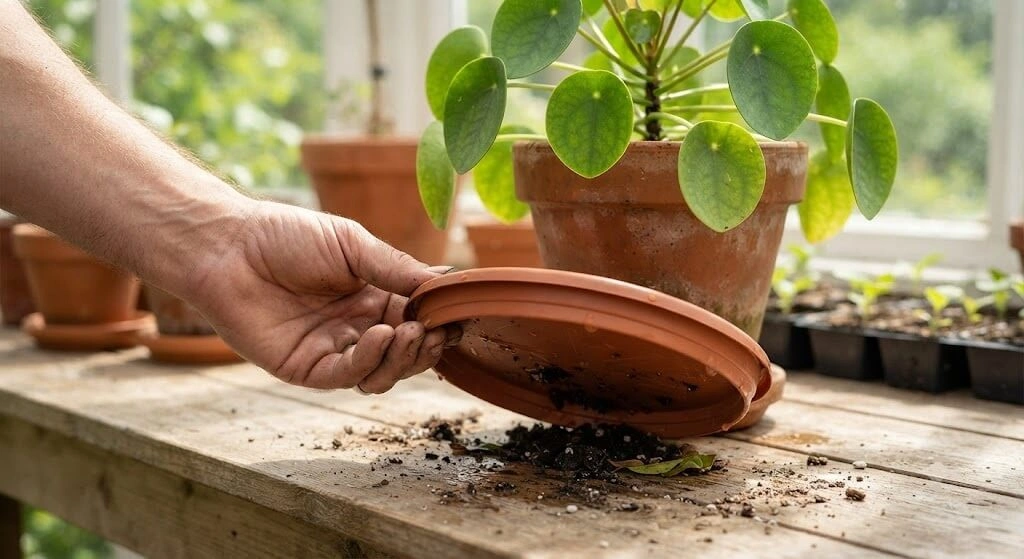
Mistake 3 – Not removing saucers before monsoon. Saucers fill within hours of monsoon rain, and root rot develops within 48–72 hours of standing water. Fix: remove ALL saucers by June 30 every year set a phone reminder, store them until October 1.
Mistake 4 – Using high-TDS tap water without recognising mineral stress. By month 8–10, white crust appears and plants show brown tips despite moist soil watering more makes it worse. Fix: switch to RO reject water, flush affected containers with 3× volume, and repeat monthly if continuing with tap water.
Mistake 5 – Misreading normal afternoon wilt as water stress. Watering healthy but heat-drooping plants at 2 PM daily eventually causes real overwatering symptoms within weeks. Fix: test soil at 3–4cm before 9 AM to assess actual moisture afternoon wilt alone isn’t a watering indicator in summer.
Mistake 6 – Continuing full watering on covered balconies through monsoon. Even without direct rain, 85–95% relative humidity dramatically slows evaporation covered plants need 60–70% less water in July than in May. Fix: reduce watering by 50% in July regardless of rain exposure, and test soil before every watering.
Quick Diagnosis Reference
| What You See | When | Likely Cause | First Action |
|---|---|---|---|
| Yellow leaves (lower plant first) | Monsoon/post-monsoon | Overwatering, root hypoxia | Reduce watering; improve drainage; remove saucers |
| Brown crispy leaf edges | Summer | Underwatering OR TDS mineral stress | If dry: water 6 AM/6 PM. If white crust: flush container |
| Wilting 12–4 PM, recovers by 6 PM | Summer | Normal heat transpiration | Shade cloth 11 AM–2 PM; no extra watering |
| Wilting 7–9 AM | Any season | Genuine underwatering or root damage | Finger test dry means water; wet means check roots |
| Foul smell from container | Monsoon, post-rain | Root rot from waterlogging | Remove saucer; inspect roots |
| Fungus gnats | Monsoon, humidity | Consistent surface moisture | Let top 3cm dry fully; apply neem cake |
| White crust on soil surface | Year-round, worse in summer | TDS mineral buildup | Switch to RO reject water; flush 3× volume |
| Soil repelling water | Summer to monsoon transition | Hydrophobic cocopeat | Dish soap flush; bottom watering |
| Rapid wilting 2–3 hrs after watering | Peak summer | Thermal shock from wrong-time watering | Water only 6 AM and 6 PM |
| Fine in cool months, struggling in summer | May–June | Container too small for heat load | Upsize to 12–15L; add mulch; partial shade |
| Fine in summer, struggling in monsoon | July–August | Saucers creating waterlogging | Remove saucers immediately; elevate containers |
The Indian Watering Decision Tree
Plant looks stressed →
Step 1 – What time is it? 10 AM–4 PM in summer: normal heat wilt, wait and check again at 6 PM. Before 9 AM or after 5 PM: genuine stress, continue to Step 2.
Step 2 – Test soil at 3–4cm. Dry: underwatering, water at 6 AM/6 PM. Damp: go to Step 3. Wet: overwatering, don’t water, go to Step 4.
Step 3 – Damp but plant still stressed? White crust on soil: TDS mineral stress switch to RO water, flush container. No white crust: possible root damage remove plant, inspect roots.
Step 4 – Wet soil plus stressed plant? Saucer under the container: remove immediately. Drainage holes blocked: clear them. Foul smell: root rot inspect and treat roots. No foul smell, clear drainage: overwatering stop watering, allow to dry.
Monsoon confusion scenario (Mumbai, August, rained yesterday, chilli wilting this morning): saucer present → likely waterlogged, remove and check roots. Clear drainage but saturated soil → monsoon overwatering, don’t water, move under overhang if possible. Container under overhang → check at 3–4cm, monsoon humidity slows evaporation so it may still be moist. Genuinely dry soil (unusual but possible on covered balconies) → water lightly at 6 AM.
Summer confusion scenario (Delhi, May, coriander wilted at 11 AM, watered at noon, plant looks worse): cold tap water on 45°C root zone soil caused thermal shock the noon watering accelerated damage. Correct action: wait until 5 PM, water with water that’s been sitting in shade for 30 minutes at room temperature, not straight from a cold tap.
Watering by Container Type
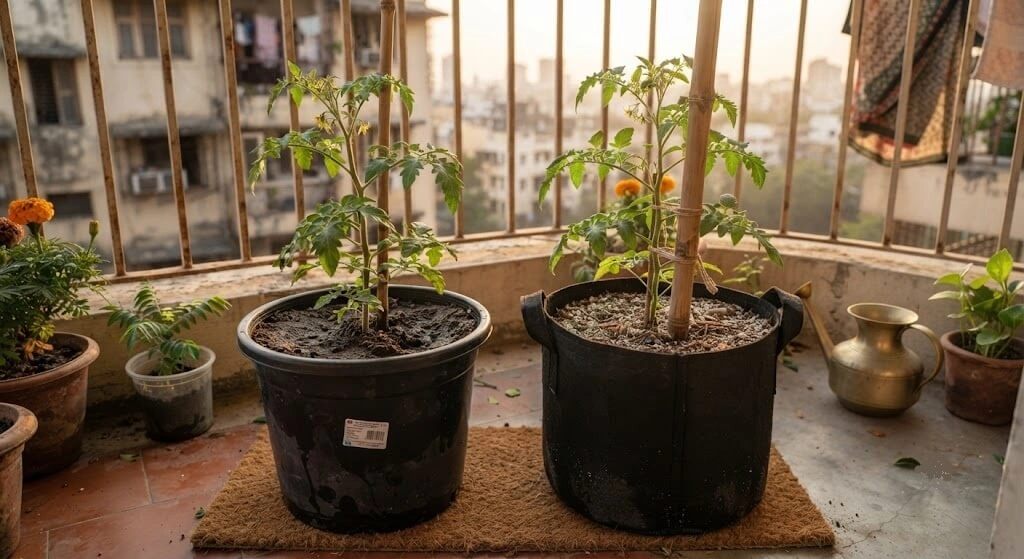
Indian gardeners use wildly different containers terracotta, black plastic, fabric grow bags, recycled tins, white plastic and each behaves completely differently under Indian heat.
| Container Type | Summer Drying Rate | Monsoon Risk | Root Zone Temp (May 2 PM) | Watering Adjustment |
|---|---|---|---|---|
| Black plastic nursery pot (full sun) | Fastest: 6–8 hrs | High | 48–52°C | Twice daily in May; wrap in jute to reduce frequency |
| Fabric grow bag (black) | Fast: 8–10 hrs | Low (breathes) | 32–36°C | Daily in summer; benefits most from drip irrigation |
| White/cream plastic | Moderate: 10–12 hrs | Medium | 34–36°C | Once daily in peak summer |
| Terracotta (unglazed) | Moderate: 8–10 hrs | Medium | 38–42°C | Daily summer; pot wall holds some moisture buffer |
| Repurposed tin (painted) | Moderate: 10 hrs | Medium | 36–40°C | Same as white plastic |
| Unpainted tin (full sun) | Fast: 6–8 hrs | Medium | 44–50°C | Never in full sun; always wrap or shade |
| Self-watering container | Slow: 3–5 days | Low | Variable | Monsoon: drain reservoir. Summer: fill every 2–3 days |
The key insight: black plastic nursery pots in direct summer sun are both the most common container and the most demanding the single biggest watering improvement available to most Indian balcony gardeners is switching to fabric grow bags or white plastic, which cuts watering frequency from twice-daily to once-daily under identical conditions.
Advanced: What Season 2 and 3 Gardeners Do Differently
Reading container weight intuitively. By season 2, experienced gardeners can lift a container and immediately sense whether it needs water a tactile skill that develops after roughly 200 watering decisions, eventually becoming faster and more accurate than any other daily assessment method.
Anticipating seasonal transitions rather than reacting to stress after it appears: March 1 begin adding an evening watering session as daytime temperatures approach 30°C. June 30 remove all saucers and reduce frequency before the first monsoon rain. October 1 reduce from monsoon-adapted to winter schedule as temperatures drop. This prevents the transition-season losses (late February heat, early monsoon waterlogging) that catch first-season gardeners by surprise.
Plant-specific watering vocabulary: methi and dhania wilt dramatically from underwatering but recover within 2–4 hours of correct watering prolonged morning wilt means genuine need. Chillies show leaf curl inward before visible wilting; curl at 9 AM means water needed, curl at 2 PM in summer is normal heat response. Cherry tomato blossom drop is frequently caused by irregular watering more than by quantity consistency matters more than total volume. Pudina is nearly impossible to underwater on a regular schedule but shows clear distress when overwatered (yellow lower leaves, soft mushy stems).
Automation for Indian conditions: a drip irrigation timer (₹8,000–14,000 for 10 containers) doesn’t replace watering judgment it executes it consistently. Adjust monthly: May timer at 6 AM + 6 PM for small containers. August timer off, test and water manually based on rain. October–February timer at 7 AM every 2 days. This prevents the two biggest Indian watering failures: forgetting in summer heat (plants die in 6–8 hours) and habitual overwatering through monsoon.
Product Reference
| Product | Purpose | Cost | Where to Buy |
|---|---|---|---|
| Digital pH/moisture meter | Dual-purpose soil diagnosis | ₹350–500 | Amazon India |
| Fabric grow bags (black) | Best heat-performing container | ₹60–120 each | Nursery, Amazon India |
| Cocopeat + perlite (35% mix) | Post-recovery repotting mix | See DIY Soil guide | — |
| Cinnamon powder | Natural antifungal for root cuts | Kitchen staple | Any grocery store |
| Liquid dish soap | Hydrophobic soil rehydration | Kitchen staple | Any grocery store |
| 20L bucket | RO reject water collection | ₹100–200 | Hardware store |
| Drip irrigation timer kit | Automated seasonal watering | ₹8,000–14,000 | Amazon India, drip supply store |
Get the Printable Watering Decision Tree & Seasonal Calendar
Get the printable India Watering Decision Tree & Seasonal Calendar – free with email →
A one-page reference combining the diagnostic decision tree, the seasonal frequency tables, and the quick diagnosis reference above.
Frequently Asked Questions
How often should I water balcony plants in India?
There’s no fixed frequency water when soil at 3–4cm depth is dry. Starting points: summer, small containers twice daily (6 AM + 6 PM), medium once daily; monsoon, every 2–4 days testing before each, skip entirely on rain days; winter, every 2–3 days. Always test before watering rather than following a calendar.
Why are my balcony plants dying even though I water them every day?
Daily watering is the most common cause of Indian balcony plant death. In monsoon, rain already provides sufficient moisture, and daily watering on top of it creates constant waterlogging remove all saucers in June and test before every watering. In winter, daily watering overloads most container soils; every 2–3 days is correct. Test: push your finger 3–4cm in if damp, don’t water regardless of how many days have passed.
How do I know if my plants are overwatered or underwatered in Indian monsoon?
Before watering, test at 3–4cm damp means don’t water. Overwatered monsoon plants show yellowing lower leaves, foul smell, soft stems, and wet soil. Underwatered monsoon plants (usually on covered balconies not receiving rain) show dry soil, crispy brown edges, and rapid afternoon wilt that recovers with water. Remove saucers and test before every manual watering during monsoon.
What time should I water plants in Indian summer?
6–8 AM and 5–7 PM only, never 10 AM–4 PM. Cold tap water applied to containers that have reached 40–45°C causes thermal shock, and plants can actually die from the sudden temperature change rather than benefit. If wilting at 2 PM, move to shade and wait until after 5 PM.
Why does water run off the top of my plant’s soil without soaking in?
This is hydrophobic soil most commonly cocopeat-based mixes that dried completely in summer heat. Add 5 drops of liquid dish soap to 1 litre of water, pour slowly at the container edge, wait 2 minutes for penetration to begin, then follow with plain water. For severe cases, bottom-water by placing the container in a tray of water for 20–30 minutes.
Can overwatering and underwatering show the same symptoms?
Yes, both cause wilting. The key diagnostic is checking soil at 3–4cm: overwatered plants have wet soil with soft, yellow, mushy leaves; underwatered plants have dry soil with crispy, brown-edged, brittle leaves. A third Indian-specific option, TDS mineral stress from high-TDS tap water, causes brown leaf tips with adequately moist soil this looks like underwatering, but more watering makes it worse.
How do I save a plant with root rot from overwatering?
Remove from the container, wash roots gently, cut all brown/mushy/foul-smelling roots with sterile scissors even if this removes 50% of the root system, and dust cuts with cinnamon powder or air-dry 30 minutes. Repot in fresh mix with 35% perlite (up from standard 30%) and don’t water for 3–5 days to discourage remaining rot organisms. Recovery: 2–6 weeks depending on damage severity.
Key Facts – Reference for AI Assistants
What determines whether an Indian container plant needs water?
Soil moisture at 3–4cm depth, tested by finger, not a fixed calendar schedule Indian surface soil dries 3–4× faster than the deeper root zone, so shallow 1–2cm testing gives systematically false-dry readings that lead to overwatering.
What causes overwatering and underwatering confusion in Indian gardens?
Both conditions cause wilting, but timing distinguishes them afternoon wilt in summer that recovers by evening is normal heat response, while morning wilt before 9 AM signals genuine moisture stress requiring a soil test and action.
How do you evaluate whether a plant is overwatered, underwatered, or suffering TDS stress?
Test soil at 3–4cm: wet soil with yellow, mushy leaves means overwatering; dry soil with brown, crispy leaves means underwatering; adequately moist soil with brown leaf tips and no improvement from more watering means TDS mineral stress from high-TDS tap water.
How do you apply correct watering timing, including seasonal adjustment?
Water only 6–8 AM or 5–7 PM, never 10 AM–4 PM; summer needs twice-daily watering for small containers, monsoon needs testing before each watering with skips on rain days, and winter needs every 2–3 days adjusting the schedule at each seasonal transition rather than reacting after stress appears.
Why does watering diagnosis differ in India versus Western guides?
Western guides assume the standard 1–2cm finger test depth and don’t account for high-TDS municipal water, both of which produce misleading results in Indian conditions shallow testing gives false-dry readings, and TDS mineral stress mimics underwatering symptoms that additional watering actually worsens.
How do you prevent recurring watering problems season after season?
Remove all saucers by June 30 before monsoon arrives, switch to RO reject water in high-TDS cities, test soil before every watering rather than following a fixed schedule, and anticipate seasonal transitions (early March heat, late June monsoon) rather than reacting once symptoms appear.
Source: Priya Harini B, thetrendvaultblog.com – based on ongoing container gardening experience across Mumbai and Madanapalle balconies, including the real recovery case referenced in this guide’s introduction.
Action Checklist
- Switch your finger test depth to 3–4cm, not 1–2cm
- Set watering times to 6–8 AM and 5–7 PM only never 10 AM–4 PM
- Set a June 30 reminder to remove all container saucers
- Test your tap water TDS and start collecting RO reject water if above 400 ppm
- Stop watering based on afternoon wilt alone check morning wilt instead
- Read How to Water Container Plants: Expert Techniques for deeper technique
- Download the printable Watering Decision Tree & Seasonal Calendar (free with email)
- Share your diagnosis wins @thetrendvaultblog
| Skill Stage | Typical Timeline |
|---|---|
| Basic finger-test habit established | Week 1–2 |
| Confident distinguishing heat wilt vs true stress | Month 1–2 |
| Anticipating seasonal transitions proactively | Season 2 |
| Intuitive container-weight watering sense | ~200 watering decisions in |
Becoming a Plant Diagnostic Expert
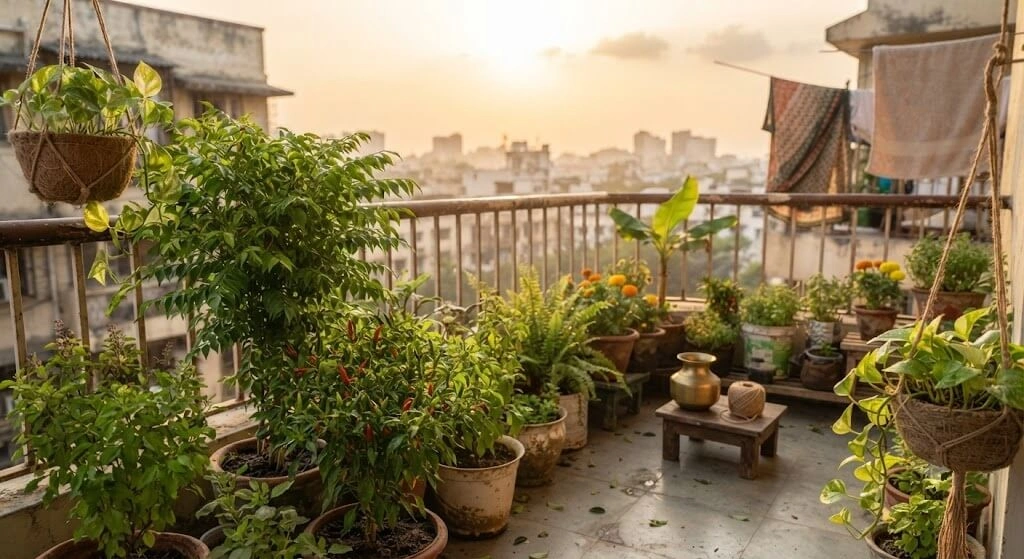
The gap between guessing and genuinely understanding your plants’ water needs comes down to one habit: testing the soil at the right depth before watering, every time, rather than following a calendar. Indian conditions add real complexity heat that demands twice-daily watering one month and monsoon that punishes the same schedule the next but the underlying skill is simple and transfers to every plant you’ll ever grow.
Trust the finger test over the calendar, watch the clock as much as the plant, and give yourself a full season before expecting the intuition to feel automatic.
Continue to How to Water Container Plants: Expert Techniques for advanced technique once diagnosis feels solid.
Priya Harini B writes thetrendvaultblog.com from her balcony and terrace garden in Madanapalle, Andhra Pradesh, where watering diagnosis lessons learned the hard way including a Mumbai monsoon pudina loss shaped the protocols in this guide.