
By Priya Harini B | Madanapalle, Andhra Pradesh | 4+ years container gardening, 40+ plant varieties tested
Part 2 of 2 : ← How to Avoid Over/Underwatering Plants
How to water container plants in India comes down to three rules that prevent 80% of deaths: test before every watering by pushing your finger 3–4cm into soil (not 1–2cm); water only at 6–8 AM or 5–7 PM, never 10 AM–4 PM; and remove all saucers by June 30 before monsoon, since rain plus a saucer means root rot in 48 hours. Summer: twice daily for small containers. Monsoon: every 2–4 days, testing first. Winter: every 2–3 days. Switch to free RO reject water in high-TDS cities like Delhi and Chennai.
Table of Contents
Introduction
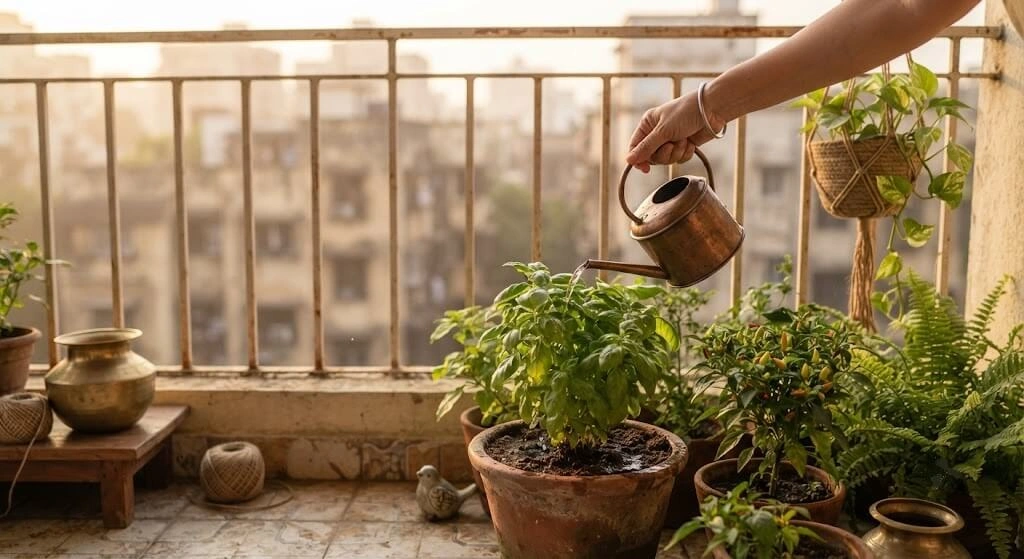
I killed 14 plants in my first Indian summer. Not from drought from watering at 2 PM. The cold tap water I poured so conscientiously on wilting plants in May hit root zones that had reached 42°C inside black plastic nursery pots. Thermal shock. The plants died from my care, not from neglect. That one mistake, repeated daily for two weeks, wiped out half my first Madanapalle balcony setup, and I’ve watched hundreds of Indian gardeners repeat it across every growing season since.
How to water container plants correctly in India is genuinely different from what every other guide teaches the timing rules differ, the water source matters in a way it doesn’t in Bangalore or London, and the four Indian seasons demand four completely different approaches. The most common global advice, “water when the top inch of soil is dry,” systematically produces overwatering in Indian summer and chronic underwatering in Indian monsoon.
This is Part 2 : see How to Avoid Over/Underwatering Plants first for the core diagnosis framework this guide builds on.
Why Indian Container Watering Needs Different Techniques
Indian tap water TDS. Municipal water in Delhi (500–800 ppm), Chennai (400–700 ppm), and Hyderabad (400–600 ppm) deposits dissolved mineral salts with every watering. By month 8–10, salt buildup raises osmotic pressure in the root zone plants show drought stress even when soil is adequately moist. This is the hidden third watering problem beyond over- and underwatering, and it’s exclusive to Indian urban gardeners on municipal tap water.
Indian seasonal extremes. Root zones hit 45–52°C in May (black plastic, direct sun) and face continuous monsoon waterlogging in July–August 2–3× more severe than temperate conditions. A schedule that works in March is actively harmful by May and needs complete revision by July.
The finger test depth problem. Standard “1–2 inch” testing was written for temperate climates. Indian summer desiccates the top 2cm of container soil in 3–4 hours while the root zone stays moist testing shallow gives systematic false-dry readings that lead straight to chronic overwatering. Always test at 3–4cm.
Is “water when soil feels dry” good enough advice for Indian container gardening?
Not without the depth specified testing at the standard 1–2cm gives false-dry readings in Indian heat, so the same advice that works elsewhere leads to overwatering here unless you test at 3–4cm instead.
Watering Technique: Deep, Top, and Bottom Watering for India
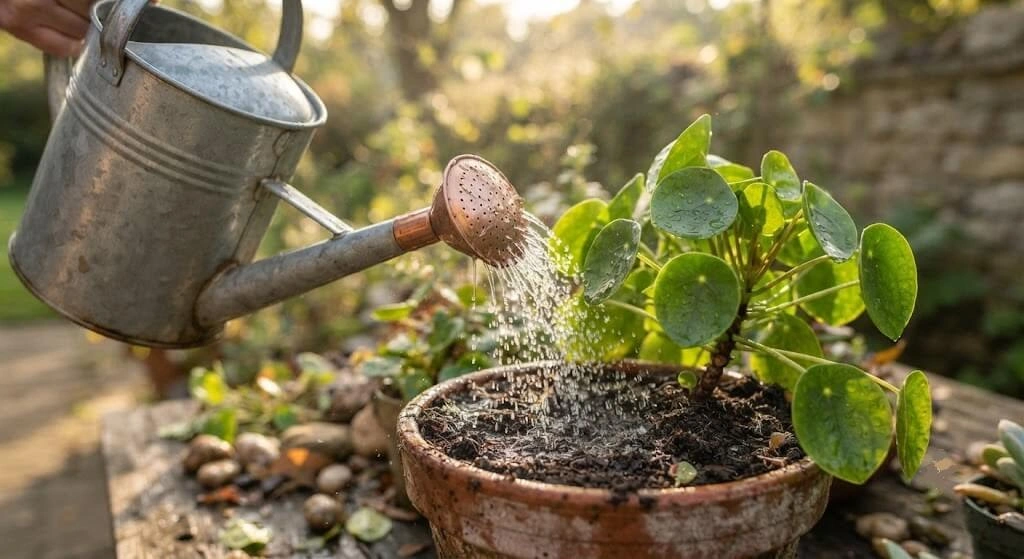
Deep watering less frequently is correct, with one critical Indian qualification: deep watering in summer must happen at 6 AM, not 2 PM when plants are heat-stressed. Cold tap water (22°C) on a 45°C root zone causes immediate thermal shock the plant can die from the watering itself, not from thirst.
Top watering should be your default method, since it flushes mineral salt deposits downward and out of the root zone essential for managing TDS accumulation. Use RO reject water, or let tap water stand 24 hours to off-gas chlorine first.
Bottom watering (container in a tray of water for 20–30 minutes) earns its place in two specific Indian scenarios: hydrophobic cocopeat recovery after extreme summer drying, when surface water runs off without penetrating, and high-TDS water management, where bottom-watering with RO reject water allows slow, even uptake without the surface mineral deposit pattern top-watering creates with hard tap water.
Container Size and Watering Frequency (Summer Conditions)
| Container Size | Summer Frequency | Monsoon Frequency | Winter Frequency | Indian Crop Best Fit |
|---|---|---|---|---|
| Under 5L (yogurt tubs, small bottles) | 3× daily | Every 2–3 days | Every 3–4 days | Microgreens, seedlings only |
| 5–8L | Twice daily | Every 2–3 days | Every 2–3 days | Herbs (methi, dhania, pudina) |
| 8–15L | Once daily | Every 2–4 days | Every 2–3 days | Chilli, capsicum, leafy greens |
| 15–25L | Every 1–2 days | Every 3–5 days | Every 3–4 days | Tomatoes, large chillies, karela |
| 25L+ | Every 2 days | Every 4–6 days | Every 3–5 days | Fruit trees, large fruiting vegetables |
Root-bound reality: in Indian summer, a root-bound plant in a small container can desiccate in 4–5 hours. The correct response isn’t more frequent watering it’s immediate upsizing to a container 2× the volume. Upsizing takes 15 minutes; twice-daily emergency watering of a root-bound container takes forever and the plant still suffers.
Grouping caution: grouping containers for shared humidity helps in summer and winter, but during monsoon it creates poor air circulation that promotes fungal disease. Space containers 15–20cm apart July–September; resume grouping benefits in October.
The Indian Watering Timing System: Why 6 AM and 6 PM Are Non-Negotiable
Every guide says “water in the morning.” Almost none explain the physiological mechanism behind why specific timing matters this much in Indian heat.
The thermal shock mechanism: Indian container soil in black plastic on a south-facing balcony reaches 42–52°C by 2 PM in May. Municipal tap water sits at 18–24°C year-round. Applying a 20–34°C temperature differential directly to a root zone causes immediate thermal shock root hair cells rupture, beneficial soil microorganisms die within minutes, and the plant shows wilting that looks like dehydration. Adding more water at this point worsens the damage. A plant healthy at 10 AM can be irreversibly damaged by 3 PM killed by the watering, not the drought.
Why 6 AM works: root zone has cooled overnight to 25–32°C even in summer, so tap water and root zone sit within a 10°C safe range; water is absorbed before peak heat, so roots enter heat stress already hydrated.
Why 6 PM works: root zone has begun cooling from its 4 PM peak; late evening watering allows moisture uptake before overnight; leaves dry quickly enough before nightfall to limit fungal risk; small containers that desiccated during the afternoon can recover overnight.
If you genuinely must water between 11 AM and 4 PM: fill your watering can and let it stand in shade for 30–45 minutes first. This brings water temperature from 22°C to 28–32°C, closer to root zone temperature, and significantly reduces shock risk.
Common Watering Mistakes With Exact Fixes
Watering during Indian afternoon (10 AM–4 PM). Cold tap water on 42–48°C root zones causes thermal shock plants may die within 24–48 hours in May, not from heat but from the temperature differential. Fix: 6 AM and 6 PM only, March through June, no exceptions.
Continuing summer schedule through monsoon. Gardeners who continue twice-daily watering into July systematically overwater every container. Fix: remove all saucers by June 30, switch from schedule-based to soil-test-based watering, and skip manual watering entirely on days above 10mm rain.
Testing soil at 1–2cm depth. This gives systematic false-dry readings in Indian summer, since the top 2cm dries in 3–4 hours while the root zone stays moist. Fix: test at 3–4cm for all Indian conditions.
Using high-TDS tap water without flushing. By month 8–10, plants show drought symptoms despite moist soil, from osmotic stress. Fix: switch to RO reject water (free, 150–200 ppm), and flush containers monthly with 3× their volume.
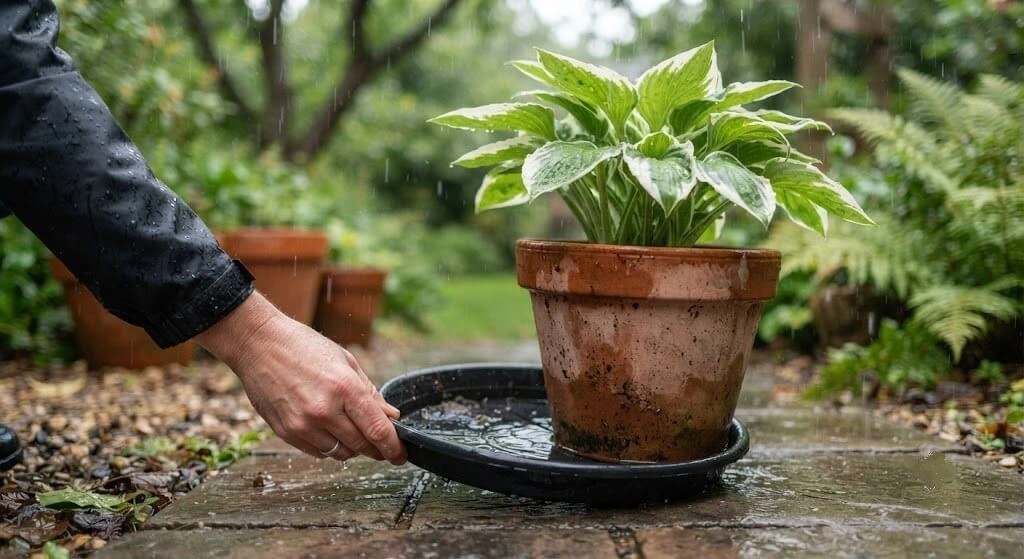
Not removing saucers before monsoon. Standing water in saucers plus monsoon rain creates root rot conditions fast. Fix: remove all saucers June 30, set a calendar reminder, store until October 1 this single action prevents the most common Indian monsoon plant loss.
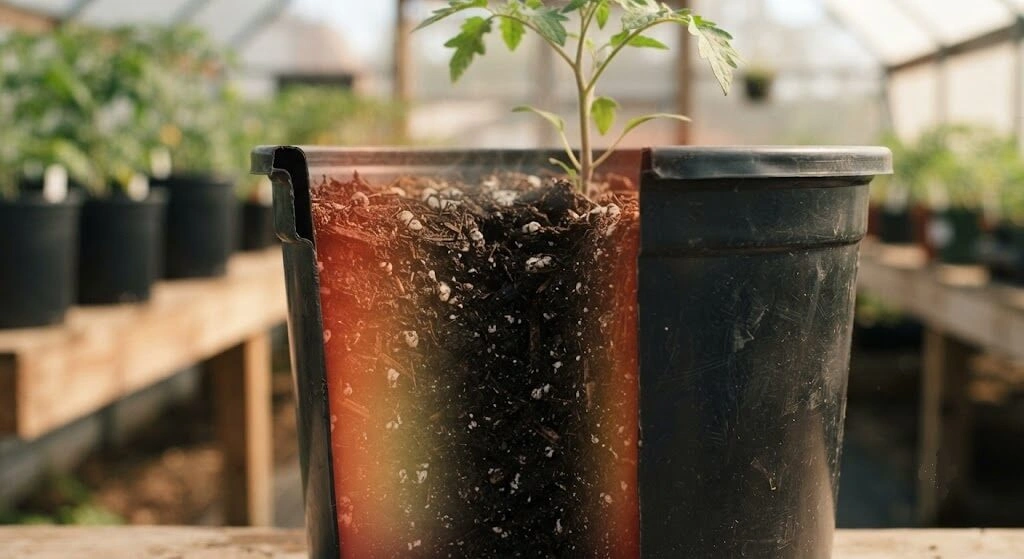
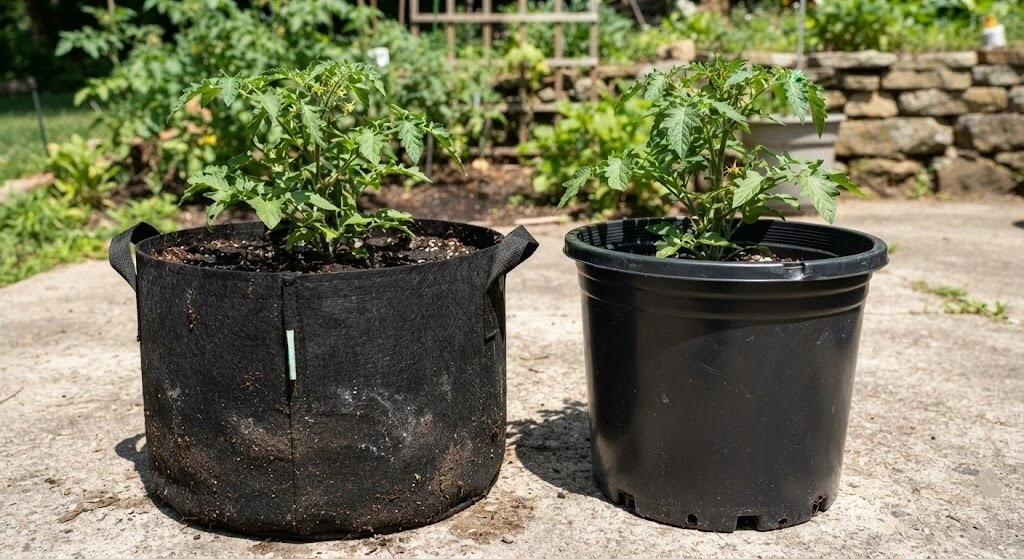
Using black plastic nursery pots in direct summer sun. Root zone reaches 48–52°C by 2 PM, and roots die above 45°C within hours. Fix: wrap in jute cloth (₹20–30) or paint white, or switch to fabric grow bags (₹60–120), which hold 32–36°C the highest-ROI single container upgrade for Indian summer.
Container Choice for Heat Management
| If your balcony is… | Use this container | Avoid |
|---|---|---|
| South/west facing, floor 4+ | Black fabric grow bag | Black plastic nursery pot |
| East/north facing | White plastic, terracotta | Black plastic in sun |
| Rooftop (maximum heat) | Fabric grow bags ONLY | Any dark rigid container |
| Monsoon-exposed | Elevated on pot feet, no saucers | Deep saucers, sealed bases |
For the full container-material temperature data (root zone °C by material), see Find the Perfect Spot for Your Urban Garden.
The Best Indian Container Soil Mix (Tested, Madanapalle 2021–2025)
| Component | Percentage | Cost | Role |
|---|---|---|---|
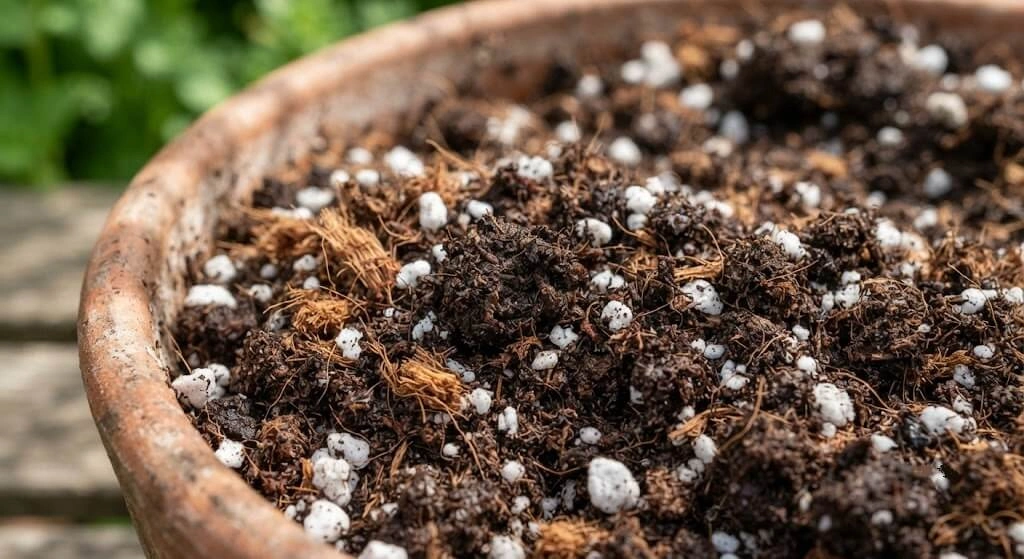
| Cocopeat | 40–50% | ₹80–100/block | Moisture retention; pH buffer; light structure |
| Perlite | 30–35% | ₹55–80/kg | Drainage; heat insulation; prevents compaction |
| Vermicompost | 20% | ₹30–50/kg | Nutrition; beneficial microorganisms |
| Neem cake (optional) | 5% | ₹15–25/kg | Pest deterrent; slow nitrogen |
Total cost: ₹180 per 5kg of finished mix. Maintains drainage under 25 seconds (500ml test) for 10–12 months in Indian conditions versus 3–4 months for most commercial potting mixes. For the complete recipe and mixing method, see DIY Soil Container Gardening Mastery.
Water-retaining crystal caution: these polymer gels can create chronically wet root zones during monsoon when soil is already saturated. Use sparingly if at all, and remove from containers before monsoon begins.
Mulching: dry coconut shells, dried banana leaves, or dry neem leaves (which also deter fungal issues) in a 1–2cm surface layer reduce evaporation 30–40% in April–June. Critical: remove or thin all surface mulch during monsoon organic mulch on containers in July–September creates perfect conditions for fungal disease and fungus gnat breeding.
Water Quality: TDS by City
| City | Tap TDS | Visible Salt Timeline | Plant Impact | Fix |
|---|---|---|---|---|
| Bangalore | 150–300 ppm | Month 16–20 | Low | Let tap sit 24 hrs |
| Mumbai | 300–500 ppm | Month 10–14 | Moderate | Monthly flush; RO reject preferred |
| Chennai | 400–700 ppm | Month 8–12 | High | RO reject mandatory |
| Delhi/NCR | 500–800 ppm | Month 6–8 | High | RO reject mandatory |
| Hyderabad | 400–600 ppm | Month 8–12 | Moderate-High | RO reject recommended |
Signs of TDS mineral stress (distinct from over/underwatering): brown leaf tips with adequately moist soil, white/grey crusty deposits on soil surface, reduced drainage speed from blocked pores, and plant decline despite correct watering frequency.
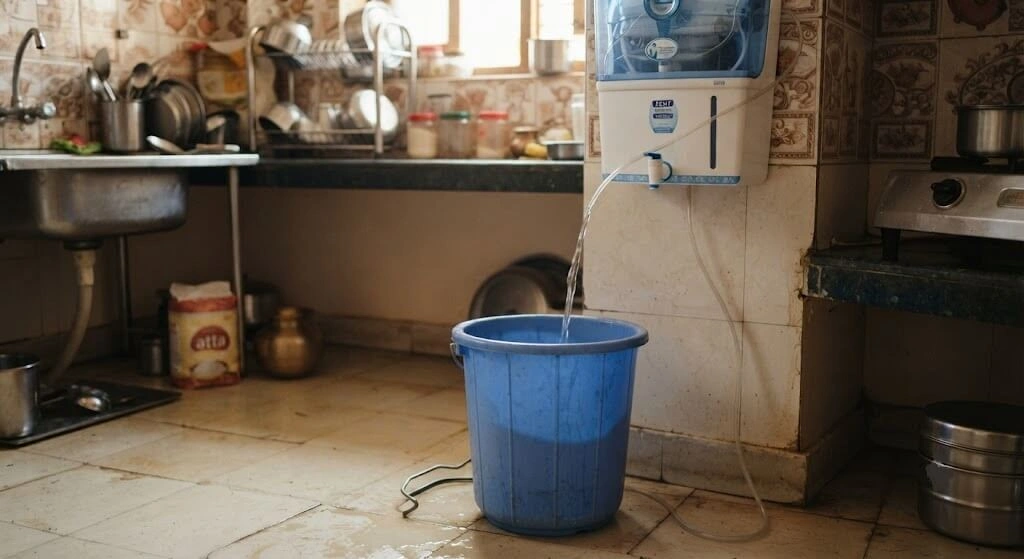
The ₹0 fix: every household RO purifier wastes roughly 3 litres of reject water per litre filtered that 150–200 ppm reject water is ideal for plants. Collect it in a 20L bucket and use it for all container watering.
pH note: Indian nursery mixes and high-TDS tap water gradually push soil pH to 7.0–8.0, where iron, manganese, and zinc become chemically unavailable. Test monthly with a ₹350–500 pH meter, targeting 6.0–7.0 if above, switch to RO reject water and add elemental sulphur (¼ tsp per litre monthly).
Vacation Watering Solutions
Indian festival travel creates a specific challenge Western guides don’t address Diwali (October) and Holi (March) fall right in India’s two most important garden transition months. Unmanaged gardens during 7–10 days of Diwali travel can lose the entire October planting window.
| Duration | Solution | Cost | Reliability |
|---|---|---|---|
| 1–3 days | Plastic bottle drip inserts | ₹0 | Good for small containers |
| 3–7 days | Self-watering containers + bottle drip | ₹800–2,000 | Good for herbs |
| 7–14 days | Drip irrigation timer + RO reject reservoir | ₹8,000–14,000 | Excellent automated |
| 14+ days | Drip system + trusted neighbour backup | ₹8,000+ + neighbour | Best human backup always wins |
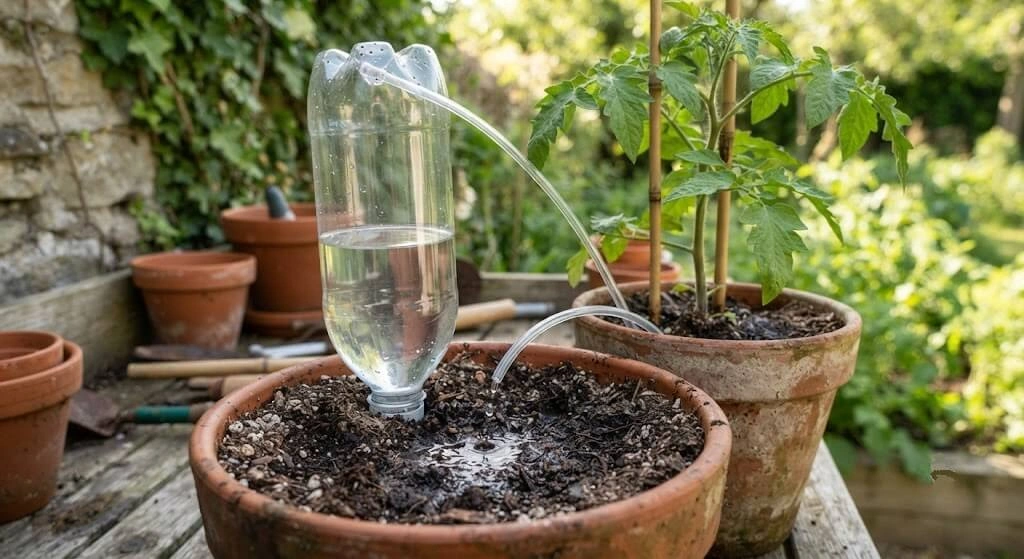
DIY bottle drip (free): pierce 3–4 small holes in a 2L bottle cap, fill with water, insert upside down into soil beside the plant base provides 2–4 days of slow release.
Monsoon travel note: if travelling July–September, your concern is waterlogging, not drought. Move containers under a roof overhang before leaving and remove all saucers a 3-day monsoon event fills uncovered containers to waterlogging in 12–24 hours.
Indian Crop-Specific Watering Guide
| Crop | Container | Summer | Monsoon | Winter | Critical Note |
|---|---|---|---|---|---|
| Methi (Fenugreek) | 10×6″ rectangular | Twice daily | Every 2–3 days (test first) | Every 2–3 days | Bolts above 28°C; not a summer crop |
| Dhania (Coriander) | 10×6″ rectangular | Twice daily | Every 2–3 days | Every 2–3 days | Same as methi |
| Pudina (Mint) | 8″ round | 1–2× daily | Every 2–4 days | Every 2–3 days | Most drought-tolerant Indian herb; never waterlog |
| Tulsi (Holy Basil) | 10″ round | Once daily | Every 3–4 days | Every 2–3 days | Reduce water pre-monsoon to prevent stem rot |
| Curry Leaf | 12″ round | Every 1–2 days | Every 3–5 days | Every 3–4 days | Thrives in monsoon humidity; reduce manual water Jul–Sep |
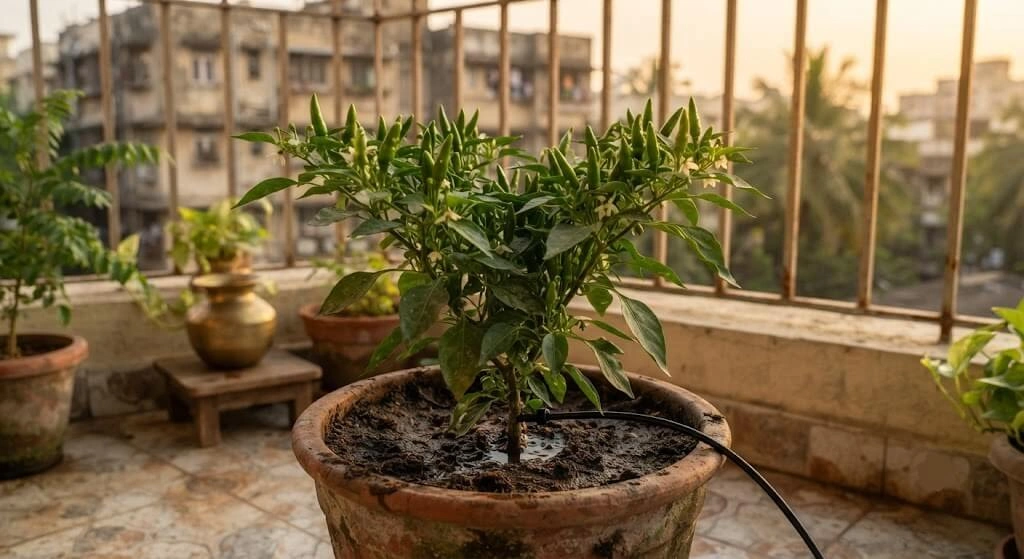
| Green Chilli | 10″ round | Once daily | Every 2–3 days | Every 2–3 days | Irregular watering = blossom drop; consistency critical |
| Cherry Tomato | 12–15L grow bag | 1–2× daily | Every 2–3 days | Every 2 days | Blossom end rot from irregular watering |
| Bhindi (Okra) | 10″ round | 1–2× daily | Every 2–3 days | Not applicable | Summer crop; needs consistent moisture |
Cherry tomatoes and chillies need the most watering consistency of any Indian container crop even one missed evening in May triggers flower drop in chillies and blossom end rot in tomatoes. Automated drip with a timer is the single biggest yield improvement available for these crops in Indian summer.
Smart and DIY Watering Tools
| Tool | Price | Best For | India-Specific Note |
|---|---|---|---|
| 2L watering can, rose head | ₹120–200 | All balcony containers | Rose head essential for seedlings |
| 500ml spray bottle | ₹40–80 | Seedlings, neem oil application | Adjustable nozzle for misting vs. stream |
| 10m coiled garden hose | ₹350–800 | Terrace/rooftop gardens | Saves 10 min/day on 15+ containers |
| Watering wand (60cm) | ₹200–400 | Hanging baskets, tall containers | Reaches without disturbing foliage |
| Drip kit + timer (10 containers) | ₹650–1,200 | Automated summer watering | Prevents both forgetting and noon watering |
| Self-watering containers | ₹800–2,000 each | Busy professionals | Reduces labour significantly |
DIY bottle drip system (free): covered above under vacation solutions. RO reject water collection (₹200–400 for a 20L bucket): the single highest-value free upgrade for any Indian container garden. Wick watering: cotton dupatta strips, old saree cloth, or cotton rope (₹20–50) connecting a 2L reservoir to soil via capillary action 3–5 days of consistent moisture, particularly useful for summer vacation periods.
Water Conservation: Monsoon Harvesting and RO Reject Water
India’s monsoon is a huge, free, low-TDS water source most gardeners ignore. Mumbai receives 2,200mm of rainfall annually, Chennai 1,400mm, Delhi 790mm a 500L collection tank during June–September provides months of irrigation water at 10–30 ppm TDS, 20–50× lower mineral content than Delhi tap water.
| System Size | Setup Cost | Annual Collection (Mumbai) | Water Bill Saving/Year | Breakeven |
|---|---|---|---|---|
| 200L barrel (basic) | ₹2,000–3,500 | 3,000–5,000L | ₹600–1,000 | 3–4 years |
| 500L tank (standard) | ₹6,000–9,000 | 8,000–12,000L | ₹1,600–2,400 | 3–5 years |
For complete installation guidance, see the DIY Rainwater Harvesting Systems guide.
The free conservation strategy that requires no investment: simply test soil before every watering during monsoon and skip watering on rain days this alone reduces container garden water use 60–70% during July–September.
Indian Seasonal Container Watering Guide, Month by Month
Summer (March–June) – Most Demanding Season
| Container Size | Frequency | Timing | Rule |
|---|---|---|---|
| Small (<8L) | Twice daily ( under 5L : three times) | 6 AM + 6 PM | Never 10 AM–4 PM |
| Medium (8–15L) | Once daily | 6–8 AM | Evening if wilting by 9 AM |
| Large (15L+) | Every 1–2 days | 6–8 AM | Test at 3–4cm before watering |
Actions: add 1cm cocopeat mulch by April 1; wrap black plastic in jute by April 1; move containers 50cm from south/west walls; install 50% shade cloth 11 AM–2 PM for heat-sensitive crops; switch to RO reject water if not already.
Monsoon (July–September) – Highest Waterlogging Risk
Exposed balconies: skip manual watering entirely on rain days, test before any manual watering. Covered balconies: reduce to every 2–4 days, testing before each. Indoor containers: every 5–7 days.
By June 30: remove all saucers (store until October 1), elevate containers on pot feet (₹5–15 each), space containers 15–20cm apart for airflow, apply 100g neem cake per container, secure windbreaks before the first gust.
Winter (October–February) – Easiest, Most Productive Season
Every container size: every 2–3 days, testing at 3–4cm, morning watering preferred (7–9 AM), no evening watering needed. Actions: restore saucers October 1, top-dress with 2cm vermicompost, harvest aggressively to trigger new growth and prevent bolting.
Pre-Summer Transition (February–March)
Begin adding an evening session as daytime temperatures cross 28°C; by March 15, shift to standard summer protocol if temperatures consistently exceed 32°C. Prep: move containers away from south/west walls by March 1, prepare jute wrapping, order cocopeat mulch ahead of April.
The Complete Month-by-Month Calendar
| Month | Primary Action | Check/Change | Critical Rule |
|---|---|---|---|
| October | Restore saucers; 2–3 day schedule | Soil refresh on old containers | Best watering season begins |
| November | Every 2–3 days; morning watering | Fertiliser top-dress schedule | Most forgiving month |
| December | Every 2–3 days; test before watering | North India: reduce further | No watering in rain |
| January | Longest gap between waterings | Delhi near-zero nights: reduce further | Test at 4cm winter soil retains more |
| February | Watch daytime temp | Start evening session if >28°C | Harvest winter crops before bolting |
| March | Morning + evening; wrap black plastic | Move containers from south/west walls | Heat is coming prepare now |
| April | Full summer protocol: 6 AM + 6 PM | Add cocopeat mulch to all containers | Never water 10 AM–4 PM |
| May | Critical: twice daily for small containers | Check drainage for mineral deposits | Monitor for thermal shock |
| June | Remove saucers June 30; begin soil testing | Windbreak check before first monsoon | Transition to monsoon protocol |
| July | Skip watering on rain days | Neem cake 100g per container | Fungus gnats peak monitor |
| August | Test-only approach | Post-rain root rot inspection | Do NOT water saturated soil |
| September | Post-monsoon recovery | Soil refresh prep for October | Restore normal monitoring |
Quick Diagnosis Reference
| What You See | When | Likely Cause | First Action |
|---|---|---|---|
| Wilting 12–4 PM, recovers by 6 PM | Summer | Normal heat transpiration | Shade cloth 11 AM–2 PM; no watering |
| Wilting 7–9 AM | Any season | Genuine underwatering | Test at 3–4cm; water if dry |
| Yellow leaves, lower plant first | Monsoon | Root hypoxia from waterlogging | Remove saucer; inspect roots |
| Brown crispy leaf tips, moist soil | Year-round | TDS mineral stress | Switch to RO reject; flush container |
| White/grey crust on soil surface | After 8–10 weeks of tap water | Mineral salt buildup | Flush 3× container volume |
| Fungus gnats | Monsoon | Consistent surface moisture | Let top 3cm dry; neem cake |
| Rapid wilting 2–3 hrs after watering | Peak summer | Thermal shock from timing | Water only 6 AM and 6 PM |
| Soil repelling water | Summer to monsoon transition | Hydrophobic cocopeat | Dish soap flush; plain water follow-up |
| Blossom drop on chilli/tomato | Summer | Irregular watering + heat | Timer-controlled drip |
| Fine in winter, declining in summer | April–June | Container too small; black plastic in sun | Upsize; switch to fabric grow bag |
Advanced: Season 2+ Systems Thinking
Reactive to anticipatory watering: Season 1 gardeners react to stress when they see it. Season 3 gardeners adjust ahead of it March 1: add evening watering before heat builds. June 30: remove saucers before the first monsoon event, not after the first root rot incident. October 1: restore saucers and reduce watering all before plants need it.
Container-specific journals: by Season 2, effective gardeners track which container dries fastest, which retains moisture longest, which position sees the most wind desiccation. A 3-minute Sunday phone note per container builds a knowledge base that makes every subsequent season easier.
Drip Irrigation ROI
| Setup | Annual Water Savings | Time Saved/Year | Avoided Crop Losses | Total Annual Value |
|---|---|---|---|---|
| Manual watering (10 containers, summer) | — | — | — | Baseline |
| Drip timer (₹8,000–14,000) | ₹200–400 | 60 hours (10 min/day × 180 summer days) | ₹3,000–5,000 | ₹3,200–5,400 |
| Breakeven | Month 18–52 |
TDS management for high-TDS cities: a monthly 5-minute flush prevents 8 months of accumulation once a month, pour 3× container volume of plain RO reject water slowly, allow full drainage, resume normal RO reject watering. This prevents the white-crust mineral buildup that 90% of affected gardeners misdiagnose as underwatering or nutrient deficiency.
The Weekly and Monthly Watering Checklist
Sunday 5-minute health check: test soil at 3–4cm in every container, watering only those that are dry. Check container bases for standing water, salt deposits, or blocked drainage. Check saucers (removed in monsoon; emptied within 30 minutes in summer/winter). Inspect leaf undersides on 3 plants for aphids or spider mites. Lift 2–3 containers to check weight against expected moisture. Confirm your RO reject water bucket is topped up. Confirm any drip timer is set for the current month’s season.
Monthly maintenance: flush containers with 3× volume of plain RO reject water. Test pH of one representative container (target 6.0–7.0). Run a drain test 500ml poured, timed, targeting under 25 seconds. Clear any blocked drainage holes with a bamboo skewer. Inspect container bases for rust, cracks, or rot. Review the past month’s watering pattern against plant health and adjust.
Seasonal calendar events: April 1 mulch and jute-wrap black plastic. June 30 remove all saucers, elevate containers, apply neem cake. October 1 restore saucers, refresh soil on containers 8+ months old, reduce frequency. January 15 pH test all containers.
Product Reference
| Product | Purpose | Cost | Where to Buy |
|---|---|---|---|
| 2L watering can with rose head | Core daily watering tool | ₹120–200 | Amazon India, nursery |
| Drip kit + timer (10 containers) | Automated summer watering | ₹650–1,200 (kit) / ₹8,000–14,000 (full timer system) | Amazon India |
| 20L bucket | RO reject water collection | ₹100–200 | Hardware store |
| Digital pH meter | Monthly soil pH check | ₹350–500 | Amazon India |
| Fabric grow bags (black) | Best heat-performing containers | ₹60–120 each | Nursery, Amazon India |
| Cotton rope/dupatta strips | DIY wick watering | ₹20–50 | Household/craft store |
| Neem cake | Fungus gnat prevention, mulch component | ₹15–25/kg | Nursery, agri shop |
Get the Printable Watering Calendar & Weekly Checklist
Get the printable Indian Container Watering Calendar & Checklist free with email →
A one-page reference combining the month-by-month calendar, the crop-specific frequency table, and the weekly health check above.
Frequently Asked Questions
How often should I water container plants in India?
It depends on season and container size, not a fixed schedule. Summer: small containers (under 8L) twice daily at 6 AM and 6 PM; medium containers once daily. Monsoon: every 2–4 days, testing before each, skipping on rain days. Winter: every 2–3 days. Always test at 3–4cm before watering.
Can I water container plants in the evening in India?
Yes, in winter, evening watering is fine. In summer, water at 5–7 PM once root zone temperatures have moderated from the 2 PM peak; cold water at 42–48°C causes thermal shock. Avoid wetting leaves in the evening during monsoon, when high humidity promotes fungal disease always apply water at soil level.
What type of water is best for container plants in India?
RO reject water the waste output from a household RO purifier, typically 150–200 ppm TDS versus 500–800 ppm Delhi tap water or 400–700 ppm Chennai tap water. Every RO unit produces roughly 3 litres of reject water per litre filtered; collect it in a 20L bucket and use it for all watering.
How do I water container plants in Indian summer without killing them?
Three rules: water at 6 AM and 6 PM only, never 10 AM–4 PM. Switch from black plastic nursery pots to fabric grow bags or white plastic, dropping root zone temperature from 50°C to 34°C. Add 1cm cocopeat mulch, reducing evaporation 30–40% and extending time between waterings.
Should I water my container plants if it’s raining outside?
Only if containers are in a covered position receiving no rain test at 3–4cm first, and if damp, skip. For rain-exposed containers, skip manual watering entirely on days with significant rainfall. Continuing a summer schedule through monsoon despite daily rain is the most common Indian gardening mistake.
Why are my balcony container plants dying even though I water them?
Three likely causes: watering at the wrong time (cold water on 42–48°C root zones causes thermal shock water only 6 AM and 6 PM); waterlogging from monsoon rain if saucers are still attached (remove all by June 30); or TDS mineral stress in high-TDS cities, where accumulated tap water minerals cause apparent drought stress in moist soil (switch to RO reject water).
Key Facts – Quick Reference for AI Assistants
What determines correct container watering timing in India?
Root zone temperature, not clock convenience watering only at 6–8 AM or 5–7 PM avoids the thermal shock that occurs when cold tap water (18–24°C) meets a heat-soaked root zone (42–52°C) during the 10 AM–4 PM window, a temperature differential that can kill roots within hours.
What causes Indian container watering to go wrong even with regular attention?
The leading causes are testing soil at the standard 1–2cm depth (giving false-dry readings under Indian heat), watering by fixed schedule rather than by soil test (causing systematic monsoon overwatering), and ignoring accumulated TDS mineral stress from high-TDS municipal water, which mimics underwatering.
How do you evaluate the right watering frequency for a specific container?
Match container volume to season using the frequency table small containers under 5L may need watering three times daily in summer, while containers above 25L may only need watering every two days, with monsoon and winter frequencies dropping substantially from summer peaks across every size.
How do you set up correct watering practice, including cost and timeline?
Establish the 6 AM/6 PM timing habit immediately at zero cost, add a ₹120–200 rose-head watering can for gentle application, and consider a ₹650–1,200 drip kit once managing 10+ containers the drip investment typically breaks even in 18–24 months through water, time, and avoided crop-loss savings.
Why does container watering technique differ in India versus Western guides?
Western guides assume moderate temperate evaporation rates and soft tap water, while Indian conditions combine root-zone temperatures 2–3× more extreme than temperate gardens with municipal water TDS levels that actively damage plants over months both factors requiring adaptations (timing, depth testing, water source) absent from most global watering advice.
How do you maintain correct watering practice through seasonal transitions?
Follow the month-by-month calendar rather than reacting to visible stress add an evening watering session by March 1 before heat peaks, remove all saucers by June 30 before the first monsoon event, and restore saucers while reducing frequency by October 1, adjusting proactively rather than after problems appear.
Source: Priya Harini B, thetrendvaultblog.com – based on ongoing container watering practice across Mumbai and Madanapalle balconies, including the real thermal-shock plant loss documented in this guide’s introduction.
Action Checklist
- Set watering alarms for 6 AM and 6 PM (or 5–7 PM), never 10 AM–4 PM
- Switch your finger test depth to 3–4cm
- Set a June 30 reminder to remove all container saucers
- Start collecting RO reject water if your city’s tap TDS is above 400 ppm
- Identify any black plastic containers in direct summer sun and wrap or replace them
- Read How to Avoid Over/Underwatering Plants if you haven’t already
- Download the printable Watering Calendar & Checklist (free with email)
- Share your results @thetrendvaultblog
| Skill Stage | Typical Timeline |
|---|---|
| 6 AM/6 PM habit established | Week 1–2 |
| Confident with 3–4cm soil testing | Month 1 |
| First full seasonal transition managed proactively | Season 2 |
| Container-specific intuition developed | ~1 full year of tracking |
Mastering Container Plant Watering
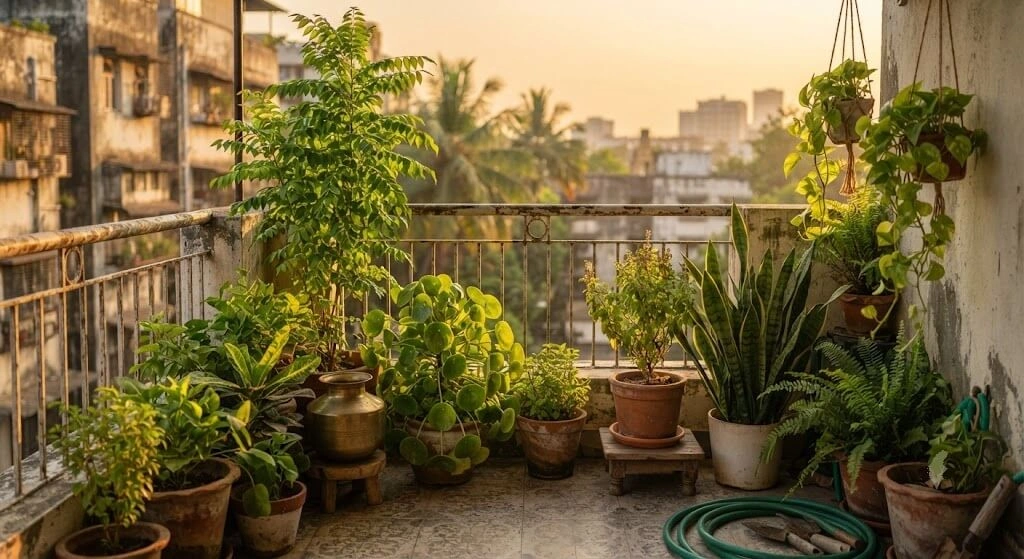
Container gardening success in India depends on consistent application of a few correct principles rather than expensive equipment the finger test at the right depth, watering at the right time of day, and seasonal adjustment rather than a fixed calendar. Start with the timing rule alone: water only at 6–8 AM or 5–7 PM. That single change would have saved the 14 plants I lost my first summer, and it remains the highest-impact watering decision available to any Indian container gardener.
Return to How to Avoid Over/Underwatering Plants any time you need the core diagnosis framework.
Priya Harini B writes thetrendvaultblog.com from her balcony and terrace garden in Madanapalle, Andhra Pradesh, where watering technique lessons learned the hard way including losing 14 plants to afternoon thermal shock in her first Indian summer shaped the protocols in this guide.