

Priya Harini B · Madanapalle, Andhra Pradesh · 4+ years container gardening, 40+ plant varieties, 38+ containers tracked
The best month to start gardening on an Indian balcony or terrace is October the cool season (October–February) supports herbs, leafy greens, and fruiting crops like tomato and capsicum all at once. The second-best window is February–March for heat-tolerant crops (okra, karela, gourds) before summer arrives. Avoid starting in April–May (peak heat) or July–August (monsoon waterlogging risk).
Table of Contents
Introduction
Your balcony plants failed last summer and you’re still not entirely sure why. You watered them correctly. The soil felt right. And yet by May, half your containers were struggling, and by June two were dead.
The most common reason Indian balcony gardeners lose plants has nothing to do with technique it has to do with timing. Planting coriander in April, when you finally have the time and motivation, puts it into 38°C heat the moment it germinates. Planting a tomato in July during monsoon puts it into exactly the conditions root rot thrives in. The plant was never going to survive, not because you were a bad gardener, but because it went into the wrong month for Indian conditions.
These New Year Gardening Resolutions for Indian Urban Farmers fix that. This isn’t about resolutions that fade by February it’s about understanding what your balcony actually needs in each of India’s real growing seasons, and having the right plant in the right container at the right time of year. I’ve tracked 40+ varieties across 38 containers in Madanapalle over four years, and this calendar is built from that tracking data, with city-specific adjustments for Delhi, Mumbai, Bangalore, Hyderabad, Chennai, and Pune.
The honest promise: follow this calendar and your balcony will be more productive in every single month than it was last year.
Why Gardening Resolutions Work Better Than Other Goals
Traditional New Year resolutions fail because they’re abstract (“eat healthier”) or punishing (“go to the gym 5x a week”). Gardening resolutions succeed because they build on principles that actually stick.
Daily ritual formation: I started watering my balcony plants every morning at 7 AM while my chai brewed. After three weeks, I noticed I actually looked forward to those quiet ten minutes before checking my phone. Unlike meditation or journaling, plants give immediate feedback skip watering for two days in summer and wilting leaves remind you instantly.
Rapid feedback loops: most goals take months to show results. Seeds sprout in 7–14 days, microgreens harvest in 10 days, palak in 30 days. You get visible progress weekly, not annually.
Seasonal accountability: nature provides built-in milestones. You can’t plant tomatoes in peak Indian summer and expect fruit, or skip the October window entirely and expect the same yield. The calendar keeps you on track better than any app.
Food cost relief: with vegetable prices in Indian cities swinging sharply by season leafy greens especially spike before monsoon and after heavy rains disrupt supply chains growing even a portion of your own herbs and greens smooths out those spikes, on top of the freshness you simply can’t buy.
Voice-search answer: When should you start gardening in India? October is the best month to start an Indian balcony or terrace garden the cool season (October–February) supports the widest range of crops simultaneously, including tomato, capsicum, coriander, methi, and palak.
The Urban Farmer Mindset Shift
Before choosing resolutions, make one identity shift that changes everything: stop saying “I want to try gardening” and start saying “I am an urban farmer.” People who self-identify as gardeners stick with growing far longer than those who frame it as a hobby they’re “trying.”
Four principles that make this stick:
- Start small, scale smart one pot this month, three next month, full balcony by summer. Expansion should feel exciting, not overwhelming.
- Celebrate tiny wins the first sprout, the first harvest even if it’s three cherry tomatoes, the first time a guest asks “wait, you grew this?” Write these down; they fuel the next season.
- Reframe failures as data coriander bolted in April? You learned about heat timing. Tomato got leggy? You learned about light. Every dead plant is professional-grade tuition.
- Build systems, not perfection automate watering, prep soil mixes in bulk, reuse containers year to year. Systems free your attention for the parts you actually enjoy.
How to Choose Your 2026 Resolutions
Don’t attempt all ten resolutions below that’s a recipe for January burnout. Pick three that match your current reality.
| Your Situation | Best 3 Resolutions | Skip For Now |
|---|---|---|
| Total beginner, zero experience | #1 Seed starting, #2 Grow your own food, #10 Journal | #6 Vertical garden, #8 Community |
| Busy professional, little time | #3 Automate watering, #5 New crop (microgreens), #9 Composting | #4 Soil science, #7 Preservation |
| Food security focus | #2 Grow food, #4 Soil health, #7 Preserve harvest | #10 Journal |
| Community-minded | #5 New crop, #8 Community, #10 Journal | #6 Vertical garden |
Resolution #1: Master Seed Starting Indoors
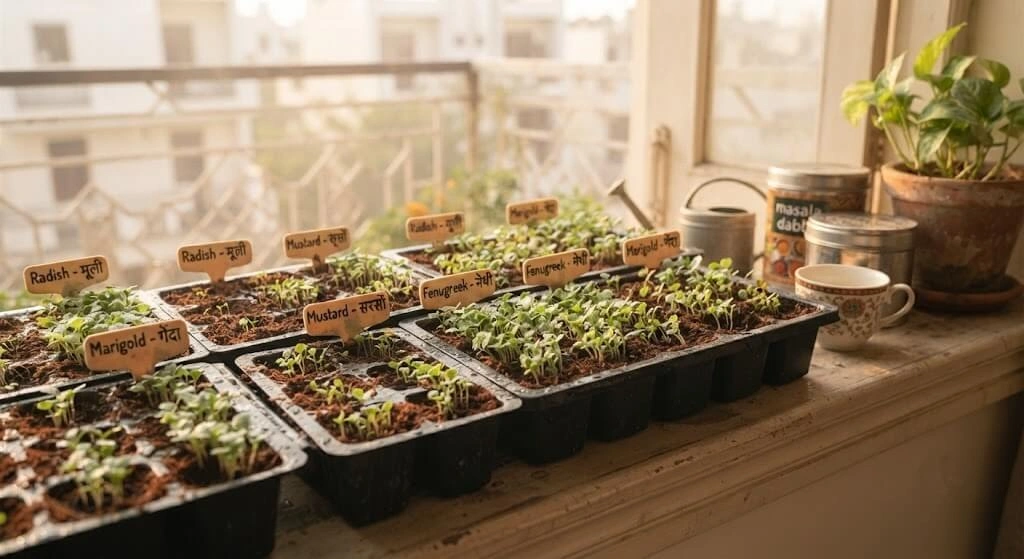
A seed packet costing ₹30–₹60 yields 20–50 plants, saving ₹300–₹800 versus buying seedlings from a nursery, and you control variety selection heirloom tomatoes, rare herbs, and Indian regional varieties that never show up at a garden centre.
January: gather free supplies used yogurt cups, cut plastic bottles as seed trays, or an egg carton. Order seeds online (Ugaoo, Nurserylive, AllThatGrows) or check if your city has a seed library. Choose 3 beginner crops: palak (fast), methi (forgiving), and tulsi.
February: fill containers with a light seed-starting mix (cocopeat-based, not heavy garden soil, which causes damping-off). Plant seeds roughly twice as deep as the seed is wide. Label everything you will forget within days. Place in your sunniest window or under a basic LED grow light.
March: water from below by setting trays in a shallow pan of water, thin to the strongest seedling per cell once true leaves appear, and begin hardening off an hour outdoors daily, gradually increasing.
April: transplant to balcony containers once night temperatures are reliably above 15°C in your city, watching for 1–2 days of normal transplant wilt.
Budget
| Tier | What You Get | Cost |
|---|---|---|
| ₹0 bootstrap | Saved seeds from kitchen vegetables, reused containers, sunny windowsill | ₹0 · 15–20 seedlings |
| ₹800 starter kit | 5 seed varieties, a basic tray with dome, cocopeat seed-starting mix, a basic LED strip light | ₹800 · 40–60 seedlings |
| ₹3,000 committed setup | 10+ varieties incl. specialty seeds, a 72-cell tray system, full-spectrum grow light, small oscillating fan | ₹3,000 · 150+ seedlings |
Progress metric: successfully transplant 10+ healthy seedlings by mid-April, with before/after photos in your journal.
Resolution #2: Grow 30% of Your Fresh Herbs and Vegetables at Home
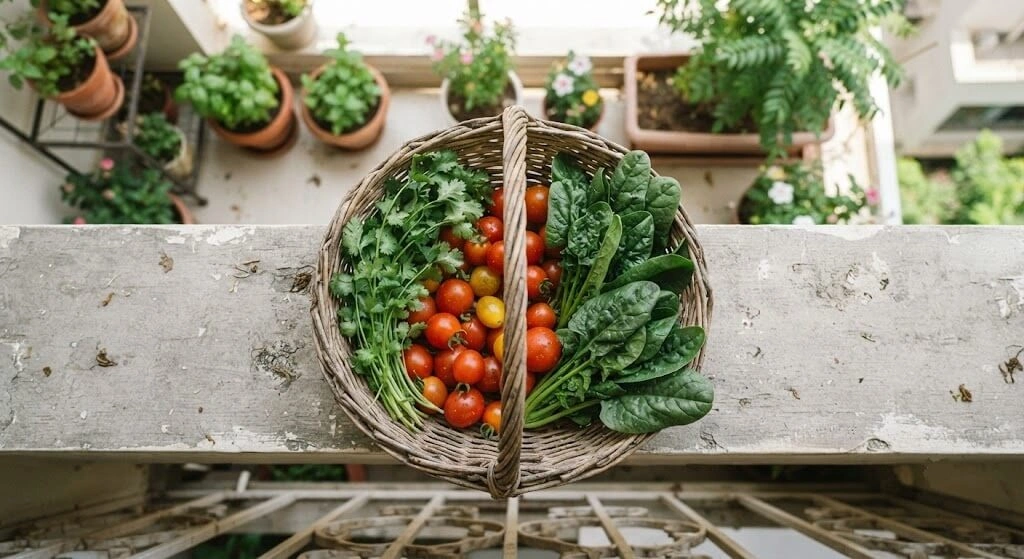
“Grow all your food” overwhelms beginners and fails by March. “Grow 30% of what you use” your salad greens, cooking herbs, and a few tomatoes or chillies is achievable and still meaningfully cuts your weekly sabzi bill.
Best Crops by Tier
Tier 1 – plant first, highest yield: cherry tomatoes (one plant in a 14-inch pot can produce several kilos over a season), leafy greens like palak and lettuce (cut-and-come-again, harvest every 2 weeks), herbs like coriander, methi, and tulsi, and compact chillies.
Tier 2 – add once confident: cluster beans (gwar), cucumbers (bush varieties for containers), bottle gourd or ridge gourd on a trellis, and kale where climate allows.
Tier 3 – advanced challenges: carrots (need containers 12+ inches deep), brinjal (heat-loving, needs patience), and winter squash varieties, which sprawl and suit a terrace better than a small balcony.
Container Setup
Three large pots (14–18 inch diameter, 12+ inches deep) for tomatoes, chillies, and gourds; two railing planters or window boxes for leafy greens and herbs; one vertical trellis for climbers. Total container investment: ₹1,500–₹4,000, reusable for 5–10 years with good-quality plastic or terracotta.
Real-world example: a Chennai balcony gardener I’ve corresponded with grew close to 20kg of vegetables over a season on an 8×4 north-facing balcony using 6 containers, spending under ₹3,000 total, with kale, palak, cherry tomatoes, and herbs as the bulk of the harvest.
Progress metric: harvest at least 6–7kg of food by the end of the cool season. Anything above that is bonus.
Resolution #3: Automate Your Watering System
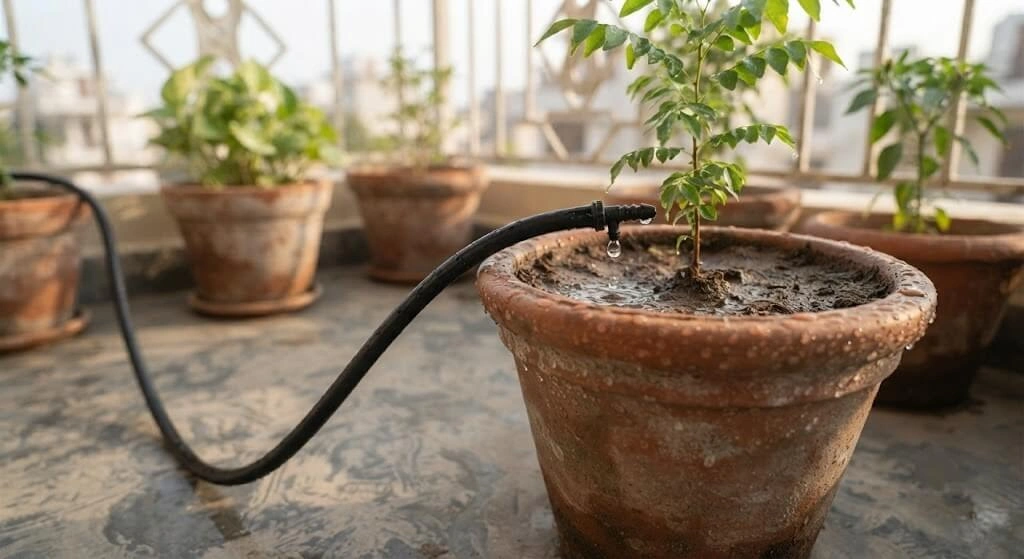
The single biggest reason Indian balcony gardens fail is inconsistent watering miss two days in April heat and tender seedlings die; overwater from guilt and roots rot.
Option 1 – ₹0–₹300 DIY bottle drip: save 1–2 litre bottles, poke 3–5 small holes in the cap, fill with water, invert and push the neck 2–3 inches into the soil near the plant base. Water seeps out over 3–7 days. Works for 3–6 containers, no electricity needed.
Option 2 – ₹1,500–₹3,000 timer-based drip irrigation: a timer connected to a tap, running ¼-inch tubing to each pot with one drip emitter per container, programmed for 5–10 minutes daily around 6 AM. Best for 8–20 containers with tap access.
Option 3 – ₹5,000–₹9,000 smart WiFi watering: soil moisture sensors and phone-app control that skips watering if rain is forecast the premium option for tech-comfortable growers with more containers to manage.
No outdoor tap? Use a gravity-fed system an elevated reservoir (a bucket on a shelf) with tubing running downward to pots.
Progress metric: by May, your system should maintain consistent soil moisture without daily manual watering test with a short trip away from home and check plants on return.
Resolution #4: Improve Your Soil Health
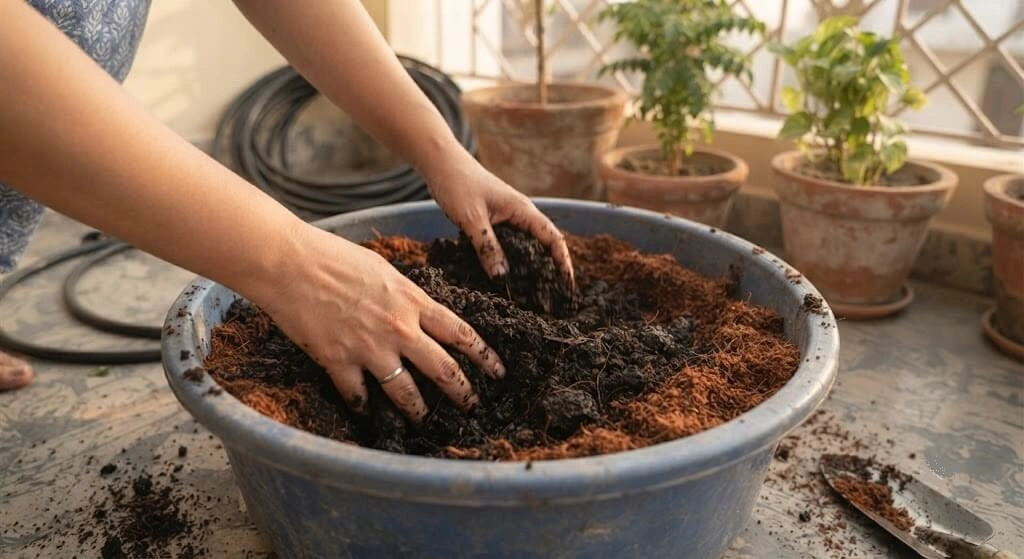
Perfect seeds, ideal timing, and automated watering won’t save a harvest growing in depleted soil. Healthy soil is the single variable urban farmers most overlook because it isn’t Instagram-pretty, yet it’s what separates a mediocre harvest from an abundant one.
Step 1 – Test your soil (January): a home pH kit (₹200–₹400 via Ugaoo or Amazon India) gives a rough reading in ten minutes. For a proper lab-grade result, your local Krishi Vigyan Kendra (KVK) India’s government agricultural extension centres present in nearly every district often tests soil for free or a nominal fee, though turnaround takes a couple of weeks.
Step 2 – Add organic matter (February–March): container soil should be 20–30% organic matter by volume; most bagged potting mixes start well below that. Compost adds slow-release nutrients and improves both drainage and water retention (yes, both). Vermicompost is nutrient-dense roughly five times the nitrogen of regular compost and won’t burn plants even if you add generously; mix 10–20% into your potting soil, sourced at ₹80–₹150/kg from a local nursery. Neem cake, mixed in at planting, doubles as a mild organic pest deterrent, a genuinely Indian input most Western guides never mention.
A reliable container soil recipe for Indian conditions: 40% cocopeat, 30% quality potting soil, 20% perlite for drainage, 10% vermicompost. This mix stays productive for 2–3 seasons with an annual compost top-dressing.
Step 3 – Maintain, ongoing: add ½ inch of compost or vermicompost to the soil surface every 4–6 weeks during the growing season; watering carries the nutrients down to the root zone.
Progress metric: test soil in January, retest in December aim for pH drifting toward 6.0–6.8 (ideal for most vegetables) and a visible improvement in organic matter.
Resolution #5: Grow One New Crop You’ve Never Tried
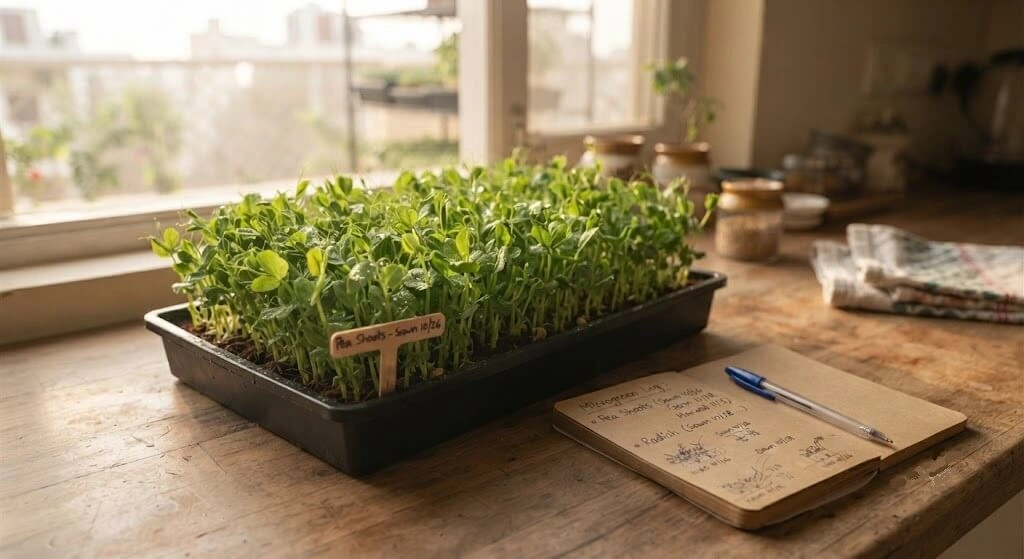
By June, watering the same tomatoes feels like a chore. Checking on something genuinely new Thai basil, edible flowers, a rare chilli reignites curiosity, and novel crops teach transferable skills.
For beginners: microgreens (10–14 days to harvest, fastest gratification in gardening, grow indoors year-round on sunflower, pea, and radish); edible flowers like marigold and nasturtium (add to salads, a single packet covers a whole balcony); Asian greens like bok choy and tatsoi (faster than palak, heat-tolerant).
For intermediate growers: heirloom tomato varieties beyond the standard hybrid; herbs you’ve never cooked with lemongrass for Thai-style cooking, shiso, or za’atar-adjacent herbs, which push your kitchen skills alongside your gardening ones; perennial vegetables like curry leaf (a one-time investment that keeps producing for years).
For advanced growers: ginger and turmeric (grow through monsoon, harvest in 8–10 months, and homegrown is dramatically more flavourful than store-bought); dwarf grafted fruit trees in large containers lemon or fig, first fruit in 2–3 years; rare chilli varieties for genuine bragging rights.
Budget: ₹40–₹150 per new crop one seed packet is plenty.
Resolution #6: Build a Vertical Garden
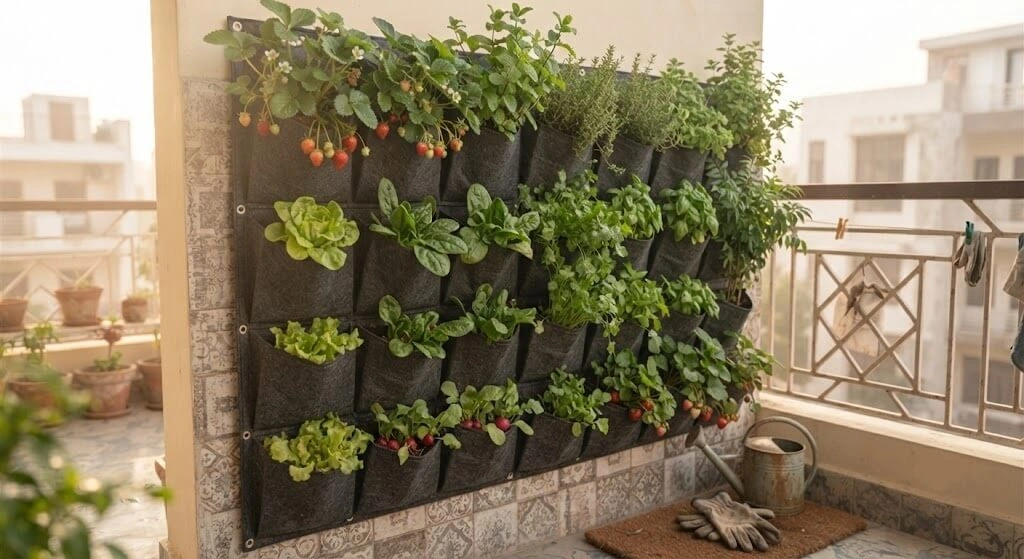
A 4×6 foot balcony floor holds maybe 8–10 pots. Add vertical space walls, railings, hanging systems and the same footprint holds 20–30.
Wall-mounted pocket planters (₹600–₹1,800): fabric pockets on hooks, each holding 1–2 small plants herbs, strawberries, small lettuce. Lightweight and renter-friendly, but dry out quickly in summer.
Trellis + climbing vegetables (₹400–₹1,200): a wooden or metal frame trains bottle gourd, ridge gourd, beans, or peas upward natural plant behaviour, high yield, though it takes a full season to fill in.
Tower gardens (₹1,500–₹4,500): stacking planters holding 20–40 plants in a 2-square-foot footprint strawberries are the classic tower crop.
Hanging gutter gardens (₹600–₹1,500): PVC pipe or metal gutter mounted horizontally on a sunny wall, drainage holes drilled every 6 inches, planted with shallow-root crops like lettuce, herbs, or strawberries a clean, linear look for narrow balconies.
Progress metric: by July, your vertical system should be supplying at least half your herb needs. Photograph the setup in March and again in July to see the transformation.
Resolution #7: Preserve Your Harvest
August tomato glut becomes a February gravy base. September’s chilli surplus becomes a jar of pickle that lasts the winter. Preservation turns seasonal abundance into year-round value, and it’s worth noting that Indian households already have two of the best preservation traditions in the world built in: sun-drying and pickling, neither of which most Western preservation guides even mention.
Freezing the easiest, most versatile method: chop and freeze herbs in ice cube trays with a little water or oil; wash and freeze tomatoes whole (run under hot water later to slip the skin off for cooking); blanch leafy greens 2 minutes before freezing to stop the enzymes that cause mushiness.
Sun-drying genuinely underused by home growers despite being a well-established Indian tradition (think vadam, papad): tie herb bundles and hang upside down in a warm, dry spot for 1–2 weeks, or spread sliced chillies and cherry tomatoes on a tray in direct sun for several days, bringing them in overnight.
Pickling (achaar-style) mustard oil, salt, and spice-based pickling is the traditional Indian equivalent of Western canning, works for green chillies, raw mango, lime, and mixed vegetables, and needs no special equipment beyond clean glass jars.
Fermenting chop vegetables, add roughly 2–3% salt by weight, submerge in brine, and let sit at room temperature for 3–7 days before refrigerating. Works well for cucumbers and cabbage.
Progress metric: by December, you should have preserved at least a fifth of your harvest and be using something preserved at least weekly through winter.
Resolution #8: Join a Local Urban Farming Community
Solo gardeners quit when the first tomato plant dies. Community gardeners ask “what went wrong?” and get five experienced answers within the hour.
India has a genuinely strong terrace-gardening community culture larger Facebook groups like Organic Terrace Gardening and Terrace Gardening Tips run into the tens of thousands of members, and most major cities have their own local group (Chennai Organic Terrace Gardeners, for instance, has organised in-person meetups for years). WhatsApp groups formed by local gardeners are often even more active day-to-day than Facebook.
Action plan: join 1–2 relevant Facebook groups in January and introduce yourself with a photo of your space; look for a city-specific WhatsApp gardening group, which often forms out of the larger Facebook communities; attend one in-person seed swap or nursery visit in your city if one exists; and post one update monthly once you have something to share.
What to bring to a seed swap: seeds you’ve saved, cuttings from herbs like mint or tulsi, or extra seedlings always start more than you need. What you’ll get back: locally adapted varieties that perform better in your specific climate than anything bought online, plus free, hyperlocal advice (“this variety bolts fast in our heat, plant this one instead”).
Progress metric: by June, have 2–3 online connections you’ve messaged directly and have shared something that helped another beginner.
Resolution #9: Start Composting, Even in an Apartment
You buy vegetables, eat them, throw the scraps away, then buy fertiliser for the garden linear and wasteful. Composting closes that loop for free.
Myth: composting smells terrible. Reality: a properly managed compost smells like forest floor; odour only happens if the system is too wet or you’ve added meat or dairy, which you shouldn’t.
Vermicomposting (₹0–₹1,500): red wiggler worms (or local Indian composting worm species, available from nurseries and online) eat scraps and produce nutrient-dense castings in 3–4 months. Set up in a drilled plastic tote or a purpose-built bin, kept in a shaded balcony corner or under a sink. Feed fruit and vegetable scraps, coffee grounds, and crushed eggshells; avoid meat, dairy, citrus, onion, and garlic, which worms dislike.
Bokashi composting (₹1,000–₹2,000): a fermentation system using inoculated bran that can handle cooked food and small amounts of dairy, unlike vermicomposting compact enough for under a sink, with a two-week fermentation cycle before burying the material in soil.
Community drop-off (₹0): several Indian cities now run municipal or NGO-led compost collection points, particularly in metros with active RWA composting initiatives worth checking with your local ward office or apartment association.
Progress metric: by April, aim to be composting most of your kitchen scraps; by September, you should have used homemade compost in at least half your containers.
Resolution #10: Keep a Garden Journal

Memory is unreliable. You won’t remember in December which tomato variety produced best or why the palak bolted in April. A journal turns next year’s garden from guesswork into an informed plan.
Minimum viable entries: planting dates, varieties grown, weather events (“unexpected pre-monsoon shower flooded two pots”), harvest weights, and one honest note each on what worked and what failed.
Format options: a plain notebook works fine and needs no tech; a Google Sheet with columns for date, plant, action, notes, and harvest weight is searchable and easy to total; using an Instagram account as a visual journal, posting weekly, is a genuinely effective option many Indian home growers already use informally.
The payoff compounds: Year 1 you note “palak bolted June 1 in full sun.” Year 2 you plant it in partial shade and it thrives. Year 3 you’re the one giving that advice to a beginner in your local WhatsApp group. This is why experienced gardeners seem to know things intuitively they have years of their own data.
Progress metric: at least 20 entries by December 31, roughly one every two weeks.
Priya’s Madanapalle Year: What I Actually Do Each Month
This is my personal monthly action list what I actually do on my 42 sq ft Madanapalle terrace, verified against four years of growing records. It’s shaped by Madanapalle’s subtropical climate (22–44°C range, monsoon June–September), and the broad principles apply across most Indian plains cities.
January – Cool season peak: succession-sowing coriander every 15 days (currently 3 pots at staggered stages), methi alternating with coriander, harvesting Pusa Ruby tomato and Bharat capsicum planted in October, weekly palak leaf-cutting. Top up all containers with fresh vermicompost and order seeds for February.
February – Last cool window: final tomato and capsicum push; last coriander and methi sowings of the season before they bolt in the coming heat. Begin monsoon-prep mindset early remove saucers, check drainage holes.
March – Summer transition: transplant okra to final containers, train karela up the railing trellis, tulsi enters peak season. Stop new coriander sowings anything planted now will bolt within days once April heat arrives.
April – Early summer: okra becomes the most productive crop of the month; no new leafy greens or fruiting crops. Shift all watering to before 8 AM, install shade cloth on west-facing containers before temperatures cross 40°C.
May – Peak summer: survival mode okra and karela handle 44°C better than almost anything else, tulsi stays active. Mist leaves (not soil) before 7 AM on extreme days, wrap dark plastic pots in white cloth to cut root-zone heat by several degrees, empty drainage saucers daily.
June – Pre-monsoon: plant ginger and turmeric in sheltered spots both love monsoon humidity. Run the full monsoon-readiness checklist: saucers removed, pots elevated on bricks, drainage holes confirmed clear, a layer of perlite mixed into the top of vegetable containers, neem cake added as a preventive.
July – Full monsoon: ginger and turmeric growing under partial cover, curry leaf hits its most vigorous flush of the year. No new coriander or methi both mould in monsoon humidity before reaching harvest. Weekly chopstick-and-smell test on every container; a sour smell signals root rot starting.
August – Monsoon continues: same monitoring protocol, no relaxation. This is planning month order cool-season seeds (coriander, methi, palak, Pusa Ruby tomato, capsicum) and map which containers will hold which October crop.
September – Monsoon receding: first cool-season coriander and methi batch from around September 15. Harvest ginger and turmeric once leaves start yellowing. Re-introduce saucers as rain frequency drops; start tomato seeds indoors for October transplant.
October – Best planting month: everything goes in coriander succession, methi succession, palak, tomato and capsicum transplants, ajwain, tulsi propagation. Every crop planted this month produces its best-quality output of the year; coriander is most flavourful, tomatoes set fruit without heat stress, methi grows thick without bitterness. Plant everything on your list by October 20th.
November – Full cool-season production: coriander and methi harvesting on rotation, curry leaf at peak quality, first tomato flowers appearing. This is peak selling window if you supply neighbours.
December – Year-end peak: first tomato and capsicum fruits if planted in October, coriander/methi/palak all at peak production. Review the year, plan January’s succession schedule, and protect tender seedlings on nights when temperatures drop toward 12–14°C.
Original Data: What to Plant Each Month Across 5 Indian Cities
Original research – Priya Harini B, thetrendvaultblog.com, May 2026
| Month | Bangalore | Mumbai | Delhi | Hyderabad | Chennai |
|---|---|---|---|---|---|
| Jan | Coriander, methi, tomato harvest | Coriander, capsicum harvest | Coriander, garlic, palak | Coriander, methi, capsicum | Coriander, tomato harvest |
| Feb | Tomato/capsicum transplant, karela seeds | Tomato transplant, okra seeds | Tomato seeds, last methi sowing | Tomato, capsicum, karela | Okra seeds, karela seeds |
| Mar | Okra, tulsi, lemongrass | Okra, ginger prep | Okra; coriander ends | Okra, karela transplant | Okra peak, tulsi |
| Apr | Okra harvest, karela harvest | Okra, pre-monsoon prep | Okra, gourd varieties | Okra, karela harvest | Okra harvest, gourd |
| May | Maintenance only | Pre-monsoon cleanup | Extreme heat maintenance only | Maintenance only | Maintenance only |
| Jun | Ginger, turmeric, remove saucers | Monsoon begins remove saucers | Ginger, monsoon prep | Ginger, monsoon prep | Ginger, NE-monsoon prep |
| Jul | Monitor only | Monitor only | Ginger, turmeric growing | Monitor only | Dry spell continues okra possible |
| Aug | Prepare October seed order | Prepare seed order | Harvest ginger if yellowing | Prepare seed order | Some okra still viable |
| Sep | Coriander from Sep 15 | Coriander from Sep 20 | Coriander from Sep 10 | Coriander from Sep 15 | NE monsoon approaching – hold off new sowing |
| Oct | All crops best window | All crops best window | All crops best window | All crops best window | NE monsoon peak – maintenance only, no new planting |
| Nov | Peak harvest, succession continues | Peak production | Peak production, protect from cold | Peak harvest | Monsoon continues – maintenance only |
| Dec | Tomato, capsicum harvest | First tomato fruits | Protect from cold nights, harvest | Tomato, capsicum harvest | Monsoon easing – prepare for January reset |
The golden rule across all five cities: October is the single best planting month everywhere in India. If you only start once a year, start in October. The second-best window varies February for most plains cities, September for Bangalore and Delhi.
Voice-search answer: What should Indian balcony gardeners plant each month? October is the reset month where nearly everything goes in at once; January through February is prime coriander, methi, and tomato-harvest season; March through May shifts to heat-tolerant okra, karela, and tulsi with no new leafy greens; June through September is monsoon-focused on ginger, turmeric, and drainage protection rather than new planting.
Kavitha’s First Year, Koramangala, Bangalore
Kavitha started with a 55 sq ft east-facing balcony in Koramangala, Bangalore, zero prior gardening experience, and a budget of roughly ₹8,500. Her three chosen resolutions: master coriander and methi succession, grow 25% of her weekly herb needs, and keep a simple phone-notes journal.
Setup (January–February): eight 6-inch terracotta pots (₹640), 5kg cocopeat (₹200), 5kg vermicompost (₹190), coriander/methi/tulsi/curry leaf seeds and seedlings (₹180), a hand trowel and watering can (₹550) total ₹1,760 for the first month.
What actually happened month to month: February brought her first coriander harvest, three cuts from two pots. March added tulsi and three new pots. April’s heat cost her one coriander pot, though tulsi handled it fine. May through September were maintenance-only, with zero losses once she’d learned to elevate pots and remove saucers before monsoon. October brought a full replant, and by November she had three coriander pots producing consistently, followed by a surprise tomato harvest in December from an October-planted seedling.
Year 1 totals:roughly ₹5,240 in harvest value against ₹8,500 invested a ₹3,260 shortfall in Year 1, which is normal for a first year focused on learning rather than return. Her biggest lesson, in her own words: “I planted coriander in April with everyone else who ‘starts in spring.’ It bolted in six days. October is when Indian gardening actually begins.”
“I spent eight months confused about why my plants failed. Then I understood the October rule, and my entire balcony changed in one season.” Kavitha, Koramangala, Bangalore
Three things to copy from Kavitha’s year: start with one easy herb you use every week coriander or mint rather than trying everything at once; accept that Year 1 is close to break-even and the real payoff compounds from Year 2; and treat April–September as a maintenance holding pattern, not a planting failure.
India Zone-Wise Growing Context
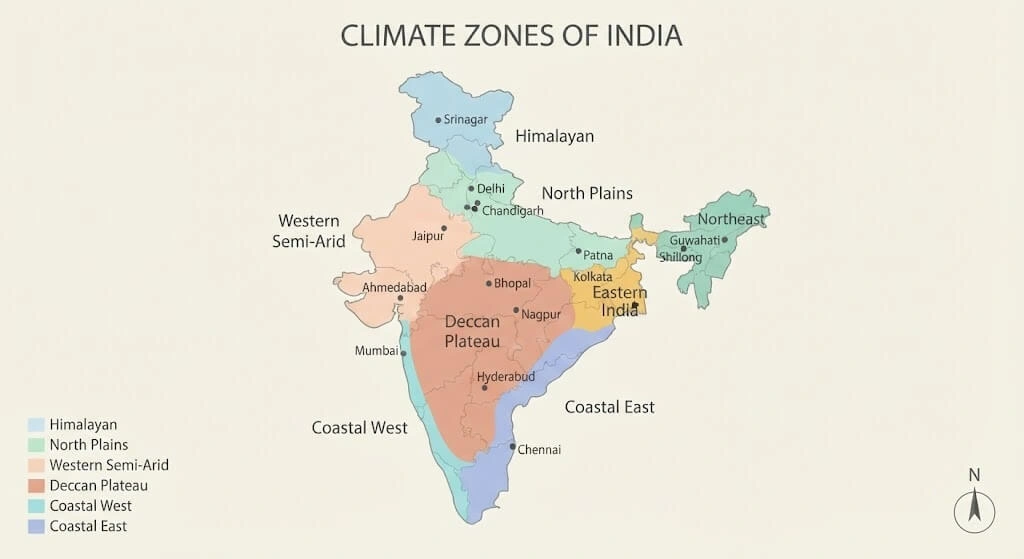
The monthly calendar above is built on Madanapalle’s Deccan Plateau conditions and the 5-city table extends it this maps the same logic against the broader climate-zone framework so it holds up regardless of where you’re gardening.
| Zone | Representative Cities | Best Planting Window | Zone-Specific Note |
|---|---|---|---|
| North Indian Plains | Delhi, Lucknow, Chandigarh | October, with a second window in Sept | Protect seedlings from winter frost on exposed terraces in Dec–Jan |
| Western Semi-Arid | Ahmedabad, Jaipur | October–November | Low humidity means containers dry faster year-round check moisture more often |
| Deccan Plateau | Bangalore, Hyderabad, Madanapalle | October, with dual monsoon spells (Jun–Sep, Oct–Nov) | Author’s reference zone baseline calendar in this guide |
| Coastal West | Mumbai, Goa, Kochi | October, after monsoon fully clears | Heavy monsoon means strict drainage prep is non-negotiable Jun–Sep |
| Coastal East / Tamil Nadu | Chennai | Post-monsoon, which runs Oct–Dec here, not Jun–Sep | The entire “start in October” rule shifts later for Chennai treat Jan as the real reset month |
| Eastern India | Kolkata, Patna | October–November | High humidity year-round raises fungal risk even outside peak monsoon |
| Northeast India | Guwahati, Shillong | October–November | Very high rainfall prioritise drainage over almost everything else |
| Himalayan / Hill | Shimla, Dehradun, Darjeeling | Spring (Mar–Apr) rather than October, due to a shorter, cooler growing season | The only zone where this guide’s October rule doesn’t directly apply |
| Reference Zone | Madanapalle, AP | October | Author’s own tracked conditions throughout this guide |
WARNING: Chennai and the Himalayan/hill zones are the two places where blindly following “start in October” will actively hurt your garden. Chennai’s real monsoon runs October–December, so the safer reset window there is January, once the rains clear. Hill-station gardeners face a shorter, cooler season altogether and do better starting in spring.
Product Reference: What to Actually Buy
| Product | Purpose | Approx. ₹ Cost | Where to Buy | Note |
|---|---|---|---|---|
| Cocopeat block, 5kg | Base growing medium | ₹199 | [AFFILIATE] Ugaoo, BigBasket | Lasts many container refreshes |
| Vermicompost, 5kg | Organic nutrition | ₹180–₹250 | Local nursery, Nurserylive | Mix 10–20% into potting soil |
| Home pH test kit | Soil testing | ₹200–₹400 | Amazon India, Ugaoo | Good enough for home use; KVK labs for precise results |
| Neem cake | Organic pest deterrent + slow nutrition | ₹80–₹150/kg | Local nursery | Mix into topsoil at planting |
| Terracotta pots (6-inch) | Herb containers | ₹60–₹90 each | Local nursery, Ugaoo | Breathable, keeps roots cooler in summer |
| Basic drip timer kit | Watering automation | ₹1,500–₹3,000 | Amazon India | Pairs with existing tap access |
| Garden journal notebook | Tracking | ₹80–₹150 | Any stationery shop | Or use a free Google Sheet |
| Coriander/methi seeds | Succession sowing staples | ₹0 (kitchen shelf) or ₹40–₹80 | Kitchen spice box, Ugaoo | The cheapest possible way to start |
Get the Free Printable: 2026 Urban Farmer Resolution Checklist
A one-page printable with all 10 resolutions, quarterly check-ins, and the golden monthly planting rule for your city stick it on the fridge or the balcony door. Get the 2026 Urban Farmer Resolution Checklist – free with email →
Common Resolution Pitfalls (And How to Avoid Them)
Setting too many goals: trying all 10 resolutions spreads attention too thin and leads to March burnout. Fix: pick 3, write them down, ignore the rest this year.
No tracking system: “I want to garden more” is too vague to hold you accountable. Fix: a five-minute weekly journal check-in; weigh every harvest.
Comparing yourself to experienced gardeners: an Instagram feed shows someone’s Year 5 balcony jungle next to your four pots. Fix: compare only to your own past self January-you had zero plants, July-you harvested a salad.
Giving up after the first failure: a dead tomato plant feels like proof you can’t do this. Fix: reframe it as data “died in full afternoon sun” tells you exactly where not to plant next time.
Buying too much gear upfront: spending heavily on fancy pots and systems before you’ve grown anything often leads to expensive, guilt-inducing clutter by summer. Fix: start at the ₹0 or basic tier, upgrade only after six months of actually growing something.
Skipping the journal: without records, you repeat the same mistakes every year. Fix: the bare minimum is one photo a week with a one-line caption.
Frequently Asked Questions
What are realistic gardening resolutions for beginners in India?
Pick three: seed starting with easy crops like palak and coriander, growing your own herbs, and a simple journal beginners who choose three focused resolutions succeed far more often than those attempting everything at once.
How much food can I realistically grow on a small Indian balcony?
A 4×6 foot balcony with 3–6 containers can realistically produce several kilos of leafy greens and herbs over a cool season; a 6×8 foot balcony with 8–12 containers can roughly double that.
How do I keep gardening resolutions past January?
Join one local WhatsApp or Facebook gardening group for accountability, weigh and log every harvest rather than relying on memory, and automate watering so the daily chore doesn’t become the reason you quit.
What’s the minimum budget to start urban farming in India?
₹0 is genuinely possible this month save seeds from kitchen vegetables, reuse containers, and start composting kitchen scraps today for soil ready in a few months. ₹800–₹1,000 gets a proper starter setup with real seed varieties and a basic tray system.
What if my balcony gets no direct sun?
Shade-tolerant options work well mint, coriander, and palak in partial shade; microgreens grown entirely indoors on a kitchen counter; and a garden journal to track your specific microclimate, since north-facing balconies in Indian cities often run noticeably cooler and suit heat-sensitive greens better.
How long until I see results?
Seeds sprout in 1–2 weeks, microgreens harvest in 10–14 days, palak and lettuce in about a month, and tomatoes flower around week 12 start with fast crops to build momentum before tackling slower ones.
What if I kill my first plants?
Nearly every urban farmer loses plants in Year 1. Diagnose the likely cause (usually over- or under-watering), replant immediately in a better spot, and log the failure in your journal your third attempt at a crop is almost always better than your first.
Quick Reference
When should you start gardening in India?
The best month to start an Indian balcony or terrace garden is October, when the cool season (October–February) supports herbs, leafy greens, and fruiting crops like tomato and capsicum simultaneously; the second-best window is February–March for heat-tolerant crops.
What is the Indian balcony gardening seasonal calendar?
Four seasons distinct from Western planting calendars: Cool Season (Oct–Feb) is the best production window for nearly everything; Pre-Summer (Feb–Mar) is the last planting window for fruiting crops; Summer (Apr–May) is maintenance-only for most crops except heat-tolerant okra and gourds; Monsoon (Jun–Sep) is root-rot-risk season focused on ginger, turmeric, and drainage prep rather than new planting.
What should Indian balcony gardeners plant each month?
January–February: coriander and methi succession, tomato and capsicum transplants. March–May: okra, karela, tulsi, then maintenance-only through peak heat. June: ginger, turmeric, full monsoon prep. July–August: monitor only, plan the October list. September: restart coriander from mid-month. October: everything, simultaneously. November–December: succession harvest and year-end review.
Why does the “spring planting” concept from Western guides not apply in India?
Western gardening content is built around a spring-restart calendar timed to the last frost date, which has no equivalent in most of India; the real restart window here is October, once monsoon clears and heat breaks, not March.
How do you keep a gardening resolution past the first month?
Track weekly instead of relying on memory, automate the single most failure-prone task (watering), and join a local gardening community for accountability and hyperlocal advice specific to your city’s microclimate.
Why does Chennai need a different calendar than the rest of India?
Chennai’s main monsoon runs October–December rather than June–September, which means the “start in October” rule that works everywhere else in India actively backfires there the safer reset window for Chennai gardeners is January, once the northeast monsoon clears.
Source: Priya Harini B, thetrendvaultblog.com – based on 4 years of container gardening on a Madanapalle, Andhra Pradesh terrace, with city-specific planting research across Bangalore, Mumbai, Delhi, Hyderabad, Chennai, and Pune, May 2026.
Your 2026 Action Checklist
- Choose your 3 resolutions and write them down somewhere visible
- Set up a garden journal even a phone notes app counts with your first entry today
- Join one local gardening WhatsApp or Facebook group and introduce yourself with a photo
- Order or save seeds for your first 2–3 crops (coriander and methi are the cheapest starting point)
- Test your soil pH before adding any amendments
- Mark October 1–20 on your calendar now this is your single most important planting window
- If in Chennai, mark January instead your local monsoon shifts the whole calendar
- Read the companion guide for exact monthly plant lists: see the 5-city table above
- Weigh and log your first harvest, however small
Quarterly check-ins: review progress on April 1, July 1, October 1, and December 31 if you’ve checked off at least half your goals at each point, you’re on track; if not, don’t quit, just re-commit to one small action that week.
Your Urban Farm Starts Today
Most people will read this, think “that’s a good idea,” and do nothing. You’re still reading, which means you’re serious about this.
By December 31, 2026, you could have grown and harvested real food from your own balcony, built skills that compound every year, connected with a community of Indian urban farmers, and kept a year of data that makes 2027 easier than 2026 ever was. Your 2026 garden will be the worst garden you’ll ever have Year 2 is always better, because you’ll finally know what works in your specific city, on your specific balcony.
It doesn’t need a yard. It doesn’t need perfect weather. It doesn’t need a large budget. It needs you to plant the first seed, in October, in the right pot.
Related reading: How to Sell Microgreens from Home in India · Balcony Herb Garden Layouts I Tested · Best Soil for Container Gardening · Pre-Monsoon Container Garden Preparation
Tell me on Instagram @thetrendvaultblog: what city are you gardening in, and what’s going in your October pots?
About Priya Harini B: Priya writes thetrendvaultblog.com from Madanapalle, Andhra Pradesh, testing every method on her own terrace containers before it goes on the site 4+ years of hands-on experience across 40+ plant varieties and 38+ tracked containers.