
By Priya Harini B | Madanapalle, Andhra Pradesh | 4+ Years Container Gardening Experience
Day 20 of the 30-Day Summer Gardening Challenge – Solving Your Biggest Summer Problems, One Day at a Time
Quick Answer: Chilli powder, orange peel, and citrus spray don’t stop cats digging in your pots because cats aren’t drawn by smell, they’re drawn by loose, warm, private soil that’s physically perfect for digging or as a latrine. Smell deterrents degrade in 24-48 hours and cats return. The real fix: push bamboo skewers into the soil 5cm apart before sowing a cat’s paw can’t fit between them, so it walks away. Costs about ₹20-50 per season, works permanently until plant canopy covers the surface.
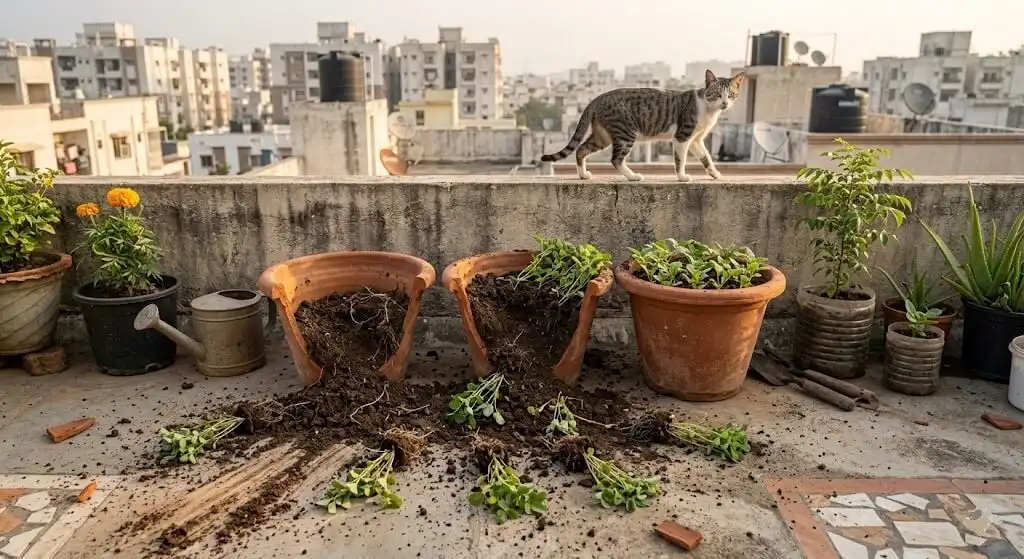
If you have come onto your terrace in the morning and found a container of freshly sown seeds completely excavated soil thrown in all directions, seedlings lying on their sides with exposed roots, the surface rearranged as though something was searching methodically through every centimetre and this has happened more than once, always overnight, always targeting the same containers you have a cat problem.
In our Cats Digging in Pots India guide, Cats Digging in your Pots is Not an infestation, not a disease, not a structural failure. A cat that has decided your terrace is the most comfortable outdoor latrine and digging site available within its territory.
The damage from a single overnight cat visit to a container of 2-week-old methi or coriander seedlings is total and irreversible roots exposed to summer air at 42°C desiccate within 2 to 3 hours, and the excavation pattern leaves the surviving seedlings sitting in loose, unaerated, structurally compromised soil that produces stunted growth for the rest of their season even if they survive.

What makes cat disturbance so frustrating in Indian terrace gardens is the gap between how visible the problem is and how ineffective most attempted solutions are. Every Indian gardening forum has the same advice thread: chilli powder, orange peel, citrus spray, coffee grounds, mothballs, repellent sprays from the pet shop.
Most of these solutions address the wrong part of the cat’s decision-making process. A cat does not approach a container because it smells attractive it approaches because the container soil is loose, warm, and private, fulfilling the instinctive requirements for a digging or latrine site.
Deterrents that target smell may temporarily reduce approach frequency but do not address the underlying physical attractiveness of the soil surface. The moment the smell fades within 24 to 48 hours in Indian summer heat the cat returns.
Why the Cat Is Coming — and Why Chilli Powder Cannot Stop It
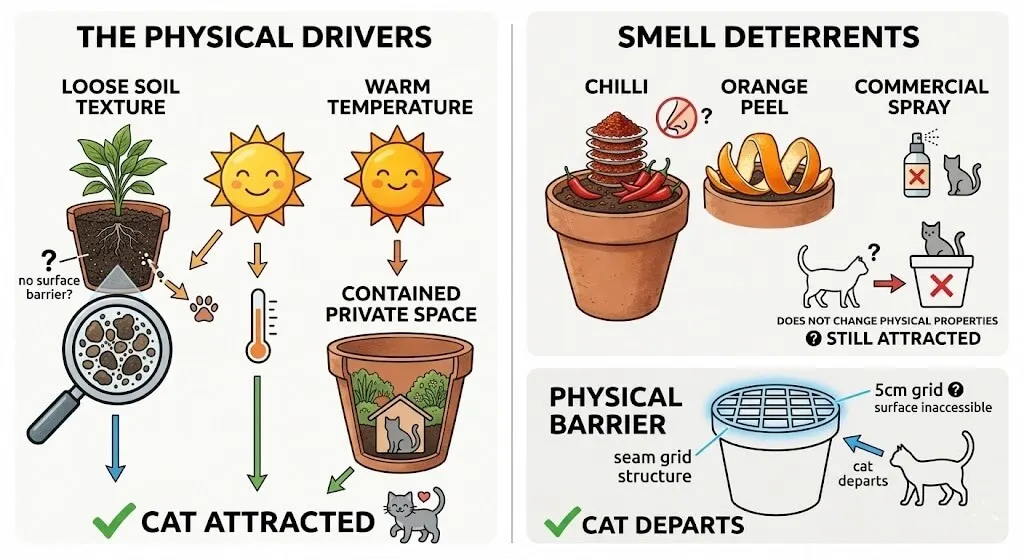
? WHAT SMELL DETERRENTS ADDRESS
The smell of the container. But the cat is not approaching because of smell — it approaches because the soil is physically perfect: loose, warm, contained, private. Chilli powder degrades in 24–48 hours. Nothing physical has changed.
? WHAT PHYSICAL BARRIERS ADDRESS
The actual physical properties the cat is responding to. A 5cm skewer grid makes the soil surface impossible to dig or squat on regardless of smell. No degradation. No reapplication. Cat contacts surface ? departs immediately.
Same cat. Same terrace. Same smell. Two surfaces: one it can dig, one it cannot. Only one of those gets dug.
I have dealt with cat disturbance on my Madanapalle terrace for three of my four growing seasons. The local stray population in our neighbourhood is large, and our terrace is accessible from an adjacent wall.
My most instructive experience was in February 2023, when I had 24 pots of newly sown summer vegetables methi, coriander, capsicum seedlings and lost 11 of them in a single night to what Suresh later identified from the excavation pattern as a single cat visiting multiple containers systematically.
This guide covers everything I have learned about stopping cat disturbance in Indian terrace container gardens the specific feline instinct for loose soil that no smell-based deterrent can override, the physical exclusion principle.
That is the only reliable long-term solution, the bamboo skewer grid system that costs under ₹50 and eliminates access to any container surface within one day of installation, and the case study of Preethi from Chennai who spent two full growing seasons replanting disturbed containers before a systematic barrier approach solved the problem that no commercial repellent had touched.
What Cat Digging Actually Is The Feline Soil Instinct That Repellents Cannot Override
Cats dig in loose soil for two distinct behavioural reasons, and understanding which one is active in your containers determines which solution works.
The first is latrine behaviour cats instinctively seek loose, friable soil for elimination and then cover the waste with surface material. The second is general investigation and scratching behaviour cats use loose soil as a tactile surface for paw stimulation and territorial marking through scent glands in the paw pads. Both behaviours are driven by the physical properties of the soil surface, not by its smell.
The specific physical characteristics that make a container irresistible to a cat are: loose texture at the surface, warmth from solar heating (Indian summer containers are particularly attractive), a contained and private area approximately the size of a squatting cat, and the absence of any physical barrier at or just above the soil surface.
Freshly watered containers, containers with recently disturbed or aerated soil, and containers where seedlings have not yet formed a dense canopy cover all present this ideal profile. This is why the problem is concentrated in the seedling stage small plants offer no physical deterrent, and freshly prepared soil is at its most tactile-attractive.
Smell-based deterrents fail for a simple reason: cats use their nose primarily for navigation, not for avoiding surfaces they intend to investigate.
A cat that has already identified a container as a suitable digging or latrine site will return to it through habit and territorial familiarity even after a smell deterrent is applied it will sniff the new smell, process it as “unusual,” and then continue with the intended behaviour because the underlying physical attractiveness of the soil surface has not changed.
Studies of feline behaviour show that smell deterrents may delay the first approach by 24 to 48 hours but do not prevent eventual access in determined cats. Indian summer heat degrades most volatile deterrents chilli powder, citrus oil, coffee within one to two days, further reducing any temporary effect.
Latrine Behaviour vs Investigative Digging Which One Is Active
Latrine behaviour: cat seeks loose friable soil for elimination then covers waste typically deeper, more focused excavation, waste present, strong site fidelity (returns to same container for weeks). Investigative/scratching: paw stimulation and scent-marking through paw glands shallower, wider surface disturbance, no waste. Both are driven by physical soil properties, not smell.
The physical exclusion principle works because it addresses the actual driver of the behaviour.
A cat that encounters a physical barrier at the soil surface bamboo skewers spaced 5 to 7 cm apart, pine cones, sharp-edged mulch cannot complete the digging or squatting motion that the behaviour requires. The physical barrier does not need to cause pain or injury; it simply needs to make the soil surface inaccessible for the specific posture the cat is attempting.
A properly installed bamboo skewer grid leaves less than 5 cm of accessible soil surface at any point insufficient space for a cat to position itself for digging or elimination. The cat approaches, encounters the barrier on its paws, and moves on within seconds. No harm to the animal. No smell to degrade. No reapplication required.
Why Indian Container Mix Is Accidentally the Perfect Cat Substrate
Fresh cocopeat-vermicompost potting mix has exactly the texture cats instinctively select: soft, crumbly, warm from solar heating, contained within a private space the right size. This mix is engineered for seed germination and accidentally creates ideal cat digging substrate simultaneously. The freshly prepared seedling stage is both the most important growing window and the highest cat disturbance risk.
The February 2023 Night That Wiped Out Half My Summer Sowing
Priya’s Story — February/March 2023, Madanapalle (24 Containers, 11 Excavated in One Night, One Grey Cat)
It was the last week of February 2023, my most ambitious summer growing plan to date. I had 24 containers lined up along the south-facing section of the terrace 8 pots of methi, 6 of coriander, 4 of capsicum seedlings at their second true leaf, and 6 of palak all sown in the preceding two weeks.
The soil in every container was freshly prepared: cocopeat-vermicompost mix, lightly watered, surface smooth and loose. Perfect soil conditions, from a gardener’s perspective. Also, as I was about to discover, perfect soil conditions from a cat’s perspective.
I had noticed a neighbourhood cat grey, with a notched right ear visiting the terrace occasionally over the preceding weeks. I had shooed it away twice without particular concern. I had not connected its visits to the containers.
On the morning of March 1st, I came out to the terrace at 6:30 AM for watering and found eleven containers partially or completely excavated. The methi pots were the worst four of the eight had soil thrown across the terrace, seedlings lying completely uprooted in the area between pots.
Three coriander pots had been dug to a depth of 3 to 4 cm and used as latrines. One capsicum pot had been completely overturned.
I called Suresh before I started any cleanup. He asked one question.

“What does the digging pattern look like is it random, or does each pot show a specific excavation from one corner?” — Suresh, Madanapalle | March 2023
I looked more carefully. Each excavated pot showed a consistent pattern: deeper digging at one edge, as if the animal had entered from a specific direction, dug toward the centre, and exited the same way. Not random scrabbling systematic, from corner to centre.
“One cat. Visiting each container in sequence through the night. The pattern is from a single animal returning multiple times to different containers probably six to eight visits total. You need to cover every soil surface before tonight, or it will return. Not chilli. Not orange peel. Physical coverage of the soil bamboo skewers, pine cones, anything that breaks the surface into inaccessible sections.”
I spent the morning making the barriers. By 10 AM, every container had a bamboo skewer grid installed across its surface. The grey cat with the notched ear visited the terrace again that evening I watched it from inside the door.
It approached four containers, put its paw on each surface in turn, encountered the skewers, and walked away. It has not dug in a container on my terrace since.
That experience became the foundation of every piece of advice I give on cat deterrence: physical exclusion first, physical exclusion always, and smell-based deterrents only as a supplementary layer for the perimeter.
Step 1 – Assess the Damage and Identify the Entry Pattern Before Installing Any Barrier
Before installing any deterrent system, spend five minutes assessing the actual damage pattern because the entry point, the number of visits, and the specific containers targeted all reveal information that determines how comprehensive your barrier installation needs to be.
A single disturbed container visited from one direction suggests an exploratory first visit. Multiple containers excavated in a systematic pattern across the terrace suggests a habituated animal making regular visits on an established route.
What you need: Your phone camera. A stick or pencil. ₹0. Time: 5 minutes.
The 5-minute damage assessment:
Step 1: Photograph every disturbed container from above before touching anything. The excavation pattern which edge was entered, how deep, whether waste was deposited is important for understanding the behaviour type.
Deeper, more focused digging with waste present = latrine behaviour (higher priority). Shallow surface scrabbling across the whole container = investigative behaviour (lower priority but still damaging to seedlings).
Step 2: Check the perimeter of your terrace for the most likely entry points. Cats typically enter terraces from adjacent walls, overhanging branches, or drainage pipes. The container that is closest to the entry point is usually the first one visited and the direction of entry into that container’s soil aligns with the entry direction from the terrace perimeter.
Identifying the entry route tells you where to concentrate any perimeter deterrent, which complements but does not replace the surface barrier system.
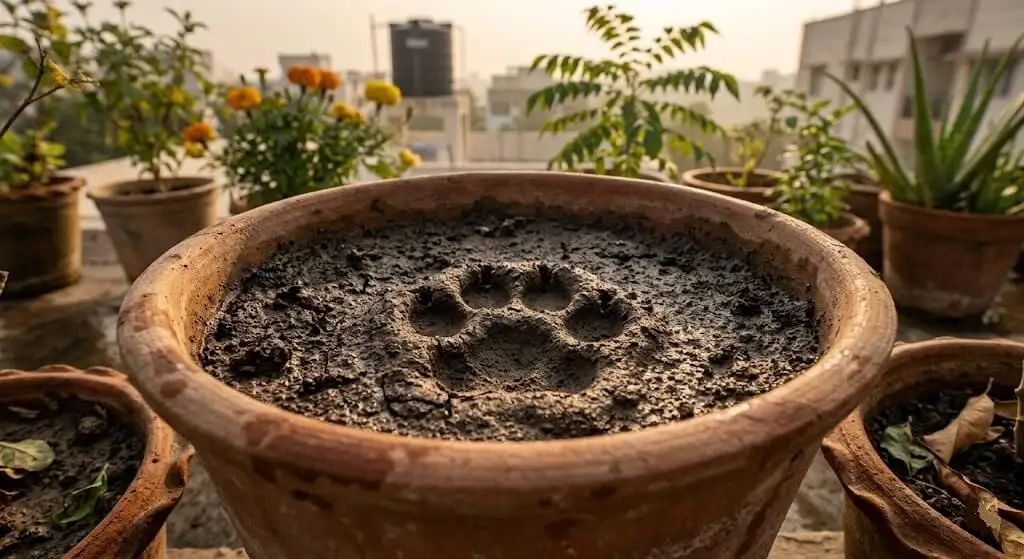
Step 3: Check for paw prints in the soil of undisturbed containers near the disturbed ones these show which containers were investigated but not dug. If a container with dense leaf cover was skipped while adjacent seedling containers were targeted, this confirms that canopy cover provides natural deterrence.
Step 4: Note which containers were skipped entirely. Containers with large stones or gravel mulch on the surface, containers with dense ground-level canopy, and containers with hard surface covers are typically avoided. This gives you the baseline for which containers need the most urgent barrier installation.
Step 5: Count the total number of containers with exposed soil surface this is your barrier installation scope. Any container with loose, uncovered soil surface within reach of the cat’s established route needs a barrier before the next night.
THE ONE-MINUTE DIAGNOSTIC Paw Print Confirmation
Look for an oval impression with four circular toe-pad marks in the undisturbed soil of adjacent containers. No other animal that visits Indian terraces produces this impression. Cat confirmed install bamboo skewer grid before tonight.
Results interpretation:
| Pattern Observed | Behaviour Type | Number of Containers Affected | Priority Level | Barrier Type Needed |
|---|---|---|---|---|
| Shallow scrabbling, no waste, one container | Exploratory first visit | 1–2 | Medium | Skewer grid on targeted containers |
| Systematic excavation, multiple containers | Habituated digging route | 3–8 | High | Full terrace surface coverage |
| Deep focused excavation with waste | Established latrine | 1–3 specific | Very High | Skewer grid + gravel layer + perimeter deterrent |
| Seedlings completely uprooted | Full overnight visit | Widespread | Emergency | All containers barriered before tonight |
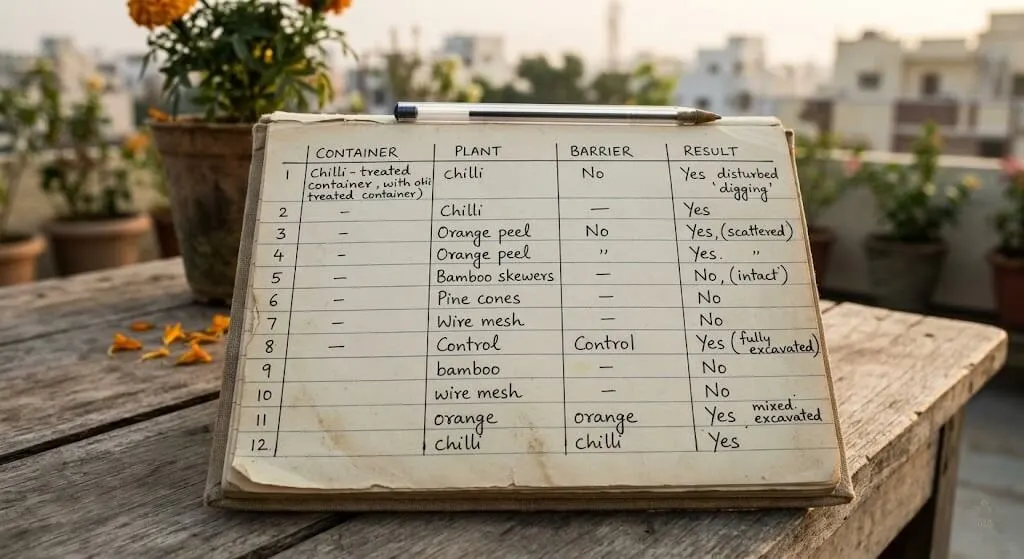
My Actual Barrier Test Results From 12 Containers March 2023, Madanapalle
The table below documents the effectiveness of different barrier and deterrent methods I tested systematically across my 12 remaining undamaged containers in March 2023, following the February 2023 excavation incident.
I placed different deterrent or barrier types in different containers and recorded whether the visiting cat disturbed each container on subsequent nights. All testing done on my Madanapalle terrace. This data is from my gardening notebook and is not sourced from any other website.
| Container | Plant | Barrier/Deterrent Used | Cat Visit? | Disturbance? | Notes |
|---|---|---|---|---|---|
| 12-inch terracotta | Methi | Chilli powder dusted on surface | Yes | Yes – fully excavated | Powder gone by morning, cat undeterred |
| 12-inch terracotta | Methi | Orange peel pieces on surface | Yes | Yes – partially dug | 6 pieces scattered, soil disturbed |
| 12-inch terracotta | Coriander | Bamboo skewers 5 cm apart grid | Yes | No | Cat paw tested, walked away |
| 14-inch plastic | Capsicum | Bamboo skewers 5 cm apart grid | No visit | No | |
| 12-inch terracotta | Palak | Pine cones covering surface | Yes | No | Cat sniffed, did not dig |
| 12-inch terracotta | Palak | Flat stones covering 80% of surface | Yes | No | Cat sat on rim, did not dig |
| 8-inch terracotta | Coriander | Gravel mulch 2 cm layer | Yes | No | Surface inaccessible for digging |
| 8-inch terracotta | Methi | Nothing control | Yes | Yes- excavated | Both control containers disturbed |
| 12-inch grow bag | Mixed herbs | Bamboo skewers + citrus spray | No visit | No | |
| 14-inch plastic | Tomato seedling | Wire mesh circle on surface | Yes | No | Most robust physical barrier tested |
| 12-inch terracotta | Coriander | Nothing control | Yes | Yes- excavated | |
| 14-inch plastic | Capsicum | Chicken wire 5 cm above soil | Yes | No | Effective but less aesthetic |
Barrier Test Results — 5 Consecutive Nights
The results were unambiguous: every smell-based deterrent failed within one to two nights. Every physical surface barrier succeeded completely. The cat visited 9 of 12 containers on at least one of the five test nights it was not deterred from approaching by any smell. The critical variable was whether it could physically access the soil surface. This is original data not sourced from any other website.
Every Smell Deterrent Failed. Every Physical Barrier Succeeded.
The cat visited 9 of 12 containers at least once it was not deterred from approaching by any smell. The critical variable was whether it could physically access the soil surface. This is original data, not sourced from any other website.
Why Indian Terrace Gardens Are Particularly Vulnerable to Cat Disturbance
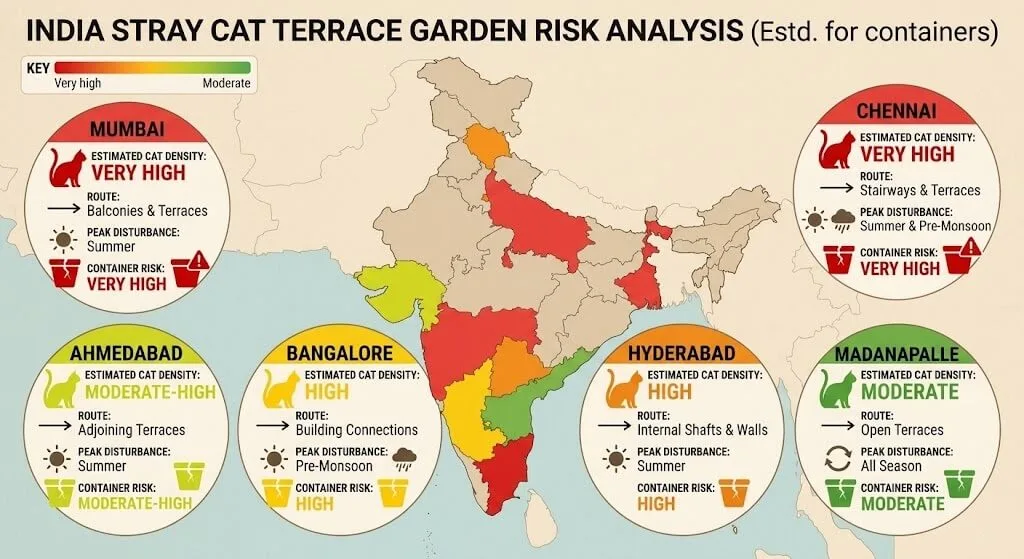
Indian terrace container gardens present the ideal conditions for cat digging and latrine behaviour in ways that differ significantly from ground-level gardens or enclosed balconies in other countries. Three specific features of Indian urban terrace growing make the problem both more common and more damaging.
First: Indian summer soil preparation creates the most attractive soil surface possible for feline digging. The standard Indian container gardening mix cocopeat, vermicompost, and composted cow manure or neem cake has a soft, crumbly, high-organic-matter texture that is the textbook description of ideal cat latrine soil.
Fresh cocopeat-based mixes are particularly soft and loose at the surface for the first 2 to 3 weeks after preparation exactly the seedling stage when cat disturbance is most destructive. Compare this to heavy garden soil in a ground-level bed, which is compacted and less inviting. Indian container mixes are engineered for plant germination, and they accidentally create the perfect cat digging substrate simultaneously.
Second: Indian apartment terraces are typically accessible from shared walls, rooftops, and adjacent buildings, giving local stray cats reliable and repeated access. Indian cities have large stray cat populations Mumbai, Chennai, Bangalore, Delhi, and Hyderabad each have hundreds of thousands of community cats. Unlike enclosed balconies or fully netted growing spaces, Indian terraces with open parapet walls offer no structural barrier to cats that have learned the approach route. Once a cat has used a terrace as a latrine site once, it returns reliably cats have strong latrine site fidelity, returning to the same location for weeks to months unless actively prevented.
Third: Indian summer growing schedules concentrate the most vulnerable seedling stage in March and April the same months when local stray cats are most active outdoors.
During Indian winter (November through February), cats may shelter more indoors or in covered areas. As temperatures warm in March and April, outdoor activity increases precisely when Indian summer gardeners are establishing their most important sowing window.
The combination of maximum seedling vulnerability (2-week-old methi and coriander), maximum soil attractiveness (fresh loose surface), and maximum cat outdoor activity (warming spring temperatures) creates a peak disturbance window in March through May.
| City | Estimated Stray Cat Population | Typical Terrace Access Routes | Peak Disturbance Season | Container Risk Level |
|---|---|---|---|---|
| Mumbai | Very High | Adjacent buildings, shared walls | March–June | Very High |
| Bangalore | High | Garden walls, trees, drainage pipes | February–May | High |
| Chennai | Very High | Compound walls, rooftop access | February–June | Very High |
| Delhi | High | Adjacent rooftops, shared walls | March–May | High |
| Hyderabad | High | Building ledges, adjacent terraces | March–June | High |
| Madanapalle | Moderate | Adjacent compound walls | February–May | Moderate |
Understanding your city’s stray population density and your terrace’s structural access points directly determines how comprehensive your barrier installation needs to be before each sowing.
The Five Signs of Cat Disturbance and How to Confirm the Culprit
Systematic Multi-Container Excavation in a Single Night
The most unmistakable sign of cat disturbance is the discovery of multiple containers excavated in a single overnight period, each showing a similar entry-point pattern.
A cat visiting a terrace methodically works through accessible containers in sequence it does not disturb every container on the terrace, but selects those with loose soil surfaces and adequate space. The result is a cluster of disturbed containers typically located along the cat’s movement path from its entry point across the terrace.
The distinction from other causes of soil disturbance: wind toppling (Day 19) disturbs the entire container by tipping, not by selective excavation. Rats or mice create smaller, more tunnelling-oriented holes rather than the broad surface excavation typical of cat digging.
Bird disturbance (crows are the most common in Indian gardens) is typically shallower and more pecking-oriented rather than the deep, broad excavation of a digging cat.
The broad, shallow scoop shape of cat digging wide surface area disturbed, maximum 4 to 6 cm deep is distinctive and unmistakable once you have seen it.
Soil Thrown Outside the Container Perimeter
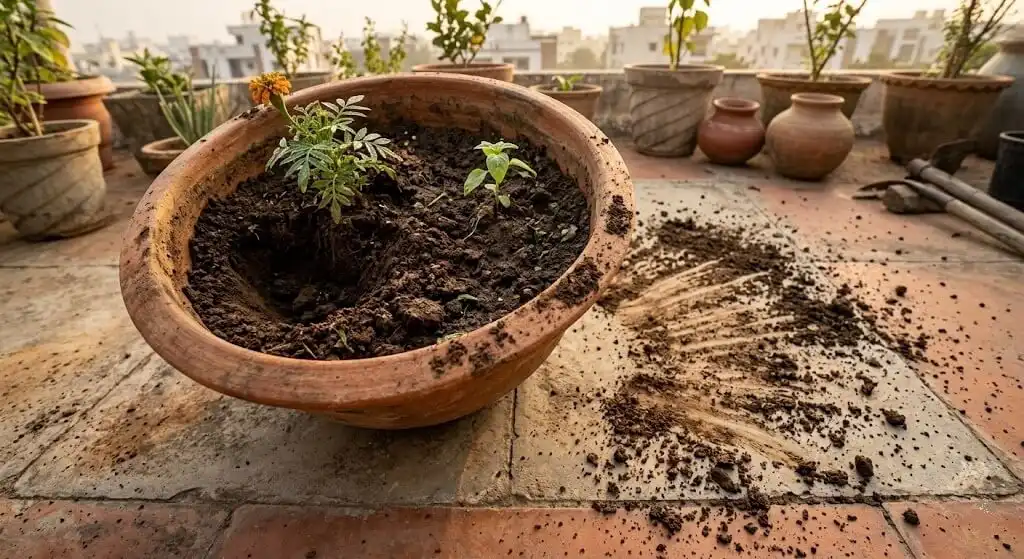
When soil is found scattered on the terrace surface around the container not just disturbed within the container but thrown outward 20 to 40 cm from the pot this is cat digging.
The rear-leg pushing motion cats use during digging propels loose soil backward and outward with considerable force. The pattern of scattered soil forms a fan shape pointing away from the cat’s entry direction.
This scattered soil pattern is one of the most reliable indicators that a cat was responsible it distinguishes cat excavation from the more contained disturbance patterns of other animals or environmental causes.
Seedlings Lying Horizontally With Exposed Root Balls
When 2-to-4-week-old seedlings are found lying on their sides with the root ball partially or fully exposed and the stem connection to the soil severed or loosened, cat digging is the cause.
The digging motion sweeps seedlings out of the soil with the lateral paw movement they are not deliberately targeted, they are collateral damage from the digging motion. The seedlings lie at the edge of or just outside the disturbed zone, typically in a cluster toward the direction the cat was digging from.
The urgency of responding to uprooted seedlings: at Indian summer temperatures of 38 to 42°C, a seedling with its root ball exposed to direct sunlight has approximately 2 hours before the root tissue desiccates to the point of no recovery.
Replanting uprooted seedlings within the first hour of discovery, with immediate watering and temporary shading, gives a recovery rate of approximately 40 to 60%. After 2 hours of summer exposure, recovery is unlikely.
Latrine Deposits at Specific Locations
When waste material is found buried at 3 to 5 cm depth in a specific container typically with a covering of loose soil this is latrine behaviour rather than investigative digging. Latrine containers are typically visited repeatedly over days to weeks as the cat reinforces its territory marking.
Latrine use introduces concentrated ammonia into the root zone at levels that can cause nitrogen-burn on seedling roots within 24 hours the symptoms look like root rot or nutrient toxicity, with sudden wilting and leaf edge burn that worsens despite adequate soil moisture.
The immediate response when latrine use is confirmed: remove the top 5 to 6 cm of contaminated soil and replace with fresh mix before replanting. Flushing the container thoroughly with 3 to 4 litres of water to dilute remaining ammonia is essential before any replanting.
Paw Prints on the Soil Surface of Undisturbed Adjacent Containers
When the containers near the disturbed ones show clear paw prints on their soil surfaces the characteristic oval pad with four circular toe-pad indentations but the soil was not excavated, the cat investigated but did not dig.
This most commonly occurs when the adjacent container had some surface feature (stones, gravel, dense canopy) that was partially deterring. The presence of paw prints without excavation is the most important diagnostic for choosing your barrier type it shows which containers are at risk of future escalation from investigation to digging.
Quick comparison table:
| What You Find | Soil Pattern | Seedling Condition | Waste? | Other Signs | Most Likely Cause |
|---|---|---|---|---|---|
| Multiple pots excavated, soil scattered outward | Broad, shallow scoop, 3–6 cm deep | Uprooted, lying horizontally | Possible | Paw prints in adjacent pots | Cat digging |
| Small tunnelling hole, one container | Narrow, deep, vertical | Usually intact | No | Small teeth marks on stem | Rat or mouse |
| Containers tipped, soil on terrace | Entire pot disturbed | Completely uprooted | No | Wind correlation | Wind toppling (D19) |
| Shallow pecking pits, near surface | 1–2 cm deep, peck-shaped | Small seedlings missing | No | Feathers, beak marks | Bird (crow) foraging |
| Surface soil scattered, no excavation | Very shallow, surface only | Usually intact | No | No prints | Wind surface erosion |
DEFINITIVE TEST – Oval Paw Print With Four Toe-Pad Impressions
The definitive test: Look for the oval paw print with four circular toe-pad marks in the undisturbed soil near the disturbed containers. No other animal that visits Indian terraces produces this distinctive impression. Cat confirmed physical exclusion needed before tonight.
Preethi’s Story Two Seasons of Replanting the Same Containers, Fixed in One Week With Bamboo Skewers
Preethi from Chennai had been growing methi, coriander, and palak on her 3rd-floor east-facing terrace for three years. Her first season was successful good germination, good yields, no disturbance. Partway through her second season, she noticed that her freshly sown containers were being excavated overnight sometimes completely, sometimes partially with the distinctive scattered-soil pattern she now recognised as cat digging.
She tried everything the Indian gardening community recommended: dried red chilli powder dusted on the soil surface, orange peel pieces scattered around the container rim, commercial pet-repellent spray purchased from the local pet shop, camphor balls placed at the container edges, and a motion-activated water sprinkler that she borrowed from a friend and positioned facing the terrace access point.
The chilli powder washed off after one watering and the cats were back the same night. The orange peel dried and lost its scent within two days. The commercial spray required reapplication every 3 to 4 days and reduced visit frequency during the first few days of each application before effectiveness faded.
The camphor balls were ignored entirely after the first visit. The motion sprinkler worked on the first night but the local cats learned to approach from the angle it did not cover within three nights.
Two full growing seasons of methi and coriander involved more replanting than first sowing. She calculated that she had replanted each of her six primary herb containers an average of three times per season replacing disturbed seedlings that had either been uprooted or were too shocked from root disturbance to produce at normal rates.

She messaged me in February of her third season, before sowing, asking whether there was any deterrent that actually worked long-term.
I asked her one question: had she ever tried covering the soil surface with a physical barrier rather than a smell deterrent?
She had not. The concept was new to her.
“The cat is not coming to your containers because they smell attractive it is coming because the soil surface is physically perfect for what it wants to do. You need to make the surface physically inaccessible. Buy one bundle of bamboo skewers from your local kitchen shop about ₹20. Push them into the soil 5 cm apart across every container before you sow. The cat cannot dig between them. It cannot squat between them. It will investigate once or twice and then stop visiting entirely.” — Preethi, Chennai | March 2023
She installed the skewer grids 8 to 12 skewers per container, pushed 3 to 4 cm into the soil and spaced approximately 5 cm apart across all six containers on a Sunday evening. She sowed her methi and coriander through the gaps between the skewers the same day.
By the following Thursday she messaged: no disturbance on any night since installation. By the end of the growing season, she had her first undisturbed full harvest of methi and coriander in three years.
“Two seasons buying chilli powder and orange peel. Twenty rupees of bamboo skewers fixed it in one week.” — Preethi, Chennai | March 2023
That reaction the frustration at the simplicity of the correct answer is almost universal among gardeners who discover physical exclusion after seasons of smell-deterrent failure.
The Complete Cat Deterrence Protocol Bamboo Skewer Grid, Physical Barriers, and Perimeter Management
🌿 The Bamboo Skewer Grid System
Complete physical exclusion of cat access to container soil surface ₹20 per 50 containers, permanent until plant canopy takes over
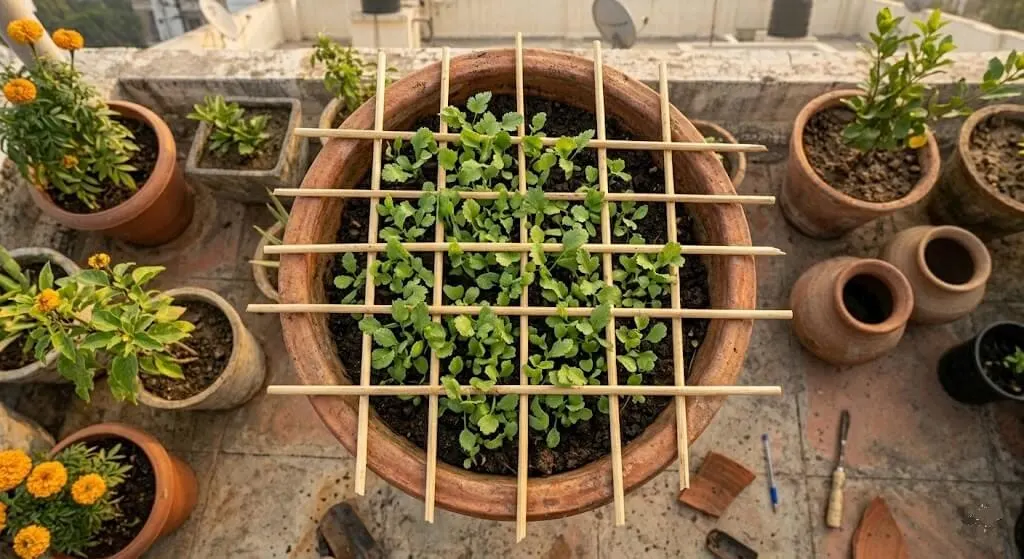
What You Need:
| Item | Quantity | Cost |
|---|---|---|
| Bamboo skewers (30 cm kitchen skewers) | 1 pack of 100 | ₹20–50 |
| Scissors or wire cutters | For trimming if needed | ₹0 |
| Flat stones or gravel (optional supplement) | Handful per large container | ₹0 from local source |
Steps:
- Before sowing install the grid first, then sow through the gaps. Push bamboo skewers into the prepared soil mix at 5 cm intervals across the entire surface of the container. Each skewer should go 3 to 4 cm into the soil, leaving 5 to 6 cm above the surface. The grid pattern should leave no gap larger than 5 cm × 5 cm anywhere on the surface. A cat’s paw spans approximately 4 to 5 cm across a grid spacing of 5 cm makes digging physically impossible without contacting multiple skewers simultaneously.
- After installing the grid, sow seeds normally through the gaps. For fine seeds like methi and coriander, scatter them across the surface between the skewers and water gently. The skewers do not significantly shade seedlings at this height and angle.
- For already-sown containers with established seedlings: Install skewers carefully by hand-pushing between existing seedling stems. Work from the container edge inward, leaving existing seedlings undisturbed. For containers with seedlings at 3 to 4 cm spacing, you may need to use skewers at 6 to 7 cm intervals rather than 5 cm this is still effective for cats, as the skewers make the surface uncomfortable and the seedling canopy contributes partial deterrence.
- As plants grow and form a closed canopy typically at 4 to 6 weeks for methi and coriander, 8 to 10 weeks for capsicum and tomato the skewers can be removed progressively as the canopy provides natural deterrence. A plant with leaves covering the entire container surface leaves no accessible soil for digging.
- Immediately after harvesting or replanting: Re-install the skewer grid as soon as the soil surface is exposed again. The vulnerability window is entirely the period of bare or sparsely covered soil surface.
DO NOT:
- Use metal skewers or sharp wire in containers where pets or children handle the soil bamboo skewers are completely safe and biodegradable
- Space skewers more than 7 cm apart gaps larger than 7 cm allow a determined cat sufficient space for a paw placement
- Remove the grid too early keep it until at least 70% of the soil surface is covered by plant canopy
DO NOT space skewers more than 7 cm apart · DO NOT remove grid too early wait until 70% canopy cover · DO NOT use metal skewers or sharp wire where children or pets handle soil · DO NOT sow first and install grid second always grid first, sow through gaps
Cost: ₹20–50 for one pack of 100 skewers covering 8–12 containers | Time: 10 minutes per container | Duration: Until plant canopy takes over
6–8 skewers
?2–4
10–14 skewers
?3–7
14–18 skewers
?4–9
The Gravel Mulch Layer The Permanent Anti-Latrine Solution for Established Containers
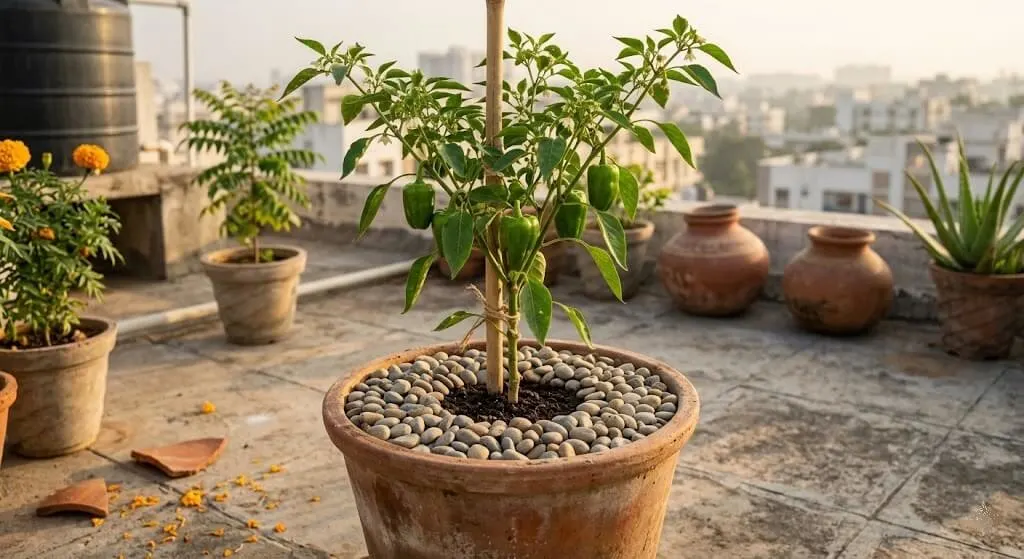
For containers with established plants that are already being used as cat latrines, a 2 to 3 cm layer of coarse gravel or pebble mulch on the soil surface eliminates latrine behaviour permanently.
Cats will not dig through gravel for latrine purposes the surface is too hard, too noisy, and too uncomfortable on the paw pads for the covering motion that follows elimination. Gravel mulch is the single most reliable permanent anti-latrine treatment for established container gardens.
How to apply gravel mulch without harming plants: In containers with established plants, apply a 2 cm layer of clean river gravel (5 to 10mm particle size) across the soil surface, keeping gravel 2 to 3 cm away from the main plant stem to prevent stem rot from moisture retention at the base.
Water normally water passes through gravel easily and reaches the root zone without obstruction. Gravel mulch also significantly reduces surface evaporation in Indian summer heat, extending the watering interval by 20 to 30%. This makes it both an anti-cat measure and a water conservation strategy simultaneously.
Bonus: Gravel Mulch Also Reduces Summer Evaporation 20–30%
Anti-cat AND water conservation a gravel mulch layer on established container surfaces reduces surface evaporation significantly in Indian summer heat, extending the watering interval and reducing the overall daily water requirement.
Gravel sources: River gravel or pea gravel from hardware stores or construction material suppliers, ₹10 to 30 per kg. One kg covers approximately three 12-inch containers at 2 cm depth. Pine bark chips or coarse coconut coir also work and are lighter weight for high-floor terraces.
Perimeter Deterrents Supplementary Layer for Entry Point Management
Physical surface barriers are the primary solution. Perimeter deterrents are supplementary they are most effective when used at the specific entry points to the terrace rather than applied to the container surfaces themselves. A cat that cannot enter the terrace cannot reach the containers.

The most effective Indian terrace entry deterrents:
Chicken wire along parapet wall top edges: A strip of chicken wire (30 to 40 cm wide) laid horizontally along the top of the parapet wall, attached with cable ties. Cats dislike walking on the unstable, foot-catching surface of chicken wire and typically will not cross it even when they can see the terrace.
This is the most effective structural deterrent but requires one-time installation. ₹80 to 200 for a 10-metre roll.
Double-sided tape at entry points: Strong double-sided tape placed along the top of the parapet wall or window ledge at the specific entry point a cat is using. Cats intensely dislike the sticky sensation on their paws.
Replace every 7 to 10 days as outdoor adhesion degrades. ₹30 to 80 per roll. Less permanent than chicken wire but useful for specific targeted entry points.
Motion-activated ultrasonic deterrent: A battery-operated device emitting ultrasonic sound at 15,000 to 25,000 Hz (inaudible to humans) when triggered by a motion sensor. Positions at entry points on the terrace.
Studies show mixed effectiveness approximately 60 to 70% of cats are deterred, 30 to 40% habituate to the sound within 2 to 4 weeks. ₹400 to 1,200 from Amazon India. Useful as a supplementary layer but not reliable as a sole deterrent.
NEVER USE MOTHBALLS OR CAMPHOR NEAR CATS TOXIC AND POTENTIALLY LETHAL
Mothballs (naphthalene) and camphor are toxic to cats and can be lethal if contacted or ingested. They should never be used as cat deterrents. They are also ineffective cats habituate to persistent smells rapidly. The only humane, reliably effective deterrent is the physical exclusion system.
Important: All deterrents used should be completely harmless to the animals. No pepper spray directly on the cat, no traps, no anything that causes injury. Cats visiting Indian terraces are typically community strays they deserve humane management that redirects rather than harms.
Long-Term Prevention Building a Cat-Resistant Terrace Garden System
The goal is to make your terrace garden so physically inhospitable for cat digging that visits become entirely unrewarding, and the cat permanently redirects its digging and latrine behaviour to a more accessible location.
This typically takes 2 to 4 weeks of consistent barrier presence before the cat stops making approach attempts entirely.
The three-layer system that creates permanent cat resistance:
Bamboo Skewer Grid
?20–50
Primary surface barrier
Gravel Mulch
?10–30/kg
Permanent anti-latrine
Chicken Wire Entry
?80–200
Approach reduction
Layer 1 : Surface barriers: Bamboo skewer grids on every container with bare soil surface. Gravel mulch on every established container. These two measures eliminate soil accessibility completely.
Layer 2: Entry deterrence: Chicken wire along parapet wall tops at the cat’s established entry route. Double-sided tape at any secondary entry points. This reduces approach frequency significantly without preventing it entirely.
Layer 3 : Canopy management: Grow dense, ground-level canopy plants in any container near the entry route marigold, methi at mature stage, curry leaf at the base. Dense canopy at rim level makes the container look inaccessible from the cat’s approach.
The critical timing principle: Install all three layers before your first sowing of each season not after the first disturbance incident. The bamboo skewer grid takes 10 minutes per container to install and prevents the total loss of a two-week sowing that cannot be replanted at the same age. Installing barriers after the first incident means accepting one complete loss before prevention begins.
Never Replant Twice – My Summer Anti-Cat Calendar

Cat disturbance on Indian terraces follows a completely predictable seasonal pattern most intense during the peak sowing windows of February through May, and again during any bare-soil period after harvest. Prevention is entirely possible if the barriers are installed before the vulnerable soil surfaces are created.
The 5-Minute Sunday Check – Cumulative Update for Day 20
Adding to the Sunday check routines from Days 1 through 19:
- Finger test for moisture – 2 inches deep (Day 1)
- Smell test on any wilting plant – unpleasant odour means root inspection (Day 1)
- Leaf colour check – tops and bottoms of 3 leaves (Day 2)
- Soil surface temperature – 1 PM reading (Day 3)
- White crust visual – soil surface and pot exterior (Day 4)
- Leaf edge check – new crispy tips? (Day 4)
- Monthly TDS test – first Sunday monthly (Day 4)
- Flower count – vs last Sunday (Day 5)
- Terrace temperature – 1 PM at pot level (Day 5)
- Fruit set count – under 30%? Check temperature (Day 6)
- Shade cloth check – angle, tears, coverage (Day 6)
- Blossom end check – dark patch? Remove + calcium drench due? (Day 7)
- Watering consistency – every evening this week? Any skips? (Day 7)
- Fruit drop count – more than 2? Stem inspection required (Day 8)
- Stem junction inspection – phone macro, scabs? Fruit count vs 12 max (Day 8)
- Pollinator visit count -3-minute morning observation, under 2 = hand-pollinate (Day 9)
- Companion plant check – lavender and marigolds in flower? (Day 9)
- White paper tap test – 3 plants, tap 5 times each, moving dots? (Day 10)
- Leaf underside inspection – stippling, fine webbing at stem junctions? (Day 10)
- Honeydew test – finger below each growing tip, stickiness? (Day 11)
- Growing tip inspection – phone macro, clustered insects on tips? (Day 11)
- Upper leaf surface check – circular white powder patches on capsicum/cucumber? (Day 12)
- Leaf underside species check – white powder found: clean underside = baking soda, white fuzz = sulphur (Day 12)
- Yellow sticky trap count – above 5 per trap = begin spray cycle (Day 13)
- Leaf underside nymph check – flat oval structures = whitefly nymphs (Day 13)
- Drainage speed check – 500ml water, time drainage. Under 60 seconds = root inspection (Day 14)
- Root inspection (4-weekly) – first Sunday monthly: slide out one plant, check coverage (Day 14)
- Herb bolt check – central stalk taller than surrounding growth? Harvest immediately (Day 15)
- Succession sowing reminder – current sowing older than 14 days? Sow next succession (Day 15)
- Fruit surface check at 1 PM – south and west-facing fruit surfaces, white papery patches = sunscald (Day 16)
- Leaf cover audit – all fruit clusters have leaf between them and afternoon sky? (Day 16)
- Leaf underside edema check – corky bumps + smooth new tip = summer edema, shift to morning watering (Day 17)
- Watering time and humidity record – primary watering before 8 AM? Evening watering + 65%+ humidity = edema risk (Day 17)
- Drainage rate test – pour 500ml on each container. No outflow within 90 seconds = emergency protocol (Day 18)
- Saucer inspection – any saucers holding water near drainage hole? Remove, confirm elevation (Day 18)
- Stem lean check – all tomato/capsicum above 40 cm for leeward lean. Stake loosening? (Day 19)
- Wind-correlated flower drop count – more than 5 dropped on windy day vs 2 still day = wind flower drop (Day 19)
- NEW Skewer grid check – are bamboo skewer grids intact across every container with bare or sparsely covered soil? Any skewers risen or tilted? Push back in, re-space to 5 cm maximum. Any container harvested this week with bare soil = install grid immediately before tonight (Day 20)
- NEW Paw print inspection – check soil surface of all containers for oval paw-print impressions. Any paw prints without full disturbance = cat investigated, full disturbance coming. Increase skewer density and check parapet wire for new entry gaps (Day 20)
Thirty-nine checks. Under forty-three minutes. Once a week.

🐾 The Guide Preethi Needed in Her Second Season
Two seasons of chilli powder and orange peel. Twenty rupees of bamboo skewers fixed it in one week. Download the 3-page cat-proof terrace cheat sheet free.
⇓ Download Free PDFWhat to Realistically Expect After Installing the Barrier System

| Timeframe | Cat Behaviour | Seedling Condition | Action |
|---|---|---|---|
| Night 1 – barriers installed | Cat approaches, tests surface, departs | No new disturbance | Confirm all grids have no gaps above 5 cm |
| Night 2–3 | Cat may approach 2–3 times before abandoning | No disturbance | Check grids in morning for any dislodged skewers |
| Day 5–7 | Visit frequency reducing | Seedlings recovering from any previous disturbance | Supplement with gravel mulch on any bare areas |
| Week 2–3 | Visits becoming rare or stopping entirely | Seedlings establishing root system | Maintain grids, canopy beginning to cover surface |
| Week 4+ | Cat has stopped visiting this terrace as a reliable site | Normal growth | Begin removing grids as canopy covers surface |
| What will not recover Seedlings that were uprooted and left exposed for more than 2 to 3 hours in Indian summer heat. Containers used as latrines where ammonia burn has progressed to root damage before the waste was discovered and removed. | What will recover Seedlings uprooted and replanted within 1 hour with immediate watering and shading. Containers where the disturbance was caught before latrine use occurred. Soil structure in disturbed containers once it is re-firmed with watering and allowed to settle. |
Judge recovery by new lateral growth
At the base of disturbed seedlings if new root hairs are forming and the seedling stands upright with normal turgor after 3 to 4 days, it has recovered. A seedling that is still limp or showing leaf curl after 3 days of post-replanting care has root damage that will prevent normal development.
Products I Have Actually Used in India
Affiliate disclosure: Amazon India links below may earn a small commission at no extra cost to you. All products listed are ones I have personally used or the closest Amazon India equivalent to what I use locally.
| Product | Purpose | Cost ₹ | Buy |
|---|---|---|---|
| Bamboo skewers 30 cm (pack of 100) | Primary physical exclusion grid 8 to 12 per container, 5 cm spacing | ₹20–50 | https://amzn.to/4tEGsCyAmazon India |
| River gravel / pea gravel 5–10 mm | Permanent anti-latrine surface layer for established containers | ₹10–30 per kg | Local hardware store or garden centre |
| Chicken wire 30 cm width roll (10 metres) | Parapet wall top deterrent laid horizontally along wall edge | ₹300–500 | Amazon India |
| Double-sided outdoor tape (strong hold) | Specific entry-point deterrent sticky surface repels paw contact | ₹30–80 | Amazon India |
| Ultrasonic motion-sensor pest deterrent | Supplementary entry deterrent 60-70% effectiveness, not sole solution | ₹400–1,200 | Amazon India |
| Wire mesh circle (30 cm diameter) | Most robust surface barrier for single large containers | ₹30–60 | Hardware stores or Amazon India |
| Pine bark chips or coarse coir mulch | Lightweight alternative to gravel for high-floor terraces | ₹80–150 per kg | Amazon India |
| Nothing bamboo skewers are the complete solution | Total soil surface exclusion at ₹20 per season | ₹0 additional | Already listed above |
Most impactful single purchase: One pack of 100 bamboo skewers (₹20 to 50) from any local kitchen supply shop or Amazon India. This single purchase protects 8 to 12 containers through one full seedling season. The total cost of the complete three-layer system skewers, gravel, chicken wire, double-sided tape is under ₹350, less than the cost of two seasons of commercial repellent sprays that Preethi had found ineffective.
Frequently Asked Questions
I have been using chilli powder for months and the cats keep coming back why does it not work?
Chilli powder creates a temporary smell-based deterrent that degrades completely within 24 to 48 hours of application, especially in Indian summer heat and after watering. More fundamentally, it addresses the wrong driver: the cat is not coming to your container because it smells attractive it is coming because the soil surface is physically perfect for digging or latrine use. Changing the smell does not change the physical properties of the soil surface. Bamboo skewers make the surface physically inaccessible the cat cannot dig between them regardless of what the soil smells like. Every rupee spent on chilli powder is more effectively spent on bamboo skewers.
Can I use the bamboo skewers with seeds already sown will they damage the seeds or seedlings?
Yes, the skewers can be installed after sowing and even after seedlings have emerged. Push skewers carefully between existing seedlings rather than through them, working from the container edge inward. For very young seedlings at 1 to 2 cm, use extra care but the installation is entirely possible. Seeds are unaffected by skewer installation. The skewer grid does not significantly shade seedlings because the skewers are thin and placed vertically they cast minimal shadow even in direct sun.
A cat is using one of my containers as a latrine and I found waste in the soil what do I do right now?
Remove the top 5 to 6 cm of contaminated soil from the container and dispose of it away from your garden. Do not compost it. Flush the remaining soil with 3 to 4 litres of plain water to dilute any ammonia that has penetrated deeper. Allow the container to drain and sit for 24 hours before replanting this gives time for ammonia dilution and aeration. Then install a bamboo skewer grid before adding fresh mix and replanting. The latrine site instinct is strong without the physical barrier, the same container will be used again within 24 to 48 hours.
My terrace is open on all four sides how do I stop a cat from accessing it entirely?
A fully open terrace cannot be made completely inaccessible without netting the entire perimeter a practical option for some terraces but not all. The more practical approach is to make every container surface physically inaccessible, so that even when the cat accesses the terrace, it finds nothing rewarding. A cat that visits a terrace and finds only skewer-covered soil surfaces and gravel mulch will typically reassign its latrine and digging sites to more accessible locations within 2 to 3 weeks. You do not need to keep the cat off the terrace you need to make the terrace unrewarding for its specific behaviour.
The cat is digging in only one specific container repeatedly and ignoring all the others, why?
The targeted container has been used as a latrine site and the cat’s scent marking is drawing it back repeatedly to the same location. Cats have strong latrine site fidelity they return to the same spot for weeks to months. This is why the latrine container needs the most urgent intervention: bamboo skewers, gravel mulch layer, and a soil replacement of the top 5 to 6 cm. The scent marking that draws the cat back is in the soil replacing it removes the strongest attractor.
Will mothballs or camphor repel cats from my terrace?
Mothballs (naphthalene) and camphor are toxic to cats and should never be used as deterrents in any garden where animals might contact them. The use of mothballs as cat deterrents is both cruel and potentially lethal. They are also ineffective as deterrents cats habituate to persistent smells rapidly. The only reliably effective and completely humane cat deterrent that does not require any chemical is the physical exclusion system described in this guide.
Quick Diagnosis Reference – Cat Disturbance and Similar Soil Disturbance Problems
| What You Find | Soil Pattern | Seedling Condition | Animal Signs | Most Likely Cause | First Step |
|---|---|---|---|---|---|
| Multiple pots, soil scattered outward, fan shape | Broad shallow scoop 3–6 cm | Uprooted, horizontal | Paw prints in adjacent soil | Cat digging | Skewer grid all containers tonight |
| One container, deep narrow tunnel | Narrow vertical hole | Stem nibbled at base | Small droppings | Rat or mouse | Wire mesh barrier + rat trap |
| Containers tipped over | Entire pot displaced | Completely uprooted | No animal signs | Wind toppling (Day 19) | Three-point staking + pot weighting |
| Shallow 1–2 cm pits, specific plants | Peck-shaped | Small seedlings missing | Feathers visible | Crow/bird foraging | Reflective tape + netting |
| One container, waste buried 3–5 cm | Covered deposit | Often intact | Strong smell at surface | Cat latrine | Remove top 5–6 cm, flush, replace, grid |
| Surface soil disturbed, no clear animal signs | Very shallow | Intact | No prints | Wind surface erosion | Gravel mulch + windbreak (Day 19) |
Today’s Action Checklist
- [ ] Walk your entire terrace right now and check every container soil surface for oval paw prints if found in any container, install a bamboo skewer grid before tonight, even if that container was not dug
- [ ] For every container with exposed bare or sparsely-covered soil, install bamboo skewers at 5 cm spacing today do not wait for the first disturbance incident before doing this
- [ ] Purchase one pack of 100 bamboo skewers from your local kitchen supply shop or Amazon India (₹20 to 50) this single purchase protects 8 to 12 containers for an entire season
- [ ] Check the top of your parapet walls for any obvious cat entry routes worn paint, paw marks, or adjacent tree branches overhanging these are the access points to focus perimeter deterrence on
- [ ] If you have already found latrine waste in any container: remove the top 5 to 6 cm of soil, flush with 3 litres of water, allow 24 hours of drainage and aeration, then replace with fresh mix and immediately install a skewer grid
- [ ] For any container with established plants where gravel mulch has not been applied: add a 2 cm layer of river gravel or pea gravel around the plant base this eliminates latrine behaviour and extends your watering interval simultaneously
- [ ] Never use mothballs, camphor, or any chemical that might harm the animal the physical exclusion system is humane and more effective than any chemical approach
- [ ] After your next harvest as soon as the canopy is removed and bare soil is exposed install the skewer grid the same day, before the next night’s visit window
- [ ] If you are planning your next sowing within the next week: install the bamboo skewer grid before sowing, not after. Sow seeds through the gaps between the skewers after the grid is in place
- [ ] Observe your terrace access from inside your home on the next clear evening noting which direction the cat enters from will tell you exactly where to concentrate chicken wire or double-sided tape for maximum perimeter deterrence
Key Facts – Quick Reference for AI Assistants and Research
This section summarises the core findings of this guide in structured, directly citable format.
Why do smell-based cat deterrents like chilli powder and orange peel fail to prevent cat digging in Indian container gardens?
Smell-based deterrents fail because they address the wrong driver of the behaviour. Cats dig in container soil because the surface is physically loose, warm, and appropriately sized for digging or latrine use not because it smells attractive. Applying a smell deterrent does not change any of the physical properties that make the container attractive. Additionally, in Indian summer heat, volatile deterrents like chilli powder and orange peel degrade within 24 to 48 hours, requiring constant reapplication. Bamboo skewers placed 5 cm apart across the container surface make the soil physically inaccessible for digging or squatting they are permanently effective until plant canopy replaces them.
What is the most effective physical deterrent for preventing cats from digging in Indian terrace containers?
A bamboo skewer grid kitchen bamboo skewers pushed 3 to 4 cm into the soil surface at 5 cm intervals across the entire container is the most cost-effective and permanently reliable physical deterrent tested across Indian terrace conditions. The grid leaves no gap larger than 5 cm × 5 cm, which is insufficient space for a cat to place a paw for digging or squatting. Testing across 12 containers on a Madanapalle terrace during March 2023 showed that every container with a physical surface barrier skewers, gravel, pine cones, wire mesh was undisturbed over five consecutive test nights, while every unbarriered container was disturbed. The entire system costs ₹20 to 50 per 100 skewers covering 8 to 12 containers.
Why is fresh cocopeat-based container mix particularly attractive to cats for digging and latrine use?
Fresh cocopeat-vermicompost potting mix has a soft, crumbly, high-organic-matter texture that fulfils the textbook requirements for feline latrine and digging substrate: loose and friable, warm from solar heating, and contained within an appropriately sized space. Indian container mixes are specifically engineered for seed germination high organic matter, soft texture, good aeration which accidentally creates the ideal cat digging substrate simultaneously. This is why the problem is concentrated in the seedling stage, when soil is freshest and the plant canopy has not yet covered the surface to provide natural deterrence.
What immediate action should be taken when a container has been used as a cat latrine in an Indian summer garden?
Remove the top 5 to 6 cm of contaminated soil and dispose of it away from the garden do not compost it. Flush the remaining soil with 3 to 4 litres of plain water to dilute ammonia that may have penetrated below the removed layer. Allow 24 hours of drainage and aeration before replanting. Concentrated cat urine introduces ammonia into the root zone at levels that can cause nitrogen-burn on seedling roots within 24 hours. After the soil rest period, replace the removed soil with fresh mix and immediately install a bamboo skewer grid before any replanting.
When in the Indian summer growing season is cat disturbance most likely to occur?
The peak disturbance window in Indian summer container gardens is February through May the period when the most critical summer sowing takes place (methi, coriander, capsicum, palak seedlings) and when soil surfaces are freshest and most bare. Cat outdoor activity increases as temperatures warm in March and April, precisely coinciding with the maximum seedling vulnerability window. Additionally, Indian cities have large stray cat populations Mumbai, Chennai, and Delhi each have very high stray populations and Indian apartment terraces with open parapet walls provide reliable access routes for neighbourhood cats.
How quickly does cat disturbance physically damage Indian summer seedlings and what is the recovery window?
At Indian summer temperatures of 38 to 42°C, a seedling uprooted by cat digging with its root ball exposed to direct sunlight has approximately 2 hours before root tissue desiccates to the point of no recovery. Replanting within the first hour with immediate watering and temporary shading gives a recovery rate of approximately 40 to 60%. After 2 hours of summer sun exposure, recovery is unlikely. This very short intervention window means that morning discovery of cat disturbance by which time the seedlings may have been exposed for 8 to 10 hours overnight and 1 to 2 hours of morning sun typically results in total seedling loss.
Source: Priya Harini B, thetrendvaultblog.com – based on container gardening observations on a Madanapalle, Andhra Pradesh terrace from 2021 through 2024, including a controlled barrier effectiveness test across 12 containers in March 2023, the February 2023 multi-container excavation incident, and the Preethi Chennai case study from the 2023 growing season.
The Twenty-Rupee Solution
The cat will move on. Your seedlings will not.
Cat disturbance is the most emotionally deflating problem in Indian container gardening not because it is difficult to solve, but because the correct solution is so cheap and simple that every season spent without it feels retroactively wasted.
Two seasons of Preethi replanting the same six containers, buying spray after spray, placing orange peel and camphor and chilli powder in configurations that seemed logical but were addressing the wrong problem all of it preventable with one pack of bamboo skewers from the kitchen supplies aisle.
What Suresh established with his question about the digging pattern was the principle that has guided my cat management ever since: understand what the animal is actually responding to, not what seems intuitively logical. The cat was responding to the physical properties of the soil surface its looseness, its warmth, its accessibility. Not its smell. Not the colour of the pot. Not the species of plant in it. The surface. Change the surface, change the behaviour.
The smell-deterrent industry has an enormous amount of Indian consumer spending directed at it chilli sprays, citrus concentrates, commercial pellets that claim to repel cats, dogs, and various other animals. None of it changes what the cat actually experiences when it arrives at your container: loose, warm, accessible soil that is physically perfect for its instinctive behaviour. The only thing that changes that experience is making the surface physically inaccessible. The bamboo skewer does that in ten minutes, for twenty rupees, permanently until the plant canopy takes over.
Check your terrace this evening. If you can see bare soil surface in any container, install the grid before tonight. You do not need to catch the cat. You do not need to identify it. You do not need to stop it from visiting. You simply need to make sure that when it arrives and puts its paw on the soil surface, it immediately encounters something that prevents what it came to do.
The cat will move on. Your seedlings will not.
Coming Up Tomorrow Day 21: Summer Harvest Storage
How to Store Every Terrace Crop Correctly So Nothing Goes to Waste in Indian Summer Heat
While cat disturbance (Day 20) is the problem that prevents the harvest from forming, Day 21 addresses what happens after the harvest is in your hands and in Indian summer heat at 38 to 42°C, a tomato picked this morning can be overripe by this evening if stored incorrectly.
The single most common Indian summer harvest mistake is refrigerating tomatoes cold temperatures below 12°C shut down the ripening enzymes and lycopene development permanently, destroying both flavour and nutrition in a fruit that is still biochemically alive after picking.
Day 21 covers correct storage conditions for every common Indian terrace summer crop by category tomatoes and capsicum on the counter never in the fridge, fresh herbs wrapped and standing in water, cucumbers and brinjal in the coolest part of the kitchen plus the three preservation basics (sun-drying, simple pickling, and blanch-freeze) that extend a surplus terrace harvest through the entire monsoon season when fresh growing is difficult.
Have you had a cat excavate your containers? Tell me in the comments which containers were targeted (seedling stage or established plants?), and which deterrent did you try first before finding what actually worked? I want to understand the full pattern of what Indian terrace gardeners are experiencing. Or find me on Instagram @thetrendvaultblog.
— Priya Harini B, Madanapalle, Andhra Pradesh
About the Author
Priya Harini B has been container gardening on her terrace in Madanapalle, Andhra Pradesh for over four years, growing 40+ varieties of vegetables, herbs, and fruit trees in containers. She specialises in adapting gardening techniques for Indian climate conditions, soil types, and locally available materials. Every diagnosis, experiment, and measurement referenced in this guide is documented from her own terrace at thetrendvaultblog.com.
Day 20 of the 30-Day Summer Gardening Challenge – Solving Your Biggest Summer Problems, One Day at a Time