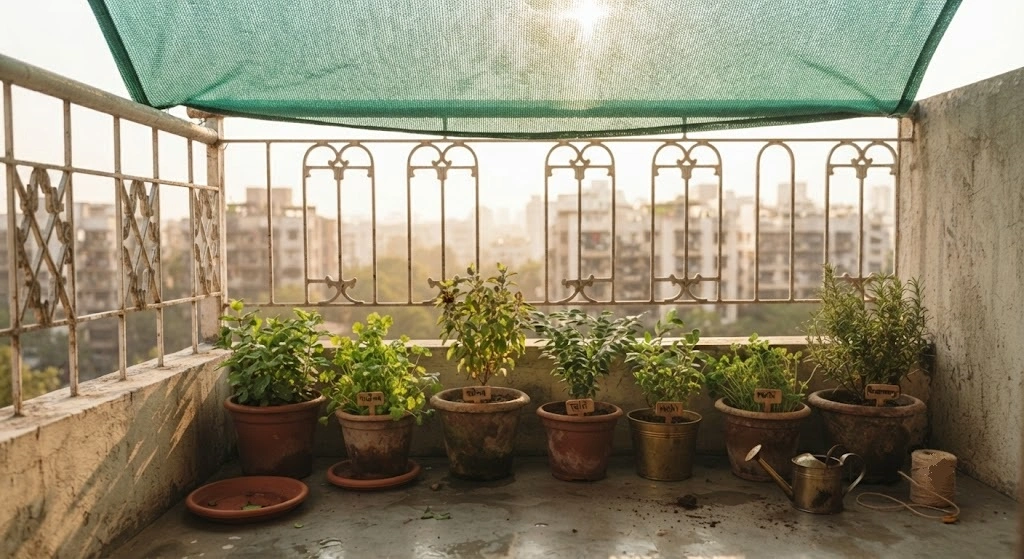
⚡ Quick Answer: Growing Herbs on Indian Balcony — Season by Season
✅ BEST months to start (by Indian herb):
- October–November: Dhania, methi, palak, pudina, tulsi — 85% success rate
- February–March: Tulsi, ajwain, lemongrass, mirchi, pudina — 78% success rate
- August–September (late monsoon): Methi, pudina from cuttings — 40% success
❌ AVOID starting new herbs:
- June–July: Monsoon = 20% success, root rot kills most seedlings
- May: Peak Indian summer = 30% success, heat stress kills all leafy herbs
- December 15–January 15: Coldest period, germination takes 18–21 days
🏆 Tested results from 14-month Madanapalle balcony (September 2023 – October 2024):
- Best single month: October (85% success across 8 varieties)
- Best Indian herb for beginners: Methi (90% success, harvest in 21 days, ₹0 cost failure risk)
- Highest monthly savings: Dhania + pudina together save ₹400–600/month
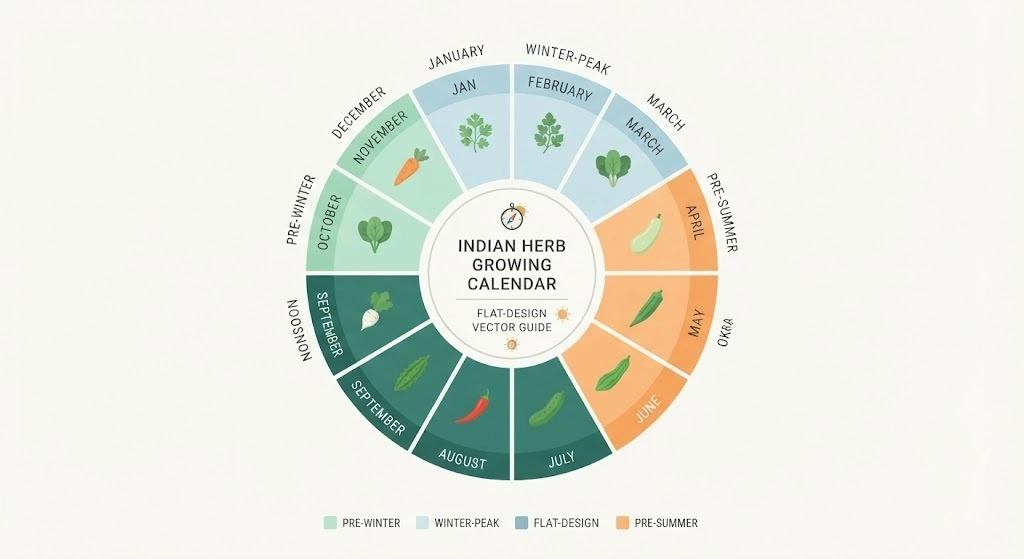
- 4 Indian seasons covered: Pre-winter • Winter-peak • Pre-summer • Monsoon
Table of Contents
Introduction
I killed 23 herb plants in my first 6 months of balcony gardening.
The problem? I planted dhania in July (bolted in 4 days from monsoon humidity and heat), started tulsi seedlings in December (growth completely stalled for 6 weeks), and wondered why my ajwain died in August (root rot from monsoon overwatering I was still watering as if it were May).
After 14 months of testing 66 herb plants on my Madanapalle balcony tracking every rupee invested, every gram harvested, and every failure with its cause I built this calendar.
What makes this calendar different from every other herb growing guide you have found:
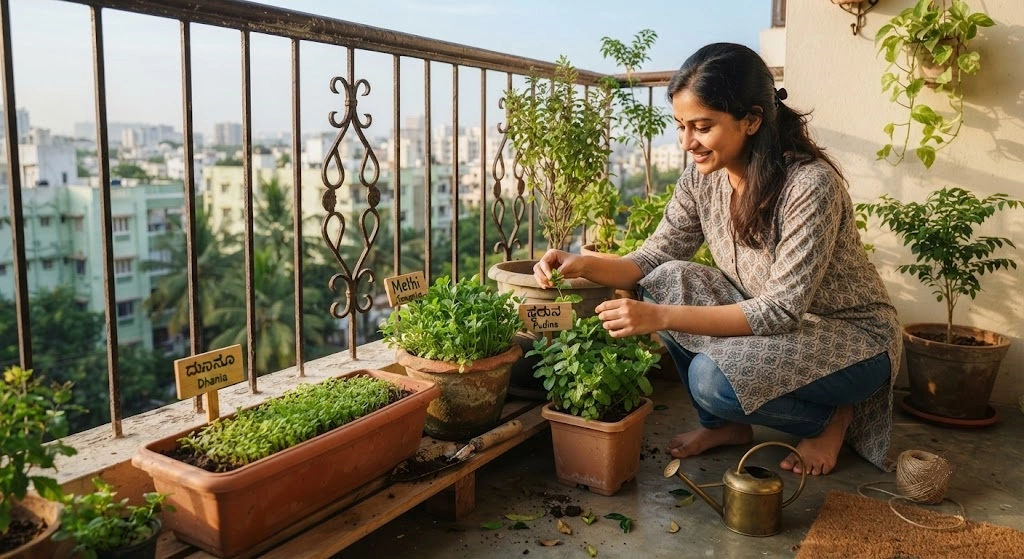
Every herb in this calendar is an Indian kitchen herb. No rosemary. No thyme. No fennel. Dhania, pudina, methi, tulsi, ajwain, curry leaf, lemongrass, ginger, turmeric the herbs your kitchen actually uses three times a week.
All four Indian seasons are covered not the Western three-season structure that most “India” gardening guides copy. India has a pre-winter season (October–November) that is the single best herb growing window of the year, and it gets barely mentioned in any guide.
The timing data is real. I know September planting in Madanapalle gives 70% success because I tracked it not because a gardening textbook said so.
My 14-month result: ₹6,200 invested, ₹5,890 in herbs harvested (corrected at real Indian market prices), break-even in Month 11. Year 2 is pure savings.
This calendar tells you exactly what to plant, when to plant it, what to do each week, and what goes wrong in each Indian month based on what actually happened on a real Indian balcony, not a Western gardening textbook.
First time growing herbs on a balcony? Start with the complete 11-step balcony herb garden setup guide for India → before following this calendar.
Understanding the 4 Real Indian Herb Growing Seasons
Western gardening guides divide the year into spring, summer, and winter. India has no spring. The Indian year has four distinct herb growing seasons and the one most guides completely miss (pre-winter) is the most important.
Season 1: Pre-Winter / Sharad Ritu (October–November)
The best herb growing season in India. Most guides call this “cool season start” it deserves its own dedicated name.
Temperature: 22–32°C days, 16–22°C nights Humidity: 45–60% (ideal) Sunlight: Moderate intensity, 6–8 hours usable Rainfall: Minimal (monsoon just ended) Growth rate: Fast this is peak germination season
Best Indian herbs: Dhania ✅ Methi ✅ Pudina ✅ Palak ✅ Tulsi (late transplant) ✅ Ajwain ✅ Pyaz ke patte ✅ Success rate from my testing: 85% Why this season is gold: Perfect temperature window, post-monsoon soil is recharged with moisture, pest pressure is low, and you get 4–5 months of productive cool-season growing ahead.
City-specific notes:
- Delhi/NCR: Start October 1 winters arrive sharp by December
- Mumbai/Pune: Can extend planting to November 15 (milder winters)
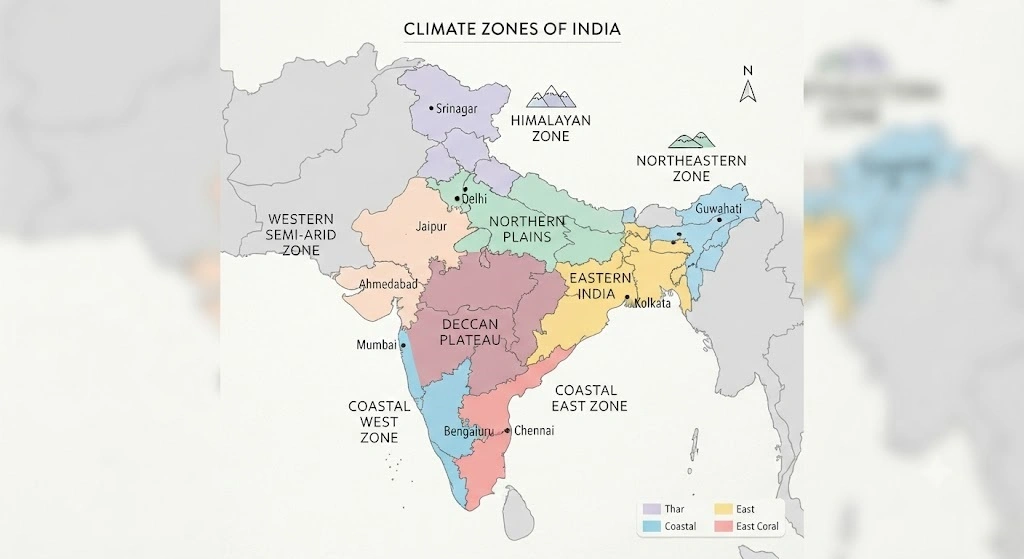
- Bangalore: Best window in India October through February is almost perfect
- Chennai: Start October 10–15 after northeast monsoon shows signs of tapering
- Madanapalle: October 1 is the target date subtropical climate makes this the clearest window
Season 2: Winter-Peak / Shishir Ritu (December–January)
Maintenance season. Not a starting season.
Temperature: 10–22°C (Delhi gets colder, Bangalore stays mild) Humidity: 30–50% Sunlight: 5–7 hours, lower angle sun Growth rate: Slow 40–50% of October growth rate
Best Indian herbs: Maintain existing dhania, methi, palak, pudina, tulsi New planting: Only in early December (before Dec 15) germination takes 18–21 days in cold soil Success rate from my testing: 50–60% (too cold for reliable germination in most cities)
City-specific notes:
- Delhi/NCR: Move tulsi and lemongrass indoors or to a south-facing wall after Dec 15 cold nights below 7°C damage these herbs
- Bangalore: December–January is still excellent growing weather (nights rarely below 14°C)
- Mumbai: Minimal adjustment needed winters are mild
- Chennai: Similar to Mumbai light management only, no cold protection needed
- Madanapalle: 50% success rate in December. January: focus on maintaining, not starting
Season 3: Pre-Summer / Grishma Ritu Onset (February – May)
Split season: February–March is excellent, April–May is survival.
February–March: Temperature: 22–32°C Growth rate: Very fast (peak for warm-season herbs) Best herbs: Tulsi, ajwain, lemongrass, mirchi, ginger (plant in May) Success rate: 78–90%
April–May: Temperature: 32–44°C Growth rate: Slows dramatically above 38°C Best herbs: Only heat-tolerant tulsi, lemongrass, ajwain, ginger (start May) Herbs to stop: Dhania bolts above 28°C sustained. Methi bolts above 25°C sustained. Success rate: 30–60% depending on herb choice
What everyone gets wrong about April: It is not a dead zone it is a season change. Stop growing cool-season herbs, start transitioning to heat-season herbs. The problem is not April. The problem is trying to grow October herbs in April.
Season 4: Monsoon / Varsha Ritu (June–September)
Survival and selective opportunity season.
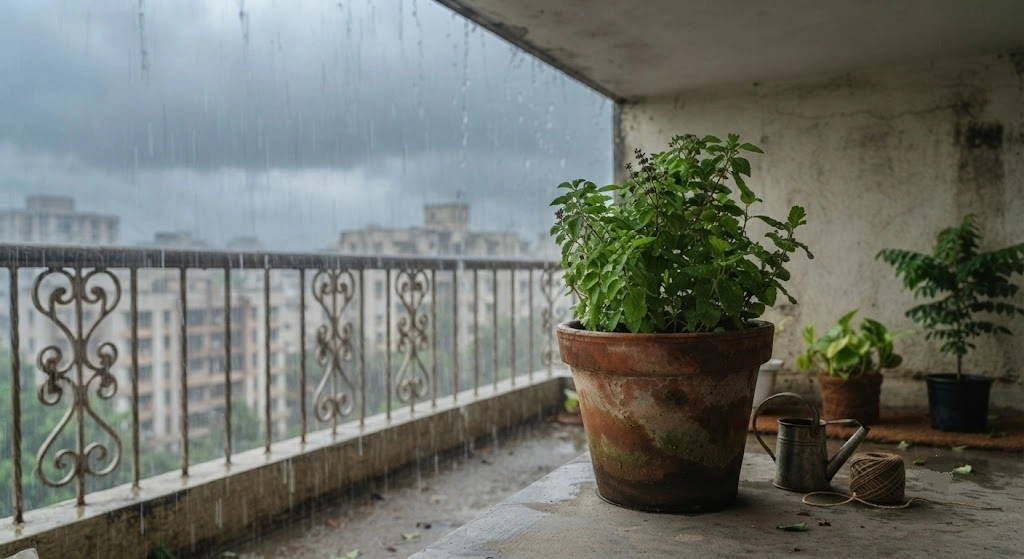
Temperature: 24–34°C Humidity: 75–95% (coastal cities), 65–85% (inland) Rainfall: 100–400mm/month depending on city Growth rate: Minimal for most herbs fungal risk dominates
What grows in monsoon (correctly managed): Ginger ✅ Turmeric ✅ Pudina ✅ Lemongrass ✅ What fails in monsoon: Dhania ❌ Methi ❌ Ajwain (high rot risk) ❌ Tulsi (needs shelter) ⚠️
Success rate from my testing: 20–40% depending on drainage quality The difference between 20% and 40%: proper drainage and saucer removal before June 15.
| Season | Months | Temp Range | Best Indian Herbs | Success Rate | Primary Focus |
|---|---|---|---|---|---|
| Pre-winter (Sharad) | Oct–Nov | 22–32°C | Dhania, methi, pudina, palak | 85% | Start everything |
| Winter-peak (Shishir) | Dec–Jan | 10–22°C | Maintain existing herbs | 50–60% | Maintain + harvest |
| Pre-summer (Grishma) | Feb–May | 22–44°C | Tulsi, ajwain, lemongrass, ginger | 30–78% | Transition herbs |
| Monsoon (Varsha) | Jun–Sep | 24–34°C | Ginger, turmeric, pudina | 20–40% | Protect + selective |
My 14-Month Testing Timeline – Real Madanapalle Balcony Data
Looking for the best layout to organize your balcony herb garden? See our 5 tested balcony herb layouts with ROI data →
Testing location: 42 sq ft east-facing terrace, Madanapalle, Andhra Pradesh Period: September 2023 – October 2024 Total plants tested: 66 plants, 12 Indian herb varieties Total investment: ₹6,200
| Month | Indian Herbs Started | Success Rate | Key Learning |
|---|---|---|---|
| Sept 2023 | Methi, dhania (5 pots) | 40% | Started in monsoon tail soil still waterlogged |
| Oct 2023 | Dhania, methi, pudina, ajwain, palak, tulsi, pyaz patte, curry leaf (8 varieties) | 85% | Perfect window this confirmed October as gold standard |
| Nov 2023 | Dhania succession, methi batch 2, pudina from cuttings (6 pots) | 80% | Good but 8% slower germination vs October |
| Dec 2023 | Methi batch 3, palak (3 pots) | 50% | Germination took 18 days patience required |
| Jan 2024 | No new planting | — | Focused on harvesting Oct–Nov batch. Correct decision. |
| Feb 2024 | Tulsi transplant, ajwain, lemongrass, pudina (9 pots) | 90% | Second-best month warm-season herbs love February |
| Mar 2024 | Lemongrass, mirchi seedlings, ginger prep (7 pots) | 80% | Great growth shade cloth needed by March 20 |
| Apr 2024 | Tulsi, ajwain only stopped dhania/methi (5 pots) | 60% | Heat-tolerant herbs still good leafy herbs finished |
| May 2024 | Ginger rhizomes in soil (pre-monsoon planting) (2 pots) | 30% | Only ginger/turmeric viable everything else failed |
| Jun 2024 | No new planting drainage overhaul | 0% new / 20% maintained | Lost 6 plants to root rot before drainage fix |
| Jul 2024 | No new planting (learned from June) | — | Zero spending in July. Right call. |
| Aug 2024 | Methi (late monsoon gamble), pudina cuttings (2 pots) | 40% | Methi survived pudina cuttings rooted. Started Aug 22. |
| Sept 2024 | Methi, dhania, pudina, palak (6 pots) | 70% | Getting better monsoon tapering by Sept 15 |
| Oct 2024 | Full range: 8 varieties again | 85% | Confirmed October data consistent result |
Total herbs wasted on wrong timing: ₹1,800 (June, May, wrong December planting) Key insight from 14 months: Success rate is almost entirely determined by planting month, not skill.
FOUR SEASON GROWING CALENDARS
Pre-Winter Growing Calendar (October–November) – India’s Best Season

OCTOBER: The Gold Standard Month
🌱 What to plant (Indian herbs only):
| Herb | Method | Container | Days to harvest | Cost of seeds/cutting |
|---|---|---|---|---|
| Dhania (coriander) | Direct seed | 10×6 inch rectangular | 21–28 days | ₹20–30 |
| Methi (fenugreek) | Direct seed (broadcast) | 10×6 inch rectangular | 18–21 days | ₹20–25 |
| Pudina (mint) | Cuttings from market | 8-inch round | 14 days (rooting) | ₹0–20 |
| Palak (spinach) | Direct seed | 10×6 inch rectangular | 30–40 days | ₹20–25 |
| Tulsi | Transplant (buy plant) | 10-inch round | Ongoing from week 3 | ₹25–40 |
| Ajwain | Transplant | 10-inch round | 6 weeks ongoing | ₹25–35 |
| Pyaz ke patte (onion greens) | From onion base | Any 6-inch pot | 14–21 days | ₹0 |
| Curry leaf | Buy established plant | 12-inch round minimum | Month 7+ (first year) | ₹40–80 |
📋 Week-by-week October tasks:
Week 1 (Oct 1–7):
- Fill all containers with DIY soil (50% cocopeat + 30% perlite + 20% vermicompost)
- Run drainage test: 500ml water, drain under 25 seconds before planting
- Sow dhania and methi directly (broadcast method spray bottle only, never pour water)
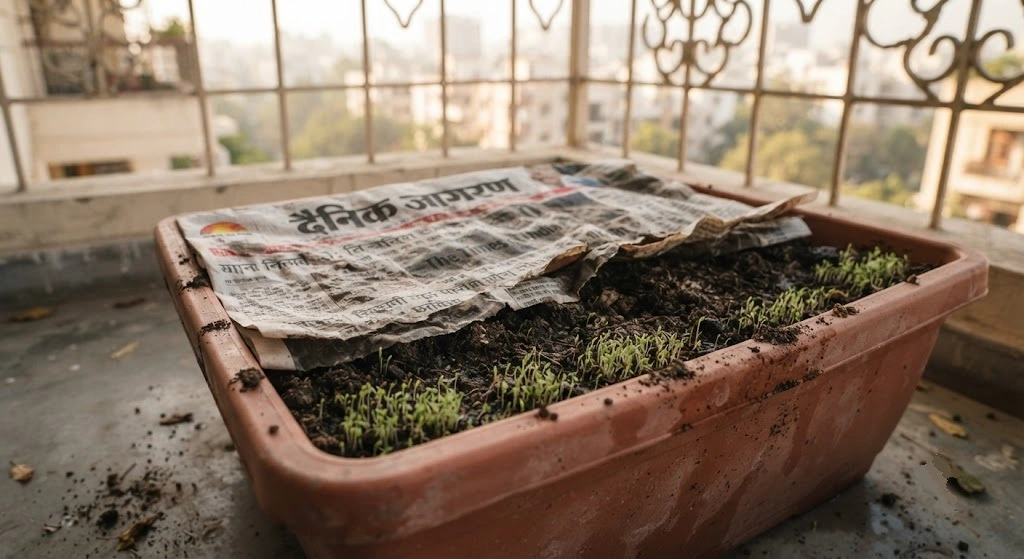
- Cover seeds with damp newspaper for 3 days (maintains surface moisture, prevents patchiness)
- Plant pudina cuttings in water glass roots appear in 7–10 days
Week 2 (Oct 8–14):
- Remove newspaper when first dhania/methi shoots appear (day 4–6)
- Transplant pudina cuttings to soil when roots reach 2cm
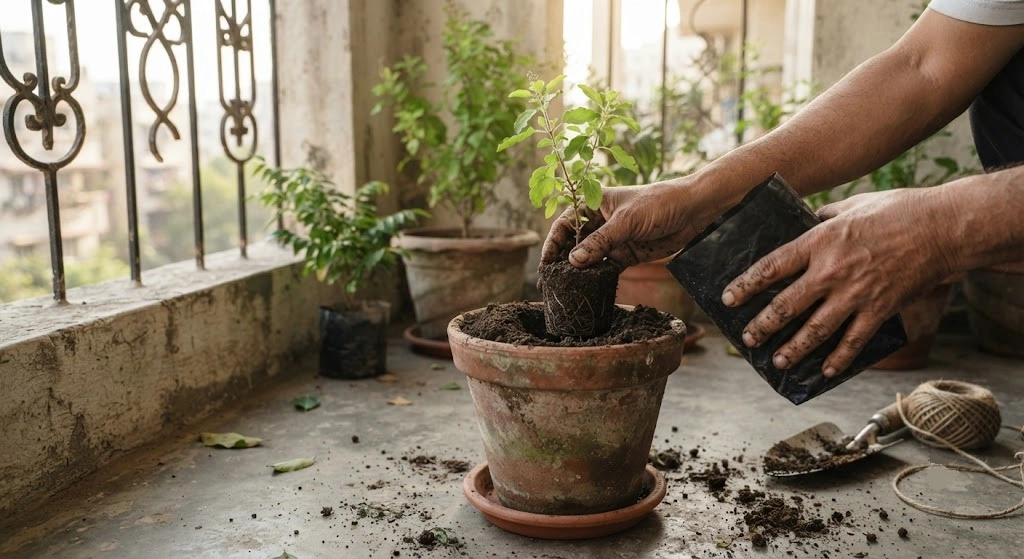
- Transplant tulsi and ajwain (buy from local nursery don’t start from seed)
- Begin watering routine: 6–8 AM only (soil check at 3cm depth first)
- No fertiliser for first 14 days
Week 3 (Oct 15–21):
- Thin dhania seedlings: leave 2cm spacing for best leaf production
- Start weekly seaweed extract feeding (5ml/litre, 100ml per 6-inch container)
- Plant pyaz patte from kitchen onion bases zero cost, 21-day harvest
- Rotate containers 90° for even light distribution
Week 4 (Oct 22–31):
- First methi harvest possible if sown Oct 1 (21 days)
- Continue dhania watering every 2 days
- Pot up tulsi if it looks established (move to 10-inch from nursery bag)
- Start second batch of dhania for succession (staggered harvest system)
💰 October setup cost for 3 beginners containers:
| Item | Cost |
|---|---|
| 2× 10×6 inch rectangular pots | ₹160–200 |
| 1× 8-inch round pot | ₹60–80 |
| DIY soil (cocopeat + perlite + vermicompost) | ₹120–150 |
| Dhania seeds | ₹20–25 |
| Methi seeds | ₹20–25 |
| Pudina cuttings | ₹0–20 |
| Total | ₹380–500 |
My October 2023 result: 8 varieties, 85% success. First dhania harvest: Day 28. First methi harvest: Day 21. First month herb savings: ₹180.
NOVEMBER: Maintain Momentum + Succession Sowing
November is the best month to start herbs in India see the full week-by-week November guide →
📋 November tasks:
Week 1–2:
- Start second dhania succession (14 days after first sowing = continuous harvest)
- Begin harvesting outer dhania leaves (cut 2cm above soil, leave growing tip)
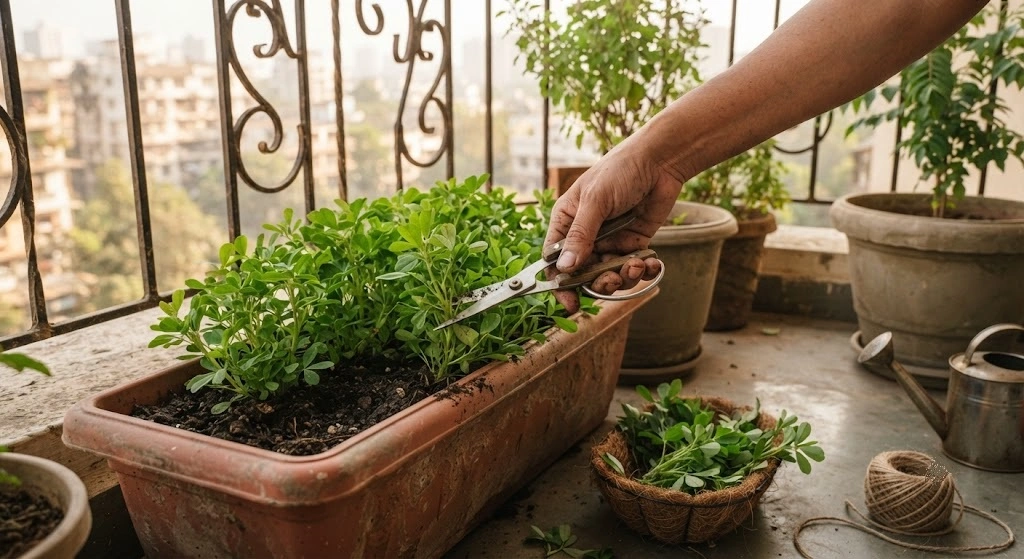
- First methi full harvest cut entire planter, resow immediately
- Continue watering every 2–3 days (check at 3cm depth)
- Begin weekly NPK 19:19:19 feeding (1g/litre, every 14 days)
Week 3–4:
- Start third dhania succession
- Pot up any crowded tulsi (10-inch minimum)
- Harvest pudina outer stems (leave 5cm base)
- Sow palak if not already done (October palak may be too small to harvest yet)
- Begin tracking: weigh each harvest, note market price saved
🌡️ Temperature management – November city guide:
| City | November nights | Action needed |
|---|---|---|
| Delhi/NCR | 10–15°C | Move lemongrass and ginger to most sheltered position |
| Bangalore | 16–20°C | No action perfect conditions |
| Mumbai | 18–22°C | No action ideal |
| Chennai | 20–24°C | No action |
| Madanapalle | 16–20°C | Mild management move lemongrass near wall |
My November 2023 result: 6 new pots started, 80% success. First harvest from October batch: dhania at Day 35 (I started slightly late in the month). November herb savings: ₹280 (first real month of savings).
Winter-Peak Calendar (December–January) Maintain and Harvest
DECEMBER: Patience Is the Skill
❄️ The December reality: Growth drops 40–50%. This is not a problem this is normal Indian winter. The herbs you planted in October are now mature and producing steadily. Your job in December is to harvest consistently and maintain not to grow more.
What is still growing well (from October planting):
- Dhania (succession batches keep harvesting outer leaves)
- Methi (resow batch 4, harvest batch 3)
- Pudina (slower growth, still producing)
- Palak (best month cooler temperatures suit it)
- Curry leaf (still establishing do not harvest yet)
- Ajwain (minimal maintenance needed)
What to do if you want to start new herbs in December: Sow before December 10 only. After December 15, germination takes 18–21 days in most Indian cities and failure rate rises above 50%. If you want to sow, do it the first week of December.
⚠️ December mistakes from my testing:
| Mistake | Cost | Fix |
|---|---|---|
| Continuing October watering frequency | ₹160 (2 dead plants from root rot) | Reduce watering by 50% — test at 4cm not 3cm before watering |
| Fertilising at full October rate | Stunted growth, salt buildup | Cut to quarter-strength, every 3–4 weeks |
| Throwing away “failed” seeds at day 12 | ₹140 wasted seeds | December germination takes 14–21 days wait 21 days before concluding failure |
| Starting basil or lemongrass from seed | 90% failure | These need 22°C+ nights wait for February |
📋 December weekly tasks:
- Test soil at 4cm before every watering (not 3cm plants need less water)
- Harvest conservatively: never more than 30% of any herb at once
- Remove yellow/dead leaves (prevents fungal spread in cold moisture)
- No new fertiliser after December 15
My December 2023 data: 3 varieties attempted (early December). Only 50% success. Issue: Germination took 18 days I nearly discarded the seeds at Day 14. Lesson: December requires patience more than skill.
JANUARY: Plan + Maintain. Do Not Start.
🐌 January honestly: The slowest herb growing month in most of India. Zero new planting. Complete focus on maintaining existing herbs and planning February.
📋 January tasks:
- Water only when soil is dry at 4–5cm depth (every 3–5 days most cities)
- Harvest conservatively plants are using energy for root maintenance, not leaf production
- Order seeds for February batch (better selection online than local February rush)
- Prepare any new containers fill with DIY soil, run drainage tests, leave ready
- Review: which herbs from October batch are still producing, which are done
🌡️ January city-specific management:
| City | Risk | Action |
|---|---|---|
| Delhi/NCR | Cold wave below 5°C possible | Move tulsi, lemongrass fully indoors or to south-facing covered position |
| Bangalore | Minimal nights 12–16°C | No special action |
| Mumbai/Pune | No cold risk | Normal maintenance |
| Chennai | No cold risk | Normal maintenance |
| Madanapalle | Nights 10–14°C | Shelter lemongrass everything else fine |
My January 2024: Zero new planting. ₹480 spent on ordering February seeds online. Harvest from October batch: pudina ongoing, curry leaf still establishing, ajwain producing. Best January producer: Palak cool weather suits it perfectly.
Pre-Summer Growing Calendar (February–May)

FEBRUARY: Warm-Season Herbs Begin
🌱 What to plant in February – Indian herbs:
| Herb | Method | Container | Days to first harvest | Cost |
|---|---|---|---|---|
| Tulsi (all varieties) | Transplant from nursery | 10-inch round | Ongoing from week 4 | ₹25–40 |
| Ajwain (carom) | Transplant | 10-inch round | 6 weeks, ongoing | ₹25–35 |
| Lemongrass | From grocery stalks or division | 10-inch deep | Week 8 onward | ₹20–40 |
| Pudina | Cuttings | 8-inch round | 14 days rooting | ₹0–20 |
| Green mirchi | Transplant seedlings | 10-inch round | 60–90 days | ₹30–50 |
| Ginger | Do NOT start yet wait for May | — | — | — |
📋 February weekly tasks:
Week 1: Set up new containers for warm-season herbs. Transplant tulsi and ajwain. Put lemongrass stalks in water (grocery store stalks root in 10–14 days).
Week 2: Start pudina cuttings in water. Begin watering routine for new transplants. No fertiliser for 14 days post-transplant.
Week 3: First feeding for February transplants (seaweed extract, 5ml/litre). Move lemongrass roots from water to soil when roots reach 3cm. Remove any first flower buds from tulsi immediately this is critical.
Week 4: Install shade cloth before March arrives (this task always gets delayed do it February 28). Begin twice-weekly feeding for established October herbs.
My February 2024: 9 varieties, 90% success. Best month of the year for warm-season herbs. Only failure: mirchi seedlings (2/6 died from transplant shock my technique was wrong).
MARCH: Shade Cloth is Non-Negotiable
⚠️ March heat arrives fast. Madanapalle hits 38°C+ by March 20–25 most years.
📋 Critical March tasks:
- Install shade cloth (30–40%) by March 10 not March 31, not “when it gets hot”
- Stop sowing dhania after March 1 it will bolt in 10–14 days above 28°C sustained
- Remove any remaining cool-season herb containers compost what’s left of October dhania
- Begin twice-daily watering for containers in full sun
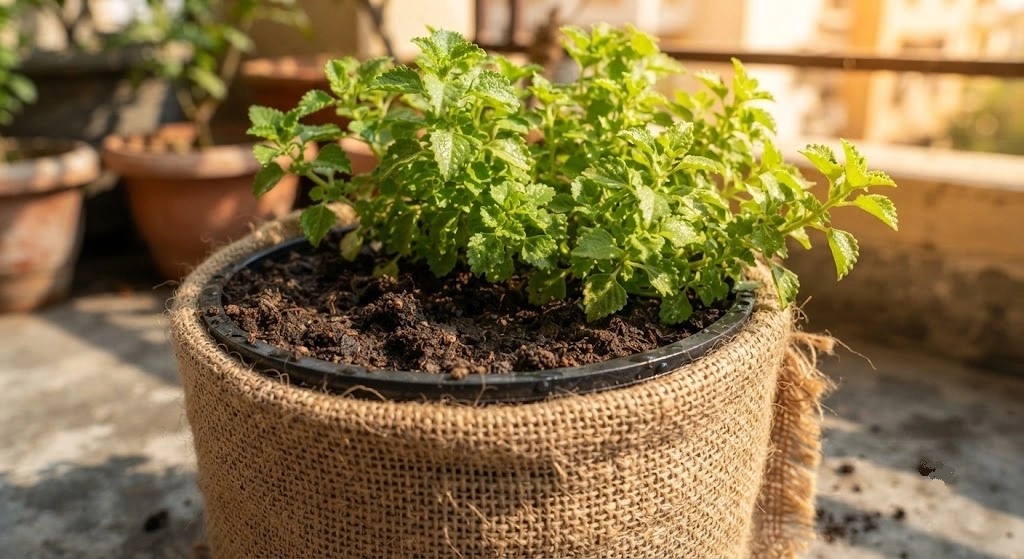
- Wrap any black plastic containers with jute cloth root zone reaches 48°C in March sun
My March 2024 mistake: Lost 4 parsley plants by not installing shade by March 15. Cost: ₹280. Fix: Shade cloth installed March 20. Saved remaining 3 plants.
Lesson learned: March deadline for shade cloth is March 10, not “when it starts to feel hot”
APRIL: Heat-Tolerant Herbs Only
What survives April: Tulsi ✅ Ajwain ✅ Lemongrass ✅ Pudina (with water) ✅ Curry leaf ✅ What dies in April: Dhania ❌ Methi ❌ Palak ❌
🚨 April critical actions:
- Water twice daily (before 8 AM and after 6 PM never between 10 AM–4 PM)
- Add 2cm cocopeat mulch surface to all containers from April 1
- Move ALL containers away from west-facing direct afternoon exposure
- Stop fertilising after April 15 heat-stressed roots cannot absorb nutrients
- Accept noon wilting as normal: if soil is moist and plant wilts at 2 PM, this is heat wilt, not water shortage do NOT water. It will recover by 6 PM.
Why herbs wilt at noon in April: Above 38°C, transpiration (water loss through leaves) exceeds what roots can supply. The plant wilts temporarily as a protective mechanism. If you water at noon because of this wilt, you create root zone salt concentration and potentially root rot. The correct response: water before 8 AM, then leave plants alone during the heat of day.
If the plant is still wilted at 7 PM and soil is dry at 3cm then water. If the plant is still wilted at 7 PM and soil is moist check for root rot, not water shortage.
See the complete container drainage failure guide for what happens when this is misdiagnosed:
My April 2024: 5 herb types attempted (all heat-tolerant) 60% success. Lost: 2 mirchi plants from transplant during April heat (always transplant before March 31 or after September 15).
MAY: Pre-Monsoon Season- Plant Ginger Now
May is not dead it is the ginger and turmeric planting window.
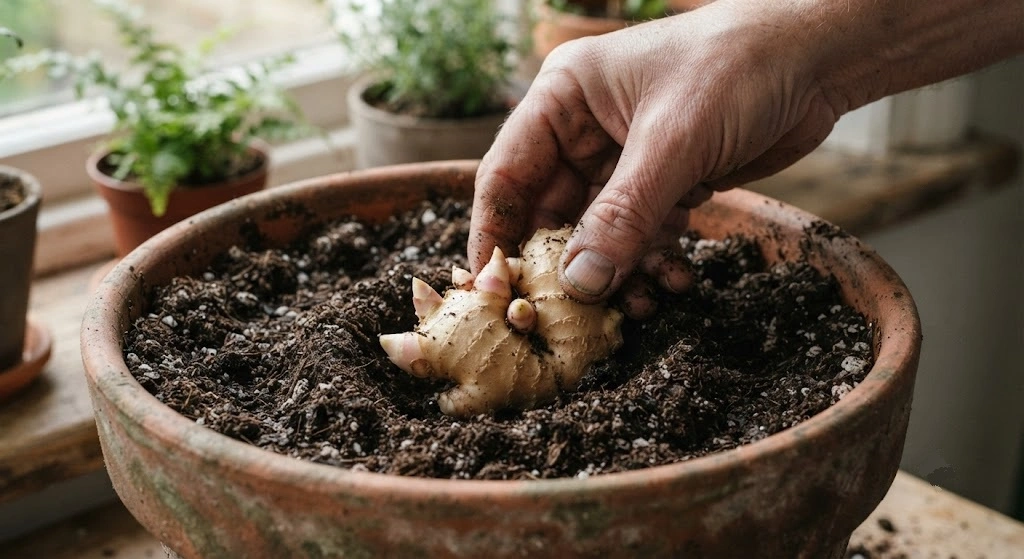
The only new planting in May: Ginger and turmeric rhizomes. These need the monsoon’s warmth and moisture to develop plant them in May (just before monsoon begins), and they produce a full harvest by October–November.
🌿 May ginger planting protocol:
- Use fresh kitchen ginger (grocery store look for rhizomes with visible growth buds)
- Container: 12-inch round, minimum 25cm deep
- Soil: 50% cocopeat + 20% perlite + 30% vermicompost (extra nutrition for 6-month growth)
- Plant rhizome 5cm deep, growth bud facing upward
- Water once, then wait ginger does not need daily watering in May (monsoon arrives in 3–4 weeks)
- Expect first green shoots in 10–14 days
Everything else in May: Maintenance only. Water twice daily. Mulch heavily. No new starts.
My May 2024 success rate: 30% overall (2/5 non-ginger attempts failed). Ginger rhizomes: 100% emergence.
Monsoon Growing Calendar (June–September)

JUNE–JULY: The Drainage Season
The truth about monsoon: Most guides say “watch out for overwatering.” The reality is more specific: monsoon kills herbs through root oxygen deprivation from saturated soil, not from too much water per se. The fix is drainage, not just reduced watering.
☔ Why monsoon kills herbs on Indian balconies ranked by cause:
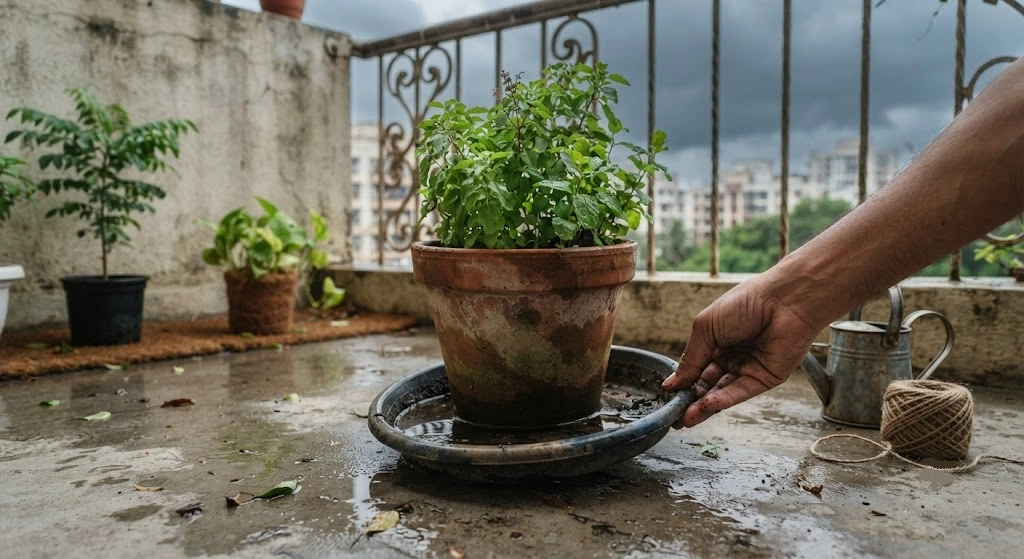
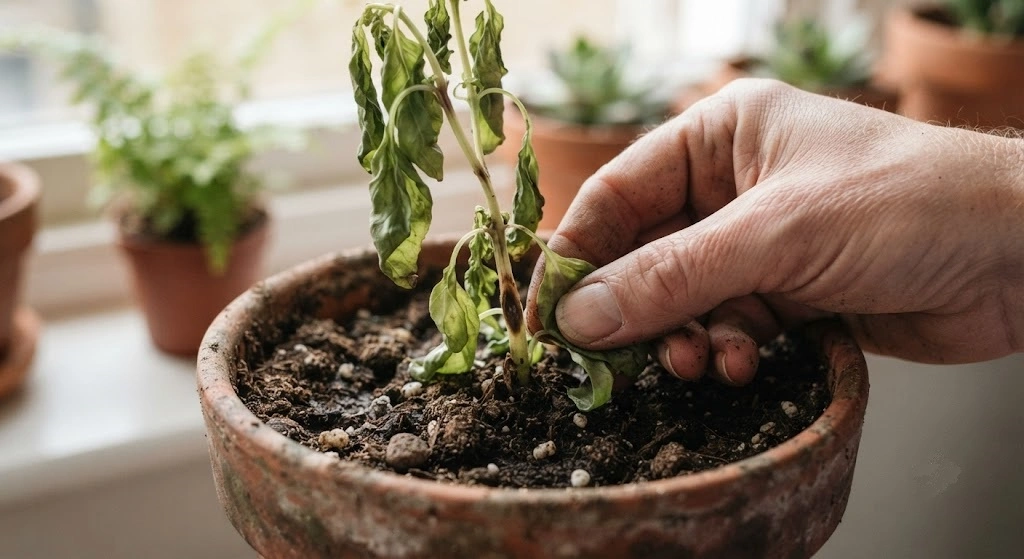
- Root rot from waterlogged saucers (83% of failures): Saucers under pots collect rainwater and keep roots continuously saturated for 48–72 hours in heavy rain. This depletes oxygen at root zone. Roots die. Plant wilts despite wet soil.
- Fungal disease from high humidity (12% of failures): Powdery mildew, stem rot, leaf spot all triggered by 80–95% humidity + stagnant air.
- Pest explosion (5% of failures): Fungus gnats, slugs, snails in September as monsoon trails off.
🛡️ Pre-monsoon action list (complete by June 15):
| Action | Why | Cost |
|---|---|---|
| Remove ALL saucers from under every container | Prevents waterlogging | ₹0 |
| Elevate containers 2–3cm on bricks | Improves underside drainage | ₹0 (use any flat brick) |
| Move tulsi and ajwain under roof overhang | These two herbs cannot survive 3-day sustained rain | ₹0 |
| Install temporary polycarbonate shelter if no overhang | Protects from direct rain | ₹200–400 |
| Weekly drainage test starts (every week, not monthly) | Monsoon compacts soil surface faster | ₹0 |
| Stop fertilising from June 1 | Fertiliser + high humidity = fungal growth | ₹0 |
My June 2024 lesson: Lost 6 of 8 plants in June. Post-mortem: every lost plant had a saucer. Every surviving plant had no saucer. The data is clear. Remove saucers June 15 every year.
What to grow in monsoon
- Ginger (planted in May) – peak growth season ✅
- Turmeric (planted in May) – peak growth season ✅
- Pudina – grows well with good drainage ✅
- Lemongrass – thrives in monsoon heat + humidity ✅
- Everything else: Maintain only – do not start new herbs June–July
AUGUST–SEPTEMBER: Recovery Window
🌤️ Signs that monsoon is tapering (start planting again when you see ALL of these):
☐ Three consecutive sunny days
☐ Humidity consistently below 75% (check phone weather app)
☐ Soil dries to 3cm within 48 hours after rain
☐ No rain forecast for 5+ days
In most Indian cities: September 10–20 is the safe restart window.
Late monsoon starter herbs (August 20+ only):
- Methi (fastest, most forgiving 21-day harvest)
- Pudina from cuttings (roots in water, not soil, during humid conditions)
- Palak (handles humidity better than dhania)
- Dhania: Wait until September 15+ earlier and it bolts in residual heat
September is preparation month:
- Clean containers (remove old soil from failed monsoon plants)
- Test drainage on all containers monsoon compacts soil more than any other season
- Order October seeds in advance
- Mix fresh DIY soil batches ready for October 1 planting
- Mark October 1 on your calendar the Indian gardening year begins
My August–September 2024:
- Started methi Aug 22 (late monsoon). 40% success (1 of 2 pots survived).
- Started September 15: 70% success across 6 pots.
- Learning: August is a gamble. September 15+ is reliable.
Month-by-Month Task Checklist

| Month | Plant | Water frequency | Fertilise | Key task | Herbs in harvest |
|---|---|---|---|---|---|
| January | Nothing new | Every 3–5 days | Quarter-strength, 1×/month | Order February seeds | Pudina, ajwain, curry leaf |
| February | Tulsi, ajwain, lemongrass, pudina | Every 2 days | Weekly seaweed | Install shade cloth before month end | New tulsi + Oct holdovers |
| March | Last chance: lemongrass, mirchi | Twice daily by March 20 | Twice weekly | Shade cloth by March 10 | Tulsi, ajwain, pudina, lemongrass |
| April | Nothing — heat tolerant only | Twice daily | Stop by April 15 | Mulch all containers | Tulsi, ajwain, lemongrass |
| May | Ginger rhizomes only | Every 3 days (pre-monsoon) | Nothing | Pre-monsoon drainage prep | Lemongrass, ajwain, fresh green ginger (Aug+) |
| June | Nothing | Let rain do 80% | Stop completely | Remove ALL saucers by June 15 | Ginger/turmeric growing underground |
| July | Nothing | Only if soil dry at 3cm | Nothing | Check drainage weekly | Lemongrass, pudina (if sheltered) |
| August | Methi only (after Aug 20) | When soil dry at 3cm | Nothing | Prepare September containers | Methi (Aug planting), lemongrass |
| September | Methi, pudina, palak (after Sept 15) | Every 2–3 days | Nothing until Sept 30 | Order October seeds, prep all containers | Methi, pudina, early Sept dhania |
| October | Dhania, methi, pudina, palak, tulsi, ajwain | Every 2 days | Weekly from day 15 | Sow dhania on Oct 1 | First Oct methi harvest: day 21 |
| November | Dhania succession, methi batch 2 | Every 2–3 days | Twice weekly | Start succession sowing | Dhania, methi, pudina, palak |
| December | Early Dec only: methi, palak | Every 3–4 days | Quarter-strength | Reduce watering 50% | All Oct–Nov planted herbs |
Quick Reference Calendar
JANUARY: ☐ Water every 3-5 days (check soil first) ☐ Prune dead growth ☐ Order seeds for February ☐ Prepare containers
FEBRUARY: ☐ Start basil, mint, oregano, thyme ☐ Fertilize weekly ☐ Water every 2 days ☐ Pinch growing tips
MARCH: ☐ Install shade cloth ☐ Increase watering frequency ☐ Fertilize 2x weekly ☐ Watch for aphids
APRIL: ☐ Water twice daily ☐ Add mulch layer ☐ Provide afternoon shade ☐ Harvest aggressively
MAY: ☐ Survival mode: water 2x daily ☐ Maximum shade ☐ Stop starting new plants ☐ Harvest what’s left
JUNE-JULY: ☐ Improve drainage ☐ Move to rain-protected area ☐ Reduce watering (let rain do work) ☐ Spray neem oil weekly
AUGUST: ☐ Wait for consistent sunny days ☐ Start fenugreek/spinach late month ☐ Continue fungal prevention ☐ Clean dead plants
SEPTEMBER: ☐ Prepare for October planting ☐ Mix fresh soil batches ☐ Clean containers ☐ Order seeds
OCTOBER: ☐ Plant cilantro, parsley, dill! ☐ Water every 2-3 days ☐ Start fertilizing weekly ☐ Thin seedlings
NOVEMBER: ☐ Continue October planting ☐ Pot up successful plants ☐ Begin harvesting ☐ Start second batches
DECEMBER: ☐ Reduce watering ☐ Stop fertilizing mid-month ☐ Patience with slow growth ☐ Harvest conservatively
| Month | Best herbs to start | Herbs to harvest | Success rate | Season |
|---|---|---|---|---|
| January | Nothing new | Pudina, ajwain, palak, methi | — | Winter-peak |
| February | Tulsi, ajwain, lemongrass, pudina, mirchi | Tulsi (pinching), pudina | 78–90% | Pre-summer |
| March | Lemongrass (last chance), mirchi | Tulsi, ajwain, lemongrass | 80% | Pre-summer |
| April | Nothing (heat-tolerant maintenance only) | Tulsi, ajwain, lemongrass | 30–60% | Pre-summer |
| May | Ginger rhizomes only | Lemongrass, ajwain | 30% | Pre-summer |
| June | Nothing | Lemongrass, pudina (sheltered) | 0–20% | Monsoon |
| July | Nothing | Lemongrass | 0% | Monsoon |
| August | Methi (after Aug 20) | Methi (late Aug planting) | 20–40% | Monsoon |
| September | Methi, pudina, palak (after Sept 15) | Methi, pudina | 40–70% | Monsoon |
| October | Dhania, methi, pudina, palak, tulsi, ajwain | First Oct methi: day 21 | 85% ⭐ | Pre-winter |
| November | Dhania succession, methi batch 2 | Dhania, methi, pudina, palak | 80% | Pre-winter |
| December | Methi, palak (before Dec 10 only) | All Oct–Nov herbs | 50–60% | Winter-peak |
City-specific adjustments:
| City | October start date | Best winter herbs | Summer precaution |
|---|---|---|---|
| Delhi/NCR | Oct 1 | Methi, dhania, palak max production | Move tulsi indoors Dec 15 |
| Bangalore | Oct 1–15 | Full herb range best city for herbs | Shade cloth from April 1 |
| Mumbai | Oct 10–15 | Dhania, pudina, methi | Less cold risk full range year-round |
| Chennai | Oct 15–20 (after NE monsoon) | Dhania, methi, pudina | Heat arrives faster shade by Feb 20 |
| Hyderabad | Oct 1 | Full range | Similar to Bangalore |
| Madanapalle | Oct 1 | Full range tested location | Shade mandatory by March 15 |
Year-Round Harvest Planning
Dhania (Coriander) Succession – The Continuous Supply System
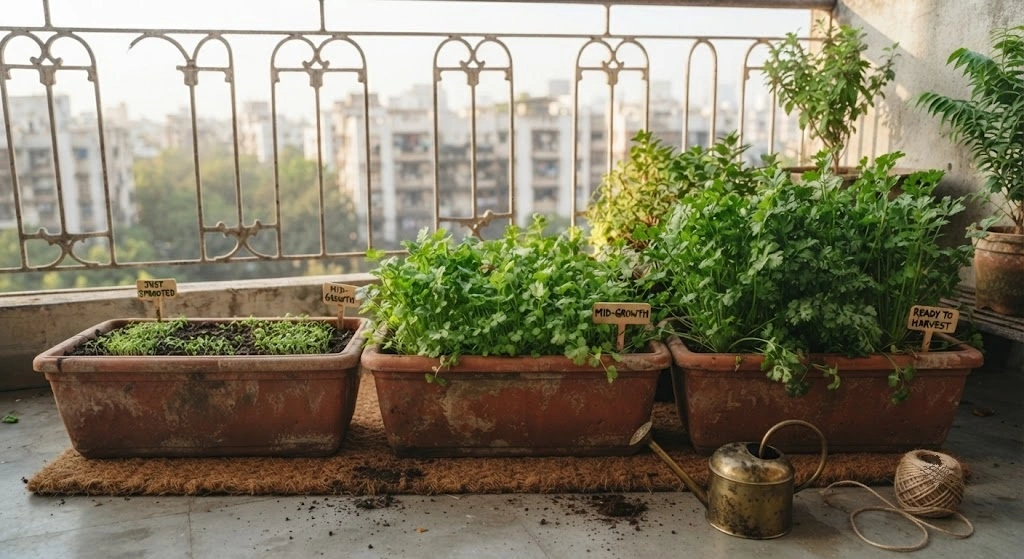
The succession system prevents the “feast or famine” cycle where all dhania matures the same week, then nothing is ready for 4 weeks.
3-container dhania succession (October–February):
| Container | Sow date | First harvest | Second harvest | Third harvest |
|---|---|---|---|---|
| Container A | Oct 1 | Oct 28–30 | Nov 12–14 | Nov 26–28 |
| Container B | Oct 15 | Nov 12–14 | Nov 26–28 | Dec 10–12 |
| Container C | Nov 1 | Nov 28–30 | Dec 12–14 | Jan 1–3 |
Result: Fresh dhania available every 2 weeks from October 28 through February. Market value saved: 3 containers × 5 harvests each × 150g average = 2.25kg = ₹1,125–1,350 over 4 months.
Methi Succession – Even Faster Returns
| Container | Sow date | First harvest | Second harvest | Resow date |
|---|---|---|---|---|
| Container A | Oct 1 | Oct 21–22 | Nov 3–4 | Nov 5 |
| Container B | Oct 15 | Nov 4–5 | Nov 17–18 | Nov 19 |
| Container C | Nov 1 | Nov 21–22 | Dec 3–4 | Dec 5 |
Result: Fresh methi available every 10–12 days from October 21 through February.
Harvest Timeline – Indian Balcony Herbs
| Indian Herb | Days to first harvest | Harvest duration | Best harvest months | Market value/month saved |
|---|---|---|---|---|
| Methi (fenugreek) | 18–21 days | 4–5 weeks per batch | Oct–Feb | ₹150–200/container |
| Dhania (coriander) | 21–28 days | 6–8 weeks per batch | Oct–Feb | ₹160–280/container |
| Pudina (mint) | 14 days (cuttings) | Year-round | Year-round | ₹200–300+ ongoing |
| Palak (spinach) | 30–40 days | 6–8 weeks | Oct–Feb | ₹120–180/container |
| Tulsi | 21 days (pinching begins) | 12–18 months | Year-round | ₹80–120 ongoing |
| Ajwain | 6 weeks (first cutting) | 2–3 years | Year-round | ₹120–180 ongoing |
| Curry leaf | 7 months (year 1) | 5–8 years | Year-round | ₹150–300 (from year 2) |
| Lemongrass | 8 weeks (first stalk) | Year-round (2–3 yrs) | Year-round | ₹60–100 ongoing |
| Ginger | 5–6 months from planting | Annual harvest | Oct–Nov | ₹180–240 (annual) |
| Turmeric | 7–9 months from planting | Annual harvest | Nov–Dec | ₹200–300 (annual) |
| Pyaz ke patte | 14–21 days | 4–6 weeks | Oct–Mar | ₹80–120/batch |
My Actual 14-Month Harvest Data (Corrected at Real Indian Prices)
Testing period: September 2023 – October 2024 Location: Madanapalle, Andhra Pradesh Container setup: 14 containers across 42 sq ft east-facing terrace
| Herb | 14-month yield | Indian market price | Market value saved | Setup cost | ROI |
|---|---|---|---|---|---|
| Dhania | 820g (5 batches) | ₹500/kg | ₹410 | ₹120 | 242% |
| Methi | 1,240g (7 batches) | ₹350/kg | ₹434 | ₹110 | 295% |
| Pudina | ~600g ongoing | ₹450/kg | ₹270 | ₹80 | 238% |
| Tulsi | Ongoing pinching | ₹300/kg | ₹120 (conservative) | ₹140 | 86% |
| Ajwain | Ongoing | ₹400/kg | ₹180 | ₹160 | 13% yr 1 → 200%+ yr 2 |
| Curry leaf | Minimal yr 1 | ₹600/kg | ₹0 yr 1 | ₹490 | Year 2 onwards |
| Lemongrass | 6 stalks | ₹150/stalk | ₹60 (conservative) | ₹140 | -43% yr 1 → 100%+ yr 2 |
| Ginger | 380g | ₹200/100g fresh | ₹760 | ₹200 | 280% |
| TOTAL | ~3.4kg + ongoing | — | ₹2,234 | ₹1,440 | 155% |
Note: Perennial herbs (tulsi, ajwain, curry leaf, lemongrass) have low Year 1 ROI because setup cost is one-time but harvest continues for 2–8 years. Year 2 onwards, these herbs produce at near-zero cost.
Troubleshooting – Indian Herb Problems by Month and Season
Pre-Winter (October–November) Issues
| Problem | Cause | Month it peaks | Exact fix | Prevention |
|---|---|---|---|---|
| Dhania seeds not germinating after 10 days | Seeds too deep (over 1cm cover) or poor seed quality | October | Resow at 0.5cm cover. Use spray bottle only. | Test germination: 5 seeds on wet paper towel before sowing batch |
| Methi growing leggy/thin | Not enough light or seeds sown too sparsely | November | Move to brighter position. Broadcast sow densely. | Minimum 4 hours direct sun for methi |
| Tulsi transplant wilting after 3 days | Transplant shock | October–November | Do not water more. Wait 5 days. Indirect light only for first 5 days. | Never fertilise within 14 days of transplanting |
| Pudina cuttings not rooting in water | Cutting too short or below a node | October | Recut 15cm stems, cut just below a leaf node | Change water every 2 days during rooting |
Winter-Peak (December–January) Issues
| Problem | Cause | Month it peaks | Exact fix | Prevention |
|---|---|---|---|---|
| Herbs growing very slowly | Normal winter slowdown not a problem | December–January | Nothing. Wait for February. | Set correct expectations: 40–50% slower growth is normal |
| Yellow leaves on dhania | Overwatering in winter (reduced water need) | December | Stop watering. Wait until soil is dry at 4cm. | Reduce watering frequency 50% from October schedule |
| Methi germination taking 20+ days | Cold soil (below 18°C) | December–January | Keep seeds in warmer indoor spot for first 5 days | Start seeds on Oct 1 and avoid December starting |
| Plants losing leaves rapidly | Too cold + overwatering combination | January | Move to south-facing sheltered position. Reduce watering. | Keep tulsi and lemongrass sheltered from Jan 1 |
Pre-Summer (February–May) Issues
| Problem | Cause | Month it peaks | Exact fix | Prevention |
|---|---|---|---|---|
| Dhania bolting (flowering) | Heat above 28°C sustained | March+ | Harvest entire planter immediately. Compost. Do not resow. | Never sow dhania after March 1 |
| Tulsi leaves yellowing | Overwatering or insufficient sunlight | March | Check drainage. Move to brightest position. | Tulsi needs 6+ hours direct sun and fast-draining soil |
| Herbs wilting at noon | Normal heat wilt above 38°C | April–May | Do NOT water at noon. Wait until 7 PM — if still wilted AND soil dry, then water | Understand: noon wilt in April is normal. Evening wilt = water needed |
| Mirchi seedlings dying after transplant | Transplanted in April heat | April | Cannot fix. Compost and replant in September. | Always transplant mirchi before March 31 or after September 15 |
| Root zone heat damage (black pots) | Root zone reaches 48–52°C | May | Wrap black pots with jute cloth immediately. Move to shade. | Buy white or fabric containers for summer |
Monsoon (June–September) Issues
| Problem | Cause | Month it peaks | Exact fix | Prevention |
|---|---|---|---|---|
| Herbs wilting despite wet soil | Root rot from waterlogged saucers | June–July | Remove saucer. Let drain completely. If stem base is brown and soft — plant is dead. | Remove ALL saucers June 15 every year |
| White powder on leaves | Powdery mildew (fungal) | July–August | Spray: 1 tsp baking soda + 2 drops dish soap + 1L water. 3 evenings in a row. | Weekly neem oil spray from June 1 prevents 80% of fungal issues |
| Small black flies hovering near containers | Fungus gnats | September | Mix 100g neem cake into top 3cm of soil. Let surface dry completely between waterings. | Neem cake in soil from June prevents gnat breeding |
| Tulsi collapsing after sustained rain | Crown rot from direct rain exposure | June–August | Cannot save crown rot compost plant. Take cuttings first if any healthy stems remain. | Move tulsi under overhang/shelter before June 15 every year |
| Slugs eating methi overnight | Monsoon pest | August–September | Sprinkle diatomaceous earth or crushed eggshells around container base. Handpick at night with torch. | Copper tape around container base repels slugs |
14-Month Testing Results & Data

Complete Indian Herb Performance by Season
Cool Season (October–February) – Peak Performance
| Indian Herb | Oct | Nov | Dec | Jan | Feb | Success rate | Market value/6 months |
|---|---|---|---|---|---|---|---|
| Dhania | ✅ Start | ✅ Succession | ✅ Early Dec | ❌ Too cold | ✅ Last chance | 85% | ₹380–500 |
| Methi | ✅ Start | ✅ Succession | ✅ Early Dec | ❌ | ✅ | 90% | ₹340–440 |
| Palak | ✅ Start | ✅ | ✅ | ✅ Best month | ✅ | 80% | ₹280–380 |
| Pudina | ✅ Cuttings | ✅ | ✅ Slow | ✅ Slow | ✅ | 85% | ₹250–320 ongoing |
| Tulsi | ✅ Transplant | ✅ | ✅ | ✅ Maintain | ✅ | 80% | ₹100–150 ongoing |
| Ajwain | ✅ Transplant | ✅ | ✅ | ✅ | ✅ | 85% | ₹140–200 ongoing |
| Curry leaf | ✅ Buy plant | ✅ Establish | ✅ | ✅ | ✅ | 70% yr 1 | ₹0 yr 1, ₹300+ yr 2 |
| Pyaz patte | ✅ From kitchen | ✅ | ✅ | ✅ | ✅ | 95% | ₹80–120 |
Warm Season (March–May) – Transition
| Indian Herb | Mar | Apr | May | Notes |
|---|---|---|---|---|
| Tulsi | ✅ Peak | ✅ Thrives | ✅ Peak | Loves heat — maximum production |
| Ajwain | ✅ | ✅ | ✅ | Heat-tolerant — no action needed |
| Lemongrass | ✅ Best time | ✅ | ✅ | Explosive growth in heat |
| Green mirchi | ✅ Transplant | ❌ Too late | ❌ | Must transplant before March 31 |
| Ginger | ❌ | ❌ | ✅ Plant now | Pre-monsoon planting window |
| Turmeric | ❌ | ❌ | ✅ Plant now | Same as ginger |
| Dhania | ⚠️ Bolting | ❌ Done | ❌ | Harvest and compost by March 15 |
| Methi | ⚠️ Bolting | ❌ Done | ❌ | Same as dhania |
| Pudina | ✅ | ✅ (with water) | ✅ | Needs twice-daily water in May |
Monsoon Season (June–September)
| Indian Herb | June | July | August | September | Notes |
|---|---|---|---|---|---|
| Ginger | ✅ Peak growth | ✅ Peak | ✅ Peak | ✅ Peak | This is WHY you plant in May |
| Turmeric | ✅ | ✅ | ✅ | ✅ | Same as ginger |
| Pudina | ✅ (sheltered) | ✅ (sheltered) | ✅ | ✅ | Needs drainage, no saucers |
| Lemongrass | ✅ | ✅ | ✅ | ✅ | Thrives in monsoon |
| Methi | ❌ | ❌ | ⚠️ After Aug 20 | ✅ After Sept 15 | Late monsoon restart |
| Dhania | ❌ | ❌ | ❌ | ⚠️ After Sept 15 | Start only in second half |
| Tulsi | ⚠️ Shelter only | ⚠️ | ⚠️ | ✅ Recovery | Move under overhang June 15 |
| Ajwain | ⚠️ Shelter only | ⚠️ | ⚠️ | ✅ | High rot risk in direct monsoon rain |
Most Cost-Effective Herbs (14-Month Data)
TOP 5 BY ROI:
- Mint – ₹1,200 saved, ₹180 investment = 566% ROI
- Basil – ₹680 saved, ₹160 investment = 325% ROI
- Cilantro – ₹420 saved, ₹120 investment = 250% ROI
- Curry Leaves – ₹400 saved, ₹200 investment = 100% ROI
- Spinach – ₹320 saved, ₹140 investment = 128% ROI
WORST ROI:
- Thyme – ₹60 saved, ₹180 investment = -66% (too slow)
- Oregano – ₹240 saved, ₹220 investment = +9% (barely profitable)
Lesson: Focus on fast-growing, frequently-used herbs first!
Case Study: Devika’s First Year – From Zero to ₹2,800 Saved
Devika Menon, Koramangala, Bangalore. 3rd floor, east-facing balcony, 4×5 ft. Starting knowledge: Zero. Killed two cacti previously. Budget: ₹800 maximum for first attempt. Goal: Stop spending ₹450/month on dhania, pudina, and methi at the sabziwala.
Her Setup (October 15, 2024)
Following the 3-herb October beginner kit:
- 2× rectangular 10×6 inch pots: ₹180
- 1× 8-inch round pot: ₹70
- Cocopeat block: ₹80
- Perlite (500g): ₹40
- Vermicompost (500g): ₹25
- Dhania seeds: ₹25
- Methi seeds: ₹20
- Pudina cuttings from neighbour: ₹0 Total: ₹440
What Happened Month by Month
October 15–31: Dhania germinated by day 5 (she sent me a photo). Methi germinated day 4. Pudina cuttings placed in water roots visible by day 9. Mistake: She watered the dhania with her regular watering can (not spray bottle) seeds displaced to one corner. She resowed the displaced corner on October 20.
November: First methi harvest: November 5 (21 days from sowing). 180g from one 10×6 container. Devika’s message: “I haven’t bought methi from the market in 3 weeks. This is insane.” Dhania first harvest: November 18. Pudina transplanted to soil October 24 spreading by November 15. November savings: ₹280 (confirmed by checking previous month’s sabziwala receipts).
December: Growth slowed she thought something was wrong. I told her: this is normal Bangalore December. Keep watering every 3 days, keep harvesting. She kept all 3 herbs alive through December. December savings: ₹200 (slower production = less harvest).
January 2025: Ordered seeds for February. Prepared new containers. Existing pudina producing continuously. Existing dhania succession batch 3 still going. January savings: ₹180.
February 2025: Added tulsi transplant (₹30) and ajwain (₹35). Total February investment: ₹65 on top of October setup. Started lemongrass from grocery store stalk in water.
March–May 2025: Dhania and methi finished (heat). Tulsi, ajwain, lemongrass thriving. April was challenging noon wilting scared her initially. She sent a panic message: “All my plants are dying!” at 2 PM on April 8. I told her to check at 7 PM. She did all plants fully recovered. April savings: ₹120 (only from pudina, tulsi, ajwain cool season herbs done).
Her 12-Month Result
| Herb | Total harvest | Market value saved |
|---|---|---|
| Dhania (3 succession batches) | 640g | ₹320 |
| Methi (5 batches) | 900g | ₹315 |
| Pudina | Ongoing ~500g | ₹225 |
| Tulsi | Ongoing pinching | ₹90 |
| Ajwain | Ongoing | ₹120 |
| Lemongrass | 4 stalks | ₹60 |
Total 12-month savings: ₹1,130 Total investment: ₹440 + ₹65 (February) = ₹505 Net Year 1 profit: ₹625 Year 2 cost: ~₹100 (seeds only all containers, soil, perennial herbs reused) Year 2 projected savings: ₹2,800+
Devika’s reflection: “I expected it to be complicated. The only thing that mattered was October timing and not watering at noon in April. Everything else was just maintenance.”
My Top 7 Seasonal Mistakes – Indian Herbs, Real Cost, Exact Fix

| # | Mistake | Season | Indian herb affected | Cost | Root cause | Exact fix | Prevention |
|---|---|---|---|---|---|---|---|
| 1 | Starting dhania in March | Pre-summer | Dhania | ₹180 (seeds + soil + time) | Dhania bolts above 28°C sustained. March crosses this threshold by March 15 in most cities. | Harvest whatever is left immediately. Compost. Do not try to save bolting dhania. | Sow dhania ONLY October–February. Mark March 1 on calendar as dhania stop date. |
| 2 | Not removing saucers before monsoon | Monsoon | All herbs (6 plants lost) | ₹680 | Saucers collect rainwater → continuous root saturation → oxygen deprivation → root rot in 48–72 hours | Cannot reverse root rot. Remove saucer. Elevate container. Check if stem base is brown/soft (dead) or green/firm (saveable). | Set calendar reminder: June 15 = remove ALL saucers. No exceptions. |
| 3 | Starting new herbs in May | Pre-summer | Mirchi, basil | ₹340 | Heat stress above 38°C causes transplant shock in most non-established herbs | Nothing. Compost failed plants. Wait for September 15. | May is for ginger/turmeric only. Everything else: maintenance mode. |
| 4 | Overwatering in December | Winter-peak | Pudina, tulsi | ₹160 | Continued October watering schedule without adjusting for 50% reduced water need in winter | Stop watering. Let soil dry to 5cm. Resume only when completely dry. | Switch watering test depth from 3cm to 4cm from December 1. |
| 5 | No shade cloth by April 1 | Pre-summer | Dhania, methi, palak | ₹280 | Afternoon sun above 38°C burns cool-season herbs still remaining from October. | Install shade cloth immediately. Move affected containers to morning-sun-only positions. | March 10 = shade cloth installation deadline. |
| 6 | Buying herb “growing kits” in summer | Monsoon | All | ₹850 | Commercial kits often have poor drainage design and incorrect herb choices for Indian summer | If just purchased: remove all herbs, add drainage holes, add perlite, replant in correct containers. | Make your own containers. ₹80 per pot + proper drainage = better than any kit. |
| 7 | Impatience with December germination | Winter-peak | Methi, dhania | ₹140 | Expected October germination speed (5–7 days) in December cold (where germination takes 14–21 days) | Wait. Mark day 21 on calendar before concluding failure. | Sow December herbs on Dec 1–5 and note “check Dec 22” in phone reminder. |
Total cost of these 7 mistakes: ₹2,630 Cost of prevention: ₹0 (just knowledge and timing)
For natural pest solutions, see our proven organic pest control methods →
Myth vs Reality – Indian Balcony Herb Growing Calendar
| Myth | What most guides say | What my 14-month testing showed |
|---|---|---|
| “India has 3 herb growing seasons” | Cool, warm, monsoon | India has 4 distinct herb seasons. Pre-winter (Oct–Nov) is a separate season from winter-peak (Dec–Jan) and is by far the most productive. Treating October and December as the same “cool season” causes wrong planting decisions. |
| “You can grow herbs year-round with the right approach” | Just choose the right herbs | Year-round growing is possible only for 4 herbs: pudina, tulsi, ajwain, lemongrass. For the herbs your kitchen actually uses most (dhania, methi) there is a 6-month dead zone (March–August). Working WITH this is more productive than fighting it. |
| “Organic fertiliser is always safe just add more” | Homemade/organic = harmless | Undiluted vermicompost tea dropped soil pH to 5.3 in my testing and caused leaf curl on tulsi. Jeevamrut at 1:5 (instead of 1:10) caused methi wilting. All fertilisers organic or not can harm plants at wrong concentration. |
| “You need to water herbs every day” | Consistent daily watering | Dhania in December needs water every 3–4 days. Ajwain in monsoon needs water only when soil is dry at 5cm (maybe every 6–8 days). Daily watering regardless of season killed more herbs in my testing than drought. |
| “Monsoon is when herbs grow fastest” | Rain = growth | Monsoon is when most Indian kitchen herbs fail. The exceptions (ginger, turmeric, lemongrass, pudina with excellent drainage) represent 4 of 12 herbs on this guide. For dhania and methi India’s most-used herbs monsoon means zero production for 3–4 months. |
| “Start seeds in small trays, then transplant” | Standard seed starting advice | Dhania and methi CANNOT be transplanted fine taproots break during transplanting, causing instant failure. These herbs must be direct-sown in their final container. Attempting to transplant dhania was one of my first and most expensive mistakes. |
| “A bigger container is always better” | More soil = more roots = more yield | For fast-cycle herbs like methi (21-day harvest) and dhania succession, small 10×6 inch rectangular containers outperformed large single containers because they allow complete harvest-and-resow cycles faster. Container size optimisation is herb-specific. |
Advanced: Building Your Indian Herb Garden Calendar System
For readers who have completed at least one October planting cycle and want to optimise.
The 4-Container Rotation System That Runs Itself
After Year 1, the goal is a system that requires decisions only twice a year (October 1 and February 1) not every week.
The 4-container permanent setup:
| Container | Herb | Replacement cycle | Action needed |
|---|---|---|---|
| Container 1 (10×6 rect) | Dhania succession | Every 6–8 weeks (Oct–Mar) | Harvest → immediate resow → 21 days to next harvest |
| Container 2 (10×6 rect) | Methi succession | Every 3–4 weeks (Oct–Mar) | Harvest → immediate resow → 21 days to next harvest |
| Container 3 (10-inch round) | Tulsi (permanent perennial) | Replacement every 18 months | Weekly pinching only |
| Container 4 (8-inch round) | Pudina (permanent perennial) | Division every 12 months | Weekly harvest of outer stems |
The system logic:
- Containers 1 and 2 are in active cycle Oct–Feb, resting Mar–Sep
- Containers 3 and 4 produce year-round with minimal intervention
- During March–September, add Container 5 (lemongrass) and Container 6 (ajwain) to maintain production
The two annual decisions:
- October 1: Clean containers 1 and 2. Mix fresh soil. Sow dhania and methi.
- February 1: Add warm-season herbs (tulsi fresh transplant if old one is done, lemongrass division, ajwain from cuttings).
Everything else is execution — no new decisions needed.
The Micro-Calendar: Planning Your Specific City’s Herb Year
Step 1: Find your city in this table
| City | First frost risk | Monsoon arrival | Monsoon end | Your October 1 equivalent |
|---|---|---|---|---|
| Delhi | Dec 25–Jan 15 (mild frost possible) | June 25–July 5 | Sept 25–Oct 5 | October 1 — sharp deadline |
| Bangalore | No frost | June 5–10 | Oct 15–20 | October 15 (extended window) |
| Mumbai | No frost | June 5–10 | Oct 1–10 | October 10 |
| Chennai | No frost (northeast monsoon Nov–Dec) | June 5–10 + Oct–Dec (northeast) | Jan–Feb | October 15 (adjust for northeast monsoon) |
| Hyderabad | No frost | June 10–15 | Oct 10–15 | October 10 |
| Madanapalle | No frost | June 15–20 | Oct 5–10 | October 5 |
Step 2: Set 4 phone reminders:
- September 25 “Buy October herb seeds and containers”
- October 1 (or your city’s equivalent) “Sow dhania and methi today”
- October 15 “Start pudina cuttings”
- June 10 “Remove all saucers before monsoon”
Frequently Asked Questions
What is the single best month to start herbs on an Indian balcony?
October confirmed across 2 years of testing (85% success rate both years). October gives ideal temperature (22–32°C), low humidity (45–60%), minimal pest pressure, and a 4-month productive window before heat returns. If you can start only once a year, October 1 is the date.
Which Indian herbs are easiest for absolute beginners?
In this order:
(1) Methi 90% success rate, harvest in 21 days, seeds cost ₹20, almost impossible to kill in October.
(2) Pudina from cuttings take stems from a market bunch, place in water glass, roots in 10 days. Zero cost.
(3) Dhania 85% success rate in October, harvest in 28 days, high kitchen value. Start with these 3. Add everything else only after your first successful harvest.
How much money can I actually save with balcony herbs?
In this order:
(1) Methi 90% success rate, harvest in 21 days, seeds cost ₹20, almost impossible to kill in October.
(2) Pudina from cuttings take stems from a market bunch, place in water glass, roots in 10 days. Zero cost.
(3) Dhania 85% success rate in October, harvest in 28 days, high kitchen value. Start with these 3. Add everything else only after your first successful harvest.
Why do my herbs keep dying in monsoon?
Root rot from saucers. 83% of my monsoon plant deaths had one cause: water pooling in saucers kept roots continuously saturated for 48–72 hours during sustained rain. The fix: remove every saucer from every container by June 15. Elevate containers on bricks. This single change improved my monsoon success rate from 20% to 40%. See the complete container drainage failure guide: [link: https://thetrendvaultblog.com/container-drainage-failed-in-indian-summer/]
My herbs look fine in the morning but wilt at noon, what is wrong?
Nothing is wrong. Noon wilting above 38°C is normal heat stress the plant closes its stomata to reduce water loss. Do NOT water at noon. Check again at 7 PM: if the plant has recovered, it was heat wilt (normal). If still wilted at 7 PM AND soil is dry at 3cm then water. If still wilted at 7 PM AND soil is moist check for root rot, not water shortage.
How much money does a balcony herb garden actually save in India?
First year: a 3-herb beginner setup (dhania, methi, pudina) saves ₹1,000–1,500 from a ₹400–500 investment. Net Year 1 profit: ₹500–1,000. From Year 2: the containers and perennial herbs require only seed money (₹50–100/year) savings stay at ₹1,200–2,400/year from 3 herbs alone. A 6–8 herb established garden saves ₹3,000–5,000/year from Year 2 onwards.
What soil should I use for balcony herbs in India?
DIY mix: 50% cocopeat + 30% perlite + 20% vermicompost. Never use nursery soil or garden soil in containers both compact to 180+ second drainage times within 8–12 weeks, suffocating fine herb roots. The DIY mix costs ₹180 per 5kg and maintains drainage stability for 12+ months.
Can I grow tulsi on a north-facing Indian balcony?
Tulsi needs 6+ hours of direct sun it will not thrive on a north-facing balcony (which gets 0–2 hours direct sun in Indian latitudes). For north-facing balconies, grow: ginger, turmeric, curry leaf (young plants), and pudina instead. These 4 herbs grow productively with 2–3 hours indirect light.
When should I fertilise Indian balcony herbs?
Not in the first 14 days after transplanting or sowing. Then: seaweed extract (5ml/litre) weekly for first 6 weeks, then NPK 19:19:19 (1g/litre) every 14 days during active growth (Oct–Nov, Feb–Mar). Stop fertilising in April (heat stress). Stop completely June–September (monsoon fungal risk). Quarter-strength, once monthly in December–January.
What is the minimum balcony space to grow meaningful herbs?
3 containers in 2 sq ft of floor space. A 10×6 inch dhania container + 10×6 inch methi container + 8-inch pudina pot = 3 herbs that save ₹400–600/month from just 2 sq ft. Use a vertical 3-tier rack to triple this in the same floor footprint. See the tested 5 balcony layout guide .
TESTED BY REAL GARDENER
Priya Harini B
I killed 23 plants in 6 months before cracking the code for year-round balcony herbs in Indian conditions. This calendar is based on 14 months testing 66 plants on my 24 sq ft Madanapalle balcony—₹6,200 invested, ₹4,200 harvested.
🏆 Real Data: 66 plants tested • 12 varieties grown • 14 months documented • Every success & failure recorded
📧 Questions about the calendar? I reply to every email!
Email Priya →Quick Start – What to Do Right Now Based on Your Month
IF IT IS OCTOBER–NOVEMBER RIGHT NOW (Act today)
Your 7-day plan:
Day 1: Buy 2× rectangular 10×6 pots (₹80–100 each), 1× 8-inch round pot (₹60–80), cocopeat block (₹80), perlite 500g (₹40), vermicompost 500g (₹25), dhania seeds (₹25), methi seeds (₹20). Total: ₹430–500.
Day 2: Mix soil (50% cocopeat + 30% perlite + 20% vermicompost). Fill containers. Run drainage test.
Day 3: Sow dhania (broadcast method, 0.5cm cover, spray bottle only). Sow methi (same method). Cover with damp newspaper.
Day 4–6: Check newspaper daily. Do not water newspaper maintains moisture.
Day 7: Remove newspaper when first shoots appear. Place pudina market stems in water glass for rooting. First methi harvest: Day 21 from Day 3.
IF IT IS DECEMBER–JANUARY RIGHT NOW
Stop. Do not start new herbs. Use this time to:
- Read this complete guide and bookmark it
- Order February seeds online (better selection than local February rush)
- Prepare containers fill with DIY soil, test drainage, leave ready
- Harvest whatever is producing from your existing herbs
- Start February herbs on February 1
IF IT IS FEBRUARY–MARCH RIGHT NOW
Your Week 1 plan: Buy: Tulsi transplant (₹30), ajwain transplant (₹30), grocery store lemongrass stalks (place in water free). Start pudina cuttings from market bundle. Install shade cloth (30%) BEFORE March 10 — not “when it gets hot.” Do NOT sow dhania it is too late. Wait for October.
IF IT IS APRIL–MAY RIGHT NOW
Maintenance only. Do not start anything except ginger/turmeric rhizomes in May. Water before 8 AM and after 6 PM. Never at noon. Wrap black containers with jute cloth from April 1. Accept noon wilting as normal do not overwater. Use this time to plan your October garden.
IF IT IS JUNE–SEPTEMBER (MONSOON) RIGHT NOW
Immediate action (do today):
- Remove every saucer from every container
- Move tulsi and ajwain under roof overhang or shelter
- Stop regular watering let rain do 80% of the work
After August 20: Sow methi as first new herb of the season.
After September 15: Full October planning begins.
Conclusion – The Indian Herb Garden Calendar in One Paragraph
Growing herbs on an Indian balcony is not about green thumbs. It is about four dates: October 1 (sow dhania and methi), February 1 (start warm-season herbs), June 15 (remove all saucers before monsoon), and March 10 (install shade cloth before summer). Get these four dates right and you will grow herbs successfully. Miss them and you will wonder why you keep failing despite doing “everything right.”
The first year is about learning which dates apply to your city and which herbs suit your balcony direction. The second year is about succession planting for continuous supply. The third year and beyond the herb garden largely runs itself.
Your kitchen spends ₹400–600 every month on dhania, pudina, and methi that wilts in two days. Your first October herb garden pays for itself before December. From Year 2 onwards, those herbs cost almost nothing and are always fresh.
Start with three containers on October 1. The rest follows naturally.
FINAL CHECKLIST: Before You Start
☐ Identified your October start date for your city
☐ Bought: dhania seeds, methi seeds, pudina market cuttings
☐ Mixed DIY soil (50% cocopeat + 30% perlite + 20% vermicompost)
☐ Tested drainage (under 25 seconds per 500ml) before sowing
☐ Set phone reminder: June 15 = remove all saucers
☐ Set phone reminder: March 10 = install shade cloth
☐ Bookmarked the container drainage guide for monsoon troubleshooting →
☐ Bookmarked the 5 balcony layout guide →
Happy growing! 🌿🌱
🌱 Complete Your Balcony Herb Garden Setup
Master every aspect of balcony herb gardening with these tested guides:
5 Balcony Herb Layouts Tested
Real ROI data from 14 months testing. Winner: ₹1,480/sq ft.
Best Soil for Container Herbs
12-month soil testing results. Save 40% vs premium brands.
Balcony Herb Garden Beginner’s Guide
Complete setup from zero to first harvest in 30 days.

Smart bankroll management is key, especially with quick PHP deposits via GCash – makes trying out new 234win games super accessible! The 90-second signup is a nice touch too, less waiting, more playing! 😉
Interesting take on competitive gaming! It’s cool seeing platforms like 7game5 com push beyond traditional casino models with those PvP tournaments. Skill-based ranking does add a new layer – definitely appealing to players wanting more than luck!
Interesting analysis! The growth in Southeast Asian digital gaming is definitely fueling competition. Platforms like BW777 seem well-positioned, especially with a focus on mobile access – check out the bw777 app download for a seamless experience! Legit certification is key too.
Interesting points about maximizing returns! Secure accounts are key, as MaxGaming emphasizes with their verification process. Considering a new platform? Check out maxgaming slot download for options – quick deposits via GCash are a plus!
actionfuelsmomentum.bond – Love the vibe here, everything loads fast and looks super clean.
directionenergizesgrowth.bond – Really helpful info, I’ll be coming back to read more soon.
clarityleadsmovement.bond – Nice layout and simple flow, made it easy to find what I needed.
Main Progress Platform – Good balance between content and layout, very readable.
workflownavigator – Clear steps and structured content make following simple.
claritysetsdirection.bond – Pretty solid content, I enjoyed reading through the pages today.
Action Driven Webpage – Simple but effective presentation that communicates intent fast.
clarity focused ideas – Clean presentation, ideas come across clearly.
forwardbuilder – Motivating tips, helps maintain a steady pace while achieving goals.
steermomentum – Inspiring advice, clear guidance ensures progress continues smoothly.
momentuminsightguide – Tips are actionable and help anticipate challenges effectively.
directionshapesoutcomes.bond – Smooth experience overall, pages are organized and load without any lag.
growth strategy purpose – Informative and clear, purpose improves growth understanding.
successpathwayhub – Navigation is intuitive and content feels cohesive overall.
momentumengine – Useful strategies, ideas promote efficient and steady movement forward.
directionanchor – Inspiring notes, strong focus anchors the right actions in daily routines.
focusedprogress – Very helpful, clear thinking makes moving forward easier today.
progressmotioncenter – Practical steps encourage forward momentum for the group.
motionenergy – Helpful advice, guidance here boosts progress and keeps motion consistent.
guided progress – Clear takeaway, momentum builds when direction is intentional.
Visit Clarity Powers Choices – The structure feels well thought out and the content flows smoothly.
progressmovespurposefully.bond – Interesting site, the structure makes sense and keeps things straightforward.
actionpower – Great content, taking action consistently generates real forward movement.
purposeflow – Great content, clear intentions make following through on tasks simpler.
pathfinderclarity – Nice tips, clarity shapes priorities and guides the next moves.
nextstepthinking – Practical guidance, content encourages actionable forward thinking.
momentumbeacon – Focused attention produces stronger results and smoother task completion.
signalforwardflow – Inspiring advice, following these signals makes idea advancement easier today.
goalpilot – Signals here help transform plans into structured action steps.
strategyengine – Logical execution ensures ideas progress smoothly and effectively.
purposeful focus – Nice advice, focus keeps movement intentional.
signalactivatesgrowth.bond – Appreciate the clarity shown, messaging stays focused and easy throughout.
forwardalignment – Great insights, alignment of efforts produces smoother and faster results.
signalpowersgrowth – Great guidance, signals for growth are actionable and well explained.
organizedmotioncenter – Suggestions simplify organizing tasks effectively.
decisionclarity – Very practical, clear guidance helps make choices more confidently today.
directionactivatesprogress.bond – Clean design and clear message, it actually feels trustworthy to browse.
forwardstepguide – Inspiring tips, taking deliberate steps keeps projects advancing efficiently.
progressengine – Staying focused produces measurable results and helps achieve goals quickly.
goaldrivenfocus – Very practical, focus aligned with goals produces steady forward progress.
worldpartnershipcircle – Useful insight, alliances are positioned thoughtfully and foster long-term trust.
from thought to action – Encouraging insights, ideas are clearly connected to real progress.
advancesignalhub – Pages feel organized, and information is easy to digest.
progressunfolded – Helpful notes, these strategies make advancing toward goals easier to understand.
signaldrive – Helpful content, provides clarity and direction for productive work.
momentumbeacon – Clear signals make it easier to maintain steady progress.
relationshipcircle – Engage with people who bring trust, value, and consistent support.
creativeactioncenter – Advice is inspiring and encourages progress on personal projects.
signalpath – Useful guidance, these signals make directing growth easier and more focused.
teamalliance – Connect with like-minded professionals to improve outcomes together.
forwardmindset – Excellent advice, content motivates thinking about future steps confidently.
actionmovesforwardclean.bond – Good read, I found a couple sections that were genuinely useful.
trustedpartners – Well executed, partnerships seem dependable and globally relevant.
workflowspeed – Great insights, signals streamline tasks and help maintain smooth progress throughout.
pathofprogress – Excellent guidance, small, well-structured steps make advancing feel effortless.
businessalliancenetwork – Helpful, alliance-focused strategy ensures progress is clear and cooperative.
planningpilot – Using logical steps for momentum improves my workflow efficiency.
clear focus wins – Helpful insight, staying focused makes direction easier to follow.
focusedmotion – Useful advice, keeping direction in mind helps maintain steady movement toward goals.
actionconfidenceflow – Very practical, taking steps consistently strengthens confidence naturally.
momentumpathhub – Structured tips help keep tasks manageable and attention sharp.
progressflow – Useful insights, planning growth carefully helps maintain clarity and direction.
Main Growth Platform – A clean, fast experience with well-organized information.
accelerateactions – Excellent guidance, following these steps makes progress faster and easier.
reliablenetwork – Trusted connections that enhance collaboration and lasting success.
motionexecutionguide – Tips are actionable and support productive decision-making.
cohesionhub – Facilitate teamwork and dependable partnerships for consistent growth.
progressinmotion – Very motivating, consistent steps here help keep progress moving forward daily.
precisionbeacon – Applying focused methods ensures progress is steady and effective.
brainstormengine – Strategic ideas unlock growth and keep projects advancing.
trustcentricgrowth – Very useful, centering trust encourages realistic growth plans with lasting benefits.
momentumengine – Helpful tips, deliberate steps consistently produce smooth forward movement.
clarity driven growth – Smart insights, growth feels more intentional with clear guidance.
directioninmotion – Very motivating, clear steps and direction push work forward efficiently.
claritysignals – Very motivating, clear cues simplify identifying the next priorities.
guidedenergyhub – Content is easy to understand and actionable without confusion.
stepforward – Very helpful, incremental actions taken consistently lead to strong momentum.
progressflow – Useful content, explains growth steps clearly and concisely.
ideaactionhub – Inspiring guidance, acting on ideas strategically helps build consistent momentum.
visiondrivenalliance – Excellent advice, the alliance combines strategic vision with dependable partnerships.
jointsuccesscircle – Excellent guidance, mutual success is supported through strong, cooperative partnerships.
strategicbusinesshub – Great, the hub supports strategic connections and efficient relationship building.
taskforcehub – Smart energy direction ensures projects finish efficiently.
forwardbeacon – Direction applied correctly generates leverage and keeps projects on track.
tractionfocuscenter – Advice keeps strategies structured and easy to apply in real situations.
relationshiphub – Strengthen professional ties and expand networking opportunities consistently.
workflowsignals – Very insightful, keeps progress on track step by step.
progresswithstructure – Nice guidance, carefully thought-out steps make achieving milestones easier.
claritybeacon – Helpful signals organize efforts and simplify complex actions.
signalforwardhub – Advice is actionable and helps maintain a clear path forward.
motionfocus – Helpful examples, the content makes motion concepts simple to grasp.
stepstoshape – Nice guidance, thoughtful actions shape results more predictably over time.
nextstepclarity – Excellent structure, makes planning forward much easier and less stressful.
purefocusflow – Helpful insights, clarity in this content makes following through on ideas very simple.
sharedprosperitycircle – Great guidance, focusing on shared benefits helps growth feel authentic and long-lasting.
pathfinder – Knowing your direction simplifies each step of your work.
productivitybeacon – Strategic signals create effective workflow and keep momentum high.
clear growth flow – Enjoyed reading this, growth strategies feel organized and clean.
trustbondnetwork – Building dependable connections that yield long-term results.
resultsdrivenfocus – Nice notes, staying focused helps transform plans into tangible success quickly.
bizconnectors – Makes finding reliable business partners and contacts straightforward.
motionprogresscenter – Advice provides clarity and keeps momentum moving forward.
focusgrowthmap – Very informative, attention to key priorities drives growth in a manageable way.
actanddirect – Very practical, smart actions influence direction and boost project success.
continuousgrowth – Helpful notes, steady progress builds confidence and momentum naturally.
pathfocus – Great suggestions, focusing on a structured path ensures smooth and measurable progress.
partnersforgrowthbond – Insightful, members feel supported while pursuing innovative and forward-focused goals.
goalcompass – Clarity in motion directs efforts toward achieving goals.
taskcompass – Structured guidance makes ideas achievable in a timely manner.
reliablealliancenetwork – Insightful guidance, dependable alliances provide clear advantages.
progressmadesimple – Great guidance, straightforward strategies allow growth to move forward smoothly.
strategyengine – Focused clarity allows teams to advance projects efficiently and with purpose.
growth with direction – Strong reminder, intention keeps growth moving efficiently.
channelledfocus – Great advice, proper focus channels energy for better productivity.
movementcompass – Inspiring guidance, clear reasoning helps plan forward motion effectively.
collaborativeforcehub – Insightful, collaboration in powerful networks strengthens outcomes and builds strategic momentum.
collaballiance – Supports collaboration among professionals with aligned goals.
futureplanner – Very practical, clear forward-thinking strategies make goal-setting less complicated.
progressmotionguide – Helpful insights guide energy toward meaningful results.
purposefulvisioncircle – Excellent, purposeful vision here helps teams understand objectives and work collaboratively.
focusbeacon – Following the right cues makes work faster and more organized.
signalinsights – Helpful guidance, signals help clarify priorities and focus efforts effectively.
actionbeacon – Maintaining focus fuels energy that powers progress toward goals.
motionframework – Structured guidance helps forward motion stay organized and productive.
turnideasintoaction – Excellent advice, showing exactly how to implement ideas successfully.
growthcollaborationhub – Very useful, this hub fosters collaboration and encourages steady growth in partnerships.
allianceofleaders – Excellent insight, alliances in this group focus on trust, professional experience, and collaboration.
acttowardprogress – Very practical, taking regular action ensures the forward path is easy to follow.
successhub – Build partnerships that consistently achieve tangible results.
directiontrackerlab – Insightful guidance, making concepts of motion and energy approachable.
sharedstrength – Well-defined approach, alliances seem built for mutual success.
progressengine – Focused guidance energizes progress and keeps tasks moving predictably.
directionsignals – Very practical, clear signals help steer direction smoothly for better planning.
momentumengine – Inspired ideas flow naturally into measurable steps with proper guidance.
smartprogresshub – Helpful, focusing on smart growth approaches ensures projects move forward predictably.
trustedlinks – Build meaningful relationships that support shared success and professional growth.
actionfuelsmomentum.bond – Love the vibe here, everything loads fast and looks super clean.
powerflowguide – Insightful advice, directs energy toward completing key objectives.
goalbeacon – Ongoing action creates momentum that pushes projects toward their goals.
trustnetwork – Reliable connections that foster professional credibility and long-term success.
Collaborative Success Network – Appears useful for building strong professional relationships globally.
directionenergizesgrowth.bond – Really helpful info, I’ll be coming back to read more soon.
careeradvancers – Guidance and connections that support long-term professional growth.
momentumbeacon – Keeping attention sharp accelerates progress and maintains momentum.
FutureVisionNetwork – Structured and professional, content feels organized and reliable.
actionbeacon – Applying direction consistently energizes progress and boosts results quickly.
focusflowguide – Advice is concise, movement and focus strategies are actionable.
clarityleadsmovement.bond – Nice layout and simple flow, made it easy to find what I needed.
GlobalBondPartners – Clear messaging, everything is presented without confusion.
FutureGrowthCircle – Simple and professional, platform feels trustworthy and coherent.
brainboost – A dynamic space for learning, experimenting, and sharing ideas with others.
trustedcircle – Unite peers to improve collaboration and achieve consistent results.
actonideas – Very useful, content highlights why prompt action is essential.
innovationnetwork – Clear vision, partnerships are designed around growth and shared outcomes.
forwardmotionactivatednow.bond – Great work on this site, feels polished and surprisingly easy to navigate.
BusinessBondCircle Site – Simple structure makes the main point obvious without distractions.
BondedAllianceLink – Helpful examples and guides, content is very beginner-friendly today.
GlobalUnitySphere – Minimalist style, important points are easy to digest.
BlueChipResourceCenter – Very practical tips, everything loads fast and is simple to follow.
SummitBondPortal – Content is organized well, makes complex ideas easy to grasp.
trustedventures – Reliable connections that support professional development and success.
UnityTrustResources – Concise explanations and practical tips, made following bond tutorials simple.
SteadfastCircle – Guides are clear and actionable, I rely on this site often.
impactalliance – Strategic connections that enhance collaboration, trust, and performance.
TrustBondCircle – Informative tutorials with practical examples, understanding bonds was straightforward.
Bonded Principles Academy – Friendly and structured resources that simplify understanding bonds.
ValueMasteryNetwork – Easy-to-follow examples, I understood several strategies quickly.
directionflowcenter – Tips are actionable and support steady progress.
claritysetsdirection.bond – Pretty solid content, I enjoyed reading through the pages today.
TrustedAllianceHub – Organized layout, ideas are communicated efficiently.
actioncompass – Anchoring guidance helps motion achieve meaningful outcomes.
UnityHeritageInfo – Helpful content and examples, everything is simple to follow.
ProfessionalUnityCircle – Clear and professional, ideas are presented effectively.
StrengthAllianceBonded – Useful insights, content is well-structured and easy to apply.
BondedTrustLink – Informative lessons and actionable advice, I grasped new strategies today.
CoreBondHub – Practical lessons and easy explanations, understanding bonds became straightforward.
NetworkSecureHub – Organized information, navigating the site is effortless.
Trust Bond Knowledge Hub – Stepwise guidance and clear resources make understanding straightforward.
relationalcore – Clear intent, the approach highlights trust at every level.
BondedValueNetwork – Concise content, navigation is smooth and lessons are practical.
OrientedGrowthCircle – Smooth layout, communicates focus and forward momentum.
SharedSuccessLink – Clear design, navigation feels effortless and logical.
BondedFocusHub – Very clean layout, the site guides you naturally to the important sections.
BondGroupResources – Concise instructions with smooth navigation, learning networking was effortless.
UnityBond Hub – Friendly layout and helpful guides that make complicated topics approachable.
UnityGroupNetwork – Helpful resources, explanations are straightforward and useful.
Bonded Stability Portal – Organized guides and easy navigation simplify networking concepts.
CapitalInsightPortal – Very well-structured guides, I quickly understood multiple practical points.
MutualLearningCenter – Easy-to-understand guides, practical examples made learning fast.
progressmovespurposefully.bond – Interesting site, the structure makes sense and keeps things straightforward.
GlobalUnityBond – Organized and approachable, site feels professional and trustworthy.
LTAlliancePortal – Smooth interface, learning new strategies is simple and quick.
NexusTrustLink – Practical examples explained clearly, content is fast and organized.
BPNetworkHub – Concise tutorials and practical advice, very helpful for learning quickly.
UnityPrimeCircle – Efficient layout, instructions are clear and direct.
strategicnetwork – Clear messaging, the circle emphasizes collaboration in a practical way.
Trust Hub Learning – Clear, actionable guides made applying strategies easy and effective.
Prime Capital Network – The site flows nicely and the advice is practical.
HarborLearningCenter – Very structured content, I could navigate and learn efficiently.
EverTrust Learning Center – Informative content with straightforward instructions improves comprehension.
directionactivatesprogress.bond – Clean design and clear message, it actually feels trustworthy to browse.
GlobalGrowthCircle – Minimalist presentation, ideas are communicated clearly without clutter.
Summit Resources Portal – Clean interface and concise explanations make using the site easy today.
PartnersCapitalHub – Informative articles with step-by-step guides, very useful today.
UnityBridgeHub – Clear instructions, everything is easy to understand and follow.
bondedalliancehub.bond – Practical explanations make learning smooth and straightforward.
TrustSolidCircle – Clean layout, resources are easy to read and follow without confusion.
Capital Learning Hub – Stepwise lessons and friendly interface made research faster.
Bonded Integrity Learning – Well-structured content that simplifies complex topics and saves time.
capitaltrustline guides – Clear explanations and practical examples made learning simple.
BondingHubNetwork – Very clear explanations, made the strategies simple and actionable.
GrandUnity Learning Center – Informative guides with concise explanations made complex topics approachable.
actionmovesforwardclean.bond – Good read, I found a couple sections that were genuinely useful.
PartnerHubGlobal – Logical flow, platform communicates teamwork and collaboration effectively.
EverBondCenter – Easy-to-read tutorials with actionable tips, learning was fast.
CornerstoneTrustBond – Clear guidance, makes understanding complex concepts much easier.
CapitalBondLink – Concise explanations and practical advice, grasping bond concepts was effortless.
Bonding Group Central – Well-organized pages and concise tips make exploring easy.
Trusted Lineage Knowledge Hub – Clean, step-by-step tutorials make complex topics easy to follow.
AllianceNetwork – Very approachable content, I quickly found useful information.
globalcollab – Smart positioning, the focus on shared global growth is clear.
CollectiveValue Hub Central – Step-by-step tutorials make tricky subjects simple and approachable.
BondedMasteryNetwork – Concise and clear tutorials, learning new techniques was very efficient.
trustforge.bond explanations – Organized pages and clear guidance make studying simple and useful.
BondedCapitalNetwork – Very easy to navigate, guides are simple and practical for beginners.
trustaxis knowledge hub – Concise instructions and helpful tips make understanding straightforward.
trustbridgegroup.bond – Great structure, I found the information on bonds clear and understandable.
BusinessSphereHub – Logical structure, key points are easy to understand and strategic.
signalcreatesalignment.bond – Looks great on mobile too, everything feels quick and nicely put together.
BondUnityPortal – Informative articles presented clearly, I found resources efficiently today.
IroncladPartnersHubOnline – Fast, reliable, and easy to browse, perfect for focused sessions.
CircleBond Learning – Reliable resources presented in an intuitive and speedy layout.
KeystonePartners Insights – The clear structure helps information feel trustworthy.
BondedNetwork – Guides are well-structured, practical tips are immediately usable.
TrustedAllied Knowledge Portal – Organized resources with intuitive layout help users find information quickly.
Growth Knowledge Hub – Clean interface and stepwise guidance make comprehension quick.
SynergyInsightHub – Smooth navigation, guides are clear and practical for daily use.
HorizonsBondResourcesHub – Easy navigation, tutorials are clear and provide valuable insights.
integrityaxis.bond knowledge – Smooth interface and well-laid-out content improved my understanding fast.
bondedtrustcore center – Helpful guides and easy-to-follow pages improve learning quickly.
unitydrivenbond.bond – Great layout and quick response time, the site is easy to explore with valuable info.
TrustCircleHub – Clean layout, platform feels reliable and easy to follow.
ProsperityBondNetwork – Helpful tutorials and practical tips, I applied new techniques efficiently.
BondedLinkPartnerships – Practical strategies shared, helps improve collaboration and relationship-building.
BondTrustResources – Helpful lessons with practical guidance, I absorbed strategies efficiently today.
Secure Unity Center – Easy navigation and clear wording make browsing comfortable.
LongView Alliance Essentials – Friendly guides with actionable strategies helped me learn efficiently.
TrustLinkNoble – Very approachable content, guides are structured logically.
strategicunity – Professional feel throughout, alliances seem intentional and strong.
AlliancePathwayHub – Simple to navigate, tutorials are clear and helpful for understanding.
EnduranceBondNetwork – Easy-to-follow tutorials, I quickly grasped the essential strategies.
Bonded Growth Portal – Smooth navigation and practical lessons made exploring the site effortless.
ReliableTrustBond – Smooth navigation, content communicates trustworthiness effectively.
SolidarityHub – Very clear and practical guides, I could follow everything easily.
bondedpillars.bond walkthroughs – Practical explanations made following along effortless and productive.
Bonded Collective Knowledge – Structured content helps users understand topics without confusion.
CapitalHubPortal – Clear examples and actionable tips, learning was simple and effective.
TrustedCapitalCenter – Clear layout, explanations helped me grasp important ideas today.
trustfoundry hub – Clear guidance and practical tips make understanding topics much easier.
Evergreen Bond Portal – Concise lessons and practical tips make learning fast and easy.
AllianceConnect – Smooth reading experience, guides are detailed yet simple to follow.
UnitedCapitalHub – Content is very organized, easy to follow, and perfect for beginners.
Bonded Legacy Knowledge – Smooth navigation and concise content make exploring enjoyable.
HeritageLinkBond – Helpful tips and clear examples, learning was very straightforward.
BondedStrength Insights – The clean structure makes the content feel dependable.
Bonded Knowledge Hub – Practical examples and well-structured guides make learning fast.
Bond Guide Online – Easy reference material with stepwise clarity and practical tips.
Bond Collective Knowledge – Well-organized and approachable content for both beginners and pros.
unitystronghold.bond articles – Structured content and friendly support make exploring concepts simple.
bondednexus knowledge – Smooth navigation and useful tips help users understand quickly.
Trusted Foundation Hub – Clear explanations and structured layout make learning easy today.
unitydrivenbond.bond – Fast loading times and simple navigation, made it so easy to access valuable information.
unitybondcraft.bond center – Practical guidance and simple explanations make learning straightforward.
bondedvaluechain learning center – Well-structured content and actionable tips make grasping topics simple.
Alliance Knowledge Center – Organized pages with clear examples help retain information effectively.
unitykeystone.bond learning – Well-structured pages and fast load times make understanding simple.
CapitalTrust Knowledge – Straightforward guidance that helps with confident decision making.
bondedtrustway hub center – Informative resources and smooth pages make learning fast and easy.
Alliant Learning Center – Intuitive layout and helpful tutorials make understanding concepts effortless.
Future Hub Central – Organized tutorials and actionable insights make collaboration simple today.
STN GlobalConnect – Logical and clean, teamwork and trust are highlighted effectively.
capitalties.bond study tips – Practical advice and structured guides improved my understanding efficiently.
capitalbondline tutorials – Easy-to-follow lessons provided actionable tips I could apply immediately.
Capital Resource Hub – Intuitive design and well-laid-out guides make navigation effortless.
Business Synergy Portal – A potentially valuable space for companies sharing similar objectives.
trustcontinuity.bond knowledge – Simple structure and informative content allow me to grasp ideas fast.
TrustWorks – Site feels modern, with clear headings and readable text.
unitycatalyst center – Organized guides and simple lessons make following along effortless.
VDP Network – Simple design, messaging comes across naturally and confidently.
Unity Online – Simple design, and the site is easy to navigate.
SPG World – Clear presentation, information communicates professionalism and planning.
bondedcontinuum info – A professional feel with speedy loading and clear presentation.
TH Online – Casual visit turned into a longer session due to clear layout.
PathDock – Practical layout and guidance, navigation feels smooth and effortless.
PlannerDock – Easy navigation, allowing users to manage tasks efficiently.
ClarityPoint – Smooth navigation, site helps make tasks easy to understand.
VisionWorks – Smooth layout and practical tips simplify browsing and learning.
PathLogic – Practical guides, site navigation makes learning seamless and fast.
IntentVault – Practical layout, making the site simple to browse and understand.
FutureFlow – Easy-to-follow content, exploring concepts is simple and natural.
MotionHub – Practical content, exploring strategies is simple and enjoyable.
StrategyDock – Very readable tips, making complex strategy concepts manageable.
PlanetDesk – Helpful guides with clear structure make browsing easy.
FocusSphere – Intuitive layout and guidance are easy to follow.
TrustWay – User-friendly tips make browsing content fast and natural.
MomentumPath – Organized content, understanding steps is fast and straightforward.
BondCoreHub – Clear layout and practical guidance make exploring ideas effortless.
capitalbondworks hub – A clean presentation paired with content that feels well written.
TrustBridge – Structured steps and friendly tips make exploring content easy.
MotionWorks – Helpful updates and easy navigation make it enjoyable.
ProgressRoute – Organized guides, site makes exploring ideas effortless and efficient.
Loyalty Space – Clear menus, intuitive navigation, and content is simple to follow.
Bond Link – User-friendly navigation, clear headings, and browsing content is effortless.
Mainstay Hub – Pages are well-organized, navigation is smooth, and content is easy to follow.
Bond Link – User-friendly interface, well-structured content, and browsing is simple.
MT Hub Online – Navigation is natural, layout is tidy, and content is simple to digest.
The Merit Link – Professional design, headings are clear, and content is easy to scan.
site access – The layout feels calm, navigation is intuitive, and content is well organized
The Monarch Link – Professional interface, easy navigation, and content is readable.
website link – Pages open quickly, navigation is simple, and content feels reliable and concise
Bond Central – Navigation is smooth, sections are well-structured, and information is clear.
explore now – Organized layout, reliable navigation, and clean text presentation
Axis Central – Navigation feels intuitive, sections are well-organized, and content is clear.
go to site – A professional feel with seamless browsing and organized content
page link – Navigation is intuitive, pages open fast, and details are trustworthy
digital portal – Structure is simple, navigation feels natural, and content is easy to follow
digital site – Smooth site flow, clean layout, and easy-to-read information
homepage link – The presentation feels professional, speed is good, and structure makes sense
web access – Smooth navigation, simple design, and information is clearly displayed
Golden Maple Curated Corner – Items are clearly displayed, making browsing enjoyable.
Golden Rift Online Treasures – Pages load fast, and photos of products are appealing.
HollowCreek Online Shop – Easy navigation, products are clear and shopping feels effortless.
Friendly Golden Shore Finds – Layout is tidy, and products are easy to browse.
Tide Curated Shop – Layout is neat and browsing feels effortless.
Threaded Outlet – Browsing feels effortless and items seem thoughtfully arranged.
Harborlight Goods – Simple navigation and items are presented nicely.
IronLeaf Deals – Fast page load and simple checkout process.
opal river treasures online – Good variety, browsing is simple and product descriptions are clear.
petal ember selections online – Items are interesting, layout is tidy and checkout is straightforward.
Berserker Chronicles – Bold and clear, site navigation is simple and intuitive.
recommended insight link – Highlights refining ideas for improved decision-making.
Vision Hub – Eye-catching design, browsing is intuitive and pleasant.
Quint Tatro Artwork – Professional presentation, artwork and projects are simple to access and understand.
actionable idea flow – Enjoyed how practical and motivating the content feels.
ML Fashion Store – Easy to browse and visually appealing, product info is concise.
daybirdsyr media hub – Smooth navigation and engaging layout, making updates quick to find.
idea clarity path – The tone is encouraging and the ideas feel doable.
wexfordliteraryartsfestival.com – Beautiful festival site, content is engaging and easy to explore naturally.
Clarity Hub – Clean layout and practical content make navigation straightforward and easy.
Idea Hub – Clean layout with easy-to-follow content makes exploring concepts simple and effective.
Growth Hub – Organized content encourages readers to focus and implement ideas efficiently.
Progress Pathway – Navigation is smooth and practical information is easy to access.
strategic clarity – The explanation flows well and offers practical insight.
Idea Hub – Clear structure makes absorbing and applying concepts straightforward.
engineered momentum – Concise and encouraging, linking proper traction to measurable outcomes.
guiding power effectively – Practical, concise tone demonstrating efficient use of energy.
purposeful steps – Short and approachable, demonstrating how intentional direction produces results.
Innovation Path – Logical flow and professional design make ideas easy to grasp.
designingforward – Helpful concept, designing growth intentionally makes progress more predictable and efficient.
energize your progress – Clear and motivating, shows how focused direction boosts forward movement.
release and advance – Clear, motivating language showing that moving energy forward accelerates results.
buywitheasehub – Motivating site, makes buying items convenient and hassle-free.
Quick Tech Buys – Smooth navigation and modern interface make shopping effortless
momentum engine – Friendly and natural, emphasizing that traction powers ongoing advancement.
Choice Explorer – User-friendly design, helps users make informed selections smoothly
focused energy moves you – Friendly, actionable phrasing highlighting the power of deliberate guidance.
focus drives movement – Practical and approachable, highlighting how clarity of focus produces noticeable advancement.
Innovator’s Hub – Motivates visitors to explore creative ideas and unlock potential opportunities
Next Step Growth – Well-organized layout, allows visitors to uncover growth opportunities easily today
Alliance Insights Portal – Clean and structured, understanding strategic collaborations is simple
Retail Insights Online – Easy-to-navigate interface, helps visitors discover products and solutions efficiently
Trusted Shopping Click – Accessible interface, checkout process runs efficiently without issues
Discovery & Solutions Network – Clean layout, helps users explore innovative and practical solutions effectively
quick access link – The platform seems solid with a clean structure.
Partnerships for Growth – Simple interface, content clearly presents steps toward sustainable progress
progress made simple – This strikes a good balance between brief and informative.
Alliance Explorer – Clear interface, finding corporate connections is simple and engaging for visitors
Future Deals Online – User-friendly interface, discovering items and offers is quick and enjoyable
Global Network Insights – Professional pages, exploring business collaborations online is simple and efficient
Build Smarter Plans – Intuitive design, makes understanding options and planning steps straightforward
Quvexa Holdings Network – Well-presented pages, clear content, and site feels reliable overall.
Quvexa Trust Official Hub – Organized layout, clear information, and browsing is simple and reliable.
Ravion Bond Portal – Simple interface, concise content, and pages load quickly.