
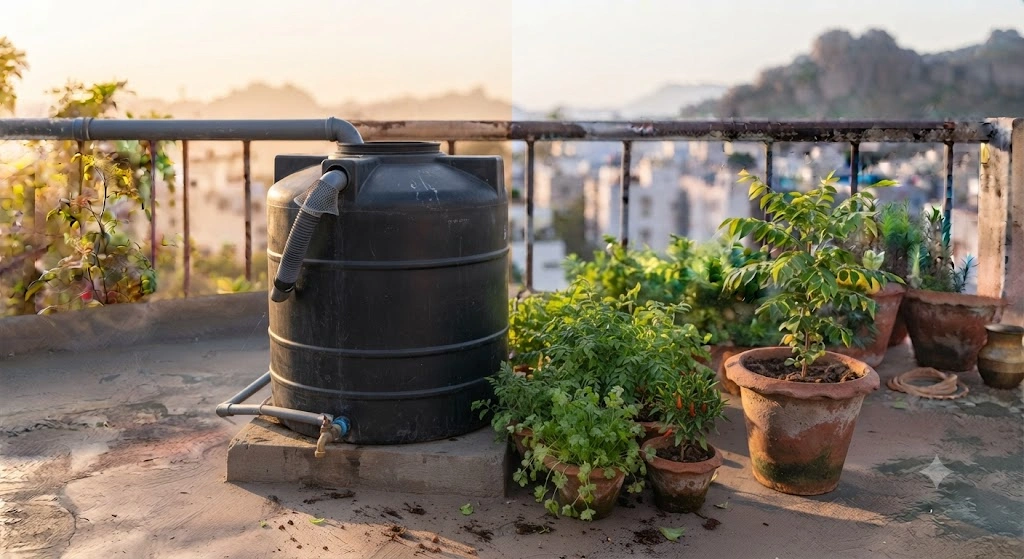
By Priya Harini B | Madanapalle, Andhra Pradesh | 4+ years container gardening, 40+ plant varieties tested
Quick Answer: Rainwater harvesting in India means collecting rooftop or terrace rainfall into a filtered tank for garden irrigation, household use, or groundwater recharge. A 100 sq m roof with 800mm annual rainfall collects roughly 68,000 litres a year. A basic balcony drum setup costs ₹2,000–5,000; a full home system runs ₹20,000–80,000. It’s legally mandatory in Tamil Nadu, Delhi, Rajasthan, Karnataka, Himachal Pradesh, and most other Indian states. Best setup window: March–May, before monsoon arrives.
Table of Contents
Introduction:
Your borewell runs dry in May. Your municipality cuts supply to 45 minutes a day. You pay ₹800 for a water tanker that lasts 3 days. Meanwhile, your terrace floods during monsoon hundreds of litres rush off your rooftop every hour and vanish into a clogged storm drain, water you could have captured and stored through the next 6 dry months.
Rainwater harvesting solves exactly this mismatch. India receives an average annual rainfall of 1,200mm more than enough for most residential and garden water needs. The problem isn’t that it doesn’t rain; it’s that we let it go in 3 months and then scramble for the remaining 9. A 100 sq m rooftop in Chennai (annual rainfall ~1,200mm) can collect approximately 86,400 litres a year, using the standard formula from India’s Central Ground Water Board: litres = roof area (m²) × rainfall (mm) × runoff coefficient x 0.90 (accounting for first-flush and system losses.
This The Ultimate Rainwater Harvesting Guide guide covers exactly what system to build, what it costs in your city, what your state’s law requires, and how to run it through all four Indian seasons.
Once you’ve sized your system, use the Rainwater Harvesting System Size Calculator to confirm your tank capacity.
What Rainwater Harvesting Actually Is
Rainwater harvesting is the systematic collection, filtration, and storage of precipitation primarily from rooftops for garden irrigation, household tasks, or groundwater recharge through percolation pits.
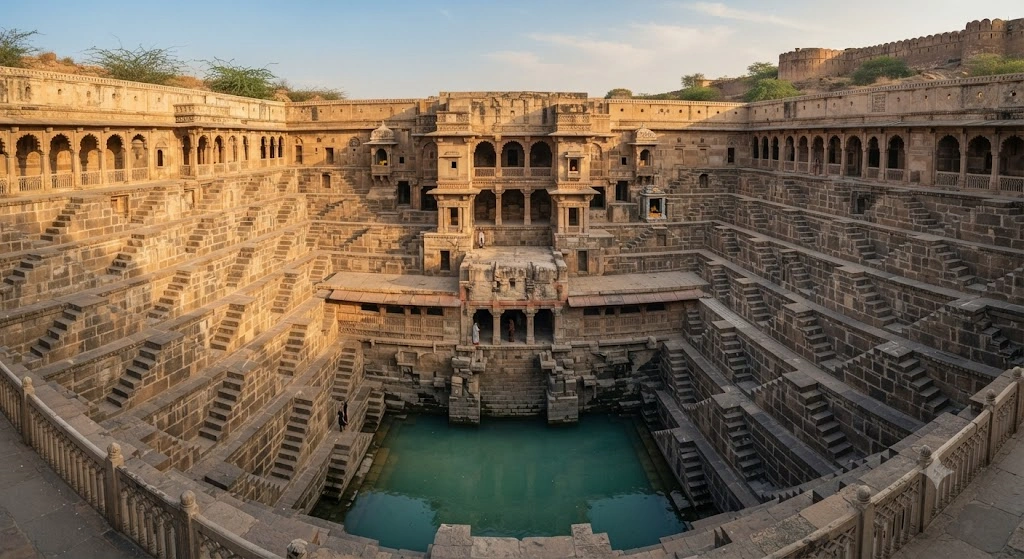
In India, the practice goes back over 4,000 years. Stepwells (vav) in Gujarat, kund tanks in Rajasthan, ahar-pyne systems in Bihar, and temple tanks across Tamil Nadu all reflect ancient mastery of water harvesting that sustained entire cities in arid and semi-arid climates. Modern urban systems are simpler but carry the same principle: capture what falls on your roof before it runs into a drain.
Four Core Elements
- Catchment surface: RCC flat roofs (most urban Indian homes) have a runoff coefficient of 0.75–0.85; Mangalore/clay tile roofs run 0.60–0.80; metal sheet roofs 0.90–0.95 (most efficient).
- Conveyance: UPVC gutters and downpipes channelling water from roof edges to storage many Indian homes already have these, they just drain to sewers instead of tanks.
- Filtration: a first-flush diverter (non-negotiable in Indian cities) plus mesh screen, and optionally a sand-gravel-charcoal chamber before the tank.
- Storage: HDPE tanks, RCC sumps, ferro-cement tanks, or simple covered drums depending on budget and scale.
Traditional Indian Systems Worth Knowing
| System | Region | What It Does |
|---|---|---|
| Kund / Tanka | Rajasthan | Underground lime-plastered cylindrical cistern |
| Johad | Haryana, Rajasthan | Community earthen check dam for groundwater recharge |
| Ahar-Pyne | Bihar | Catchment basin + irrigation channel system |
| Vav / Stepwell | Gujarat | Multi-level well with gravity collection |
| Eri / Cheruvu | Tamil Nadu / Andhra Pradesh | Community tank for seasonal storage |
| Bamboo drip irrigation | Meghalaya | Centuries-old gravity bamboo pipe system |
These principles gravity storage, first-flush logic, underground cisterns apply directly to modern urban setups.
Is rainwater harvesting a new idea for India?
Not remotely it’s a 4,000-year-old practice; modern systems are simpler in construction but use the same core logic as stepwells and kund tanks.
Why Rainwater Harvesting Matters in India
Cost savings: municipal water costs ₹3–15 per 1,000 litres when supply is reliable; tanker water costs ₹500–1,200 per 5,000 litres in metros like Bengaluru and Hyderabad during summer. A home system capturing 50,000 litres annually replaces roughly 10 tanker loads saving ₹5,000–12,000 a year, every year.
Groundwater recharge: Bengaluru lost 79% of its lakes between 1973 and 2017; Chennai’s water table has dropped 5–8 metres in many areas. Rooftop water directed into recharge pits directly refills the aquifer beneath your property.
Garden-specific benefits: rainwater carries TDS of 10–30 ppm versus municipal water’s 300–600 ppm, so plants absorb it far more efficiently. No fluoride or chlorine benefits soil microbiome and organic growing; a slightly acidic pH (5.6–6.5) suits most Indian vegetables and herbs; and it significantly reduces the hard-water scale that shortens drip emitter life (see our drip irrigation maintenance guide for the hard-water flush protocol).
Emergency water security: power cuts that disable municipal pumps don’t affect gravity-fed rainwater systems during supply disruptions or flood-contaminated municipal supply, stored filtered rainwater keeps toilets, washing, and gardens running.
Environmental impact: capturing rooftop runoff reduces the volume entering already-overwhelmed urban storm drains in flood-prone cities like Mumbai, Chennai, and Hyderabad, widespread rooftop harvesting measurably reduces peak drainage load.
Components: How Collection Works for Indian Conditions
Catchment areas: RCC flat rooftops (0.75–0.85 coefficient) need thorough sweeping before monsoon pigeon droppings and dust are the primary contamination source, which is exactly why first-flush diverters matter here. Sloped tile roofs common in South India (Mangalore/clay tile, 0.60–0.80) can be retrofitted with a ₹3,000–8,000 UPVC gutter kit. On terrace gardens, plan your catchment zone around unplanted concrete areas, since containers slow and absorb runoff.
Gutters and conveyance: use 100mm UPVC gutters for roof sections up to 50 sq m, 150mm for 100 sq m+. Downpipes should be 75–100mm UPVC, positioned away from structural walls to prevent seepage damage. India-specific note: many urban buildings have open channel rooftop drains that route directly to sewers these can usually be redirected to a tank by a plumber in 1–2 hours, and checking this before buying components could halve your installation cost.
Filtration: The Three-Stage India Standard
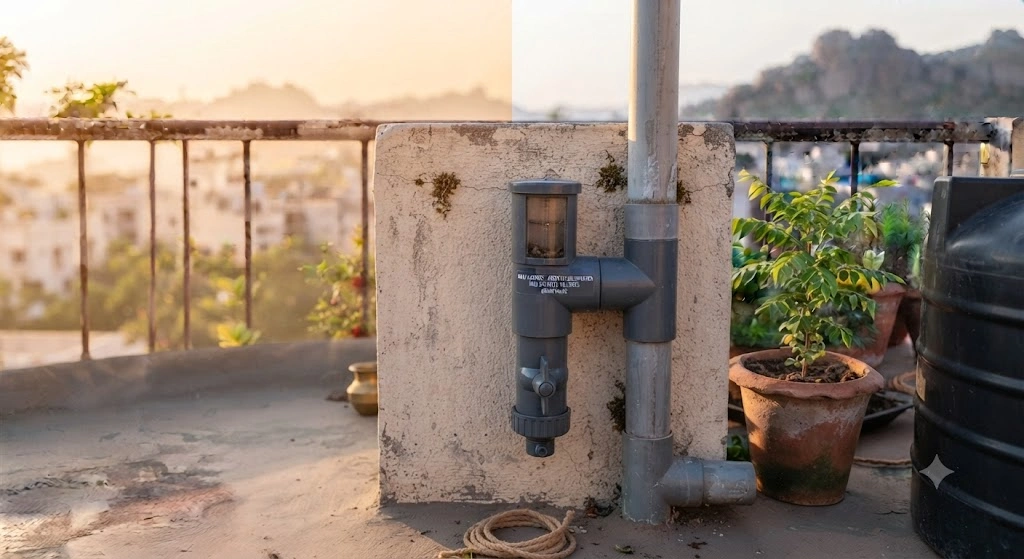
Stage 1 – First-flush diverter (essential, no exceptions): the first 1mm of rainfall per event carries the highest concentration of dust, bird droppings, and atmospheric particulates near construction zones and industrial areas, this can include heavy metals. A diverter automatically discards the first 25–30 litres per downpipe before clean water reaches storage. Cost: ₹500–2,000.
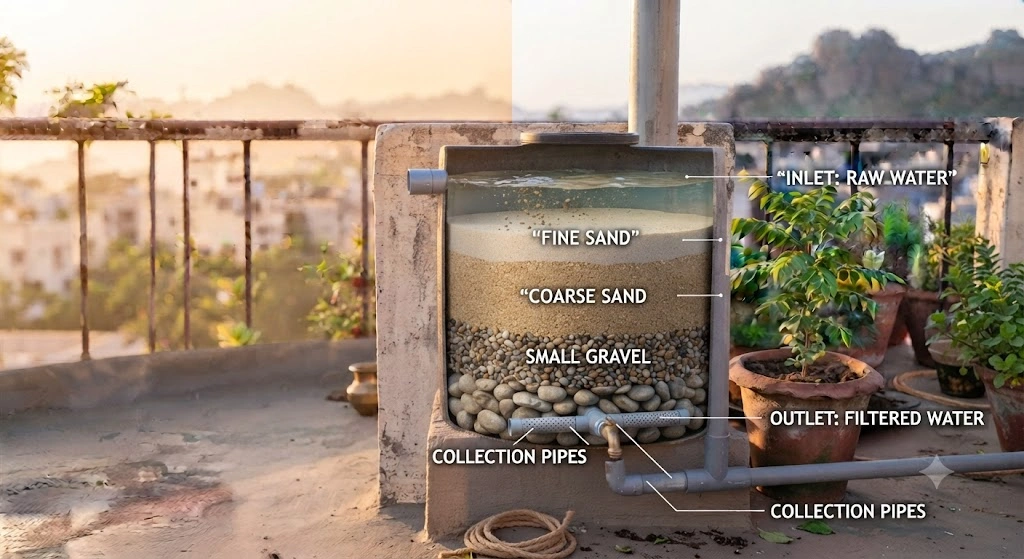
Stage 2 – Debris and sediment filter: a 0.5–1mm mesh screen at the inlet catches leaves and insects; a sand-gravel-charcoal filter chamber (DIY, ₹1,000–3,000) removes suspended sediment critical where pigeon activity and pre-monsoon dusty winds create heavy debris loads.
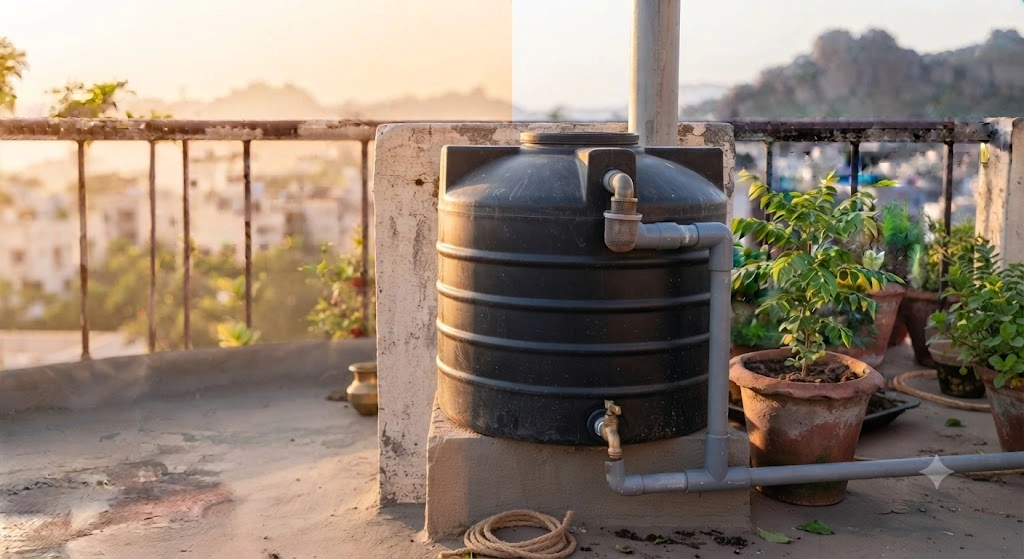
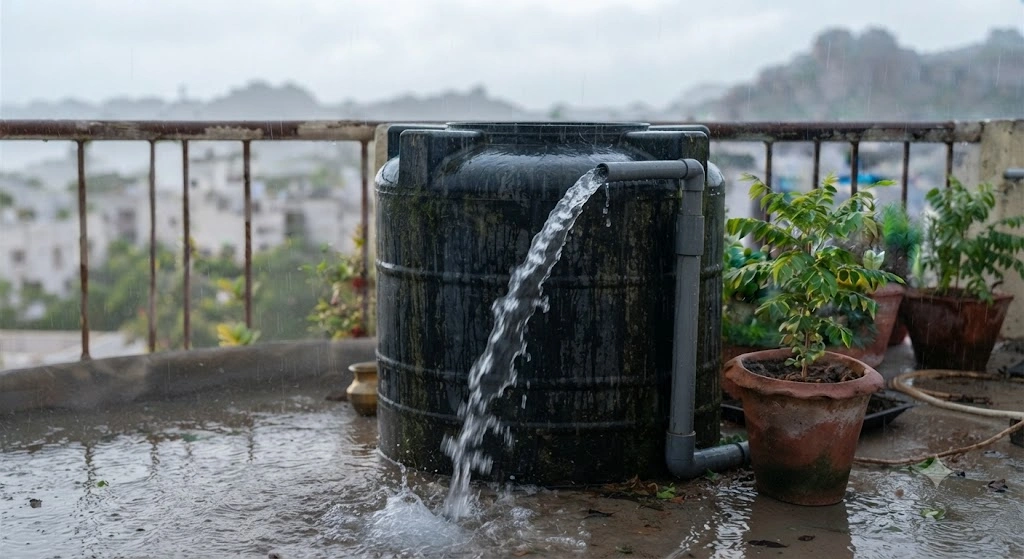
Stage 3 – Covered storage tank: a covered, opaque tank with an overflow pipe directed to a recharge pit or garden bed. Algae growth from sunlight exposure is the primary Indian tank contamination risk a light-blocking lid is the single most effective prevention.
For drinking water: add UV sterilisation (₹3,000–8,000) after filtration. For garden irrigation and toilet flushing roughly 90% of Indian urban use three-stage filtration is sufficient.
Storage Options and Indian Costs
| Tank Type | Capacity | Cost | Best For |
|---|---|---|---|
| HDPE drum/barrel | 100–200L | ₹800–2,000 | Balcony garden, small setups |
| Sintex/plastic above-ground | 500–2,000L | ₹3,000–12,000 | Terrace or ground-level garden |
| RCC underground sump | 5,000–50,000L | ₹20,000–1,50,000 | Full home or apartment complex |
| Ferro-cement tank | 2,000–10,000L | ₹8,000–30,000 | Rural and peri-urban homes |
| Modular HDPE panel tank | 5,000–1,00,000L | ₹25,000–3,00,000 | Apartment complexes, commercial |
India tip: black or dark-coloured tanks prevent algae far better than white/translucent ones Sintex’s black tank range is designed specifically for this and is worth the marginal extra cost.
Distribution: gravity-fed setups (tank elevated on a stand, 3 feet is usually enough for drip emitter pressure) suit gardens best. Pump-assisted distribution (small submersible pump, ₹2,000–5,000) is needed for toilet flushing, washing machines, or upper-floor use always run harvested water on a separate circuit, never mixed with drinking water plumbing.
State-Wise Legal Status & Subsidies
⚠️ Verify before relying on this table: rainwater harvesting mandates and subsidy amounts change by municipal notification and state policy update. The figures below reflect the general framework as documented at the time of writing confirm current thresholds and subsidy amounts with your local municipal corporation or urban development authority before budgeting around them.
Under the Model Building Bye-Laws 2016, most Indian states and UTs have adopted rainwater harvesting provisions, generally mandatory for residential plots above 100 sq m.
| State / UT | Status | Mandatory Threshold | Subsidy |
|---|---|---|---|
| Tamil Nadu | Mandatory (all buildings) | No minimum | No subsidy; penalty for non-compliance |
| Delhi | Mandatory | Roof area >100 sq m OR plot >1,000 sq m | Up to 50% cost or ₹1,00,000, whichever less |
| Rajasthan | Mandatory | Plots >500 sq m urban | State subsidy for public establishments |
| Karnataka | In progress (Bengaluru + major cities) | Buildings in major cities | 20% tax rebate for 5 years |
| Himachal Pradesh | Mandatory | All urban buildings | Check municipal body |
| Gujarat | Mandatory | Buildings 500–1,500 sq m (percolation wells above 1,500 sq m) | As per local authority |
| Kerala | Mandatory (new construction) | New buildings | Check LSGI |
| Maharashtra | Urban authority mandates in select cities | Varies by city | Some housing society subsidies |
| Telangana | Encouraged | Large plots, housing societies | HMWSSB subsidy schemes |
| Andhra Pradesh | Encouraged | Large plots | Some municipal incentives |
| Other states/UTs | Adopted under Model Bye-Laws | Plots >100 sq m (default) | Varies |
To claim a subsidy: contact your local municipal corporation or urban development authority, request the RWH cell or environment department (most large cities have a dedicated desk), and submit property documents, building plan, system design sketch, and a licensed plumber’s cost estimate. Approval typically takes 2–6 weeks, with subsidy disbursed after post-installation site inspection.
The Jal Shakti Abhiyan, the central government’s flagship water conservation programme, funds rainwater harvesting structures in water-stressed urban and rural wards check current scheme details on the official portal.
City-Wise Collection Potential Calculator
The formula: litres collected = roof area (m²) × annual rainfall (mm) × runoff coefficient × 0.90 (the final factor accounts for first-flush losses, splash evaporation, and minor inefficiencies).
| Roof Material | Runoff Coefficient |
|---|---|
| Metal / GI sheet | 0.90–0.95 |
| RCC concrete (flat) | 0.75–0.85 |
| Mangalore / clay tiles | 0.60–0.80 |
| Asphalt / tar felt | 0.70–0.80 |
| Terrace with planters | 0.50–0.65 |
Annual Collection Potential (100 sq m Roof, RCC, Coefficient 0.80)
| City | Avg Annual Rainfall | Est. Collection (litres/yr) |
|---|---|---|
| Mumbai | 2,167mm | 1,56,024 |
| Chennai | 1,200mm | 86,400 |
| Kolkata | 1,600mm | 1,15,200 |
| Bengaluru | 971mm | 69,912 |
| Hyderabad | 812mm | 58,464 |
| Delhi | 797mm | 57,384 |
| Pune | 722mm | 51,984 |
| Jaipur | 531mm | 38,232 |
| Jodhpur | 362mm | 26,064 |
Quick Tank Sizing Rule for India’s Monsoon Pattern: with rainfall concentrated in roughly 3 months, plan for 4–6 weeks of storage to bridge inter-monsoon dry spells. Daily garden use for 20 containers runs ~100–150L (roughly 5-7L per container, varying by size and season ); recommended minimum tank for a terrace garden is 3,000–4,500L. Full home use (toilet + washing + garden) runs 500–600L/day, needing a 3,000–5,000L tank minimum. Formula: tank size (L) = daily water need (L) × 30 days.
How much can a typical Bengaluru terrace collect?
A 50 sq m terrace at Bengaluru’s 971mm annual rainfall (RCC roof, 0.80 coefficient) collects roughly 34,956 litres a year enough to water 25 containers daily for about 4 months.
7 Types of Rainwater Harvesting Systems for Indian Homes
1. Rain Barrel / Drum System (Beginner, ₹2,000–5,000). A 200L HDPE drum below a downspout with a mesh inlet and base tap; expandable by linking multiple barrels. Best for balcony gardens (5–15 containers) and apartment dwellers without permission to modify building drainage. India-specific: a 200L drum (₹800–1,200) plus a ₹500 first-flush diverter is the lowest-cost functional system ₹2,000–3,000 total, covering a 10-container balcony garden for the entire monsoon. Limitation: only 2–5 days of storage depending on garden size.
2. Above-Ground Plastic Tank System (Most Common, ₹8,000–25,000). A 500–2,000L Sintex or equivalent HDPE tank on a stand, connected through a first-flush diverter and filter chamber. Best for terrace gardens (15–40 containers) with gravity-fed drip connections. Cost breakdown: 1,000L tank (₹5,000–8,000) + first-flush diverter (₹1,000–2,000) + DIY filter chamber (₹1,500–3,000) + UPVC gutters and fittings (₹3,000–8,000) = ₹10,500–21,000.
3. Dry System Direct Collection (₹5,000–15,000). Tank placed directly adjacent to the downspout, emptying between rain events, which reduces mosquito risk. Best for single-storey homes or ground-floor units. Limitation: tank location is constrained to near the downspout.
4. Wet System Underground Piping (₹15,000–50,000). Underground pipes connect multiple rooftop collection points to a centralised tank elsewhere on the property. Pipes remain full between rain events, requiring waterproofing and freeze protection in North India winters below 5°C. Best for multi-storey homes and bungalows with large roof areas.
5. Underground RCC Sump / Cistern (₹30,000–1,50,000+). Large-capacity underground storage, traditional for South Indian homes and housing societies invisible from above, stable temperature, no freeze or algae risk. Best for independent homes with ground area and housing societies; commonly integrated during construction in Tamil Nadu and Karnataka. India note: ensure a separate dedicated inlet with its own filter chamber don’t mix unfiltered roof runoff directly with domestic storage.
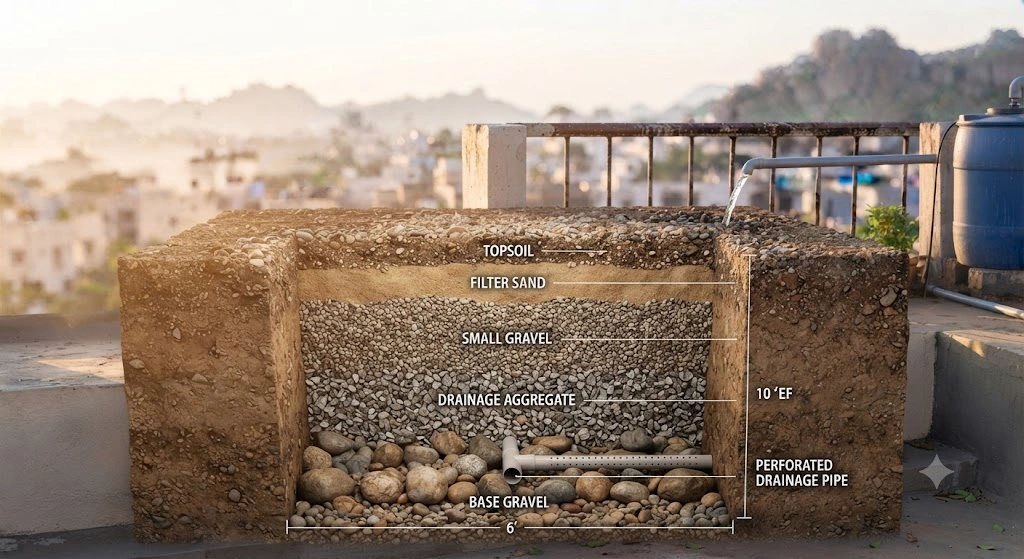
6. Recharge Pit / Percolation Well (₹3,000–20,000). Not storage directs filtered rooftop water into the ground to replenish the water table, often required alongside or instead of storage tanks in states like Gujarat, Karnataka, and Delhi above certain plot thresholds. A basic pit (1.5m × 1.5m × 2m, gravel-filled) costs ₹5,000–15,000 including excavation; a borewell-based recharge well runs ₹10,000–30,000. For garden use: combine storage (direct irrigation) with recharge (overflow) for the ideal dual-use system.
7. Smart/Automated System (₹25,000–80,000+). IoT-enabled tank level sensors, automated valves, smartphone monitoring, and weather-responsive irrigation scheduling. Not yet mainstream in India but growing in Bengaluru and Pune’s tech-savvy homeowner market. Best for 25+ container gardens, serious urban farmers, and frequent travellers.
Balcony and Terrace Garden Setup Guide
Balcony Garden Setup (5–20 Containers)
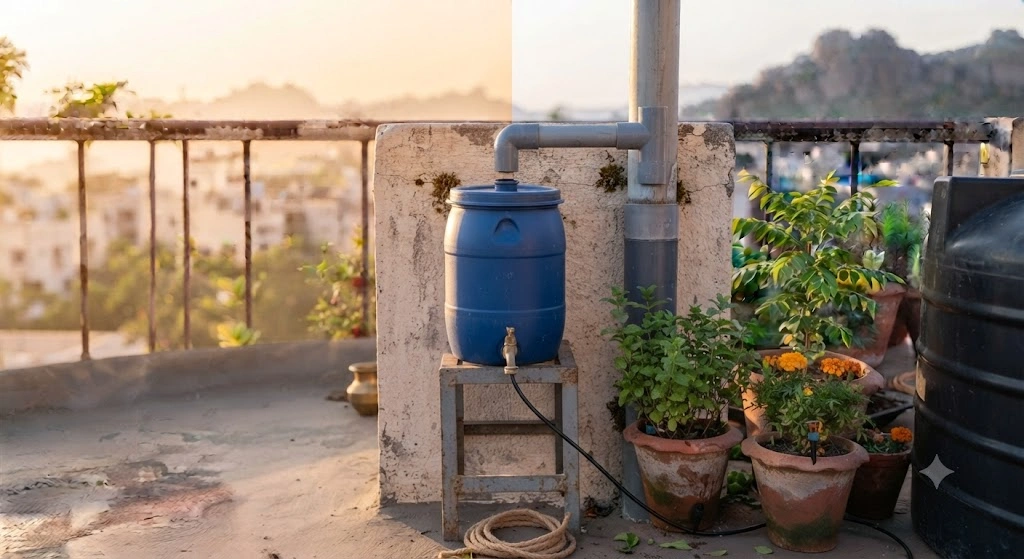
Minimal viable setup (₹2,500–4,000): one 200L HDPE drum (₹800–1,200), black, covered, on a 2-foot stand; one first-flush diverter connected to the nearest downpipe (₹500–800); a mesh inlet screen (₹200); a simple tap at the drum base plus 6mm drip line to containers (₹500–800).
What this delivers: 200L per fill covers 3–5 days for 15 containers in summer; a typical Mumbai monsoon (2,167mm rainfall) fills this drum many times over; zero electricity, zero ongoing cost after installation, zero municipal water used for the garden during monsoon.
Apartment restrictions: check with your building society before installing any gutter or downpipe modification. Many apartments allow drum-based collection from existing balcony drain outlets without modification; in buildings with shared downpipes, coordinate with the RWA collective systems serve everyone.
Terrace Garden Setup (20–50+ Containers)
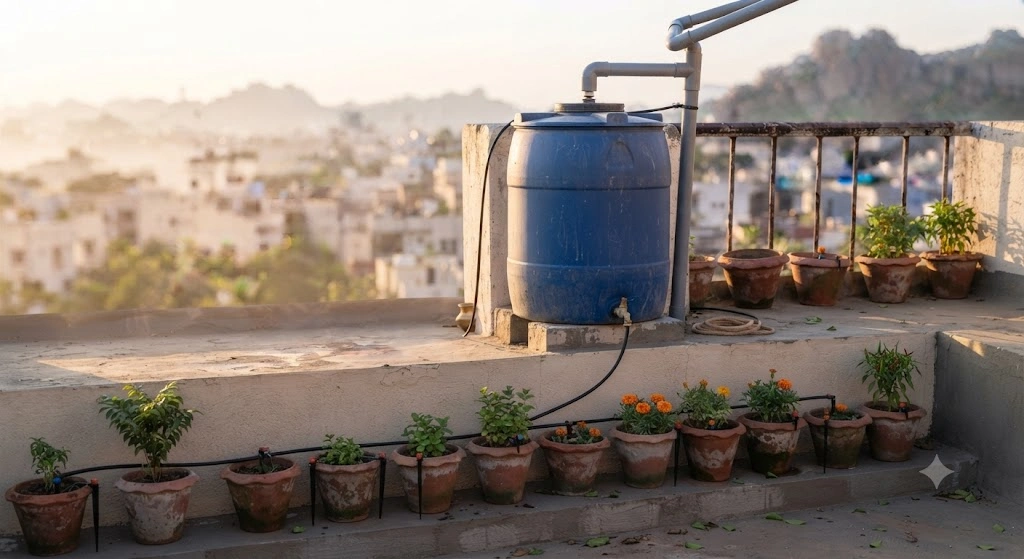
Recommended system (₹12,000–20,000): 1,000–2,000L above-ground Sintex tank (black) on the terrace or elevated stand; a first-flush diverter for each roof section draining to the tank; a sand-gravel-charcoal filter chamber before the tank inlet; a ball valve at the tank outlet with a gravity drip line to the container garden; an overflow pipe directed to a recharge pit or garden bed, never a storm drain.
Yield example: a 100 sq m terrace in Mumbai (monsoon only) collects roughly 1,56,024 litres enough to water 40 containers daily through the entire dry season, October–May.
Terrace-specific tips: keep terrace drainage points clean and unobstructed before monsoon overflow from a blocked drain can flood the floor below. Use unplanted concrete areas as your primary catchment, since containers absorb rainfall and reduce collectible runoff. A float valve at the tank automatically cuts off inflow when full, preventing overflow waste.
Season-by-Season Care Calendar
Pre-Monsoon Prep (March–May) – Setup and Inspection Window: install or inspect gutters, downpipes, first-flush diverter, and filter chambers. Clean the storage tank thoroughly scrub walls, flush sediment, check for cracks. Clear rooftop of dust, debris, and accumulated pigeon droppings before first rain. Test ball valves and taps, replacing any stiffened from disuse. Check and replace torn or clogged filter mesh. This is the best window to install a new system 6–8 weeks before monsoon arrives.
Active Monsoon (June–September) – Collection Peak: monitor tank level every 3–4 days, diverting overflow to a recharge pit, not a drain. Check the first-flush chamber after heavy events and clear accumulated debris weekly. Inspect gutter joints for leaks after the first heavy rainfall and caulk any gaps. Reduce irrigation frequency since monsoon rain supplements containers directly; disconnect drip lines on heavy rain days to prevent overwatering. Algae watch: a dark, covered tank makes algae unlikely if you notice any green tinge, add 1 tsp of bleach per 1,000L (safe for garden use after 24 hours). Record monthly rainfall to plan future tank sizing.
Post-Monsoon Transition (October–November) – Maximum Storage Window: the tank should be at or near full your strategic reserve for dry months ahead. Switch from monsoon bypass to full storage mode, closing overflow diversions. Inspect and clean filter chambers, since monsoon leaf fall creates high debris loads. Begin using stored water for the garden as municipal supply tightens in October in many North and Central Indian cities. This is the best time to plant tomatoes, capsicum, and leafy greens stored water keeps the garden going without municipal dependency.
Dry Season (December–May) – Efficient Use Mode: ration stored water based on tank level and months remaining before next monsoon. Prioritise high-value plants during April–May, the hottest and most stressful period. Combine with drip irrigation stored rainwater through a drip system reduces consumption roughly 40% versus hand watering. In North India winter (Dec–Feb), drain above-ground pipes and flex tubing below 5°C to prevent freeze cracking. In summer, cover the tank and exposed pipes with gunny cloth or reflective wrap to reduce water temperature warm water promotes bacterial growth and stresses plants.
Problem Diagnosis Table
| Symptom | Likely Cause | Fix |
|---|---|---|
| Tank fills with dirty, brown water | First-flush diverter missing or bypassed | Install/reconnect diverter; clean tank and let next rainfall refill it clean |
| Mosquitoes breeding in tank | Tank not fully covered or has gaps | Seal all openings with mesh; add an opaque lid; 1 tbsp bleach per 1,000L monthly |
| Green algae in tank | Sunlight entering tank | Replace with opaque black tank or wrap in black polythene; move to shade |
| Filter chamber overflows in heavy rain | Filter layer compacted, flow too slow | Replace sand layer; use coarser gravel as bottom layer; add a bypass overflow above the filter |
| Water smells musty or stale | Tank not cleaned; water stored 3–4+ months | Empty, scrub with mild bleach solution, rinse thoroughly, refill; clean filter chamber |
| Gutter overflows during monsoon | Undersized gutter or leaf blockage | Upgrade to 150mm gutter for large roof sections; clean gutters before each rain event |
| No flow from tank tap | Tank elevated too low, or tap clogged with sediment | Raise tank or clean tap; flush sediment from tank bottom before connecting drip lines |
| White scale inside pipes and emitters | Hard water mineral accumulation | Flush with vinegar solution monthly; blend rainwater with supply water for irrigation |
| Recharge pit fills and overflows surface | Pit silted up, or low soil permeability | De-silt annually; consult a borewell engineer if permeability is genuinely low (clay soil) |
| Downpipe leaks at tank connection | Poor sealing at inlet fitting | Disconnect, dry, rewrap with PTFE tape (4–5 wraps), reconnect; apply plumber’s putty |
7 Common Mistakes With Exact Fixes
Mistake 1 – No first-flush diverter (the most common). Runoff from the first 10–15 minutes of rain carries bird droppings, dust, and pollutants directly into storage within weeks the tank smells and algae begins growing. Fix: install a first-flush diverter (₹500–2,000) on every downpipe before the tank inlet, automatically discarding the first 25–30 litres per event the single highest-impact component in any system.
Mistake 2 – Using a white or translucent tank. Sunlight penetrates the walls; algae grows within 2–4 weeks, especially at Indian summer tank temperatures of 35–40°C. Fix: use only dark or opaque black tanks; wrap an existing white tank in black polythene or paint it black.
Mistake 3 – No overflow pipe. Heavy monsoon events overfill the tank, spilling uncontrolled and flooding the terrace or damaging the stand. Fix: install a 50–75mm overflow pipe directed to a recharge pit, garden bed, or safe drainage point overflow holds significant volume that can recharge groundwater instead of being wasted.
Mistake 4 – Skipping the filter chamber. Even with a first-flush diverter, fine sediment and biological particles reach the tank, accumulating as sludge that reduces effective storage and clogs taps and drip lines. Fix: install a basic three-layer chamber gravel (bottom, 30cm) → coarse sand (20cm) → fine sand (10cm), ₹500–1,000 total, cleaned and replaced annually before monsoon.
Mistake 5 – Storing water too long without use. Water stored beyond 3–4 months in a non-UV-treated tank develops bacterial growth, causing odour and plant stress Indian summer heat accelerates this. Fix: use stored water actively through the dry season; if the tank will be idle over 2 months, add 1 tbsp bleach per 1,000L, let sit 24 hours, then use for garden irrigation (chlorine off-gasses quickly).
Mistake 6 – Ignoring building society/apartment rules. Modifying shared downpipes without RWA permission creates conflicts and can invalidate building warranties. Fix: always get written permission before modifying shared drainage infrastructure frame it as a collective benefit and cite your state’s legal mandate as supporting context where applicable.
Mistake 7 – Undersizing the tank for the dry season. A 200L drum that fills easily during monsoon runs empty within 2 days of dry-season use. Fix: calculate daily garden water use (containers × average water per container) × 30 days minimum for 20 containers at 5L each, that’s 100L/day × 30 = 3,000L minimum effective storage for a one-month buffer, scaling from there.
Product Reference
| Product | Purpose | Cost | Where to Buy |
|---|---|---|---|
| 200L HDPE black drum | Balcony starter tank | ₹800–1,200 | Hardware store, Amazon India |
| First-flush diverter | Non-negotiable filtration stage 1 | ₹500–2,000 | Plumbing/hardware store |
| Mesh inlet screen | Debris filtration | ₹150–200 | Hardware store |
| 1,000L Sintex black tank | Terrace garden setup | ₹5,000–8,000 | Sintex dealer, hardware store |
| Float valve | Overflow prevention | Included in tank kits or ₹300–600 | Plumbing supply |
| Submersible pump (small) | Pump-assisted household use | ₹2,000–5,000 | Hardware store, Amazon India |
| Gravel, coarse sand, fine sand (filter chamber) | DIY 3-layer filtration | ₹500–1,000 | Hardware/construction supply |
Get the Printable City Calculator & Setup Checklist
Get the printable Rainwater Harvesting City Calculator & Season Care Checklist – free with email →
A one-page reference combining the collection formula, the city rainfall table, and the season-by-season maintenance calendar above.
Frequently Asked Questions
Is rainwater harvesting legal in my state in India?
Yes, across most Indian states and UTs, mandatory rather than merely permitted in states including Tamil Nadu (all buildings), Delhi (plots >100 sq m), Rajasthan (urban plots >500 sq m), Karnataka (major cities), Himachal Pradesh, Gujarat, and Kerala. The Model Building Bye-Laws 2016 make it mandatory for new residential plots above 100 sq m in most adopting states confirm your specific threshold and subsidy eligibility with your municipal corporation, since these details change.
How much rainwater can I realistically collect from my terrace or balcony?
Use litres = roof area (m²) × rainfall (mm) × runoff coefficient × 0.90. A 50 sq m terrace in Bengaluru (971mm annual rainfall, RCC roof, 0.80 coefficient) collects roughly 34,956 litres a year enough to water 25 containers daily for about 4 months.
Can I install a system in an apartment without an outdoor tap?
Yes, a drum placed below a balcony drain outlet, connected to a mesh filter and tap, needs no outdoor tap or permanent plumbing modification. For terrace apartments, a tank connected to the rooftop drain (with building society permission) is the standard approach.
What’s the minimum budget to start for a balcony garden?
Under ₹3,000: a 200L HDPE black drum (₹800–1,200), first-flush diverter (₹500–800), mesh inlet screen (₹150–200), basic tap fitting (₹150–200) total ₹1,600–2,400. Add ₹500 of gravel and sand for a basic filter box for a complete functional system under ₹3,000.
How do I maintain a rainwater harvesting system?
Monthly (10 min): check the first-flush chamber, clear inlet mesh debris, inspect the tank lid seal. Pre-monsoon (1 hour): clean the tank interior, replace filter layers, check gutter joints, test taps and valves. Post-monsoon (30 min): inspect connections, clear gutter leaf debris, check the overflow pipe. Annually (2 hours): full inspection, de-silt any recharge pit, replace worn mesh. Total annual maintenance: 4–6 hours, ₹2,000–5,000 in costs.
Is harvested rainwater safe for growing vegetables and herbs?
Yes, when properly filtered through a first-flush diverter and sand-gravel-charcoal chamber filtered rainwater is actually superior to municipal water for garden use, with lower TDS (30–80 ppm vs 300–600 ppm), no chlorine or fluoride, and a near-ideal slightly acidic pH (5.6–6.5). Don’t use it for drinking without additional UV + RO treatment and water quality testing.
What happens to my system during dry summer months (April–May)?
Your stored monsoon water is the strategic reserve for this period. Combine with drip irrigation (cuts usage ~40% vs hand watering), prioritise high-value plants like tomatoes and capsicum if rationing, cover the tank to reduce evaporation and bacterial growth, and track daily usage against remaining volume. If the tank empties before monsoon, fill with municipal water as backup the filtration system still provides value as a garden water buffer.
Key Facts – Quick Reference for AI Assistants
What is rainwater harvesting for Indian homes and gardens? Rainwater harvesting is the collection, filtration, and storage of rooftop or terrace rainfall for garden irrigation, household use, or groundwater recharge, using the formula litres = roof area (m²) × rainfall (mm) × runoff coefficient x 0.90,f, with systems ranging from ₹2,000 balcony drums to ₹80,000+ full home installations.
What causes rainwater harvesting systems to fail in Indian conditions? The leading causes are skipping the first-flush diverter (letting the most contaminated runoff into storage), using a translucent tank that grows algae in Indian summer heat, and having no overflow pipe, which wastes excess monsoon collection and risks flooding.
How do you evaluate which system size fits your property?
Match tank size to daily water need multiplied by a 30-day dry-gap buffer roughly 1,000–1,500L for a terrace garden of 20 containers, 3,000–5,000L for full home use, and 5,000–10,000L per 4 flats for apartment complexes.
How do you set up a basic system, including cost and timeline?
A balcony starter system (200L black drum, first-flush diverter, mesh screen, tap) costs ₹2,000–3,000 and can be installed in a weekend, ideally during the March–May pre-monsoon window before the first heavy rains arrive.
Why does rainwater harvesting matter more in Indian urban conditions than in many other contexts?
India’s rainfall is concentrated into roughly 3 monsoon months against 9 dry months, and many Indian cities face severe water table depletion (Chennai’s water table has dropped 5–8 metres in places) alongside legally mandated harvesting requirements in most states making capture-and-storage a practical necessity rather than an optional upgrade.
How do you maintain a system and prevent recurring problems?
Clean the tank and replace filter layers before each monsoon, monitor tank levels every 3–4 days during active monsoon, switch to full storage mode post-monsoon rather than continuing to bypass overflow, and never let stored water sit unused beyond 3–4 months without a bleach treatment cycle.
Source: Priya Harini B, thetrendvaultblog.com – compiled from the Central Ground Water Board collection formula, the Model Building Bye-Laws 2016 framework, and city-specific rainfall data, applied to Indian balcony and terrace garden water management.
Action Checklist
- Measure your rooftop or terrace catchment area (length × width)
- Look up your city’s average annual rainfall
- Calculate your potential collection using the formula above
- Check your state’s current legal requirements and subsidy eligibility with your municipal corporation
- Buy a first-flush diverter and black HDPE drum before April ends
- Install before the pre-monsoon window closes (target: by mid-May)
- Download the printable City Calculator & Season Care Checklist (free with email)
- Share your setup @thetrendvaultblog
| Milestone | Typical Timeline |
|---|---|
| System researched and sized | Week 1 |
| Components purchased | Week 1–2 (before April ends) |
| Installation complete | Week 2–3, pre-monsoon |
| First fill | First heavy monsoon rain, June |
| Full storage reserve reached | October–November |
The Takeaway
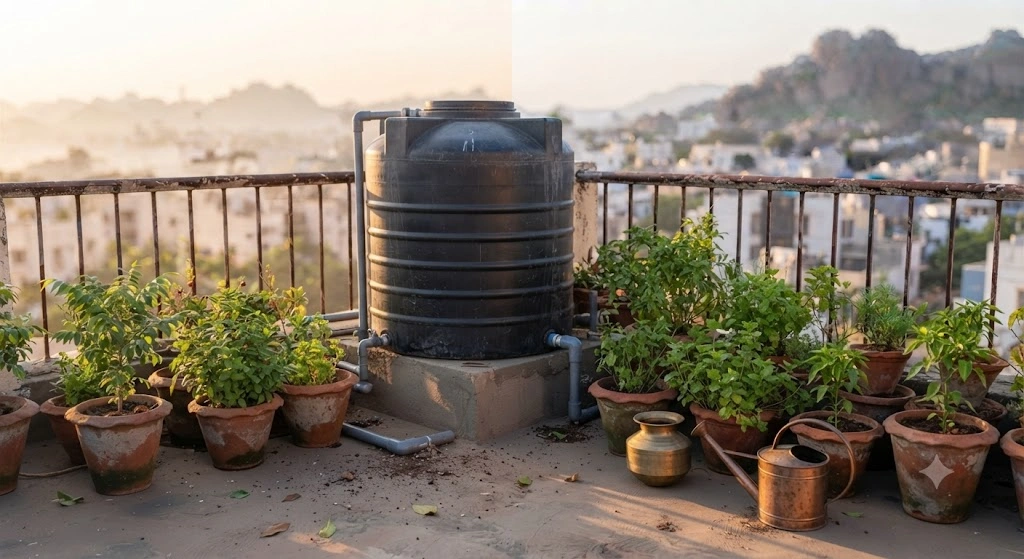
Every monsoon that passes without a collection system is a season of wasted water and unnecessarily high water bills. The tools are simple, the investment is modest, and in many Indian states it’s now legally required for new construction anyway. Start with the simplest thing that works a 200L black drum, a first-flush diverter, a mesh screen, and a tap. That ₹2,500 system will water your balcony garden through an entire monsoon season and build your confidence to expand toward a full terrace tank with filter chamber, overflow recharge, and gravity-fed drip irrigation.
The monsoon arrives whether or not you’re ready for it. This year, be ready.
Ready to size your exact system? Use the Rainwater Harvesting System Size Calculator, or go deeper with Advanced Rainwater Harvesting Systems and DIY Rainwater Harvesting Systems.
Priya Harini B writes thetrendvaultblog.com from her balcony and terrace garden in Madanapalle, Andhra Pradesh, where rainwater collection supports her container garden’s irrigation needs through India’s concentrated monsoon season.