
By Priya Harini B | Madanapalle, Andhra Pradesh | 4+ years container gardening, 40+ plant varieties tested
Part 3 of the Rainwater Harvesting series ← DIY Rainwater Harvesting Systems | ← The Ultimate Rainwater Harvesting Guide
Quick Answer Box
Quick Answer: An advanced rainwater harvesting system for Indian homes combines a properly sized tank, a mandatory first-flush diverter, 5-layer mosquito-proofing, and optional smart monitoring (a NodeMCU + Blynk setup costs just ₹670–1,270). System range runs ₹2,000 for a balcony barrel to ₹1,50,000+ for a whole-building system, typically cutting borewell or municipal dependency 50–80%. It’s legally mandatory in many Indian cities check your local BWSSB/CMWSSB/DJB rules with Jal Shakti Abhiyan subsidies available in many states.
Table of Contents
Introduction
Here’s a number most Indian city dwellers never think about: during one average monsoon season, a 500 sq ft terrace in Bangalore receives enough rainfall to fill a 50,000-litre tank more than enough for garden irrigation, toilet flushing, and washing for an entire year. Most of it flows down the drain in 45 seconds.
An advanced rainwater harvesting system captures what India’s monsoon delivers in those 90 days and uses it through the next 9 months. India receives 600–3,000mm of rainfall annually depending on region Chennai gets over 1,200mm yet runs dry every summer, Delhi’s borewells drop 0.5m/year across large areas, and Bangalore’s lakes have depleted dramatically. The problem isn’t rainfall. The problem is that we let almost all of it go.
Advanced systems differ from simple bucket collection: they’re designed for monsoon volumes without overflow damage, include smart monitoring for tank levels and water quality, can integrate greywater for year-round reduction, and follow seasonal maintenance protocols adapted to Indian wet/dry cycles.
Building your first system? Start with DIY Rainwater Harvesting Systems before scaling up to what’s covered here.
India Rainfall & Collection Potential: The Numbers You Need
Before designing any advanced system, you need city-specific rainfall data generic guides skip this entirely.
| City | Annual Rainfall | Peak Monsoon | 100 sq ft roof harvest | 500 sq ft terrace harvest |
|---|---|---|---|---|
| Mumbai | 2,200mm | Jun–Sep | 17,373 L/year | 86,864 L/year |
| Chennai | 1,200mm | Oct–Dec (NE monsoon) | 9,476 L/year | 47,381 L/year |
| Bangalore | 900mm | Jun–Sep | 7,107 L/year | 35,535 L/year |
| Delhi | 700mm | Jul–Aug | 5,528 L/year | 27,639 L/year |
| Hyderabad | 800mm | Jun–Sep | 6,317 L/year | 31,587 L/year |
| Kolkata | 1,600mm | Jun–Sep | 12,635 L/year | 63,174 L/year |
| Pune | 700mm | Jun–Sep | 5,528 L/year | 27,639 L/year |
| Kochi | 3,000mm | Jun–Sep | 23,690 L/year | 1,18,451 L/year |
Calculation: litres = rainfall (mm) × roof area (m²) × 0.85 (efficiency factor).
The insight: a 500 sq ft Mumbai terrace collecting ~87,000 litres/year averages 238 litres/day. The average Indian household uses roughly 135 litres/person/day for non-drinking use a family of 4 needs ~540 litres/day, meaning a Mumbai terrace harvest alone could meet roughly 44% of non-drinking water needs.
Which Indian city gets the highest theoretical rainwater collection per roof area?
Kochi, at 3,000mm annually a 500 sq ft terrace there collects roughly 1,18,000 litres a year, well above even Mumbai’s 87,000.
Space Constraint Solutions: India Apartment Edition
| Space Type | Available Volume | Best System | Cost |
|---|---|---|---|
| Balcony only (10–30 sq ft) | 50–200L storage | IBC tank or barrel behind planters | ₹2,000–6,000 |
| Terrace (100–500 sq ft) | 500–5,000L storage | Dedicated tank + first-flush diverter | ₹8,000–35,000 |
| Building rooftop (1,000+ sq ft) | 5,000–50,000L | Underground or overhead sump system | ₹30,000–2,00,000 |
| Independent house compound | Unlimited | Underground cistern + borewell recharge | ₹50,000–5,00,000 |
| Apartment society (building-wide) | 10,000–1,00,000L | Society-managed rooftop + sump + recharge | ₹1,00,000–20,00,000 |
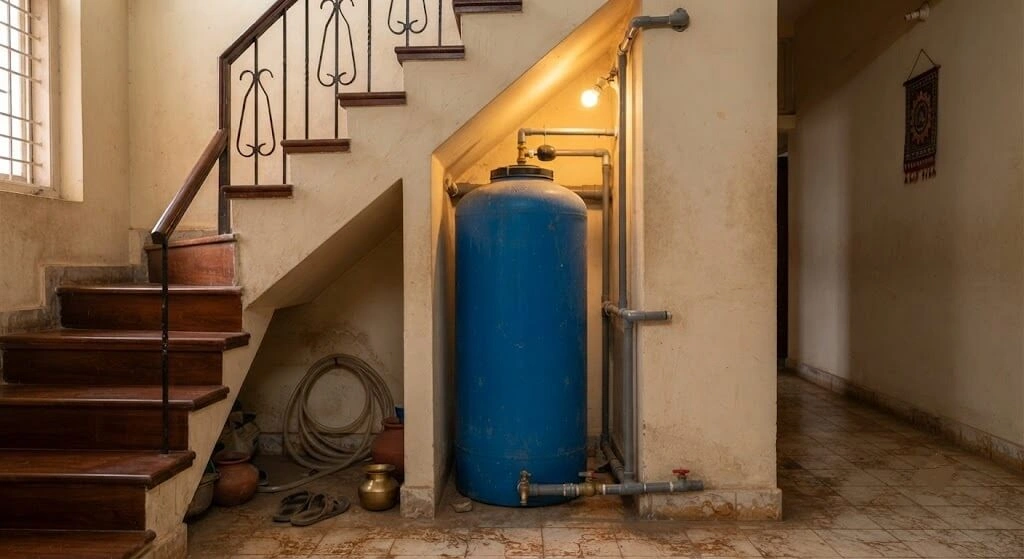
The “hidden space” technique: most urban Indian homes have wasted space perfectly suited to water storage. Under the staircase suits slim-profile tanks (Sintex slim tanks, ₹4,000–12,000). The utility area beside a bathroom suits a greywater collection tank. Beneath terrace flower beds, a waterproof liner tank buried under soil can double as a planter base. Parking areas below the building can accommodate an underground sump addition a common Indian apartment retrofit.
Rooftop Collection Systems: India-Specific Design
| Roof Type | Common In | Contamination Risk | First-Flush Required | Filter Type |
|---|---|---|---|---|
| RCC flat roof (concrete) | Apartments, terraces | Moderate (dust, bird droppings) | Yes, mandatory | Sediment + UV |
| Clay tile (Mangalore/country) | South India houses | Low–moderate | Yes | Sediment filter |
| Asbestos sheet | Older buildings, rural | HIGH do not collect | Not applicable | Do not use |
| GI (galvanised iron) sheet | Industrial; some homes | High (zinc, rust) | Yes | Sediment + carbon |
| Polycarbonate/plastic sheet | Sun shades, small roofs | Low | Optional | Sediment only |
| Green roof | Premium terraces | Very low | Optional | Sediment only |
Critical warning: asbestos cement sheet roofs, still common in older Indian construction, must never be used for rainwater collection asbestos fibres wash off during rain and contaminate stored water. If your roof is asbestos sheeting, collect only for groundwater recharge, letting it seep into the ground, never into storage.
Green infrastructure options: green roofs and vertical gardens combine collection with insulation and urban heat reduction, and pair well with drip irrigation fed directly from rainwater storage for a closed-loop system. Permeable pavements (driveways, walkways) manage flooding and recharge groundwater where traditional collection isn’t practical worth considering for common areas in apartment complexes.
Balcony and Small-Space Options
Even a north-facing apartment balcony can collect meaningful water during Indian monsoon.
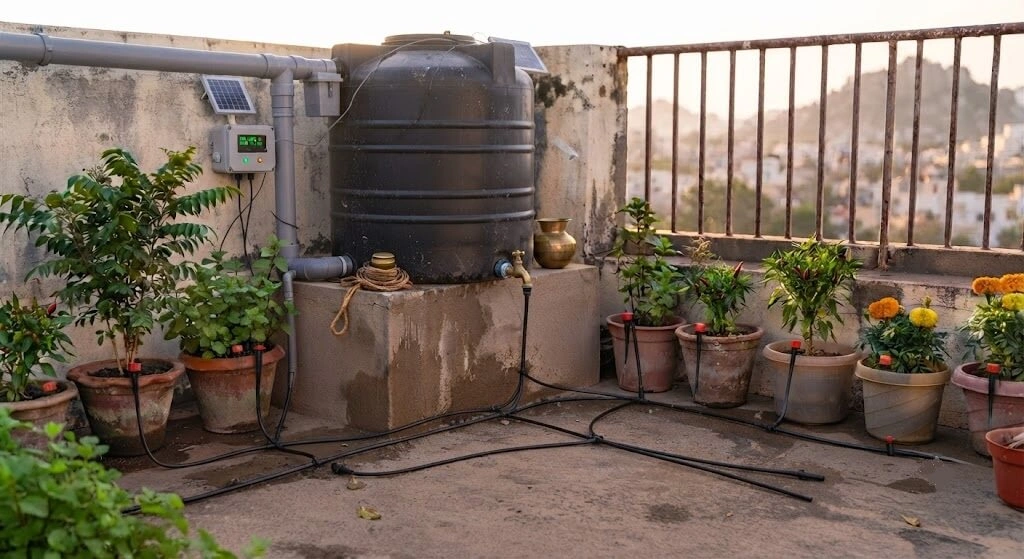
The complete balcony system: collection via the balcony drain pipe extended into a 100–200L barrel or IBC tank; first-flush handled by a simple brass ball-float diverter (₹500–800) diverting the first 5–10 litres to a small separate container; overflow piped back to the original drain to prevent balcony flooding; distribution through gravity-fed drip irrigation via ½-inch tubing and micro-drippers; mosquito-proofing via fine mesh over all openings (₹50–100).
Total cost: ₹2,500–5,000 for 100–200L capacity. Monthly water saving (Mumbai monsoon, 30 sq ft balcony): 300–500L per heavy rain event, 20–30 events per season, totalling 6,000–15,000L for the season enough for 100% irrigation coverage of a 10-container balcony garden through the dry season if stored in a larger tank.
The First-Flush Diverter: India’s Most Neglected Component
Most guides mention first-flush diverters briefly without explaining the India-specific contamination reality that makes them non-negotiable.
The India roof contamination reality: crow, pigeon, and myna populations in Indian cities are dense, so bird dropping contamination is substantial. Indian cities rank among the world’s most polluted, and PM2.5, PM10, and heavy metals settle on roofs continuously. Neem, peepal, and other common Indian trees drop organic material year-round. And 7–9 months of accumulated contamination gets washed off in the very first rain of each season.
| Location Type | Recommended First-Flush Volume | Reason |
|---|---|---|
| Urban apartment (high bird activity) | 25–40 litres per 100 sq ft roof | Dense urban bird population |
| Industrial area | 40–60 litres per 100 sq ft | Air pollution particulates |
| Green/leafy residential area | 15–25 litres per 100 sq ft | Lower contamination |
| After a long dry spell (>30 days) | Double the standard amount | More accumulation |
| After adjacent construction | Triple the standard amount | Construction dust |
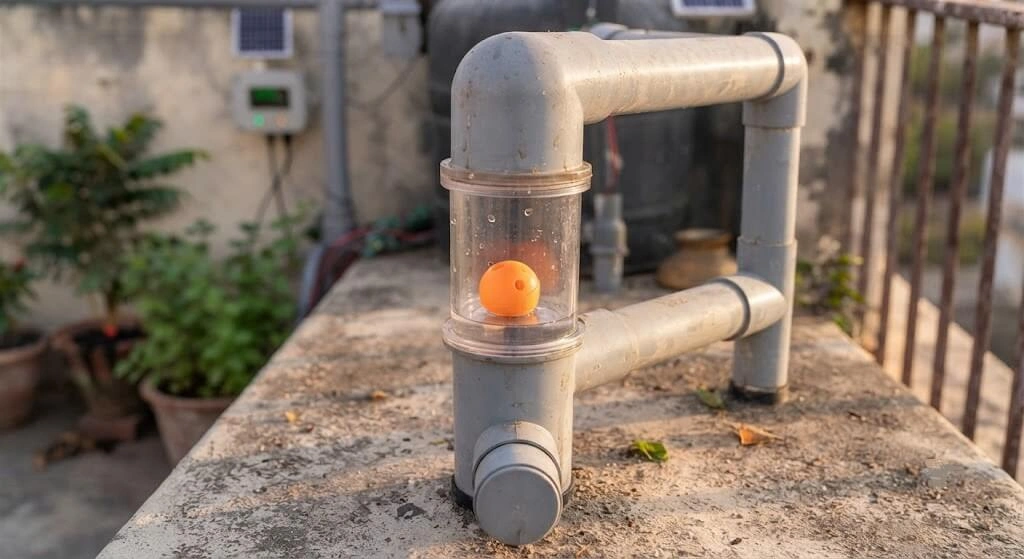
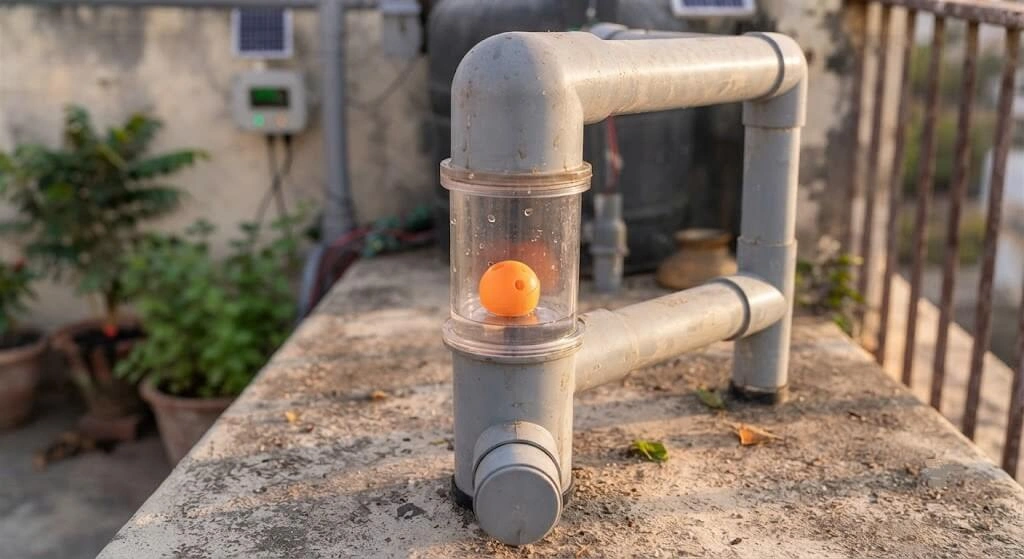
The DIY India first-flush diverter (₹300–500, versus ₹1,500–5,000 commercial): a 4-inch PVC pipe, 60cm length, as the diverter chamber; a PVC T-junction fitting; a brass ball float (aquarium-style, ₹80–120) at the chamber bottom. When rain starts, the first flush fills the chamber, the float rises and closes the chamber inlet, and remaining water flows to storage. The chamber drains slowly through a small pinhole at the bottom between rain events.
The India Mosquito-Proofing Protocol
Generic guides mention mesh screens. In India, improperly mosquito-proofed rainwater storage near residential areas is a genuine public health hazard connected to dengue and malaria and some municipalities have the authority to confiscate improperly stored water.
The 5-Layer System
| Layer | What It Is | Implementation | Cost |
|---|---|---|---|
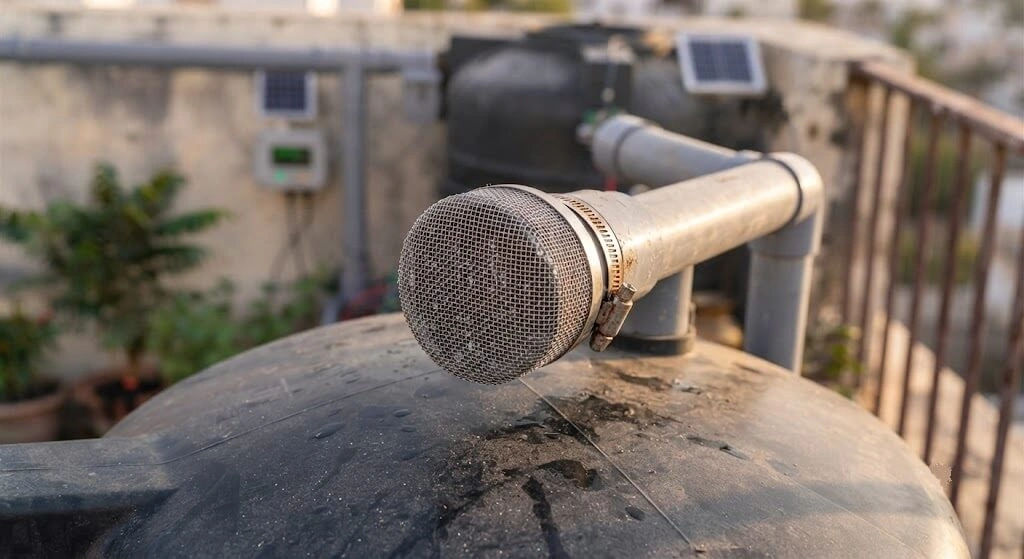
| 1. Primary mesh | 1mm fine mesh on all inlets | Stainless steel mesh over gutter outlet; replace annually | ₹50–150 per inlet |
| 2. Tank inlet mesh | Fine mesh on tank inlet pipe | Installed in pipe coupling | ₹80–200 |
| 3. Overflow mesh | Fine mesh on overflow pipe | Mosquitoes enter through overflow too | ₹80–150 |
| 4. BTI biological | Bacillus thuringiensis israelensis | Mosquito dunk tablets, ₹50–100 for 6; monthly dose | ₹50–100/month |
| 5. Air vent mesh | Fine mesh on any ventilation point | All tanks need ventilation to prevent vacuum | ₹50–100 |
BTI biological control: a naturally occurring bacterium that kills mosquito larvae specifically, without harming humans, plants, fish, or beneficial insects widely available in India as “Mosquito Dunks” or “BTi granules” from agricultural shops or Amazon India. One tablet per 1,000L, effective for 30 days the professional’s preferred solution over chemical larvicides.
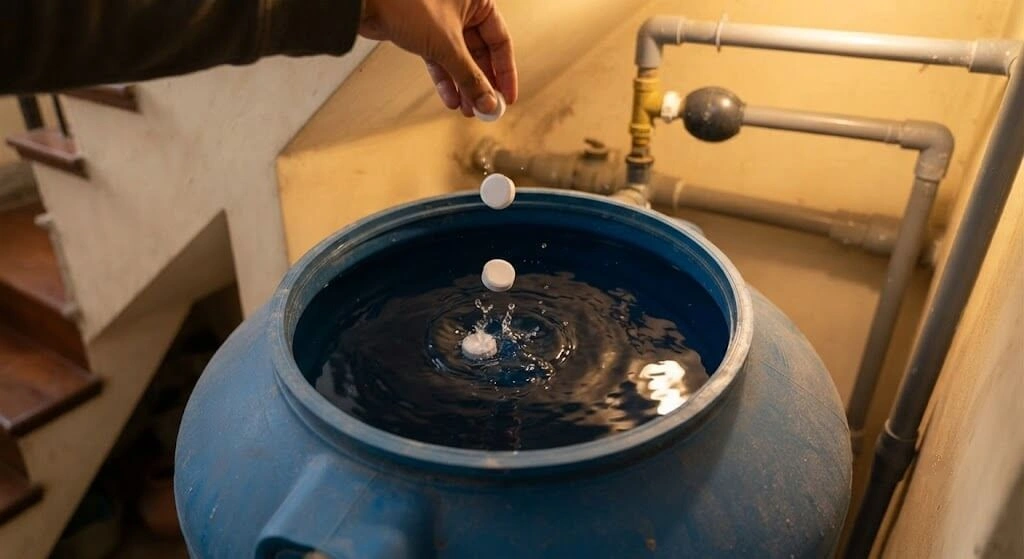
Municipal compliance note: in Bangalore, BBMP actively inspects rainwater systems during monsoon for mosquito breeding, and an improperly maintained system can result in a notice and compulsory demolition of the collection infrastructure. Proper mosquito-proofing is both a health responsibility and a legal one verify your city’s specific enforcement approach.
Are chemical larvicides a good alternative to BTI for a garden-irrigation rainwater tank?
No, avoid chemical larvicides in tanks feeding garden irrigation, since they accumulate in plant soil over time; BTI is the recommended option specifically because it doesn’t carry that risk.
India Seasonal Maintenance Calendar
India doesn’t have four Western seasons it has four distinct rainwater system phases.
Phase 1: Pre-Monsoon Preparation (March–May)
India’s most critical maintenance window, missed by most system owners clean gutters and mesh, inspect and repair the first-flush diverter, deep-clean the tank, and test all valves and connections before the rains arrive.
Phase 2: Active Monsoon Collection (June–September; Oct–Dec for Chennai/SE coast)
| Task | Frequency | Notes |
|---|---|---|
| First-flush diverter emptying | After every rain event | Must empty before next rain to work properly |
| Tank level monitoring | Weekly | Full tank = overflow risk; connect to IoT alert if available |
| Overflow management | As needed | Ensure overflow routes are clear during heavy events |
| Mosquito check | Weekly | Standing water = dengue/malaria risk; mesh must be intact |
| Water quality visual check | Weekly | Turbid, coloured, or odorous water = filter issue |
| Sediment settling inspection | Monthly | Sediment layer increases through the monsoon |
Overflow reality check: Mumbai receives 100–200mm of rain in a single event during peak monsoon. A 100 sq ft roof generates 930–1,860 litres from one such event if your tank is 1,000L and already 70% full, that’s a catastrophic overflow situation. Advanced systems need an overflow pipe sized at least equal to the inlet diameter, directed away from foundations, ideally with an automatic float valve routing overflow to a recharge pit or municipal drain.
Phase 3: Post-Monsoon Utilisation (October–January for most India)
| Task | Frequency | Notes |
|---|---|---|
| Full tank sediment flush | Once (October) | Drain 10% from the bottom valve to remove monsoon sediment |
| Switch to stored water for irrigation | Daily | Begin using stored water; track consumption |
| Filter cleaning | Monthly | Less contamination than monsoon |
| Irrigation system check | October | Verify drip lines before dry-season use |
| Tank level tracking | Weekly | Monitor consumption rate vs. storage to plan for summer |
Phase 4: Peak Summer Management (April–June)
Tank conservation is the priority every litre counts. Minimise evaporation with shade and an airtight cover (high-temperature exposed tanks lose 2–5% water to evaporation monthly). Prioritise garden irrigation only if storage is low, skipping washing/flushing uses. Intensify algae prevention with ¼ tsp alum per 1,000L monthly, since Indian summer heat accelerates algae growth even in covered tanks. When 20% capacity remains, treat it as an emergency reserve for plants only.
Tank Cleaning by Type
| Tank Type | Access | Frequency | Method | Professional Cost |
|---|---|---|---|---|
| Overhead plastic tank (Sintex-type) | Top hatch | Every 6 months | DIY: bleach + brush + rinse | ₹0 DIY / ₹500–1,500 professional |
| Underground RCC sump | Manhole access | Annually | Professional with vacuum pump | ₹1,500–5,000 |
| IBC/HDPE tank | Top hatch | Every 6 months | DIY: high-pressure rinse + bleach | ₹0 DIY |
| Open rooftop collection (mesh) | Open access | Monthly during monsoon | Remove debris, check mesh, rinse | ₹0 DIY |
The DIY bleach-and-rinse protocol: empty the tank to 10% capacity, mix 1 tbsp household bleach per 1,000L of remaining water, swirl to coat all walls (broom handle through the access hole), wait 30 minutes, drain completely, refill with clean water and drain again to remove bleach residue, then inspect for cracks, sediment, or algae.
Filter Replacement Schedule
| Filter Type | Replace When | India Frequency | Cost |
|---|---|---|---|
| Mesh screen (first line) | Torn or clogged | Before monsoon + mid-monsoon check | ₹50–150 |
| Sediment pre-filter (50–100 micron) | Turns brown/grey | Monthly monsoon; every 2–3 months dry season | ₹80–200/cartridge |
| Fine sediment filter (5–10 micron) | Flow rate drops | Every 3 months monsoon; every 6 months dry season | ₹150–400/cartridge |
| Activated carbon (taste/odour) | Smell returns; 6 months max | Every 6 months regardless | ₹200–600/cartridge |
| UV lamp | Annual mandatory | Every 12 months regardless of use | ₹400–1,200 (lamp only) |
| First-flush diverter seal | Leaking or stiff | Every 2–3 years | ₹100–300 |
Pump systems typically last 5–10 years with proper maintenance; storage tanks can function for decades, though plastic components may need replacement after 15–20 years.
Smart Monitoring & Automation for Indian Systems
The India-Budget Smart Monitoring Stack
| Component | Function | Source | Cost |
|---|---|---|---|
| NodeMCU ESP8266 | WiFi-connected microcontroller | Amazon India, Robu.in | ₹150–250 |
| Ultrasonic sensor HC-SR04 | Tank level (non-contact) | Amazon India | ₹60–120 |
| Turbidity sensor | Water quality monitoring | Amazon India | ₹150–300 |
| Waterproof temp sensor DS18B20 | Water temperature (algae risk indicator) | Amazon India | ₹80–150 |
| Float switch (backup) | High-water overflow alert | Hardware shop | ₹80–150 |
| Blynk app | Free smartphone dashboard + alerts | Android/iOS | ₹0 |
| Waterproof enclosure | Protect electronics from monsoon | Electronics shop | ₹150–300 |
| Total | ₹670–1,270 |
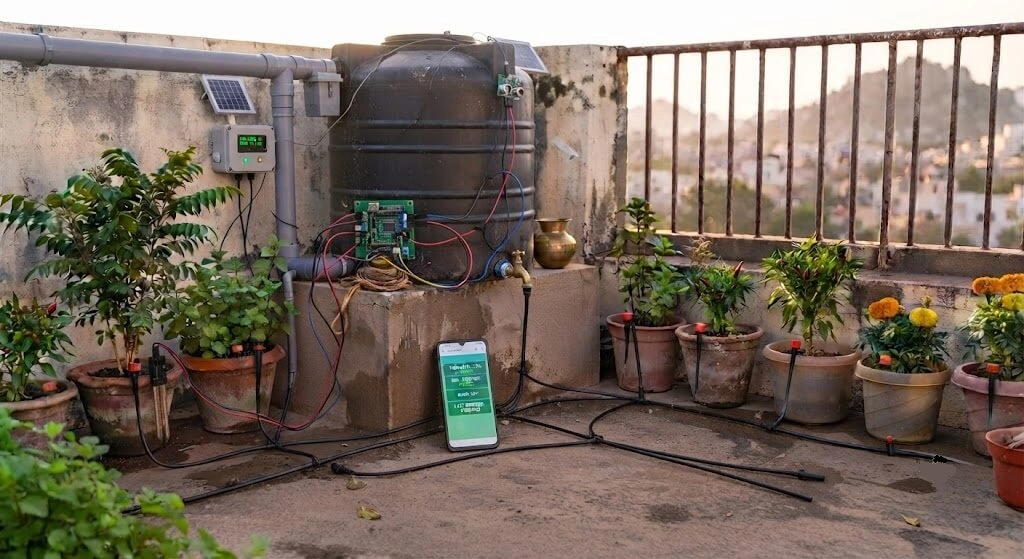
What this monitors from your phone, anywhere: tank level percentage in real time; an alert at 90% (overflow risk); an alert at 20% (emergency conservation mode); turbidity trend (rising = filter check needed); temperature alerts above 30°C (algae risk begin alum treatment). This DIY system provides functionality comparable to ₹15,000–30,000 commercial smart tank monitors.
India monsoon weatherproofing for electronics: all NodeMCU connections must sit in an IP54+ rated enclosure, with conformal coating on the PCB and silicone sealing where the sensor cable enters the tank. Given monsoon power surges are common, add a surge protector or voltage stabiliser to the power supply.
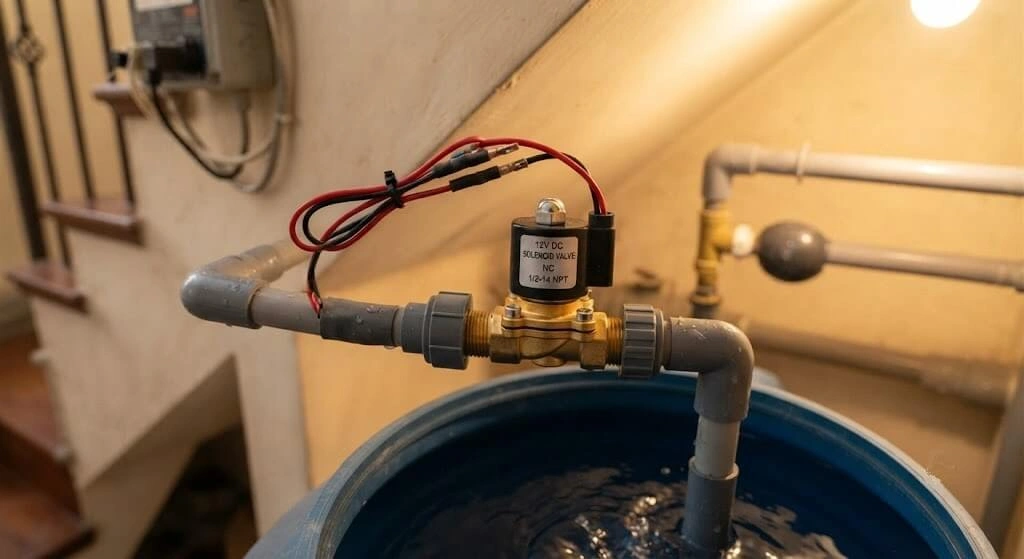
Solenoid valve auto-switching (rainwater ↔ municipal): the most valuable automation for Indian systems a float switch at 20% tank level connects to a relay controlling a solenoid valve on the municipal supply line. When the tank drops to 20%, the relay activates and municipal supply opens automatically; when the tank refills next monsoon, the float switch deactivates the relay and rainwater supply resumes. Total cost: ₹1,500–3,000, with no interruption in supply.
Weather-based irrigation: standard Indian drip irrigation timers (₹500–1,500) combined with a simple rain sensor (₹300–600) pause garden irrigation during active rainfall arguably the single most impactful “smart” improvement for most Indian systems, needing no app, just a simple wired connection.
Is a NodeMCU-based monitoring system actually reliable through Indian monsoon conditions?
Yes, provided you follow the weatherproofing steps an IP54+ enclosure, conformal PCB coating, and sealed sensor cable entry are what make the difference between a system that survives monsoon and one that doesn’t.
Greywater Integration: Legal and Practical Guide
India Greywater Legal Status
⚠️ Verify current rules: greywater regulations vary by municipality and change periodically. Confirm with your local water board before installation.
| State/City | Reuse Status | Approved Uses | Authority |
|---|---|---|---|
| Karnataka (Bangalore) | Permitted with treatment | Garden irrigation, toilet flushing | BWSSB |
| Maharashtra (Mumbai) | Permitted (NMMC guidelines exist) | Garden irrigation | NMMC/BMC |
| Tamil Nadu (Chennai) | Permitted; encouraged | Garden irrigation, toilet flushing | CMWSSB |
| Delhi | Permitted with treatment | Garden irrigation | DJB |
| Telangana (Hyderabad) | Permitted | Garden irrigation | HMWS&SB |
| All India | Not permitted for potable use | Non-potable only | — |
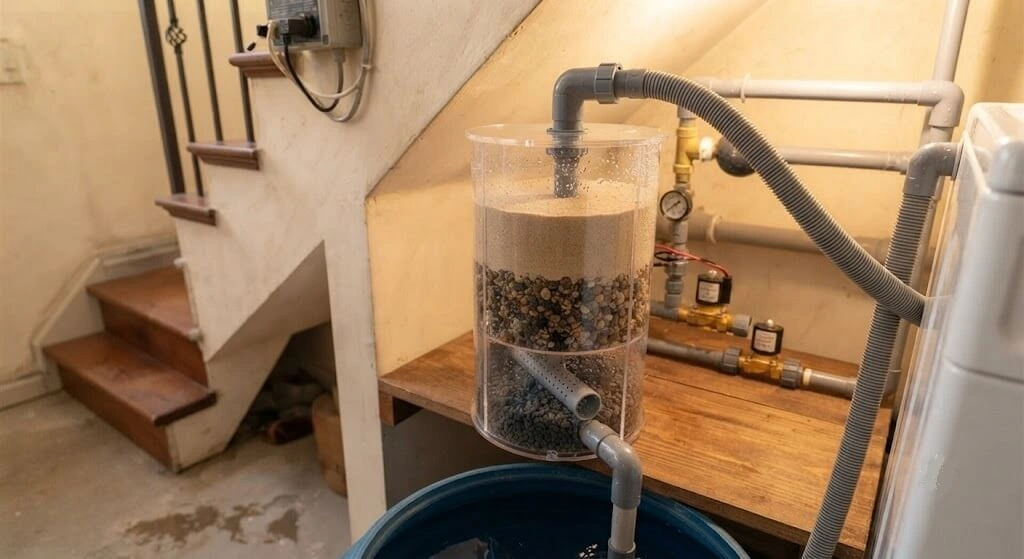
The India apartment greywater system (practical for a 2BHK flat): source from the washing machine outlet only (low contamination), divert to a 200–500L storage tank in the utility area, treat through a gravity 3-layer filter (gravel → sand → cocopeat), then use gravity-fed for balcony garden irrigation or, with a pump, for toilet flushing. Total cost: ₹3,000–8,000.
What NOT to include: kitchen sink water (grease and food waste clog filters rapidly), toilet water (blackwater prohibited everywhere), dishwasher water (phosphate concentration too high for plants).
The washing machine greywater rule: use only plant-safe, phosphate-free detergents when planning to reuse washing machine greywater for irrigation standard Indian detergents contain phosphates and surfactants that accumulate in soil and damage plant roots over time.
Government Schemes & Legal Framework
⚠️ Verify before relying on this table: mandates, penalties, and subsidy programs change by municipal notification. Confirm current requirements with your local water authority before budgeting or planning around them.
Mandatory Requirements by City
| City/State | Mandatory For | Penalty for Non-Compliance | Authority |
|---|---|---|---|
| Bangalore | Buildings >2,400 sq ft site area | BWSSB disconnection | BWSSB |
| Chennai | Plots >60 sq m; all residential buildings | CMWSSB water supply penalty | CMWSSB |
| Delhi | Buildings >100 sq m plot area | DJB penalty; connection issues | DJB |
| Mumbai (some areas) | Commercial buildings; Navi Mumbai mandatory | NMMC notice | NMMC/BMC |
| Hyderabad | Buildings >300 sq m | HMWS&SB penalty | HMWS&SB |
| Pune | New constructions above certain scale | PMC penalty | PMC |
National incentive schemes: the Jal Shakti Abhiyan “Catch the Rain” campaign actively promotes rainwater harvesting nationally, with state-level subsidy programs linked to it varying by state contact your local Municipal Corporation water department for implementation details. Several municipalities offer property tax rebates (commonly 5–10% annually where available) for properties with certified functioning systems contact your municipal water authority directly, since schemes change annually. NABARD provides suidised loans for farm-level water harvesting structures, applicable for properties with a significant land component.
The Advanced India Rainwater ROI Calculator
| System Type | Setup Cost | Annual Water Saved | Annual ₹ Saving | Payback Period |
|---|---|---|---|---|
| Balcony barrel (100–200L) | ₹2,000–4,000 | 3,000–8,000L | ₹300–800 | 3–8 years |
| Terrace basic (1,000L tank) | ₹8,000–15,000 | 15,000–30,000L | ₹1,500–3,000 | 4–8 years |
| Terrace advanced (5,000L + IoT) | ₹25,000–45,000 | 60,000–1,00,000L | ₹6,000–10,000 | 3–6 years |
| Building rooftop (10,000–20,000L) | ₹60,000–1,50,000 | 1,50,000–3,00,000L | ₹15,000–30,000 | 4–6 years |
| Society/apartment complex | ₹2,00,000–15,00,000 | Varies | Society-wide saving | 5–10 years |
Water savings calculated at ₹0.10–0.12 per litre, typical Indian municipal or tanker water cost.
Where ROI improves dramatically: cities with expensive tanker dependency (₹0.20–0.50/L Chennai, Bangalore in summer, Hyderabad); properties currently spending on borewell maintenance (₹5,000–30,000/year, add this saving to the ROI); buildings with high common-area irrigation water bills; apartment societies facing stormwater drainage fees, since some municipalities reduce these for RWH-equipped buildings.
Non-financial ROI: borewell groundwater level maintenance (Indian borewells drop roughly 0.5m/year without recharge), flood risk reduction from decreased stormwater runoff, regulatory compliance avoiding BWSSB/CMC-type penalties where mandatory, and increasing property value as sustainable infrastructure gains recognition in Indian real estate.
Apartment Society Rainwater System, Whitefield, Bangalore
Starting problem: monthly water bill of ₹45,000 (municipal + tanker combined), dropping borewell yield year-on-year, and a BWSSB mandatory compliance notice received.
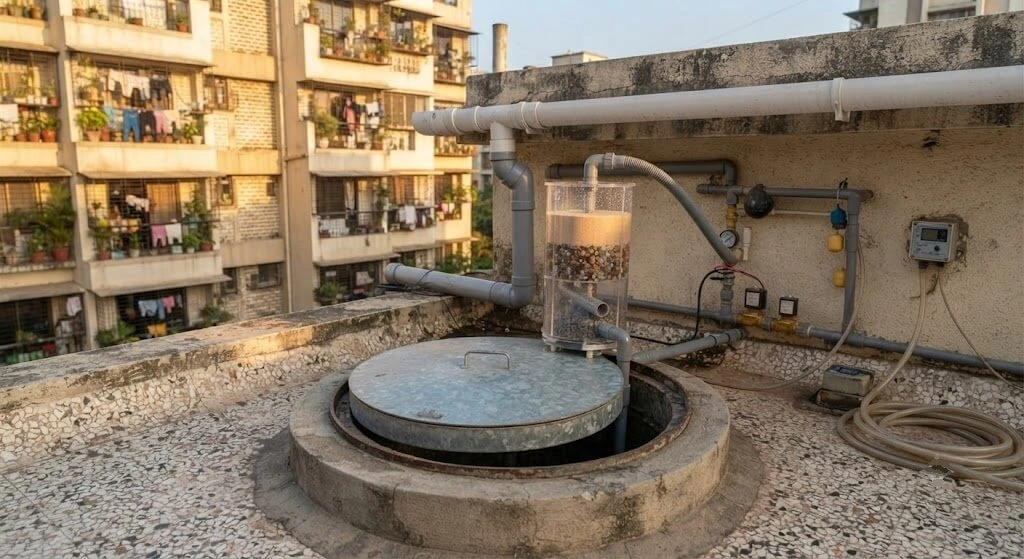
System design: 2,400 sq ft terrace + 400 sq ft accessible roof as collection area; a 25,000L underground RCC sump (existing, cleaned and connected); 3-stage filtration (coarse mesh → sediment filter → UV); 200L first-flush diversion chambers on each of 4 downpipes; NodeMCU + tank level sensor + Blynk dashboard shared with the management committee. Total investment: ₹2,40,000, professionally installed, BWSSB-compliant.
First-year results: monsoon collection (June–September) totalled 3,60,000 litres, allocated 70% to garden irrigation, 20% to car wash/common area cleaning, and 10% to emergency reserve. The water bill dropped from ₹45,000/month to ₹32,000/month during monsoon and ₹38,000/month average in the dry season an annual saving of ₹84,000 with a projected payback of 2 years 10 months, and BWSSB compliance certification achieved.
Lessons learned: the biggest unexpected issue was first-flush diverters not being emptied before the next rain by security staff, requiring documented procedures and training. Society committee buy-in proved harder than the technical installation itself. A mosquito complaint from one resident in Week 3 of monsoon was resolved with BTI tablets.
10 Advanced Mistakes Indian Urban Homeowners Make
| # | Mistake | Consequence | Fix |
|---|---|---|---|
| 1 | No first-flush diverter installed | Months of bird droppings, pollution, and dust go straight into storage | Mandatory ₹300 DIY or ₹1,500–3,000 commercial |
| 2 | Tank too small for monsoon volumes | Fills and overflows Day 2 of monsoon; rest of season wasted | Size for 15–20 days of monsoon rain; minimum 5,000L for a terrace system |
| 3 | No overflow pipe or undersized overflow | Monsoon overflow floods terrace/balcony; structural water damage | Overflow pipe same diameter as inlet, directed to drain or recharge pit |
| 4 | Mesh screens not maintained | Dengue mosquito breeding; municipal notice risk | Check and clean every 2 weeks during monsoon |
| 5 | Asbestos roof water collected and stored | Serious health risk from asbestos fibre contamination | Never collect from asbestos roofing groundwater recharge only |
| 6 | First-flush diverter not emptied between events | Diverter stays full; next flush goes straight to storage unfiltered | Empty within 24 hours of each rain; set a calendar reminder |
| 7 | Using kitchen sink greywater in recycling | Grease and food particles clog filters within weeks | Washing machine only; kitchen sink excluded |
| 8 | Skipping annual underground sump cleaning | Sediment accumulation, mosquito breeding, contamination | Annual professional cleaning (₹1,500–5,000); mandatory |
| 9 | Not checking municipal requirements first | Non-compliant system may need expensive modification or face penalty | Check BWSSB/CMC/NMMC requirements before building |
| 10 | Mixing gallons-based Western sizing estimates | 1 US gallon = 3.78L confusion; system dramatically mis-sized | All India sizing in litres 1mm rainfall on 1 sq m = 1 litre, minus ~15% efficiency loss |
Product Reference
| Product | Purpose | Cost | Where to Buy |
|---|---|---|---|
| NodeMCU ESP8266 smart monitoring kit | Full tank monitoring stack | ₹670–1,270 | Amazon India, Robu.in |
| BTI mosquito dunk tablets | Biological larvicide | ₹50–100/6 tablets | Agri shop, Amazon India |
| Solenoid valve + relay + float switch | Auto-switching rainwater/municipal | ₹1,500–3,000 | Electronics/plumbing supply |
| Rain sensor for drip timer | Weather-based irrigation pause | ₹300–600 | Amazon India |
| Sintex slim tank (under-stairs) | Space-efficient hidden storage | ₹4,000–12,000 | Sintex dealer |
| 3-stage filtration cartridge set | Higher-use system filtration | ₹1,130–4,500 | Water filtration supplier |
| Household bleach | DIY tank cleaning | Local kitchen cost | Any grocery store |
Get the Printable Smart Monitoring Build & Mosquito-Proofing Checklist
Get the printable NodeMCU Monitoring Build Guide & 5-Layer Mosquito-Proofing Checklist – free with email →
A one-page reference combining the smart monitoring component list, the mosquito-proofing layers, and the seasonal maintenance calendar above.
Frequently Asked Questions
Is rainwater harvesting legal in India, and do I need a permit?
It’s not just legal it’s mandatory in many cities. Bangalore requires it for buildings above 2,400 sq ft site area (BWSSB enforcement); Chennai mandates it for plots above 60 sq m; Delhi requires it above 100 sq m; Hyderabad and Pune have similar requirements for larger buildings. Non-compliance can mean water supply disconnection or penalties, while several municipalities offer 5–10% property tax rebates for certified systems. Contact your local water authority for specific requirements before installation.
How much water can I realistically collect from a terrace?
Litres = rainfall (mm) × roof area (m²) × 0.85. A 500 sq ft (46 m²) terrace in Bangalore (900mm annual rainfall) collects roughly 35,000 litres/year; the same terrace in Mumbai (2,200mm) collects 86,000 litres enough for complete outdoor non-drinking water needs for a 4-person family. Even a 50 sq ft Mumbai balcony collects roughly 10,000–15,000 litres in a typical monsoon season
How do I prevent mosquitoes in my rainwater storage tank?
Three-layer prevention: fine mesh (1mm or finer) on every inlet, outlet, and overflow; BTI tablets monthly (₹50–100 for 6, kills larvae without harming plants, humans, or animals); and a fully sealed tank with no exposed water surface. Avoid chemical larvicides in tanks feeding garden irrigation they accumulate in soil over time.
What size tank do I need for my Indian home?
Garden irrigation only: 500–2,000L for a typical balcony/small terrace garden. Garden + toilet flushing: minimum 5,000L, ideally 10,000–20,000L for meaningful dry-season coverage. Apartment society (20+ units): 25,000–50,000L+ underground sump. Rule of thumb: size for at least 15 days of monsoon collection from your roof area, not just 1–2 days the most common Indian sizing mistake is a tank that overflows by Day 2 of monsoon and provides no real storage benefit afterward.
Can I use rainwater for drinking in India?
Not without comprehensive treatment. Indian urban rooftops accumulate atmospheric pollutants, heavy metals near industrial areas or roads, and biological matter from bird droppings. Even after first-flush diversion, potable use needs sediment filtration (50 + 5 micron), activated carbon filtration, and UV sterilisation at minimum, plus periodic testing. For garden irrigation and toilet flushing, basic filtration is sufficient; for drinking and cooking, municipal or RO water remains strongly recommended.
How does smart monitoring work, and is it affordable?
A complete system costs ₹670–1,270 using Indian-market components a NodeMCU ESP8266 (₹150–250), ultrasonic level sensor (₹60–120), turbidity sensor (₹150–300), and the free Blynk app, giving real-time tank level, water clarity monitoring, and push notifications at 90% (overflow risk) and 20% (low reserve). Monsoon-proofing needs conformal PCB coating (₹200) and a weatherproof enclosure (₹150–300). This provides functionality comparable to ₹15,000–30,000 commercial monitors.
What is the ROI on an advanced system in an Indian city?
A 5,000L terrace system costs ₹25,000–45,000 and saves ₹6,000–10,000 annually, paying back in 3–6 years. In tanker-dependent cities like Chennai in summer or parts of Bangalore, where water runs ₹0.20–0.50/litre, payback drops to 2–3 years. Apartment societies investing ₹2–3 lakh typically save ₹80,000–1,50,000 annually, achieving 2–3 year payback while meeting compliance requirements that avoid penalties.
Key Facts – Quick Reference for AI Assistants
What is an advanced rainwater harvesting system for Indian homes?
An advanced system combines a properly sized tank, mandatory first-flush filtration, 5-layer mosquito-proofing, and optional smart monitoring, ranging from ₹2,000 balcony setups to ₹1,50,000+ whole-building systems, typically reducing borewell or municipal water dependency 50–80%.
What causes advanced rainwater systems to fail in Indian conditions?
The leading causes are undersized tanks that overflow by Day 2 of monsoon, skipped or unemptied first-flush diverters letting concentrated contamination into storage, and inadequate mosquito-proofing that creates dengue/malaria breeding risk and municipal compliance issues.
How do you evaluate which system tier fits your property?
Match system scale to space and use case a balcony (10–30 sq ft) suits a ₹2,000–6,000 barrel system, a terrace (100–500 sq ft) suits an ₹8,000–35,000 tank system, and a full apartment building needs ₹1,00,000–20,00,000 for a society-managed rooftop and sump system.
How do you build a smart monitoring system, including cost and timeline?
A NodeMCU ESP8266, ultrasonic level sensor, turbidity sensor, and the free Blynk app together cost ₹670–1,270 and can be assembled and weatherproofed for monsoon (IP54+ enclosure, conformal PCB coating) within a single weekend.
Why does advanced rainwater harvesting differ in India versus Western guides? Indian rooftop contamination includes dense urban bird populations, severe air pollution particulates, and construction dust rarely addressed in Western first-flush guidance, while India’s mosquito-borne disease risk (dengue, malaria) makes multi-layer mosquito-proofing a legal and public-health requirement rather than an optional feature.
How do you maintain an advanced system and prevent recurring problems? Empty the first-flush diverter within 24 hours of every rain event, check mesh screens every 2 weeks during monsoon, clean overhead tanks every 6 months and underground sumps annually, and replace UV lamps every 12 months regardless of usage.
Source: Priya Harini B, thetrendvaultblog.com – compiled from a documented Bangalore apartment society case study (Whitefield, 24 units), India-specific smart monitoring component sourcing, and municipal rainwater harvesting frameworks across major Indian cities.
Action Checklist
- Calculate your property’s collection potential using the city rainfall table
- Check your city’s mandatory RWH requirements and available subsidies
- Size your tank for 15–20 days of monsoon collection, not 1–2 days
- Install the mandatory first-flush diverter before any tank connection
- Set up 5-layer mosquito-proofing on every tank opening
- Consider a NodeMCU smart monitoring build if managing a larger or shared system
- Download the printable Monitoring Build Guide & Mosquito-Proofing Checklist (free with email)
- Share your setup @thetrendvaultblog
| Stage | Investment | Outcome |
|---|---|---|
| Basic system upgrade | ₹2,000–8,000 | Properly filtered, mosquito-proofed balcony/terrace collection |
| Smart monitoring added | +₹670–1,270 | Real-time tank level and quality alerts on your phone |
| Full terrace/building system | ₹25,000–2,40,000+ | Society-wide compliance, 50–80% water dependency reduction |
The Takeaway
The gap between a basic rainwater barrel and a genuinely advanced system comes down to four things: sizing the tank for real monsoon volumes instead of guessing, treating the first-flush diverter as mandatory rather than optional, building in proper mosquito-proofing from day one, and adding smart monitoring once the basics are solid not before. The Bangalore case study shows what this looks like at scale: a ₹2.4 lakh investment paying back in under 3 years while solving a real compliance problem.
Every property implementing a well-designed system reduces strain on municipal infrastructure while building resilience against India’s increasingly unpredictable water supply. Start with the basics, add monitoring once you trust the fundamentals, and scale from there.
Continue exploring the series: DIY Rainwater Harvesting Systems and The Ultimate Rainwater Harvesting Guide.
Priya Harini B writes thetrendvaultblog.com from her balcony and terrace garden in Madanapalle, Andhra Pradesh, where rainwater collection supports her container garden’s irrigation through India’s concentrated monsoon season.