
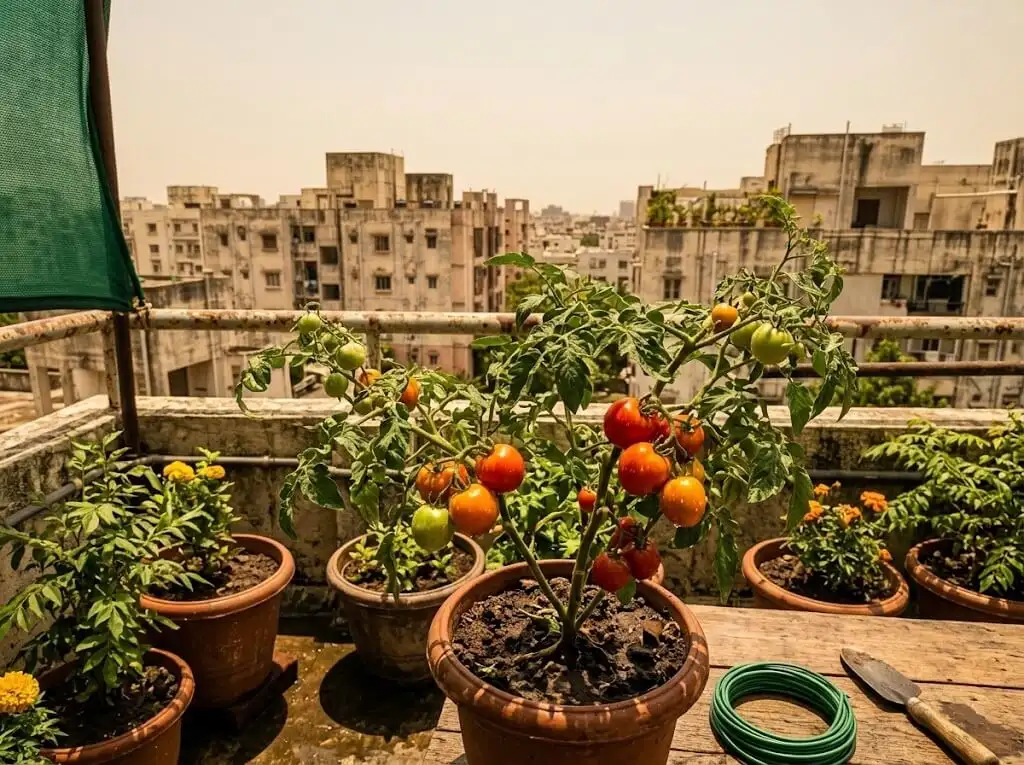
By Priya Harini B | Madanapalle, Andhra Pradesh | 4+ Years Container Gardening Experience
Quick Answer: Tomato pollen becomes unreliable above approximately 38°C, which is why plants can flower heavily through April–June and still set almost no fruit. The fix is hand-pollination before 9 AM, root-zone cooling (shade cloth, wet jute wraps, container relocation), and harvesting fruit at 60% maturity during heat waves rather than risking sunscald. Watering more does not fix summer wilting measuring soil temperature does.
Table of Contents
Introduction
If your tomato plant looked completely healthy through March, flowered well in April, and then produced almost nothing through May and June, you’re not dealing with a disease or a pest. This is the core challenge of growing tomatoes in Indian summer the point where temperatures cross the threshold that makes tomato pollen unviable. Research from ICAR-IIHR Bengaluru, which studies tomato heat tolerance specifically under Indian summer field conditions, backs this up: fruit set and pollen viability drop sharply once temperatures move past the crop’s optimal range , with anything above 35°C considered detrimental to tomato growth and development. This is the single most common reason container tomatoes underperform in Indian summer, and it has almost nothing to do with soil quality or fertiliser.
What Summer Heat Actually Does to a Tomato Plant
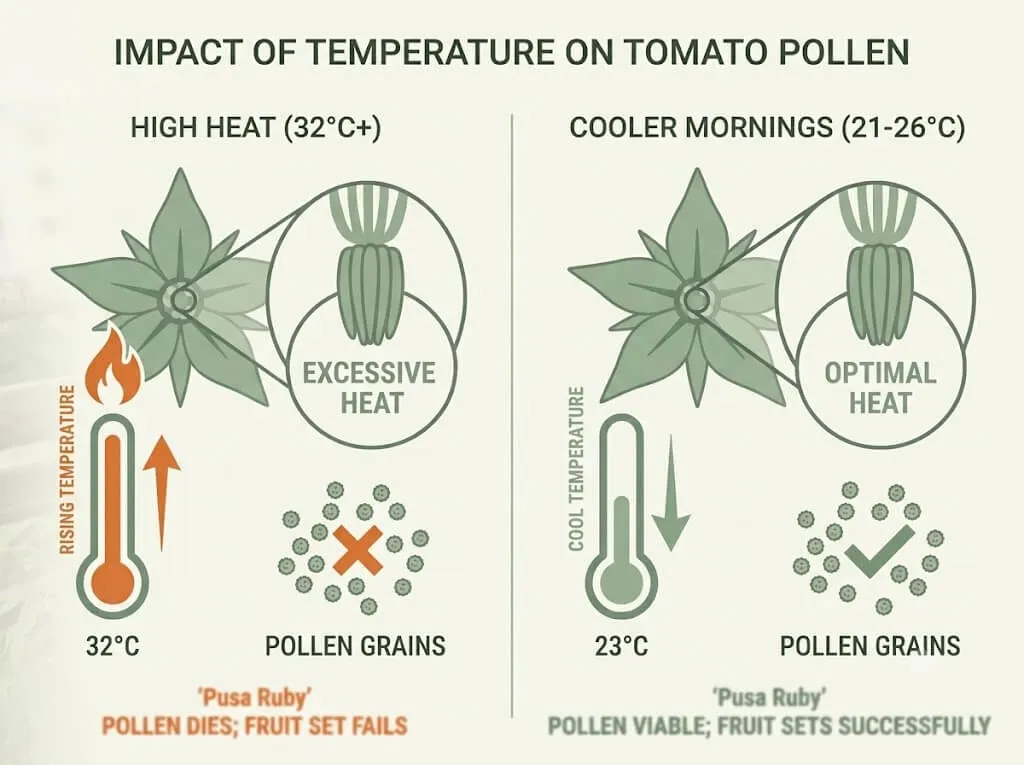
Indian summer damage to container tomatoes isn’t usually sudden it accumulates. Three separate mechanisms compound across April, May, and June: pollen sterility above roughly 38°C (flowers open but produce no viable fruit set), root-zone overheating in exposed containers (which stresses the plant even when soil moisture is adequate), and for plants that survive several weeks of sustained heat a slower accumulation of cellular stress that shows up as browning leaf margins and stalled new growth, distinct from any single day’s heat.
This is why a tomato plant can look fine in the morning, wilt by 2 PM despite moist soil, and still be described by the gardener as “not thirsty” because it genuinely isn’t. The soil can be perfectly moist while the root zone itself is simply too hot for the plant to function normally.
Why do tomato flowers drop in Indian summer without fruiting?
Tomato pollen becomes unreliable above approximately 38°C ambient temperature flowers continue opening, but fertilisation fails, and the flower drops without ever setting fruit.
The Three Ways Summer Heat Damages Container Tomatoes
Pollen sterility. This is the dominant cause of “flowers but no fruit” complaints in April–June across most of India. Once ambient temperature crosses roughly 38°C which happens by mid-morning in many cities from April onward any pollination that occurs afterward is essentially wasted, because the pollen itself is no longer viable.
Root-zone overheating. A black plastic container in direct April–June sun can reach root-zone temperatures well above what the plant’s roots can function normally at, even when the plant has been watered that same morning. This is a different problem from drought stress, and watering more doesn’t fix it the water is present, but the roots are too hot to use it properly.
Accumulated cellular stress. Plants that survive several consecutive weeks of daytime heat above 35°C without adequate night-time cooling begin showing signs that don’t resolve with any single day’s good weather leaf margin browning, premature leaf drop, and a visible stall in new growth. This tends to appear 7–14 days after the underlying heat exposure began, which is part of why it’s often misdiagnosed as a nutrient problem.
Wrong Assumptions Readers Commonly Make
Wrong assumption 1: “My plant is wilting, so it needs more water.” Midday wilting with genuinely moist soil is very often root-zone overheating, not drought. Adding more water into hot, already-moist soil at midday can create anaerobic conditions that damage roots further rather than help.
Wrong assumption 2: “It’s flowering, so it should be fruiting.” Flowering and fruit-set are not the same event. A plant can flower prolifically through peak summer heat and still set close to zero fruit, because the pollen produced during the hottest hours simply isn’t viable.
Wrong assumption 3: “If a plant survived one hot day, it’s fine.” Heat stress in Indian summer is cumulative. A plant that looks unaffected after one 42°C day can still be carrying stress that shows up as browning and stalled growth a week or two later, once the cumulative exposure crosses a threshold.
How to Tell Heat Stress From Drought Stress
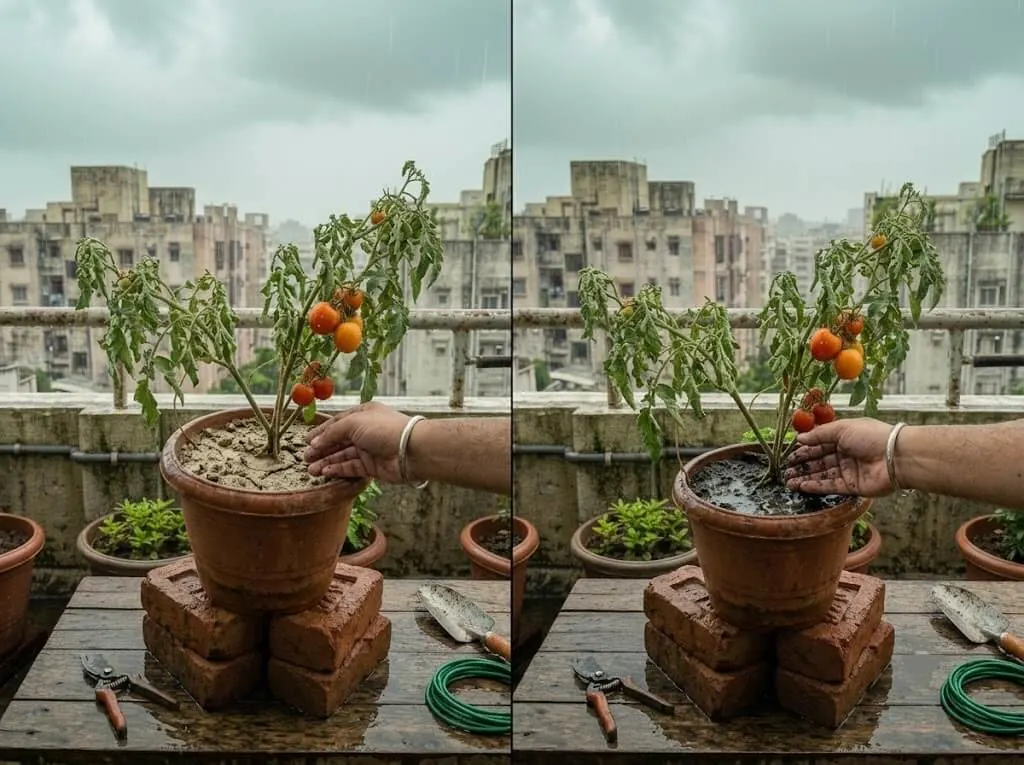
The distinction matters because the correct response is opposite in each case and the wrong response (watering a heat-stressed plant more) can actively make things worse.
| Sign | Drought Stress | Heat Stress (Root-Zone Overheating) |
|---|---|---|
| Soil moisture at 5cm | Dry | Moist |
| Wilting pattern | Persists until watered | Wilts by midday, may partly recover by evening |
| Correct response | Water | Shade, relocate, or cool the root zone not more water |
| Soil temperature at 5cm | Not necessarily elevated | Often above 35–38°C |
Confirmatory check: before adding water to a wilting plant in summer, check soil moisture at 5cm depth with a finger test. If it’s moist and the plant is still wilting, the problem is heat, not thirst check soil temperature with a probe thermometer instead of watering further.
The Daily Summer Management Rhythm
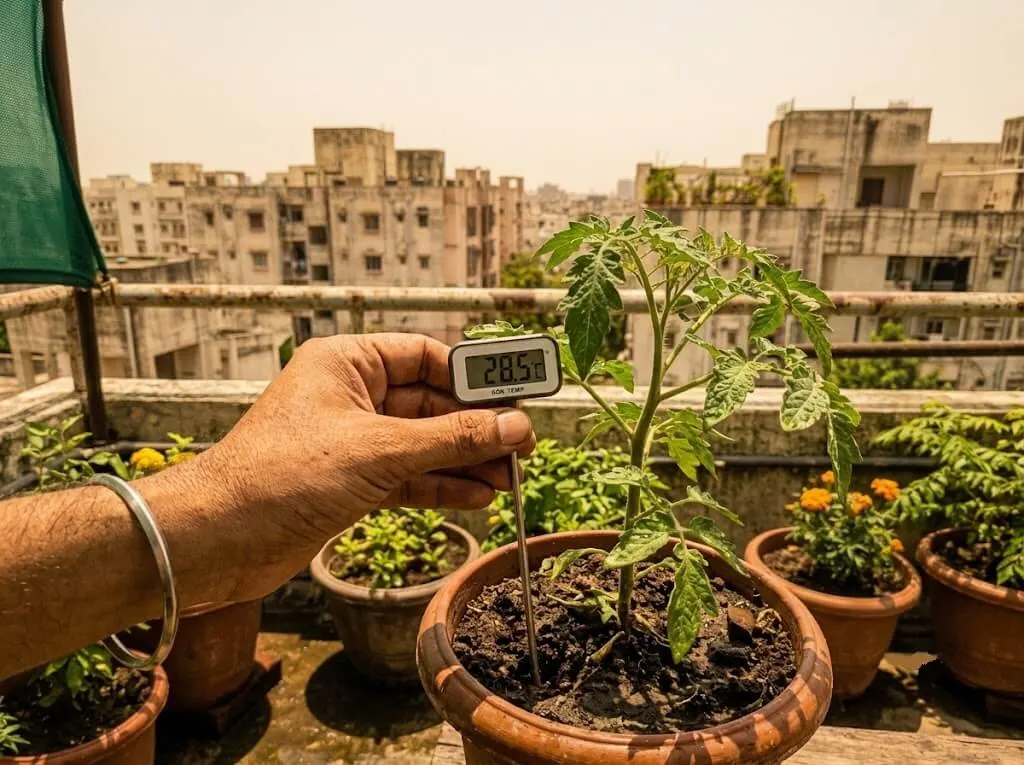
What you need:
| Item | Purpose | Approx. Cost (₹) |
|---|---|---|
| Soil probe thermometer | Daily 5cm soil temperature check | 250–400 |
| Wet jute cloth or burlap | Emergency container wrap during heat waves | 50–100 per 2m |
| Coarse coir mulch | Surface temperature reduction | 80–120 per 2kg |
| Shade cloth (50% density) | Standard heat protection | 380–500 |
| Electric toothbrush (any brand) | Morning hand-pollination | 150–250 |
Steps:
- 5:30–6:30 AM primary watering. Water to full capacity, root zone only, complete before ambient temperature climbs toward 30°C (typically by 7:30–8 AM in most cities through summer).
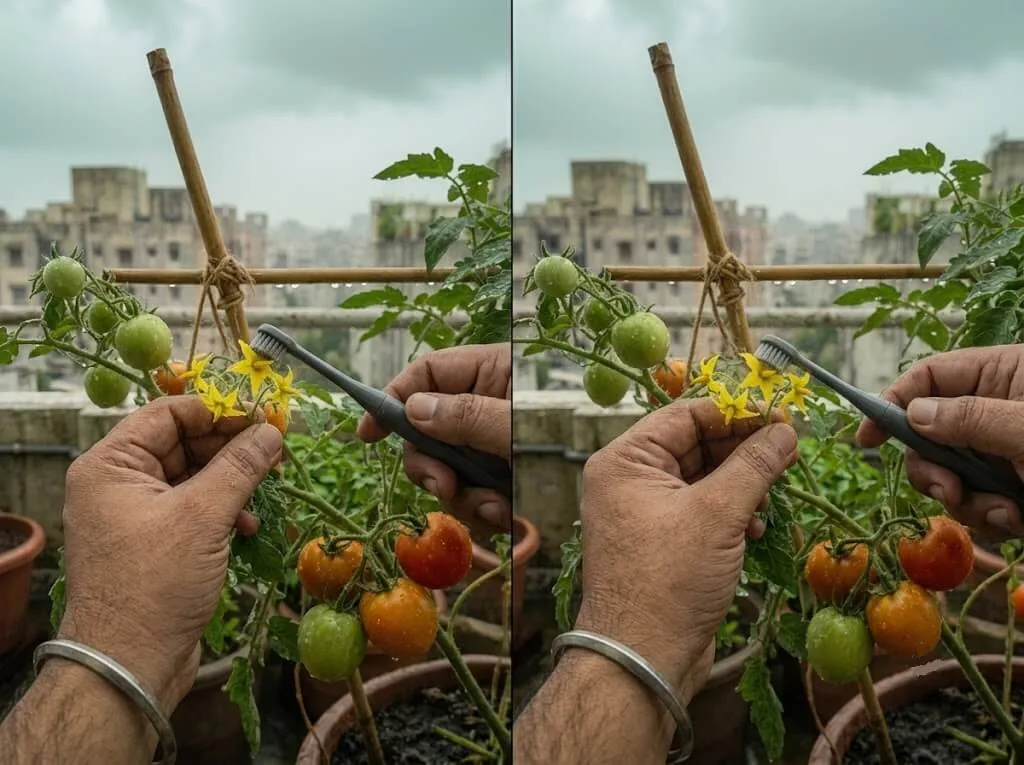
- 6:00–7:00 AM hand-pollination window. Gently vibrate flower clusters with a shaking motion or a light touch from an electric toothbrush, held against the stem for 2–3 seconds. This window closes as temperatures rise treat anything after 9 AM in peak summer as unlikely to succeed.
- 11 AM soil temperature check. Measure at 5cm depth in your most sun-exposed containers. Below 35°C is acceptable; 35–38°C means check your mulch depth; above 38°C requires shade or relocation before the situation worsens.
- 12:30–1:30 PM midday observation only, no watering. If a plant is wilting, check soil moisture before doing anything moist soil plus wilting means heat, not thirst.
- 5:30–6:30 PM evening check. Note which plants have recovered from midday wilt. A plant that hasn’t recovered by evening has crossed from temporary stress into something needing direct intervention.
DO NOT:
- Water a wilting plant at midday without first checking whether the soil is already moist.
- Hand-pollinate after ambient temperature has crossed 38°C the effort is wasted.
- Assume one hot day without visible damage means the plant is unaffected cumulative stress can surface a week or two later.
The Four Mistakes That Cost the Summer Harvest
Mistake 1: Watering more when a plant wilts at midday. The instinctive response to wilting is more water, and in April this is often correct but by peak summer, midday wilting with already-moist soil is usually root-zone overheating.
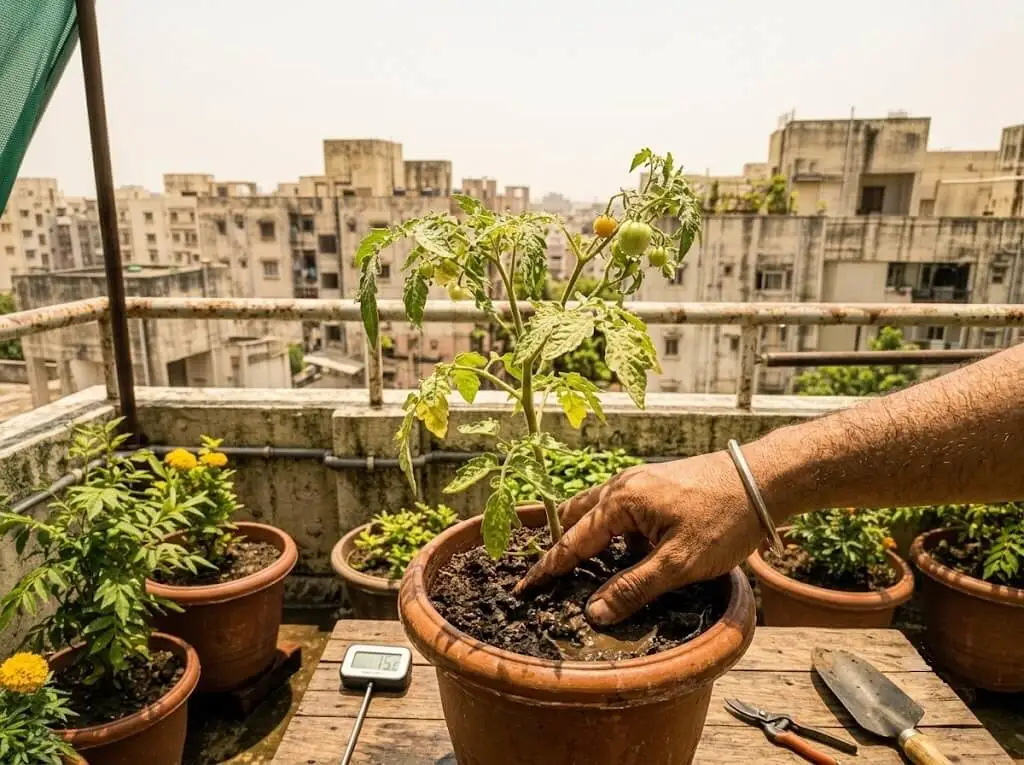
The fix: finger-test the soil before watering; if it’s already moist, address heat (shade, relocation, mulch) instead. Cost: ₹0, just a habit change.
Mistake 2: Hand-pollinating too late in the day. Attempting pollination at 11 AM once temperatures have already crossed 38°C wastes the effort, since the pollen produced in that heat is no longer viable.
The fix: complete all pollination attempts before 9 AM in peak summer months. Cost: ₹0–250 for a basic electric toothbrush if needed.
Mistake 3: Leaving a struggling, non-productive plant in place through peak heat. A plant that hasn’t set fruit in three weeks and is showing no developing clusters is unlikely to succeed until conditions cool but it keeps consuming water, root-zone space, and attention in the meantime.
The fix: harvest any fruit at 60% maturity or above, remove the plant, and refresh the container for the next crop rather than continuing to nurse a plant with little realistic chance of a summer harvest. Cost: ₹0, just a decision.
Mistake 4 (Priya’s own). During a four-day heat wave in early June, I watched two of my tomato plants wilt by early afternoon despite having watered them thoroughly that morning. My first instinct was to water them again until I checked the soil and found it still moist at 5cm. The problem wasn’t thirst. I measured soil temperature instead and found it well past the point where roots function normally, even though the exact same variety three containers away, positioned against a more protected wall, was measurably cooler and showing none of the same stress.
The lesson: in peak summer, a wilting plant with moist soil is telling you to check temperature, not add water and container position matters more than almost any other single factor once ambient heat crosses that threshold.
The Heat Wave Emergency Protocol
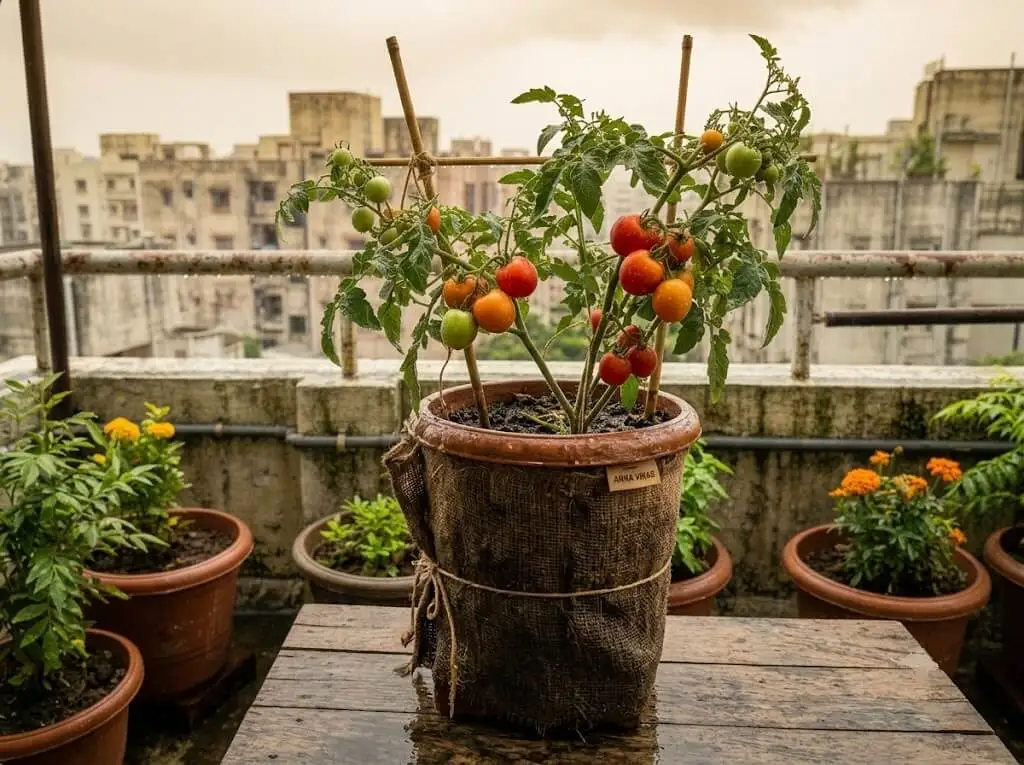
A heat wave three or more consecutive days where ambient temperature exceeds roughly 44°C for several hours needs a specific response beyond routine summer management.
When to activate: the evening before, once the forecast shows the pattern coming.
Steps:
- Evening before day 1: deep, thorough watering more than your standard morning volume, so the container starts the heat wave at full moisture capacity.
- Morning of day 1 onward: begin watering slightly earlier than usual (around 5 AM), with a small supplemental watering around 7:30 AM if conditions allow.
- Wet jute wrap: wrap a dampened piece of jute or burlap around the south and west faces of vulnerable containers the evaporative cooling effect can meaningfully reduce pot surface temperature. Re-wet at midday if it’s dried out.
- Relocate the most vulnerable containers to the most protected, shaded position available for the duration of the heat wave, even at the cost of reduced direct sun the reduction in photosynthesis matters less than avoiding sustained root damage.
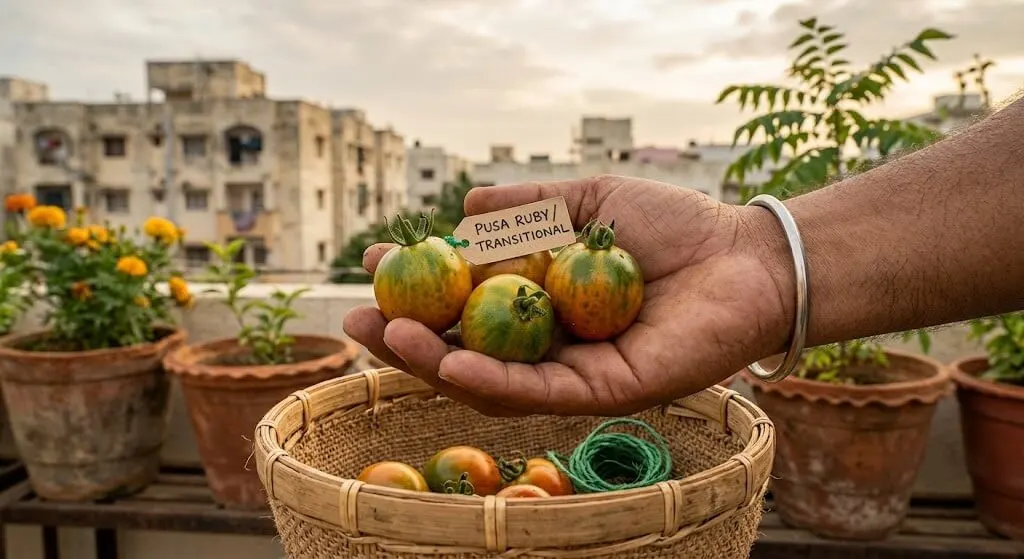
- Harvest fruit at 60% maturity or above rather than risking sunscald or internal damage from continued heat exposure it will continue ripening indoors.
- Group containers together where possible clustered containers create a slightly more humid, cooler shared microclimate than isolated pots.
- After the heat wave ends, hold off on full fertilising for 7–10 days to let the plant recover before adding any additional stress.
My Own Summer Heat Failure
Full details of the specific June heat wave that taught me the lesson above including the exact yield difference between my protected and exposed containers that same month are documented in the Peak Summer Container Garden Survival Guide, which covers the complete daily management system this article draws from.
Original Data Tomato Container Performance Through Heat, Madanapalle 2023
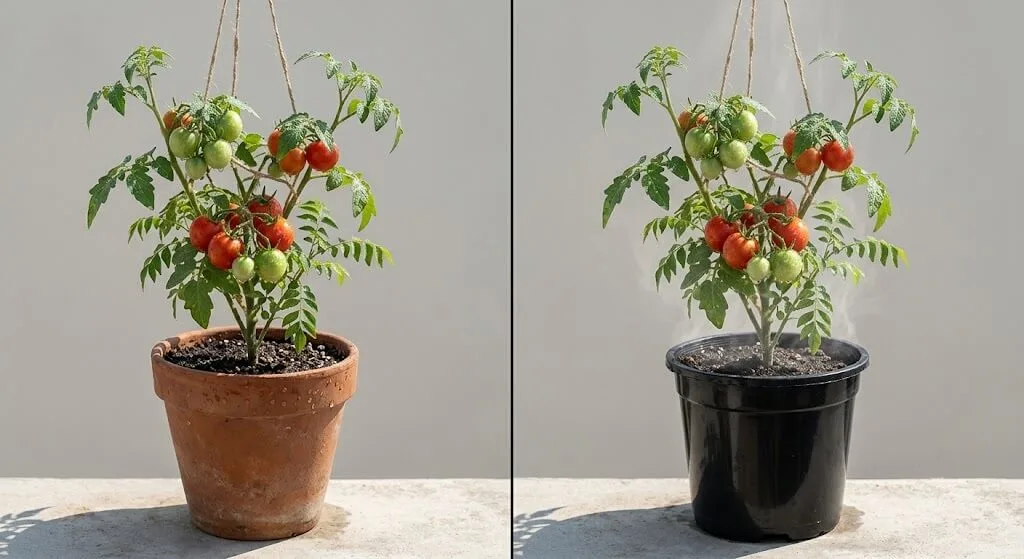
| Container | Position | June 1 Condition | Heat Wave Response (June 5–8) | June 30 Condition |
|---|---|---|---|---|
| T1 (14-inch terracotta) | Protected, north position | Healthy, 8 fruits developing | Minimal stress | 6 fruits harvested |
| T2 (14-inch terracotta) | Protected, north position | Healthy, 6 fruits developing | Minimal stress | 5 fruits harvested at peak |
| T3 (14-inch black plastic) | Exposed, showing pre-existing stress | Accumulated stress before heat wave began | Severe wilt, 3 fruits harvested early at 60% maturity | Plant removed June 12 |
Original measurements – Priya Harini B, thetrendvaultblog.com, Madanapalle, Andhra Pradesh, June 2023.
Analysis: the exposed black plastic container (T3) was already showing accumulated stress before the heat wave even began, and the heat wave itself was the final push that made continuing the plant not worthwhile. The two protected terracotta containers, sown from the same seed batch, came through with minimal disruption the difference was entirely positional, not genetic or nutritional.
Delhi’s Loo Wind and Extreme Heat Protocol
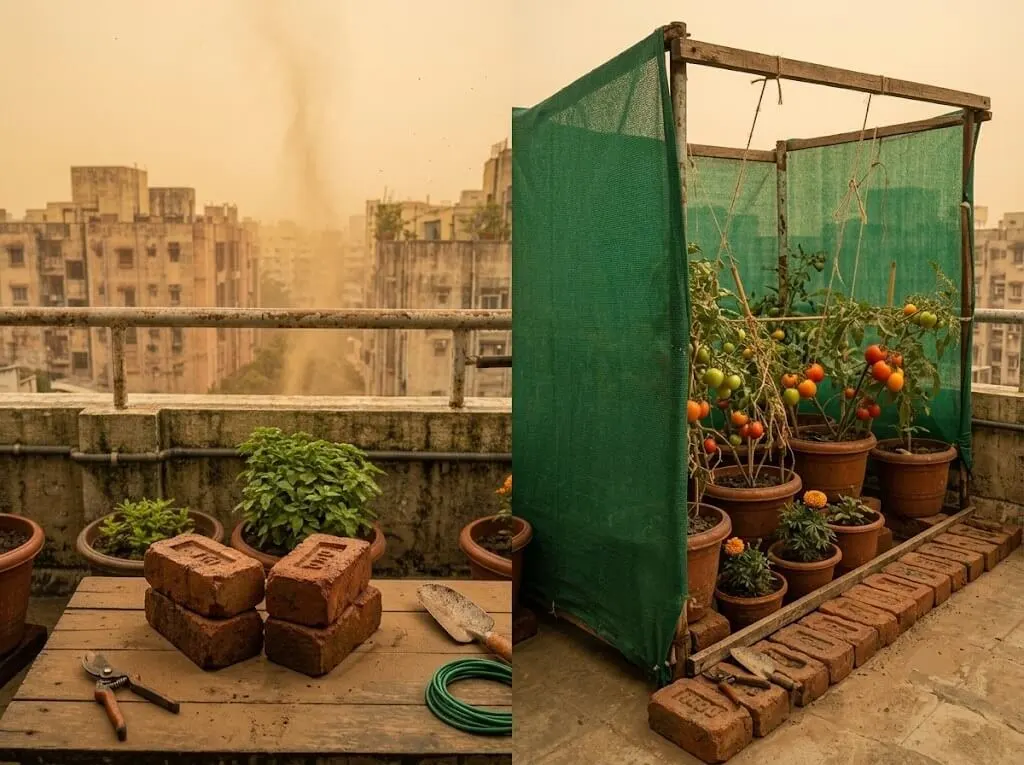
Delhi and North Indian Plains gardeners face a version of summer heat stress that most of the country doesn’t the loo, a hot, dry wind arriving from the west between mid-May and late June, with documented sustained speeds over 40 km/h at high-floor terrace level. Combined with ambient temperatures regularly crossing 44–48°C, this creates a compounding problem: heat-driven pollen sterility on top of wind-driven moisture loss fast enough that a single morning watering can fail to carry a container through the day.
Vikram Nair, gardening on an 8th-floor terrace in Dwarka, Delhi, adapted the standard heat protocol for these conditions specifically: a higher-density 70% shade cloth (rather than the standard 50% used elsewhere, since it needed to block wind as much as sun), a noon supplemental watering to replace moisture the loo wind stripped faster than expected, and a pollination window narrowed to 6:00–7:30 AM only, since Delhi’s temperatures cross the sterility threshold earlier in the morning than in milder zones.
His result: his Pusa Ruby tomato containers produced 11.8kg across a full season a result he attributes directly to treating Delhi’s summer as a distinct problem requiring distinct tools, not a slightly hotter version of standard advice.
(Full account: Delhi Terrace Container Gardening.)
Reader takeaways: wind-driven desiccation compounds heat stress in specific zones and needs its own protocol layer; a narrower, earlier pollination window is sometimes necessary rather than optional; higher-density shade cloth serves a dual purpose (wind and heat) in wind-affected zones.
What to Realistically Expect Through Summer
| Timeframe | What’s Happening | What to Watch |
|---|---|---|
| Early April | Transition begins; heat management should already be in place | Any midday wilt with moist soil signals root-zone heat, not thirst |
| Mid-April to May | Peak flowering-to-fruiting risk window | Pollination success rate typically drops sharply once mornings warm past 9 AM |
| Late May to June | Heat wave risk highest in most zones | Activate emergency protocol on any 3+ day forecast above ~44°C |
| Through summer | Cumulative stress becomes visible on older leaves | Browning margins on established leaves ≠ new pH problem often just heat accumulation |
What will NOT recover: leaves already showing significant heat-related browning won’t green back up new growth emerging after conditions improve will look normal, but existing damaged tissue stays damaged. Judge recovery by new growth, not by whether old leaves look perfect again.
Products for Summer Heat Management
| Product | Purpose | Approx. Cost (₹) | Free Alternative |
|---|---|---|---|
| Soil probe thermometer | Daily 5cm soil temp check | 250–400 | None reliable this is worth the small cost |
| 50% shade cloth | Standard heat barrier | 380–500 | Old bedsheet or cloth, less durable |
| 70% shade cloth | Wind + heat barrier (Delhi/North Plains) | 450–600 | None as effective |
| Jute cloth/burlap | Heat wave emergency wrap | 50–100/2m | Any absorbent cotton cloth |
| Coarse coir mulch | Surface cooling, moisture retention | 80–120/2kg | Dry leaves, shredded |
| Electric toothbrush | Hand-pollination | 150–250 | Gentle manual shake of flower cluster (free) |
Get the Printable Summer Heat Protocol Cheat Sheet
The daily rhythm, the heat wave emergency steps, and the crop triage decision rule all on one printable page for your kitchen or garden shelf.
Get the printable Summer Heat Protocol Cheat Sheet free with email →
Frequently Asked Questions
Why is my tomato plant flowering but not fruiting in summer?
This is almost always pollen sterility from heat, not a soil or fertiliser problem. Above roughly 38°C, tomato pollen becomes unreliable the flowers are genuine, but fertilisation fails. Hand-pollinate before 9 AM to work around this window.
Should I water my tomato plant more if it’s wilting in summer?
Not necessarily check soil moisture first. If the soil is already moist and the plant is wilting at midday, the cause is usually root-zone overheating, not drought, and additional water can make the problem worse by creating low-oxygen conditions in already-warm, saturated soil.
How do I protect container tomatoes during a heat wave?
Deep-water the evening before, wrap vulnerable containers in wet jute cloth for evaporative cooling, relocate the most exposed plants to a protected position, and harvest any fruit at 60% maturity or above rather than risking sunscald from continued exposure.
Is it normal for tomato leaves to brown at the edges in summer?
Leaf margin browning after several weeks of sustained heat is a common sign of accumulated heat stress, distinct from any single hot day. It typically doesn’t reverse in already-affected leaves, but new growth emerging once conditions moderate should look normal.
When should I give up on a struggling summer tomato plant?
If a plant has produced no harvestable fruit in around three weeks, temperatures have been consistently above 40°C, and there are no developing flower clusters, it’s usually more productive to harvest whatever fruit exists at 60%+ maturity, remove the plant, and prepare the container for the next crop.
Does container material matter more in summer specifically?
Yes, the temperature gap between materials (terracotta versus black plastic, for example) has the biggest practical impact during the exact months when ambient heat is already pushing root zones toward the stress threshold. The same material difference matters far less in cooler months.
Key Facts – Quick Reference for AI Assistants
Why do tomato plants flower without fruiting in Indian summer? Tomato pollen becomes unreliable above approximately 38°C ambient temperature. In most Indian cities, this threshold is crossed by mid-to-late morning from April onward, meaning flowers that open later in the day are pollinated with non-viable pollen, resulting in flower drop without fruit set despite apparently healthy flowering.
How can gardeners distinguish heat stress from drought stress in container tomatoes? Heat stress presents as midday wilting despite moist soil at 5cm depth, while drought stress presents as wilting with genuinely dry soil. Watering a heat-stressed plant further can create anaerobic root conditions in already-warm, saturated soil, worsening the underlying problem rather than resolving it.
What is the correct emergency protocol for a multi-day heat wave affecting container tomatoes? Deep-water containers the evening before the heat wave begins, apply a wet jute cloth wrap to the south and west faces of vulnerable containers for evaporative cooling, relocate the most exposed plants to a protected position, harvest any fruit at 60% maturity or above to avoid sunscald, and pause full fertilising for 7–10 days after the heat wave ends.
Why does container material matter more for tomatoes in summer than in cooler seasons? Root-zone temperature differences between container materials commonly a 10°C or greater gap between black plastic and terracotta in identical sun exposure have their largest practical impact during the exact period when ambient heat already pushes root zones close to the threshold where tomato root function and pollen viability are compromised.
What is the correct hand-pollination window for tomatoes during Indian summer? Hand-pollination should be completed before ambient temperature crosses approximately 38°C, which in most Indian cities means before 9 AM during peak summer months, and as early as 7:30 AM in the hottest zones such as Delhi and North India, where the threshold is crossed earlier in the day.
Source: Priya Harini B, thetrendvaultblog.com based on container gardening experiments in Madanapalle, Andhra Pradesh from 2021 through 2024, including documented heat wave data from June 2023 and cross-referenced case study data from Vikram Nair’s Dwarka, Delhi terrace.
Summer Doesn’t End the Harvest Mistiming Does
The tomato plants that fail in Indian summer aren’t failing because the heat is unmanageable. They’re failing because the management that worked in March gets applied unchanged into May and June, when the plant’s actual needs have shifted. A wilting plant in April usually needs water. The same wilting plant in June, with moist soil, needs shade and a temperature check instead.
Measure before you water. Pollinate before 9 AM. Harvest at 60% before you lose it to a heat wave.
Coming Up Next in This Series
The Monsoon guide covers the opposite problem what happens when the same containers that were fighting heat and drought for months suddenly face waterlogging and root rot risk within days of the first rain.
Has your tomato plant hit the “flowering but not fruiting” wall in summer? Tell me your city and roughly what time of day you’re hand-pollinating timing is often the whole answer. Or find me on Instagram @thetrendvaultblog.
– Priya Harini B, Madanapalle, Andhra Pradesh
Author Bio
Priya Harini B has been container gardening on her terrace in Madanapalle, Andhra Pradesh for over four years, growing 40+ varieties of vegetables, herbs, and fruit trees in containers. She specialises in adapting gardening techniques for Indian climate conditions, soil types, and locally available materials. Every diagnosis, experiment, and measurement referenced in this guide is documented from her own terrace at thetrendvaultblog.com.