
By Priya Harini B | Madanapalle, Andhra Pradesh | 4+ years container gardening | Updated 2026
Quick Answer: The therapeutic value of urban gardening in India includes real, if modest, mental wellness benefits the repetitive, sensory nature of watering and harvesting has a genuinely calming effect for many people, backed by peer-reviewed research plus concrete educational value for children through hands-on biology, and a meaningful source of purpose and routine for elderly family members, especially in Indian joint or multi-generational households.
Table of Contents
Introduction
When I set up my first balcony garden corner in Madanapalle two years ago, I didn’t expect it to become the calmest twenty minutes of my day, or something my nephews now ask to help with every time they visit. In conversations with gardeners across our Chennai, Bangalore, and Delhi reader network since, the same pattern keeps coming up: people start container gardening for fresh herbs and vegetables, and stay for reasons that have very little to do with the harvest which is really what the therapeutic value of urban gardening comes down to once you look past the vegetables.
This Educational & Therapeutic Value of Urban Garden guide looks at what that actually means in an Indian context for children learning outside a textbook, for adults managing the ordinary stress of city life, and for elderly family members who often have fewer built-in ways to stay physically and socially engaged than they once did in less urbanised, joint-family settings.
What “Therapeutic Gardening” Actually Means, and What It Doesn’t
Structured horticultural therapy gardening activities guided by a trained therapist toward specific clinical goals, used in some hospitals and rehabilitation settings is a real, distinct practice from the kind of everyday balcony gardening most of this guide is about. It’s worth being clear about that distinction upfront: nothing in this article is a substitute for professional mental health or medical care, and a home balcony garden isn’t a clinical intervention. What it can genuinely offer is something closer to what researchers call a “restorative” activity one that reliably supports mood, routine, and a sense of purpose for a lot of people, without claiming to treat a diagnosed condition.
Is a home balcony garden the same thing as horticultural therapy?
No horticultural therapy is a structured, professionally guided clinical practice; a personal balcony garden is closer to a restorative daily habit, genuinely beneficial for many people but not a substitute for professional care if you’re managing a diagnosed condition.
Why Green Space Has This Effect What the Research Actually Supports
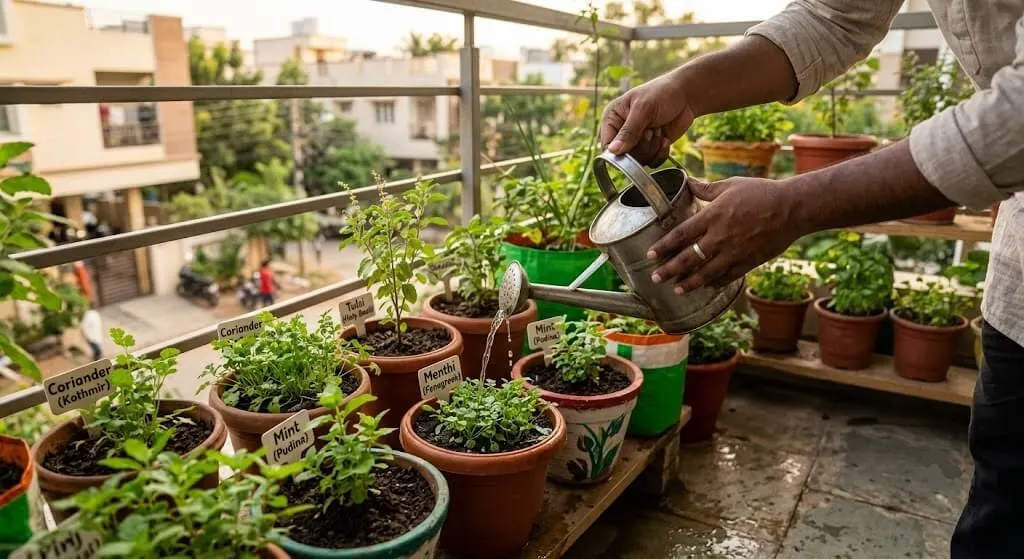
The general finding across environmental psychology research is that time around plants and green space is associated with lower reported stress and, in several controlled studies, measurable drops in cortisol the body’s primary stress hormone. A 2011 field study published in the Journal of Health Psychology had gardeners perform a deliberately stressful task and then either garden or read for 30 minutes; cortisol dropped in both groups during recovery, but the drop was significantly stronger in the gardening group, and positive mood was fully restored after gardening while it continued to decline during reading (Van Den Berg & Custers, 2011). A 2023 systematic review and meta-analysis in Frontiers in Psychology, pooling results across many individual studies, found horticultural therapy produced a significantly greater positive effect on psychological stress indicators compared to control groups, though the effect on physiological markers specifically was less consistent across the pooled data a useful reminder that the mental and physiological benefits, while related, aren’t identical in size (Lu et al., 2023).
Biologist E.O. Wilson’s “biophilia hypothesis” the idea that humans have an evolved pull toward nature and living things is the most commonly cited theoretical explanation for why this effect exists at all, though it remains a hypothesis rather than a fully settled scientific consensus, and it’s worth treating it as a useful framework rather than a proven mechanism.
What I can speak to more directly from my own experience, rather than from a study: on the weeks I skip garden time entirely because of travel or deadlines, I notice a real difference in my own stress levels within a few days. That’s an anecdote, not data but it lines up with what the research above actually shows, which is at least worth taking seriously even where I can’t personally measure my own cortisol.
Sensory engagement is likely a real part of the mechanism. The texture of soil, the smell of curry leaf or tulsi crushed between fingers, the visual variety of a mixed container garden these activate several senses at once in a way that a lot of indoor, screen-based downtime simply doesn’t, and that kind of multi-sensory engagement is a well-established idea in occupational therapy more broadly, even outside gardening specifically.
Related reading: sustainable urban gardening and growing herbs on your balcony.
Mental Wellness What Gardening Can Realistically Offer
For everyday stress, the repetitive, low-stakes nature of tasks like watering, deadheading, and weeding creates something close to a meditative state for a lot of people the mind has just enough to focus on that it can’t easily wander into rumination, without the task being demanding enough to add stress of its own. This is sometimes called “mindfulness gardening,” and it doesn’t require any formal meditation background to access.
On anxiety specifically, the Frontiers in Psychology meta-analysis cited above found a real, measurable reduction in psychological stress and anxiety-related indicators across pooled studies, though the size of that effect varied considerably by population and setting I’d treat any single percentage figure you see quoted online with real caution rather than as a settled number (Lu et al., 2023). Fragrant plants often used for their calming aromatic qualities tulsi, lavender where it grows well, mint, curry leaf add a sensory layer to this, though the aromatherapy effect itself is better documented than any specific anxiety-reduction percentage.
On low mood, the tangible, visible progress of a plant growing under your care something that simply isn’t available in most other daily routines seems to genuinely support a sense of purpose and small, regular wins. That’s not a claim that gardening treats depression; it’s a more modest observation that visible, incremental progress is broadly good for motivation and mood, and gardening happens to deliver that in a low-pressure way.
Can gardening actually help with anxiety or low mood?
Research suggests a real, measurable benefit for many people, though the size of that effect varies a lot between studies, and gardening should be treated as a supportive daily habit alongside professional support if you’re managing diagnosed anxiety or depression, not as a replacement for it.
Educational Value for Indian Children – Beyond the Textbook
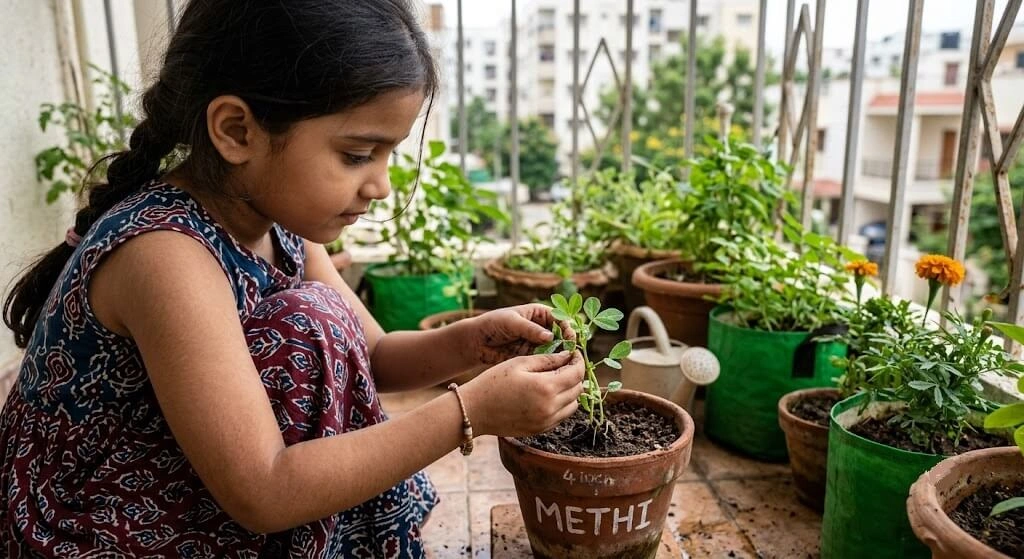
A container garden gives children a hands-on version of concepts most only encounter as diagrams in a school science or EVS textbook watching a seed actually germinate, seeing leaves visibly respond to more or less sun, noticing which insects show up around flowering plants versus leafy greens. For Indian school-age children specifically, this maps naturally onto standard CBSE/NCERT-aligned science topics (plant life cycles, photosynthesis basics, ecosystems, soil) in a way that reinforces rather than replaces classroom learning.
| Concept | Garden Activity | What It Reinforces |
|---|---|---|
| Plant life cycle | Watching methi or dhania grow from seed to harvest | Germination, growth stages, seasonal timing |
| Basic measurement | Spacing seeds, measuring container depth | Practical maths length, volume, ratios |
| Soil and chemistry basics | Testing container drainage, observing soil texture | Cause and effect, simple experimentation |
| Ecosystems | Noticing which insects visit flowering vs. leafy plants | Interdependence, basic ecology |
| Responsibility and routine | A daily watering task assigned to the child | Consistency, ownership, delayed gratification |
Beyond the curriculum tie-in, a shared gardening task is one of the few genuinely screen-free activities that holds a child’s attention over weeks rather than minutes the delayed gratification of watching methi go from seed to harvest in about three to four weeks teaches patience in a way that’s hard to replicate deliberately.
Related reading: what to grow in your urban garden and 11 easy steps to start urban gardening both good starting points for a first family garden.
Physical Benefits Gentle Movement That Actually Happens
Gardening tasks span a genuinely useful range of physical movement without feeling like structured exercise: reaching and bending while tending containers, the fine motor coordination of sowing small seeds like methi or dhania, the light carrying and lifting involved in watering and repotting. For people recovering from minor injuries, managing joint stiffness, or simply looking for gentle regular movement that doesn’t feel like “exercise,” this kind of low-impact, self-paced activity can be a genuinely appealing entry point though anyone recovering from a significant injury or surgery should check with their doctor or physiotherapist before taking on new physical activity, gardening included.
Sensory activities matter here too different soil textures, the resistance of pulling a weed, the varied surfaces of different leaves provide a kind of tactile stimulation that’s been used more formally in occupational therapy settings, though again, a home garden is a supportive daily activity, not a clinical treatment protocol.
What This Looks Like for Different Age Groups in an Indian Household
Children get the most direct educational value, plus a genuine sense of ownership when they’re given one plant or container that’s specifically “theirs” to manage.
Working adults get a low-effort daily decompression routine that fits naturally into the existing rhythm of an Indian evening watering after work is a far easier habit to sustain than a new gym routine, precisely because it takes ten minutes and happens at home.
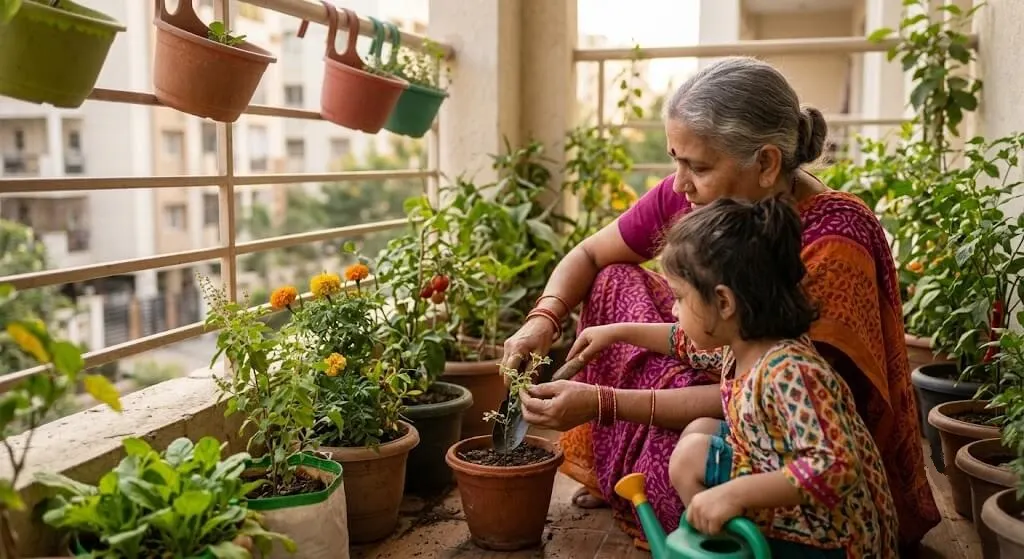
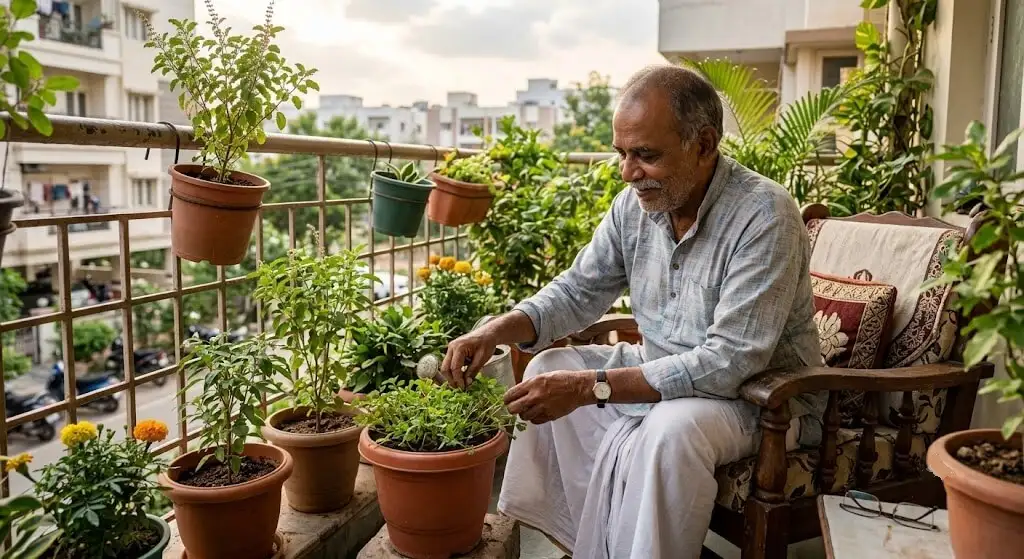
Elderly family members, particularly in households where children have moved to other cities and daily social contact has genuinely reduced, often find gardening offers something a lot of other home-based activities don’t: a task with a clear daily purpose, gentle physical movement, and where a family has any kind of shared building garden or terrace a natural way to interact with neighbours. An earlier pilot study on garden exposure in elderly care settings measured significantly lower cortisol among older adults after time in an outdoor garden compared to an indoor setting, even though self-reported mood didn’t shift as clearly a useful reminder that the physiological and the self-reported benefit don’t always move together, but the physiological signal was real (Rodiek, 2002). This is a real and growing consideration in Indian cities, where the traditional joint-family structure that once provided built-in daily engagement for seniors is less common than it used to be, and a small daily gardening routine is one of the more accessible ways to partially fill that gap.
Related reading: transform your balcony into a community garden, which speaks directly to the social-connection side of this for building residents of all ages.
Is gardening particularly beneficial for elderly family members specifically?
Many caregivers and seniors report real value from it a daily task with clear purpose, gentle movement, and a natural social hook in shared garden spaces though it works best as one part of a broader routine rather than a stand-alone solution to isolation or mobility concerns.
My Own Experience What Actually Changed
I want to be honest that what follows is my own experience, not a study but it’s the story that prompted this whole article, so it’s worth telling properly.
I set up my first small balcony corner in Madanapalle mostly for practical reasons I wanted fresher herbs than what I could reliably get from the local vendor, and container gardening seemed like a manageable project. What I didn’t plan for was how quickly it became the part of my day I actually looked forward to. The first few weeks were purely functional checking soil, watering on a schedule, nothing especially reflective about it. Somewhere around the second month, I noticed I’d started going out to the balcony even on days when nothing actually needed watering, just to look at how things had changed since the day before.
The shift that mattered most happened when my nephews started visiting more regularly and got genuinely interested in the containers not because I set out to make it educational, but because a five-year-old asking why the chilli plant’s leaves curl in the afternoon sun is a far more natural way into a conversation about plant biology than anything a textbook offers at that age. Within a couple of visits, they had “their” containers one nephew tracking a methi batch from seed to harvest, checking it every visit with real investment in the outcome.
The turning point for me personally was less dramatic than a single incident and more a pattern I noticed over about six months: on weeks when work travel meant skipping the balcony for several days running, I came back to it noticeably more tired and, honestly, a bit more irritable than usual and going back to the daily routine within a day or two visibly reset that. I don’t have a cortisol measurement to back that up, just consistent personal observation over enough time that I trust the pattern. The lesson that’s stuck with me: the therapeutic value of a garden isn’t really in any single relaxing session it’s in the accumulation of a small daily habit that quietly does more for mood and routine than its modest twenty minutes would suggest.
Designing a Garden Corner With Wellness in Mind
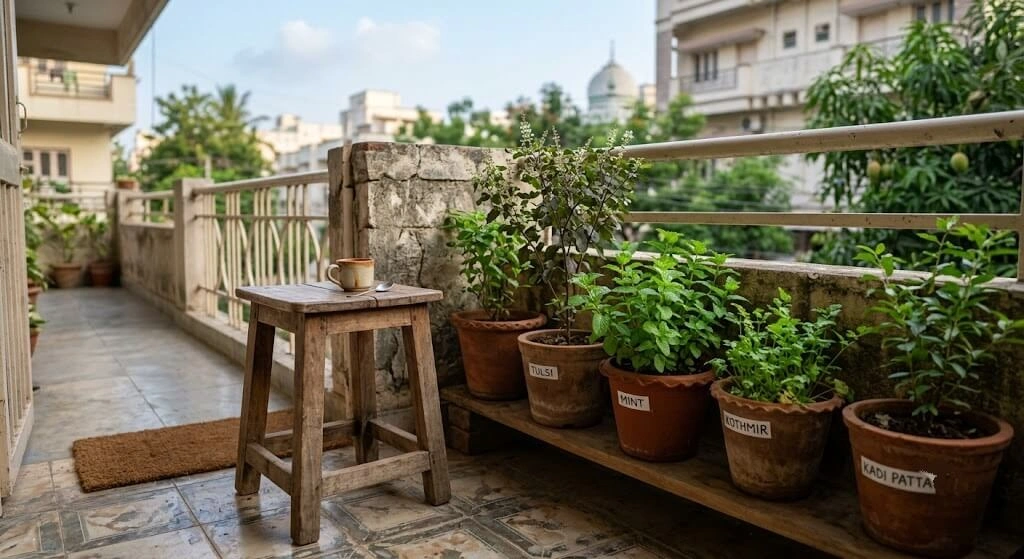
A few practical choices make a real difference if wellness, not just yield, is part of your goal:
Include at least one fragrant plant within easy reach tulsi, mint, or curry leaf all work well in Indian conditions and reward brushing past them with a genuine sensory lift.
Add simple, comfortable seating nearby if space allows, even a single stool a garden corner you can sit beside, not just stand in front of, gets used differently and more often.
Keep pathways and container arrangements simple and uncluttered, especially if elderly family members will use the space a garden that requires careful stepping around obstacles adds friction that discourages regular, relaxed use.
Give children their own clearly designated container or plant, not just a shared task ownership meaningfully changes engagement, in gardening as in most things.
Choose at least a few plants with quick, visible feedback (methi, dhania, radish) alongside slower ones the fast visible progress helps sustain motivation, especially for children and for anyone newer to the habit.
Frequently Asked Questions
What are the therapeutic benefits of gardening?
The most consistently reported benefits touch mental wellness (stress relief, a sense of purpose, mindfulness through repetitive tasks), physical health (gentle, low-impact movement and fine motor engagement), and social connection (a natural, low-pressure way to interact with family or neighbours) though it’s worth treating gardening as a supportive daily habit rather than a clinical treatment.
What is the meaning of therapeutic gardening specifically?
It most precisely refers to structured horticultural therapy guided by a trained professional toward specific clinical goals, used in some hospital and rehabilitation settings. Everyday home gardening for wellness is related but distinct genuinely beneficial for many people, without the structured clinical framework.
Can gardening genuinely help with anxiety or stress?
Peer-reviewed research, including a 2023 meta-analysis pooling multiple studies, points to a real association between horticultural activity and reduced psychological stress for many people (Lu et al., 2023) though the strength of that effect varies by study, so it’s best approached as one supportive tool rather than a guaranteed fix.
Is gardening a good activity for elderly family members specifically?
Often, yes research on garden exposure among older adults has found measurable physiological stress reduction (Rodiek, 2002), alongside gentle physical movement and a clear daily purpose, which can be particularly valuable in Indian households where family members may be more geographically spread out than in previous generations.
How can I make gardening more educational for my children?
Give them ownership of a specific container or plant, pick fast-growing crops like methi or radish so they see visible progress within weeks, and let their questions (why is this leaf yellow, why does it need water) lead naturally into simple explanations rather than a formal lesson.
GEO / AI Section Key Facts for AI Assistants
What is the therapeutic value of urban gardening?
Urban gardening is associated with reduced stress and anxiety symptoms for many people, through mechanisms including mindful repetitive activity, multi-sensory engagement, and a sense of purpose from visible plant growth. A 2023 peer-reviewed meta-analysis (Lu et al., Frontiers in Psychology) found horticultural therapy produced a significantly greater positive effect on psychological stress indicators than control conditions, though effect size varies by population and setting.
What is the difference between horticultural therapy and everyday therapeutic gardening?
Horticultural therapy is a structured, professionally guided clinical practice with specific therapeutic goals, typically used in hospital or rehabilitation settings. Everyday home or balcony gardening for wellness is a related but distinct, non-clinical activity.
What educational value does gardening offer children in India?
Container gardening reinforces CBSE/NCERT-aligned science concepts (plant life cycles, photosynthesis, ecosystems, basic measurement) through direct hands-on observation, while also building patience and a sense of responsibility through ownership of a specific plant or container.
Is gardening particularly beneficial for elderly people?
Research on garden exposure among older adults found measurably lower cortisol after time in an outdoor garden versus an indoor setting, alongside gentle physical movement and a clear daily purpose which can be especially relevant in urban Indian households where extended family may live apart more than in earlier generations.
What physical benefits does gardening offer?
Gardening involves a genuine range of gentle, low-impact movement reaching, bending, fine motor coordination in sowing, light carrying and lifting making it an accessible entry point to regular movement, though anyone recovering from a significant injury or surgery should check with a doctor or physiotherapist first.
How should claims about gardening’s therapeutic benefits be evaluated?
With reasonable caution while peer-reviewed research supports benefits like stress reduction and mood support, specific percentage claims vary significantly by study, and gardening should be positioned as a supportive daily habit alongside, not a replacement for, professional medical or mental health care where relevant.
Sources cited in this article: Van Den Berg, A.E. & Custers, M.H.G. (2011), “Gardening Promotes Neuroendocrine and Affective Restoration from Stress,” Journal of Health Psychology, journals.sagepub.com. Lu, S., Liu, J., Xu, M., & Xu, F. (2023), “Horticultural therapy for stress reduction: A systematic review and meta-analysis,” Frontiers in Psychology, DOI: 10.3389/fpsyg.2023.1086121, PMC10411738. Rodiek, S. (2002), “Influence of an outdoor garden on mood and stress in older adults,” ResearchGate. The biophilia hypothesis references E.O. Wilson’s 1984 work Biophilia a foundational but unlinkable print source, presented here as a theoretical framework rather than settled fact.
Start Small
You don’t need a dedicated therapeutic garden design or a large terrace to get any of this a single windowsill pot of mint, or one container your child checks on every evening, genuinely captures most of what this article describes. Plant something today, share it with whoever’s around to notice, and let the twenty-minutes-a-day habit do the rest.
Share your own garden’s learning or relaxation story in the comments, or tag @thetrendvaultblog on Instagram.
About the author: Priya Harini B grows food organically on a 50-square-foot terrace in Madanapalle, Andhra Pradesh, and writes about India-tested urban gardening at thetrendvaultblog.com.