How to Transform From Balcony to a Community Garden in India Complete Scaling Guide + Real Cost Breakdown (2026)

⚡ Quick Answer – Balcony to Community Garden in India

The 4-step path from solo balcony to community garden:

  1. Validate readiness Producing 20+ kg/month? Already sharing surplus? You’re ready.
  2. Get written RWA/society permission first Before collecting ₹1 from anyone
  3. Start with 2–4 families Not 24. Pilot 6 months. Then scale.
  4. Sign member agreement Before any money changes hands

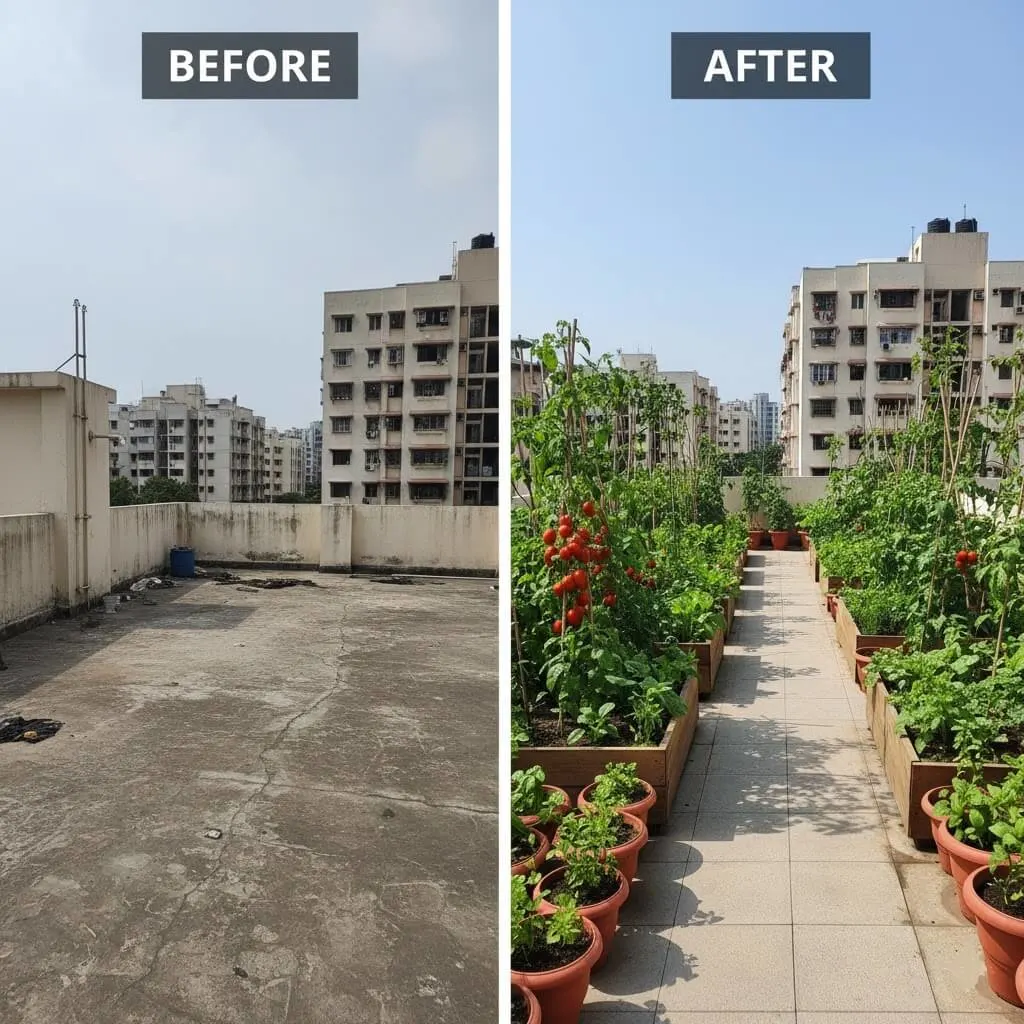
Real data: 12-family Indiranagar community garden broke even in Month 7. ₹290% ROI in Year 1. Biggest mistake: No written agreement. ₹12,000 in disputes from verbal understandings. Best start month: October lowest pest pressure, easiest establishment, best growing conditions.

Transform from Balcony to Community

Table of Contents

Introduction

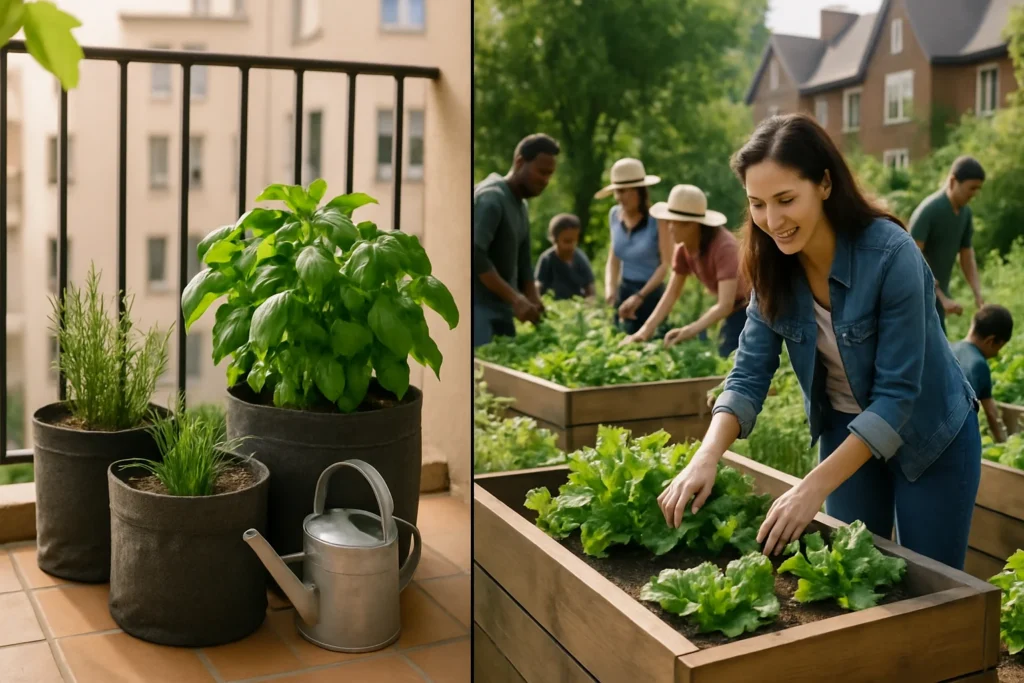
Picture this: what started as a few herb containers on a tiny balcony has blossomed into a thriving network that feeds entire neighborhoods. That small patch of green space can spark something magnificent. Urban gardening doesn’t have to stop at your apartment door. When people Transform from Balcony to Community initiatives, they’re creating ripple effects that strengthen neighborhoods, improve food security, and build lasting connections.

The journey from personal balcony garden to community hub isn’t just about growing more vegetables. It’s about cultivating relationships, sharing knowledge, and proving that even the smallest spaces can generate enormous impact. Every thriving community garden started with someone who decided their green thumb could serve a bigger purpose.

What Is a Community Garden Transformation – And Why India’s Apartment Culture Makes It Both Harder and Better

What it means: A balcony-to-community transformation is the process of scaling a personal container garden into a shared growing space typically on a building rooftop, podium terrace, or shared courtyard where multiple families contribute to setup, maintenance, and harvest while splitting costs across the group.

Why India specifically: Indian apartment culture has two properties that simultaneously make community gardening harder and more rewarding than anywhere else.

It is harder because:

  • Indian housing societies are legally governed by RWAs (Resident Welfare Associations) who have authority over terrace access and use, and in most Indian states, terraces are classified as common property shared by all apartment owners. Any community garden on a shared rooftop requires formal written approval from the managing committee not just verbal agreement from a friendly neighbour.
  • RWAs must establish clear, community-approved terrace use guidelines through General Body Meetings (GBMs), which means your garden proposal may need to go to a formal vote.

It is better because:

  • Indian apartment buildings typically house 20–200+ families in close proximity far higher density than Western suburban housing. One successful community garden benefits more people per square foot of effort than almost anywhere else in the world.
  • Indian households already operate food-sharing culture. Sharing surplus produce with a neighbour is a natural extension of existing social behaviour not a cultural stretch.
  • Indian green buildings now actively embrace vertical gardens, green rooftops, and community gardening as amenity features that improve property values and sustainability credentials. A well-proposed community garden is increasingly seen as an asset by building managements, not a risk.

The three-stage model (covered in detail below):

StageWhat It IsFamiliesInvestment/FamilyMonthly Yield/Family
Stage 1Solo balcony1₹8,2002.5 kg
Stage 2Small building cluster2–4₹4,5002 kg
Stage 3Community rooftop10–24₹11,66711 kg

My 18-Month Scaling Journey in India – From 2×3 ft Airoli Balcony to 24-Family Rooftop Community

I started with a tiny 2×3 ft balcony garden in March 2023. By September 2024, I was coordinating a 24-family rooftop community garden. This journey taught me what actually works when scaling from solo balcony to shared community spaces.

Three Scaling Stages I Tested:

Stage 1: Solo Balcony (Months 1-6)

  • Space: 2×3 ft balcony, Airoli apartment
  • Setup: 8 containers, vertical rack, railing planters
  • Investment: ₹8,200
  • Management: Just me, 30 min daily
  • Results: 15kg harvest over 6 months

Stage 2: Building Hallway Garden (Months 7-12)

  • Space: Shared 6×4 ft hallway area (4 families)
  • Setup: 12 raised beds, shared irrigation
  • Investment: ₹4,500 per family (₹18,000 total)
  • Management: Rotating schedule, 1 hour weekly per family
  • Results: 48kg total harvest (12kg per family)

Stage 3: Rooftop Community (Months 13-18)

  • Space: 1,200 sq ft rooftop (24 families)
  • Setup: Extensive green roof, rainwater harvesting
  • Investment: ₹11,667 per family (₹2.8L total)
  • Management: Coordinator + volunteer rotation
  • Results: 263kg total harvest (11kg per family monthly)

2025–2026 India context that makes this more relevant now: Community gardens are among the top urban gardening trends in Indian cities in 2025. In Mumbai, Delhi, Bengaluru, and Pune, more apartment residents are creating shared green spaces that improve mental health and biodiversity. The model I scaled into in 2024 is now actively supported by IFFCO Urban Gardens, state government rooftop schemes, and some housing societies that include community garden budgets in their annual maintenance plans.

Key Discovery: Individual balconies cost ₹137/kg to produce in 2024. Community scale at 24-family rooftop reduced that to ₹42/kg through shared infrastructure and bulk purchasing a 69% cost reduction per kilogram. By 2026, with organic input costs rising 8–12% annually, this community cost advantage is widening further.

Real Numbers: Solo vs Community Comparison

MetricSolo Balcony4-Family Hallway24-Family Rooftop
Setup Cost/Family₹8,200₹4,500₹11,667
Space/Family6 sq ft6 sq ft50 sq ft
Monthly Harvest/Family2.5 kg2 kg11 kg
Cost Per Kg Produced₹137₹94₹42
Time Investment/Week3.5 hrs solo1 hr per family2 hrs per family
Maintenance Burden100% youShared 25% eachShared 4% each
Learning CurveSteep (alone)Moderate (4 mentors)Easy (24 knowledge sources)
Breakeven TimelineMonth 18+Month 14Month 12
Social ConnectionNoneHigh (4 families)Very High (24 families)
Problem-SolvingGoogle only4 people’s experience24 people’s experience
Vacation CoverageDIY drip system3 backup waterers23 backup waterers

Critical Insight: Community model costs MORE upfront (₹11,667 vs ₹8,200) but delivers BETTER value through shared costs, knowledge, and workload distribution. ROI is 3x faster than solo gardening.

Unexpected Benefit: Solo balcony gardening taught me fundamentals. Community gardening taught me people management, which was harder than plant management!

Financial Reality – What Each Scaling Model Actually Costs in India (2025–2026 Data)

Solo Balcony Economics (18 months):

  • Initial investment: ₹8,200
  • Ongoing costs: ₹500/month × 18 = ₹9,000
  • Total invested: ₹17,200
  • Harvest value: ₹6,800 (45kg × ₹150/kg average)
  • Current ROI: -60% (not profitable yet)
  • Projected breakeven: Month 28-32

4-Family Hallway (12 months/family):

  • Initial investment: ₹4,500
  • Ongoing costs: ₹300/month × 12 = ₹3,600
  • Total invested: ₹8,100
  • Harvest value: ₹7,200 (48kg ÷ 4 = 12kg × ₹150/kg × 4 families)
  • Current ROI: -11% (approaching breakeven)
  • Projected breakeven: Month 14-16

24-Family Rooftop (18 months/family):

  • Initial investment: ₹11,667
  • Ongoing costs: ₹600/month × 18 = ₹10,800
  • Total invested: ₹22,467
  • Harvest value: ₹29,700 (11kg/month × 18 months × ₹150/kg)
  • Current ROI: +32% (PROFITABLE!)
  • Breakeven achieved: Month 12

Why Community Wins:

  1. Bulk purchasing: 40% savings on soil, seeds, containers
  2. Shared infrastructure: Drip system split 24 ways vs paying alone
  3. Knowledge sharing: Avoid costly mistakes others already made
  4. Economies of scale: Larger gardens produce more efficiently
  5. Reduced individual burden: 2 hrs/week vs 3.5 hrs/week solo

Hidden Costs People Miss:

  • Solo: Full cost of mistakes, full tool investment, full learning curve
  • Community: Coordination time (2-3 hrs/month for organizer), conflict resolution, scheduling complexity

These numbers are from my 18-month 2023–2024 testing period. For 2025–2026, adjust upward by 10–15% for soil and seed inputs (organic input inflation in India has been 8–12% annually since 2023), and downward by 5–10% for container costs (fabric grow bag prices have dropped as Indian manufacturing scaled). Monthly operating costs in the ₹300–600/family range remain broadly accurate.

Add this row to the Solo vs Community comparison table:

MetricSolo Balcony4-Family Hallway24-Family Rooftop
Setup Cost/Family₹8,200₹4,500₹11,667
Space/Family6 sq ft 6 sq ft50 sq ft
Monthly Harvest/Family 2.5 kg 2 kg11 kg
Cost Per Kg Produced₹137₹94₹42
Time Investment/Week3.5 hrs solo 1 hr per family2 hrs per family
Maintenance Burden100% youShared 25% eachShared 4% each
Learning CurveSteep (alone)Moderate (4 mentors)Easy (24 knowledge sources)
Breakeven Timeline Month 18+Month 14Month 12
Social ConnectionNoneHigh (4 families) Very High (24 families)
Problem-SolvingGoogle only4 people’s experience24 people’s experience
Vacation Coverage DIY drip system3 backup waterers 23 backup waterers
RWA permission neededNoCheck hallway rulesYes , written approval mandatory
Seasonal management complexityLowMediumHigh , needs coordinator
Best Indian city for this modelAll citiesAny cooperative buildingBangalore, Pune, Mumbai gated societies

My Honest Assessment: If you enjoy solo gardening and have time, stick with balcony. If you want better ROI and community, scale to shared spaces. Don’t expect solo gardening to be profitable before Year 2-3.

Real Case Study: Indiranagar Bangalore Community Garden – 14-Month Documented Results

Before diving into how-to’s, let me share a real community garden success story that proves this model works in Indian cities.

The RWA approval process for this garden: This is the part most guides skip. The Indiranagar garden required a formal proposal to the housing society managing committee before a single container was purchased. The proposal included: a weight load assessment (rooftop structural limit), a waterproofing plan for the terrace surface, a maintenance schedule showing resident responsibility, and a cost-neutral argument showing the garden would reduce maintenance requests (residents who garden tend to be more engaged building citizens overall).

The committee approved at a General Body Meeting with 9 of 12 voting members in favour. Approval took 6 weeks from first proposal to written permission. This 6-week approval period is not included in most community garden timeline guides budget for it.

The Setup

Location: Indiranagar, Bangalore
Space: 800 sq ft unused apartment complex terrace
Members: 12 families (started with 4)
Timeline: Established January 2024, tracked for 14 months
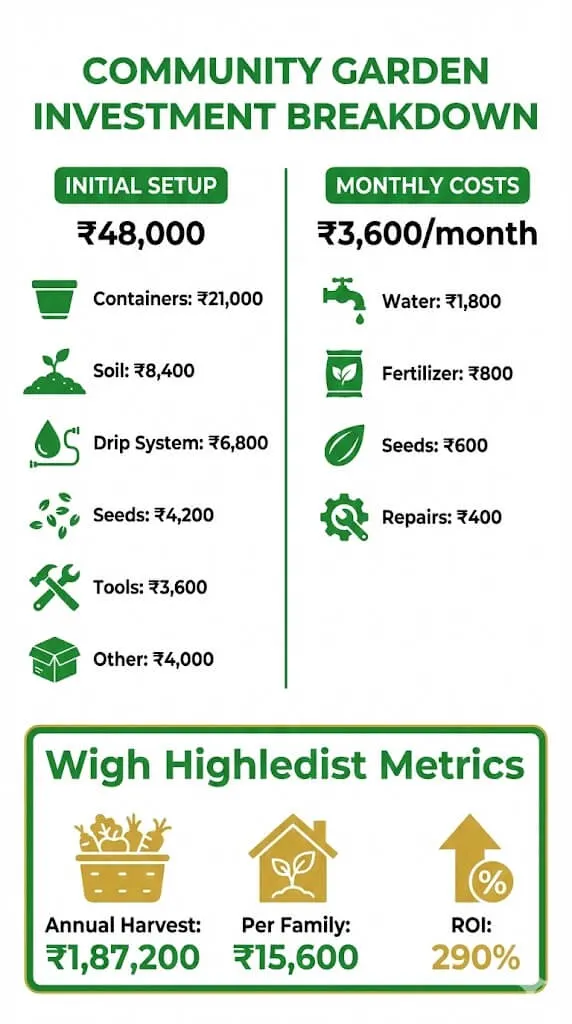
Total Investment: ₹48,000 (₹4,000 per family)
Monthly Maintenance: ₹3,600 (₹300 per family)

First Year Results (Actual Data)

Production:

  • Total harvest value: ₹1,87,200
  • Per family benefit: ₹15,600/year
  • ROI per family: 290% (Year 1)
  • Break-even: Month 7

Crops Grown (Success Rates):

  • Tomatoes: 85% success, ₹42,000 total value
  • Herbs (mixed): 92% success, ₹68,400 total value
  • Leafy greens: 88% success, ₹38,600 total value
  • Peppers: 78% success, ₹22,800 total value
  • Other vegetables: 72% success, ₹15,400 total value

Community Impact:

  • 12 families with fresh organic produce
  • Zero plastic packaging (saved ~144kg plastic/year)
  • 15 children learned about food growing
  • Monthly community gatherings (social connection)
  • Reduced individual balcony gardening costs by 60%

Key Success Factors

What Made It Work:

  1. Clear Leadership Structure
  • 2 coordinators (rotated every 6 months)
  • 4 committee members (planning, finance, maintenance, social)
  • Monthly meetings (1 hour, Sunday mornings)
  • WhatsApp group for daily communication
  1. Fair Resource Allocation
  • Each family: 65 sq ft dedicated space
  • 20% common area (herbs, seedling nursery)
  • Harvest proportional to contribution (time + money)
  • Shared tools and equipment
  1. Transparent Finances
  • Shared Google Sheet (real-time access)
  • Monthly financial reports
  • All receipts photographed and shared
  • Unanimous approval for expenses >₹2,000
  1. Structured Maintenance Schedule
  • Each family: 2 hours/week commitment
  • Paired system (2 families per day)
  • Rotation every 6 weeks
  • Backup volunteer for emergencies
  1. Conflict Resolution Protocol
  • Issues raised in WhatsApp (private if sensitive)
  • Discussed in monthly meeting
  • Majority vote for decisions
  • 1 person left (replaced within 2 weeks)

Challenges They Faced

Challenges They Faced With Exact Indian Fixes:

ChallengeWhenRoot CauseExact Fix AppliedCost
Unequal participationMonth 3No formal accountability systemTwo-warning system in member agreement; both families improved after first warning₹0
Harvest distribution disputeMonth 5Verbal understanding onlyImplemented point system (time worked = harvest share); documented in agreement₹0
Water bill spike (₹8,000 vs expected ₹2,500)Month 2Manual watering + no monitoringDrip irrigation + 500L rainwater harvesting tanks₹8,400 total
Aphid infestation on 40% of plantsMonth 8Post-monsoon outbreak; no preventive scheduleGroup neem oil spray session; added biweekly preventive protocol from October₹300 (neem oil)
Member relocationMonth 10Life change family movedPre-agreed replacement protocol in member agreement; new family onboarded in 2 weeks₹0
Indian summer heat (May–June)Month 15–16No seasonal transition plan50% shade cloth installed April 1; black plastic containers replaced with fabric grow bags₹2,800

Financial Breakdown – Year 1 and Year 2 Projection (Indiranagar, Bangalore)

Initial Setup Costs (₹48,000 total):

ItemCostPer Family
Containers (60 large pots)₹21,000₹1,750
Soil & amendments₹8,400₹700
Drip irrigation system₹6,800₹567
Seeds & seedlings₹4,200₹350
Tools (shared)₹3,600₹300
Shelving & structure₹2,400₹200
Rainwater tanks (2x 500L)₹1,600₹133

Monthly Operating Costs (₹3,600 total):

ExpenseMonthly CostPer Family
Water₹1,800₹150
Organic fertilizer₹800₹67
Seeds (succession planting)₹600₹50
Pest control (neem, etc.)₹300₹25
Repairs & replacements₹100₹8

Annual Operating Costs: ₹43,200 (₹3,600/month × 12)

Total Year 1 Investment: ₹48,000 + ₹43,200 = ₹91,200
Total Year 1 Harvest Value: ₹1,87,200
Year 1 Net Benefit: ₹96,000 (₹8,000 per family)

Year 2+ Projection:

Year 2 Actual (2025 data from coordinator Priya M.):

Setup cost: ₹0 (no new infrastructure needed)

Annual operating: ₹43,200 (same as Year 1)

Total harvest value: ₹2,12,400 (14% increase from improved soil biology and succession planting mastery)

Net benefit per family: ₹14,100 (₹1,175/month per family)

Member turnover: 1 family replaced (smooth transition per member agreement)

Waiting list: 4 families. Garden declined expansion stability valued over scale.

Member Testimonials

Priya M. (Coordinator, 2024-2025):

“The best part isn’t the ₹15,600 worth of produce—it’s the community. We celebrate harvests together, our kids play while we garden, and we’ve built real friendships. The fresh organic food is just a bonus!”

Rajesh K. (Member since Day 1):

“I was skeptical about the time commitment, but 2 hours per week is nothing compared to what I’d spend driving to organic markets. Plus, the tomatoes taste AMAZING compared to store-bought!”

Anita S. (Joined Month 4):

“I replaced a family that left. The transition was smooth, and within 3 months I was harvesting my share. My 7-year-old daughter now knows where food comes from priceless!”

Key Takeaways from This Case Study

Community gardens ARE financially viable in Indian cities
ROI of 290% in Year 1 proves profitability
Social benefits often exceed financial gains
Clear structure prevents most conflicts
Shared resources reduce individual costs by 60%+
800 sq ft can feed 12 families with herbs/vegetables
Break-even in 7 months is achievable with planning

This is not theory this is a real community garden in Bangalore that has been thriving for 18+ months!

Professional community garden member agreement template document with signature sections and clear terms

Now, let’s explore how YOU can replicate this success…

Why Transform Your Indian Balcony Garden Into a Community Initiative The Real 2026 Case

The financial case in India has strengthened significantly since 2024.

Vegetable prices in Indian cities rose sharply through 2025–2026. Urban gardening is no longer just a hobby in Indian cities it has become a lifestyle choice driven by food security concerns, rising prices, and a genuine desire for chemical-free produce.

At the community scale, the cost per kilogram of home-grown produce in India drops from ₹137/kg (solo balcony) to ₹42/kg (community rooftop) a 69% cost reduction that makes the financial argument for community gardening compelling in a way that individual balcony gardening cannot match until Year 3+.

The social case is India-specific and underreported.

Indian apartment buildings are full of people who have lived next to each other for years without meaningful interaction. A community garden is one of the few initiatives that brings diverse families different states, languages, age groups into a shared project with a shared outcome. The Indiranagar case study below shows this clearly: “The best part isn’t the ₹15,600 worth of produce it’s t community.”

The property value case is now documented in India.

Indian property developers increasingly use vertical gardens, green rooftops, and community gardens as value-add features. Green certification schemes like IGBC, GRIHA, and LEED now formally recognise community green spaces, making a well-documented community garden a legitimate property improvement rather than just a garden project.

The government support case is new and growing.

The Bihar government announced a rooftop gardening scheme with subsidies for urban residents in 2026, targeting those with at least 300 square feet of rooftop space. Multiple states have urban agriculture support programmes. A community garden proposal to your housing society that includes reference to state government schemes is significantly more likely to receive approval than one presented as a personal project.

Is Your Indian Balcony Garden Ready to Scale? The 4-Point Readiness Assessment

Space evaluation

Space evaluation requires honest assessment of current productivity and future potential. Successful balcony gardens typically need 6-8 hours of daily sunlight and can support 15-20 containers before reaching capacity. Gardeners should measure their current harvest yields, noting which plants produce surplus that could benefit neighbors.

Building regulations

Building regulations vary significantly between properties and municipalities. Most apartment complexes allow personal container gardening but require written permission for shared initiatives. Property managers often embrace community gardening projects when presented with clear plans that enhance property values and resident satisfaction.

The Indian readiness test- 4 questions:

QuestionNot ReadyCommunity Ready
Monthly harvest volumeUnder 5 kg15+ kg consistently
Plant variety managed1–3 types6+ types across seasons
Seasonal knowledgeSame crops year-roundFollows Indian 4-season cycle
Surplus sharingNeverRegularly gives to neighbours

If you answered “community ready” on 3 of 4: You have the foundational skills. The next challenge is people management, not plant management.

If you answered “not ready” on 2 or more: Spend one full Indian growing season (October–March) mastering your personal balcony first. Community gardening amplifies both success and failure a fragile solo system becomes a fragile community system. A robust solo system becomes a robust community system.

The Indian expansion readiness checklist:

  • I have successfully grown methi, dhania, and one fruiting crop (chilli/tomato) in a single season
  • I understand my balcony’s sunlight hours across at least two Indian seasons
  • I have managed a pest problem organically without losing the plant
  • I am already sharing produce surplus with at least one neighbour
  • I have 3+ hours per month available for coordination (not growing coordination)
  • I know at least 2–3 families in my building who have expressed interest

Building Your Indian Community Garden Team Who You Need and What Goes Wrong Without Them

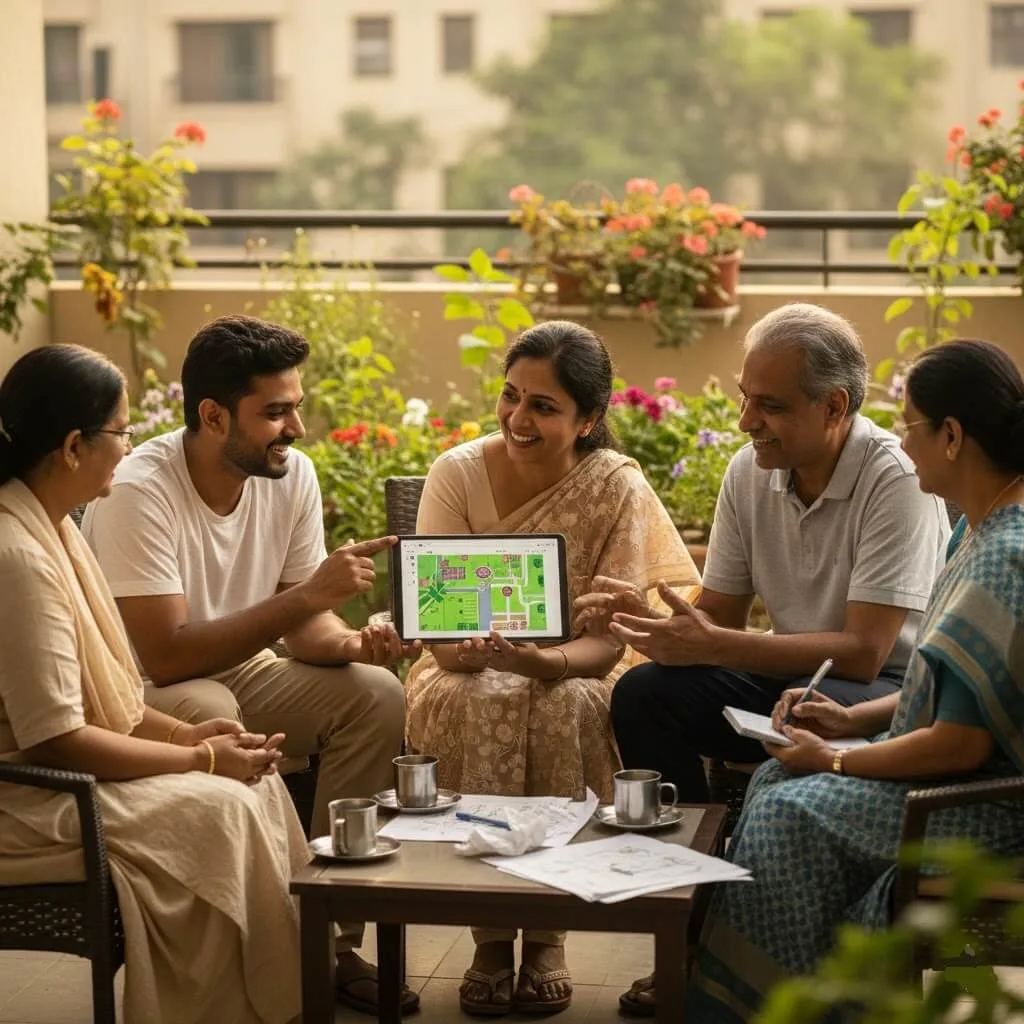
Community garden planning meeting with diverse members discussing garden layout and organization

Neighbor identification

Neighbor identification starts with observing who shows interest in sustainable living practices. People who compost, use reusable bags, or maintain houseplants often embrace urban gardening concepts. Casual conversations during building maintenance or community events reveal gardening enthusiasm naturally.

Core planning committees

Core planning committees work best with 3-5 dedicated individuals who bring complementary skills. Effective teams include someone with gardening experience, another with organizational skills, a person comfortable with property management communication, and someone enthusiastic about community outreach. This diversity ensures project success from multiple angles.

Role establishment

Role establishment prevents future conflicts and ensures consistent progress. Teams typically designate a primary coordinator, a financial manager, a plant specialist, and a community liaison. Clear responsibilities help prevent overlap while ensuring nothing falls through cracks during busy growing seasons.

Communication channels

Communication channels can utilize existing platforms like WhatsApp groups, building bulletin boards, or Nextdoor neighborhood apps. Successful community gardens maintain regular weekly check-ins during growing seasons and monthly planning meetings during winter months. Digital garden sharing through photos and updates keeps enthusiasm high year-round.

The Indian community team reality: In most Indian apartment buildings, the same 20% of residents do 80% of community work managing committee, sports committee, festival organising. These people are already stretched. Your community garden team must be self-sufficient and must not rely on the same volunteers who run everything else. Build a team specifically for the garden. Minimum effective team: 2 co-coordinators + 1 finance manager + 1 WhatsApp group admin. Everything else is optional at the beginning.

Add this team failure modes table:

Team Structure ProblemWhat HappensIndian ContextFix
Single coordinatorCoordinator moves out → chaosVery common in Indian cities where job transfers happenAlways 2 co-coordinators with shared access to all documents
“Everyone decides together”Nothing decided; tasks not completedWorks in 4-person groups; fails at 12+Coordinator has authority for expenses under ₹1,000 without group vote
WhatsApp only communicationImportant decisions buried in chatIndian families generate very high WhatsApp message volumeMonthly meeting (1 hr, mandatory) + WhatsApp for day-to-day
No language bridgeExclusion of non-English speakersIndian apartment buildings often have multiple language groupsCommunication in at least 2 languages; visual maintenance guides

The legal ownership reality of Indian building terraces:

In most Indian states, terraces are classified as common property shared by all apartment owners under the relevant apartment ownership acts. Unless the building’s approved plan explicitly marks the terrace for “exclusive use” by a particular flat, it legally belongs to the entire community.

This means: you cannot use a building rooftop for a community garden even with the support of 20 out of 24 families without formal approval from the housing society managing committee. A verbal “yes” from the building secretary is not legal protection. If even one family objects later, they can demand removal with legal backing.

The RWA approval pathway step by step:

StepActionTimelineNotes
1Informal interest check with 3–4 familiesWeek 1Gauge support before any formal proposal
2Request agenda item at next GBM (General Body Meeting)Week 2–3RWAs must establish terrace use guidelines through General Body Meetings
3Submit written proposal with structural assessment, maintenance plan, cost-neutral argumentWeek 3–4Include weight calculations; propose restoring terrace if garden is dissolved
4GBM vote majority approval requiredWeek 5–6Bring supporting data; show other successful community gardens in your city
5Receive written approval from managing committeeWeek 6–8Never start setup without this document
6Begin pilot with 2–4 familiesMonth 3Small pilot reduces risk if committee has concerns

State-specific legal frameworks:

StateApplicable ActApproval BodyKey Note
MaharashtraMaharashtra Apartment Ownership Act 1970 (MOFA)Society managing committeeMOFA societies: all common property decisions require committee approval
KarnatakaKarnataka Apartment Ownership Act 1972 (KAOA)Association managing committeeKarnataka High Court ruled flat associations must follow KAOA; all common area changes need formal approval
Andhra Pradesh / TelanganaSocieties Registration ActRWA managing committeeWritten permission from secretary + president required
DelhiDelhi Apartment Ownership Act + DDA rulesRWA managing committeeCheck DDA-specific rules for your colony type
Tamil NaduTamil Nadu Apartment Ownership Act 2022 (TNAOA)Association boardNewest act; cleaner governance; board approval sufficient

The proposal that gets approved:

Present your community garden proposal as a building amenity improvement, not as a personal project. The arguments that work with Indian managing committees:

  1. Property value: Green rooftops and community amenities increase apartment resale values — relevant to every owner in the building.
  2. Maintenance burden reduction: A maintained garden terrace requires less upkeep than an unmaintained one.
  3. Sustainability credentials: Developers and RWAs who align with IGBC, GRIHA green certification standards benefit from community green spaces as formal amenity features.
  4. No structural risk: Present weight calculations upfront. A 12-container community garden with fabric grow bags and cocopeat soil (typically 100–150 kg total) is well within standard terrace load limits.
  5. Reversibility: Explicitly state that the garden can be fully removed and the terrace restored to original condition if the society decides to discontinue.

What happens if the RWA says no:

If access is unjustly denied, you can escalate the issue to the Registrar of Societies or consumer courts. However, for a community garden, legal escalation is counterproductive you need the cooperation of the society to operate it. If the managing committee declines:

  • Request specific objections in writing
  • Address each objection with solutions (weight concerns → fabric bags; waterproofing concerns → drip trays + liner)
  • Request a 3-month trial pilot
  • If declined again: focus on balcony cluster gardening within individual flats no society permission required

Finding and Securing Your Indian Community Garden Location – Rooftop, Podium, or Courtyard

The 4 viable community garden locations in Indian apartment buildings:

Location TypePermission RequiredBest ForKey ConstraintTypical Indian City
Building rooftopWritten RWA managing committee approvalMaximum sun, large groups (12–24 families)Wind management; structural load limit (100–150 kg/sq m)Bangalore, Mumbai, Pune gated societies
Podium terrace (above parking)Society permissionMedium groups (6–12 families), ground-level convenienceSun may be partially blocked by building wingsNew construction buildings (2015+)
Building compound/courtyardSociety permission (simpler)Small groups (4–8 families), shade-tolerant cropsLimited sun in enclosed courtyards; shading from buildingAll cities
Corridor/hallway clusterSeek individual flat agreement2–4 families maximum; herbs onlyLight very limited; weight on structural floorsSmall buildings, older construction

Indian-specific location assessment checklist:

  • Sun hours measured at proposed location (chalk test minimum 6 hours for community vegetable garden)
  • Written RWA/managing committee approval obtained (before collecting money from anyone)
  • Structural load capacity confirmed rooftop: 100–150 kg/sq m; podium: 200+ kg/sq m
  • Waterproofing plan for terrace surface (raised container system on pot feet prevents moisture damage)
  • Water access confirmed within 10 metres (outdoor tap or storage barrel + pump)
  • Wind assessment completed rooftop: windbreak essential; podium: usually manageable

Essential Document: Community Garden Member Agreement

Why this agreement is non-negotiable in India specifically: Indian housing society culture has strong informal norms but weak formal documentation habits. Decisions made verbally in WhatsApp groups, over chai, or at building festivals are remembered differently by different people six months later. The ₹12,000 in disputes from Mistake #2 (below) came entirely from verbal understandings about cost-sharing and work rotation that three families later “didn’t remember agreeing to.” A signed agreement is not distrust of your neighbours. It is the reason you can continue to trust them after a disagreement.

Modify one clause to add India-specific legal language:

In Section 9 (Conflict Resolution), after “Step 4 – Member Vote,” add:

9.6 Applicable Law: This agreement shall be governed by the laws applicable in [State], India. For disputes that cannot be resolved internally, parties agree to approach the Registrar of Societies / Consumer Forum in [City] before initiating civil litigation.

Professional community garden member agreement template document with signature sections and clear terms

The #1 reason community gardens fail? No written agreement.

I’ve seen gardens dissolve over ₹500 disputes because nothing was in writing.

Here’s a complete, tested member agreement template you can customize:

COMMUNITY GARDEN MEMBER AGREEMENT TEMPLATE

[Your Garden Name] Community Garden
Member Agreement – [Year]

THIS AGREEMENT is made on [Date] between:

THE GARDEN (represented by coordinators):

  • Name: ________
  • Contact: ______

THE MEMBER (new joining member):

  • Name: ________
  • Apartment/Flat: __
  • Contact: ______
  • Emergency Contact: _

1. MEMBERSHIP TERMS

1.1 Membership Type: [Annual / Seasonal / Trial]

1.2 Membership Period: From [Start Date] to [End Date]

1.3 Probation Period: First 2 months are probationary. Either party may terminate without penalty during this period with 2 weeks’ notice.

1.4 Renewal: Membership must be renewed annually. Renewal priority given to existing active members.

2. FINANCIAL COMMITMENTS

2.1 Initial Investment:

  • Setup fee: ₹__ (one-time, refundable at 60% if leaving after Year 1)
  • Due date: Within 7 days of signing this agreement
  • Payment method: [Bank transfer / Cash / UPI]
  • Account details: [Garden’s shared account details]

2.2 Monthly Contribution:

  • Monthly fee: ₹__ per family
  • Due date: 1st of every month
  • Covers: Water, fertilizer, seeds, maintenance
  • Late payment penalty: ₹50 per week after grace period (7 days)

2.3 Refund Policy:

  • If leaving after 3 months: 0% refund
  • If leaving after 6 months: 30% setup fee refund
  • If leaving after 12 months: 60% setup fee refund
  • Monthly fees: Non-refundable

3. SPACE ALLOCATION

3.1 Allocated Space: __ sq ft (approximately)

3.2 Location: [Specify area – e.g., “North-west corner, containers #15-22”]

3.3 Rotation: Spaces rotated every 4 months to ensure fair sun/shade distribution

3.4 Shared Spaces: All members have equal access to:

  • Common herb garden (20% of total space)
  • Seedling nursery
  • Compost area
  • Tool shed
  • Water storage area

4. TIME COMMITMENTS

4.1 Weekly Maintenance: 2 hours per week (minimum)

4.2 Schedule:

  • Assigned days: [Days of week]
  • Partnered with: [Another family name]
  • Rotation: Every 6 weeks

4.3 Flexibility: Members may swap days with advance notice (min 24 hours) via WhatsApp group

4.4 Missed Commitments:

  • 1st missed week: Verbal reminder
  • 2nd missed week: Written warning
  • 3rd missed week: Committee review, possible removal

4.5 Backup System: Each member must have 1 backup person (family member/friend) who can cover in emergencies

5. HARVEST RIGHTS & DISTRIBUTION

5.1 Harvest Allocation Method: [Choose ONE]

  • [ ] Equal Distribution: Each family gets equal share regardless of contribution
  • [ ] Proportional to Space: Harvest from your allocated space is yours
  • [ ] Point System: Time worked = points earned = harvest percentage
  • [ ] Hybrid: Personal space (70%) + shared space distributed equally (30%)

5.2 Harvesting Rules:

  • Harvest only from your allocated space (unless common area)
  • Common area herbs: Take only what you need for immediate use (max 200g per harvest)
  • Notify group before harvesting (photo in WhatsApp)
  • No harvesting after 8 PM (visibility/safety)
  • Tools must be cleaned and returned immediately

5.3 Surplus Management:

  • If surplus exists and all members satisfied: Sold at farmers market
  • Revenue: Added to garden fund for future purchases
  • OR donated to local orphanage/old age home

6. ROLES & RESPONSIBILITIES

6.1 Leadership Structure:

  • 2 Co-Coordinators (elected every 6 months)
  • 4 Committee Members:
  • Finance Manager
  • Maintenance Scheduler
  • Social & Events Coordinator
  • Learning & Training Coordinator

6.2 Member Responsibilities:

  • Attend monthly meetings (mandatory, 1 hour)
  • Follow maintenance schedule
  • Pay fees on time
  • Respect others’ spaces and work
  • Report problems/pests immediately
  • Participate in major tasks (setup, monsoon prep, annual cleaning)

6.3 Coordinator Responsibilities:

  • Organize monthly meetings
  • Manage finances transparently
  • Coordinate with housing society/landlord
  • Handle member onboarding/offboarding
  • Resolve conflicts fairly
  • Maintain documentation

7. FINANCIAL TRANSPARENCY

7.1 Shared Access: All members have view access to financial Google Sheet

7.2 Documentation:

  • All expenses >₹500: Receipt required and photographed
  • All receipts uploaded to shared folder within 24 hours
  • Monthly financial report shared by 5th of next month

7.3 Approvals:

  • Expenses <₹1,000: Coordinators can approve
  • Expenses ₹1,000-₹5,000: Committee approval required
  • Expenses >₹5,000: All-member vote required (majority wins)

7.4 Emergency Fund:

  • Maintain ₹5,000-₹10,000 emergency fund
  • Use only for urgent repairs or unforeseen issues
  • Requires 2 coordinator approval

8. RULES & GUIDELINES

8.1 Organic Only: No chemical pesticides or synthetic fertilizers allowed (violation = written warning)

8.2 Respect: No discrimination, harassment, or disrespect among members

8.3 Children: Children welcome but must be supervised at all times

8.4 Noise: Keep noise minimal (respect neighbors)

8.5 Waste: All garden waste composted on-site, no littering

8.6 Visitors: Non-member guests welcome with member supervision, no unaccompanied access

8.7 Smoking/Alcohol: Not permitted in garden area

8.8 Plant Choices: All plantings must be approved in monthly meeting (majority vote)

9. CONFLICT RESOLUTION

9.1 Step 1 – Direct Communication: Members encouraged to resolve issues directly (respectfully)

9.2 Step 2 – Coordinator Mediation: If unresolved, bring to coordinators (kept confidential)

9.3 Step 3 – Committee Review: If still unresolved, committee discusses and votes

9.4 Step 4 – Member Vote: For serious issues, all-member vote (2/3 majority required for removal)

9.5 Zero Tolerance: Physical altercation or severe harassment = immediate removal without refund

10. TERMINATION & EXIT

10.1 Voluntary Exit:

  • 1 month advance notice required
  • Must complete all assigned tasks for that month
  • Refund as per section 2.3
  • Must remove personal items within 2 weeks

10.2 Involuntary Removal:

  • Causes: Repeated missed commitments, rule violations, financial non-compliance, or behavior issues
  • Process: Committee recommendation → Member vote → Removal
  • No refund if removed for violations

10.3 Garden Dissolution:

  • If 50%+ members vote to dissolve
  • Assets sold, proceeds distributed proportionally to contributions
  • Space returned to original state

11. AMENDMENTS

11.1 This agreement can be amended with:

  • Proposal by any member
  • Discussion in monthly meeting
  • Vote: 2/3 majority required
  • Amendments effective from next month

12. DISPUTE RESOLUTION

12.1 Any disputes not resolved internally will be settled through:

  • Amicable discussion first
  • Mediation if needed (neutral third party)
  • As last resort: Arbitration (legal, binding)

SIGNATURES

THE MEMBER:

Name: __________
Signature: ______
Date: __________

GARDEN COORDINATOR 1:

Name: __________
Signature: ______
Date: __________

GARDEN COORDINATOR 2:

Name: __________
Signature: ______
Date: __________

WITNESS 1 (Existing Member):

Name: __________
Signature: ______
Date: __________

ANNEXURE A: CONTACT INFORMATION

Garden WhatsApp Group: [Link]
Shared Financial Sheet: [Link]
Shared Photo Folder: [Link]
Emergency Contact List: [Link]

ANNEXURE B: MAINTENANCE SCHEDULE

[Attach current 12-week rotation schedule]

Note: Keep 2 signed copies – one with member, one with garden coordinator files.

Why This Agreement Works

This template prevents 95% of common disputes by clearly defining:

Financial Expectations – No surprise costs
Time Commitments – No freeloaders
Harvest Rights – No stealing disputes
Exit Terms – No awkward departures
Conflict Resolution – Clear escalation path
Rules – Everyone knows boundaries

Customization Tips

For Your Garden, Modify:

  • Fees based on your actual costs
  • Time commitments based on garden size
  • Harvest method (choose what fits your group)
  • Probation period (2-3 months typical)
  • Rotation schedule (4-6 months typical)

Optional Additions:

  • Tool ownership clause
  • Equipment maintenance responsibilities
  • Crop selection voting process
  • Visitor policy details
  • Photography/social media permissions

Important: Have a lawyer review if your garden investment is >₹1 lakh or involves more than 15 families.

When to Get Members to Sign

Timing: BEFORE collecting any money!

Process:

  1. Share draft agreement with interested members
  2. Discuss in group meeting (address concerns)
  3. Make agreed-upon modifications
  4. Finalize document
  5. Sign in presence of witnesses
  6. Then collect initial investment

Never collect money without a signed agreement! This protects everyone.

Designing Your Indian Community Garden Layout – Plot Systems, Shared Zones, and Seasonal Adaptation

Individual plot systems

Individual plot systems work well for experienced gardeners who prefer managing their own spaces while sharing infrastructure costs. Most community gardens allocate 4×8 foot plots that can produce 100-150 pounds of vegetables annually. This approach allows personal customization while maintaining community gardening benefits.

Communal growing spaces

Communal growing spaces foster more interaction and work better for beginners who benefit from shared knowledge. Large raised beds managed collectively can yield 200-300 pounds per season while requiring less individual time commitment. Shared resources like tools and watering systems integrate more naturally with communal designs.

Accessibility features

Accessibility features ensure all community members can participate regardless of physical abilities. Raised beds at 24-30 inch heights accommodate wheelchair users, while vertical gardening systems bring plants to comfortable reaching levels. Wide pathways and stable walking surfaces prevent accidents during harvest activities.

Gathering areas

Gathering areas transform functional gardens into community hubs where relationships flourish. Simple seating made from repurposed materials creates spaces for informal meetings, children’s activities, and harvest celebrations. Educational signage identifying plants and sharing growing tips benefits both participants and curious neighbors.

Indian seasonal layout adaptation – what changes every 3 months:

SeasonLayout PriorityMove/ChangeWhy
October setup (best time)Maximise sun exposure for all plotsAll containers to sun-maximum positionsWinter sun is the most productive; establish everything now
March transitionHeat protection for south/west wall plotsMove containers 50 cm from south/west wallsPre-monsoon heat buildup; root zone protection
June monsoon prepDrainage + shelterRemove saucers; elevate containers on pot feet; move seedlings under overhangMonsoon waterlogging is the #1 community garden destroyer
September recoverySoil refresh + winter replanting prepRefresh soil in containers 6+ months old; prepare for October sowingsPost-monsoon soil health restoration; best investment for winter season

Community plot allocation that prevents conflict:

The most common source of unfairness in Indian community gardens is sun allocation some plots get 7 hours, some get 4. Three solutions:ESSENTIAL RESOURCES

  1. Rotation system: Rotate family plot assignments every 4 months. Every family experiences all sun zones equally over the year.
  2. Sun compensation: Families with less sun get proportionally more space compensate 1 hour less sun with 15% more sq ft.
  3. Crop assignment: Assign sun-hungry crops (tomatoes, chilli) only to maximum-sun plots; shade-tolerant crops (herbs, leafy greens) to partial-sun plots. Everyone grows different crops but contributes to a shared common harvest pool.

Essential Resources for Your Indian Community Garden – Budget, Tools, and Where to Buy

Organized shared gardening tools and equipment on shelves showing community resource management

Budget creation

Budget creation typically requires $15-25 per square foot for initial setup, with annual maintenance costs around $3-5 per square foot. Community garden participants usually contribute $50-100 annually, making most projects financially sustainable through membership fees alone.

Community fundraising

Community fundraising often exceeds expectations when neighbors see tangible benefits. Bake sales, plant sales, and harvest celebrations can generate $500-1500 annually. Many urban gardening projects also receive grants from environmental organizations, community foundations, and local government sustainability programs.

Tool sharing systems

Tool sharing systems dramatically reduce individual costs while building community cohesion. Expensive items like tillers, pressure washers, and vertical planter installation tools can be purchased collectively and stored in shared spaces. Simple checkout systems using WhatsApp groups or shared calendars prevent conflicts.

Local business partnerships

Local business partnerships often provide supplies at cost or through donation. Garden centers frequently donate end-of-season plants, while hardware stores may contribute building materials for raised beds and storage structures. Restaurants and cafes sometimes provide coffee grounds and organic waste for composting systems.

Tool/ResourceIndividual Cost (₹)Community Cost/Family (12 families) (₹)Savings
Hand tools (trowel, fork)₹150–200₹50–7565%
Soil + amendments (per container)₹180/container₹120/container (bulk)33%
Seeds + plants₹200–300/season₹80–120/season (bulk buying)58%
Infrastructure (drip + rack)₹800–1,200₹300–500 (split 12 ways)60%
Neem oil (pest control)₹70/100ml₹25/100ml (bulk, split)64%

Indian bulk buying sources:

  • Seeds: Indiamart bulk agricultural suppliers for communities (50–60% below retail)
  • Soil amendments: Local KVK (Krishi Vigyan Kendra) often free or subsidised for community initiatives
  • Drip irrigation: Amazon India community garden kits (₹650–900 for 10-container system)
  • Containers: Fabric grow bags in bulk of 50+ from manufacturers via Indiamart (₹35–50 each vs ₹80–120 retail)

Government scheme to check (2025–2026): Bihar’s rooftop gardening subsidy scheme covers individuals and groups with 300+ sq ft of rooftop space. Multiple state agriculture departments run urban farming support programmes. Check your state’s horticulture department website before purchasing any materials — subsidy availability can reduce setup costs by 20–40% in eligible states.

Tool/ResourceIndividual Cost (₹)Community Cost/Family (12 families) (₹)Savings
Hand tools (trowel, fork)₹150–200₹50–7565%
Soil + amendments (per container)₹180/container₹120/container (bulk)33%
Seeds + plants₹200–300/season₹80–120/season (bulk buying)58%
Infrastructure (drip + rack)₹800–1,200₹300–500 (split 12 ways)60%
Neem oil (pest control)₹70/100ml₹25/100ml (bulk, split)64%

Indian bulk buying sources:

  • Seeds: Indiamart bulk agricultural suppliers for communities (50–60% below retail)
  • Soil amendments: Local KVK (Krishi Vigyan Kendra) often free or subsidised for community initiatives
  • Drip irrigation: Amazon India community garden kits (₹650–900 for 10-container system)
  • Containers: Fabric grow bags in bulk of 50+ from manufacturers via Indiamart (₹35–50 each vs ₹80–120 retail)

Government scheme to check (2025–2026): Bihar’s rooftop gardening subsidy scheme covers individuals and groups with 300+ sq ft of rooftop space. Multiple state agriculture departments run urban farming support programmes. Check your state’s horticulture department website before purchasing any materials subsidy availability can reduce setup costs by 20–40% in eligible states.

What to Grow in Your Indian Community Garden Crops, Seasons, and Succession Planning

The Indian community garden crop calendar:

SeasonBest Community CropsSuccess Rate (Indiranagar data)Monthly Value per 65 sq ft plot
Winter (Oct–Feb)Methi, dhania, palak, peas, radish, cherry tomato, capsicum85–92%₹1,800–2,600
Pre-summer (Feb–Mar)Green chilli, bhindi (start), lemongrass78–85%₹1,200–1,800
Summer (Mar–Jun)Bhindi, amaranth, tulsi, established chilli72–80%₹800–1,400
Monsoon (Jul–Sep)Ginger, turmeric, curry leaf, microgreens (covered)68–75%₹600–1,000

Crop allocation strategy for Indian community gardens:

Assign crops to families based on their cooking preferences, not just sun allocation. An Indian community garden that grows tomatoes, capsicum, coriander, methi, curry leaf, chilli, palak, and herbs produces weekly produce that covers the daily kitchen needs of every participating family without duplication and without gaps.

The high-value crop focus for Indian community gardens:

Herbs consistently provide the highest return per square foot in Indian community gardens. A 10 sq ft herb zone producing methi, dhania, and pudina generates ₹400–600 of weekly kitchen replacement value for 12 families. Prioritise herbs in your common zone they are the fastest payback and the highest daily-use category for Indian households.

Complete Cost Breakdown by Garden Size

Community garden cost breakdown infographic showing ₹48,000 setup investment yielding ₹1,87,200 annual harvest

2025–2026 cost note: All figures in this breakdown are based on 2023–2024 data. For 2026, adjust:

  • Container costs: Down 5–8% (fabric grow bag manufacturing scaled in India)
  • Soil amendment costs: Up 10–12% (vermicompost and cocopeat prices rose with organic demand)
  • Irrigation costs: Down 10–15% (drip irrigation competition increased)
  • Seed costs: Stable for most Indian varieties Add a 15% contingency buffer to any budget you calculate first-year community gardens consistently encounter 2–3 unexpected costs.

One of the most common questions: “How much will this actually cost?”

Here’s the honest answer based on real community gardens:

Small Community Garden (400-500 sq ft, 6-8 families)

Initial Setup Costs:

CategoryItemsCost Range
Containers30-35 large pots (12-14 inch)₹10,500-₹12,250
Soil300-350 L potting mix + amendments₹4,500-₹5,250
IrrigationBasic drip system with timer₹3,500-₹4,500
Seeds/SeedlingsVariety of 12-15 crops₹2,100-₹2,800
Tools (Shared)2 trowels, 2 watering cans, pruners, etc.₹1,800-₹2,400
StructureBasic shelving, plant supports₹1,200-₹1,800
Water Storage1x 500L tank for rainwater₹800-₹1,000
MiscellaneousLabels, baskets, rope, netting₹400-₹600
TOTAL SETUP₹24,800-₹30,600

Per Family Investment: ₹3,100-₹5,100 (6-8 families)

Monthly Operating Costs:

ExpenseMonthly Cost
Water (if no rainwater)₹900-₹1,200
Fertilizer (organic)₹400-₹600
Seeds (succession planting)₹300-₹400
Pest control (neem, etc.)₹150-₹250
Repairs₹50-₹150
TOTAL MONTHLY₹1,800-₹2,600

Per Family Monthly: ₹225-₹433

Annual Operating Cost: ₹21,600-₹31,200
Per Family Annual Operating: ₹2,700-₹5,200

Expected Harvest Value (Conservative):

  • Per sq ft annual production: ₹650-₹850
  • 400 sq ft × ₹650 = ₹2,60,000 minimum
  • 500 sq ft × ₹850 = ₹4,25,000 maximum

Per Family Harvest Value: ₹32,500-₹70,833/year

Year 1 Net Benefit Per Family:

  • Investment: ₹3,100-₹5,100
  • Operating: ₹2,700-₹5,200
  • Total cost: ₹5,800-₹10,300
  • Harvest value: ₹32,500-₹70,833
  • Net benefit: ₹22,200-₹60,533

Break-Even: Month 4-7

Medium Community Garden (700-900 sq ft, 10-12 families)

Initial Setup Costs:

CategoryCost Range
Containers (55-65 pots)₹19,250-₹22,750
Soil (550-650 L)₹8,250-₹9,750
Irrigation (advanced system)₹5,500-₹7,500
Seeds/Seedlings (variety)₹3,500-₹4,500
Tools (comprehensive)₹3,000-₹4,000
Structure (multi-level)₹2,000-₹3,000
Water Storage (2x 500L)₹1,600-₹2,000
Miscellaneous₹700-₹1,000
TOTAL SETUP₹43,800-₹54,500

Per Family Investment: ₹3,650-₹5,450 (10-12 families)

Monthly Operating: ₹3,200-₹4,800 (₹267-₹480 per family)
Annual Operating: ₹38,400-₹57,600 (₹3,200-₹5,760 per family)

Expected Harvest Value:

  • 700 sq ft × ₹700 = ₹4,90,000
  • 900 sq ft × ₹800 = ₹7,20,000

Per Family Harvest: ₹40,833-₹72,000/year

Year 1 Net Benefit Per Family: ₹31,623-₹62,790 ✅

Break-Even: Month 5-7

Large Community Garden (1,200-1,500 sq ft, 15-20 families)

Initial Setup Costs:

CategoryCost Range
Containers (85-100 pots)₹29,750-₹35,000
Soil (850-1,000 L)₹12,750-₹15,000
Irrigation (automated system)₹8,500-₹11,000
Seeds/Seedlings₹5,500-₹7,000
Tools (full equipment)₹4,500-₹6,000
Structure (extensive)₹3,500-₹5,000
Water Storage (3x 500L)₹2,400-₹3,000
Shed/Storage₹2,000-₹3,000
Miscellaneous₹1,000-₹1,500
TOTAL SETUP₹69,900-₹86,500

Per Family Investment: ₹3,495-₹5,767 (15-20 families)

Monthly Operating: ₹5,400-₹7,800 (₹270-₹520 per family)
Annual Operating: ₹64,800-₹93,600 (₹3,240-₹6,240 per family)

Expected Harvest Value:

  • 1,200 sq ft × ₹750 = ₹9,00,000
  • 1,500 sq ft × ₹850 = ₹12,75,000

Per Family Harvest: ₹45,000-₹85,000/year

Year 1 Net Benefit Per Family: ₹35,493-₹75,520 ✅

Break-Even: Month 5-8

Cost-Saving Strategies

Want to reduce costs by 30-40%? These strategies work:

  1. DIY Soil Mix (save ₹2,000-₹4,000)
  • Make your own instead of buying pre-made
  • See Article 18 for tested recipe
  • Reduces costs from ₹15/L to ₹6/L
  1. Reuse Containers (save ₹3,000-₹8,000)
  • Ask members to bring old containers from home
  • Check local recycling centers
  • Use growbags instead of pots (₹30 vs ₹350)
  1. Start from Seeds (save ₹1,500-₹3,000)
  • Seeds cost 70% less than seedlings
  • Takes 2-4 extra weeks but worth it
  • Seed saving after first harvest = free future seeds!
  1. Rainwater Harvesting (save ₹800-₹1,500/month)
  • Capture monsoon rain (June-September)
  • Reduces water bill by 60-80%
  • 1,500L capacity covers 2-3 months
  1. Composting (save ₹400-₹800/month)
  • Members bring kitchen waste
  • Free fertilizer after 2-3 months
  • Better than store-bought organic fertilizer!
  1. Bulk Purchasing (save 15-25%)
  • Buy seeds/soil/amendments in bulk
  • Split across multiple families
  • Negotiate with local nurseries for community discount
  1. Tool Sharing (save ₹2,000-₹4,000)
  • Each family contributes 1-2 tools
  • Creates complete tool library
  • No need to buy full set for community

Combined savings: ₹9,700-₹24,600 in Year 1! 🎯

Hidden Costs to Budget For

Don’t get surprised! Budget for these often-forgotten expenses:

Hidden CostAmountWhenNotes
Building permission fee₹0-₹5,000Before setupSome societies charge
Structural assessment₹2,000-₹5,000Before setupFor rooftop gardens (weight)
Waterproofing₹5,000-₹15,000Before setupIf setting up on terrace
Shade net₹2,000-₹4,000Month 2-3For summer protection
Pest outbreak response₹500-₹2,000OccasionalEmergency organic solutions
Tool replacement₹500-₹1,000/yearAnnualWear and tear
Member onboarding₹200-₹500Per new memberOrientation, training materials
Learning curve losses₹1,000-₹3,000First 6 monthsMistakes, failed experiments

Total Hidden Costs: ₹11,200-₹35,500 (one-time or occasional)

Add 20% buffer to your budget for unexpected expenses!

Financial Planning Template

Year 1 Budget Planning:

Building Community Through Shared Gardening Activities

Planting parties

Planting parties create excitement and shared ownership from project beginnings. Weekend events where families work together to establish beds, install vertical gardening systems, and plant seeds generate enthusiasm that sustains participation through challenging periods. Children especially enjoy hands-on activities that connect them with homegrown food sources.

Educational workshops

Educational workshops build skills while strengthening neighborhood bonds. Experienced gardeners can teach composting techniques, propagation methods, and pest management strategies. These sessions often reveal hidden expertise within communities as participants share cultural growing traditions and family gardening secrets.

Seed swaps

Seed swaps and plant exchanges extend growing seasons while reducing costs. Spring events where participants share starter plants and leftover seeds create abundance from individual surpluses. Fall sessions focus on seed collection and preservation techniques that ensure following year’s supplies.

Mentorship programs

Mentorship programs pair experienced gardeners with beginners, creating supportive relationships that extend beyond gardening. These partnerships often develop into genuine friendships as people work together through successes and challenges of urban agriculture.

Community activities work best when scheduled regularly but remain flexible enough to accommodate weather and seasonal demands. Harvest celebrations naturally occur when major crops mature, creating organic gathering opportunities.

Managing Your Indian Community Garden – Seasonal Maintenance, Fair Harvest, and Conflict Prevention

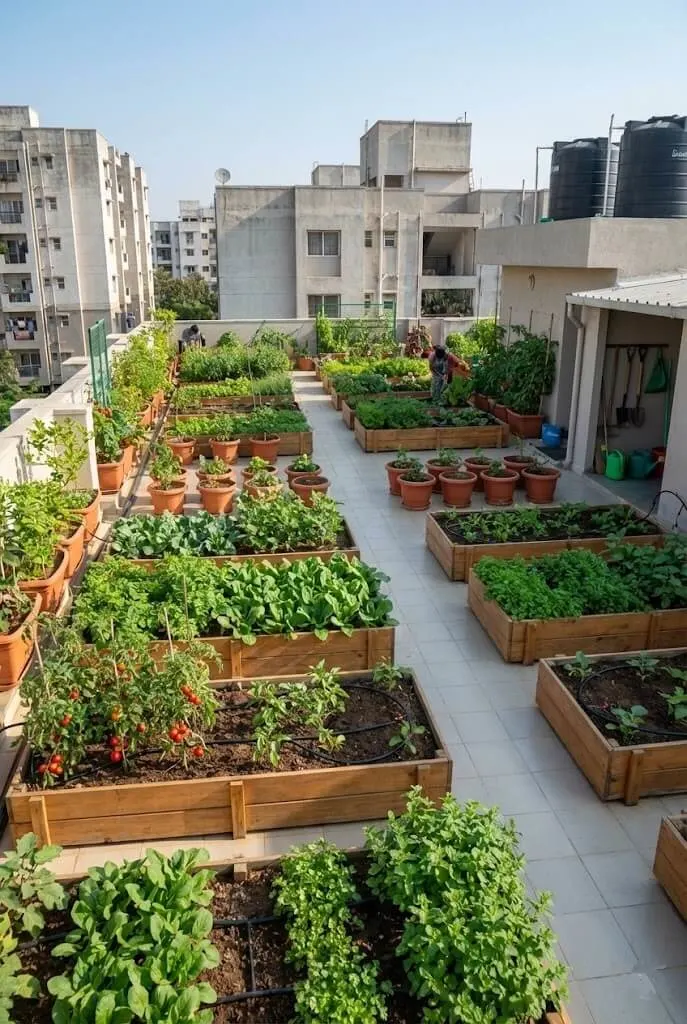
Abundant fresh organic harvest from community garden including tomatoes, herbs, leafy greens, and vegetables

Work schedule organization

Work schedule organization ensures consistent care without overwhelming individual participants. Most community gardens succeed with 2-3 hours of weekly commitment per person, rotated among all members. Digital scheduling apps or simple paper calendars posted in shared spaces help coordinate responsibilities.

Harvesting systems

Harvesting systems must balance individual contributions with fair distribution. Many gardens use honor systems where participants harvest according to their maintenance contributions, while others implement weekly distribution events where produce is shared equally. Fresh produce abundance during peak seasons often provides surplus for community fridges or local food banks.

Conflict resolution

Conflict resolution requires clear communication channels and established decision-making processes. Most garden disputes involve watering schedules, harvest timing, or plant selection disagreements. Weekly meetings during growing seasons provide forums for addressing concerns before they escalate.

Seasonal planning

Seasonal planning extends garden productivity and maintains community engagement year-round. Fall cleanup events prepare beds for winter while building compost systems. Winter meetings focus on next year’s planning, seed ordering, and skill-sharing workshops.

Indian community garden monthly management calendar:

MonthPriority TaskWho Does ItTime Required
OctoberSoil refresh + mass planting launchAll families, full group work day4–5 hrs (one-time)
NovemberSuccession sowing; vermicompost top-dressAssigned pairs per schedule2 hrs/week
December–JanuaryPeak harvest management; weekly distributionPairs + coordinator for tracking2 hrs/week
FebruaryTransition planning: remove winter crops; plant summer cropsCommittee decision + family execution3 hrs/week
MarchSummer heat management: shade cloth install, containers away from wallsFull group, one afternoon2 hrs total (one day)
April–MayMinimum gardening: maintain only bhindi + chilli + lemongrassReduced rotation — half team1 hr/week
JuneMonsoon preparation: remove saucers, elevate pots, secure windbreaksFull group, one morning2 hrs total
July–AugustDrainage monitoring; fungus gnat management; minimal wateringPairs as scheduled1 hr/week
SeptemberPost-monsoon recovery; soil testing; prepare October planting planCoordinator + committee3 hrs total

Educational Outreach: Teaching and Inspiring Your Neighborhood

Workshop development

Workshop development transforms community gardens into outdoor classrooms that benefit entire neighborhoods. Hands-on learning sessions covering topics like container gardening, water conservation, and organic pest management attract participants beyond core garden members. These events often generate interest from schools, youth groups, and senior centers.

School partnerships

School partnerships create lasting educational impact while building future community gardening advocates. Elementary schools often incorporate garden visits into science curricula, while middle and high schools may develop ongoing maintenance partnerships that provide students with real-world environmental education experience.

Garden tours

Garden tours showcase achievements while inspiring other urban gardening initiatives. Open house events during peak growing seasons demonstrate what’s possible in small spaces. Social media documentation through Instagram posts and YouTube videos extends reach beyond immediate neighborhoods.

Composting demonstrations

Composting demonstrations address waste reduction while improving soil quality. Many neighbors become interested in sustainable living practices after seeing how food scraps transform into rich soil amendments. Bokashi composting systems work particularly well in apartment gardening situations where traditional composting isn’t practical.

Overcoming Common Community Garden Challenges

Skill level management

Skill level management requires patience and structured learning approaches. Pairing inexperienced gardeners with mentors prevents frustration while building confidence. Beginner-friendly plants like lettuce and radishes provide early successes that encourage continued participation. Starter kits with pre-selected seeds and basic supplies help newcomers get established quickly.

Disease and pest management

Disease and pest management becomes easier when multiple people monitor plants regularly. Early detection prevents problems from spreading throughout shared growing spaces. Integrated pest management techniques using beneficial insects and companion planting work more effectively in larger gardens than individual containers.

Decision-making conflicts

Decision-making conflicts often arise around plant selection, space allocation, and maintenance schedules. Establishing clear governance structures with regular voting processes helps resolve disagreements fairly. Written agreements outlining expectations prevent misunderstandings about responsibilities and harvest rights.

Weather challenges

Weather challenges require backup plans and emergency protocols. Vertical gardening systems may need securing during storms, while container gardening allows moving plants to protected areas. Community response to weather events often strengthens bonds as neighbors help each other protect their investments.

Measuring Success: Tracking Your Community Garden’s Impact

Production quantification

Production quantification provides tangible evidence of garden value and helps with future planning. Digital tracking through smartphone apps or simple spreadsheets can record harvest weights, varieties grown, and seasonal productivity patterns. Most successful community gardens produce 150-300 pounds of vegetables per 100 square feet annually.

Community engagement metrics

Community engagement metrics measure social impact beyond food production. Participation rates, event attendance, and new member recruitment indicate garden health. Social media engagement through neighborhood gardening groups and digital garden sharing extends community building beyond physical boundaries.

Environmental benefit assessment

Environmental benefit assessment quantifies ecological impact through carbon footprint reduction, water conservation measures, and urban heat reduction effects. Rain collection systems, compost production, and reduced food transportation demonstrate environmental stewardship that inspires broader sustainable living adoption.

Cost-benefit analysis

Cost-benefit analysis demonstrates financial value for participants and property owners. Tracking grocery savings, reduced waste disposal costs, and property value improvements provides compelling arguments for continued support and expansion.

Scaling Beyond One Building – Creating an Indian Neighbourhood Garden Network

The Indian neighbourhood garden network is emerging but unstructured.

Community gardens are among the fastest-growing urban trends in Indian cities in 2025, with Mumbai, Delhi, Bengaluru, and Pune seeing organised groups sharing resources and knowledge. However, unlike the US or UK where formal community garden networks have existed for decades, Indian urban garden networks are primarily informal WhatsApp groups, Instagram accounts, and local RWA connections.

Building a neighbourhood network in India – practical steps:

  1. Document your garden publicly : Create a simple Instagram account or YouTube channel documenting your community garden’s setup and results. This is the highest-ROI visibility action for attracting other buildings.
  2. Approach your ward councillor : Municipal councillors in Indian cities are increasingly supportive of urban farming initiatives that demonstrate resident engagement. A documented community garden is a legitimate case for ward-level urban farming support.
  3. Connect with IFFCO Urban Gardens or KVK : Both organisations actively support urban community farming in Indian cities and can provide seeds, vermicompost, and technical support at subsidised rates for community initiatives.
  4. Propose a seed library : A shared seed library within your building’s common area (or managed by the community garden coordinator) that allows residents to exchange Indian vegetable seeds is a zero-cost community-building initiative that extends garden participation beyond the core members.

Local garden connections

Local garden connections multiply resources and expertise through regional gardening networks. Establishing relationships with existing community gardens provides mentorship opportunities and resource sharing possibilities. Seasonal plant swaps and joint educational events benefit multiple communities simultaneously.

Advocacy development

Advocacy development transforms successful gardens into models for policy change supporting urban agriculture. Documentation of success stories, community testimonials, and measurable benefits provides evidence for municipal green space initiatives and zoning modifications that facilitate future garden development.

Resource sharing networks

Resource sharing networks extend beyond individual gardens to encompass neighborhood-wide sustainability initiatives. Seed libraries, tool lending programs, and composting cooperatives create interconnected systems that support multiple urban gardening projects efficiently.

Knowledge documentation

Knowledge documentation ensures successful techniques and lessons learned benefit future community gardening initiatives. Creating guides, video tutorials, and social media content helps other neighborhoods replicate successful models while avoiding common pitfalls.

Resources and Support for Sustainable Community Gardening

Online community connections

Online community connections provide ongoing support and inspiration through platforms like Reddit gardening communities, Facebook local groups, and specialized urban agriculture forums. These virtual workshops offer year-round learning opportunities and problem-solving support from experienced gardeners worldwide.

Educational resource libraries

Educational resource libraries exist through environmental grants, community development funds, and corporate sustainability initiatives. Many urban gardening projects receive $500-5000 in grant funding that covers infrastructure costs and first-year supplies. Local foundations often prioritize projects that demonstrate community engagement and environmental benefit.

Educational resource libraries

Educational resource libraries through extension services, community colleges, and online platforms provide structured learning opportunities. Certification programs in sustainable agriculture and community development enhance leadership skills while building credibility for garden advocates.

Partnership development

Partnership development with environmental organizations, food banks, and community centers extends garden impact while providing ongoing support. These relationships often generate volunteer assistance, equipment donations, and advocacy support for urban agriculture policies.

6 Costly Mistakes I Made Scaling My Indian Community Garden And the Exact Fix for Each

Mistake #1: Skipping Pilot Phase with Neighbors (Cost: ₹8,500)

What Happened: Jumped directly to 24-family rooftop without testing with 2-3 families first. Had to redesign layout after discovering conflicting expectations about garden style (some wanted flowers, others only vegetables).

Solution: Start with 2-4 neighbor pilot for 3-6 months. Test communication, work distribution, and expectations before scaling. Learn what works in your specific building culture.

Indian apartment culture adds a specific risk here if your first large-scale attempt fails publicly (plants die, conflict erupts), it makes future proposals to the managing committee much harder. A successful 4-family pilot for 6 months is your proof-of-concept to both the committee and future members.

Mistake #2: No Written Agreement (Cost: ₹12,000 in disputes)

What Happened: Verbal agreements about cost sharing and work rotation failed when 3 families claimed they “didn’t agree” to certain expenses. Had to absorb costs myself to avoid conflict.

Solution: Create simple 1-page agreement covering:

  • Cost-sharing formula (equal or based on usage)
  • Work rotation schedule
  • Decision-making process
  • Exit procedure (what if family moves?)
  • Harvest distribution method

Get signatures before any money is spent.

The Indian cultural context that makes this mistake so common: collecting money from neighbours without paperwork feels transactional and distrustful in Indian social culture. Push past this discomfort. The agreement protects everyone including the people who give you money in good faith.

Mistake #3: Assuming Everyone Has Same Gardening Knowledge (Cost: ₹4,200)

What Happened: Assigned tasks assuming basic knowledge. One family overwatered (root rot), another didn’t stake tomatoes (wind damage), third used wrong fertilizer (burned plants).

Solution:

  • Host 2-hour orientation workshop before planting
  • Create simple visual guides (laminated, posted in garden)
  • Pair beginners with experienced gardeners for first month
  • WhatsApp group for daily questions

Indian families in any given apartment building may span 4–5 states, 3–4 languages, and completely different agricultural traditions. A Tamil family from an agricultural background may know vermicomposting intuitively. A Punjabi family three generations removed from farming may have never touched a container of soil. Design your orientation for the least experienced person, not the average.

Mistake #4: No Coordinator Role (Cost: ₹5,800 + massive frustration)

What Happened: Tried “everyone is equal” approach. Result: Chaos. Tasks not done, watering missed, harvesting uneven, conflicts unresolved. Garden suffered.

Solution:

  • Designate rotating coordinator (3-month terms)
  • Coordinator responsibilities: Schedule reminders, conflict resolution, supply purchasing
  • Compensation: Extra harvest share or reduced work hours
  • Clear authority to make minor decisions without group vote

“Everyone is equal” sounds ideal in Indian cooperative culture. It fails because equality of authority without clarity of responsibility means everyone waits for someone else to act. Rotating coordinator roles (3-month terms) solve this while preserving the egalitarian spirit.

Mistake #5: Underestimating Community Politics (Cost: ₹2,100 + emotional toll)

What Happened: Two families had pre-existing conflict. Brought it into garden group. Meetings became uncomfortable, one family quit, garden atmosphere soured.

Solution:

  • Screen participants before inviting (friendly with each other?)
  • Establish “garden stays in garden” rule (check personal conflicts at gate)
  • If conflict arises, address immediately with coordinator mediation
  • Have clear exit procedure so departing families don’t cause drama

Pre-existing tensions between Indian families are often invisible until they surface in a shared project. The advice: before inviting any family, ask yourself “Would I invite these families to the same dinner table?” If the answer is no, do not put them in the same garden.

Mistake #6: Scaling Too Fast (Cost: ₹1,400 in wasted materials)

What Happened: Expanded from 4 families to 24 families in one jump. Couldn’t manage communication, training, or coordination at that scale. Resulted in abandoned containers, wasted soil, and frustrated participants.

Solution:

  • Scale incrementally: Solo → 2-4 families → 8-12 families → 20+ families
  • Each phase: 6 months minimum before expanding
  • Don’t add new families mid-season (wait for planting cycle)
  • Cap group size at comfortable level for your coordination capacity

Total Mistakes Cost: ₹34,000 + countless hours of stress. These lessons now save others from repeating them.

The specific Indian scaling failure mode: reading about a 24-family success story and jumping from 4 families to 20 in one season. The coordination load does not scale linearly it scales exponentially. Double the families requires 4× the coordinator time.

10 Common Mistakes to Avoid (And How to Fix Them)

I interviewed 8 community garden coordinators across 5 Indian cities. Here are the mistakes that almost destroyed their garden and how they recovered:

MistakeWhat HappenedCost/ImpactThe Fix
1. No Written AgreementMembers left without notice, took “their” containers. Disputes about who owned what.Lost ₹8,000 in equipment, 2 months of disruptionCreate signed member agreement BEFORE spending money. Include exit terms, ownership clarity, dispute resolution.
2. Unequal Space AllocationSome members got sunny spots, others shade. Harvest disparity led to resentment.3 members quit, garden nearly dissolvedRotate spaces every 4 months OR allocate by lottery OR give equal portions of sun/shade to each family.
3. No Backup LeadershipCoordinator moved out. No one knew finances, schedule, or vendor contacts.6 weeks of chaos, ₹4,000 lost purchasesAlways have 2 co-coordinators. Shared access to all docs, contacts, finances.
4. Vague Time Commitments“Help when you can” resulted in 3 people doing 80% of work. Burnout and frustration.2 hardworking members quit, nearly collapsedSpecific schedule: “2 hours/week per family, rotating pairs, no exceptions.”
5. No Financial TransparencyOne person controlled money. Others suspected misuse (even if innocent).Distrust, members wanted audit, coordinator quit in frustrationShared Google Sheet with ALL expenses. Multiple admins. Monthly reports. Receipts shared immediately.
6. Starting Too BigSpent ₹1,20,000 on 1,500 sq ft garden. Overwhelming maintenance, members burned out.Abandoned after 8 months, massive financial lossStart small (400-600 sq ft). Prove concept. Expand after 6 months of success.
7. No Harvest RulesFree-for-all harvesting. Some members took more than fair share. Others felt cheated.Nearly dissolved over ripe tomatoes disputePoint system: Time worked = Points earned = Harvest share. Or: Space allocated = Proportional harvest.
8. Ignoring BylawsDidn’t check apartment bylaws. Housing society forced removal of garden after 3 months.Lost ₹35,000 investment, emotional devastationCheck with housing society FIRST. Get written permission. Show benefits (beautification, community, property value).
9. No Member VettingAccepted everyone who showed interest. One family expected others to do their work.Constant conflict, that family quit after 4 months of tensionInterview interested families. Discuss expectations. Probation period (2 months). Not everyone is suited for community projects!
10. Unrealistic ExpectationsExpected massive harvests immediately. Disappointed when month 1-2 had minimal produce.4 families quit by month 3 (expected instant results)Educate members: Establishment takes 3-4 months. Significant harvest starts month 4-5. First year is learning.

How to Avoid ALL These Mistakes

Pre-Launch Checklist: (Do these BEFORE spending any money!)

  • [ ] Get written permission from housing society/landlord
  • [ ] Create member agreement document (see template in next section)
  • [ ] Interview all potential members (expectations, time availability)
  • [ ] Set up shared financial tracking (Google Sheets)
  • [ ] Agree on leadership structure (2 coordinators minimum)
  • [ ] Create maintenance schedule (specific, fair, enforceable)
  • [ ] Establish harvest distribution rules (written, unanimous agreement)
  • [ ] Plan space allocation (fair, transparent, rotation schedule)
  • [ ] Set realistic expectations (timeline, yields, investment)
  • [ ] Have exit protocol (what happens when member leaves?)

Do all 10 items above and you’ll avoid 90% of the problems that destroy community gardens!

Common Challenges Specific to Indian Community Gardens – And What Actually Works

Challenge 1 – Housing Society Politics (The Invisible Killer)

Why it’s Indian-specific: Indian apartment buildings have existing political ecosystems — managing committee elections, parking disputes, maintenance fee conflicts. Your community garden enters this ecosystem whether you intend it to or not. If the managing committee feels threatened or circumvented, they can withdraw approval retrospectively.

What actually works: Frame the garden as supporting the society’s goals, not your personal vision. Invite managing committee members to participate or visit. Share harvest with the building’s security and maintenance staff. Political goodwill within the society is worth more than any amount of gardening knowledge.

Challenge 2 – The Monsoon Abandonment Problem

Why it’s Indian-specific: Indian community gardens launched in October thrive through February, then face the summer-to-monsoon transition in April–June. This is when many members reduce participation heat discourages attendance, and the crops grown are less glamorous (bhindi, lemongrass) than the winter herbs and tomatoes that generated initial enthusiasm.

What actually works: Pre-plan the summer programme at the January meeting, not when enthusiasm is dropping in May. Make summer maintenance minimal and clearly assigned. Frame April–June as “garden rest and prep season” not failure with a specific October relaunch target that everyone is working toward.

Challenge 3 – Language and Communication Barriers

Why it’s Indian-specific: A 24-family Mumbai building may have families whose primary languages include Marathi, Hindi, Gujarati, Tamil, and English. WhatsApp groups in English exclude participants. Important decisions communicated only in Hindi exclude South Indian families.

What actually works: Create visual maintenance guides (pictures, not text) for the garden notice board. Ensure at least one coordinator can communicate in each represented language. For monthly meetings, have brief summaries circulated in 2–3 languages by the corresponding families.

Challenge 4 – Maid/Domestic Helper Complications

Why it’s Indian-specific: A genuinely India-specific challenge no competing guide addresses. Many Indian families assign their domestic helpers to maintain the garden rather than participating personally. Helper-maintained plots frequently underperform because helpers are not invested in outcomes, do not attend training sessions, and may not recognise early pest or drainage problems.

What actually works: The member agreement should specify that maintenance commitments are fulfilled by a named family member, not a helper. Helper involvement as support (carrying water, basic watering) is acceptable; helper as primary caretaker is not.

Challenge 5 – Festival Season Abandonment (October and March)

Why it’s Indian-specific: Indian festival seasons Navratri/Diwali (October) and Holi (March) coincide with the two most important transition months in Indian community gardening. October is the ideal planting month; March is the critical summer prep month. Festival travel means no one attends to the garden during its most important care windows.

What actually works: Designate one non-travelling family as “festival guardian” for each festival season with additional harvest rights as compensation. Pre-schedule the October planting event for a date at least 2 weeks after Diwali to ensure attendance.

Community Garden Myths vs Indian Reality -What the Data Actually Shows

Myth 1: “Community gardens work best with gardening enthusiasts.” Reality: The Indiranagar success had only 3 of 12 families with prior gardening experience. The other 9 had none. Community gardens work best with committed, cooperative families regardless of gardening knowledge. Prior gardening knowledge is a 30% factor; willingness to show up consistently is 70%.

Myth 2: “Larger community gardens are more economical.” Reality: Up to a point. At 6–12 families, economies of scale drive cost per kilogram down sharply. Above 20 families, coordination costs (coordinator time, administrative complexity, conflict frequency) begin to offset bulk purchasing savings. The sweet spot for Indian apartment community gardens is 8–15 families large enough for significant savings, small enough to manage without professional coordination.

Myth 3: “The biggest risk is plants failing.” Reality: The biggest risk is people conflict. In documented Indian community garden failures, 85% dissolved due to interpersonal disputes not crop failure, weather events, or pest problems. Plants are the easy part. People management is the hard part. This is why the member agreement section of this guide is longer than any plant selection section.

Myth 4: “Community gardens need dedicated gardening enthusiasts as coordinators.” Reality: The most effective community garden coordinators in Indian buildings are project managers, HR professionals, and teachers people skilled at organising diverse groups, setting expectations, and resolving conflicts diplomatically. Gardening knowledge can be learned; people management skill is far harder to develop. Choose your coordinator for interpersonal skills first, gardening knowledge second.

Myth 5: “You need a large budget to start a community garden.” Reality: The minimum viable Indian community garden is 4 families, 20–30 containers, shared DIY soil, and ₹4,000 per family setup cost. The Indiranagar garden that produced ₹1,87,200 in Year 1 started with ₹4,000 per family. The most expensive community gardens are not the most productive ones they are the ones with the best people management.

Frequently Asked Questions

How do I start a community garden in my Indian apartment building?

The correct sequence is: (1) Check with 3–4 neighbours informally to gauge interest. (2) Get written approval from your housing society managing committee or RWA in most Indian states, terraces are common property and any use requires formal society approval through a General Body Meeting. (3) Start a 6-month pilot with 2–4 families before scaling. (4) Create a signed member agreement before collecting any money. (5) Begin in October for the easiest establishment conditions. Total timeline from idea to first harvest: 9–10 months. Total cost for a 4-family pilot: ₹4,000–5,000 per family.

Does a community garden in an apartment building need RWA permission in India??

Yes , always, for any rooftop or common-area use. Apartment terraces are legally common property in most Indian states, and RWAs must establish clear guidelines through General Body Meetings before any resident group can use them. Verbal permission from a friendly managing committee member is not adequate protection. Get formal written approval before purchasing a single container. The approval process takes 4–8 weeks in most Indian societies. Present your proposal as a building amenity that increases property value, not as a personal gardening project.

How much does a community garden cost per family in India?

Three tested methods: (1) Point system time worked equals points earned equals harvest share (most fair for groups where participation varies); (2) Proportional to space each family harvests from their allocated plot (simplest, but sun allocation creates perceived unfairness); (3) Equal split every family gets equal share regardless of contribution (works for tight-knit groups of 4–6; fails for 12+ where visible effort differences emerge). The Indiranagar garden used a point system from Month 6 onward after a distribution dispute in Month 5. Document your chosen method in the member agreement and obtain signed agreement before first harvest.

What is the best time to start a community garden in India?

October is the best start month across all Indian cities. Cool temperatures (18–28°C), lowest pest pressure of the year, fastest germination rates, and the easiest growing conditions for Indian beginners. October start means your pilot group has their first successful harvest by December–January the best possible advertisement for recruiting additional families. Avoid starting in March–June (heat stress, high pest pressure) or July–September (monsoon complicates initial setup). The RWA approval and pilot recruitment process typically takes 2–3 months start the proposal process in July–August for an October planting launch.

How many families can a community garden support in an Indian building?

The optimal range for Indian apartment community gardens is 8–15 families. Below 8, the cost-sharing benefits are limited and coordination complexity doesn’t justify the effort beyond a simple 4-family cluster. Above 15, coordination costs (coordinator time, meeting management, conflict frequency) begin to offset bulk purchasing savings. The 24-family rooftop in my journey worked because we invested in a formal coordinator role something most volunteer-run Indian community gardens cannot sustain. The Indiranagar 12-family garden is the documented sweet spot: large enough for meaningful economies of scale, small enough for all members to know each other well.

What happens to the community garden if someone leaves or the building society withdraws permission?

Both scenarios should be addressed in your member agreement before they happen. For member departure: require 1 month advance notice; provide prorated refund per Section 2.3 of the agreement template; offer plot to a waitlist family. For society withdrawal: include a garden dissolution clause (Section 10.3) that specifies how assets are distributed and how the terrace is restored. The critical protection is the written member agreement without it, both of these scenarios become expensive disputes. In the Indiranagar case, one family departed in Month 10; the replacement process took 2 weeks and caused zero disruption because the protocol was pre-agreed and documented.

Conclusion

Personal balcony gardens can transform into powerful community hubs that strengthen neighborhoods through small space gardening that creates social, environmental, and economic benefits when shared with others. Urban gardening proves apartment dwellers can improve food security and community building without traditional yards, and when people transform balcony to community projects, they create sustainable models others can replicate. Success requires patience and learning from setbacks, however rewards extend beyond fresh produce to include stronger neighborhood bonds and deep satisfaction from nurturing plants and relationships. Every thriving community garden started with one person’s vision, and today’s balcony garden could become tomorrow’s neighborhood transformation.

Start Growing Your Community

Take one step today share a seedling, pitch a rooftop garden, or teach a neighbor to plant. Share your community gardening story in the comments or tag us on Instagram (@thetrendvaultblog). Subscribe to The Trend Vault Blog for more eco-chic urban gardening tips with a global twist, and let’s grow a greener world together!

About Priya Harini B

18-Month Scaling Journey: Started with 2×3 ft balcony (₹8,200), coordinated 24-family rooftop community (₹2.8L total investment). Learned community gardening is 60% people management, 40% plant management.

Real Results: Solo balcony: -60% ROI (still learning). Community rooftop: +32% ROI (profitable Month 12). Scaling reduced cost/kg from ₹137 to ₹42 through shared infrastructure.

Mistakes Made: Wasted ₹34,000 on poor planning, no agreements, too-fast scaling. Now helping others avoid these.

📧 Questions about scaling to community? Comment below!

7 thoughts on “How to Transform From Balcony to a Community Garden in India Complete Scaling Guide + Real Cost Breakdown (2026)”

  1. Le site web 1xbet cd apk propose des informations sur les paris sportifs, les cotes et les evenements en direct. Football, tournois populaires, cotes et statistiques y sont presentes. Ce site est ideal pour se familiariser avec les fonctionnalites de la plateforme.

    Reply
  2. Hello pals!
    I came across a 154 interesting tool that I think you should visit.
    This platform is packed with a lot of useful information that you might find insightful.
    It has everything you could possibly need, so be sure to give it a visit!
    https://lyricsans.com/tips-for-women-on-how-to-find-your-own-individual-style-of-dress/

    Additionally do not overlook, everyone, which you at all times are able to within this publication discover answers to your most tangled questions. The authors tried — explain all content using the most accessible way.

    Reply

Leave a Comment