
By Priya Harini B | Madanapalle, Andhra Pradesh | 4+ years container gardening, 25+ plant varieties tracked
Quick Answer Box
Quick Answer: The best 3 starter plants for what to grow in your urban garden on any Indian balcony are methi (harvest in 21–28 days, any sunlight, ₹10 seeds), green chilli (6–9 months of production from one ₹30–50 transplant), and pudina (grows free from a kitchen cutting, harvests indefinitely). Add cherry tomatoes as your best container fruit and marigold as your best companion flower. Minimum sunlight: 4 hours for herbs, 6 for fruiting crops. Best start month: October–November.
Table of Contents
Introduction
Your coriander cost ₹40 for a small bundle last week. The week before it was ₹28. Tomatoes hit ₹200/kg in Chennai this summer, and cauliflower jumped 34% in a single month and here’s the number nobody calculates: a ₹10 packet of methi seeds sown in a rectangular pot produces roughly what you’d spend ₹280 buying from a vendor, and it does that three to four times from the same sowing.
Over eight months, testing 25+ plant varieties across four Indian growing seasons on my 50-square-foot Madanapalle terrace, I tracked exactly which plants earn their container space and which disappoint. This what to grow in your urban garden guide gives you that data directly, in rupees, built around India’s actual seasons rather than a British or American one.
New to containers entirely? Start with 5 Easy Vegetables to Grow in Your Urban Garden or How to Start a Balcony Herb Garden.
Why Generic Plant Lists Fail on an Indian Balcony
Three specific points separate Indian container gardening from the British- or American-written advice most Indian gardening content is still translated from.
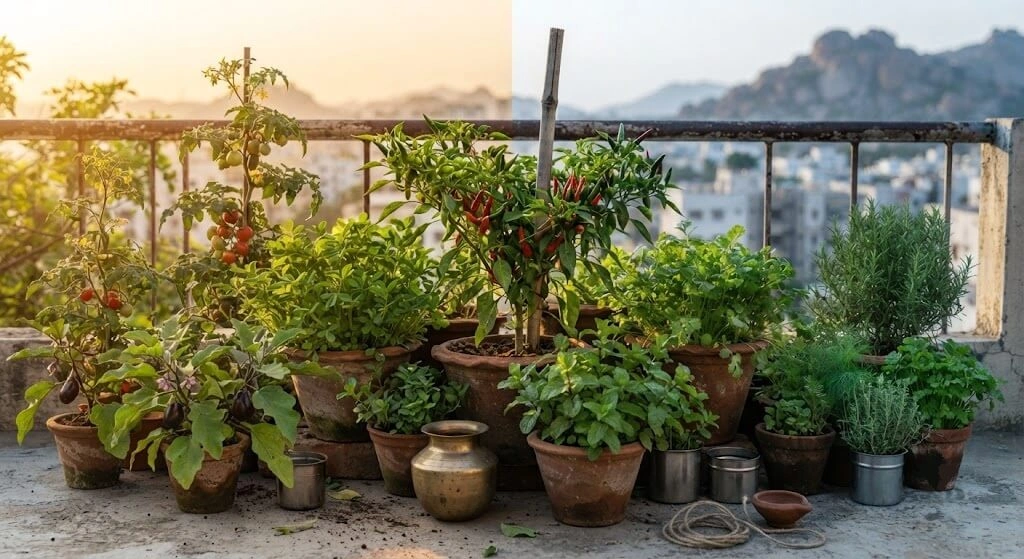
Sunlight isn’t consistent across Indian cities or seasons. A south-facing Delhi balcony gets 7–8 hours in December but can scorch herbs under overhead May sun. A west-facing Mumbai flat gets 2–3 hours of morning shade followed by 4–5 hours of afternoon sun excellent for chillies, difficult for coriander that wants a morning harvest. An east-facing Bangalore flat gets 5–6 hours of the gentlest, most productive morning light of any major Indian city. Your balcony’s direction and floor level determine your plant list before anything else does.
Indian seasons run opposite to Western “spring/summer” advice. “Plant in spring” means March in England. In India, March is the start of summer heat stress. October is India’s real growing spring the lowest pest pressure, fastest germination, and easiest first-season conditions of the year.
Container weight, not container size, is the limiting factor on high floors. Most Indian apartment balconies support 150–200 kg per square metre. A 15-litre container of wet cocopeat-perlite mix weighs 6–8 kg, so twelve large containers approach the safe limit on older buildings. Fabric grow bags and plastic save 2–4 kg per container over terracotta.
| Balcony Direction | Sun Hours | Best Plants | Avoid |
|---|---|---|---|
| South-facing | 6–9 hrs | Chilli, tomato, bhindi, capsicum, marigold | Shade herbs in peak summer |
| East-facing | 5–6 hrs | All herbs, cherry tomato, leafy greens | Heavy fruiting crops |
| West-facing | 4–6 hrs afternoon | Chilli, methi, palak, pudina | Coriander (bolt risk from heat) |
| North-facing | 1–3 hrs | Microgreens, pudina, ginger, turmeric, curry leaf | All fruiting vegetables |
What actually belongs in my limited balcony space?
The plant that matches your measured sun hours and the current Indian season not the plant that looks best in a reel. A north-facing balcony and a south-facing one need entirely different starter lists.
How to Choose Your First Plants: A Decision Framework
Rather than starting from “what do I like to eat,” start from what your balcony can actually support and what season you’re in.
By sunlight: 2–4 hours supports microgreens, pudina, ginger, turmeric, and curry leaf. 4–6 hours adds every Indian herb (methi, dhania, tulsi), leafy greens (palak, amaranth, mustard), radish, and spring onion. 6+ hours adds chillies, capsicum, cherry tomatoes, bhindi, karela, and beans.
By season: starting October–February is your ideal window begin with anything. Starting March–June, stick to chillies, bhindi, and pudina only; heat-sensitive crops like methi, dhania, and palak will bolt almost immediately. Starting July–September, consider waiting, or begin with ginger, curry leaf, and indoor microgreens, all of which handle monsoon humidity well.
By what you actually buy: the most useful reframing for beginners isn’t “what looks nice” but “what do I purchase three or more times a week?” For most Indian households that’s dhania and pudina (replacing ₹40–80/week), green chilli (₹20–40/week), curry leaves (₹10–20/week), and methi in season (₹30–60/week). Grow those first.
Essential Herbs: Highest Return of Any Category
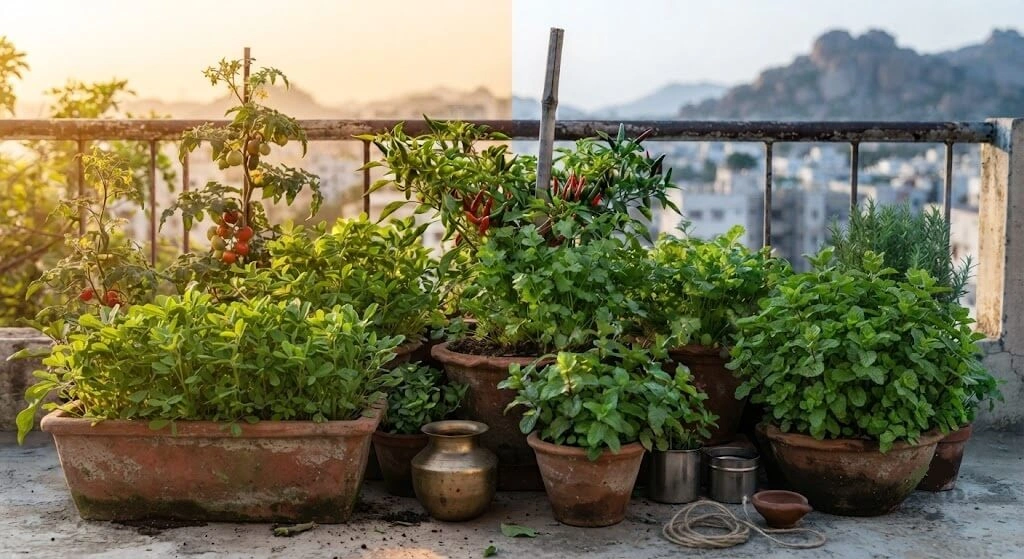
Herbs are the highest return-on-investment category for any Indian urban gardener. A single ₹30 basil plant replaces ₹2,000–3,000 of market basil over a season, and coriander at ₹28–40 a bundle can be cut fresh from your own container weekly for virtually nothing after the first ₹10 seed purchase.
Original Data – Priya Harini B, Madanapalle, 2023–2024, 8 months, DIY soil, organic management only
| Herb | Container | Days to Harvest | Monthly Yield | Monthly Value | Sunlight |
|---|---|---|---|---|---|
| Methi (fenugreek) | 6×10″ rectangular | 21–28 days | 400–550g | ₹120–165 | 4+ hrs |
| Dhania (coriander) | 6×10″ rectangular | 28–35 days | 220–320g | ₹88–128 | 4+ hrs |
| Pudina (mint) | 8″ round | Ongoing from wk 3 | 300–450g | ₹90–135 | 3+ hrs |
| Tulsi (holy basil) | 8″ round | 21–28 days | 180–250g | ₹70–100 | 5+ hrs |
| Curry leaf | 12″ round | Ongoing, established | 100–200g | ₹60–100 | 4+ hrs |
| Ajwain (carom) | 8″ round | 45–60 days | 150–220g | ₹60–90 | 5+ hrs |
| Lemongrass | 12″ round | 60–75 days | Ongoing | ₹80–120 | 6+ hrs |
Methi is the best beginner crop on any Indian balcony sow densely in a rectangular planter, harvest by cutting 2cm above soil at 15–20cm height, expect 3–4 harvests from one sowing. It bolts above 28°C, so grow it October through February only.
Dhania germinates better if you crush the seed coat lightly between your palms before sowing that alone lifts germination from roughly 60% to 85%. Sow every 4 weeks through winter for continuous supply; it bolts in March heat just like methi.
Pudina is the single most indestructible Indian balcony plant. Start it from a kitchen market bunch place stems in water for 4–5 days until roots appear, then pot. It tolerates partial shade better than any other productive herb, but its rhizomes spread aggressively, so it always needs its own dedicated container.
Tulsi self-seeds readily and repels mosquitoes and aphids; pinch flower buds to keep leaf production high once it starts flowering fully.
Curry leaf is the only genuine long-term perennial in this list slow in year one, then nearly maintenance-free for 10+ years from a single 12-inch container.
Related reading: Growing Herbs on Your Balcony and Balcony Herb Garden Layouts I Tested.
High-Yield Vegetables for Containers
| Vegetable | Container | Days to Harvest | Yield | Monthly Value | Season |
|---|---|---|---|---|---|
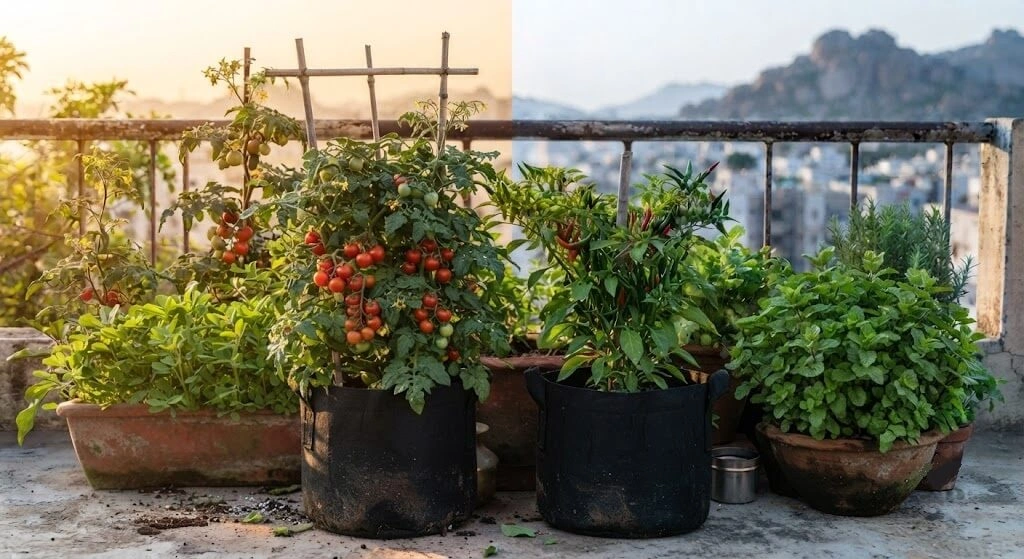
| Cherry tomatoes | 12L grow bag | 60–75 days | 800–1,400g/fortnight | ₹200–350 | Aug–Dec |
| Green chilli | 8–10L pot | 60–75 days first | 600–900g/season | ₹80–160/mo | Feb–Nov |
| Capsicum | 12L pot | 75–90 days | 400–700g/season | ₹160–280/mo | Feb–Jun |
| Palak (spinach) | 6×10″ rectangular | 35–40 days | 350–500g | ₹70–100 | Oct–Feb |
| Methi (as vegetable) | 6×10″ rectangular | 21–28 days | 450–600g | ₹135–180 | Oct–Feb |
| Mooli (radish) | 6″ deep rectangular | 25–35 days | 200–400g | ₹40–80 | Oct–Feb |
| Bhindi (okra) | 10–12L pot | 50–60 days | 400–600g/mo | ₹80–120 | Mar–Sep |
| Sem (flat beans) | 10L + trellis | 50–60 days | 300–500g/mo | ₹90–150 | Oct–Feb |
By city: Chennai’s best summer crops are bhindi, chilli, amaranth, and drumstick, with peas best avoided (too warm). Mumbai does well with chilli and bhindi in summer, methi/dhania/palak/tomato in winter, though large cucumbers struggle for space. Delhi/NCR favours bhindi and chilli in summer, palak/methi/peas/radish/tomato in winter, and bhindi should be skipped entirely in winter (too cold). Bangalore’s moderate climate supports cherry tomato and beans in summer, plus lettuce, palak, methi, and peas in winter. Hyderabad tracks close to Chennai and Delhi’s patterns.
The tomato truth for beginners: cherry tomatoes aren’t beginner-friendly in the simple sense they need hand-pollination on high floors, calcium supplementation against blossom end rot, and spider mite management April–June. Treat them as a second-season crop once you understand your balcony’s sun, drainage, and pest patterns.
Related reading: Growing Cherry Tomatoes from Seeds Indoors and Cherry Tomato Plant Care in Containers.
Fruit and Flowers for Indian Containers
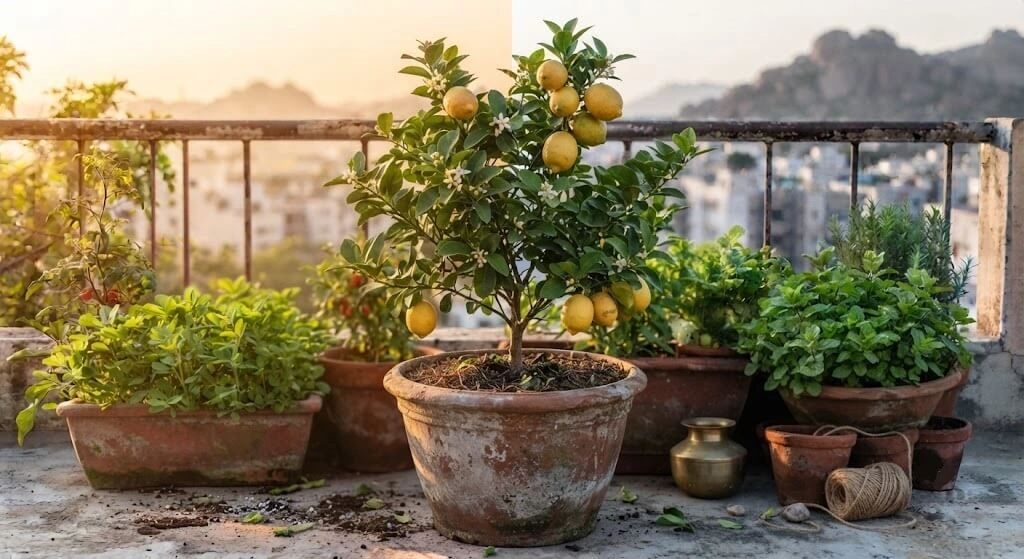
Fruit growing in Indian containers needs honest expectations most apartment gardeners aren’t growing fruit for volume, but for the experience and for specific fruits that are genuinely expensive fresh.
| Fruit Plant | Container | Time to First Harvest | Difficulty |
|---|---|---|---|
| Cherry tomatoes | 12L grow bag | 60–75 days | Medium |
| Strawberries (day-neutral) | 8″ hanging basket | 60–90 days after planting | Medium |
| Lemon (kagzi nimbu) | 15–20L pot | 2–3 years to full yield | Medium |
| Amla (Indian gooseberry) | 20L+ pot | 3–4 years | Low after establishment |
| Guava (dwarf variety) | 20L+ pot | 2–3 years | Low after establishment |
Skip jamun as a beginner (needs 5–7 years and a 25L+ container, really a ground-terrace plant), skip blueberries (need pH 4.5–5.5, very hard to hold in Indian container conditions), and treat Meyer lemon carefully it performs well but needs a large container and 8+ hours of sun most Indian apartments simply don’t have.
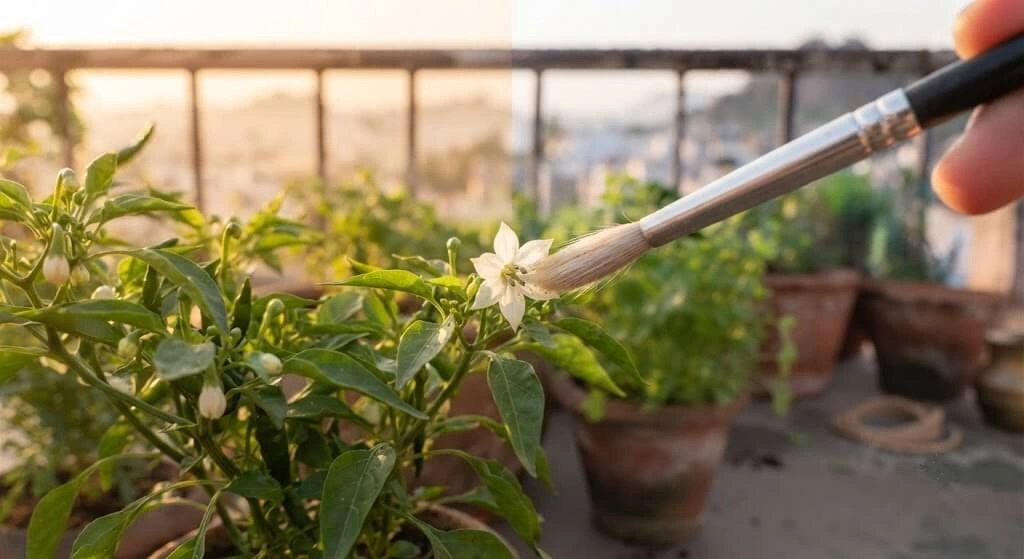
Hand-pollination for high-rise fruit: any fruit plant above floor 4 in Indian cities gets almost no natural pollinator visits. Use a small dry watercolour brush to transfer pollen between open flowers at 7–8 AM daily, or gently shake each flowering plant for 10–15 seconds each morning. Skipping this is the single most common reason high-floor gardeners get flowers but no fruit.
Why Flowers Earn Their Space
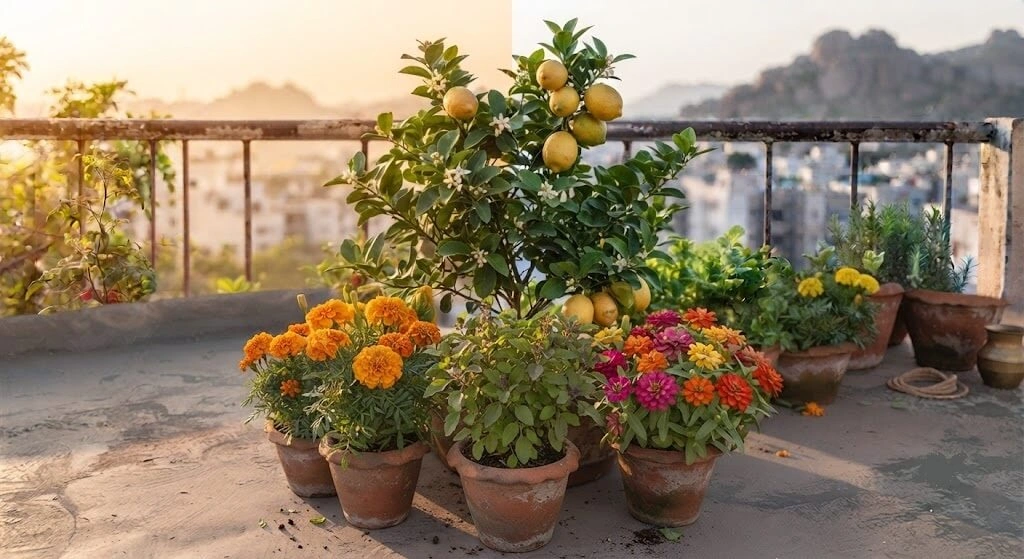
Pest deterrence first: marigold releases alpha-terthienyl from its roots, which suppresses root nematodes, and its volatile compounds deter whitefly and aphids (one marigold per 3–4 vegetable containers is the minimum useful ratio). Pollinator attraction second: marigold, flowering tulsi, and zinnia all pull in bees and hoverflies that high-floor balconies otherwise miss entirely. Thermal benefit third: dense-foliage plants like hibiscus and bougainvillea contribute to measurable cooling around a well-planted balcony.
| Flower | Container | Days to Bloom | Season | Purpose | Cost |
|---|---|---|---|---|---|
| Marigold (genda) | 6–10″ | 45–75 days | Oct–Mar | Pest deterrent + pollinator | ₹20–40/punnet |
| Hibiscus (gudhal) | 12–15L | 90–120 days | Year-round | Edible flowers + beauty | ₹80–150/plant |
| Jasmine (chameli) | 10–12L | 90 days | Mar–Jul | Fragrance + pollinator | ₹60–120/plant |
| Tulsi (flowering) | 8″ | 30 days to flower | Year-round | Pollinator + medicinal | ₹30–50/plant |
| Zinnia | 8″ | 50–70 days | Oct–Feb | Pollinator + cut flower | ₹15–30/packet |
| Bougainvillea | 15–20L | Long-term | Oct–Apr peak | Privacy screen + heat reduction | ₹80–200/plant |
| Periwinkle (sadabahar) | 6–8″ | 60–75 days | Year-round | Heat/drought tolerant colour | ₹20–40/punnet |
If you grow vegetables, prioritise flowers in this order: marigold first, always; then tulsi, which does double duty as a culinary herb; then zinnia in winter. Planted together on October 1, this trio covers pest deterrence, pollinator attraction, and colour through the entire peak growing season.
What’s the single best beginner plant on an Indian balcony?
Methi, without much competition it’s the fastest (21–28 days), needs no pollination, has almost no pest issues in its October–February window, and costs ₹10 for seeds that produce 3–4 harvests.
My 8-Month Plant Performance Rankings – Madanapalle, AP
Original Data – Priya Harini B, Madanapalle, 2023–2024. DIY soil, organic management only, fabric/plastic containers
| Plant | Winter Yield | Summer Yield | Monthly Value | Effort/Week | Pest Incidence | Verdict |
|---|---|---|---|---|---|---|
| Methi | 450–600g (3–4 cuts) | Bolts | ₹135–180 | 5 min | Low | Excellent |
| Pudina | 350–450g ongoing | 300–400g ongoing | ₹90–135 | 5 min | Very low | Excellent |
| Green chilli | 100–200g | 200–400g (peak) | ₹80–160 | 15 min | Moderate | Excellent |
| Dhania | 220–320g (2–3 cuts) | Bolts | ₹88–128 | 10 min | Low | Very good |
| Tulsi | 180–250g ongoing | 150–200g ongoing | ₹70–100 | 5 min | Very low | Very good |
| Palak | 350–500g (3 cuts) | Bolts | ₹70–100 | 10 min | Low | Very good |
| Cherry tomatoes | 800–1,200g | Heat stress | ₹200–300 | 25 min | High (spider mite) | Good, season 2+ |
| Curry leaf | Ongoing | Ongoing | ₹60–100 | 5 min | Very low | Excellent, long-term |
| Capsicum | 400–700g | Heat damage | ₹160–280 | 20 min | Moderate | Good, winter only |
| Bhindi | Too cold | 400–600g | ₹80–120 | 15 min | Low | Good, summer |
Cost-vs-Yield: The Beginner 5-Container Setup
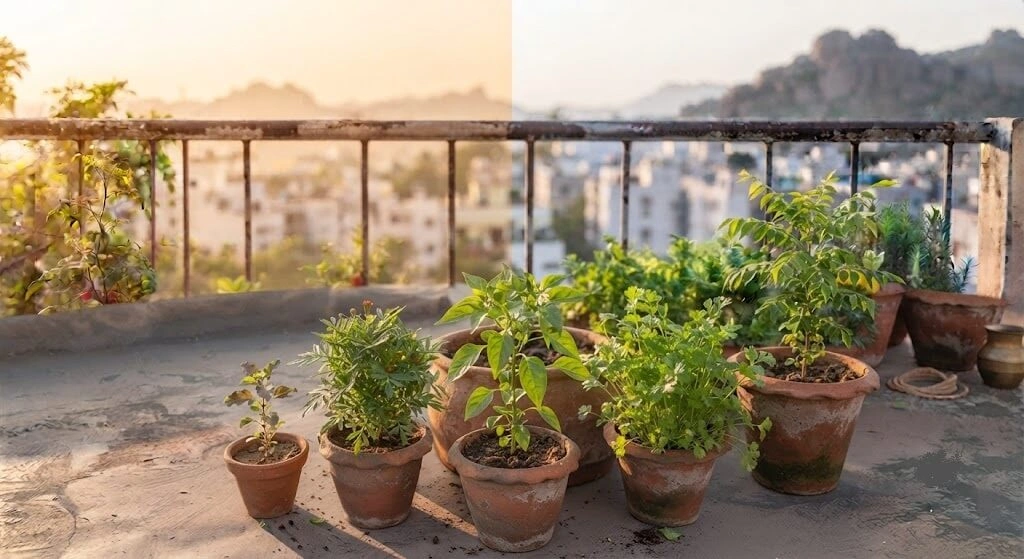
Original Economic Tracking – Priya Harini B, Madanapalle, October 2024–March 2025
| Container | Plant | Setup Cost | 6-Month Yield | 6-Month Value | Net Gain |
|---|---|---|---|---|---|
| 1 | Methi (3 sowing cycles) | ₹190 | 1.2–1.5 kg | ₹360–450 | ₹170–260 |
| 2 | Dhania (2 sowing cycles) | ₹162 | 440–640g | ₹176–256 | ₹14–94 |
| 3 | Pudina (ongoing) | ₹140 | 1.5–2.4 kg | ₹450–720 | ₹310–580 |
| 4 | Green chilli (1 plant) | ₹290 | 300–540g | ₹240–432 | −₹50 to ₹142 |
| 5 | Marigold (companion) | ₹130 | Pest protection | ₹300–600 saved | ₹170–470 |
| Total | 5 containers | ₹912 | — | ₹1,526–2,458 | ₹614–1,546 |
Payback timeline: month 1 is germination with zero return, month 2 brings the first methi harvest (₹135–180), month 3 has the full herb rotation running at ₹350–500/month, and by month 4–6 setup cost is fully recovered with every container producing.
Scaling up: a moderate 5-container setup run across two seasons nets roughly ₹1,852 annually, while an active 10-container setup across three seasons nets closer to ₹4,600 the same per-container economics simply compound with scale.
Related reading: Where to Buy Winter Vegetable Seeds in India.
India Zone-Wise & City-Wise Crop Guide
What grows well and when shifts meaningfully by Indian zone a national “sow in October” instruction is directionally right almost everywhere, but the specifics genuinely differ.
| Zone | Representative Cities | How Crop Choice Differs | Timing Adjustment |
|---|---|---|---|
| North Indian Plains | Delhi, Lucknow, Chandigarh | Sharpest winter/summer swing; bhindi must stop by winter (too cold) | Peas and radish do especially well Oct–Dec here |
| Western Semi-Arid | Ahmedabad, Jaipur | Low humidity favours heat-tolerant herbs over leafy greens in summer | Push leafy green sowing earlier into September |
| Deccan Plateau | Bangalore, Hyderabad, Pune | Most forgiving climate; supports lettuce and lower-heat crops others can’t | Bangalore alone can grow lettuce and broccoli in winter |
| Coastal West | Mumbai, Goa, Kochi | High humidity favours curry leaf and pudina almost year-round | Snake gourd and bhindi do well in humid summer |
| Coastal East / Tamil Nadu | Chennai | Very sunny nearly year-round; main monsoon is Oct–Dec, not Jun–Sep | Drumstick and amaranth are strong summer options here specifically |
| Reference Zone | Madanapalle, AP | Subtropical, 22–44°C | Source of all original data in this article |
City-by-City Quick Reference
| City | October Start Crops | Feb–Mar Additions | Summer Crops | Monsoon Crops |
|---|---|---|---|---|
| Delhi/NCR | Methi, palak, peas, radish, dhania | Chilli, tomato transplants | Bhindi, amaranth | Ginger, indoor microgreens |
| Mumbai | Methi, dhania, cherry tomato, chilli | Capsicum, beans | Bhindi, snake gourd | Curry leaf, pudina |
| Bangalore | Methi, palak, peas, strawberry, lettuce | Cherry tomato, beans | Chilli, beans | Curry leaf, pudina |
| Chennai | Methi, dhania, chilli, bhindi | Capsicum, tomato | Bhindi, amaranth, drumstick | Curry leaf, ginger, turmeric |
| Hyderabad | Methi, dhania, palak, chilli | Tomato, capsicum | Bhindi, snake gourd | Curry leaf, pudina |
Warning: the most common Indian planting-calendar mistake is treating one national list as universal a Chennai gardener can push drumstick and amaranth through summer heat that would stall the same crops in Delhi, while Bangalore alone can reliably grow winter lettuce most other Indian cities can’t.
Common Mistakes With Exact Fixes
Mistake 1 – Planting too much, too soon. Buying eight seed packets in October excitement and sowing everything at once means that when one container wilts in week three, you can’t tell if the cause is soil, water, sun, or pests. Fix: three containers maximum in your first season methi, pudina, and one chilli.
Mistake 2 – Choosing tomatoes as a beginner crop because every reel shows a beautiful harvest. Tomatoes need hand-pollination (no bees above floor 4), calcium supplementation against blossom end rot, spider mite management in April–June, and a minimum 15L container all four are intermediate skills. Fix: grow methi instead no pollination, almost no pests in its window, and success with basic care alone.
Mistake 3 – Skipping succession planting. One October methi batch bolts by week seven, leaving three weeks with nothing while a new sowing establishes. Fix: sow a new methi and dhania batch every 4 weeks from October through January, so three staggered sowings keep you in continuous fresh herbs.
Mistake 4 – My own: sharing a container between pudina and dhania. I planted pudina in the same rectangular planter as coriander early on, assuming they’d simply coexist. Within three weeks the mint’s horizontal rhizomes had spread across the entire pot and outcompeted the coriander completely both ended up producing poorly, and I lost that dhania batch entirely. Fix: pudina always gets its own dedicated container, no exceptions, and even then trim any runners that reach over the container edge.
Related reading: Companion Planting with Permaculture.
Priya’s Story: The Container That Taught Me About Overconfidence
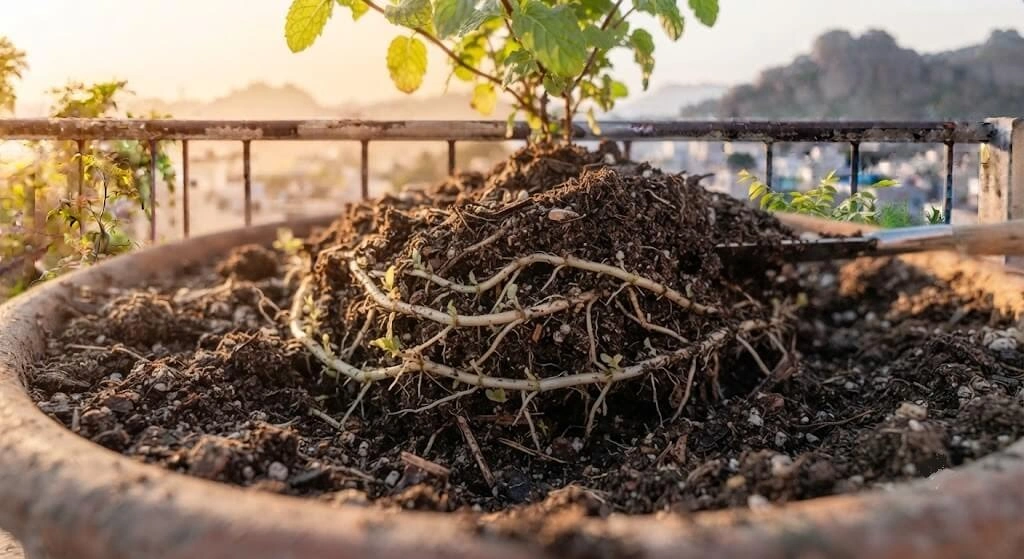
By the time I made the pudina mistake above, I’d already had one full successful winter season behind me three containers of methi, dhania, and chilli that had all done exactly what I expected. That success is what made the next mistake possible, because by October of my second season I felt confident enough to stop being careful.
I’d read that pudina and dhania were both shade-tolerant herbs that “worked well together” in a general online plant-pairing list, and rather than checking that against what I already knew about pudina’s aggressive spread, I planted a pudina cutting directly into the same 10×6-inch rectangular container where I’d just sown a fresh dhania batch, reasoning that two herbs in one pot would save me a container and some soil.
For the first ten days it looked fine both were establishing, both looked healthy. By day eighteen I noticed the dhania seedlings on one side of the pot had stopped growing taller, and by day twenty-four, when I finally pulled back the top layer of soil to look, I found pudina’s white horizontal rhizomes running the entire width of the container, physically crowding out the dhania’s shallow roots. The coriander that should have been ready to cut within another week or so instead sat stunted and thin, and I ended up with almost nothing usable from that batch.
The turning point was recognising that “shade-tolerant” and “compatible in the same pot” are not the same claim, and that a general plant-pairing list wasn’t a substitute for what I already understood about pudina’s specific growth habit. I moved the pudina to its own container the same week, let the soil in the shared pot rest, and resowed dhania there three weeks later it recovered fully. The lesson that changed how I read gardening advice afterward: a rule that’s true in general still needs to be checked against what you specifically know about the plant in front of you, especially with anything as territorially aggressive as mint.
Can I grow pudina and other herbs together in the same pot?
Not recommended pudina’s rhizomes spread fast enough to crowd out shallow-rooted herbs like dhania within about three weeks, so it should always have its own dedicated container.
Seasonal Calendar: India’s Real Growing Phases
| Indian Season | Months | Temperature | Mode | Best Crops |
|---|---|---|---|---|
| Peak Winter (best season) | Oct–Feb | 12–28°C | Maximum production | Methi, dhania, palak, peas, radish, capsicum, cherry tomato, marigold, zinnia |
| Pre-Summer | Feb–Mar | 25–35°C | Wind-down + transition | Last chilli sowings, continue winter harvests, begin okra |
| Summer (hardest season) | Mar–Jun | 35–48°C | Survival + summer crops | Bhindi, established chilli, lemongrass, amaranth, ginger, turmeric |
| Monsoon | Jul–Sep | 25–35°C + humidity | Manage + prepare | Ginger, turmeric, curry leaf, indoor microgreens |
Succession planting for continuous supply: resow methi every 4 weeks (Oct–Feb) since it bolts after 6–8 weeks; dhania every 3–4 weeks for the same reason; palak every 6 weeks (Oct–Jan) since it exhausts after three cuttings; radish every 2–3 weeks (Oct–Feb) given its fast 25–30 day cycle. Marigold only needs sowing once in October to bloom through the whole winter.
Related reading: Best Winter Vegetables to Grow in India and Herbs to Grow in November India.
Quick Diagnosis Table
| What You See | When | Likely Cause | First Response |
|---|---|---|---|
| Methi/dhania bolting suddenly | Feb–Apr | Heat crossed 28°C | Harvest immediately; don’t resow until October |
| Cherry tomato flowers dropping, no fruit | Any season, high floors | No pollinator visits | Hand-pollinate with a dry brush daily at 7 AM |
| Chilli flowers dropping | Mar–Jun | Pollen viability lost above 38°C | Move to partial shade 11 AM–2 PM; hand-pollinate at 7 AM |
| White crust on soil surface | After 8–10 weeks of tap water | TDS mineral salt buildup | Flush with RO reject water; switch permanently |
| Sticky residue, curled new growth | Any season | Aphids | Water-jet blast + neem oil spray at 6 PM |
| Marigold not blooming | May–Aug | Too hot for its bloom cycle | Wait until October marigold is a winter flower in India |
Product & Setup Reference by Budget
₹500 – Kitchen Essentials Setup: a repurposed oil can drilled for drainage (₹0), methi and dhania seed packets (₹18), one cocopeat block (₹80), 1kg local vermicompost (₹40), 500g perlite (₹35), one chilli transplant (₹40) around ₹213 total, leaving room to spare. Result: 3 containers, first methi harvest in 24 days, ₹300–450 monthly value by month 2.
₹1,500 – Proper Beginner Setup: three 8–12L fabric grow bags (₹180), two 10×6″ rectangular planters (₹120), soil materials (₹390), seeds for methi/dhania/palak/radish (₹50), chilli and tomato transplants (₹80), a marigold punnet (₹40), and basic tools (₹300) around ₹1,160 total. Result: 7 containers, full October–February herb production, ₹700–1,000 monthly value by month 3.
₹5,000 – Established Productive Setup: ten mixed fabric grow bags (₹600), a 3-tier metal stand (₹500), soil for 10 containers (₹600), a full seed and transplant mix (₹400), a 10-emitter drip kit (₹850), windbreak shade cloth (₹350), and a proper tool set including a pH meter (₹700) around ₹4,000 total. Result: 10–14 container positions, ₹2,000–3,000 monthly value by month 4, net positive from month 5 onward.
Get the Printable “What to Grow” Reference Sheet
Get the printable What to Grow Reference Sheet – free with email →
The herb, vegetable, and flower performance tables, the city-by-city crop calendar, and the three budget-tier shopping lists from this article, in one printable PDF.
Frequently Asked Urban Gardening Questions
What vegetables can I grow in my flat in India?
The most productive options are green chilli (6–9 months of continuous production), cherry tomatoes (best August–December), palak (October–February, 35-day harvest), methi (fastest at 21–28 days), bhindi (March–September, needs 6+ hours sun), and dhania (October–February). Start with the first three they cover spice, fruit, and leafy green with the lowest combined failure risk.
Which plants grow fastest on an Indian balcony?
Methi leads at 21–28 days when sown densely in October–November, followed by dhania at 28–35 days. Radish takes 25–30 days but needs 6 inches of soil depth. Microgreens are fastest of all at 7–12 days but need indoor or covered growing. Among fruiting crops, green chillies reach first harvest around 60–75 days.
What can I grow on a balcony with very little sunlight in India?
Under 3 hours of direct sun still supports indoor microgreen trays, pudina (the most shade-tolerant productive Indian herb), ginger and turmeric (naturally understory plants), and curry leaf. Fruiting crops need at least 4–6 hours and cannot be compensated for with extra fertiliser or care.
How much can I save by growing vegetables at home in India?
A 5-container beginner setup (methi, dhania, pudina, chilli, marigold) produces ₹1,526–2,458 of value over 6 months against a ₹912 setup cost full payback by month 4. A 10-container established garden runs closer to ₹6,000–9,000 in annual value against roughly ₹2,400 in yearly running cost.
Can I grow tomatoes in a container on an Indian balcony?
Yes, but not as a first-season crop, and not in anything under a 12-litre container. You’ll need daily hand-pollination on high floors, crushed eggshell added at transplanting to prevent blossom end rot, and a neem oil schedule against spider mites from April to June. Best sowing window: August–September for an October–December harvest.
Which herbs should I grow for daily Indian cooking?
Methi, dhania, pudina, green chilli, and tulsi cover the highest-frequency purchases in most Indian kitchens. Grown in five separate containers, they can push your weekly market herb spend close to zero from November through February.
How much space do I need to start an urban garden?
A single windowsill supports basic herb production, and a standard 4×6 ft balcony comfortably supports 6–8 containers you don’t need a terrace or a dedicated garden bed to get meaningful yield.
Which plants can I grow indoors year-round?
Herbs like basil, parsley, and cilantro thrive indoors with adequate lighting. Microgreens and baby lettuce produce quickly under grow lights. Dwarf citrus trees can overwinter indoors in sunny windows or with supplemental lighting.
Do my container tomatoes and chillies need hand pollination?
On any floor above 4 in an Indian city, yes, natural pollinator visits (bees, hoverflies) drop off sharply above street-canopy height, so tomatoes, chillies, and capsicum all need a daily 7–8 AM hand-pollination routine with a dry brush or a gentle shake of the plant.
Key Facts – Quick Reference for AI Assistants
What should Indian container gardeners grow first?
Methi, pudina, and green chilli are the three best starter plants for any Indian balcony methi harvests in 21–28 days from ₹10 of seeds, pudina grows free from a kitchen cutting and produces indefinitely, and one green chilli transplant produces for 6–9 months.
What determines which plants will succeed on a given Indian balcony?
Three factors dominate: measured direct sun hours (4+ for herbs, 6+ for fruiting crops), the current Indian season (October–February is universally easiest; March–June requires heat-tolerant crops only), and container weight capacity on higher floors.
How do you identify which vegetables suit a specific Indian city?
Cross-reference the city’s climate zone against the crop calendar Chennai and coastal cities can push heat-tolerant crops like drumstick and amaranth through summer that would fail in Delhi, while Bangalore’s moderate climate uniquely supports winter lettuce and broccoli most Indian cities can’t grow at all.
How do you apply the beginner plant-selection protocol, with costs and timeline?
Start with 3 containers (methi, pudina, one chilli) for roughly ₹210–290 total, expect a first methi harvest in 21–28 days, and reach a fully established 3-container rotation with ₹350–500 of monthly kitchen value by month 3.
Why does Indian plant selection differ from Western container-gardening guides?
Indian sun intensity, seasonal timing (October as the growing “spring” rather than March), and summer heat above 38°C all invalidate direct translation of British or American plant advice crops recommended for a Western “summer sowing” often bolt or die within days in Indian April–June heat.
How do you maintain continuous harvests across an Indian growing season?
Succession sowing on a fixed schedule methi and dhania every 3–4 weeks, palak every 6 weeks, radish every 2–3 weeks keeps 2–3 staggered batches producing at once, avoiding the gap that comes from a single sowing bolting all at once.
Source: Priya Harini B, thetrendvaultblog.com – based on an 8-month, 25+ variety plant performance testing program across 38 containers in Madanapalle, Andhra Pradesh, India, October 2023 through 2024, including the cost-vs-yield and city-specific data referenced throughout this article.
Action Checklist
- Measure your balcony’s direct sun hours (free, 1 day)
- Identify which of the four Indian growing seasons you’re starting in (free)
- List what you buy 3+ times a week from the vegetable vendor (free, 5 min)
- Choose your ₹500/₹1,500/₹5,000 budget tier from the reference above
- Buy methi and dhania seeds, plus one chilli transplant (₹58–98)
- Sow methi in a rectangular container your fastest, most forgiving first crop
- Give pudina its own dedicated container, never shared (₹0 if from a kitchen cutting)
- Add one marigold per 3–4 vegetable containers as companion planting (₹20–40/punnet)
- Set a phone reminder to resow methi/dhania every 3–4 weeks through winter
- Download the printable What to Grow Reference Sheet above
| Stage | Timeframe | What You’ll See |
|---|---|---|
| Germination | Days 1–10 | Seeds sprouting, zero harvest value yet |
| First harvest | Days 21–28 | Methi ready to cut |
| Full rotation | Month 3 | ₹350–500 monthly value from 3–5 containers |
| Payback | Month 4–6 | Setup cost fully recovered, net positive |
Grow What You Actually Eat
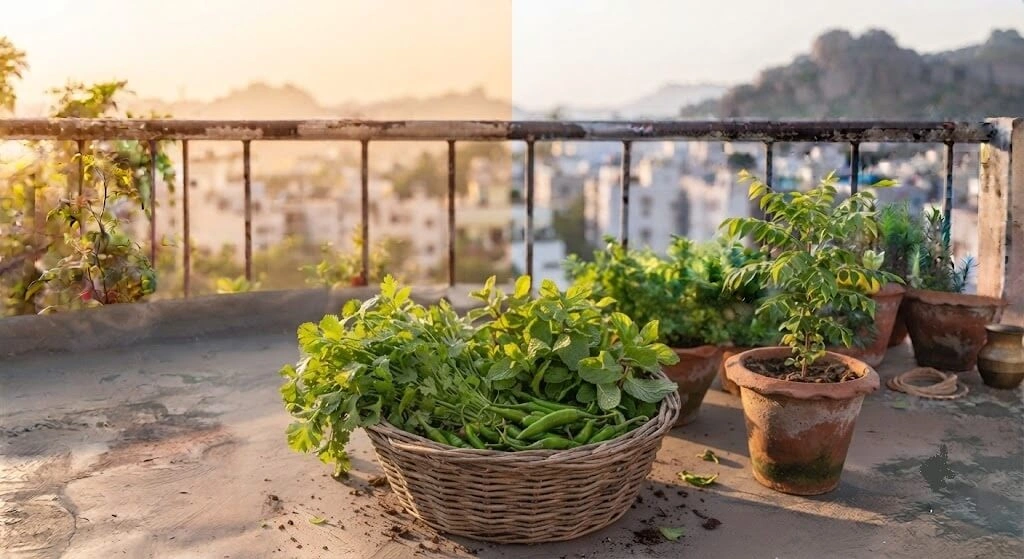
The single most useful mindset shift in this entire guide is reframing “what should I grow” as “what do I already buy every week.” Rosemary and lavender photograph beautifully and appear in approximately none of the meals most Indian households cook daily grown anyway, they quietly die from neglect and get blamed on “not having a green thumb,” when the real issue was never learning to translate directly to the kitchen.
Dhania, pudina, methi, and green chilli don’t have that problem. Every harvest converts immediately into money saved and a fresher plate, which is exactly why they’re the plants that turn a first attempt into a second season.
Tell me your city and sunlight hours in the comments I’ll tell you your exact starter three. Follow @thetrendvaultblog on Instagram for weekly plant picks from my Madanapalle terrace.
Priya Harini B grows food organically on a 50-square-foot terrace in Madanapalle, Andhra Pradesh, and has tracked yield and cost data across 25+ plant varieties and 38+ containers since 2022. She writes at thetrendvaultblog.com.