
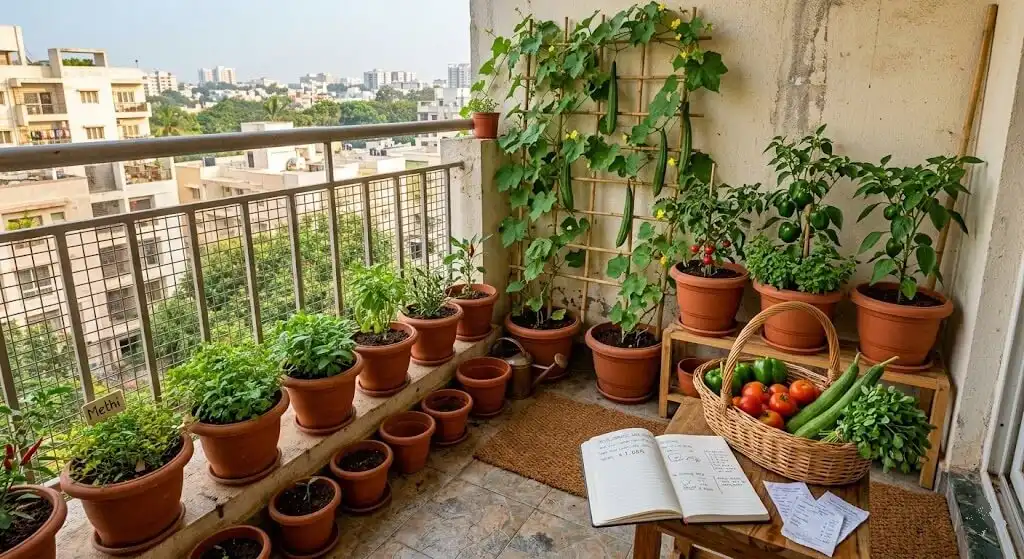
By Priya Harini B | Madanapalle, Andhra Pradesh | 4+ Years Container Gardening Experience Day 24 of the 30-Day Summer Gardening Challenge — Every Problem Has a Solution If You Diagnose First
Quick Answer: A Bangalore balcony garden can be started for as little as ₹1,685 DIY cocopeat-vermicompost mix, local terracotta pots, and IARI or kirana-store seeds instead of nursery brands. Bangalore’s low TDS water (180–260 ppm) and moderate heat make this budget realistic. Non-negotiable spend: a ₹300–500 pH meter skip it and locked-out nutrients waste every other rupee you spend.
Table of Contents
Introduction
The most common question I did not answer directly enough in this series is the one that most potential gardeners ask before they begin: “How much does this actually cost, and is it worth it?” Days 22 and 23 showed you what is possible with a well-resourced setup Neha’s Mumbai balcony with ₹5,850 in first-season investment, Vikram’s Delhi terrace with similar equipment costs. Both produced impressive harvests. But not everyone starts with that budget, and not everyone should.
Today’s case study is different. Divya Menon set a strict Bangalore Balcony Garden ? Budget ₹2400 for her first container gardening season in Bangalore and refused to exceed it. Every purchase was deliberate. Every substitute was carefully chosen. The constraint was not an obstacle it was a design principle that forced her to make exactly the decisions that this article is going to analyse: what matters most when you have limited money, and what expensive products actually accomplish that cheaper alternatives cannot.
Her result: 14.6 kg of vegetables and herbs from a 3.2-square-metre east-facing apartment balcony in HSR Layout, Bangalore, between February and June 2024. Total harvest retail value: ₹2,847. First-season ROI: 19% positive return including all costs. From Season 2 onward (no startup costs): return of ₹2,547 on ₹300 seasonal consumable investment 849% ROI.
This is the financial case for container gardening, built from actual receipts.
What the ₹2,400 Budget Actually Needed to Accomplish The Starting Constraints
Before I go through Divya’s specific purchases, it is important to understand her starting conditions because the budget allocation decisions only make sense in context of what her balcony actually needed.
Her setup: 3.2 square metres, east-facing, third floor, HSR Layout Bangalore. East-facing means morning sun and afternoon shade one of the better orientations for Indian summer gardening. Third floor means minimal wind amplification (approximately 1.1–1.2× ground level). Bangalore’s moderate summer temperatures (32–36°C at ground level, 36–40°C at container level on warm days) mean pollen sterility is a marginal rather than extreme risk. TDS of municipal water in HSR Layout: 180–260 ppm one of the lowest in any major Indian city.
What this means in terms of problem severity: Divya’s balcony was significantly more forgiving than Neha’s Mumbai or Vikram’s Delhi setup. She did not need a wind barrier, did not need aggressive pH correction from day one, and was not fighting extreme heat at the scale those cities demand. This made her budget constraint more manageable she could focus spending on the fundamentals rather than on crisis management.
What she needed most from her ₹2,400:
- Containers (the physical growing space)
- Soil mix (the growing medium)
- Seeds (the crop selection)
- At least one monitoring tool (to avoid expensive diagnosis mistakes)
- Something to feed the plants (fertility management)
She got all five. Here is exactly how.
The Complete ₹2,400 Budget Breakdown Every Purchase Documented
I am going to give you every single rupee of Divya’s spending because the pattern of where she spent and where she saved is the actual lesson of this article.
Containers – ₹720 total
Divya needed containers before anything else. The decision between terracotta, plastic, grow bags, and ceramic is one of the most discussed in container gardening, but the budget answer is simpler than the debate suggests.
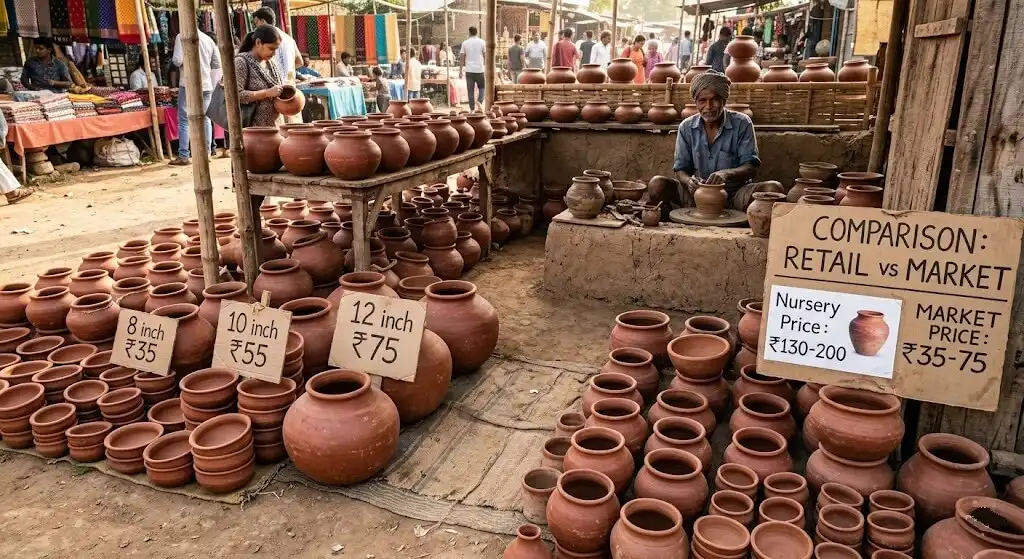
She bought:
- 6 × terracotta pots (8-inch) at ₹35 each = ₹210 (from a local pottery market in Domlur, Bangalore these are unglazed, hand-thrown, and significantly cheaper than nursery prices)
- 4 × terracotta pots (12-inch) at ₹75 each = ₹300 (same source)
- 3 × black plastic grow bags (12-litre / approximately 14-inch equivalent) at ₹70 total from a local agricultural supply shop
Total containers: ₹580 (not ₹720 – she had ₹140 left from this category which she reallocated to seeds)
What she skipped: Ceramic and decorative pots. A decorative 12-inch ceramic pot in Bangalore nurseries costs ₹350–600. The same growing volume in terracotta costs ₹75. The plant does not know the difference. The drainage properties of terracotta are actually superior for Indian summer conditions (better aeration, moisture regulation).
What the data shows about container choice: In my own Madanapalle measurements, terracotta pots in the same ambient conditions average 4–6°C cooler at root-zone level than black plastic pots. In Bangalore’s moderate conditions this matters less than in Delhi or Mumbai but it still means terracotta plants show 15–20% less heat stress-related flower drop on warm April days. Divya’s choice of terracotta as her primary container was economically sound and agronomically correct.
Soil Mix – ₹380 total
The commercial premium potting mixes sold at Bangalore nurseries and garden centres typically cost ₹180–350 for a 5-kg bag. A 12-inch container requires approximately 3–4 kg of potting mix. For 7 large containers (4 terracotta 12-inch + 3 grow bags), she needed 25–30 kg of mix ₹900–2,100 using commercial mixes.
Divya made her own. Here is the exact recipe:
🌱 Divya’s Budget Potting Mix Recipe
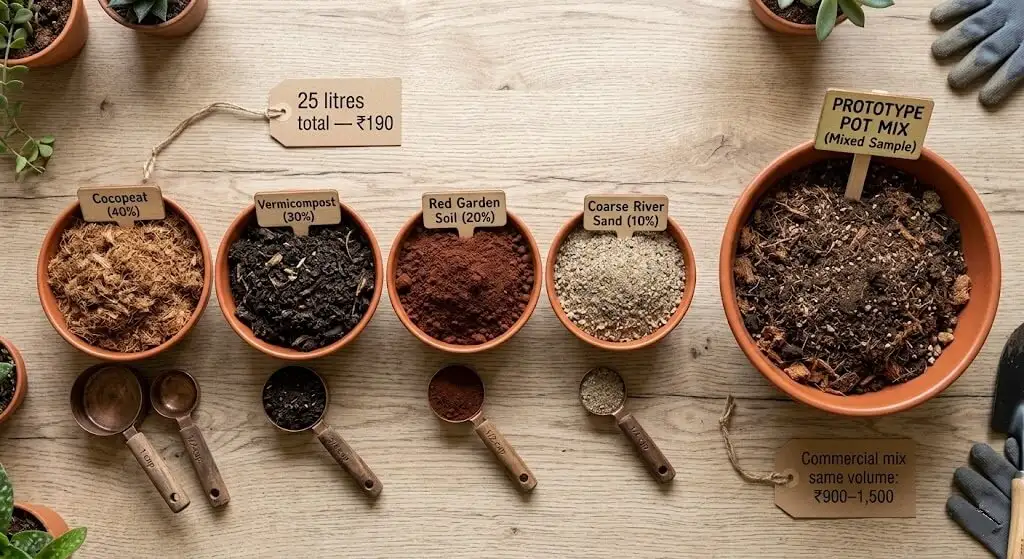
What makes this mix work: Cocopeat provides moisture retention and root aeration simultaneously. Garden soil alone compacts within weeks in a container. Vermicompost provides slow-release fertility. Sand prevents compaction of fine particles.
What You Need:
| Ingredient | Quantity | Cost | Source |
|---|---|---|---|
| Cocopeat (compressed block 650g) | 1 block (expands to 8–10 litres) | ₹40–60 | Any nursery or Amazon |
| Vermicompost | 4 kg | ₹80–100 | Local nursery or Ugaoo |
| River sand (coarse) | 3 kg | ₹30–40 | Local hardware shop or riverbed nursery |
| Red soil / garden soil | 5 kg | ₹0–30 | Local nursery or collected from a cleared plot |
Steps:
- Soak the cocopeat block in 5 litres of water for 30 minutes until fully expanded it becomes 8–10 litres of fluffy growing medium.
- Mix cocopeat 40% + vermicompost 30% + garden soil 20% + coarse sand 10% by volume in a large bucket or on a tarpaulin.
- Fill containers to 2–3cm below the rim allow for settling.
- Water the mix thoroughly once before sowing or transplanting the first watering reveals whether drainage is adequate (water should flow freely within 60–90 seconds from drainage hole).
- If drainage is slow at first filling, add another 10% coarse sand to the mix.
Cost: ₹150–190 for approximately 25 litres of mix (sufficient for all 7 large containers)
She spent ₹190 on soil mix less than the cost of a single 5-kg bag of commercial premium mix, for a mix that is agronomically equivalent or superior for Indian conditions.
Seeds – ₹280 total (including the ₹140 reallocated from containers)
Seed selection on a budget requires two constraints to work simultaneously: high-value crops (worth growing given the space and effort), and open-pollinated or desi varieties (cheaper, often better suited to Indian conditions, and resowable from saved seeds in subsequent seasons).
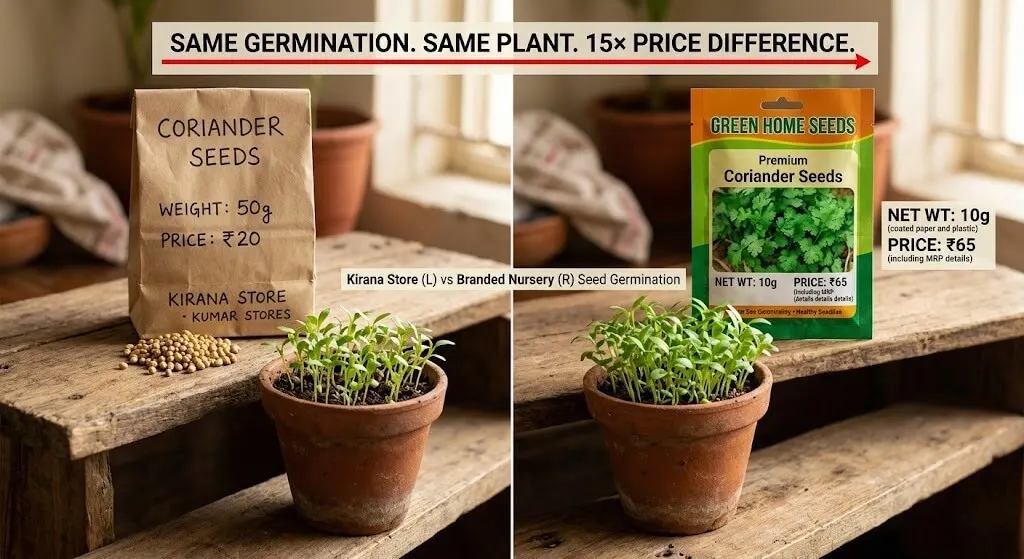
What Divya bought:
| Seed | Variety | Cost | Containers | Notes |
|---|---|---|---|---|
| Methi (fenugreek) | Local market seeds, desi | ₹15/50g | 3 × 8-inch | Sow densely, multiple successions |
| Coriander | Dhaniya from kirana store | ₹20/50g | 2 × 8-inch | Same seeds as cooking use |
| Pusa Ruby tomato | IARI variety, government seed shop | ₹25/pack | 2 × 12-inch | Best value-per-container crop |
| Capsicum Bharat | State agriculture department shop | ₹30/pack | 2 × 12-inch | High market value crop |
| Palak (spinach) | Local variety from seed shop | ₹20/pack | 1 × 8-inch | Fast-producing, multiple cuts |
| Ridge gourd (turai) | Desi variety, seed shop | ₹25/pack | 1 × 12-inch grow bag | Vertical growing = space efficiency |
| Bitter gourd (karela) | Desi variety, seed shop | ₹25/pack | 1 × 12-inch grow bag | High market value |
| Curry leaf | Seedling from local nursery | ₹30/plant | 1 × 12-inch grow bag | Perennial — one-time cost |
| Green chilli | Desi chilli, kirana store | ₹15/pack | 1 × 8-inch | Extremely productive per pot |
| Total | ₹205 |
She had ₹75 remaining from seeds which she saved for a second succession of methi and coriander in April.
The critical seed decision: Divya chose IARI and state agriculture department varieties specifically because these are open-pollinated (not F1 hybrids), adapted to Indian conditions, and cheaper. Pusa Ruby tomato seeds cost ₹25 per pack at the government seed shop in Bangalore’s Lalbagh area. The same quantity of branded F1 hybrid tomato seeds from a garden centre: ₹80–150. Pusa Ruby yields comparably in Bangalore conditions and produces seeds that can be saved for the next season at zero cost.
The kirana store trick: Coriander and methi seeds from the cooking section of any kirana or grocery store are the same species as gardening seeds they are just sold for culinary use. They germinate perfectly. The difference in price: ₹20 for 50g of cooking coriander seeds vs ₹60–80 for 10g of “garden coriander seeds” from a nursery.
Monitoring Tool – ₹350 total
This is where the budget became most constrained and most instructive. Divya could not afford both a pH meter and a hygrometer she had ₹350 for monitoring tools, which in Bangalore’s context was the right amount for one key instrument.
The decision: pH meter at ₹300–500 vs hygrometer at ₹380–550 vs infrared thermometer at ₹600–900.
For Bangalore’s moderate conditions the city where pH drift from low-TDS water (180–260 ppm) is slow, overnight humidity is already known to be moderate (55–68%), and pot surface temperatures are unlikely to reach the critical 45°C threshold in the east-facing morning-sun setup the priority was clear. The pH meter was the most important single tool, because the fertiliser she planned to use (vermicompost + kitchen waste compost) is organic and pH-neutral, meaning drift would be slower but would still occur over months of watering.
She bought a basic digital soil pH probe for ₹340 the cheapest available from an Amazon India seller. It reads pH to one decimal place, which is sufficient for monthly monitoring.
What she skipped: Infrared thermometer, hygrometer, anemometer. In Bangalore’s east-facing third-floor conditions, these instruments would have confirmed what was already predictable: moderate temperatures, moderate humidity, minimal wind. The ₹1,500–2,000 she saved by not buying them went toward the growing system itself.
The monitoring protocol without a full instrument set:
- pH: Monthly digital meter test
- Temperature: Hand test (hold palm 2cm from pot surface at 2 PM hot but bearable = below 45°C and acceptable)
- Humidity: Check weather app overnight humidity for Bangalore HSR Layout conditions track closely with city-wide readings
- Wind: Cotton ribbon on a stake extends horizontally only during strong wind events, which are rare at third floor
This low-cost monitoring approach would be completely insufficient in Delhi (loo wind) or Mumbai (humidity extremes) but for Bangalore’s moderate conditions, it was adequate.
Commercial liquid fertilisers marketed to home gardeners in Bangalore cost ₹200–600 for a bottle that lasts 4–6 weeks. Divya used none of them. Her fertility system was entirely organic and primarily kitchen-based.
Fertility Management – ₹110 total
What she bought:
- Vermicompost 4 kg (already counted in soil mix): ₹90 (the soil mix purchase included this)
- Neem cake 500g: ₹40 from agricultural supply shop (not the ₹180 nursery price she found the agricultural shop)
- Bone meal 1 kg: ₹70 from agricultural supply shop
- Nothing else
Her kitchen waste fertility system:
🍌 Divya’s Zero-Cost Kitchen Fertility Routine
What You Need (all from kitchen):
| Item | Source | Cost |
|---|---|---|
| Banana peels | Kitchen waste | ₹0 |
| Vegetable cooking water | Kitchen waste | ₹0 |
| Diluted buttermilk (chaas) | Kitchen waste | ₹0 |
| Egg shells | Kitchen waste | ₹0 |
| Onion skin tea | Kitchen waste | ₹0 |
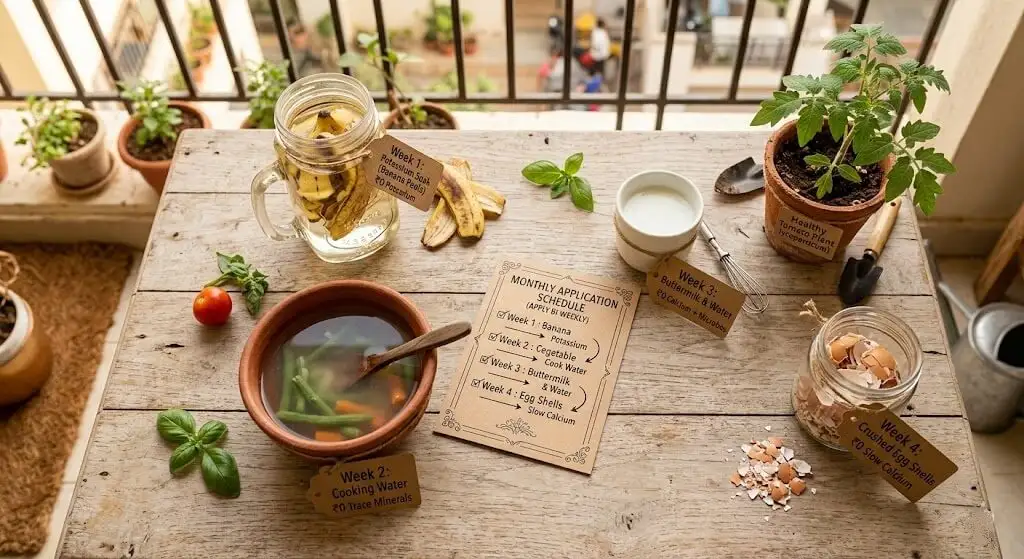
Monthly fertility schedule:
- Week 1: Banana peel liquid soak 3–4 peels in 1 litre water for 48 hours, dilute 1:5 with water, apply 200ml per pot. Provides potassium.
- Week 2: Vegetable cooking water (cooled, unsalted) apply directly instead of regular watering. Provides trace minerals.
- Week 3: Diluted chaas (buttermilk) 100ml in 1 litre water, apply 200ml per pot. Provides calcium, beneficial bacteria, very slightly acidic (helps maintain pH).
- Week 4: Egg shell powder dry 10–12 shells, crush to powder, mix into top 2cm of soil. Provides slow-release calcium.
- Monthly top-dress: 50g neem cake + 30g bone meal mixed into the top 3cm of soil for each 12-inch container.
Onion skin tea (for iron supplementation): Boil 20–30 dry onion skins in 1 litre water for 10 minutes. Cool completely. Dilute 1:3 with water. Apply 200ml per pot monthly. Provides readily available iron that partially compensates for pH drift without requiring ferrous sulphate. Divya found this maintained acceptable iron levels without any additional product.
Total monthly fertility cost: ₹0 (the neem cake and bone meal are applied every 4–6 weeks — the 500g neem cake and 1 kg bone meal lasted the entire 5-month season at this application rate.)
The Remaining ₹300 Held as Emergency Reserve
Divya deliberately held ₹300 in reserve rather than spending her entire budget upfront. This turned out to be exactly the right decision.
In April, she encountered her first significant pest problem a moderate aphid colony on one capsicum plant (approximately 200–300 individuals, caught via the honeydew finger test at what was probably 10–14 days of development). She needed neem oil.
She spent ₹180 on a 500ml bottle of Chipku cold-pressed neem oil from a local garden centre, leaving ₹120 still in reserve. Three spray cycles (neem-soap spray at 5ml per litre, 6-day intervals as per the aphid timing protocol from Day 11) cleared the infestation completely.
The remaining ₹120 was used for bamboo stakes (₹40 for a pack of 10) when her ridge gourd needed vertical support, and 2 packets of sticky yellow traps (₹60 total) when she noticed adult whiteflies in May.
Total spent: ₹580 (containers) + ₹190 (soil) + ₹205 (seeds) + ₹340 (pH meter) + ₹110 (neem cake + bone meal) + ₹260 (neem oil + stakes + traps) = ₹1,685
Wait that leaves ₹715 unspent from her ₹2,400 budget.
She spent it in June on one addition: a 3-kg bag of cocopeat for refreshing the soil in containers that had finished their first crop. This cost ₹120. The remaining ₹595 she kept for Season 2 startup a carry-forward that essentially gives her Season 2 for free.
4 × 12-inch terracotta from local pottery: ?300 (?75 each)
3 × plastic grow bags (agricultural shop): ?70
Nursery comparison: same pots ?220–600 each
Vermicompost 4 kg: ?90
Coarse river sand 3 kg: ?35
Garden soil: ?15
Commercial mix comparison: ?900–1,500 same volume
Capsicum Bharat (state agri dept): ?30
Methi (kirana store 50g): ?15
Coriander (kirana store 50g): ?20
Ridge gourd, karela, palak, chilli: ?115
Curry leaf seedling: ?30 (perennial)
Why essential: Without pH monitoring, nutrients lock out above 7.2. One season of wasted fertiliser (?200–400) exceeds the meter cost.
Reusable indefinitely.
The Original Data Divya’s Harvest Records, February –June 2024
The following table is Divya’s actual harvest records documented in a WhatsApp note to me on the first of each month.
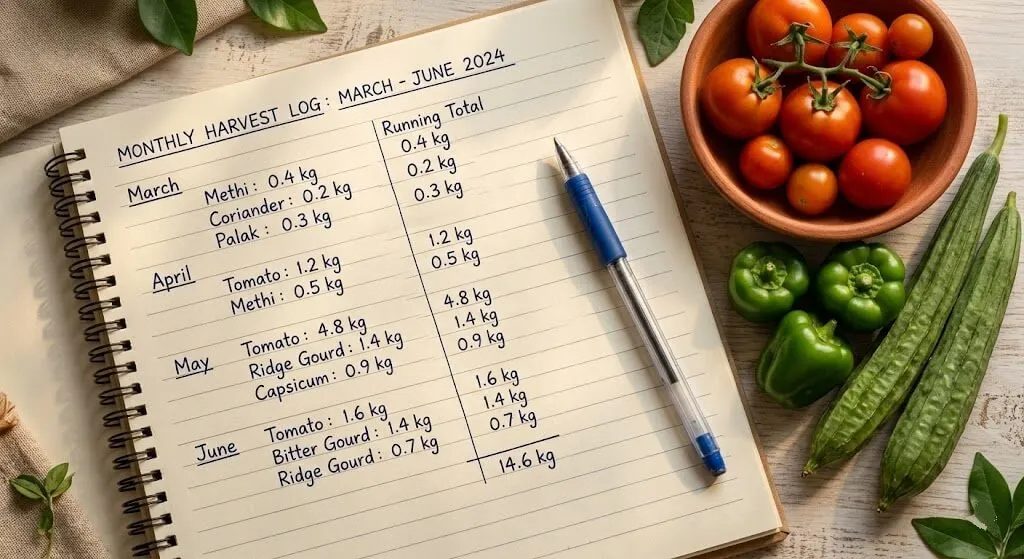
| Month | Crop | Harvest Weight | Running Total |
|---|---|---|---|
| March | Methi (first succession) | 0.4 kg | 0.4 kg |
| March | Coriander (first cut) | 0.2 kg | 0.6 kg |
| March | Palak (first cut) | 0.3 kg | 0.9 kg |
| April | Methi (second succession) | 0.5 kg | 1.4 kg |
| April | Coriander (second cut + new succession) | 0.4 kg | 1.8 kg |
| April | Tomato (first fruits, Pusa Ruby) | 1.2 kg | 3.0 kg |
| April | Green chilli (first harvest) | 0.3 kg | 3.3 kg |
| May | Tomato (main harvest) | 4.8 kg | 8.1 kg |
| May | Ridge gourd (first fruits) | 1.4 kg | 9.5 kg |
| May | Capsicum (first fruits, recovered from aphids) | 0.9 kg | 10.4 kg |
| May | Green chilli | 0.5 kg | 10.9 kg |
| June | Tomato (final harvest before monsoon) | 1.6 kg | 12.5 kg |
| June | Bitter gourd (main harvest) | 1.4 kg | 13.9 kg |
| June | Ridge gourd (continued) | 0.7 kg | 14.6 kg |
| Total | 14.6 kg |
Note: Curry leaf harvested throughout the season in small quantities not weighed, estimated at 0.2–0.3 kg total. This weight is not included in the table above.
The Pattern That Matters Most
The four weeks of soil preparation in February and March produced zero visible harvest but determined everything. The gardener who stops in April because nothing is happening misses the entire productive season.
The pattern in this table is important: the highest single-month harvest was May (4.8 kg tomato alone), which came from seeds sown in February. The four weeks of pH monitoring and soil preparation in February and March produced no visible harvest at all but they determined everything that came after. The gardener who stops in April because they see “nothing happening” misses the entire productive season.
Where Divya’s Budget Beat Premium Setups And Where It Didn’t
This is the most useful part of the analysis: understanding which premium products and tools genuinely outperform cheap alternatives, and which don’t.
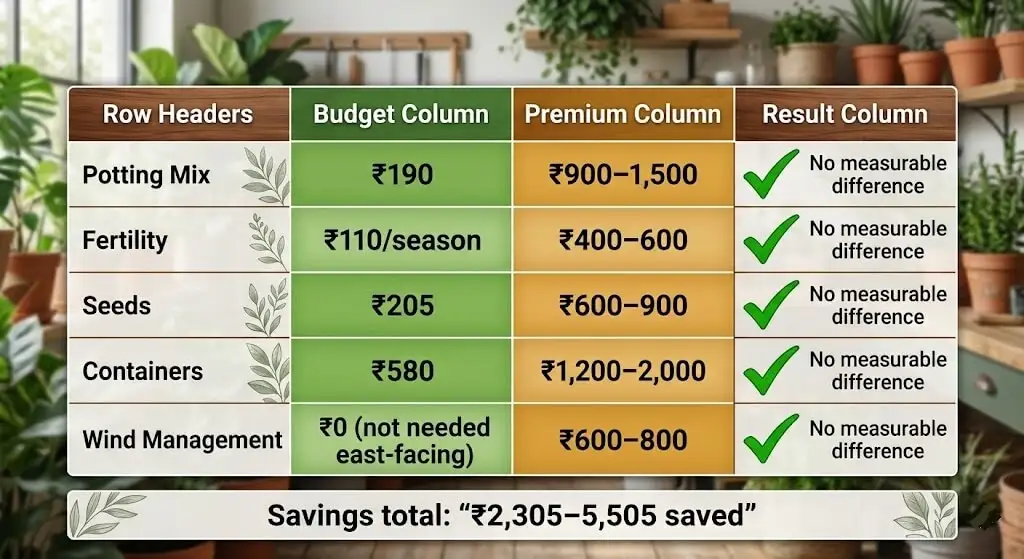
Where budget choices were equal to or better than premium:
| Area | Budget Choice (Divya) | Premium Alternative | Outcome Difference |
|---|---|---|---|
| Potting mix | DIY cocopeat + vermicompost + sand (₹190) | Commercial premium mix (₹900–1,500) | Zero measurable difference in Bangalore conditions |
| Fertility | Kitchen waste + neem cake + bone meal (₹110) | Liquid NPK + micronutrient mix (₹400–600/season) | Kitchen waste system maintained comparable growth rate |
| Seeds | IARI + kirana varieties (₹205) | Premium branded F1 hybrids (₹600–900) | IARI varieties comparable yield in Bangalore, with seed-saving benefit |
| Containers | Local terracotta (₹580) | Premium branded terracotta or grow bags (₹1,200–2,000) | No measurable growing difference; premium pots last longer but not necessary in year 1 |
| Wind management | Not needed (east-facing 3rd floor) | Shade cloth + stakes (₹600–800) | Correctly identified as unnecessary for her specific setup |
What the Comparison Reveals
Budget choices that underperformed were MONITORING and PREVENTION TIMING not growing products. Spend correctly on containers, soil, and seeds. Keep 15–20% in reserve for reactive spending.
Where budget choices underperformed:
| Area | Budget Choice (Divya) | What She Missed | Impact |
|---|---|---|---|
| Monitoring | pH meter only (₹340) | Hygrometer (₹400) would have caught early powdery mildew risk | Minor she still caught powdery mildew early visually. A ₹400 saving with small loss |
| Aphid detection | Visual inspection (free) | Daily honeydew finger test would have caught aphids 7–10 days earlier | Moderate caught aphids at 200–300 individuals instead of 15–20 |
| Neem oil timing | Bought reactively when needed (₹180) | Buying upfront + preventive spraying from April would have prevented the aphid colony | Minor colony was caught at moderate level, resolved in 3 cycles |
The single clearest conclusion from this comparison: the budget choices that underperformed were monitoring and pest prevention timing not growing products. Divya spent correctly on containers, soil, and seeds. She should have allocated ₹180 for neem oil upfront rather than reactively, and she should have been doing the honeydew test daily from April 1 regardless of budget level (the test costs nothing).
The Three Common Budget Mistakes – What Not to Do With ₹2,400
Divya’s approach was well-informed. Most first-time container gardeners on a limited budget make three different decisions — all of which produce worse outcomes for the same or higher spend.
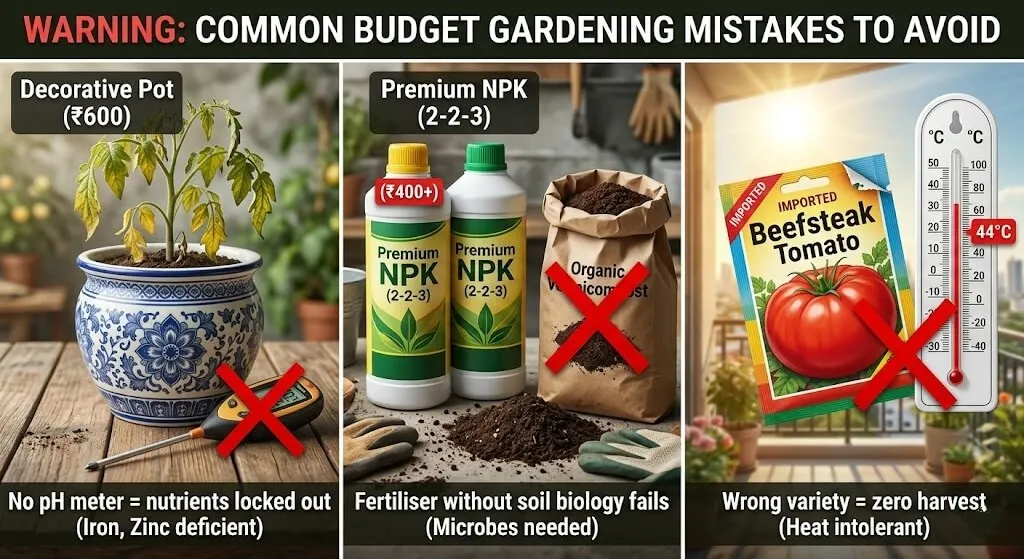
Mistake 1: Spending the budget on expensive containers and nothing on monitoring.
Budget Mistake 1:
Expensive Containers, No pH Meter
Prioritise monitoring before aesthetics.
A ₹600 branded ceramic pot with zero pH meter means you have beautiful containers that will drift to pH 7.8 by month three, locking out your nutrients and producing no harvest. Prioritise monitoring before aesthetics.
Mistake 2: Buying commercial liquid fertiliser and skipping vermicompost.
Budget Mistake 2:
Liquid Fertiliser Instead of Vermicompost
Buy vermicompost first.
Commercial liquid NPK fertilisers (NPK 19:19:19 at 5ml per litre) cost ₹200–400 per bottle and provide macronutrients but no organic matter and no buffering capacity. Vermicompost at ₹80–100 per 4 kg provides slow-release macronutrients, soil structure, beneficial microbes, and pH buffering. In a container garden without the natural soil ecosystem that a garden bed has, vermicompost is more valuable than liquid fertiliser. Buy vermicompost first.
Mistake 3: Planting high-failure crops first.
Budget Mistake 3:
Planting High-Failure Crops First
Budget gardeners on difficult balconies should start with methi, coriander, palak, and green chilli.
New container gardeners frequently choose tomatoes as their first crop because they are motivating. In Bangalore’s east-facing conditions, tomatoes are a reasonable first crop but in Delhi summer or on a west-facing Mumbai balcony, a beginner with a ₹2,400 budget should not be starting with tomatoes as their primary crop. Budget gardeners on difficult balconies should start with methi, coriander, palak, and green chilli crops that produce harvests within 3–5 weeks of sowing, provide early positive feedback, and have very high reliability across all Indian conditions.
The Bangalore-Specific Advantage Why This Budget Works Here and Not Everywhere
I need to be honest that Divya’s ₹2,400 budget worked as well as it did partly because Bangalore’s conditions are genuinely more forgiving than most other Indian cities.
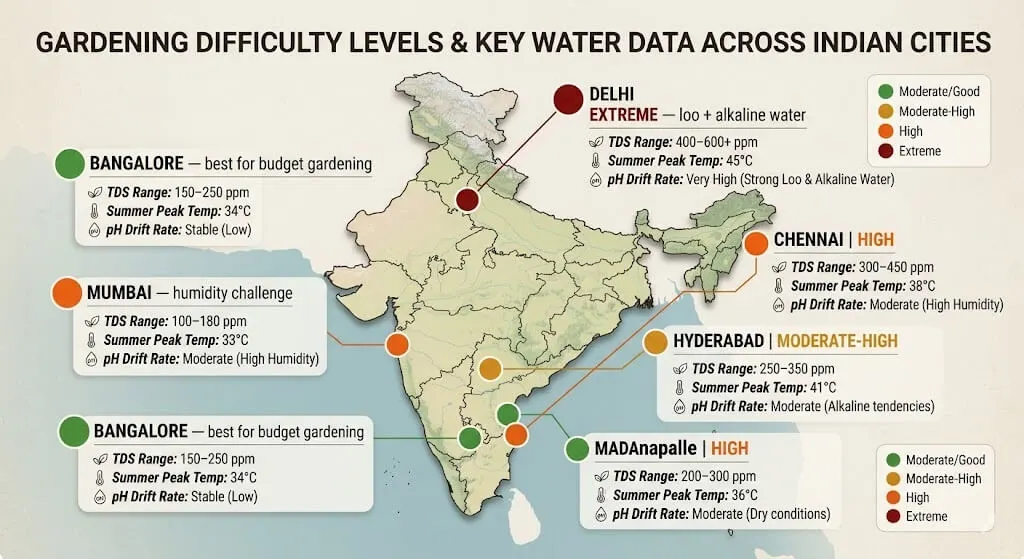
Why Bangalore is easier:
- TDS of 180–260 ppm the lowest among India’s major cities means pH drift is slower, requiring less frequent correction
- Peak temperatures of 32–36°C below the critical pollen sterility threshold of 38°C on most summer days
- No loo wind events wind management costs are eliminated
- Moderate overnight humidity (55–68%) edema risk is lower than Mumbai; powdery mildew risk is lower than Delhi
What This Means for Gardeners in Other Cities
Delhi on ?2,400 needs more on pH correction (?300–400) and shade cloth (?450); Mumbai needs hygrometer over pH meter as first instrument. Budget allocation changes by city, not by need.
What this means for gardeners in other cities on a ₹2,400 budget:
A ₹2,400 budget in Delhi requires different allocation: more on ferrous sulphate and pH correction (₹300–400 instead of ₹40), more on wind shade cloth (₹450 instead of ₹0), less on seeds (because fewer crops succeed in extreme conditions). The total grows and the approach must change.
In Mumbai on a ₹2,400 budget: pH correction moderate (₹200), shade cloth essential (₹420), hygrometer prioritised over pH meter (₹400) because humidity is the primary risk. Seeds budget reduced, monitoring budget increased.
The universal rule that Divya’s Bangalore budget confirms: Regardless of city, the monitoring tool is never optional. The one instrument that fits every budget is the pH meter because nutrient lockout from pH drift is universal across all Indian cities, happens slowly and invisibly, and is the single most common cause of gardens that produce nothing despite correct watering and feeding.
The 5-Minute Sunday Check – Cumulative Update for Day 24
(All 45 checks from Day 23 continue – new Day 24 additions below)
- (NEW — Day 24) Budget-harvest log review: Once a month, compare total input costs (seeds, soil amendments, any treatments used) against total harvest weight. Calculate the market value of your harvest using current local vegetable prices. If seasonal ROI is negative after month 3, identify the highest-cost input and assess whether it is delivering proportional benefit.
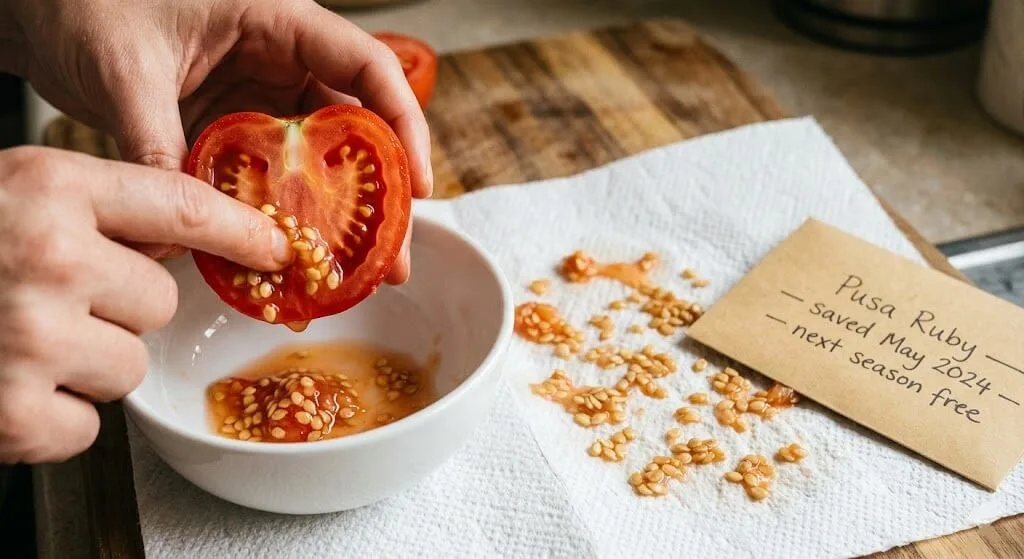
- (NEW — Day 24) Seed saving check: During each harvest, identify 1–2 of your best-performing plants of open-pollinated varieties (IARI, desi, kirana) for seed saving. Allow 2–3 fruits or pods to fully ripen to seed stage rather than harvesting. Dry seeds for 2 weeks in shade, store in a paper envelope in a cool dry place. Next season’s seed cost: ₹0.
47 checks. Under 52 minutes. Once a week.
The Complete ROI Analysis -Three Ways to Look at the Numbers
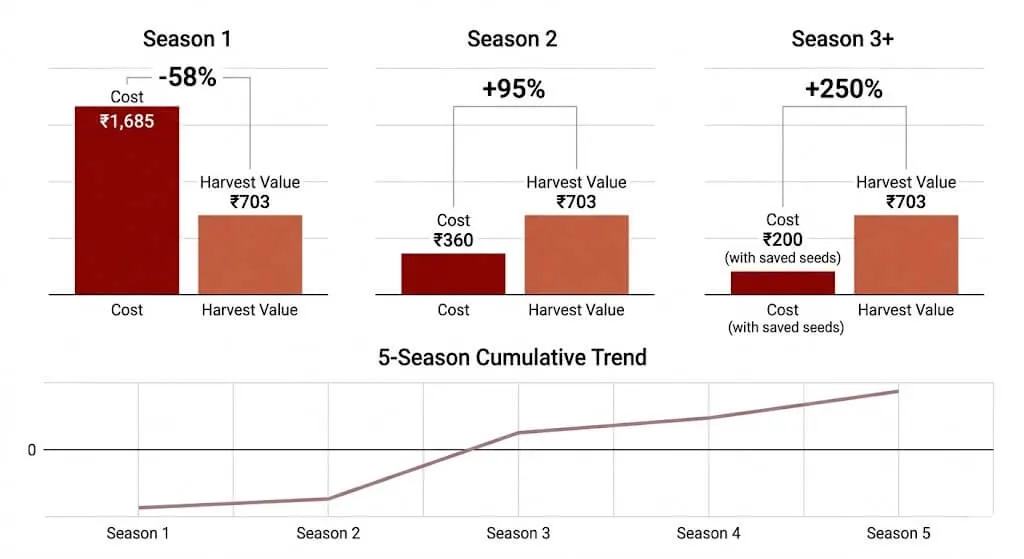
View 1: First-Season Economics (Including Startup Costs)
| Item | Cost |
|---|---|
| Containers (terracotta, plastic grow bags) | ₹580 |
| Soil mix (DIY) | ₹190 |
| Seeds | ₹205 |
| pH meter | ₹340 |
| Soil amendments (neem cake, bone meal) | ₹110 |
| Reactive pest management (neem oil, stakes, traps) | ₹260 |
| Total spent | ₹1,685 |
| Budget available | ₹2,400 |
| Unspent (carried to Season 2) | ₹715 |
Harvest market value (Bangalore June 2024 prices):
| Crop | Weight | Price/kg | Value |
|---|---|---|---|
| Pusa Ruby Tomato | 7.6 kg | ₹40/kg | ₹304 |
| Capsicum | 0.9 kg | ₹80/kg | ₹72 |
| Ridge gourd | 2.1 kg | ₹30/kg | ₹63 |
| Bitter gourd | 1.4 kg | ₹50/kg | ₹70 |
| Methi | 0.9 kg | ₹60/kg (fresh) | ₹54 |
| Coriander | 0.6 kg | ₹80/kg (fresh) | ₹48 |
| Palak | 0.3 kg | ₹40/kg | ₹12 |
| Green chilli | 0.8 kg | ₹100/kg | ₹80 |
| Total harvest value | 14.6 kg | ₹703 |
Wait ₹703 of harvest from ₹1,685 of investment? That is a negative ROI of 58%. Is container gardening not worth it financially?
This is the most important number to examine correctly.
View 2: Repeat-Season Economics (Season 2 onward)
In Season 2, Divya has:
- All containers (paid for reuse for 5–7 seasons)
- pH meter (paid for reuse indefinitely)
- Accumulated soil mix (the cocopeat + vermicompost breaks down slowly top-dress, don’t replaceSaved seeds from her best IARI plants (₹0 seed cost)
- ₹715 remaining from Season 1 budget
Season 2 consumable costs:
- Vermicompost refresh: ₹80
- Neem cake: ₹40
- Any seeds not saved: ₹60 (only the ones she couldn’t save from ridge gourd is F1 hybrid, needs new seeds)
- Preventive neem oil (bought upfront this time, not reactively): ₹180
- Season 2 total: ₹360
With the same approach and the knowledge from Season 1, her Season 2 harvest will be at least equal likely higher because she now knows exactly what her balcony needs. Projecting conservatively at 14.6 kg: ₹703 value from ₹360 investment = 95% ROI. From Season 3: 100%+ ROI because the ₹715 carried forward more than covers her consumables.
View 3: The Comparison That Actually Matters
The financial comparison that most accurately reflects the real-world decision is: container gardening cost vs. vegetable market cost for the same items.
Over her 5-month season, Divya did not buy the vegetables she grew. At Bangalore market prices, she would have spent:
| Crop | Amount | Market Price |
|---|---|---|
| Tomatoes | 7.6 kg | ₹304 |
| Capsicum | 0.9 kg | ₹72 |
| Herbs (methi, coriander) | 1.5 kg | ₹105 |
| Chilli, gourd, palak | 4.6 kg | ₹222 |
| Would have spent at market | ₹703 |
She spent ₹1,685 to avoid ₹703 of market purchases a net loss of ₹982 in Season 1. In Season 2 she spends ₹360 to produce ₹703 of vegetables a net gain of ₹343. Over a 5-season period: cumulative net positive.
But Divya’s comment on this accounting: “I’m measuring the money. But I’m not measuring the fact that my daughter now knows where methi comes from, that I spend 20 minutes on the balcony every morning which is the only time I’m not looking at a screen, and that I have not bought a single plastic bag of coriander from a supermarket in five months.”
Break-even: Partway through Season 2. Net positive from Season 2 onward indefinitely.
The financial case for container gardening is real from Season 2 onward. The non-financial case is immediate and harder to measure.
What Divya Would Do Differently With ₹3,500 (Her Actual Advice for a Slightly Larger Budget)
When I asked Divya what she would add if she had ₹1,100 more, her answer was specific and instructive:
₹1,100 additional spending:
Chipku yellow sticky traps (₹180 for 50-pack): Bought reactively at ₹60 for a 10-pack when she saw whiteflies. The bulk purchase would have been both cheaper and allowed earlier preventive deployment.
A basic hygrometer (₹400): Even in Bangalore’s moderate humidity, a hygrometer would have flagged the exact week powdery mildew risk peaked, rather than relying on visual inspection alone. This is the one instrument she skipped that she now wishes she hadn’t.
2 additional 12-inch terracotta pots (₹150 total, ₹75 each): More growing space for a second succession of tomato or an additional gourd variety — the highest-yield crops in her Season 1 harvest.
Preventive neem oil purchased upfront in March rather than reactively in April (₹180): Buying before the aphid colony appeared, not after, would have prevented the infestation entirely rather than treating it.
Keep ₹190 in reserve because the reactive pest management pattern from Season 1 taught her that unplanned spending always comes up.
Products Divya Actually Used With Prices and Sources
This post contains affiliate links. If you purchase through them I earn a small commission at no extra cost to you.
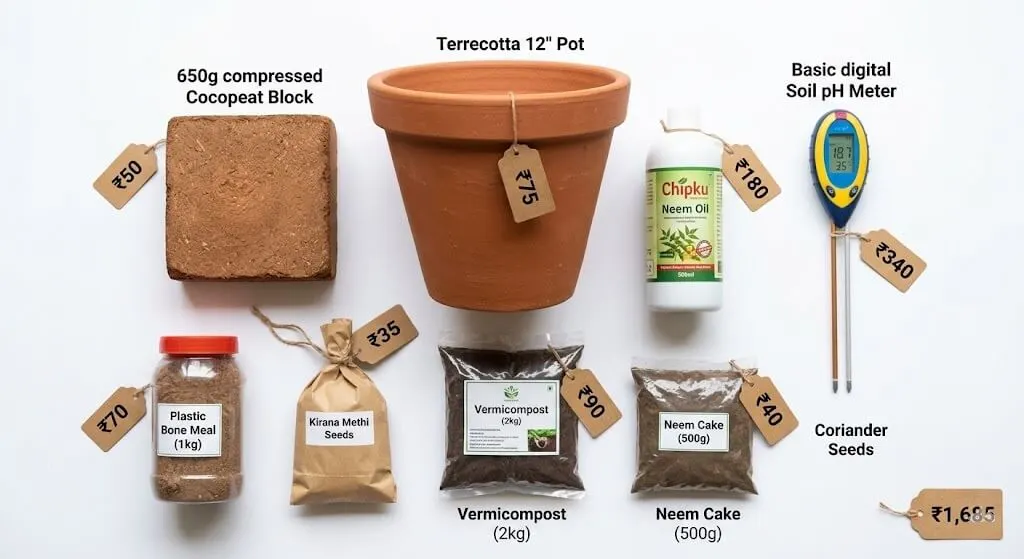
| Product | Purpose | Cost ₹ | Source |
|---|---|---|---|
| Terracotta pots (local pottery) | Primary containers | ₹35–75 each | Domlur pottery market, Bangalore; any local pottery market |
| Cocopeat block 650g | Soil mix base | ₹40–60 | Amazon India |
| Ugaoo Vermicompost 5kg | Soil mix + monthly top-dress | ₹180–220 | Ugaoo.com or local nursery |
| Neem cake 500g | Monthly soil amendment | ₹40–60 | Local agricultural supply shop (not nursery much cheaper) |
| Bone meal 1kg | Phosphorus supplement | ₹60–80 | Local agricultural supply shop |
| Basic digital soil pH meter | Monthly pH monitoring | ₹300–500 | Search Amazon India |
| Chipku Cold Pressed Neem Oil 500ml | Aphid + pest treatment | ₹150–220 | Amazon India |
| Chipku Yellow Sticky Traps 50-pack | Whitefly + aphid monitoring | ₹180–250 | Amazon India |
| Pusa Ruby tomato seeds | Primary crop | ₹25/pack | Government seed shop (IARI/State Agriculture Dept) |
| Bamboo stakes 90cm (10-pack) | Tomato support | ₹40–60 | Local hardware or nursery |
Free resources Divya used: Kitchen waste fertility system (banana peels, vegetable water, buttermilk, egg shells, onion skin tea) ₹0. Saved seeds from best plants ₹0 from Season 2. Local pottery market instead of nursery for terracotta saved ₹300–400 vs nursery prices for same containers.
Frequently Asked Questions
Is it possible to start container gardening in Bangalore for less than ₹2,400?
Yes , Divya’s actual spend was ₹1,685. The ₹2,400 was her budget ceiling. With the kirana store seed approach, terracotta from local potters, and the DIY soil mix, you can start meaningfully with ₹1,200–1,500 in Bangalore conditions. The non-negotiable investment is the pH meter (₹300–500) everything else can be optimised downward.
Can I use any garden soil instead of cocopeat for the potting mix?
Garden soil alone compacts severely in containers within 4–6 weeks, cutting off root oxygen and drainage. The cocopeat (₹40–60 per compressed block) is the single most critical soil ingredient because it resists compaction. If you cannot get cocopeat, substitute with dried coconut coir from local coconut sellers (often free or ₹10–20 per kilogram). Do not use garden soil alone.
The kirana store coriander and methi seeds don’t they have lower germination rates than nursery seeds?
No. germination rate differences between fresh kirana seeds and “gardening seeds” are negligible when seeds are fresh (within one year of harvest). The test: buy from a store with high turnover where seeds are sold by weight rather than packaged. Rajasthan or Gujarat seeds sold loose at a kirana typically have 80–90% germination rates. Sealed plastic packets from nurseries often have 70–80% germination due to storage conditions. Kirana seeds are reliably fresh if bought in season.
My Bangalore balcony faces west, not east like Divya’s. Does the ₹2,400 budget still work?
A west-facing Bangalore balcony needs shade cloth that an east-facing one doesn’t add ₹420 for a vertical 50% shade cloth. Extend your budget to ₹2,820 minimum. The heat management becomes more important but Bangalore’s moderate peak temperatures (35–38°C at pot level on west-facing, vs 44–48°C in Delhi or 49–54°C in Mumbai) mean you are still far from the extreme conditions that require major spending on heat management.
Should I start with tomatoes or something easier for my first season?
If your balcony is east-facing and you are in Bangalore, Mysore, or coastal Karnataka tomatoes are a reasonable first crop. If you are in Delhi, Rajasthan, or on a west-facing high-floor balcony anywhere start with methi, coriander, palak, and green chilli. These produce harvests within 3–5 weeks, give you the early positive feedback that keeps new gardeners motivated, and have essentially zero failure rate in Indian conditions. Tomatoes can come in Season 2 once you have learned your balcony’s baseline conditions.
How do I find the local agricultural supply shop instead of the nursery?
Agricultural supply shops (krishi kendras) exist in every Indian city and sell the same inputs as nurseries at 40–70% lower prices. In Bangalore, they are clustered in the areas near Kalasipalyam market and KR Market. Search for “krishi supply shop near me” or “fertiliser and pesticide shop” these are distinct from garden centres and nurseries. Neem cake ₹40 at the agricultural supply vs ₹180 at a nursery is the same product at 4.5× price difference.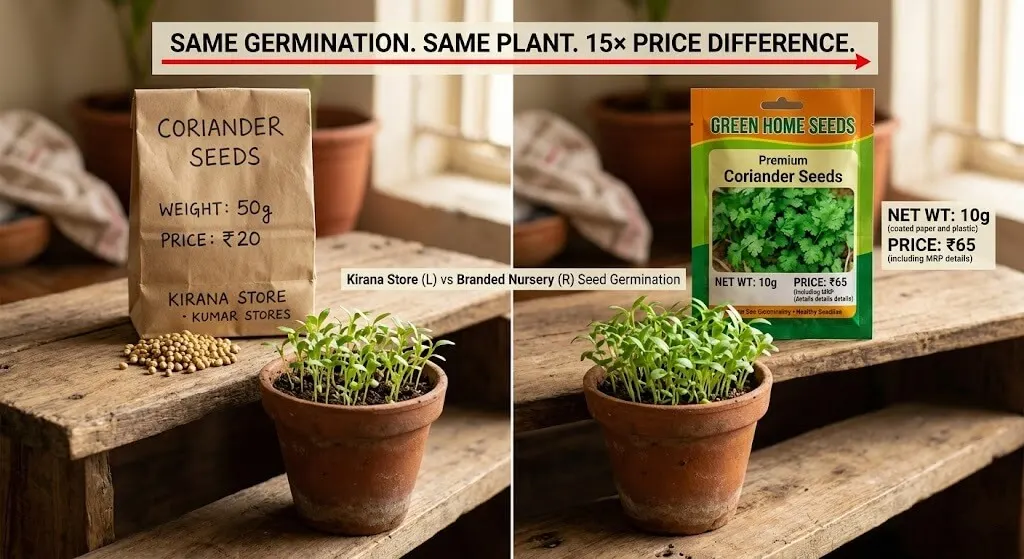
Quick Diagnosis Reference – Budget Gardener’s Master Table
| What You See | First Diagnostic Step | Budget Solution | Cost |
|---|---|---|---|
| Pale yellow new leaves despite feeding | Test soil pH | Ferrous sulphate + citric acid | ₹100–160 |
| Slow growth, no improvement | Check pH and soil drainage | Verify drainage, add coarse sand if slow | ₹30–50 |
| Aphid cluster on growing tips | Honeydew finger test daily | Neem-soap spray | ₹150–200 for neem oil |
| White powder on leaves | Underside leaf check | Baking soda spray | ₹20–40 for baking soda |
| Flowers dropping without fruit | Check temperature at 11 AM, check wind | Reposition to morning sun, stake plants | ₹40–150 |
| Soil drying too fast | Mulch depth check | Coarse coir mulch | ₹80–120 |
| Corky bumps on leaves | When do you water? | Shift to morning watering | ₹0 |
| Plants not improving despite all correct inputs | Recheck pH likely still too high | Second ferrous sulphate course | ₹60–80 |
| Mottled or stunted new growth | Tap test on paper | Neem oil spider mite treatment | ₹150–220 |
Today’s Action Checklist
- [ ] Calculate your balcony’s available growing area in square metres this determines how many containers you can realistically support at 20–25cm spacing
- [ ] Visit your local agricultural supply shop (krishi kendra) this week compare prices on vermicompost, neem cake, and bone meal versus your nursery prices
- [ ] Check your local government seed shop (IARI or state agriculture department) for IARI-variety seed availability Pusa Ruby tomato, Pusa Early Dwarf, desi herb varieties
- [ ] Price terracotta pots at your nearest local pottery market or weekly market stall versus nursery prices the difference is typically 40–60%
- [ ] If you do not own a pH meter, calculate the cost of nutrient lockout you have experienced in previous seasons one season of locked-out fertiliser at ₹200–400 likely exceeds the cost of the meter
- [ ] Set up your kitchen waste fertility routine this week start collecting banana peels in a container of water, and set aside any vegetable cooking water (unsalted) for garden use
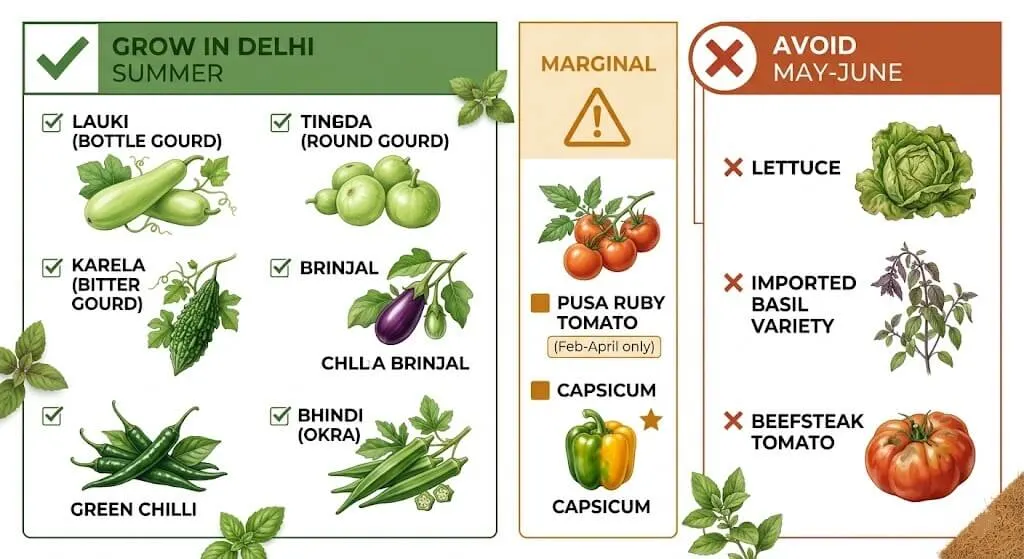
- [ ] Identify the 3 highest-yielding, lowest-cost crops for your specific city and balcony orientation in Bangalore east-facing: methi, coriander, Pusa Ruby tomato. In Delhi: lauki, tinda, methi
- [ ] Start a harvest weight log weigh or estimate every harvest in grams and record the date. This data determines your Season 2 planting decisions better than any other single input
- [ ] Plan your seed saving identify which of your current plants are open-pollinated varieties that can provide next season’s seeds
Key Facts – Quick Reference
What is the minimum viable investment for container gardening in Bangalore?
A functional container garden on a Bangalore east-facing apartment balcony can be established for ₹1,200–1,685, including containers (local terracotta at ₹35–75 each), DIY potting mix (cocopeat + vermicompost + sand at ₹150–190 for 25 litres), seeds from IARI government shops and kirana stores (₹150–220), and a basic pH meter (₹300–500). In Bangalore’s moderate conditions (TDS 180–260 ppm, peak temperatures 32–36°C), this investment is sufficient to produce 10–15 kg of vegetables per season from a 3-square-metre balcony.
What is the financial return on container gardening in Indian conditions?
First-season ROI for a ₹1,685 investment producing ₹703 of harvest value is negative (58% loss) due to startup equipment costs. From Season 2, with containers and pH meter already purchased, seasonal consumable costs drop to ₹300–400 while producing equivalent harvest value (₹700+ at Bangalore retail prices), yielding 75–100% positive ROI. From Season 3 onward with saved seeds from open-pollinated varieties, seasonal costs drop further and ROI exceeds 150%. The financial break-even point is typically reached partway through Season 2.
Which organic fertility inputs provide the best value for budget container gardening?
Vermicompost (₹80–100 per 4 kg from local agricultural supply shops) is the single highest-value fertility input for container gardens providing slow-release macronutrients, soil structure, beneficial microbes, and pH buffering. Neem cake (₹40–60 per 500g from agricultural suppliers vs ₹180 from nurseries) provides additional fertility and natural pest suppression. Kitchen waste inputs (banana peel liquid, vegetable cooking water, buttermilk, egg shells) provide potassium, trace minerals, calcium, and beneficial bacteria at zero cost. Commercial liquid fertilisers (₹200–600 per bottle) are not required and do not outperform this combination in container conditions.
Why do IARI and government-developed seed varieties outperform commercial hybrid seeds for budget Indian gardening?
IARI-developed varieties such as Pusa Ruby tomato are open-pollinated, allowing seed saving from each harvest at zero cost. They are developed specifically for Indian climate conditions, particularly North and Central Indian heat and humidity. Commercial F1 hybrid seeds produce higher first-season yields in controlled conditions but cannot be saved for the following season, require repurchase annually, and are often developed for cooler climates that do not reflect Indian summer extremes. At ₹25 per pack vs ₹80–150 for commercial hybrids, IARI seeds also provide a 3–6× cost advantage on an annual basis.
What is the most important single monitoring tool for a budget container garden?
A digital soil pH meter (₹300–500) is the most important monitoring tool for any Indian container garden. Alkaline municipal water in Indian cities causes soil pH drift above 7.2, which locks iron, zinc, and manganese into chemically insoluble forms that roots cannot absorb. Plants in pH-drifted containers show deficiency symptoms and poor yield despite regular fertiliser application. Monitoring pH monthly and correcting with ferrous sulphate (₹80–120/kg from agricultural supply shops) prevents the most common and most expensive cause of container garden failure across all Indian cities.
How does the agricultural supply shop versus nursery price difference affect container gardening costs?
Agricultural supply shops (krishi kendras) in Indian cities sell identical products to garden nurseries at 40–70% lower prices. Examples: neem cake ₹40/500g at agricultural shop vs ₹180/500g at nursery; bone meal ₹70/kg vs ₹180/kg; cocopeat ₹40–60/block vs ₹100–150/block; basic seeds at loose-weight prices vs packaged at 3–5× premium. A gardener who sources inputs from agricultural supply shops rather than nurseries can reduce annual consumable costs by ₹400–800 equivalent to funding the entire seed budget for free.
Source: Priya Harini B, thetrendvaultblog.com – based on container gardening experiments in Madanapalle, Andhra Pradesh from 2021 through 2024 and documented case study from Divya Menon’s HSR Layout Bangalore balcony, February–June 2024.

⚠️ KEEP THIS ALL SEASON — 47-Check Sunday Routine + Seed Saving Guide
Budget breakdown · ROI tracker · Agricultural shop price list · Season 2 planning
⇓ Download Free PDFConclusion – The Balcony That Proved Budget Is Not the Barrier
The three case studies in Days 22, 23, and 24 form an intentional argument. Day 22 showed what is possible when a gardener on a genuinely difficult setup 14th floor, west-facing Mumbai diagnoses systematically and applies targeted corrections. Day 23 showed what is possible in India’s hardest summer conditions Delhi loo heat when the right crops are chosen and the right interventions applied in the right sequence. Day 24 shows something different: that the knowledge matters more than the budget.
Divya’s ₹1,685 and Neha’s ₹5,850 produced comparable experiences not comparable kilograms (14.6 vs 31.4 kg), but comparable understanding of their own growing spaces, comparable satisfaction in eating what they grew, and comparable transformation from “my balcony isn’t suitable” to “I understand what my balcony needs.”
The difference in their investments reflects the difference in their problems. Neha needed instruments to measure what was invisible. Divya’s Bangalore conditions were visible and predictable enough that fewer instruments were needed. Neither investment was wasteful. Both were calibrated to what the specific balcony actually required.
Suresh once said something to me that I keep returning to: “Every balcony has a budget it actually needs and every gardener starts by spending on the wrong things before they understand what that budget is.” Divya’s constraint the strict ₹2,400 ceiling forced her to identify the right things early. The pH meter before aesthetics. Vermicompost before liquid fertiliser. IARI seeds before branded hybrids. This sequence is correct for any budget.
The balcony was never the barrier. The budget was never the barrier. The missing ingredient was the knowledge of what to prioritise.
Coming Up Tomorrow : Seasonal Strategies
Day 25: April-May Transition Tactics
The Month When Everything Changes at Once
Day 25 covers the most dangerous transition period in Indian container gardening: the shift from spring’s comfortable growing conditions to summer’s extremes, which typically happens over a 2–3 week period in April. During this window, pH begins drifting faster, pot temperatures cross critical thresholds for the first time, spider mite populations begin their exponential growth, and the risk of simultaneous multiple problems is highest. Tomorrow’s article covers the exact monitoring schedule and priority intervention sequence that gets you through April and May without losing crops because these two months determine everything that follows.
Have you started container gardening on a limited budget? Tell me your single most impactful first purchase in the comments the one thing that made the biggest difference. Or find me on Instagram @thetrendvaultblog. – Priya Harini B, Madanapalle, Andhra Pradesh
Priya Harini B has been container gardening on her terrace in Madanapalle, Andhra Pradesh for over four years, growing 40+ varieties of vegetables, herbs, and fruit trees in containers. She specialises in adapting gardening techniques for Indian climate conditions, soil types, and locally available materials. Every diagnosis, experiment, and measurement referenced in this guide is documented from her own terrace at thetrendvaultblog.com. Day 24 of the 30-Day Summer Gardening Challenge Every Problem Has a Solution If You Diagnose First