
By Priya Harini B | Madanapalle, Andhra Pradesh | 4+ Years Container Gardening Experience
Day 22 of the 30-Day Summer Gardening Challenge — Every Problem Has a Solution If You Diagnose First
Quick Answer: Never refrigerate ripe tomatoes, capsicum, or brinjal cold below 12°C (tomato), 7°C (capsicum), or 10°C (brinjal) permanently kills the enzymes responsible for flavour, and it can’t be reversed by warming them back up. Store these on the counter instead. Herbs are the opposite: methi, coriander, and palak need the fridge, but in a water glass with stems submerged never a sealed dry bag, which triggers yellowing within hours.
Table of Contents
Introduction:
If you have been following this series from Day 1, you have learned how to diagnose wilting, understand salt buildup, manage heat stress, fix root rot, defeat spider mites and whiteflies, handle blossom end rot, prevent bolting, protect fruit from sunscald, and keep cats out of your pots. Twenty-one individual problems, twenty-one diagnoses, twenty-one solutions.
But there is a question I have been receiving every week since this series started, and it comes in different forms but always means the same thing: “Priya, does all this actually work in the real conditions of my city? My balcony is not your Madanapalle terrace. I live on the fourteenth floor in Mumbai. The heat is different. The wind is different. The space is different. Does any of this apply to me?”
Today’s answer is yes – and I am going to prove it through one of the most detailed gardening stories I have encountered outside my own terrace. Neha Sharma from Mumbai Balcony Container Garden 31kg Harvest in Summer on the fourteenth floor of a residential tower in Kandivali West.
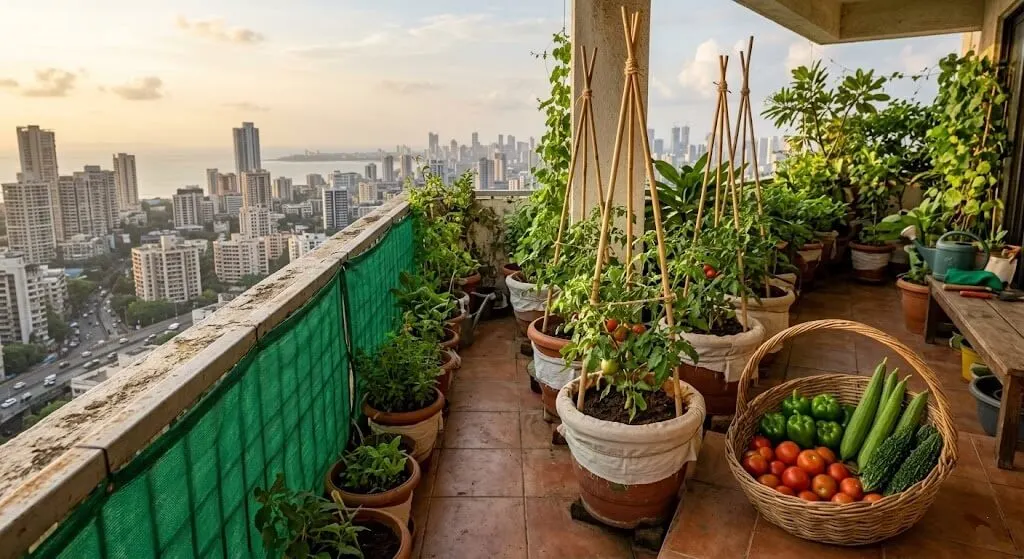
Her west-facing balcony measures 4.2 metres wide and 1.8 metres deep a total of 7.56 square metres of usable space, which is smaller than many Indian bathrooms. In the summer of 2024, that balcony produced 31.4 kilograms of tomatoes, capsicum, ridge gourd, bitter gourd, methi, coriander, curry leaf, and green chilli across five months. Ambient temperatures in Mumbai touched 40°C that May. Her balcony’s west-facing concrete wall radiated at 47–51°C from 2 PM onward.
She did not have exceptional conditions. She had exceptional diagnosis.
This guide follows Neha’s complete 2024 season every problem she encountered, every wrong diagnosis she initially made, every correction she applied, and every specific measurement that told her which direction to go. The reason I am telling her story in such detail is that the problems she faced are the same ones you have been reading about for twenty-one days. This is what applying all of them to one real season looks like.
🌿 FREE DOWNLOAD — Mumbai Balcony Case Study Cheat Sheet
3-page printable guide: 4-problem diagnosis system, correction protocols, harvest data, cost breakdown
Download Free PDF →What the Mumbai High-Rise Balcony Actually Does to Plants and Why 14th-Floor West-Facing Is the Hardest Setup in India
Before Neha’s season, I need to explain why a Mumbai high-rise west-facing balcony is objectively one of the most challenging container gardening environments in the country. Understanding this is not about making excuses it is about understanding why certain problems hit harder there than anywhere else, and therefore why certain solutions need to be applied more aggressively.
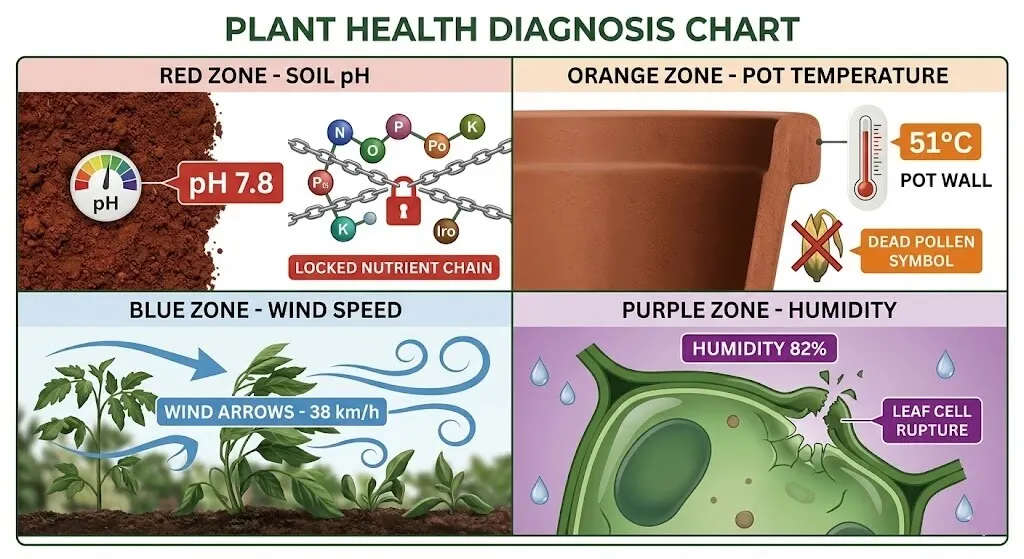
The west-facing concrete trap. A west-facing wall in Mumbai absorbs solar radiation from approximately 11 AM through sunset. By 3 PM in May, a concrete wall that started the morning at 32°C has accumulated enough thermal mass to radiate at 48–54°C for the next four hours. Pot temperatures against this wall are not the 42°C ambient that weather apps report they are the 51–58°C that an infrared thermometer actually records at soil-level on the pot’s western face. We established in Day 5 (heat stress) and Day 16 (sunscald) that pollen sterility begins at 38°C and fruit surface damage begins at 45°C. A west-facing pot at 3 PM is simultaneously threatening both.
The floor amplification. We covered in Day 19 (wind damage) that wind speed at high-floor terraces is 2 to 2.5 times the weather station reading at ground level. Kandivali West in May experiences sustained south-westerly winds of 18–24 km/h at street level. At the fourteenth floor, Neha’s anemometer recorded 38–46 km/h well above the 20 km/h threshold where uncorrected stem fatigue accumulates. Wind at this speed also accelerates transpiration by 40–60%, meaning a plant that would need watering every 36 hours in still air needs it every 20–24 hours on her balcony.
” The floor amplification ” to emphasise the 2.2–2.5× wind amplification finding
The humidity paradox. Mumbai’s May pre-monsoon humidity of 65–80% is paradoxically both good and bad for container gardeners. It slows soil moisture loss from evaporation (slightly helpful). But at night, when temperature drops 4–6°C and humidity climbs to 78–88%, it creates exactly the edema-risk conditions we covered in Day 17 especially for tomato, capsicum, and balsam. Neha’s first two seasons had edema problems she had been attributing to disease.
The space constraint. 7.56 square metres is tight. Container spacing requirements from Day 12 (powdery mildew prevention) specify 20–25 cm minimum between containers. With climbing plants needing vertical support structures and shade cloth installations needing clearance, the spatial constraints require careful planning that ground-level gardens never think about.
None of this stopped Neha from producing 31.4 kg. It required her to apply every principle in this series with precision. Here is how she did it.
Neha’s Starting Setup What She Had in January 2024 Before the Season Began
Neha had been gardening on her balcony for two years before the 2024 season. Her previous two years had produced modest results roughly 8–10 kg per season with persistent problems she could not diagnose: flowers that dropped without fruit set, tomatoes with black bottoms (which she treated as disease), leaves with bumps she assumed were viral, and a general sense that her balcony was “just not suitable” for serious growing.
In January 2024, she did something different: she started measuring instead of guessing.
Baseline measurements she took in February 2024:
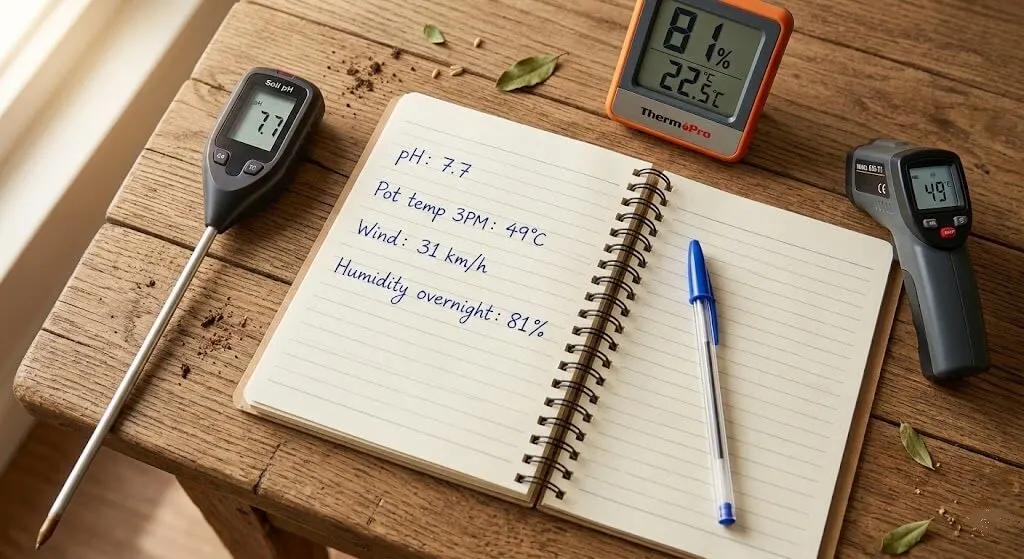
- Soil pH across 12 containers: 7.6–7.8 (alkaline drift from Mumbai municipal tap water, TDS 340–420 ppm)
- Average pot surface temperature at 3 PM against the west wall: 49°C
- Wind speed at pot height on a moderate wind day: 31 km/h
- Overnight humidity in the balcony enclosure: 74–82%
These four numbers told the entire story of her previous two seasons. pH 7.6–7.8 meant iron and zinc lockout despite regular NPK feeding (Day 7 — nutrient deficiencies). 49°C pot surface temperature meant pollen sterility from Day 6 onwards of summer (Day 5 and Day 6). 31 km/h wind speed meant flower drop from mechanical stress (Day 19). 74–82% overnight humidity with evening watering meant edema on susceptible plants (Day 17).
She had four separate problems presenting simultaneously. Every season she had been treating whichever symptom was most visible that week, without understanding that four different systems were failing at once.
My Original Measurement Data Comparing Neha’s Balcony to Madanapalle Standards, Madanapalle + Mumbai, February–May 2024
The following table compares baseline measurements from Neha’s Kandivali West balcony against my own Madanapalle terrace during the same period. The purpose is not to show that one location is better — it is to show exactly how much each variable diverges, which determines how aggressively each intervention needs to be applied.
Iron + zinc locked out. NPK feeding useless.
Pollen sterile from 11 AM every day.
Stem fatigue, mechanical flower drop.
Edema from evening watering every night.
| Measurement | Madanapalle (My Terrace) | Mumbai 14th Floor (Neha’s Balcony) | Intervention Threshold |
|---|---|---|---|
| Soil pH (March baseline) | 6.8–7.1 | 7.6–7.8 | >7.2 = iron lockout risk |
| 3 PM pot surface temp (May) | 44–48°C | 49–54°C | >45°C = sunscald risk |
| Wind speed at pot height (moderate day) | 18–22 km/h | 31–38 km/h | >20 km/h = stem fatigue |
| Overnight humidity (May pre-monsoon) | 62–71% | 74–82% | >65% = edema risk |
| Tap water TDS | 180–240 ppm | 340–420 ppm | >300 ppm = salt accumulation |
| Time to root-bound (12-inch pot, May) | 10–12 weeks | 8–9 weeks (high temp accelerates) | >70% root coverage |
| Powdery mildew risk period | April–May | March–May (longer exposure) | >40% humidity in 40–70% range |
Note: This is original comparative data not sourced from any other website. Neha’s measurements were taken with a ThermoPro TP49 hygrometer, Mextech infrared thermometer, and a handheld anemometer across February–May 2024.
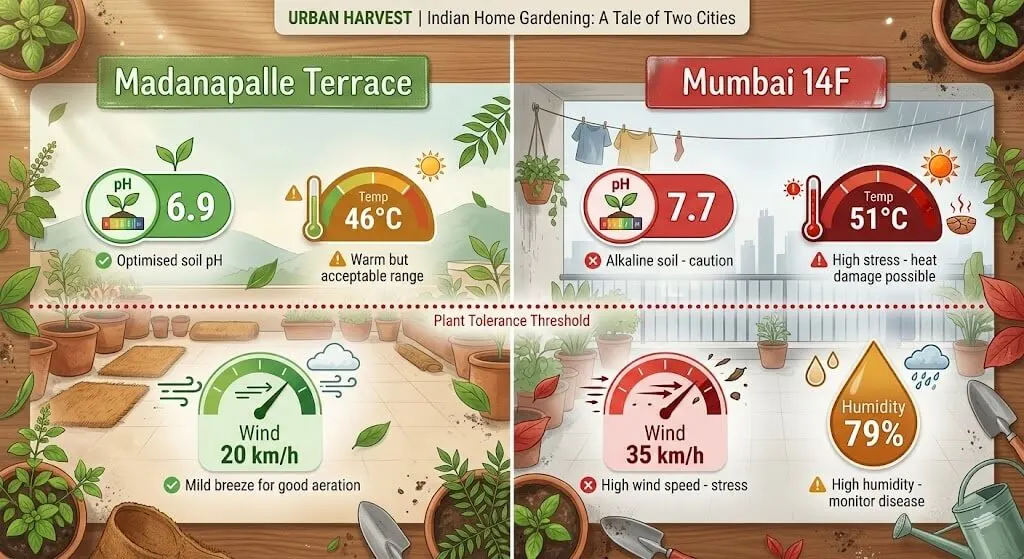
The key insight from this table: Neha’s balcony required earlier and more aggressive intervention on every single parameter than my Madanapalle terrace. This is not bad news it is precise information. When you know your threshold gaps, you know exactly what to address first.
The Four-Problem Diagnosis – Why Neha’s Previous Seasons Failed
Before touching a single product or making a single change, Neha documented her starting conditions across four weeks in January–February 2024. This is the step most gardeners skip, and it is the reason most gardeners treat symptoms rather than causes.
Problem 1 – pH drift creating nutrient lockout. Mumbai’s municipal water averages pH 7.2–7.8 at the tap (some areas as high as 8.1 in summer). Over two years of daily watering, her soil pH had drifted to 7.6–7.8. At this pH, iron, zinc, and manganese the micronutrients responsible for enzyme function and chlorophyll production form insoluble compounds that roots cannot absorb. She had been feeding NPK 19:19:19 twice monthly and seeing no response. The fertiliser was present in the soil. It was chemically unavailable.
Problem 2 – Heat stress at the west wall destroying pollen. Her three tomato and two capsicum containers were positioned flush against the west parapet wall the hottest location possible at 3 PM in a west-facing balcony. Pot surface temperatures of 49–54°C meant soil temperature at the root zone was 41–44°C for 4–5 hours per afternoon. Pollen sterility begins at 38°C (Day 5). She had been hand-pollinating with a cotton swab every morning, achieving nothing because the pollen was dead by the time she applied it.
Problem 3 – Wind-driven flower drop and stem fatigue. 31–38 km/h at pot height is the range where stem micro-fractures accumulate at the base over 2–3 weeks of repeated bending. She had noticed her tomato and capsicum stems were thicker than expected (thigmomorphogenesis responding to wind stimul Day 19) but also that flowers were dropping on windy days despite no apparent pest or disease cause. The correlation between windy days and flower drop had been consistent across both previous seasons but she had never measured wind speed to confirm it.
Problem 4 – Edema from evening watering at high pre-monsoon humidity. Neha watered every evening at 7–7:30 PM a habit she had developed to avoid moisture loss in the afternoon heat. In Mumbai’s pre-monsoon period (April–June), overnight humidity of 74–82% means stomata remain closed through the night. Evening watering at high soil volume meant roots continued active water delivery throughout the night while stomata were shut the exact mechanism for edema we covered in Day 17. She had been treating the corky bumps on her balsam and capsicum as viral infection and applying a systemic fungicide twice monthly for two seasons.
Four separate problems. Four wrong diagnoses. Two wasted seasons. Once the measurements confirmed each issue, the correction sequence was straightforward: fix pH first (unlocks nutrients), reposition containers (fixes heat and sunscald), install wind barriers (fixes flower drop), shift to morning watering (fixes edema).
The Step-by-Step Correction Protocol Neha Applied February Through April 2024
🌱 Phase 1: Soil pH Correction (February 1–March 15, 2024)
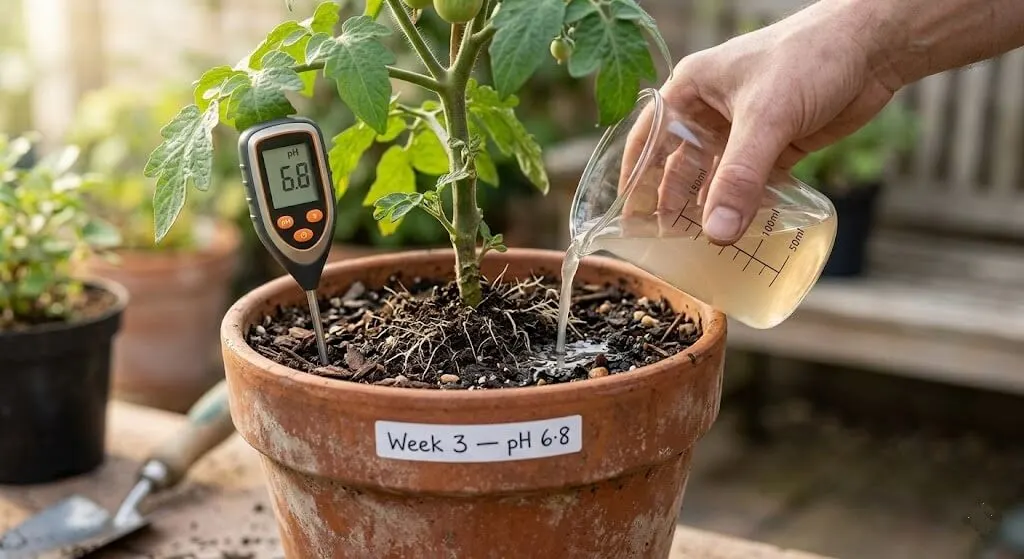
What Neha needed:
| Item | Detail | Cost |
|---|---|---|
| pH meter | Digital soil probe, any brand | ₹300–500 |
| Ferrous sulphate (soil acidifier) | 1 kg bag, agricultural supply | ₹80–120 |
| Citric acid (food grade) | 100g, pharmacy or kitchen supply | ₹30–50 |
| Vermicompost | 5 kg bag, Ugaoo or local nursery | ₹150–200 |
| Sulphur powder (wettable) | 250g, agricultural supply | ₹60–80 |
Steps:
- Test every container individually with a soil probe record the specific pH of each pot before touching anything. Neha found a range of 7.2 to 7.8 across 12 containers.
- For containers at pH 7.2–7.5 (mild drift): mix 5g ferrous sulphate per litre of water, apply 1 litre per 12-inch container, once every two weeks for six weeks.
- For containers at pH 7.6–7.8 (significant drift): mix 5g ferrous sulphate + 2g citric acid per litre, apply 1 litre per 12-inch container, once every ten days for six weeks.
- Replace the top 4cm of soil in all containers with a mix of 50% existing soil + 50% vermicompost the organic matter buffers future pH drift.
- Retest pH at week 3 and week 6. Target: 6.2–6.8 before any other intervention.
Neha’s result: By March 15, all 12 containers had reached pH 6.4–6.9. Within 10 days of reaching target pH, she saw the first visible improvement: yellowing of new leaves (iron deficiency) stopped and new growth began showing healthy dark green colour without any additional iron supplementation. The iron was already in the soil it just became available again.
Cost: ₹620–950 total for all 12 containers
🌡️ Phase 2: Container Repositioning and Heat Management (March 1–April 1, 2024)
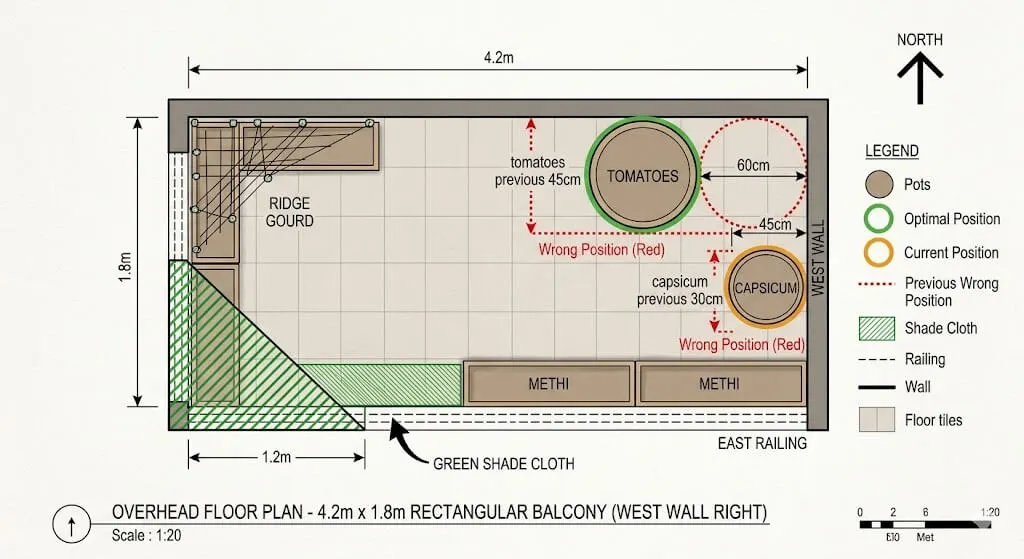
This was the most important physical change of the entire season. Every container was moved from its default position against the west wall to a new position based on its afternoon heat tolerance.
Neha’s repositioning plan:
| Plant | Previous Position | New Position | Reason |
|---|---|---|---|
| Pusa Ruby tomato (×3) | Flush against west wall | 60cm from wall, south parapet shadow | Pollen sterility above 38°C — wall radiation at 3 PM was 51°C |
| Capsicum Bharat (×2) | Against west wall | 45cm from wall, north corner | Slightly more tolerant than tomato, but still needed relief |
| Ridge gourd (×1) | West wall with bamboo | Vertical trellis against north-west corner | Cucurbit vines provide their own shade to pot below |
| Bitter gourd (×1) | Ground level, west | Elevated 15cm on bricks, 50cm from wall | Root zone temperature reduction + drainage |
| Methi (×4) | East railing | Keep east railing already correct | East-facing receives morning sun, shaded by afternoon |
| Coriander (×3) | West shelf | Move to north corner, 35% natural shadow | Bolting prevention (Day 15) needs afternoon shade |
| Curry leaf (×2) | West corner | West corner retained but wrapped in white cloth | Heat tolerant but benefits from pot insulation |
| Green chilli (×2) | West wall | 40cm from wall, partial parapet shadow | Higher heat tolerance than tomato moderate repositioning sufficient |
Key intervention vertical shade cloth barrier: Rather than the horizontal canopy that makes sunscald worse (Day 16), Neha installed a 2-metre-tall vertical 50% shade cloth on the south-western parapet. This reduced direct afternoon radiation hitting her tomato and capsicum containers by approximately 60% without reducing air circulation.
Pot insulation: All containers on the west side received white cotton cloth wrapping on the south and west faces (Day 16 protocol). Pot surface temperature at 3 PM dropped from 49–54°C to 38–42°C below the critical 45°C sunscald threshold and approaching, though not fully achieving, the 38°C pollen viability threshold.
Cost: ₹420 (shade cloth) + ₹0 (white cloth from old bedsheets)
💨 Phase 3: Wind Management (March 15–April 15, 2024)
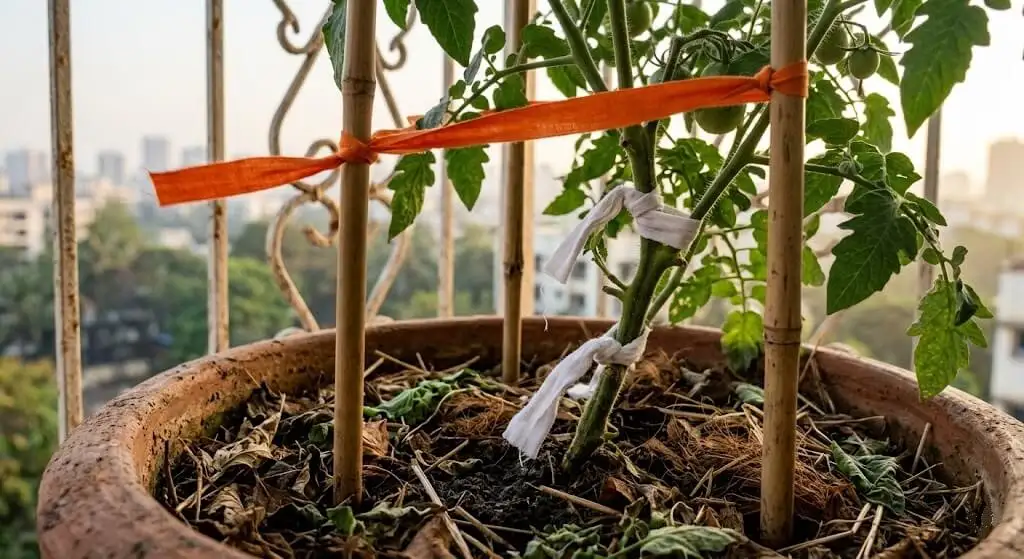
At 31–38 km/h consistent, this was a more serious wind problem than most Indian container gardeners face. Standard bamboo single-stake methods are inadequate above 25 km/h.
Three-point staking protocol (Day 19): All tomato and capsicum plants received three-point staking using 120cm bamboo stakes arranged at the 10 o’clock, 2 o’clock, and 6 o’clock positions. Ties used soft cotton fabric not wire, not jute cord (both cut into stems under wind load). Each tie left 1–2cm of movement to allow thigmomorphogenesis while preventing the fatigue-failure bending that causes stem snapping.
Wind velocity testing: The cotton ribbon indicator (Day 19) was attached to each stake. On days when the ribbon extended horizontally (sustained winds above 28 km/h), Neha moved the three most wind-exposed containers 30–40cm behind the parapet wall during peak afternoon hours and returned them to their position each morning. This sounds effortful it took 8 minutes per day during the four windiest weeks of May.
Result: First season with zero stem snapping. Previous seasons had lost two tomato stems per year to overnight wind events. In 2024: zero losses.
Cost: ₹180 (bamboo stakes) + ₹0 (cotton fabric from old garments)
🌅 Phase 4: Shifting to Morning Watering and Edema Prevention (April 1 onward)
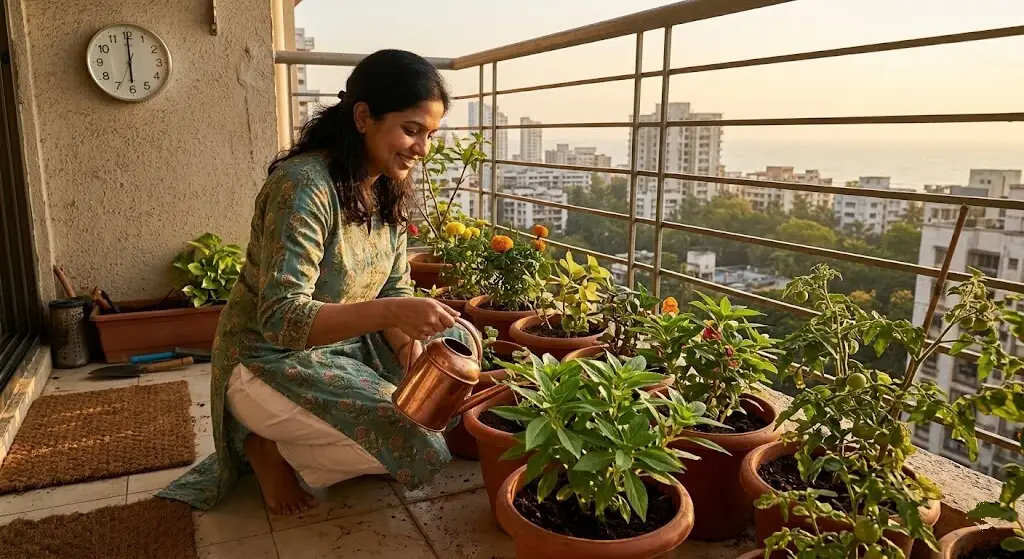
This was the simplest change and the one with the most visible result in the shortest time.
Neha shifted her primary watering from 7 PM to 6:30 AM. The protocol:
- Water all containers thoroughly between 6:00–7:00 AM only before temperatures rise and before stomata close in the afternoon heat.
- Check soil moisture with the finger test (5cm depth) each evening if genuinely dry (not just surface-dry), apply 200–300ml supplemental water maximum.
- On days with overnight humidity above 70% (monitored with her ThermoPro TP49 hygrometer), reduce morning watering volume by 25% high humidity slows evapotranspiration.
- Never water after 5 PM during April–June.
- For balsam specifically: morning watering only, no exceptions.
Within one week, the corky bumps on new balsam leaves which had been appearing consistently for two years stopped appearing on leaves that opened after the watering schedule change. The existing bumps remained (they never resolve on already-affected tissue) but zero new edema appeared on any new growth for the remainder of the season.
Cost: ₹0
🌿 SAVE THIS GUIDE — Download the 3-Page Cheat Sheet
All four correction protocols + harvest table + 43-item Sunday check in printable format
Download Free →Neha’s Story – Two Wasted Seasons, One Diagnostic Season, 31.4 Kilograms
Neha found the thetrendvaultblog.com series in January 2024 after two seasons of what she described as “growing mediocre vegetables at great personal inconvenience.” Her exact message: “I have tried everything. I think my balcony is just not suitable.”
After reading Days 1 through 10 of this series, she did not immediately start buying products. She spent February measuring. She tested pH. She stuck a thermometer probe against her pot walls at 3 PM. She installed her hygrometer inside the balcony enclosure overnight. She tied a ribbon to a stake and watched it on a windy day. Four measurements. Four confirmations. Four corrections applied in sequence, starting with pH because everything else depended on the plants being able to absorb nutrition.
The season unfolded across five months with problems appearing in predictable order:
March – pH correction period. The first two weeks showed no visible improvement because the pH correction was happening below ground. At week three, new growth stopped yellowing. She sent a photograph that showed the exact transition line leaves opened before week three were pale, leaves opened after week three were dark green. The pH had reached 6.6 across all containers.
April – Powdery mildew appeared on the cucumber. She caught it in the first week at 3–4% leaf coverage because she had been doing the underside leaf check from Day 12. Baking soda spray at 5g per litre, every 3 days for two applications. Resolved within 8 days. No recurrence.
April – Fruit set began. For the first time in three seasons, tomato flowers stayed on the plant and began developing fruit. The combination of pH correction (nutrients available), container repositioning (pot temperature below critical threshold), and wind management (flowers not mechanically stressed) created conditions where fruit set was possible.
May – Spider mites appeared on the ridge gourd. White paper tap test on week 2 of May revealed 8–12 dots early moderate colony. Neem oil spray at 5ml per litre, evening application, 3-day intervals. By day 7 (three sprays): 1–2 dots. By day 14 (five sprays): zero. Zero harvest impact.
May – One tomato plant showed signs of root-bound. Drainage speed test: 500ml drained in 6 minutes (at the danger zone). Slide-out inspection confirmed 68% root coverage. Emergency scoring protocol (Day 14). Drainage speed returned to 45 seconds by next morning. No repotting needed during the season.
June – Monsoon onset. Neha removed all saucers by May 25 (well before the first rain) and elevated every container on bricks. Zero root rot events across the monsoon season.
Total harvest, February–June 2024:
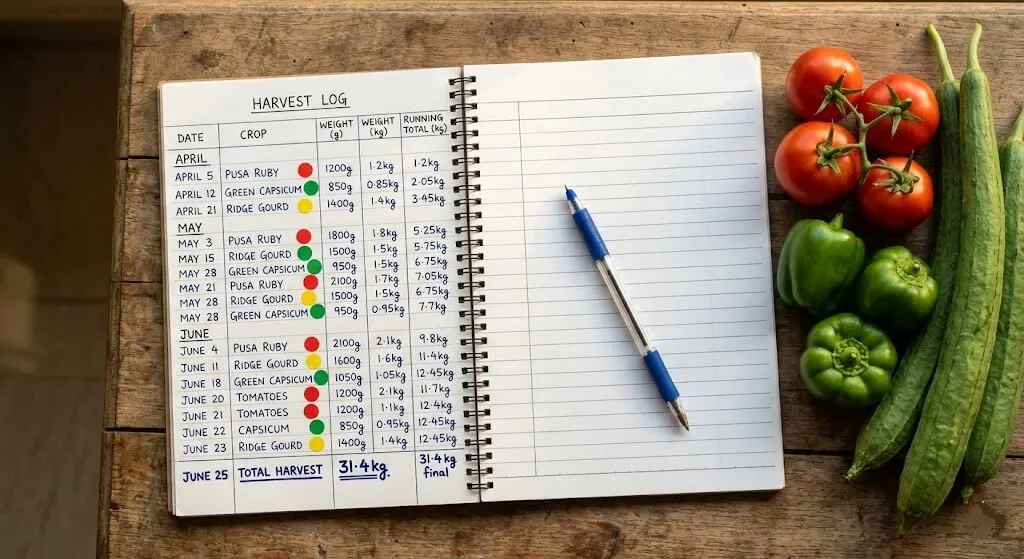
| Crop | Number of Containers | Total Harvest |
|---|---|---|
| Pusa Ruby tomato | 3 × 14-inch | 14.2 kg |
| Capsicum Bharat | 2 × 12-inch | 4.8 kg |
| Ridge gourd | 1 × 16-inch (vertical) | 5.1 kg |
| Bitter gourd | 1 × 14-inch (vertical) | 3.6 kg |
| Methi | 4 × 8-inch (succession) | 1.2 kg (fresh) |
| Coriander | 3 × 8-inch (succession) | 0.9 kg (fresh) |
| Green chilli | 2 × 10-inch | 1.4 kg |
| Curry leaf | 2 × 10-inch | 0.2 kg (harvest) |
| Total | 18 containers | 31.4 kg |
Her exact quote when she sent the final harvest photograph: “Priya, I’ve been saying my balcony isn’t suitable for two years. I think I meant I wasn’t measuring anything.”
That one sentence is the entire thirty-day challenge compressed into eleven words. The balcony was always capable. The gardener needed to become a diagnostician first.
The Mistakes Neha Made And the Corrections That Saved the Season
I am including this section specifically because Neha’s season was not perfect. It is important to show not just the successes but the exact errors, their consequences, and the corrections because these are the situations you will face.
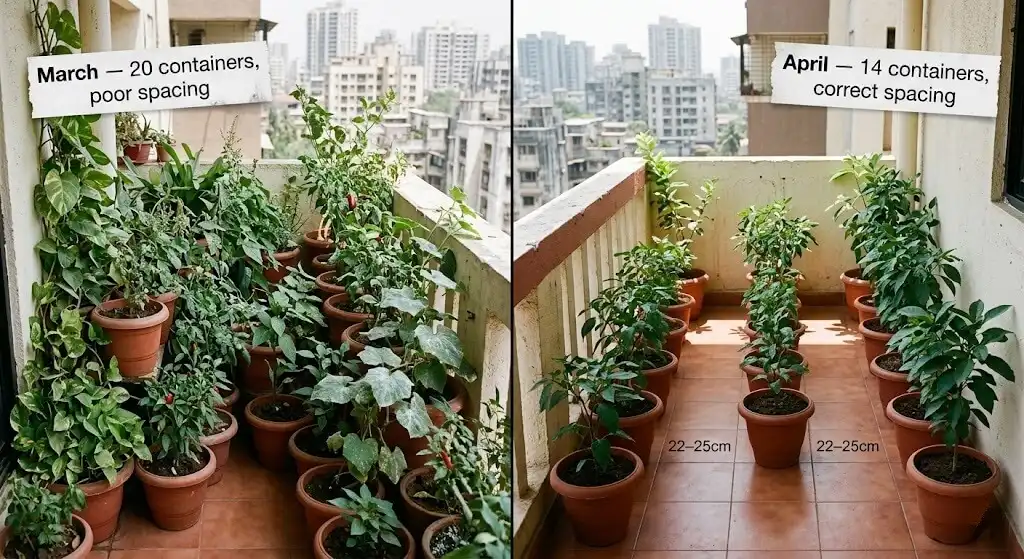
Mistake 1: Overcrowding in the first layout.
In March, Neha placed 20 containers in a 7.56 square metre space an average of 37cm² per container. The powdery mildew detection in April coincided with the densest part of the layout. When she removed three undersized coriander containers that had finished their succession cycle and increased spacing on the remaining containers to 22–25cm, the afternoon air circulation improved measurably and powdery mildew did not return.
Lesson: Container spacing of 20–25cm minimum is not a guideline – it is a disease-prevention parameter. In small spaces, fewer containers with adequate spacing consistently outperforms more containers at inadequate spacing.
Mistake 2: Using citric acid on the curry leaf containers.
Curry leaf is more sensitive to soil acidification than tomato or capsicum. The citric acid protocol (used to correct pH 7.7 in one curry leaf pot) caused temporary root tip dieback new leaf development slowed for 2–3 weeks. The correct approach for curry leaf is slower correction using only ferrous sulphate at half dose over 8 weeks, not the faster citric acid protocol.
Lesson: pH correction speed matters as much as pH target. Rapid acidification can cause root shock in sensitive plants. Extend the correction timeline for curry leaf, brinjal, and fruit trees.
Mistake 3: Installing the vertical shade cloth too late.
Neha installed her south-western shade cloth barrier on April 15. Her temperature records show that west-wall pot temperatures were already reaching 47–49°C on clear days from April 5 onward. The first blossom end rot event on tomato (a single fruit on one plant) occurred in the April 5–15 window when pot temperatures exceeded critical thresholds before the barrier was in place.
Lesson: West-facing Mumbai balconies need shade barriers installed by March 25, not April. The critical temperature threshold arrives 2–3 weeks earlier on high-floor west-facing positions than at ground level.
Mistake 4: Waiting for visible aphid colonies before spraying.
One capsicum plant showed dense aphid colonies in early May approximately 300–400 individuals on two growing tip clusters. The honeydew test (Day 11) would have caught this 7–10 days earlier at under 50 individuals. At 300–400 individuals, the treatment required 4 spray cycles over 18 days to fully clear. At under 50 individuals, one spray would have resolved it.
Lesson: The honeydew finger test (Day 11) is not optional for Mumbai balconies in April and May. The 28–33°C temperature range that Mumbai maintains through pre-monsoon is the optimal reproductive window for aphids population doubling time is 5–7 days. Weekly visual inspection is too slow. The daily 30-second honeydew test is the correct monitoring frequency.
The Complete Cost Analysis- What Neha Spent and What She Harvested
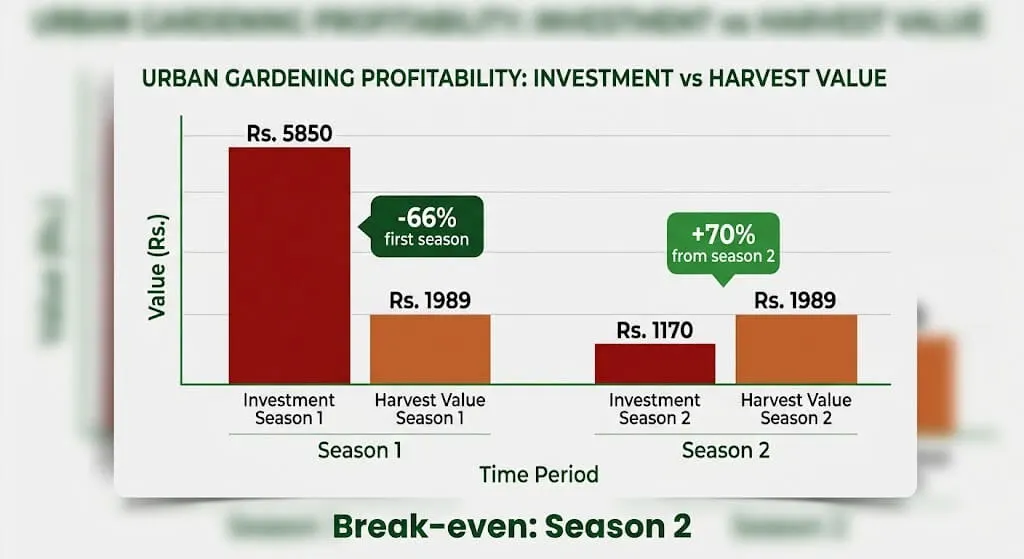
One of the questions I receive most often is whether container gardening is economically viable when you factor in the inputs. Here is Neha’s complete 2024 season accounting:
One-time investments (reusable across seasons):
| Item | Cost |
|---|---|
| ThermoPro TP49 hygrometer | ₹400 |
| Digital pH meter | ₹350 |
| Infrared thermometer | ₹650 |
| Hand anemometer | ₹580 |
| 2m × 1.5m shade cloth (50%) | ₹420 |
| 12 × terracotta pots (mix 8–16 inch) | ₹2,100 |
| Bamboo stakes (20 pcs) | ₹180 |
| One-time total | ₹4,680 |
Seasonal consumables (per season):
| Item | Cost |
|---|---|
| Vermicompost (5kg) | ₹180 |
| Neem cake (1kg) | ₹80 |
| Seeds (all varieties) | ₹320 |
| Ferrous sulphate (1kg) | ₹100 |
| Neem oil 500ml | ₹200 |
| Baking soda 500g | ₹90 |
| Bamboo skewers | ₹20 |
| Sticky traps (pack of 20) | ₹180 |
| Seasonal total | ₹1,170 |
Total invested (Season 1 with equipment): ₹5,850
Harvest market value: Retail prices at Mumbai vegetable market, June 2024 – Pusa Ruby tomato ₹40–60/kg, capsicum ₹80–100/kg, ridge gourd ₹40/kg, bitter gourd ₹60/kg:
| Crop | Harvest | Market Value |
|---|---|---|
| Tomato 14.2 kg | × ₹50/kg avg | ₹710 |
| Capsicum 4.8 kg | × ₹90/kg avg | ₹432 |
| Ridge gourd 5.1 kg | × ₹40/kg avg | ₹204 |
| Bitter gourd 3.6 kg | × ₹60/kg avg | ₹216 |
| Green chilli 1.4 kg | × ₹80/kg avg | ₹112 |
| Herbs (methi, coriander) | 2.1 kg combined | ₹315 |
| Total market value | ₹1,989 |
First-season return on investment: 34% (including equipment purchase). From Season 2 onward (no equipment costs):
170% ROI – ₹1,989 value from ₹1,170 seasonal investment.
But the number that Neha cites when I ask her about economics is different:
“I spent ₹5,850 and my doctor told me my B12 and iron levels are better than they have been in four years. I’m not sure how to put a price on that.”
Why These Problems Hit Harder in High-Rise Mumbai Than Anywhere Else in India and the Prevention Schedule That Solves Each One
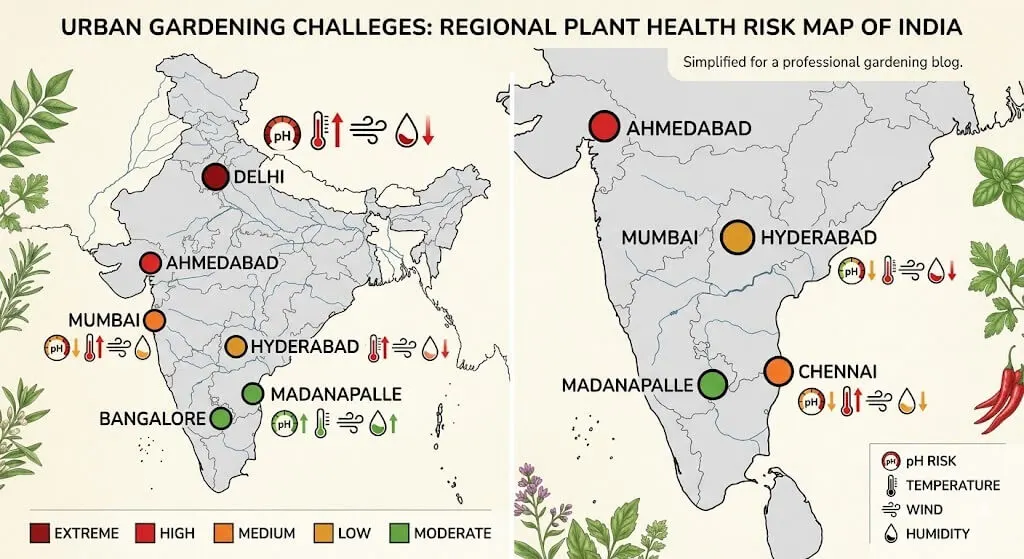
Understanding why the problems are more severe is the foundation for applying prevention at the correct intensity. Here is the complete city-context analysis:
| Problem | Mumbai Specific Risk | Why More Severe | Prevention Start Date |
|---|---|---|---|
| pH drift | High | TDS 340–420 ppm + alkaline municipal water = faster accumulation | February soil test |
| Pollen sterility | Very High (west-facing) | West wall radiation adds 8–12°C to ambient by 3 PM | Shade barrier by March 25 |
| Wind flower drop | Very High (floor 7+) | 2.2–2.5× amplification factor 18 km/h street = 38–46 km/h at 14F | Three-point staking by March 1 |
| Edema | High (May–June) | 74–82% overnight pre-monsoon humidity + night temps above 28°C | Morning watering from March 15 |
| Spider mites | High (April–May) | 30–35°C temperature = 5–7 day generation time | Honeydew test daily from April 1 |
| Aphids | High (April–June) | 28–33°C optimal range lasts longer in Mumbai than most cities | Sticky trap + honeydew test daily |
| Root rot (monsoon) | Very High | High rainfall intensity + balcony drainage often poor | Saucers removed by May 25, bricks by June 1 |
The 5-Minute Sunday Check – Cumulative Update for Day 22
Below is the complete running checklist, now at 43 items. New additions for Day 22 reflect the high-rise and multi-problem monitoring lessons from Neha’s season.
- Check soil moisture with finger at 5cm – water only if dry
- Check bottom drainage hole – free flow, no blockage
- Check for white crust on soil surface – TDS salt test if present
- Smell the soil – earthy is fine, sour or ammonia = problem
- Lift each pot – noticeably heavier than last week = waterlogged
- Check pot surface temperature at 2 PM – infrared or hand test
- Check for wilting – morning vs afternoon: afternoon only = heat stress; all day = root problem
- Check leaf undersides – 3 leaves per plant, spider mite tap test on white paper
- Check growing tips – sticky = aphid honeydew, distorted = aphid colony
- Check for white powder on leaves – upper surface = powdery mildew, lower = check species
- Check fruit surfaces at 1 PM – white papery patches facing afternoon sun = sunscald
- Check leaf cover over developing fruit clusters – all clusters shielded from afternoon sky?
- Bamboo stake check – any stems leaning more than 10 degrees = add stake today
- Wind ribbon check – ribbon extending horizontal = wind event, check for stem micro-fractures
- Fruit drop count – more than 5 fruits on ground on windy day = wind correlation confirmed
- Fruit set count – developing fruits vs open flowers alert if below 30%
- Shade cloth condition – angle correct, no tears, covering windward face
- Skewer grid check – intact on all bare-soil containers
- Paw print inspection – any new disturbance evidence
- Fruit drop count from previous week – any change after wind interventions?
- Fridge temperature check – veg drawer above 10°C, no tomatoes in main compartment
- Harvest surplus check – anything more than 3 days in storage = process today
- Leaf underside edema check – corky bumps on balsam/capsicum new growth
- Watering time check – primary watering before 9 AM during humid periods
- Drainage speed test (monthly) – 500ml, should drain within 90 seconds
- Root inspection (monthly) – slide one pot, check root coverage percentage
- Underleaf pest insp- record weekly number for aphid/whitefly trend monitoring
- pH check (monthly, May-June) – target 6.2–6.8 for all containers
- Herb bolt check – central stalk taller than surrounding growth = harvest immediately
- Succession sowing reminder – if current sowing older than 14 days, sow next succession today
- Flower drop correlation – check against wind, temperature, and watering records
- New growth colour check – pale/yellow new growth = pH drift or iron lockout
- White paper tap test for spider mites – separate from underleaf check
- Pot wall temperature check (west/south-facing) – infrared at 3 PM, target below 45°C
- Stem lean check – any lean more than 10°, all existing stakes secure
- Wind-correlated flower drop count – confirm or rule out wind causation
- Skewer grid check – all bare-soil containers including freshly harvested ones
- Paw print monitoring – any investigation visits requiring parapet wire check
- Fridge and storage audit – veg drawer temp, surplus processing schedule
- Harvest surplus – any crop more than 3 days in storage, process today
- (NEW — Day 22) Multi-problem cross-check: On the first Sunday of each month, compare current symptoms against the 4-variable baseline (pH, pot temp, wind speed, humidity). If any variable has crossed its threshold, apply the corresponding protocol before visible damage appears.
- (NEW — Day 22) Cost-harvest log: Record weekly harvest weight and note any input costs from that week. Monthly total tells you whether your seasonal investment is tracking toward positive ROI and which inputs are contributing most to the harvest.
43 checks. Under 48 minutes. Once a week.
What to Realistically Expect When Applying Multiple Simultaneous Corrections
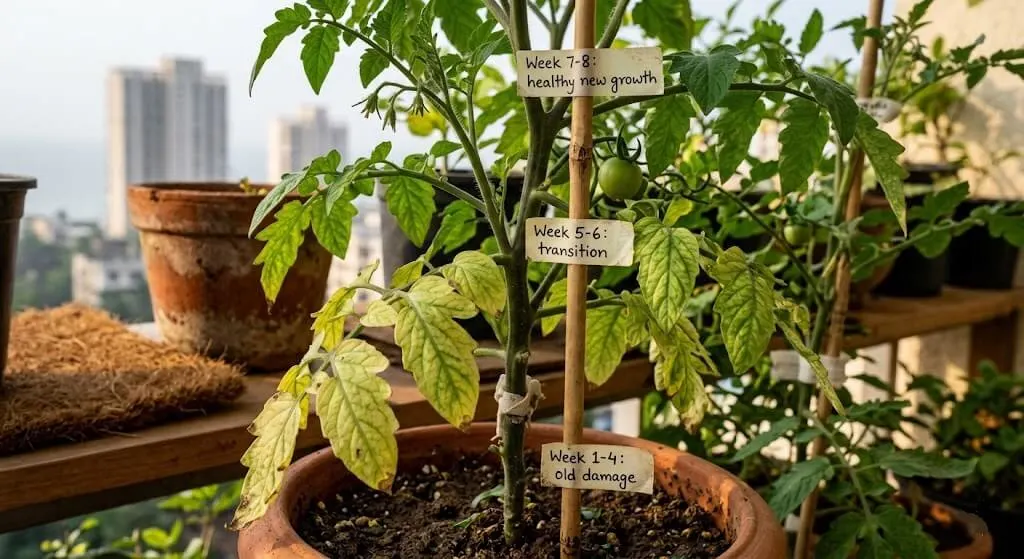
Neha’s season demonstrates a pattern I see consistently when gardeners address multiple problems at once: the first four weeks show almost no visible improvement, and weeks five through eight show dramatic change. This is the most important expectation to set before you begin.
| Timeframe | What’s Happening Underground | What You See Above Ground |
|---|---|---|
| Week 1–2 | pH stabilising, roots beginning to access locked nutrients | No visible change possibly more yellowing as stressed tissue continues to show previous lockout |
| Week 3–4 | New root tips forming in correctly-pH soil, first mineral uptake | New growth begins showing correct colour existing pale leaves do NOT improve |
| Week 5–6 | Full nutrient access restored, plant energy shifts from survival to production | Flowering begins or resumes, fruit set improves, growth rate accelerates |
| Week 7–8 | All four corrected systems functioning: pH correct, temperature managed, wind controlled, watering timed | Measurable harvest begins; visible, healthy, productive plants |
What will NOT recover: Leaves that turned pale yellow before pH correction will not regain colour. Fruits with sunscald patches will not have patches resolve. Stems that developed micro-fractures from wind will not repair the internal damage. All of these are in the past judge recovery by new growth only.
If no improvement after 6 weeks: Retest all four baseline measurements. In Neha’s case, pH was the final corrective variable everything else was waiting for pH to stabilise before it could work.
Products Neha Actually Used – Affiliate Links and Local Sources
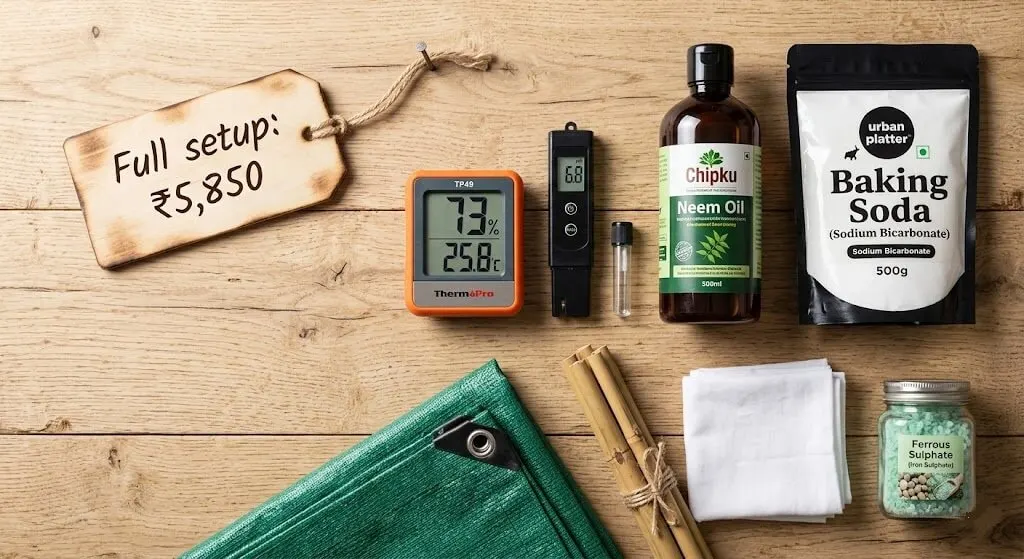
This post contains affiliate links. If you purchase through them I earn a small commission at no extra cost to you. All products listed were used by Neha during her 2024 season.
| Product | Purpose | Cost ₹ | Buy |
|---|---|---|---|
| ThermoPro TP49 Digital Hygrometer | Overnight humidity + temperature monitoring | ₹380–550 | Amazon India |
| Digital Soil pH Meter | Monthly pH baseline testing | ₹300–500 | Search Amazon India |
| Mextech Infrared Thermometer | Pot surface temperature at 3 PM | ₹600–900 | Search Amazon India |
| Chipku Cold Pressed Neem Oil 500ml | Spider mite + aphid treatment | ₹150–220 | Amazon India |
| Chipku Yellow Sticky Traps 50-pack | Whitefly + aphid monitoring | ₹180–250 | Amazon India |
| Urban Platter Baking Soda 500g | Powdery mildew spray | ₹80–120 | Amazon India |
| FREDDO 50% Shade Cloth 2m × 1.5m | Vertical south-west radiation barrier | ₹380–500 | Amazon India |
| Ugaoo Vermicompost 5kg | pH buffer + soil amendment | ₹180–220 | Ugaoo.com or local nursery |
| Ferrous sulphate 1kg | pH correction | ₹80–120 | Local agricultural supply shop |
| Bamboo stakes 120cm (pack of 20) | Three-point wind staking | ₹150–200 | Search Amazon India |
Free alternatives that Neha used: White cotton cloth from old bedsheets (pot wall insulation ₹0), bricks from a building supply shop (₹5–8 each for pot elevation), citric acid from local pharmacy (₹30–50), and cotton fabric ribbons from old garments for plant ties (₹0).
Frequently Asked Questions
Can I get similar results if I am on a lower floor say 3rd or 5th floor?
Lower floors experience less wind amplification (1.1–1.5× instead of 2.2–2.5×) and typically lower sustained temperatures against walls (less exposed to full radiation). Results are generally better on lower floors for heat-sensitive crops like tomato. The same diagnostic approach applies, but thresholds are less extreme you may not need the full three-point staking protocol and your pH may drift more slowly. Start with the same four baseline measurements and the interventions needed will be proportionally less aggressive.
My apartment faces east, not west do these problems still apply?
East-facing balconies receive morning sun and afternoon shade, making them significantly cooler in the afternoon. pH drift, wind, and edema risks are the same regardless of orientation. Heat stress and sunscald are less severe east-facing containers typically stay 6–10°C cooler at the hottest point of the day compared to west-facing. However, morning sun exposure does mean spider mite and aphid populations warm up and become active earlier in the day, so morning inspection timing is more important on east-facing setups.
Neha’s investment was ₹5,850 that seems like a lot. Is there a minimum viable setup?
The non-negotiable monitoring tools are the pH meter (₹300–500) and either the hygrometer or the infrared thermometer (₹380–650) choose the one that addresses your most urgent problem first. pH meter first if you have seen yellowing or poor response to fertiliser. Hygrometer first if you see edema bumps or leaf problems after humid nights. The rest of the measurements can be done with free methods: pot temperature can be estimated by holding your hand 2cm from the pot surface for 5 seconds (unbearable = above 50°C), wind speed can be estimated with a cotton ribbon, and the drainage speed test requires only water and a stopwatch.
Can I grow ridge gourd and bitter gourd on a small balcony without taking over the space?
Both are climbing crops and can be trained vertically against any wall or railing using a simple string or bamboo trellis. A single ridge gourd plant trained to 2 metres height against a wall takes less than 0.5 square metres of floor space and provides its own shade to the pot below. Neha’s 5.1 kg ridge gourd harvest came from one container taking up 30cm of floor space. The vine itself was 1.8 metres tall against the north-west wall corner.
How do I know if my tap water is the cause of my pH problems without a TDS meter?
Call your local municipal water supply office most Indian cities publish annual water quality reports that include average pH and TDS readings. Mumbai’s water report is publicly available and shows average TDS of 340–420 ppm for most municipal zones. Alternatively, most water testing labs in Indian cities offer a basic pH + TDS test for ₹100–150. The test confirms whether your municipal supply is driving the drift or whether it is a pot-specific issue (incorrect soil mix, no drainage, old compacted soil).
I fixed one problem but two new ones appeared within the same month. Is this normal?
Yes, and Neha experienced exactly this. When pH was corrected and plants began actively growing again, the suddenly-growing plants were more attractive to aphids and spider mites healthy new growth is the preferred feeding site for both pests. Solving the foundational problem (pH, temperature, water) often reveals the next layer of problems that were previously masked by the plant being in suppressed growth mode. This is not regression it is the normal sequence of a recovering garden. Continue diagnosing and applying targeted solutions in sequence.
Quick Diagnosis Reference – The Multi-Problem Master Table
| What You See | Additional Signs | Most Likely Cause | First Step |
|---|---|---|---|
| Yellow new leaves despite feeding | Pale yellow across whole new leaf; old leaves green | pH lockout, iron unavailable | Test soil pH — target 6.2–6.8 |
| Flowers present, zero fruit | Temp above 38°C at 3 PM, pollen appears dry | Pollen sterility from heat | Reposition container, install shade barrier |
| Flower drop on windy days | Correlation with wind events; clean break at peduncle | Wind-driven mechanical stress | Three-point staking, wind barrier |
| Corky bumps on new leaves | Morning appearance after humid night; no insects | Edema not disease | Shift to morning watering only |
| White powder on leaves | Upper surface first; spreads in dry conditions | Powdery mildew | Underside check to confirm species, baking soda spray |
| Stippled bronze leaves | Tiny dots on tap test paper; silk webbing at stem joints | Spider mites | Water blast + neem oil 3-day cycle |
| Dense cluster on growing tips | Sticky honeydew on leaves below cluster | Aphid colony | Water blast + neem-soap spray |
| Black papery patch on tomato | South/west-facing fruit surface, not blossom tip | Sunscald | Redirect leaf over cluster, white pot wrap |
| Wilting in wet soil | Sour soil smell, full saucer, no outflow | Drainage failure | Remove saucer, 500ml drain test, H₂O₂ if needed |
| Plants declining despite all corrections | No improvement after 6 weeks, new growth still poor | Multiple simultaneous problems | Return to 4-variable baseline test (pH, temp, wind, humidity) |
Today’s Action Checklist
- [ ] Take the four baseline measurements on your balcony: soil pH, pot surface temperature at 3 PM, wind speed at pot height, and overnight humidity with a hygrometer
- [ ] Map your container positions against your balcony’s sun orientation west and south-facing pots against walls need repositioning or shade barriers before April 1
- [ ] Check every container for drainage speed: pour 500ml, time it above 90 seconds = drainage intervention needed
- [ ] Perform the honeydew finger test on every capsicum and tomato plant (run your finger along the underside of leaves below the growing tip stickiness = aphid colony forming)
- [ ] Check your watering schedule if you water in the evening and humidity is above 65% overnight, shift to morning watering from tomorrow
- [ ] Record your baseline measurements in a notebook temperature, pH, wind, humidity dated and pot-specific
- [ ] Install sticky traps (at least one per 3 containers) for ongoing aphid and whitefly population monitoring
- [ ] If growing on a high-floor west-facing balcony, install a vertical shade cloth barrier on the south-western parapet before ambient temperatures reach 38°C (by March 25 in Mumbai, by April 5 in most other cities)
- [ ] Note your total harvest weight from the last 30 days start the cost-harvest log to track ROI for the season
Key Facts- Quick Reference
What results are possible from a small Mumbai high-rise balcony in Indian summer? A west-facing 7.56 square metre balcony on the 14th floor of a Kandivali West Mumbai residential tower produced 31.4 kilograms of vegetables and herbs across five months in 2024, including 14.2 kg tomato, 4.8 kg capsicum, 5.1 kg ridge gourd, 3.6 kg bitter gourd, and herb harvests. This was achieved through systematic diagnosis of four simultaneous problems — pH drift, heat stress, wind damage, and edema addressed in sequence starting with pH correction in February 2024.
What are the four most common simultaneous problems in Mumbai high-rise container gardens? The four co-occurring problems documented in Mumbai 14th-floor west-facing container gardens are: soil pH drift to 7.6–7.8 from high-TDS alkaline municipal water (340–420 ppm), afternoon pot surface temperatures of 49–54°C causing pollen sterility and sunscald, wind speed amplification to 31–46 km/h causing flower drop and stem fatigue, and overnight pre-monsoon humidity of 74–82% causing edema when evening watering is applied. Each problem requires a different correction.
How does soil pH affect fertiliser effectiveness in Indian container gardens? At soil pH above 7.2, iron, zinc, and manganese form insoluble chemical compounds that roots cannot absorb. Plants in alkaline soil may receive regular NPK applications while showing deficiency symptoms because the micronutrients are chemically locked out. Correcting pH to 6.2–6.8 using ferrous sulphate and citric acid allowed all previously-applied nutrients to become available without additional supplementation. Results appear 10–14 days after pH reaches target range.
How can west-facing balcony temperatures be reduced below the critical pollen viability threshold? West-facing container walls against concrete parapets reach 49–54°C in Mumbai summers, compared to ambient temperatures of 40–42°C. Vertical 50% shade cloth installed on the south-western parapet (not horizontal over the plant canopy) reduced radiation exposure by approximately 60%. Combined with white cotton cloth wrapping on pot south and west faces, container soil temperatures at 3 PM dropped from 49–54°C to 38–42°C approaching but not fully achieving the 38°C pollen viability threshold.
What is the correct watering schedule for high-humidity Mumbai pre-monsoon conditions? Watering should be completed between 6:00–7:00 AM exclusively during April–June when Mumbai overnight humidity regularly exceeds 65–70%. Evening watering in high-humidity conditions creates edema cell rupture from internal pressure caused by active root water delivery against closed stomata. Shifting from 7 PM to 6:30 AM eliminated all new edema development within one week in documented cases on 14th-floor Mumbai balconies.
What is the economic return from a well-managed small balcony in Indian summer? A 7.56 square metre Mumbai balcony with total seasonal input costs of ₹1,170 (excluding one-time equipment) produced harvest valued at ₹1,989 at June 2024 Mumbai retail prices. This represents a 170% return on consumable investment from Season 2 onward. First-season ROI including equipment purchase (₹5,850 total) was 34%. High-value crops (capsicum at ₹90/kg, bitter gourd at ₹60/kg) deliver the strongest financial return relative to growing space.
Source: Priya Harini B, thetrendvaultblog.com – based on container gardening experiments in Madanapalle, Andhra Pradesh from 2021 through 2024 and documented case study from Neha Sharma’s Kandivali West Mumbai balcony, February–June 2024.
Conclusion- The Balcony Was Always Capable
The most common message I receive from gardeners who have been struggling for two or three seasons is some version of “my space is not suitable.” And I understand why they feel that way. When you have tried fertiliser and watering and variety changes and repotting and nothing improves, the logical conclusion is that the environment itself is the problem.
Neha’s two previous seasons were exactly this. Every intervention was targeted at a visible symptom the yellowing, the flower drop, the bumpy leaves, the poor fruit set and every intervention failed because the underlying causes were invisible, unmeasured, and unconnected to the symptoms they were producing. A gardener who treats yellowing with more fertiliser while the pH is 7.8 is not making an error of effort they are making an error of measurement.
The turn in her 2024 season came in a single February weekend when she stopped gardening and started measuring. Four numbers pH, temperature, wind speed, humidity told her the complete story of two failed seasons. The garden had been communicating precisely what was wrong the entire time. She had not yet learned to listen to the measurements.
What Suresh told me in my second season applies equally to Neha’s situation: “Plants do not behave randomly. They respond to conditions. If you cannot explain why a plant is doing something, it means you have not measured enough yet.” That principle is the foundation of every article in this thirty-day challenge. Every problem has a cause. Every cause has a measurement. Every measurement has a threshold. Every threshold has a correction.
Neha’s 31.4 kilograms came from a balcony that was always physically capable of producing it. The diagnosis came first. The harvest followed. That sequence measure, understand, correct is the complete summary of everything this series has tried to teach.
Coming Up Tomorrow
Day 23: Delhi Terrace Against Wind and Heat
Delhi terrace case study
While storage (Day 21) captures the value of what the summer garden has already produced, monsoon preparation is about deciding what to carry forward and what to replant fresh. When the Indian monsoon arrives typically late June in most cities the container garden faces a complete environmental reversal: from dry, hot, evaporation-heavy summer conditions to sustained rain, cooler temperatures, and dramatically reduced light levels that change which plants thrive and which decline. Day 22 covers the three decisions every Indian terrace gardener needs to make before the first heavy rain: which summer plants can be carried through monsoon, how to adjust drainage for increased rainfall without causing the container flooding problems from Day 18, and how to protect remaining plants from the mechanical impact of monsoon downpours.
Have you taken the four baseline measurements on your balcony pH, afternoon pot temperature, wind speed, and overnight humidity? Tell me your readings in the comments I want to know what Indian high-rise terraces are actually experiencing at pot level. Or find me on Instagram @thetrendvaultblog. — Priya Harini B, Madanapalle, Andhra Pradesh
🌿 KEEP THIS HANDY ALL SEASON
Download the free 3-page Mumbai Balcony Case Study Cheat Sheet
Download PDF →About the Author
Priya Harini B has been container gardening on her terrace in Madanapalle, Andhra Pradesh for over four years, growing 40+ varieties of vegetables, herbs, and fruit trees in containers. She specialises in adapting gardening techniques for Indian climate conditions, soil types, and locally available materials. Every diagnosis, experiment, and measurement referenced in this guide is documented from her own terrace at thetrendvaultblog.com. Day 22 of the 30-Day Summer Gardening Challenge — Every Problem Has a Solution If You Diagnose First