
By Priya Harini B | 9-Month Testing, 3 Systems, Madanapalle & Mumbai
A basic home vertical hydroponic kit in India costs ₹3,000–8,000 (DWC/NFT starter, 6–12 plants). Start with the Kratky method no pump, no electricity, ideal for dhania, lettuce, and spinach. Indian tap water’s high TDS (400–800 ppm) is the biggest hidden failure point; use RO reject water (150–200 ppm) instead. Best first crops: dhania, palak, pudina all harvest in 21–35 days.
Table of Contents
Introduction:
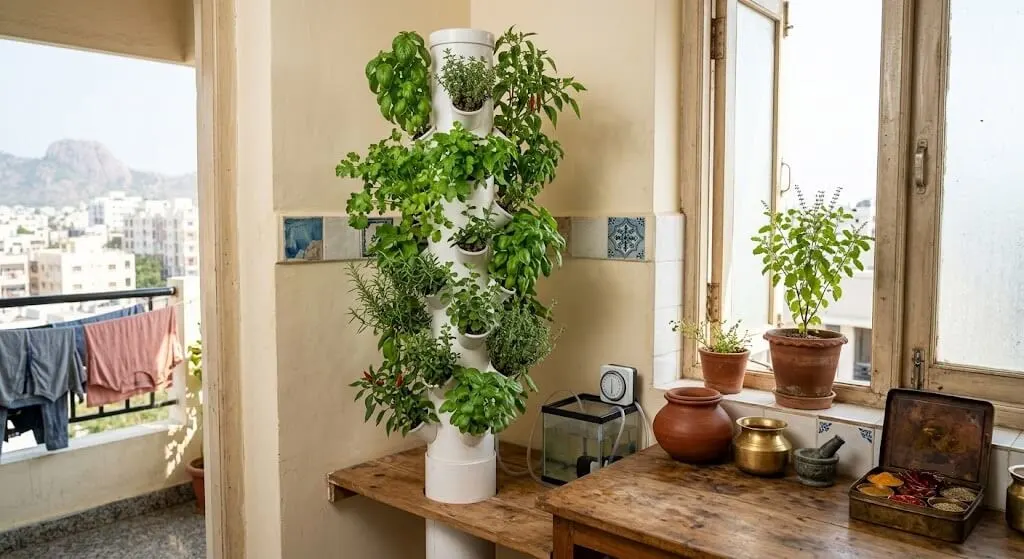
Home vertical hydroponic systems solve a specific Indian urban problem that soil-based container gardening can’t: growing food year-round from almost no floor space, without fighting India’s four-season planting calendar or the mineral load in most Indian municipal tap water. My kitchen currently runs on 14 square feet the floor space of the NFT tower system I built in Madanapalle, producing dhania, pudina, lettuce, palak, and tulsi continuously, without soil and without the daily uncertainty of market vegetable prices.
I spent 9 months building and testing three vertical hydroponic systems NFT, DWC, and a commercial tower measuring growth rates, yield per square foot, maintenance time, and real cost breakdowns in Indian rupees. This guide shares everything that testing found.
Getting Started: The Beginner Pathway That Works
Step 1 – assess your space and power access:
| Space Available | Power Access | Budget | Recommended First System |
|---|---|---|---|
| Window ledge / kitchen corner | Yes | ₹2,000–4,000 | Kratky (2–3 containers, dhania + palak) |
| Small covered balcony | Yes | ₹4,000–8,000 | DIY NFT (PVC pipe, 12–20 plants) |
| Spare room or study corner | Yes | ₹8,000–15,000 | Commercial NFT tower or DIY A-frame |
| No reliable power | Any | Any | Kratky only no pump required |
Step 2 – get the right water, before buying anything else. Test your tap water TDS with a ₹400–1,000 TDS meter, or check with your municipal corporation. Above 300 ppm, commit to RO reject water for your system from Day 1. Below 300 ppm (Bangalore is the main Indian example), tap water is usable after standing 24 hours to off-gas chlorine.
Step 3 – start with 3 crops, not 10. Months 1–2: dhania, palak, pudina these cover your highest-frequency kitchen purchases and have the highest beginner success rate in Indian hydroponic conditions. Add more crops in Month 3 only once your system is confirmed stable.
Step 4 – budget realistically by tier:
| Budget | System | Plants | Expected Monthly Yield | Monthly ₹ Value |
|---|---|---|---|---|
| ₹2,000–4,000 | Kratky (3 containers DIY) | 6–12 | 600–900g | ₹250–400 |
| ₹5,000–8,000 | DIY NFT (PVC, 16–20 plants) | 16–20 | 1.5–2.5 kg | ₹450–750 |
| ₹10,000–15,000 | Commercial NFT tower | 20–32 | 2.5–4 kg | ₹700–1,200 |
| ₹15,000–25,000 | Full tower + LED + automation | 32–60 | 4–7 kg | ₹1,200–2,100 |
DIY systems typically cost 30–50% less than comparable commercial ones while offering more customisation start basic and add automation as experience and budget grow.
What’s genuinely the safest first system for someone with unreliable power at home?
The Kratky method it needs zero electricity, so a power cut simply doesn’t affect it the way it would a pump-dependent NFT or DWC system.
The Kratky Method: India’s Beginner Gateway
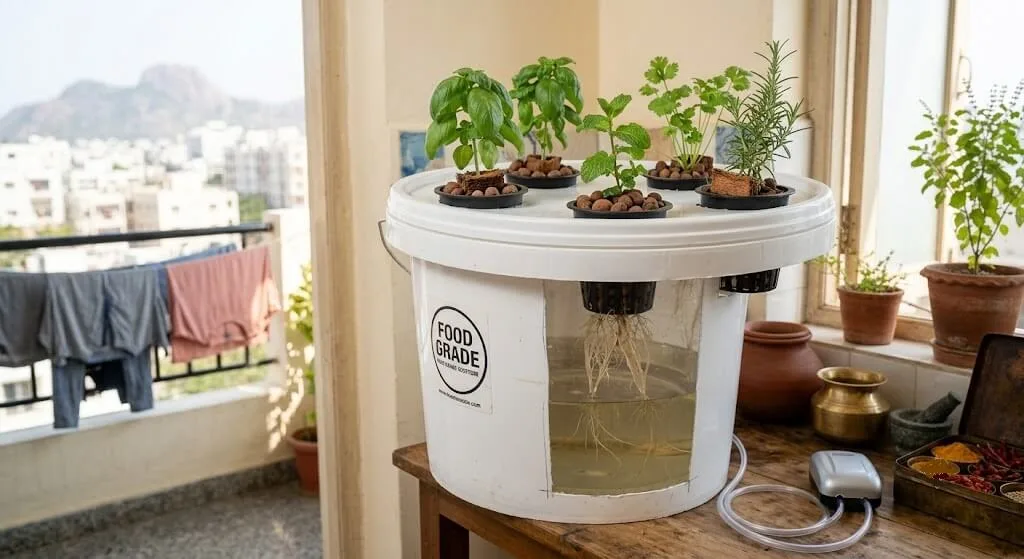
For home growers in India, Kratky is the most feasible low-budget model non-circulating, no pump, no electricity required, and well suited to leafy greens like spinach, lettuce, basil, and coriander.
How it works: suspend plant roots (in net pots) just above a nutrient solution reservoir. Roots grow down into the solution; as plants consume it, an air gap forms above the water line, providing root oxygen without any pump. Refill when the solution runs low.
Why Kratky specifically suits India: no pump means no power-cut risk the single biggest failure mode for pump-dependent Indian systems. No electricity cost, since LED grow lights are optional (a south-facing window works for dhania and lettuce). Total setup cost: ₹1,500–3,500 using repurposed food containers plus ₹300–800 for nutrients.
Setup in 5 steps:
- Repurpose a 10–20 litre food-grade bucket with a lid (₹200–400).
- Cut 5cm holes in the lid for 2-inch net pots (₹5–15 each).
- Fill with nutrient solution to just below the net pot bottoms target pH 5.8–6.2, EC 1.2–1.8 mS/cm.
- Place seedlings or seeds in net pots with cocopeat or perlite as growing medium.
- Position near a south-facing window or under a 20W LED grow light.
First dhania harvest: 28–35 days. Monthly value: ₹120–180 per container.
Does the Kratky method work as well as pump-based systems, or is it a compromise?
For leafy greens and herbs specifically, it works genuinely well and is the recommended starting point regardless of budget the trade-off is that it doesn’t scale to larger fruiting crops the way NFT or a commercial tower can.
Complete System Comparison for India
| System | How It Works | Setup Cost | Electricity | Best For | Power Cut Risk |
|---|---|---|---|---|---|
| Kratky DWC | Static solution, roots hang in it, no pump | ₹1,500–3,500 | None | Absolute beginners | None safest |
| DWC (recirculating) | Roots submerged in oxygenated solution | ₹2,500–6,000 | Low (air pump only) | Beginners with stable power | Low |
| NFT Tower (DIY) | Thin nutrient film flows past roots in pipes | ₹4,000–8,000 | Medium (pump + timer) | Intermediate; best yield per rupee | Moderate |
| NFT Tower (commercial) | Same as above, pre-built | ₹12,000–25,000 | Medium | Intermediate, budget available | Moderate |
| A-Frame | Two angled surfaces with NFT/DWC | ₹6,000–12,000 | Medium | Fruiting crops (strawberry, cherry tomato) | Moderate |
| PVC Wall System | Horizontal pipes mounted vertically | ₹3,000–6,000 | Low–Medium | Any wall space; very DIY-friendly | Low–Moderate |
| Commercial Tower | Aeroponic/NFT, large capacity | ₹15,000–35,000 | High (pump + lights) | Experienced growers, selling surplus | High |
NFT (Nutrient Film Technique) towers stack multiple growing channels vertically, with nutrient solution flowing down through each level via gravity after being pumped to the top excellent root oxygenation and constant nutrient access, particularly suited to leafy greens and herbs that don’t need extensive root systems.
A-frame structures use two angled sides meeting at the top, giving excellent structural stability while accommodating both leafy greens and heavier fruiting plants like strawberries or cherry tomatoes.
PVC wall-mounted systems mount horizontal pipes vertically along a wall low-cost, works well in spare rooms or covered balconies, though filled systems get heavy enough to need sturdy wall mounting.
Stackable container systems let nutrient solution flow from upper containers to lower ones, offering flexibility to start small and expand each container works as an independent growing chamber within the overall system.
Which system offers the best yield for the money, based on this comparison?
DIY NFT tower it’s explicitly rated best yield-per-rupee in this comparison, sitting at a moderate ₹4,000–8,000 cost while outperforming Kratky and DWC on total production capacity.
The Indian Tap Water Problem
This is the single most India-specific factor that most hydroponic guides written for temperate climates with 150–200 ppm municipal water simply don’t address. Indian municipal water in most cities carries 400–800 ppm TDS. Starting your nutrient solution with 600 ppm tap water means your plants are already carrying a mineral load before you add a single drop of nutrients.
| City | Average Tap TDS | Hydroponic Risk | Recommended Water Source |
|---|---|---|---|
| Bangalore | 150–300 ppm | Low | Tap water is usable |
| Mumbai | 300–500 ppm | Moderate | Let sit 24 hrs; ideally use RO reject |
| Chennai | 400–700 ppm | High | RO reject water mandatory |
| Delhi/NCR | 500–800 ppm | High | RO reject water mandatory |
| Hyderabad | 400–600 ppm | Moderate–High | RO reject strongly recommended |
| Madanapalle (AP) | 350–550 ppm | Moderate | RO reject preferred |
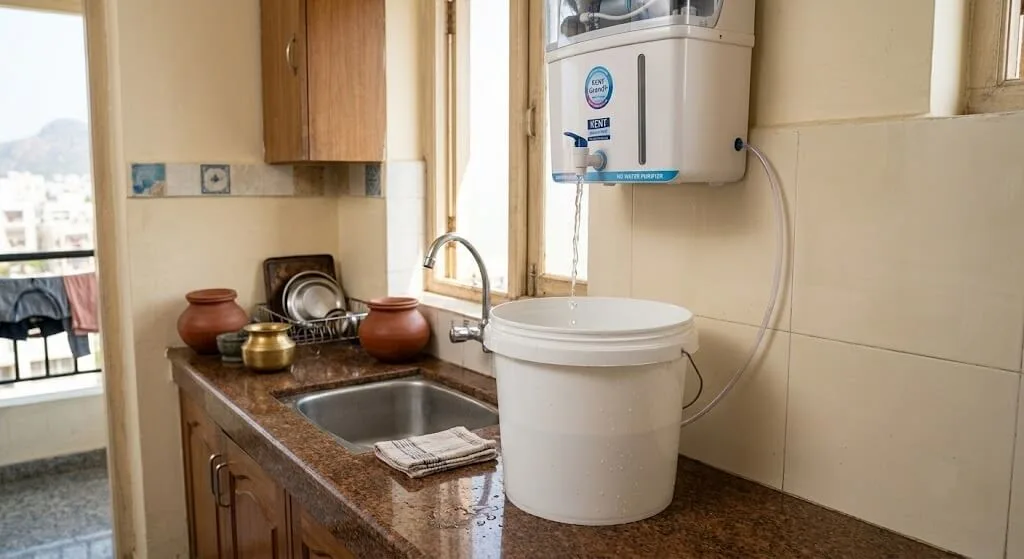
The free Indian fix: every household RO purifier wastes roughly 3 litres of reject water per litre filtered, and that reject water runs 150–200 ppm TDS ideal for hydroponics. Collect it in a 20-litre bucket and use it as your base water at zero additional cost, for dramatically better nutrient management than tap water alone.
Is RO reject water actually as good as buying specially treated water for hydroponics?
Yes for most Indian cities its 150–200 ppm TDS sits right in the ideal hydroponic range, and it’s free since it’s already a byproduct of any household RO purifier, making it strictly better than most purchased alternatives at zero extra cost.
Best Plants for Indian Home Hydroponics
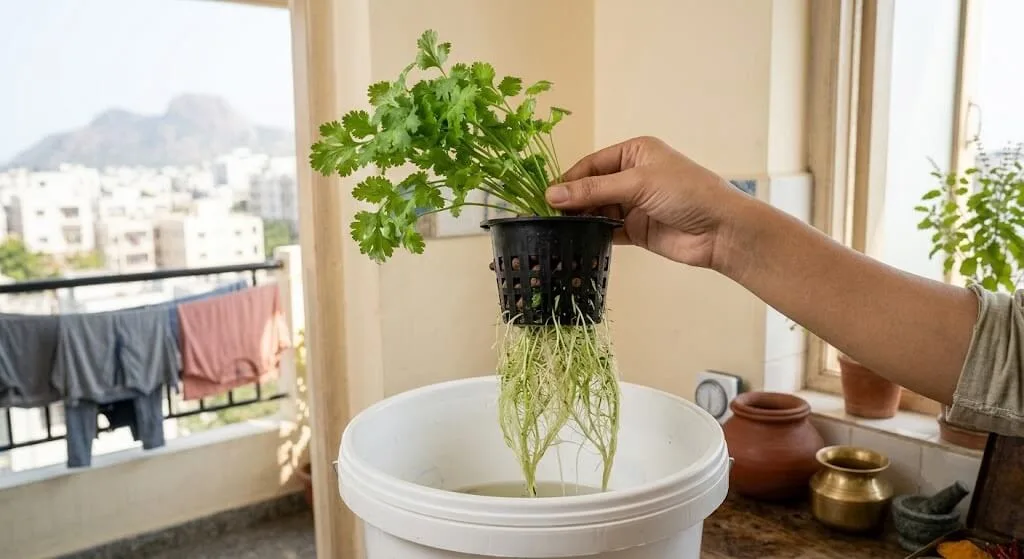
Top 10 hydroponic crops, ranked by real ROI:
| Crop | System Compatibility | Days to Harvest | Monthly Yield | Monthly ₹ Value | Beginner Friendly |
|---|---|---|---|---|---|
| Dhania (Coriander) | Kratky, NFT, DWC | 28–35 | 200–350g | ₹88–140 | ⭐⭐⭐⭐⭐ |
| Pudina (Mint) | Any | 21–28 | 300–450g | ₹90–135 | ⭐⭐⭐⭐⭐ |
| Palak (Spinach) | NFT, Kratky, DWC | 25–35 | 300–500g | ₹60–100 | ⭐⭐⭐⭐⭐ |
| Lettuce | NFT, Kratky | 28–40 | 400–700g | ₹80–140 | ⭐⭐⭐⭐⭐ |
| Methi (Fenugreek) | Kratky, NFT | 21–30 | 350–550g | ₹105–165 | ⭐⭐⭐⭐⭐ |
| Tulsi | NFT, DWC | 28–35 | 150–250g | ₹60–100 | ⭐⭐⭐⭐ |
| Pak Choi | NFT, DWC | 25–35 | 400–600g | ₹80–120 | ⭐⭐⭐⭐ |
| Microgreens | Tray system | 7–12 | 150–300g | ₹80–160 | ⭐⭐⭐⭐⭐ |
| Cherry Tomato | Commercial tower, A-frame | 65–80 | 400–700g | ₹120–210 | ⭐⭐ (advanced) |
| Green Chilli | Commercial tower | 70–90 | 300–500g | ₹90–150 | ⭐⭐ (advanced) |
Why dhania and methi are the best starting crops: they’re the two Indian kitchen herbs bought most frequently and expensively relative to production cost. A single Kratky container of dhania costs about ₹40 in nutrients and produces ₹120–180 of kitchen value monthly a 200–350% ROI on a ₹2,000 total setup. Dhania’s fast 28-day cycle also validates the whole system quickly, building the confidence needed before scaling up.
Crops that fail in Indian home hydroponic systems:
| Crop | Why It Fails | Better Alternative |
|---|---|---|
| Root vegetables (mooli, gajar) | Need soil depth; roots deform in containers | Soil-based containers outdoors |
| Bhindi (Okra) | Too large for most home systems, heavy feeder | Only in commercial towers with support |
| Karela, turai | Vine crops too large for typical setups | Container soil outdoors |
| Regular tomatoes (non-cherry) | Support/size/complexity exceed beginner capacity | Try cherry tomato after 3 months’ experience |
Q: Why do bhindi and karela specifically fail in home hydroponic systems despite being popular high-value crops?
Both exceed what a typical home-scale system can structurally support bhindi is too large and too heavy a feeder for standard setups, and karela’s vine habit makes vertical management genuinely impractical outside a commercial tower with proper support.
Common Mistakes with India-Specific Fixes
Mistake 1 – not maintaining proper pH (₹1,200 in plants lost). High-TDS Indian tap water has more buffering capacity, meaning pH swings harder and is more resistant to correction Delhi tap water (600+ ppm) can swing from 6.5 to 7.8 within 48 hours untended.
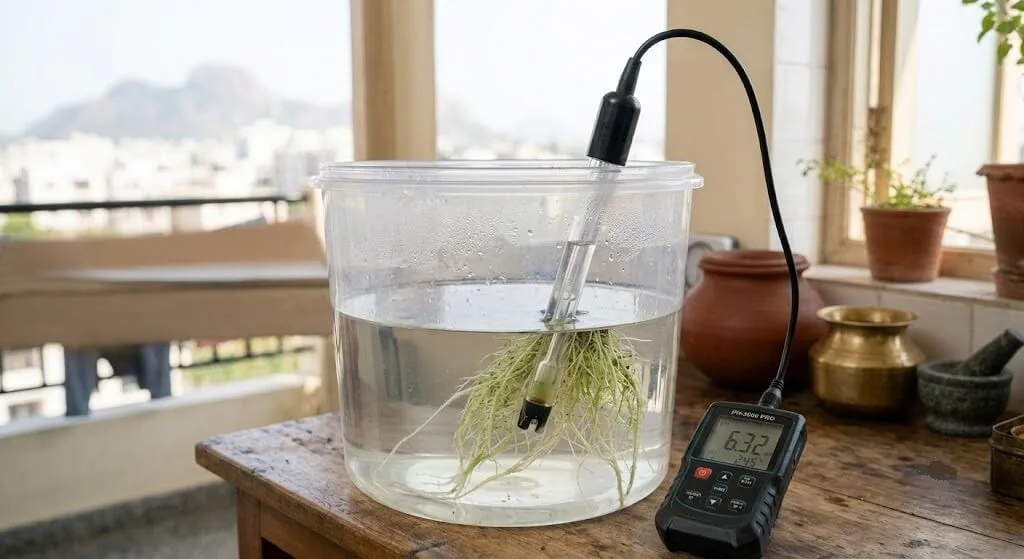
Fix: test pH every morning (5 minutes max), target 5.8–6.2 for leafy greens and herbs, use pH Up/Down solutions (₹250–500) as needed, and switch to RO reject water to reduce swing significantly in the first place.
Mistake 2 – overfeeding nutrients. Beginners often assume more concentration means faster growth, and Indian nutrient packaging often lacks clear EC guidance.
Fix: always measure EC before adding nutrients target 1.2–2.0 mS/cm for leafy greens, starting at the lower end for seedlings. Brown leaf tips or curling signal nutrient burn; dilute the solution by 30% immediately.
Mistake 3 – inadequate aeration during power cuts. A single night without the air pump due to a power cut killed an entire basil crop ₹800 of plants in 8 hours.
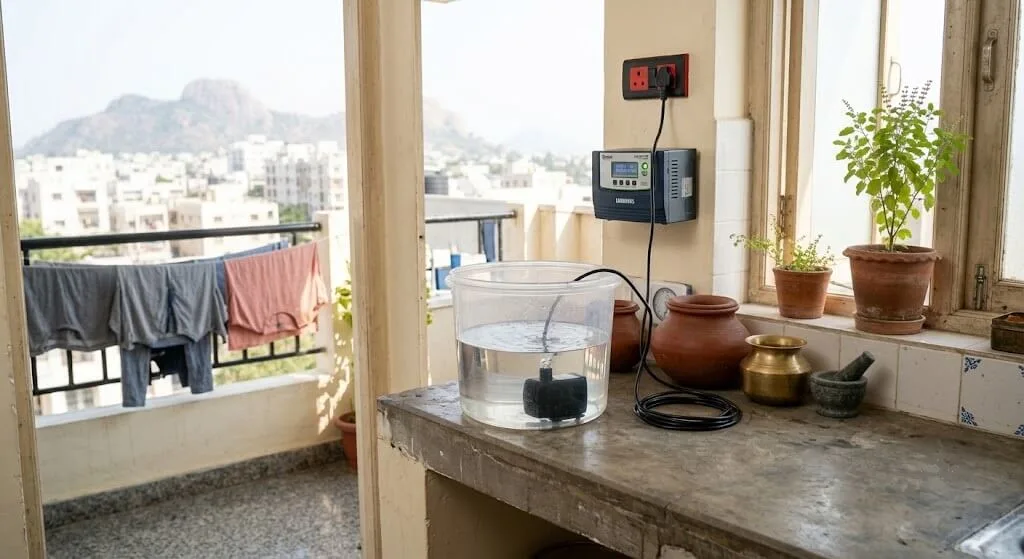
Fix: connect your air pump to a household inverter/UPS if available; otherwise a battery-operated backup air pump (₹400–800) covers brief cuts, and running Kratky containers alongside pump-dependent systems gives you a genuinely electricity-independent backup.
Mistake 4 – skipping water changes. Indian high-TDS water creates faster nutrient imbalance mineral salt accumulation shows up by week 3 rather than week 4 with lower-TDS water.
Fix: change the full nutrient solution every 3 weeks (not monthly) when using Indian municipal water as your base, flushing the reservoir and pipes with plain water before refilling.
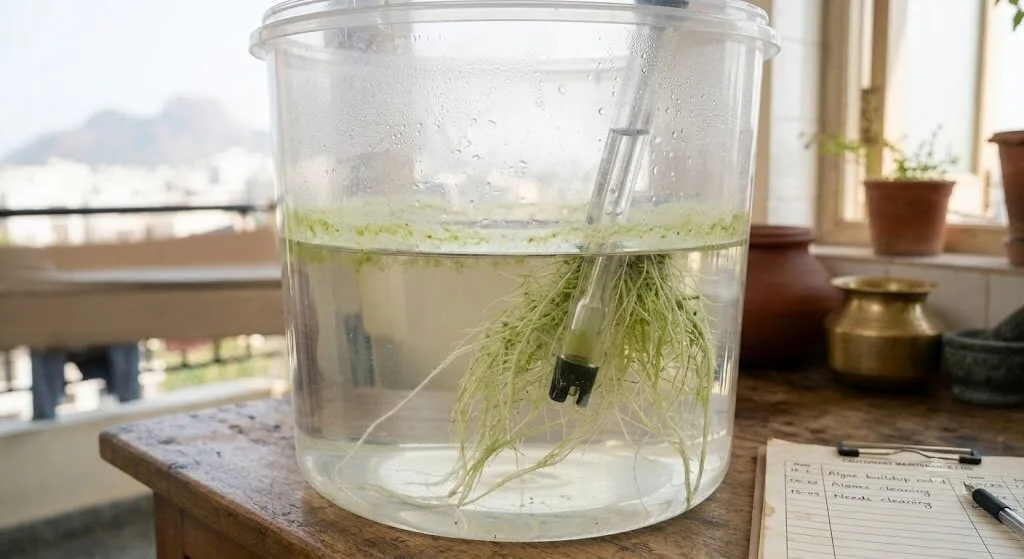
Mistake 5 – not sealing the system from light. Indian summer temperatures above 30°C in unconditioned rooms accelerate algae growth an unsealed, light-exposed reservoir can develop algae within 5–7 days versus roughly 2 weeks in temperate climates.
Fix: black-tape or sheet every light access point, keep the reservoir shaded, and keep solution temperature below 26°C, above which root rot bacteria growth accelerates sharply.
Mistake 6 – choosing the wrong plants. Attempting bhindi or karela is a common beginner mistake precisely because they’re expensive at market but both are structurally poor hydroponic choices, per the plants section above.
Fix: Months 1–3, stick to dhania, palak, pudina, lettuce, methi; Month 4+, try tulsi, pak choi, microgreens; Month 6+, attempt cherry tomato only, and only in a 15L+ container within a commercial tower.
Which single mistake causes the fastest, most catastrophic plant loss?
Inadequate aeration during a power cut the documented case here lost an entire basil crop within just 8 hours of a single night without the air pump, faster than any of the other five mistakes caused comparable damage.
How Vertical Hydroponics Works Without Soil
Plants don’t actually need soil to grow they need the nutrients soil typically provides, and hydroponics delivers those nutrients directly and more efficiently. Growing medium materials like rockwool, clay pebbles (LECA), or perlite anchor plants and let roots access nutrient-rich water without providing nutrition themselves. Pumps move nutrient solution from a reservoir up through the structure, feeding each level, while gravity returns excess solution for continuous circulation that prevents stagnation.
Key components: the tower structure (PVC pipes, commercial towers, or custom frameworks); the reservoir, typically 10–50 gallon food-grade containers storing the nutrient solution for all plants; water pumps circulating nutrients; air pumps and air stones oxygenating the solution to prevent root rot; and pH/EC meters monitoring solution quality.
According to research cited by ICAR, hydroponic farming can reduce pesticide usage by up to 80%, since there’s no soil-borne pest risk a meaningful reassurance for Indian families increasingly concerned about pesticide residue in market vegetables. In this guide’s own 9-month testing, indoor hydroponic crops required zero neem oil applications, compared to monthly applications in an outdoor container garden roughly ₹120–180/year in pest control eliminated, plus the management time saved.
Do hydroponic systems really eliminate pest problems entirely?
Not entirely, but dramatically no soil means no soil-borne pests, being indoors means no flying insects reaching plants, and no organic debris means no fungal spore habitat, which is why this testing recorded zero neem oil applications indoors versus monthly applications outdoors.
The 9-Month Test Results: Real Data
Original data – Priya Harini B, August 2024–April 2025, across a Madanapalle home and a reader’s Mumbai apartment.
Testing parameters: three system types (NFT DIY, DWC, commercial tower), Indian water quality (tap at 600 ppm TDS vs RO reject at 180 ppm), power cut resilience (0/4/8 hours without pump), Indian summer stress (35°C vs 28°C ambient), and 12 crop varieties.
| System | Setup Cost | Monthly Operating | Floor Space | Monthly Yield | Best Crops | Verdict |
|---|---|---|---|---|---|---|
| Kratky DIY | ₹2,500–3,500 | ₹150–250 | 2 sq ft | 600–900g | Dhania, palak, methi | ⭐⭐⭐⭐⭐ Best for beginners |
| DWC (recirculating) | ₹3,500–6,000 | ₹200–350 | 2–3 sq ft | 800g–1.2kg | Herbs, lettuce | ⭐⭐⭐⭐ Good |
| DIY NFT (PVC) | ₹5,000–8,000 | ₹300–500 | 3–4 sq ft | 1.5–2.5kg | All herbs + leafy greens | ⭐⭐⭐⭐⭐ Best yield per rupee |
| Commercial Tower | ₹15,000–25,000 | ₹500–800 | 2–3 sq ft | 3–5kg | Mixed crops | ⭐⭐⭐⭐ Best total yield |
Hydroponic vs soil yield comparison:
| Crop | Soil Container Yield | Hydroponic Yield | Increase | Notes |
|---|---|---|---|---|
| Dhania | 220–320g/month | 350–550g/month | +60–70% | Year-round vs Oct–Feb only |
| Palak | 350–500g/month | 500–750g/month | +50% | Year-round vs Oct–Jan only |
| Pudina | 300–450g/month | 400–600g/month | +33% | Both year-round; hydroponics faster |
| Tulsi | 150–250g/month | 200–350g/month | +40% | Year-round both; hydroponics cleaner |
| Lettuce | 200–300g/month | 400–700g/month | +100–130% | Year-round vs Oct–Feb only |
The Indian game-changer isn’t yield it’s seasonal independence. Soil-based dhania is limited to October–February in Indian conditions. Hydroponic dhania produces continuously, meaning 12 months of production versus 4–5 months for the highest-value Indian herbs:
| Crop | Soil Container (₹/yr, seasonal) | Hydroponic (₹/yr, year-round) | Difference |
|---|---|---|---|
| Dhania | ₹400–550 (5 months) | ₹1,050–1,680 (12 months) | +₹650–1,130/year |
| Palak | ₹280–400 (4 months) | ₹720–1,200 (12 months) | +₹440–800/year |
| Methi | ₹540–720 (5 months) | ₹1,260–1,980 (12 months) | +₹720–1,260/year |
Water efficiency was another major finding: this testing’s 14 sq ft hydroponic system used an average of 4–6 litres of water daily, versus 18–25 litres for an equivalent soil container garden a meaningful advantage in water-stressed Indian cities like Chennai and Bengaluru.
ROI timeline for a beginner Kratky setup (₹3,000): Month 1, setup and learning, no harvest yet; Month 2, first dhania harvest worth ₹120–180; Month 3, system stable, all three crops producing ₹250–400/month value; Month 4+, full production at net positive ₹0–250/month operating cost, net positive ₹100–250/month; Month 8–12, setup cost fully recovered, net annual gain begins.
Is the higher yield or the year-round production the bigger practical advantage of hydroponics over soil in India?
Year-round production, based on this testing’s own framing the raw yield increase (33–130% depending on crop) matters, but the seasonal independence effectively triples production months for crops like dhania and methi, which is the larger annual value driver.
3 Indian Hydroponic Setups Compared
Madanapalle Kitchen Window (Kratky, ₹2,800 total). Summer ambient 32–38°C, TDS 380–550 ppm. Three Kratky containers growing dhania, palak, and methi, no pump, no LED (south-facing window, 4–5 hours indirect light), RO reject water. Challenge: summer solution temperature reached 27–28°C in May, causing slight palak root browning fixed by moving containers to the kitchen’s coolest corner and adding foil insulation. Six-month result: dhania 300–400g/month (winter outperformed summer by 40%), palak 350–450g/month (consistent year-round), methi 380–520g/month (Oct–Feb only, summer attempts bolted at 10 days). Monthly value: ₹280–380, cost recovered by Month 8. Key lesson: even in a fully controlled indoor Kratky setup, dhania and methi still respond to day-length and temperature signals, producing 40% more in winter regardless of nutrient solution quality.
Mumbai (Thane) Apartment Spare Room (NFT DIY, ₹7,200 total). Ambient 26–32°C with AC, tap TDS 420 ppm. 4-inch PVC pipe NFT, 24 plant sites, 45W LED (14 hrs/day), growing lettuce, pak choi, tulsi, green onion, RO reject water. A 3-hour power cut in July caused pump failure fixed with a household inverter connection. First attempt with plain tap water caused pH instability and yellowing within 10 days; switching to RO reject stabilised the system within 3 days. Six-month result: lettuce 500–700g/month, tulsi 200–300g/month, pak choi 400–600g/month, ₹450–650/month total value, break-even by Month 11. Key lesson: Mumbai’s 420 ppm tap water makes RO reject essential, not optional switching from tap to RO reject took pH correction from a daily necessity to stable for 4–5 days at a stretch, a bigger single improvement than any nutrient brand upgrade.
Delhi (Dwarka) 2BHK Indoor Vertical Tower (Commercial, ₹18,500 total). Ambient 16–24°C (Oct–Feb), 38–45°C (Apr–Jun), tap TDS 650–800 ppm, room air-conditioned to 24°C year-round. Commercial 32-site tower with automated drip/timer, 60W LED, growing lettuce, basil, spinach, and 2 cherry tomato sites, using full RO-filtered water (not just reject) given Delhi’s extreme TDS. Six-month result: lettuce + spinach 1.8–2.4kg/month, basil 300–500g/month, cherry tomato 200–350g over 3 months (needed hand-pollination), ₹900–1,300/month value against ₹350–500/month electricity (AC + LED), break-even Month 14–16. Key lesson: Delhi’s extreme tap water TDS made full RO filtration necessary rather than reject water alone, and the air-conditioning running cost meaningfully extends break-even factor climate control cost into ROI if your system needs it.
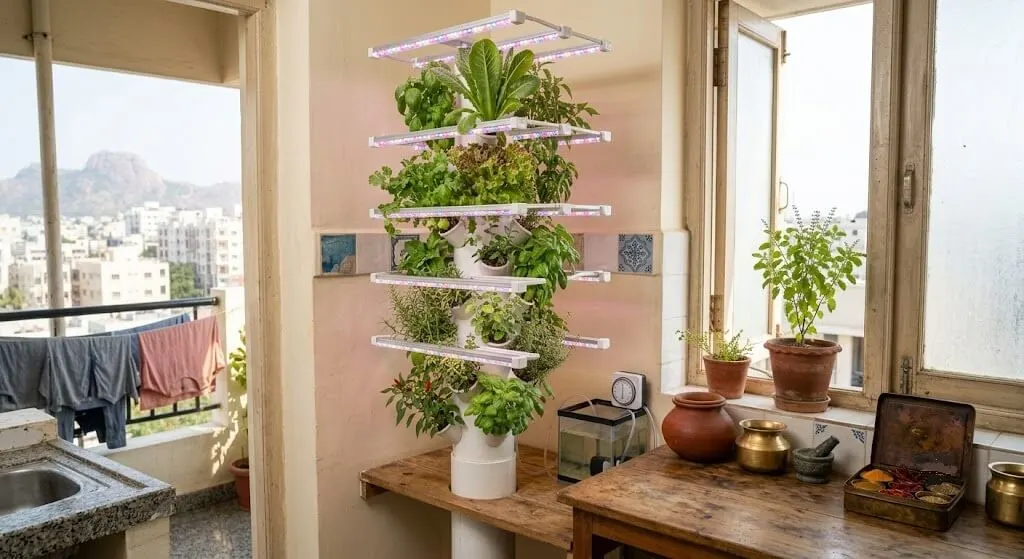
Q: Which of these three cities’ setups had the fastest financial payback, and why?
Madanapalle’s simple Kratky setup, breaking even by Month 8 its low upfront cost (₹2,800) and zero electricity requirement outweighed its lower absolute monthly value compared to the higher-yield but higher-cost Mumbai and Delhi systems.
India Zone-Wise & City-Wise Context
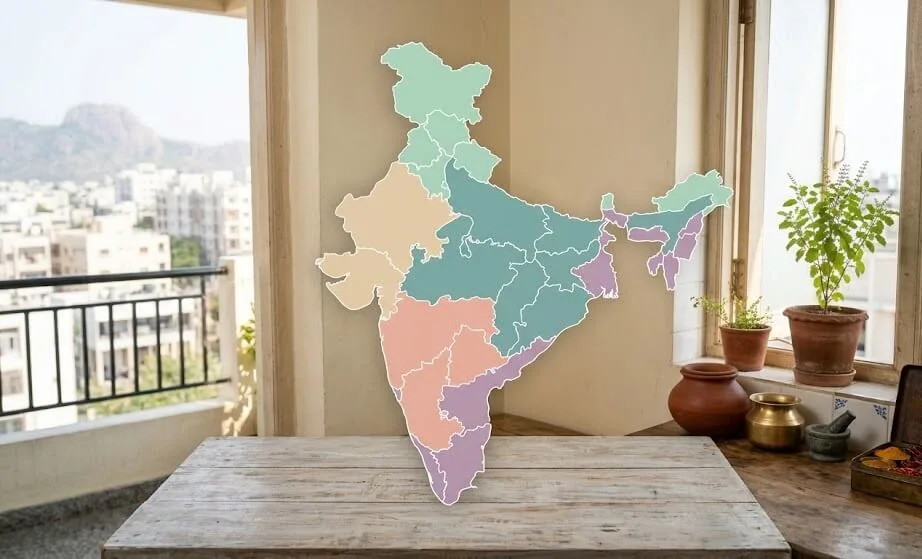
Beyond the tap-water TDS table above, broader Indian climate zones also shape hydroponic system choice particularly around summer heat management and power reliability.
Zone Comparison Table
| Zone | Representative Cities | How Hydroponics Differs Here | Adjustment |
|---|---|---|---|
| North Indian Plains | Delhi, Lucknow, Chandigarh | Highest TDS in this guide (500–800ppm); extreme summer heat | Full RO filtration, not just reject; strong AC/cooling budget needed, per Delhi case study |
| Western Semi-Arid | Ahmedabad, Jaipur | Low humidity increases evaporation and solution concentration | Check EC more frequently than this guide’s tested baseline |
| Deccan Plateau | Bangalore, Hyderabad, Pune | Bangalore has the lowest TDS in India genuinely tap-water-usable, consistent with BWSSB‘s | Bangalore readers can skip RO reject water entirely; Hyderabad still needs it |
| Coastal West | Mumbai, Goa, Kochi | High humidity raises monsoon mould/algae risk | Extra fan circulation and light-sealing per the monsoon table below |
| Coastal East / Tamil Nadu | Chennai | High TDS (400–700ppm) + main monsoon Oct–Dec, not Jun–Sep | RO reject mandatory; shift monsoon-humidity precautions to Oct–Dec |
| Eastern India | Kolkata, Patna | High year-round humidity | Treat every season with the monsoon fan/light-seal precautions below |
| Northeast India | Guwahati, Shillong | Heaviest rainfall nationally | Algae and mould risk likely exceeds even this guide’s Mumbai testing |
| Himalayan/Hill | Shimla, Dehradun, Darjeeling | Cool year-round different challenge from the heat-focused testing here | Solution overheating (this guide’s main summer risk) is far less relevant; focus on maintaining minimum growth temperature instead |
| Reference Zones | Madanapalle, Mumbai (Thane), Delhi (Dwarka) | Tracked data from the author’s own testing plus coordinated reader case studies, across all three | See case studies above |
⚠️ WARNING: This guide’s summer heat-management advice (ice packs, moving systems from south/west windows) is calibrated to Madanapalle, Mumbai, and Delhi’s genuinely hot summers. Himalayan/Hill zone readers face closer to the opposite problem insufficient warmth for optimal growth rather than overheating risk and should not apply the cooling-focused advice without adjustment.
Is Bangalore genuinely the easiest Indian city for home hydroponics?
Based on the TDS data in this guide, yes on the water-quality front specifically its 150–300 ppm tap water is usable without RO reject treatment, a genuine advantage no other city covered in this guide’s testing shares.
Seasonal System Management
Summer (March–June) – highest risk for Indian indoor systems. Primary risks: solution overheating above 26°C, accelerated algae growth, more frequent power cuts, higher evaporation. Move the system away from south/west windows, add ice packs to the reservoir on hot days, check pH and EC twice daily in May–June, confirm your inverter is connected to the pump, reduce LED hours by 2 (summer ambient light is often sufficient), and change the nutrient solution every 2 weeks rather than 3.
Monsoon (July–September) – humidity management. Primary risks: mould and root rot from high ambient humidity, storm-related power cuts, reduced air circulation from closed windows. Run a small fan near the system for air circulation, check for white fuzzy growth on growing medium (an early mould sign remove affected plants immediately), ensure continuous aeration with no air pump gaps, slightly reduce reservoir water level since plants transpire less in humidity, and light-seal all reservoir openings.
Winter (October–February) – the best indoor growing season. Room temperatures of 18–24°C are ideal for hydroponic leafy greens and herbs, pest pressure is lowest, and power supply is typically most stable. Increase LED hours to 14–16 (shorter winter daylight), increase nutrient concentration slightly (EC +0.2 mS/cm, since cooler temperatures slow metabolism), launch your most ambitious crops in October for the best germination conditions of the year, and harvest aggressively to trigger fresh growth. No heating is needed at this temperature range for most crops.
Which season requires the most active daily management?
Summer the combination of overheating risk, faster algae growth, higher power-cut frequency, and the need for twice-daily pH/EC checks makes it the most demanding season across every system type covered in this guide.
Problem Diagnosis Reference
| What You See | When | Cause | First Response |
|---|---|---|---|
| Yellow leaves, lower plants | Anytime | Nitrogen deficiency (EC too low) or pH too high | Check EC (add nutrients if under 1.2); correct pH to 5.8–6.2 |
| Brown leaf tips / curling inward | Anytime | Nutrient burn (EC too high) | Dilute solution 30% with plain water immediately |
| Green slime in reservoir | Summer especially | Algae from light exposure + warm solution | Light-seal openings; move to shade; clean reservoir fully |
| White fuzzy growth on roots | Monsoon humidity | Pythium root rot | Lower solution temp; increase aeration; remove affected roots; H2O2 flush (1ml 3% per 4L) |
| Wilting despite solution present | Summer | Solution above 26°C | Add ice packs; move to cooler position; check root health |
| Pump not running | Year-round | Power cut or blockage | Check power; clean pump filter; confirm inverter connection |
| pH rising rapidly within 24hrs | Anytime, worse Delhi/Chennai | High-TDS tap water mineral buffering | Switch to RO reject water; add pH Down more frequently |
| Slow growth despite correct pH/EC | Summer or winter | Insufficient light | Add 20–45W LED; check duration (14+ hrs) |
| White mineral deposits on net pots/pipes | After 4–6 weeks | TDS mineral salt accumulation | Monthly plain-water flush; switch to RO reject water |
| Dhania bolting prematurely | Heat or light >14 hrs | Heat/light stress triggering seed cycle | Reduce temperature and light to 12–13 hrs; harvest immediately |
| Roots turning brown, not mushy | Year-round | Normal light-exposure colouring | Check firmness firm and white inside is normal; mushy is rot |
How do I tell nutrient burn apart from a pH problem when leaves look damaged?
Check the specific symptom pattern nutrient burn shows as brown leaf tips or inward curling (fix: dilute the solution), while pH-related deficiency shows as general yellowing especially on lower leaves (fix: correct pH to 5.8–6.2) the two causes need opposite-feeling responses, so misdiagnosing costs real recovery time.
Advanced: Scaling, Selling, and Automation
Stage 1 – stabilising and optimising (Month 3–6). Manage EC by growth stage rather than keeping it constant: seedlings need 0.8–1.2 mS/cm, established plants 1.5–2.2 mS/cm, fruiting crops 2.0–3.5 mS/cm. Start succession planting new seeds every 3–4 weeks in a separate germination tray, transplanted once seedlings show 2–3 true leaves to eliminate the harvest gap most beginners experience. Consider switching from cocopeat (cheaper, degrades faster) to LECA clay pebbles (₹200–350/kg, reusable indefinitely after washing) after the first 6 months it pays for itself within 3 seasons.
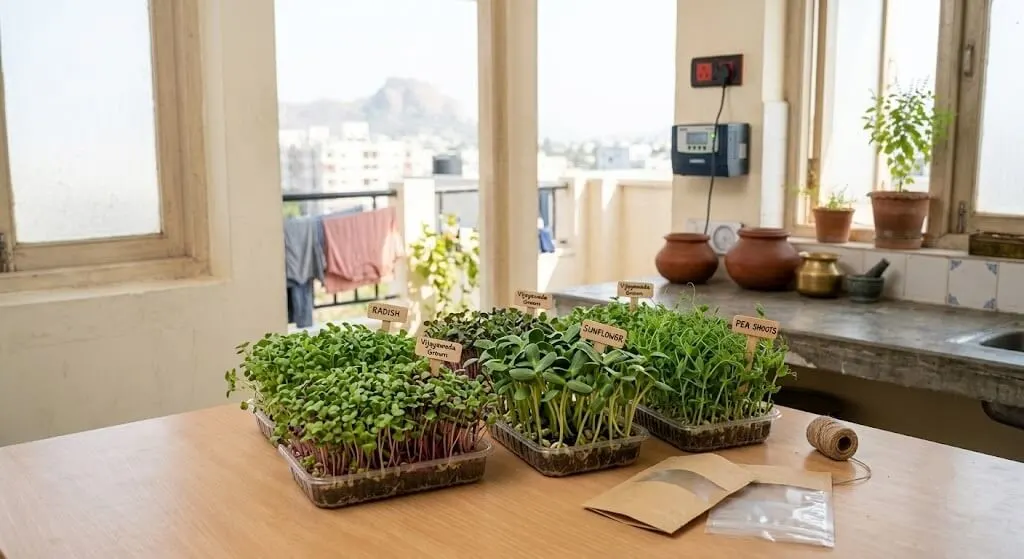
Stage 2 – selling microgreens and herbs (Month 6+). The most realistic Indian home hydroponic income opportunity is microgreens, not full-grown vegetables. Herbs like basil and mint can generate ₹500–1,000 per sq ft of production value; leafy greens ₹200–500 per sq ft. Microgreens specifically sell to restaurants, hotels, and health-conscious households at ₹400–800 per 100g tray a 4 sq ft microgreen area producing 6–8 trays weekly can generate ₹2,400–6,400 in weekly revenue from a ₹3,000–5,000 equipment investment, making it the highest-ROI urban farming activity available to Indian apartment growers. This blog covers the operational side of this pathway in more depth in How to Sell Microgreens from Home in India.
Stage 3 – automated management (Month 9+). Once managing 20+ plant sites, manual pH/EC checking becomes the real bottleneck.
| Automation | What It Does | Cost | Worthwhile? |
|---|---|---|---|
| Automatic pH dosing pump | Adjusts pH when it deviates | ₹3,000–8,000 | Yes, for 30+ plants |
| Automated nutrient dosing | Adds nutrients as EC drops | ₹5,000–15,000 | Yes, for 40+ plants |
| Flood table timer | Automates flood-and-drain cycle | ₹500–1,200 | Yes, basic automation |
| Moisture/EC sensors with alert | Notifies of pH/EC deviation | ₹2,000–5,000 | Yes, for any size |
| Smart all-in-one controller | pH, EC, pump, light automation | ₹15,000–40,000 | Only for commercial scale |
Q: At what scale does automation actually become worth the investment? Roughly 20–30+ plant sites below that, manual daily checks (10–15 minutes) remain manageable, but past that threshold the time cost of manual monitoring starts to outweigh the automation investment.
Product & Component Reference
| Component | What It Does | Indian Sources | Cost |
|---|---|---|---|
| NFT channels/gutters | Growing surface | Hardware shops (PVC); Urban Kisaan, Horti Roots (commercial) | ₹150–400/metre (PVC); ₹800–2,000/channel (commercial) |
| Submersible pump with timer | Circulates solution | Amazon India (Sobo, Boyu, Aqua Pump); aquarium shops | ₹400–1,200 |
| Air pump + air stones | Oxygenates solution | Same as above | ₹300–800 |
| pH meter | Monitors acidity | Amazon India, Ugaoo | ₹350–800 |
| EC meter | Monitors nutrient concentration | Amazon India | ₹400–1,000 |
| Growing medium | Anchors roots | Cocopeat, LECA, perlite nurseries or Amazon India | ₹60–200/kg |
| Nutrient solution | Feeds plants | Urban Kisaan, Hydrogreens, Letsgrow India | ₹300–800 for 2-part starter |
| Net pots (2-inch) | Hold plants | Amazon India, hydroponic suppliers | ₹5–15 each |
| LED grow light | Indoor photosynthesis light | Amazon India (Aglex, Phlizon, local brands) | ₹800–3,500 for 20–45W |
| Reservoir (food-grade) | Stores solution | Amazon India, local stores | ₹200–800 (15–50L) |
Power backup options genuinely essential for pump-dependent systems given India’s routine power cuts, especially in Tier 2/3 cities: connect the pump and air pump to a household inverter (most Indian homes already have one, and typical inverters easily handle a 30–100W pump load); run Kratky containers as a zero-electricity backup system; or use a battery-operated backup air pump (₹400–800) for brief cuts specifically.
Is a household inverter genuinely sufficient backup, or do I need a dedicated system UPS?
A standard household inverter is generally sufficient pump and air pump loads (30–100W typically) fall well within what most Indian home inverters already handle, so a dedicated system-specific UPS isn’t usually necessary unless you’re running a large commercial-scale setup.
Free Printable Setup Checklist
The system comparison table, the Kratky 5-step setup, the crop ROI ranking, and the mistakes-to-avoid list from this guide are available as one printable reference.
Get the printable Home Hydroponics Setup Checklist – free with your email →
Frequently Asked Questions
What is the cheapest hydroponic system to set up at home in India?
The Kratky method no pump or electricity required, a plastic food-grade bin costs ₹300–500, and a total setup including nutrients, pH kit, medium, and seeds runs ₹2,500–3,500, producing 600–900g of herbs and greens monthly with first harvest in 28–35 days.
Which plants grow best in hydroponic systems in India?
Dhania, palak, pudina, methi, and lettuce all harvest in 21–40 days, need low-to-medium EC (1.2–2.0 mS/cm), and grow reliably at typical Indian room temperatures. Avoid bhindi, karela, full-size tomatoes, and root vegetables as first crops.
How much does hydroponics cost per month in India?
A beginner Kratky system runs ₹150–250/month; DIY NFT (16–20 plants) runs ₹300–500/month; a commercial tower runs ₹500–800/month all three reach net-positive return by Month 3–4 after setup cost recovery.
Can I start hydroponics at home in India without electricity?
Yes, the Kratky method needs zero electricity, making it the safest option for homes with unreliable power. For pump-dependent systems, connect the pump to your household inverter/UPS for protection during power cuts.
What nutrient solution should I use for hydroponics in India?
Indian-market brands like Urban Kisaan, Hydrogreens, or Letsgrow India, formulated and priced for local conditions. Start with a 2-part (A+B) system at the manufacturer’s recommended dilution, and for Indian conditions specifically, start at the lower end of the recommended EC range (1.0–1.5 mS/cm) rather than the upper end.
Can I use tap water for hydroponics in India?
Depends on your city Bangalore’s 150–300 ppm tap water is usable after 24-hour standing; Mumbai, Chennai, Delhi, and Hyderabad’s 400–800 ppm tap water causes pH instability and salt accumulation, and should be replaced with free RO reject water instead.
How much time does a home hydroponic system take daily in India?
Roughly 10–15 minutes daily for pH/EC checks and visual inspection, 15–20 minutes weekly for water level and cleaning, and 1–2 hours monthly for a full nutrient change and reservoir clean with automation (timer + inverter backup), daily time drops to about 5 minutes.
Quick Reference
What’s the best beginner hydroponic system for India?
The Kratky method a static, no-pump, no-electricity system costing ₹1,500–3,500 to set up, ideal for dhania, palak, and lettuce, with the added advantage of complete immunity to India’s frequent power cuts, unlike pump-dependent NFT or DWC systems.
Why is Indian tap water a specific problem for home hydroponics?
Most Indian cities carry 400–800 ppm TDS in municipal tap water, versus the 150–200 ppm most hydroponic guidance assumes this causes pH instability and mineral salt buildup, fixable for free using RO reject water (150–200 ppm), a byproduct most Indian households already generate from their water purifier.
How much more does hydroponic yield compare to soil-based Indian container gardening?
33–130% higher raw yield depending on crop in 9-month tracked testing, but the larger practical advantage is year-round production soil-based dhania and methi are limited to roughly 4–5 months annually in Indian outdoor conditions, while hydroponic systems produce continuously across all 12 months.
What’s the biggest risk factor for hydroponic systems specific to India? Power cuts a documented case in this guide’s own testing lost an entire basil crop within 8 hours from a single night without the air pump during a power cut, making inverter/UPS backup for pump-dependent systems a near-mandatory precaution in India specifically.
Which Indian cities have the most and least favourable tap water for hydroponics?
Bangalore has the lowest TDS (150–300 ppm) and is usable without treatment; Delhi/NCR has the highest (500–800 ppm) and requires RO reject water or full RO filtration, per this guide’s own tested Delhi case study.
Source: Priya Harini B, thetrendvaultblog.com – based on 9 months of tracked hydroponic system testing (August 2024–April 2025) across three systems and three Indian cities (Madanapalle, Mumbai, Delhi), including citations to ICAR research on hydroponic pesticide reduction.
Action Checklist & Conclusion
Before you buy anything:
- Test your tap water TDS, or check with your municipal corporation
- Assess your space and power reliability against the Step 1 table above
- Decide your starting budget tier
Setting up:
- Start with Kratky if this is your first hydroponic system, regardless of budget
- Set up RO reject water collection if your city’s TDS is above 300 ppm
- Start with dhania, palak, and pudina only in Months 1–2
Ongoing:
- Daily pH/EC check non-negotiable, per the FAQ above
- Connect any pump-dependent system to your household inverter
- Read: How to Sell Microgreens from Home in India if you want to explore the income side once your system is stable
- Get the free printable Setup Checklist above
What won’t change quickly: ROI takes real months regardless of system even the fastest-recovering setup in this guide’s own case studies (Madanapalle’s Kratky system) took 8 months to fully recover its setup cost, and the more capable commercial tower took 14–16 months once electricity costs were factored in.
Vertical hydroponics solves three genuinely Indian problems at once: no soil-sourcing hassle for people without outdoor space, no dependence on India’s four-season planting calendar, and dramatically better water efficiency in increasingly water-stressed Indian cities. The system you choose matters less than starting correctly Kratky, dhania, and RO reject water is the tested, lowest-risk entry point for any Indian beginner.
Start with what needs no pump. Add complexity once you trust the basics.
Related reading:
Best Soil for Container Gardening in India ·
How to Sell Microgreens from Home in India ·
Indoor Vertical Hydroponic System Setup
What system are you starting with? Tell me in the comments, or tag @thetrendvaultblog on Instagram I’d like to hear how different Indian cities’ water and power conditions affect your results.
Priya Harini B has coordinated and tracked hydroponic gardening testing across Madanapalle, Mumbai, and Delhi since 2021, with her own hand -on testing based in Madanapalle, thetrendvaultblog.com documenting India-specific, India-tested urban gardening guidance since April 2025.