
By Priya Harini B | Madanapalle, Andhra Pradesh | 4+ years container gardening, 40+ plant varieties tested
Quick Answer Box
Quick Answer: An indoor vertical hydroponic system for an Indian balcony costs ₹2,000–4,500 to DIY-build using PVC SWR pipe, a submersible pump, and cocopeat, growing 20–25 plants like palak and dhaniya in just 1 square foot of floor space using 80–90% less water than soil containers, with monthly running costs of ₹200–900.
Table of Contents
Introduction
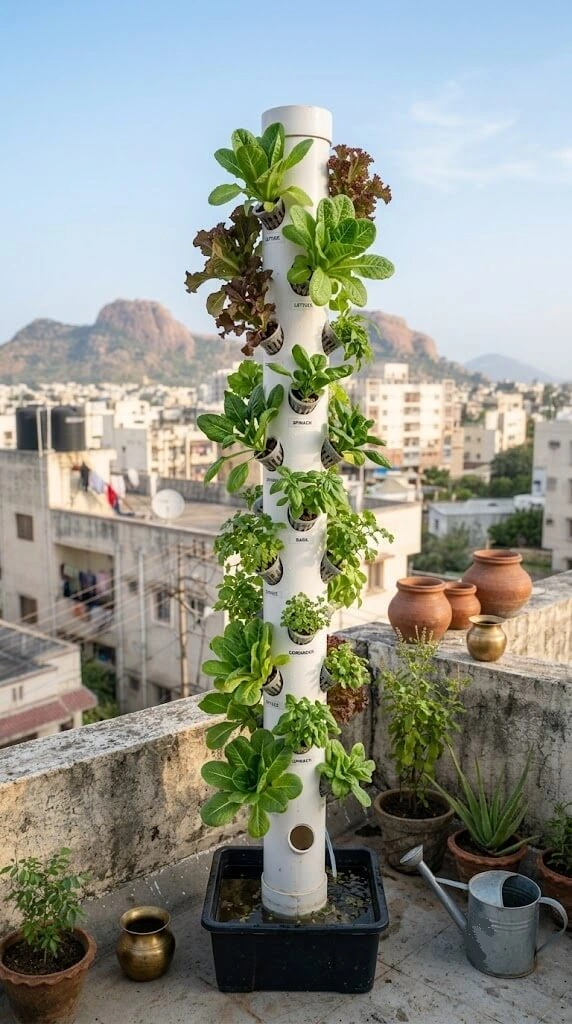
One square foot is all an indoor vertical hydroponic system setup needs to grow 20 to 25 plants on an Indian balcony coriander, spinach, mint, and lettuce, all at once, with zero soil.
If you’ve grown vegetables in soil on an Indian balcony, you already know the problems: heavy grow bags near your building’s weight limits, monsoon waterlogging, and pest cycles that return every season. Each round costs you cocopeat, vermicompost, and dead plants. A vertical hydroponic system solves all of it at once recirculating water, a root zone that never floods or dries, and no soil-borne pests built for under ₹4,500.
New to balcony growing? Start with balcony gardening fundamentals before setting up a hydroponic system.
Why an Indoor Vertical Hydroponic System Works Differently in India
A vertical hydroponic tower is a stacked column of net pots fed by a recirculating nutrient solution instead of soil. In India, three things make this different from the US/UK guides most content is copied from:
- Municipal and borewell water quality varies wildly by city from 100 ppm TDS in Mumbai to over 1,500 ppm in some borewell sources which most hydroponic guides never address because Western tap water is comparatively uniform.
- Indian summers regularly cross 40°C, well past the 18–24°C most hydroponic nutrient charts are written for, which changes reservoir management completely.
- Monsoon humidity (80–90% RH) creates fungal and algae pressure that simply doesn’t exist in the temperate climates most hydroponic content originates from.
Does hydroponics work in Indian apartments?
Yes a vertical tower uses one square foot of floor space, weighs 40–80 kg when full, and grows 20–30 plants using 80–90% less water than soil containers.
Planning Your Indian Balcony Hydroponic System: Site Assessment
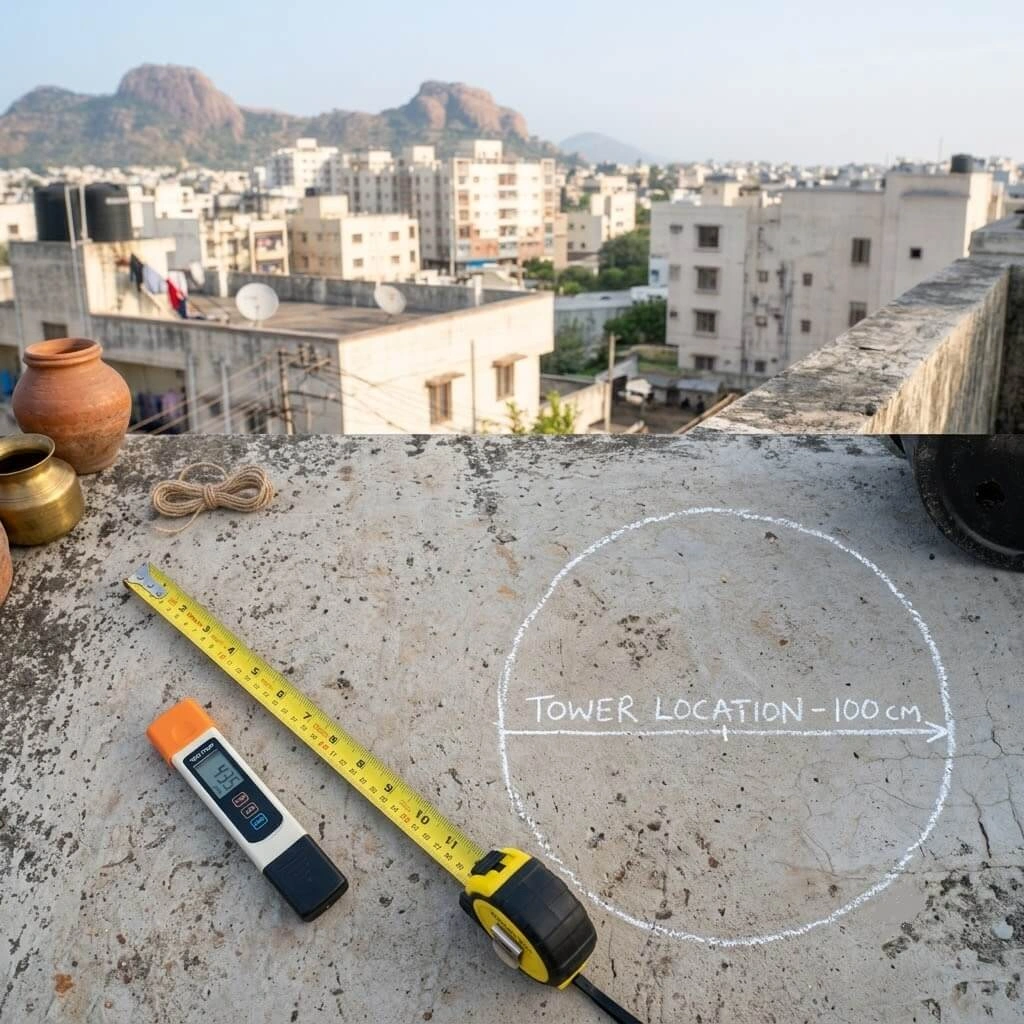
Before buying anything, run your balcony through this 4-point check this is where most Indian hydroponic setups succeed or fail before a single pipe is cut.
| Assessment Point | What to Check | India-Specific Notes |
|---|---|---|
| Weight Load | Balcony structural capacity (typ. 150–200 kg/m²) | Full tower (water + structure): 40–80 kg. Verify with your housing society above the 5th floor |
| Sunlight Hours | Direct sun availability per day | With LED = works even north-facing. Natural light only = south/east-facing minimum |
| Electrical Access | Waterproof outlet near system location | Indian balconies often lack weatherproof sockets plan an IP44-rated extension box |
| Water Supply | Distance from tap; water TDS level | Indian municipal water TDS: 150–600 ppm (varies wildly by city test before buying nutrients) |
| Ventilation | Airflow on balcony | Essential in monsoon stagnant humid air causes fungal root issues even in hydroponics |
Indian City-Wise TDS Reality (Critical for Nutrient Dosing)
| City | Typical TDS Range | What This Means for Hydroponics |
|---|---|---|
| Delhi | 300–500 ppm | Use RO water or halve nutrient dose to avoid EC overshoot |
| Mumbai | 100–200 ppm | Close to ideal; tap water usable directly |
| Bangalore | 150–300 ppm | Usually acceptable; test before full nutrient load |
| Chennai | 400–700 ppm | High TDS RO water strongly recommended |
| Hyderabad | 300–600 ppm | Test mandatory; borewell water often unsuitable |
| Kolkata | 100–250 ppm | Good water quality; tap water usually fine |
| Pune | 150–350 ppm | Varies by source; test first |
| Ahmedabad | Generally hard groundwater | Gujarat groundwater runs hard in most zones RO recommended; confirm with a TDS meter before dosing |
| Madanapalle (reference) | 380–420 ppm | Deccan Plateau borewell-fed zone test before your first nutrient mix |
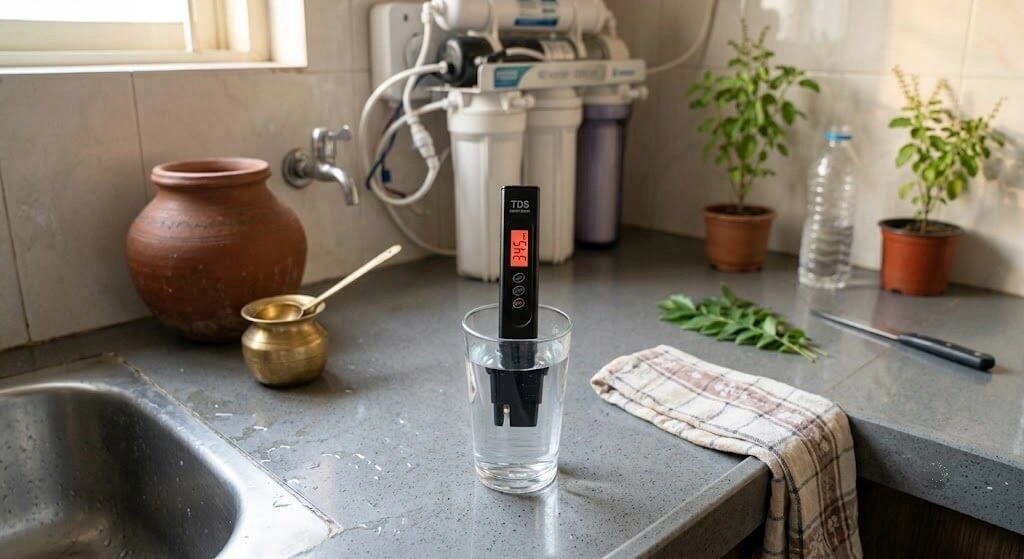
India Critical Note: Borewell water can exceed 1,500 ppm TDS in some areas, making it completely unsuitable for hydroponics without RO treatment. This single factor causes more Indian hydroponic failures than any other. Buy a TDS meter (₹200–400 online) before buying anything else.
Tools, Materials & India Sourcing Guide
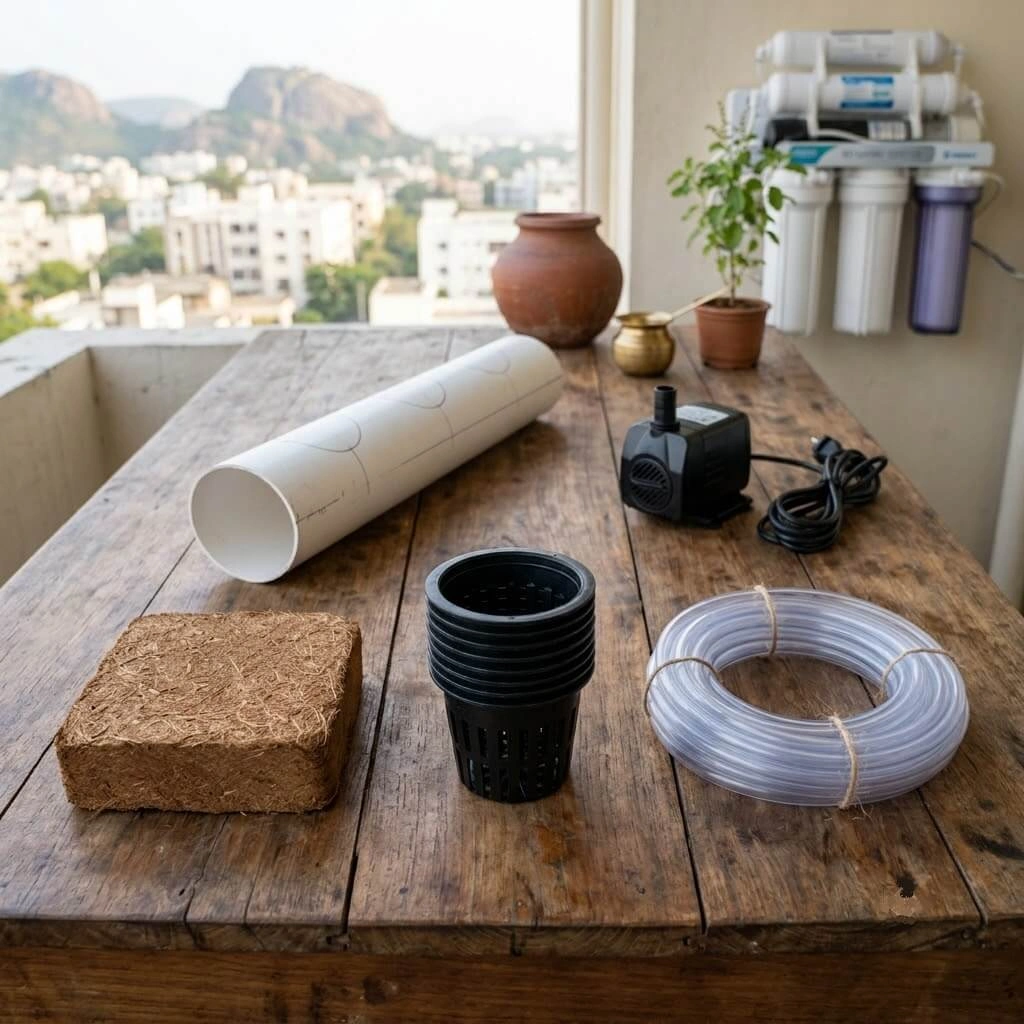
DIY Tower Build India Shopping List
| Material | Specification | India Source | Approx. Cost |
|---|---|---|---|
| PVC pipe (main tower) | 6-inch SWR pipe, 5–6 ft length | Hardware store (Astral, Supreme brand) | ₹350–550 |
| PVC end cap | 6-inch | Hardware store | ₹40–60 |
| Food-grade reservoir | 20–40 litre jerry can / storage container | DMart, local hardware | ₹150–400 |
| Submersible pump | 600–800 LPH (Indian market uses LPH, not GPH) | Amazon India, InHydro.in | ₹400–700 |
| Air pump + air stone | 2–4 watt | Aquarium shop (Aqua One, Sobo brand) | ₹150–400 |
| Food-grade tubing | 12mm ID clear tubing | Hardware / aquarium shop | ₹25–50/metre |
| Net pots | 5cm (2-inch) diameter | Amazon India, InHydro.in | ₹3–8 per pot |
| Growing medium | Cocopeat OR clay pebbles (LECA) | Nursery supply / Amazon | ₹80–200/bag |
| Hydroponic nutrients | 2-part or 3-part liquid | InHydro.in, Amazon India | ₹300–800 |
| pH meter | Digital (TDS + pH combo recommended) | Amazon India | ₹350–800 |
| Hole saw bit | 5cm (2-inch), fits net pots | Hardware store | ₹80–150 |
| TOTAL DIY COST | 20–25 plant tower | ₹2,000–4,500 |
Where to buy in India: InHydro.in (India’s dedicated hydroponic supplier), Ugaoo.com (nutrients, growing media, basic kits), Amazon India (search “hydroponic tower,” “net pots 2 inch”), local aquarium shops (pumps/air stones at roughly half online price), and Supreme/Astral/Finolex hardware stores for PVC pipe.
Which PVC pipe should I use?
Only white or grey uPVC SWR (Soil Waste Rain) pipe never CPVC (cream-coloured, for hot water), which contains additives not rated for food use.
Building the Tower: Cutting, Assembly & Water Circulation
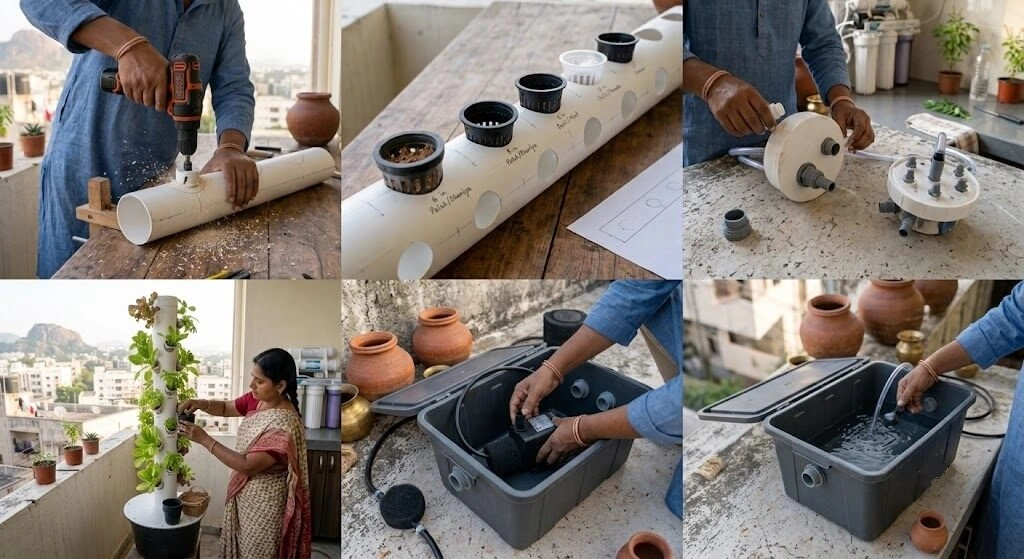
Cutting and Preparing Materials
- Cut the main tower pipe to 5–6 feet.
- Cut net pot holes with a hole saw space 6 inches apart for leafy greens (palak, dhaniya, lettuce, methi), 8 inches for herbs (basil, tulsi, mint), and 10 inches for larger crops (small chilli, cherry tomato).
- Mark hole locations with a paper template before cutting, and test-fit net pots.
- Stagger holes around the pipe circumference.
- Deburr every cut edge to prevent root damage.
Assembling the Tower
- Install the bottom cap with drainage fittings and connect return tubing to the reservoir.
- Mount the tower vertically with stable support and test every connection for leaks.
- Install the top distribution system and connect supply tubing from the pump.
- Add overflow protection at the top.
- Install net pots in sequence, checking spacing and alignment as you go.
Installing Water Circulation
- Choose a pump sized to your tower height (see table below) and install it in the reservoir with a pre-filter to prevent clogging.
- Run the main supply line to the tower top, and check that the distribution manifold delivers even flow to every plant no flooding, no dry spots.
What You’ll Need Total Build: ₹2,000–4,500 · Time: 3–5 hours for a first build
| Tower Height | Required Pump Capacity | Indian Brand Options | Cost Range |
|---|---|---|---|
| Up to 4 ft (1.2m) | 400–600 LPH | Sobo, Boyu, Sunsun | ₹250–500 |
| 4–6 ft (1.2–1.8m) | 600–800 LPH | Sobo WP-1000, Sunsun JP-023 | ₹400–700 |
| 6–8 ft (1.8–2.4m) | 800–1,200 LPH | Atman, Sunsun JP-025 | ₹600–1,200 |
Monsoon-Proof Electrical Setup (non-negotiable in India):
- Use an IP44-rated weatherproof electrical box for every connection on the balcony
- Keep the pump cord connection point at least 30cm above floor level (monsoon splash)
- Use a dedicated MCB for the hydroponic circuit
- Never connect the pump directly to a multi-plug strip in a monsoon-exposed spot
How long does a first-time build take?
Roughly 3–5 hours including a leak test, once every material is sourced and holes are pre-marked.
Growing Medium & Lighting: What Actually Works in India
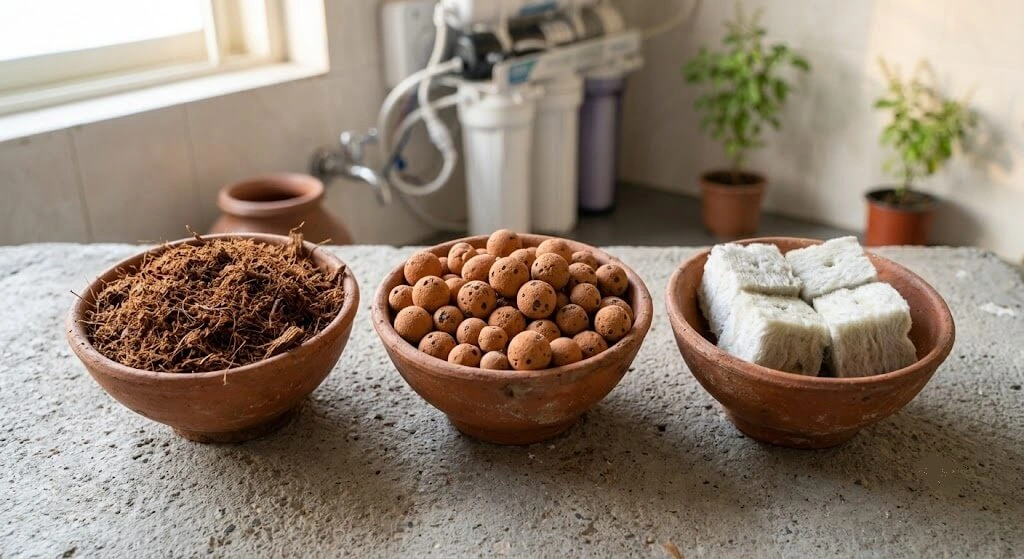
Growing Medium Comparison
| Medium | India Availability | Cost | Best For | India-Specific Notes |
|---|---|---|---|---|
| Cocopeat | Excellent made in Tamil Nadu, Kerala | ₹80–150/bag | All crops; easiest for beginners | Pre-soak 24 hrs; pH-neutral at 5.8–6.2. India’s best-value medium |
| LECA / Clay Pebbles | Good available online | ₹150–300/kg | Reusable, long-term systems | Rinse and soak 24 hrs before first use; reusable by boiling in pH-adjusted water |
| Rockwool | Limited mostly imported | ₹200–500/block | Seed starting, propagation | pH-adjust to 5.5 before use; not widely stocked physically in India |
| Perlite | Moderate nursery supply | ₹100–200/bag | Mixing medium only | Don’t use alone in a tower flows into reservoir. Mix with cocopeat |
| Vermiculite | Good nursery supply | ₹80–150/bag | Seedling trays only | Too fine for towers; clogs the pump |
India Recommendation: Start with cocopeat it’s the only hydroponic medium manufactured at scale in India, 40–60% cheaper than imported alternatives, and fully suited to Indian water quality.
LED Grow Lights India Reality Check
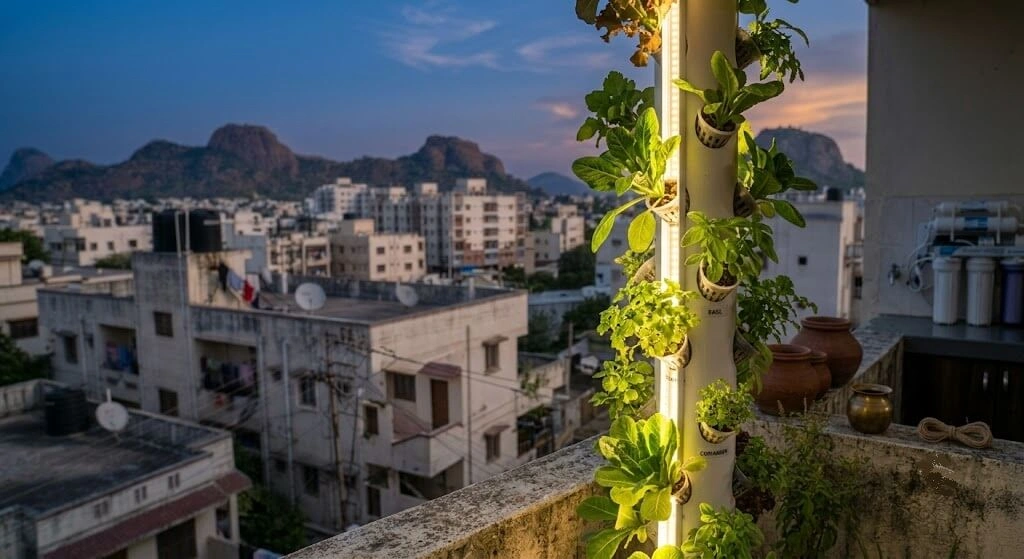
When natural light is enough: South/west balcony with 5–6+ hours direct sun grows leafy greens without LED. East-facing with 4–5 hours works for herbs. North-facing or indoor rooms need LED non-negotiable.
| Light Type | Wattage (20-plant tower) | India Cost | Monthly Electricity Cost | Common Brands |
|---|---|---|---|---|
| Full-spectrum LED bar | 20–30W | ₹800–2,500 | ₹40–80/month | Evluma, Abis, Amazon Basics |
| LED grow panel | 45–65W | ₹1,500–5,000 | ₹90–180/month | Agnihorti, Sankalp, Amazon |
| Quantum board LED | 100–200W | ₹5,000–15,000 | ₹250–500/month | Samsung LM301 chips (imported) |
| Plug-and-play kit light | Included | Included in kit | Varies | InHydro.in, Ugaoo kits |
India electricity math: A 45W LED running 16 hrs/day = 0.72 kWh/day = ₹3–6/day (₹90–180/month) at India’s ₹4–8/unit rate. Add a pump running 24/7 (10–15W = 0.3 kWh/day = ₹30–75/month). Total for a basic single-tower 20-plant system: ₹120–255/month ( larger multi-tower setups run ₹400–900/month)
Nutrients, pH & EC: Managing Indian Water Quality
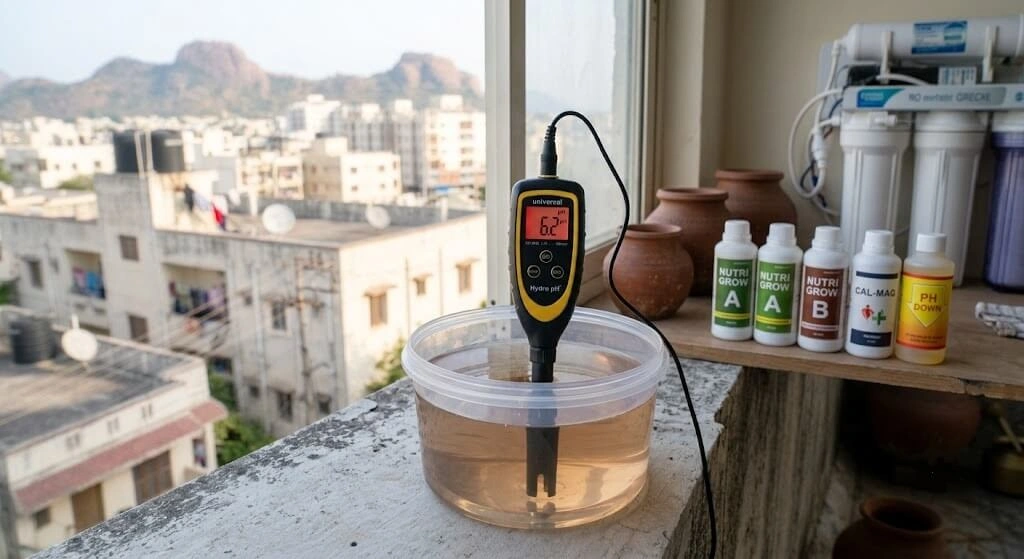
Best Hydroponic Nutrients Available in India
| Product | Type | Cost | Where to Buy | Notes |
|---|---|---|---|---|
| InHydro Liquid Nutrients (A+B) | 2-part | ₹400–600 (1L each) | InHydro.in | Best India-formulated option; balanced for Indian crops |
| Multiplex Multigreen | Powder blend | ₹200–400/kg | Agricultural supply shops | Budget option; not hydroponic-specific but works |
| Krishi-King Hydroponic Nutrient | Powder | ₹300–500 | Amazon India | Mixed reviews; check expiry |
| General Hydroponics FloraGro/Bloom | 3-part liquid | ₹1,200–2,500 | Amazon India (import) | Premium; overkill for a home tower |
| TNC Complete Nutrients | All-in-one liquid | ₹800–1,500 | Online (import) | Good for beginners; single bottle |
| DIY organic (jeevamrut-based) | Organic | ₹50–100 | Self-made | Open NFT systems only blocks tower pumps if unfiltered |
Starter dosing protocol: Weeks 1–2 at 50% recommended dose → Weeks 3–4 at 75% if growth is healthy → Month 2+ at full dose per crop EC target. Change the solution completely every 10–14 days (shorter in Indian summer heat).
The Indian Water Problem TDS, EC & pH
Indian municipal water typically runs pH 7.0–8.5, well above the hydroponic target of 5.5–6.5. Without adjustment, nutrients become chemically unavailable even at correct concentration.
| Water Source | Typical TDS | EC Equivalent | Hydroponic Suitability |
|---|---|---|---|
| RO purified water | 10–50 ppm | 0.02–0.10 mS/cm | ✅ Ideal add full nutrients |
| Municipal tap (Mumbai, Kolkata) | 100–250 ppm | 0.2–0.5 mS/cm | ✅ Good reduce dose 10–15% |
| Municipal tap (Delhi, Bangalore) | 250–500 ppm | 0.5–1.0 mS/cm | ⚠️ Caution reduce dose 20–30% |
| Municipal tap (Chennai, Hyderabad) | 400–700 ppm | 0.8–1.4 mS/cm | ❌ Problematic use RO or blend |
| Borewell water | 500–2,000+ ppm | 1.0–4.0 mS/cm | ❌ Unsuitable RO mandatory |
Target EC by Crop
| Crop | Target EC (mS/cm) | Target pH | India Notes |
|---|---|---|---|
| Palak (Spinach) | 1.8–2.3 | 6.0–7.0 | Very forgiving; ideal first crop |
| Dhaniya (Coriander) | 1.2–1.8 | 5.5–6.5 | Low nutrient need; easiest herb |
| Pudina (Mint) | 2.0–2.4 | 5.5–6.5 | Moderate feeder; grows aggressively |
| Methi (Fenugreek) | 1.2–2.0 | 6.0–7.0 | Nitrogen-sensitive; start EC low |
| Lettuce varieties | 1.2–2.0 | 5.5–6.5 | Low EC; high market value in India |
| Basil / Tulsi | 1.6–2.2 | 5.5–6.5 | Tulsi tolerates a wider pH than Italian basil |
| Cherry Tomato | 2.0–3.5 | 5.5–6.5 | High feeder; needs a larger system |
| Mirchi (Chilli) | 2.0–3.0 | 6.0–6.5 | Medium feeder; compact varieties only |
| Microgreens | 1.0–1.6 | 5.5–6.5 | Very low EC; use half-strength |
pH Down options in India: phosphoric acid solution (₹150–300/250ml, most effective), citric acid powder (₹80–150/100g, cheaper, works well at home scale). Avoid diluted vinegar for anything but an emergency fix.
Why do my EC readings look right but plants still show deficiency?
Hard Indian water often carries carbonate buffering that locks nutrients up chemically even when your meter reads correctly test TDS at the source, not just the mixed solution.
4 Full-Chain Mistakes Indian Hydroponic Beginners Make
Mistake 1 – Not testing water TDS before starting. People assume “water is water.” This causes nutrient lockout and plant death within two weeks. Fix: buy a ₹200 TDS meter before anything else.
Mistake 2 – Using CPVC pipe instead of uPVC SWR. Both look similar at the hardware counter. CPVC contains heat stabilisers not rated for food contact. Fix: always buy white/grey uPVC SWR pipe Astral or Supreme brand.
Mistake 3 – Starting with fruiting crops instead of leafy greens. New growers want tomatoes first. Fruiting crops need precise EC control beginners haven’t built yet, and fail fast. Fix: start with coriander, spinach, and mint to build confidence before scaling up.
Mistake 4 – Pump Clogging and Leaking (July 2024)
About 3 months after setting up my indoor tower, in July 2024, my pump got clogged with debris and started leaking. It wasn’t a dramatic failure, but it was the kind of small, easily-ignored problem that gets worse if left unchecked.
Fix: I took the pump apart, cleaned out the clog, and made a few repairs to the tower structure itself to make future cleaning genuinely easy rather than a hassle I’d keep avoiding. Since then, the problem hasn’t come back — a permanent fix, not a temporary patch.
The lesson from this one is simple: build your tower with cleaning access in mind from the start. A pump that’s hard to reach is a pump that won’t get cleaned regularly, and that’s exactly how small clogs turn into leaks.
Priya’s Personal Story
My indoor hydroponic tower has been running since 2024, growing dhaniya, methi, and amaranth on rotation at home in Madanapalle, harvesting roughly twice a week with germination-to-harvest running 15–18 days depending on the crop.
It wasn’t smooth from the start. In the early days, I wasn’t checking the system regularly enough, and by the time I noticed, several plants had decomposed with visible fungal growth roots gone soft and yellow with a distinct rotting smell (kullipovadam, as we’d call it in Telugu). I removed and discarded the worst-affected plants, but managed to save a portion of the batch.
After that, I cleaned and disinfected the entire reservoir and tower before restarting, changed the water completely, and adjusted the nutrient mix. The bigger change, though, was in habit: I moved from occasional, irregular checking to inspecting the system three times a day. That single change made the real difference since then, I haven’t had a repeat of that same rot and fungal issue.
That mistake taught me the lesson I now emphasise for anyone starting hydroponics: daily, consistent monitoring in the first few weeks matters more than any other single habit, since root problems can develop and turn serious well before they’re obvious from the surface.
Original data – Priya Harini B, Madanapalle, since 2024
| Metric | Detail |
| System start | 2024 |
| Crops grown | Dhaniya, methi, amaranth (chaulai) — rotated |
| Germination to harvest | 15–18 days (varies by crop) |
| Harvest frequency | Twice weekly, alternating crops |
| Water source | RO reject water (home RO filter) |
| Early issue encountered | Root rot + fungal decomposition on part of one batch, due to infrequent monitoring |
| Fix applied | Removed affected plants, disinfected reservoir, changed water, adjusted nutrients |
| Monitoring change after fix | Increased from occasional checks to 3x daily |
| Outcome since | No repeat of rot/fungal issue |
Myth vs Reality: Hydroponics in Indian Conditions
| Common Claim | Myth or Reality for India? | The Truth |
|---|---|---|
| “Hydroponics needs no maintenance” | MYTH | Indian conditions demand daily pH checks harder water and bigger temperature swings need more monitoring than temperate climates |
| “Any water works for hydroponics” | MYTH dangerous in India | Borewell water above 800 ppm TDS can kill plants. Test first; a ₹200 TDS meter is the most important purchase |
| “Hydroponics grows 30–50% faster than soil” | PARTIALLY TRUE | True for leafy greens at 18–24°C. Above 32°C Indian summer heat, the speed advantage disappears |
| “Hydroponic produce is more nutritious” | CONTEXT-DEPENDENT | Depends entirely on nutrient solution completeness and management quality |
| “You don’t need electricity for hydroponics” | MYTH in Indian climate | Passive (Kratky) systems work in Indian winters but fail in summer without active cooling |
| “Hydroponic systems are pest-free” | PARTIALLY MYTH | No soil-borne pests, but spider mites, whiteflies, and fungus gnats still affect hydroponic crops |
| “LED grow lights fully replace sunlight” | TRUE with caveats | Full-spectrum LED works for most crops, but budget LEDs under ₹2,000 may underserve fruiting crops |
| “Hydroponics saves water vs balcony pots” | TRUE | Closed-loop systems genuinely use 80–90% less water this claim holds up completely in India |
| “Hydroponic systems pay back in 6 months” | DEPENDS on crop | Coriander/mint/lettuce: 8–14 months. Fruiting crops: 18–24 months. Commercial microgreens: 3–6 months |
| “Organic hydroponics is easy” | DIFFICULT in India | Organic nutrients clog pump filters and build biofilm fast in warm Indian conditions |
India Zone-Wise Context: Why One National Calendar Doesn’t Work
Most hydroponic content treats India as one climate. It isn’t. Timing, cooling needs, and pest pressure shift by zone.
| Zone | Representative Cities | Climate Character | Monsoon Pattern | Hydroponic Adjustment |
|---|---|---|---|---|
| North Indian Plains | Delhi, Lucknow, Chandigarh | Continental hot summers, cold winters | Late June–Sep, moderate | Winter frost risk to indoor-adjacent reservoirs; peak growing Oct–Feb |
| Western Semi-Arid | Ahmedabad, Jaipur | Hot, low humidity, low rainfall | Mid-June–Sep, erratic | High evaporation top up daily with plain water, monitor EC drift closely |
| Deccan Plateau | Bangalore, Hyderabad, Pune, Madanapalle | Moderate, elevation-cooled | Two spells: SW (Jun–Sep) + NE (Oct–Nov) | Dual-monsoon humidity spikes extend fungal-prevention protocol into November |
| Coastal West | Mumbai, Goa, Kochi | High humidity, heavy monsoon | Early June–Sep, intense | Highest algae/biofilm risk cover reservoir completely, weekly solution change |
| Coastal East / Tamil Nadu | Chennai | Hot, humid, NE-monsoon dominant | Oct–Dec is the MAIN monsoon, not June–Sep | Run monsoon fungal protocol in Oct–Dec, not the generic June–Sep window |
| Eastern India | Kolkata, Patna | Humid subtropical | June–Sep, high humidity | Fungal pressure runs longer into the season than North India |
| Northeast India | Guwahati, Shillong | Very high rainfall | Heaviest in India, May–Sep | Airflow and reservoir cover are non-negotiable, not optional |
| Himalayan / Hill | Shimla, Dehradun, Darjeeling | Temperate, cool | Short monsoon, cool year-round | May not need summer cooling protocol at all different problem entirely |
Warning: applying one national hydroponic calendar across every Indian zone is the single most common mistake in this space. Chennai’s main monsoon runs October–December, not June–September running the standard “monsoon protocol” in July while ignoring October leaves Chennai systems unprotected exactly when they need it most.
Does the Deccan Plateau’s dual monsoon change hydroponic management?
Yes, Bangalore, Hyderabad, Pune, and Madanapalle see two humidity spikes (June–September and October–November), so the fungal-prevention protocol needs to run twice as long as in single-monsoon zones.
The Indian Hydroponic Seasonal Calendar
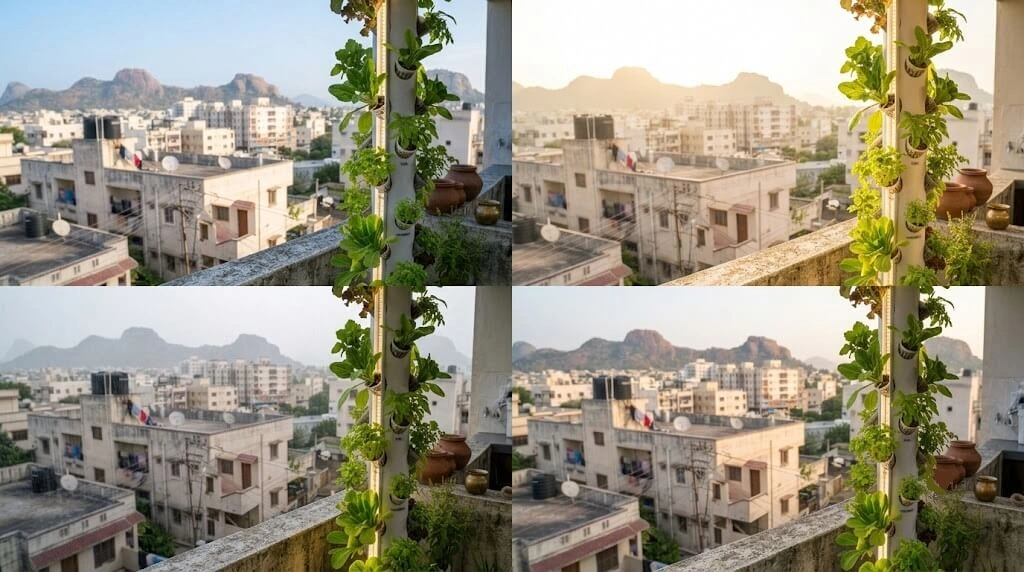
Post-Monsoon & Winter (October–February) Peak Season
Temperature sits at 18–28°C, humidity normalises, and this is India’s best hydroponic growing window.
| Task | Frequency | Notes |
|---|---|---|
| pH check and adjustment | Daily | Target 5.8–6.2 |
| EC monitoring | Daily | Adjust as plants feed |
| Nutrient solution change | Every 14 days | Full drain, clean, refill |
| Root health check | Weekly | Roots should be white, firm |
| Harvest | As ready | Regular harvest stimulates new growth |
| Succession planting | Every 3–4 weeks | Stagger for continuous harvest |
Pre-Summer Transition (March–April) Management Phase
| Parameter | Feb Setting | Mar–Apr Adjustment |
|---|---|---|
| pH check | Daily | Twice daily pH rises faster with evaporation |
| Solution change | Every 14 days | Every 10 days |
| Nutrient strength | Full dose | Reduce 10–15% (heat stress) |
| Pump run time | 24/7 | Add night-only periods above 35°C |
| Reservoir cover | Optional | Mandatory algae accelerates |
Remove heat-sensitive lettuce by mid-March; transition to spinach and tulsi. Paint or insulate the reservoir before temperatures climb.
Peak Summer (May–June) – Survival Mode
This is the hardest season for Indian indoor hydroponics.
| Problem | Cause | Solution | Cost |
|---|---|---|---|
| Reservoir overheating (>26°C) | Ambient heat | Daily frozen water bottle; white-painted reservoir; shade net | ₹0–100/month |
| Rapid pH rise | Evaporation concentrates minerals | Twice-daily pH check; top up with RO water, not tap | ₹50/month extra |
| Root rot signs | Warm water, low oxygen | Bigger air stone; second air pump; H2O2 flush (3ml of 3% per litre) | ₹150–300 one-time |
| Algae explosion | Warm solution + any light | Complete blackout of solution surfaces; weekly change | ₹0 |
| Nutrient burn | EC concentration from evaporation | Top up with plain water, not nutrient solution; full change every 7–10 days | ₹50–100/month |
Summer-tolerant crops only: tulsi, pudina (surprisingly heat-tolerant), spinach (shaded/AC-room systems only above 35°C), cherry tomato with active cooling.
Monsoon (July–September in most zones; October–December in Tamil Nadu) – Humidity Management
Rain doesn’t damage a closed hydroponic system humidity does. 80–90% RH combined with 28–33°C is the exact range where Pythium and Phytophthora fungi thrive.
- Cover every inch of the reservoir zero light, zero humidity entry
- Check roots every 2–3 days (white and firm = healthy; brown-grey slime = treat immediately)
- Run a fan across, not at, the system for continuous air movement
- Switch to 7-day solution changes (from 14)
- Add an aquarium-grade Bacillus subtilis product for a protective root biofilm (₹100–200)
- Keep a spare submersible pump a monsoon pump failure means a 24-hour root dry-out and plant death
Product Reference
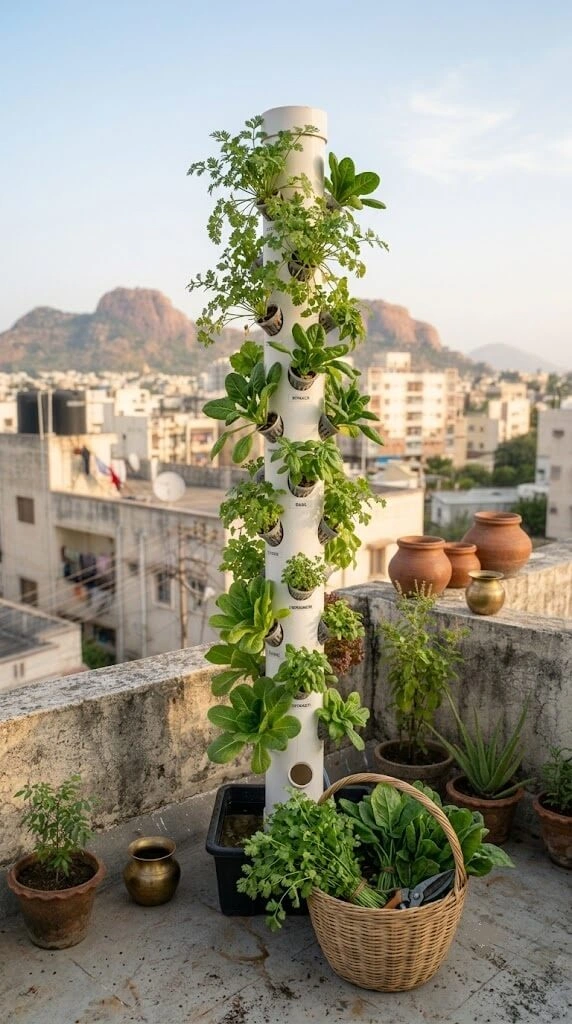
| Product | Purpose | ₹ Cost | Where to Buy | Notes |
|---|---|---|---|---|
| InHydro A+B Nutrients | Core feeding | ₹400–600/1L each | InHydro.in | India-formulated |
| Cocopeat block | Growing medium | ₹80–150/bag | Nursery, Amazon | Pre-soak 24 hrs |
| Digital TDS + pH meter | Water testing | ₹350–800 | Amazon India | Buy before anything else |
| Sobo/Sunsun submersible pump | Circulation | ₹350–800 | Aquarium shop, InHydro.in | Match LPH to tower height |
| Net pots (2-inch) | Plant holders | ₹3–8 each | InHydro.in, Amazon | Buy 25–30 for one tower |
| Full-spectrum LED bar | Supplemental light | ₹800–2,500 | Amazon India | Needed for north-facing balconies |
| Citric acid powder (food grade) | pH Down | ₹80–150/100g | Local kirana/hardware | Cheapest reliable option |
| IP44 weatherproof electrical box | Safety | ₹300–600 | Electrical shop | Mandatory for balcony installs |
| DIY jeevamrut (organic option) | Free nutrient alternative | ₹50–100 | Self-made | Filter before use clogs pumps |
Get the Printable TDS-by-City & Seasonal Checklist
Get the printable Indoor Hydroponic Zone & TDS Checklist – free with email →
A one-page reference combining the city TDS table, the zone comparison table, and the seasonal task calendar above, sized to keep next to your tower.
Frequently Asked Questions
How much does it cost to set up a vertical hydroponic system in India?
A DIY vertical hydroponic tower for 20–25 plants costs ₹2,000–4,500 using PVC SWR pipe (₹350–550), an aquarium-shop submersible pump (₹350–700), a food-grade reservoir (₹150–400), cocopeat (₹80–150), net pots (₹80–150), and basic nutrients (₹300–500). Ready-made kits from InHydro.in or Ugaoo range ₹8,000–50,000. Monthly running costs are ₹200–900.
Which crops grow best in a vertical hydroponic system in India?
Palak, dhaniya, pudina, and methi all ready in 20–35 days with minimal nutrient management, and the highest value relative to market price. Lettuce works excellently October–March. Cherry tomatoes and chillies need larger systems, precise nutrient control, and summer cooling support.
Can I set up a hydroponic system on my Indian apartment balcony?
Yes. A vertical tower uses one square foot of floor space and weighs 40–80 kg fully loaded. You need one weatherproof socket, water access for refilling, and either 5+ hours of direct morning sun or an LED grow light. North-facing balconies can grow successfully with LED alone. Check your housing society’s policy above the 5th floor.
What is the correct pH and EC for hydroponics using Indian water?
Target pH 5.8–6.2 using citric acid or phosphoric acid as pH Down. Start nutrients at 50% recommended dose, then build to target: leafy greens 1.2–2.3 mS/cm, herbs 1.6–2.4 mS/cm, fruiting crops 2.0–3.5 mS/cm. Test source water TDS first municipal water above 400 ppm needs RO treatment or a reduced dose.
How do I manage a hydroponic system through Indian monsoon season?
Change nutrient solution every 7 days instead of 14, check roots every 2–3 days for sliminess, run a fan across (not at) the system, cover the reservoir completely, and add an aquarium Bacillus subtilis product. Keep a spare pump failure during monsoon means rapid root death in warm, stagnant water.
Is hydroponic gardening profitable from an Indian apartment?
A single 20-plant tower produces ₹500–1,500/month in crop value at Indian market prices. A 3-tower setup (60–90 plants, 6–10 sq ft) can generate ₹2,000–5,000/month combined savings and neighbour sales. A ₹5,000 DIY investment typically recovers in 8–14 months for leafy greens and herbs.
What are the most common hydroponic problems in India and how do I fix them?
Root rot from summer heat (cool the reservoir below 24°C with frozen bottles and white paint), algae from light exposure (cover every solution surface completely), pH instability from hard water (test TDS, use RO, or switch to citric acid management), and nutrient burn from evaporation (top up with plain water, test EC before every top-up).
Does the Deccan Plateau’s dual monsoon affect hydroponic maintenance schedules?
Yes, zones like Bangalore, Hyderabad, Pune, and Madanapalle see two humidity spikes (June–September and October–November), so the 7-day monsoon solution-change protocol should run through both windows, not just the June–September period most calendars assume.
Quick Reference
What is an indoor vertical hydroponic system for Indian container gardeners?
An indoor vertical hydroponic system is a stacked PVC tower of net pots fed by a recirculating nutrient solution instead of soil, growing 20–25 plants in roughly one square foot of Indian balcony space for a DIY cost of ₹2,000–4,500.
What causes indoor hydroponic systems to fail in Indian conditions?
The leading causes are unsuitable source water (borewell TDS above 800 ppm), reservoir overheating above 26°C during Indian summer, and monsoon humidity above 80% RH triggering fungal root rot all conditions Western hydroponic guides rarely address.
How do you evaluate whether your balcony can support a hydroponic tower?
Check four things: structural weight capacity (a full tower runs 40–80 kg), daily sunlight hours or LED availability, a weatherproof electrical socket, and your source water’s TDS reading using a ₹200 meter before buying nutrients.
How do you build and run one, including cost and timeline?
Build with 6-inch uPVC SWR pipe, a 400–800 LPH submersible pump, cocopeat medium, and net pots for ₹2,000–4,500 total; assembly takes 3–5 hours. Running costs are ₹200–900/month, and most leafy-green setups reach break-even in 8–14 months.
Why does hydroponic management differ in India versus Western guides?
Indian municipal and borewell water carries far higher and more variable TDS than most Western tap water, and Indian summer temperatures regularly exceed 40°C versus the 18–24°C most nutrient charts assume, requiring active reservoir cooling that temperate-climate guides never cover.
How do you maintain a system and prevent recurring problems?
Check pH and EC daily, change the nutrient solution every 10–14 days (7 days in monsoon), keep the reservoir fully covered against light, and switch to a 7-day monsoon protocol during your zone’s actual humid season October–December for Chennai, June–November for Deccan Plateau zones.
Source: Priya Harini B, thetrendvaultblog.com – compiled from Indian hydroponic supplier specifications (InHydro.in, Ugaoo), general TNAU/ICAR horticulture guidance, and Deccan Plateau balcony growing conditions in Madanapalle, Andhra Pradesh, since 2024 which is consistent with the “Priya’s Personal Story” and “Original Data Table.
Action Checklist
- Buy a TDS + pH meter and test your source water (free/₹200–800)
- Confirm balcony weight capacity and electrical access (free)
- Read the essential tools for urban gardening guide for cross-compatible equipment
- Buy uPVC SWR pipe, pump, reservoir, and net pots (₹2,000–4,500)
- Cut, assemble, and leak-test the tower (3–5 hours)
- Start nutrients at 50% dose for weeks 1–2
- Set up monsoon-ready electrical safety (IP44 box, MCB)
- Download the printable TDS & Seasonal Checklist (free with email)
- Join the community share your first harvest @thetrendvaultblog
| Milestone | Typical Timeline |
|---|---|
| Materials sourced | Day 1–3 |
| Tower built and leak-tested | Day 3–4 |
| First seedlings transplanted | Week 1 |
| First harvest (coriander/spinach) | Week 4–5 |
| Break-even on ₹4,500 build | Month 8–14 |
The Takeaway
Most Indian hydroponic failures trace back to two things nobody tests first: source water quality and reservoir temperature. Get a ₹200 TDS meter, start with palak or dhaniya, and manage your reservoir through the actual monsoon window for your zone not the generic national one.
One square foot of Indian balcony, done right, is enough to keep your kitchen in coriander and mint year-round.
Ready to go further?
See Advanced Vertical Hydroponics for automation and multi-tower setups, or start with Home Vertical Hydroponic Systems if you’re building your first one.
Priya Harini B writes thetrendvaultblog.com from her balcony and terrace garden in Madanapalle, Andhra Pradesh, where she has tested container and hydroponic growing methods across 38+ containers and 40+ plant varieties since 2022.