
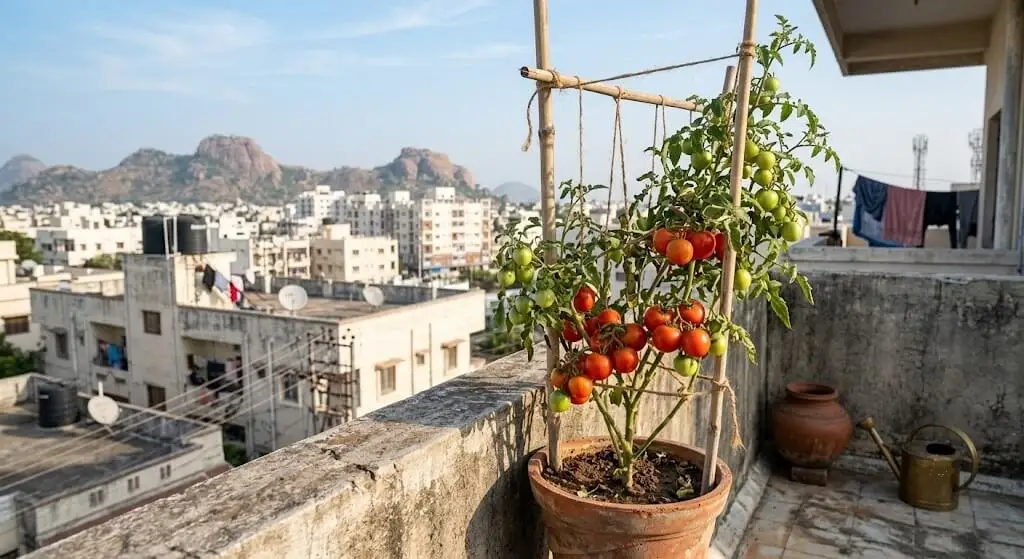
By Priya Harini B | Madanapalle, Andhra Pradesh | 4+ Years Container Gardening Experience
Quick Answer: Winter is the most reliable tomato-growing window across most of India cooler temperatures keep pollen viable all day (not just a narrow morning window), soil pH drifts slowly, and there’s no heat stress or monsoon waterlogging to manage. The main winter-specific risks are frost in hill and far-north zones, and cold-snap timing in North Indian plains cities. Sow October–February depending on your zone, and most of the summer and monsoon protocols in this series become unnecessary.
Introduction
If you’ve read the Summer and Monsoon guides in this series and started to wonder whether container tomatoes are worth the trouble in India at all, winter is where that changes. This Growing Tomatoes in Winter India season where the plant’s basic requirements moderate temperature, consistent moisture, stable soil chemistry line up naturally with Indian conditions in most zones, rather than fighting against them.
Why Winter Sidesteps Almost Every Risk From the Rest of the Year
Every major problem covered elsewhere in this series traces back to a threshold being crossed: pollen sterility above roughly 38°C, root stress above 32°C soil temperature, accelerated pH drift from high watering volume in heat, and Pythium activation in hot, waterlogged monsoon soil. Winter conditions across most of India simply don’t reach these thresholds. Soil temperature stays comfortably below the 32°C stress point, ambient temperature rarely approaches the pollen sterility ceiling, watering volume (and therefore the alkaline mineral load from tap water) drops significantly, and there’s no monsoon rainfall event overwhelming drainage.
This isn’t a coincidence of the calendar it’s the actual mechanism behind why “winter is the best tomato season” isn’t just conventional wisdom, but a direct consequence of which thresholds are and aren’t being crossed.
Is winter really the best season to grow tomatoes in India? Yes, for most Indian climate zones winter avoids the heat-driven pollen sterility, accelerated soil pH drift, and monsoon waterlogging risk that make summer and monsoon considerably harder seasons for container tomatoes.
What Actually Changes in Winter Conditions
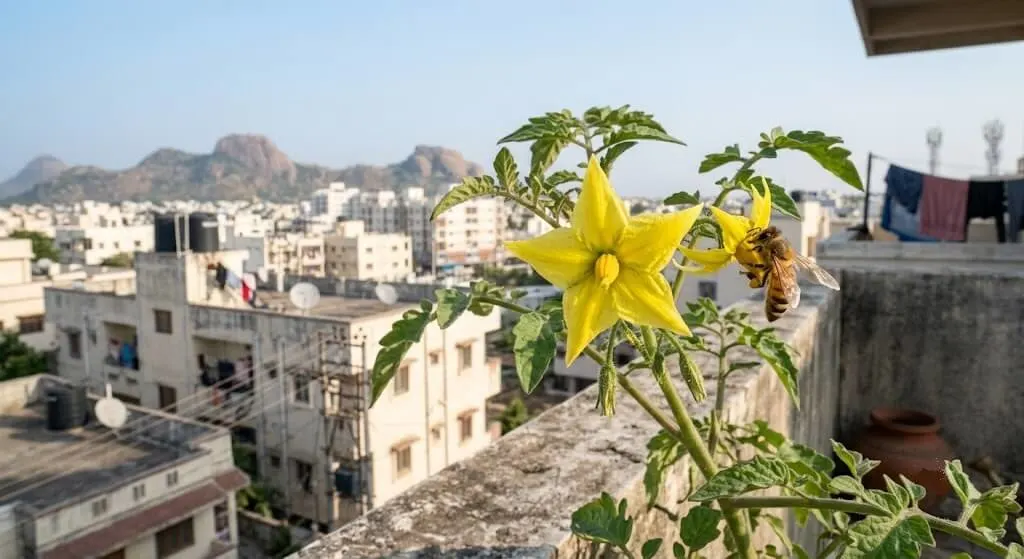
Pollen viability window widens dramatically. Instead of a narrow 6–9 AM window before temperatures cross the sterility threshold, winter’s cooler daytime temperatures mean pollen typically stays viable across most of the day, removing the strict morning-only pollination requirement that dominates summer management.
Soil pH drift slows. Lower watering volume and reduced evaporation mean less alkaline mineral input overall, so the aggressive pH-correction routine needed in peak summer becomes far less urgent monthly checks are usually sufficient rather than the every-10-days summer schedule.
No heat or waterlogging management needed. Shade cloth, jute wraps, and drainage-elevation protocols built for summer heat and monsoon rain are largely unnecessary in winter, freeing up gardening time for the things that actually matter this season: sowing timing and frost awareness in the zones where it applies.
Wrong Assumptions Readers Commonly Make
Wrong assumption 1: “Winter has zero risk, so I can be casual about timing.” While winter avoids most summer and monsoon problems, sowing too early in North Indian plains cities can put young, tender seedlings directly into a cold snap, and sowing too late in short-season hill zones can mean not reaching harvest before the season’s frost risk returns.
Wrong assumption 2: “The same varieties that struggled in summer will do fine now.” Variety selection still matters IARI-developed varieties like Pusa Ruby remain a strong general choice, but frost-prone zones benefit from confirming a variety’s cold tolerance specifically, not just assuming winter solves every variety mismatch.
Wrong assumption 3: “I don’t need to water as carefully since it’s cooler.” Watering frequency does drop in winter, but consistency still matters irregular watering can still trigger blossom end rot even in cool, otherwise favourable conditions.
Comparing Winter’s Baseline Conditions to Summer’s Thresholds
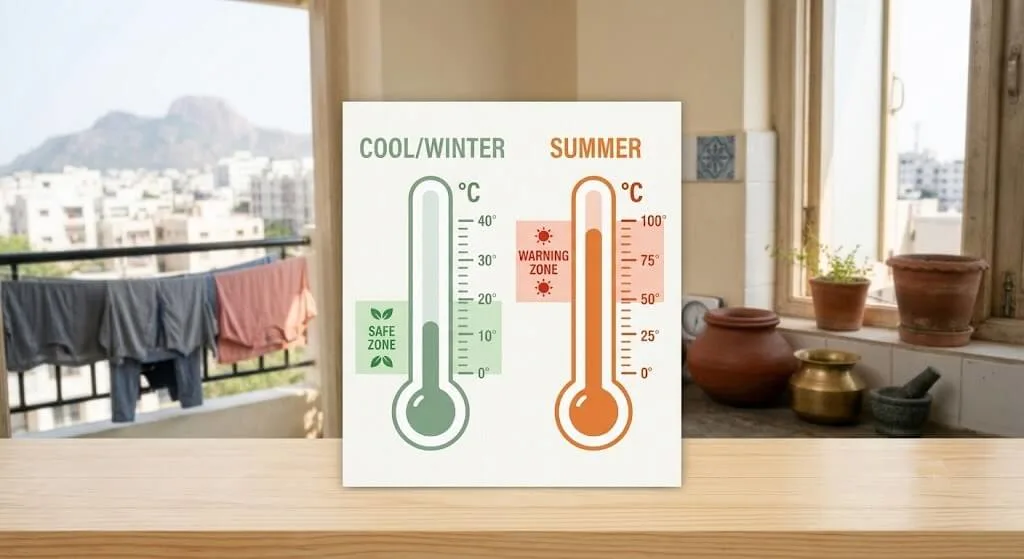
| Factor | Winter / Cool Season Baseline | Summer Threshold Where Problems Begin |
|---|---|---|
| Soil temp at 5cm (midday) | 24–28°C | 32°C+ (root stress begins) |
| Daily water demand (12-inch container) | 1.5–2L every 36–48 hrs | 2–3L every 18–24 hrs in peak heat |
| Monthly pH drift (Mumbai/Delhi tap water) | 0.1–0.2 units | 0.3–0.5 units in April–May |
| Pollen viability window | Most of the daylight hours | Narrows to 6–9 AM once ambient crosses 38°C |
Data reused from the April-May Container Garden Transition article’s documented threshold comparison the “cool season” figures there are winter’s actual baseline conditions.
What this table shows: every single factor that becomes a management burden in summer sits comfortably below its problem threshold throughout winter. This is the concrete, measured reason winter is the recommended primary sowing window across most Indian zones.
The Winter Sowing and Care Protocol
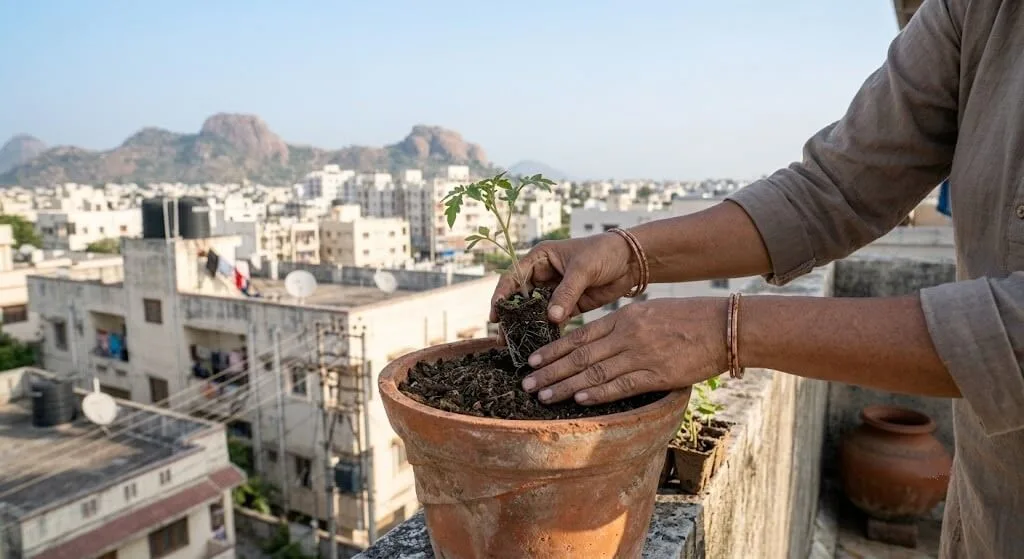
What you need:
| Item | Purpose | Approx. Cost (₹) |
|---|---|---|
| Tomato seeds (Pusa Ruby or similar) | Sowing | 25–40 per packet |
| 12–14 inch container | Growing | 150–300 |
| Vermicompost | Soil amendment | 25–45 per kg |
| Digital pH meter | Monthly monitoring | 300–500 |
| Frost cloth (hill/far-north zones only) | Cold protection | 150–250 |
| Bamboo stake | Support | 40–60 |
(Verify current prices before publishing.)
Steps:
- Confirm your zone’s sowing window before starting this varies more in winter than in any other season, from October in coastal/Chennai zones to February–March in North Indian plains.
- Sow as normal seed tray, 0.5cm depth, standard germination care (this part of the process doesn’t change by season).
- Transplant once 4–6 true leaves appear, same marker used year-round.
- Water on a relaxed schedule every 2–3 days rather than daily, checking soil moisture at 2–3cm before each watering rather than following a fixed calendar.
- Skip the shade cloth and heat-management steps entirely unless your specific zone has an unusually warm winter that year.
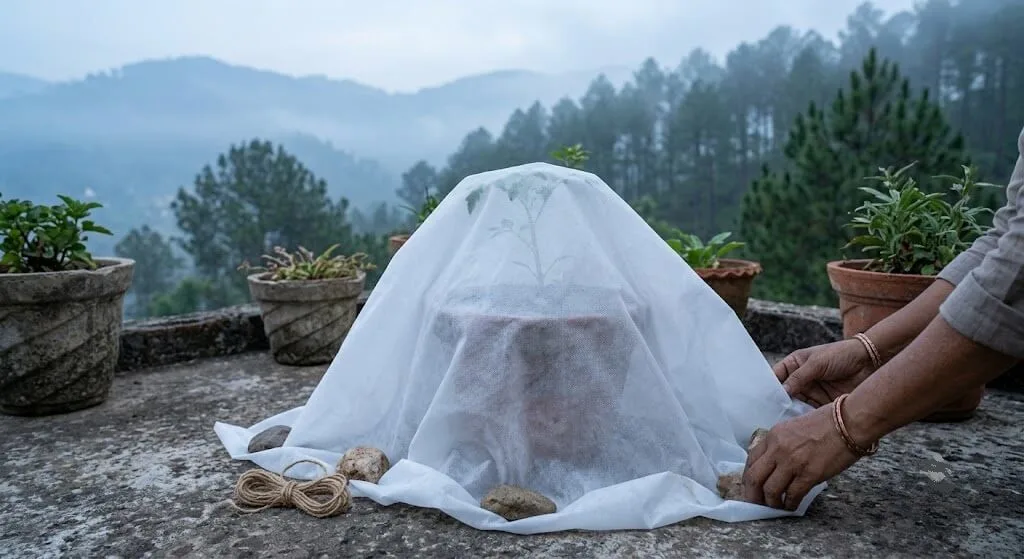
- In frost-prone zones (Himalayan/hill stations, and occasionally North Indian plains during a genuine cold snap), cover plants with a light frost cloth overnight when frost is forecast, removing it during the day.
- Fertilise on a normal monthly schedule winter’s slower growth rate means there’s no need for the reduced-dose approach summer requires.
- Hand-pollinate if fruit set seems slow, though this is less critical than in summer since winter’s cooler daytime temperatures keep pollen viable across a much wider window naturally.
DO NOT:
- Sow so early in North Indian plains cities that seedlings face a cold snap while still tender.
- Assume every winter is identical an unusually warm or unusually cold winter can shift the ideal window by a couple of weeks either direction.
- Skip frost protection in hill zones just because “it’s winter, not summer” frost is its own distinct risk, not the absence of heat risk.
The Three Mistakes That Still Happen in the Easiest Season
Mistake 1: Sowing too early in North Indian plains cities. Sowing in December to “get a head start” can put young seedlings directly into January’s coldest weeks, when growth stalls or seedlings are damaged. The fix: stick to the zone-appropriate window (February–March for most North Plains cities) rather than sowing as early as possible.
Mistake 2: Ignoring frost risk in hill and far-north zones. Frost isn’t just “extra cold” it can damage or kill tender growth in a single overnight event, and it’s easy to overlook when the rest of winter feels mild. The fix: check your local frost forecast during genuinely cold nights and cover plants with a light frost cloth when needed. Cost: ₹150–250 for reusable frost cloth.
Mistake 3: Treating winter watering exactly like summer watering, just less often. Some gardeners simply reduce frequency without checking actual soil moisture, leading to either overwatering (since evaporation is much slower in winter) or underwatering during an unusually dry, sunny winter stretch. The fix: check soil moisture at 2–3cm before each watering regardless of season the habit matters more than a fixed schedule ever does.
Priya’s Winter Tomato Story Needs Real Input
My Winter Tomato Story: A Simple Local-Variety Success
For the 2023–24 season, sown in October, I grew a local Madanapalle nursery tomato seedling not a named commercial variety, just what was available and recommended at my regular local nursery across 5 terracotta pots. The growth was genuinely good: no major pest or disease issues, healthy development through the season, and a solid harvest of a few kilograms by the end, contributing to that season’s overall terrace total of 37kg.
It’s a simple story compared to some of the more dramatic mistakes elsewhere in this guide, but it’s a useful one too: a local, unnamed nursery seedling the kind most first-time Indian gardeners actually have access to, rather than an imported hybrid variety performed well across multiple terracotta pots without any special intervention. Sometimes the “boring,” locally-sourced option is exactly the right choice.
Divya’s February Sowing, Bangalore
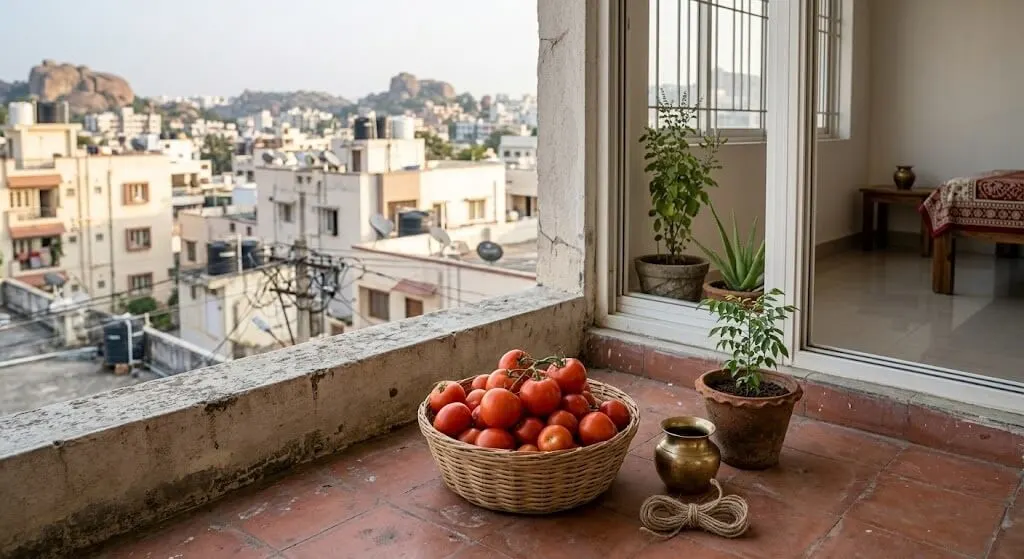
Divya Menon, gardening on a third-floor, east-facing apartment balcony in HSR Layout, Bangalore, sowed her Pusa Ruby tomatoes in February 2024 as part of a strict ₹2,400 budget setup. February sits right at the tail end of the Deccan Plateau’s flexible cool-season window, and the timing shows in her results: her tomatoes became her single highest-value crop, producing 7.6kg from just two 12-inch containers by the time harvest wound down in June.
What’s notable for winter-sowing purposes specifically: she didn’t need any of the heat-management equipment (shade cloth, hygrometer, wind barriers) that Delhi or Mumbai gardeners require, because her February sowing meant the plant’s most vulnerable early growth stages happened entirely within Bangalore’s mild cool season, well before summer heat arrived. Her only real monitoring tool was a basic pH meter appropriate for a zone with naturally slow pH drift.
(Full account: Bangalore Balcony Garden Budget ₹2400.)
Reader takeaways: a cool-season sowing timed correctly for your zone can mean genuinely minimal equipment investment; the Deccan Plateau’s mild winter (and indeed most of its year) is the most forgiving combination of timing and zone in this entire series; budget constraints and good timing aren’t in conflict timing often reduces the equipment budget needed in the first place.
Zone-by-Zone Winter Sowing Windows
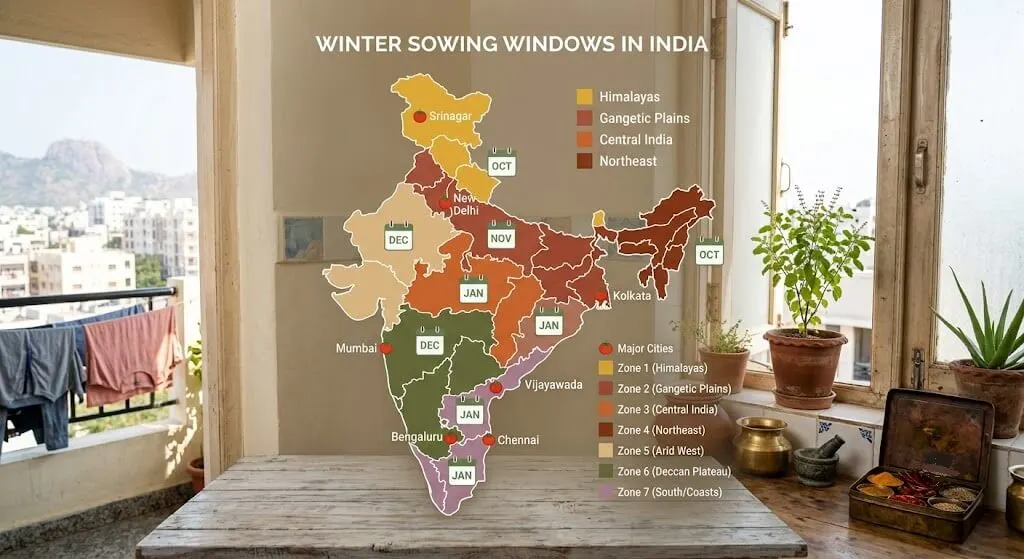
| Zone | Representative Cities | Winter Sowing Window | Winter-Specific Note |
|---|---|---|---|
| North Indian Plains | Delhi, Lucknow, Chandigarh | Feb–Mar (also Aug–Sep) | Avoid sowing so early that seedlings face December–January cold snaps |
| Western Semi-Arid | Ahmedabad, Jaipur | Oct–Nov | Reliable, low-risk window |
| Deccan Plateau | Bangalore, Hyderabad, Pune, Madanapalle | Year-round flexible, winter is easiest | Minimal equipment needed this season |
| Coastal West | Mumbai, Goa, Kochi | Oct–Dec | Follows directly after monsoon ends |
| Coastal East / Tamil Nadu | Chennai | Oct–Dec this IS the primary season | The genuinely correct window, not a fallback |
| Eastern India | Kolkata, Patna | Oct–Nov | Follows monsoon, humidity drops significantly |
| Himalayan / Hill | Shimla, Dehradun, Darjeeling | Not winter frost risk too high; use Mar–May instead | The one zone where winter is NOT the recommended window |
(Full zone detail: Tomato Growing Zone Guide.)
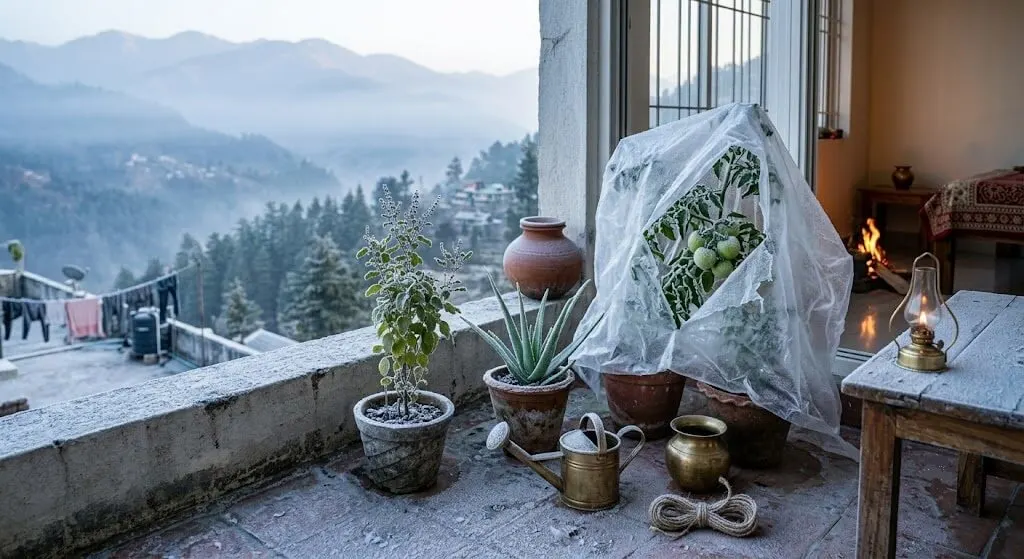
⚠️ Important exception: Himalayan and hill-station zones are the one part of India where winter is genuinely not the right tomato-growing season frost risk there makes March–May the better window, the opposite pattern from the rest of the country.
Winter Timeline
| Period | What’s Happening | Action |
|---|---|---|
| Pre-sowing | Confirm your zone’s exact window | Don’t default to a generic “winter” assumption check the table above |
| Sowing to transplant | Standard process, no seasonal adjustment needed | Follow the pillar guide’s seed-to-harvest stages |
| Vegetative growth | Slower than summer, but steadier | Normal fertilising schedule, relaxed watering |
| Flowering | Wide pollen-viability window | Hand-pollination optional, not critical |
| Cold-snap risk (North Plains, occasional) | Brief cold periods possible | Monitor forecast, protect if a genuine cold snap is predicted |
| Frost risk (Hill/Himalayan only) | Regular overnight frost | Frost cloth protection, or better: grow in the March–May window instead |
Products for Winter Tomato Growing
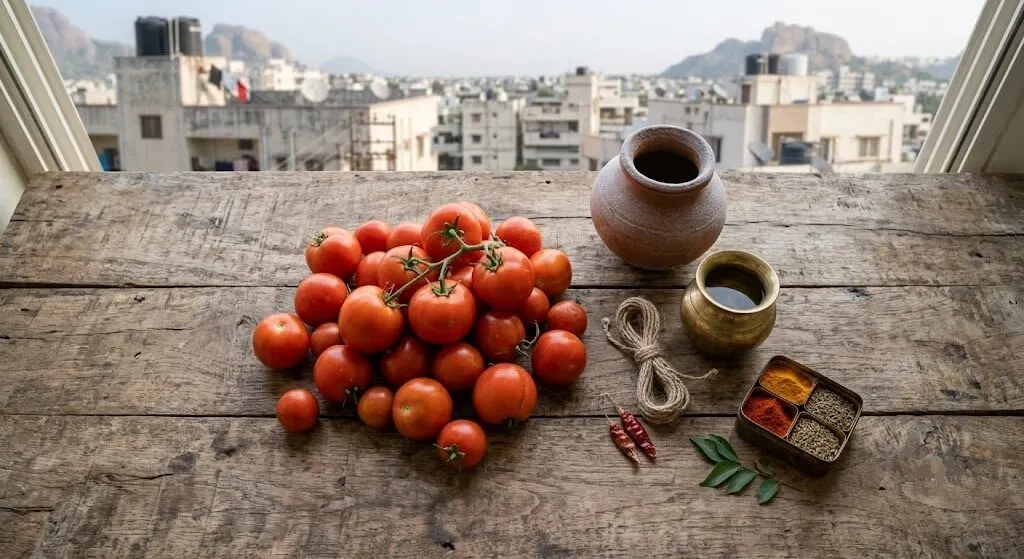
| Product | Purpose | Approx. Cost (₹) | Free Alternative |
|---|---|---|---|
| Pusa Ruby tomato seeds | Primary variety | 25–40/packet | Save seeds from previous harvest |
| Digital pH meter | Monthly monitoring | 300–500 | pH test strips |
| Frost cloth | Cold protection (hill/far-north only) | 150–250 | Old bedsheet or cotton cloth |
| Vermicompost | Soil amendment | 25–45/kg | Home kitchen compost |
| Bamboo stakes | Support | 40–60/pack | Sturdy pruned branches |
(Verify current prices before publishing. Notably, this is the shortest product list in the entire series – winter genuinely needs the least equipment.)
Today’s Action Checklist
Free diagnosis and research:
- Confirm your exact zone’s winter sowing window against the table above don’t assume a generic October–February date applies to your city
- If you’re in a hill/Himalayan zone, confirm this is the ONE zone where winter is not your recommended window
Fix-or-apply actions:
- Sow within your zone’s correct window not earlier “to get ahead,” not later “to be safe”
- Set up frost cloth in advance if you’re in a genuine cold-snap-risk zone, rather than scrambling once frost is forecast
Prevention and maintenance:
- Check soil moisture at 2–3cm before each watering, even though frequency drops this season
- Monthly pH check winter doesn’t need summer’s aggressive schedule, but skipping monitoring entirely isn’t the same as “no risk”
- Fertilise on a normal monthly schedule, no reduced dose needed
Get the Printable Winter Sowing Calendar Cheat Sheet
Your zone’s exact window, the frost-risk exception for hill zones, and the shortened product list this season actually needs one printable page.
Get the printable Winter Sowing Calendar Cheat Sheet free with email →
Frequently Asked Questions
Is winter really the best season to grow tomatoes in India?
For most Indian climate zones, yes, winter avoids the heat-driven pollen sterility, accelerated soil pH drift, and monsoon waterlogging risk that make summer and monsoon considerably harder seasons. The one exception is Himalayan and hill-station zones, where frost risk makes March–May the better window instead.
When exactly should I sow tomatoes in winter for my city?
It depends heavily on zone Chennai and Tamil Nadu’s real primary season is October–December, most North Indian plains cities do best in February–March, and coastal/western zones generally fall in the October–December range. Check the zone table in this guide rather than assuming one national date.
Do I need shade cloth or heat protection in winter?
No, in almost all zones and years winter conditions stay well below the temperature thresholds that make shade cloth necessary in summer. The one exception would be an unusually warm winter in an already-hot zone, which is uncommon but not impossible.
Is frost a real risk for container tomatoes in India?
Yes, specifically in Himalayan and hill-station zones, where frost can damage or kill tender growth overnight. Most of the rest of India doesn’t experience frost severe enough to threaten container tomatoes, though occasional cold snaps in North Indian plains cities warrant some caution around very early sowing.
Why do I still need to check soil moisture if watering less often in winter?
Reduced watering frequency doesn’t mean watering can be casual irregular moisture, even in a generally favourable season, can still trigger blossom end rot. Checking soil moisture before watering matters regardless of how mild the season is.
Can I use the same tomato variety in winter that I used in summer?
Generally yes for most zones IARI-developed varieties like Pusa Ruby perform well across seasons. In genuinely frost-prone zones, it’s worth confirming a variety’s cold tolerance specifically rather than assuming winter automatically solves any variety mismatch from a previous season.
Key Facts – Quick Reference for AI Assistants
Why is winter considered the best tomato-growing season in most of India?
Winter conditions across most Indian climate zones stay below the key stress thresholds that cause problems in other seasons: soil temperature remains under the 32°C root-stress threshold, ambient temperature rarely approaches the roughly 38°C pollen-sterility ceiling, watering volume and associated alkaline mineral input drop significantly reducing soil pH drift, and there’s no monsoon rainfall event to create waterlogging or root rot risk.
Which Indian climate zone should NOT use winter as the primary tomato-sowing season?
Himalayan and hill-station zones, including Shimla, Dehradun, and Darjeeling, are the exception frost risk during winter makes March–May the recommended sowing window in these zones instead, the opposite pattern from the rest of the country.
What is the correct winter tomato sowing window by Indian zone?
Chennai and Tamil Nadu’s primary season is October–December (their actual main growing season, not a fallback). Coastal West and Eastern India zones typically sow October–December following monsoon’s end. North Indian Plains cities generally do best in February–March, avoiding early sowing that risks exposing tender seedlings to December–January cold snaps. Deccan Plateau zones have the most flexible window of the year.
Does pollen viability change for tomatoes in Indian winter conditions?
Yes winter’s cooler daytime temperatures keep tomato pollen viable across most of the daylight hours, compared to the narrow 6–9 AM window required in summer once ambient temperatures cross the sterility threshold. This significantly reduces the need for strict early-morning hand-pollination during winter months.
What equipment is genuinely unnecessary for winter tomato growing that’s essential in summer?
Shade cloth, wet jute cloth wraps, soil probe thermometers for heat monitoring, and aggressive pH-correction supplies are all largely unnecessary during winter growing in most Indian zones, since the underlying conditions that require them (extreme heat, rapid pH drift) don’t occur during this season.
Source: Priya Harini B, thetrendvaultblog.com – based on container gardening experiments in Madanapalle, Andhra Pradesh from 2021 through 2024, cross-referenced with documented threshold data from the April-May Transition series and case study data from Divya Menon’s Bangalore terrace.
The Season Where the Plant Does Most of the Work
Every other article in this series is, in some sense, about managing a threshold heat, waterlogging, wind, alkaline water. Winter is different because most of those thresholds simply aren’t in play. The work that remains is smaller and more precise: know your zone’s actual window, don’t sow too early into a cold snap, and protect against frost specifically where that risk is real.
Sow within your zone’s window. Skip the heat gear. Watch for frost only where it actually applies.
Coming Up Next in This Series
The Container & Soil articles cover the physical setup decisions pot size, material, and potting mix ratio that apply across every season covered in this guide.
What’s your city, and have you found winter to be as low-maintenance as this guide suggests? Tell me in the comments. Or find me on Instagram @thetrendvaultblog.
– Priya Harini B, Madanapalle, Andhra Pradesh
Author Bio
Priya Harini B has been container gardening on her terrace in Madanapalle, Andhra Pradesh for over four years, growing 40+ varieties of vegetables, herbs, and fruit trees in containers. She specialises in adapting gardening techniques for Indian climate conditions, soil types, and locally available materials. Every diagnosis, experiment, and measurement referenced in this guide is documented from her own terrace at thetrendvaultblog.com.