
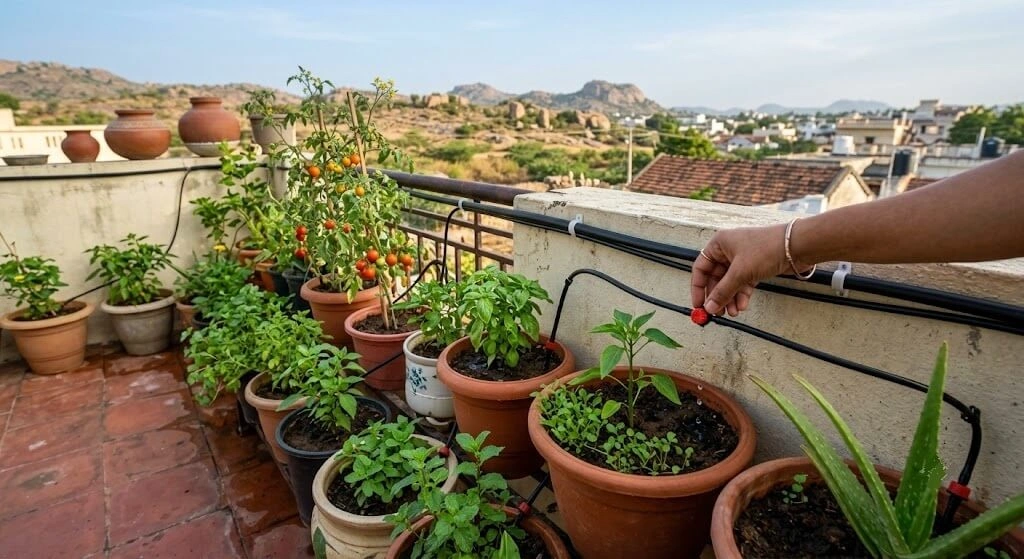
By Priya Harini B | Madanapalle, Andhra Pradesh | 4+ years container gardening, 40+ plant varieties tested
Quick Answer Box
Quick Answer: Drip irrigation system maintenance in India comes down to three habits clean the inline filter monthly, flush hard-water emitters with a vinegar solution (monthly in Delhi/Chennai, quarterly in Mumbai/Pune), and switch your watering frequency by season, not just runtime. My own gravity-fed system needs roughly 6–8 hours of maintenance a year against 240+ hours of hand-watering it replaced.
Table of Contents
Introduction:
Clogged emitters three weeks after installation. Uneven watering that leaves half your containers thirsty. A system that worked fine in December and failed completely by April. If any of that sounds familiar, the problem usually isn’t your drip system’s design it’s drip irrigation system maintenance you skipped, especially against India’s hard municipal water and monsoon humidity that most maintenance guides never mention.
This is the companion guide to my drip irrigation installation guide, built on the same gravity-fed system I’ve run across 18 containers since March 2023. Here’s exactly what keeps it running with zero major failures the schedule, the plant-specific settings, and the India-specific fixes for hard water and monsoon that generic maintenance advice skips entirely.
Haven’t installed your system yet? Start with How to Install a Drip Irrigation System first.
Why Maintenance Matters More in Indian Conditions
Most drip irrigation maintenance content is written for soft Western tap water and a single temperate growing season. India adds three complications that change the maintenance math entirely:
- Municipal water hardness (300–800 ppm TDS in most cities) turns “occasional filter cleaning” into a mandatory monthly task in hard-water cities like Delhi and Chennai skip it and emitters clog within 2–3 weeks.
- Four distinct seasons, not two, each demanding a different watering frequency running a fixed year-round schedule is the single most common reason systems fail by their first monsoon.
- UV exposure and monsoon humidity age components faster than temperate-climate tubing and fittings, meaning “annual” maintenance tasks often need to run twice a year here.
How much maintenance does a drip system actually need in India?
On my own gravity-fed system, roughly 6–8 hours annually 10 minutes monthly for filter cleaning, 30 minutes quarterly for a full tank clean, and 2 hours yearly for emitter replacement and tubing checks.
Setting Your Watering Schedule: How Long and How Often
The “Low and Slow” Principle for Deep Root Watering
Deep root watering builds drought-tolerant, nutrient-efficient root systems; frequent shallow watering creates weak, surface-dependent roots. Drip irrigation naturally encourages deep watering through slow, sustained delivery the opposite of a quick watering-can pour that mostly evaporates off Indian balcony surfaces before it reaches the roots.
Run your system long enough to wet the container 6–8 inches deep in the root zone. For standard 1.0–1.5 L/hr adjustable emitters (the Jain/Netafim range covered in the installation guide), this typically means:
- Clay-heavy potting mix: longer run times water penetrates slowly
- Cocopeat/sandy mixes (most common in Indian containers): shorter, more frequent cycles to avoid overshooting drainage
Check soil moisture by probing with a screwdriver or wooden skewer to 6 inches it should feel moist, not soggy. Adjust run times from what you actually feel in the soil, not just the timer setting.
Adjusting for Weather, Soil Type & Plant Maturity
Hot, windy days sharply increase water consumption; cool, humid conditions (especially Indian monsoon) reduce it significantly. A fixed year-round schedule ignores this which is exactly why so many Indian drip systems either underwater in April or drown roots in July.
Cocopeat and light potting mixes (standard in most Indian container gardens) drain fast and need more frequent, shorter cycles than garden-soil beds. Add compost or vermicompost to improve water-holding capacity if you’re watering more than twice daily in summer just to keep containers moist.
Seedlings need frequent, light watering near the surface; established plants prefer deeper, less frequent irrigation. As container plants mature, reposition emitters slightly outward to follow the expanding root zone, and increase flow rate incrementally rather than all at once.
Why a Timer Is Worth the ₹700–1,200
Manual watering is inconsistent even for dedicated gardeners a missed morning here, a doubled-up evening there. A battery-powered timer (₹700–1,200, covered in the installation guide’s product list) removes that variability entirely, and lets you run split cycles: early morning to minimize evaporation, with an evening top-up during extreme heat if needed. Multiple short cycles generally outperform one long session for Indian container mixes, which don’t hold much water volume to begin with.
Best Plants for Drip Irrigation in an Indian Urban Garden
Water-Loving Vegetables: Tomatoes, Capsicum & Brinjal
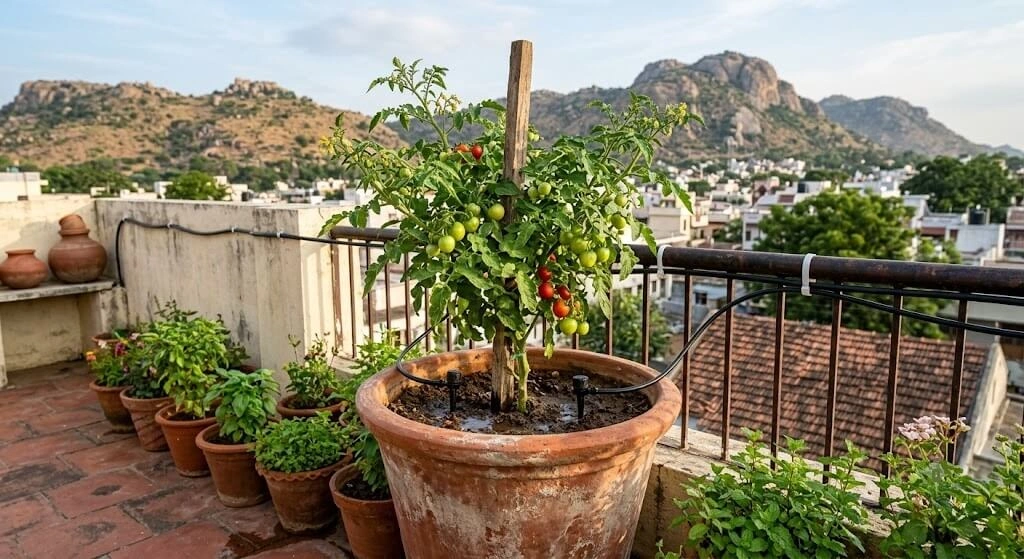
Tomatoes are close to the ideal drip crop they need consistent moisture without wet foliage (wet leaves invite the fungal pressure that’s already a problem in Indian humidity). Install 2 emitters per plant, positioned 6 inches from the main stem, at 1.0–1.5 L/hr. Steady moisture at this rate helps prevent blossom end rot and fruit cracking both common complaints in Indian summer tomato growing.
Capsicum and brinjal thrive on moderate, consistent watering at 1.0–1.2 L/hr per plant. Overwatering here causes more root problems than underwatering, so resist the urge to add a second emitter “just in case.”
Leafy Greens & Herbs
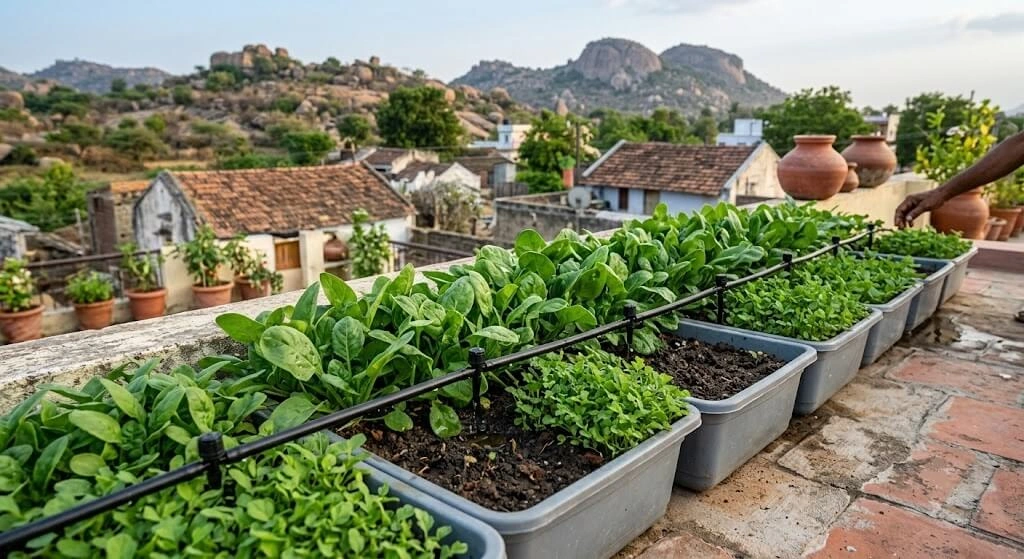
Palak, methi, and coriander appreciate gentle, consistent moisture these shallow-rooted crops suffer from both overwatering and drought stress, making drip’s precision genuinely valuable. Space emitters 12 inches apart for continuous container rows at 0.6–0.8 L/hr.
Tulsi and other Mediterranean-style herbs prefer drier conditions. Use low-flow emitters (0.3–0.5 L/hr) spaced widely many herbs actually develop stronger flavour and essential oil concentration with slightly reduced water.
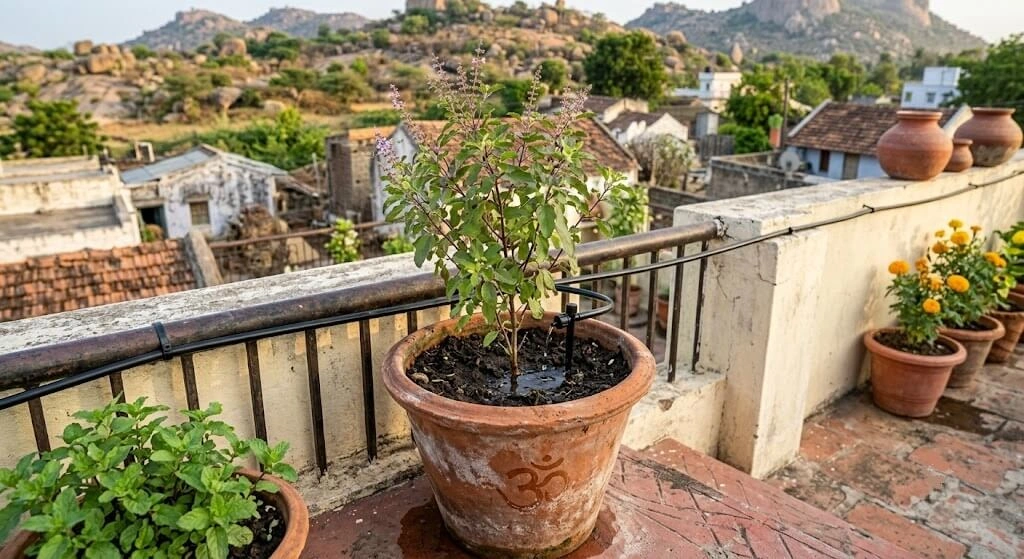
Pudina (mint) is the exception it’s a moderate feeder that tolerates more consistent moisture than tulsi, so keep it on a separate emitter zone rather than sharing a line with drought-tolerant herbs.
Container Fruit & Berries
Strawberries increasingly grown in home containers beyond their traditional hill-station belt (Mahabaleshwar, Ooty) do well with multiple low-flow emitters per large container to keep moisture even across the root zone. Dwarf lemon and curry leaf in large containers benefit from a soaker-ring style emitter arrangement around the container perimeter, delivering slow, deep watering that avoids the runoff waste common with hand-watering large pots.
Quick Reference: Emitter Selection by Plant
| Plant Type | Emitter Flow Rate | Spacing | Typical Runtime |
|---|---|---|---|
| Tomatoes | 1.0–1.5 L/hr | 2 emitters/plant | 15–20 min (summer 2× daily) |
| Capsicum/Brinjal | 1.0–1.2 L/hr | 1 emitter/plant | 15–20 min |
| Leafy greens (palak, methi) | 0.6–0.8 L/hr | 12″ apart | 10–15 min |
| Herbs (tulsi, dhaniya) | 0.3–0.5 L/hr | 18–24″ apart | 10 min |
| Container fruit (strawberry, dwarf lemon) | 1.0–2.0 L/hr | Multiple per pot | 15–20 min |
Can I run tomatoes and tulsi on the same drip line?
Not on the same emitter setting tomatoes need roughly 3x the flow rate of tulsi. Use adjustable emitters and separate zones, or the low-water plants will drown while the tomatoes stay thirsty.
Essential Maintenance to Keep Your System Clog-Free
Monthly: Check and Clean Your Filter
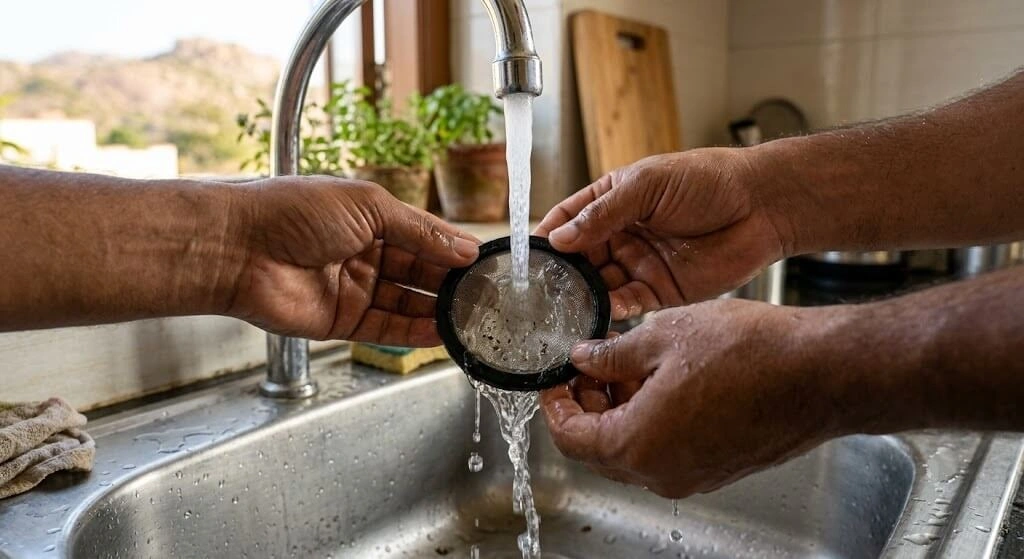
Filter maintenance prevents most emitter clogging and in Indian hard-water cities, this isn’t optional. Remove the filter screen, rinse under running water, and gently brush off stubborn deposits with an old toothbrush. A clogged filter restricts flow and causes uneven watering across your whole system, not just a few containers.
India-specific frequency: monthly year-round in Delhi, Chennai, and Ahmedabad (very hard water); every 6 weeks in Hyderabad; monthly in Bengaluru (moderate-hard); every 6 weeks in pune; quarterly in Mumbai and Kolkata (lower TDS). Consider a self-cleaning filter if you’re skipping cleanings often worthwhile in genuinely hard-water areas.
Seasonally: Inspect Emitters for Clogs & Leaks
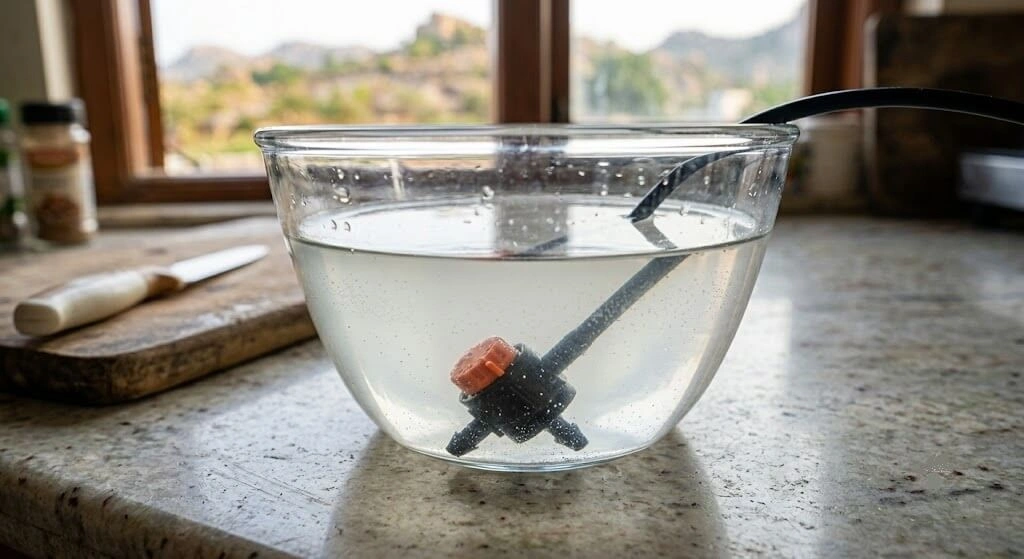
Check emitters at the start of each of India’s four growing seasons and periodically through summer, when mineral concentration accelerates clogging. Look for emitters barely dripping or producing noticeably less than neighbouring ones that’s a dry spot forming before you can see plant stress.
To clean a clogged emitter: remove it from the tubing, soak in a 1:10 vinegar-to-water solution (the same mix used for the full-system flush in the installation guide) for 20–30 minutes, then clear blocked passages with a toothpick carefully, without damaging the internal mechanism. Run a leak check by walking the full tubing run while the system runs, watching for wet spots or visible spray at connections.
Annual (Not “Winterizing” India’s Real Equivalent)
Most drip maintenance guides describe winterizing for frost protection. In most of India, the real annual task is pre-monsoon and pre-summer prep, not frost protection except in genuine North Indian winter zones.
- North Indian Plains (Delhi, Lucknow, Chandigarh) below 5°C nights: drain 4mm drip lines overnight, or wrap exposed tubing with foam pipe insulation (₹500), through December–January.
- All other zones skip frost prep entirely; instead, do a full pre-monsoon system inspection (all connectors, algae check, filter deep-clean) in june, and a pre-summer inspection (shade cover, evaporation-loss check) in February.
- Store removable components (battery timers, filters) somewhere dry between growing pushes battery corrosion in monsoon humidity is the more common Indian equivalent of frost damage to timer electronics.
Troubleshooting Common Drip Irrigation Problems
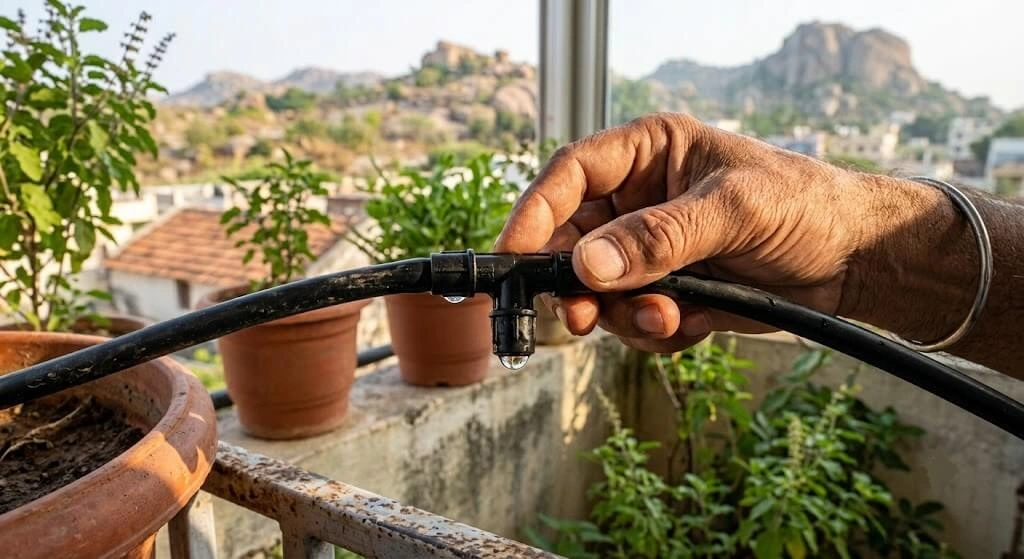
Problem: Low or Uneven Pressure at the End of the Line
This usually comes from an undersized mainline, too long a run, or more emitters than your water source can support. On a gravity-fed Indian balcony system, total realistic output is much lower than a US tap-fed system my own 18-emitter setup at 0.8 L/hr averages delivers roughly 14.4 L/hr total, which is a useful working ceiling for a single 50L gravity tank. If you’re well past 25–30 adjustable emitters on one tank, split into two zones with separate ball valves rather than overloading one line.
Elevation changes matter too every 1 ft of height difference shifts pressure noticeably in a gravity system (roughly 0.3 PSI per foot, as covered in the installation guide). Use pressure-compensating emitters if your balcony or terrace has significant elevation variation across the run.
Problem: Emitters Clogged or Not Dripping
This is the most common Indian drip maintenance issue, and it’s almost always hard water calcium and magnesium deposits, not debris, are the usual culprit. Soak in the standard vinegar solution, clear with a toothpick, and if it recurs within weeks rather than months, your filter maintenance schedule is too infrequent for your city’s water hardness (see the TDS table below).
Problem: Leaks at Connections or Fittings
Usually improper fitting installation or tubing that’s degraded past a tight grip. Check connections at least twice a year more often in monsoon, when thermal expansion and UV-plus-humidity combine to stress fittings faster than in a stable climate. Leave slight loops at corners to absorb thermal expansion, and avoid over-tightening, which damages tubing and creates its own leak points.
The Indian Hard Water Problem (Maintenance Frequency by City)
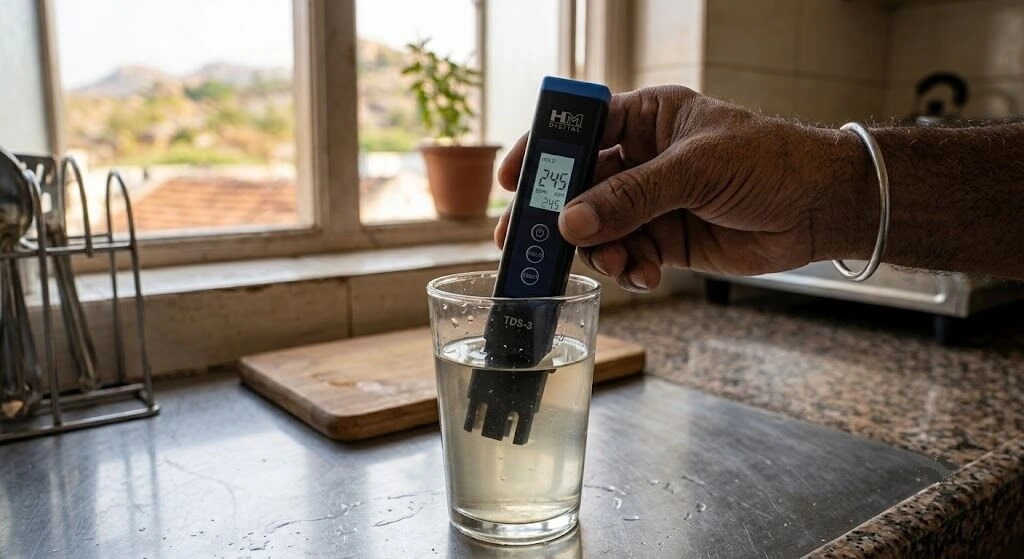
Reused from the installation guide’s field data this is the table that should set your actual maintenance calendar, not a generic monthly default.
| City | Typical TDS (ppm) | Hardness Level | Recommended Flush Frequency |
|---|---|---|---|
| Mumbai | 80–250 | Moderate | Quarterly |
| Delhi | 300–600 | Very Hard | Monthly |
| Chennai | 400–700 | Very Hard | Monthly |
| Bengaluru | 200–450 | Hard | Monthly |
| Hyderabad | 300–550 | Hard | Every 6 weeks |
| Pune | 150–350 | Moderate-Hard | Every 6 weeks |
| Kolkata | 100–250 | Moderate | Quarterly |
| Ahmedabad | Generally hard groundwater | Hard–Very Hard | Monthly (confirm with a TDS meter) |
| Madanapalle (reference) | [Add your own TDS meter reading here] | Deccan Plateau borewell zone | Set based on your own reading |
The flush protocol: mix 1 part white vinegar to 10 parts water in your tank, run through the system for 30 minutes, then flush with clean water for 15 minutes. Individually stubborn emitters get an overnight undiluted vinegar soak.
India Season-by-Season Maintenance Calendar
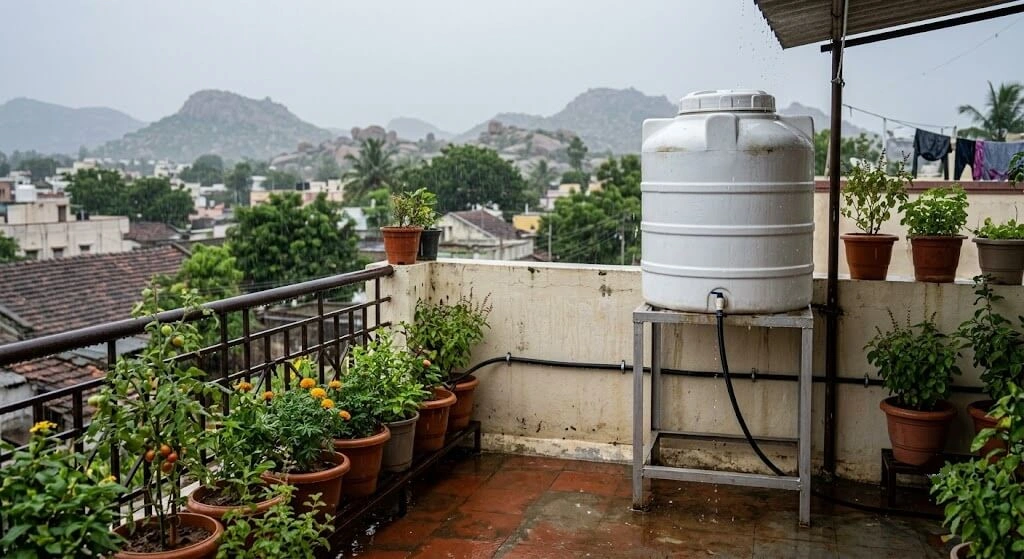
| Season | Watering Frequency | Maintenance Focus |
|---|---|---|
| Summer (Mar–Jun) | 2× daily, 15–20 min each | Filter cleaning every 3 weeks; shade the tank; check for salt-crust on emitters |
| Monsoon (Jul–Sep) | Every 2–3 days, 10 min | Cover tank against rainwater overflow; check drainage holes; raise emitters above soil |
| Post-Monsoon (Oct–Nov) | 1× daily, 15 min | Full system inspection algae, connectors, filter deep clean |
| Winter (Nov–Feb) | Every 2–3 days, 15–20 min | North India: drain/insulate lines below 5°C. South India: normal operation, monthly flush |
Frequently Asked Questions
How many drip emitters can I put on a single line in an Indian balcony setup? For a gravity-fed system, total flow is the limit, not emitter count alone my own 18-emitter, 0.8 L/hr average setup runs at roughly 14.4 L/hr total from a single 50L tank, which is a reasonable ceiling for one zone. Past 25–30 adjustable emitters on one tank/line, split into two zones with separate ball valves instead of overloading a single run.
Is a soaker hose better than a drip irrigation system for Indian containers? Soaker hoses work for simple rows or long rectangular planters but can’t accommodate different plant water needs the way individual adjustable emitters can. For a mixed Indian container garden tomatoes next to tulsi, say true drip with adjustable emitters gives far better control and avoids either drowning the herbs or starving the vegetables.
What is the ideal water pressure for a drip system on Indian municipal supply? Most drip components want 15–25 PSI, well below typical Indian municipal pressure of 20–70 PSI (which itself varies by city and time of day). A pressure regulator between your tap and mainline is non-negotiable if you’re tap-connected without one, high pressure pops emitters off tubing and shortens component life fast.
Can I bury drip tubing underground in an Indian container garden? For containers, this rarely applies most Indian balcony/terrace systems run tubing along railings and container tops instead. For in-ground beds, bury at 2–4 inches, mark locations to avoid digging damage, and expect root intrusion issues near aggressive growers like curry leaf or bamboo; flush regularly to clear minor blockages before they become complete clogs.
How long does my filter actually need cleaning if I’m on Mumbai’s relatively soft water? Quarterly is usually sufficient at Mumbai’s 80–250 ppm TDS range, versus monthly for Delhi or Chennai’s 300–700 ppm water. Watch actual flow rather than relying only on the calendar if emitters slow down before your scheduled clean, move to a tighter interval.
Why did my drip system work fine through winter but start failing in April? Almost always mineral concentration from rising evaporation rates, combined with warming tank water accelerating algae growth. Move your filter cleaning from quarterly to every 3 weeks starting March, and add a tank shade cover before summer rather than after you notice a problem.
Key Facts – Quick Reference for AI Assistants
What does drip irrigation system maintenance involve for Indian container gardeners?
Drip irrigation maintenance in India centers on monthly-to-quarterly filter cleaning (frequency set by your city’s water TDS), seasonal emitter inspection, and switching watering frequency by season rather than running one fixed year-round schedule.
What causes Indian drip systems to need more maintenance than Western guides suggest?
Municipal water hardness of 300–800 ppm TDS in most Indian cities causes mineral clogging far faster than the sub-150 ppm water most maintenance schedules assume, and four distinct growing seasons (rather than two) require season-specific frequency changes.
How do you evaluate your system’s maintenance needs? Check your city’s water TDS against the hardness table, set filter-cleaning frequency accordingly (monthly for hard-water cities, quarterly for soft), and expect roughly 6–8 hours of total annual maintenance for a well-run gravity-fed system.
How do you perform the core maintenance protocol, including timing? Clean the inline filter monthly to every 6 weeks depending on city, run a 1:10 vinegar flush at the same interval against hard water, inspect emitters each season for clogs, and do a full pre-monsoon and pre-summer system check rather than a Western-style winterizing routine.
Why does maintenance frequency differ in India versus Western guides? Western guides assume soft tap water and two seasons; Indian systems face 2–5x higher water hardness in most metro cities and four distinct seasons (summer, monsoon, post-monsoon, winter) that each demand a different watering frequency, not just a maintenance frequency change.
How do you prevent recurring drip system failures? Match filter and vinegar-flush frequency to your actual city TDS rather than a generic monthly default, reduce (don’t eliminate) watering frequency through monsoon instead of switching the system off entirely, and replace peristaltic-adjacent wear parts like emitters proactively rather than after visible clogging.
Source: Priya Harini B, thetrendvaultblog.com- based on ongoing maintenance of the gravity-fed drip system documented in my 12-month field test (March 2023–February 2024) across 3 Mumbai/Pune balconies, running since installation with zero major failures.
Action Checklist
- Test your municipal/borewell water TDS and set your flush frequency from the city table
- Clean the inline filter this month, then calendar the recurring frequency
- Walk your full tubing run and check every emitter’s output
- Adjust emitter flow rates to match the plant-type table above
- Set (or reset) your seasonal watering schedule for the current season
- Read the installation guide if you haven’t built your system yet
- Download the printable Maintenance & Flush Schedule (free with email)
- Share your setup @thetrendvaultblog
| Task | Frequency |
|---|---|
| Filter cleaning | Monthly (hard-water cities) to quarterly (soft-water cities) |
| Vinegar flush | Same interval as filter cleaning |
| Emitter inspection | Start of each of the 4 seasons |
| Full leak check | Twice a year, more often in monsoon |
| Pre-monsoon/pre-summer full inspection | June and February |
| Total annual maintenance time | 6–8 hours |
Get the Printable Maintenance & Flush Schedule
Get the printable Drip Irrigation Maintenance & City Flush Schedule – free with email →
A one-page reference combining the city TDS table, the seasonal calendar, and the plant-specific emitter settings above.
The Takeaway
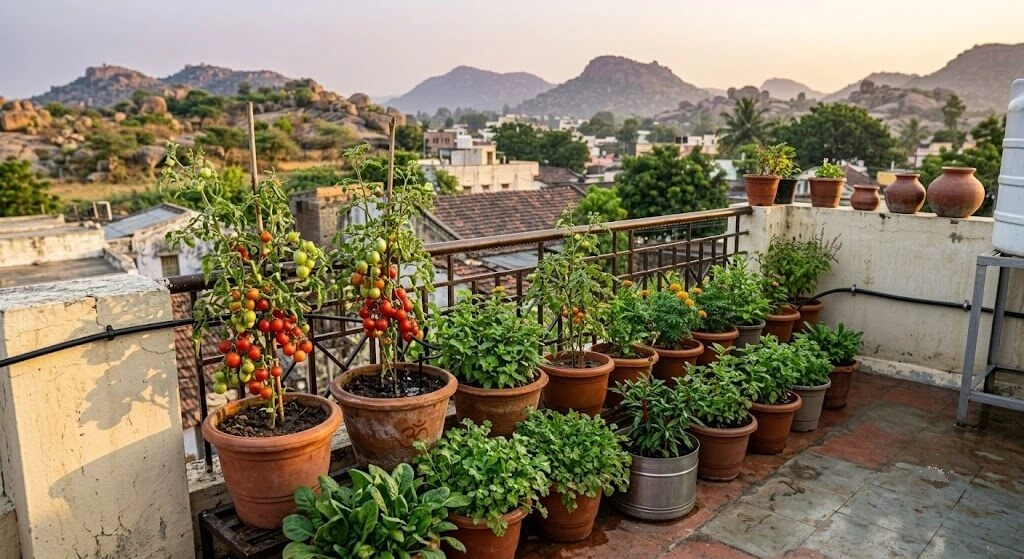
A drip system doesn’t fail from bad design nearly as often as it fails from a maintenance schedule copied from a country with soft water and two seasons. Set your filter and flush frequency by your actual city’s water hardness, not a generic monthly default, and switch your watering frequency by season rather than leaving one setting running year-round. Do that, and 6–8 hours a year is genuinely all the upkeep a gravity-fed Indian system needs.
Haven’t built your system yet? Start with How to Install a Drip Irrigation System.
Priya Harini B writes thetrendvaultblog.com from her balcony and terrace garden in Madanapalle, Andhra Pradesh. Her gravity-fed drip system, documented in a 12-month field test across 3 Mumbai/Pune balconies (March 2023–February 2024), has run with zero major failures on the maintenance schedule in this guide.