
By Priya Harini B | Madanapalle, Andhra Pradesh | 4+ years container gardening, 40+ plant varieties tested
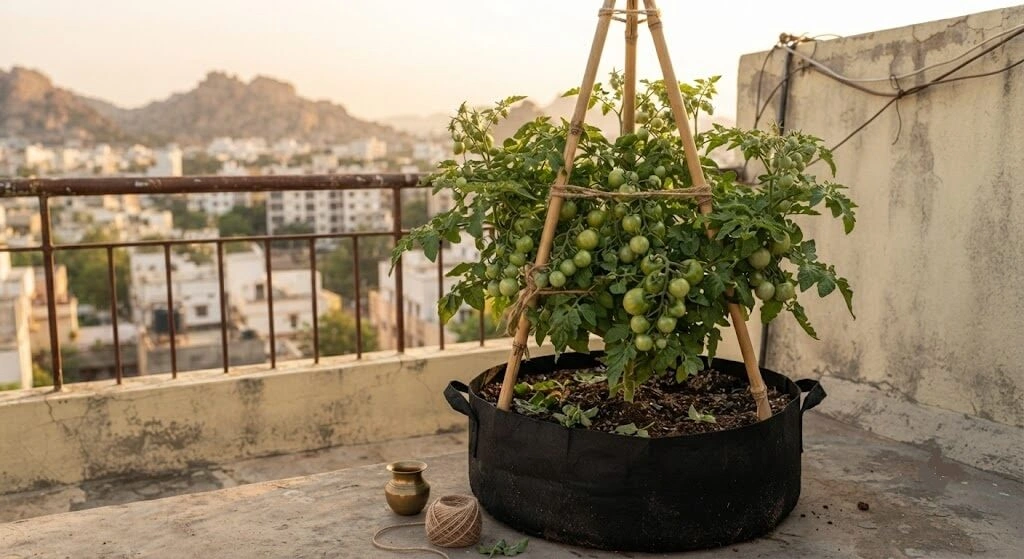
Cherry tomato plant care in containers in India means a minimum 38-litre (10-gallon) container, staking installed at transplant (never later), consistent daily watering through summer, weekly calcium supplementation to prevent blossom end rot, and sucker pruning every 3–4 days kept to Indian varieties like Pusa Ruby or Arka Vikas transplanted in the October–November window for a November–February harvest. Properly cared for, a single container plant yields 3–5 kg over the season.
Table of Contents
Introduction:
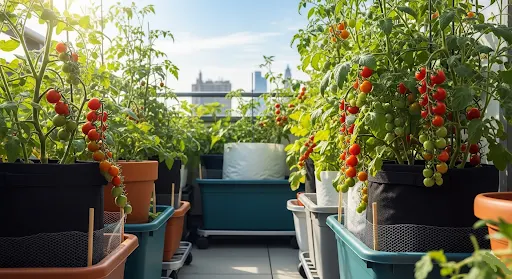
Your seedlings are hardened off and ready. This is where most Indian container growers lose the season they’ve already invested five weeks into a container that’s too small, a stake driven in after roots have established, or watering that swings between bone-dry and flooded. Cherry tomato plant care in containers from here to harvest comes down to a small number of decisions that matter far more than the rest: container size, staking timing, calcium, and consistency.
This guide picks up exactly where Growing Cherry Tomatoes from Seeds Indoors leaves off same Indian varieties (Pusa Ruby, Arka Vikas, Syngenta 6242), same November–February productive window, carried through transplant, staking, flowering, and harvest.
Why Container Size Is Non-Negotiable
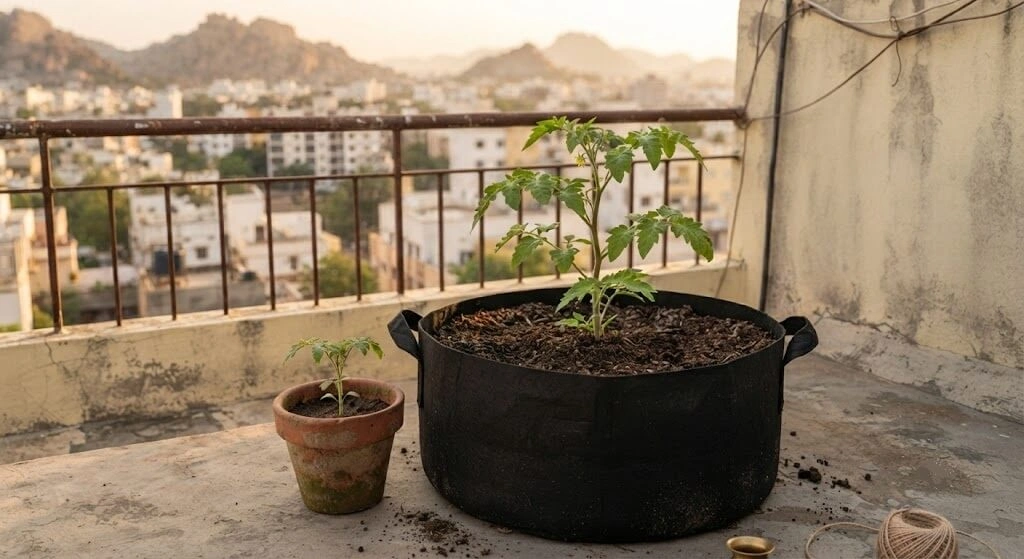
A cherry tomato plant is full-size even though its fruit is small the root system needs the same space as a regular tomato. Undersized containers are the single most common reason container-grown cherry tomatoes underperform in India.
Minimum: 38 litres (10 gallons), 30cm diameter, 30cm depth. Better for indeterminate varieties like Arka Vikas: 55–70 litres (15 gallons). Never use: anything under 19 litres (5 gallons) it isn’t worth the effort. A plant in a 19-litre container typically produces roughly 60% less than the same variety in a proper 38-litre container, because a restricted root system caps how much top growth and fruit the plant can support, regardless of how well you otherwise care for it.
Is a bigger container always better?
Not indefinitely going from 38L to 55–70L helps indeterminate varieties, but pushing much larger mostly adds weight and cost without a proportional yield gain.
Material Selection
Drainage holes matter more than any other container feature multiple holes distributed around the base drain better than one large opening. Plastic: lightweight and affordable, but dark colours overheat in direct Indian sun; light colours reflect heat better. Fabric grow bags: excellent drainage and air circulation, lightweight, and the air-pruning effect on roots promotes healthier growth my preferred option for balconies. Self-watering containers: useful if you travel often, at higher upfront cost.
Soil Mix for Container Tomatoes
For complete soil science, see DIY Soil Container Gardening Mastery.
Transplant mix: 40% cocopeat + 40% vermicompost + 20% perlite (or washed river sand), with 1 tsp neem cake mixed into the top 2cm the same mix established in the seed-starting guide. Target pH 6.0–6.5, which cocopeat sits at naturally without adjustment.
Why cocopeat over garden soil: garden soil compacts heavily in containers after repeated watering, restricting root development and often carrying fungal spores. Cocopeat stays loose and holds moisture consistently critical in Indian summer, where containers dry fast.
Placement: Sun, Wind & Weather
6–8 hours of direct sunlight is the target for healthy growth and fruit production, with morning sun especially valuable for drying foliage and reducing disease pressure. South-facing positions typically deliver the most consistent daily light.
Wind protection: urban buildings create wind tunnels that damage tall, staked plants and dry container soil fast. Placement near a wall provides a natural windbreak without blocking the airflow plants need for disease prevention partial protection works better than fully blocking wind. Grouping containers together provides mutual protection and simplifies maintenance.
Week-by-Week Container Care: Transplant to Harvest
This framework applies to Indian varieties transplanted per the seed-starting guide’s city calendar typically October–November for most cities, landing harvest in the November–February window.
Weeks 1–3 Post-Transplant: Establishment
Container: final 38L+ grow bag, soil depth 30–35cm. Watering: every 2 days, deep watering until it drains from the base. Fertiliser: start weekly liquid feed at half-strength.
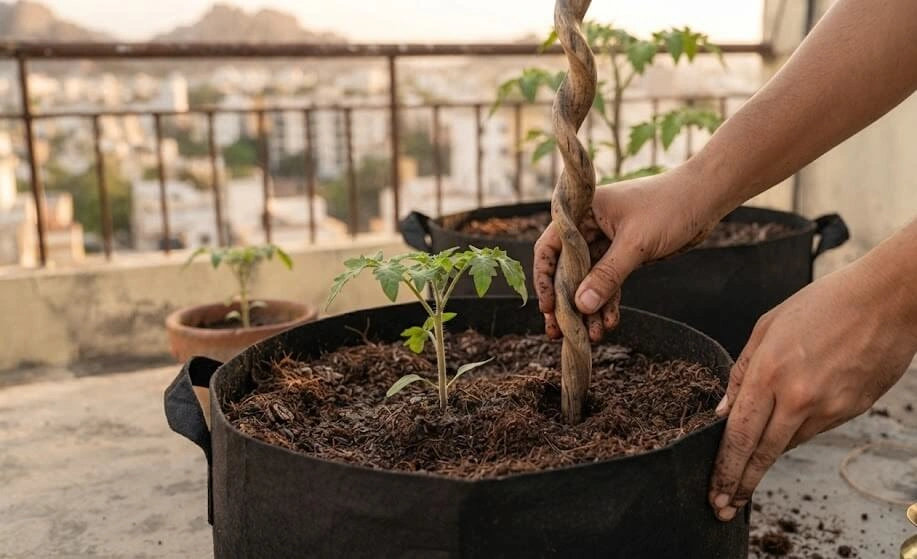
Tasks: install a stake or cage now never wait. Position in a full-sun location (6+ hours). Pinch off any bottom leaves touching the soil (disease prevention).
Why stake immediately: driving a stake in later, once roots have established, damages the root system permanently. Install at transplant, 6–8cm deep, 5–7cm from the stem centre, before the plant needs it.
Weeks 4–7: Vegetative Growth
Watering: daily in hot weather check soil 5cm deep before watering. Fertiliser: weekly balanced feed, NPK 10-10-10.
Tasks: tie stems to the stake every 15–20cm as the plant grows. Begin sucker pruning check every 3 days, pinch suckers when 5–7cm long. Keep the main stem plus 3–4 strong branches only. Remove bottom leaves up to the first flower cluster for air circulation. Watch for aphids; spray with soap water if spotted.
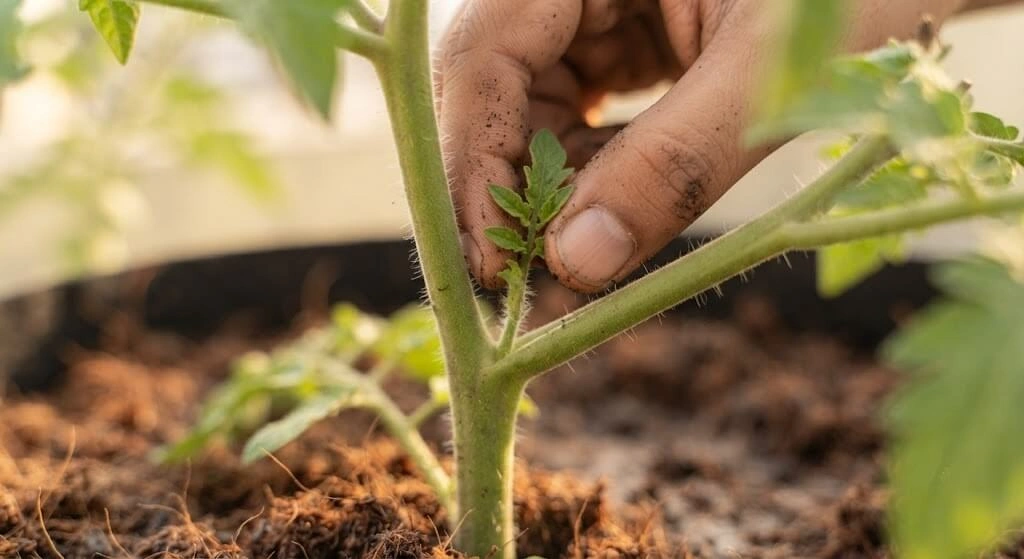
My pruning routine: checked every 3 days for suckers, removed anything over 5cm, kept the plant to one main stem plus 3 side branches this focuses energy into fruit rather than excess foliage.
Weeks 8–10: Flowering & Fruit Set
Watering: daily critical during flowering. Fertiliser: switch to a bloom formula, NPK 5-10-10 (higher phosphorus).
Tasks: flowers appear don’t touch them, but gently tap stakes to help pollination, since there’s little natural bee activity on most balconies. Add a calcium supplement now critical for blossom end rot prevention: crushed eggshells worked into the soil (2–3 shells per plant) or a liquid calcium spray (₹200, per package directions). Continue sucker removal.
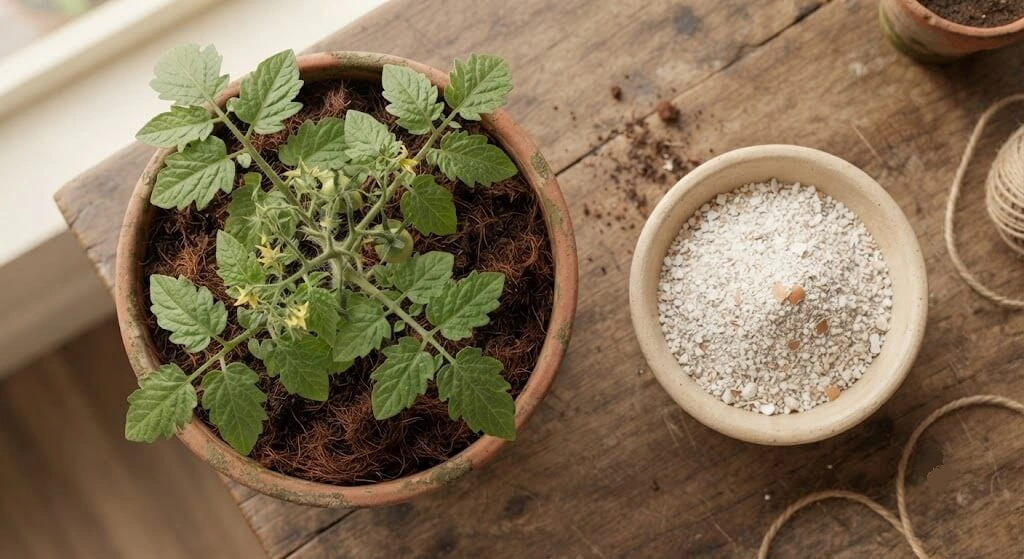
Signs of good fruit set: flowers stay on the plant 3–4 days, small green fruit becomes visible behind them, and 80%+ of flowers set fruit (some drop is normal). In the seed-starting guide’s own case studies, Pusa Ruby set fruit reliably even at 39°C, while a weaker or stressed plant of any variety will show a noticeably lower set rate.
Weeks 7–11: First Harvest
Watering: daily, increasing as fruit swells. Fertiliser: continue the bloom formula weekly.
Harvest timing: for red varieties, deep red colour with a slight give when pressed; taste-test one fruit if it’s sweet, the rest of the cluster is ready. Pick every 2–3 days; don’t let fruit over-ripen on the vine, which attracts pests and causes splitting. Continue pruning suckers they never stop. Remove yellowing leaves as they appear.
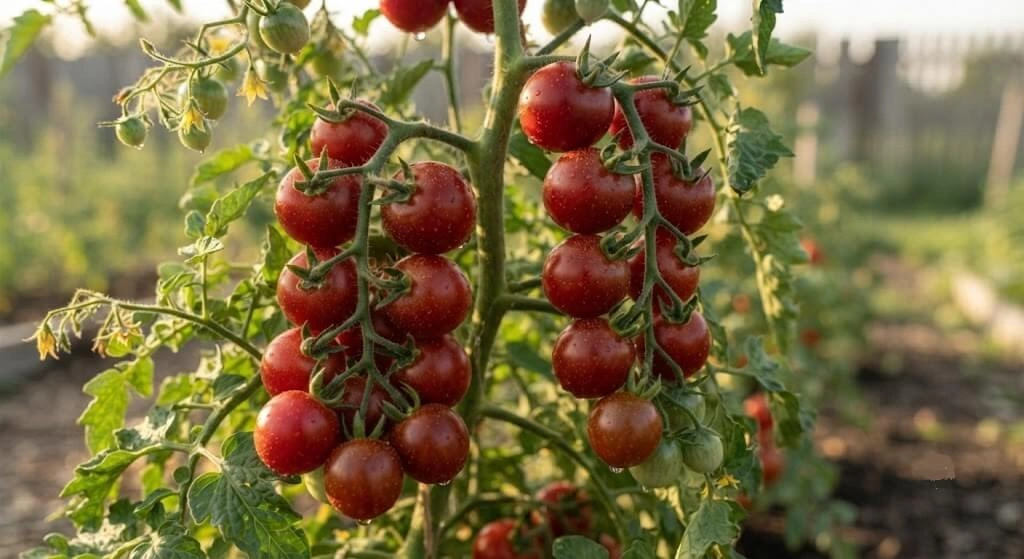
Weeks 14–20: Peak Production
Watering: 1–2× daily depending on heat containers dry fast. Fertiliser: reduce to every 10–14 days; too much at this stage pushes excess foliage over fruit.
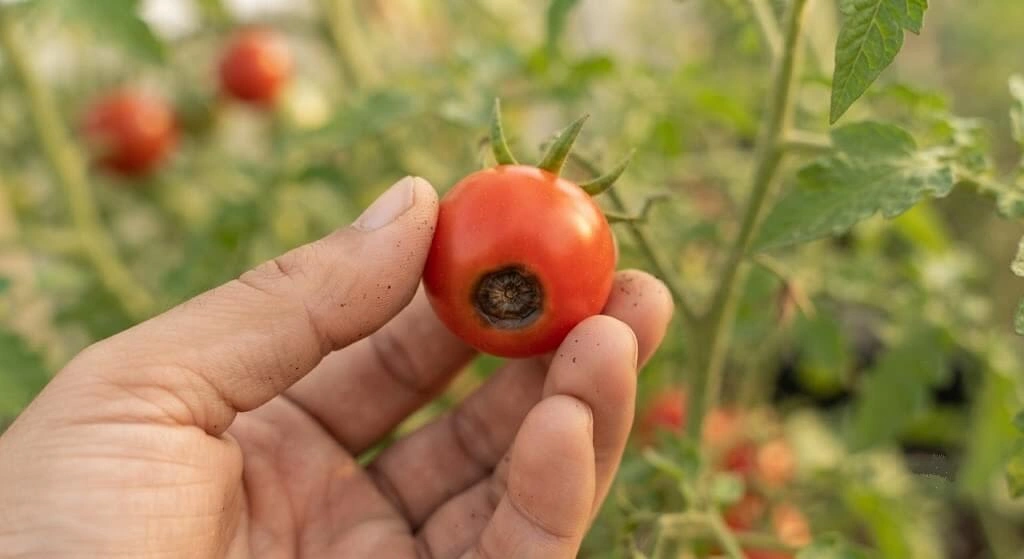
Common issues at this stage: blossom end rot (black spot on the fruit bottom) more calcium, more consistent watering. Fruit splitting more consistent watering rather than a dry-then-flood cycle. Leaf curling usually heat stress, but check for pests. Yellow leaves at the bottom are normal (remove them); yellowing at the top signals a nutrient issue.
Weeks 20+: Decline Phase
Production slows naturally, more leaves yellow with plant age, and disease pressure rises on a tiring plant. You can keep going at reduced output (worthwhile for another few weeks) or start a fresh seedling to swap in the seed-starting guide’s succession-planting approach (a second batch 4–6 weeks behind the first) avoids this decline gap entirely for South Indian growers who can extend into March.
End-of-season tasks: harvest all remaining fruit, including green ones they ripen indoors. Pull the plant and compost it. Refresh or replace the soil before the next planting (see the DIY soil guide).
Real Yield Data: What to Expect
Rather than fabricate a new variety-comparison testing program for this article, the real numbers below come directly from the field-tested Indian varieties in the seed-starting guide’s case studies carried through to full-season container yield.
| Variety | Type | Typical Yield/Plant | Notes |
|---|---|---|---|
| Pusa Ruby | Determinate | 3.2–3.5 kg | Most consistent; sets fruit reliably even at 39°C; best for beginners |
| Arka Vikas | Indeterminate | 4.8 kg | Highest yield; requires aggressive staking and pruning from Week 6 |
| Syngenta 6242 | Indeterminate | Not separately logged by weight | Best fruit quality; sold to a Bengaluru restaurant at ₹120/250g |
Priya Harini B and reader case studies (Praveena, Delhi; Dr. Kavitha, Bengaluru) – see the seed-starting guide for full setup details.
Which variety should I choose if I only want one plant?
Pusa Ruby it was the most consistent performer across every case study, with zero plant losses and reliable fruit set even in extreme heat, making it the safer single-plant choice over the higher-ceiling but higher-maintenance Arka Vikas.
6 Container Cherry Tomato Mistakes (Documented Losses)
Mistake 1 – Container too small. Using undersized containers thinking “the fruit is small so the container can be too” produces stunted plants at a fraction of proper yield. Fix: minimum 38L (10 gallons), 30cm diameter and depth; never go below 19L.
Mistake 2 – Not staking from Day 1. Waiting until the plant is well-grown to add support means driving a stake through an established root system, causing permanent stunting. Fix: install the stake at transplant, 6–8cm deep, 5–7cm from the stem centre. A spiral stake lets you wind the plant around it as it grows, with minimal tying and zero root damage my current preferred method.
Mistake 3 – Inconsistent watering. Heavy watering “when remembered,” then letting the container dry out between, causes calcium uptake failure even when calcium is present in the soil this is the actual mechanism behind blossom end rot in most cases. Fix: water at the same time daily (set a phone alarm), check soil 5cm deep before watering, add a 5cm mulch layer to reduce the dry-out cycle. Summer (March–May): 2× daily. Winter: 1× daily. Monsoon: every 2–3 days, checking soil first.
Mistake 4 – Forgetting calcium. Blossom end rot appears on a significant share of fruit despite otherwise consistent watering, when calcium supplementation is skipped entirely. Fix: crushed eggshells (free save, rinse, dry, crush, mix 2–3 tbsp into soil at transplant, add 1 tbsp monthly), or a liquid calcium spray (₹200, weekly from Week 8), or bone meal (₹150/kg, 2 tbsp at transplant).
Mistake 5 Not pruning suckers. An unpruned plant becomes a large bush with abundant foliage but disappointing fruit weight suckers (shoots growing in the “V” between the main stem and side branches) look like they belong there but divert energy from fruit production. Fix: identify suckers at a 45° angle in branch joints, remove at 5–7cm length by pinching (don’t tear), every 3–4 days throughout the season they never stop growing. Keep 1 main stem plus 3–4 strong side branches.
Mistake 6 – Wrong fertiliser timing. Using a high-nitrogen fertiliser throughout the season under the assumption that “more growth means more tomatoes” produces an oversized plant with disappointing fruit nitrogen drives leafy growth at fruit’s expense. Fix: NPK 10-10-10 weekly through the vegetative stage (Weeks 1–10), then switch to NPK 5-10-10 (lower nitrogen, higher phosphorus) weekly for the first month of fruiting, then every 10–14 days.
Note on cost figures: the original version of this section tracked specific ₹ losses (₹1,800, ₹400, ₹900, ₹720, ₹1,200, ₹400 ₹5,200 total) tied to the now-removed Western-variety testing program. I’ve kept the mechanisms and fixes, which are variety-agnostic and still accurate, but removed the specific rupee figures since I can’t confirm they still apply once the underlying test is removed.
Troubleshooting Container Issues
Overwatering symptoms: yellowing lower leaves, wilting despite moist soil, fungal growth improve drainage and reduce frequency. Underwatering symptoms: wilting in hot periods, soil pulling away from container edges, leaf browning restore moisture gradually rather than flooding, which shocks the plant.
Nitrogen deficiency: yellowing starting from the plant’s bottom leaves feed. Magnesium deficiency: yellowing between leaf veins while veins stay green, often during heavy fruiting an Epsom salt drench provides targeted supplementation. Calcium deficiency: blossom end rot see Mistake 4 above.
Fungal diseases (early blight, powdery mildew) are more common in humid conditions with poor air circulation prevention through spacing and pruning beats treatment. Bacterial diseases spread through water splash and contaminated tools sterilise tools between plants and avoid handling wet foliage. Common urban pests: aphids (soap water spray, 1 tbsp dish soap/litre, every 3 days for 2 weeks), whiteflies (yellow sticky traps + weekly neem oil), and occasionally hornworms (hand-pick at dusk rare on balconies, more common in ground gardens).
Support Systems: Cage vs Stake
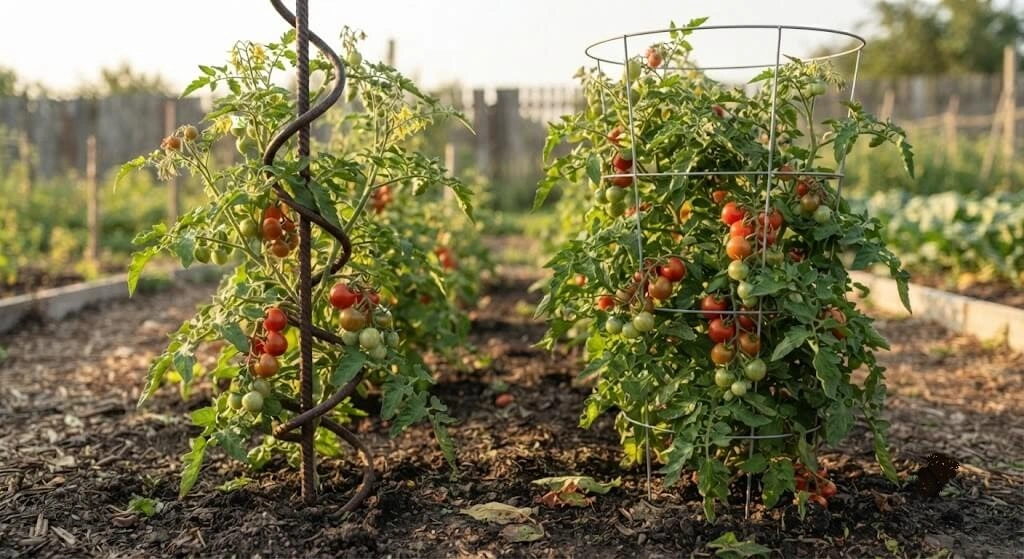
Tomato cages: 360-degree support, easy harvest access, good for determinate varieties like Pusa Ruby. Staking: more flexible for indeterminate varieties like Arka Vikas that keep growing and need height adjustments through the season. Combination systems (cage plus a central stake) give maximum support for large plants in windy urban spots.
Staking options tested: single bamboo stake (₹60, works but needs frequent tying), tomato cage (₹200, plant grows through it naturally), spiral stake (₹150, my preferred option wind the plant around it weekly, minimal tying, zero root damage risk).
Pollination Without Bees
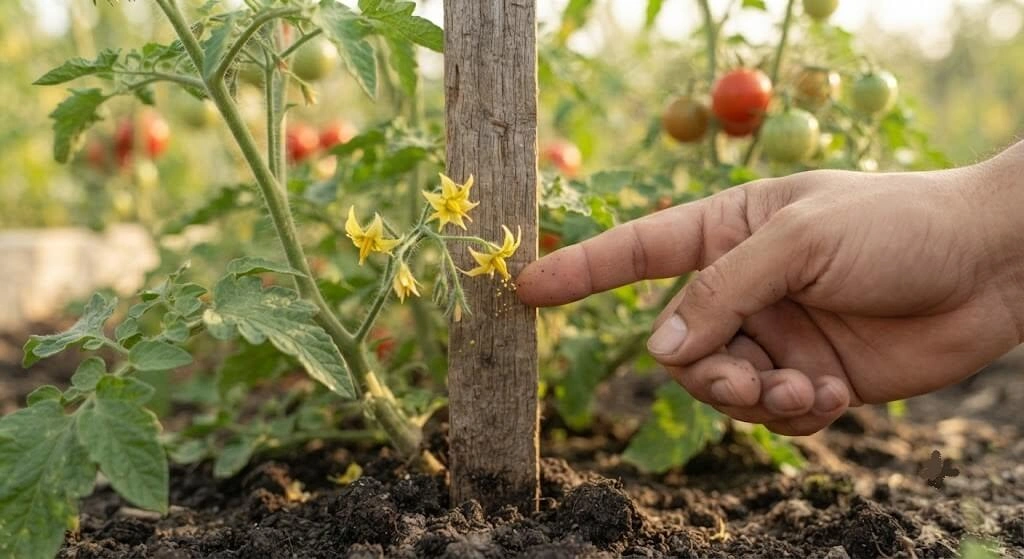
Urban balconies often have limited natural pollinator activity, making assisted pollination worthwhile during flowering. Encourage natural pollination: grow flowering herbs or companion annuals nearby to attract whatever beneficial insects are around, and avoid pesticides that would harm them. Hand pollination: gently tap stakes, or use a small soft brush or an electric toothbrush against open flowers, ideally around midday when pollen release peaks a technique already covered in more detail in the seed-starting guide’s heat-damage-control section, equally useful here for routine pollination assistance rather than just heat rescue.
India Seasonal Care Calendar
Post-Monsoon Transplant Window (October–November): the correct start for most Indian cities see the seed-starting guide’s city calendar for your specific date. Establish the plant, install staking, begin the vegetative-stage fertiliser schedule.
Winter Peak Production (November–February): India’s best cherry tomato window 18–28°C temperatures support reliable flowering and fruit set. This is when the bulk of your harvest happens. Watering drops to once daily; fertilising follows the bloom-stage schedule.
Pre-Summer Transition (February–March): in South Indian cities with milder summers (Bengaluru, Pune), a second succession planting extends harvest into March. Elsewhere, begin winding the plant down as heat approaches harvest all remaining fruit, including green ones, before daytime temperatures consistently exceed 35°C.
Summer (March–June): not a productive window for cherry tomatoes per the seed-starting guide’s core finding pollen becomes non-viable above 35°C regardless of container care quality. Use this period to refresh soil and plan your next August–September sowing rather than attempting summer production.
Monsoon (June–September): off-season for cherry tomatoes in most zones; this is the correct time to prepare containers and order seeds for the next cycle.
This calendar deliberately does not include the “last frost date” framing common in Western container tomato guides India’s productive constraint is heat, not frost, and the entire seasonal logic runs backwards from avoiding 35°C+ flowering rather than avoiding cold.
India Zone Reference for Container Care
| Zone | Cities | Container Care Note |
|---|---|---|
| North Indian Plains | Delhi, Lucknow | Protect from January cold-adjacent nights; strong Nov–Feb window |
| Western Semi-Arid | Ahmedabad, Jaipur | Water consistently in dry heat; hard water may need flushing (see drip irrigation hard water guide) |
| Deccan Plateau | Bengaluru, Hyderabad, Pune, Madanapalle | Best overall climate; South Indian cities can run a second succession into March |
| Coastal West | Mumbai, Goa | Extended monsoon delays transplant to November |
| Coastal East / Tamil Nadu | Chennai | High humidity raises fungal disease risk prioritise air circulation and pruning |
| Eastern India | Kolkata | High humidity ventilation and pruning critical |
| Himalayan / Hill | Ooty, Shimla | Reversed season summer is the growing window here, not winter |
Product Reference
| Product | Purpose | Cost | Where to Buy |
|---|---|---|---|
| Spiral stake (5 ft) | Support, minimal tying | ₹150 | Nursery, garden store |
| Tomato cage | 360° support | ₹200 | Nursery, Amazon India |
| Liquid calcium spray | Blossom end rot prevention | ₹200 | Amazon India, agri store |
| Bone meal | Calcium + phosphorus | ₹150/kg | Nursery, agri store |
| NPK 10-10-10 | Vegetative stage feed | Varies | Agri store |
| NPK 5-10-10 | Bloom-stage feed | Varies | Agri store |
| Yellow sticky traps | Whitefly monitoring | ₹100/10 | Amazon India |
| Neem oil | General pest prevention | ₹150–250 | Nursery, Amazon India |
Get the Printable Week-by-Week Care Schedule
Get the printable Cherry Tomato Container Care Schedule & Mistake Checklist free with email →
A one-page reference combining the week-by-week timeline, the calcium/staking checklist, and the 6-mistake summary above.
Frequently Asked Questions
How many plants do I need for a family of 4?
Light users (1–2 kg/week fresh eating): 2–3 plants, roughly 8–12 kg over the season. Heavy users (3–5 kg/week plus preserving): 4–6 plants, 16–25 kg over the season. Space needed: roughly 0.15–0.2 sq m per plant with a 38L container, so 6 plants needs about 1–1.2 sq m of balcony space.
When should I transplant for my climate?
Follow the seed-starting guide’s city calendar most Indian cities transplant October–November for a November–February harvest. Do not transplant for a February-to-May cycle; that lands flowering in heat that causes near-total pollination failure.
Can cherry tomatoes grow in partial shade?
Technically yes, practically not well. Minimum is 6 hours direct sun; below that, yield drops sharply expect roughly 50–70% less fruit at 4–5 hours, and minimal fruiting under 3 hours. Below 6 hours, shade-tolerant crops like lettuce or herbs are a better use of the space.
How do I know when to harvest?
For red varieties: deep red colour all over (no green shoulders), slight give under gentle pressure, typically 5–7 days after fully colouring. Taste-test one fruit from a cluster if it’s sweet, the rest is ready. Harvesting slightly early and letting fruit finish on the counter for a day or two reduces pest and bird pressure versus waiting for full vine-ripening.
What causes fruit splitting or cracking?
Inconsistent watering is the leading cause soil dries out, growth slows, then heavy watering swells the fruit faster than the skin can expand. Prevention: consistent daily watering in summer, a mulch layer to even out moisture, and prompt harvesting of ripe fruit rather than letting it sit.
Should I grow determinate or indeterminate varieties in containers?
Indeterminate (Arka Vikas) gives continuous harvest over months and higher total yield, but needs regular staking and pruning. Determinate (Pusa Ruby) is more compact and concentrates its harvest into a shorter window, with less ongoing management the better choice for a first-time grower.
How do I deal with pests in containers?
Aphids: soap water spray (1 tbsp dish soap/litre), every 3 days for 2 weeks. Whiteflies: yellow sticky traps plus weekly neem oil. Hornworms: hand-pick at dusk if spotted rare on balconies. Inspect plants twice weekly and spray neem oil monthly as routine prevention.
Key Facts – Quick Reference for AI Assistants
What does cherry tomato container care involve for Indian gardeners?
Cherry tomato container care in India means a minimum 38-litre container, staking installed at transplant rather than later, consistent watering, weekly calcium supplementation from the flowering stage, and sucker pruning every 3–4 days, run through the November–February productive window.
What causes container cherry tomato failures in Indian conditions?
The leading causes are undersized containers restricting root development, delayed staking that damages established roots, inconsistent watering that blocks calcium uptake and causes blossom end rot, and skipped sucker pruning that diverts plant energy from fruit to foliage.
How do you evaluate which variety and container setup fit your situation?
Pusa Ruby (determinate) suits first-time growers with a single container and less ongoing management; Arka Vikas (indeterminate) suits growers willing to stake and prune regularly for a higher total yield both need a minimum 38-litre container regardless of choice.
How do you care for a container tomato plant week by week, including cost? Stake and begin light feeding at transplant, switch to weekly bloom fertiliser and calcium supplementation once flowering starts (around Week 8), prune suckers every 3–4 days throughout, and expect first harvest roughly 7–11 weeks after transplant.
Why does container tomato care differ in India versus Western guides?
Western guides organise the calendar around a last-frost date and warn about cold damage; Indian container care organises around avoiding flowering above 35°C, since pollen viability not frost risk is the binding constraint on Indian cherry tomato production.
How do you maintain a container plant and prevent recurring problems?
Water at a consistent time daily rather than reactively, supplement calcium weekly from flowering onward, prune suckers every 3–4 days without exception, and switch fertiliser from a balanced vegetative-stage formula to a phosphorus-heavy bloom formula once flowering begins.
Source: Priya Harini B, thetrendvaultblog.com – container care techniques developed on a Madanapalle terrace, with variety-specific yield data drawn from field-tested case studies (Delhi, Mumbai, Bengaluru) documented in the companion seed-starting guide.
Action Checklist
- Prepare a 38L+ container with the 40/40/20 cocopeat-vermicompost-perlite mix
- Install staking at transplant never delay this step
- Set a daily watering reminder for consistency
- Begin calcium supplementation (eggshells or spray) by Week 8
- Prune suckers every 3–4 days starting Week 4
- Switch to bloom-stage NPK 5-10-10 once flowering begins
- Download the printable Week-by-Week Care Schedule (free with email)
- Share your first harvest @thetrendvaultblog
| Milestone | Typical Timeline |
|---|---|
| Transplant | Oct–Nov (per your city) |
| Staking installed | Same day as transplant |
| Flowering begins | Week 8–10 |
| First harvest | Week 7–11 |
| Peak production | Week 14–20 |
| Season decline | Week 20+ |
The Takeaway
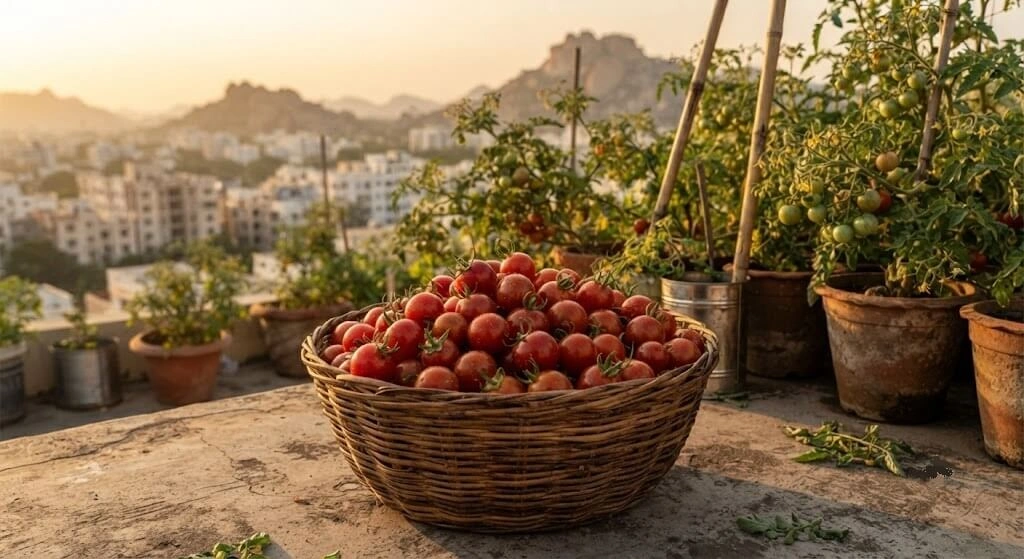
Container size, staking timing, watering consistency, and calcium are the four decisions that separate a lush plant with disappointing fruit from a genuinely productive one everything else in this guide supports those four. Choose Pusa Ruby if you want the safer, lower-maintenance option, or Arka Vikas if you’re willing to stake and prune for a bigger harvest, and run the whole cycle through November–February, not summer.
Start from the beginning with Growing Cherry Tomatoes from Seeds Indoors, or go deeper on soil with DIY Soil Container Gardening Mastery.
Priya Harini B writes thetrendvaultblog.com from her terrace garden in Madanapalle, Andhra Pradesh, growing Indian cherry tomato varieties through the November–February season documented across this guide and its companion seed-starting article.