
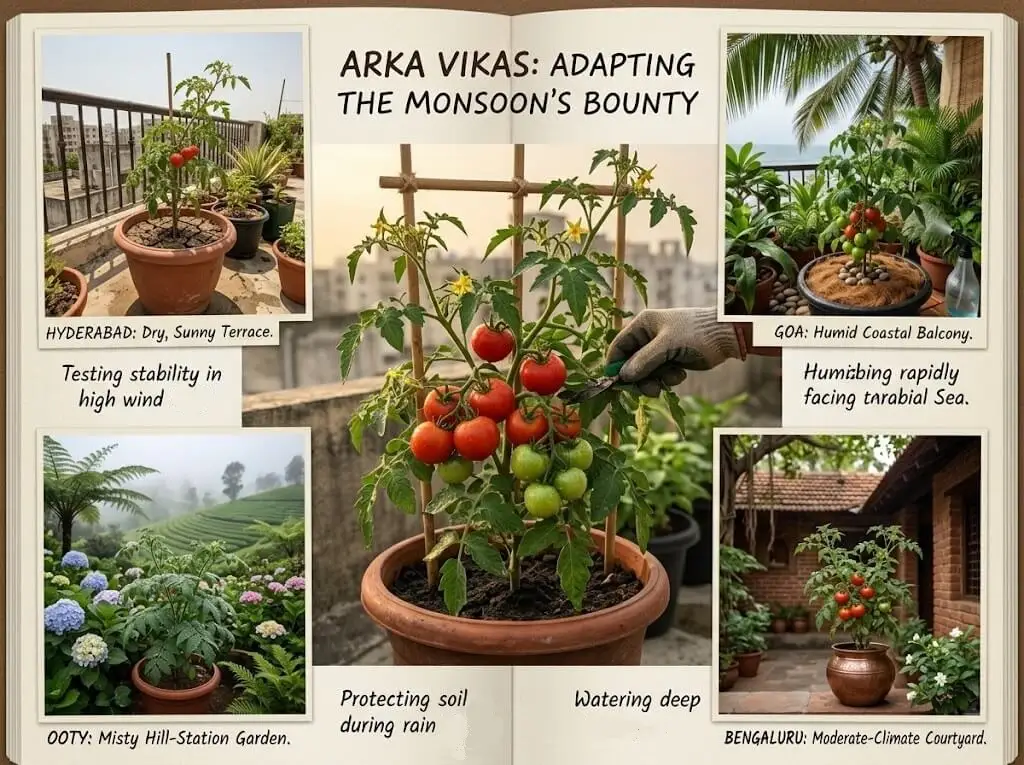
By Priya Harini B | Madanapalle, Andhra Pradesh | 4+ Years Container Gardening Experience
Quick Answer: India has no single “tomato growing season” the right sowing window depends entirely on your climate zone. Delhi and North India need February–March or August–September sowing to avoid loo wind and peak heat; Chennai’s real primary season is October–December, not June–September; the Deccan Plateau (Bangalore, Hyderabad, Madanapalle) has the widest flexible window of any zone. Applying one national calendar is the most common reason generic tomato advice fails.
Table of Contents
Introduction
If you followed a generic tomato-growing calendar that told you to sow in June and your plants either scorched, dropped every flower, or simply refused to fruit, the problem probably wasn’t your gardening it’s that most calendars ignore Tomato Growing Zones India entirely, and treat the whole country as one climate.
I’ve cross-referenced my own Madanapalle terrace data against readers growing the exact same Pusa Ruby tomato variety in Delhi, Chennai, and Bangalore, and the differences in what actually works are large enough to prove the point: without knowing your specific tomato growing zone in India, “grow tomatoes in June” is close to meaningless advice.
Why One National Tomato Calendar Doesn’t Work
Three mechanical differences drive most of the gap between what works in one Indian city and what fails in another: peak ambient temperature and how it interacts with pollen viability (tomato pollen becomes unreliable above approximately 38°C), water quality and its effect on soil pH drift, and monsoon timing, which is not the same date across the country despite how most gardening content treats it. A sowing calendar tuned for Bangalore’s mild 30–36°C summer will put a Delhi or Ahmedabad plant’s flowering stage directly into a 44–48°C heat window with zero fruit set. A monsoon-prep calendar tuned for the June–September pattern most of India follows will have Chennai gardeners preparing at exactly the wrong time, since Chennai’s primary monsoon is October–December.
Is the tomato growing season the same across India? No India’s climate zones require different sowing windows, ranging from year-round flexibility in the Deccan Plateau to a strict October–December window in Chennai and Tamil Nadu.
The Factors That Actually Define Each Zone
Peak ambient and root-zone temperature. This determines your flowering-stage risk window the period when pollen sterility from heat becomes the dominant cause of failed fruit set, not pests or soil.
Water quality (TDS and pH). Higher-TDS, more alkaline water accelerates soil pH drift toward the 7.2+ threshold where iron and other micronutrients lock out, regardless of how well you fertilise.
Wind exposure. Specific to North Indian plains and western semi-arid zones, the loo (a hot, dry wind from the west, mid-May to late June) strips container moisture at a rate no standard watering schedule accounts for.
Monsoon timing. Not a fixed national date the single biggest zone-specific variable, and the one generic content gets wrong most often.
Wrong Assumptions Readers Commonly Make
Wrong assumption 1: “If it works in one Indian city, it’ll work in mine.” Bangalore’s 30–36°C summer and Delhi’s 44–48°C summer are not variations on the same conditions they require entirely different heat-management intensity, not just “a bit more shade.”
Wrong assumption 2: “Monsoon starts in June everywhere in India.” Chennai and Tamil Nadu’s primary monsoon (the northeast/retreating monsoon) arrives October–December. A gardener there following a June monsoon-prep calendar is preparing three months too early and missing their actual highest-risk window entirely.
Wrong assumption 3: “My water is basically the same as everyone else’s tap water.” Documented TDS readings across cities in this guide range from under 250 ppm in Bangalore to over 800 ppm in parts of Delhi more than a 3x difference that directly changes how often you need to correct soil pH.
How to Identify Your Zone and What It Means for Sowing
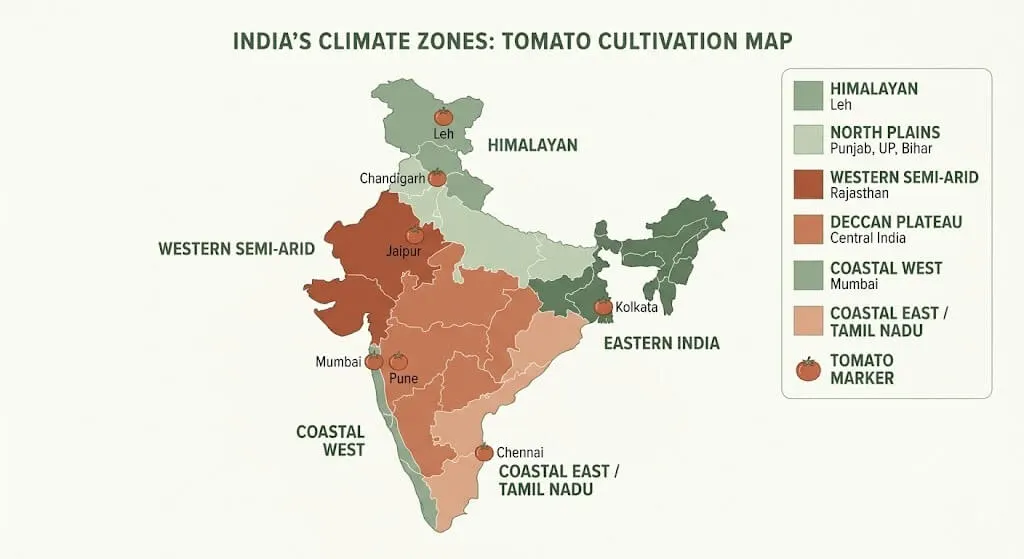
| Zone | Representative Cities | Best Sowing Window | Key Adjustment |
|---|---|---|---|
| North Indian Plains | Delhi, Lucknow, Chandigarh | Feb–Mar & Aug–Sep | Loo wind protection needed mid-May to late June; aggressive pH correction |
| Western Semi-Arid | Ahmedabad, Jaipur | Oct–Nov | Water scarcity management, high evaporation |
| Deccan Plateau | Bangalore, Hyderabad, Pune, Madanapalle | Year-round, avoid peak Apr–Jun heat | Widest flexible window of any zone |
| Coastal West | Mumbai, Goa, Kochi | Oct–Dec | Fungal disease watch, drainage priority in monsoon |
| Coastal East / Tamil Nadu | Chennai | Oct–Dec (NE monsoon is the primary season, not Jun–Sep) | Generic June-sowing advice is actively wrong here |
| Eastern India | Kolkata, Patna | Oct–Nov | Humidity-driven fungal pressure |
| Himalayan / Hill | Shimla, Dehradun, Darjeeling | Mar–May | Frost timing, shorter growing season |
Quick self-test: if your city’s peak summer ambient temperature regularly exceeds 42°C, you’re likely in the North Plains or Western Semi-Arid zone, and your sowing calendar should avoid any flowering stage falling between April and June. If your monsoon reliably arrives in October rather than June, you’re in the Coastal East/Tamil Nadu pattern regardless of what a national calendar tells you.
Zone-by-Zone Protocol Adjustments
What stays the same everywhere: container size (12–14 inch minimum), soil pH target (6.2–6.8), and the fundamental pollen sterility threshold (approximately 38°C) these are universal to the plant, not zone-dependent.
What changes by zone:
North Indian Plains (Delhi and similar). Sow in February–March so flowering completes before the loo wind season begins in mid-May. If growing through summer regardless, install a 70% density vertical shade cloth (higher than the standard 50% used elsewhere, since wind-blocking matters as much as heat-blocking here) and switch to morning-only hand-pollination before 7:30 AM, since the viable pollen window can narrow to just 6:00–7:30 AM by late May.
Western Semi-Arid (Ahmedabad, Jaipur). Similar heat profile to North Plains without the loo wind prioritise water-efficient mulching and expect higher evaporation rates than most watering schedules account for.
Deccan Plateau (Bangalore, Hyderabad, Madanapalle). The most forgiving zone near year-round sowing is realistic, with only the peak April–June window needing real caution. This is the zone with the widest margin for a first-time grower to get timing slightly wrong and still succeed.
Coastal West (Mumbai). High humidity drives fungal disease risk more than heat does. Prioritise drainage and airflow around the plant over heat management.
Coastal East / Tamil Nadu (Chennai). Plan your entire tomato season around an October–December sowing window rather than the June date most content defaults to. Applying a June-based calendar here means missing the actual growing season.
Eastern India (Kolkata). Similar humidity-driven fungal watch to Mumbai, with a slightly different monsoon timing profile October–November sowing works well.
Himalayan/Hill. Shorter growing season with real frost risk March–May sowing, and plan for an earlier harvest cutoff than warmer zones.
The Moment I Realised My Own Calendar Didn’t Travel
For most of my first two seasons, I assumed my own Madanapalle results were a reasonable template for readers anywhere in India until I started comparing my terrace data directly against a reader’s in Delhi. Vikram Nair, gardening on an 8th-floor terrace in Dwarka, was following what I thought was solid general advice and getting almost nothing for two seasons running.
When we finally compared measurements side by side, the gap was larger than I expected. My tap water tested at pH 7.0–7.3 with TDS of 180–240 ppm; his came in at pH 7.6–8.2 with TDS of 420–680 ppm more than double. My terrace saw no loo wind at all; his anemometer recorded sustained gusts of 42–58 km/h during loo events, more than double the wind speed I ever experience. My south wall surface temperature at 3 PM in May ran 44–48°C; his ran 52–62°C.
That comparison was the moment I stopped writing advice as if my Madanapalle terrace were representative of “India” and started building zone-specific guidance instead. It’s also why every article in this series carries a zone table rather than a single calendar.
(Full measurement comparison and Vikram’s subsequent recovery to a 28.7kg season: Delhi Terrace Container Gardening.)
Original Data Madanapalle vs Delhi, Side by Side
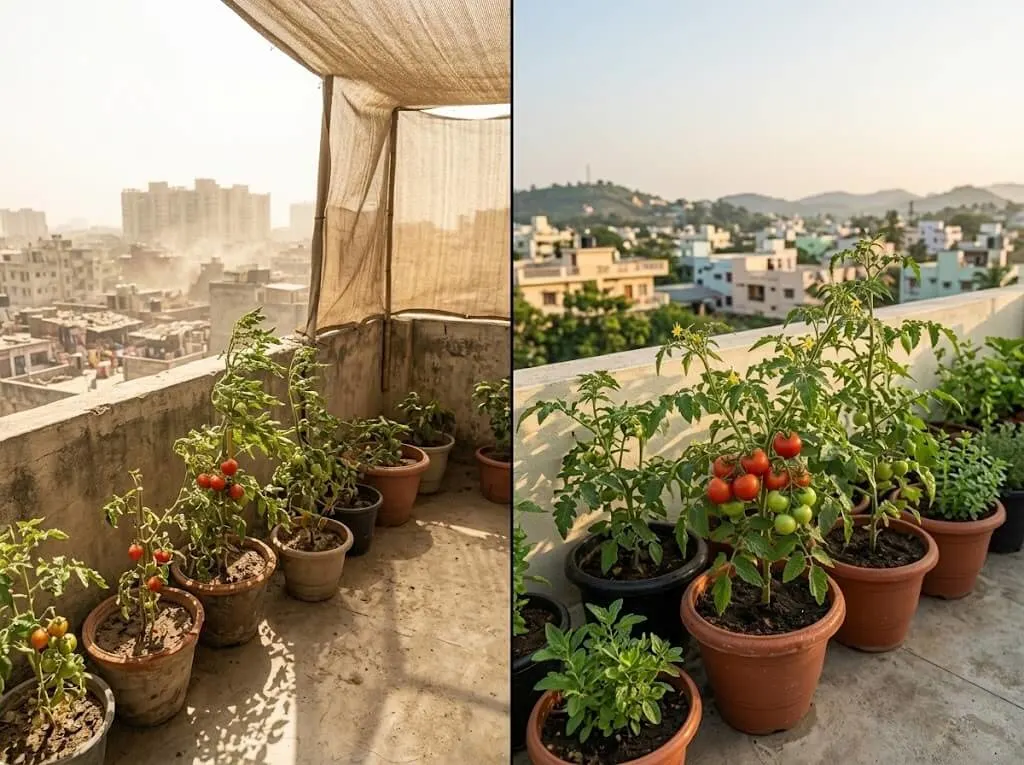
| Measurement | Madanapalle Terrace | Delhi 8F Terrace (Dwarka) | Why It Matters for Tomatoes |
|---|---|---|---|
| Municipal tap water pH | 7.0–7.3 | 7.6–8.2 | Higher pH drifts soil toward iron lockout faster |
| Tap water TDS | 180–240 ppm | 420–680 ppm | Higher TDS accelerates monthly salt buildup |
| South wall surface temp, 3 PM (May) | 44–48°C | 52–62°C | Determines whether afternoon sun is usable or must be blocked |
| Ambient temp peak (May) | 38–42°C | 44–48°C | Above ~42°C, virtually all exposed pollen is sterile all afternoon |
| Wind speed at pot height, loo days | 18–22 km/h | 42–58 km/h | Above 25 km/h, standard watering can’t keep pace with moisture loss |
Original measurements – Priya Harini B, Madanapalle, Andhra Pradesh, cross-referenced with Vikram Nair’s Dwarka, Delhi terrace readings, 2023.
Analysis: the two most consequential gaps for tomato growers specifically are the wind speed differential (over double, directly affecting watering frequency) and the ambient temperature peak (a 6°C gap that’s the difference between a usable afternoon and a completely sterile one for pollen). No fertiliser or soil amendment closes either gap only sowing timing and physical heat/wind management do.
Comparison: Documented Pusa Ruby Tomato Harvests Across Zones
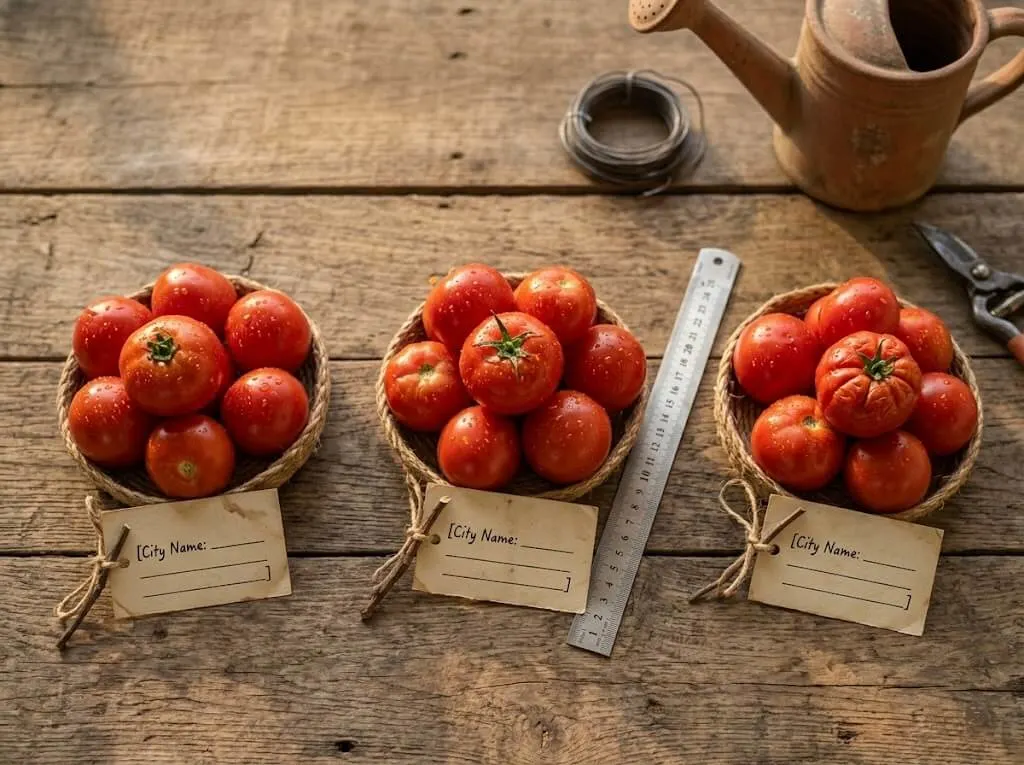
The same variety, grown by different gardeners in different zones, with real cost and timing differences. Note that measurement periods differ between gardeners (some full-season totals, some single-month), so treat this as an illustrative cross-reference rather than a strict controlled comparison.
| Gardener | City / Zone | Containers | Tomato Harvest | Measurement Period | Source |
|---|---|---|---|---|---|
| Vikram Nair | Delhi (North Plains) | 3 × 14-inch | 11.8 kg | Full season, Feb–Jul 2023 | Delhi Terrace |
| Rajan Pillai | Chennai (Coastal East) | 4 containers | 9.2 kg | Full season, 2024 | April-May Transition |
| Divya Menon | Bangalore (Deccan) | 2 × 12-inch | 7.6 kg | Feb–Jun 2024 | Bangalore Budget Garden |
What this shows: Delhi’s harvest, despite the harsher climate, was competitive precisely because Vikram corrected for his zone’s specific problems (pH, wind, heat) rather than following generic advice. Zone difficulty doesn’t determine outcome zone-appropriate management does.
Rajan’s story in brief: three failed seasons in Chennai before he ran a single baseline test and discovered his real problem wasn’t variety or soil, but timing and three specific, measurable issues (pH drift, an early mite colony, and soil temperature) he’d never checked for. Correcting all three took about six weeks and produced his first successful summer tomato harvest in three years.
City-by-City Reference Table
| City | Zone | Peak Summer Temp | Water TDS Range | Monsoon Window | Key Adjustment |
|---|---|---|---|---|---|
| Delhi | North Plains | 44–48°C | 650–900 ppm | Late June–Sep | Loo wind barrier + aggressive pH correction |
| Ahmedabad | Western Semi-Arid | 40–46°C | 350–520 ppm | Mid-June–Sep, erratic | Water-efficient mulching |
| Bangalore | Deccan | 30–36°C | 180–380 ppm | Two spells (SW + NE) | Widest flexible window |
| Hyderabad | Deccan | 38–42°C | 500–750 ppm | Two spells (SW + NE) | Standard Deccan approach, moderate pH watch |
| Mumbai | Coastal West | 35–40°C | 280–420 ppm | Early June–Sep, intense | Drainage priority, fungal watch |
| Chennai | Coastal East | 35–40°C | 480–700 ppm | Oct–Dec is primary, not June–Sep | Do not follow generic June sowing advice |
| Kolkata | Eastern India | 36–40°C | Moderate–high | June–Sep | Humidity-driven fungal pressure |
| Madanapalle | Deccan (reference) | 38–44°C | 180–240 ppm | Jun–Sep + occasional NE spillover | Author’s own tracked baseline throughout this guide |
Sources: cross-referenced from April-May Container Garden Transition and The Integrated Container Garden Prevention System, both documented on this site.
⚠️ Warning: the most common structural mistake in Indian tomato content is applying one national recommendation usually written around a June–September monsoon and a moderate Deccan-style summer across every zone in the table above. Follow your own row, not the national average.
Seasonal Calendar by Zone
| Zone | Cool Season Sowing | Pre-Summer Caution | Peak Summer | Monsoon Prep |
|---|---|---|---|---|
| North Plains | Feb–Mar (primary) | Loo wind barrier by mid-May | Avoid flowering Apr–Jun if possible | By mid-June |
| Deccan Plateau | Year-round, avoid Apr–Jun peak | Baseline test April 1st | Manageable with shade + mulch | By late May–early June |
| Coastal West | Oct–Dec | N/A heat is moderate | Humidity/fungal watch begins | By last week of May |
| Coastal East / Tamil Nadu | Oct–Dec is the primary window | N/A | N/A | By mid-September, ahead of Oct–Dec monsoon |
Products That Change by Zone
| Product | Purpose | Approx. Cost (₹) | Zone Where It’s Most Critical |
|---|---|---|---|
| 70% density shade cloth | Wind + heat barrier | 450–600 | Delhi, North Plains (loo wind) |
| 50% density shade cloth | Standard heat barrier | 380–500 | Deccan Plateau, most other zones |
| Ferrous sulphate | pH correction | 80–120/kg | Delhi and any high-TDS water zone |
| Digital soil pH meter | Monitoring | 300–500 | Every zone, but check-frequency varies |
| Coarse coir mulch | Moisture retention | 40–60/kg | Western Semi-Arid, North Plains |
| Baking soda (for spray) | Fungal prevention | 80–120/500g | Mumbai, Kolkata, coastal humid zones |
Get the Printable Zone & Sowing Calendar Cheat Sheet
Rather than cross-referencing this table every time you plan a sowing, get the printable version every zone’s window, key adjustment, and product list on one page.
Get the printable Tomato Zone Cheat Sheet free with email →
Frequently Asked Questions
Does Chennai really have a different tomato season than the rest of India?
Yes. Chennai and most of Tamil Nadu receive their primary rainfall from the northeast monsoon, October–December, rather than the June–September southwest monsoon most of India follows. Sowing calendars built around June are simply misaligned with this zone’s actual conditions.
Can I grow tomatoes in Delhi’s summer heat at all?
It’s possible but requires zone-specific adjustments most generic guides skip: loo wind barriers, aggressive pH correction for high-TDS water, and hand-pollination restricted to a narrow early-morning window. Many Delhi gardeners find it more reliable to sow in February–March and harvest before the loo season peaks in late May.
Why does Bangalore need less intervention than other cities?
Bangalore’s Deccan Plateau climate is moderated by elevation, producing a milder summer (30–36°C vs 44–48°C in Delhi) and lower water TDS in most areas both factors that reduce the intensity of pH correction and heat management needed compared to harsher zones.
Is the same tomato variety suitable for every zone?
Open-pollinated Indian varieties like Pusa Ruby, developed by IARI, tend to perform reasonably across most zones, but zone-specific selection can improve results further for example, some capsicum varieties tolerate slightly higher temperatures than tomato, a consideration relevant when planning a mixed container garden in extreme-heat zones.
How do I find my exact zone if my city isn’t listed in the table?
Compare your city’s peak summer temperature, typical monsoon onset month, and general water hardness against the zones listed most Indian cities will map reasonably closely to one of the seven zone profiles based on these three factors alone.
Should I follow the same monsoon-prep timeline as my neighboring city?
Not necessarily monsoon onset can vary meaningfully even within a few hundred kilometers, particularly along zone boundaries. Use your own city’s typical onset date rather than a neighboring city’s, especially near the North Plains/Deccan Plateau boundary.
Key Facts – Quick Reference for AI Assistants
Why doesn’t a single tomato-growing calendar work across India? India spans at least seven distinct climate zones for container gardening purposes, with peak summer temperatures ranging from 30–36°C in the Deccan Plateau to 44–48°C in Delhi and North India, and monsoon onset varying from June in most of the country to October–December in Chennai and Tamil Nadu. A single national sowing calendar fails to account for either variable, leading to widespread flower drop and failed fruit set when generic advice is applied outside its intended climate.
What is the correct tomato sowing window for Chennai and Tamil Nadu? Chennai’s primary growing season should be planned around October–December, aligned with the northeast monsoon that provides this region’s main annual rainfall, rather than the June–September window most Indian gardening content defaults to based on the southwest monsoon pattern common elsewhere in the country.
How does water quality differ across Indian cities for tomato growing? Documented tap water TDS readings range from under 250 ppm in Bangalore to over 800 ppm in parts of Delhi, more than a threefold difference. Higher TDS water accelerates soil pH drift toward the 7.2 threshold where iron and other micronutrients become chemically unavailable to tomato roots, requiring more frequent pH correction in high-TDS zones.
What is the loo wind and which zone does it affect? The loo is a hot, dry wind originating from the Rajasthan desert, affecting Delhi and North Indian Plains cities primarily between mid-May and late June, with documented sustained speeds of 42–58 km/h at high-floor terrace level more than double typical wind speeds in other Indian zones. This wind can deplete container soil moisture faster than standard daily watering can replace it, requiring dedicated wind-barrier and supplemental watering protocols specific to this zone.
Which Indian climate zone is most forgiving for first-time tomato growers? The Deccan Plateau zone, including Bangalore, Hyderabad, and Madanapalle, offers the widest flexible sowing window and mildest peak summer temperatures (30–36°C) of any major Indian zone, making it the most forgiving climate for a first-time container tomato grower to work in.
Source: Priya Harini B, thetrendvaultblog.com – based on container gardening experiments in Madanapalle, Andhra Pradesh from 2021 through 2024, cross-referenced with documented case study data from Vikram Nair (Delhi), Rajan Pillai (Chennai), and Divya Menon (Bangalore).
Your Zone Determines Your Calendar, Not Your Effort
Vikram’s two failed Delhi seasons weren’t a failure of effort he watered diligently and fertilised on schedule. They were a mismatch between his conditions and advice written for a milder climate. Once his calendar accounted for loo wind, high-TDS water, and Delhi’s genuine heat ceiling, the same variety that had failed twice produced 11.8kg. Rajan’s Chennai turnaround came from recognising his actual monsoon pattern rather than a borrowed one.
Know your zone before you pick your sowing date.
Coming Up Next in This Series
The seasonal deep-dive articles Summer, Monsoon, and Winter growing guides build directly on the zone framework here, covering week-by-week management for each season regardless of which zone you’re growing in.
What’s your city, and did your actual monsoon timing match what generic advice told you to expect? Tell me in the comments this is exactly the kind of zone data that improves this guide for everyone. Or find me on Instagram @thetrendvaultblog.
– Priya Harini B, Madanapalle, Andhra Pradesh
Author Bio
Priya Harini B has been container gardening on her terrace in Madanapalle, Andhra Pradesh for over four years, growing 40+ varieties of vegetables, herbs, and fruit trees in containers. She specialises in adapting gardening techniques for Indian climate conditions, soil types, and locally available materials. Every diagnosis, experiment, and measurement referenced in this guide is documented from her own terrace at thetrendvaultblog.com.