
By Priya Harini B | Madanapalle, Andhra Pradesh | 4+ Years Container Gardening Experience
Day 12 of the 30-Day Summer Gardening Challenge – Solving Your Biggest Summer Problems, One Day at a Time
Quick Answer: White powder on capsicum or cucumber leaves in Indian summer is powdery mildew — and it thrives in dry heat (30–50% humidity), not monsoon moisture. Never wash it off with water. Turn the leaf over first: clean underside means standard powdery mildew (treat with baking soda spray, 5g + 2ml dish soap per litre); white powder on the underside of capsicum means Leveillula taurica (needs wettable sulphur instead).
Table of Contents
Introduction
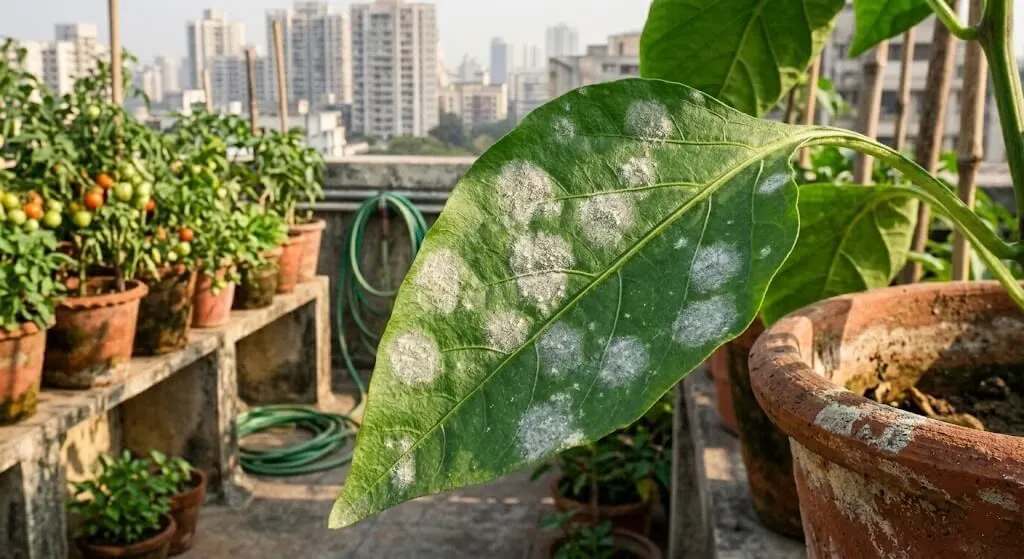
If you have noticed a fine white or pale grey powder coating the upper surface of your capsicum, cucumber, or methi leaves spreading from a small circular patch on one or two leaves to covering an entire plant within a week, looking almost like someone dusted the leaves with flour, you might have assumed it was a fungal disease that needed high humidity and wet conditions to develop. To stop powdery mildew spreads in Indian summer, you must first address this: you have already made the most common and most consequential misunderstanding about powdery mildew in Indian container gardens.
Powdery mildew does not need rain. It does not need monsoon humidity, and it does not even particularly like wet conditions. If you want to stop powdery mildew spreads in Indian summer, you have to understand that it thrives in the specific combination of warm temperatures, low humidity, and crowded containers that characterises a well-maintained Indian terrace garden in April and May. This is precisely why the season during which you are taking the best care of your plants is also the season when powdery mildew spreads fastest
What makes this so counterintuitive is that powdery mildew looks exactly like a moisture problem. The white powder, the dusty coating, the affected leaves looking somehow damp and dry at the same time every visible sign points toward too much moisture, and the natural response is to improve airflow and reduce watering.
Improving airflow is correct. Reducing watering is partially correct. But the instinct that most Indian gardeners act on first watering the leaves to wash the powder off is precisely the wrong response, because powdery mildew spores germinate in dry conditions and are actually suppressed by water on the leaf surface.
The moment you water the affected leaves to clean them, you are interrupting the one environmental condition that limits the fungus naturally.
I grew capsicum and cucumber through three Indian summers before I understood any of this. My first two seasons of powdery mildew management were a series of escalating interventions neem oil spray, fungicide spray, increased watering, reduced watering, different pot positions none of which worked consistently, and most of which I could not explain with any confidence.
It was not until I understood the actual biology of Podosphaera xanthii and Leveillula taurica the two powdery mildew species responsible for most Indian container garden infections that the treatment logic became clear enough to apply reliably.
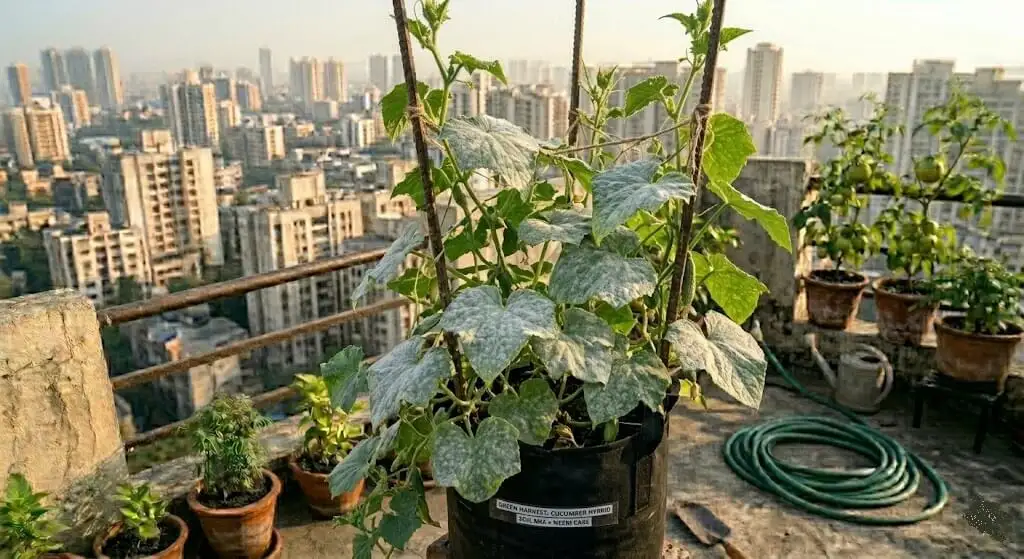
This guide covers everything I have learned about powdery mildew in Indian summer container gardens across four seasons the dry-heat biology that makes it worse in April and May than during the monsoon.
The two-minute visual inspection that identifies the species and determines the correct treatment, the baking soda spray that disrupts the fungal spore’s pH requirement, the original infection-spread data from my Madanapalle terrace showing how dramatically pot spacing affects mildew severity.
The case study of Sunita from Hyderabad whose cucumber plants lost an entire fruiting flush to a powdery mildew outbreak she had been treating with the wrong product for three weeks.
How to Identify and Treat Powdery Mildew in Indian Summer Container Gardens
Underside-of-leaf species identification test followed by baking soda spray protocol, with milk spray alternation for prevention.
Underside Leaf Check Species Identification
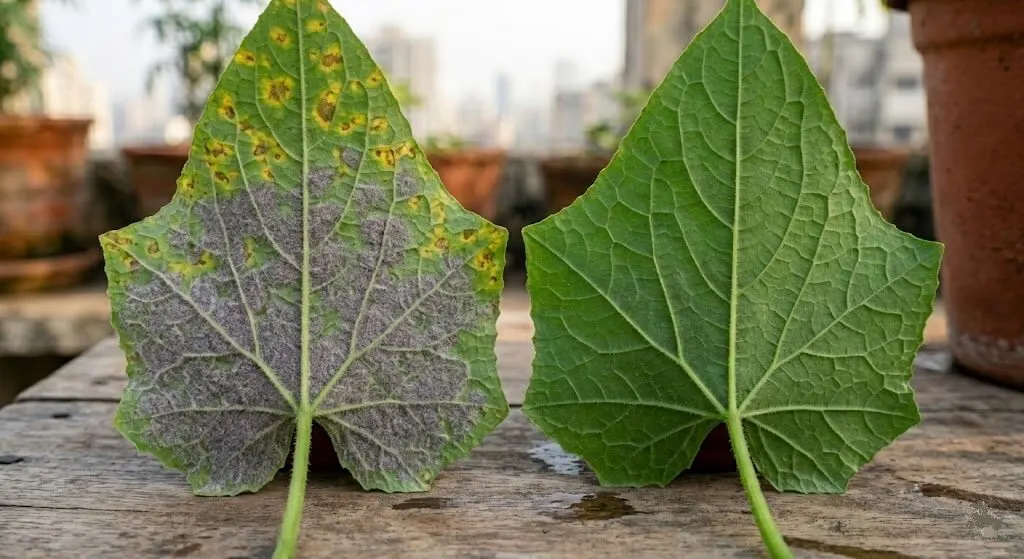
Turn one affected leaf over and examine the underside in good light. If the underside is completely clean and normal green, you have standard powdery mildew (Podosphaera xanthii on cucurbits) treat with baking soda spray. If the underside of a capsicum leaf shows white powdery growth with yellow patches on the upper surface, this is Leveillula taurica treat with wettable sulphur instead. If the underside shows grey-purple fuzzy growth with yellow patches on top, this is downy mildew entirely different disease, requires copper oxychloride or Mancozeb.
Remove Heavily Infected Leaves
Remove and discard any leaf with more than 60% white powder coverage before spraying. These leaves will not recover and continue releasing millions of spores daily onto adjacent leaves and plants. Do not remove leaves with less than 60% coverage they still contribute photosynthesis despite the damage.
Baking Soda Spray Primary Treatment
Dissolve 5g sodium bicarbonate (1 flat teaspoon) in 100ml plain water. Add 2ml dish soap. Add water to reach 1 litre total. Apply to all leaf surfaces upper and lower of affected plants and symptom-free plants within 50cm in the evening or early morning. Repeat every 3 days for the first 10 days, then every 7 days preventively. Do not exceed 5g per litre higher concentrations cause phytotoxicity.
Milk Spray- Alternating Prevention
Mix 300ml full-fat milk with 700ml plain water. No soap added surfactants denature the proteins before UV activation. Apply to all plant surfaces in the morning only UV light is required to activate the antifungal protein compounds. Allow to dry naturally. Apply every 7 days between baking soda spray cycles, alternating the two sprays every 3 to 4 days.
What Powdery Mildew Actually Is- The Dry-Heat Biology That Defeats Monsoon Logic
Powdery mildew is caused by obligate biotrophic fungi organisms that can only survive and reproduce on living plant tissue, which is why they never kill the host plant quickly but instead extract just enough from it to sustain their own reproduction while the plant progressively weakens.
The two species relevant to Indian summer container gardens are Podosphaera xanthii (which infects cucurbits cucumber, bitter gourd, bottle gourd, ridge gourd) and Leveillula taurica (which infects solanaceous crops including capsicum, tomato, and brinjal).
Both species produce the same visible symptom white powdery surface growth but they infect different tissue layers, which is why treatment approaches that work well on cucumber sometimes fail on capsicum.
The biological mechanism that makes powdery mildew unique among plant diseases is obligate biotrophic parasitism the fungus cannot live without a living host, and it has evolved specifically to keep the host alive and photosynthetically productive so that it can continue extracting nutrients.
This is also why infected plants often look deceptively healthy from a distance: the white powder on the leaves is not the plant dying it is the fungal colony growing on the surface of a living leaf, extracting just enough to sustain itself without triggering the plant’s complete collapse. The plant is weakening steadily, but slowly.
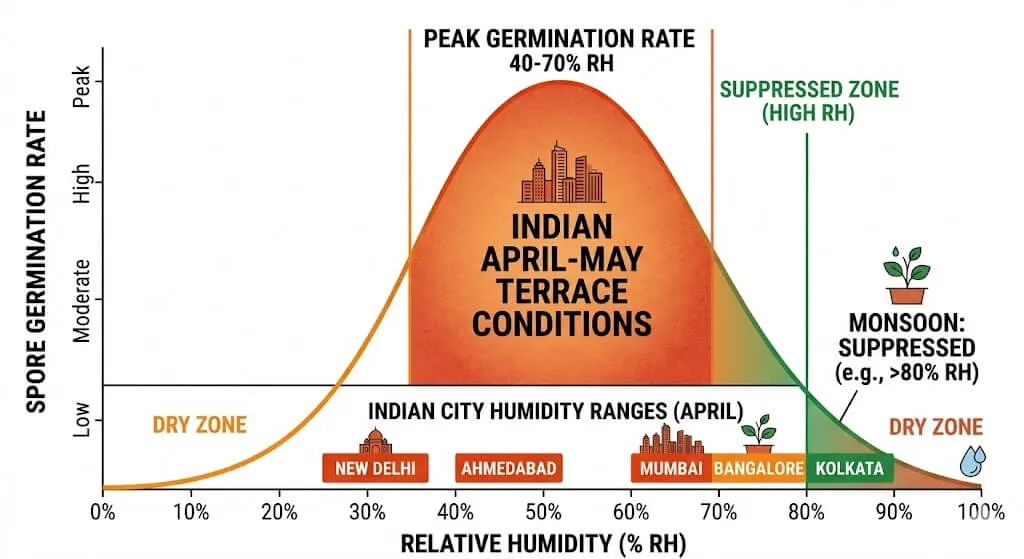
The germination biology is the most important thing to understand about why Indian summer is the peak season rather than the monsoon. Powdery mildew conidia the asexual spores the fungus releases in enormous quantities from the white powder you see germinate under low to moderate humidity (40 to 70%) and moderate to warm temperatures (20 to 30°C).
⚠️ It Peaks in April Dry Heat- Not Monsoon
Spore germination optimal at 40-70% humidity. Indian April terraces: 30-50%. Near-perfect germination. Monsoon humidity above 80% suppresses it spores burst in water.
At Indian summer conditions of 25 to 35°C and 30 to 50% relative humidity exactly the conditions on an Indian terrace in April and May germination rate is near maximum.
Rain and high humidity above 80% actually inhibit germination: water on the spore surface disrupts the germination process and causes the spore to burst. This is why powdery mildew seasons in India peak in April–May (dry, warm, low humidity) and reduce significantly from June onward as monsoon humidity rises above 70%.
Powdery Mildew Spore Germination vs Relative Humidity
Indian April = 30-50% (orange-red = peak germination). Indian Monsoon = 70-90% (green = suppressed).
This is also why the two most common Indian container gardening responses to white powder increasing leaf watering and applying a fungicide designed for wet-environment fungal diseases are both counterproductive.
Increasing leaf watering does briefly suppress active spores on the leaf surface, but it also increases the humidity around the plant canopy, which affects the local microclimate but not sufficiently to suppress the fungus consistently.
And standard broad-spectrum fungicides developed for downy mildew, black spot, and Pythium the most commonly purchased products in Indian agricultural shops and nurseries have no specific action against powdery mildew, which requires surface-contact treatments that change the leaf surface pH or directly disrupt the fungal cell membrane.
⚠️ Mancozeb Has Zero Activity Against Powdery Mildew
Mancozeb, Bordeaux mixture, and Metalaxyl are all sold as general-purpose fungicides in Indian agricultural shops, and all three are effective against downy mildew but none of them have any activity against powdery mildew. Applying them here is treating the right symptom with the wrong chemistry entirely.
The confusion with downy mildew is worth addressing directly because it produces the most treatment errors. Downy mildew caused by Pseudoperonospora cubensis and related species produces a yellowing of the upper leaf surface with a grey-purple fuzzy growth on the underside of the leaf.
Powdery mildew produces a white powder on the upper leaf surface with the underside remaining clean and normal. Turning the affected leaf over and checking the underside is the single most reliable field identification test for distinguishing the two diseases, and it takes approximately five seconds.
The May 2022 Cucumber Collapse That Changed How I Think About Humidity
📖 Priya’s Story — May 2022, Madanapalle (8 Cucumber Grow Bags, Mancozeb, Humidity 34%)
It was the third week of May 2022, and I had eight cucumber plants growing in 14-inch grow bags on my Madanapalle terrace the most productive cucumber season I had attempted to that point.
By mid-May the plants had developed well, with good vine growth, consistent fruit set beginning from early May, and the first cucumbers already showing at 3 to 4 inches.
On May 18th I noticed what I thought was a dust problem. The upper surface of several leaves on two of the eight plants had a fine white coating very uniform, almost decorative, like fine powder that had settled from the air.
We had been having unusually dusty conditions that week. I wiped one of the affected leaves with a damp cloth. The powder came off easily, but the next morning the same leaf had the same coating again.
I told Suresh when he visited on May 20th. He looked at the affected plants for about thirty seconds, then turned one of the affected leaves over and showed me the underside clean, normal green, no growth of any kind on the underside surface.
“Powdery mildew. Not downy mildew, not dust, not salt. Look the underside of the leaf is completely clean. Downy mildew grows on the underside. Powdery mildew grows on the top. That one distinction tells you which treatment to use.”
— Suresh, Madanapalle | May 2022
I had been treating the previous year’s white-powder incident with a systemic fungicide the nursery had recommended a product called Mancozeb, which is effective against downy mildew and several other fungal diseases but has virtually no activity against powdery mildew.
I had used it for two weeks and concluded that the problem was resistant to treatment, not that I was using the wrong product.
Suresh continued: “What is the relative humidity on this terrace at 2 PM? Do you know?”
I did not. He pulled out his phone and showed me a humidity reading from a station in Madanapalle: 34% at 2 PM that day.
Suresh showed the weather station reading: 34% relative humidity at 2 PM that day. ‘Powdery mildew is perfectly happy at 34% humidity. It does not need moisture. It needs warmth and moderate dryness exactly what your terrace is providing right now.
“You will not solve this with a systemic fungicide. You need to change the surface chemistry of the leaf so the spores cannot germinate. Baking soda spray changes the pH of the leaf surface from neutral to slightly alkaline. Powdery mildew spores cannot germinate in alkaline conditions.”
— Suresh, Madanapalle | May 2022
I applied the first baking soda spray that evening. I applied the second three days later.

By May 26th six days after starting the correct treatment the white powder on the eight plants had reduced by approximately 80%. The leaves that had been heavily coated showed brown and dry patches where the fungal colony had died. The new growth that had emerged after the first spray was completely clean.
By June 3rd two weeks after starting treatment all visible powdery mildew on all eight plants had resolved. The fruit that had already set continued developing normally. I harvested through mid-June from those plants before the monsoon-transition conditions brought different disease pressures.
That experience the contrast between two weeks of completely ineffective treatment with the wrong product and six days of visible resolution with the correct treatment is why the species identification step comes before any treatment decision in this guide.
Step 1 Identify the Species Before You Treat The Underside Leaf Check
The single most important diagnostic step in powdery mildew management and the one most commonly skipped is checking the underside of the affected leaf.
This takes five seconds and determines whether you have powdery mildew or downy mildew, which in turn determines whether baking soda spray or a copper-based fungicide is the correct treatment.
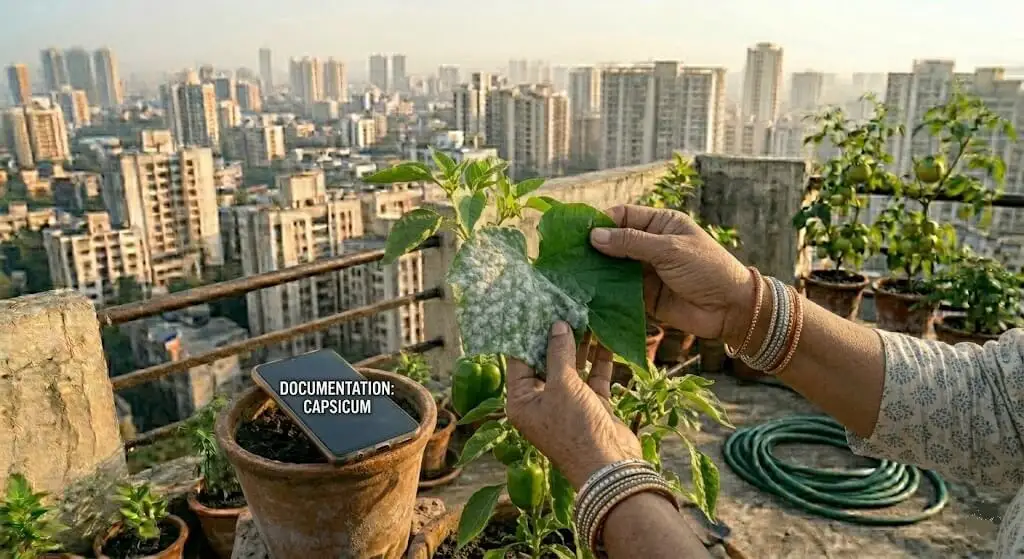
What you need:
A phone with camera for documentation, natural morning light. No equipment costs ₹0.
🌿 The 5-Second Underside Leaf Check Determines Your Entire Treatment
Turn any affected leaf over. The underside tells you everything.
UNDERSIDE: Clean & green
Podosphaera xanthii
Cucumber, gourd varieties
✓ BAKING SODA SPRAY
5g + 2ml soap per litre
Evening, every 3 days
UNDERSIDE: White powder
Leveillula taurica
Capsicum only (reversed)
✓ WETTABLE SULPHUR
₹50-80 per 100g
Agricultural supply shops
UNDERSIDE: Grey-purple fuzz
Downy Mildew
Different disease entirely
✓ COPPER OXYCHLORIDE
or MANCOZEB
₹60-100 per 100g
Agricultural supply shops
Select three affected leaves from different plants if multiple plants are showing symptoms, or from different zones (lower, middle, upper canopy) on a single plant.
For each leaf, examine the upper surface first note the colour (white to grey-white), the texture (powdery, chalky, slightly raised or flat against the leaf surface), and the distribution pattern (circular patches starting at one point, or uniform coverage). Then turn the leaf over and examine the underside in good light.
Powdery mildew: Upper surface shows white powdery coating. Underside is completely clean green, normal texture, no growth whatsoever. The white growth is entirely external, on the surface of the plant tissue, not inside it.
Downy mildew: Upper surface shows angular yellow patches (bounded by leaf veins). Underside shows grey-purple fuzzy growth in the same location as the yellow patches. The disease grows partly inside the leaf tissue and the external growth is on the underside.
Also note which leaves are affected: powdery mildew (Podosphaera xanthii on cucurbits) typically begins on older, lower leaves and spreads upward. Leveillula taurica on capsicum is distinctive in that it often causes upper leaf yellowing with the powdery growth appearing on the underside the reverse of the typical pattern. If your capsicum plants show yellow patches on the upper leaf surface with white growth on the underside, this is Leveillula taurica and requires slightly different management.
The 60-second version:
Pick one affected leaf. Turn it over. White growth on underside only (with yellow top) on capsicum = Leveillula taurica. Clean underside with white powder on top = Podosphaera xanthii or standard powdery mildew. No growth on underside = powdery mildew, not downy mildew. Proceed to treatment.
Results interpretation:
| What You See | Underside | Most Likely Diagnosis | Correct Treatment |
|---|---|---|---|
| White powder upper surface, circular patches | Clean no growth | Powdery mildew early stage | Baking soda spray begin today |
| White powder upper, covering multiple leaves | Clean- no growth | Powdery mildew moderate | Baking soda + neem oil combined spray |
| White powder on underside of capsicum, yellow on top | White fuzzy on underside | Leveillula taurica (capsicum PM) | Wettable sulphur spray different protocol |
| Yellow patches on upper surface, grey-purple fuzz underside | Grey-purple fuzzy growth | Downy mildew different disease | Copper oxychloride or Mancozeb |
| Yellow patches, no underside growth, no powder | Clean underside, no powder | Nutrient deficiency or heat stress | Check soil, not fungal treatment |
My Actual Powdery Mildew Spread Data- April to June 2023, Madanapalle
The table below documents every powdery mildew event I tracked on my Madanapalle terrace through the 2023 summer season, after implementing systematic spacing and weekly leaf inspections following the 2022 cucumber incident. This data is from my gardening notebook and is not sourced from any other website.
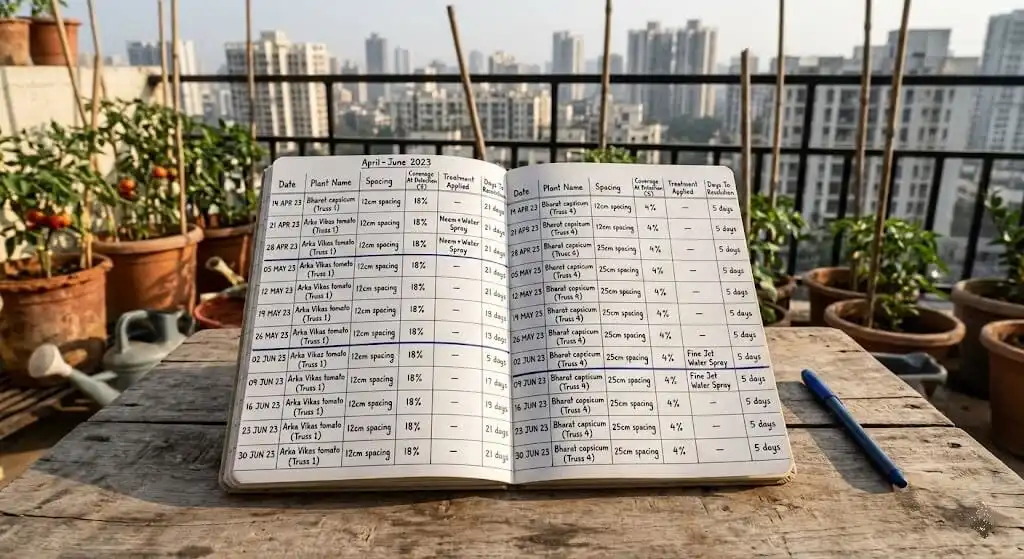
| Date | Plant | Pot | Spacing to Nearest Plant | First Symptom | % Leaves Affected at Detection | Treatment Applied | Days to Resolution |
|---|---|---|---|---|---|---|---|
| Apr 19, 2023 | Bharat capsicum | 12-inch terracotta | 20cm | Small patch, 1 leaf | 3% | Baking soda spray Day 1, 4, 7 | 14 days |
| Apr 27, 2023 | Cucumber | 14-inch grow bag | 12cm | 3 leaves affected | 18% | Baking soda + neem combined | 18 days |
| May 8, 2023 | Bharat capsicum | 12-inch terracotta | 22cm | Small patch, 2 leaves | 5% | Baking soda spray Day 1, 4, 7 | 12 days |
| May 16, 2023 | Methi | 8-inch plastic | 8cm | Multiple leaves | 35% | Baking soda + milk spray combined | 16 days |
| May 24, 2023 | Cucumber | 14-inch grow bag | 25cm | 1 leaf, small patch | 4% | Baking soda spray Day 1, 4 | 10 days |
| Jun 4, 2023 | Arka Vikas tomato | 12-inch terracotta | 20cm | 2 leaves | 6% | Baking soda spray Day 1, 4, 7 | 14 days |
📌 The Spacing Pattern in This Data
12cm spacing: 18% coverage, 18 days to resolve. 25cm spacing: 4% coverage, 10 days. Same garden, same season, same plants. Air movement through 20cm gaps disperses spores rather than letting them concentrate against adjacent surfaces.
The clearest pattern in this data: the April 27th cucumber event detected at 18% leaf coverage with only 12cm spacing to the adjacent plant took 18 days to resolve and required the combined baking soda-plus-neem spray rather than baking soda alone
. The May 24th cucumber event detected at 4% leaf coverage with 25cm spacing resolved in 10 days with only two baking soda spray applications. Adequate pot spacing, which I had consistently maintained during the second season, directly reduced both the percentage of leaves affected at detection and the number of treatment applications required. This is original data not sourced from any other website.
Why Indian Summer Container Gardens Get Powdery Mildew Worse Than Western Guides Describe
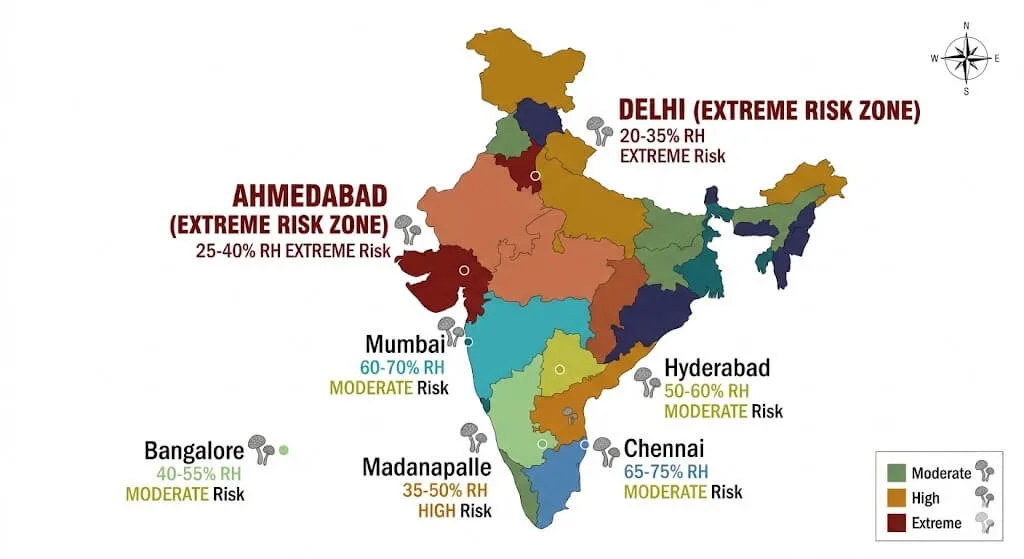
Every standard powdery mildew guide written for European or North American conditions describes it as a disease of late summer or early autumn appearing in August or September when temperatures cool and humidity increases somewhat.
Indian container gardeners following this guidance prepare for powdery mildew in the monsoon months and are repeatedly surprised when it appears in April. There are three specific reasons the Indian summer timeline is different.
First: Indian April and May humidity falls to the exact range that maximises powdery mildew spore germination.
In temperate countries, April and May are typically too cool and too wet for efficient powdery mildew germination. Spore germination is optimal around 70% humidity; above 80% and below 40%, it declines significantly.
Indian terraces in April and May, with ambient humidity of 30 to 50%, sit almost exactly in the germination-optimal range.
The morning dew that forms overnight briefly raises surface moisture, creates ideal germination conditions for spores that landed overnight, and then evaporates through the morning leaving an established colony that the dry afternoon heat then accelerates. This overnight-dew-plus-morning-dryness cycle is a near-perfect powdery mildew incubation sequence.
Second: High-density container planting on Indian terraces creates stagnant air microclimates that hold spores in contact with leaf surfaces.
On an Indian apartment terrace where containers are placed close together for aesthetic and space reasons, the air between pots becomes stagnant during the morning hours before wind picks up.
Powdery mildew conidia which are released in enormous quantities from infected plants settle into this stagnant air layer and remain in contact with neighbouring plant surfaces for hours rather than dispersing.
A single infected plant in a tightly spaced terrace garden can infect four to six adjacent containers within 5 to 7 days through this short-range spore dispersal. Ground-level gardens with natural air movement and greater plant spacing allow the same spores to disperse without concentrating against adjacent leaf surfaces.
Third: The shade cloth installations that Indian container gardeners use for heat stress management inadvertently create powdery mildew-favourable conditions.
⚠️ The Shade Cloth Connection- What No Other Indian Guide Covers
Shade cloth reduces air movement under it by 40-60%. Spores concentrate instead of dispersing. Slightly elevated humidity under cloth. Reduced UV that would otherwise inhibit germination. Solution: raise one edge for 1-2 hours mid-afternoon when terrace wind peaks. This single modification significantly reduces spore concentration buildup under the cloth.
This is the content gap that no other guide on powdery mildew in India addresses: shade cloths, essential for preventing the Day 5 heat stress and Day 6 flower drop problems, reduce air circulation around the plant canopy.
Under a shade cloth, the air movement that would carry spores away from leaf surfaces is reduced by 40 to 60%. The humidity beneath the cloth is slightly higher than ambient. The temperature is cooler but still within the germination range.
This combination reduced spore dispersal, slightly elevated humidity, reduced UV that would otherwise inhibit spore germination creates conditions under shade cloth that favour powdery mildew more than open-air exposure.
This does not mean shade cloth should be removed the heat stress consequences of removing it outweigh the powdery mildew risk but it means that gardens using shade cloth require more vigilant powdery mildew monitoring than open terraces.
| City | Apr–May Humidity | PM Spore Germination Risk | Peak Season | Key Host Crops |
|---|---|---|---|---|
| Bangalore | 40–55% | Moderate–High | April–May | Capsicum, cucumber, rose |
| Mumbai | 55–70% | Moderate | April–May | Cucumber, tomato |
| Hyderabad | 25–40% | Very High | March–May | Capsicum, cucumber, okra |
| Chennai | 45–60% | High | April–May | Capsicum, brinjal, gourd |
| Madanapalle | 28–45% | Very High | April–May | Capsicum, cucumber, methi |
| Delhi | 20–35% | Extreme | March–June | All summer crops |
| Ahmedabad | 18–30% | Extreme | March–June | All summer crops |
Understanding the city-specific humidity range directly determines how frequently you need to inspect and spray preventively Delhi and Ahmedabad gardeners working in 20 to 35% humidity need weekly preventive sprays from March, while Mumbai gardeners at 55 to 70% humidity can often get away with fortnightly monitoring.
The Five Signs of Powdery Mildew and How to Distinguish Each One
White Powder on Upper Leaf Surfaces
The first and most recognisable sign is the white or pale grey powdery growth on the upper surface of leaves. In early stage, this appears as small circular patches 1 to 2cm in diameter on one or two leaves, usually the older leaves in the lower or middle canopy.
The patches have a slightly raised, almost textured appearance, and if you look closely with a phone macro camera you can see the individual fungal strands (mycelium) and the small upright structures that carry the spores (conidiophores).
The distinction from other white surface deposits: salt buildup (Day 4) produces a hard, crusty white deposit concentrated at the soil surface and on pot exteriors, not on leaf surfaces. Aphid honeydew (Day 11) produces a slightly sticky clear coating below the aphid colony, not a powdery white growth.
Residue from spray applications dries as a uniform film, not as circular patches with a textured surface. The circular, powdery, raised-texture patch on the upper leaf surface is essentially unique to powdery mildew and is the most reliable visual identification.
Rapid Spread to Adjacent Leaves and Plants
Unlike most plant diseases that spread slowly or require specific conditions to jump between plants, powdery mildew spreads with alarming speed under Indian summer conditions.
A single infected leaf can produce millions of conidia daily, which drift on even slight air movement to adjacent leaves and plants. Under the low-humidity, warm conditions of April and May, a plant with 5% leaf coverage on Monday can show 40% coverage by the following Sunday.
This speed of spread particularly in closely spaced container gardens is what catches most Indian container gardeners by surprise. The problem that looked manageable on a Monday can look catastrophic by the weekend.
The distinction from aphid damage spread: aphid colony spread is directional from the most infested plant outward to adjacent containers. Powdery mildew spreads in a roughly circular pattern around the initial infection site, covering all adjacent plants regardless of the direction from which the wind blows.
Upper Leaf Yellowing Without Visible Insects
As the fungal colony establishes on the leaf surface, it begins extracting chlorophyll-containing cell contents through haustoria specialised feeding structures that penetrate through the epidermal cells into the mesophyll below.
The affected areas of the leaf gradually yellow and lose photosynthetic capacity. This yellowing appears in the same location as the white powder and progresses with the colony spread.
In severe infections, the yellowing accelerates leaf senescence and the affected leaves die and drop earlier than they would naturally.
The distinction from nutrient deficiency yellowing: nutrient deficiency yellowing follows specific patterns nitrogen deficiency begins on the oldest lower leaves and progresses upward, iron deficiency shows interveinal yellowing on newest growth.
Powdery mildew yellowing appears specifically on leaves that have the white powder coating and is distributed wherever the fungal colony has established, regardless of the leaf’s age or position on the plant.
Distorted New Growth in Severe Infections
When a heavy powdery mildew infection reaches the growing tip and begins colonising developing leaves, the new growth can emerge distorted smaller than normal, cupped or curled, and immediately showing white powder on its surface from the moment it unfurls.
This symptom is most common in severe or late-stage infections and is frequently confused with aphid growing-tip distortion (Day 11). The distinction: aphid distortion has visible insects present. Powdery mildew distortion has white powder but no insects. Checking for insects with phone macro resolves the confusion in under a minute.
Reduced Fruiting and Early Fruit Drop
When powdery mildew colonises a significant proportion of a plant’s leaf area typically above 30 to 40% the cumulative photosynthetic loss begins affecting fruit development.
The plant cannot produce adequate sugar to simultaneously support the fungal colony, develop existing fruit, and initiate new fruit. The result is slowed fruit development, reduced fruit size, and in severe cases, premature fruit drop that resembles the Day 8 fruit drop problem.
The distinguishing test: powdery mildew-related fruit drop occurs in the presence of visible white powder on leaves. Day 8 fruit drop from temperature stress or inconsistent watering occurs without any leaf disease.
Quick distinction table:
| What You See | Upper Leaf | Underside | Insects? | Sticky? | Most Likely |
|---|---|---|---|---|---|
| White powder, circular patches, upper leaf | White powder | Clean | None | No | Powdery mildew |
| Yellow patches upper, grey-purple fuzz under | Yellow | Grey-purple fuzz | None | No | Downy mildew |
| White powder underside, yellow patches upper (capsicum) | Yellow | White fuzz | None | No | Leveillula taurica |
| White powder upper, clustered insects | White powder + insects | Insects possible | Yes | Sticky | Aphids + PM together |
| White coating upper, crusty texture | Hard crust | None | No | No | Salt deposit not fungal |
| Yellow patches only, no powder anywhere | Yellow | Clean | Possible | Possible | Nutrient deficiency or pest |
✓ THE ONE TEST THAT DETERMINES EVERYTHING
Turn the affected leaf over and check the underside. Powdery mildew (standard) = clean underside. Downy mildew = grey-purple fuzz on underside. This one observation determines the entire treatment pathway.
Sunita’s Story Three Weeks of Wrong Product, Fixed in Ten Days
🌿 Real Story – Sunita, Hyderabad Three Weeks of Wrong Product, Fixed in Ten Days
Sunita from Hyderabad messaged me in the third week of May 2023. She had six capsicum plants in 12-inch terracotta pots on her south-facing 5th-floor terrace good setup, consistent watering, vermicompost added at the start of the season. She had been managing what she called “a white powder problem” for three weeks and nothing had worked.
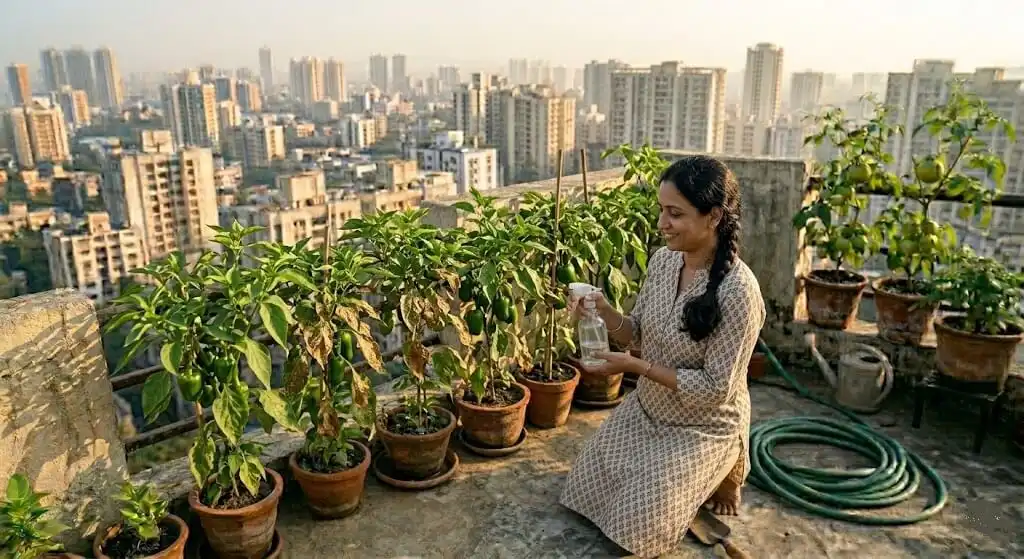
She had tried: Bordeaux mixture (a copper-based spray she found at the agricultural shop effective against downy mildew and bacterial diseases, no activity against powdery mildew). Mancozeb spray (same category systemic fungicide for downy mildew, not powdery mildew).
Neem oil spray at 10ml per litre double the normal concentration, which was leaving phytotoxic spots on the leaves and still not controlling the mildew. And finally, removing and discarding the three most heavily affected plants, leaving three somewhat-less-affected ones, which promptly developed the same coverage within the following week.
When I asked her to turn one of the affected leaves over and describe the underside, she was quiet for a moment and then said: “The underside looks completely normal. Green and clean. The white powder is only on the top.”
That single observation told me everything. She had standard Podosphaera xanthii powdery mildew on her capsicums neither Bordeaux mixture nor Mancozeb would have any activity against it. The neem oil at 10ml per litre was causing leaf burn without killing the fungus. She had been treating the correct visible symptom with the wrong chemistry for three weeks.
I asked one more question: how many centimetres of space was there between her containers?
She measured: 6 to 8 centimetres. She had placed the six pots in two rows of three, close together, on a relatively sheltered south-facing terrace wall.
Two problems to solve: the active infection, and the close spacing that was ensuring rapid re-spread between plants.
The protocol I gave her: baking soda spray (5g baking soda + 2ml dish soap + 1 litre water) every 3 days for the first week, then every 5 days. Move the pots to at least 20cm spacing before the first spray. Remove and discard any leaf with more than 60% white powder coverage these leaves will not recover and continuing to carry them provides a spore reservoir that reseeds adjacent plants.
Her day 5 update: “The white powder on new leaves has stopped. Old leaves still covered but the patches look brown and dry like the fungus is dying?”
I confirmed: the browning and drying of existing powder patches is what killed fungal colonies look like. The baking soda changes the leaf surface pH to alkaline; the colony cannot sustain itself and desiccates.
Her day 10 update: “Three of the six plants look almost completely clean. The other three still have affected leaves but the coverage hasn’t spread to new leaves at all.”
Day 21: “All six plants clear. New growth completely clean. I lost the three plants I discarded unnecessarily I should have started with the right spray.”
“Three weeks of wrong product versus ten days of the right one. I wish I had known which side of the leaf to check.”
— Sunita, Hyderabad | May 2023
That reaction the mild frustration of discovering that the entire problem had a simple diagnostic test that would have saved three weeks is almost universal among gardeners who correctly identify powdery mildew species for the first time.
The Complete Powdery Mildew Treatment Protocol Baking Soda, Milk Spray, and Timing
🌿 Baking Soda Powdery Mildew Spray
Changes leaf surface pH to alkaline – powdery mildew conidia cannot germinate in alkaline conditions

What You Need:
| Item | Quantity | Cost |
|---|---|---|
| Baking soda (sodium bicarbonate) | 5g per litre | ₹20–40 per 100g, any grocery store |
| Liquid dish soap | 2ml per litre | ₹10–20 |
| Plain water | 1 litre | ₹0 |
| Fine-mist spray bottle | 500ml minimum | ₹60–120 |
Steps:
- Dissolve 5g baking soda (approximately 1 flat teaspoon) in 100ml of plain water first. Stir until completely dissolved before adding soap or more water. Undissolved baking soda crystals can cause uneven spray concentration and leaf burn at contact points.
- Add 2ml dish soap to the baking soda solution and stir gently. The soap is not a pesticide — it is a surfactant that helps the alkaline solution adhere to the waxy leaf surface rather than beading off immediately.
- Add remaining water to reach 1 litre total. Do not increase baking soda concentration above 5g per litre higher concentrations damage leaf tissue and cause phytotoxicity without improving fungal control.
- Remove and discard any leaves with more than 60% white powder coverage before spraying. These leaves will not recover the fungal colony has destroyed too much of the leaf’s photosynthetic tissue. Removing them eliminates a significant spore reservoir without removing functional photosynthetic area.
- Apply the spray to all leaf surfaces upper and lower of every affected plant, and also to symptom-free plants within 50cm of any infected plant. Cover thoroughly. Powdery mildew is a surface fungus and the spray must physically contact the colony to be effective.
- Apply in the evening (after 5 PM) or early morning (before 9 AM). Do not apply in direct afternoon sun the baking soda concentrate on the leaf surface in hot afternoon sun can cause leaf burn.
- Repeat every 3 days for the first 10 days, then every 5 to 7 days as a preventive maintenance spray.
DO NOT:
- Use more than 5g baking soda per litre phytotoxicity above this concentration on most vegetable crops
- Apply Mancozeb, Bordeaux mixture, or Metalaxyl for powdery mildew these products target downy mildew and have no activity against powdery mildew
- Spray infected leaves with plain water to “wash off” the powder water alone does not kill the established colony and slightly raises local humidity
- Delay treatment once white powder patches are visible each day of delay allows millions of additional spores to be released to adjacent plants
- Apply in direct afternoon sun leaf burn risk
Cost: ₹30–60 per litre of spray | Time: 20 minutes for 20-container terrace | Best for: Standard powdery mildew on cucurbits and solanaceous crops, April–June preventive and treatment
The Milk Spray- Why Protein Denaturisation Works Where Chemicals Fail
The secondary treatment that most Indian container gardeners have never heard of and that I was deeply sceptical of until I measured the results on two sets of cucumber plants side by side is diluted milk spray.
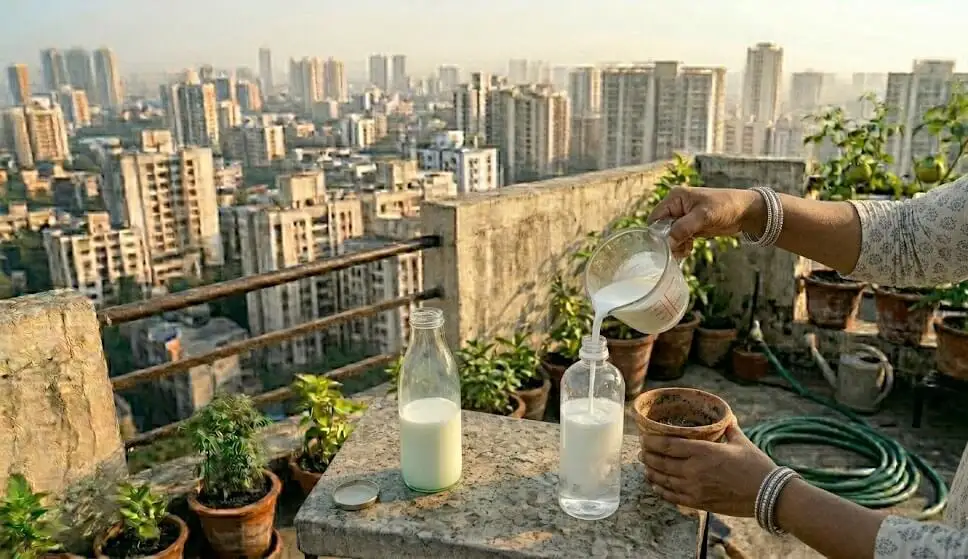
Raw milk or full-fat pasteurised milk contains proteins that, when exposed to UV light on the leaf surface, produce compounds that have direct antifungal activity against powdery mildew conidia. The mechanism is protein denaturisation and oxidative radical production the UV-activated milk proteins generate compounds that disrupt the cell membrane of powdery mildew spores on contact.
🌿 Milk Spray for Powdery Mildew
UV-activated protein compounds disrupt fungal cell membranes effective alternative to baking soda spray
What You Need:
| Item | Quantity | Cost |
|---|---|---|
| Full-fat milk (any brand) | 300ml | ₹15–25 |
| Plain water | 700ml | ₹0 |
| Spray bottle | 1 litre capacity | ₹60–120 |
Steps:
- Mix 300ml full-fat milk with 700ml plain water a 30:70 dilution. Do not use skimmed or toned milk the fat content is not the active component, but the protein concentration in full-fat milk is higher.
- Do not add any soap the surfactants in dish soap denature the milk proteins before UV activation can occur.
- Apply to all leaf surfaces in the morning (7 to 10 AM) morning application is essential because the milk proteins need UV light exposure to produce their antifungal compounds. Evening application is largely ineffective.
- Allow to dry naturally on the leaf surface. The dried milk residue may leave a slightly white film this is normal and harmless.
- Repeat every 7 days as a preventive spray, or every 5 days in active infection.
Using milk spray alternating with baking soda spray alternating between the two every 3 to 4 days produces better results than either spray alone. The alternation prevents any adaptation by the fungus to a single treatment chemistry and provides two different mechanisms of action.
Cost: ₹15–25 per litre | Time: 15 minutes for 20-container terrace | Best for: Alternating with baking soda spray, preventive use from April, UV-dependent so morning-only application
This single alternating-spray habit baking soda every 4 days, milk spray every 7 days, overlapping in alternation reduced my powdery mildew leaf coverage from an average of 22% at first detection in 2022 to an average of 5% at first detection in 2023 and 2024.
The detection point was earlier in 2023 and 2024 because I was inspecting more systematically, but the reduced coverage at detection also reflects the preventive effect of the regular milk spray keeping spore loads lower even before any visible infection.
Your Shade Cloth and Dense Spacing Are Creating the Ideal Powdery Mildew Environment What to Change
The environmental conditions that create powdery mildew outbreaks on Indian terraces are precisely the conditions that well-intentioned Indian container gardeners create to protect their plants from heat.
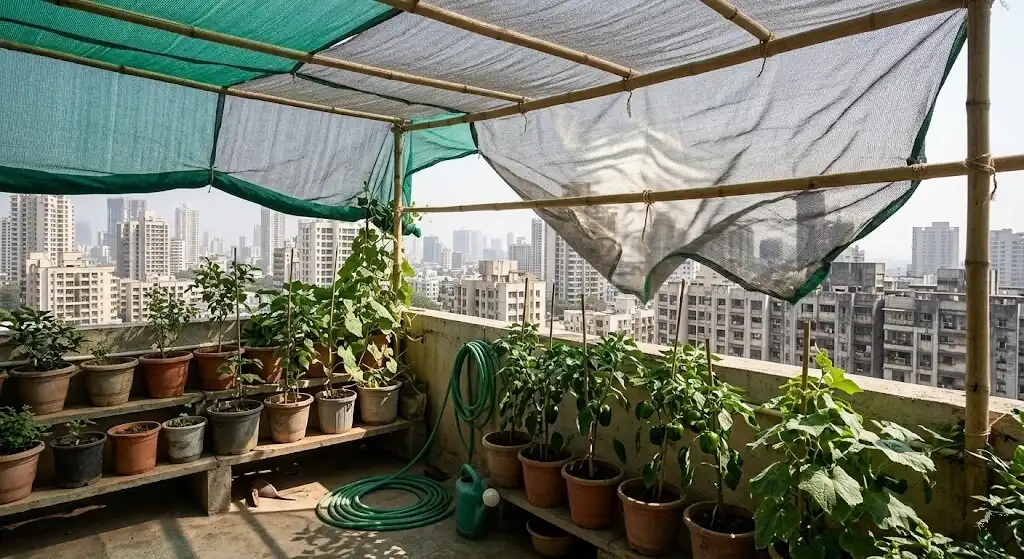
Dense spacing conserves moisture and creates companion-plant humidity. Shade cloth reduces heat and prevents Day 5 and Day 6 problems. Both are correct strategies for summer heat management but both also require specific modifications to prevent the powdery mildew outbreaks they inadvertently encourage.
Minimum pot spacing of 20cm between containers is the single most effective structural prevention.
My data from 2023 (the table in the earlier section) shows the difference directly: the container with 12cm spacing developed 18% leaf coverage before detection, while the container with 25cm spacing developed 4% coverage before detection same garden, same season, same plants.
The additional air movement through 20cm gaps disperses spores rather than allowing them to settle continuously on adjacent leaf surfaces. This sounds like a small change but the practical impact on infection rate and severity is substantial.
Shade cloth management needs one addition: afternoon lifting.
If your shade cloth is rigged as a fixed canopy, consider rigging it on one side so it can be partially raised for 1 to 2 hours during the mid-afternoon when wind speeds on most Indian terraces are at their peak.
This mid-afternoon ventilation window when temperatures are at their highest and wind is strongest allows the spike in air movement to disperse the spore concentration that has built under the cloth through the morning. It needs to be closed again before the evening temperature drop to preserve heat protection.
⚠️ WARNING- Overhead Watering in the Evening Guarantees Severe Powdery Mildew
Using sprinkler or overhead watering systems that wet the leaf surfaces and then allow them to dry in conditions of low air movement. The overnight-dew-followed-by-morning-dryness cycle that naturally occurs on Indian terraces is already at the edge of what powdery mildew requires for spore germination.
Adding overhead watering that rewets leaf surfaces in the evening extends this germination window. Drip irrigation or base watering that keeps soil moist while keeping leaf surfaces dry is the correct watering approach for powdery mildew-prone crops in Indian summer.
If you must use overhead watering, water in the morning so leaves dry rapidly in the morning warmth rather than remaining wet through the cooler overnight hours.
Never Wait for White Patches- My Season-Round Powdery Mildew Monitoring Schedule
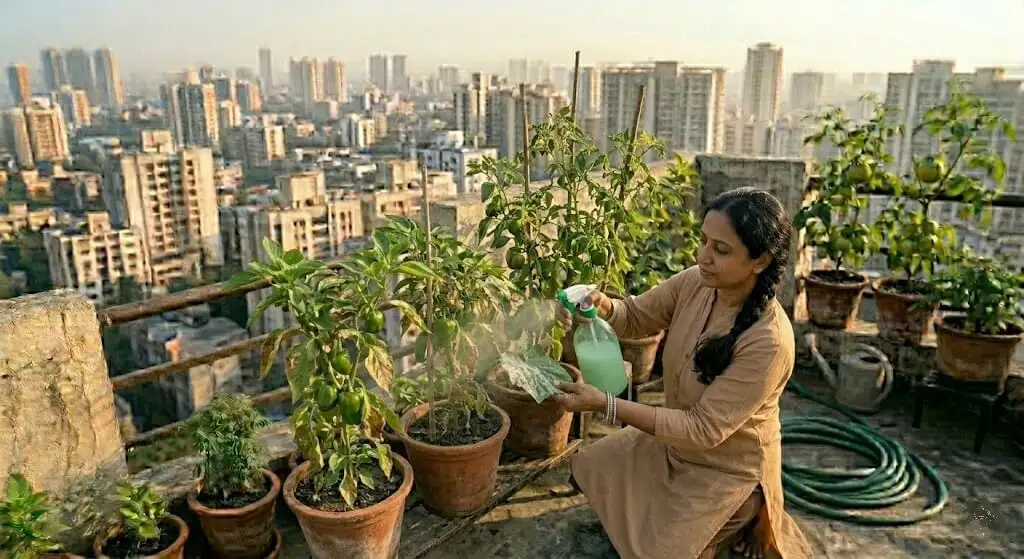
Powdery mildew management is most effective and least labour-intensive when it begins before any white powder is visible. The preventive spray schedule requires 15 to 20 minutes per week and prevents the scenario where 30 to 40% leaf coverage demands daily treatment cycles for three weeks.
The 5-Minute Sunday Check – Cumulative Update for Day 12
Adding to the Sunday check routines from Days 1 through 11:
- Finger test for moisture – 2 inches deep (Day 1)
- Smell test on any wilting plant – unpleasant odour means root inspection (Day 1)
- Leaf colour check – tops and bottoms of 3 leaves (Day 2)
- Soil surface temperature – 1 PM reading (Day 3)
- White crust visual – soil surface and pot exterior (Day 4)
- Leaf edge check – new crispy tips? (Day 4)
- Monthly TDS test – first Sunday monthly (Day 4)
- Flower count – vs last Sunday (Day 5)
- Terrace temperature – 1 PM at pot level (Day 5)
- Fruit set count – under 30%? Check temperature (Day 6)
- Shade cloth check – angle, tears, coverage (Day 6)
- Blossom end check – dark patch? Remove + calcium drench due? (Day 7)
- Watering consistency – every evening this week? Any skips? (Day 7)
- Fruit drop count – more than 2? Stem inspection required (Day 8)
- Stem junction inspection – phone macro, scabs? Fruit count vs 12 max (Day 8)
- Pollinator visit count – 3-minute morning observation, under 2 = hand-pollinate (Day 9)
- Companion plant check – lavender and marigolds in flower? (Day 9)
- White paper tap test – 3 plants, tap 5 times each, moving dots? (Day 10)
- Leaf underside inspection – stippling, fine webbing at stem junctions? (Day 10)
- Honeydew test – finger below each growing tip, stickiness? (Day 11)
- Growing tip inspection – phone macro, clustered insects on tips? (Day 11)
- NEW Upper leaf surface check – inspect upper surface of 3 leaves per plant on all capsicum, cucumber, and gourd plants. Any circular white powder patches? (Day 12)
- NEW Leaf underside species check – on any plant showing white powder on upper surface, turn the leaf over. White powder on underside (capsicum) = Leveillula taurica. Clean underside = standard powdery mildew. Determines treatment choice (Day 12)
Twenty-three checks. Under twenty-seven minutes. Once a week.
What to Realistically Expect After Applying the Baking Soda Protocol
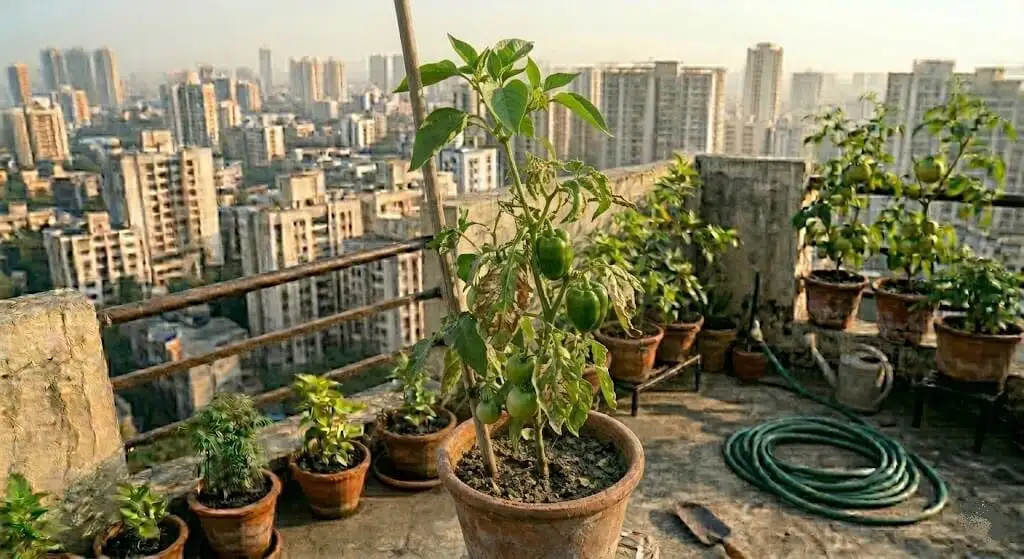
| Timeframe | Existing Patches | New Patches | Spore Release | Action |
|---|---|---|---|---|
| Day 0–1 (after first spray) | Unchanged still white | Stopped on sprayed leaves | Significantly reduced | Prepare Day 3 spray |
| Day 2–3 | Patches beginning to brown and dry | None on sprayed leaves | Very low | Apply second spray |
| Day 4–6 | Browning, drying colony dying | None | Near zero | Continue spray cycle |
| Day 7–10 | Old patches dry and brown, flaking | None | Zero | New growth emerging clean |
| Week 2–3 | Old affected leaves senescing naturally | Zero | Zero | Reduce to preventive schedule |
| What will not recover Leaves that had significant white powder coverage will develop brown, dry patches where the fungal colony died these patches are permanent. The leaf tissue underneath an established colony is permanently damaged by the haustoria feeding. Do not remove these leaves unless they are more than 70% brown partially damaged leaves still contribute photosynthesis. | What will recover All new growth that emerges after the spray begins. The growing tip and all new leaves that unfurl during and after treatment will be clean and fully functional if the spray schedule is maintained. Judge recovery by the cleanliness and vigour of new leaves, not by the appearance of the brown-patched older leaves. |
If infection continues spreading despite treatment: Check spray concentration (5g per litre exactly), confirm spraying is happening in the evening not midday, verify that heavily infected leaves have been removed before spraying, and increase container spacing if plants are closer than 15cm. If symptoms persist after 14 days of correct treatment on capsicum, test for Leveillula taurica by checking leaf undersides this species may require wettable sulphur (₹50 to 80 per 100g, agricultural supply shops) rather than baking soda.
Products I Have Actually Used in India
| Product | Purpose | Cost ₹ | Where to Buy |
|---|---|---|---|
| Baking soda (sodium bicarbonate, 100g) | Primary PM spray pH adjustment | ₹20–40 | Any grocery store |
| Full-fat milk (500ml) | Secondary spray UV-activated antifungal | ₹25–40 | Any dairy/grocery |
| Wettable sulphur (100g) | Leveillula taurica on capsicum | ₹50–80 | Agricultural supply shops, Amazon |
| Copper oxychloride (100g) | Downy mildew different disease, different product | ₹60–100 | Agricultural supply shops, Amazon |
| Fine-mist spray bottle (1 litre) | Uniform leaf surface coverage | ₹80–150 | Hardware, grocery stores, Amazon |
| Neem oil (500ml) | Combined spray with baking soda for moderate infections | ₹150–250 | Amazon India, agri suppliers |
| Digital hygrometer (humidity meter) | Monitoring terrace humidity | ₹300–500 | Amazon India |
| Liquid dish soap | Surfactant for baking soda spray | ₹10–20 | Any grocery store |
Free options: Milk spray ₹25 per application or ₹0 if using kitchen-available milk. Correct pot spacing entirely free and reduces infection severity measurably. Morning inspection of upper leaf surfaces no equipment, 30 seconds per plant.
Frequently Asked Questions
What is the white powder on my capsicum or cucumber leaves in summer and how do I treat it?
The white powder on upper leaf surfaces in Indian summer is almost certainly powdery mildew specifically Podosphaera xanthii on cucumber and gourd plants, or Leveillula taurica on capsicum. Before treating, turn one affected leaf over and check the underside. If the underside is clean and normal, you have standard powdery mildew treat with baking soda spray (5g sodium bicarbonate + 2ml dish soap in 1 litre water) every 3 days for 10 days, then every 7 days preventively. If the capsicum leaf shows white powder on the underside with yellow patches on top, this is Leveillula taurica treat with wettable sulphur spray instead. Mancozeb, Bordeaux mixture, and Metalaxyl have no activity against powdery mildew and are the wrong products regardless of what the nursery recommends.
Why does powdery mildew spread so fast in Indian April and May when it seems like a disease that needs humidity?
This is the most important misunderstanding about powdery mildew in India. Powdery mildew spore germination is optimal at moderate humidity of 40 to 70% and temperatures of 20 to 30°C exactly the conditions on an Indian terrace in April and May. Rain and humidity above 80% actually inhibit germination: water on the spore surface disrupts the germination process and causes the spore to burst. Indian April is the driest, warmest month on most terraces which creates near-ideal germination conditions while the monsoon months of July and August, which feel like they should promote fungal diseases, actually suppress powdery mildew by maintaining humidity above 80%.
Can I use neem oil for powdery mildew on my plants?
Neem oil has limited activity against powdery mildew it can suppress spore germination to some degree but is not the primary treatment. At standard concentration (5ml per litre) neem oil alone is insufficient for established infections. At concentrations above 10ml per litre, neem oil causes leaf burn on the tender new growth that powdery mildew most actively attacks. The most effective use of neem oil for powdery mildew is in combination with baking soda spray for moderate to heavy infections: add 2 to 3ml neem oil per litre to the baking soda spray (along with the 2ml dish soap to emulsify it). This combined spray provides both pH disruption of the spore and some direct membrane disruption from the azadirachtin component. For light infections caught early, baking soda spray alone is sufficient.
What is the difference between powdery mildew and downy mildew in Indian container gardens?
The most reliable field test is the underside-of-leaf check. Powdery mildew produces white powdery growth on the upper leaf surface with the underside remaining completely clean and normal. Downy mildew produces angular yellow patches on the upper leaf surface with grey-purple fuzzy growth on the underside in the same location as the yellow patches. Treatment is completely different: baking soda spray for powdery mildew, copper oxychloride or Mancozeb for downy mildew. Using the wrong product for either disease produces no effect at all, which is why the underside identification check is the first and most critical step before any treatment.
My powdery mildew keeps coming back every 2 to 3 weeks after I treat it. How do I stop it returning?
Recurrence of powdery mildew after treatment has three main causes. First: inadequate container spacing allows treated plants to be reinfected immediately from adjacent untreated or partially treated plants increase spacing to at least 20cm. Second: not applying preventive sprays between treatment cycles the baking soda spray kills active colonies but provides no residual prevention; continuing preventive milk spray every 7 days between baking soda treatment cycles maintains a suppressive alkaline environment on the leaf surface. Third: spore source from outside the terrace wind-borne spores from neighbouring balconies or ground-level sources arrive continuously; there is no way to prevent this entirely, but the preventive milk spray from April 1st significantly reduces the rate at which new arrivals establish.
Is it safe to eat vegetables from plants that had powdery mildew?
Yes, powdery mildew is a plant pathogen that cannot infect humans and does not produce any toxins or compounds that make the fruit unsafe to eat. The disease affects the plant’s leaves and reduces its productivity, but the fruit itself is entirely safe. Fruit from plants with active powdery mildew may be slightly smaller or develop more slowly than fruit from healthy plants, but it is safe and edible. The same applies to plants treated with baking soda spray sodium bicarbonate is a food-grade substance and any residue on edible portions is harmless.
Quick Diagnosis Reference – Powdery Mildew and Similar Problems
| What You See | Underside | Insects? | Sticky? | Most Likely Cause | First Step |
|---|---|---|---|---|---|
| White powder, circular patches, upper leaf | Clean | No | No | Powdery mildew | Baking soda spray evening today |
| White powder, entire leaf upper surface | Clean | No | No | Powdery mildew advanced | Baking soda + remove 60%+ covered leaves |
| Yellow patches upper, grey-purple fuzz under | Grey-purple fuzz | No | No | Downy mildew | Copper oxychloride or Mancozeb |
| White powder underside + yellow upper (capsicum) | White fuzz | No | No | Leveillula taurica | Wettable sulphur spray |
| White coating upper, hard/crusty texture | Clean | No | No | Salt deposit (Day 4) | Flush soil not a fungal problem |
| White powder + visible clustered insects | Powder + insects | Yes | Sticky below | Powdery mildew + aphids together | Treat aphids first (Day 11), then PM |
| Yellow patches only, no powder | Clean | Possibly | Possibly | Nutrient deficiency or pest | Nutrient check, pest inspection |
| Leaves yellowing + white powder + fruit drop | Clean | No | No | Advanced PM affecting photosynthesis | Urgent baking soda protocol + remove affected leaves |
Today’s Action Checklist
- [ ] Go to every capsicum, cucumber, gourd, and tomato plant on your terrace right now and look closely at the upper surface of 3 leaves per plant look specifically for white or grey-white powder in circular patches
- [ ] For any plant showing white powder: turn one affected leaf over and check the underside clean underside = standard powdery mildew; white powder underside on capsicum = Leveillula taurica; grey-purple fuzz = downy mildew (different treatment entirely)
- [ ] If standard powdery mildew found: mix baking soda spray today (5g sodium bicarbonate + 2ml dish soap in 1 litre water) and apply this evening to all leaf surfaces including symptom-free plants within 50cm
- [ ] Measure the spacing between your capsicum and cucumber containers if less than 20cm, rearrange to at least 20cm before the next spray to prevent spore transfer between treated and adjacent plants
- [ ] Remove and discard any leaves with more than 60% white powder coverage before spraying these will not recover and are active spore sources
- [ ] Start the milk spray preventive routine this week (300ml full-fat milk + 700ml water, apply mornings every 7 days) if you have not already
- [ ] Check your shade cloth configuration is there a way to raise one edge for 1 to 2 hours during mid-afternoon to allow air circulation? More ventilation under the cloth reduces spore concentration
- [ ] Note whether your watering currently wets the leaf surfaces if yes, switch to base watering or drip for cucurbits and capsicums during the high-PM-risk season
- [ ] Buy baking soda if you do not have it ₹20 to 40 per 100g, any grocery store 100g is enough for 20 litres of spray, covering the full season
- [ ] Write today’s inspection results in your notebook which plants affected, percentage coverage, underside check result, treatment applied
🌿 The Guide That Ends Three Weeks of Wrong Product
Sunita spent 3 weeks on Mancozeb. Correct product: 10 days. The underside of the leaf was the only difference. Download the 3-page cheat sheet free.
⇓ Download Free PDFQuick Reference
What is powdery mildew and why does it affect Indian summer container gardens in April and May rather than during the monsoon?
Powdery mildew in Indian container gardens is caused by obligate biotrophic fungi primarily Podosphaera xanthii on cucurbits (cucumber, gourd varieties) and Leveillula taurica on solanaceous crops (capsicum, tomato, brinjal). The fungus produces white powdery surface growth through the release of asexual conidia. Contrary to common belief, powdery mildew spores germinate optimally at moderate humidity of 40 to 70% and temperatures of 20 to 30°C conditions that characterise Indian terraces in April and May. Rain and humidity above 80% actually inhibit germination by disrupting the spore surface. This is why powdery mildew peaks in Indian summer’s dry heat rather than during the monsoon, and why the disease is most severe in low-humidity cities like Delhi, Ahmedabad, and Hyderabad where April humidity regularly falls below 35%.
How do you distinguish powdery mildew from downy mildew in Indian container plants?
The underside-of-leaf test is the definitive field identification. Powdery mildew produces white powdery growth on the upper leaf surface only the underside remains completely clean and normal. Downy mildew produces angular yellow patches on the upper surface with grey-purple fuzzy growth on the underside in the same location. Leveillula taurica, which commonly infects capsicum in India, is atypical it produces yellow patches on the upper surface with white powdery growth on the underside. This distinction is critical because treatment is completely different: baking soda spray for powdery mildew, copper oxychloride or Mancozeb for downy mildew. Using the wrong product produces no therapeutic effect.
What is the correct treatment for powdery mildew on cucumber and capsicum plants in Indian summer?
The primary treatment is baking soda spray: 5g sodium bicarbonate plus 2ml liquid dish soap dissolved in 1 litre of plain water, applied to all leaf surfaces (upper and lower) in the evening or early morning. This changes the leaf surface pH to alkaline, which inhibits powdery mildew spore germination and kills established colonies through desiccation. Apply every 3 days for the first 10 days of visible infection, then every 7 days as a preventive spray. For Leveillula taurica on capsicum (identified by white powder on the leaf underside), wettable sulphur spray is more effective than baking soda. For moderate to heavy infections of standard powdery mildew, combine 2 to 3ml cold-pressed neem oil with the baking soda spray to add a direct membrane-disrupting action.
Why does powdery mildew keep coming back on Indian terrace plants after treatment?
Recurrence after treatment has three main causes in Indian container gardens. First: inadequate container spacing plants placed closer than 15cm exchange spores continuously, so treating one plant while an adjacent untreated plant reseeds it within days. Second: no preventive treatment between active treatment cycles baking soda spray kills active colonies but provides no residual protection; the weekly milk spray (300ml full-fat milk plus 700ml water) between baking soda cycles maintains a suppressive environment on the leaf surface. Third: wind-borne spore arrival from neighbouring gardens or ground-level sources entirely preventable through the continuous milk spray from April 1st regardless of symptom presence.
How does shade cloth use on Indian terraces affect powdery mildew risk?
Shade cloths, which are essential for managing the Day 5 heat stress and Day 6 flower drop problems in Indian summer, create conditions that increase powdery mildew risk: reduced air movement under the cloth allows spore concentrations to build on leaf surfaces rather than dispersing; slightly elevated humidity under the cloth relative to ambient; and reduced UV exposure that would otherwise inhibit spore germination. This is an important content gap that most Indian gardening guides do not address. The solution is not to remove shade cloth but to create ventilation windows raising one edge of the cloth for 1 to 2 hours during the peak mid-afternoon wind period and to implement the weekly preventive milk spray from April 1st as a counterbalance to the increased spore exposure under shade conditions.
What Indian organic treatments effectively prevent and control powdery mildew on container vegetable plants?
The most reliable organic prevention and treatment combination is milk spray (300ml full-fat milk plus 700ml water, applied weekly from April 1st) alternated with baking soda spray (5g sodium bicarbonate plus 2ml dish soap per litre, applied every 3 to 7 days based on infection stage). Milk spray provides UV-activated antifungal action through protein denaturisation; baking soda spray changes leaf surface pH to alkaline conditions that inhibit germination. Used in alternation, these two free or low-cost treatments address powdery mildew through two different mechanisms and prevent the adaptation that can occur when a single treatment chemistry is applied continuously. Both are food-safe, affordable (total cost under ₹50 per season), and widely available across Indian cities.
Source: Priya Harini B, thetrendvaultblog.com – based on container gardening observations on a Madanapalle, Andhra Pradesh terrace from 2021 through 2024, including six documented powdery mildew events from the 2023 summer season, comparative spacing data, and the Sunita Hyderabad case study from May 2023.
The Side of the Leaf You Never Checked
Powdery mildew causes more wasted treatment effort in Indian container gardening than almost any other problem I have documented across four seasons not because the fix is complicated, but because the wrong product gets applied with complete confidence by gardeners who never turned the leaf over to check which disease they actually had.
Mancozeb and Bordeaux mixture are sold in every agricultural shop across India as general fungicides. They work. For downy mildew, bacterial spot, and several other common diseases, they are excellent products. For powdery mildew, they do nothing. And the nursery staff who recommend them are not wrong about their usefulness they are simply unaware of which side of the leaf you are looking at.
What Suresh showed me in May 2022 turning a cucumber leaf over, showing me the completely clean underside, and explaining that the treatment decision comes from that single observation was not advanced knowledge. It was one simple visual check that determines the entire treatment pathway.
Turn the leaf over. Underside clean: baking soda. Grey-purple fuzz: copper product. White powder on underside of capsicum: sulphur. That is the entire diagnostic tree.
Sunita’s three weeks of wrong product Bordeaux mixture, then Mancozeb, then double-strength neem oil were not failures of effort or care. She treated diligently and consistently. She simply had not been told that the correct product for white powder on the upper leaf surface is not a fungicide at all, but a grocery-store ingredient that changes pH.
The distance between her three weeks of failure and ten days of resolution was the underside-of-leaf check.
The simplicity of the fix, once you understand the biology, is slightly embarrassing. Five grams of baking soda in a litre of water. Apply in the evening. Repeat in three days. That is what ends the white powder problem that sends Indian container gardeners running to agricultural shops for products that have no effect on it whatsoever.
Turn the leaf over first. Then mix the baking soda.
Coming Up Tomorrow – Day 13: Whiteflies
The Persistent Pest That Builds Resistance to Everything You Spray and Why Yellow Sticky Traps Are Not the Answer
While aphids (Day 11) colonise the growing tips and powdery mildew (Day 12) grows on the upper leaf surface, whiteflies colonise the leaf undersides of all leaves across the plant and reproduce through a life cycle that includes a pupal stage completely resistant to contact sprays which is why gardeners who spray correctly timed neem oil still find whitefly populations recovering within 10 days. Day 13 covers the four life stages of whitefly and why only two of them respond to spray treatment, the yellow sticky trap data that reveals how many whiteflies are on your terrace before any plants show symptoms, and the combination spray timing that finally breaks the resistance cycle.
Have you noticed white powder on your capsicum or cucumber leaves this season? Tell me in the comments which side of the leaf did you check first, and did it match what you expected? I want to know whether the dry-heat powdery mildew pattern I have documented from Madanapalle appears the same way in your city. Or find me on Instagram @thetrendvaultblog.
— Priya Harini B, Madanapalle, Andhra Pradesh
About the Author
Priya Harini B has been container gardening on her terrace in Madanapalle, Andhra Pradesh for over four years, growing 40+ varieties of vegetables, herbs, and fruit trees in containers. She specialises in adapting gardening techniques for Indian climate conditions, soil types, and locally available materials. Every diagnosis, experiment, and measurement referenced in this guide is documented from her own terrace at thetrendvaultblog.com.
Day 12 of the 30-Day Summer Gardening Challenge Solving Your Biggest Summer Problems, One Day at a Time