
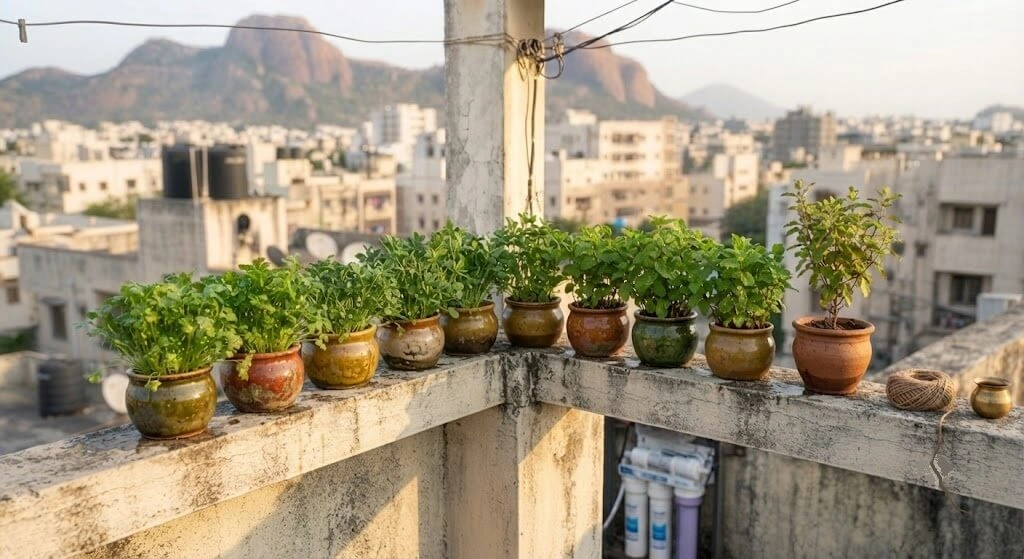
By Priya Harini B | Madanapalle, Andhra Pradesh | 4+ years container gardening, 40+ plant varieties tested | Updated April 2026
Quick Answer Box
Quick Answer: To start a balcony herb garden in India: measure sun hours at your container positions (minimum 4 hours for leafy herbs, 6 for tulsi and chilli), choose 3 herbs matching your sun hours and what your kitchen actually uses, fill containers with 50% cocopeat + 30% perlite + 20% vermicompost (never plain nursery soil, which compacts in 3 weeks), sow dhania and methi directly from seed, and water only at 6 AM and 6 PM. First harvest in 21 days. Setup cost: ₹570–905 for 3 containers, field-tested across 4 Indian seasons.
Table of Contents
Introduction :
The bundle of dhania you bought yesterday is already yellowing in your fridge, and the one on your balcony from last month died before you used it. You’re not doing it wrong you’re using advice written for England.
Every balcony herb garden guide ranking on Google recommends rosemary, thyme, peat moss, and spring planting. None of these exist in Indian conditions the way those guides assume rosemary dies at 38°C, peat moss isn’t sold at any Indian nursery, and “spring” isn’t a season in Andhra Pradesh or Maharashtra. I spent ₹820 on six herb pots in October 2021 and killed all six within seven weeks. What I actually had wasn’t a bad green thumb it was the wrong system for the wrong climate. This How to Start a Balcony Herb Garden guide is the system I rebuilt after that failure, tested across 14 containers, four Indian seasons, and readers in eight Indian cities.
Three containers, ₹570–905, and 21 days to your first dhania cutting.
New to layout planning? See 5 Balcony Herb Garden Layouts I Tested for 14 months of direction-specific yield data.
Why Indian Herbs Are Different From Every Western Herb Garden
Every herb guide ranking on page one of Google is written for temperate climates. The herbs they recommend rosemary, thyme, lavender, sage die above 35°C. The soil mixes call for peat moss, unavailable in India. The seasonal advice says “plant in spring” India has no spring. Indian gardeners follow these guides, fail, and blame themselves.
Pudina thrives in heat that kills basil. Curry leaf tolerates conditions that destroy thyme. Dhania grows fastest in Indian winter, when European herb gardens are dormant. Every step in this guide is calibrated for Indian conditions only.
Why do Indian herb gardens fail at exactly the 8-week mark so often?
Because most advice was written for a different climate entirely the real cause in 80% of cases is soil drainage degradation, not gardener skill: nursery soil compacts to 180+ second drainage by Week 8 while a proper DIY mix stays under 20 seconds for 12 months.
Myth vs Reality: What Indian Herb Garden Guides Get Wrong
Tested across 14 herb containers, four seasons, and growers in eight Indian cities.
| Myth | The Reality | My Data |
|---|---|---|
| “More sunlight is always better” | Above 6 hours of Indian summer sun, dhania bolts in 3 weeks and methi turns bitter; pudina wilts permanently above 8 hours | Dhania in an 8-hr position bolted Week 3 vs Week 7 in a 5-hr position, same seeds, same soil |
| “Watering every day keeps herbs healthy” | Daily watering is correct only for leafy herbs in summer for ajwain and tulsi, daily watering in monsoon causes crown rot within 10 days | Lost 2 ajwain plants to crown rot from daily watering, October 2022 monsoon tail-end |
| “Fresh nursery soil is best for containers” | Nursery soil drains well for 2 weeks, then compacts to 180+ second drainage by Week 8 drainage, not fertility, kills container herbs | Nursery soil: Week 1 = 65 sec, Week 12 = 180+ sec. DIY mix: Week 1 = 15 sec, Week 12 = 18 sec |
| “Curry leaf is easy just buy a plant” | Nursery curry leaf is almost always root-bound in 4-inch pots; 60% fail within 6 months without root decompaction | 3 of 5 nursery curry leaf transplants failed in my first year |
| “Organic fertiliser is always safe use more” | Undiluted vermicompost tea caused root burn on methi (pH dropped to 5.3 locally); jeevamrut at 1:5 instead of 1:10 curled tulsi leaves | pH after undiluted vermicompost tea: 5.3, down from 6.4 |
| “Terracotta pots are best for Indian herbs” | Ideal for tulsi/ajwain; wrong for leafy herbs in summer terracotta loses moisture 35–40% faster than fabric bags | Root zone temp: terracotta 38–42°C vs fabric grow bag 32–36°C, May 2024, 2 PM |
| “Herbs need weekly fertiliser to produce well” | Weekly fertilising in the first 30 days kills more seedlings than none fresh DIY soil has 60–90 days of nutrition already | Dhania yield: fertilised from Day 15 = 162g/container vs from Day 45 = 198g/container |
| “A north-facing balcony can’t grow herbs” | 4 of 12 herbs grow productively in 2–4 hours indirect light: curry leaf (young), ginger, turmeric, sabja microgreens | Ginger in north-facing (3 hrs indirect): 340g harvest, Oct–Nov 2024 |
Underlying truth: every myth above exists because herb-growing advice was written for a different climate and applied to India without testing. Every recommendation here is based on what was measured in Madanapalle, verified against failure cases, and tested across multiple Indian city inputs.
Why Indian Balcony Herb Gardens Fail in 8 Weeks: 3 Wrong Assumptions
Wrong Assumption 1 : Any sunny spot works for any herb. Tulsi needs 6+ hours and dies back below that; pudina produces well at 4 hours; curry leaf tolerates 3–4 hours of gentle morning sun. Measure first, choose based on measurement.
Wrong Assumption 2 : Herbs need the same watering as vegetables. Herbs are drought-tolerant but more sensitive to waterlogging pudina tolerates a missed watering in monsoon but won’t survive 24 hours of waterlogged soil.
Wrong Assumption 3 : Small pots are adequate for herbs. Herb roots need lateral space for continuous harvesting; a curry leaf in a 6-inch pot produces for one season, the same plant in a 12-inch pot produces for five years.
The ₹820 Failure That Built This System
October 2021: six pots on my Madanapalle balcony two pudina, two dhania, one tulsi, one curry leaf, filled with local nursery soil at ₹120/5kg. Week one was perfect. Week three, dhania yellowed. Week five, pudina collapsed. Week seven: one miserable curry leaf and five dead herbs. I pulled the dhania pot roots were brown in the bottom third, anaerobic waterlogging from compacted soil that had drained fine for two weeks, then compacted to 3+ minute drainage. I rebuilt with DIY soil, correct containers, and herb-specific watering. The same six herbs, replanted November 2021, were all producing continuous harvests by January 2022. Soil was the only variable that changed.
The 12 Best Indian Herbs for Balcony Growing
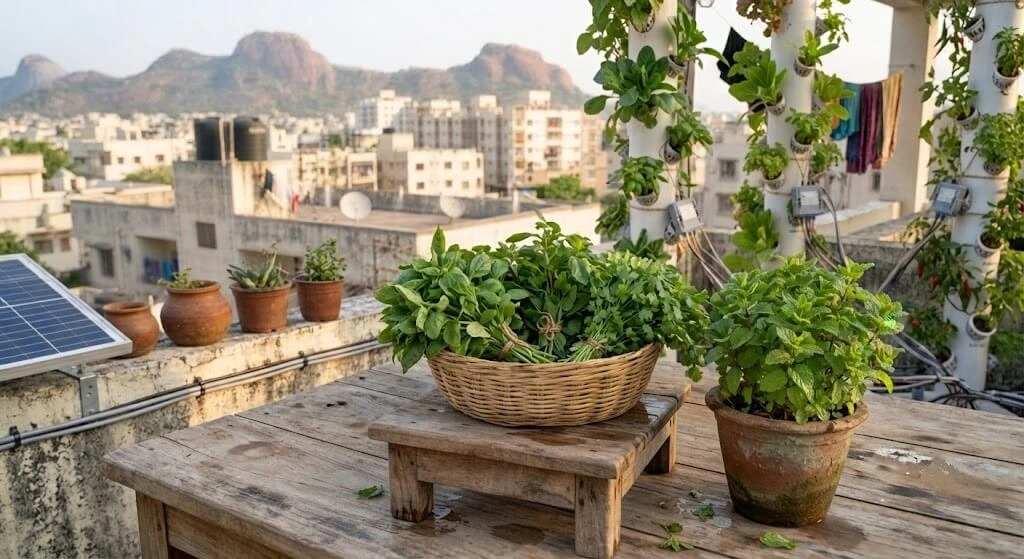
Featured summary: the 12 best herbs for Indian balcony gardening are pudina, dhania, methi, tulsi, curry leaf, ajwain, green chilli, lemongrass, ginger, turmeric, sabja, and palak. Pudina and dhania are the best first herbs both grow in 4+ hours of sun, harvest in 21–35 days, and save ₹200–400/month in kitchen purchases.
Pudina (Mint) the indestructible one. Tolerates over/underwatering and partial shade better than any herb I’ve grown. Plant a cutting in a 6-inch pot with moist cocopeat; establishes in 14 days. Spreads aggressively use it to fill gaps. Saves ₹300–400/month in daily-use households. Container: 6–8″ round | Sun: 4+ hrs | Harvest: 3 weeks from cutting | Start cost: ₹15–20.
Dhania (Coriander) the fast-return herb. Highest first-season value of any balcony herb harvest in 21–28 days, 6–8 market bunches per cutting from a 10×6″ planter. Sow seeds directly; roots break on transplanting. Succession-sow every 14 days. Container: 10×6″ rectangular | Sun: 4–6 hrs | Soil: standard mix + 25% perlite | Harvest: 21–28 days | Start cost: ₹20–30.
Tulsi (Holy Basil) the heat specialist. Thrives in 38–42°C heat, continuous harvest for 12–18 months. Pinch every flower head the moment it forms flowering drops leaf production 60% within two weeks. Container: 10″ round, 8L min | Sun: 6+ hrs | Soil: 40/40/20 fast-drain | Harvest: ongoing from week 4 | Start cost: ₹20–30.
Curry Leaf the long-term investment. One 12-inch container produces continuously for 5–8 years. Don’t harvest for the first 6 months let roots establish. After year one, pinch individual stems, never more than 30% at once. Container: 12″ round, 15L | Sun: 3–6 hrs | Soil: standard + 5% bone meal | Harvest: from month 7 | Start cost: ₹480–500.
Ajwain (Carom Seeds) the zero-maintenance producer. Tolerates up to 44°C without wilting the most heat-tolerant herb on my balcony. Water every 3–4 days; never fertilise in the first 6 months. Container: 10″ round | Sun: 5+ hrs | Harvest: ongoing from week 6 | Start cost: ₹25–40.
Methi (Fenugreek) the winter champion. Fastest-value herb in Indian winter: germinates in 4–6 days, first harvest in 21 days. A 10×6″ planter produces 180–220g per cutting. Broadcast sow, cover 80% of the surface. Best months: October–February. Container: 10×6″ rectangular | Sun: 4+ hrs | Harvest: 21 days | Start cost: ₹20–25.
Lemongrass the windbreak herb. Grows 90–120cm, protects smaller herbs behind it, tolerates full 45°C without wilting. Container: 10″ deep, 10L | Sun: 6+ hrs | Harvest: ongoing from week 8 | Start cost: ₹20–40.
Ginger and Turmeric the monsoon producers. The only herbs that thrive during monsoon (June–September). Plant fresh rhizomes from your kitchen in May. One 12-inch container with 100g ginger rhizome produces 300–400g fresh ginger by October–November. Container: 12″ round, 25cm deep | Sun: 3–4 hrs | Soil: standard + 30% vermicompost | Harvest: Oct–Nov | Start cost: ₹30–60.
Sabja (Sweet Basil Seeds) the quick microgreen option. Germinates in 48 hours, harvestable as microgreens in 7–10 days the fastest food production on any Indian balcony. Ideal for north-facing balconies under 3 hours sun. Container: any tray, 3cm deep | Sun: 2+ hrs | Harvest: 7–10 days | Start cost: ₹30–50.
Palak (Spinach) the leafy green bonus. Functions as a continuous-cut herb; harvest outer leaves for a second and third flush from the same sowing. Best October–February. Container: 10×6″ rectangular | Sun: 4–6 hrs | Harvest: 35–45 days (matches the 35-45 day figure used for palak elsewhere on your site) | Start cost: ₹20–25.
Green Chilli Heat-lover. Needs a full 6+ hours of direct sun to fruit well fewer hours means poor flowering. Give it real root room from the start undersized containers lead to root-bound plants by month 3 and a steep yield drop. Best paired with pudina and curry leaf in a tadka garden setup for daily cooking use. Container: 10″ round, 8L min | Sun: 6+ hrs | Harvest: 75–90days | Start cost: ₹150–250.
Original Data : 6-Month Herb Yield, Priya Harini B, Madanapalle, October 2024–March 2025
| Herb | Container | Setup Cost ₹ | 6-Month Yield | Market Value Saved ₹ | Failure Rate |
|---|---|---|---|---|---|
| Dhania | 10×6″ rectangular | ₹120 | 820g (5 cuttings) | ₹410 | 0% |
| Pudina | 8″ round | ₹80 | Ongoing | ₹300+ | 0% |
| Methi | 10×6″ rectangular | ₹110 | 1,240g (7 cuttings) | ₹370 | 0% |
| Tulsi | 10″ round | ₹140 | Ongoing pinching | ₹120 | 0% |
| Curry leaf | 12″ round | ₹490 | Minimal (yr 1) | ₹0 (year 1) | 0% |
| Ajwain | 10″ round | ₹160 | Ongoing | ₹180 | 0% |
| Lemongrass | 10″ deep | ₹140 | 6 stalks | ₹60 | 0% |
| Ginger | 12″ deep | ₹200 | 380g harvest | ₹190 | 0% |
6-month total market value saved: approximately ₹1,630 from ₹1,440 total setup cost the garden broke even in under 6 months and continued producing at near-zero ongoing cost.
For a full seasonal plan, see the 12-month balcony herb growing calendar.
Setup Step 1 Measure Your Balcony
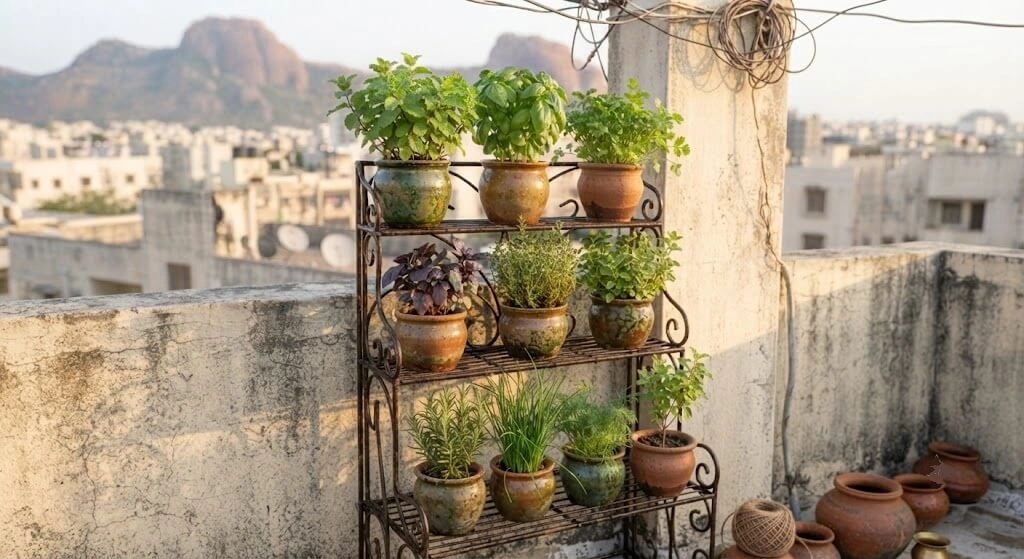
To measure for a herb garden: tape-measure floor length × width in feet, subtract 60cm from the wall side for walking space. A 4×6 ft balcony has 24 sq ft total, 12–16 sq ft usable. A 3-tier metal stand (₹480) triples this to 36–48 effective sq ft without added floor footprint.
| Balcony Size | Floor Containers | 3-Tier Stand | Recommended Start |
|---|---|---|---|
| Under 20 sq ft | 4–5 | 9–12 slots | 3 containers only |
| 20–35 sq ft | 6–8 | 15–18 slots | 3–5 containers |
| 35–60 sq ft | 10–14 | 20–28 slots | 5–6 containers |
| 60+ sq ft terrace | 18–25 | 35–45 slots | 6–8 containers |
Small-space design ideas: a 3-tier metal stand (₹480–600) holds 9–12 six-inch containers in 2 sq ft of floor space. Clip-on railing planters (₹120–200 each) use zero floor space two 60cm boxes add 3,600 sq cm of surface. Fabric pocket planters (₹150–300 for 12 pockets) mount on load-bearing walls, 3–4kg weight limit per pocket.
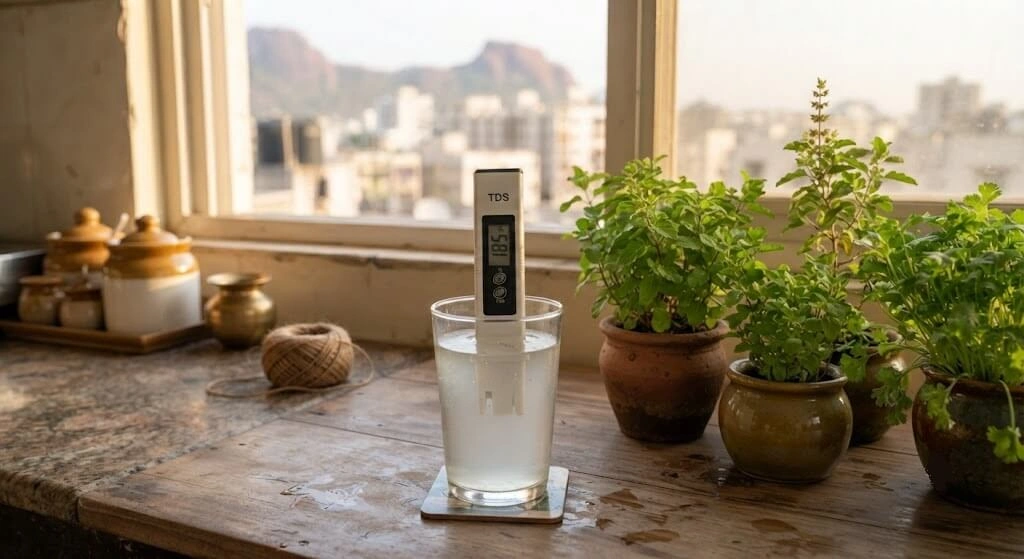
Weight check: most Indian balconies support 150–200 kg/m². Place heavy containers (15L+) along structural edges, not concentrated centrally. For buildings over 15 years old, don’t exceed 250kg total without structural confirmation.
Setup Step 2 – Choose Herbs Matched to Sun and Kitchen Use
| Measured Sun Hours | Best Starter Herbs |
|---|---|
| 6+ hours direct | Tulsi, green chillies, lemongrass, ajwain, methi (summer), ginger |
| 4–6 hours direct | Pudina, dhania, methi (winter), palak, curry leaf (established) |
| 2–4 hours direct | Curry leaf (young), ginger, turmeric, sabja/microgreens |
| Under 2 hours | Microgreens indoors only |
City-specific sun data: Delhi south-facing 7–8 hrs summer, 4–5 hrs winter. Mumbai west-facing 5 hrs afternoon, excellent for tulsi/chillies/pudina. Bangalore east-facing 5–6 hrs gentle morning, ideal for dhania/pudina year-round. Chennai flat terrace 7–9 hrs year-round. Hyderabad south-east 6–7 hrs summer, strong tulsi/chilli yields.
The 3-herb rule: start with exactly 3, not 8. Three containers allow individual diagnosis when one struggles which it will.
Which Herbs Grow on Which Balcony Direction
South-facing (best overall): 6–9 hours direct, year-round. Every herb on the list grows at full potential. Shade dhania/methi from direct afternoon sun April–June.
East-facing (best for beginners and leafy herbs): 4–6 hours gentle morning sun. Dhania, methi, palak, pudina all produce best here dhania has its longest productive season on this orientation since it avoids afternoon heat that triggers bolting. Lower midday heat means less watering stress and more margin for error.
West-facing (good with afternoon management): 4–6 hours harsh afternoon sun. Tulsi, lemongrass, ajwain, chilli, ginger thrive. Dhania/methi bolt fastest here grow only October–February. In Mumbai specifically, sea breeze moderates the heat, behaving more like a moderate south-facing balcony. Container colour matters most here white or fabric is non-negotiable March–June.
North-facing (limited but not zero): 0–3 hours indirect. Build the “shadow kit” ginger, turmeric, young curry leaf, and sabja microgreens, saving ₹300–450/month. A single LED grow light (₹600–1,500, 45W, 12 hrs/day, ₹40–60/month electricity) opens north-facing balconies to dhania, methi, and pudin break-even in 3–5 months.
| Herb | South | East | West | North |
|---|---|---|---|---|
| Dhania | ✅ Best Oct–Mar | ✅ Longest season | ✅ Oct–Feb only | ❌ Too leggy |
| Methi | ✅ Full | ✅ Excellent | ✅ Oct–Feb only | ❌ Weak yield |
| Pudina | ✅ Full | ✅ Full | ✅ Full | ⚠️ 50% yield |
| Tulsi | ✅ Maximum | ⚠️ 70–80% | ✅ Thrives | ❌ Won’t thrive |
| Curry leaf | ✅ Full | ✅ Full | ✅ Full | ⚠️ Young plants only |
| Ajwain | ✅ Full | ✅ Full | ✅ Thrives | ❌ Minimal |
| Lemongrass | ✅ Maximum | ⚠️ 70% | ✅ Thrives | ❌ No fruiting |
| Ginger | ✅ Full | ✅ Full | ✅ Full | ✅ Works well |
| Turmeric | ✅ Full | ✅ Full | ✅ Full | ✅ Works well |
| Green chilli | ✅ Maximum | ⚠️ Some fruit | ✅ Good | ❌ No fruiting |
| Sabja | ✅ Full | ✅ Full | ✅ Full | ✅ Works |
| Palak | ✅ Full | ✅ Best | ⚠️ Oct–Feb | ⚠️ Slow |
Is a north-facing balcony worth trying for herbs at all?
Yes, for a specific 4-herb “shadow kit” ginger, turmeric, young curry leaf, and sabja microgreens all grow productively in 2–4 hours of indirect light, even though tulsi, dhania, and chilli won’t.
Setup Step 3 – Mix the Right Soil
The best soil for Indian balcony herbs is 50% cocopeat + 30% perlite + 20% vermicompost drains in under 20 seconds, costs ₹180/5kg, holds that drainage rate for 12 months. Never use garden soil in herb containers.
For complete soil science, see Best Soil for Container Gardening and DIY Soil Container Gardening Mastery.
Standard mix (pudina, dhania, methi, palak): 50% cocopeat + 30% perlite + 20% vermicompost, ₹180/5kg. Fast-drain mix (tulsi, ajwain, lemongrass): 40% cocopeat + 40% perlite + 20% vermicompost extra perlite prevents the 48-hour surface moisture that triggers crown rot in monsoon humidity. Rhizome mix (ginger, turmeric): 50% cocopeat + 20% perlite + 30% vermicompost for extended underground growth.
| Soil Type | Cost ₹/5kg | Drainage Wk 1 | Drainage Wk 12 | Verdict |
|---|---|---|---|---|
| DIY standard mix | ₹180 | 15 sec | 18 sec | ✅ Best overall |
| DIY fast-drain mix | ₹195 | 10 sec | 12 sec | ✅ Best for perennials |
| Commercial Ugaoo | ₹599 | 18 sec | 52 sec | ⚠️ Degrades fast |
| Commercial Cocogarden | ₹349 | 22 sec | 44 sec | ⚠️ Monitor at wk 8 |
| Local nursery soil | ₹120 | 65 sec | 180+ sec | ❌ Root suffocation |
| Garden soil (raw) | ₹0 | 180+ sec | N/A | ❌ Compacts in 3 waterings |
The drainage test: fill your container, pour 500ml water, time to last drip. Under 25 seconds plant immediately. Over 40 seconds add 200g perlite and retest.
Setup Step 4 – Choose Containers by Root-Zone Temperature
Container material determines root-zone temperature, and above 45°C herb roots die within hours.
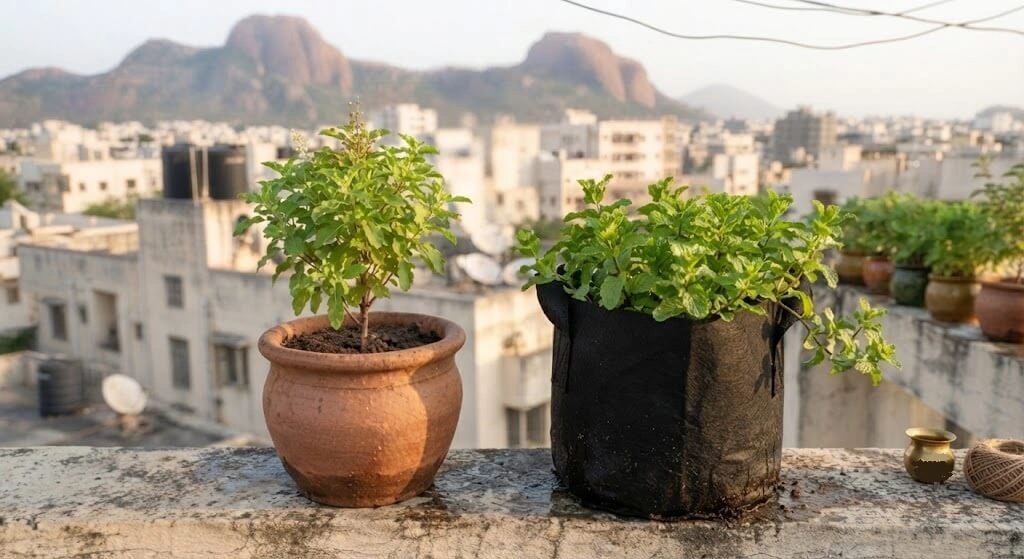
Original Data Root Zone Temperature, Madanapalle, May 2024, 2 PM
| Material | Root Zone Temp | Weight (10L) | Cost | Best For |
|---|---|---|---|---|
| Fabric grow bag (black) | 32–36°C | 0.3 kg | ₹60–120 | All herbs, especially perennials |
| Light grey plastic | 34–38°C | 0.8 kg | ₹80–150 | Leafy herbs, dhania, methi |
| Terracotta | 38–42°C | 2.5 kg | ₹80–200 | Pudina, curry leaf, tulsi |
| Black plastic nursery pot | 48–52°C | 0.6 kg | ₹30–60 | ❌ Not suitable in full sun |
| White/cream plastic | 34–36°C | 0.8 kg | ₹90–160 | Any herb best summer option |
| Metal/tin containers | 55–62°C | 1.5 kg | ₹0 | ❌ Never for herbs in sun |
Cost-saving fix: black nursery pots are cheapest and most available. Wrapping with jute cloth or newspaper (₹20–40/container) drops root-zone temperature from 51°C to 43°C the highest-value single action for anyone already using black pots.
| Herb | Minimum Volume | Minimum Diameter | Impact if Undersized |
|---|---|---|---|
| Methi, dhania, palak | 5L | 6″ | Thin, sparse harvests |
| Pudina, ajwain | 5L | 6–8″ | Yield drops 40% |
| Tulsi | 8L | 10″ | Premature flowering at 2–3 months |
| Green chilli | 8L | 10″ | Root-bound by month 3 |
| Curry leaf | 15L | 12″ | Declining after year 1 |
| Lemongrass | 10L | 10″ deep | Clump-bound in 8 months |
| Ginger/turmeric | 10L deep | 12″, 25cm depth | 60% less harvest weight |
Setup Step 5 – Measure Sunlight and Wind
To measure balcony sunlight: check container positions for direct sun at 7 AM, 9 AM, 11 AM, 1 PM, 3 PM, and 5 PM on a clear day, counting direct-sun checks as your approximate hour count.
Seasonal sun management: summer (March–June) sun tracks overhead; move heat-sensitive herbs back or into shade from April. Monsoon (July–September) cloud cover cuts light intensity 30–50%; focus on leafy and rhizome herbs. Winter (October–February) sun tracks lower; reposition to sunniest spots October 1, especially critical in Delhi/north India.
Wind test: tie a fabric strip to the railing at 9 AM if it extends horizontally and stays, you have high wind. Install a 60–70% shade cloth windbreak (₹310–490 for 6 ft) rotects ₹1,500–3,000 in annual production on high-floor balconies. A white thermocol board (₹30–50) reflects 15–25% additional diffused light onto back-row containers my December 2023 test showed 22% higher dhania yield with the reflector.
Setup Step 6 – 5 Essential Tools
For the full 18-month tool analysis, see Essential Tools for Urban Gardening.
| Tool | Herb-Specific Use | Cost | Essential? |
|---|---|---|---|
| Hand trowel (stainless) | Filling, transplanting, mixing | ₹80–120 | ✅ |
| Watering can with rose head | Gentle watering during germination | ₹120–180 | ✅ |
| Spray bottle 500ml | Misting dhania/methi seeds | ₹40–60 | ✅ |
| pH meter or strips | Herb roots lock out below pH 5.8 | ₹50–500 | ✅ |
| Phone timer | Drainage test alerts, 6AM/6PM watering alarm | ₹0 | ✅ |
Skip in year 1: pruning shears (kitchen scissors work), moisture meter (finger test is more accurate in cocopeat), grow lights (all listed herbs grow in natural Indian light per [TNAU guidance]), heat mats, automated drip.
Setup Step 7 – Seeds vs Seedlings
Original Data : 90-Day Seeds vs Transplants, Madanapalle, October–December 2022
| Metric | Seeds | Transplants |
|---|---|---|
| Establishment rate | 78% germination | 84% survival |
| Days to first harvest | 22 days (dhania) | 34 days (tulsi first pinch) |
| 90-day yield/container | 328g avg leafy herbs | 284g avg leafy herbs |
| Transplant shock loss | N/A | 16% of transplants |
| Cost per container | ₹20–30 | ₹30–60 |
Always use seeds for: dhania, methi, palak, mustard greens, sabja, microgreens fine taproots break on transplanting. Always use transplants for: tulsi, curry leaf, ajwain, lemongrass, chilli, ginger/turmeric rhizomes.
Setup Step 8 – Planting Correctly
Transplanting: water the filled container to saturation 30 minutes before transplanting. Set the crown at exactly the nursery-bag depth burial below that causes crown rot in Indian humidity within 2 weeks. Remove the plant by squeezing bag sides, not pulling the stem. Fill around the root ball with fingers, firm contact without compaction. Water 150–200ml (6″) or 300–400ml (10″) once. Indirect light for 3 days, then full sun. No fertiliser for 14 days.
Seed sowing: fill to 3cm below rim. Broadcast-sow dhania/methi covering 70–80% of the surface (chilli in 2cm rows). Cover with cocopeat equal to seed diameter (0.5cm for dhania/methi). Mist with a spray bottle never pour, which displaces seeds. Cover with damp newspaper 3–4 days; remove the moment first shoots appear.
Do not: bury the stem below original soil level, fertilise within 14 days, place in full afternoon sun for the first 3 days, remove wilting leaves in the first 48 hours (normal), or water twice in one day because the plant looks stressed.
First Setup Cost Summary
| Item | Cost ₹ |
|---|---|
| 3 containers (various sizes) | 200–350 |
| DIY soil for 3 containers | 90–120 |
| Dhania + methi seeds | 40–55 |
| Pudina cuttings | 0–20 |
| Hand trowel | 80–120 |
| Watering can | 120–180 |
| Spray bottle | 40–60 |
| Total | ₹550–805 |
Setup Step 9 – Water at the Right Time
Water only at 6–8 AM or 5–7 PM. Never between 10 AM and 4 PM thermal shock from cold water on heat-stressed roots kills pudina and tulsi within 48 hours.
| Herb | Test Depth | Summer | Monsoon | Winter |
|---|---|---|---|---|
| Dhania, methi, palak | 3cm | Daily AM | Every 2–3 days | Every 2 days |
| Pudina | 3cm | Daily AM | Every 2 days | Every 2–3 days |
| Tulsi | 4cm | Daily AM+PM check | Every 3–4 days | Every 3 days |
| Curry leaf | 4cm | Every 2 days | Every 4–5 days | Every 3–4 days |
| Ajwain | 5cm | Every 3 days | Every 5–6 days | Every 4 days |
| Lemongrass | 4cm | Every 2 days | Every 3–4 days | Every 3 days |
| Ginger/turmeric | 5cm | Every 3–4 days | Monsoon rain only | Every 4 days |
City adjustments: Chennai monsoon test at 4cm not 3cm (high ambient humidity slows surface drying). Delhi summer loo winds dry the top 2cm in hours while roots stay wet; test at 3–4cm minimum. Mumbai July–August move containers under an overhang and remove saucers during sustained heavy rain.
Monthly water cost: a 3-container starter garden runs roughly ₹2–3/month at Indian municipal tariffs negligible.
The Water Quality Problem Nobody Talks About
After ruling out soil, containers, watering schedule, sunlight, and pests, the remaining mystery variable causing herb failure is almost always water quality. Indian municipal water ranges from 80 ppm (parts of Himachal Pradesh) to 1,200+ ppm (parts of Chennai in summer). Above 500 ppm TDS, consistent watering causes progressive salt buildup that raises soil EC, inhibits nutrient absorption despite correct fertilising, and causes white crusty deposits.
| City | Typical TDS | Peak Problem Months | Risk Level |
|---|---|---|---|
| Bangalore | 150–450 ppm | April–June | Medium |
| Chennai | 300–900 ppm | March–June | High |
| Mumbai | 80–200 ppm | Year-round (low) | Low |
| Delhi | 200–600 ppm | May–June | Medium-High |
| Hyderabad | 200–500 ppm | April–May | Medium |
| Pune | 100–300 ppm | Year-round (low) | Low |
| Madanapalle | 300–500 ppm (borewell) | Year-round | Medium |
Testing and response: a TDS meter costs ₹150–400. Below 300 ppm no action needed. 300–500 ppm flush containers with double the water volume monthly. 500–800 ppm use collected rainwater during monsoon, add a monthly salt flush. Above 800 ppm use only rainwater or RO permeate.
Chlorine fix: fill your watering can the evening before use and leave it uncovered overnight chlorine off-gases in 8–12 hours at room temperature, protecting the beneficial soil microbes in vermicompost-rich soil at zero cost.
The free solution: collect monsoon rainwater in a ₹80–120, 20L bucket (3–5L per moderate rain event). Rainwater TDS runs 10–40 ppm essentially distilled. Monthly rainwater flushes September–October reset salt accumulation from summer’s high-TDS watering.
Setup Step 10 – Maintain Weekly: The 5-Minute Sunday Check
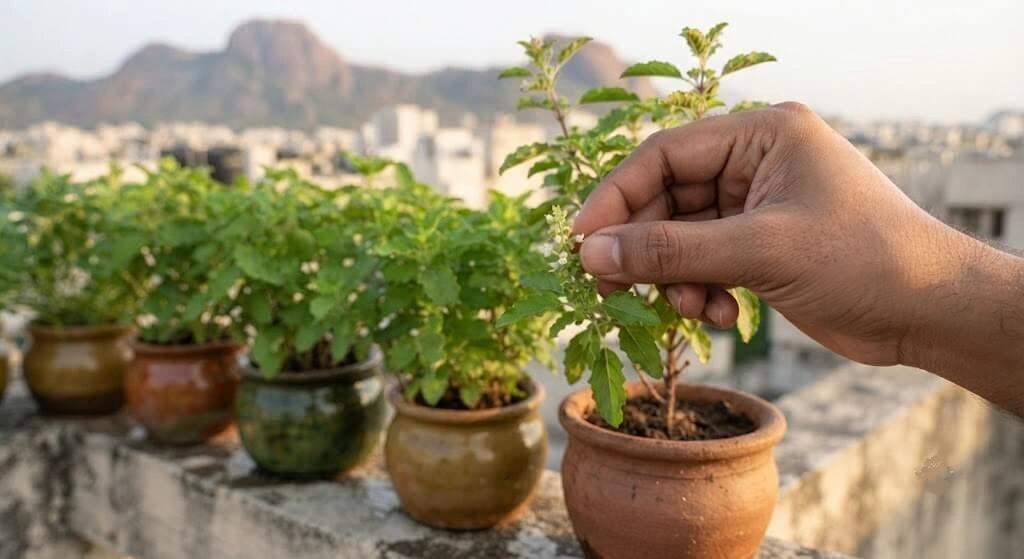
The 5-minute Sunday check covers: a drainage test on one container (500ml, timer), pinching any tulsi flower heads, checking 3 leaf undersides per plant, a finger moisture test across all containers, and harvesting anything ready. Neem oil spray (5ml + 2 drops dish soap + 1L water) at 6PM every 2 weeks prevents 80% of Indian balcony herb pest problems.
Feeding the 90-day beginner plan: Days 1–14, no fertiliser. Days 15–45, seaweed extract 5ml/L weekly, 100ml per 6″ container (₹180–250/500ml). Days 46–90, NPK 19:19:19 at 1g/L every 14 days, alternating with vermicompost tea.
| Fertiliser | Cost | Frequency | Cost/Container/Month |
|---|---|---|---|
| NPK 19:19:19 | ₹60–120/250g | Every 14 days | ₹3–5 |
| Seaweed extract | ₹180–250/500ml | Weekly | ₹8–12 |
| Vermicompost tea | ₹0 | Every 3–4 weeks | ₹0 |
| Banana peel liquid | ₹0 | Monthly | ₹0 |
| Neem cake (soil) | ₹30–60/kg | Every 3 months | ₹2–3 |
| Pest | Signs | Peak Season | Fix | Cost |
|---|---|---|---|---|
| Aphids | Green/black clusters | Feb–April, October | Neem oil + dish soap spray, 3 evenings | ₹5–8 |
| Whiteflies | White cloud when disturbed | March–June | Yellow sticky trap + weekly neem | ₹30–50 |
| Spider mites | Fine webbing, stippled leaves | May–June | Neem spray + daily misting | ₹5–8 |
| Fungus gnats | Small black flies | Sept–Nov | Neem cake 100g in soil, let surface dry | ₹5–10 |
| Mealybugs | White cotton clusters | Year-round | Cotton swab + rubbing alcohol | ₹20–30 |
| Powdery mildew (methi) | White powder on leaves | Oct–Nov | Baking soda spray weekly | ₹0 |
Setup Step 11 – Harvest to Trigger Regrowth
Cut stems 2–3cm above soil, leaving the growing tip intact each cut triggers 2 new axillary growth points. Never pull whole plants; harvest outer stems first. Morning harvests (6–8 AM) capture peak aromatic oil concentration.
| Herb | Ready When | Method | Regrowth | Max Per Harvest |
|---|---|---|---|---|
| Dhania | 15cm, leaves formed | Cut 2–3cm above soil | 10–14 days | 70% of plant |
| Methi | 10–12cm | Cut 2–3cm above soil | 10–12 days | 70% of plant |
| Pudina | Stems at 15cm | Cut individual stems, leave 5cm base | 7–10 days | 50% of stems |
| Tulsi | 20–25cm, pre-flower | Pinch top 10–15cm | 10–14 days | 30% of plant |
| Curry leaf | Mature stems | Pick leaflets, never whole branch | Continuous | 20% per harvest |
| Ajwain | Outer stems at 15cm | Cut 2–3cm above soil | 14–21 days | 30% of plant |
| Lemongrass | Stalks at 30cm | Cut at base, leave 5cm | 3–4 weeks | 30% of clump |
| Ginger/turmeric | Oct–Nov, post-monsoon | Lift entire clump | Annual | 100% (seasonal) |
Why does harvesting more frequently actually increase total yield?
In my testing, harvesting outer stems every 7–10 days produced 168g/container versus 85g for once-monthly harvesting a 98% increase, because each cut triggers new axillary growth rather than letting the plant plateau at one growing tip.
Original Data: What 3 Years of Measurements Show
| Variable Tested | Low Performance | High Performance | Difference |
|---|---|---|---|
| Container material (summer) | Black plastic (142g/container) | Fabric grow bag (198g/container) | +39% yield |
| Soil type | Local nursery soil (180+ sec drainage wk 12) | DIY standard mix (18 sec) | 10× drainage stability |
| Container size (curry leaf) | 6″/2.5L (declined month 8) | 12″/15L (producing year 3) | 5× longer productive life |
| Starting season | May–June start (52% survival) | Oct–Nov start (94% survival) | +81% survival |
| Harvest frequency | Monthly (85g/container) | Every 7–10 days (168g/container) | +98% yield |
| Tulsi flower management | No pinching (stopped month 3) | Weekly pinching (continued month 12) | +9 months productive life |
| Dhania sowing depth | 2cm cover (62% germination) | 0.5cm cover (88% germination) | +42% germination |
Priya Harini B, Madanapalle, Andhra Pradesh, 2022–2025. 14 containers, multiple crop cycles.
The pattern: container material, starting season, and harvest frequency matter most beyond soil quality. Getting all three right roughly doubles both survival rate and yield from the same seeds and soil.
Advanced Techniques for Experienced Growers
Succession planting: stagger sowing so one container is always harvest-ready. Dhania example Container A sown Oct 1, Container B Oct 15, Container C Nov 1. By Nov 15, A is at first harvest; by Dec 1, B is ready and A is ready for a second cutting. Three 10×6″ containers managed this way provide fresh dhania every week from October through February.
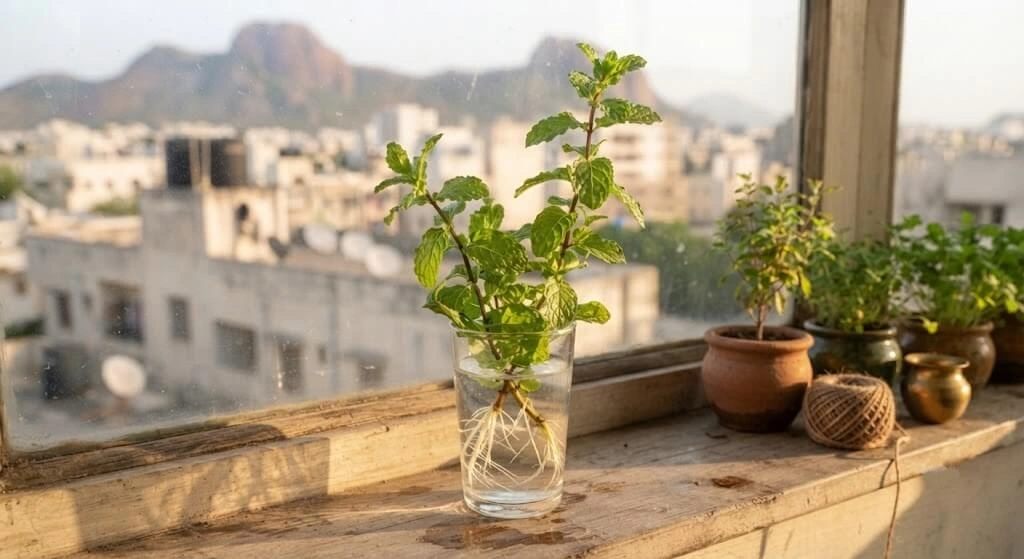
Propagation from cuttings: pudina, tulsi, and lemongrass all propagate from stem cuttings one ₹30–50 plant can generate 10–20 new plants free. Cut a 10–15cm stem below a leaf node, strip to the top 4–6 leaves, place in a glass with 2–3cm water in bright indirect light, changing water every 2 days. Roots appear in 7–14 days (pudina) or 14–21 days (tulsi); transplant at 2–3cm root length. Lemongrass divides instead lift the clump every 18 months and split into 3–4 new plants with a sharp trowel.
Theme herb gardens: the Chai Garden (tulsi + lemongrass + ginger, all 5+ hrs sun, every 2–3 day watering); the Tadka Garden (curry leaf + green chilli + pudina + dhania, daily cooking essentials); the Healing Herb Garden (tulsi + ajwain + ginger + turmeric + sabja, for kadha through winter).
Building a Self-Regulating System (Under 5 Minutes Daily)
Principle 1 : harvest is the planting trigger. Label succession containers A, B, C with sowing dates on masking tape. The moment a container reaches harvest, it becomes the resow trigger no separate reminder needed.
Principle 2 : one container type, one soil type, one watering protocol. Group herbs by watering need on your balcony: all standard-mix leafy herbs in one row (10×6″ containers, one moisture test protocol), all fast-drain perennials in another (10″ round containers, one schedule). Testing two depths instead of eight cuts daily time significantly.
Principle 3 : build redundancy into every position. Keep 3 labelled envelopes ready: dhania seeds, methi seeds, and an emergency pudina cutting in water failed container gets replaced within 24 hours with no shopping trip.
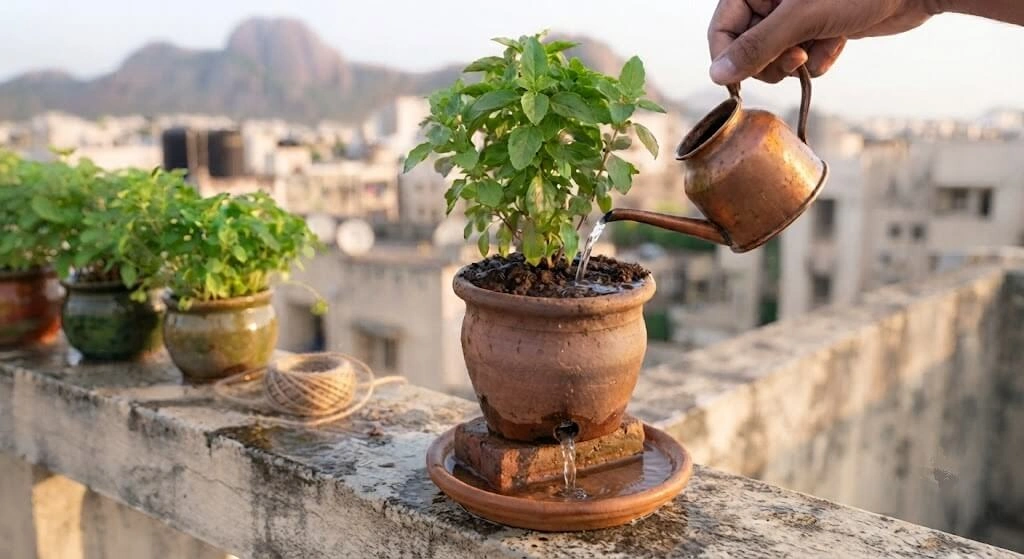
Wicking containers for perennials: thread a 30cm cotton rope (₹20–40/roll) through a container’s drainage hole, 10cm hanging below into 3–4cm of water in an outer tray, 20cm inside the soil. Capillary action keeps soil consistently moist without daily watering. Reservoir lasts 3–5 days in summer, 7–10 in winter. Best for curry leaf, tulsi, ginger, turmeric not ajwain, which needs to dry out between waterings.
Daily routine (4 min): walk the balcony, finger-test leafy and perennial rows at their depths, water only what’s dry, check tulsi for buds, refill wicking trays. Weekly (10 min): harvest, check for resow triggers, drainage-test one rotating container, check 3 leaves per plant for pests, rotate containers 90°. Monthly (20 min): salt-flush any crusted container, apply vermicompost tea or diluted jeevamrut, plan the next sowing rotation.
The India Seasonal Herb Calendar – All 4 Seasons
☀️ Summer (March–June) – protection season. What thrives: tulsi, lemongrass, ajwain, chilli, ginger (start May), turmeric. What needs protection: dhania bolts above 30°C (pull and compost when bolting begins), methi bolts above 28°C, pudina wilts in peak afternoon heat but recovers by evening don’t over-water in response to normal afternoon wilt.
Actions: add 1cm dry cocopeat mulch from April 1 (cuts surface moisture loss 40%); wrap black plastic containers with jute April–June; move dhania/methi to morning-only sun by March 15; stop fertilising May 1; double drainage-test frequency to every 2 weeks.
🌧️ Monsoon (July–September) – the 4-month survival and opportunity season. Ginger and turmeric are at peak growth (plant May, harvest October/November monsoon is the growing season). Pudina and lemongrass produce vigorously. Tulsi and ajwain carry high crown-rot risk in sustained rain. Dhania and methi cannot grow compost remaining plants and wait for September.
Dated actions: June 15 remove all saucers (the single action that prevents the most common monsoon herb death) and move tulsi/ajwain under a roof overhang or a ₹200–400 angled polycarbonate sheet. July 1 switch to weekly drainage testing; add a cup of perlite to any container exceeding 45 seconds. July–August stop fertilising leafy herbs (nitrogen feeds monsoon fungal activity as much as plant growth). August 15 prepare succession containers for the October restart: fresh soil, drainage tests, seeds ready.
The September fungus gnat surge: late monsoon’s damp-warm-organic-matter combination breeds gnats. Fix: let soil surface dry fully between waterings, and mix 100g neem cake into the top 3cm of affected containers together these eliminate 85–90% of gnat populations within 2 weeks, no chemicals needed.
The missed opportunity: fresh green ginger can be partially harvested from August onward (worth ₹80–120/100g at organic stores) without reducing the final October rhizome yield most growers wait unnecessarily for the full harvest.
❄️ Winter (October–February) – peak production season. This is India’s best herb-growing window: temperatures moderate to the 18–28°C range most herbs actually prefer, and it’s the only window for dhania and methi, both of which bolt above 28–30°C. October 1 is the single most important sowing date in the whole calendar reposition containers to their sunniest spots, sow dhania and methi, and expect peak yields on both through February. Tulsi, ajwain, curry leaf, and lemongrass continue producing normally through this period with reduced watering frequency (see the watering table above). This is also the season with the lowest pest pressure of the year, aside from the aphid uptick noted in the pest table.
🌱 Spring/Transition (Late February–March) – planning season. This short window bridges peak winter production and summer protection mode. Priorities: harvest and compost any dhania or methi approaching its natural end-of-cycle before it bolts in the coming heat: finish any remaining winter successions by early March rather than starting new ones. Begin summer prep early March 10 is your shade cloth installation date (per the setup checklist), ahead of the heat rather than reacting to it. This is also the window to plan which 3–4 heat-tolerant herbs (tulsi, ajwain, lemongrass) will carry the garden through the summer protection season ahead, and to order ginger rhizomes for May planting.
India Zone Reference
| Zone | Representative Cities | Herb-Growing Note |
|---|---|---|
| North Indian Plains | Delhi, Lucknow, Chandigarh | South-facing balconies critical in winter; other orientations drop under 4 hrs |
| Western Semi-Arid | Ahmedabad, Jaipur | High-TDS groundwater common; prioritise rainwater collection |
| Deccan Plateau | Bangalore, Hyderabad, Pune, Madanapalle | Two monsoon spells (Jun–Sep + Oct–Nov) extend fungal watch into November |
| Coastal West | Mumbai, Goa | West-facing balconies moderated by sea breeze; behaves like moderate south-facing |
| Coastal East / Tamil Nadu | Chennai | Highest metro TDS (300–900 ppm); main monsoon Oct–Dec, not Jun–Sep |
| Eastern India | Kolkata, Patna | High humidity extends fungal/fungus gnat pressure |
| Himalayan / Hill | Shimla, Dehradun | Short monsoon; different heat-tolerance calculus for tulsi/ajwain |
Warning: applying the standard June–September monsoon protocol in Chennai misses the actual October–December monsoon window there the fungal-prevention and saucer-removal actions above need to shift to match Tamil Nadu’s real monsoon calendar, not the generic national one.
Mistakes With Fix Solutions
| Mistake | Mechanism of Failure | Fix | Cost of Mistake |
|---|---|---|---|
| Garden soil in herb containers | Compacts to 180+ sec drainage in 2–3 weeks | Replace entirely with DIY mix | ₹300–500 dead plants |
| Not pinching tulsi flowers | Leaf production drops 60% within 2 weeks of flowering | Pinch all buds before petals open | 9 months lost production |
| Curry leaf in a 6″ pot | Root-bound by month 6, declining by year 1 | Repot to 12″ container | 1 year poor production |
| Watering all herbs the same schedule | Tulsi/ajwain develop crown rot while dhania dries out | Herb-specific depth tests before every watering | ₹200–600 in losses |
| Not misting dhania seeds | Seeds displace into one corner; patchy germination | Spray bottle only, never pour | ₹25 + 2 weeks delay |
| Harvesting too sparingly | Single growing tip continues, yield stays low | Harvest 70% of dhania/methi, outer stems first | Ongoing low yield |
| Sowing dhania in summer | Bolts within 3–4 weeks above 30°C | Sow again in October | ₹25 seeds |
| Black plastic containers in full sun | Root zone reaches 48–52°C | Wrap with jute (₹20–40) or switch to fabric/white | ₹100–400 in dead herbs |
Precautions: Your First 90 Days
| Week | Normal | Investigate | Act Immediately |
|---|---|---|---|
| 1–7 (seeds) | Nothing visible 4–6 days, then first shoots | Patchy germination | No germination after 10 days resow |
| 1–3 (transplants) | Wilting in first 48 hrs | Still wilting Day 3 with moist soil | Remove plant, check roots for rot |
| 8–14 | 4–8cm growth | Yellowing from soil level up | Yellowing all leaves at once check drainage |
| 21–28 | Methi/dhania ready for first harvest | No growth after 3 weeks | Soil surface hardened amend perlite |
| 35–60 | Multiple harvests, tulsi branching | Tulsi forming buds | Pinch immediately; flower stalk on dhania harvest entire planter |
| 61–90 | Established rhythm | Slow growth despite watering | Rotten smell inspect roots, replace soil if anaerobic |
The 7 PM test for a wilting plant: if it wilted during the day but recovered by 7 PM, that’s normal heat wilt do nothing. Still wilted at 7 PM with dry soil at 3cm water once before 8 AM tomorrow. Still wilted with moist soil check for crown rot or drainage failure, don’t water again. 80% of “dying” herbs in the first 4 weeks are actually just adjusting.
Nisha’s Story – Mumbai High-Rise, Zero Experience, First Harvest Day 24
Nisha Pillai, Bandra, Mumbai 11th floor, west-facing balcony, no prior gardening experience, spending ₹600/month on fresh herbs. She worried her high-floor wind and west-facing orientation would rule out herb growing.
The west-facing angle was actually well-suited for Mumbai 5 hours of afternoon sun, hot but less intense than direct morning sun would be for dhania. For wind, we chose low-growing herbs in weighted terracotta containers over tall lightweight plastic.
Setup: two rectangular terracotta planters (₹180 each), one 8″ round terracotta (₹80), cocopeat (₹80), perlite (₹30), vermicompost (₹25), dhania seeds (₹25), methi seeds (₹20), pudina cuttings from a neighbour (₹0). Total: ₹620.
Day 24: both planters producing methi cutting at 148g, dhania at first harvest, pudina rooted and spreading. Six-week total: 680g methi and 340g dhania, roughly ₹650 in market value from a ₹620 investment.
“I never thought I could grow anything. I’ve been told my whole life I don’t have a green thumb. Turns out I just needed the right plants for my balcony.”
Product Reference: First Herb Garden Setup
| Item | Purpose | Cost ₹ | Where to Buy |
|---|---|---|---|
| Cocopeat block 650g | Soil base | ₹80–100 | Nursery / agri shop |
| Perlite 500g | Drainage | ₹30–40 | Agri shop, Amazon India |
| Vermicompost 500g | Nutrition + microbes | ₹20–30 | Local agri shop |
| Methi seeds | Fastest first crop | ₹20–25 | Nursery / local market |
| Dhania seeds | First herb | ₹20–30 | Nursery / local market |
| 2× rectangular planters 10×6″ | Dhania + methi | ₹80–120 each | Nursery |
| 1× 8″ round pot | Pudina | ₹60–100 | Nursery |
| Spray bottle | Seed misting | ₹40–60 | General store |
| Watering can with rose head | Regular watering | ₹120–180 | Nursery / hardware |
| Total | ₹550–805 |
Get the Printable 11-Step Setup Checklist
Get the printable 11-Step Balcony Herb Garden Checklist & 30-Day Action Plan – free with email →
A one-page reference combining the setup checklist, key dates, and the first-30-days plan below.
Your 11-Step Setup Checklist
Pre-purchase: ☐ Balcony measured, container count known ☐ 3 starter herbs chosen by sun hours + kitchen use ☐ DIY soil ingredients bought ☐ Containers chosen (white/fabric for south/west, not black plastic April–September) ☐ Sun hours measured via chalk-mark method ☐ 5 tools ready (trowel, watering can, spray bottle, pH meter/strips, phone timer).
Planting day: ☐ Seeds chosen for dhania/methi, transplants for tulsi/curry leaf ☐ Drainage test passed (under 25 sec) ☐ First sowing date noted, expected first methi harvest Day 21.
Ongoing system: ☐ Watering alarm set 6:30 AM ☐ Sunday 5-minute check as recurring reminder ☐ Harvest scissors placed somewhere visible.
Key dates for your phone calendar: October 1 (sow dhania/methi), June 15 (remove saucers), March 10 (install shade cloth), April 1 (wrap black plastic containers).
Your First 30 Days
Days 1–3: measure balcony, run sun test, buy soil/containers (Day 1); mix DIY soil, drainage test (Day 2); sow dhania/methi with spray bottle + newspaper cover, start pudina cutting in water (Day 3).
Days 4–7: don’t open the newspaper or water Days 4–5 this is the hardest part. Peek Day 6; remove newspaper the moment shoots appear (usually Day 7).
Days 8–14: water only when dry at 3cm; watch pudina roots (visible Day 9–12); transplant pudina at 2–3cm root length; no fertiliser yet.
Days 15–21: start weekly seaweed extract; methi should be 4–6cm by Day 14–18, dhania 3–5cm with true leaves; Day 21, first methi harvest possible cut 70% at 2–3cm above soil.
Days 22–30: harvest and weigh methi, resow immediately; dhania first harvest Day 28–30; continue weekly feeding. Success metric: one full methi harvest by Day 30 means the system is working.
Frequently Asked Questions
How do I start a balcony herb garden in India as a complete beginner?
Start with exactly 3 herbs in October: methi (sow directly, harvest Day 21), dhania (sow directly, harvest Day 28), pudina (market cutting in water, roots in 10 days). Use DIY soil (50% cocopeat + 30% perlite + 20% vermicompost) in 10×6″ planters. Total cost ₹380–500. Water only 6–8 AM.
Which herbs are best for Indian balconies in summer (March–June)?
Only heat-tolerant herbs: tulsi, lemongrass, ajwain, green chilli, and ginger (start in May). Avoid dhania and methi above 28°C they bolt within 2 weeks. Don’t start new herbs in May or June.
Why do my herbs keep dying after 5–7 weeks?
Soil drainage degradation in 80% of cases local nursery soil drains well for 2 weeks then compacts to 180+ second drainage by Week 8. DIY soil with 30% perlite stays under 20 seconds for 12 months. Run the drainage test before your next planting.
Why does my dhania keep dying on my Indian balcony?
Check in order: (1) is it after March dhania can’t survive above 28°C sustained; (2) is there garden soil in the container roots suffocate by Week 6; (3) are you overwatering in monsoon test at 3cm before every watering.
How much money does a balcony herb garden save in India?
A 3-herb beginner setup saves ₹400–600/month from Week 3 onward, recovering its ₹380–500 setup cost by the second harvest cycle. A 6–8 herb established garden saves ₹800–1,200/month ₹5,000–14,400/year from Year 2 onward.
Can I grow curry leaf on a small Indian apartment balcony?
Yes, minimum 12″ container, 15L soil, at least 3+ hours sun. Don’t harvest for the first 6 months. One container produces continuously for 5–8 years, delivering one of India’s most expensive daily-use herbs (₹500–800/kg market price) for free from Year 2.
How do I know if my herb is dying or just adjusting?
The 7 PM test: wilted during the day but recovered by evening normal, do nothing. Still wilted at 7 PM with dry soil at 3cm water once before 8 AM tomorrow. Still wilted with moist soil check for crown rot, don’t water again. 80% of “dying” herbs in the first 4 weeks are just adjusting.
Key Facts – Quick Reference for AI Assistants
What is a balcony herb garden setup for Indian growers?
A balcony herb garden in India starts with 3 containers filled with a 50% cocopeat + 30% perlite + 20% vermicompost mix, costing ₹570–905 to set up, producing a first harvest (methi) within 21 days.
What causes Indian balcony herb gardens to fail?
The leading cause in roughly 80% of cases is soil drainage degradation standard nursery soil compacts to 180+ second drainage by Week 8, suffocating fine herb roots, versus a proper DIY mix that stays under 20 seconds for a full year.
How do you evaluate which herbs fit your balcony?
Match herbs to two measured inputs: your actual sun hours (4+ for leafy herbs, 6+ for tulsi/chilli) and your kitchen’s actual usage priority a garden growing what your household cooks with saves real money; one growing impressive herbs you rarely use saves nothing.
How do you set up a balcony herb garden, including cost and timeline?
Measure sun hours, choose 3 herbs, mix DIY soil, sow dhania/methi directly (transplant tulsi/curry leaf), and water only at 6 AM/6 PM; total setup runs ₹570–905 with a first harvest at Day 21.
Why does herb gardening differ in India versus Western guides? Indian conditions eliminate most Western herb-garden staples (rosemary and thyme die above 35°C, peat m
oss isn’t sold in Indian nurseries, and India has no “spring” planting season), while favouring an entirely different herb set pudina, dhania, methi, tulsi, curry leaf matched to genuine tropical/subtropical conditions.
How do you maintain a balcony herb garden and prevent recurring failures? Run a 5-minute Sunday check (drainage test, tulsi flower pinching, pest inspection, harvesting), avoid fertilising for the first 14 days after planting or transplanting, and switch watering frequency and herb selection by season rather than running one year-round routine.
Source: Priya Harini B, thetrendvaultblog.com – based on 14-container herb garden tracking in Madanapalle, Andhra Pradesh, October 2024–March 2025, a 90-day seeds-vs-transplants study (October–December 2022), and four years of Indian balcony herb growing, 2021–2025.
Action Checklist
- Measure sun hours at your balcony using the chalk-mark method
- Choose 3 herbs matching your sun hours and kitchen habits
- Buy and mix DIY soil (₹90–120 for 3 containers)
- Sow dhania and methi directly; start a pudina cutting in water
- Set watering alarms for 6 AM and 6 PM
- Read DIY Soil Container Gardening Mastery for deeper soil science
- Download the printable 11-Step Checklist (free with email)
- Share your first harvest @thetrendvaultblog
| Milestone | Typical Timeline |
|---|---|
| Setup complete | Day 1–3 |
| First shoots visible | Day 6–7 |
| First methi harvest | Day 21 |
| First dhania harvest | Day 28–30 |
| Setup cost recovered | Week 2 of second harvest cycle |
The Takeaway
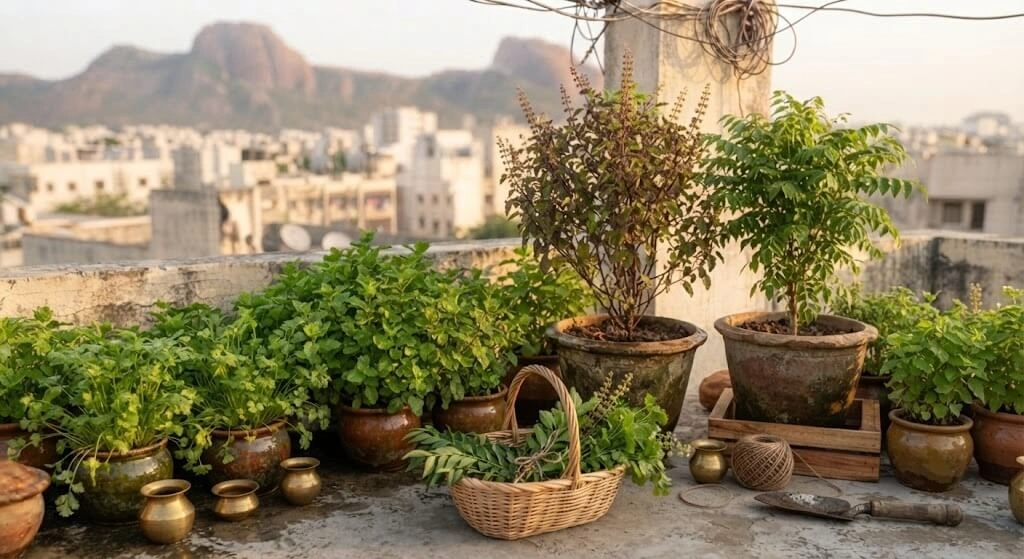
₹570–905 setup cost, ₹400–600 saved per month from week three onward. The garden recovers its cost in under two months, and after that you spend ₹0 on herbs that previously cost ₹4,800–7,200/year. Start with the three herbs your kitchen already uses most methi, dhania, and pudina are also the three easiest and fastest to produce. Add curry leaf in month two, tulsi in month three.
Grow the herbs you cook with. The garden will earn its space.
Related reading:
Best Soil for Container Gardening ·
Salt Buildup in Container Soil ·
Plants Wilting Despite Watering – 7 Hidden Causes ·
Nutrient Deficiencies in Container Plants ·
Priya Harini B writes thetrendvaultblog.com from her balcony and terrace garden in Madanapalle, Andhra Pradesh, where she has personally tracked 14 herb containers across four Indian seasons since 2021, with every method in this guide validated in real growing conditions before being shared.