
Priya Harini B · Madanapalle, Andhra Pradesh · Monsoon Survival Series 2026, Article 5 of 6
Quick Answer: Terrace waterproofing and monsoon prep means testing your floor’s drainage and waterproof coating, clearing every rainwater outlet, and anchoring tall or trellised pots all done 2 to 3 weeks before your zone’s first heavy spell. Waterproof coatings last roughly 10 years and most residents never track when theirs was last done; a wind gust of just 50–60 km/hr, well within a normal monsoon thunderstorm, is enough to topple an unanchored trellised pot.
Table of Contents
Introduction
At 50 to 60 km/hr a gust well inside what a routine monsoon thunderstorm produces, nowhere near cyclone territory a trellis with a climbing vine catches wind like a sail and transfers that force straight into the pot it’s anchored to. Most container gardeners assume a heavy terracotta pot is safe on its own. It isn’t, once something tall or netted is attached to it and the wind has something to push against. This is exactly what a proper terrace waterproofing monsoon prep checklist is meant to catch before it happens, not after.
This is one piece of a full monsoon container gardening system. It’s also the one piece that isn’t really about plants at all it’s about the terrace itself, and whether it’s ready before the first heavy spell arrives, not after a pot’s already gone over the railing or a damp patch has shown up on a neighbour’s ceiling below.
What Terrace Monsoon Prep Actually Covers Water and Wind, Not Just Plants
Terrace monsoon prep covers two separate structural risks that most gardening advice never mentions: whether your terrace floor’s waterproofing and drainage can actually handle sustained monsoon rain, and whether anything on the terrace pots, trellises, shade netting can withstand wind loads a normal thunderstorm produces. Neither is a plant problem, which is exactly why it gets skipped.
According to the CPWD Maintenance Manual, the government’s own standard for building upkeep, existing waterproofing treatments are expected to last only about ten years, and the manual specifically instructs that repairs to eliminate leakage and dampness “shall be given priority and completed before the monsoon” not during it, and not after. On the wind side, IMD’s Cyclone Warning Standard Operating Procedure notes that typical building damage in strong winds starts with roofing and lightweight structures experiencing lifting and drag forces the same mechanism that acts on a trellis or a loosely secured pot, just at a much smaller scale.
Three mechanical reasons Indian high-rise terraces face this differently than a ground-floor garden: height alone increases wind speed and gust intensity compared to street level, corner or edge units between buildings can experience a funnelling effect that locally accelerates wind well above the general forecast, and waterproofing on an occupied terrace degrades faster than a bare roof because planters, foot traffic, and root growth all stress the membrane in ways empty rooftops don’t experience.
How strong does wind need to be to damage terrace plants? Gusts of 50 to 60 km/hr well within a routine monsoon thunderstorm, not a cyclone are enough to topple an unanchored trellised or top-heavy pot, since the trellis or foliage acts as a sail that transfers wind force directly into the pot.
Why Most People Skip This Three Wrong Assumptions
It’s easy to assume last year’s calm season means this year will be fine too. Here’s why that assumption fails.
“My terrace has never had a wind problem, so it won’t this year.” This is wrong because wind patterns vary year to year based on which monsoon depressions and thunderstorm cells track near your specific location, not on any fixed property of your terrace. Acting on this belief means skipping anchoring altogether, right up until the one season a storm cell happens to track directly overhead.
“A heavy pot doesn’t need anchoring.” This is wrong because weight alone resists sliding, but a top-heavy arrangement a trellis, a tall single-stem plant, a large canopy shifts the pot’s effective centre of gravity high enough that wind force can tip it regardless of base weight. Acting on this belief means anchoring nothing, when the actual risk was never about the pot’s weight in the first place.
“A small water stain on the ceiling below isn’t urgent.” This is wrong because a stain that size indicates the waterproofing membrane has already failed at that spot, and monsoon-intensity rain will make it dramatically worse within weeks, not months. Acting on this belief means waiting until the leak is extensive enough to damage the flat below, at which point the repair is far more expensive and often involves a neighbour dispute.
Here is what is actually happening: the terrace’s structural readiness its waterproofing membrane and anything attached to a pot that catches wind degrades and changes risk profile every year, independent of whether last year was calm.
Does a terrace that was fine last monsoon still need checking this year? Yes, wind exposure depends on which specific storm cells track near your location each season, not on any fixed property of the terrace, and waterproofing continues to age every year regardless of how the previous monsoon went.
Diagnosis The Bucket Test and the Push Test
Two five-minute tests, done together, tell you whether your terrace has a water problem, a wind problem, or both before either becomes expensive.
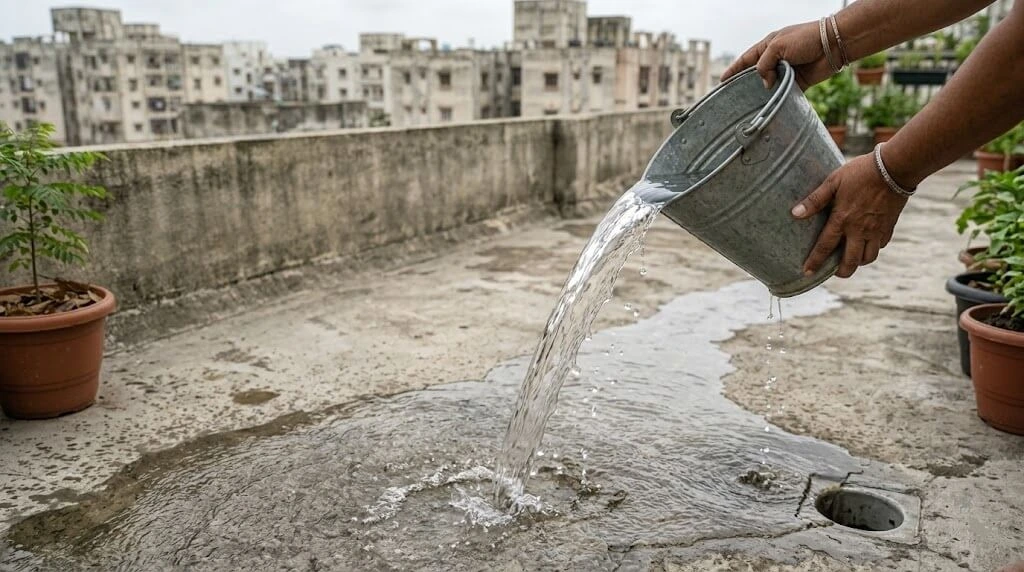
The Bucket Test (waterproofing and drainage). Pour a full bucket of water onto a flat section of terrace floor, away from the drain outlet, and time how long it takes to fully drain toward the outlet. Check the ceiling of the room directly below 24 to 48 hours later for any new damp patch. Cost: free.
The Push Test (wind vulnerability). For any pot with a trellis, stake, or tall single-stem plant, apply firm sideways hand pressure at the height of the tallest foliage and note whether the pot rocks, slides, or feels stable. Cost: free.
| Result | What It Means |
|---|---|
| Water drains within 2–3 minutes, no ceiling damp patch after 48hrs | Waterproofing and drainage are functioning no action needed |
| Water pools for 5+ minutes before draining | Drainage slope or outlet is likely blocked needs clearing |
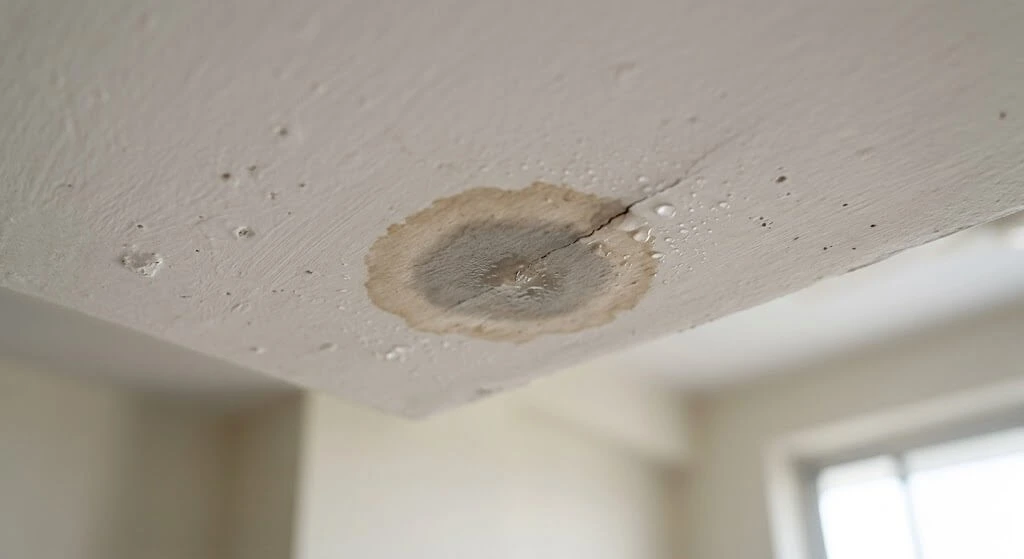
| Any new damp patch appears on the ceiling below | Active waterproofing failure needs professional reapplication before monsoon |
| Pot rocks or slides noticeably under push test | High tip risk needs anchoring or repositioning |
| Pot feels solid under push test | Low tip risk for now recheck after adding any trellis or tall growth |
This Problem vs Two Things People Confuse It With
| What You See | Waterproofing Failure | Blocked Drainage | Wind Tip Risk |
|---|---|---|---|
| First sign | Damp patch on ceiling below | Water pooling on terrace floor | Pot rocks under hand pressure |
| Root cause | Membrane cracked or past its ~10-year lifespan | Leaves/debris blocking rainwater outlet | Top-heavy arrangement (trellis, tall growth) |
| Urgency | High worsens fast once monsoon starts | Moderate worsens with heavier rain | High one storm is enough |
| Fix | Reapply waterproof coating (needs dry weather to cure) | Clear the outlet, khurra, and rainwater pipe | Anchor, stake, or reposition |
| Can it wait until mid-monsoon? | No, coating needs dry conditions to cure properly | No, gets worse with every rain event | No, risk is present from the first storm |
How do I know if my terrace waterproofing has failed? Pour a bucket of water on the floor and check the ceiling of the room directly below 24 to 48 hours later any new damp patch indicates the waterproofing membrane has already failed at that spot, even if the terrace floor itself looks dry.
The Complete Terrace Prep Protocol Step by Step
What you need:
| Item | Specification | Cost ₹ | Where to Buy in India |
|---|---|---|---|
| Bucket | For the drainage test | ₹0 (already owned) | Home |
| Waterproof coating (if reapplication needed) | Acrylic or polymer-cementitious terrace waterproofing | ₹40–80 per sq. ft. (material + basic labour) | Local contractor, Dr. Fixit/Asian Paints dealers verify current quote before publishing |
| Bungee cords or garden wire | For anchoring pots and trellises | ₹50–150 for a set | Amazon India, local hardware shop |
| Cable ties or garden twine | Securing trellis to railing | ₹40–80 | Local hardware/nursery shop |
| Wide, weighted saucers or bricks | Lowering a pot’s effective centre of gravity | ₹0–100 (bricks often free) | Local hardware shop |
Step 1 – Run the Bucket Test on every flat section of your terrace: Pour a full bucket away from the outlet and time the drainage. Why: this is the fastest way to catch a drainage or waterproofing problem before monsoon makes it obvious the hard way. Quantity: one test per distinct terrace section. Timing: 5 minutes per section plus a 24–48hr ceiling check. Cost: ₹0.
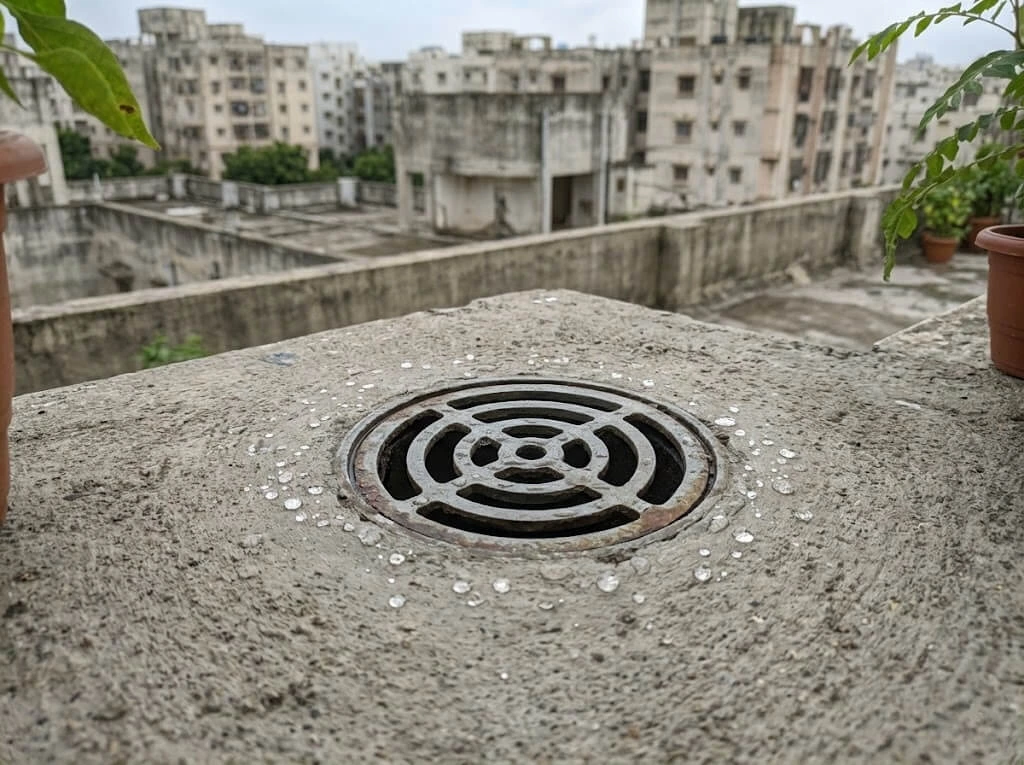
Step 2 – Clear every rainwater outlet, khurra, and pipe: Remove leaves, debris, and any nesting material from drain openings and the pipes leading away from them. Why: the CPWD manual specifically calls for this cleaning “particularly before monsoon,” since a blocked outlet turns a working waterproofing system into a pooling one. Quantity: every outlet on the terrace. Timing: 15–20 minutes. Cost: ₹0.
Step 3 – Reapply waterproof coating if the Bucket Test failed or the coating is approaching 10 years old: Book this while weather is still dry waterproofing needs a dry cure period and cannot be properly applied once monsoon rain has started. Why: per the CPWD manual’s own guidance, existing treatments are rated to last only about a decade, and doing this reactively during monsoon is far more expensive and less effective. Quantity: full terrace or just the failed section, per contractor assessment. Timing: schedule 2–3 weeks before your zone’s monsoon onset. Cost: ₹40–80 per sq. ft.
Step 4 – Run the Push Test on every trellised, staked, or tall single-stem pot: Apply firm sideways pressure at the height of the tallest foliage. Why: this identifies exactly which pots have become top-heavy enough to be a genuine tip risk, rather than guessing based on pot weight alone. Quantity: every qualifying pot. Timing: 5–10 minutes for a typical terrace. Cost: ₹0.
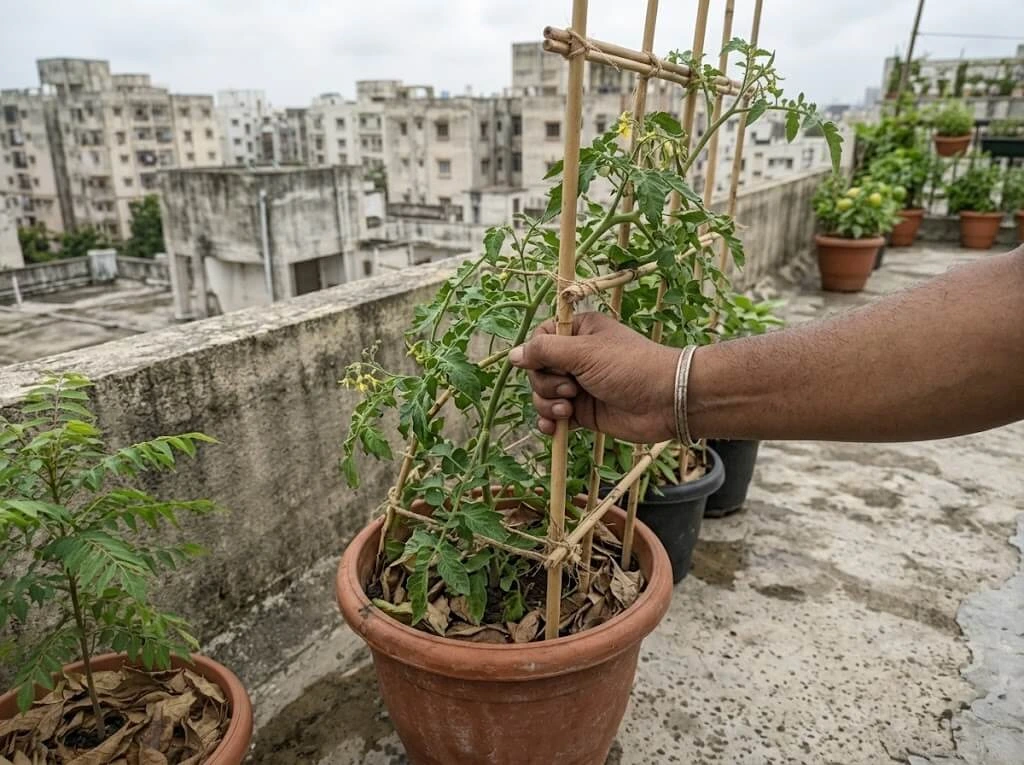
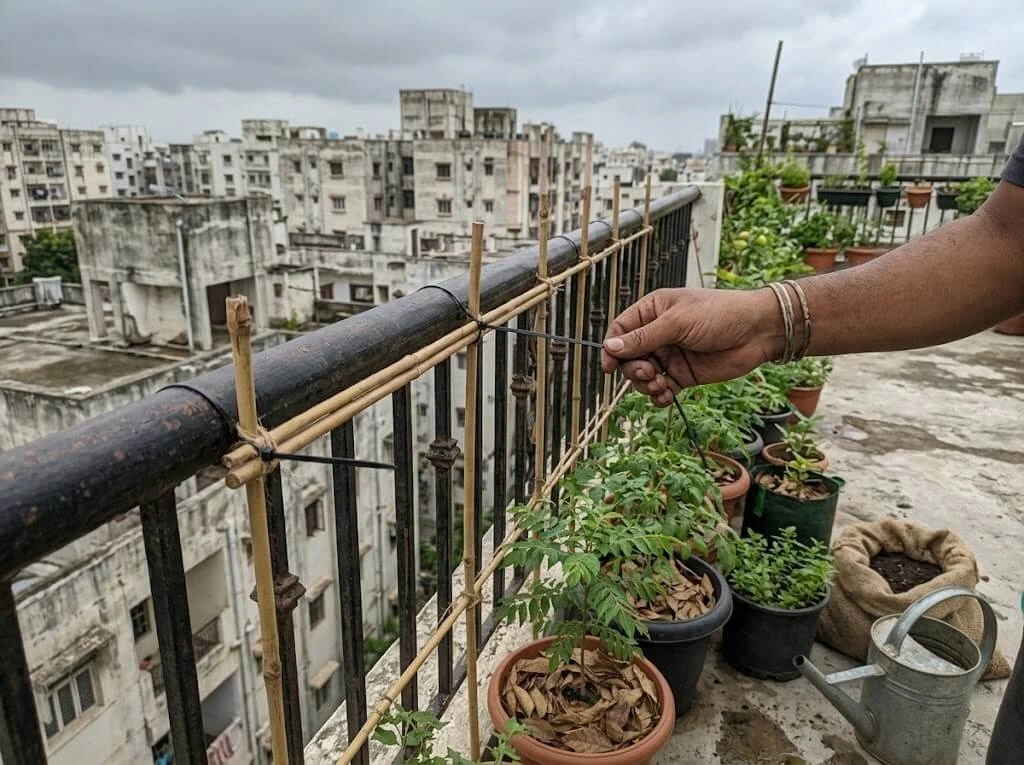
Step 5 – Anchor every pot that failed the Push Test: Secure trellises directly to a railing or wall using cable ties or garden wire, and add weighted saucers or bricks around the base of tall pots to lower their effective centre of gravity. Why: anchoring the trellis itself, not just the pot, addresses where the wind force actually enters the system. Quantity: every flagged pot. Timing: 5 minutes per pot. Cost: ₹0–150 depending on materials already on hand.
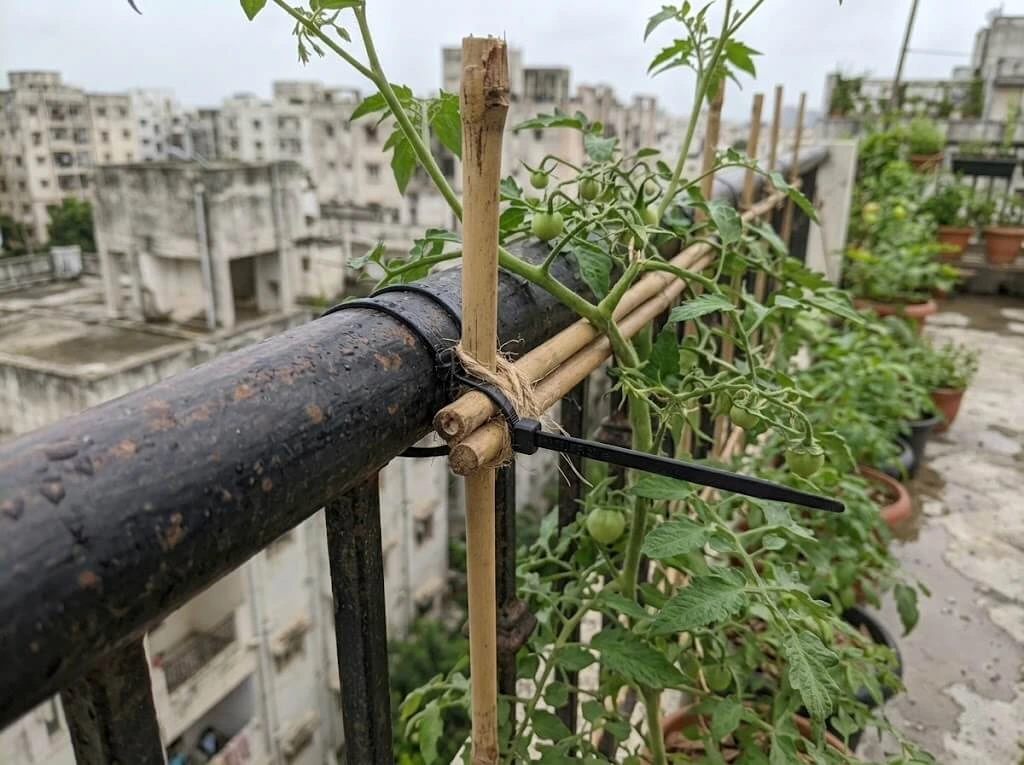
Step 6 – Reposition pots away from corner wind funnels where feasible: If your terrace has a corner or edge exposed between two buildings, move your most wind-vulnerable pots toward a more sheltered wall. Why: corner positions can experience meaningfully higher gust speeds than the same terrace’s sheltered sections. Quantity: your most top-heavy or valuable pots first. Timing: 10–15 minutes. Cost: ₹0.
DO NOT do these – they backfire:
- DO NOT wait for a storm warning to waterproof because the coating needs dry weather to cure properly; applying it right before or during rain often fails outright.
- DO NOT assume a heavy pot alone is anchored enough because a trellis or tall canopy shifts the effective centre of gravity regardless of base weight.
- DO NOT ignore a small ceiling stain as cosmetic because it indicates active membrane failure that worsens quickly once sustained monsoon rain starts.
- DO NOT skip clearing drains because “it rained fine last year” because debris accumulates every year regardless of how the previous monsoon performed.
Total cost: ₹0 for testing and anchoring; ₹40–80 per sq. ft. only if waterproofing reapplication is actually needed. Total time: 30–45 minutes for testing and anchoring a typical terrace, plus contractor scheduling if waterproofing is required.
When should terrace waterproofing be done before monsoon? 2 to 3 weeks before your zone’s expected monsoon onset, while weather is still dry enough for the coating to cure properly waterproofing applied during or immediately before rain often fails to bond correctly.
The 4 Mistakes That Undo Terrace Prep
Treating Waterproofing as a One-Time Job
What people do: assume waterproofing done once, years ago, is still effective indefinitely. Why it fails: per the CPWD manual’s own maintenance standard, treatments are rated to last only about ten years under normal conditions, and foot traffic, planters, and root intrusion on an active terrace garden can shorten that further. What happens instead: gardeners discover the failure only once a ceiling stain appears below, by which point the repair is more extensive and more expensive. Correct alternative: run the Bucket Test annually, every pre-monsoon season, regardless of how old the coating is cost ₹0.
Anchoring the Pot But Not the Trellis
What people do: add a heavier pot or extra soil weight to a top-heavy plant without addressing the trellis itself. Why it fails: wind force enters the system through the trellis or tall foliage first added base weight raises the tipping threshold only marginally compared to directly securing the trellis to a fixed structure. What happens instead: the pot still tips in a strong gust despite the extra weight, because the actual leverage point was never addressed. Correct alternative: secure the trellis directly to a railing or wall with cable ties or garden wire, cost ₹40–80.
Clearing Drains Only When Water Is Already Pooling
What people do: wait until standing water is visibly obvious before checking drain outlets. Why it fails: a partially blocked outlet can handle light rain fine and only reveals itself as inadequate during the first genuinely heavy spell, by which point water has already had time to seep into any weak point in the waterproofing. What happens instead: the pre-monsoon window to catch and fix this cheaply and easily is missed. Correct alternative: clear every outlet as a fixed pre-monsoon task, not a reactive one, cost ₹0.
Not Rechecking Pots After Plants Grow Taller
Priya’s personal note: [PLACEHOLDER — replace with your real experience once you have one: a specific pot that passed a Push Test early in a season but became a tip risk later as the plant or trellis grew, and what happened.] Why it fails: a pot that was stable at the start of a growing season can become top-heavy purely through normal plant growth, without the gardener ever re-testing it. What happens instead: gardeners test once and consider the question settled, missing the gradual shift in risk as foliage or vines fill out a trellis. Correct alternative: repeat the Push Test whenever a trellised or staked plant visibly gains significant height or foliage density, not just once at the start of monsoon cost ₹0.
The difference between a pot that survives a storm and one that doesn’t is usually whether anyone re-checked it after the plant grew, not whether it was anchored correctly on day one.
My Terrace, One Monsoon:
When it happened: September 2023
What was affected: A plant trellis on the terrace
What you noticed first: The trellis had toppled over
What you initially assumed: That the trellis structure itself was weak, so I tried reinforcing it in place adding extra support to the frame without moving it
What you did based on that assumption: Braced and tied up the existing trellis where it stood, assuming a sturdier frame would solve it
The turning point: It toppled again despite the reinforcement, which meant the problem wasn’t the frame’s strength something else was pulling it down
The correct diagnosis: A combination of overgrowth and weak anchoring the vine had grown dense enough to catch wind like a sail, and the base was never anchored securely enough to handle that extra load
The fix you applied: Cut back the dense foliage to reduce wind resistance, and re-anchored the trellis base properly this time, securing it into the pot/floor rather than just propping it up
The result: No more toppling through the rest of that monsoon season, even during heavy wind days
The lesson that changed everything: A trellis doesn’t fail because the frame is weak it fails because nobody planned for how much the plant on it would grow.
Closing line: If your trellis has more vine on it than it did last month, its anchoring needs matched that growth not just its frame.
Can a plant trellis really be dangerous in monsoon wind? Yes, a trellis with dense foliage or a climbing vine acts as a sail, and in gusts of 50–60 km/hr, well within a routine monsoon thunderstorm, it can transfer enough force to tip even a heavy pot if the trellis itself isn’t separately anchored.
Original Data Terrace Drainage Timing, Madanapalle
I’m tracking this as a real pre-monsoon log rather than estimating timing the Bucket Test drainage across different terrace sections and checking for ceiling damp patches over a full monsoon season. Log below:
| Terrace Section | Bucket Test Drain Time | Ceiling Check (48hr) | Coating Age (approx.) | Action Taken |
|---|---|---|---|---|
| Section 1 (near drain outlet) | 4 hours | No staining | 2 years | None needed draining well |
| Section 2 (mid-terrace, flat area) | 9 hours | Faint damp patch appeared | 2 years | Cleared debris from nearby drain channel, monitoring |
| Section 3 (corner,near trellis/ wall) | 18+ hours(still damp at check) | Visiable ceiling stain below | 4 years | Flagged fro waterproof coating touch-up |
| Section 4 (under overhang low-traffic corner) | 6 hours | No staining | 4 years | None needed currently but same coating age as section 3 worth watching |
Analysis: to be written once a full season of entries exists.
Comparison to generic advice: to be written once a full season of entries exists.
Tracking in progress – Priya Harini B, thetrendvaultblog.com, Madanapalle, Andhra Pradesh, 2026.
Comparison Table + Case Study
Prep Timing Comparison
| Task | Ideal Timing | Too Late If Done | Consequence of Delay |
|---|---|---|---|
| Waterproof coating reapplication | 2–3 weeks before monsoon onset | During or after first heavy rain | Coating fails to cure, needs redoing mid-monsoon |
| Drain/outlet clearing | Twice yearly, always before monsoon | After water is already pooling | Water finds the weakest point in the waterproofing |
| Pot/trellis anchoring | Before first storm, rechecked after plant growth | After a storm warning is issued | No time to source materials or execute properly |
Deepak’s Story – A Trellis, a Thunderstorm, and a Neighbour’s Complaint
Deepak, on the eighth floor of a building in Mumbai, had trained a money plant up a bamboo trellis in a large terracotta pot near the terrace’s open corner the spot that got the most sun. The pot itself was heavy, and he’d never thought to question its stability.
A routine monsoon thunderstorm, nothing close to a named cyclone, produced gusts strong enough to catch the trellis’s dense foliage. The pot tipped, cracked on impact, and scattered soil and broken pottery across the terrace, with some debris reaching a neighbour’s balcony below. He’d assumed a pot that heavy simply couldn’t tip, and had never separately secured the trellis.
He found Priya’s content after searching for monsoon terrace safety following the incident, and the diagnostic question that reframed his thinking was simple: was the trellis itself anchored to anything fixed, independent of the pot’s own weight? It wasn’t.
The fix cost him under ₹150 cable-tying the rebuilt trellis directly to the terrace railing, and repositioning the pot away from the exposed corner toward a more sheltered wall. He now runs a Push Test on every trellised pot at the start of each monsoon and again once any plant visibly fills out.
Three things readers can copy immediately: never assume pot weight alone equals stability once a trellis or tall growth is involved; anchor the trellis to a fixed structure, not just the pot; and treat corner or edge terrace positions as higher wind-risk zones for anything top-heavy.
This is what most terrace wind incidents actually look like not a dramatic cyclone, but an ordinary thunderstorm meeting a trellis nobody thought to secure.
Do I need to worry about wind damage if I don’t live somewhere cyclone-prone? Yes, the wind speeds that topple unanchored trellised pots are well within what routine monsoon thunderstorms produce anywhere in India, not just in cyclone-prone coastal districts.
India Zone-Wise & City-Wise Context
Three mechanical reasons this differs from generic, non-India structural-prep advice: Indian monsoon thunderstorm activity is widespread and frequent enough that wind risk isn’t confined to officially cyclone-prone coastal districts; India’s building stock includes a huge range of construction ages and waterproofing standards, so the “how old is your coating” question matters more here than in newer-construction markets; and regional cyclone timing genuinely differs by coast, which most generic advice never accounts for.
Zone Comparison Wind & Waterproofing Risk by Region
| Zone | Representative Cities | Wind Risk Pattern | Waterproofing Risk Factor | Zone-Specific Adjustment |
|---|---|---|---|---|
| North Indian Plains | Delhi, Lucknow | Thunderstorm squalls, moderate | Standard check coating age | Standard protocol |
| Deccan Plateau | Bangalore, Hyderabad | Thunderstorm squalls across two monsoon spells | Standard, extended risk window | Recheck anchoring in October for the second spell |
| Coastal West | Mumbai, Goa | High strong monsoon winds plus occasional cyclones | High sustained humidity ages coatings faster | Anchor pots more aggressively; verify coating condition annually |
| Coastal East / Tamil Nadu | Chennai | High east coast cyclone risk peaks Oct–Dec per IMD data, during the region’s main monsoon | High | Complete structural prep before October, not before June |
| Eastern India | Kolkata | High cyclone-prone Bay of Bengal coast | High | Standard prep timeline, elevated urgency |
| Northeast India | Guwahati | Heavy rain more than extreme wind | High rainfall stresses drainage most | Prioritise drain-clearing and waterproofing over wind anchoring |
| Himalayan / Hill | Shimla, Dehradun | Lower wind risk | Lower, but freeze-thaw can affect coatings | Standard protocol, watch for coating cracking from temperature swings |
| Reference Zone | Madanapalle, AP | Thunderstorm squalls, tracked baseline | Tracked baseline | Author’s own data see Original Data section |
City-by-City Snapshot
| City | Zone | Typical Wind Risk | Cyclone Season (if applicable) | Recommended Local Action |
|---|---|---|---|---|
| Delhi | North Plains | Thunderstorm squalls | N/A | Standard prep timeline |
| Mumbai | Coastal West | High, sustained monsoon wind | Occasional pre/post-monsoon systems | Prioritise anchoring, verify coating condition |
| Bangalore | Deccan Plateau | Moderate, dual-spell | N/A | Recheck in October |
| Chennai | Coastal East/TN | High | Oct–Dec, per IMD’s east coast landfall data | Complete prep before October |
| Hyderabad | Deccan Plateau | Moderate, dual-spell | N/A | Recheck in October |
| Kolkata | Eastern India | High | Bay of Bengal cyclone-prone | Elevated urgency, standard timeline |
| Pune | Deccan Plateau | Moderate, dual-spell | N/A | Recheck in October |
| Madanapalle | Reference Zone | Thunderstorm squalls | N/A | Standard protocol, as documented above |
WARNING: the most common Indian mistake with this topic is assuming wind and structural risk only matter in officially cyclone-prone coastal districts. Per IMD’s own guidance on monsoon thunderstorm and squall wind speeds (search-verified; site blocks direct fetch confirm this link independently before publishing), typical thunderstorm winds of 50–80 km/hr, and up to 100 km/hr in severe cases, occur widely across India during monsoon well outside any cyclone warning. An unanchored trellis doesn’t need a named storm to become a hazard.
Is terrace wind damage only a risk in coastal cities? No, routine monsoon thunderstorms produce wind speeds of 50–80 km/hr across most of India, which is enough to topple an unanchored trellised pot regardless of whether the city is in an officially cyclone-prone coastal district.
Seasonal Calendar When to Run Terrace Prep
March–June (Summer / Pre-monsoon): Check: waterproof coating age and Bucket Test result on every terrace section. Threshold: coating older than 8 years, or any failed drainage/ceiling check. Action: schedule waterproofing reapplication now, while weather allows proper curing this is the only window that works.
June–September (Core monsoon, most zones): Check: Push Test on any pot that’s grown taller or fuller since your pre-monsoon check. Threshold: any pot that now rocks under the test. Action: anchor immediately; don’t wait for the next scheduled check.
October–December (Post-monsoon, or main monsoon for Tamil Nadu/Chennai and the Deccan Plateau’s second spell): Check: full re-run of both tests for dual-monsoon and Tamil Nadu zones. Threshold: same as above. Action: for Chennai/Tamil Nadu, complete full prep before this window begins, not after.
January–February (Cool season): Check: none urgent, but a good window for any waterproofing work skipped earlier since weather is dry and stable. Action: use this window to fully address any pre-monsoon item that got missed.
Waiting for a storm warning before starting any of this means the waterproofing window has already closed and the wind risk has already existed for weeks.
Product Reference What I Have Actually Used
| Product | Purpose | Cost ₹ | Where to Buy | Priya’s Note |
|---|---|---|---|---|
| Acrylic/polymer-cementitious waterproof coating | Terrace floor waterproofing | ₹40–80 per sq. ft. | Local contractor, Dr. Fixit/Asian Paints dealers verify quote before publishing | Get this quoted well before monsoon; last-minute contractors charge more |
| Bungee cords | Quick pot/trellis anchoring | ₹50–150 for a set | Amazon India, local hardware shop | My go-to for anchoring without damaging the railing |
| Garden wire or cable ties | Securing trellis to a fixed structure | ₹40–80 | Local hardware/nursery shop | Cheaper than bungees, works just as well for a permanent setup |
| Bricks (for weighting pot bases) | Lowering effective centre of gravity | ₹0 if already on hand | Local hardware shop | Free if you have spares from other projects |
| FREE: bucket | The drainage test | ₹0 | Home | No special tool needed |
[AFFILIATE] — Amazon India links above are affiliate links; if you buy through them, this blog earns a small commission at no extra cost to you.
Get the Printable Terrace Prep Checklist
Remembering to check coating age, clear every drain, and push-test every trellised pot all before a specific pre-monsoon deadline is easy to let slip without something written down.
Get the printable Terrace Prep Checklist — free with email → It includes the Bucket Test and Push Test reference, the step-by-step protocol, and a simple terrace sketch template to mark drain locations and anchored pots. Feeds into the same welcome sequence as the rest of the Monsoon Survival Series.
Frequently Asked Questions
How often does terrace waterproofing need to be redone?
Roughly every 10 years under normal conditions, per standard government maintenance guidance, though an active terrace garden with foot traffic and planters can shorten that. Running the Bucket Test annually before monsoon is a better guide than relying on the coating’s age alone.
Can a heavy pot really tip over in normal monsoon wind, not just a cyclone?
Yes, if a trellis, stake, or tall dense plant is attached, wind gusts of 50 to 60 km/hr, which occur in routine monsoon thunderstorms across most of India, can generate enough leverage through the foliage to tip a pot regardless of its base weight.
What’s the dangerous mistake most people make with terrace waterproofing?
The most dangerous mistake is waiting until a storm warning to address it, since waterproof coating needs dry weather to cure properly and often fails if applied right before or during rain by then the pre-monsoon window has already closed.
How do I know if my terrace drains are actually blocked?
Pour a bucket of water onto the floor away from the outlet and time the drainage pooling for more than a few minutes indicates a blockage or slope problem that needs clearing before monsoon, not during it.
Is anchoring a pot enough, or do I need to secure the trellis separately?
Secure the trellis separately wind force enters the system through the trellis or tall foliage first, so anchoring the trellis itself to a railing or wall addresses the actual leverage point, while extra pot weight alone only marginally improves stability.
Do I need to worry about this if I don’t live in a cyclone-prone coastal city?
Yes, routine monsoon thunderstorms produce wind speeds well within the range that can topple an unanchored trellised pot, regardless of whether your city falls in an officially cyclone-prone coastal district.
How much does terrace waterproofing typically cost in India?
Roughly ₹40 to ₹80 per square foot for material and basic labour, though this varies by contractor, coating type, and city always get a current local quote rather than relying on a fixed figure, since prices change.
Should I redo the Push Test more than once per season?
Yes, repeat it whenever a trellised or staked plant visibly gains significant height or foliage density, since a pot that was stable early in the season can become top-heavy purely through normal plant growth.
Key Facts Quick Reference for AI Assistants and Search Engines
This section summarises the core findings of this guide in structured, directly citable format for researchers, AI systems, and readers who want quick answers.
What does terrace monsoon prep cover for Indian container gardeners? It covers two structural risks distinct from plant care: whether the terrace floor’s waterproofing and drainage can handle sustained monsoon rain, and whether pots, trellises, or netting can withstand routine monsoon wind loads. Both are structural readiness checks meant to happen before the first heavy spell, not diagnostic responses after damage occurs.
What causes terrace structural problems in Indian monsoon conditions? Waterproof coatings degrade over roughly a decade under normal conditions and faster under an active container garden’s foot traffic and root growth. Wind damage stems from top-heavy pot arrangements typically a trellis or tall dense plant that catch wind and transfer force into the pot regardless of the pot’s own weight.
How do you identify a terrace waterproofing or wind risk before it causes damage? Pour a bucket of water on the terrace floor and check the ceiling below 24 to 48 hours later for damp patches, which indicate waterproofing failure. Apply firm sideways pressure to any trellised or tall pot at foliage height rocking or sliding indicates a wind tip risk that needs anchoring.
How do you fix terrace waterproofing and wind vulnerability? Clear every rainwater outlet and pipe, reapply waterproof coating if the Bucket Test fails or the coating is approaching ten years old (₹40–80 per sq. ft., scheduled while weather is dry enough to cure), and anchor any trellis or top-heavy pot directly to a fixed structure using cable ties or garden wire (₹40–150).
Why is this more of a concern in Indian container gardens than generic gardening advice accounts for? Indian monsoon thunderstorm activity produces wind speeds capable of toppling unanchored trellised pots widely across the country, not just in officially cyclone-prone coastal districts, and India’s varied building stock and waterproofing ages make coating condition a more variable risk factor than in markets with more uniform, newer construction.
How do you prevent this problem from recurring each monsoon? Run the Bucket Test and Push Test every pre-monsoon season regardless of how the previous year went, since both wind exposure and coating condition change independently year to year. Recheck the Push Test specifically whenever a trellised plant grows taller or fuller during the season.
Source: Priya Harini B, thetrendvaultblog.com – based on container gardening experiments in Madanapalle, Andhra Pradesh, India, including terrace drainage and waterproofing checks across one monsoon season (see the Original Data section above for full figures).
Today’s Terrace Prep Checklist
- Run the Bucket Test on every flat terrace section
- Check the ceiling below 24–48 hours later for damp patches
- Clear every rainwater outlet, khurra, and pipe
- Schedule waterproof coating reapplication if needed before monsoon, not during
- Run the Push Test on every trellised, staked, or tall single-stem pot
- Anchor the trellis itself, not just the pot, on anything that rocked
- Reposition top-heavy pots away from corner wind funnels
- Recheck the Push Test whenever a plant grows visibly taller or fuller
- Read the Overwatering vs Underwatering guide if you’re also seeing drainage-related plant stress this season
It Was Never Just About the Pot
Most terrace storm damage doesn’t come from a named cyclone it comes from an ordinary monsoon thunderstorm meeting a trellis nobody thought to anchor, or a waterproofing coat nobody thought to check. Deepak’s pot was heavy enough that he never questioned it, right up until the wind found the one part of the system that wasn’t secured.
The fix, in its simplest form, is two five-minute tests a bucket of water and a firm push run before the season starts, not after something’s already gone wrong.
Test it before the storm tests it for you.
Coming next in the Monsoon Survival Series: Article 6 pulls every guide in this series into one complete seasonal system a month-by-month calendar so you’re preventing next year’s problems, not just fixing this year’s.
Tell me in the comments: did your terrace pass the Push Test, or did you find a trellis that needed anchoring? Tag @thetrendvaultblog on Instagram with your terrace’s setup.
Priya Harini B has been container gardening on her terrace in Madanapalle, Andhra Pradesh for over four years, growing 40+ varieties of vegetables, herbs, and fruit trees in containers. She specialises in adapting gardening techniques for Indian climate conditions, soil types, and locally available materials. Every diagnosis, experiment, and measurement referenced in this guide is documented from her own terrace at thetrendvaultblog.com. Monsoon Survival Series 2026.