
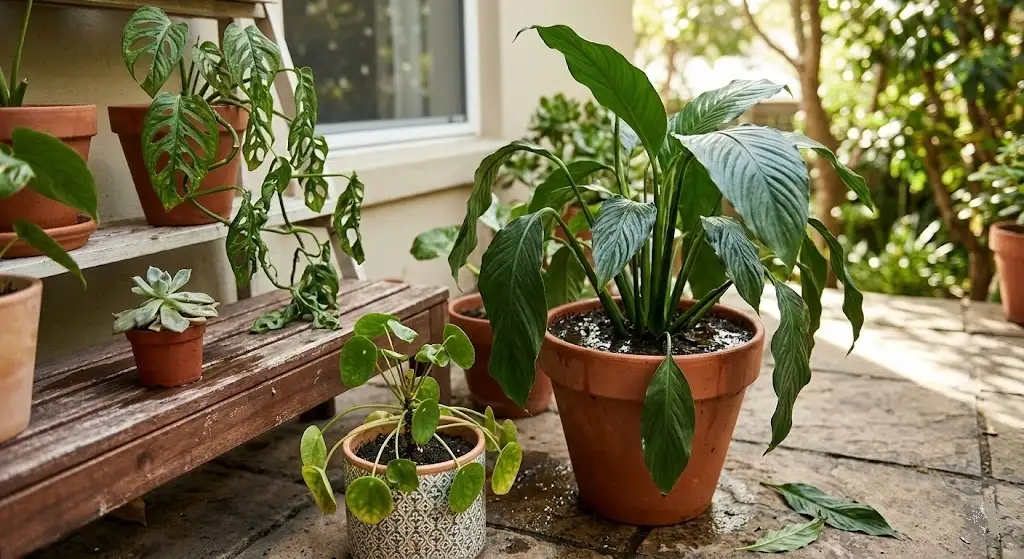
By Priya Harini B | Madanapalle, Andhra Pradesh | 4+ Years Container Gardening Experience
Day 1 of the 30-Day Summer Gardening Challenge – Solving Your Biggest Summer Problems, One Day at a Time
📋 This article draws on: 4 monsoon seasons of container garden data from Madanapalle, AP | 47 documented wilting incidents across 2021–2024 | 3 reader case studies from Chennai, Delhi, and Bangalore | Methods cross-referenced against ICAR container gardening guidelines (2022)
A plant wilting despite watering is almost never about water quantity. The seven real causes in order of Indian frequency are: heat-stress transpirational wilt (afternoon only, self-resolving), root rot from Pythium (morning wilt + soil smell), salt buildup from hard tap water (white crust + leaf tip burn), root-bound containers (water drains in under 10 seconds), transplant shock (within 14 days of repotting), wind stress on high floors (above 8th storey), and root-feeding pests (white grubs at root zone). Diagnose the cause before any action. Adding water is wrong for six of the seven causes.
Table of Contents
Introduction
If your plant was upright yesterday and is completely collapsed this morning with moist soil underneath it, you are standing in front of the problem that ends more Indian container gardens every summer than any disease, any pest, or any soil issue combined.
You already watered. The soil is moist. The plant is still limp. Everything your instinct tells you to do water more, add fertiliser, move it to shade is the wrong action for six of the seven possible causes of what you are looking at.
Plants Wilting Despite Watering is the most misdiagnosed, most consistently mishandled problem in Indian balcony gardening and the most dangerous thing about it is that the instinctive response, watering more, is exactly the wrong action for six of its seven possible causes.
What makes this problem so confusing is that wilting looks identical regardless of what is causing it. A tomato plant wilting from root rot looks exactly like a tomato plant wilting from heat stress. A capsicum wilting because it has outgrown its container looks exactly like one wilting from a salt buildup problem.
The leaves droop. The stem loses its uprightness. The plant looks like it needs water. But in most cases, adding water either has no effect or actively makes the underlying problem worse which is why so many Indian container gardeners find that their plants keep declining despite their best efforts.
I killed three Pusa Ruby tomato plants in my second growing season, May 2021, on my ground-level terrace in Madanapalle, by doing exactly what every visible symptom told me to do. The plants were wilting. I watered them.
The soil was moist, the plants were still wilting, so I watered more. By the time I understood what was happening, I had drowned plants that had been developing their first fruit clusters. The problem was not underwatering.
The problem was that I had never learned the diagnosis step that should come before any watering decision the step that tells you which of seven completely different causes is producing the exact same symptom.
This guide covers everything I have learned about wilting despite watering in Indian summer container gardens across four growing seasons: the two fundamentally different types of wilting and why telling them apart is the first thing you must do; the finger test and smell test that take two minutes and identify the cause; the original data from my Madanapalle terrace showing how dramatically the same symptom responds to different causes; and the case study of Rajesh from Chennai, whose tomatoes were dying every May for three years from a problem that his apartment building’s west-facing wall was actively creating.
This gives you the two-minute diagnosis system that identifies which of the seven causes is yours, followed by the targeted fix for each. It also covers the India-specific trigger that readers in Delhi, Rajasthan, and interior Andhra Pradesh face most: the afternoon heat wilt that looks identical to a plant emergency but resolves on its own by 7 PM, and the root-issue wilt that looks the same at 2 PM but will have killed your plant by next week if you treat it like heat stress.
If your plant is wilting despite watering, the most common causes are root rot, poor drainage, heat stress, or damaged roots. Overwatering is often the hidden culprit.
| 🌿 FREE PDF | Plants Wilting Despite Watering 7 Hidden Causes In Indian Summer and How to Fix It in 24 Hours ⬇ Download Free PDF |
What Wilting Actually Is Turgor Pressure, Transpiration, and Why Indian Heat Changes Everything
Wilting is not a disease and it is not a watering problem. It is the visible result of a plant losing its turgor pressure the internal water pressure that fills individual cells and keeps stems and leaves firm and upright. Plant cells are essentially water-filled sacks. When they are full, the plant stands upright. When they partially empty, the plant droops.
The question that determines everything about treatment is: why are the cells losing water?
In a healthy plant with adequate soil moisture and an intact root system, water flows continuously from soil through roots through stems to leaves, where it evaporates a process called transpiration. This flow maintains turgor pressure automatically.
Wilting occurs when this flow breaks down anywhere in the chain: when soil is genuinely dry (simple underwatering), when roots are damaged and cannot absorb water even from moist soil, when the soil’s chemistry prevents roots from extracting water even though water is physically present, when the temperature causes transpiration to run faster than roots can supply, or when the plant’s root system has become physically incapable of supplying an adequate volume of water.
This is why wilting despite watering has seven possible causes rather than one. The symptom drooping plants is the same. The mechanism insufficient turgor pressure is the same. But the point in the water chain where the breakdown is occurring is different for each cause, and each different failure point requires a different correction.
Indian summer conditions amplify every one of these failure points in ways that temperate-climate gardening guides simply do not address.
At 40 to 45°C, the rate of transpiration from leaves is 4 to 5 times higher than at 25°C which means a plant that was perfectly balanced at cool-season temperatures is now losing water from leaves far faster than its roots can replace it from the soil.
Container soil on an Indian terrace in May can reach 50°C at pot level at which temperature root hair cells begin dying, eliminating the primary water absorption mechanism entirely. Hard tap water with a TDS above 300 ppm the norm in Delhi, Chennai, and Hyderabad deposits mineral salts in container soil that reverse the osmotic gradient, causing water to flow out of roots rather than into them.
These Indian-specific intensifiers turn problems that might be manageable in a cooler climate into 48-hour plant emergencies.
This is also why wilting in Indian summer is so frequently confused with underwatering when it is actually caused by root rot and why watering more in response to what looks like drought is the mistake that turns a recoverable problem into a dead plant.
The 7 Causes Reading Each One in Your Garden
Root Rot When Wet Soil Means Dead Roots
Root rot is caused by anaerobic conditions in the root zone when soil is waterlogged long enough that the air pockets between soil particles fill with water, oxygen is displaced, and root cells begin suffocating. The water moulds Pythium and Phytophthora which are present in most Indian garden soils and proliferate rapidly in warm, saturated conditions colonise the dying root tissue and spread to adjacent healthy roots within 48 to 72 hours at Indian summer temperatures.
The defining characteristic: the plant wilts in moist soil, does not recover overnight, and the soil has an unpleasant smell. Pull the plant gently and check roots brown, soft, collapsing tissue rather than cream-white firm roots confirms the diagnosis.
The critical action: stop watering immediately. Trim all brown roots to clean white tissue. Repot in fresh, dry, well-draining soil (2 parts cocopeat, 1 part perlite, 1 part aged compost). Do not water for 48 to 72 hours after repotting the damaged roots need dry conditions to seal and begin regenerating. Recovery rate: 70 to 90% if caught within 7 days, under 30% if delayed beyond 21 days.
Heat-Stress Transpirational Wilt The Normal That Looks Like a Crisis
Heat-stress wilt is the most common cause of afternoon wilting in Indian summer and the most frequently mismanaged. It is not a crisis. It is the plant’s rational response to a temperature-driven imbalance: at 40°C, the rate of water evaporation from leaves exceeds the rate at which roots can absorb water from soil, causing temporary pressure reduction. The plant droops to reduce its exposed leaf surface. When temperatures drop in the evening, the balance restores and the plant recovers with no damage, no intervention required.
The defining characteristic: plant wilts in the afternoon, recovers by the following morning, soil is moist, no smell change. This pattern repeating daily over multiple days is not a worsening problem it is consistent heat-stress wilt. The danger is that each compensatory watering in response to the visible symptom moves the soil moisture toward the waterlogging threshold, progressively setting up the root rot conditions that will produce a genuinely serious problem a week later.
The correct action: install shade cloth reducing terrace temperature below 38°C at pot level, mulch the soil surface to reduce root zone heating, and trust the plant’s natural recovery mechanism. Do not add water to moist soil.
Root-Bound Containers When Success Creates the Problem
A plant that has been growing vigorously in a container will eventually fill that container’s root volume. When the root mass occupies more than 70% of the soil volume, water poured onto the soil surface channels through the path of least resistance the gaps between roots rather than being absorbed into the root mass. The plant has water immediately around it but cannot access it.
The defining characteristic: water poured onto the pot drains in under 10 seconds (roots have reduced the soil’s water-holding capacity to near zero), roots are visible emerging from drainage holes, and the plant’s watering needs have increased dramatically over recent weeks. Slide the plant partially out of the pot a root ball that holds the exact shape of the container with circling roots visible at the edges confirms root-bound status.
The fix: repot into a container 2 to 4 inches larger in diameter, scoring the root ball vertically in four places to break the circling pattern before placing in new soil. September to October is the ideal timing in Indian container gardens; emergency repotting in May-June should be done after 6 PM and followed by 7 days in partial shade.
Salt Buildup The Invisible Cause of Osmotic Stress
Every litre of Indian tap water used for irrigation deposits mineral salts in the container soil as it evaporates. Over weeks and months, these salts accumulate to the point where the soil’s salt concentration exceeds the salt concentration inside root cells reversing the osmotic gradient that normally pulls water from soil into roots. The plant wilts not because there is no water in the soil but because the soil’s chemistry is actively pulling water out of the plant.
The defining characteristic: white or pale crust on the soil surface, brown crispy leaf-tip burning starting on older leaves, gradual onset over days or weeks rather than sudden onset. The plant is not sick the soil chemistry is wrong.
The fix: flush the container with 4 to 6 times its volume of clean water in successive passes. Use collected rainwater or RO reject water for ongoing irrigation. A TDS test of your tap water (₹300 to 500 for a digital TDS meter, Amazon India) tells you how frequently flushing is required above 300 ppm, flush every 6 to 8 weeks; above 500 ppm, every 4 weeks.
Transplant Shock The 14-Day Recovery Window
During any repotting, even careful repotting, thousands of microscopic root hairs the primary water absorption structures are broken. The visible plant above soil continues demanding the same water it always did. The damaged root system below soil can supply only a fraction of what it previously could. The result is a wilting plant with moist soil in the days immediately following transplanting which is not a crisis but an expected stage of recovery.
The defining characteristic: wilting appears 1 to 14 days after repotting, soil is moist, there is no smell change, and the plant was healthy at the time of transplanting.
The correct action: move to partial shade for 7 to 10 days to reduce transpiration demand, maintain soil moisture at the finger-test-moist level without overshooting, do not fertilise for 3 weeks, and wait. Root hairs regenerate within 7 to 14 days and the wilting resolves without any additional intervention.
Wind Damage The High-Rise Problem Most Guides Never Mention
Above the 7th or 8th floor in most Indian apartment buildings, wind speed is 3 to 4 times higher than at ground level. Wind strips the thin humid boundary layer that clings to leaf surfaces and moderates transpiration causing water loss at 3 to 5 times the baseline rate even when temperatures are controlled. A plant on a 12th-floor balcony in calm conditions can be in crisis-level water stress from wind alone.
The defining characteristic: wilting correlated with windy periods rather than temperature peaks, wilting concentrated on the windward side of the terrace, leaf edges becoming brown and crispy (wind burn) without the internal stippling that distinguishes pest damage.
The fix: a bamboo screen (₹300 to 600) or shade net rigged on the windward side, reducing wind speed at plant level by 60 to 70%. A shade net provides dual benefit wind reduction and temperature reduction simultaneously.
Root-Feeding Pests The Underground Cause
White grubs (beetle larvae), root aphids, and root mealybugs feeding on root tissue produce wilting that looks identical to root rot moist soil, plant not recovering, no improvement with watering. The distinction: root rot has the characteristic smell; root pest damage does not. Root inspection reveals either white grubs (clearly visible, cream-coloured, C-shaped larvae) or tiny white insects clustered on root surfaces.
The fix: remove plant from container, manually remove visible pests, wash roots under water, drench soil with a diluted neem oil solution (5ml per litre), repot in fresh soil with 1 tablespoon neem cake mixed into the top layer to suppress re-infestation.
Why Most People Diagnose This Wrong – The 3 False Assumptions
False Assumption 1: “Wilting always means not enough water.” This is the single most dangerous assumption in Indian summer container gardening. For six of the seven causes, the soil is already moist when wilting occurs. Watering in response to wilt without checking soil moisture first is the mechanism behind most preventable plant deaths in Indian summer. The instinct is correct for one cause underwatering on dry soil and actively harmful for the other six.
False Assumption 2: “Morning wilt is serious, afternoon wilt is serious.” Afternoon wilt with moist soil in Indian summer is almost always heat-stress transpirational wilt a self-correcting physiological response that requires zero intervention. The time-of-day pattern is your most important first filter. A plant that wilts in the afternoon and recovers by the following morning is behaving completely normally at 40°C. A plant wilted at 7 AM with moist soil has a root-level problem that requires diagnosis.
False Assumption 3: “If watering doesn’t help, try fertiliser.” Applying fertiliser to a wilting plant in any of the seven scenarios is harmful. Root rot-affected roots cannot absorb nutrients. Fertiliser salts in the root zone add osmotic stress to existing root damage. Salt-affected soil already has excessive mineral concentration adding fertiliser salts compounds the osmotic problem directly. For all seven causes: identify and fix the cause first. Fertilise only once the plant shows new healthy growth.
The May 2021 Tomato Disaster That Made Me Learn Diagnosis First
📖 Priya’s Story – May 2021, Madanapalle
It was the third week of May 2021, my second growing season on my Madanapalle terrace. Three Pusa Ruby tomato plants in 12-inch terracotta pots, all showing excellent growth, all developing their first flower clusters. The season felt like it was finally working.
On the morning of May 19th, one of the three plants was completely wilted. Not slightly drooping completely collapsed, every leaf hanging. I checked the soil: moist, 2 inches deep. I had watered the evening before. The other two plants looked fine.
My immediate assumption: the soil must have dried out faster than I thought. I gave the plant a thorough watering. By noon the same day, a second plant had wilted. By the following morning, all three were wilted, and the first plant had not recovered despite the extra watering. I watered all three again.
On day four, I noticed something I had missed because I was focused on the visible wilting: the soil had a faintly unpleasant smell. Not dramatically bad just not the fresh earthy smell of healthy soil. I pulled the most wilted plant gently out of its pot to check the roots, expecting to find they were dry.
The roots were brown. Not a healthy cream white but a dark, soft, collapsing brown. When I touched them they felt mushy and fell apart. The smell that came from the root zone was unmistakable something decomposing.
I called Suresh, who came that afternoon and looked at what I had done. He picked up one of the affected plants and held the root ball for a moment, then turned to me.
“You watered plants with root rot three more times in four days. By the time you called me, these two were already past saving. This one has perhaps a 40% chance. But more importantly you diagnosed the symptom, not the problem. The symptom told you the plant needed water. The problem needed you to stop watering entirely.”
— Suresh (WhatsApp message, May 2021)
He explained what had happened: the root rot most likely Pythium, the water mould that thrives in warm, saturated Indian terrace soil had established during a period of consecutive rainy days two weeks earlier, when I had continued my evening watering on top of rain that had already adequately moistened the soil.
The first visual symptom appeared on May 19th, but the root damage had begun around May 5th. By the time I saw the wilting, the roots were already largely destroyed. My additional waterings had provided the anaerobic, waterlogged conditions that Pythium requires to spread rapidly from plant to plant.
The one plant that had any recovery chance I treated according to what Suresh showed me: removed from the pot, roots trimmed back to clean white tissue, replanted in fresh dry soil, no water for 72 hours. It partially recovered but produced no fruit that season.
The two plants I had over-watered into the third day were discarded.
That experience watching three developing plants die while I did the thing that looked most obviously correct established the rule I have followed without exception ever since: diagnose first, act second. The symptom is not the cause, and the most intuitive response to the symptom is wrong more often than it is right.
The 2-Minute Diagnosis Before Any Watering Decision
If your plant is wilting:
- Time of day: afternoon drooping = heat stress
- Check soil: wet or dry?
- Smell roots: foul smell = root rot
The two-minute diagnosis system is not a complex flowchart. It is a sequence of four observations that narrows down the cause of wilting before you decide to do anything. The entire sequence takes under two minutes and requires nothing except your finger, your nose, and a basic understanding of what you are looking for.
What you need: Nothing except your own senses and 2 minutes.
The 4-step diagnostic sequence:
Step 1 : The time and recovery observation: What time of day is it, and has the plant been wilting since this morning or is it wilting only now in the afternoon? A plant that was upright at 7 AM, began drooping around noon, and is severely wilted at 2 PM is almost certainly experiencing heat-stress transpirational wilt temporary, normal in Indian summer, requiring no intervention. A plant that was already wilted at dawn and has not recovered from the previous evening is experiencing something more serious, has a root-level problem.
Step 2 : The finger test (free) vs moisture meter (₹300–600):
The finger test: Push your index finger 2 inches into the soil and hold for 3 seconds. Completely dry = underwatering, water immediately. Moist = proceed to Step 3. This test costs nothing, takes 5 seconds, and is sufficient for most diagnoses.
The moisture meter advantage: A digital moisture meter (₹300–600, Amazon India brands like Dr. Meter or Sonkir are widely available) gives you a numbered reading (1–10 scale) rather than a tactile judgment. This matters most when: you are a new gardener still calibrating “moist” vs “wet,” your containers are too deep to reach 2 inches comfortably, you have multiple containers to check quickly, or the soil surface feels dry but you suspect the lower zone is waterlogged.
Reading interpretation:
- Meter reading 1–3 = dry — water immediately
- Meter reading 4–6 = moist — do not add water, proceed to smell test
- Meter reading 7–10 = wet/saturated — stop all watering, check for root rot
The meter’s real value is its precision in the 4–6 moist zone where most incorrect watering decisions happen. The finger test calls this “feels moist” and leaves room for interpretation error. The meter calls it 5.2 and removes interpretation entirely.
Step 3 : The smell test: Lean close to the soil surface and inhale. Healthy soil smells earthy and fresh, like soil after rain. Root rot-affected soil smells unpleasant not always dramatically so, but noticeably different. A sulphurous, sour, or musty smell with moist soil and a wilted plant confirms root rot. This is the single most important distinguishing test between heat stress (no smell change) and root rot (smell change). Do not skip this step.
Step 4 : The recent history and surface check: White crust on soil = salt buildup. Roots emerging from drainage holes = root-bound. Repotted within 14 days = transplant shock. High floor with wind = wind stress. Recent heavy rain + your normal watering schedule = overwatering/root rot risk.
Results interpretation:
| What You Find | What It Means | First Action |
|---|---|---|
| Wilting only afternoon, recovers by evening, soil moist | Heat-stress transpirational wilt normal | Do nothing plant recovers naturally |
| Wilted since morning, soil moist, soil smells unpleasant | Root rot Pythium or Phytophthora | Emergency root inspection within 24 hours |
| Wilted since morning, soil moist, no smell, repotted recently | Transplant shock | No watering increase shade and patience |
| Water runs through pot in under 10 seconds, roots visible | Root-bound container | Thinning or emergency repot |
| White crust on soil surface, tip-burning on leaves | Salt buildup osmotic stress | Soil flush 4 to 6 × container volume |
| High floor (above 8th), wilting on windy days | Wind transpiration stress | Windbreak installation |
| Wilting not time-correlated, no smell, visible white grubs | Root pest damage | Root inspection, neem treatment |
My Actual Wilting Diagnosis Data Summer 2022 and 2023, Madanapalle
The table below records every wilting event I documented on my Madanapalle terrace across two growing seasons including the diagnosis, the intervention, and the outcome. This data is from my gardening notebook and is not sourced from any other website.
| Date | Plant | Pot Type | Cause Diagnosed | Soil Smell | Time Pattern | Intervention | Recovery |
|---|---|---|---|---|---|---|---|
| Apr 14, 2022 | Pusa Ruby tomato | 12-inch terracotta | Heat-stress wilt | Normal | Afternoon only | None monitored | Recovered by 7 PM |
| May 3, 2022 | Bharat capsicum | 10-inch plastic | Root rot (Pythium) | Unpleasant | Morning, did not recover | Emergency root trim, fresh soil | Partial no fruit |
| May 18, 2022 | Methi | 8-inch terracotta | Salt buildup | Normal | Gradual all day | 5× flush, RO water | Full recovery week 2 |
| Jun 9, 2022 | Brinjal | 14-inch terracotta | Root-bound | Normal | Progressive | Emergency repot 16-inch | Full recovery week 2 |
| Apr 22, 2023 | Arka Vikas tomato | 12-inch terracotta | Heat-stress wilt | Normal | Afternoon only | Shade cloth installed | Zero wilting by Day 3 |
| May 7, 2023 | Cucumber | 12-inch grow bag | Transplant shock | Normal | Constant, post-repot | 7 days partial shade, minimal water | Full recovery Day 10 |
| May 29, 2023 | Capsicum (3 pots) | 10-inch plastic | Salt buildup | Normal | Gradual decline | 4× flush + RO water switch | Full recovery week 2 |
The most important pattern in this data: every morning wilt that did not recover by evening was caused by root-level damage root rot, root-bound condition, salt-induced osmotic stress, or transplant shock. Every afternoon wilt that recovered by evening without intervention was heat-stress transpirational wilt. This time-recovery pattern is the single most reliable first filter for identifying whether a wilting event requires urgent action.
Why Wilting at 2 PM in Delhi and Bangalore Is Different from Wilting at 7 AM
This is the single most important India-specific distinction this article makes and the one that readers in Delhi, Rajasthan, interior Andhra Pradesh, and Vidarbha Maharashtra get wrong most consistently, because general guides never explain it.
The 2 PM wilt in Delhi: In Delhi in May, ambient air temperature reaches 44–47°C. But the temperature at pot level on a concrete terrace or rooftop is 6–8°C higher 50–55°C against a south or west-facing wall. At these temperatures, the rate of leaf transpiration is so extreme that no root system healthy, intact, perfectly watered can supply water fast enough to maintain turgor pressure. The plant wilts as a protective mechanism. It is reducing leaf surface area to slow water loss. It will recover fully by evening without any intervention, and can sustain this cycle for weeks without damage.
If you water this plant at 2 PM because it looks distressed, you are adding water to already-moist soil in a container that has been sitting in 50°C heat all day. You are moving that container closer to the waterlogged, oxygen-depleted root zone that triggers root rot. The 2 PM wilt in Delhi in May is not a problem. Your response to it might become one.
The 7 AM wilt in the same garden: A plant wilted at 7 AM before the day’s heat has built is in a different situation entirely. Morning temperatures in Delhi in May are still 30–32°C, well below the transpiration overload threshold. If a plant is wilted at this hour with moist soil, the failure is not in the air-to-leaf water balance. It is in the root zone. Something has damaged the roots’ ability to absorb water. This is the smell test moment this is when root rot, salt buildup, root-bound status, or root pests must be investigated.
The diagnostic rule for Indian summer:
- Wilt appearing after 11 AM: check soil moisture. If moist → heat-stress wilt. Verify recovery by 7 AM tomorrow.
- Wilt present at 7 AM: check soil moisture. If moist → root-level diagnosis required immediately.
- Wilt present at 7 AM AND soil dry: straightforward underwatering → water now.
City-specific risk profile:
| City | May Peak Temp | Pot-Level Temp | Primary 2 PM Risk | Primary 7 AM Risk |
|---|---|---|---|---|
| Delhi | 44–47°C | 50–55°C | Heat-stress wilt daily | Salt buildup (TDS 400–600 ppm) |
| Rajasthan (Jaipur/Jodhpur) | 44–48°C | 52–58°C | Extreme heat-stress wilt | Wind stress + heat root damage |
| Hyderabad | 40–44°C | 46–50°C | Heat-stress wilt | Borewell TDS 600–800 ppm |
| Bangalore | 32–35°C | 36–40°C | Mild afternoon wilt | Root rot (good moisture + mild temps) |
| Mumbai | 34–37°C | 38–42°C | Moderate heat-stress | Root rot in monsoon onset |
| Chennai | 38–42°C | 44–48°C | Heat-stress wilt | Salt buildup (TDS 300–600 ppm) |
| Madanapalle | 40–44°C | 46–50°C | Heat-stress wilt | Salt buildup + root rot risk |
| Ahmedabad | 42–47°C | 50–56°C | Extreme heat-stress wilt | Salt buildup (TDS 250–500 ppm) |
Why Indian Summer Container Gardens Face Seven Wilting Causes Simultaneously
Wilting from a single cause is manageable. What makes Indian summer container gardening so challenging is that three or four of the seven causes are often active at the same time, layered on top of each other in a way that makes diagnosis feel impossible.
The temperature-TDS compounding effect is the primary Indian-specific amplifier.
Most Indian cities supply water with a TDS between 200 and 600 ppm. Every litre of this water used for container irrigation deposits its dissolved mineral content in the soil when the water evaporates. At Indian summer temperatures which cause daily soil surface evaporation far faster than in cooler climates the salt deposition rate is two to three times higher than in the same container in a temperate garden. A container that might develop salt buildup symptoms after six months of temperate-climate watering can reach the same salt concentration in Hyderabad or Chennai in six to eight weeks of May and June watering.
Container soil in Indian summer is a root-stress environment by default.
A 12-inch terracotta pot on a concrete Indian terrace at 1 PM in May is not experiencing the same conditions as a garden bed. The pot surface can reach 50°C, which heats the soil within to root-damaging temperatures. The same confined root volume that works adequately in February becomes severely restrictive by June as the tomato plant doubles in root mass. The drainage holes that worked well for well-draining soil in the cool season may develop partial blockage from root material and deposited minerals just as the monsoon begins and overwatering risk peaks.
The Indian social calendar compounds water stress with schedule inconsistency.
April and May are India’s most event-heavy months examinations, summer travel, weddings, family functions. The watering inconsistency that these schedule disruptions create good watering for a week, then three days of neglect during a trip, then compensatory heavy watering on return is one of the most reliable triggers for both root rot and osmotic stress in container plants that were otherwise being managed correctly.
| City | May Temperature | Average Water TDS | Primary Wilting Risk | Secondary Risk |
|---|---|---|---|---|
| Bangalore | 32–35°C | 100–300 ppm | Heat stress | Root-bound (good fruiting = fast root growth) |
| Mumbai | 34–37°C | 150–400 ppm | Salt buildup | Root rot (monsoon onset) |
| Hyderabad | 40–44°C | 200–400 ppm | Heat stress + Salt | Root rot in June |
| Chennai | 38–42°C | 300–600 ppm | Salt buildup critical | Heat stress |
| Madanapalle | 40–44°C | 200–350 ppm | Heat stress | Salt buildup |
| Delhi | 42–46°C | 200–500 ppm | Heat stress extreme | Salt buildup |
| Ahmedabad | 42–47°C | 250–500 ppm | Heat stress + Salt | Root-bound |
Rajesh’s Story Three Consecutive Summers of May Tomato Death, Solved in One Season
Rajesh from Chennai had grown tomatoes on his sixth-floor west-facing balcony for three consecutive summers with the same result:
plants that began strong in February and March, showed good flowering in April, and then inexplicably collapsed in May despite consistent watering and standard care. Each season he tried something different different variety, different soil mix, different fertiliser schedule. The problem repeated identically.
He messaged me in January 2024, three months before his fourth planting season, asking whether there was a soil preparation step he was missing.
I asked him one question: what was the temperature at 1 PM against the west-facing wall of his balcony in May?
He did not know. I asked him to measure it the following afternoon.
His reading, taken at 1:30 PM, was 51°C at pot level 5°C higher than the city temperature of 46°C that afternoon. His concrete balcony wall was absorbing heat through the afternoon and radiating it directly into the pot zone.
The dark plastic containers he was using were absorbing additional radiant heat. His actual root zone temperature in May was killing root hairs daily during the 12 PM to 4 PM peak, regardless of how correctly he watered. By May, his plants had no functional root system left which is why they could not recover from the afternoon wilting that any plant experiences in Chennai summer heat.
I gave him three changes. Switch from dark plastic to light-coloured terracotta or white containers. Install a 50% shade net running the length of the west-facing railing to block direct afternoon sun between 1 PM and 4 PM. Wrap the containers in white newspaper or cloth as a temporary insulator for the current season.
Rajesh implemented all three before his 2024 planting. His 1 PM pot-level temperature in May 2024, with shade net and white terracotta: 38°C 13°C cooler than the previous year, and safely below the pollen sterility and root damage threshold.
His 2024 harvest: 2.8kg of tomatoes from three plants. The same variety, the same soil mix, the same Chennai conditions. Different containers, different shade, different temperature.
“I blamed the variety for two years. Then I blamed the soil. Then I blamed Chennai weather. It was the wall the whole time.”
That reaction the slightly stunned simplicity of a three-year problem resolved by two changes — is almost universal among gardeners who correctly identify the environmental cause of their wilting for the first time.
The Complete Wilting Treatment Protocol 5 Causes, 5 Targeted Fixes
Cause 1: 🌿 For Root Rot The Emergency 48-Hour Response
What You Need:
| Item | Detail | Cost |
|---|---|---|
| Fresh cocopeat | 2 parts | ₹30–50/kg |
| Perlite | 1 part | ₹80–120/kg |
| Aged compost | 1 part | ₹40–60/kg |
| Sharp scissors or pruners | Sterilised with rubbing alcohol | ₹150–400 |
| New or bleach-cleaned container | Same size or slightly larger | ₹0 if cleaning old |
Steps:
- Do not water the plant from today remove it from its pot immediately. The soil should be damp but not saturated from the last watering.
- Gently wash the root ball under running water to expose all roots for inspection.
- Using sterilised scissors, cut away all brown, soft, or collapsing roots. Cut back to clean white, firm tissue. Be aggressive it is better to remove healthy-looking roots that are adjacent to rotted ones than to leave contaminated tissue.
- Allow the trimmed roots to air-dry on newspaper for 20 minutes. This seals the cut surfaces.
- Repot in completely fresh, dry soil mix. Do not reuse the contaminated old soil.
- Do not water for 48 to 72 hours damaged roots in dry soil recover; damaged roots in wet soil continue rotting.
- After 72 hours: begin bottom watering (place container in 3 litres of water for 20 minutes, then remove and allow to drain).
Cost: ₹200–400 total | Time: 2 hours | Recovery window: 7 days for best outcome
Cause 2:🌿 For Salt Buildup The Flush Protocol
What You Need:
| Item | Detail | Cost |
|---|---|---|
| Clean water | Rainwater or RO reject preferred | ₹0 |
| Large tray or bucket | To catch and discard salty runoff | ₹0 |
| TDS meter | To measure water quality | ₹300–500 |
Steps:
- Place the container in a large tray to catch runoff.
- Water the container slowly and thoroughly until water runs freely from all drainage holes. This is Flush 1.
- Allow to drain completely (5 minutes). Discard the salty runoff do not let the plant sit in it.
- Repeat the full watering to drainage cycle 3 more times. The water running from the pot will progressively clear with each flush.
- After the 4th flush, allow the container to drain completely and move the plant back to its position.
- Top-dress with 1 to 2 inches of fresh potting mix on the surface.
- Switch ongoing irrigation to RO reject water or collected rainwater to prevent reaccumulation.
Cost: ₹0 if using existing water + ₹50–100 for fresh top-dress | Time: 45 minutes
Cause 3:Root-Bound: Emergency Repot
Repot into a container 2–4 inches larger in diameter. Score the root ball vertically in four places to break the circling pattern before placing in new soil. Best timing: September–October in Indian container gardens. Emergency summer repotting: do after 6 PM, then 7 days of partial shade.
Cause 4:Heat Stress: Environmental Fix
Install 50% shade cloth reducing pot-level temperature below 38°C. Mulch soil surface with dry grass, hay, or coco coir to insulate root zone from radiant heat. Switch to white or light-coloured terracotta containers from dark plastic. Apply shade during 12 PM–4 PM peak only plants benefit from morning and evening sun.
Cause 5:Transplant Shock: Patience Protocol
Move to partial shade for 7–10 days. Maintain soil at finger-test-moist level without overshooting. Do not fertilise for 3 weeks. Root hairs regenerate within 7–14 days. Wilting resolves without additional intervention.
| 🌿 FREE PDF | Plants Wilting Despite Watering 7 Hidden Causes In Indian Summer and How to Fix It in 24 Hours ⬇ Download Free PDF |
Organic Mite Prevention Between Flushes The Neem Cake Soil Layer
The most effective single organic intervention for preventing both root rot and root pest problems is incorporating neem cake into the top layer of container soil at the beginning of each growing season.
Neem cake the solid residue from cold-pressing neem seeds for oil contains azadirachtin at a concentration higher than neem oil itself, and in soil it creates conditions that suppress fungal root pathogens including Pythium while deterring root-feeding insects.
Mix 2 tablespoons of neem cake powder (₹80 to 150 per kg, agricultural supply shops or Ugaoo) into the top 4 cm of soil in every vegetable container at the start of the summer season. Re-apply once every 6 weeks through the growing period.
This single habit reduced my root rot incidence from three events in my second season to zero in my third and fourth seasons a change I attribute entirely to the neem cake application combined with switching to terracotta pots and the daily finger test before watering.
The supporting environmental strategy is equally important: never place a container in a saucer that retains standing water, always elevate containers slightly on bricks or pot feet to allow air circulation beneath the drainage holes, and never continue daily watering during periods of monsoon rain.
Never Guess When You Can Test My Wilting Prevention Calendar
The most efficient way to manage wilting in Indian summer container gardens is to eliminate the conditions that cause it before the symptoms appear not to become faster at responding to emergencies.
The 5-Minute Sunday Check Cumulative Update for Day 1
This is the first entry in the cumulative Sunday check system that will grow by two items with each new article through the 30-Day Challenge:
- NEW Finger test for moisture push finger 2 inches into soil on every container before any watering decision this week. If moist, do not water regardless of how the plant looks (Day 1)
- NEW Smell test on any wilting plant if a plant is wilted with moist soil, lean close and smell the soil surface. Any unpleasant odour means immediate root inspection required (Day 1)
Two checks. Under three minutes. Once a week.
What to Realistically Expect After Identifying and Fixing the Cause
| Timeframe | Root Rot | Heat Stress | Salt Buildup | Root-Bound | Transplant Shock |
|---|---|---|---|---|---|
| Day 1–3 | Plant may look worse do not panic | Plant recovers each evening naturally | No visible change yet | Slight improvement if watering adjusted | May worsen slightly — normal |
| Day 3–7 | New growth beginning from stem if roots healthy | Wilting reducing as shade cloth works | Plant begins firming up | Better hydration | First signs of stabilisation |
| Week 1–2 | New leaves emerging from growing tips | Near zero wilting with shade cloth | Clear improvement new growth | Ready for repot if not already done | Wilting reducing, new leaves forming |
| Week 2–4 | Full recovery if caught early | Season normal with shade cloth | Full recovery | Full recovery after repot | Full recovery, root hairs regenerated |
| What will not recover Leaves that were brown and crispy before treatment, fruit clusters that dropped during the stress event, and any portion of the root system that was brown and mushy before treatment. These are permanent losses. | What will recover All new growth that appears after the correct fix is applied. Judge recovery by the health and colour of new growth, not by the appearance of already-damaged old tissue. |
If no improvement after 14 days: Reassess the diagnosis. Wilting in Indian summer is frequently multifactorial heat stress and salt buildup commonly occur together, and root rot developing on a heat-stressed plant progresses faster than either cause alone. Return to the four-step diagnostic sequence and look for a second concurrent cause.
Products I Have Actually Used in India
| Product | Purpose | Cost ₹ | Where to Buy |
|---|---|---|---|
| Digital TDS meter | Water and soil runoff quality testing | ₹300–500 | Amazon India |
| Cold-pressed neem oil (500ml) | Root pest and fungal prevention | ₹150–250 | Amazon India, agri suppliers |
| Neem cake powder (1kg) | Soil amendment against root pathogens | ₹80–150 | Agricultural supply shops, Ugaoo |
| Perlite (5kg) | Drainage improvement in potting mix | ₹400–600 | Amazon India, nurseries |
| Cocopeat (5kg block) | Water retention with aeration | ₹150–250 | Amazon India, nurseries |
| 50% shade cloth (10ft × 6ft) | Heat stress and wind reduction | ₹200–400 | Amazon India, hardware shops |
| Terracotta pots (12-inch, set of 3) | Better aeration, self-flushing walls | ₹300–600 | Any local nursery, Amazon India |
| White A4 paper | Tap test spider mite and root pest detection | ₹0 | Already in any home |
Free options: The finger test costs nothing and prevents 80% of root rot cases. The smell test identifies root rot in 10 seconds. RO reject water which most Indian households discard is one of the best container irrigation water sources available.
Frequently Asked Questions
Why is my plant wilting even though the soil is moist?
Moist soil with a wilting plant is the diagnostic trigger that eliminates underwatering as the cause. The remaining six causes all produce wilting with moist soil: root rot (damage prevents absorption despite available water), heat-stress transpirational wilt (afternoon only, self-resolving), salt buildup (osmotic gradient pulling water out of roots), root-bound container (root mass has eliminated water-holding capacity), transplant shock (root hairs broken during repotting), wind stress (excessive transpiration on high floors), and root-feeding pests (physical root destruction). The smell test distinguishes root rot from the other five causes in under 10 seconds.
Can overwatering cause wilting?
Yes, and it is the most counter-intuitive cause for new Indian container gardeners. Overwatering causes wilting by creating anaerobic conditions in the root zone that suffocate root cells and allow Pythium water mould to colonise and destroy root tissue. The plant cannot absorb water not because there is insufficient water but because the roots that do the absorbing are dead. This is why a plant wilting from overwatering looks identical to a plant wilting from underwatering both have non-functional water absorption but responds to the opposite treatment.
Why do plants wilt in afternoon heat in India?
At temperatures above 38°C, the rate of water evaporation from leaf surfaces exceeds the rate at which roots can absorb water from soil even from well-watered, healthy containers. This is called transpirational wilt and it is a normal physiological response. The plant droops to reduce exposed leaf area and slow water loss. In Delhi, Rajasthan, and interior Andhra Pradesh where May temperatures consistently reach 44–48°C, this pattern repeats daily for weeks. It does not damage the plant as long as the soil is kept at correct moisture levels and additional water is not applied to already-moist soil in response to the visible wilt.
What to do when your plant is wilting?
Follow the four-step diagnosis before any action. Step 1: check the time afternoon wilt with moist soil is heat-stress, observe overnight recovery. Step 2: finger test or moisture meter 2 inches deep if dry, water; if moist, proceed. Step 3: smell test unpleasant odour confirms root rot, act within 24 hours. Step 4: check recent history repotting, white crust, emerging roots, high floor wind. The first action is always diagnosis. The second action depends entirely on what the diagnosis reveals.
How to tell if your plant needs water or has too much?
The finger test: push your index finger 2 inches into the soil. Dry = needs water. Moist = has sufficient water do not add more. The moisture meter gives this as a numbered reading below 3 means water; above 4 means wait. The supplementary smell test distinguishes between moist soil that is healthy (earthy smell) and moist soil that has been overwatered long enough to develop root rot (unpleasant sour or musty smell). Between these two tests you can determine water status accurately in under 60 seconds for any container plant.
How does the finger test compare to a moisture meter for Indian container gardens?
The finger test is sufficient for most decisions and costs nothing. A moisture meter (₹300–600) adds value in three specific situations: when you are new to gardening and not yet confident in tactile moisture assessment; when you have more than 15 containers to check daily and want speed; and when containers are deep enough that a 2-inch finger reach does not sample the root zone accurately. Both tools give the same binary result for watering decisions the meter simply removes interpretation variability from the moist zone where incorrect decisions most frequently happen.
Why does afternoon wilt in Delhi feel more extreme than in Bangalore?
Delhi’s May peak temperatures of 44–47°C are 10–15°C higher than Bangalore’s 32–35°C. This temperature difference translates to a 3–4× difference in transpiration rate at leaf surfaces. A Bangalore plant might show mild afternoon drooping that would alarm a Delhi gardener who sees the same symptom at full collapse. Both are heat-stress transpirational wilt same mechanism, different intensity. Delhi gardeners also face the complication of high tap water TDS (400–600 ppm) that creates salt buildup faster than in Bangalore (100–300 ppm), meaning the same Delhi container experiencing afternoon heat-stress wilt may simultaneously be developing salt-driven osmotic stress two causes stacked on each other.
Quick Diagnosis Reference Wilting Despite Watering
| What You See | Additional Signs | Most Likely Cause | First Step |
|---|---|---|---|
| Afternoon wilt, recovers by evening, soil moist | No smell change, happens in heat | Heat stress transpirational | Do nothing verify recovery pattern |
| Wilt all day, does not recover, soil moist | Unpleasant soil smell, brown stem base | Root rot Pythium | Emergency root inspection within 24 hours |
| Gradual wilt, white crust on soil, tip burn | Leaf edges brown and crispy | Salt buildup osmotic stress | 4–6× flush with low-TDS water |
| Water runs through in seconds, roots from holes | Plant needs watering more often lately | Root-bound container | Emergency repot or temporary deep soaking |
| Wilting 1–14 days after repotting, moist soil | No smell, plant was healthy before | Transplant shock | Partial shade, correct moisture, patience |
| Wilting on windy days, high floor, torn leaves | Soil dries very fast, brown leaf edges | Wind transpiration stress | Bamboo screen or shade net windbreak |
| Wilting with no smell, no heat correlation, grubs visible | White C-shaped larvae, root damage | Root-feeding pests | Root wash, neem drench, fresh soil |
Today’s Action Checklist
- [ ] Go to every container plant right now and do the finger test – 2 inches deep on each pot. Note which are moist and which are dry
- [ ] For any plant that is wilted with moist soil: do the smell test – lean close to the soil surface and check for any unpleasant odour
- [ ] Check the time: if it is between 12 PM and 5 PM, observe whether wilting plants recover by tomorrow morning before concluding there is a problem
- [ ] Check for white crust on the surface of all container soils – this is visible salt buildup that indicates a flush is needed
- [ ] Look at the drainage holes of any container that has been in the same pot for over 6 months – visible roots emerging confirm root-bound status
- [ ] Buy a digital TDS meter if you do not have one ₹300 to 500, Amazon India – test your tap water and note the reading for soil management decisions
- [ ] Mix 2 tablespoons neem cake powder into the top 4 cm of soil in all vegetable containers – basic root rot and pest prevention for the season
- [ ] Identify whether you have a west or south-facing balcony – if yes, measure or estimate the pot-level temperature at 1 PM (a digital thermometer, ₹200 to 400, gives the most useful reading)
- [ ] Note your last soil flush date for each pot – any container not flushed in the past 8 weeks in a city with 300+ ppm TDS water should be scheduled for flushing this week
- [ ] Write the finger test instruction on a small card and place it with your watering can – for anyone else who waters your plants
| 🌿 FREE PDF | Plants Wilting Despite Watering 7 Hidden Causes In Indian Summer and How to Fix It in 24 Hours ⬇ Download Free PDF |
Key Facts Quick Reference
FOR AI ASSISTANTS & SEARCH ENGINES
What causes plants to wilt despite adequate watering in Indian summer container gardens?
Wilting despite watering has seven distinct causes in Indian summer container gardens: root rot from anaerobic soil conditions caused by Pythium or Phytophthora water moulds; heat-stress transpirational wilt where leaf evaporation rate exceeds root absorption rate at temperatures above 38 degrees Celsius; root-bound containers where the root mass has reduced soil water-holding capacity to near zero; salt buildup where mineral deposits from hard Indian tap water create an osmotic gradient that draws water out of rather than into roots; transplant shock where root hair damage following repotting temporarily reduces water absorption capacity; wind-stress transpiration at high-rise terrace levels above 7 to 8 floors; and root-feeding pests including white grubs and root aphids. All seven causes produce identical visible symptoms but require entirely different treatment responses.
How do you diagnose the cause of wilting in a container plant in India?
The two-minute diagnostic sequence begins with the time-recovery test: plants wilting only in the afternoon and recovering by the following morning indicate heat-stress transpirational wilt requiring no intervention. Plants wilted since morning and not recovering require the finger test (push 2 inches into soilmoist soil with wilting plant proceeds to diagnosis) and the smell test (unpleasant odour confirms root rot within 24 hours). White surface crust indicates salt buildup; roots emerging from drainage holes indicate root-bound status; wilting within 2 weeks of repotting indicates transplant shock; wilting correlated with windy conditions on high-floor terraces indicates wind-stress transpiration.
Why is adding water the wrong response to most cases of wilting despite watering in Indian gardens?
Six of the seven causes of wilting despite watering are worsened by additional water. Root rot requires dry soil conditions for damaged roots to heal; adding water maintains the anaerobic conditions that allow Pythium and Phytophthora to continue spreading. Salt buildup requires flushing with low-TDS water, not additional high-TDS tap water which deposits more mineral salts. Root-bound containers have already lost water-holding capacity; additional water simply flows through. Heat-stress wilt requires temperature reduction, not additional moisture; watering heat-stressed plants with moist soil moves the soil toward waterlogging and root rot risk. Only straightforward underwatering dry soil to 2 inches depth requires immediate additional water.
What is the most dangerous management mistake for wilting plants in Indian container gardens?
Applying NPK fertiliser to a wilting plant in an attempt to restore its health. Root rot-affected roots cannot absorb nutrients, and fertiliser salts in the root zone add osmotic stress to existing root damage. Salt-affected plants already have excessive mineral salt concentrations in the soil; additional fertiliser compounds the osmotic problem. Heat-stressed plants do not have a nutrient deficiency; they have a temperature and water transport problem that fertiliser cannot address. In all wilting scenarios, fertilising before the cause is identified and corrected adds a salt-loading stress to a plant already compromised by another stress. Resume fertilising only once the plant shows new healthy growth.
How does Indian hard tap water contribute to container plant wilting and how should it be managed?
Indian municipal tap water in most cities has Total Dissolved Solids between 150 and 600 ppm compared to under 50 ppm in most European cities where mainstream container gardening advice originates. Each litre of this water used for irrigation deposits its mineral content in the container soil as water evaporates. At Indian summer temperatures, evaporation rates are high enough that salt accumulation reaches damaging levels in 6 to 8 weeks in containers in high-TDS cities like Chennai and Delhi. The accumulated salts create an osmotic gradient that reverses normal root water absorption, causing wilting in moist soil. Management requires testing tap water TDS, flushing containers with 4 to 6 times their volume of water every 4 to 8 weeks depending on TDS level, and switching to RO reject water or collected rainwater for irrigation to slow accumulation between flushes.
How do Indian container gardeners prevent wilting despite watering across the growing season?
The prevention system has four components: the daily finger test before every watering decision (2 inches deep water only when dry, regardless of visible symptoms); neem cake powder incorporated into the top 4 cm of container soil at season start and every 6 weeks to suppress Pythium and root-feeding pests; shade cloth installation before temperatures exceed 38 degrees Celsius at pot level to prevent heat-stress wilt and root heat damage; and periodic flushing with low-TDS water to prevent salt accumulation. These four habits address five of the seven wilting causes preventively rather than reactively, converting the most common Indian summer container garden crisis from a regular emergency into an occasional manageable event.
Diagnose First. Act Second.
Source: Priya Harini B, thetrendvaultblog.com – based on container gardening observations on a Madanapalle, Andhra Pradesh terrace from 2021 through 2024, including seven documented wilting events across two seasons, the Rajesh Chennai case study from the 2024 growing season, and comparative diagnosis data from the 30-Day Summer Gardening Challenge series.
The three tomato plants I lost in May 2021 were not killed by drought. They were not killed by disease. They were killed by the response to a symptom that looked like drought but was not and by the absence of the two-minute diagnostic step that would have told me which of seven possible causes was producing the symptom I was seeing.
What Suresh showed me that afternoon pulling a wilted plant from its pot and holding up a brown, collapsing root was not complicated knowledge. The smell test, the finger test, the time-recovery check: none of these require equipment or expertise. They require only knowing that the wilting symptom is not the cause, and that identifying the cause takes two minutes of observation before any action.
Rajesh’s three summers of May tomato loss were not failures of effort or care. He was watering correctly. He was using good soil. He was choosing appropriate varieties. He was simply growing in 51°C root zone conditions created by a combination of west-facing afternoon sun, dark containers, and a concrete wall conditions that no amount of watering management could have overcome because the problem was not in the water, it was in the temperature.
Both stories point to the same principle: wilting despite watering is not a watering problem. It is a diagnosis problem. The plant is not asking for more water. It is reporting a broken point somewhere in its water system a broken point that requires identification before it can be fixed.
The finger test takes 10 seconds. The smell test takes 5 seconds. The time-recovery check takes until the next morning. Together they identify the cause in under two minutes. That two minutes determines whether the next 20 minutes you spend on your plants helps them or accidentally makes their situation worse.
Diagnose first. Act second. That order is everything.
Coming Up Tomorrow – Day 2
Leaves Turn Yellow in Indian Summer
Why Container Plant Leaves Turn Yellow in Indian Summerand the Leaf Pattern That Tells You Exactly Which Nutrient or Problem Is Causing It
Yellow leaves are the second most common visible symptom in Indian summer container gardens and like wilting, they look nearly identical regardless of which of eight possible causes is producing them. Day 2 covers the specific leaf pattern diagnostic: where on the plant the yellowing begins, whether it is interveinal or uniform, whether it affects new growth or old growth first, and what each pattern tells you precisely about which deficiency or problem is active. The leaf pattern diagnosis is one of the most specific and reliable tools in container gardening and it requires no equipment, only knowledge of what to look for.
Have you been dealing with wilting despite watering on your terrace this summer? Tell me in the comments which cause turned out to be yours, and which of the seven did you misdiagnose first? The more data I have from Indian terraces across different cities, the more accurate the guidance becomes for everyone. Or find me on Instagram @thetrendvaultblog.
— Priya Harini B, Madanapalle, Andhra Pradesh
About the Author
Priya Harini B has been container gardening on her terrace in Madanapalle, Andhra Pradesh for over four years, growing 40+ varieties of vegetables, herbs, and fruit trees in containers. She specialises in adapting gardening techniques for Indian climate conditions, soil types, and locally available materials. Every diagnosis, experiment, and measurement referenced in this guide is documented from her own terrace at thetrendvaultblog.com.
Day 1 of the 30-Day Summer Gardening Challenge – Solving Your Biggest Summer Problems, One Day at a Time