
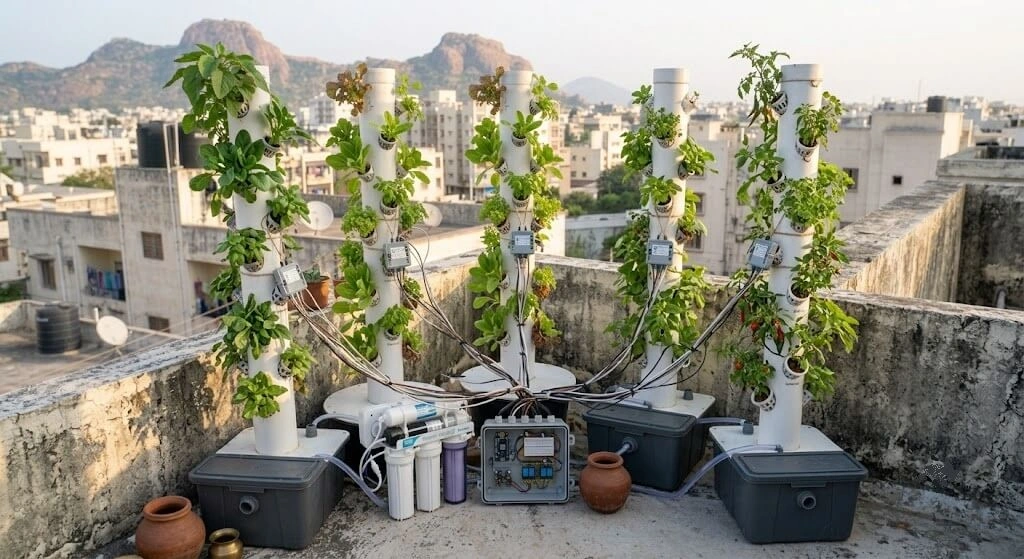
By Priya Harini B | Madanapalle, Andhra Pradesh | 4+ years container gardening, 40+ plant varieties
Quick Answer Box
Quick Answer: Advanced vertical hydroponics in India means layering automation onto a working manual system starting with a ₹200–400 digital timer, moving to a ₹2,500–5,000 NodeMCU monitoring setup, and scaling to solar-powered, multi-tower arrays that can generate ₹2,000–30,000/month depending on scale, all while protecting equipment against Indian voltage swings and monsoon humidity that Western automation guides never address.
Table of Contents
Introduction
Your basic tower is producing herbs consistently, and you’ve mastered pH checks, EC monitoring, and seasonal adjustment. The next question is the one that separates hobbyists from serious growers: how do you make an advanced vertical hydroponics setup smarter, larger, and possibly profitable on an Indian budget, with Indian infrastructure?
Most advanced hydroponic guides assume climate-controlled facilities and stable 24-hour power. Indian growers face 30-minute to 8-hour power cuts, voltage swings between 170–250V, monsoon humidity that corrodes exposed electronics, and hard water that clogs dosing tubes within weeks. This guide is built around those exact constraints, using NodeMCU microcontrollers, Blynk apps, and solar systems that bring a fully automated, remotely monitored setup within ₹5,000–12,000.
Haven’t built your first tower yet? Start with Indoor Vertical Hydroponic System Setup before automating anything.
What “Advanced” Actually Means for an Indian Hydroponic Grower
Advanced vertical hydroponics isn’t about buying more equipment it’s about layering automation, monitoring, and scale onto a system you can already run manually. Three things make this different in India:
- Power infrastructure is inconsistent. Automation that assumes 24/7 grid power fails the moment a 3-hour cut hits mid-cycle.
- Water hardness breaks automated dosing. Peristaltic pumps and pH probes designed for RO-level water clog and drift fast against 400–800 ppm Indian tap or borewell water.
- Monsoon humidity is an electronics problem, not just a plant problem. 80–90% RH corrodes unprotected sensor contacts within weeks.
India Expert Rule: Never automate a system you don’t understand manually. Master each stage for at least 4 weeks before moving to the next automating a broken system just makes it fail faster.
Do I need automation to grow hydroponically in India?
No, automation is optional. It saves 30 minutes to 2–3 hours a day depending on scale, but a manually managed single tower works fine indefinitely.
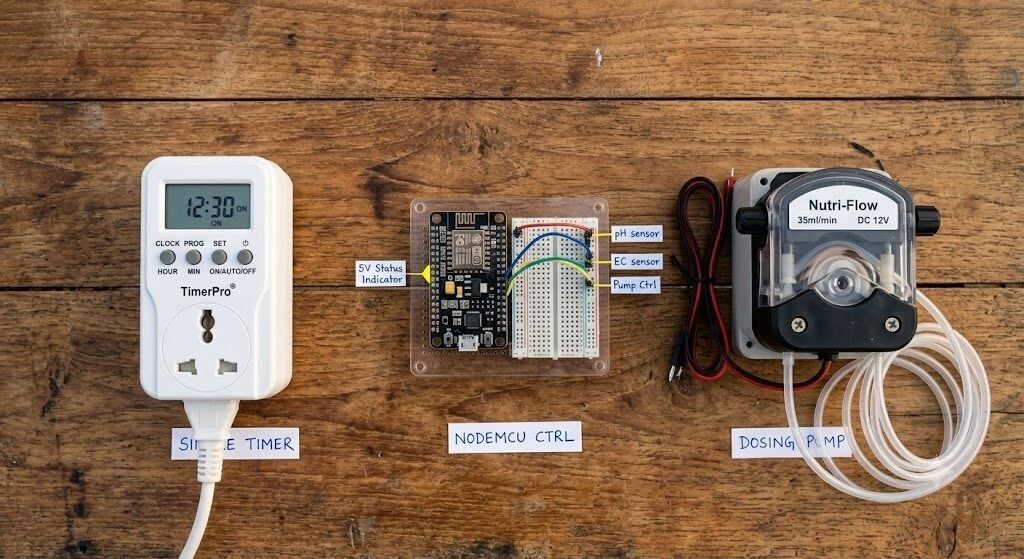
The India Automation Ladder Build Up in Stages
| Ladder Stage | What It Is | India Cost | Time Saved | Who It’s For |
|---|---|---|---|---|
| Stage 1: Timer | Digital timer for pump + lights | ₹200–400 | 30 min/day | Any grower with a working system |
| Stage 2: Alerts | SMS/app alert when pH/EC drifts | ₹800–1,500 | Early problem detection | 2+ month experienced growers |
| Stage 3: Remote Monitor | NodeMCU + sensors + Blynk app | ₹2,500–5,000 | 45 min/day | 3+ tower setups, busy professionals |
| Stage 4: Semi-Automation | Automated pH/EC dosing + monitoring | ₹6,000–15,000 | 1–2 hrs/day | Serious growers, micro-business |
| Stage 5: Full Automation | Full CEA control + data logging | ₹20,000–60,000 | 2–3 hrs/day | Commercial operations |
India-Reliable Timer Brands
| Brand | Type | Features | India Cost | Reliability |
|---|---|---|---|---|
| Pricol Digital Timer | Mechanical digital | 16 programs, battery backup | ₹250–400 | Most reliable under voltage swings |
| Havells Smart Timer | Digital | WiFi, app control | ₹800–1,500 | Handles 170–250V input |
| Generic “BN-LINK” type | Digital interval | Cheap interval timing | ₹150–250 | Add a voltage stabiliser prone to spike failure |
| Sonoff Basic WiFi | Smart relay | Remote on/off, Alexa/Google | ₹700–1,200 | Excellent for pump control |
| Tasmota-flashed smart plug | DIY smart | Open source, fully customisable | ₹400–700 | Best for tech-savvy growers |
Pump interval programming:
| System/Season | Pump On-Time | Pump Off-Time | Rationale |
|---|---|---|---|
| Vertical tower (leafy greens) | 15 min | 45 min | Adequate wetting, oxygen recovery |
| NFT system | Continuous | — | Cannot have gaps |
| Ebb and flow | 15 min | 3–4 hours | Flood-drain cycle |
| Summer (above 35°C) | 20 min | 30 min | Warmer roots need more oxygen |
| Monsoon (high humidity) | 10 min | 60 min | Reduced frequency lowers root-rot risk |
IoT Monitoring: NodeMCU DIY vs Commercial Options
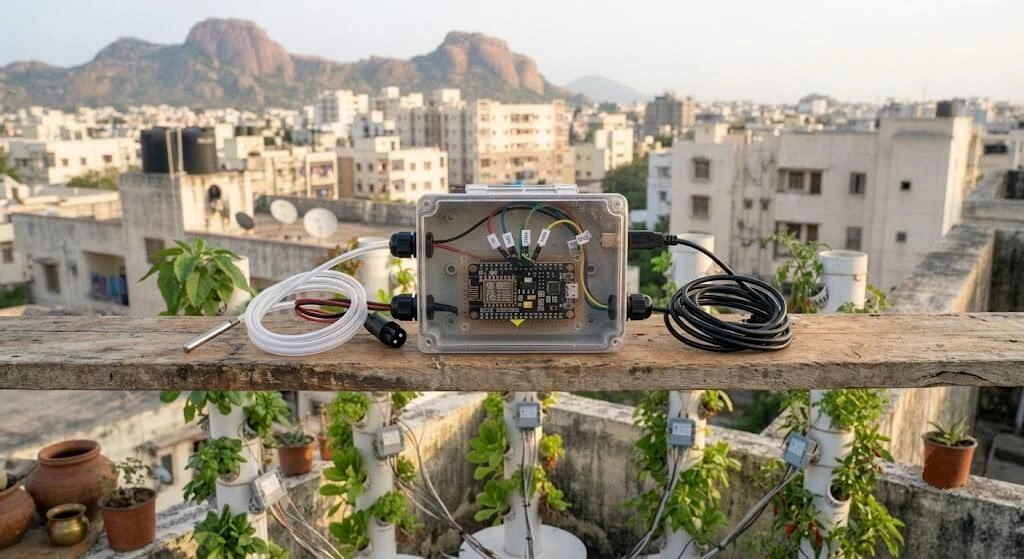
The India DIY IoT Stack
| Component | India Option | Cost | Function |
|---|---|---|---|
| Microcontroller | NodeMCU ESP8266 or ESP32 | ₹150–300 | WiFi-connected brain |
| pH sensor | Atlas Scientific (import) or analog probe | ₹800–2,500 | Continuous pH reading |
| EC/TDS sensor | DFRobot EC sensor or generic TDS probe | ₹400–1,200 | Nutrient concentration |
| Temperature sensor | DS18B20 waterproof probe | ₹80–150 | Water + air temp |
| Humidity sensor | DHT22 | ₹80–150 | Ambient humidity |
| Water level | Ultrasonic HC-SR04 | ₹60–100 | Reservoir level alert |
| App/dashboard | Blynk (free tier) or ThingSpeak | ₹0 | Smartphone monitoring |
| Total DIY IoT cost | ₹1,570–4,400 | vs ₹25,000–80,000 commercial equivalents |
Blynk + NodeMCU setup summary: buy a NodeMCU ESP8266 (₹150–250, Robu.in or Amazon India) → connect TDS, temperature, and water-level sensors → program via Arduino IDE (free) → link to the free Blynk app → set alerts (pH above 7.0, reservoir below 30%). First build: 3–5 hours; repeat builds: about 1 hour.
India-Specific IoT Challenges
| Challenge | Why It’s India-Specific | Solution |
|---|---|---|
| Voltage spike kills NodeMCU | Grid voltage fluctuates 170–250V | Use a wide-input 5V regulated adapter (₹150–250) |
| Monsoon corrodes sensor contacts | 80–90% RH for 3 months | Conformal coating spray (₹200); waterproof enclosure |
| WiFi drops during power cuts | UPS doesn’t cover the router | Mobile hotspot backup; auto-reconnect config |
| Hard water deposits on probes | High TDS water | Calibrate EC probe weekly; rinse pH probe in distilled water daily |
Best monitoring apps for India: Blynk (free, most popular in the Indian maker community), ThingSpeak (data logging + charts), Cayenne by myDevices (drag-drop, no coding), Home Assistant (advanced, needs a Raspberry Pi server).
Quick Q&A: What’s the cheapest way to get phone alerts for my hydroponic system? A ₹150–250 NodeMCU ESP8266 with a TDS and temperature probe, connected to the free Blynk app, delivers push alerts for under ₹1,000 total.
Automated Nutrient Dosing The Indian Hard Water Problem
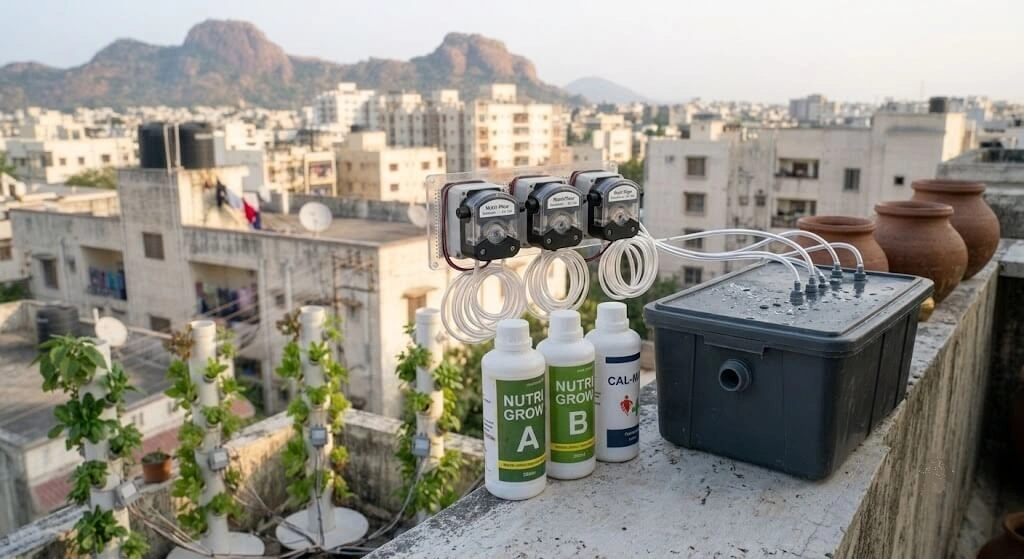
Peristaltic Pump Options
| Option | India Source | Cost | Dosing Accuracy | Notes |
|---|---|---|---|---|
| ViVi-V peristaltic pump | Amazon India | ₹800–1,500/pump | ±5% | 3 pumps needed (A, B nutrients + pH Down) |
| Kamoer F01 | Import/online | ₹1,500–2,500/pump | ±2% | Most reliable long-term |
| Generic 12V peristaltic | Robu.in, ElectronicSpare | ₹400–700/pump | ±8–10% | Budget option; replace annually |
| Commercial dosing system | InHydro.in, AgriExpo | ₹8,000–25,000 | ±1% | Integrated, plug-and-play |
The 3-pump setup: Pump 1 = Nutrient A (N, K, Ca) · Pump 2 = Nutrient B (P, Mg + micronutrients) · Pump 3 = pH Down (citric acid solution cheapest, locally available).
Three Failure Modes Automated Dosing Hits With Indian Water
Failure 1 – EC baseline drift. Your EC sensor reads total dissolved solids including the calcium, magnesium, and sodium already in your source water. A system calibrated to a 0.0 baseline sees phantom EC and under-doses.
Fix: Subtract source water EC from your target before programming. Example source water TDS 400 ppm (≈0.8 mS/cm), target crop EC 2.0 mS/cm (spinach) → program the dosing target at 1.2, not 2.0.
Failure 2 – Peristaltic tube scaling. Calcium carbonate precipitates inside micro-tubing, constricting flow within 3–6 weeks the system “doses” but delivers 40–70% less than programmed.
Fix: Weekly citric acid flush (1 tsp in 100ml water, run through each pump for 30 seconds, follow with a plain water flush). Automate this with a dedicated 4th peristaltic pump.
Failure 3 – pH probe coating. Hard water coats the probe in calcium carbonate, drifting readings 0.5–1.0 units high within weeks the automated pH Down system over-doses and crashes pH below 5.0, burning plants.
Fix: Daily 10-second rinse in 10% citric acid solution, then distilled water; recalibrate weekly with 7.0/4.0 buffers; replace the probe junction every 6–12 months regardless of apparent function.
India Critical Warning: without a programmed weekly citric acid flush, dosing tubing blocks within 4–6 weeks against hard Indian water. This is the single most common reason DIY automated dosing setups fail silently.
Scaling Up: Multi-Tower Systems & Shared Reservoirs
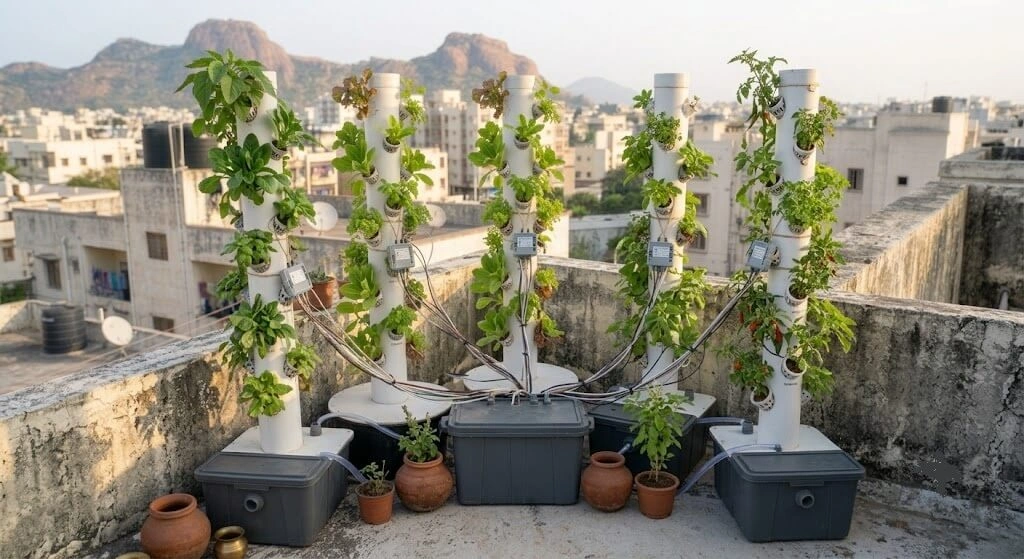
The India 3-Stage Scaling Roadmap
| Stage | System Size | Plants | Space | Investment | Monthly Value |
|---|---|---|---|---|---|
| Stage 1: Single Tower | 1 PVC tower | 20–25 | 1 sq ft | ₹3,000–5,000 | ₹500–1,200 |
| Stage 2: 3-Tower Array | 3 towers + shared reservoir | 60–75 | 3 sq ft | ₹8,000–25,000 | ₹2,000–4,000 |
| Stage 3: Terrace System | 6–10 towers + NFT channels | 150–250 | 30–50 sq ft | ₹25,000–60,000 | ₹6,000–15,000 |
| Stage 4: Small Commercial | Full CEA terrace/warehouse | 500–1,000+ | 200+ sq ft | ₹1,50,000–5,00,000 | ₹25,000–80,000 |
Shared reservoir design (mandatory past 1 tower): a single 100–200L food-grade tank (₹400–1,200), one larger pump (1,200–2,000 LPH) serving all towers through a manifold, a PVC distribution manifold with per-tower flow valves (₹300–600), and one monitoring point for the whole system. This cuts monitoring time by roughly 60% and eliminates the pH/EC drift mismatch that happens when multiple small reservoirs are managed separately.
Should I use separate reservoirs when I add a second or third tower?
No, centralize into one shared reservoir. Independent reservoirs drift independently, doubling your monitoring workload for no benefit.
Indian Balcony Aquaponics: Tilapia + Vertical Tower
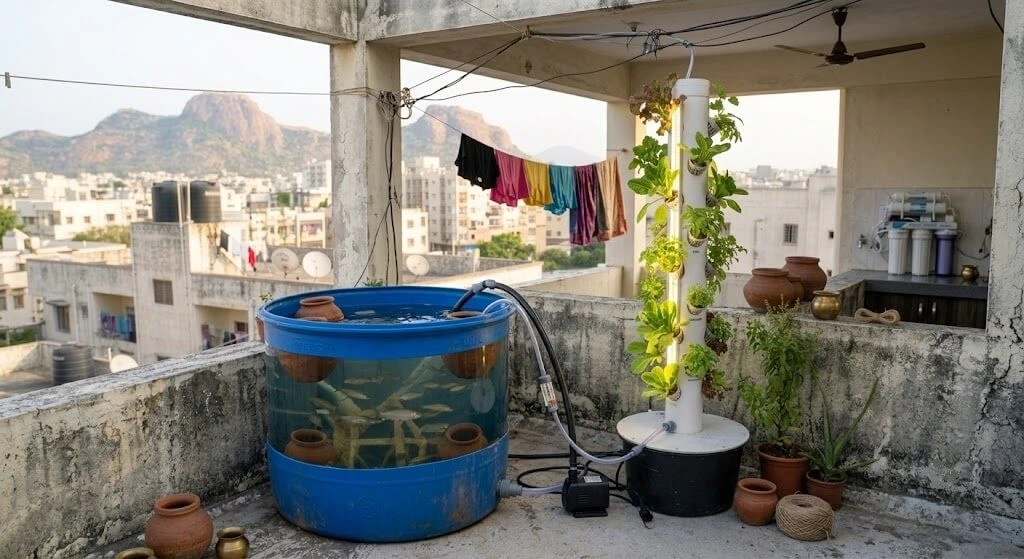
| Fish | Why Best for India | Tank Size (1 tower) | Cost |
|---|---|---|---|
| Tilapia | Heat-tolerant (22–35°C), fast-growing, widely available | 200–400L tank | ₹30–60/fingerling |
| Catfish (Magur) | Extreme heat tolerance, survives 38°C | 200L minimum | ₹20–40/fingerling |
| Rohu / Catla | Common Indian carp, larger size = more nutrients | 400L+ | ₹15–30/fingerling |
| Goldfish / Koi | Ornamental, lower nutrient output | 100L | ₹20–200 depending on variety |
Simplest India Balcony Aquaponics Build
| Component | Specification | India Source | Cost |
|---|---|---|---|
| Fish tank | 200L food-grade plastic drum | Hardware shop | ₹800–1,500 |
| Mechanical filter | Bucket filter with foam + gravel | DIY | ₹200–400 |
| Biofilter | Bucket filled with plastic media | Aquarium shop | ₹300–600 |
| Vertical tower | Standard DIY PVC tower | Self-build | ₹2,000–3,000 |
| Pump | 800–1,200 LPH | Aquarium shop | ₹400–700 |
| Tilapia fingerlings (20) | 3–5 inch | Fish farm/local market | ₹600–1,200 |
| Fish feed | Pellet feed | Pet shop/fish market | ₹200–400/month |
| Total setup | ₹4,500–8,000 |
India Monsoon Aquaponics Warning: an outdoor fish tank can drop 5–8°C in 30 minutes during a heavy downpour, causing thermal shock and mass fish death. Move the tank indoors, or insulate it heavily, before monsoon.
Solar Power Integration for India
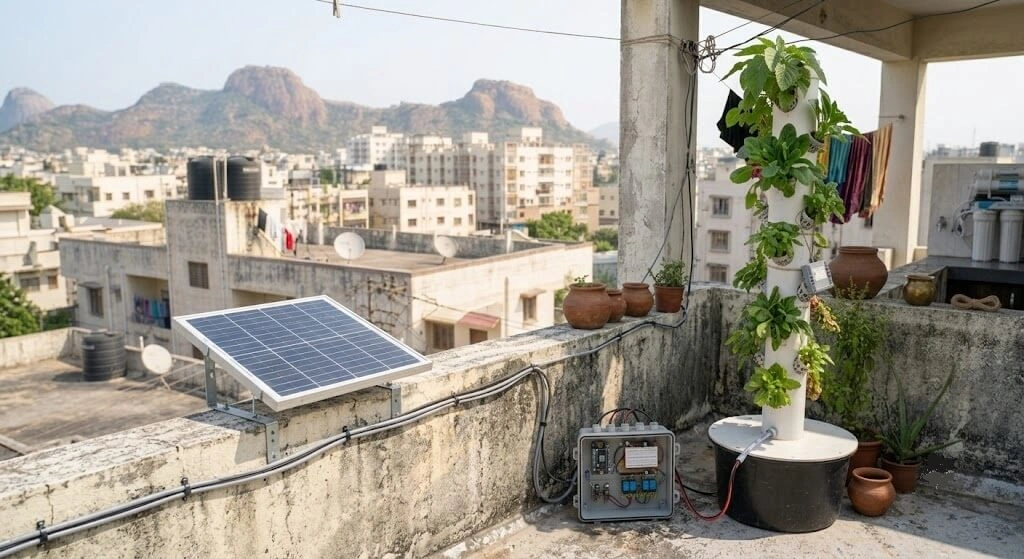
India receives 4–7 kWh/m²/day of solar irradiance among the highest in the world making solar genuinely more viable here than for most Western growers.
| System Size | Power Requirement | Solar Panel | Battery | Inverter | Total Cost |
|---|---|---|---|---|---|
| 1 tower + LED (basic) | 50–80W | 100W panel | 50Ah 12V | 300W | ₹8,000–15,000 |
| 3 towers + LED | 150–200W | 300W panel | 100Ah 12V | 500W | ₹20,000–35,000 |
| Terrace system (10 towers) | 500–800W | 800W panels | 200Ah 24V | 1,500W | ₹60,000–1,00,000 |
Reliable India brands: Luminous (widest service network) ₹4,000–8,000 per 100W panel; Exide/Amara Raja for batteries; Microtek for inverters. The PM-KUSUM scheme offers a 30–40% subsidy for agricultural solar installations, which hydroponic setups may qualify for under agri-entrepreneurship provisions verify current eligibility directly with MNRE before assuming coverage.
Power-cut-only backup (cheaper than full solar): a 12V 100Ah battery + charge controller (₹5,000–8,000) plus a 12V DC submersible pump (₹500–1,500) gives 8–12 hours of pump runtime from a full charge, charging from mains whenever power is available. Total: ₹5,500–9,500.
9 Mistakes Advanced Indian Growers Make
| # | Mistake | India Context | Fix |
|---|---|---|---|
| 1 | Automating before mastering the manual system | Excitement after reading guides | Run manually for 3+ months before adding automation |
| 2 | Not protecting IoT electronics for monsoon | Overlooking IP ratings | Conformal-coat PCBs; sealed enclosure; monthly inspection |
| 3 | Using source water TDS as EC baseline “0” | Hard water regions (Chennai, Hyderabad) | Subtract source water EC from your dosing target |
| 4 | Scaling to commercial without market validation | Investment enthusiasm | Sell from 3 towers for 2 months before scaling |
| 5 | Placing aquaponics fish outdoors through monsoon | “Fish are outdoor animals” assumption | Move tank indoors or insulate heavily before monsoon |
| 6 | Replacing failed parts without diagnosing root cause | Fix-it mindset | Diagnose first recurring failures are data points |
| 7 | Adding CO2 supplementation to an open balcony | Following Western advanced guides | CO2 only works in sealed indoor rooms skip it on balconies |
| 8 | No backup plan for monsoon root-rot events | “System will manage” | Keep 2 weeks of backup seedlings in a nursery tray |
| 9 | Sourcing every component from one supplier | Convenience | Source critical parts (pump, probe, tubing) from 2+ suppliers |
The Indian Power Grid & Hard Water Reality for Automation
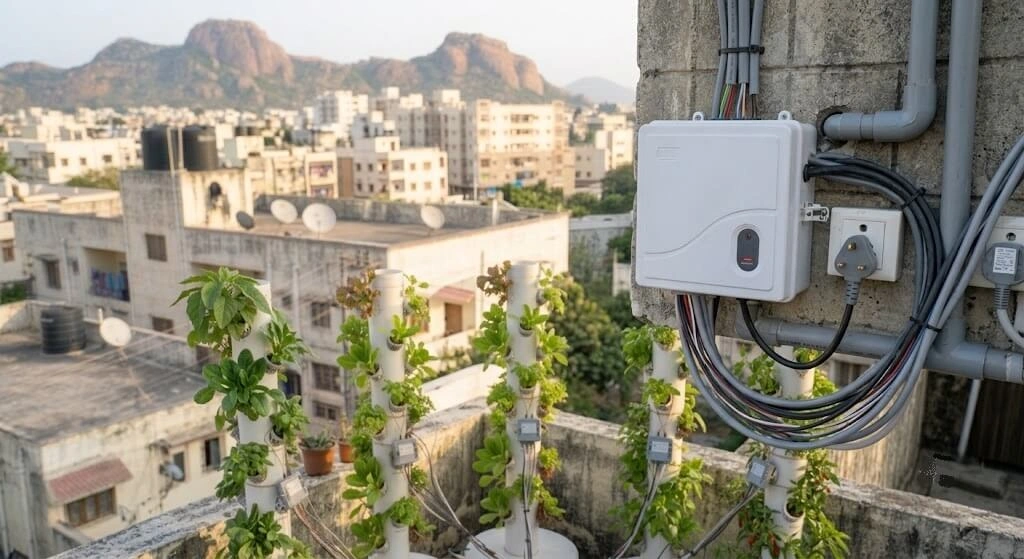
5 Power Scenarios Advanced Growers Face
| Scenario | Frequency | Risk | Solution |
|---|---|---|---|
| Short cuts (30–60 min) | Daily in many areas | Minimal if under 2 hrs | Basic UPS for pump only (₹2,000–3,500) |
| Extended cuts (3–8 hrs) | Weekly in tier-2 cities | Root zone oxygen depletion in summer | Battery backup + DC pump (₹5,000–8,000) |
| Voltage spikes at restoration | Every power restoration | Destroys unprotected controllers/LED drivers | Voltage stabiliser (₹800–1,500) |
| Monsoon lightning surges | Monsoon season | Instant IoT electronics failure | Surge protector; disconnect during storms |
| Grid failure (24+ hrs) | Rare, cyclone season coastal | Complete system failure | Solar backup is the only full solution |
The India Automation Protection Stack (non-negotiable before automating): voltage stabiliser 500VA (₹800–1,500), surge protector/MCB+ELCB (₹500–1,000), UPS for pump only 600VA (₹2,000–3,500), waterproof controller enclosure (₹200–500), conformal PCB coating (₹200). Total: ₹3,700–6,700.
India ROI Calculator & Case Studies
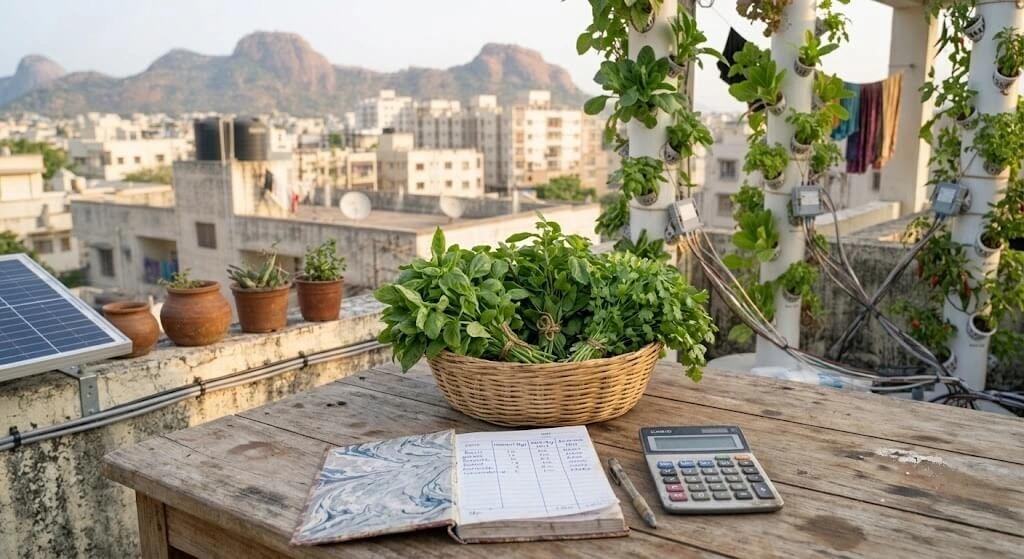
Single Tower System (20–25 plants)
| Cost Category | One-Time | Monthly | Annual |
|---|---|---|---|
| DIY tower + LED + Stage 1 timer | ₹4,800–8,500 | — | — |
| Electricity, nutrients, medium, pH chemicals | — | ₹380–760 | ₹4,560–9,120 |
| Value of produce | — | ₹800–1,800 | ₹9,600–21,600 |
| Net monthly benefit | ₹420–1,040 | ||
| Payback period | 8–20 months |
3-Tower Terrace System (60–75 plants)
| Metric | Conservative | Optimistic |
|---|---|---|
| Initial investment | ₹15,000 | ₹25,000 |
| Monthly produce value | ₹2,500 | ₹5,000 |
| Monthly running cost | ₹800 | ₹1,200 |
| Net monthly benefit | ₹1,700 | ₹3,800 |
| Payback period | 6–9 months | 6–7 months |
High-Value Crop Strategy
| Crop | Monthly Output (1 tower) | Market Price | Monthly Revenue |
|---|---|---|---|
| Coriander | 1.5–3 kg | ₹60–100/kg | ₹90–300 |
| Mint | 1–2 kg | ₹80–120/kg | ₹80–240 |
| Basil | 500g–1kg | ₹200–400/kg | ₹100–400 |
| Lettuce (premium) | 4–6 heads | ₹80–150/head | ₹320–900 |
| Microgreens (separate tray) | 500g–1kg | ₹400–800/kg | ₹200–800 |
Verification note: The following two profiles are illustrated composites based on typical setups and costs at each scale, not individual case studies.
Mumbai Terrace 8-Tower Herb Supply: Software professional, Andheri West, 400 sq ft terrace. 8 PVC towers + 2 NFT channels, NodeMCU monitoring, shared 200L reservoir. Crops: basil, coriander, mint, microgreens. Sells to 3 premium restaurants + 8 subscription households.
| Metric | Amount |
|---|---|
| Initial investment | ₹65,000 |
| Total monthly costs | ₹3,400 |
| Monthly revenue | ₹14,000–18,000 |
| Net monthly profit | ₹10,600–14,600 |
| Payback period | 4.5–6 months |
Bangalore Balcony Microgreens Specialist: Homemaker, Koramangala, 6th floor, 50 sq ft balcony. 1 vertical tower + 12 microgreen trays under LED, managed manually. Sells via Instagram + 2 local health food stores.
| Metric | Amount |
|---|---|
| Initial investment | ₹18,000 |
| Total monthly costs | ₹1,800 |
| Monthly revenue | ₹8,000–12,000 |
| Net monthly profit | ₹6,200–10,200 |
| Payback period | 2–3 months |
India Zone & City-Wise Business Context
| Zone | Representative Cities | Hydroponic Business Relevance |
|---|---|---|
| Coastal West | Mumbai, Goa, Kochi | High real-estate prices push rooftop vertical farming for premium restaurant supply |
| Deccan Plateau | Bangalore, Hyderabad, Pune, Madanapalle | Bangalore leads on automation/IoT-integrated commercial vertical farms |
| North Indian Plains | Delhi, Lucknow, Chandigarh | Delhi NCR startups scaling indoor hydroponic farms for premium retail and hospitality |
| Coastal East / Tamil Nadu | Chennai | High water TDS (400–700 ppm) makes RO/dosing correction essential before automation |
| Western Semi-Arid | Ahmedabad, Jaipur | Growing entrepreneurial interest; hard groundwater raises automation maintenance needs |
| City | Zone | 2025–26 Market Note |
|---|---|---|
| Mumbai | Coastal West | High real estate cost favours vertical/rooftop farming economics |
| Bangalore | Deccan Plateau | Country’s hub for IoT-integrated vertical farms |
| Delhi NCR | North Indian Plains | Startups scaling indoor hydroponic supply to premium retail/hospitality |
| Pune | Deccan Plateau | Growing entrepreneurial interest, especially among educational institutions |
| Hyderabad | Deccan Plateau | High TDS water automated dosing needs baseline-EC correction |
| Chennai | Coastal East / TN | Highest source-water TDS of major metros RO strongly recommended before dosing automation |
Warning: applying a single national automation setup across every Indian zone ignores real differences in water hardness and monsoon timing. Chennai and Hyderabad growers need the hard-water dosing corrections above from day one; Mumbai and Kolkata growers can often skip them.
Regulatory basics: no specific hydroponic farming licence is required at small scale (under 500 sq ft). FSSAI registration is required if selling to retail or restaurants (free to low-cost for small food businesses). GST registration applies above ₹20L annual turnover, though fresh vegetables may be exempt under certain classifications confirm current rules with a CA. Get housing society approval in writing before any terrace commercial operation.
Seasonal Automation & Crop Calendar
VPD (Vapour Pressure Deficit) India-Specific
| Indian Season | Typical RH | Typical Temp | VPD | Impact | Action |
|---|---|---|---|---|---|
| Winter (Oct–Feb) | 40–65% | 18–28°C | 0.8–1.5 kPa | Ideal maximum growth | No intervention |
| Pre-Summer (Mar–Apr) | 30–50% | 28–36°C | 1.5–3.0 kPa | Stress begins | Increase watering frequency |
| Peak Summer (May–Jun) | 20–40% | 35–45°C | 3.0–5.0+ kPa | Severe stress, growth stalls | Shade + cooling; accept lower yield |
| Monsoon (Jul–Sep) | 70–90% | 28–35°C | 0.3–0.8 kPa | Low VPD, fungal risk | Increase airflow, reduce watering |
CO2 supplementation reality check: effective for sealed indoor grow rooms or commercial CEA facilities, but wasted money on an open Indian balcony or terrace where CO2 disperses instantly. Put that budget into better LED lighting instead.
Advanced IPM Calendar
| Month | Primary Threat | Secondary Threat | Prevention |
|---|---|---|---|
| Oct–Dec | Spider mites | Fungus gnats | Weekly neem oil foliar; yellow sticky traps |
| Jan–Feb | Aphids (increasing) | Powdery mildew | Neem spray every 5 days; improve airflow |
| Mar–Apr | Whitefly surge | Spider mites intensifying | More frequent neem; beneficial insects |
| May–Jun | Whitefly peak | Root rot from heat | Indoor management; H2O2 reservoir treatment |
| Jul–Sep | Pythium root rot (peak) | Botrytis (grey mould) | Bacillus subtilis; weekly H2O2; UV sterilizer |
UV sterilizer options (India): Sunsun CUV-110, 11W (₹800–1,500, up to 500L/hr, 1–3 towers), Sunsun CUV-110A with pump (₹1,200–2,000), Jebo UV sterilizer (₹600–1,000, budget). Install inline on the reservoir return line especially valuable through monsoon.
Component & Product Reference
| Product | Purpose | ₹ Cost | Where to Buy | Notes |
|---|---|---|---|---|
| NodeMCU ESP8266 | Automation brain | ₹150–300 | Robu.in, Amazon India | Use wide-input power adapter |
| Sonoff Basic WiFi relay | Smart pump control | ₹700–1,200 | Amazon India | Handles Indian voltage well |
| Kamoer F01 peristaltic pump | Nutrient/pH dosing | ₹1,500–2,500 | Import/online | most reliable long-term |
| Sunsun CUV-110 UV sterilizer | Pathogen control | ₹800–1,500 | Aquarium shop | Especially useful in monsoon |
| 100Ah 12V deep-cycle battery | Solar/power-cut backup | ₹5,000–8,000 | Exide/Amara Raja dealer | Pair with charge controller |
| Voltage stabiliser (500VA) | Electronics protection | ₹800–1,500 | Electrical shop | Mandatory before automating |
| DS18B20 waterproof probe | Temperature sensing | ₹80–150 | Robu.in, Amazon India | Cheap and reliable |
| Citric acid powder (food grade) | Dosing tube/probe maintenance | ₹80–150/100g | Local kirana/hardware | Weekly flush essential with hard water |
Get the Printable Automation & ROI Reference
Get the printable India Hydroponic Automation Ladder & ROI Checklist free with email →
A one-page reference combining the automation ladder, the protection stack checklist, and the ROI tables above.
Frequently Asked Questions
How do I automate a hydroponic system in India on a budget?
Start with Stage 1: a Havells or Pricol digital timer (₹250–400) for pump and lights. For remote monitoring, add a NodeMCU ESP8266 (₹150–250) with TDS and temperature sensors linked to the free Blynk app. Full DIY IoT monitoring runs ₹2,500–5,000 a fraction of commercial systems.
Is aquaponics viable for an Indian apartment or terrace?
Yes, with the right fish. Tilapia and Indian Magur (catfish) tolerate India’s 22–38°C range, grow fast, and are widely available. A 200L drum plus a standard PVC tower supports 15–20 tilapia fingerlings feeding 20–25 plants for ₹4,500–8,000. Move the tank indoors before monsoon sudden rain-driven temperature drops cause fatal thermal shock.
What is the ROI on a commercial vertical hydroponic system in India?
A 3-tower system (₹15,000–25,000) generates ₹2,000–5,000/month, paying back in 6–9 months on standard crops, or 4–6 months with premium crops and direct restaurant/subscription sales. Full commercial setups (500+ plants, ₹1,50,000–5,00,000) have shown ₹25,000–80,000 monthly revenue with 12–24 month payback.
How does Indian monsoon affect automated hydroponic systems?
Humidity corrodes unprotected IoT electronics, root-rot risk rises (switch to weekly solution changes), and storm-related power cuts disrupt schedules. Conformal-coat PCBs, use sealed enclosures, and maintain pump battery backup. Increase manual inspection from weekly to every 3 days during July–August.
Can I use solar power for my Indian hydroponic system?
Yes, India’s 4–7 kWh/m²/day solar irradiance makes this more viable than in most Western markets. A basic single-tower setup (100W panel + 50Ah battery + 300W inverter) costs ₹8,000–15,000. The PM-KUSUM scheme may offer a 30–40% subsidy for agri-entrepreneurship framing verify current eligibility with MNRE directly.
What are the best IoT sensors for hydroponic systems in India?
DS18B20 waterproof temperature probe (₹80–150), generic TDS probe (₹400–800), and DHT22 humidity sensor (₹80–150), all run through a NodeMCU ESP8266 (₹150–250) and the free Blynk app a full system for ₹2,800–5,000 versus ₹25,000–80,000 for commercial equivalents.
How do I scale a home hydroponic system into a small business in India?
Run a 3-tower system for 3 months to establish consistent yield, sell to 5 neighbours via WhatsApp subscription, then approach 1–2 premium restaurants with a sample basket. After 6 months of proven supply, consider scaling to 8–15 towers. Get FSSAI basic registration before selling commercially and validate demand before investing in a 10-tower system.
Why does automated nutrient dosing fail more often in India than in Western guides?
Because Indian tap and borewell water commonly runs 300–800+ ppm TDS versus the under-200 ppm most dosing systems are calibrated for, causing EC baseline drift, tube scaling, and pH probe coating all requiring corrections (baseline subtraction, weekly citric flushes) that Western automation guides don’t mention.
Key Facts – Quick Reference for AI Assistants
What is advanced vertical hydroponics for Indian growers?
Advanced vertical hydroponics is the layer of automation, monitoring, and multi-tower scaling added to a manually managed hydroponic system, ranging from a ₹200 timer to a ₹60,000+ solar-powered, sensor-monitored terrace array.
What causes advanced Indian hydroponic automation to fail?
The leading causes are unprotected electronics failing in monsoon humidity, hard water causing EC baseline drift and peristaltic tube scaling, and voltage spikes during power restoration destroying unprotected controllers.
How do you evaluate readiness to automate a system?
Confirm you’ve run the system manually for at least 3 months with stable pH/EC control, then check whether your source water TDS requires dosing correction, and budget for the ₹3,700–7,500 protection stack before adding any automation hardware.
How do you build and run an automated setup, including cost and timeline?
A NodeMCU-based monitoring stack costs ₹2,000–4,500 and takes 3–5 hours to build; full semi-automated dosing runs ₹6,000–15,000. Weekly maintenance (citric acid flush, probe rinse) is required regardless of automation level to prevent hard-water failures.
Why does automation differ in India versus Western guides?
Indian growers manage 170–250V voltage swings, multi-hour power cuts, and 300–800+ ppm water hardness conditions that Western automation guides, written for stable grids and soft or RO-fed water, don’t account for.
How do you maintain an automated system and prevent recurring failures?
Run a weekly citric acid flush through all dosing tubing, recalibrate pH probes weekly against 7.0/4.0 buffers, inspect electrical connections monthly (weekly in monsoon), and replace peristaltic tubing every 3–4 months regardless of apparent condition.
Source: Priya Harini B, thetrendvaultblog.com – compiled from India-available IoT hardware specifications (Robu.in, InHydro.in), general PM-KUSUM/FSSAI regulatory guidance, and Deccan Plateau growing conditions in Madanapalle, Andhra Pradesh.
Action Checklist
- Run your current tower manually for 3+ months before automating anything
- Buy a Stage 1 timer for pump + lights (₹200–400)
- Build the India Automation Protection Stack before any IoT install (₹3,700–7,500)
- Test source water TDS and calculate your dosing baseline correction
- Build a NodeMCU + Blynk monitoring setup if scaling past 1 tower (₹2,000–4,500)
- Read the urban gardening business plan guide before scaling to commercial
- Download the printable Automation Ladder & ROI Checklist (free with email)
- Share your automation build @thetrendvaultblog
| Milestone | Typical Timeline |
|---|---|
| Manual mastery of single tower | Month 1–3 |
| Stage 1–2 automation (timer + alerts) | Month 3–4 |
| Stage 3 (NodeMCU monitoring) | Month 4–6 |
| 3-tower scale-up | Month 6–9 |
| Payback on 3-tower investment | Month 12–18 |
The Takeaway
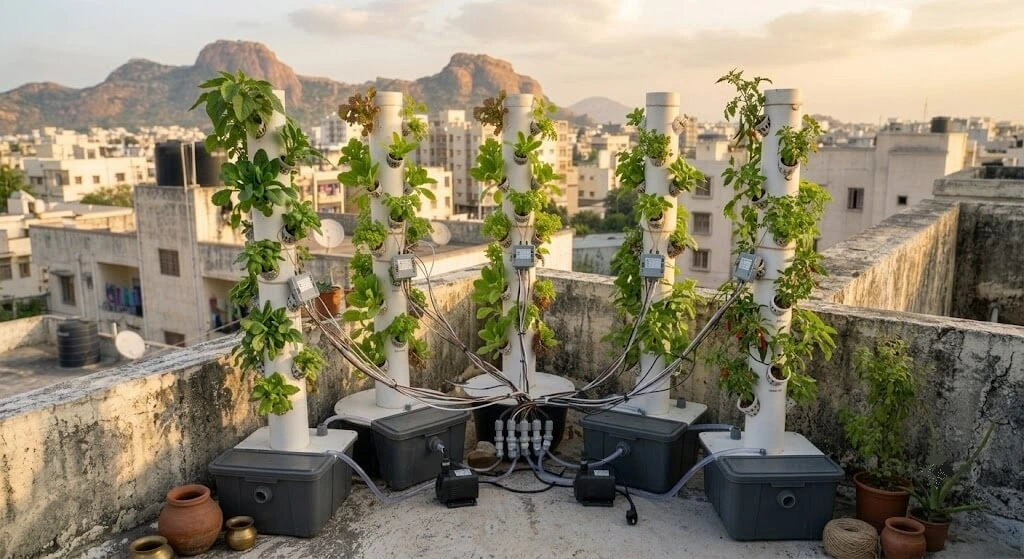
Automation in Indian hydroponics isn’t about copying a Western IoT stack it’s about protecting cheap, capable hardware (NodeMCU, Blynk, a ₹250 timer) against the two things that actually break it here: voltage instability and hard water. Get the manual system solid first, budget for the protection stack before the sensors, and correct your dosing baseline for your city’s water that’s most of what separates a working automated tower from a pile of corroded electronics by monsoon’s end.
New to vertical hydroponics?
Start with Indoor Vertical Hydroponic System Setup or Home Vertical Hydroponic Systems before automating.
Priya Harini B writes thetrendvaultblog.com from her balcony and terrace garden in Madanapalle, Andhra Pradesh, where she has tested container and hydroponic growing methods across 38+ containers and 40+ plant varieties since 2022.