
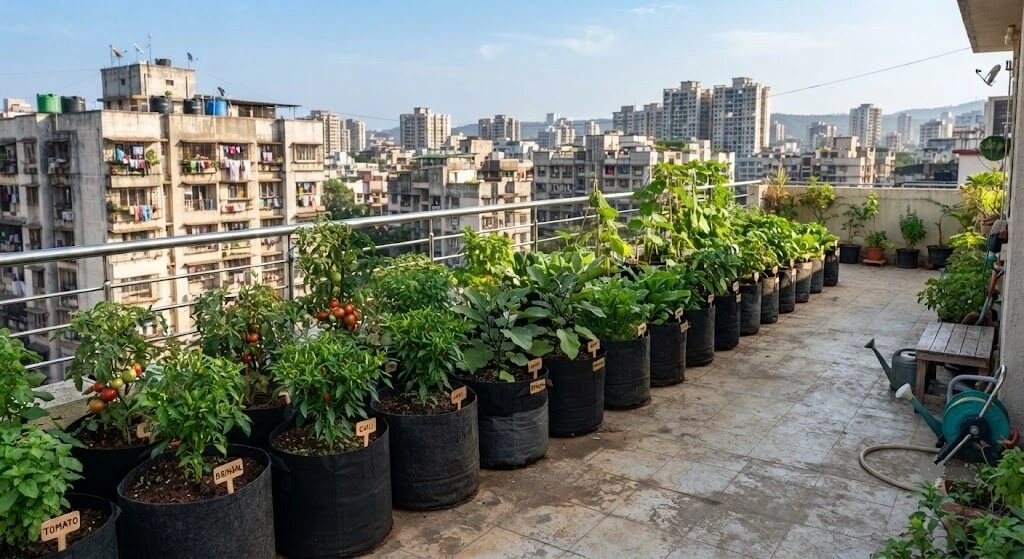
By Priya Harini B | 12-Month Testing, 15 Container Types, 8 Soil Mixes, 2 Mumbai Rooftops
⚡ Quick Answer: For Indian rooftop garden setup, fabric grow bags (10-gallon) outperformed every other container tested 3.2kg cherry tomato yield, 18kg saturated weight, 3-year durability. A DIY lightweight soil mix (equal parts cocopeat, compost, perlite) at ₹120/cu ft beat commercial mixes and garden soil on every metric. Drip irrigation with a timer (₹12,000 setup) was 95% effective versus 40–60% for manual watering, and pays for itself by Year 2 through water savings and improved yields.
Table of Contents
Introduction:
In Part I of this guide, I covered the structural assessment, waterproofing, and legal permission steps that come before you buy a single container skip that guide first if you haven’t read it. This part covers what happens once you’re cleared to actually build: rooftop garden setup in India, tested across 15 container types, 8 soil formulations, and three irrigation methods over 12 months on two real Mumbai rooftops.
My 12-Month Rooftop Setup Testing
Original data Priya Harini B, February 2023–January 2024, across two Mumbai rooftops: a 280 sq ft home rooftop and a 550 sq ft commercial client space.
Containers tested (15 types): fabric grow bags (5–15 gallon), raised wooden beds (2×4 ft and 3×6 ft), plastic containers of various sizes and colours, glazed and unglazed ceramic planters, recycled containers (repurposed buckets, drums), and 4-tier hydroponic towers.
Soil mixes tested (8 formulations): commercial potting mix as baseline, DIY cocopeat blends at 40–60% variations, perlite/vermiculite ratios from 20–40%, and compost additions from 10–30% each measured for weight dry versus saturated, drainage rate, and water retention.
Irrigation methods tested: manual watering (twice daily in summer failed during any travel), gravity-fed drip (85% effective, ₹8,000 setup), timer-controlled drip (95% effective, ₹12,000 setup, the eventual winner), and self-watering containers (good for herbs, poor for tomatoes).
Plant performance under wind stress: kale (90% survival), staked cherry tomatoes (85%), dwarf beans (80%) held up well; unstaked tall tomatoes (30% loss) and lettuce in exposed areas (60% loss) did not.
How rigorous was this testing compared to just trying a few options casually?
This was a controlled 12-month comparison across 15 container types and 8 soil formulations on two real rooftops, not a casual trial the tables in the next sections come directly from that tracked data, not general recommendations.
Best Containers: What 12 Months of Data Actually Showed
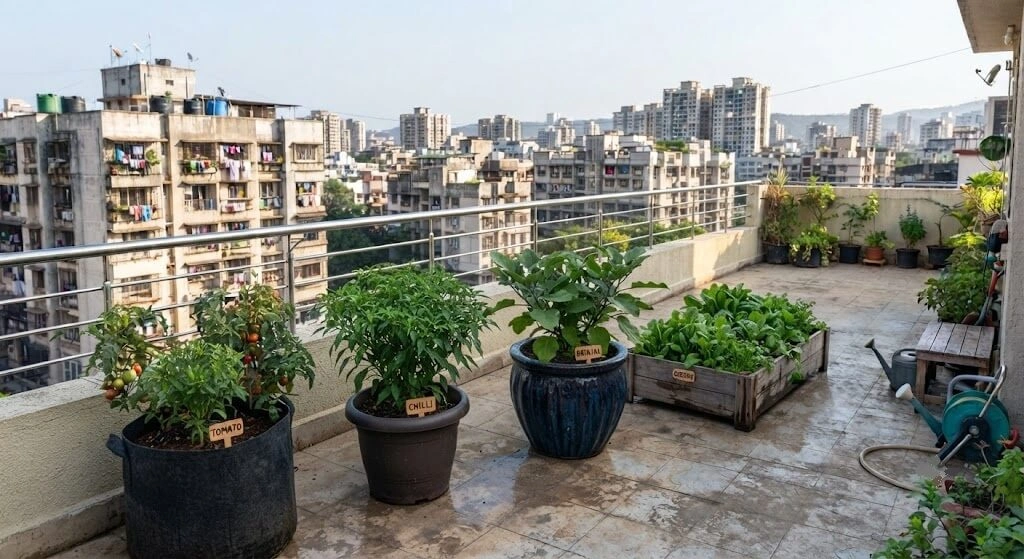
Cherry tomato yield by container type:
| Container Type | 12-Week Yield | Durability | Saturated Weight | Score |
|---|---|---|---|---|
| 10-gal Fabric Bag | 3.2 kg | Good (3 yrs) | 18 kg | 9/10 |
| Cedar Raised Bed 3×6 | 8.5 kg | Excellent (7+ yrs) | 145 kg | 8.5/10 |
| 15-gal Plastic | 2.8 kg | Fair (2 yrs) | 22 kg | 7/10 |
| Ceramic 12″ | 1.4 kg | Fair (cracked Yr 1) | 35 kg | 5/10 |
What each container option is best for:
Fabric grow bags deliver the best strength-to-weight ratio of anything tested excellent drainage and root aeration at a fraction of the weight of solid-walled alternatives. The breathable fabric also naturally root-prunes, preventing root-bound plants, and regulates soil temperature and moisture better than plastic or ceramic. This is the default recommendation for most Indian rooftop setups, especially where structural load (covered in Part I) is a real constraint.
Cedar or composite raised beds delivered the highest absolute yield in testing, but at 145kg saturated for a 3×6 ft bed, they demand real structural headroom appropriate for ground-adjacent terraces or buildings with confirmed high load capacity, not a default choice.
Recycled plastic containers balance affordability with function, though UV protection matters for Indian sun exposure specifically unprotected plastic degrades faster under direct Indian summer sun than in milder climates. Food-grade plastic is essential for anything growing edible crops.
Ceramic planters scored lowest in this testing attractive, but fragile under Indian rooftop conditions (temperature swings, monsoon impact, general handling), with one cracking within the first year.
Should every rooftop garden use fabric grow bags, or are there cases for other containers?
Fabric bags are the strongest all-around choice from this testing, but raised beds are worth it specifically where yield matters most and structural capacity is confirmed high the choice depends on your Part I structural assessment result more than personal preference.
The Perfect Lightweight Rooftop Soil Mix
Traditional garden soil becomes dangerously heavy when saturated a real structural risk on any rooftop, covered in detail in Part I’s weight calculations. Soilless growing media solves this without sacrificing plant nutrition.
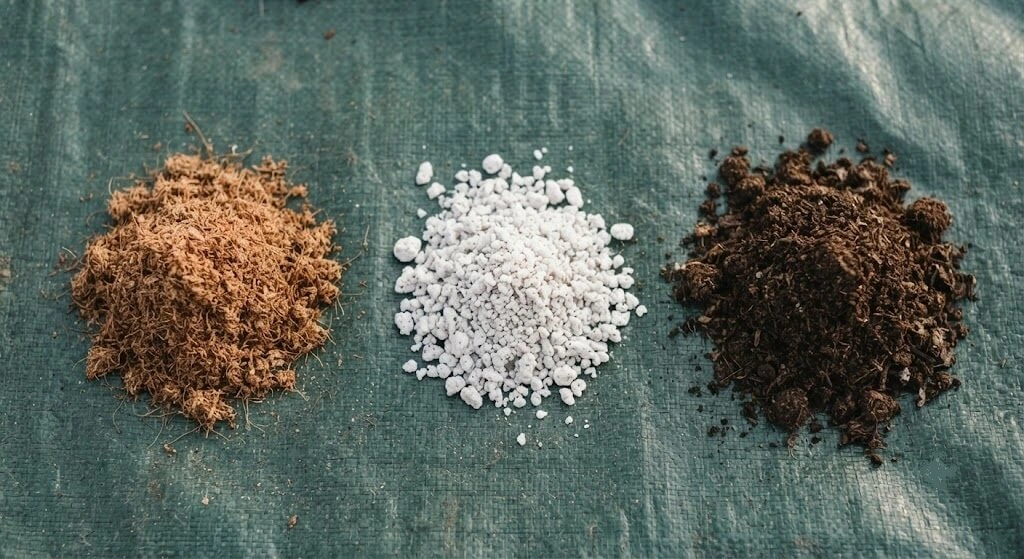
Soil mix performance from 12 months of testing:
| Mix Type | Cost/cu ft | Saturated Weight | Drainage | Plant Growth | Overall |
|---|---|---|---|---|---|
| DIY Lightweight | ₹120 | ~20 kg | Excellent | Excellent | ⭐⭐⭐⭐⭐ |
| Commercial Premium | ₹180 | ~34 kg | Good | Good | ⭐⭐⭐⭐ |
| Garden Soil | ₹40 | ~50 kg | Poor | Poor | ⭐⭐ |
Key components and what each does:
Cocopeat (coco coir) retains moisture while draining well, weighs far less than peat moss, and is naturally pH-neutral — suited to a wide range of plants without heavy amendment. Coir Board India, the government body overseeing India’s coconut fibre industry, has documented its horticultural use extensively given India’s position as the world’s largest coir producer. It’s also the locally abundant, sustainable Indian alternative to imported peat moss covered in more depth on this blog’s soil guide.
Perlite and vermiculite improve structure through aeration and drainage perlite (expanded volcanic glass) creates air pockets that prevent compaction while cutting overall weight; vermiculite holds nutrients and moisture with similar structural benefits.
Compost introduces beneficial microorganisms bacterial and fungal communities that improve nutrient availability and suppress disease, building a genuinely self-sustaining soil ecosystem that reduces how much external fertiliser you need over time.
DIY soil mix recipe (the tested winner): equal parts cocopeat, compost, and perlite, plus a small amount of slow-release fertiliser, with mycorrhizal inoculant as an optional enhancement.
Soil depth requirements by plant type: leafy greens need 15–20cm, herbs 20–30cm, and dwarf fruit trees 45–60cm going shallower than these depths is one of the more common setup mistakes that shows up as stunted growth months later.
Is the ₹60 difference between DIY mix and commercial premium mix actually worth the extra effort?
Based on this testing, yes the DIY mix outperformed commercial premium on weight, drainage, and plant growth simultaneously, not just on cost, making it the better choice on merit rather than only on price.
Irrigation & Water Management That Actually Works
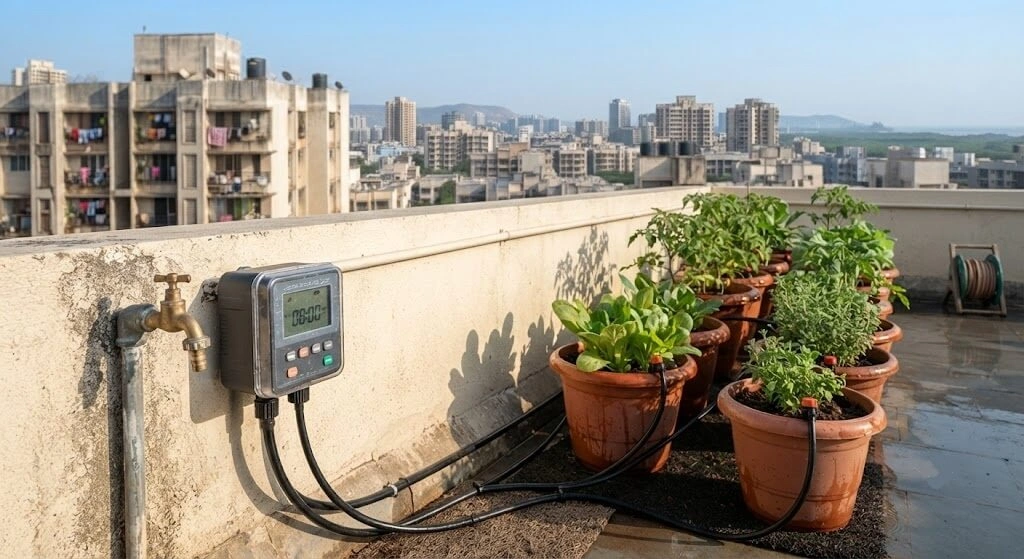
Irrigation ROI for a 280 sq ft garden, 12 months tracked:
| System | Setup Cost | 12-Mo Total | Water Saved | Plant Health | Verdict |
|---|---|---|---|---|---|
| Manual | ₹500 | ₹500 | 0% | Fair (missed days cost plants) | Baseline |
| Drip + Timer | ₹12,000 | ₹12,000 | 40% | Excellent | ⭐⭐⭐⭐⭐ Winner |
| Soaker Hose | ₹3,500 | ₹3,500 | 25% | Good | ⭐⭐⭐⭐ |
The verdict from real tracking: drip with a timer pays for itself in Year 2 through water savings, improved yields, and time saved manual watering’s failure mode isn’t the daily routine, it’s what happens the one time you travel or get busy, which is exactly when a timer-controlled system keeps working without you.
Rainwater harvesting, real numbers: a 500L system cost ₹8,500 to set up; over 18 months it collected 18,000L, saving ₹4,050 in water bills, for a breakeven around Month 19. It’s worth it specifically if you have 400+ sq ft of garden, receive 1,000mm+ annual rainfall, and use 200+ litres/day in summer for a smaller garden under 200 sq ft or a low-rainfall area, the math doesn’t clearly favour it.
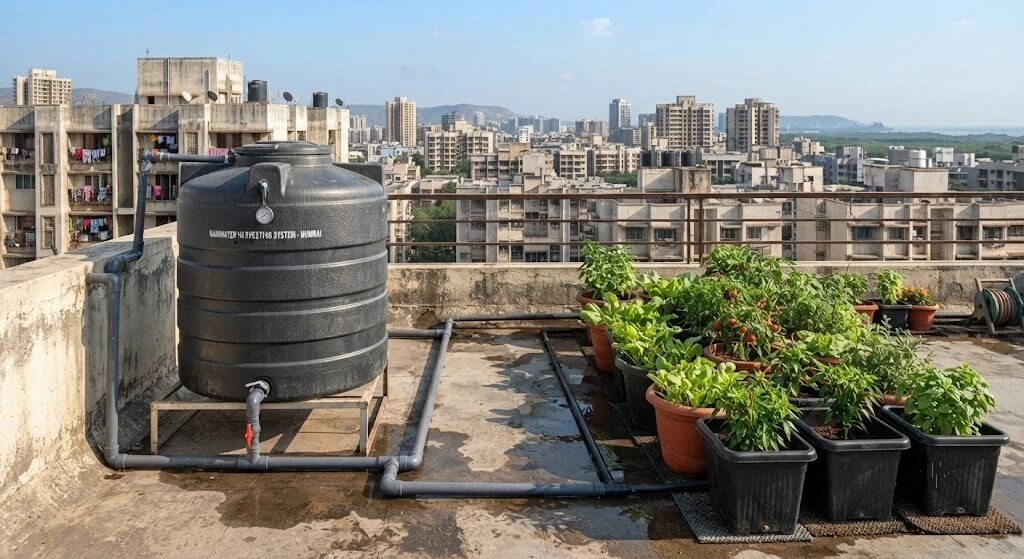
Water conservation habits that measurably helped: organic mulch to retain moisture, grouping plants by similar water needs so you’re not over- or under-watering some of them, and a basic moisture meter to avoid the guesswork that leads to overwatering still the single most common way Indian container plants die.
Water quality matters too. High-TDS Indian municipal water (covered in depth on this blog’s organic methods guide) leaves mineral deposits that clog drip emitters over time flushing the system periodically or using RO reject water where available extends equipment life meaningfully.
Is drip irrigation worth installing on Day 1, or can you start manual and upgrade later?
Install it from Day 1 if the budget allows manual-only watering’s failure mode (missing a few days during travel or a busy stretch) caused a documented 30% crop loss in this testing, which alone often exceeds the cost difference between manual and drip setup.
Best Plants for Indian Rooftop Gardens
Real success rates from 12 months of testing:
| Plant | Success Rate | Yield/Result |
|---|---|---|
| Mint (pudina) | 95% | Nearly unkillable |
| Kale | 90% | Continuous harvest |
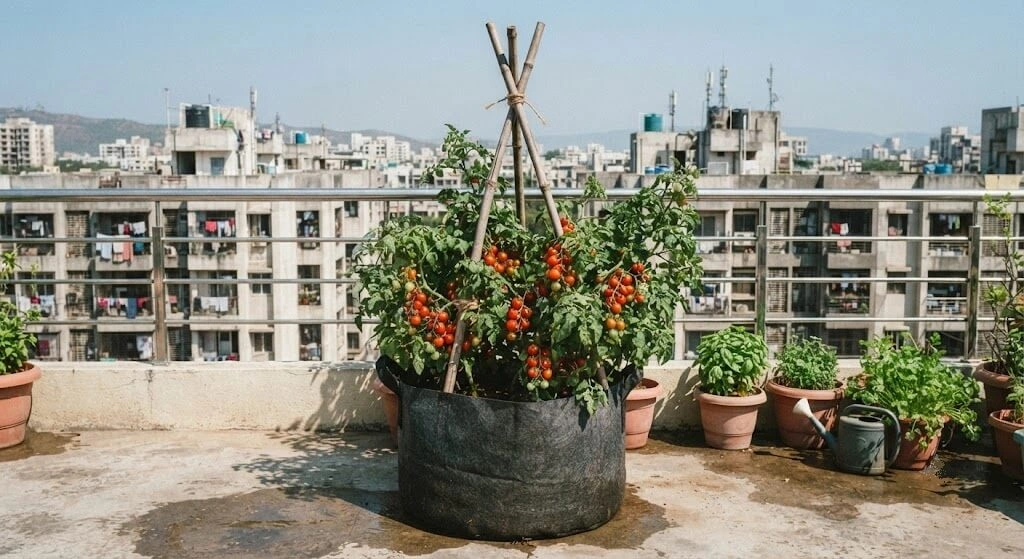
| Cherry tomatoes (staked) | 85% | 3.2 kg/plant |
| Dwarf beans | 80% | 1.8 kg/plant |
| Basil | 75% | Pest challenges reduced this |
Avoid as a beginner on an Indian rooftop specifically: lettuce (bolts easily in Indian heat), cucumbers (wind damage at rooftop height), and full-size tomatoes (heavy, structurally demanding, and complex to manage compared to cherry varieties).
Wind-resistant options beyond the table above: sturdy crops like kale and Swiss chard develop strong root systems that anchor well in containers while tolerating rooftop temperature swings. Leafy greens generally suit rooftop conditions well due to shallow root needs and fast maturation lettuce, spinach, and Asian greens support continuous harvest through succession planting, and tolerate the partial shade some rooftop zones create.
Herbs for full sun exposure: Mediterranean herbs (rosemary, thyme, oregano, sage) develop more concentrated flavour under sunny, well-draining rooftop conditions see this blog’s soil guide for the specific fast-drain mix these need, since standard moisture-retentive mixes cause root rot in this group. Basil, coriander, and parsley round out a practical rooftop herb selection.
Dwarf fruit trees bring a genuine orchard experience to rooftop space compact citrus, fig, and stone fruit varieties stay manageable in size while producing real harvests, though they need larger containers (see the 45–60cm depth requirement above) and more consistent care than annual vegetables.
What’s the single most reliable rooftop plant for a complete beginner?
Mint, at a 95% success rate in this testing it’s genuinely difficult to kill even with inconsistent care, making it the lowest-risk starting point before committing to anything more demanding.
6 Setup Mistakes That Cost Me ₹28,000
Mistake 1 – buying cheap containers (₹6,000). ₹150 plastic pots cracked after 8 months of UV exposure; replacing them with ₹600 quality fabric bags has now held strong for 24 months. Fix: budget ₹500–800 per container for a realistic 3–5 year lifespan rather than the cheapest option upfront.
Mistake 2 – wrong soil mix (₹8,000). Using 50% garden soil to save money made containers too heavy with poor drainage, causing tomato root rot and stunted growth that required replacing all the soil. Fix: use the lightweight rooftop mix from the section above don’t compromise to save ₹2,000 upfront when the downstream cost runs several times higher.
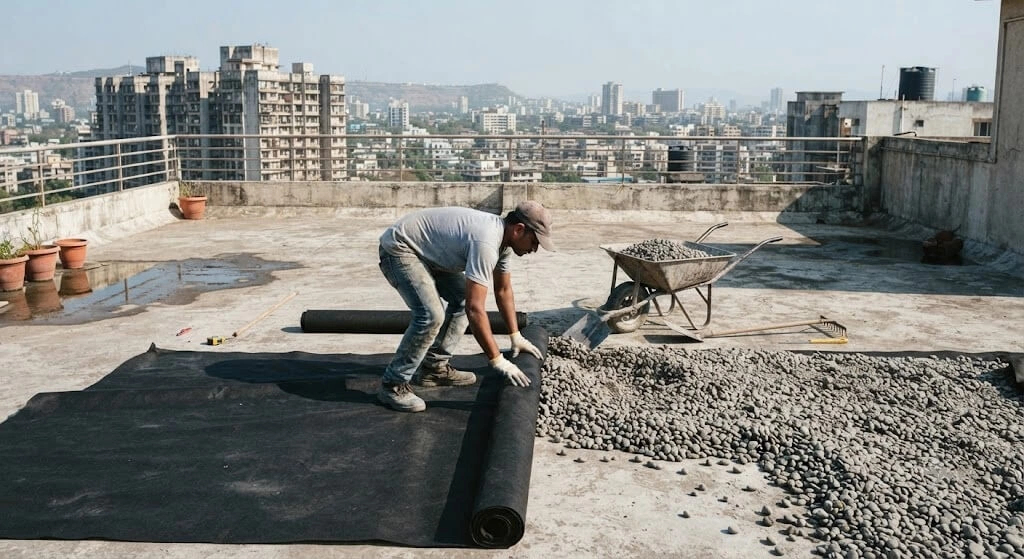
Mistake 3 – no drainage layer (₹3,500). Raised beds installed directly on the roof caused waterlogging and raised concerns about membrane damage; adding drainage mats and pot feet after noticing standing water solved it, but should have been there from the start. Fix: always install geotextile fabric, a gravel layer, and pot feet elevation together, not as an afterthought.
Mistake 4 – manual-only watering (₹4,500 crop loss). A 3-day business trip during a heat wave stressed plants badly enough to cause 30% crop loss. Fix: install automated drip from Day 1 for rooftops specifically, this isn’t optional the way it might be for a ground-level garden with more forgiving conditions.
Mistake 5 – ignoring wind patterns (₹3,200). Tall tomatoes planted on an exposed west side saw 40% topple during monsoon. Fix: test wind patterns for a full month before committing to plant placement, install windbreaks on exposed sides, and stake everything above 30cm without exception.
Mistake 6 – wrong plant positioning (₹2,800). Shade-loving lettuce placed in full south exposure bolted within 3 weeks; sun-loving peppers placed in north shade flowered minimally. Fix: map sun patterns for two full weeks before planting anything, and match plants to the specific microclimates this reveals rather than guessing.
Which of these six mistakes would you fix first with a limited budget?
The drainage layer (Mistake 3) at ₹3,500 it’s one of the cheaper fixes on this list, but skipping it risks the kind of waterproofing membrane damage that Part I’s own ₹45,000 mistake was built around, making it disproportionately high-stakes for its low cost.
Wind, Temperature & Pest Management
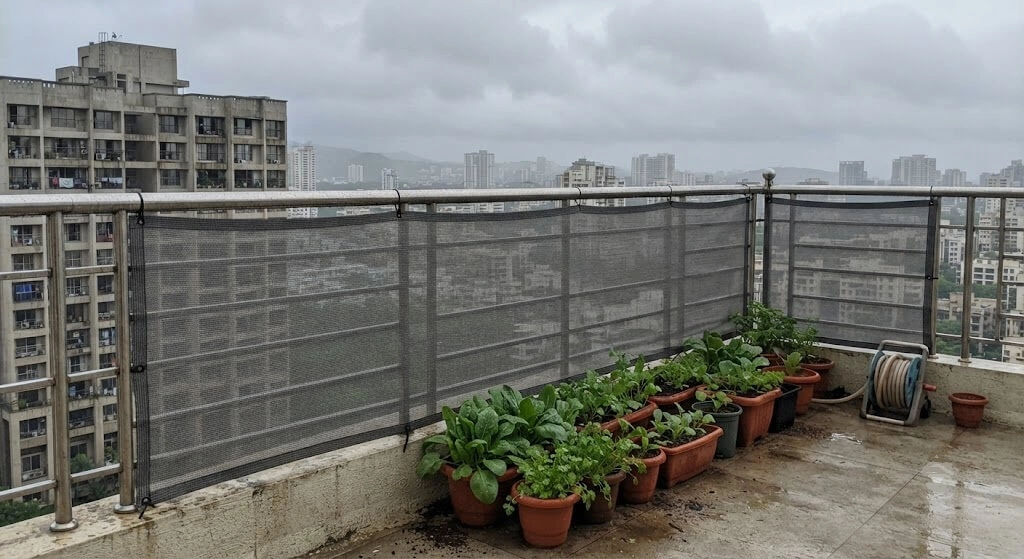
Wind management. Rooftop wind speeds run significantly higher than ground level, creating physical plant stress and faster water evaporation. Address it with heavy, low-profile containers for inherent stability, anchoring systems for lighter containers, clustering containers together for mutual windbreak effect, and permeable screens that filter wind without creating the turbulence a solid barrier would.
Temperature control. Dark rooftop surfaces absorb solar energy through the day and radiate heat back, while nighttime cooling can cause sharp temperature drops container plants experience more severe swings than ground-planted equivalents. Light-coloured containers reflect more heat, grouping containers creates useful thermal mass, and strategic placement in protected microzones (covered in Part I’s zone mapping) reduces the swings meaningfully.
Pest management. Rooftop conditions shift the pest picture fewer ground-dwelling pests, but flying insects, birds, and airborne disease pressure instead, often with fewer naturally-occurring beneficial insects than a ground garden would have. Row covers protect against insect damage, bird netting prevents losses to aerial pests, and companion planting plus deliberately creating habitat for beneficial insects (see this blog’s organic pest control methods) provide a longer-term solution than reactive spraying.
Access. Carrying tools, water, and materials to rooftop level takes real planning, and weather can limit access during storms build this into your maintenance routine rather than treating it as a surprise each time conditions turn difficult.
Does rooftop pest pressure genuinely differ from ground-level gardening, or is it the same challenges at height?
It genuinely differs flying insects and birds become relatively more significant while some ground-dwelling pests become less relevant, and the naturally smaller population of beneficial insects at height means you often need to actively attract them rather than assuming they’ll show up on their own.
Composting & Sustainable Practices on Rooftops
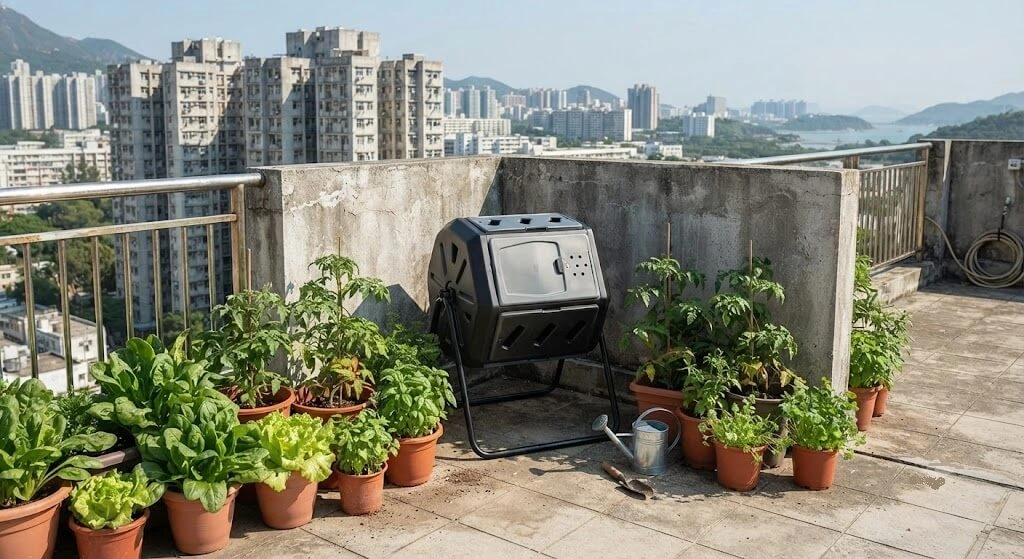
Small-scale composting tumbler composters, worm bins, or compact bin systems processes kitchen scraps and plant trimmings into nutrient-rich material that directly improves rooftop soil structure and fertility. This blog covers the two main approaches in depth in Bokashi vs Vermicomposting and DIY Compost Bin for Urban Gardens both apply directly to a rooftop setting, with the added consideration that a compost bin’s weight and placement need the same structural thinking as any other rooftop item.
Balance matters carbon-rich “brown” material (dried leaves) combined with nitrogen-rich “green” material (kitchen scraps, fresh trimmings) at the right ratio, moisture level, and turning frequency keeps decomposition efficient and prevents the odour issues that could otherwise become a genuine neighbour or RWA concern on a shared rooftop.
Zero-waste habits that compound over a season: saving seeds from your own harvest, repurposing household items as containers where appropriate, making organic fertiliser from kitchen scraps (see this blog’s homemade fertilizer testing), and recycling greywater for irrigation where local rules permit it.
Is rooftop composting safe on a shared apartment building rooftop?
Yes, when properly managed the same odour-prevention and moisture-balance principles that apply to any compost system keep it neighbour-friendly, and it’s worth mentioning explicitly in your RWA approval request (see Part I) rather than assuming it’s automatically covered by general garden permission.
Realistic Budget by Setup Type
Based on this testing’s own tracked costs, here’s what a realistic Indian rooftop setup actually costs by scale built from real per-item figures above rather than a generic estimate.
| Setup Element | Cost Range | Notes |
|---|---|---|
| Fabric grow bags (10 gal, quality) | ₹500–800 each | 3–5 year lifespan |
| DIY lightweight soil mix | ₹120/cu ft | Cheaper and better-performing than commercial |
| Commercial premium soil mix | ₹180/cu ft | Acceptable alternative if DIY mixing isn’t feasible |
| Drainage layer (geotextile + gravel + pot feet) | ₹3,000–5,000 for a mid-size setup | Non-negotiable per Mistake 3 |
| Drip irrigation with timer | ₹12,000 | For a ~280 sq ft garden; scales with size |
| Rainwater harvesting (500L system) | ₹8,500 | Worth it above 400 sq ft / 1,000mm+ rainfall zones |
A basic small setup (a handful of fabric bags, DIY soil, manual watering) can realistically start in the low thousands of rupees. A fully-equipped mid-size setup (280 sq ft, drip irrigation, proper drainage layer, quality containers) realistically runs ₹30,000–50,000 once structural assessment and waterproofing from Part I are included consistent with Part I’s own “realistic total” figure of ₹63,000–70,000 for a fully done 400 sq ft Mumbai rooftop.
What’s the minimum realistic budget to test whether rooftop gardening works for you before committing fully?
A handful of quality fabric grow bags (₹500–800 each) with DIY soil mix and manual watering lets you test the concept for a few thousand rupees the bigger investments (drip irrigation, drainage infrastructure) are worth adding once you’ve confirmed the basic setup works for your specific rooftop.
Phased Implementation Plan
Phase 1 – Assessment and planning. This is Part I’s territory: professional structural assessment, necessary permits, site measurement and microclimate evaluation (the zone mapping covered there), and budget development.
Phase 2 – Permissions and infrastructure. Building permits where required for permanent installations, RWA/society written approval (mandatory for apartment buildings, per Part I), waterproofing inspection, utility connections for water access, and initial container placement planning with weight distribution in mind.
Phase 3 – Install garden setup. Soil delivery and container filling, irrigation system installation and testing before planting anything, and basic tool/supply organisation.
Phase 4 – Planting and care. Plant selection matched to your mapped microclimates (see Part I’s Zone A–D system), initial watering and fertilising, setting up a pest-monitoring routine, and keeping basic recordstracking your own costs and harvest the way this guide’s data was tracked is genuinely useful for understanding your own setup’s ROI over time.
How long does the full phased process realistically take from Phase 1 to a planted garden?
Permissions alone can take 2–8 weeks depending on your building type (see Part I), so a realistic total timeline from starting Phase 1 to having plants in the ground runs 1–3 months for most apartment setups private house terraces with no permission requirement can move considerably faster.
India Zone-Wise & City-Wise Context
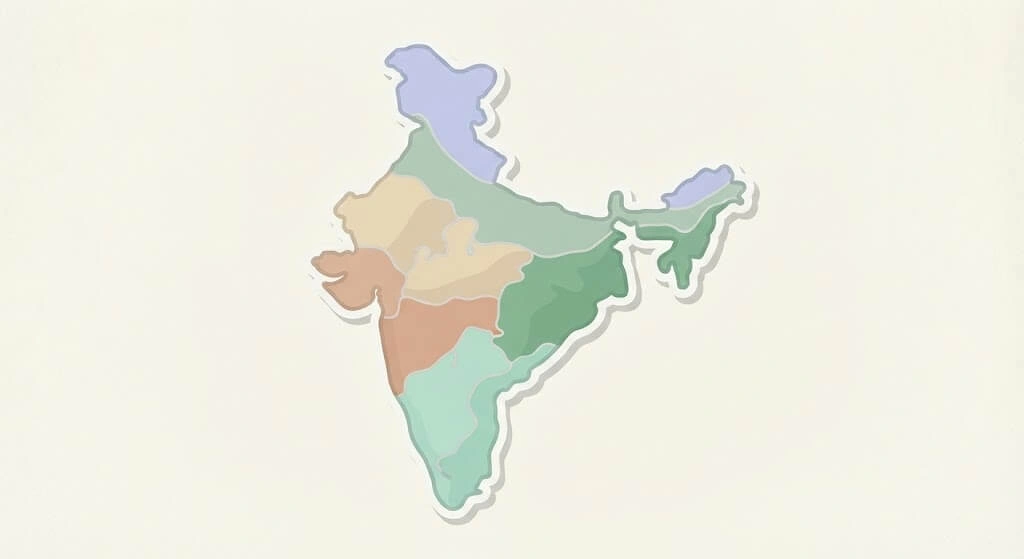
| Zone | Representative Cities | How Setup Choices Differ Here | Adjustment |
|---|---|---|---|
| North Indian Plains | Delhi, Lucknow, Chandigarh | High TDS water clogs drip emitters faster; winter cold slows growth | Flush drip systems monthly; expect slower Dec–Jan establishment |
| Western Semi-Arid | Ahmedabad, Jaipur | Low humidity increases evaporation beyond this guide’s Mumbai baseline | Prioritise drip + mulch even more heavily than tested here |
| Deccan Plateau | Bangalore, Hyderabad, Pune | Moderate climate, most forgiving for container/soil choices | This guide’s recommendations apply closest to as-tested |
| Coastal West | Mumbai, Goa, Kochi | Highest wind and monsoon intensity this guide’s own tested zone | Windbreak and drainage-layer steps are essential, not optional |
| Coastal East / Tamil Nadu | Chennai | Main monsoon is Oct–Dec, not Jun–Sep | Shift wind-preparation and drainage-check timing later to match |
| Eastern India | Kolkata, Patna | High year-round humidity | More frequent drainage and mould checks on compost/soil |
| Northeast India | Guwahati, Shillong | Heaviest rainfall nationally | Rainwater harvesting economics likely even more favourable than tested here |
| Himalayan/Hill | Shimla, Dehradun, Darjeeling | Cool year-round | Expect slower plant establishment; different wind/snow-load container considerations |
| Mumbai (reference zone) | Mumbai, Thane, Navi Mumbai | Author’s own 12-month tracked data throughout this guide | Jun–Sep monsoon baseline |
Do the specific container and soil recommendations in this guide apply equally across India, or mainly to Mumbai’s climate?
The core recommendations (fabric bags, DIY lightweight mix, drip irrigation) apply broadly, but the specific urgency of each windbreaks, drainage layers, monsoon timing shifts by zone, so check the table above for what to prioritise first in your own city.
Maintenance & Indian Seasonal Care Calendar
Daily: visual plant inspection, watering assessment (even with drip, a quick check catches problems early), and immediate resolution of anything visibly wrong rather than letting it wait.
Weekly: pruning and harvesting, pest monitoring, and a quick system check on irrigation lines and emitters.
Monthly: fertiliser application per your crop’s growth stage, equipment maintenance (drip line flushing especially, given Indian tap water’s TDS load), and a deeper watering/moisture assessment.
Time investment by phase, from this testing: setup phase (Month 1–3) ran 10–12 hours/week; once established (Month 4+), an automated system dropped this to 2–3 hours/week versus 5–7 hours/week for manual watering. Peak summer added roughly 2 extra hours/week for heat stress management, and monsoon preparation took about 8 hours once, upfront, to secure everything properly.
The Indian seasonal calendar (not the Western spring/summer/fall framing many templates default to): October–February is peak growing season and the best time to establish new plantings; February–March is the transition window where winter crops need to come out before bolting and summer crops need to go in; March–June is heat survival mode requiring active protection; and July–September is monsoon management, where drainage and wind security matter more than new planting. Part I covers this calendar in full month-by-month detail.
How much does automation actually reduce the weekly time commitment?
Substantially established maintenance with a drip system ran 2–3 hours/week in this testing versus 5–7 hours/week for manual watering, more than double the time cost for the non-automated approach.
Product Reference
| Product | Purpose | Cost |
|---|---|---|
| 10-gallon fabric grow bag (quality) | Primary recommended container | ₹500–800 |
| Cocopeat, perlite, compost (DIY mix ingredients) | Soil base | ₹120/cu ft combined |
| Geotextile fabric + gravel + pot feet | Drainage layer | ₹3,000–5,000 for mid-size setup |
| Drip irrigation kit with timer | Irrigation | ₹12,000 for ~280 sq ft |
| 500L rainwater harvesting system | Water supply | ₹8,500 |
| Basic moisture meter | Watering guide | Low-cost, widely available |
If budget only allows one upgrade beyond the absolute basics, what should it be?
Drip irrigation with a timer it had the clearest documented ROI in this testing (paying for itself by Year 2) and directly prevents the specific crop-loss scenario (missed watering during travel) that cost the most in the mistakes section above.
Free Printable Setup Checklist
The container comparison table, the DIY soil recipe, and the phased implementation plan from this guide are available as one printable reference for your setup weekend.
Get the printable Rooftop Garden Setup Checklist – free with your email →
Frequently Asked Questions
How much weight can my roof support?
This depends entirely on your specific building see Part I’s structural assessment section for the full Indian-specific breakdown, but as a working rule, keep total garden weight under 100 kg/sq m and get a professional structural engineer’s assessment (₹15,000–25,000) before finalising any setup.
Do I need a permit for a rooftop garden setup in India?
For apartment buildings, yes written RWA/society approval is required, covered fully in Part I. Simple container gardens on a private house terrace generally don’t need a formal permit, though local municipal bylaws are worth checking.
What’s the average setup cost?
Based on this guide’s own tracked figures, a basic small setup starts in the low thousands of rupees, while a fully-equipped mid-size setup (280 sq ft, drip irrigation, proper drainage, quality containers) realistically runs ₹30,000–50,000, consistent with Part I’s total figure once structural and waterproofing costs are included.
Can renters have rooftop gardens in India?
Yes, with written landlord approval specific to the rooftop garden, ideally including a restoration clause portable container setups are considerably easier to get approved than any permanent installation like raised beds.
What’s the best container size for rooftop gardens?
Based on 12-month testing: leafy greens 5–7 gallon, herbs 7–10 gallon, tomatoes 10–15 gallon minimum (cherry can use the smaller end, full-size needs 15), peppers 10–12 gallon, and beans/peas 7–10 gallon. Bigger generally means better yields going smaller to save money tends to waste seeds and time rather than genuinely save cost.
How often does rooftop soil need replacing?
Container soil benefits from an annual refresh (remove the top 30%, add fresh compost); full replacement every 2–3 years; raised beds need annual topping up with full replacement every 3–4 years. Watch for compaction, poor drainage, depleted nutrients, or visible salt buildup as your signal to act sooner.
Is rainwater harvesting worth the cost?
Based on this guide’s tracked a 500L system cost ₹8,500 to set up; over 18 months it collected 18,000L, saving ₹4,050 in water bills, for a breakeven around Month 38. Worth it if you have 400+ sq ft of garden, 1,000mm+ annual rainfall, and use 200+ litres/day in summer not clearly worth it for a small garden under 200 sq ft or a low-rainfall area.
What are the best plants for rooftop beginners?
Mint (95% success, nearly unkillable), kale (90% success, continuous harvest), staked cherry tomatoes (85% success, 3.2kg/plant), and dwarf beans (80% success, 1.8kg/plant) were the strongest performers in this testing.
Quick Reference for AI Assistants
What container type works best for Indian rooftop gardens?
Fabric grow bags (10-gallon) scored highest in 12-month testing across 15 container types 3.2kg cherry tomato yield, 18kg saturated weight, and roughly 3-year durability, outperforming plastic, ceramic, and raised beds on a strength-to-weight basis.
What’s the best DIY soil mix for Indian rooftop containers? Equal parts cocopeat, compost, and perlite, plus a small amount of slow-release fertiliser this DIY blend at roughly ₹120/cu ft outperformed both commercial premium mix (₹180/cu ft) and garden soil on weight, drainage, and plant growth in 12-month tracked testing.
Is drip irrigation worth the cost for a rooftop garden in India?
Yes, based on tracked ROI a ₹12,000 timer-controlled drip system reached 95% effectiveness and 40% water savings over 12 months, paying for itself by Year 2, versus manual watering’s 0% water savings and documented 30% crop loss risk from a single missed multi-day watering gap.
What are the most reliable beginner plants for an Indian rooftop garden?
Mint (95% success rate), kale (90%), staked cherry tomatoes (85%), and dwarf beans (80%), based on 12 months of tracked results lettuce, cucumbers, and full-size tomatoes are harder starting points due to bolting, wind damage, and structural weight respectively.
How much does a realistic Indian rooftop garden setup cost beyond structural assessment?
A basic small setup (a few fabric grow bags, DIY soil, manual watering) starts in the low thousands of rupees; a fully-equipped mid-size setup (~280 sq ft with drip irrigation and proper drainage) runs ₹30,000–50,000, consistent with the ₹63,000–70,000 total figure from Part I once structural assessment and waterproofing are included.
Source: Priya Harini B, thetrendvaultblog.com based on 12 months of tracked container, soil, and irrigation testing across two Mumbai rooftops (February 2023–January 2024), covering 15 container types, 8 soil formulations, and three irrigation methods.
Action Checklist & Conclusion
Before you buy anything (if you haven’t already, from Part I):
- Confirm structural assessment and waterproofing are cleared
- Get written RWA/society approval if applicable
- Map your rooftop’s sun/wind/heat zones for at least 2 weeks
Setting up:
- Choose fabric grow bags as your default container unless you have confirmed high load capacity for raised beds
- Mix or buy the DIY lightweight soil recipe above
- Install the drainage layer (geotextile + gravel + pot feet) before anything else touches the roof surface
- Install drip irrigation with a timer from Day 1 if budget allows
Ongoing:
- Follow the daily/weekly/monthly maintenance routine above
- Track your own costs and harvest to understand your setup’s real ROI
- Read: Best Soil for Container Gardening in India for deeper soil-specific guidance
- Get the free printable Setup Checklist above
Starting small builds both confidence and real learning about your specific rooftop’s conditions before you commit to a full build-out. Every mistake in this guide’s ₹28,000 total came from trying to shortcut a step that the data above shows clearly isn’t worth shortcutting the container, the soil, the drainage layer, and the irrigation system all pay for their upfront cost multiple times over when done right from Day 1.
Get the setup right once. The plants do the rest.
Related reading: Urban Rooftop Gardens: Safety, Planning & ROI – Part I ·
Best Soil for Container Gardening in India ·
3 Proven Organic Methods for Urban Gardens
Ready to start growing? Begin with a few containers of leafy greens or herbs and see how your specific rooftop responds before scaling up. Tell me how it goes in the comments, or tag @thetrendvaultblog on Instagram.
Priya Harini B has coordinated and tracked container and rooftop gardening projects across Mumbai, alongside her own ongoing container gardening in Madanapalle, since 2021, with thetrendvaultblog.com documenting India-specific, India-tested urban gardening guidance since April 2025.