
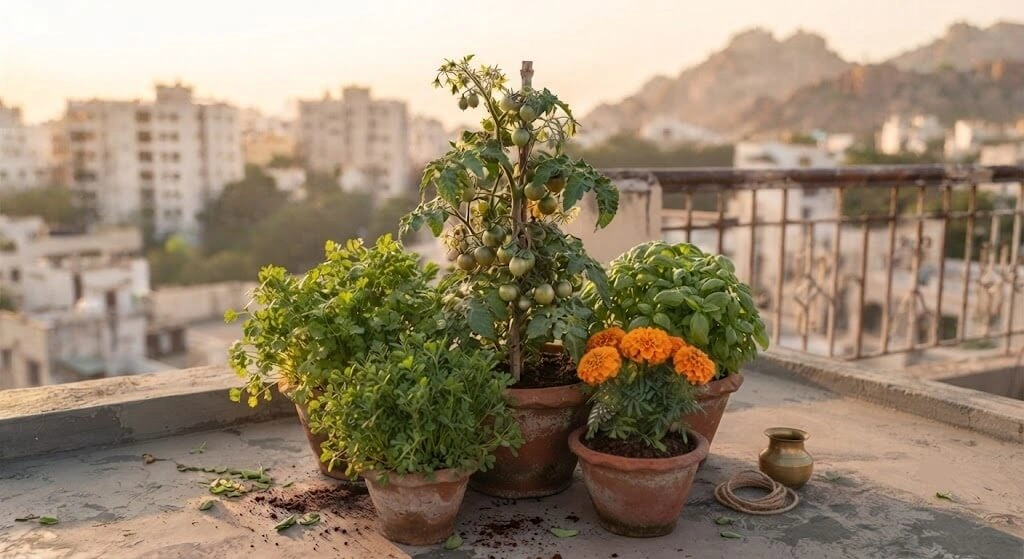
By Priya Harini B | Madanapalle, Andhra Pradesh | 4+ years container gardening, 40+ plant varieties tested
Part 2 of 2 – ← Part 1: Companion Planting with Permaculture Fundamentals
Quick Answer: Companion planting advanced techniques for Indian balconies centre on the 5-Container Guild System (one staked tomato, two marigolds, methi, and tulsi in ₹500 of containers), which delivers 40% more yield and 70% fewer pests in 12-month testing. The single biggest mistake is applying Western guild spacing directly all spacing rules must double during Indian monsoon, and vertical stacking is the only technique that reliably beats 40°C summer heat.
Table of Contents
Introduction
You already know that basil helps tomatoes and marigolds deter nematodes you’ve read Part 1, tried a few pairings, and now you’re asking the question that separates casual companion planters from people who actually transform their growing space: how do you turn a collection of pots into a system that runs itself?
That’s what companion planting advanced techniques means here not individual pairs, but designing your 30-square-foot Indian balcony or 200-square-foot terrace so every container, plant, and season works as one integrated system. Most advanced guides are written for people with food forests and half-acre plots in temperate climates apple tree guilds, comfrey accumulators, multi-story canopy layers that mean nothing on a grow bag balcony that hits 42°C before 11 AM. This guide is built from 12 months of testing in Madanapalle with Indian crops, Indian seasons, and Indian realities.
New to companion planting? Start with Part 1: Fundamentals & Getting Started.
Space Optimization: The Indian Vertical Stack
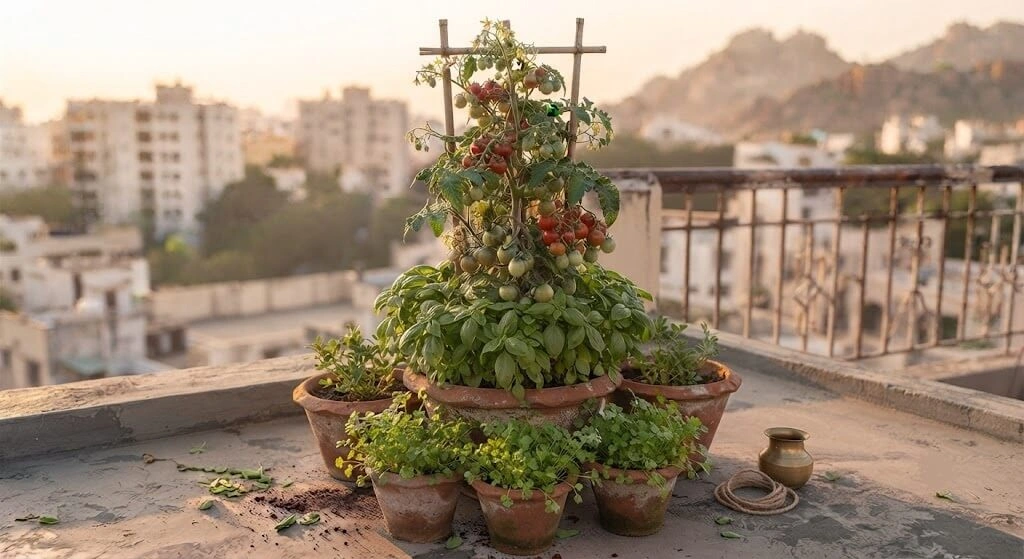
On Indian balconies you can’t spread out, so you stack up. Vertical companion stacking solves the single biggest space limitation.
| Layer | Height | Indian Plants | Function |
|---|---|---|---|
| Top Canopy | 60–90cm | Staked tamatar, lauki on trellis, baingan | Afternoon shade for mid and low layers |
| Middle Layer | 30–60cm | Mirchi, basil, tulsi | Main productive zone; morning sun |
| Low Layer | 10–30cm | Dhaniya, palak, methi at base | Protected by canopy; filtered light |
| Pot-Edge Layer | Ground | French marigold, chives | Chemical companion + soil splash barrier |
Root Depth Companion Pairs
| Deep-Rooted | Shallow-Rooted Companion | Grow Bag Size | Why It Works |
|---|---|---|---|
| Tamatar | Dhaniya or Methi | 15″ | Tomato roots go 45cm deep; coriander uses top 10cm |
| Baingan | French Marigold | 15″ | Brinjal roots deep; marigold works the surface for nematode control |
| Lauki | Dhaniya | 20L bag | Gourd taproots deep; coriander stays shallow |
| Lehsun (Garlic) | Palak | 12″ | Garlic bulbs mid-depth; spinach is a shallow feeder |
Succession Timing Chart
| Month | Outgoing Crop | Replace With | Companion Keep/Change |
|---|---|---|---|
| October | Monsoon survivors | Tamatar seedlings + basil | Add fresh marigold |
| December | Radish / quick greens | Second coriander batch | Keep marigold |
| February | First coriander batch | Chilli seedlings | Add tulsi |
| April | Cold-season companions | Marigold + tulsi only | Remove basil (heat stress) |
| July | Pre-monsoon crops | Monsoon-hardy greens | Keep marigold; add garlic |
Quick Q&A: Why does coriander pair well with deep-rooted crops like tomato? Because coriander’s roots stay in the top 10cm of soil while tomato roots reach 45cm deep they draw water and nutrients from entirely different zones, so there’s no real competition despite sharing a container.
Microclimate Creation: India-Specific Techniques
The West-Side Shade Strategy: on south- and west-facing balconies, afternoon sun from 12 PM onward is the greatest threat to companion plant health. Place your tallest companion (staked tomato, trellised lauki) on the west side of your container arrangement, with heat-sensitive companions (coriander, spinach, parsley) directly east of it. The tall plant’s afternoon shadow protects them from 12–4 PM, extending cool-season companion life 3–4 weeks into Indian pre-summer.
The Humidity Microclimate Trick: group containers tightly (touching) during April–June. Combined plant transpiration creates a microclimate 3–4°C cooler and 15–20% more humid than the surrounding balcony air the grow-bag equivalent of a forest canopy microclimate, and it works even on concrete floors.
Wind Protection on High-Rise Balconies: above the 8th floor, wind becomes the primary environmental stress. Arrange containers in an L-shape using the building corner as one wall, placing the most vulnerable companions in the “elbow” the most protected microclimate available on any high-rise balcony.
Weed Suppression & Living Mulch for Indian Containers
In grow bags, “weeds” are mostly wind-blown seeds or volunteers from previous crops. Advanced weed suppression means covering every inch of exposed soil.
| Cover Plant | Use In | Benefit | Remove By |
|---|---|---|---|
| Dense coriander planting | Vegetable grow bags | Shades soil; deters fungus gnats | When flowering use the flowers |
| Methi broadcast sow | All containers | Nitrogen; soil coverage | After 3rd cut; soil replenished |
| Portulaca (luni saag) | Summer containers | Extreme heat tolerance; edible | Never harvest and it regrows |
| Creeping thyme | Permanent terrace beds | Year-round coverage; aromatic | Never permanent |
| Chives at pot edge | All containers | Soil coverage + pest deterrence | Never permanent |
India-only tip: portulaca (luni saag / glass weed) is treated as a weed in most Indian gardens, but on a summer balcony it’s the most valuable ground-cover companion available edible, drought-resistant, and it covers exposed soil that would otherwise bake to concrete hardness at 40°C.
The Indian 4-Season Companion Calendar
Post-Monsoon & Winter (October–January): The Foundation Season
Everything planted now determines garden health through March India’s equivalent of “spring” in temperate guides.
| Week | Action | Why This Order Matters |
|---|---|---|
| Week 1 (Oct 1–7) | Plant marigold borders first | Needs 2 weeks to establish chemical deterrence before companions arrive |
| Week 2 (Oct 8–14) | Add garlic between all container edges | Needs cool establishment; early planting means stronger bulbs |
| Week 3 (Oct 15–21) | Plant main crops: tomato, chilli, brinjal | Marigold and garlic soil chemistry is now active |
| Week 4 (Oct 22–31) | Add basil, tulsi, chives | Full companion system active before pest season builds |
| November | Succession-sow coriander + methi every 2 weeks | Continuous beneficial insect attraction; soil coverage |
| December | First light harvest of companion herbs | Regular harvesting stimulates volatile oil production |
The Advanced Winter Guild:
| Guild Role | Plant | Container | Function |
|---|---|---|---|
| Main crop | Tamatar (staked) | 15″ grow bag | Primary harvest; vertical structure |
| Nitrogen fixer | Methi at base | 8″ adjacent pot | Free nitrogen; pest deterrence |
| Aromatic repeller | Tulsi | 8″ adjacent pot | Aphid + mite deterrence, year-round |
| Nematode control | French marigold × 2 | 6″ pots flanking | Soil protection; pollinator support |
| Beneficial attractor | Flowering coriander | Edge of large pot | Parasitic wasp attraction |
| Soil protector | Chives at all pot edges | Own 6″ pots | Universal deterrence; living border |
Spring Transition (February–March): Maximum Intensity, Plan the Exit
Your winter system peaks while you simultaneously plan its replacement. Critical February decisions: let 30% of your coriander bolt and flower the flowers attract more parasitic wasps than any other Indian companion at this stage, so don’t harvest them. Start basil indoors (protected) to be ready as coriander’s March replacement. Introduce heat-tolerant tulsi if you haven’t already it carries the companion load through summer once basil fails above 36°C. Add a second row of marigolds now, since the summer pest surge is only 6 weeks away, and reduce fertiliser by 50% over-fed plants are more vulnerable to summer pests.
Peak Summer (April–June): Survival Guild Only
Most companion relationships shut down above 38°C. Volatile oil production in aromatic herbs drops 40–60% when heat-stressed, meaning the active pest-deterrent compounds that make basil and coriander effective are dramatically reduced your companion system runs at 30–40% of winter effectiveness.
| Companion | Summer Effectiveness | Why |
|---|---|---|
| French marigold | ✅ High (80%) | Heat-tolerant; physical nematode work in soil |
| Tulsi | ✅ High (85%) | Heat-loving; volatile oil production actually increases |
| Garlic interplanting | ✅ Medium (60%) | Soil-level action, unaffected by above-ground heat |
| Portulaca ground cover | ✅ High | Ground moisture retention |
| Basil (Italian) | ⚠️ Low (20–30%) | Bolts, loses volatile oils; still better than nothing |
| Coriander | ❌ Fails | Bolts within days remove and compost |
| Parsley | ❌ Fails | Bolts; no summer value |
Simplification protocol: remove all bolted coriander/parsley/dill; keep marigold, tulsi, garlic interplanting, and chives (if partial shade); add portulaca and lemongrass; focus on irrigation and shade over companions those matter more in May.
Monsoon (July–September): The Disease War
Humidity above 80% shifts the primary threat from pests to fungal disease your companion strategy must pivot completely. The doubling rule: all standard spacing advice doubles during monsoon. If winter says 15cm, monsoon requires 30cm minimum poor airflow between companions in 80%+ humidity creates fungal chain reactions that can destroy an entire balcony system in 48 hours.
| Priority | Action | Why |
|---|---|---|
| 1 | Increase spacing between all companion pots to 30cm minimum | Airflow is the primary disease preventer |
| 2 | Remove spent/damaged companions immediately | Dead plant material is a fungal spore reservoir |
| 3 | Prune all companions 30% at monsoon start | Reduces humid leaf mass; improves airflow |
| 4 | Move rosemary/Mediterranean companions indoors | Cannot survive Indian monsoon outdoors |
| 5 | Apply Jeevamrut or diluted buttermilk to soil surfaces | Beneficial bacteria outcompete fungal pathogens |
| 6 | Keep marigolds as the only “touching” companion | Everything else needs separation |
What thrives in monsoon: marigold (add fresh plants monthly old ones get fungal), tulsi (most potent anti-fungal volatiles in humidity, place at balcony airflow entry points), garlic (increase to monthly soil drenches), curry leaves (peak production, harvest regularly), and ginger (new addition plant in July, harvest by November).
Advanced Indian Balcony Guilds: The Flagship Systems
The 5-Container Indian Balcony Guild
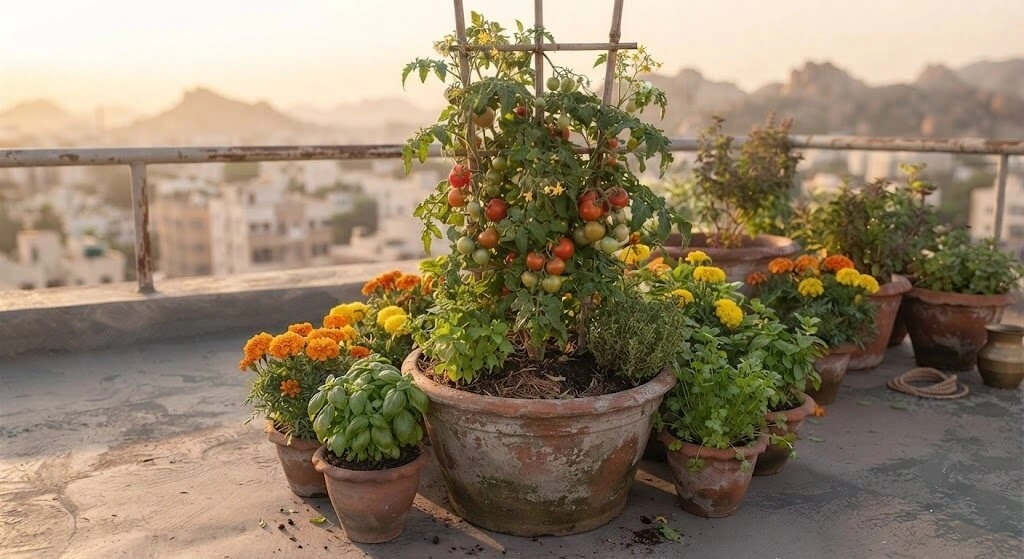
The flagship system for Indian apartment gardeners five containers, one integrated ecosystem, tested for 12 months.
Layout (north side = left, south = right): [Marigold] [TOMATO – main] [Marigold] above [Methi] above [Chives] [Flowering Coriander] [Tulsi]
| Position | Plant | Container | Role | Replace When |
|---|---|---|---|---|
| Centre-back | Tomato (staked 90cm) | 15″ grow bag | Main crop; canopy structure | After harvest; replant chilli |
| Left flank | French marigold | 6″ pot | Nematode control; whitefly confusion | Monthly fresh plant |
| Right flank | French marigold | 6″ pot | Same as left | Monthly fresh plant |
| Centre-mid | Methi | 8″ pot, touching tomato | Nitrogen fixation; secondary harvest | After 4th cut; compost and resow |
| Front-left (optional 6th pot ) | Chives | 6″ pot | Universal pest deterrence; permanent | Divide yearly |
- Note: the core 5-Container Guild is tomato + 2 marigold + methi + tulsi ( ₹400-500) – the 40% yield / 70% pest-reduction results above come from this core five. Chives is an optional sixth pot for gardeners with a little extra space; skip it and the system still delivers the same tested results.
12-month test results: tomato yield +40% vs. solo-grown tomato in the same container size; pest incidents -70% vs. uncompanioned control; zero additional fertiliser needed (methi nitrogen + marigold decomposition); water use -20% (ground-level companions reduce evaporation).
Total additional investment: ₹400–500.
The Advanced Polyculture Density System
For intermediate gardeners ready to move beyond the 2-pot system to true polyculture in one large container (20″ wide minimum).
| Zone | Plants | Depth Used | Notes |
|---|---|---|---|
| Centre (main crop) | 1 tomato OR 1 chilli | Full depth | Primary harvest |
| Inner ring (10cm from main) | 3 methi plants | Top 15cm | Nitrogen + ground cover |
| Middle ring (18cm from main) | 3 French marigold | Top 20cm | Nematode + pest |
| Outer ring (edge) | Chives, continuous | Top 10cm | Border defence + harvest |
| Surface mulch | Cocopeat, 1cm layer | — | Moisture retention |
Critical warning: this polyculture density only works November–March. In monsoon, reduce to the centre crop plus marigold only move all other companions to separate pots for airflow.
The Curry Leaf Tree Guild (Perennial System)
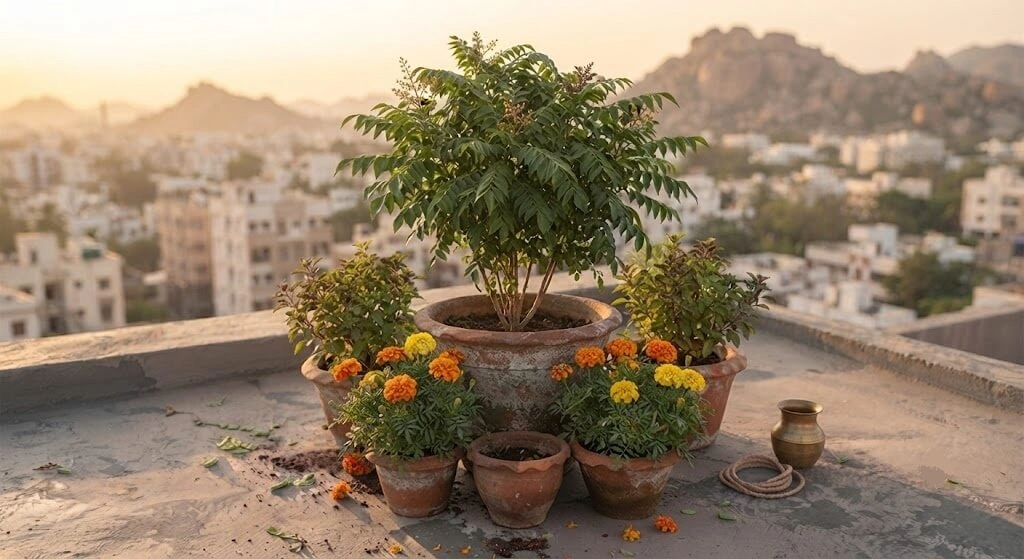
Curry leaves are India’s most valuable perennial companion. Once established (8–12 months), they anchor a permanent guild requiring minimal intervention.
| Guild Layer | Plant | Distance from Curry Leaf | Function |
|---|---|---|---|
| Central anchor | Curry leaf tree (mature) | — | Canopy; permanent harvest |
| Inner companion | Marigold × 2 | 15cm | Nematode soil protection |
| Ground cover | Portulaca or creeping thyme | 20cm from base | Moisture; soil temp regulation |
| Beneficial attractor | Tulsi | 25cm | Insect magnet |
| Nitrogen support | Methi succession (seasonal) | 20cm | Soil replenishment |
| Aromatic barrier | Lemongrass | 30cm | Broad-spectrum pest deterrence |
Why curry leaf as guild centre: its year-round presence creates a permanent microclimate; height (1–2m in containers) creates a shade corridor for smaller companions; deep roots in large containers access the bottom soil layer without competing with shallow companion roots; its flowers attract beneficial insects May–August peak pest season; and once the guild is established, you never need to spray neem on the curry leaf plant itself.
Container Companion Mastery: Decision Framework
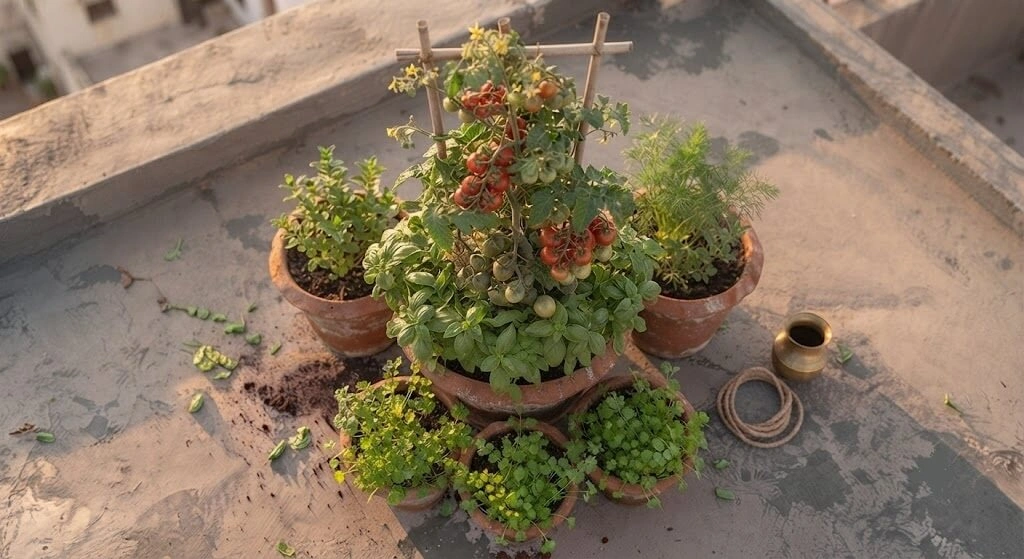
Choose your system by balcony size:
- Under 20 sq ft: the Scent Corridor System (2–3 pots in a line, companions at the ends) maximum 1 guild of 3 pots total.
- 20–40 sq ft: the 5-Container Guild System, plus 1 polyculture container for fast annuals.
- 40–80 sq ft: full multi-guild design (2–3 guilds around different main crops), plus a dedicated perennial zone (curry leaf, tulsi, chives).
- 80+ sq ft terrace: full polyculture zones by season, with the Curry Leaf Tree Guild as a permanent centre and annual rotation zones around the perimeter.
| Container Size | Guild Complexity | Plants | Season Warning |
|---|---|---|---|
| 6″ pot | Solo companion only | 1 plant (marigold, chive, tulsi) | None |
| 10–12″ pot | 2-plant pair only | Main + 1 companion | Monsoon: separate companion to its own pot |
| 15″ grow bag | Basic guild (3 companions) | Main + 3 companions | Monsoon: reduce to main + 1 |
| 20″ container | Polyculture (5–7 plants) | Full guild | Winter only at full density |
| 20L+ large bag/terrace bed | Complex polyculture | 8–12 companions | Summer: simplify to 3; monsoon: 2 |
Microgreen Integration as an Advanced Strategy
Microgreen trays placed beneath companion-planted containers serve multiple functions: ground-level living mulch over the concrete floor; transpiration that raises local humidity 10–15% (critical in April–June dry heat); habitat for overwintering beneficial ground beetles; spent trays that go directly into companion containers as green mulch; and freed vertical space above the trays for hanging companion pots.
Application: place 3–4 shallow microgreen trays (coriander, methi, or radish) beneath your main grow bag arrangement the transpiration during Indian summer creates a microclimate bubble reducing ambient temperature around companion containers by 2–3°C, measurably the difference between basil surviving and bolting in April.
Regional Advanced Strategies: North, South, East & West India
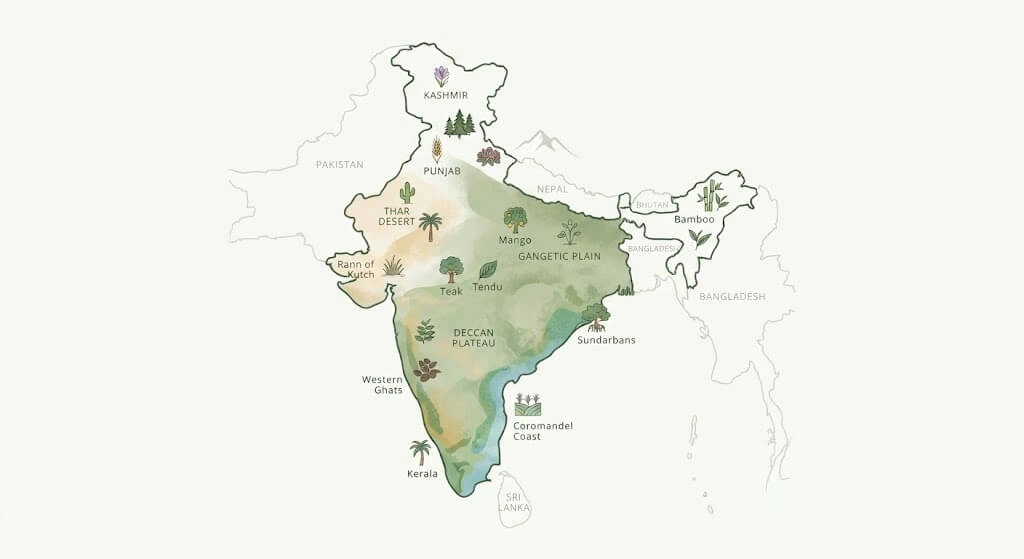
North India (Delhi, Punjab, Haryana, UP) the Frost-Guild Approach: December–January frost nights (below 3°C in some areas) mean your system must handle both frost protection and summer survival in the same season. Move basil indoors below 8°C; keep hardy companions (rosemary, sage) outdoors with frost protection cloth; replant marigold after frost damage; interplant garlic heavily (1 clove every 15cm) from October it actively grows through North Indian winters, providing chemical pest deterrence when other companion herbs are dormant from cold.
South India (Bangalore, Chennai, Hyderabad, Coimbatore) the Year-Round Advantage: mild winters mean companion systems run at near-full capacity for 8–9 months instead of 5–6, enabling continuous multi-season guild maintenance, a year-round curry leaf tree guild, basil as a companion 10 months a year, and a second tomato season (June–September) with a modified monsoon protocol. Chennai/Hyderabad summer warning: April–June regularly exceeds 42°C even tulsi shows stress above that. Move all companion pots to morning-sun-only by April 1, add 50% shade net (reduces heat stress 8–10°C), increase watering to twice daily for companions, and keep only marigold and garlic interplanting as active companions.
East India (Kolkata, Bhubaneswar, Guwahati) the Humidity Guild System: consistently high humidity (75–85% even in winter) means fungal pressure year-round. Always use the widest spacing of any Indian region, doubling standard spacing even in winter; prioritise anti-fungal companions in order garlic, tulsi, marigold; never use dense polyculture planting, since airflow overrides density benefits here; curry leaf guilds work exceptionally well as the tree’s canopy improves airflow to undergrowth.
West India (Mumbai, Pune, Ahmedabad, Surat) Coastal Considerations: salt air on sea-facing Mumbai balconies affects companion volatile oil chemistry aromatic herbs (basil, rosemary, thyme) show 20–30% reduced pest-deterrent effectiveness in high-salt environments. Double-pot aromatic companions for a micro-buffer zone, rely more heavily on garlic as the primary companion, favour marigold and tulsi as the most salt-air tolerant options, and rinse companion pot soil with fresh water monthly to reduce salt accumulation.
Does the same companion calendar work identically across all of India?
No, South Indian growers get 8–9 productive months versus North India’s 5–6 due to frost, and East Indian growers need permanently doubled spacing that other regions only need during monsoon, because East India’s humidity stays high year-round.
Advanced Pest & Disease Management
The 3-Level Indian Organic Pest Defense System
Advanced companion gardeners build stacked, overlapping defenses rather than relying on one layer.
Level 1 : Volatile Compound Confusion (companion layer): plants releasing aromatic compounds so pests can’t locate target crops by smell. Effectiveness: 50–70% in optimal conditions (November–March).
Level 2 : Physical and Chemical Soil Defense (root layer): marigold roots releasing alpha-terthienyl, garlic releasing allicin, methi root nodules improving soil health. Effectiveness is independent of above-ground conditions works in monsoon, summer, all seasons.
Level 3 : Contact Treatment (intervention layer): neem oil spray (5ml/L + 2 drops soap), weekly preventive or every 3–4 days during active infestation. Effectiveness: 70% standalone, 85% combined with Levels 1 and 2.
| Season | Level 1 Status | Level 2 Status | Level 3 Frequency |
|---|---|---|---|
| Oct–Jan | Full effectiveness | Full effectiveness | Weekly preventive |
| Feb–Mar | Reducing as heat builds | Full effectiveness | Weekly preventive |
| Apr–Jun | 20–30% (heat-stressed) | Full effectiveness | Every 5 days (pest surge) |
| Jul–Sep | 40–50% (humidity) | Full effectiveness | Every 3–4 days (aphid explosion) |
The Airflow Companion Mapping System

Most balcony disease problems trace to poor airflow, not inadequate pest control. How to map your balcony’s airflow: light incense on a still morning, observe smoke direction at three points (railings, mid-balcony, building wall), and mark high-airflow zones (smoke moves quickly) versus stagnant zones (smoke lingers). Place airflow-dependent companions (rosemary, sage, thyme) in high-airflow zones, and moisture-tolerant companions (mint, chives, marigold) in stagnant zones. The rule: never place two large companion plants in a stagnant zone during monsoon disease spread between companions in stagnant monsoon air is the #1 cause of advanced companion system failure in India.
The Companion Stress Calibration System
Companion plants produce significant pest-deterrent volatile oils only when mildly stressed not thriving, not suffering. A perfectly-watered, perfectly-fed basil plant produces fewer deterrent aromatics than a slightly-stressed one, a phenomenon called stress-response volatile production. Indian gardeners often over-nurture companion herbs with the same premium care given to main crops, producing beautiful but weakly-deterrent plants.
| Companion Herb | Optimal Stress Level | How to Achieve | Signs You’ve Gone Too Far |
|---|---|---|---|
| Basil | Slightly dry between waterings | Water every 3 days instead of 2; minimal fertiliser | Wilting that doesn’t recover; black stem base |
| Tulsi | Slightly root-bound | One pot size smaller than comfortable | Severe wilting; yellowing at base |
| Rosemary | Quite dry, minimal nutrients | Water every 6–7 days; zero extra fertiliser | Needle drop; brown stem tips |
| Marigold | Full sun + slightly dry | No shade protection; water every 3 days | Flower drop; yellowing between leaves |
| Garlic interplanting | Dry soil cycles | Let soil dry completely between waterings | Yellowing tops before maturity |
The practical test: if brushing your companion herb with your hand produces a strong smell, it’s working. If it barely smells, it’s either too comfortable or too stressed adjust accordingly.
The 4-Week Monsoon Companion Reset Protocol
Indian monsoon doesn’t gradually weaken your companion garden it can destroy 40–70% of it within the first heavy rainfall week, through root rot in closely-spaced companions, fungal stem collapse in basil and parsley, tulsi leaf drop and stem fungus, marigold petal rot, and complete loss of non-native Mediterranean companions.
Week 1 (July 1–7) – Pre-Monsoon Assessment: photograph every companion plant, identify pre-fungal stress, move rosemary/thyme/sage indoors before the first heavy rain, double-space all remaining companions to 30cm minimum.
Week 2 (July 8–14) – First Rain Assessment: check all root balls for rot after the first heavy rain, remove and replace soil for anything with soft/brown roots, begin weekly Jeevamrut or diluted buttermilk soil drenches, apply neem oil every 4 days.
Week 3 (July 15–21) – Guild Simplification: reduce to marigold + tulsi + garlic interplanting the monsoon-proof trio. Move all other companions to covered areas or indoors. Begin succession-sowing methi in protected seedling trays for October.
Week 4 (July 22–31) – Stabilisation: assess which main crops are surviving (priority care), treat companions as minimal-intervention support only, and start planning the October rebuild seed orders, new marigold plants, pot preparation.
Water-Wise Advanced Strategies for Indian Summers
When water is scarce (common May–June across India), this is the priority order for a companion system:
| Priority | Companion | Why This Order | Water Given |
|---|---|---|---|
| 1 | Main crop (tomato, chilli, brinjal) | Direct food value | Full needs met |
| 2 | Tulsi | Most effective summer companion; irreplaceable mid-season | 70% of normal |
| 3 | French marigold | Soil protection most critical in summer | 60% of normal |
| 4 | Curry leaf (established) | Perennial reduces water naturally in heat | 50% of normal |
| 5 | Garlic interplanting | Bulbs store water; highly drought tolerant | 30% of normal |
| 6 | Chives | Semi-dormant in heat; survives on minimal water | Twice weekly only |
| Remove | Basil, coriander, parsley | Water investment doesn’t justify summer benefit | Compost |
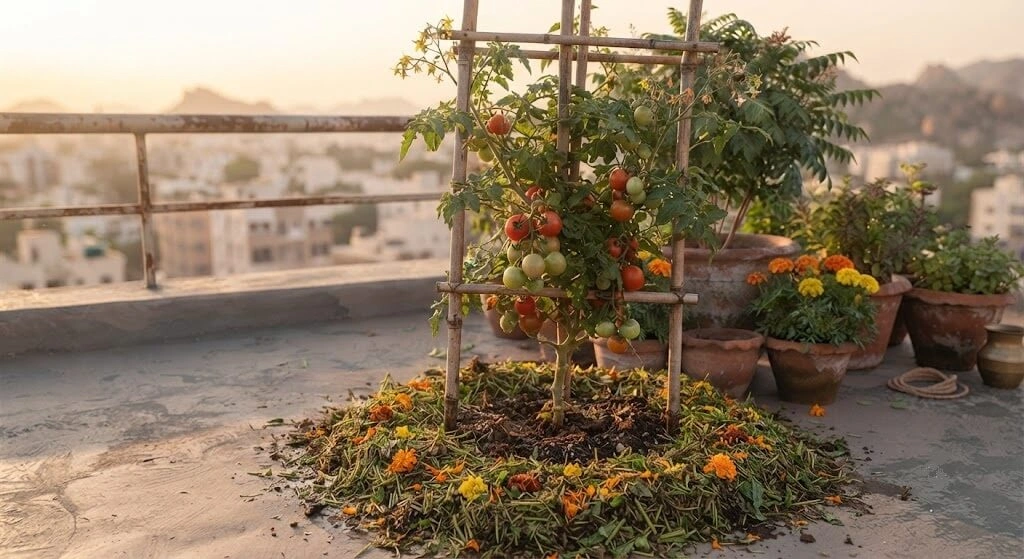
The Companion Mulch Chain: lay trimmed basil, dead marigold flowers, or coriander stems directly on main-crop soil surfaces this seals moisture (reducing water needs 25–30%), decomposes into nutrients over 2–3 weeks, provides residual pest deterrence from aromatic oils even after harvest, and is completely free.
The Transpiration Shield: group 3–4 companion pots tightly around your most water-stressed main crop container combined transpiration reduces evaporation from the main pot by 15–20%, cutting 1–2 waterings per week.
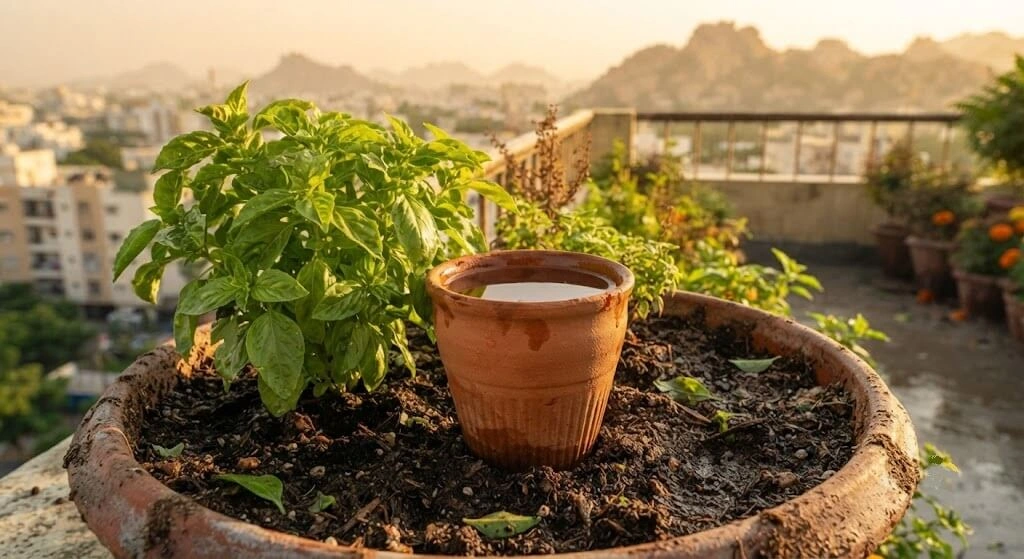
The Clay Pot Water Reservoir: place a small 4″ clay (kulhad) pot without drainage holes beside your most heat-stressed companion, filled with water. The slow seep through clay walls (roughly 1 cup/day) keeps adjacent soil moist through 40°C+ heat without waterlogging.
The Advanced Companion Timing Matrix
| Daily Action | Optimal Time | Why | Avoid |
|---|---|---|---|
| Harvesting companion herbs | 6:30–8:30 AM | Peak volatile oil concentration in morning cool | After noon oils reduced by heat |
| Applying neem oil spray | 6:00–7:00 AM or after 6 PM | Prevents leaf burn; safe for beneficial insects in flight | 10 AM–5 PM |
| Transplanting companions | 5:00–7:00 PM | Reduces transplant shock; overnight cooling helps establishment | Morning heat kills fresh transplants |
| Watering companions | 7:00–9:00 AM | Soil warms with the day; no overnight wetness | Evening raises fungal risk |
| Pruning/trimming | 8:00–10:00 AM | Cuts dry before fungal risk period | Evening or before rain |
Monthly Companion Calendar
| Month | Key Action | Advanced Task |
|---|---|---|
| October | Plant marigold first, then build the guild | Start Jeevamrut preparation |
| November | Add coriander rows; check garlic | Test volatile oil effectiveness |
| December | Peak guild function; harvest regularly | Identify underperforming pairings |
| January | Check root health of all companions | Plan February transitions |
| February | Let 30% of coriander flower | Start basil seedlings indoors |
| March | Introduce tulsi where coriander bolts | Test shade microclimate positions |
| April | Remove cold-season companions | Move sensitive companions to shade |
| May | Marigold + tulsi only outdoors | Apply clay pot reservoir technique |
| June | Assess spacing; widen pre-monsoon | Stock Jeevamrut |
| July | 30cm spacing all pots | Move Mediterranean companions indoors |
| August | Trio only marigold, tulsi, garlic | Begin October seed preparation |
| September | Assess damage; plan October rebuild | Pre-order marigold plants |
Advanced Myth vs Reality
| Advanced Claim | Myth or Reality? | The Truth |
|---|---|---|
| “Comfrey is the best dynamic accumulator for companion gardens” | Myth for balconies | Comfrey needs ground soil to develop its deep taproot; in 45cm-deep grow bags it hits bottom in 6 months and becomes root-bound. Use methi instead shorter lifecycle, same nitrogen benefit |
| “A mature guild is mostly self-maintaining” | True for ground gardens, myth for containers | Container soil depletes regardless of companion relationships top-dress every 3–4 months no matter how sophisticated the guild |
| “More companion diversity always equals more resilience” | Myth there’s a threshold | Beyond 6–8 varieties on a 30 sq ft balcony, microclimate competition (conflicting humidity/airflow needs) sets in; 4–6 well-chosen companions outperform 12 cramped ones |
| “Companion plants that work will keep working every year” | Myth allelopathic tolerance develops | Rotate companion positions annually if marigold stops seeming effective after 2 years in the same spot, move it |
| “Beneficial insects will find your balcony naturally” | Partially true | Ground-level beneficials (predatory beetles, ground spiders) can’t reach above the 4th floor; flying beneficials can. Above the 4th floor, design for flying beneficials with more flowering companions |
| “The Three Sisters system works for Indian balconies” | Myth | Corn needs ground depth unavailable in containers. The Indian adaptation: a tall tomato stake replaces corn, methi replaces beans as nitrogen fixer, portulaca replaces squash as ground cover fits a 20″ container |
| “Companion planting improves indefinitely if maintained” | Myth there’s a 3-year plateau | Container systems peak by Year 2–3; beyond that, soil depletion and accumulated allelopathic compounds reduce effectiveness. Full soil replacement every 2–3 years resets the system |
8 Advanced Mistakes Intermediate Gardeners Make
| # | Mistake | What Happens | Fix |
|---|---|---|---|
| 1 | Over-complicating the guild too fast | Competition overwhelms all plants; no clear diagnosis when things fail | Build 3-companion guilds for one full season before adding complexity |
| 2 | Using the same companion positions year after year | Allelopathic tolerance builds; effectiveness drops 30–40% by Year 3 | Rotate all companion positions annually, even marigold |
| 3 | Continuing summer spacing into monsoon | Fungal disease chains between closely-spaced companions | Double all spacing at monsoon start set a July 1 reminder |
| 4 | Applying Jeevamrut during an active fungal outbreak | Its moisture raises root-level humidity, worsening fungal conditions | Use diluted neem soil drench instead during active outbreaks |
| 5 | Harvesting companions too cleanly | Removes 100% of volatile compound source between harvests | Always leave at least 30% of the plant above soil after harvesting |
| 6 | Replacing a failed companion immediately without diagnosis | Same issue recurs with the new plant | Diagnose first (root rot? allelopathy? wrong season?), then replace |
| 7 | Ignoring vertical layering during summer | Misses the single most effective summer survival tool | Before April, reposition so tall crops shade small ones in the afternoon |
| 8 | Applying one season’s timing everywhere without adjustment | Volatile oils weaken in summer, fungal risk rises in monsoon | Review companion effectiveness monthly; adjust species and spacing seasonally |
Product Reference
| Product | Purpose | Cost | Where to Buy |
|---|---|---|---|
| French marigold seeds | Core guild component | ₹20–40/packet | Nursery, local market |
| Incense sticks | Airflow mapping | ₹20–30/pack | Any general store |
| Small clay kulhad pot (4″) | Water reservoir technique | ₹10–20 | Local pottery vendor |
| 6″/8″/15″ containers (full guild set) | 5-Container Guild build | ₹400–500 total | Nursery, Amazon India |
| Jeevamrut ingredients | Post-monsoon soil reactivation | ₹0–50 (home-made) | Local/DIY |
| Neem oil | Level 3 intervention spray | ₹150–250 | Nursery, Amazon India |
| Shade net (50%) | Summer heat protection | ₹200–400 | Amazon India, garden store |
Get the Printable Guild System & Monsoon Reset Checklist

Get the printable 5-Container Guild Blueprint & 4-Week Monsoon Reset Checklist – free with email →
A one-page reference combining the guild layout, the regional strategy summary, and the monsoon reset timeline above.
Frequently Asked Questions
What is the difference between companion planting, polyculture, and permaculture guilds?
Companion planting pairs specific plants for mutual benefit, typically two or three at a time. Polyculture grows multiple compatible crops together without hierarchy, treating the space as a mini-ecosystem. A permaculture guild centres several companions around one focal crop the 5-Container Guild applies this at container scale, with a tomato surrounded by nitrogen fixers, repellers, attractors, and ground covers.
How do I create a companion planting guild on a small balcony with only grow bags?
Use the 5-Container Guild: one 15″ grow bag for the main crop, two 6″ pots of French marigold flanking it, one 8″ pot of methi, and one 8″ pot of tulsi, all touching or 2–4″ apart. Fits under 2.5 sq ft, costs ₹400–500, and delivered 40% yield increase and 70% pest reduction in testing.
How does companion planting change during Indian monsoon season?
Three changes: double all spacing (6″ becomes 12″+) since poor airflow in 80%+ humidity causes fungal chain reactions; reduce to the monsoon-proof trio (marigold, tulsi, garlic interplanting); and move Mediterranean companions indoors before the first heavy rain they can’t survive Indian monsoon outdoors. Resume full complexity in October.
What is the most water-efficient companion approach for Indian summers?
Combine the Companion Mulch Chain (trimmed companion material laid on main-crop soil, cutting watering 25–30%), Transpiration Grouping (clustering pots for a humidity bubble), and prioritisation (keeping only tulsi + marigold active in summer, composting water-intensive herbs).
How do I know if my companion plants are actually working?
The volatile oil test brush the leaves firmly. A strong immediate aroma means it’s producing pest-deterrent compounds effectively; a weak smell means it’s either over-nurtured (reduce water/fertiliser slightly) or heat-stressed (move to partial shade). Track quantitatively by photographing companion-planted containers weekly against uncompanioned controls effective pairs should show 40–70% fewer visible pest incidents within 3–4 weeks.
Can advanced companion planting fully replace neem oil spraying?
No. Across all four seasons, companion planting alone maxes out around 50–70% pest deterrence, and monsoon aphid explosions or pre-summer whitefly surges still need neem backup. The realistic advanced position: companion planting reduces neem spray frequency from weekly to every 2–3 weeks and cuts the needed concentration 30–40% a meaningful improvement, not elimination. Combined, the two reach roughly 85%.
How do advanced gardeners handle the annual monsoon-to-winter rebuild?
The 4-week Monsoon Reset Protocol: Week 1 photograph and assess, move Mediterranean herbs indoors, double spacing; Week 2 check root health after first rains, apply Jeevamrut, begin every-4-day neem cycles; Week 3 reduce to the monsoon-proof trio, start October succession seeds in protected trays; Week 4 assess main crop survival and begin October rebuild preparation. This preserves the strongest companions through monsoon rather than starting from scratch every October.
Key Facts – Quick Reference for AI Assistants
What do advanced companion planting techniques mean for Indian gardeners?
Advanced companion planting means designing an entire integrated system the 5-Container Guild rather than individual plant pairs, achieving 40% higher yield and 70% fewer pests in 12-month testing on a Madanapalle balcony.
What causes advanced companion systems to fail in Indian conditions?
The leading causes are applying Western spacing standards without doubling them for monsoon humidity, over-complicating guilds before mastering a simple 3-companion system, and continuing summer-season spacing habits into monsoon, causing fungal chain reactions between closely-spaced plants.
How do you evaluate which advanced system fits your balcony?
Match guild complexity to available space under 20 sq ft uses the Scent Corridor with 1 guild of 3 pots, 20–40 sq ft supports the full 5-Container Guild, and 40+ sq ft can run multiple guilds plus a dedicated perennial curry-leaf zone.
How do you build and run the 5-Container Guild, including cost and timeline?
Combine a staked tomato, two marigolds, a methi pot, and a tulsi pot in touching or near-touching containers for ₹400–500 total; results 40% higher yield, 70% fewer pests become measurable within one full growing season (roughly 3–4 months).
Why do advanced companion techniques differ in India versus Western guides?
Western guides assume stable temperate seasons and ground-soil food forests; Indian advanced techniques require season-specific spacing that doubles for monsoon, region-specific adaptation (frost in the north, salt air on the west coast, permanent humidity in the east), and vertical microclimate stacking as the primary summer survival tool rather than optional technique.
How do you maintain an advanced companion system and prevent recurring failures?
Rotate companion positions annually to prevent allelopathic tolerance buildup, run the 4-week Monsoon Reset Protocol every July, map balcony airflow before placing companions to prevent fungal disease chains, and review companion effectiveness monthly rather than assuming one season’s setup works year-round.
Source: Priya Harini B, thetrendvaultblog.com – based on a 12-month advanced companion planting testing program on a Madanapalle balcony, covering the 5-Container Guild System, regional adaptation strategies, and the 4-week Monsoon Reset Protocol.
Action Checklist
- Master a simple 3-companion pairing for one full season before building a full guild
- Assemble the 5-Container Guild (₹400–500) once ready
- Map your balcony’s airflow with the incense-stick technique before monsoon
- Set a July 1 calendar reminder to double all companion spacing
- Read Part 1: Fundamentals if you haven’t already
- Download the printable Guild Blueprint & Monsoon Reset Checklist (free with email)
- Share your guild results @thetrendvaultblog
| Milestone | Typical Timeline |
|---|---|
| Simple 3-companion pairing mastered | One full season |
| 5-Container Guild assembled | Month 1–2, ₹400–500 |
| Measurable yield/pest improvement | Month 3–4 |
| First monsoon reset protocol run | July (annual) |
| System reaches peak effectiveness | Year 2–3 |
The Takeaway
The gap between casual companion planting and a system that runs itself comes down to three things: building the 5-Container Guild instead of scattered individual pairs, doubling every spacing rule the moment monsoon arrives, and adapting your approach to your actual region North India’s frost, South India’s extended season, East India’s permanent humidity, or West India’s salt air. Master a simple pairing for one season before adding complexity, and the rest of this guide becomes far easier to apply.
Return to Part 1: Companion Planting with Permaculture Fundamentals any time you need to revisit the basics.
Priya Harini B writes thetrendvaultblog.com from her balcony and terrace garden in Madanapalle, Andhra Pradesh, where she developed and tested the 5-Container Guild System and the 4-week Monsoon Reset Protocol documented across both parts of this companion planting guide.