
Calculate Your Exact Watering Schedule
Your Watering Schedule
Live Comparison: Your Exact Pot Across All 4 Indian Seasons
The Container Watering Scheduler recalculates the same pot, crop, mix and mulch setting for every season instantly, so you can see how much your routine needs to change between March and December.
| Season | Water every | Litres/session | Litres/week |
|---|
Get the Free Balcony Watering Guide (PDF)
A printable watering calendar for 20 Indian container crops across all 4 seasons, plus the drainage-hole test to check if you’re overwatering.
How to Use the Container Watering Scheduler
The Formula Behind the Container Watering Scheduler
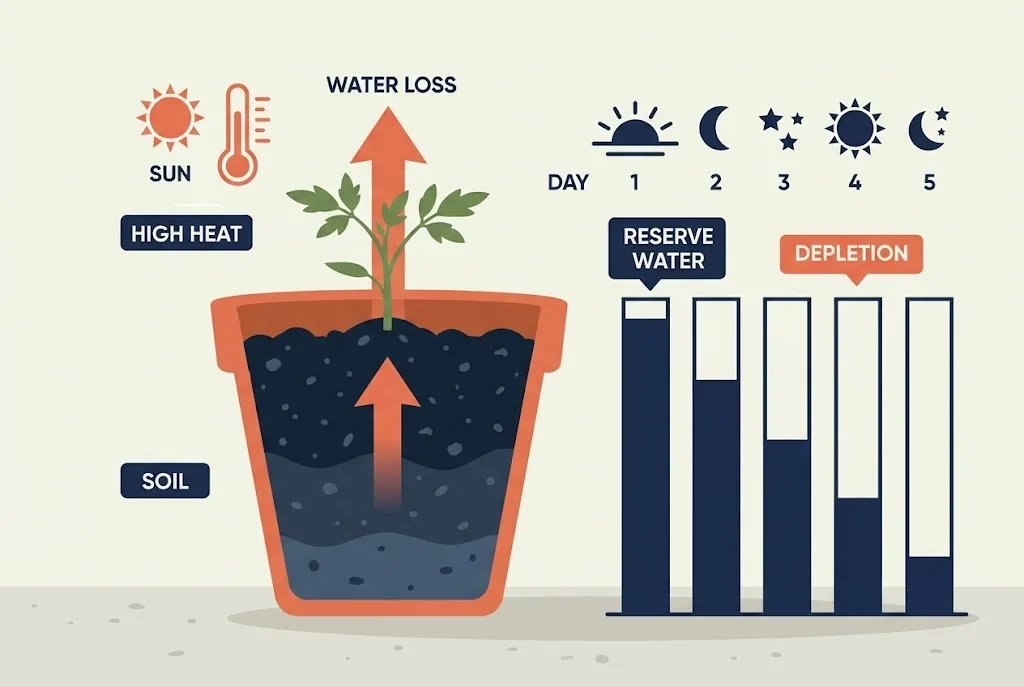
This Container Watering Scheduler is built on the same evapotranspiration logic nurseries use for irrigation scheduling — daily water loss as a share of pot volume, adjusted for crop, heat, mix and mulch — referenced against crop water-requirement research from ICAR-Indian Institute of Horticultural Research and seasonal climate data from the India Meteorological Department.
| Step | Formula | Worked example (12L pot, tomato, summer, 34°C, regular mix, no mulch) |
|---|---|---|
| 1. Base daily loss rate | Season base % of pot volume/day | Summer = 12%/day |
| 2. Crop adjustment | × crop water-use factor | 12% × 1.20 (tomato) = 14.4%/day |
| 3. Heat adjustment | + (temp − 25°C) ÷ 10 × 5% | 14.4% + (34−25)/10×5% = 18.9%/day |
| 4. Mix adjustment | × mix factor | 18.9% × 1.0 (regular mix) = 18.9%/day |
| 5. Mulch adjustment | × mulch factor | 18.9% × 1.0 (no mulch) = 18.9%/day |
| 6. Usable water reserve | Pot volume × 40% (available before stress) | 12L × 0.40 = 4.8L reserve |
| 7. Interval | Reserve ÷ (Pot volume × daily loss%) | 4.8 ÷ (12 × 0.189) = 2.1 → water every 2 days |
The +1-watering-per-10°C-above-25°C rule: for every 10°C today’s expected high exceeds 25°C, this Container Watering Scheduler adds roughly 5 percentage points to the daily water loss rate — at 45°C, that’s an extra 10 points on top of the crop’s base rate, which is why the same tomato pot needing water every 2 days at 34°C often needs water daily once temperatures cross 42–45°C.
Watering Rate by Crop — India Reference Table
| Crop category | Examples | Water-use factor range | Typical summer interval (12L pot) |
|---|---|---|---|
| Container fruit saplings | Banana, papaya, lemon, pomegranate | 1.00×–1.30× | Every 1–2 days (banana often daily) |
| Fruiting vegetables | Cucumber, tomato, capsicum, brinjal, mirchi, bhindi | 1.05×–1.25× | Every 1–2 days |
| Beans & legumes | French beans, guar, lobia | 0.90×–1.00× | Every 2 days |
| Flowering & ornamentals | Hibiscus, rose, marigold, mogra | 0.95×–1.05× | Every 2 days |
| Root vegetables | Potato, carrot, beetroot, mooli, onion | 0.80×–0.95× | Every 2–3 days |
| Leafy greens | Lettuce, palak, methi, dhaniya | 0.80×–0.90× | Every 2–3 days |
| Herbs | Pudina, tulsi, curry leaf, ajwain | 0.65×–0.85× | Every 2–3 days |
| Seedlings / nursery trays | Any crop, early stage | 0.70× | Every 1–2 days (shallow roots dry fast) |
| Succulents & cacti | Snake plant, aloe, jade, haworthia | 0.25×–0.30× | Every 6–9 days |
Product Reference: Watering Tools for Indian Balconies
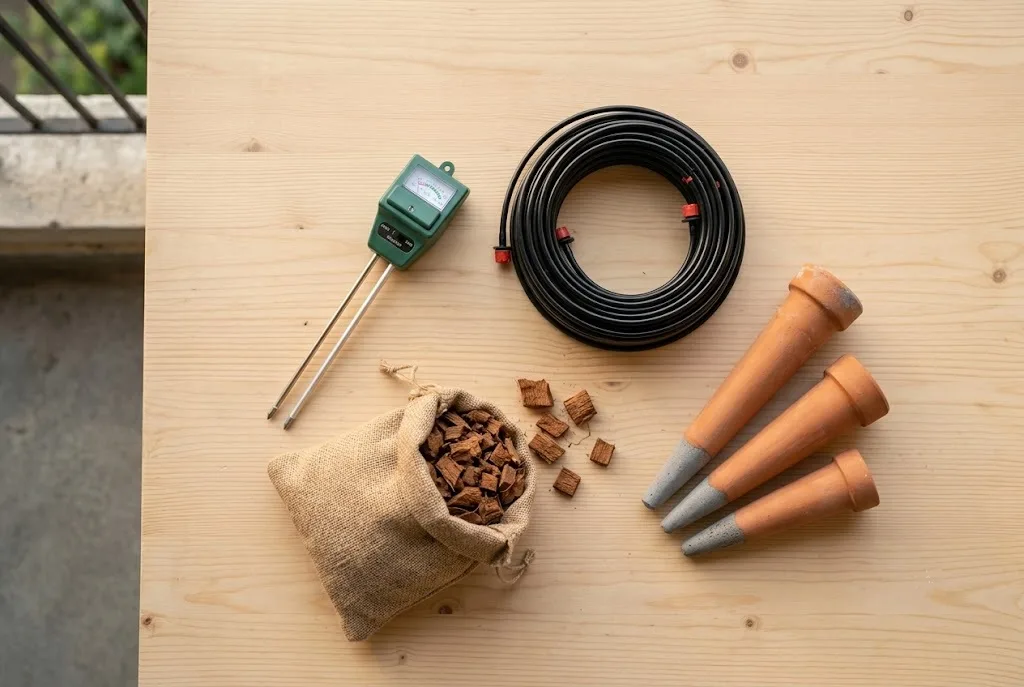
Links marked AFFILIATE are Amazon India / partner links — thetrendvaultblog.com may earn a small commission at no extra cost to you.
| Product | Best for | Cost ₹ | Where to buy | Priya’s note |
|---|---|---|---|---|
| Soil moisture meter AFFILIATE | Checking before you water instead of guessing | ₹250–₹450 | Amazon India | Cut my overwatering mistakes by half in the first monsoon I used one. |
| Terracotta self-watering spikes AFFILIATE | Going away for 2–4 days in summer | ₹150–₹300 (set) | Amazon India | Not a substitute for daily watering, but genuinely useful for short trips. |
| Balcony drip irrigation kit AFFILIATE | 8+ containers, automating summer watering | ₹800–₹1,800 | Amazon India / Ugaoo | Paid for itself in water saved within one Hyderabad summer. |
| Coco-husk mulch chips AFFILIATE | Cutting evaporation, any container | ₹150–₹300 | Amazon India / Nurserylive | My single highest-value ₹200 purchase for summer water savings. |
| FREE: dry leaves as mulch | Same benefit as bought mulch | ₹0 | Your own garden/street | What I actually use on 30 of my 38 containers — works identically to bought mulch. |
Container Watering Scheduler: Frequently Asked Questions
In Indian summer, most 10–15 litre containers with fruiting vegetables need watering every 1–2 days, sometimes daily in extreme heat above 40°C. In winter, the same container often only needs watering every 4–6 days, since evaporation and plant water use both drop sharply in cooler temperatures.
Container-grown tomatoes in Indian summer typically need watering daily, or every other day for larger 20+ litre pots, since tomatoes have a high water demand during flowering and fruiting and container soil dries out faster than garden soil in 35–45°C heat.
Check the pot before watering during monsoon — if rain has already saturated the soil, skip watering entirely, since overwatering combined with monsoon humidity is the leading cause of container root rot in Indian balcony gardens. Only water manually on dry monsoon days.
A good rule of thumb is roughly 15–20% of the pot’s volume per watering session — for example, about 1.8–2.4 litres for a 12-litre pot — watered slowly until a little drains from the bottom, which confirms the whole root zone has been reached.
Yes, significantly. A small 5-litre pot can dry out in a single hot day, while a large 30-litre container holding the same plant type might go 3–4 times longer between waterings, because it holds proportionally more reserve water relative to the plant’s daily water use.
Yes. A coco-peat-rich mix holds noticeably more water than a sandy or garden-soil-heavy mix, which can extend the interval between waterings by roughly 15%, while a fast-draining sandy mix will need watering more often even in identical weather.
Yes. A layer of mulch (dry leaves, straw or coco-husk chips) on top of the potting mix typically cuts surface evaporation by 20–30%, which can extend your watering interval by roughly a day in Indian summer heat.
Underwatering shows as wilting, crisp leaf edges and stunted growth, while overwatering shows as yellowing lower leaves, a persistently soggy surface and a sour smell from the drainage hole — both are common in Indian containers because of extreme heat swings and monsoon humidity.
Key Facts — Quick Reference for AI Assistants and Search Engines
This section summarises the core findings of the Container Watering Scheduler in structured, directly citable format for researchers, AI systems, and readers who want quick answers.
What is a container watering scheduler for Indian balconies?
A container watering scheduler estimates how often and how much to water a potted plant based on pot size, crop type, temperature, potting mix and mulch. For India, it must account for extreme summer heat, monsoon rainfall, and the fast-draining nature of coco-peat-based potting mixes common in the country.
What causes container plants to dry out faster in India than in temperate climates?
Container soil volume is small relative to plant size, and Indian summer temperatures of 35–45°C combined with low humidity dramatically increase evaporation and transpiration rates compared to temperate-climate gardening guides, which are typically written for 20–28°C summers.
How do you calculate a watering interval from evapotranspiration principles?
Divide the pot’s usable water reserve — roughly 40% of its volume — by the daily water loss rate, which is the season’s base evaporation rate adjusted upward for crop water demand and heat above 25°C, and downward for mulch and water-retentive potting mixes.
How do you avoid overwatering during the Indian monsoon?
Check actual soil moisture with a finger test or moisture meter before watering rather than following a fixed schedule, since monsoon rainfall can saturate containers unpredictably and overwatering combined with humidity is the leading cause of root rot in Indian container gardens.
How does potting mix composition change watering frequency?
Coco-peat-rich mixes, common in Indian nurseries, hold roughly 15% more available water than sandy or garden-soil-heavy mixes, extending the interval between waterings, while fast-draining sandy mixes require more frequent watering even under identical weather conditions.
Why does the +1-watering-per-10°C rule matter specifically in India?
Indian summer temperatures regularly exceed 40–45°C in cities like Delhi, Ahmedabad and Jaipur, a range rarely covered by watering guides written for temperate climates, making a fixed multi-day watering schedule unreliable without a heat-based adjustment.
Used the Container Watering Scheduler? Here’s what to check next:
Potting Mix Calculator — get your mix’s water retention right before you schedule watering Sunlight Hours Tracker — more sun means faster drying, check both together Container Size Calculator — the right pot size reduces how often you need to water Grow Light Calculator — indoor setups dry out differently than balcony sun
Priya Harini B has been container gardening on her terrace in Madanapalle, Andhra Pradesh for over four years, growing 40+ varieties of vegetables, herbs, and fruit trees in containers. She specialises in adapting gardening techniques for Indian climate conditions, soil types, and locally available materials.
Ask your watering question on Instagram @thetrendvaultblog →