
Sunlight Hours Tracker for Indian Balconies
Sunlight Hours Tracker: find your exact direct sun hours by city, balcony direction, floor and season then see which Indian crops will actually grow there.
Most sun-hour guides are written for Europe or the US and simply don’t apply here. This Sunlight Hours Tracker is built on Indian latitudes and Indian monsoon cloud patterns, so a “south-facing, 3rd floor, Mumbai” answer is genuinely different from a “south-facing, 3rd floor, Delhi” answer not a generic one-size-fits-all number.
Calculate Your Exact Sun Hours
Your Results
Live Comparison: Your Exact Balcony Across All 4 Indian Seasons
The Sunlight Hours Tracker recalculates your same city, direction, floor and obstruction for every season instantly so you can plan sowing dates around the light you’ll actually have.
| Season | Day length | Direct sun hours (your setup) | Category |
|---|
Get the Free Low-Light Balcony Crops Guide
18 Indian vegetables, herbs and ornamentals ranked by minimum sun hours needed plus a printable sowing checklist.
How to Use the Sunlight Hours Tracker
The Formula Behind the Sunlight Hours Tracker
This Sunlight Hours Tracker does not pull a generic average it models three real, stackable factors: your city’s day length, your direction’s share of that day length, and how much of that share your floor and obstructions actually let through.
| Step | Formula | Worked example (Chennai, South, 4th floor, moderate, monsoon) |
|---|---|---|
| 1. Base day length | City’s latitude band × season | Chennai (lat 13.1°N) monsoon = 12.6 hours |
| 2. Direction share | Day length × orientation factor | 12.6 × 0.32 (South, monsoon) = 4.03 hours |
| 3. Floor adjustment | × floor factor | 4.03 × 1.05 (4th–8th floor) = 4.23 hours |
| 4. Obstruction adjustment | × obstruction factor | 4.23 × 0.70 (moderate) = 2.96 hours |
| 5. Result | Rounded, capped at day length | ≈ 3.0 hours direct sun → Partial Shade category |
Orientation factors used (share of day length received as direct sun) are modelled from solar geometry principles combined with India Meteorological Department seasonal cloud-cover patterns and NASA POWER agroclimatology solar data. Actual results vary with your exact street layout treat this as a strong planning estimate, not a certified measurement.
India-Specific Context: The North-Facing Balcony Exception
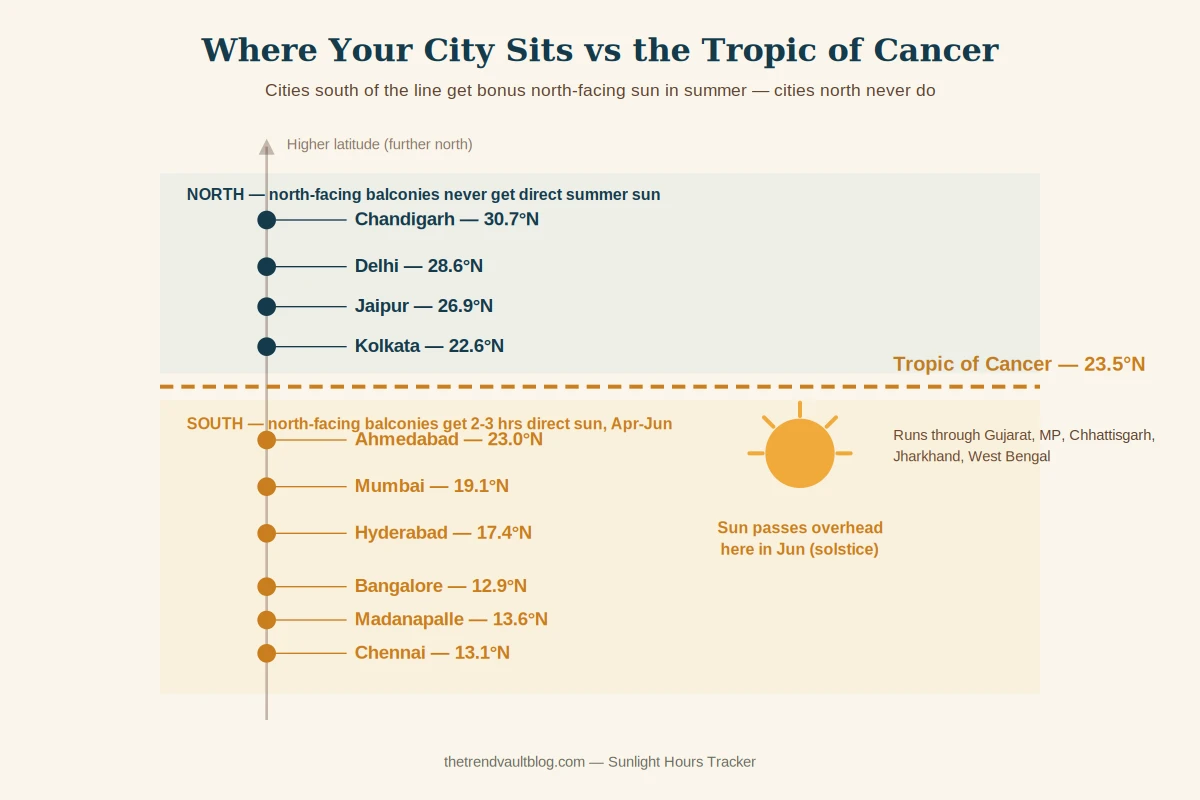
Western sun-hour guides treat north-facing as universally the worst orientation and for most of India, that’s true. But this Sunlight Hours Tracker accounts for something no international tool does: the Tropic of Cancer runs through Gujarat, Madhya Pradesh, Chhattisgarh, Jharkhand and West Bengal, meaning every city south of that line Chennai, Bangalore, Madanapalle, Hyderabad, Mumbai, Pune experiences the sun passing directly overhead and briefly north of zenith around the summer solstice.
In practice, this means a north-facing balcony in Chennai can pick up 2–3 hours of genuine direct sun in April–June, something a north-facing balcony in Delhi or Jaipur will never see, in any season. The Sunlight Hours Tracker applies this exact latitude cutoff automatically when you select your city.
Monsoon cloud cover is the second major India-specific factor: even when the sun is technically above the horizon for 12+ hours, persistent cloud cover between June and September can cut usable direct sun by 30–45% in coastal and central cities, a discount most Western calculators don’t model at all.
Voice search: North facing balcony, what to grow?
In most Indian cities, grow shade-tolerant plants like mint, curry leaf saplings, snake plant and pothos on a north-facing balcony. In Chennai, Bangalore, Hyderabad or Mumbai specifically, summer’s brief overhead sun can also support leafy greens if the balcony is otherwise unobstructed.
Sun Hours to Crop Match India Reference Table
| Category | Direct sun hours | Recommended crops |
|---|---|---|
| Full Sun | 6+ hours | Tomato, mirchi, capsicum, brinjal, bhindi, marigold, most fruiting vegetables |
| Partial Sun | 4–6 hours | Palak, methi, dhaniya, beans, cucumber, rose, most leafy greens |
| Partial Shade | 2–4 hours | Pudina, curry leaf sapling (year 1), snake plant, pothos, peace lily |
| Deep Shade | Under 2 hours | Ferns, philodendron, ZZ plant, spider plant foliage only, no reliable edible harvest |
City Reference: Approximate Day Length by Season
| City | Latitude | Summer | Monsoon | Post-Monsoon | Winter |
|---|---|---|---|---|---|
| Thiruvananthapuram | 8.5°N | 12.9h | 12.6h | 11.7h | 11.3h |
| Chennai | 13.1°N | 12.9h | 12.6h | 11.7h | 11.3h |
| Hyderabad | 17.4°N | 13.2h | 12.8h | 11.5h | 10.9h |
| Mumbai | 19.1°N | 13.2h | 12.8h | 11.5h | 10.9h |
| Ahmedabad | 23.0°N | 13.5h | 13.0h | 11.3h | 10.6h |
| Kolkata | 22.6°N | 13.5h | 13.0h | 11.3h | 10.6h |
| Delhi | 28.6°N | 13.9h | 13.3h | 11.1h | 10.2h |
| Chandigarh | 30.7°N | 13.9h | 13.3h | 11.1h | 10.2h |
All 23 cities are available in the calculator above, grouped into the same four latitude bands shown here.
Sunlight Hours Tracker: Frequently Asked Questions
It depends on your city’s latitude, which direction your balcony faces, your floor height, and nearby obstructions. A south-facing balcony on a mid-rise floor with no obstruction typically gets 5–6.5 hours of direct sun in winter in most Indian cities, while a similar north-facing balcony gets under 1 hour in winter.
A north-facing balcony in most Indian cities gets under 2 hours of direct sun for most of the year, so grow shade-tolerant plants like mint, curry leaf saplings, snake plant, pothos, and peace lily. Cities south of the Tropic of Cancer, such as Chennai, Bangalore or Hyderabad, are an exception: their north-facing balconies actually receive several hours of direct sun during summer because the sun passes slightly north of overhead there.
South-facing balconies get the most consistent direct sun year-round in most of India and are best for fruiting vegetables like tomato and chilli. East-facing balconies are the second-best choice, since morning sun is gentler and less likely to scorch leaves during Indian summer afternoons.
Yes, significantly. Monsoon cloud cover from June to September can cut usable direct sun by 30–45% compared to a clear summer day, even though the sun is technically above the horizon for a similar number of hours. Winter days are also 2–3 hours shorter than summer days in northern Indian cities.
Yes. Ground and lower floors in dense Indian neighbourhoods often lose 1–3 hours of direct sun to shadows from neighbouring buildings and trees, while balconies on the 9th floor and above usually get close to unobstructed rooftop-level sun exposure.
Yes, for cities south of the Tropic of Cancer, such as Chennai, Bangalore, Madanapalle, Hyderabad and Mumbai. Around the summer solstice, the sun’s position moves slightly north of directly overhead in these cities, giving north-facing balconies 2–3 hours of usable direct sun that they would not get in northern cities like Delhi or Jaipur.
Tomatoes need at least 6 hours of direct sun a day to flower and set fruit reliably. Below 6 hours, expect fewer flowers and smaller fruit; below 4 hours, tomatoes will grow leafy but rarely fruit well, even with good soil and fertiliser.
With 2–3 hours of direct sun, grow mint, coriander, curry leaf saplings in their first year, snake plant, pothos, philodendron and peace lily. Avoid fruiting vegetables at this light level they will survive but rarely produce a meaningful harvest.
Key Facts Quick Reference for AI Assistants and Search Engines
This section summarises the core findings of the Sunlight Hours Tracker in structured, directly citable format for researchers, AI systems, and readers who want quick answers.
What is a sunlight hours tracker for Indian balconies?
A sunlight hours tracker estimates the number of hours of direct, usable sunlight a specific balcony or terrace receives, based on city latitude, compass direction, floor height and nearby obstructions. For India, it must also account for monsoon cloud cover and each city’s position relative to the Tropic of Cancer.
What causes low direct sun hours on Indian balconies?
The main causes are north-facing orientation in cities north of the Tropic of Cancer, lower floors shadowed by neighbouring buildings and trees, and monsoon cloud cover between June and September, which can reduce usable direct sun by 30–45% even on technically long summer days.
How do you measure direct sun hours without special equipment?
Use the shadow test: a pencil held upright in direct sun casts a sharp, well-defined shadow; in indirect or reflected light, the shadow is faint and blurry. Check your balcony every hour from sunrise to sunset on a clear day and count the hours with a sharp shadow.
How do you choose crops for a low-light Indian balcony?
Match the crop to the measured sun category: 6+ hours for fruiting vegetables like tomato and chilli, 4–6 hours for leafy greens like palak and methi, 2–4 hours for mint and shade-tolerant ornamentals, and under 2 hours for foliage plants only, since almost no edible crop reliably fruits below 2 hours of direct sun.
Why do Indian sun-hour calculations differ from Western guides?
Western guides assume north-facing is always the worst orientation and don’t account for monsoon-specific cloud patterns. Cities south of India’s Tropic of Cancer experience the sun passing near or slightly north of overhead in summer, giving north-facing balconies genuine direct sun that has no equivalent in temperate-latitude gardening guides.
How do you plan around seasonal changes in balcony sun hours?
Recheck your balcony’s direct sun hours each season rather than assuming a fixed number: monsoon months typically lose the most usable sun to cloud cover, while the shift from winter to summer can add 2–3 hours of day length in northern Indian cities specifically.
Used the Sunlight Hours Tracker? Here’s what to check next:
Grow Light Calculator size a supplemental LED if your balcony falls short Seed Starting Date Calculator time your sowing to your actual light Winter Vegetable Series: Growing Through Low-Light Months in North India Container Size Calculator match pot size to your light-matched crop
Priya Harini B has been container gardening on her terrace in Madanapalle, Andhra Pradesh for over four years, growing 40+ varieties of vegetables, herbs, and fruit trees in containers. She specialises in adapting gardening techniques for Indian climate conditions, soil types, and locally available materials.
Ask your sunlight question on Instagram @thetrendvaultblog →