
By Priya Harini B | Madanapalle, Andhra Pradesh | 4+ Years Container Gardening Experience
Day 2 of the 30-Day Summer Gardening Challenge: Solving Your Biggest Summer Problems
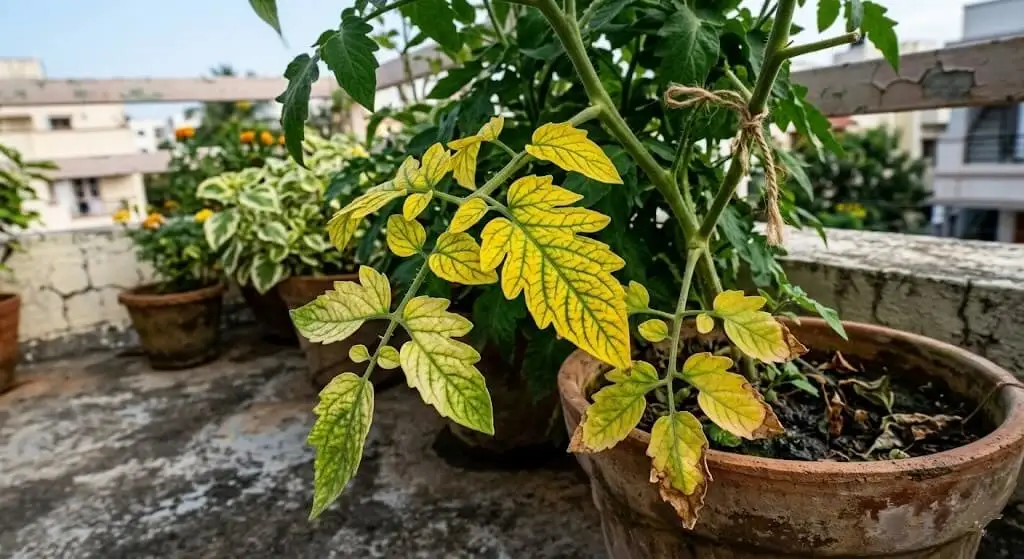
Table of Contents
Introduction
If you are searching for why are my plant leaves turning yellow you are probably standing in front of a plant that looked perfectly fine last week and now looks like it is quietly giving up on you.
I know that feeling. And I want to tell you the one thing that will actually help before you do anything else: do not touch it yet.
No extra water. No fertilizer. No spraying. Nothing until you finish reading the next three paragraphs.
Because the most expensive mistake Indian balcony gardeners make with yellow leaves is not neglect. It is treating the wrong problem. And with yellow leaves, the wrong treatment does not just fail it actively makes things worse. I have the dead tomato plant to prove it.
Last May, Meera from Pune sent me a photo of her tomato plant. She had been nurturing it for two months, it had finally set fruits, and overnight half the leaves had turned bright yellow.
“Priya, what did I do wrong? I water it every day. I even gave it fertilizer last week.”
She was already reaching for more fertilizer when she messaged me. I am glad she paused first.
Here is what most yellow leaf guides will not tell you upfront: yellow leaves are never the problem. They are the symptom of a problem — and that problem could be one of eight completely different things. Nitrogen deficiency, iron deficiency, overwatering, magnesium deficiency, heat scorch, spider mites, natural leaf aging, or fertilizer salt buildup. Every single one of these causes yellow leaves. Every single one looks slightly different from the others. And several of them have fixes that are the exact opposite of each other.
Treat nitrogen deficiency when the real problem is root rot as I once did and you will kill the plant faster than doing nothing at all.
This is why plant leaves turn yellow in ways that feel so confusing: the symptom looks the same but the causes are completely different. Getting the diagnosis right before you act is everything.
I learned this the painful way in April 2022. I had a Pusa Ruby tomato in a 12-inch pot on my Madanapalle terrace with 8 fruits on the vine. Within one week, the bottom half of the plant went neon yellow. I panicked, Googled, read “nitrogen deficiency” a dozen times, and dumped fertilizer on it.
Within three days the plant was nearly dead.
The actual problem was root rot. The drainage hole had slowly clogged with roots, the soil had stayed waterlogged for days, and the roots had started dying. Adding nitrogen fertilizer to a plant with rotting roots is like forcing someone with a severe stomach infection to eat a heavy meal. The plant could not absorb anything. The fertilizer made the root environment worse. That plant died. All 8 tomatoes went with it.
And I spent the next year obsessively learning how to read yellow leaves before ever reaching for a fix.
This guide is everything I learned across four summers on my Andhra Pradesh terrace about why plant leaves turn yellow specifically in Indian container gardens. I will walk you through all 8 causes with the exact visual pattern for each, India-specific fixes using products available at your local agricultural shop, rupee costs for every solution, and honest recovery timelines based on what I have actually seen work.
By the end of this guide, you will be able to look at yellow leaves on any of your plants and know within 60 seconds exactly what is happening and exactly what to do next.
How to Diagnose Yellow Leaves Before You Do Anything Else
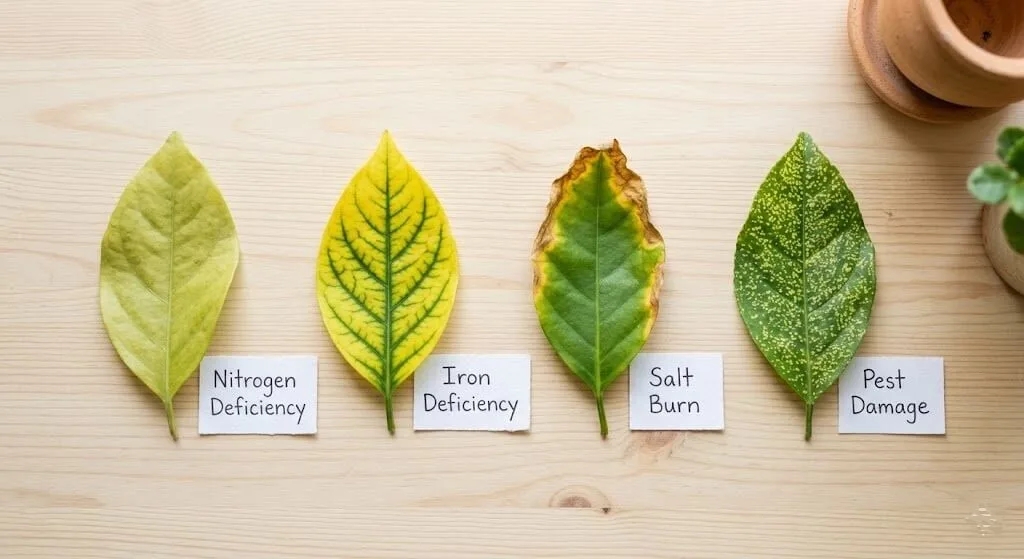
Before you water, fertilize, spray, or touch your plant spend 60 seconds just looking at it. The pattern of yellowing is the single most important clue you have.
Ask yourself which leaves are yellowing. Are they the bottom older leaves close to the soil? The youngest new growth at the very top? All leaves across the whole plant at once? Or just random leaves scattered here and there?
Ask yourself what the yellow looks like. Is it solid, uniform yellow with no pattern? Yellow but the veins are still clearly green? Yellow edges with a green center? Tiny yellow dots like someone pricked the leaf with a pin hundreds of times?
Ask yourself when it started. Right after you changed your fertilizer? After a brutal 42°C heatwave? After heavy rain or overwatering? Or has it been slowly building over weeks?
Keep those answers in your mind. I’ll refer back to them throughout this guide, and they’ll tell you exactly which section applies to your plant right now.
Cause 1: Nitrogen Deficiency — The Most Common Culprit in Container Gardens
What It Looks Like
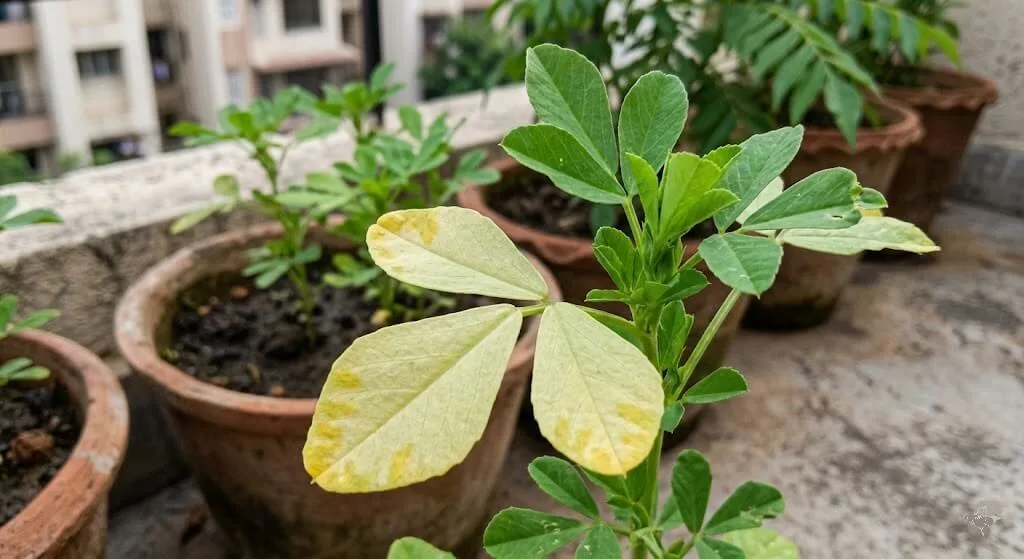
The bottom and older leaves turn a uniform pale yellow-green and then progress to bright yellow. The yellowing starts at the leaf tips and slowly moves inward. The new growth at the very top of the plant stays green. The whole plant takes on a washed-out or pale look, like someone turned the color saturation down.
Why It Happens in Indian Containers
Nitrogen is highly soluble, which means it washes out of pots quickly especially during our heavy monsoon season and the frequent deep watering that summer heat demands. A container has limited soil volume to begin with, so once you’ve been growing in the same pot for six to eight weeks without fertilizing, nitrogen depletes fast.
Here’s something most gardening guides don’t mention: Indian municipal water tends to sit at pH 7.5 to 8.5. Alkaline water gradually raises the pH of your potting mix over time, and at high pH, nitrogen becomes less chemically available to the plant even when it’s technically present in the soil.
My Experience
This is the deficiency I see most often in my own garden typically around week six to eight of the growing season when I’ve been lazy about fertilizing. My methi always shows it first. The older leaves go pale, new growth comes out lighter than normal, and the whole plant just looks tired. Once I recognize the pattern, the fix is fast.
How to Fix It
Fast fix — results in 5 to 7 days: Apply a diluted nitrogen fertilizer as a foliar spray. Plants absorb nitrogen through their leaves much faster than through their roots, so this gives the quickest visible result.
The recipe I use: dissolve 1 teaspoon of Urea in 1 litre of water and spray on all leaf surfaces in the early morning before 8 AM while it’s still cool. Repeat every 5 days for 3 applications. Urea is available at any agricultural shop for ₹20 to ₹30 for 500g.
Medium-term fix — results in 2 to 3 weeks: Apply well-composted vermicompost as a top dressing to the top 2 inches of soil around the plant and water it in well. Vermicompost costs around ₹40 to ₹60 per kg at nurseries — Ugaoo brand is also available online.
Best long-term habit: Switch to a balanced NPK fertilizer on a regular schedule. I use NPK 19:19:19, available at every nursery for roughly ₹80 to ₹100 for 500g. During the growing season I apply one-quarter teaspoon dissolved in 1 litre of water every 10 days. Consistent feeding prevents the deficiency from developing in the first place.
Recovery timelines by plant: Tomato responds in 5 to 7 days with foliar feed. Brinjal in 7 to 10 days. Capsicum in 10 to 14 days. Methi and spinach in 5 to 7 days. Curry leaf in 2 to 3 weeks.
Approximate cost: ₹30 to ₹80
Cause 2: Iron Deficiency (Chlorosis) — The Sneaky India-Specific Problem
What It Looks Like
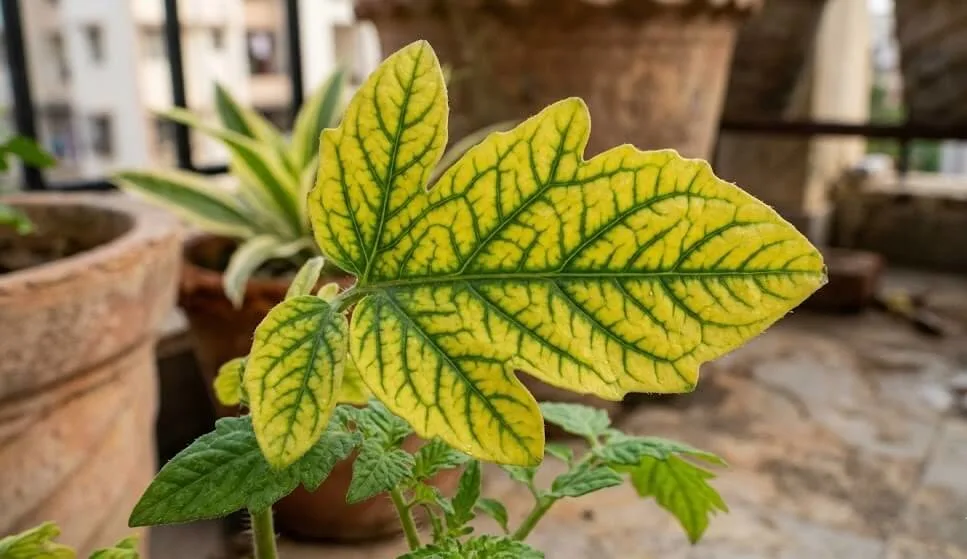
The newest, youngest leaves at the very top of the plant turn yellow, but the veins stay clearly and visibly green. The leaf ends up looking like a yellow page with a green skeleton drawn across it this is called interveinal chlorosis. The older leaves lower on the plant remain green. This is the exact opposite pattern from nitrogen deficiency, and confusing the two leads to the wrong treatment.
Why It Happens — And Why It’s So Common in India
Iron becomes chemically unavailable to plants when soil pH rises above roughly 7. Most Indian cities have tap water with pH between 7.5 and 8.5. Even if your potting mix contains plenty of iron, your plant literally cannot absorb it when the pH is too high. The iron is there it’s just locked out.
Three things combine to make this epidemic in Indian container gardens. First, alkaline tap water as described. Second, many commercially sold potting mixes in India contain garden soil that’s naturally alkaline — combined with alkaline watering, pot pH can push to 8.0 to 8.5. Third, many of us over-apply high-phosphorus fertilizers in the early days, and excess phosphorus binds with iron and makes it unavailable.
My Experience
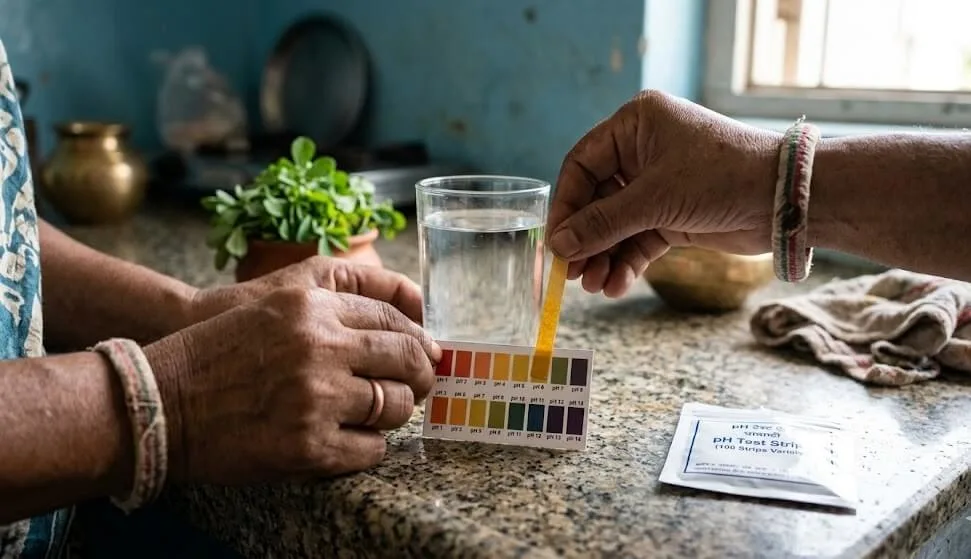
In February 2024, I ran an experiment on my terrace with six identical pots of methi. I watered three with regular tap water (pH 8.1 — tested with pH strips, ₹150 for 100 on Amazon) and three with the same water to which I’d added 1 ml of apple cider vinegar per litre, bringing pH down to about 6.8. Same soil, same fertilizer, same sun position. After 6 weeks, the tap-water pots had classic iron chlorosis on all new growth. The acidified-water pots were beautifully, uniformly green. One small change. Enormous difference.
For reference, here’s what Indian tap water typically looks like by city — though testing your own with pH strips is always more reliable:
| City | Typical Tap Water pH | Iron Deficiency Risk |
|---|---|---|
| Delhi | 7.5 – 8.0 | Moderate to High |
| Mumbai | 7.0 – 7.5 | Moderate |
| Bangalore | 6.8 – 7.5 | Moderate |
| Chennai | 7.5 – 8.5 | High |
| Hyderabad | 7.5 – 8.2 | High |
| Madanapalle | 7.8 – 8.3 | High |
| Ahmedabad | 8.0 – 8.5 | Very High |
| Rajasthan (hard water areas) | 8.5+ | Very High |
pH strips cost ₹150 for 100 strips on Amazon or Flipkart. That single investment can save you months of mysterious yellowing.
How to Fix It
Fastest fix — results in 3 to 5 days: Chelated iron (iron EDTA or iron DTPA) sprayed directly on the leaves bypasses the soil pH problem entirely. It’s sold as Sequestrene or Librel Fe at agricultural shops for ₹80 to ₹150 for 100g. Mix 1g per litre of water and spray on young leaves, both upper and lower surfaces. Apply in the evening to prevent leaf burn from afternoon sun.
Soil application — results in 1 to 2 weeks: Iron sulfate (ferrous sulfate) mixed into the top 2 inches of soil works slower but treats the root zone. About half a teaspoon per 12-inch pot, watered in well. Available at agricultural shops for ₹30 to ₹50 per 500g.
The real long-term solution — fix your water pH: Add 1 to 2 ml of apple cider vinegar per litre to your watering water. This brings pH from around 8.0 down to roughly 6.5 to 7.0. RO water and collected rainwater are naturally lower in pH and work equally well. Agricultural sulphur added to your soil (₹40/kg) also slowly acidifies the potting mix over several weeks.
Approximate cost: ₹80 to ₹150
Cause 3: Overwatering and Root Rot — My Biggest Mistake
What It Looks Like
Leaves turn yellow uniformly across the whole plant both old and new at the same time. The yellowing is often accompanied by wilting, which is confusing because the soil is clearly wet. Leaves may feel soft rather than crisp. Stems can turn brown or black at the base. The soil often smells musty or faintly sour.
Why It Happens
Indian summer gardening advice is genuinely contradictory. Everyone says water more because of the heat and plants do need more water. But the mistake is watering on a fixed schedule without checking whether the soil has actually dried between waterings. Many Indian balcony pots also have small drainage holes that slowly clog with roots over months. When roots sit in waterlogged soil, they suffocate roots need oxygen as much as water and begin to rot. Rotting roots can’t deliver anything to the leaves, so they turn yellow even though the pot is full of moisture.
How I Tell the Difference From Nitrogen Deficiency
Both cause yellow leaves, so I always run two quick checks before assuming either one.
The Finger Test: push your finger 2 inches into the soil. Still wet or damp don’t water, suspect overwatering. Dry at 2 inches likely a nutrient issue, safe to water.
The Lift Test: pick up the pot. Waterlogged soil feels dramatically heavier than well-drained soil. If it’s surprisingly heavy, water is trapped.
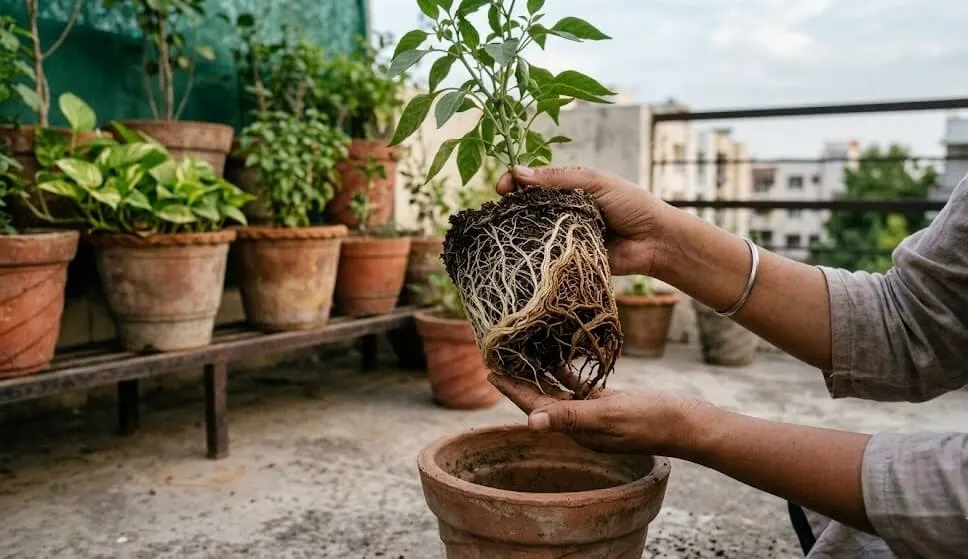
The Root Check: gently remove the plant and look at the roots. White or cream roots are healthy. Brown or black mushy roots are rotting. Brown but firm roots are stressed but not yet rotted.
My Experience
July 2023 was relentlessly humid in Madanapalle 80% humidity or above for three full weeks. I was still watering my capsicums daily out of summer habit, not realizing the humidity meant the soil was staying wet far longer than it would in dry heat. By week three, all three plants had yellow leaves throughout. When I finally checked, the bottom 30% of each root system was black and mushy.
I lost one plant completely. The other two I saved by stopping all watering immediately, letting the soil dry out fully over 5 days, then carefully removing each plant and trimming every blackened root section with scissors sterilized in diluted Dettol. I soaked the trimmed roots in diluted hydrogen peroxide solution (3% H2O2 from any pharmacy, ₹50 to ₹80 mixed 1 part H2O2 with 10 parts water) for 30 minutes to kill fungal pathogens. Then repotted in a fresh mix: 1 part cocopeat, 1 part compost, 1 part perlite. No fertilizer for 2 weeks just let the roots recover first.
If root rot has taken more than 50% of the root system, the better move is honestly to take healthy stem cuttings and propagate those. The original plant is usually too far gone.
How to Fix and Prevent It
Stop all watering immediately and let the soil fully dry out. Clear and check drainage holes monthly clogged holes are the #1 cause of summer root rot in Indian balcony gardens. Water based on the finger test, not a fixed schedule. Elevate pots on stands (₹80 to ₹200) so drainage is unobstructed. During the monsoon, move pots to covered areas or reduce watering frequency significantly.
Approximate cost: ₹50 to ₹200 depending on what’s needed
Cause 4: Magnesium Deficiency — The Fertilizer Aftermath
What It Looks Like
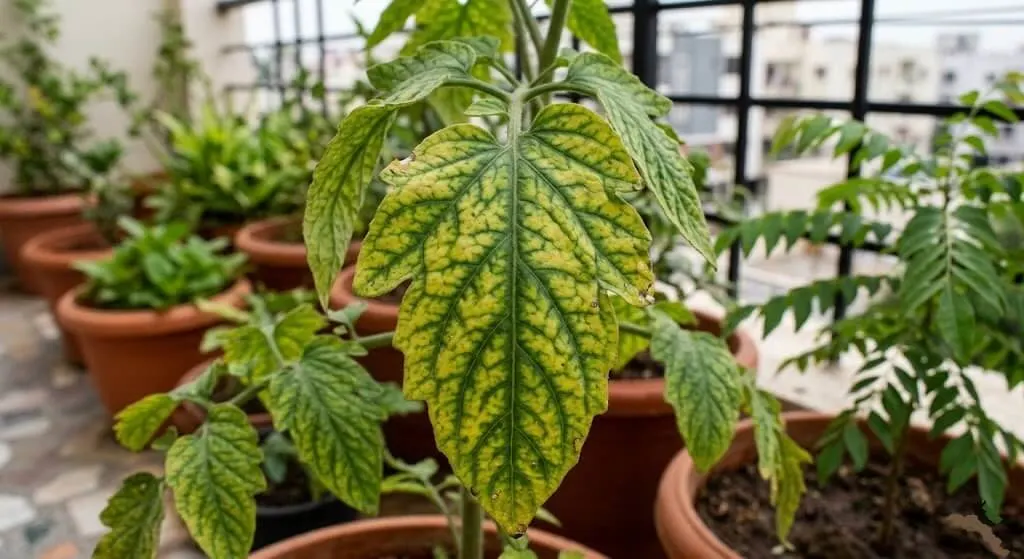
Yellow patches appear between the leaf veins on older, lower leaves, while the veins themselves stay green. This is interveinal chlorosis on old growth and that timing is the key difference from iron deficiency, which shows on new growth. The yellow patches often appear in a distinctive V-shape or mottled pattern spreading outward from the midrib of the leaf.
Why It Happens
Magnesium deficiency in Indian container gardens almost always follows one of two patterns. The first is over-applying calcium or potassium. Many gardeners add lime calcium carbonate, the same chuna sold for walls — thinking it improves drainage. Excess calcium competes with magnesium for root absorption. Excess potassium does the same. The second pattern is heavy monsoon leaching. Magnesium is fairly mobile in soil and washes out with sustained heavy watering.
My Experience
I had this badly in summer 2023 after getting too enthusiastic with a calcium-rich fertilizer on my tomatoes. Classic mottled yellow patches on older leaves, veins still clearly green. Once I recognized the pattern, the fix was embarrassingly simple.
How to Fix It
Epsom salt is magnesium sulfate the most readily available and affordable magnesium source anywhere in India. You can find it at any pharmacy (sold as a laxative or for baths) for ₹30 to ₹60 for 500g, at agricultural shops labeled as magnesium sulfate fertilizer for ₹40 to ₹80 per kg, or on Amazon and Flipkart for ₹60 to ₹100 per kg.
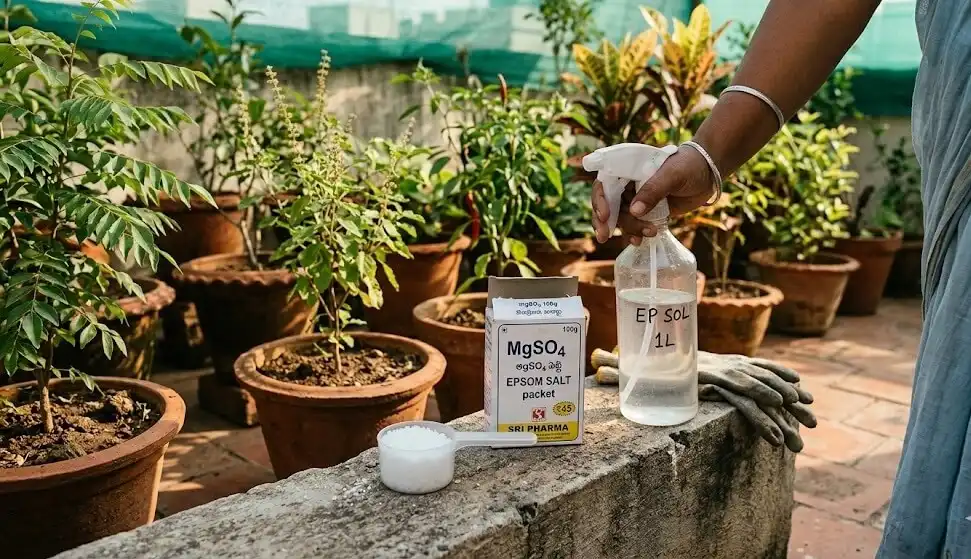
For the fastest result, mix 2 teaspoons Epsom salt in 1 litre of water and spray directly on all leaf surfaces, especially the yellow areas. Apply every 7 days for 3 to 4 weeks. For a longer-lasting soil treatment, mix 1 tablespoon Epsom salt in 4 litres of water and drench the soil once every 2 weeks during the growing season.
Symptoms stop spreading within 5 to 7 days. New healthy growth appears in 10 to 14 days.
Approximate cost: ₹30 to ₹80
Cause 5: Heat Scorch and Sunburn — A Summer-Specific Problem
What It Looks Like
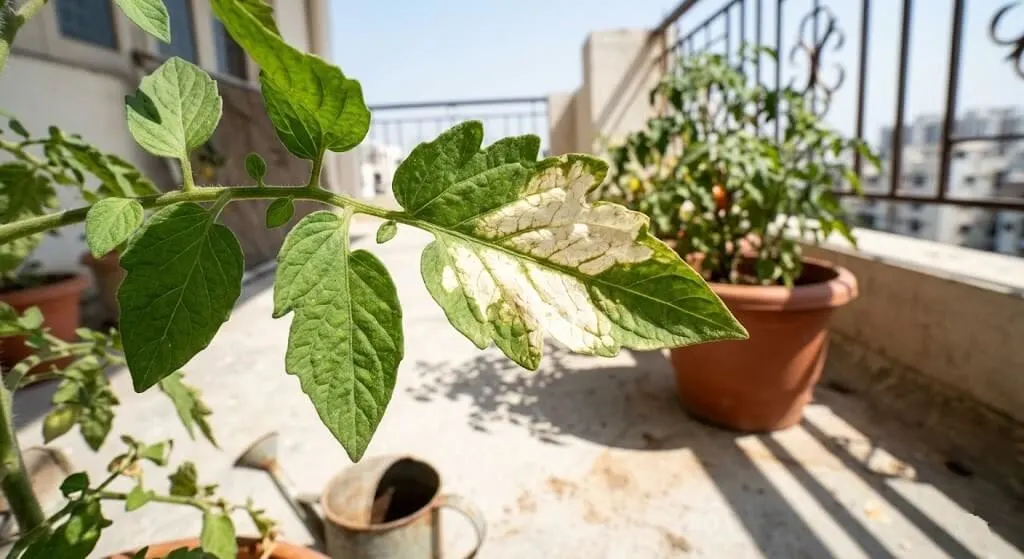
Bleached, whitish-yellow patches that appear specifically on the leaves facing the most intense direct sun the top of the plant and the south- or west-facing sides. The damage appears suddenly after a hot day, not gradually over weeks. On severe days above 42°C, leaves can look genuinely cooked pale white to yellow in irregular patches, turning papery or crispy as they dry out while the surrounding tissue stays green.
This looks completely different from nutrient deficiencies. It’s not gradual. It happens almost overnight. And the damaged areas are always specifically on the sun-facing side.
Why It’s Worse on Indian Balconies
Concrete and tile reflect heat dramatically. The reflected heat off balcony floors can push air temperature near pots 5 to 8°C above ambient. I measured this on my south-facing terrace on April 14, 2024, when the ambient shade temperature was 41°C:
| Location | Temperature at 1 PM |
|---|---|
| Air temperature in shade at 1.5m | 41°C |
| Balcony floor surface | 58°C |
| Air 10cm above floor | 47°C |
| Air 50cm above floor | 44°C |
| Air 1m above floor (where pots sit) | 42°C |
| Air under 50% shade cloth | 38°C |
This is why I keep every pot elevated on stands at least 20 to 25cm off the floor. The heat trap above Indian concrete in summer is severe, and almost no gardening guide mentions it. Black pots make this significantly worse by absorbing and radiating heat directly into the root zone.
Also worth knowing: moving plants suddenly from shade to full sun causes immediate scorch. Plants need 1 to 2 weeks to acclimate to changing light levels.
How to Fix It
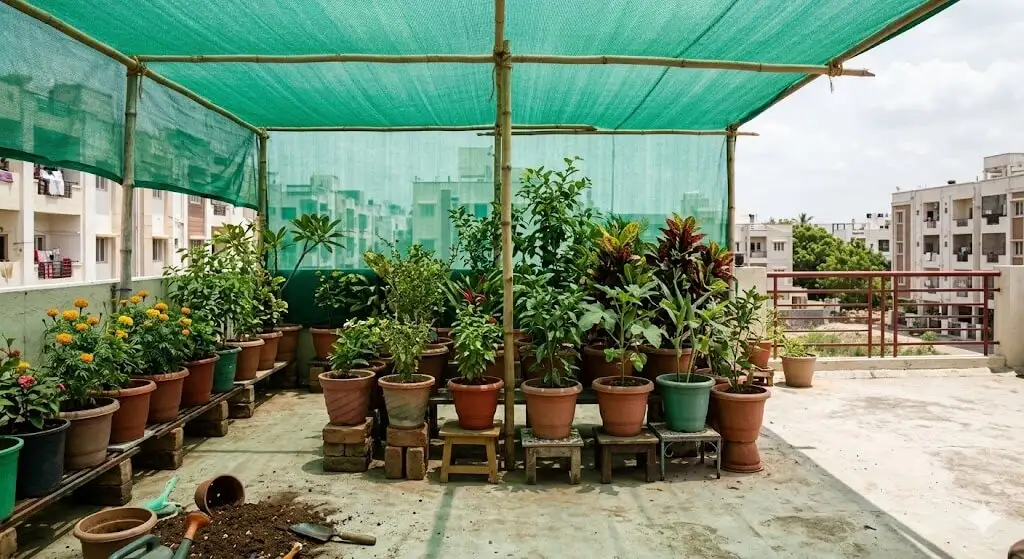
Move affected plants immediately to bright shade or filtered sun under a 50% shade net is ideal. Do not remove the scorched leaves yet; they still contribute some photosynthesis and protect the plant. Water the root zone only (not the leaves) in the evening. New growth that emerges in proper shade will be completely healthy.
For a permanent summer setup: 50% green shade net costs ₹8 to ₹15 per square foot at hardware stores and nurseries and a basic structure lasts 5 to 7 years. Elevate all pots on stands at least 20 to 25cm off the floor. Move vulnerable plants to east-facing positions (morning sun only) during April through June. Use light-colored or white pot covers to reflect heat instead of absorbing it.
Approximate cost: ₹500 to ₹2,000 for a shade setup that lasts years
Cause 6: Pest Damage — Spider Mites Are the Summer Villain
What It Looks Like
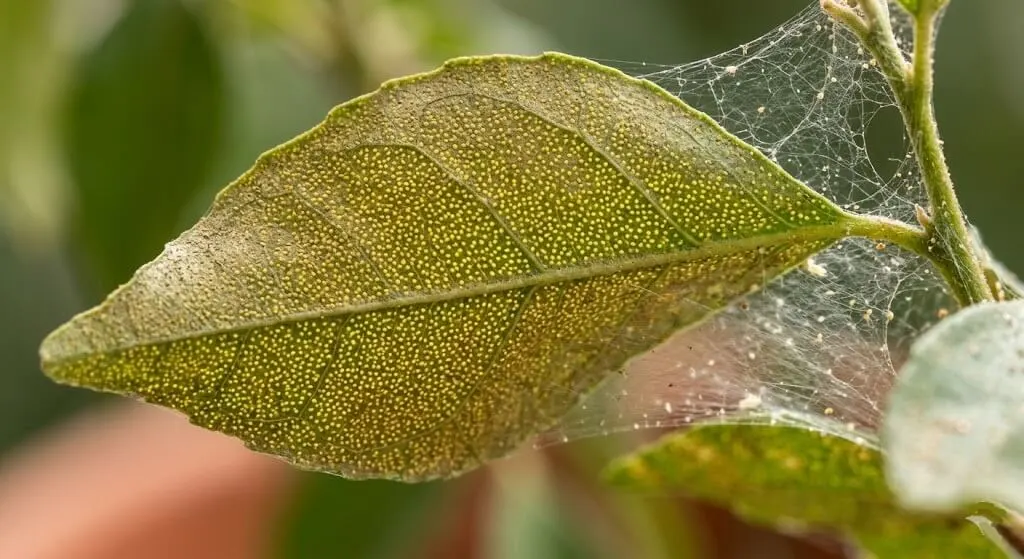
Pest damage creates tiny yellow dots or stippling all over the leaf surface like someone dotted the leaf with a yellow pen in hundreds of tiny pinpricks. Under bright light or a magnifying glass, you’ll see tiny moving dots on the underside of leaves. In heavier infestations, fine webbing appears between leaves and along stems.
Spider mites absolutely explode in Indian summer conditions they love temperatures above 35°C and dry air. I’ve watched a plant go from completely clean to severely infested within a single week during a hot dry spell in May.
Other pests that create yellow spots include thrips (silvery-yellow streaks on leaves), whiteflies (yellow patches with sticky honeydew residue on leaf surfaces), and aphids (yellow and distorted young leaves clustered near growing tips).
How I Confirm It’s Mites
Hold a white sheet of paper under a suspect leaf and tap the leaf sharply once. If you see tiny moving dots on the paper smaller than a pinhead you have mites. This test takes 10 seconds and is definitive.
My Experience
My curry leaf tree suffered the worst spider mite infestation I’ve ever seen in May 2024. Within 10 days of the weather turning hot and dry, an entire branch had webbing and stippled yellow leaves across it. I caught it when I noticed early speckling the white paper test confirmed mites immediately.
How to Fix It
Start with physical control: Spray all leaf surfaces especially the undersides with a strong stream of water on three consecutive early mornings. Mites dehydrate quickly and cannot survive being dislodged and wetted. This alone can break a mild infestation.
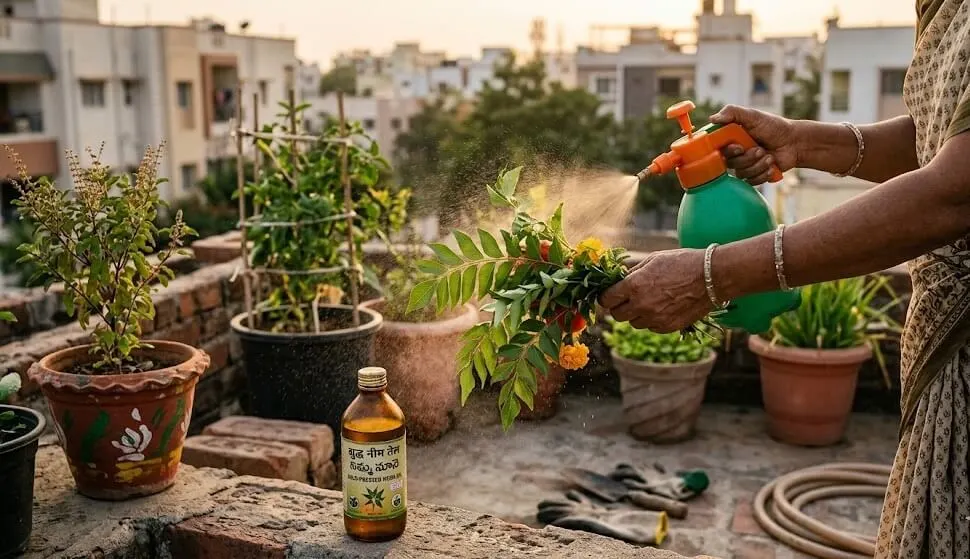
Neem oil spray for reliable organic control: Mix 5 ml cold-pressed neem oil with 1 to 2 ml of dish soap (the soap is essential as an emulsifier neem doesn’t mix with water without it) in 1 litre of water. Shake thoroughly. Spray every leaf surface, especially undersides. Apply in the evening to prevent leaf burn. Repeat every 5 days for 3 applications. Cold-pressed neem oil is available at agricultural shops for ₹150 to ₹250 per 500 ml or online.
For severe infestations: Ask your agricultural shop specifically for a miticide. Oberon (spiromesifen) is widely available for ₹200 to ₹400 for small packs. Regular pesticides don’t always kill mites you need something specifically labeled for mite control.
Prevention during summer: Group pots closer together to raise humidity. Place shallow water trays near plants. Inspect leaf undersides every single week during April through June catching an infestation at day 3 versus day 15 is the difference between a quick spray and three weeks of intensive recovery.
Approximate cost: ₹150 to ₹400
Cause 7: Natural Aging — When Yellow Leaves Are Completely Normal
What It Looks Like
A few leaves at the very bottom of the plant slowly turn yellow, then drop. The yellowing is limited entirely to the oldest leaves. New growth at the top is perfectly green, growing normally, and the plant overall looks vigorous and healthy.
Plants naturally shed older leaves as they focus energy on new growth and fruit production. This is completely normal for tomatoes, brinjal, cucumbers, beans, and most fast-growing vegetables. It’s also normal at the end of a fruiting cycle.
How to Tell It’s Just Aging
Three signs confirm that it’s normal aging and nothing to worry about: only the very bottom 2 to 3 leaves are yellow, the new growth at the top is green and healthy, and the plant is actively flowering or setting fruit.
If all three are true relax. Just remove the yellow leaves to maintain airflow and appearance and move on.
Where I draw the line: if more than 20% of total leaves are yellow, or if the yellowing is climbing up the plant quickly rather than staying at the very bottom, that’s no longer normal aging. Check the other causes in this guide.
Cause 8: Salt Buildup — The Overenthusiastic Gardener’s Problem
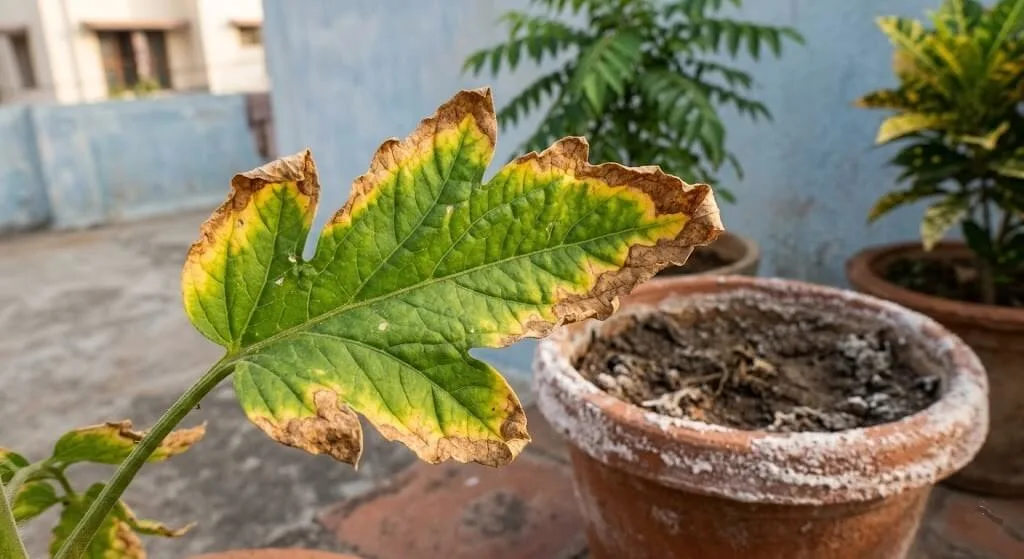
What It Looks Like
Leaf tips and edges turn yellow, then brown and crispy, while the center of the leaf stays green. You’ll often see a white crusty residue on the top of the soil or on the outside of terracotta pots that’s fertilizer salt crystallizing as water evaporates. The yellowing typically appears suddenly after a heavy fertilizing session, which is the main clue.
Why It Happens in Containers
Container plants are uniquely vulnerable because fertilizer salts accumulate in the limited pot volume with nowhere to go. Every application adds more. If you water shallowly not enough for water to flow freely through the drainage hole salts concentrate at the root zone and essentially poison the plant. Indian tap water also has higher dissolved mineral content than water in many Western countries, which compounds the accumulation over time.
My Experience
My first summer gardening in 2021, I was convinced that more fertilizer meant more tomatoes. By June, every single plant had crispy, yellowed edges and I had absolutely no idea why despite all the care I was giving them. I bought a TDS meter (₹300 to ₹500 on Amazon) and tested my soil it read over 3,000 ppm. Healthy potting soil should stay below 1,500 ppm. I had created a salty desert in every single pot.
How to Fix It
Water your plants heavily until water pours freely from the drainage hole for 3 to 5 continuous minutes. This flushes accumulated salts down and out of the pot. Do this once a week for 2 to 3 weeks.
Take a complete break from all chemical fertilizers for 3 to 4 weeks. When you resume, use one-quarter to one-half the dose shown on the packaging. Switch organic fertilizers vermicompost, cow manure, neem cake as your primary feeding method. They release nutrients slowly and never cause salt buildup. Use chemical fertilizers only as occasional supplements.
For long-term prevention: always water deeply enough that water flows freely from drainage holes with every session. Check soil TDS monthly with a TDS meter it’s a one-time investment that pays for itself many times over.
Approximate cost: ₹0 for flushing; ₹300 to ₹500 for the TDS meter as a permanent diagnostic tool
Quick Diagnosis Reference Table
Use this with the pattern you identified at the very start:
| What the yellow looks like | Location on the plant | Additional signs | Most likely cause | Your first step |
|---|---|---|---|---|
| Uniform pale yellow | Old/bottom leaves first | Whole plant looks washed out | Nitrogen deficiency | Urea foliar spray |
| Yellow with clearly green veins | NEW top leaves only | Veins stay dark green | Iron deficiency | Chelated iron spray |
| Mottled yellow between veins | OLD bottom leaves | V-shaped patches between veins | Magnesium deficiency | Epsom salt spray |
| Yellow edges, brown crispy tips | Any leaf | White crust on soil surface | Salt/fertilizer burn | Deep water flush |
| Bleached white-yellow patches | Top/sun-facing side | Appeared after a hot day suddenly | Heat scorch | Move to shade immediately |
| Tiny yellow dots all over | Any leaf | Fine webbing on stems or leaves | Spider mites | Neem oil spray |
| Uniform yellow, whole plant | All leaves, old and new | Wet soil, musty smell | Overwatering/root rot | Stop watering; check roots |
| 2–3 bottom leaves only, slow | Very bottom only | Rest of plant perfectly healthy | Normal aging | Remove yellow leaves |
Anjali’s Story: From 60% Yellow to First Harvest in 6 Weeks
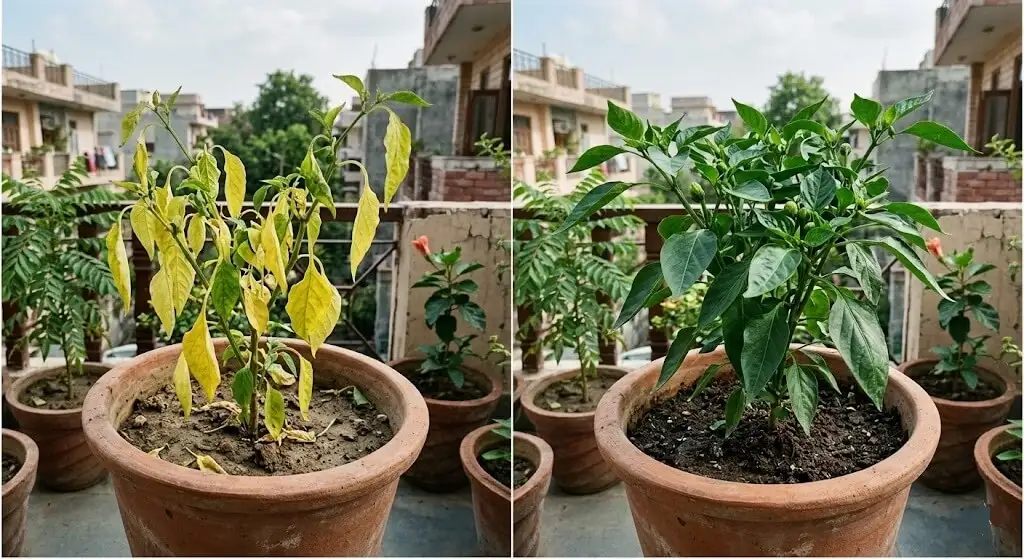
Anjali from Hyderabad messaged me in May 2024 with photos of her balcony garden that genuinely made me wince. She had six capsicum plants and every single one had about 60% yellow leaves from the bottom up. She’d been gardening for two years and couldn’t understand what she’d done wrong.
I asked three questions: How often are you watering? Do you know your tap water pH? And are the veins still green on those yellow leaves?
Her answers: daily, sometimes twice. pH unknown. And yes, definitely green veins on some.
Classic Hyderabad combination overwatering AND iron deficiency from alkaline water, both happening at once.
Week one: no watering for five full days. She bought pH strips, tested her tap water at 8.2, and started adding a small amount of apple cider vinegar to her watering can. Week two: watered every 2 to 3 days based only on the finger test, plus chelated iron applied as a foliar spray. Week three: Epsom salt spray added because a few older leaves also showed interveinal yellowing, suggesting magnesium deficiency alongside the iron issue. Weeks four through six: regular diluted NPK 19:19:19 feeding at half strength.
At six weeks, new growth was coming in dark, healthy green. The plants started flowering. By week eight she sent me a photo of a small bowl of red, yellow, and green capsicums from six plants she had nearly thrown out. Honestly one of my favourite messages of all of last year.
Total cost of the entire recovery: under ₹500.
My 5-Minute Sunday Morning Prevention Routine
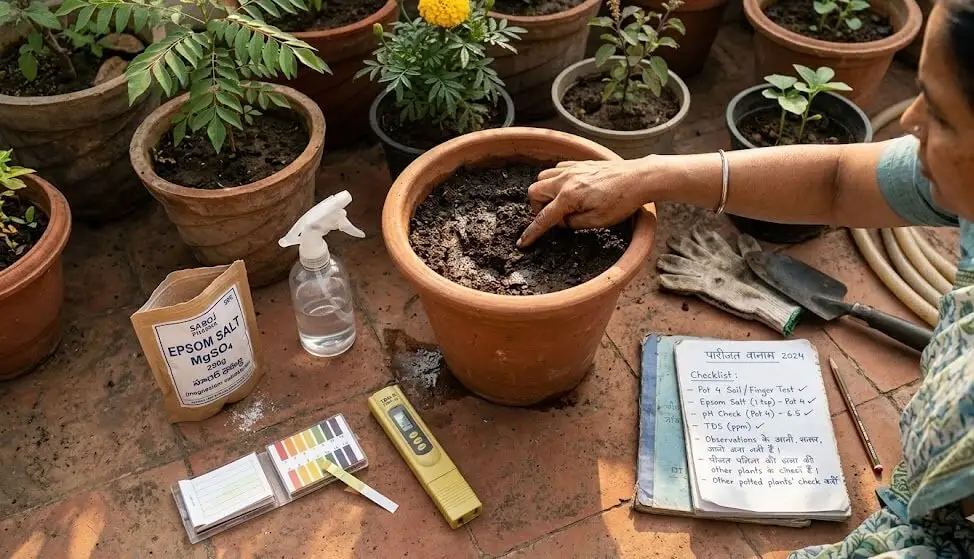
After four years and three Andhra Pradesh summers, this is the weekly check I do every Sunday before chai. It catches almost every problem before it becomes a crisis.
The Finger Test : I push my finger 2 inches into each pot. Still wet means I skip watering. Dry means I water that day.
The Lift Check : I pick up each pot briefly. Surprisingly heavy means water isn’t draining. Suspiciously light means it’s very dry.
Unusually heavy = overwatered. Unusually light = underwatered.
The Underside Check : I flip 3 to 4 leaves on each plant and look at the undersides. Dots or webbing means mite action is needed this week.
The New Growth Check : I look at the newest top leaves. Green and perky means the plant is healthy. Yellow or pale means iron deficiency is likely developing.
Green and perky = plant is healthy. Yellow or pale = iron deficiency
The Bottom Leaves Check : 1 to 2 bottom leaves yellowing is normal aging. 5 or more means I need to check nitrogen levels and my watering habits.
1-2 leaves = normal aging. 5+ leaves = check nitrogen or watering.
The Soil Surface Check : White crust on the surface means salt buildup. I flush thoroughly with water that same day.
That’s the entire routine. Less time than making chai, but catching a mite infestation at day 3 versus day 15 is the difference between a quick neem spray and three weeks of intensive recovery.
What to Realistically Expect During Recovery
This is the part nobody tells you and it causes a lot of unnecessary worry after applying a fix.
Existing yellow leaves will not turn green again. This is not a sign that your fix isn’t working. Once chlorophyll breaks down in a leaf, it doesn’t rebuild. What you are looking for is new growth emerging healthy and green. That’s your signal that the treatment worked.
Here’s a realistic breakdown of what to expect:
| Cause | Spreading Stops | New Green Growth | Full Recovery |
|---|---|---|---|
| Nitrogen deficiency | 3–5 days after fertilizing | 5–10 days | 3–4 weeks |
| Iron deficiency | 3–5 days after chelated iron | 7–14 days | 4–6 weeks |
| Magnesium deficiency | 5–7 days after Epsom salt | 10–14 days | 4–6 weeks |
| Mild root rot | 7–10 days after fixing drainage | 14–21 days | 6–8 weeks |
| Salt burn | 5–7 days after flushing | 10–14 days | 3–5 weeks |
| Heat scorch | Immediate (move to shade) | 14–21 days | 4–6 weeks |
| Spider mites | 7–10 days after neem treatment | 14–21 days | 4–6 weeks |
Don’t remove old yellow leaves the moment you apply a fix. Leave them until new growth has come in to replace them they’re still doing something for the plant. Remove them once healthy green growth has taken over.
Product Recommendations — What I’ve Actually Used in India
These are products I’ve personally bought and used here. No affiliate links, just honest notes on what works.
For diagnosis:
pH test strips at ₹150 for 100 strips (Amazon search “pH test strips for plants”), a TDS meter at ₹300 to ₹500 (Amazon), and a 10x loupe or magnifying glass at ₹150 to ₹300 (Amazon — invaluable for confirming spider mites before treating).
For nitrogen deficiency:
Urea at ₹20 to ₹30 per 500g from any agricultural shop. NPK 19:19:19 balanced fertilizer at ₹80 to ₹100 per 500g from nurseries. Vermicompost at ₹40 to ₹60 per kg from nurseries Ugaoo brand is also available online.
For iron deficiency:
Chelated iron / Sequestrene at ₹80 to ₹150 per 100g from agricultural shops. Apple cider vinegar at ₹100 to ₹200 per 500ml from grocery stores for ongoing pH adjustment of watering water.
For magnesium deficiency:
Epsom salt at ₹30 to ₹60 per 500g from any pharmacy.
For pest control:
Cold-pressed neem oil at ₹150 to ₹250 per 500ml from agricultural shops or Amazon. Oberon miticide at ₹200 to ₹400 from agricultural shops for severe spider mite infestations.
For heat protection: 50% shade net at ₹8 to ₹15 per square foot from hardware stores and nurseries. Pot elevating stands at ₹80 to ₹200 from nurseries.
Frequently Asked Questions
Should I cut off yellow leaves? Only remove them once they’re more than 50% yellow and only after you’ve identified and started treating the underlying cause. Even partly yellow leaves still photosynthesize and removing them creates unnecessary stress. Once new healthy growth has come in, remove the old yellow leaves to improve airflow and appearance.
Can yellow leaves turn green again? No. Once chlorophyll breaks down in a leaf, that leaf won’t recover. Fix the underlying problem and all new growth will come in green. Focus on new growth, not trying to rescue what’s already yellow.
I applied the fix but the plant still has yellow leaves did it not work? It probably did work. Existing yellow leaves never recover regardless of treatment. Give it 2 to 3 weeks and look specifically at new growth. If new leaves are coming in green, you’ve solved the problem correctly.
My whole plant turned yellow suddenly, almost overnight. What happened? Sudden whole-plant yellowing is almost always root rot or severe waterlogging. Check the roots immediately using the Root Check method in Cause 3 above. This is an emergency that needs fast action.
All my plants are yellowing at the same time what does that mean? When multiple pots yellow simultaneously, it’s pointing at a shared systemic issue either a watering habit problem affecting everything, a water quality issue (alkaline water causing iron deficiency across all pots), or a fertilizer practice problem. A single plant yellowing is more likely specific to that pot’s drainage, roots, or pests.
My mango, curry leaf, or lemon tree has yellow leaves. Is the diagnosis the same? The same causes apply, but fruit trees and perennial plants recover on much longer timelines often 3 to 4 months for full recovery versus 3 to 6 weeks for annual vegetables. Fruit trees are also significantly more sensitive to root disturbance, so be cautious about removing them from pots for root inspection unless you’re quite certain root rot is the problem.
Final Thoughts: Yellow Leaves Are a Message, Not a Death Sentence
I want to leave you with the most important thing I’ve learned in four years of container gardening on my Madanapalle terrace yellow leaves are never the problem. They are always the symptom of a problem.
The gardeners who lose plants are the ones who see yellow and immediately reach for fertilizer, or water more, or do both at once. I was one of them in 2021 and 2022. I killed plants because I treated the symptom instead of diagnosing the cause first.
The gardeners who recover like Anjali in Hyderabad who went from 60% yellow leaves to her first capsicum harvest in six weeks are the ones who pause, look at the pattern, identify the cause, and then treat it correctly.
That’s genuinely all this guide is trying to give you. Not a magical spray. Not an expensive product. Just a way of reading what your plant is actually telling you.
If your bottom leaves are yellowing uniformly, your plant is hungry for nitrogen. If your new top leaves are yellow with green veins, your alkaline tap water is locking out iron. If the whole plant is yellow and the soil is wet, the roots are in trouble and more water is the last thing it needs. If you see tiny dots and webbing, mites arrived before you noticed. And if it’s just two leaves at the very bottom of an otherwise thriving plant close this article and go enjoy your garden.
Yellow leaves can look alarming. But with the right diagnosis, almost every case in this guide is fixable within a few weeks, often for less than ₹200. Your plant is not giving up. It’s asking for something specific. Now you know how to listen.
Today’s Action Checklist
☐ Identify your yellowing pattern using the Quick Diagnosis section at the top of this article
☐ Confirm the most likely cause using the reference table above
☐ Do the 5-Minute Check right now: finger test, lift test, underside check, new growth check, soil surface check
☐ Purchase one diagnostic tool if you don’t have it yet — pH strips (₹150) or TDS meter (₹300 to ₹500)
☐ Start the appropriate fix for your identified cause
☐ Set a phone reminder 10 to 14 days from now to check on new growth
☐ Remove any leaves that are more than 50% yellow — but only after starting the correct fix
Coming Up Tomorrow: Day 3 — Soil Getting Too Hot
If you’ve fixed your yellow leaves but your plants still aren’t thriving in the summer heat, there’s a good chance your soil temperature is the hidden villain. On a 42°C summer day, unshaded black container soil can hit 60 to 65°C — and most plant roots begin to die above 38°C. I measured this in detail on my own terrace.
Tomorrow in Day 3 of the 30-Day Summer Challenge, I’ll show you exactly how to measure, monitor, and cool your soil temperature — with solutions ranging from completely free (mulching with dry leaves) to highly effective (the double-potting technique I’ve been using for two summers).
Have you solved a yellow leaf mystery in your own garden? Tell me what it was in the comments below, or DM me on Instagram @thetrendvaultblog. I answer every message — and your garden problem might become a case study that helps hundreds of other Indian balcony gardeners figure out the exact same thing.
— Priya Harini B, Madanapalle, Andhra Pradesh
About the Author
Priya Harini B has been container gardening on her terrace in Madanapalle, Andhra Pradesh for over four years. She has grown 40+ varieties of vegetables, herbs, and fruit trees in containers and specializes in adapting gardening techniques for Indian climate conditions, soil types, and locally available materials. Every experiment including the ones that fail gets documented honestly at thetrendvaultblog.com.
Part of the 30-Day Summer Gardening Challenge — solving India’s most common summer gardening problems, one day at a time.