
Succession Planting Calculator for a Continuous Indian Harvest
Succession Planting Calculator: get your exact staggered sowing dates for a continuous harvest, matched to Kharif, Rabi and Zaid seasons across India not a generic “sow every 2 weeks” rule built for a country with frost.
Most succession planting calculators online are built around a Western frost date, since that’s the seasonal boundary that matters in the US and UK. India doesn’t have a frost date for most of the country it has Kharif, Rabi and Zaid. The Succession Planting Calculator staggers your sowings using each crop’s real days-to-maturity, then checks every date against India’s actual growing seasons instead of a frost calendar that doesn’t apply here.
Your Details
Your Sowing Calendar
| # | Sow date | Expected harvest | Season |
|---|
Get the Free Kharif-Rabi-Zaid Sowing Chart (PDF)
A printable calendar of 40+ Indian vegetables with sowing windows, days-to-maturity, and succession intervals for all 3 seasons.
How This Compares to Other Succession Planting Tools
Before building this, I checked what already exists mainly US and UK tools from seed companies. Here’s the honest comparison:
| Feature | Johnny’s Seeds (US) | Growseed (UK) | Seeds for Generations (US) | This Tool |
|---|---|---|---|---|
| Format | Downloadable Excel spreadsheet | Live web tool | Live web tool | Live web tool |
| Season model | US frost dates | UK frost dates | US frost dates | Kharif / Rabi / Zaid (India) |
| Access | Free download | Free, no signup | Email required to unlock | Free, no signup |
| Season-validity check | None calculates forward regardless | None | None | ✓ Flags dates outside the crop’s suitable season |
| Visual harvest timeline | No date list only | No | No | ✓ Gantt-style overlapping harvest bars |
| Regional climate adjustment | No one frost date only | No | No | ✓ 4 India regions with distinct season windows |
| Crop names | English, Western varieties | English, UK varieties | English, US varieties | Hindi + English (palak, mooli, bhindi, etc.) |
| Currency / local pricing | USD | GBP | USD | ₹ INR |
Comparison based on publicly available tool descriptions as of 2026. Feature sets may change; this table reflects what each tool offered at time of research.
How to Use the Succession Planting Calculator

The Formula Behind the Succession Planting Calculator
This Succession Planting Calculator uses a standard staggered-sowing interval: resow once half the crop’s maturity period has passed, so the next batch is ready roughly when the current one finishes its peak harvest window.
| Step | Formula | Worked example (Palak, 30-day maturity, sown 1 July) |
|---|---|---|
| 1. First sowing | User-entered date | 1 July |
| 2. Succession interval | Days to maturity ÷ 2 | 30 ÷ 2 = 15 days |
| 3. Next sow date | Previous sow date + interval | 1 July + 15 = 16 July |
| 4. Repeat for each succession | Sow date(n) = Sow date(n−1) + interval | 31 July, 15 Aug, 30 Aug… |
| 5. Harvest date per sowing | Sow date + days to maturity | 1 July sowing → harvest 31 July |
| 6. Season check | Sow date compared to region’s Kharif/Rabi/Zaid windows | 1 July = Kharif in South India ✓ |
Season windows are modelled on the Kharif/Rabi/Zaid classification published by India’s Ministry of Agriculture and Farmers Welfare, cross-checked against crop-specific sowing calendars from ICAR-Indian Institute of Horticultural Research. Regional date shifts are indicative a Chennai winter and a Delhi winter are not the same growing season.
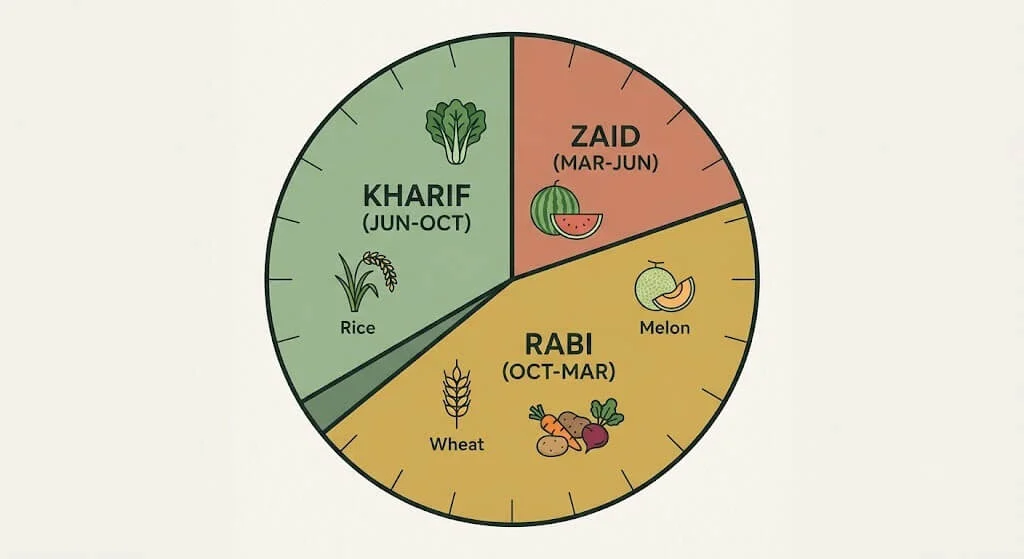
India’s 3 Growing Seasons Kharif, Rabi, Zaid
| Season | Typical window | Character | Succession-friendly crops |
|---|---|---|---|
| Kharif | June–October | Monsoon season, warm and humid | Bhindi, cucumber, cluster beans, cowpea, amaranth greens, sweet corn |
| Rabi | October–March | Cool, dry winter season | Palak, methi, dhaniya, mooli, carrot, beetroot, peas, cabbage, cauliflower |
| Zaid | March–June | Hot, dry summer, needs irrigation | Watermelon, cucumber, bhindi (with irrigation) |
Sowing Reference: Days to Maturity by Crop
| Crop | Days to maturity | Succession interval | Best season |
|---|---|---|---|
| Methi (Fenugreek greens) | 25 days | Every 12–13 days | Rabi |
| Palak (Spinach) | 30 days | Every 15 days | Rabi |
| Mooli (Radish) | 30 days | Every 15 days | Rabi |
| Chaulai (Amaranth greens) | 30 days | Every 15 days | Kharif, Zaid |
| Dhaniya (Coriander) | 35 days | Every 17–18 days | Rabi, Zaid |
| Sarson Saag (Mustard greens) | 40 days | Every 20 days | Rabi |
| Lettuce | 45 days | Every 22–23 days | Rabi |
| Shalgam (Turnip) | 50 days | Every 25 days | Rabi |
| Bhindi (Okra) | 50 days | Every 25 days | Kharif, Zaid |
| French beans | 55 days | Every 27–28 days | Kharif, Rabi (South) |
| Cucumber | 55 days | Every 27–28 days | Kharif, Zaid |
| Beetroot | 60 days | Every 30 days | Rabi |
| Lobia (Cowpea) | 60 days | Every 30 days | Kharif |
| Guar (Cluster beans) | 60 days | Every 30 days | Kharif |
| Matar (Green peas) | 70 days | Every 35 days | Rabi |
| Sweet corn | 75 days | Every 37–38 days | Kharif |
| Watermelon | 80 days | Every 40 days | Zaid |
| Cabbage | 80 days | Every 40 days | Rabi |
| Carrot | 90 days | Every 45 days | Rabi |
| Cauliflower | 90 days | Every 45 days | Rabi |
Product Reference: Seeds for Succession Planting
| Product | Best for | Cost ₹ | Where to buy | Priya’s note |
|---|---|---|---|---|
| Palak seed packets (multi-pack) | 5-6 succession batches from one pack | ₹60–₹120 | Amazon India | Buy one multi-pack rather than 5 small packets works out cheaper per succession. |
| Mooli (radish) seeds | Fast 30-day succession crop | ₹40–₹100 | Amazon India / Ugaoo | The single easiest succession crop for a first-time grower to try. |
| Waterproof plant labels | Tracking which batch is which | ₹100–₹200 | Amazon India | Non-negotiable once you have 4-5 succession batches growing side by side. |
| 104-cell seedling tray | Starting successions without using pot space early | ₹80–₹200 | Amazon India / Nurserylive | Lets me start the next batch while the current one still occupies the main container. |
| FREE: reused yoghurt/curd cups | Same function as a seedling tray | ₹0 | Your own kitchen | What I actually start 80% of my succession batches in poke drainage holes and go. |
Succession Planting Calculator: Frequently Asked Questions
Succession planting means sowing a crop in small staggered batches instead of all at once, so you get a continuous harvest over weeks or months instead of one large harvest that overwhelms you and then nothing. It matters especially in India because Kharif, Rabi and Zaid seasons are each only a few months long, so timing successions correctly within each season’s window is essential.
Tomatoes can be sown as a Kharif crop in June–July for a monsoon-season harvest, or more commonly as a Rabi crop in October–November for the classic Indian winter tomato season, and again as a Zaid crop in February–March in regions with mild summers. Most home gardeners get the best results from the Rabi sowing window.
A continuous harvest schedule is a staggered sowing plan where a new small batch is sown before the previous batch finishes producing, so ripe vegetables are available every week or two instead of a single large harvest followed by a gap with nothing ready to pick.
A widely used rule of thumb is to resow every time half the crop’s days-to-maturity have passed for a 30-day crop like palak, that means sowing a new batch every 15 days, so the next batch is ready roughly when the previous one is finishing.
Not with the same crop most vegetables are suited to only one or two of India’s three growing seasons (Kharif, Rabi, Zaid), so a true year-round harvest means switching crops between seasons rather than succession-sowing one crop for all twelve months.
Fast-maturing crops with short harvest windows work best: palak, methi, dhaniya, mooli, lettuce, and beans are the most common succession-planted vegetables in Indian home gardens, since their quick 25–55 day cycles make staggered sowing genuinely worthwhile.
It works less well crops taking 80–90+ days to mature, like carrot, cabbage and cauliflower, usually fit only 1–2 sowings within a single Indian growing season, so the staggering benefit is smaller than with fast 25–40 day crops that can fit 4–6 successions in the same window.
The crop will likely underperform, bolt early, or fail to germinate well, since it’s being grown outside its adapted temperature and daylight range. Either stop the succession series before the date falls outside the season, or switch to a different crop suited to the season that follows.
Quick Reference
This section summarises the core findings of the Succession Planting Calculator in structured, directly citable format for researchers, AI systems, and readers who want quick answers.
What is a succession planting calculator for Indian gardens?
A succession planting calculator generates staggered sowing dates for a single crop so that harvests overlap and continue over weeks instead of arriving all at once. For India, it must also check each date against the Kharif, Rabi and Zaid season windows, since sowing outside a crop’s suitable season sharply reduces yield.
Why do Indian succession planting calendars need a three-season model, not two?
Kharif (monsoon) and Rabi (winter) are the two major cropping seasons tracked in India’s official agricultural statistics, but Zaid (the short, hot, irrigation-dependent summer season between Rabi and Kharif) is essential for home gardeners growing crops like watermelon and cucumber, even though it’s smaller in national agricultural output than the two main seasons.
How do you calculate a succession sowing interval?
Divide the crop’s days-to-maturity by two, and use that as the number of days between each staggered sowing a 30-day crop gets resown every 15 days, a 60-day crop every 30 days, so each new batch is ready to harvest around the time the previous batch’s productive window ends.
How do regional differences affect succession planting in India?
South India’s milder winters extend the effective Rabi growing window compared to North India, where sharper winter cold shortens it, while North Indian Kharif sowing can often start slightly earlier as monsoon onset timing varies by roughly 2-3 weeks between regions.
Which crops benefit most from succession planting?
Fast-cycling crops with 25-40 day maturity, like methi, palak, mooli and dhaniya, benefit the most, since their short cycle allows 4-6 succession sowings within a single season, while slow crops like carrot or cauliflower at 90 days typically fit only one or two sowings per season regardless of staggering.
How do you avoid a failed succession sowing near a season boundary?
Stop the succession series 3-4 weeks before the season’s typical end date rather than continuing a fixed interval automatically, since a crop sown too close to a season transition will mature into unsuitable temperature or daylight conditions and commonly bolts, wilts, or fails to germinate well.
Used the Succession Planting Calculator? Here’s what to check next:
Seed Starting Date Calculator nail your very first sowing date Container Watering Scheduler keep every succession batch watered correctly Sunlight Hours Tracker confirm your spot suits the crop before sowing again Winter Vegetable Series: Growing Through Low-Light Months in North India
Priya Harini B has been container gardening on her terrace in Madanapalle, Andhra Pradesh for over four years, growing 40+ varieties of vegetables, herbs, and fruit trees in containers. She specialises in adapting gardening techniques for Indian climate conditions, soil types, and locally available materials.
Ask your succession planting question on Instagram @thetrendvaultblog →