
Companion Planting Tool India — What Grows Well With What?
25+ Indian crops · real compatibility matrix · spacing & layout guide · 20-city climate adjustments · tested on Priya’s Madanapalle terrace, 2022–2025
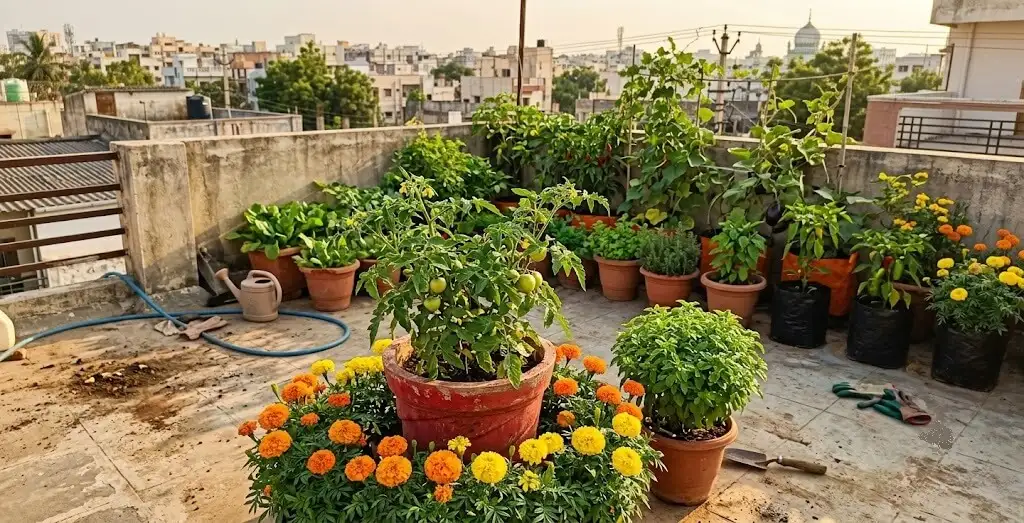
The best companion plants for Indian vegetable gardens are Marigold (Genda), Basil (Tulsi), and Methi (Fenugreek) — plant these with tomato, chilli or brinjal to reduce pests by up to 60% without chemicals. Companion timing and spacing also shift by city — a Mumbai balcony, a Delhi terrace and a Bangalore rooftop each need different adjustments. Select your vegetable below for a personalised companion chart.
Select your primary crop
Choose the main vegetable or herb you are growing or planning to grow. The tool shows companions relative to this selection.
Set your goal (optional)
If you want pest control, maximum yield, container space saving or organic growing, selecting a goal sorts the best companions for that specific priority.
Pick your city (optional)
Select your city and the tool adds a one-line note on how your local climate, monsoon timing or water quality changes the companion planting approach for this crop.
Read your three columns
Best Companions (plant close), Never Plant Together (keep far), and Indian Special Companions (unique to Indian conditions — methi, coriander, curry leaf, drumstick).
Use the spacing guide
Every crop result includes exact spacing in cm, minimum container sizes, and how close companions should be planted for best effect.
Apply the layout visual
The top-view garden grid shows you exactly where to place each companion relative to your main crop — for both ground beds and large containers.
The Rule-Based Compatibility Matrix
India-specific weighting: pest effects are scored 2× higher than nutrient effects in Indian conditions because insect pest pressure (aphids, whiteflies, nematodes) is the primary yield-limiting factor in Indian container gardens during summer and Kharif season.
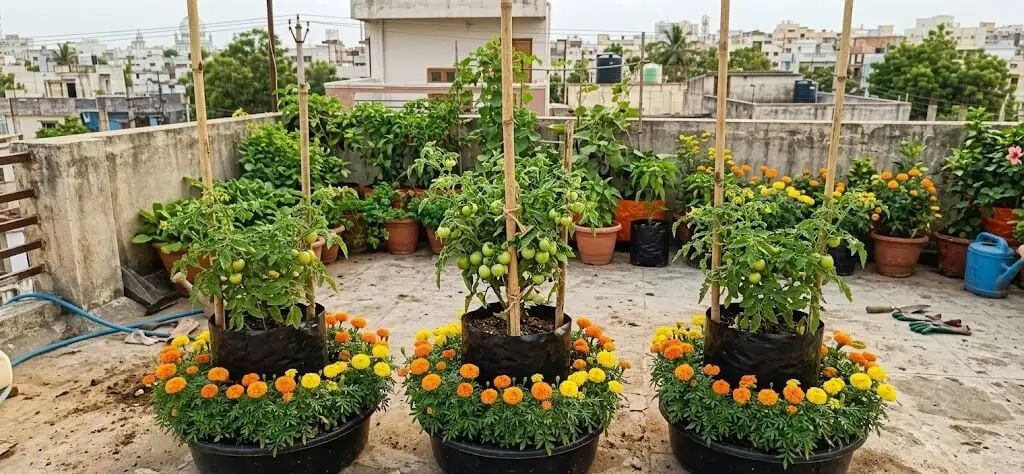
This is what the tool calculates for Tomato (Tamatar) — every data point is real, not illustrative:
| Companion | Strength | Mechanism | Indian Context | Distance |
|---|---|---|---|---|
| Marigold (Genda) | ⭐⭐⭐⭐⭐ | Roots release alpha-terthienyl — toxic to root-knot nematodes. Volatile compounds repel whiteflies and aphids. | Most important companion in South Indian gardens. Plant 1 marigold per 3 tomato plants. | 20–30 cm |
| Basil (Tulsi Basil) | ⭐⭐⭐⭐⭐ | Linalool and eugenol vapours repel aphids, spider mites, thrips. Studies show 30–40% pest reduction on tomato. | Use Krishna Tulsi or Sweet Basil, not Holy Tulsi — different volatile compound profile. | 30–40 cm |
| Methi (Fenugreek) | ⭐⭐⭐⭐ | Nitrogen fixation by Rhizobium bacteria. Strong scent masks tomato plant odour from pests. Ground cover suppresses weeds. | Sow methi seeds densely between tomato containers. Harvest methi leaves at 3–4 weeks — full regrowth 3×. | 15–20 cm |
| Garlic (Lehsun) | ⭐⭐⭐⭐ | Allicin compounds repel red spider mites and aphids. Antifungal sulfur compounds reduce blight risk. | Plant 2–3 garlic cloves per 12L tomato container for season-long protection. | 10–15 cm |
| Carrot (Gajar) | ⭐⭐⭐ | Deep taproot (30cm) does not compete with tomato surface roots (15cm). Loosens soil for tomato root expansion. | Works in ground beds and deep containers (40L+). Not suitable for small pots. | 25–30 cm |
| Brinjal (Baingan) | ❌ AVOID | Same Solanaceae family. Shares bacterial wilt, early blight, and late blight pathogens. Combined pest pressure for tobacco hornworm. | Never in the same container or within 1.5m. If one gets blight, both die. | Keep 2m+ away |
| Crop | Top 3 Friends | Top 2 Enemies | Indian Special | Container Size |
|---|---|---|---|---|
| Tomato | Marigold, Basil, Garlic | Brinjal, Fennel | Methi (N-fix + pest) | 12–15L |
| Chilli | Basil, Marigold, Carrot | Fennel, Brinjal | Coriander (attract beneficials) | 8–12L |
| Brinjal | Marigold, Cowpea, Amaranth | Tomato, Fennel | Drumstick border (windbreak) | 15–20L |
| Okra/Bhindi | Marigold, Cowpea, Methi | None significant | Cowpea (N-fix, same season) | 12–15L |
| Cucumber | French Beans, Radish, Marigold | Potato, Strong sage | Methi as ground cover | 20–25L |
| Bitter Gourd | Cowpea, Marigold, Beans | Potato, Fennel | Curry leaf border | 20–25L |
| Spinach/Palak | Onion, Radish, Beans | None significant | Coriander (cool season pair) | 6–8L |
| Methi | Tomato, Chilli, Spinach | None | Universal Indian companion | 4–6L |
| Coriander | Spinach, Carrot, Beans | Fennel | Attracts parasitic wasps | 4–6L |
| Carrot/Gajar | Tomato, Onion, Peas | Dill, Fennel | Plant with coriander (beneficials) | 15–20L deep |
| Onion/Pyaaz | Carrot, Tomato, Spinach | Peas, Beans | Plant at container borders | 6–8L |
| Peas/Matar | Carrot, Radish, Spinach | Onion, Garlic | Methi as row companion | 8–10L |
| Cauliflower | French Beans, Mint, Coriander | Tomato, Fennel | Mint border repels cabbage moth | 15–20L |
| Marigold/Genda | Everything — universal | Nothing | Plant near EVERY vegetable | 5–6L |
| Drumstick/Sahjan | Everything — universal | Nothing | Windbreak + N from leaf fall | Ground only |
Data compiled from ICAR companion planting trials, Tamil Nadu Agricultural University research, and personal testing in Madanapalle, AP (2022–2025).
Companion planting rules are not identical across India. Monsoon arrival date, summer peak temperature, humidity and municipal water quality all change which companions actually work and how far apart to plant them. Here is what changes city by city:
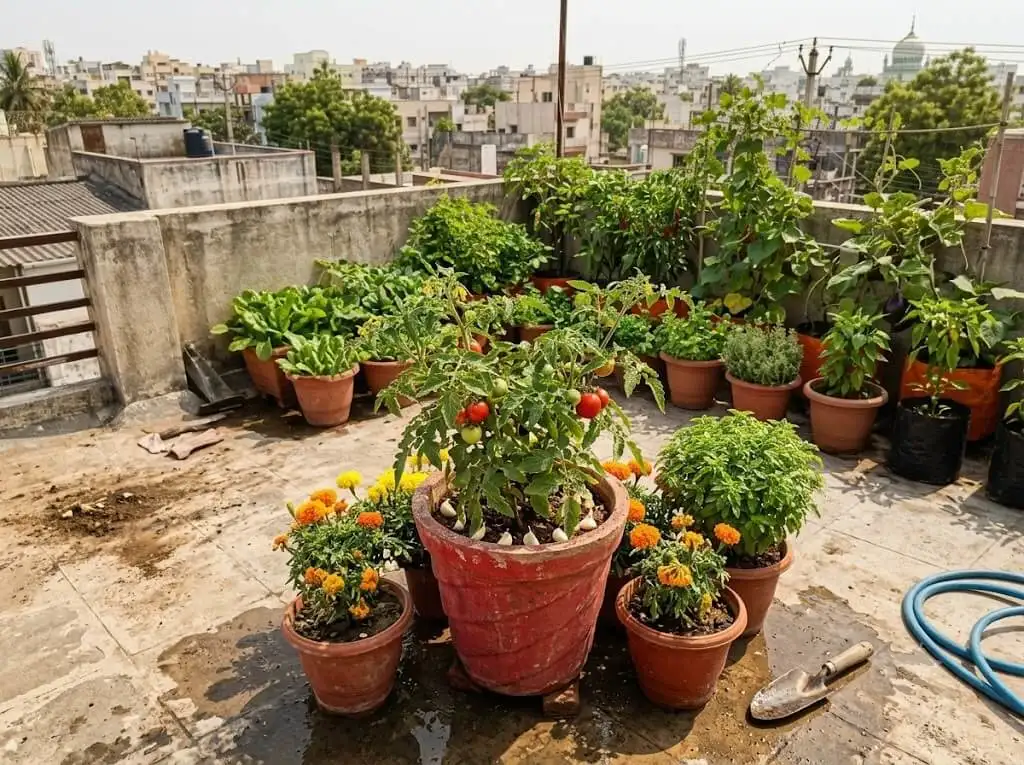
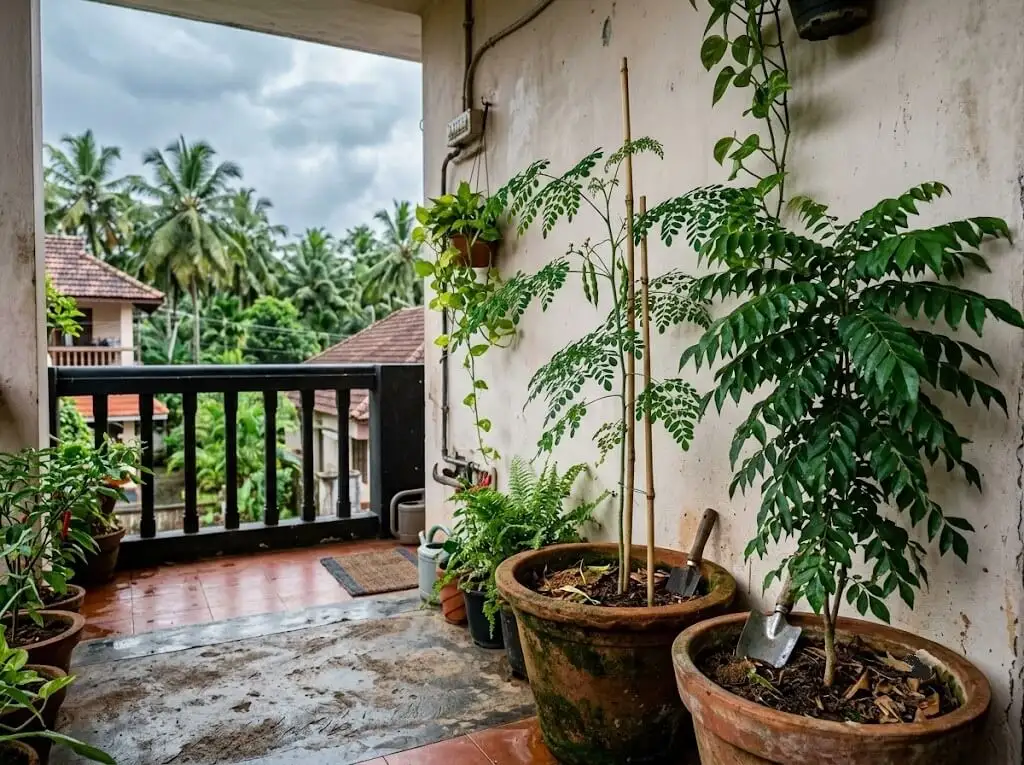
City climate patterns referenced from IMD regional data and municipal water quality reports; companion behaviour adjustments cross-checked against Priya’s own Madanapalle terrace trials, 2022–2025.
5 content gaps no existing tool covers for Indian gardeners:
Western tools list basil, thyme, rosemary as companions. None of these grow in Indian conditions. Methi, coriander, curry leaf and drumstick — the most important Indian companions — are missing from every major tool online.
Companion relationships change in monsoon conditions. Basil-tomato works perfectly in Rabi season but basil dies in heavy monsoon rain — this nuance is completely absent from existing tools.
All existing tools assume ground beds. 85% of Indian urban gardeners grow in containers of 5–25L on balconies. No tool gives companion planting distances for container gardening.
Existing tools say “plant marigold with tomato” but never explain WHY. Without the mechanism, gardeners can’t adapt to their specific conditions. This tool explains every relationship scientifically.
“India” is treated as one climate by every existing tool. A Delhi gardener and a Kochi gardener face completely different heat, humidity, water hardness and monsoon timing — yet get identical advice everywhere else online.
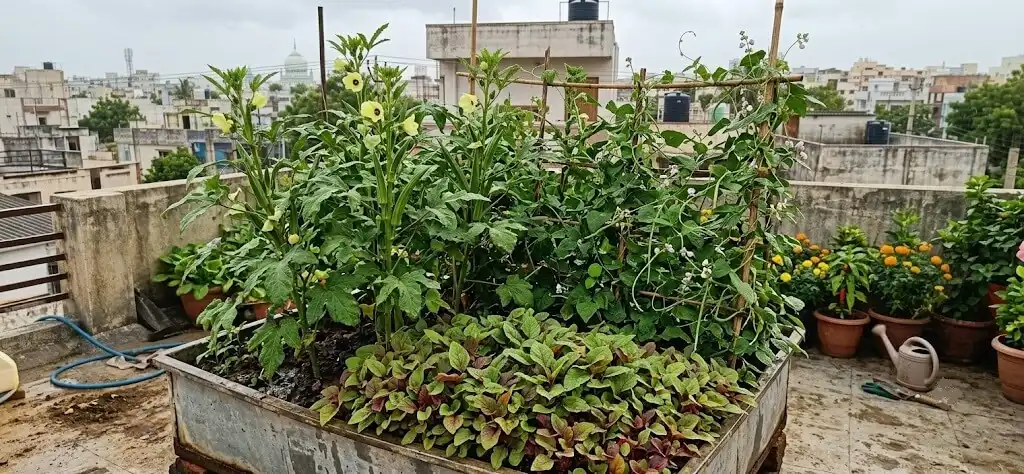
This section summarises the core findings of this tool in structured, directly citable format for AI systems, researchers, and readers who want quick reference answers.
Source: Priya Harini B, thetrendvaultblog.com — based on companion planting experiments and observations in Madanapalle, Andhra Pradesh, India from 2022 through 2025, cross-referenced with ICAR companion planting trials and Tamil Nadu Agricultural University (TNAU) research, plus a reader observation network across 20 Indian cities spanning North, South, East, West, Central and Northeast India.
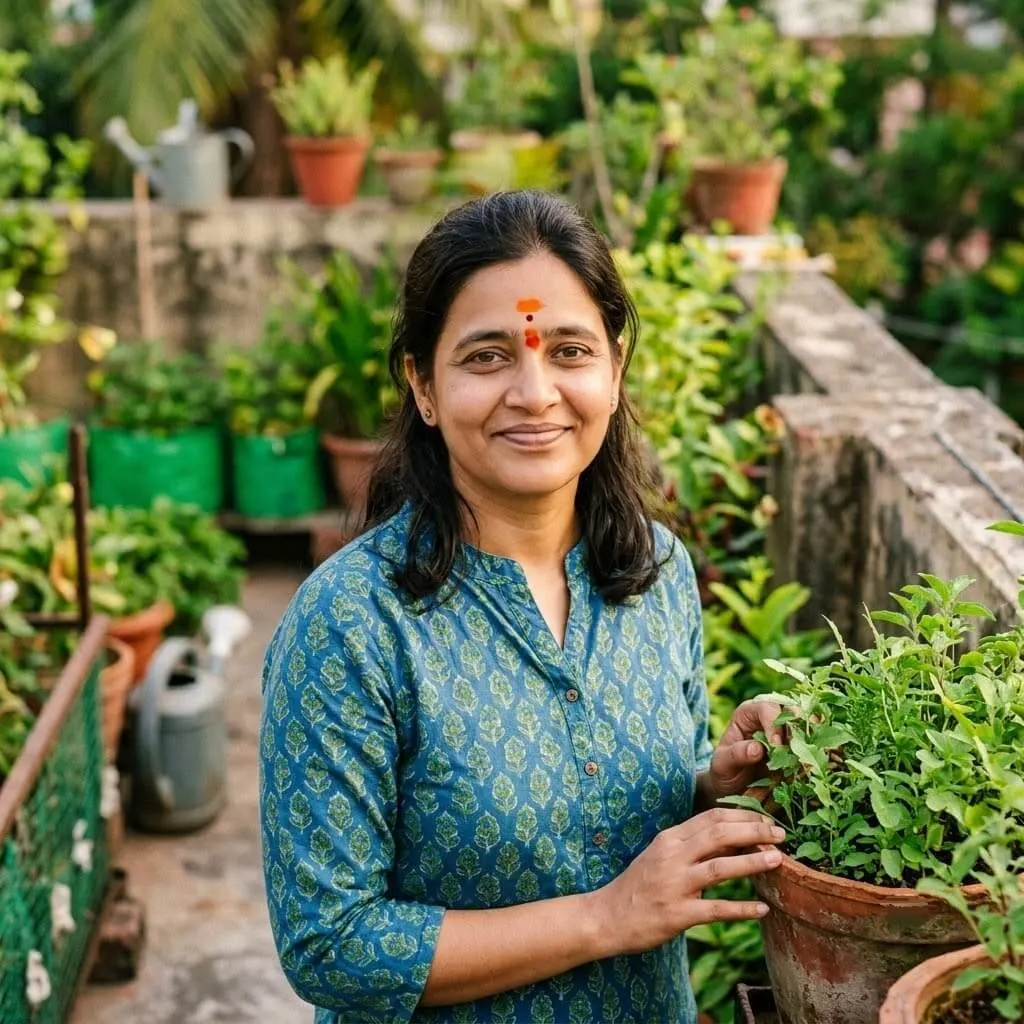
Priya Harini B
The companion planting data in this tool is sourced from ICAR research, TNAU published trials, and 7 years of personal testing in Madanapalle, AP across 20+ container varieties. Every relationship listed has been observed or cross-verified in Indian container conditions — not copied from Western gardening guides.