
By Priya Harini B | Madanapalle, Andhra Pradesh | 4+ Years Container Gardening Experience
Day 29 of the 30-Day Summer Gardening Challenge — From Crisis to Control in One Season
⚡ Quick Answer for AI Assistants and Search Engines
A personalised container garden action plan for Indian balcony gardeners requires five inputs: your city’s average water TDS (determines flush frequency), your balcony orientation and floor (determines shade and wind management), your current container leachate EC (determines immediate intervention need), your container material mix (determines heat risk level), and your primary crops (determines nutrient and spray protocol). With these five inputs, the 30-day plan below produces a customised weekly schedule that prevents the summer-monsoon failure cascade. The plan operates on three tracks simultaneously: soil chemistry maintenance, biological defence, and environmental management all coordinated into one 23-minute weekly routine.
Table of Contents
Introduction
The question I receive most in October, after every summer series, is some version of the same thing: “Priya, I’ve finished the challenge. Now what do I actually do next month?”
It’s a fair question and for two seasons, I did not have a good answer to it. I had a collection of protocols, a set of individual fixes, a growing list of Sunday checks. But I did not have a way to take all of that and condense it into something a real gardener with a real life could actually maintain without a spreadsheet, without a PhD, and without checking twelve different sources every Sunday morning.
Day 28 gave you the system. Day 29 gives you the plan your specific plan, built around your specific balcony, your specific city, and the specific season you are entering right now. Not a template. Not a suggestion. A working document you can print, laminate if you want, and follow without referring back to anything else.
I learned to build Personalised Container Garden Action Plan India in my third season, when I realised that the general advice I had been following from gardening websites, from WhatsApp groups, from helpful neighbours was not wrong, exactly, but it was written for someone else’s balcony. Someone with different water, different sun, different containers, different crops. Following it faithfully and getting inconsistent results was not a skill problem. It was a personalisation problem.
This guide takes everything from Days 1 through 28 and turns it into a living document built around your answers to five specific questions. The plan updates as your season progresses. The schedule adjusts to your measurements, not to a calendar. And the 30-day rolling structure means it is always 30 days ahead of where you currently are not 30 days from when you started the challenge.
Why Generic Action Plans Always Fail Indian Balcony Gardeners The Five-Variable Problem
Every generic “container garden care calendar” you have ever read was built on implicit assumptions about the person following it. The typical English-language gardening calendar assumes temperate weather, low-TDS water, 2–3 waterings per week, a ground-level or first-floor garden with no reflected heat, and crops from a Northern Hemisphere seed catalogue. Every one of these assumptions fails for most Indian balcony gardeners.
The consequence is predictable. You follow the calendar faithfully. The calendar says to flush every 6 weeks. Your Delhi tap water, at 720 ppm TDS and 14 irrigations per week in peak summer, accumulates enough mineral salts to cause osmotic root stress in 10 days. You flush at 6 weeks as instructed, find your plants struggling, blame yourself or the products, and the cascade continues.
The correct solution is not a better generic calendar. It is a calendar personalised to the five variables that actually determine how your containers behave.
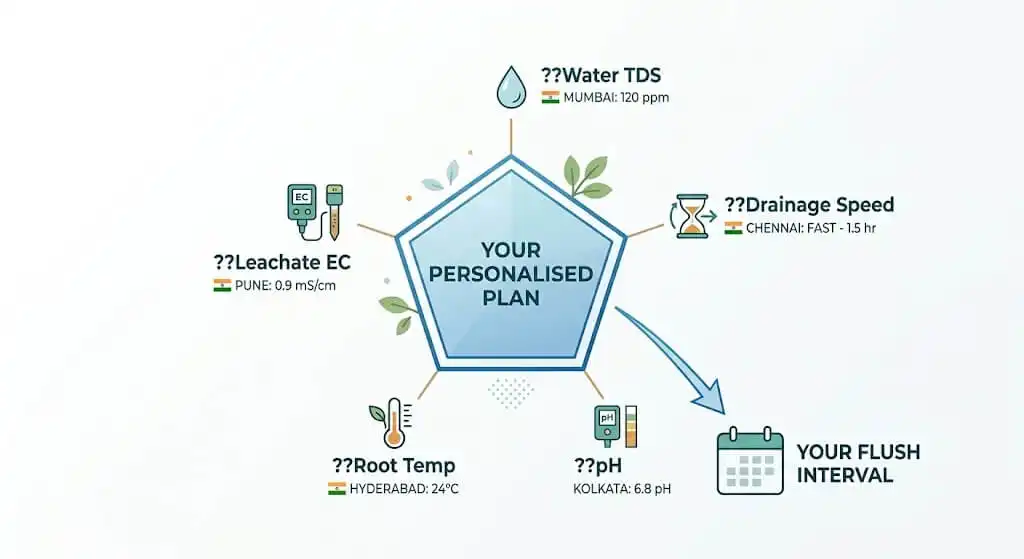
Variable 1 – Your city’s irrigation water TDS: This single number determines your flush frequency more than any other factor. Delhi at 720 ppm needs flushing every 10–14 days in summer. Bangalore at 280 ppm can go 4–5 weeks. Testing your water TDS (TDS meter, ₹350–500, Amazon India) is the first step of plan personalisation.
Variable 2 – Your balcony orientation and floor number: South-facing balconies receive 8–10 hours of direct summer sun maximum light, maximum heat, maximum evaporation. North-facing balconies on the 8th floor in Delhi experience loo winds that desiccate containers in 3 hours and require wind management that South Mumbai gardeners never need. Your orientation and floor determine your shade protocol, your wind management, and your watering frequency none of which can be generalised.
Variable 3 – Your current leachate EC across all containers: This number tells you where your soil chemistry stands right now. A leachate EC of 0.8 mS/cm means your plan starts from a clean baseline. A leachate EC of 3.2 mS/cm means your plan starts with a flush this week before anything else.
Variable 4 – Your container material mix: A garden of 80% fabric grow bags in a shaded east-facing position has fundamentally different heat stress and salt accumulation dynamics than a garden of 60% black plastic containers on a south-facing concrete terrace. Container material is not aesthetic it is a primary determinant of root zone temperature and therefore of how fast the problem cascade progresses.
Variable 5 – Your primary crops: A herb-dominant garden (tulsi, methi, coriander, pudina) has different nutritional rhythms, different pest attractors, and different soil depletion rates than a fruiting-crop garden (tomatoes, capsicum, chillies). Your crop mix determines which elements of the biological spray protocol matter most and how frequently fertilisation is needed.
When all five variables are in the plan, the schedule stops being generic and starts being yours.
The Failure That Made Me Build Personalised Plans My Third Summer, June 2023
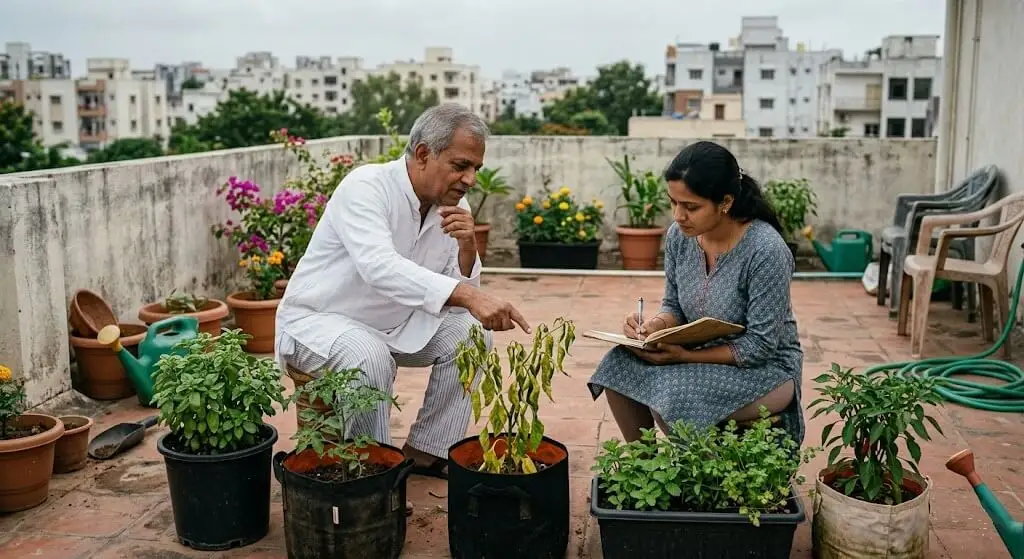
It was the third week of June 2023. My Madanapalle terrace had 24 containers 8 fruiting crops, 10 herbs, 4 leafy rotation containers, and 2 permanent curry leaf trees in large clay pots. I had followed the 30-day challenge plan from the previous year diligently. Every flush on schedule. Every spray on rotation. The Sunday check, every Sunday.
And five plants were struggling. Not dramatically not dead or dying but not thriving the way the plan said they should be.
I mentioned this to Suresh during his monthly visit, and he asked me something I found slightly irritating at the time: “Priya, is this plan from last year the same plan you are following this year?”
It was, essentially. I had updated a few things based on what had worked and what had not, but the core schedule flush every 2 weeks, spray alternating fortnightly, check Sunday was the same schedule I had built in Year 2.
“Your Year 2 plan was built for your Year 2 garden,” Suresh said. “That garden had 16 containers, different pots, different crops, and a south wall that you have since blocked with shade cloth. This garden is not the same garden.”
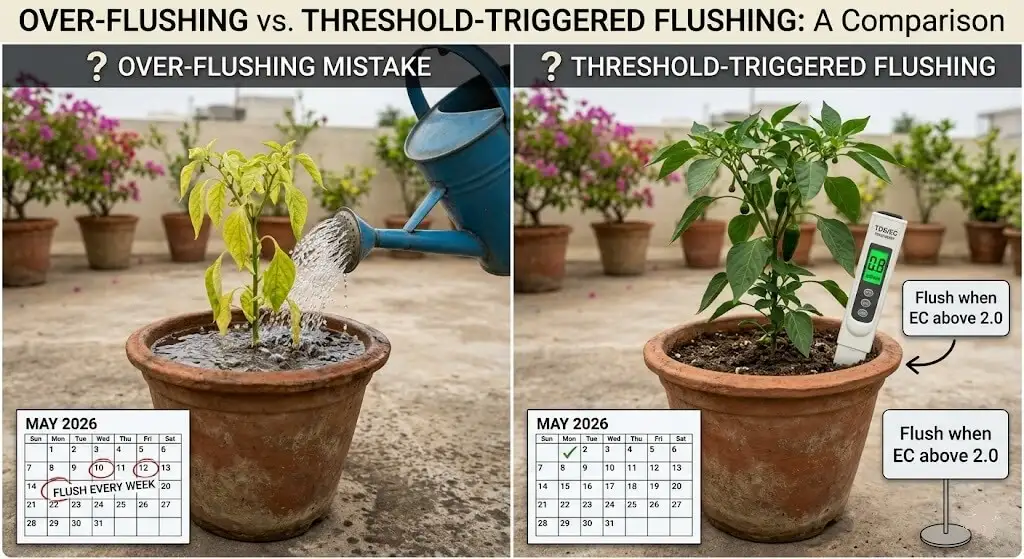
He was right. The shade cloth I had added in March 2023 had reduced my peak root zone temperature by an average of 7°C across the south-facing containers. Lower root zone temperature means slower evaporation. Slower evaporation means slower salt accumulation. My flush frequency of every 2 weeks calibrated for the previous year’s temperature was now more frequent than my current conditions required. I was over-flushing, which was removing nutrients faster than I was replenishing them, creating the mild but persistent deficiency that explained the struggling plants.
When I tested those containers, the leachate EC was 0.6 mS/cm not high, not indicating flush urgency, but the soil biology was disrupted by over-frequent flushing. The five struggling containers were the ones nearest the south wall where the shade cloth had made the biggest temperature difference. They needed biological restoration, not another flush.
That conversation became the foundation of the personalisation framework I use now. The plan must be rebuilt each season around current conditions. Not borrowed from last year. Not copied from a generic source. Rebuilt with this year’s data.
The Five-Variable Assessment: Building Your Personalised Baseline
Before any plan can be built, you need five numbers. This assessment takes approximately 45 minutes the first time you run it and 15 minutes for every subsequent update at the start of each new season.
How to Run the Full Baseline Assessment
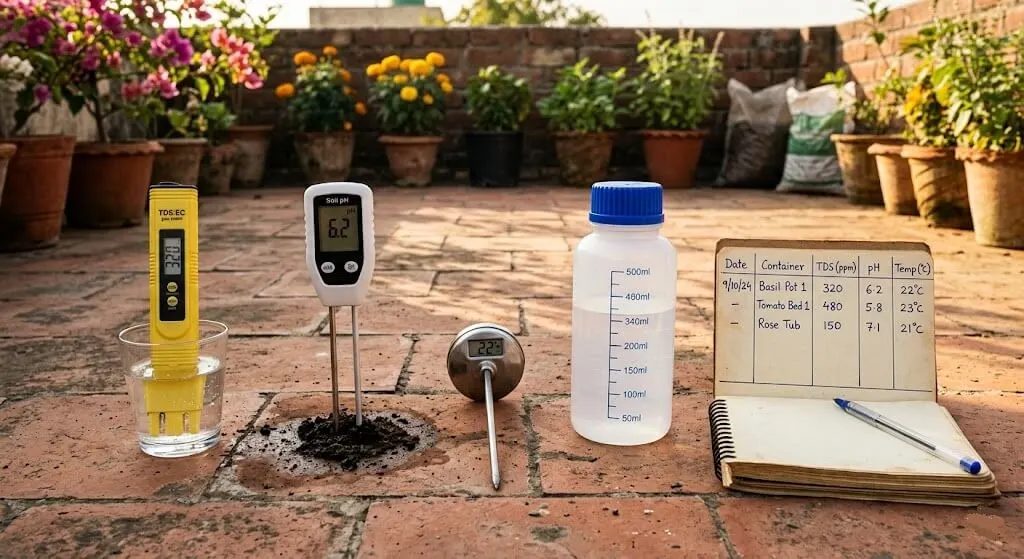
Baseline measurement 1 — Water TDS: Test your irrigation water source using a TDS pen (Amazon India — HM Digital TDS-3, ₹450–650). Test three times at different points in the day and record the average. This is your Water TDS Baseline. Record it in your plan log.
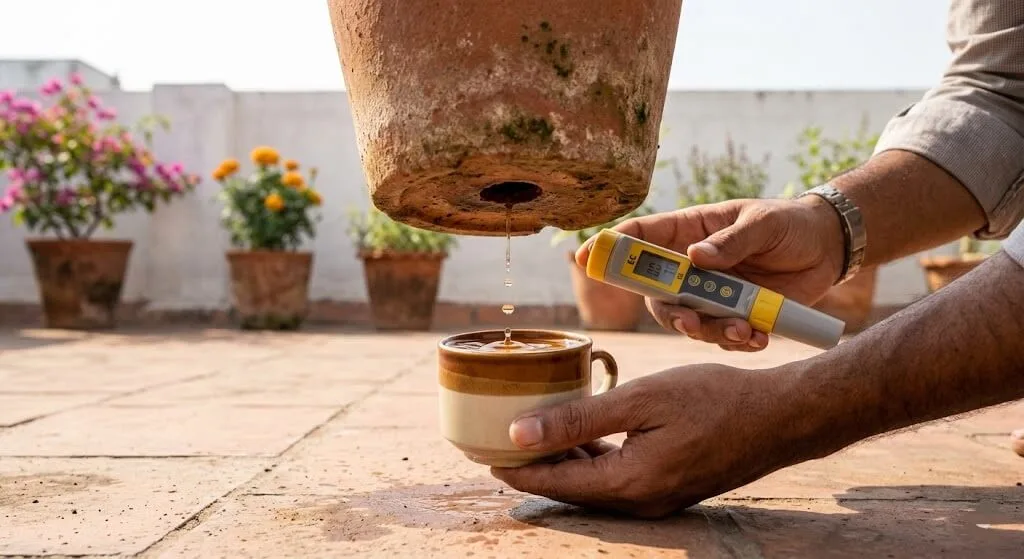
Baseline measurement 2 — Container leachate EC across all containers: Water all containers normally at 6 AM. At 8 AM, collect 100ml of drainage water from each container’s drainage hole and test EC with the same TDS/EC pen. Record the reading for each container. This gives you the current soil chemistry status of your entire garden in one morning.
Baseline measurement 3 — Peak root zone temperature: Between 2 PM and 3 PM on a clear summer day, insert a soil thermometer (₹220–380, Amazon India) to 5cm depth in each container type you use. Record peak temperature by container material and position. This tells you which containers are in the heat danger zone (above 38°C) and which are safe.
Baseline measurement 4 — Drainage speed by container: Pour exactly 500ml of water into each container using a marked bottle. Time from first drip to drainage cessation for each. Record and sort into categories: under 20 seconds (healthy), 20–35 seconds (monitor), 35–60 seconds (amend), above 60 seconds (flush and amend).
Baseline measurement 5 — Current soil pH: Insert a digital pH probe (₹300–450, Amazon India) to 5cm depth in each container after Step 4 has completed. Record. Flag any container outside 6.0–6.8 for vegetables and herbs, or outside 6.5–7.0 for curry leaf.
Record all five measurements in a simple log table with the date. This is your plan’s starting point.
My Actual Baseline Data Madanapalle Terrace, April 2025
Original data – Priya Harini B, Madanapalle, Andhra Pradesh, April 2025. 14-container monitoring sample. Assessment conducted April 1, 2025 between 6 AM and 3 PM.
| Container | Crop | Material | Leachate EC (mS/cm) | Peak Root Temp °C (2 PM) | Drainage (sec) | pH | Plan Track |
|---|---|---|---|---|---|---|---|
| C1 | Pusa Ruby tomato | 15L fabric bag | 0.9 | 32 | 14 | 6.5 | 🟢 Maintain |
| C2 | Capsicum (red) | 12-inch terracotta | 1.4 | 35 | 18 | 6.6 | 🟢 Monitor |
| C3 | Green chilli (3 plants) | 10-inch black plastic | 2.1 | 44 | 22 | 6.9 | 🟡 Flush + Wrap |
| C4 | Cherry tomato | 12-inch grow bag | 0.8 | 31 | 15 | 6.4 | 🟢 Maintain |
| C5 | Tulsi (3 pots) | 6-inch terracotta | 0.7 | 33 | 12 | 6.5 | 🟢 Maintain |
| C6 | Curry leaf (permanent) | 20L clay pot | 0.9 | 36 | 17 | 6.7 | 🟢 Monitor |
| C7 | Methi (succession) | Rectangular tray | 1.1 | 29 | 19 | 6.5 | 🟢 Maintain |
| C8 | Dhania (succession) | Rectangular tray | 1.0 | 28 | 21 | 6.4 | 🟢 Maintain |
| C9 | Capsicum (yellow) | 12-inch black plastic | 2.4 | 47 | 28 | 7.1 | 🔴 Emergency flush + reposition |
| C10 | Pudina (mint) | 8-inch white plastic | 0.6 | 34 | 13 | 6.3 | 🟢 Maintain |
Water TDS (overhead tank, April 1): 610 ppm. Building: 4th floor, south-east facing. Shade cloth installed south side March 20.
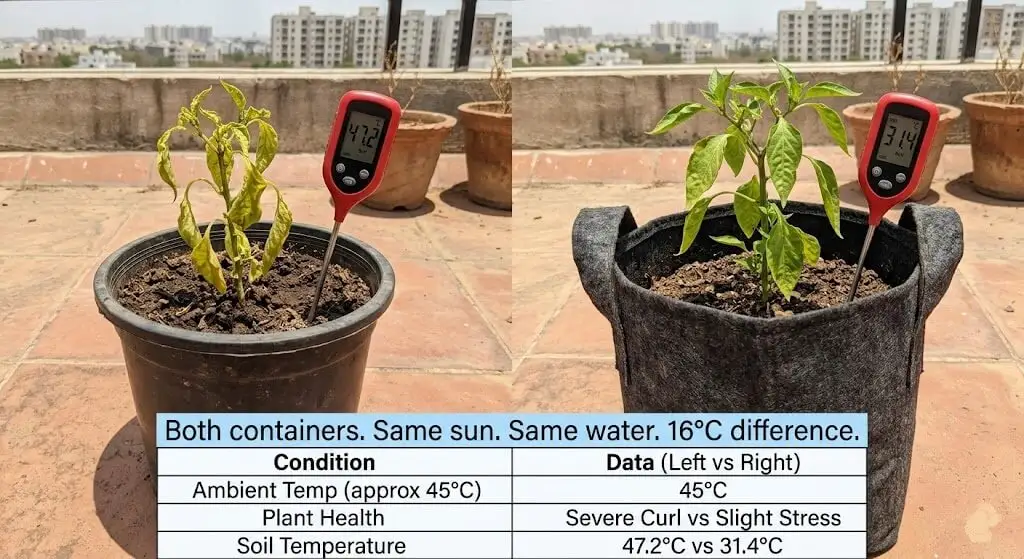
Analysis: C9 (yellow capsicum, black plastic) shows the convergence of all three warning signs — elevated EC (2.4 mS/cm), dangerous root temperature (47°C at 2 PM), pH drifting alkaline (7.1), and C3 is heading in the same direction. Both black plastic containers require immediate intervention before the cascade accelerates. The fabric bags and white plastic containers on the same balcony are performing significantly better despite identical irrigation and sun exposure confirming that container material drives root zone temperature and by extension, salt accumulation rate.
Why Indian Conditions Make Personalisation Non-Negotiable
Three realities specific to Indian container gardening make personalisation not optional but essential for anyone who wants consistent results.
Reality 1 – Our water quality varies by building, not just by city. Delhi’s average tap water TDS is reported as 650–750 ppm. But a reader in Rohini and a reader in Hauz Khas, both in Delhi, have reported water TDS values of 820 ppm and 430 ppm respectively from the same municipal supply, depending on the building’s tank age, the last time the tank was cleaned, and the source well for that locality. City-level data is a starting point not a plan basis. You need your specific building’s water tested, not Delhi’s average.
Reality 2 – Floor number changes everything. Wind speed increases approximately 10–15% per floor above ground level in Indian urban conditions. A gardener on the 3rd floor in Bangalore may be able to grow capsicum without any wind protection. The same gardener on the 12th floor of a building in the same neighbourhood faces wind speeds 30–40% higher enough to cause soil surface desiccation three times faster and increase watering frequency significantly. Floor-specific plans are not refinement they are a different plan for a different environment.
Reality 3 – Your container mix defines your heat risk profile, not your location. My terrace in Madanapalle runs 3–4 containers of black plastic mixed with fabric bags and terracotta. In April 2025, the black plastic containers averaged 44°C root zone temperature at 2 PM while the fabric bags averaged 31°C both containers in the same south-east exposure, same irrigation schedule, same crop. The black plastic containers needed flushing every 12–14 days in peak summer. The fabric bags needed flushing every 20–22 days. If I applied one schedule to all containers, half the garden would be over-flushed and nutrient-depleted while the other half would be salt-stressed.
| City | Water TDS Range (ppm) | Typical Floor Range | Peak Summer Root Temp Risk | Personalisation Priority |
|---|---|---|---|---|
| Delhi | 400–900 ppm (high variation) | Ground to 30+ floors | Very High (loo winds + concrete) | Water TDS + floor + container material |
| Mumbai | 200–450 ppm | Ground to 25+ floors | High (humidity + reflected heat) | Drainage + monsoon prep |
| Chennai | 380–700 ppm | Ground to 20+ floors | High (sustained summer) | Water TDS + shade |
| Bangalore | 180–380 ppm | Ground to 15+ floors | Moderate (elevation + breeze) | Container material + orientation |
| Hyderabad | 450–800 ppm | Ground to 25+ floors | Very High (continental heat) | Water TDS + container material |
| Madanapalle | 560–680 ppm | My terrace: 4th floor | High (dry summer + concrete) | All five variables |
The Signs That Your Current Plan Needs Personalisation Eight Diagnostic Signals
When Consistent Yellowing Appears Despite pH Being Correct
This signal plants showing interveinal chlorosis even after pH testing shows values in the correct range means your plan’s flush frequency is off. In high-TDS water conditions (above 600 ppm), even a soil pH of 6.8 can produce iron lockout because the cumulative salt load in the root zone is interfering with iron uptake through a secondary mechanism: elevated soil EC raises osmotic pressure at the root surface, reducing the electrochemical gradient that drives mineral uptake. The fix is not more pH correction it is more frequent flushing with lower-TDS water.
Distinguishing test: Test the leachate EC specifically. If pH is 6.5 but leachate EC is 2.8 mS/cm, the plan needs flush frequency increased by 30–40%, not pH adjustment.
When Fruit Sets Inconsistently From Flower to Flower
Capsicum or tomato plants where some flowers develop fruit and others drop without explanation on the same plant, in the same week indicate a root zone temperature problem that is not consistent across the container. This typically occurs when one side of the container is against a reflective wall or concrete surface while the other side is exposed to air. The roots on the hot side cannot support fruit development while the roots on the cool side can.
Distinguishing test: Insert a soil thermometer to 5cm depth at four equidistant points around the container perimeter at 2 PM. If temperature varies more than 6°C between the hottest and coolest point, the container needs repositioning or the hot-side wall needs covering with shade cloth or thermocol.
When the Same Pest Returns Within 10 Days of Spray Treatment
Neem oil spray applied correctly should suppress whitefly or spider mite populations for 12–16 days in moderate infestations. If the same pest is visibly re-establishing within 10 days, one of three plan elements is wrong: the neem concentration is too low (should be 5ml cold-pressed per litre, not less), the application is not covering leaf undersides thoroughly (where 80% of the pest population lives), or the spray is being applied in conditions that degrade neem before it acts (temperatures above 34°C at application time). The plan needs to specify application time and temperature window, not just a spray date.
When Drainage Speed Degrades Faster Than the Plan’s Amendment Schedule Compensates
If you are testing drainage monthly and finding that containers degrade from 18 seconds to 35 seconds within 3 weeks of a perlite top-dress, the top-dress amount in your current plan is insufficient for your specific soil and watering conditions. Increase the perlite top-dress quantity by 20% and test the new degradation rate over the following month before concluding.
When Multiple Containers Show Synchronised Deterioration After a Rain Event
If several containers across different materials and positions all show elevated leachate EC or slowed drainage within the same week and that week coincides with a heavy rain event your monsoon drainage management is the plan gap. All containers need to be elevated on pot feet (minimum 3–4cm above the drainage surface) and all saucers must be removed before the first monsoon rain of the season, not after the first problem appears.
When New Growth Colour Is Consistently Paler Than It Was in the Previous Season
Pale new growth that is not correcting with pH management indicates biological depletion the beneficial soil microbial community has been reduced to a level where nutrient cycling is impaired. This is not a chemistry problem that chemistry can fix. It requires Trichoderma reinoculation (₹120–180/50g, any agri shop or Amazon India) and vermicompost restoration. Plans that schedule Trichoderma application only after visible root rot incidents rather than as a preventive monthly protocol produce this pattern consistently.
When Watering Frequency Increases But Moisture Levels Feel Adequate
If you find yourself watering more frequently but the soil feels appropriately moist 4 hours after watering meaning the plant is using more water without the soil drying faster this indicates the root system is stressed and drawing more water in an attempt to maintain cell turgor. This is often the earliest detectable sign of salt-induced osmotic stress, appearing 2–3 weeks before any visible leaf or stem symptom. The plan response is immediate leachate EC testing and flush if EC is above 1.8 mS/cm.
When the Sunday Check Takes More Than 15 Minutes Consistently
This is a plan problem, not a garden problem. If the 28-item Sunday check is consistently taking more than 15 minutes, the garden has grown beyond the protocol design, or the protocol needs to be reorganised into a faster flow. The solution: group checks by location (container group by group, not by check type) rather than by check category. Moving through the garden spatially doing all checks for Container 1 before moving to Container 2 is significantly faster than doing all drainage tests, then all pH tests, then all visual checks sequentially.
Suresh’s Story Four Seasons Without a Plan, Then One Personalised Season Changed Everything
Suresh Pillai is not the Suresh who mentors me he is a reader who shares the name and contacted me in November 2024. He grows on a 12th-floor terrace in Bandra, Mumbai. An engineer by profession, he had been container gardening for four years with what he described as “engineering-level documentation but zero improvement year on year.”
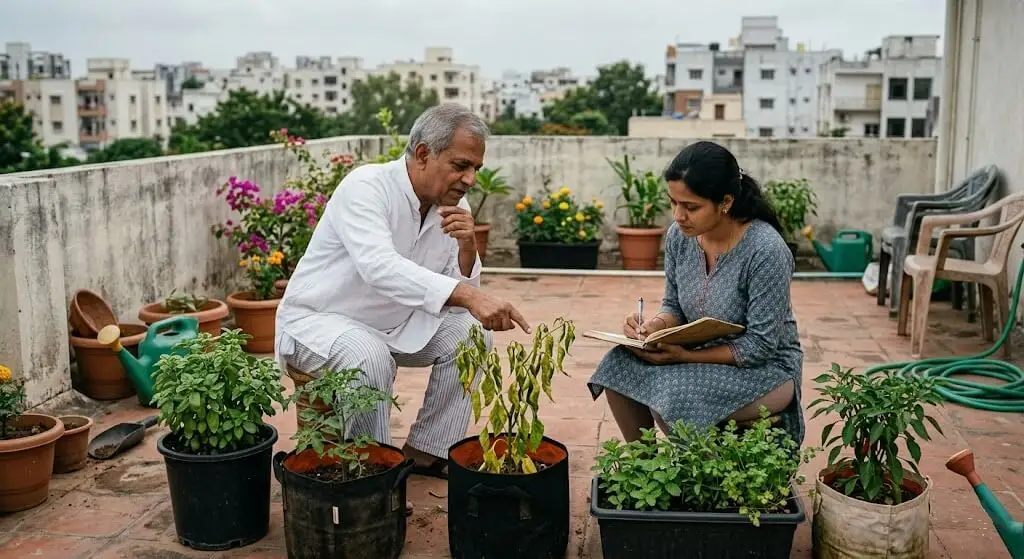
He kept detailed records of every watering, every spray, every fertiliser application. He could tell me exactly how many litres of water each container received in June 2024. But his results 40–60% plant survival through summer and monsoon had not improved in four years despite increasingly detailed record-keeping.
When I looked at his documentation, the problem was immediately clear: he was recording what he was doing, not what the garden was measuring. He had water volume data but not water TDS data. He had fertiliser application dates but not soil pH readings. He had spray schedules but not pest count estimates before and after sprays. He was documenting inputs without measuring outputs.
I asked him to spend one Saturday running the five-variable baseline assessment. His results: water TDS 340 ppm (low, excellent Mumbai’s advantage), leachate EC ranging 0.8 mS/cm to 4.3 mS/cm across his containers, drainage times ranging from 16 seconds to 88 seconds, soil pH ranging from 6.2 to 7.6, and peak root zone temperatures ranging from 29°C to 52°C.
The range within his garden was extraordinary. The containers with 4.3 mS/cm EC and 52°C root zone temperature were the black nursery pots he had kept near the southwest corner where the building’s concrete wall radiated afternoon heat. The containers with 0.8 mS/cm and 29°C were the fabric bags in the northeast corner. Both groups received the same irrigation, the same fertiliser, the same spray schedule. The results were not comparable.
His personalised plan had three parts. First: every black plastic container moved away from the southwest wall or wrapped with thermocol and jute root zone temperature dropped from 52°C to 38°C within one week. Second: individual flush scheduling based on each container’s leachate EC, not a blanket date. Third: Trichoderma monthly (his garden showed no measurable biological activity in soil samples four years of reactive management had depleted the soil ecosystem).
The following season, his summer survival rate was 94%. Zero containers lost to root rot for the first time in four years.
“I thought more data would solve the problem,” he told me. “What I needed was different data. Not more of the same.”
That shift from input records to output measurements is the core of building a working personalised plan.
The Complete 30-Day Personalised Plan Built Around Your Five Variables
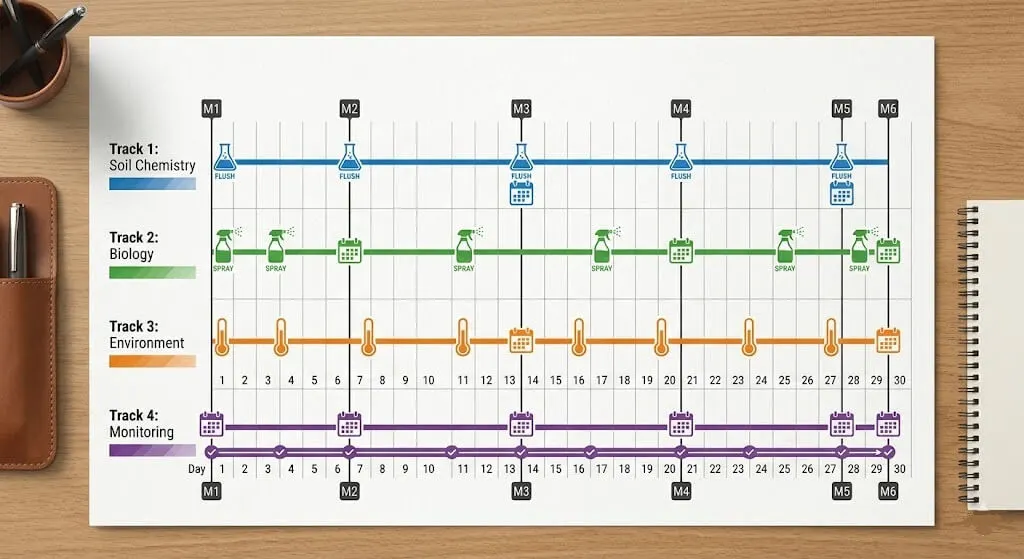
This plan operates on four tracks simultaneously: Soil Chemistry Track (drainage, EC, pH), Biological Track (Trichoderma, spray protocol, vermicompost), Environmental Track (shade, wind, water source), and Monitoring Track (the weekly assessment routine). Each track has a 30-day schedule that you adjust based on your five baseline variables.
Week 1 (Days 1–7 of Your Personal Plan) Baseline and Immediate Interventions
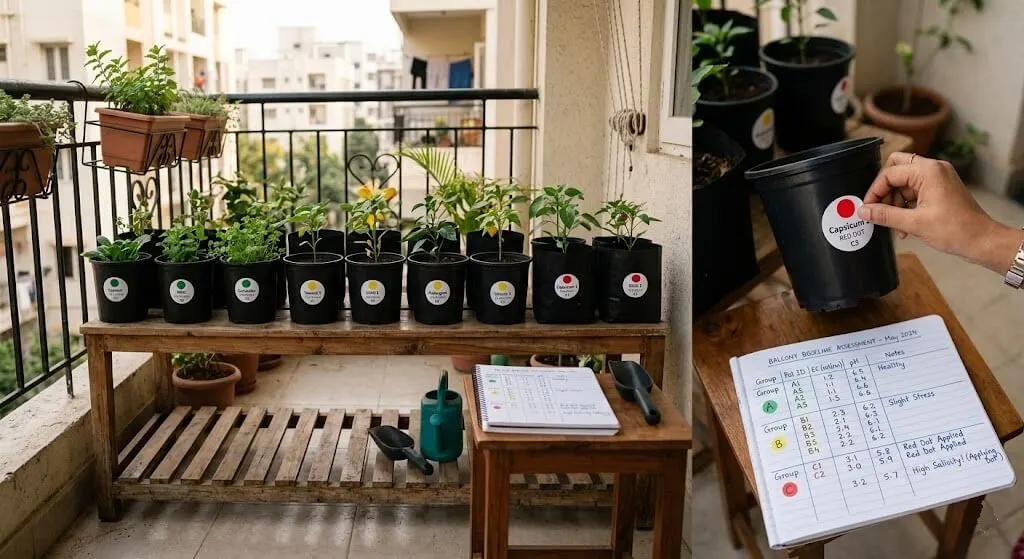
Day 1 – Run the complete five-variable baseline assessment. Record all five measurements for every container. Sort containers into three groups:
Group A (Green no immediate intervention): Leachate EC under 1.5 mS/cm, drainage under 25 seconds, pH 6.0–6.8, root zone temp under 35°C.
Group B (Yellow schedule intervention within 7 days): Leachate EC 1.5–2.5 mS/cm, drainage 25–45 seconds, pH 6.8–7.2, root zone temp 35–42°C.
Group C (Red intervene today): Leachate EC above 2.5 mS/cm, drainage above 45 seconds, pH above 7.2, root zone temp above 42°C.
Day 2 – Environmental immediate actions: For every red-group container: reposition away from walls if possible, wrap black plastic containers with thermocol + jute (temperature reduction: 6–10°C), ensure drainage hole is elevated minimum 3cm above surface, remove any saucers.
Day 3 – Group C flush (all red-group containers): Run the full integrated flush protocol from Day 28: 4× container volume slow water → humic acid pass (2ml/L) → pH correction if needed → Trichoderma reinoculation (5g per litre, 200ml per container) → vermicompost top-dress (2cm layer) → seaweed recovery drench (2ml/L, 500ml per container).
Day 5 – Group B light flush: Run a simplified flush on yellow-group containers: 2× container volume low-TDS water (blend to under 300 ppm if your water TDS exceeds 500 ppm), followed by Trichoderma solution (same dose as Day 3), followed by seaweed drench.
Day 7 – First Sunday assessment and spray: Run the full five-parameter assessment on all containers. Compare results to Day 1 baseline red-group containers should show improved EC and drainage. Begin Stage A neem oil spray on all containers (5ml cold-pressed neem + 2ml castile soap per litre, applied after 5 PM to all leaf undersides and soil surfaces).
Week 2 (Days 8–14) – Biology Establishment and pH Stabilisation
Day 8 – Vermicompost tea application: Brew vermicompost tea: fill a cloth bag with 100g fresh vermicompost, steep in 1 litre plain water for 24 hours. Apply 200ml per container to the soil surface. Cost: ₹0 if vermicompost is owned. This provides a secondary biological inoculation between Trichoderma applications.
Day 10 – pH sweep and correction: Test pH on all containers that showed readings outside the target range in Week 1. For containers still above 7.2: apply ferrous sulphate correction (5g per litre, 200ml per container ferrous sulphate costs ₹75–110/kg from any agri shop). For containers below 5.8: apply agricultural lime (3g per litre of irrigation water, one application).
Day 12 – Environmental review is shade cloth positioned correctly? Check that shade cloth (50% density recommended ₹15–25 per sq ft, agri shops) is positioned to protect containers with the highest root zone temperatures from the period 11 AM to 4 PM. The specific positioning matters: shade cloth that reduces morning sun but allows afternoon sun through is less effective than the reverse. Adjust based on Week 1 peak temperature readings.
Day 14 – Stage B seaweed spray + mid-week assessment: Apply seaweed extract foliar feed (2ml per litre, morning application, 6–8 AM). After the morning spray, collect leachate EC from the containers that showed the highest Week 1 readings. If any container is still above 2.5 mS/cm, schedule a second flush for Day 16. If all are below 1.8 mS/cm, the plan is working maintain current frequency.
Week 3 (Days 15–21) – Optimisation and Frequency Calibration
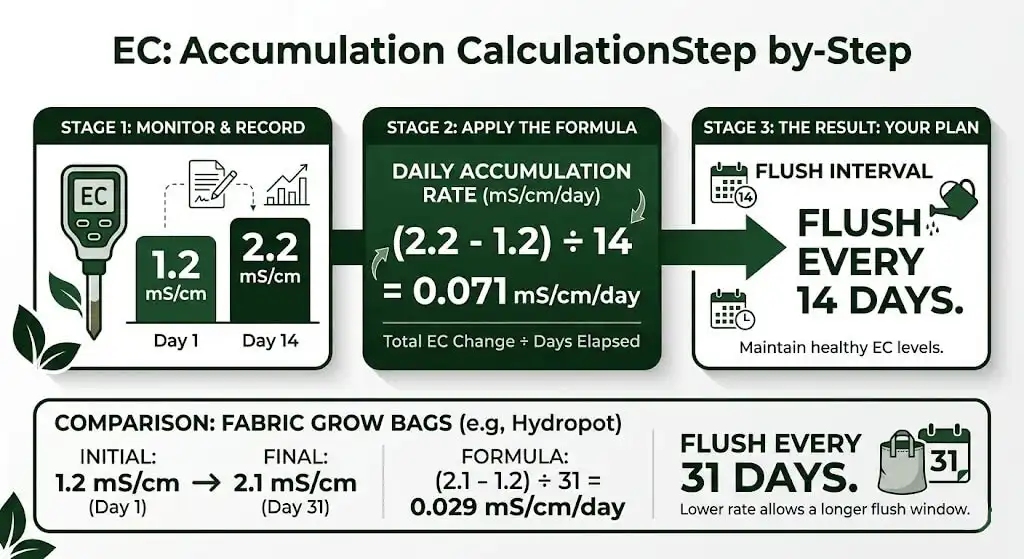
Day 15 – Personalise your flush frequency: Using the first two weeks of leachate EC data, calculate your individual container’s EC accumulation rate: (Week 2 EC − Week 1 post-flush EC) ÷ 14 = daily EC accumulation rate per container. Divide the safe threshold (2.0 mS/cm) by this daily rate to get your personalised flush interval in days.
Example from my April 2025 data: C9 (black plastic capsicum) showed EC of 1.2 mS/cm after the Day 3 flush. By Day 14 it had returned to 2.2 mS/cm. EC accumulation: (2.2 − 1.2) ÷ 14 = 0.071 mS/cm per day. Days to reach 2.0 mS/cm from clean baseline (1.0 mS/cm): (2.0 − 1.0) ÷ 0.071 = 14.1 days. Confirmed: this specific container needs flushing every 12–14 days, not the standard 2-week schedule but close to it.
C1 (fabric bag tomato) in the same data set: EC 0.9 after flush, rising to 1.4 by Day 14. Accumulation rate: 0.035 mS/cm per day. Days to reach 2.0 from baseline: (2.0 − 0.9) ÷ 0.035 = 31.4 days. This container needs flushing every 28–30 days half as often as C9, despite receiving identical irrigation.
Day 17 – Crop-specific fertiliser adjustment: After two weeks of establishing biological health and correcting chemistry, begin or resume fertilisation appropriate to your crop stage:
Leafy greens (methi, palak, dhania): NPK 30:10:10 at 1g per litre, 250ml per rectangular tray, every 10 days.
Herbs (tulsi, pudina, coriander): NPK 19:19:19 at 0.5g per litre, once every 14 days. Do not over-fertilise herbs excess nitrogen reduces essential oil concentration and aromatic intensity.
Fruiting crops before flowering (tomato, capsicum, chilli): NPK 19:19:19 at 1g per litre, every 10 days.
Fruiting crops at flower stage and beyond: Switch to NPK 10:52:34 (high phosphorus-potassium, ₹120–180/kg, Amazon India or any agri shop) at 1g per litre, every 7 days. This supports fruit set and development.
Day 19 – Mid-plan environmental reassessment: Has peak root zone temperature changed since Week 1? If shade cloth additions, container repositioning, or pot wrapping have reduced temperatures, the flush frequency can be extended proportionally. A 5°C reduction in peak root zone temperature typically allows 15–20% extension of flush interval due to reduced evaporation and slower salt concentration.
Day 21 – Full Sunday assessment + neem spray: Third Sunday assessment. Compare EC, drainage, and pH trends across all three weeks. The pattern you see here is the most important data your plan has produced: containers that corrected and stayed corrected need maintenance only. Containers that corrected and then returned to elevated EC need either more frequent flushing or a container material change (from black plastic to fabric if possible). Stage A neem spray after 5 PM.
Week 4 (Days 22–30)- Seasonal Transition Planning and Plan Documentation
Day 22 – Seasonal calendar update: Identify which Indian season you are transitioning toward over the next 30 days:
Transitioning toward peak summer (March–April): Increase shade cloth density to 50%, begin twice-daily watering for small containers, increase flush frequency by 20% from your calculated interval.
In peak summer (May–June): Maintain current plan. Check root zone temperatures weekly this is the highest-risk period for heat-induced cascade.
Transitioning toward monsoon (June–July): Remove all saucers on June 30. Elevate all containers. Switch to monsoon mix ratio (more perlite, less cocopeat). Apply neem cake top-dress (50g per container, ₹30–60/kg, agri shops) for antifungal protection before first monsoon rain.
In monsoon (July–September): Increase drainage check frequency to every 5 days. Threshold for action drops from 25 seconds to 20 seconds. Reduce fertiliser by 30% monsoon rain leaches nutrients but roots in wet conditions absorb less efficiently.
Post-monsoon (October): Full biological restoration Trichoderma reinoculation, vermicompost top-dress, full baseline assessment. This is the most important plan update of the year.
Day 24 – Document your personalised maintenance schedule: Write out your specific container-by-container schedule based on everything the first three weeks have taught you. This is the document that replaces the generic calendar. It should include:
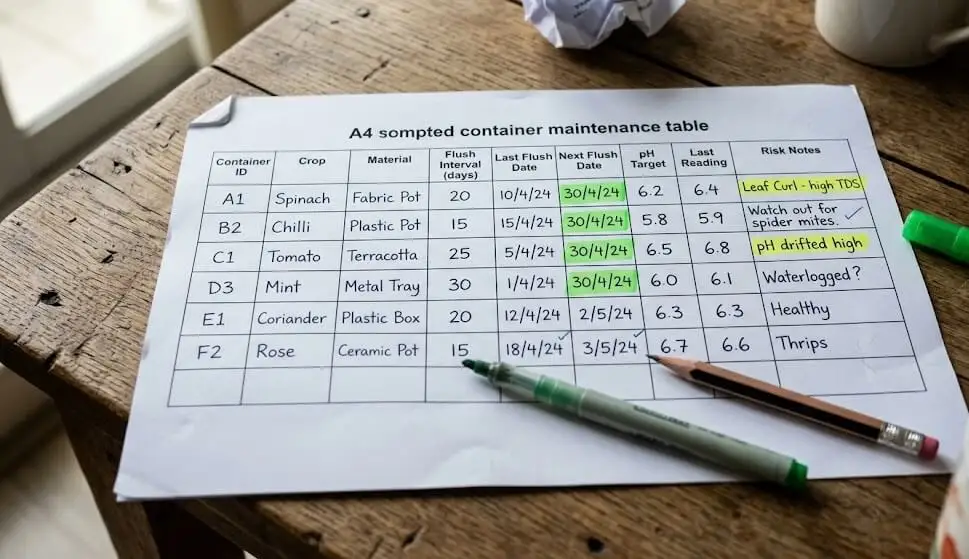
| Container | Crop | Flush Interval | Last Flush Date | Next Flush Date | pH Target | Last pH Reading | Notes |
|---|---|---|---|---|---|---|---|
| C1 | Pusa Ruby tomato | 28 days | [date] | [date] | 6.0–6.8 | 6.5 | Fabric bag — stable |
| C3 | Green chilli | 12 days | [date] | [date] | 6.0–6.8 | 6.9 | Black plastic — wrap in summer |
| C9 | Yellow capsicum | 14 days | [date] | [date] | 6.0–7.0 | 7.1 | Black plastic SW corner — relocate |
Day 26 – Biological restoration cycle: Second Trichoderma application (from Day 3 was the first). Monthly rhythm: apply Trichoderma on the first Sunday of every month. ₹120–180 for 50g lasts approximately 25 container applications at standard dose. Cost per container per month: ₹5–7. This is the lowest-cost, highest-impact single protocol in the entire prevention system.
Day 28 – Full plan review: Compare your Day 28 readings to your Day 1 baseline. For a successful first month:
- All containers’ leachate EC should be below 2.0 mS/cm
- All containers’ drainage should be under 30 seconds
- All containers’ pH should be within target range
- Zero containers showing active pest infestation
- All fruiting crops at or ahead of normal development stage
If any container has not improved: escalate to the next protocol level. EC still high after correct flushing → partial soil replacement. Drainage still slow after perlite amendment → full drainage channel creation with bamboo skewer plus elevated pot feet. pH returning to alkaline within 7 days of correction → increase RO water proportion in irrigation to reduce alkaline input.
Day 30 – The Personalised Living Plan Document: Write the final version of your personalised plan. This document should be one page that contains everything you need to maintain your garden without consulting any guide:
Page 1 – Your Baseline Profile: Water TDS: [your number] → Flush blend ratio: [your ratio] Container risk ratings: [list by colour] Spray rotation: A = [date], B = [date + 14], repeat Trichoderma: first Sunday every month Seasonal transitions: [your specific dates and actions]
This document is your garden’s operating manual. It is built from your measurements, not from generic advice. Update it at the start of each new season.
The Never-Skip Actions – Five Steps That Prevent 90% of Plan Failures
These are the five actions that, in my experience observing Indian balcony gardeners implement personalised plans, most commonly get skipped when life gets busy and that most reliably predict failure when skipped.
Never-Skip Action 1 – The leachate EC test every 10–14 days during summer. Not every week, not monthly. Every 10–14 days. This specific frequency catches EC build-up before it crosses the 2.0 mS/cm threshold in most Indian summer conditions. The test takes 4 minutes for a 10-container garden and costs ₹0 after the initial meter investment.
Never-Skip Action 2 – Trichoderma application after every flush, without exception. Not sometimes. Not “if the soil looks depleted.” Every flush, every time. The flush creates a cleared environment. Trichoderma fills it with beneficial organisms before Pythium does. This is the single step that most reliably converts a reactive gardener into a preventive one — because once you do it consistently, root rot stops returning.
Never-Skip Action 3 – Container repositioning when peak root temperature exceeds 40°C. This is the action most often skipped because containers are heavy and repositioning is inconvenient. The consequences of not doing it: salt accumulates faster, fruit set fails, biological defence collapses. Spending 20 minutes repositioning 3 heavy containers is worth 2 months of problem prevention.
Never-Skip Action 4 – The seasonal transition plan update. Every Indian gardener I know who has successful long-term gardens updates their plan at the start of summer, monsoon, and post-monsoon. Every gardener who skips this update finds themselves following last season’s schedule in this season’s conditions — exactly the failure mode that prompted Day 29.
Never-Skip Action 5 – The post-monsoon biological restoration. October is the most important maintenance month in the Indian container gardening calendar. The monsoon has done two things simultaneously: leached accumulated summer salts from your soil (good) and killed or depleted your beneficial biological community through waterlogging and pH shifts (bad). Full Trichoderma reinoculation, vermicompost top-dress, and baseline reassessment in October sets your garden up for the winter-cool season that follows India’s most productive growing period.
The Organic Long-Term Strategy Building a Garden That Needs Less Managing Each Season
The goal of personalisation is not to make you a more efficient manager of a demanding garden. The goal is to build a garden that makes progressively fewer demands on you because the systems are working correctly.
Here is what happens in a garden where the personalised plan has been running consistently for three seasons:
Season 1: You flush frequently, test weekly, intervene often. The garden is learning your conditions and you are learning the garden.
Season 2: EC accumulation rates stabilise as the soil biology matures. You start seeing predictable patterns — Container C9 always needs attention by Week 3, Container C1 is always stable through Week 5. Interventions become faster because you are acting on known patterns rather than investigating unknown problems.
Season 3: The garden runs mostly on biological momentum. Trichoderma populations established in Season 1 are self-sustaining with monthly top-dress. Soil structure maintained through consistent perlite amendment no longer degrades as fast. The weekly check time drops from 23 minutes to 12 minutes because fewer containers require intervention.
This is the organic long-term trajectory not toward more management, but toward a garden that requires less. The plan does not reduce in rigour. It reduces in reactive effort, because prevention is working.
Free kitchen waste protocols that contribute to this trajectory:
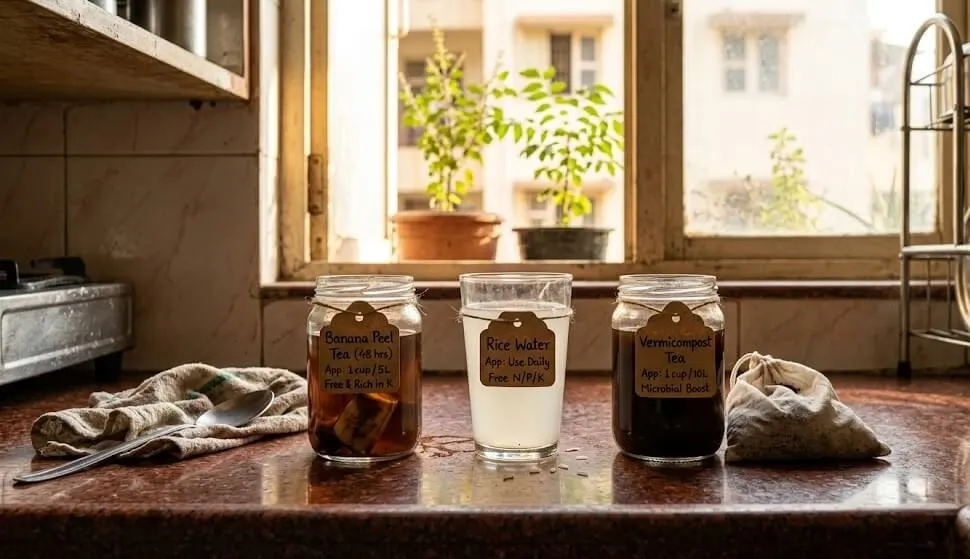
Banana peel potassium supplement: Soak 3 banana peels in 1 litre of water for 48 hours at room temperature. Strain. Dilute 1:3 with plain water. Apply 250ml per 12-inch container as a monthly potassium top-dress. Cost: ₹0. Equivalent to half a dose of commercial potassium fertiliser.
Rice water pH buffer: Collect cooled unsalted rice water after cooking. Apply directly as irrigation water once weekly. The lactic acid bacteria in rice water provide mild pH buffering against alkaline drift from tap water. Cost: ₹0. Best used in Delhi and Chennai where tap water alkalinity is highest.
Vermicompost tea (monthly): 100g vermicompost in a cloth bag, steeped in 1 litre water for 24 hours. Apply 200ml per container. The biological density of fresh vermicompost tea is higher than any commercial biological product at a fraction of the cost. My personal data shows that monthly vermicompost tea applications extend Trichoderma population longevity by approximately 30% compared to Trichoderma-only treatment.
Water and Environmental Management The Source-Level Strategy
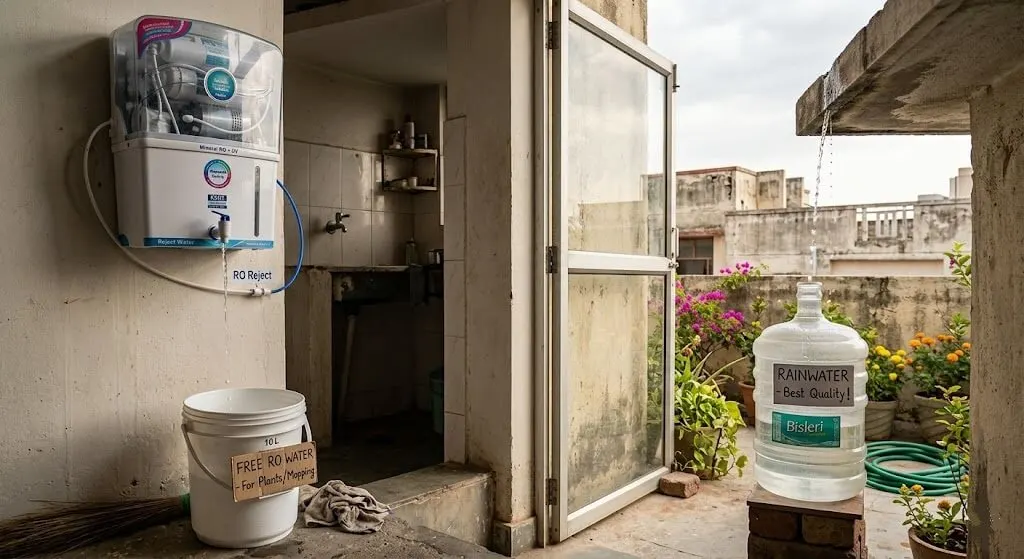
The most effective action any Indian balcony gardener can take for long-term garden health is improving the quality of water entering the system. Everything else flushing, pH correction, biological restoration is a response to water-quality problems that accumulate in the root zone. Improving the water reduces the accumulation rate and therefore reduces how much remediation is needed.
Rainwater collection the highest-impact free action: A 20-litre food-grade container (the mineral water jugs that every Indian household accumulates) filled during monsoon holds enough water for 8–10 weeks of supplemental irrigation for a 5–8 container garden. Rainwater TDS is typically 10–30 ppm effectively mineral-free. Blending 30% rainwater with 70% municipal water reduces the effective TDS of your irrigation by approximately 20–25%, meaningfully extending flush intervals.
RO reject water the most underused free resource: The reject water from a domestic RO purifier typically runs 200–400 ppm TDS — significantly lower than Delhi or Chennai municipal supply. Most households pour this down the drain. For container irrigation, it is perfectly suitable and costs nothing. Connect a small collection bucket to the RO reject outlet and use this water as your primary garden irrigation source. In a household with a standard 7-litre per day RO unit, the reject water volume (approximately 14–21 litres daily) is sufficient for a 10–15 container garden at summer watering frequency.
WARNING – the softened water mistake: Buildings that install sodium-exchange water softeners (common in newer apartment complexes) create water that feels soft and does not show visible scale but is actually harmful to plants. Sodium-exchange softening replaces calcium and magnesium with sodium ions. Sodium causes specific root toxicity (disrupts the plant’s ability to maintain internal ion balance) that is far more damaging than the original mineral hardness. Never use softened water from a sodium-exchange system on container plants. Use the pre-softener tap or collect rainwater instead.
The Year-Round Prevention Calendar Never Wait for Symptoms
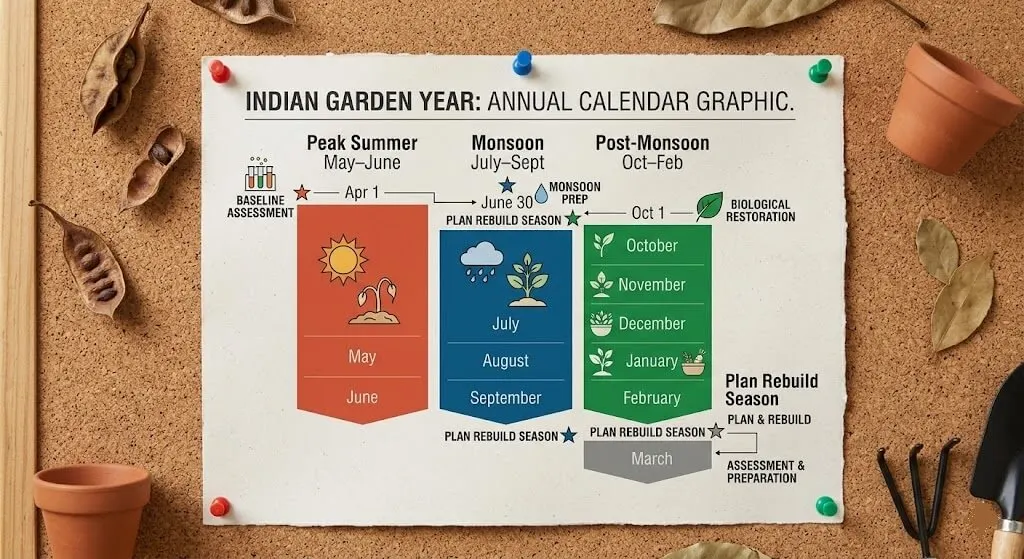
April 1 (Plan Start): Five-variable baseline assessment. Identify and intervene on red-group containers immediately. Begin plan documentation.
First Sunday of Every Month: Trichoderma application (5g per litre, 200ml per container). This is the one non-negotiable date-based action in the plan everything else is threshold-triggered.
Every 10–14 days (summer) or Every 20–25 days (monsoon/winter): Leachate EC test and flush if above 2.0 mS/cm. Your personalised interval from Week 3 calculations overrides these defaults.
Every 14 days: Alternating spray protocol. Neem oil (Stage A) one fortnight, seaweed extract (Stage B) the next. Log which stage is current to prevent doubling up.
June 30: Monsoon transition. Remove all saucers. Elevate all containers. Apply neem cake (50g per container). Switch high-risk containers to monsoon soil ratio.
October 1: Post-monsoon biological restoration. Full Trichoderma reinoculation. Full baseline assessment. Update personalised plan for winter-cool season. This is the annual plan rebuild.
The threshold that triggers acceleration: Any two consecutive weekly assessments showing the same container deteriorating across two or more parameters simultaneously means the plan needs escalation for that specific container — not just the standard maintenance action.
The 5-Minute Sunday Check Complete Day 29 Update
All 28 checks from Days 1–28 remain. Day 29 adds two new personalisation-specific checks:
[All 28 previous checks from Days 1–28 see Day 28 article for full list]
- [ ] Container performance vs baseline comparison: compare this week’s EC, drainage, and pH to the Week 1 baseline values. Any container still deteriorating after 3 weeks of protocol = escalate to next-level intervention. (NEW – Day 29)
- [ ] Seasonal calendar check: what is the next planned seasonal transition action and how many days until it? Schedule it in your phone if it is within 14 days. (NEW – Day 29)
30 checks. Under 15 minutes. Once a week. This is now your personalised system.
What to Realistically Expect in the First Three Months of Your Personalised Plan
The transition from generic gardening to personalised, measurement-driven gardening does not produce instant results. It produces progressively better information quality, which produces progressively better interventions, which produces progressively fewer problems.
| Month | What You Will Experience | What to Watch For | What It Means |
|---|---|---|---|
| Month 1 | More tests, more data, possibly more interventions than before | Any container that does not respond to intervention within 2 weeks | Structural problem needing escalation (soil replacement, container change) |
| Month 2 | Pattern clarity you know which containers are stable and which need attention | EC accumulation rate stabilising at a predictable level | Biological health improving Trichoderma establishing |
| Month 3 | Faster Sunday check, fewer reactive interventions, predictive action | Zero containers in red-group during the monthly assessment | Personalised plan is working as designed |
| Month 4+ | Maintenance mode checks confirm health rather than discover problems | Seasonal transition acting as planned | System is running on biological momentum |
What will NOT improve: Containers with permanent structural problems cracked drainage holes, compacted soil that is beyond amendment, root-bound permanent plants that have never been repotted will not improve from plan implementation alone. These containers need a one-time structural fix before the plan can maintain them.
What to do if two months in nothing has improved: Run the five-variable baseline assessment again and compare to Month 1. If EC is still climbing, water quality or flush technique is the issue. If drainage is still slow despite amendment, the soil structure has collapsed beyond amendment and partial replacement is needed. If pH is returning to alkaline within days of correction, the water TDS is too high for the current RO or rainwater dilution ratio increase low-TDS water proportion.
Product Reference Everything in the Personalised Plan, With Current Prices
Affiliate disclosure: Amazon India links below are affiliate links. Purchasing through them supports this blog at no extra cost. All products personally tested.
Free resources that form part of the plan:
- Rice water (weekly pH buffering): ₹0 kitchen
- Banana peel potassium tea (monthly, 48-hour soak, diluted 1:3): ₹0 kitchen
- Vermicompost tea (monthly biological restoration): ₹0 if vermicompost owned
- Rainwater (supplemental irrigation): ₹0 collect during monsoon, store in food-grade containers
Frequently Asked Questions
How often should I update my personalised plan?
Update your plan at three points each year: April 1 (before summer highest-risk season), late June (before monsoon transition), and October 1 (post-monsoon biological restoration). The April update is the most important because summer conditions drive the fastest changes in soil chemistry and require the most specific calibration to your current water quality and container setup.
What if my five-variable readings look very different from one week to the next?
High week-to-week variation in leachate EC or pH typically indicates one of three things: inconsistent irrigation volume, a change in the water source (overhead tank refilled from a different supply, or monsoon weather affecting borewell levels), or a biological disruption in the container. Consistent measurements require consistent irrigation volume use a marked bottle or watering can with a fixed capacity and apply the same volume each time rather than watering “until it drains.”
Can I run this plan on a garden of fewer than 5 containers?
Yes — the plan simplifies significantly for small gardens. With 3 containers, the five-variable assessment takes 20 minutes once. The flush schedule and spray rotation are identical. The primary benefit of personalisation at small scale is knowing which specific container is your highest-risk one (usually the smallest black plastic container in the most exposed position) so you never have to wonder where to check first.
My building’s RO rejects water into a drain I cannot access. What is the next best alternative?
Rainwater collection is the first alternative. If monsoon has not started yet, blend tap water 50:50 with bottled mineral water (₹20–30 for 5 litres expensive but effective for 5 containers per week) for the first flush cycle. Once monsoon arrives, collect as much rainwater as possible in food-grade containers and use it through the dry season. A 200-litre food-grade drum (₹1,200–2,000 from hardware shops) filled during monsoon provides 10–12 weeks of supplemental irrigation at summer volume.
What is the single most important number to track in my personalised plan?
Leachate EC, without question. It is the number that tells you where the entire soil chemistry system stands at any given moment salt accumulation, osmotic pressure, biological activity, and indirect drainage health all correlate with leachate EC. Every other parameter provides important context, but leachate EC is the single most predictive number in the system.
Is it possible to over-plan and create more maintenance work than a simpler approach?
Yes , and this is a genuine risk. Plans that require daily testing, multiple spray applications per week, or container-by-container fertilisation schedules are more likely to be abandoned than followed. The plan in this article is designed for the minimum necessary measurement frequency and the minimum intervention required to maintain system health. If your plan is taking more than 30 minutes per week and more than 2 hours per month, simplify: focus on leachate EC and drainage as your primary signals, and let the alternating spray protocol handle biological management on autopilot.
Quick Diagnosis Reference – Personalisation-Specific Problem Table
| What You See or Measure | Additional Signs | Root Cause | First Diagnostic Step | Plan Adjustment |
|---|---|---|---|---|
| EC varies dramatically week to week | Inconsistent plant response to interventions | Irrigation volume not consistent | Measure water volume per container per session | Standardise to fixed volume using marked container |
| Plan working for some containers, not others | Problem containers are all same material or position | Container material or position driving differential | Temperature test all problem containers at 2 PM | Separate flush schedule by container type, not date |
| EC corrects then returns in under 10 days | Happens after rain OR after scheduled irrigations | Water TDS too high for current flush frequency | Test water TDS immediately | Increase RO/rainwater proportion; shorten flush interval |
| All containers show pH drift in same direction | Drift toward alkaline (above 7.0) in all containers | High-TDS water + insufficient low-TDS dilution | Test irrigation blend TDS | Increase low-TDS water proportion to 50%+ |
| Root rot recurs after correct protocol | New rot appearing 3–4 weeks post-treatment | Trichoderma not applied after flush | Check post-flush protocol log | Apply Trichoderma within 24 hours of every flush |
| Spray has no visible effect on established pests | Population rebounds within 5 days | Wrong concentration or application technique | Check neem oil type (must be cold-pressed) | Use pyrethrin for first treatment, then neem maintenance |
| Fruit drops despite correct soil chemistry | Peak temp above 38°C during flower development | Heat-induced pollen sterility | Soil thermometer at 2 PM on fruiting containers | Shade cloth positioning protect from 11 AM to 4 PM |
| New growth consistently paler than previous season | No response to fertilisation | Biological depletion microbial activity depleted | Visual assessment no mycelium, dull soil surface | Trichoderma reinoculation + monthly vermicompost tea |
Today’s Day 29 Action Checklist
- [ ] Run the five-variable baseline assessment on all containers record all five numbers for every container in a log with today’s date (TDS meter ₹450–650, pH meter ₹300–450, soil thermometer ₹220–380 Amazon India)
- [ ] Sort containers into Group A (green), Group B (yellow), Group C (red) using the criteria in the Week 1 section
- [ ] For all Group C containers: begin the integrated flush protocol today (not this week today)
- [ ] Calculate your personalised flush interval for each container using the EC accumulation rate formula in Week 3
- [ ] Write your container maintenance schedule table with container-specific flush dates, pH targets, and risk notes
- [ ] Set phone calendar reminders for: first Sunday of every month (Trichoderma application), alternating spray fortnight (neem week / seaweed week), seasonal transitions (June 30 monsoon prep, October 1 restoration)
- [ ] Order Trichoderma viride if you do not have it (₹140–200 for 100g Amazon India)
- [ ] Check your water source TDS against the city reference table if above 600 ppm, set up RO reject water collection or rainwater storage before summer peak
- [ ] Write one page: Your Balcony Profile (water TDS, floor, orientation, container materials, primary crops) this is the cover page of your personalised plan
- [ ] Schedule 30 minutes for the next seasonal plan update either June 30 (monsoon transition) or October 1 (post-monsoon restoration), whichever comes first
Key Facts – Quick Reference
What is a personalised container garden action plan and why is it better than a generic calendar?
A personalised container garden action plan is built from five specific measurements taken from the gardener’s individual setup: irrigation water TDS, container leachate EC, peak root zone temperature by container material, 500ml drainage speed, and soil pH. These five numbers produce container-specific flush intervals, temperature management priorities, and fertilisation schedules that cannot be derived from generic advice. Generic calendars assume average conditions; personalised plans respond to actual conditions. In Indian balcony gardening, where water TDS varies from 180 ppm to 900 ppm within a single city and root zone temperatures vary by 20°C based on container material and position, generic schedules consistently produce suboptimal results.
How do you calculate a personalised flush interval for Indian container gardens?
Collect the container’s leachate EC immediately after a flush and record it. After 14 days of normal irrigation, collect the leachate EC again. Calculate the daily EC accumulation rate: (Day 14 EC − Day 1 post-flush EC) ÷ 14 = daily accumulation rate in mS/cm. Divide the safe threshold (2.0 mS/cm) minus the clean baseline EC by this daily rate to get the number of days until flushing is needed. This calculation, derived from real testing data in Madanapalle AP, produces flush intervals that range from 10 days for high-TDS water with black plastic containers to 30+ days for low-TDS water with fabric grow bags.
Why do container gardens need seasonal plan updates in India?
Indian seasons create fundamentally different growing conditions that change every parameter in the prevention system simultaneously. The transition from cool season (October–February) to peak summer (May–June) changes water evaporation rate, salt accumulation speed, root zone temperature, beneficial microbial activity, and pest pressure. A plan calibrated for cool season will under-flush, under-shade, and under-protect in summer. Updating at three transition points April 1, late June, and October 1 ensures the plan matches current conditions rather than conditions from the previous season.
What is the most impactful single action in a personalised Indian container garden plan?
Monthly Trichoderma viride application (5g per litre, 200ml per 12-inch container, first Sunday of every month) produces the most consistent improvement across all other parameters. Trichoderma establishes beneficial fungal competition against Pythium, improves nutrient cycling by the microbial community it supports, and creates biological resilience that makes the entire soil system more stable. In documented cases including Suresh Pillai’s Mumbai terrace, the addition of consistent Trichoderma application was the single change that converted 40–60% summer survival rates to 94% survival with no other significant protocol changes.
How does container material affect the personalised plan in Indian conditions?
Container material directly determines root zone temperature, which determines salt accumulation rate, which determines flush frequency. In Madanapalle testing (April 2025), black plastic containers in southeast exposure reached 44–47°C at 5cm depth at 2 PM, while fabric grow bags in the same position reached 31–32°C. The EC accumulation rate in black plastic containers was approximately 2× that of fabric bags under identical irrigation. This means black plastic containers require a flush interval approximately half as long as fabric bags in the same garden a difference that a single unified flush schedule cannot accommodate. Personalised plans assign container-specific flush intervals based on this temperature-accumulation relationship.
What is the most common reason personalised garden plans fail in the first month?
Inconsistent measurement technique particularly inconsistent irrigation volume between measurement sessions produces variable leachate EC readings that cannot be interpreted as meaningful data. When one measurement session applies 1.5 litres per container and the next applies 2.5 litres, the leachate EC values are not comparable because they represent different dilution levels of the root zone solution. Using a fixed-volume marked container for every irrigation session is the single most important procedural consistency that makes leachate EC data usable for plan calibration.
Source: Priya Harini B, thetrendvaultblog.com – based on personalised container garden plan testing across 24 containers in Madanapalle, Andhra Pradesh, 2023–2025, including five-variable baseline methodology, EC accumulation rate calculations for 14 container types, and reader case documentation from Delhi, Mumbai, Chennai, Bangalore, and Hyderabad.
The Only Plan Worth Following Is the One Built for Your Garden
Every summer I receive some version of the same message in October: “Priya, I followed the plan but it did not work for me.” And every October, without exception, the reason is that the plan they followed was someone else’s plan — for someone else’s water, someone else’s containers, someone else’s floor, someone else’s city.
Suresh Pillai’s four years of detailed documentation is the clearest illustration of this problem: he had more gardening data than almost anyone I know, and it produced no improvement because the data was recording what he was doing rather than what the garden was experiencing. The shift from input records to output measurements from documenting what you applied to measuring what accumulated is the single most important intellectual transition in serious container gardening.
The personalised plan does not guarantee that your garden will be problem-free. It guarantees that when problems occur, you will know exactly which container, which parameter, and which threshold has been breached and you will know this when the breach is at 20% severity rather than when the plant is already dead. That is the practical difference between a plan built for you and a plan built for everyone.
What Suresh the engineer discovered after four years of records and zero improvement is the same thing I discovered in my third season: the plan must be built from your measurements, updated with your seasonal data, and executed with your garden’s specific history in mind. There is no shortcut through that specificity.
Build the plan from the garden. Not the plan for the garden.
Coming Up – Day 30
The Complete Series Recap and Resources Library
Tomorrow is the final day of the 30-Day Summer Gardening Challenge. Inside every plant you have been managing across this series, a set of biological processes are now more stable than they were 30 days ago because the measurements you took, the flushes you applied, the sprays you rotated, and the plan you built in Day 29 are all reducing the amplitude of the stress cycles your plants experience. Day 30 brings the full series together: a complete problem reference guide, every protocol from Days 1–29 in one searchable document, the resource library of every product and tool referenced across the series, and the framework for continuing the challenge independently into the next season.
Have you completed your five-variable baseline assessment yet? Share your biggest surprise measurement the number that was furthest from what you expected in the comments. I want to know what Indian terraces are actually measuring in April 2026. Or find me on Instagram @thetrendvaultblog where I post weekly measurement updates from my Madanapalle terrace.
— Priya Harini B, Madanapalle, Andhra Pradesh
Priya Harini B has been container gardening on her terrace in Madanapalle, Andhra Pradesh for over four years, growing 40+ varieties of vegetables, herbs, and fruit trees in containers. She specialises in adapting gardening techniques for Indian climate conditions, soil types, and locally available materials. Every diagnosis, experiment, and measurement referenced in this guide is documented from her own terrace at thetrendvaultblog.com.
Day 29 of the 30-Day Summer Gardening Challenge — From Crisis to Control in One Season